


Mobile app development in Saudi Arabia has accelerated rapidly over the past few years, driven largely by the country’s Vision 2030 initiative and its strong push toward digital transformation. Businesses across sectors such as retail, healthcare, fintech, logistics, and government services are investing heavily in mobile-first platforms to meet rising consumer expectations. Saudi Arabia has one of the highest smartphone penetration rates in the Middle East, exceeding 90 percent, making mobile applications a primary channel for customer engagement, service delivery, and revenue generation.
When businesses ask, “How much does it cost to develop an app in Saudi Arabia?”, the answer depends on multiple variables, but a general range can be established. A basic mobile application with limited features typically costs between SAR 30,000 and SAR 80,000 (approximately USD 8,000 – USD 21,000). Mid-level applications with custom UI, backend systems, and integrations usually range from SAR 80,000 to SAR 250,000 (approximately USD 21,000 – USD 66,500). Highly complex applications, such as fintech platforms, on-demand delivery systems, or enterprise-grade solutions, can exceed SAR 250,000 (USD 66,500+) and go up to SAR 800,000+ (USD 213,000+), depending on scale, security requirements, and performance expectations.
The reason for this wide cost variation lies in several critical factors. App complexity is the primary driver, including the number of features, level of customization, and real-time capabilities. Platform selection also plays a role, as building separate native apps for iOS and Android increases costs compared to cross-platform development. Additionally, compliance requirements in Saudi Arabia, especially in regulated sectors like finance and healthcare, add to development time and cost due to strict data protection and regulatory standards. The choice of development team, whether local agencies, freelancers, or offshore partners, further impacts pricing and delivery timelines.
This guide is designed for decision-makers across different segments, including startups building their first MVP, small and medium-sized businesses digitizing operations, enterprises scaling digital products, and government organizations aligning with national digital initiatives. It provides a clear, structured understanding of app development costs in Saudi Arabia, helping you plan budgets, evaluate vendors, and make informed investment decisions.
What Is the Average Cost to Develop an App in Saudi Arabia?
Understanding the average cost of app development in Saudi Arabia requires looking beyond a single price point. Costs vary based on app complexity, development approach, and the location of your development team. However, businesses can estimate budgets by categorizing apps into three broad levels: basic, mid-level, and complex. Additionally, comparing Saudi Arabia with other global markets and understanding the difference between freelancers and agencies provides a more complete financial picture for decision-makers.
-
Cost Overview by App Complexity
The most reliable way to estimate app development cost is by evaluating the complexity of the application and the features involved.
Basic Apps (SAR 30,000 – 80,000 | USD 8,000 – 21,000)
Basic applications are typically designed for simple use cases with minimal features. These apps include static content, basic user interfaces, and limited backend functionality. Examples include informational apps, small business apps, or simple booking systems without real-time tracking. Development timelines are shorter, often ranging from 1 to 3 months, and require fewer resources. These apps are ideal for startups testing an idea or businesses entering the digital space for the first time.
Mid-Level Apps (SAR 80,000 – 250,000 | USD 21,000 – 66,500)
Mid-level applications involve more advanced features such as user authentication, dashboards, API integrations, payment gateways, and moderate backend infrastructure. Examples include eCommerce platforms, service marketplaces, and customer engagement apps. These apps often require custom UI/UX design and integration with third-party services like payment systems or maps. Development timelines typically range from 3 to 6 months. This category represents the most common investment range for SMEs and growing businesses in Saudi Arabia.
Complex Apps (SAR 250,000 – 800,000+ | USD 66,500 – 213,000+)
Complex applications include enterprise-grade systems, fintech platforms, healthcare apps, and on-demand services like delivery or ride-hailing platforms. These apps require real-time data processing, high scalability, advanced security, and compliance with Saudi regulations. Features such as AI integration, multi-user systems, admin dashboards, analytics, and cloud infrastructure significantly increase costs. Development timelines can extend from 6 months to over a year. These projects often involve large teams, multiple development phases, and ongoing optimization.
-
Cost Comparison: Saudi Arabia vs Other Countries
When evaluating app development costs globally, Saudi Arabia sits in a mid-to-high pricing tier due to its regulatory environment, quality expectations, and local talent costs.
In Saudi Arabia (KSA), hourly development rates typically range between USD 40 and USD 120, depending on expertise and project complexity. Costs are higher than offshore markets but reflect stronger alignment with local regulations, Arabic-first UX requirements, and business practices.
In India, app development is significantly more affordable, with rates ranging from USD 15 to USD 40 per hour. This makes India a preferred outsourcing destination for cost-sensitive projects. However, businesses may face challenges related to time zone differences, communication gaps, and limited familiarity with Saudi compliance standards.
In the UAE, pricing is similar or slightly higher than Saudi Arabia, often ranging from USD 50 to USD 150 per hour. UAE agencies typically focus on premium projects with strong design and enterprise-level capabilities.
In the United States, development costs are the highest, with hourly rates between USD 100 and USD 250. While quality and innovation are strong, the cost is often prohibitive for startups and SMEs.
The key trade-off across these regions is between cost, quality, and compliance. While offshore development reduces initial investment, local or regional teams often provide better alignment with Saudi market needs, regulations, and user expectations.
-
Cost Differences: Freelancers vs Agencies
Another major factor affecting app development cost is whether you choose freelancers, local agencies, or offshore development teams.
Freelancers generally offer the lowest upfront cost. In Saudi Arabia or offshore markets, freelance developers may charge anywhere between USD 15 and USD 60 per hour. This approach can work well for small projects or MVPs with clearly defined requirements. However, freelancers typically work independently, which means businesses must manage project coordination, quality assurance, and timelines themselves. There is also a higher risk of inconsistency, delays, or lack of long-term support.
App development agencies, on the other hand, provide end-to-end services, including strategy, design, development, testing, and post-launch support. In Saudi Arabia, agencies typically charge higher rates but deliver structured processes, dedicated teams, and higher reliability. Agencies also bring domain expertise, especially in regulated sectors like fintech and healthcare, where compliance is critical.
Offshore agencies offer a hybrid approach, combining lower costs with structured delivery. Many businesses in Saudi Arabia adopt this model by working with experienced international partners while maintaining local oversight.
The choice between freelancers and agencies ultimately depends on project complexity, budget, and risk tolerance. For simple apps, freelancers may be sufficient. For scalable, secure, and business-critical applications, agencies provide significantly better long-term value.
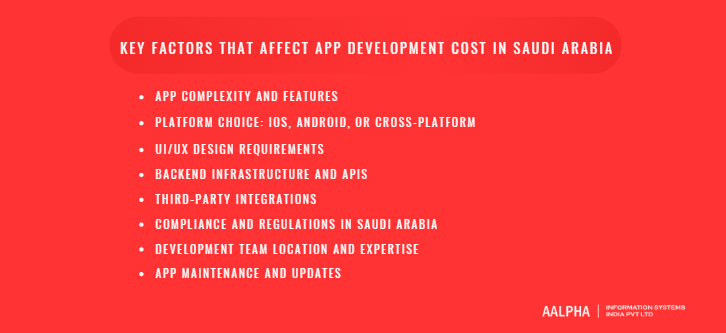
Key Factors That Affect App Development Cost in Saudi Arabia
The cost of developing an app in Saudi Arabia is not determined by a single variable. It is influenced by a combination of technical, regulatory, and business factors that directly impact development time, resource allocation, and long-term scalability. Understanding these cost drivers allows businesses to make informed decisions, avoid budget overruns, and align their investment with expected outcomes.
-
App Complexity and Features
App complexity is the most significant factor affecting development cost. At a fundamental level, applications can be categorized into simple CRUD-based systems or highly advanced, feature-rich platforms.
CRUD apps (Create, Read, Update, Delete) are relatively straightforward. These include basic business apps, simple dashboards, or content-driven platforms where users interact with structured data. Since these apps rely on standard workflows and minimal logic, they require fewer development hours and limited backend infrastructure.
In contrast, AI-powered or real-time applications significantly increase complexity. For example, a delivery app requires features such as live tracking, route optimization, push notifications, and multi-user interaction between customers, drivers, and administrators. A fintech app goes even further, requiring secure payment processing, fraud detection, encryption, compliance checks, and transaction monitoring systems.
The difference in cost between these categories is substantial because complexity introduces additional layers such as advanced backend logic, higher testing requirements, and scalability considerations. As features increase, so does the need for experienced developers, system architects, and extended development timelines.
-
Platform Choice: iOS, Android, or Cross-Platform
Choosing the right platform has a direct impact on both development cost and time-to-market. Businesses must decide whether to build native applications for iOS and Android separately or use cross-platform frameworks.
Native development involves building separate apps using platform-specific technologies such as Swift for iOS and Kotlin for Android. This approach delivers the best performance, smoother user experience, and deeper integration with device features. However, it effectively doubles development effort, making it the most expensive option.
Cross-platform frameworks such as Flutter and React Native allow developers to write a single codebase that works across both platforms. This reduces development time and cost by approximately 30 to 40 percent compared to native development. For most startups and SMEs in Saudi Arabia, cross-platform development is a practical choice for launching quickly while maintaining acceptable performance.
The decision ultimately depends on the app’s complexity, performance requirements, and budget constraints.
-
UI/UX Design Requirements
User interface and user experience design play a critical role in determining development cost. Applications with custom, high-end designs require significantly more effort compared to those using pre-built templates.
Custom UI/UX involves detailed research, wireframing, prototyping, and iterative design processes. This is particularly important in Saudi Arabia, where user expectations are high and digital experiences must align with local preferences. Arabic-first design is a key consideration, requiring right-to-left (RTL) layouts, culturally relevant visuals, and localized content.
Template-based designs reduce cost but limit flexibility and differentiation. Businesses aiming to build strong digital brands or premium user experiences typically invest more in custom design.
-
Backend Infrastructure and APIs
The backend architecture of an app is a major cost driver, especially for applications that require real-time data processing, scalability, and integrations.
Simple apps may rely on basic backend systems with limited data storage and minimal API usage. However, more advanced applications require cloud infrastructure, database management, and robust API layers. For example, a delivery app needs real-time location tracking, order management systems, and communication between multiple users. This requires scalable backend services hosted on platforms such as AWS, Azure, or Google Cloud.
APIs play a central role in connecting frontend interfaces with backend systems and third-party services. The more APIs an app uses, the more complex the development becomes. Additionally, real-time systems, such as chat features or live tracking, demand higher server performance and continuous data synchronization, which increases both development and operational costs.
-
Third-Party Integrations
Most modern applications rely on third-party services to accelerate development and enhance functionality. These integrations add convenience but also contribute to overall cost.
In Saudi Arabia, payment integration is a critical requirement. Gateways such as Mada and STC Pay must be integrated securely, often requiring compliance checks and certification processes. Similarly, apps that depend on location services require integration with mapping APIs such as Google Maps for navigation and geolocation.
Other common integrations include push notification services, SMS gateways, analytics tools, and authentication systems. While these services reduce the need to build features from scratch, they often involve subscription fees, usage-based pricing, and additional development effort for integration and maintenance.
-
Compliance and Regulations in Saudi Arabia
Regulatory compliance is a major cost factor, particularly in sectors such as fintech, healthcare, and government services. Saudi Arabia has strict data protection and cybersecurity requirements that must be adhered to during app development.
Organizations such as the Communications, Space and Technology Commission (CITC) and the Saudi Data and Artificial Intelligence Authority (SDAIA) enforce guidelines related to data privacy, storage, and processing. Applications that handle sensitive user data must implement strong encryption, secure authentication mechanisms, and data localization practices.
For fintech apps, compliance with Saudi Central Bank regulations adds another layer of complexity, including transaction security, anti-fraud systems, and audit trails. Healthcare applications must comply with patient data protection laws and may require integration with national health systems.
These compliance requirements increase development time, require specialized expertise, and often involve additional testing and certification processes.
-
Development Team Location and Expertise
The location and experience level of the development team significantly influence cost. Local development teams in Saudi Arabia typically charge higher rates due to market demand, regulatory familiarity, and operational costs. However, they offer advantages such as better communication, cultural alignment, and understanding of local business requirements.
Offshore teams, particularly in countries like India, provide more cost-effective options. Businesses can reduce development costs by 30 to 60 percent by outsourcing. However, this approach may introduce challenges such as time zone differences, communication barriers, and limited understanding of Saudi-specific regulations.
Highly experienced teams or specialized developers also command higher rates but deliver better quality, faster execution, and fewer long-term issues.
-
App Maintenance and Updates
App development does not end at launch. Ongoing maintenance is an essential cost component that businesses must plan for from the beginning.
Maintenance includes bug fixes, performance optimization, security updates, and compatibility adjustments for new operating system versions. Additionally, apps often require feature updates based on user feedback and market trends.
In Saudi Arabia, where digital competition is increasing rapidly, continuous improvement is necessary to remain relevant. App maintenance costs typically range from 15 to 25 percent of the initial development cost annually. Apps with complex infrastructure or high user traffic may incur even higher ongoing expenses.
Ignoring maintenance can lead to performance issues, security vulnerabilities, and user dissatisfaction, ultimately impacting business growth.
Detailed Cost Breakdown by Development Stage
To accurately estimate app development costs in Saudi Arabia, it is essential to understand how the budget is distributed across each stage of the development lifecycle. Each phase requires different expertise, tools, and time investment, which collectively determine the final cost. Businesses that understand this breakdown can better allocate resources, prioritize features, and avoid unexpected expenses during execution.
-
Discovery and Planning
The discovery and planning phase lays the foundation for the entire project. This stage involves gathering requirements, defining business objectives, identifying target users, and outlining core features. It also includes competitor analysis and market research, which are particularly important in Saudi Arabia’s rapidly evolving digital ecosystem.
During this phase, development teams conduct stakeholder interviews, create product roadmaps, and define technical architecture at a high level. Clear documentation is produced to ensure alignment between business goals and technical execution.
Although this stage typically accounts for a smaller portion of the total budget, usually around 5 to 10 percent, it plays a critical role in preventing costly revisions later. Poor planning often leads to scope creep, delays, and increased development costs. Investing in a thorough discovery phase ensures that the project starts with clarity and direction.
-
UI/UX Design
UI/UX design is one of the most important stages in app development, directly influencing user adoption and engagement. This phase includes wireframing, prototyping, visual design, and user journey mapping.
Wireframes define the structure of the app, outlining how screens are organized and how users interact with features. Prototypes provide interactive models that simulate the user experience, allowing stakeholders to validate functionality before development begins. Visual design then focuses on branding, typography, colors, and overall aesthetics.
In Saudi Arabia, UI/UX design must also consider Arabic language support, right-to-left (RTL) layouts, and cultural preferences. These requirements add complexity and require specialized design expertise.
Design costs typically account for 10 to 15 percent of the total budget, depending on the level of customization. Applications with highly polished interfaces or unique user experiences require more iterations, increasing both time and cost. However, strong design significantly improves user retention and reduces the need for costly redesigns post-launch.
-
Frontend Development
Frontend development focuses on building the user-facing components of the app. This includes translating UI/UX designs into functional mobile interfaces using technologies such as Swift or Kotlin for native apps, or Flutter and React Native for cross-platform development.
This stage involves implementing navigation, animations, user interactions, and responsiveness across different devices and screen sizes. Developers ensure that the app performs smoothly, loads quickly, and provides a consistent experience.
Frontend development typically accounts for 20 to 30 percent of the total cost. The complexity of the interface plays a major role in determining cost. Simple apps with minimal screens are faster to build, while apps with dynamic content, real-time updates, and advanced animations require more development effort.
In Saudi Arabia, additional considerations such as Arabic localization, font rendering, and RTL compatibility increase development complexity. Ensuring a seamless bilingual experience often requires extra testing and optimization.
-
Backend Development
Backend development is the backbone of any modern application. It involves building the server-side logic, databases, APIs, and administrative systems that power the app.
This stage includes creating user authentication systems, managing data storage, handling business logic, and integrating third-party services. For example, a delivery app requires backend systems for order management, driver allocation, and real-time tracking. A fintech app requires secure transaction processing, encryption, and compliance mechanisms.
Backend development typically represents 25 to 35 percent of the total cost, making it one of the most resource-intensive stages. The cost increases significantly for apps that require real-time data processing, high scalability, or complex integrations.
Additionally, backend infrastructure often involves cloud services such as AWS or Azure, which introduce ongoing operational costs. A well-designed backend ensures scalability, security, and performance, making it a critical investment for long-term success.
-
Testing and QA
Testing and quality assurance (QA) ensure that the application functions correctly, performs reliably, and delivers a seamless user experience. This phase includes both manual and automated testing processes.
Manual testing involves checking the app’s functionality, usability, and user flows to identify bugs or inconsistencies. Automated testing uses scripts and tools to validate performance, security, and scalability under different conditions.
Testing typically accounts for 10 to 15 percent of the total development cost. Applications with complex features, multiple integrations, or high user traffic require more extensive testing, increasing costs.
In Saudi Arabia, testing must also account for localization requirements, including Arabic language support and regional user behavior. Ensuring compatibility across various devices and operating systems is essential to avoid negative user experiences after launch.
-
Deployment and Launch
The deployment phase involves preparing the app for release on platforms such as the Apple App Store and Google Play Store. This includes finalizing builds, configuring servers, and ensuring compliance with platform guidelines.
Developers must optimize the app for performance, security, and compatibility before submission. App store approvals can require additional adjustments, especially if the app includes sensitive features such as payments or user data handling.
This stage typically represents 5 to 10 percent of the total cost. While relatively small compared to development, it is a critical step that determines how smoothly the app enters the market.
Businesses must also consider app store fees, developer account registrations, and potential marketing efforts associated with the launch.
-
Post-Launch Support
Post-launch support is an ongoing phase that ensures the app remains functional, secure, and competitive over time. This includes bug fixes, performance improvements, feature updates, and compatibility adjustments for new operating system versions.
User feedback often drives updates, requiring continuous development to improve features and address issues. Additionally, security updates are essential to protect user data and comply with evolving regulations in Saudi Arabia.
Post-launch support typically costs 15 to 25 percent of the initial development cost annually. Applications with high user activity or complex infrastructure may incur higher maintenance expenses.
Ignoring post-launch support can lead to performance degradation, security vulnerabilities, and user dissatisfaction. Businesses that plan for ongoing investment in maintenance are more likely to achieve long-term success and scalability.
App Development Cost by Industry in Saudi Arabia
App development costs in Saudi Arabia vary significantly depending on the industry because each sector has unique technical requirements, regulatory constraints, and user expectations. While a general cost range provides a starting point, industry-specific factors often determine the final budget. Understanding these variations helps businesses estimate realistic costs and prioritize features that align with their domain.
-
eCommerce Apps
eCommerce apps are among the most commonly developed applications in Saudi Arabia, driven by the rapid growth of online retail and changing consumer behavior. These apps typically include features such as product catalogs, search and filtering, shopping carts, secure payment gateways, order tracking, and customer accounts.
The cost of developing an eCommerce app usually ranges from SAR 80,000 to SAR 300,000 (USD 21,000 – 80,000) depending on complexity. Basic eCommerce apps with standard features fall on the lower end, while advanced platforms with personalized recommendations, AI-driven search, multi-vendor support, and inventory management systems significantly increase costs.
Key cost drivers include integration with local payment systems such as Mada and STC Pay, logistics integration for delivery tracking, and scalability to handle high transaction volumes. Additionally, UI/UX design plays a critical role, as user experience directly impacts conversion rates. Businesses that invest in seamless checkout flows and personalized experiences often see better returns but incur higher development costs.
-
Healthcare Apps
Healthcare app development in Saudi Arabia is influenced heavily by regulatory compliance and data security requirements. These apps often include telemedicine features, appointment booking, patient records management, video consultations, and integration with wearable devices.
The cost typically ranges from SAR 150,000 to SAR 500,000+ (USD 40,000 – 133,000+) depending on the level of functionality and compliance requirements. Telemedicine apps, for example, require real-time video infrastructure, secure communication channels, and high data privacy standards.
A major cost driver in this sector is compliance with healthcare regulations and data protection laws. Applications must ensure secure storage and transmission of sensitive patient information, often requiring encryption, authentication systems, and audit trails. Integration with hospital management systems and national healthcare platforms further increases complexity.
Additionally, user experience must be simple and accessible for both patients and healthcare providers, which requires careful design and usability testing. The combination of technical complexity and regulatory requirements makes healthcare one of the more expensive industries for app development.
-
Fintech Apps
Fintech applications are among the most complex and costly to develop due to their high security requirements and strict regulatory oversight. These apps include mobile banking platforms, digital wallets, investment apps, and payment systems.
Fintech app development costs typically range from SAR 200,000 to SAR 800,000+ (USD 53,000 – 213,000+), depending on features and compliance needs. Core functionalities include secure user authentication, transaction processing, real-time data updates, and fraud detection mechanisms.
The primary cost drivers are security and compliance. Fintech apps must adhere to regulations set by the Saudi Central Bank and other authorities, requiring advanced encryption, multi-factor authentication, and continuous monitoring systems. Implementing these features increases both development time and cost.
Additionally, fintech apps often integrate with multiple financial institutions and APIs, adding to backend complexity. High performance and reliability are critical, as any downtime or security breach can result in significant financial and reputational damage. As a result, businesses must invest heavily in both development and ongoing maintenance.
-
Logistics and Delivery Apps
Logistics and delivery apps have gained significant traction in Saudi Arabia due to the growth of eCommerce and on-demand services. These apps typically include features such as real-time tracking, route optimization, order management, and communication between customers, drivers, and administrators.
The cost of developing a logistics or delivery app generally ranges from SAR 120,000 to SAR 400,000+ (USD 32,000 – 106,000+) depending on the scale and complexity. Apps similar to on-demand delivery platforms require multiple user roles, including customers, drivers, and admins, each with distinct interfaces and functionalities.
Real-time tracking is a major cost driver, as it requires continuous data synchronization, GPS integration, and efficient backend systems. Route optimization algorithms and dynamic pricing models further increase complexity. Additionally, integration with payment systems and notification services adds to development effort.
Scalability is another critical factor, as these apps must handle high volumes of orders and users simultaneously. Businesses aiming to build platforms similar to large-scale delivery services must invest in robust infrastructure and advanced backend systems, increasing overall cost.
-
Education Apps
Education apps in Saudi Arabia are growing rapidly, particularly with the rise of digital learning platforms and government initiatives to enhance online education. These apps often include features such as course management, video streaming, quizzes, progress tracking, and user dashboards.
The cost of developing an education app typically ranges from SAR 70,000 to SAR 250,000 (USD 18,500 – 66,500) depending on functionality. Basic apps with pre-recorded content and simple user interfaces fall on the lower end, while advanced platforms with live classes, AI-based recommendations, and interactive learning tools require higher investment.
Key cost drivers include content management systems, video streaming infrastructure, and scalability to support multiple users simultaneously. Additionally, user experience is crucial, as the app must be intuitive for students of different age groups.
Localization, including Arabic language support and culturally relevant content, is also important in the Saudi market. While education apps are generally less complex than fintech or healthcare apps, advanced features can significantly increase development costs.
-
Government and Enterprise Apps
Government and enterprise applications in Saudi Arabia are typically large-scale, high-complexity systems designed to serve a wide range of users and integrate with multiple internal and external systems.
Development costs for these applications often start at SAR 300,000 and can exceed SAR 1,000,000 (USD 80,000 – 266,000+) depending on scope and scale. These apps require robust architecture, high security, and seamless integration with existing enterprise systems such as ERP, CRM, and data management platforms.
A major cost driver is scalability, as these applications must handle large user bases and high data volumes. Additionally, strict compliance requirements, security protocols, and performance standards increase development complexity.
Integration is another key factor, as enterprise and government apps often need to connect with multiple legacy systems and databases. This requires extensive planning, testing, and customization.
Due to their critical nature, these applications also require ongoing support, regular updates, and continuous optimization, making them one of the most resource-intensive categories in app development.
Cost of Hiring App Developers in Saudi Arabia
Hiring the right development team is one of the most important cost decisions in any app project. In Saudi Arabia, businesses can choose between local talent, freelancers, development agencies, or offshore teams. Each option comes with different pricing structures, capabilities, and risks. Understanding these differences helps organizations align their hiring strategy with budget, timeline, and product complexity.
-
Hourly Rates in Saudi Arabia
The cost of hiring app developers in Saudi Arabia varies based on experience, specialization, and role within the project. Compared to global markets, Saudi Arabia sits in a mid-to-high pricing range due to demand for skilled talent and the need for compliance with local regulations.
On average, mobile app developers in Saudi Arabia charge between SAR 150 and SAR 450 per hour (USD 40 – 120). Junior developers typically fall at the lower end of the range, while senior developers with expertise in complex systems, such as fintech or AI-driven apps, command higher rates.
UI/UX designers generally charge SAR 120 to SAR 350 per hour (USD 32 – 93), depending on experience and the level of design sophistication required. Projects involving custom interfaces, branding, and Arabic-first design systems tend to be more expensive.
Project managers and technical leads, who oversee development, timelines, and communication, typically charge SAR 200 to SAR 500 per hour (USD 53 – 133). While this may seem like an additional cost, effective project management often reduces delays, improves quality, and prevents costly rework.
Overall, hiring a full local team ensures better communication, cultural alignment, and understanding of Saudi market requirements, but it also increases the overall project budget compared to offshore alternatives.
-
Cost of Hiring Freelancers
Freelancers are often the most cost-effective option for app development, especially for small projects or MVPs. Rates vary widely depending on location and expertise, typically ranging from SAR 60 to SAR 220 per hour (USD 15 – 60).
The primary advantage of hiring freelancers is cost savings. Businesses can access skilled developers at lower rates, particularly when working with offshore talent. Freelancers also offer flexibility, allowing companies to scale resources up or down as needed.
However, this approach comes with notable risks. Freelancers usually work independently, which means there is no structured team handling design, development, testing, and project management. This can lead to communication gaps, inconsistent quality, and delays if the freelancer is unavailable or managing multiple projects.
Additionally, freelancers may not provide long-term support or maintenance, which is critical for apps that require ongoing updates and improvements. For simple applications with clearly defined requirements, freelancers can be a viable option. For complex or business-critical projects, the risks often outweigh the cost savings.
-
Cost of Hiring an App Development Company
App development companies or agencies provide end-to-end services, making them a preferred choice for businesses looking for reliability and scalability. In Saudi Arabia, agencies typically charge higher rates but deliver structured processes, dedicated teams, and comprehensive support.
The cost of hiring an app development company is usually project-based rather than hourly, with pricing aligned to app complexity. As a general estimate, businesses can expect to pay anywhere from SAR 80,000 to SAR 800,000+ (USD 21,000 – 213,000+) for a complete app development project.
Agencies include multiple roles within their pricing, such as developers, designers, project managers, and QA specialists. This ensures that every stage of the development lifecycle is handled professionally. They also follow established methodologies such as Agile, providing regular updates, testing cycles, and iterative improvements.
Another key advantage is domain expertise. Agencies experienced in sectors like fintech, healthcare, or logistics understand regulatory requirements and industry-specific challenges, reducing the risk of compliance issues.
While the upfront cost is higher compared to freelancers, agencies offer better long-term value through quality assurance, scalability, and ongoing support.
-
Offshore vs Local Development Cost
Many businesses in Saudi Arabia consider offshore development to reduce costs while maintaining quality. Offshore teams, particularly in countries like India, Eastern Europe, and Southeast Asia, offer significantly lower rates compared to local developers.
Offshore development can reduce costs by 30 to 60 percent, with hourly rates ranging from USD 15 to USD 50 (SAR 55 – 190). This makes it an attractive option for startups and companies with limited budgets.
However, cost savings come with trade-offs. Time zone differences can slow communication, and cultural or language barriers may lead to misunderstandings. Additionally, offshore teams may not fully understand Saudi-specific requirements such as Arabic localization or regulatory compliance.
To address these challenges, many businesses adopt a hybrid model. In this approach, core development is handled offshore to reduce costs, while local teams or consultants manage strategy, compliance, and communication. This model balances affordability with quality and market alignment.
Ultimately, the choice between offshore and local development depends on project complexity, compliance requirements, and the level of control a business wants to maintain. For highly regulated or user-sensitive applications, local expertise remains critical, while offshore teams can be effective for cost optimization when managed correctly.
How to Reduce App Development Costs Without Compromising Quality
Reducing app development costs is not about cutting corners. It is about making strategic decisions that maximize efficiency while maintaining performance, scalability, and user experience. Businesses in Saudi Arabia can significantly optimize their budgets by focusing on the right development approach, prioritization, and technology choices. The following strategies provide practical ways to control costs without sacrificing quality.
-
Build an MVP First
One of the most effective ways to reduce development costs is to start with a Minimum Viable Product (MVP). Instead of building a fully featured application from the beginning, an MVP focuses only on the core functionality required to solve the primary problem.
For example, a delivery app does not need advanced analytics, AI-based recommendations, or complex loyalty programs at launch. It only needs essential features such as user registration, order placement, and basic tracking. By limiting the initial scope, businesses can reduce development time, minimize upfront investment, and launch faster.
An MVP also provides real-world feedback from users, allowing businesses to validate their idea before investing in advanced features. This approach prevents unnecessary spending on features that may not deliver value. In Saudi Arabia’s competitive digital market, launching early and iterating based on user behavior is often more cost-effective than building a complete product upfront.
-
Use Cross-Platform Development
Cross-platform development frameworks such as Flutter and React Native allow businesses to build a single codebase that works on both iOS and Android. This significantly reduces development time and cost compared to building separate native applications.
By eliminating duplicate development efforts, businesses can save approximately 30 to 40 percent of the total cost. This approach is particularly useful for startups and SMEs that need to launch quickly and operate within limited budgets.
While native development may still be necessary for highly complex or performance-intensive applications, cross-platform solutions provide a strong balance between cost efficiency and functionality for most use cases.
-
Prioritize Core Features
Feature prioritization is critical in controlling development costs. Many projects exceed budgets because businesses attempt to include too many features in the initial release.
A structured approach involves identifying must-have features, nice-to-have features, and future enhancements. By focusing only on the features that directly contribute to user value and business goals, development teams can reduce complexity and avoid unnecessary work.
For example, instead of building a complete multi-language system at launch, a business targeting Saudi users can prioritize Arabic and English initially and expand later. This phased approach ensures efficient use of resources while maintaining a clear product roadmap.
-
Choose the Right Development Partner
Selecting the right development partner has a direct impact on both cost and quality. An experienced partner helps optimize architecture, avoid common mistakes, and deliver projects efficiently.
While freelancers may appear cheaper, they often lack the structure and expertise required for complex projects. On the other hand, experienced development companies provide end-to-end services, including planning, design, development, testing, and post-launch support. This reduces the risk of delays, rework, and long-term issues.
Businesses in Saudi Arabia often benefit from a hybrid approach, combining offshore development for cost savings with local expertise for compliance and market alignment. The key is to choose a partner with proven experience, transparent processes, and strong communication practices. Investing in the right partner early can prevent significant cost overruns later.
-
Leverage Pre-Built Solutions
Using pre-built components, frameworks, and third-party services is another effective way to reduce development costs. Instead of building every feature from scratch, businesses can integrate existing solutions for common functionalities such as authentication, payment processing, notifications, and analytics.
For example, integrating established payment gateways or using cloud-based backend services eliminates the need for custom development, saving both time and money. Similarly, using ready-made UI components can accelerate frontend development.
While pre-built solutions may involve subscription costs, they are often more economical than developing and maintaining custom systems. This approach allows businesses to focus resources on unique features that differentiate their app in the market.
How to Choose the Right App Development Company in Saudi Arabia
Selecting the right app development company is a critical decision that directly impacts project success, cost efficiency, and long-term scalability. In Saudi Arabia, where digital transformation is accelerating and regulatory requirements are strict in certain sectors, businesses must evaluate partners carefully. The right company not only builds the application but also contributes to strategy, user experience, compliance, and future growth.
-
Industry Experience
Industry experience is one of the most important factors when choosing an app development company. A partner with prior experience in your domain understands the specific challenges, workflows, and compliance requirements associated with that industry.
For example, a company experienced in fintech development will already be familiar with secure transaction systems, regulatory requirements, and fraud prevention mechanisms. Similarly, a healthcare-focused development team will understand patient data protection, telemedicine workflows, and system integrations with hospitals or clinics.
In Saudi Arabia, industry knowledge is particularly important due to localized regulations and user expectations. Companies that have previously worked on projects within the region are more likely to deliver solutions that align with cultural preferences, Arabic language requirements, and legal standards.
Choosing a partner with relevant domain expertise reduces development time, minimizes errors, and ensures that the final product meets both business and regulatory requirements.
-
Technical Expertise
Technical expertise determines the quality, scalability, and performance of the application. A strong development company should have experience across multiple technologies, including mobile frameworks, backend systems, cloud infrastructure, and third-party integrations.
Businesses should evaluate whether the company can handle both native and cross-platform development, depending on project requirements. Additionally, expertise in modern architectures such as microservices, cloud-native systems, and API-driven development is essential for building scalable applications.
Security is another critical aspect, especially for apps handling sensitive data. The development partner should demonstrate experience in implementing secure authentication, encryption, and compliance with data protection standards.
Companies with a strong technical foundation can also provide strategic guidance, helping businesses choose the right technologies, optimize performance, and plan for future scalability. This reduces the risk of costly redesigns or performance issues after launch.
-
Transparent Development Process
A transparent development process ensures that businesses have clear visibility into project progress, timelines, and deliverables. Reliable development companies follow structured methodologies such as Agile, which involve iterative development, regular updates, and continuous feedback.
Transparency includes clear communication, defined milestones, and detailed documentation. Businesses should expect regular progress reports, demo sessions, and access to project management tools that track tasks and timelines.
A lack of transparency often leads to misunderstandings, delays, and unexpected costs. In contrast, a well-structured process ensures alignment between stakeholders and development teams, reducing risks and improving overall efficiency.
-
Post-Launch Support
App development does not end at launch. Ongoing support is essential to maintain performance, address issues, and introduce new features based on user feedback.
A reliable development company should offer post-launch services such as bug fixes, updates, performance optimization, and security enhancements. In Saudi Arabia, where user expectations are high and competition is increasing, continuous improvement is necessary to stay relevant.
Businesses should clarify support terms in advance, including response times, maintenance costs, and update cycles. A partner that provides long-term support ensures that the application remains functional, secure, and aligned with evolving market needs.
-
Client Reviews and Case Studies
Client reviews and case studies provide valuable insights into a company’s reliability, expertise, and delivery quality. Reviewing past projects helps businesses understand how the company approaches different challenges and whether it has successfully delivered similar solutions.
Case studies should highlight measurable outcomes, such as improved user engagement, increased revenue, or operational efficiency. Positive client feedback indicates strong communication, timely delivery, and consistent quality.
Businesses should also look for companies with a proven track record in delivering scalable and high-performing applications. Established development firms with global experience, such as Aalpha Information Systems, often bring a combination of technical expertise, structured processes, and industry knowledge that can significantly improve project outcomes.
Evaluating reviews and case studies ensures that the chosen partner has demonstrated capability, reducing the risk of project failure and ensuring a smoother development journey.
Final Words
App development costs in Saudi Arabia vary widely based on complexity, industry, and development approach, but the key to success lies in making informed decisions early. Businesses that clearly define requirements, prioritize essential features, and choose the right development partner can control costs while building scalable, high-quality applications. In a market driven by rapid digital transformation, investing strategically in app development is not just a technical decision but a long-term business advantage.
If you are planning to build an app in Saudi Arabia and need a precise cost estimate tailored to your requirements, consult an experienced development partner. A structured approach can help you optimize budget, reduce risks, and launch a product that delivers real business value. Contact us today to turn your app idea into a scalable, market-ready solution.