


The real cost of building a mobile app in Dubai typically ranges between AED 40,000 to AED 350,000+ (approximately USD 11,000 to USD 95,000+), depending on complexity, design requirements, platform choice, integrations, and long-term scalability needs. A basic MVP with limited features may fall between AED 40,000–80,000. A mid-level business app with backend integration, payment gateways, and custom UI usually ranges from AED 90,000–180,000. Enterprise-grade, AI-enabled, or real-time platforms can exceed AED 250,000–350,000.
Dubai is not a low-cost outsourcing market. It is a premium, high-regulation, innovation-driven ecosystem. The city functions as a regional technology hub connecting the Middle East, Africa, Europe, and Asia. Government-backed digital transformation initiatives, strong data protection expectations, multilingual user bases (Arabic and English), and high consumer purchasing power influence development standards. As a result, businesses building apps in Dubai are often targeting quality, scalability, and compliance from day one.
This guide is designed for startup founders validating an MVP idea, SMEs digitizing operations, enterprises launching customer-facing platforms, and investors evaluating technology budgets in the UAE market. Whether you are building an eCommerce platform, fintech solution, on-demand service app, healthcare system, or enterprise workflow tool, understanding realistic cost benchmarks is essential before committing capital.
Mobile app pricing in the UAE is influenced by several measurable factors. These include feature complexity, backend architecture requirements, security compliance standards, payment integration (such as local gateways and Apple Pay), bilingual UI support, cloud infrastructure design, and post-launch maintenance planning. Hiring model also plays a significant role. A local Dubai agency will charge differently than an offshore or hybrid team, and in-house development brings additional overhead.
Understanding cost early prevents scope misalignment, budget overruns, and strategic delays. A well-planned app investment in Dubai can generate strong returns, but only when pricing expectations are grounded in technical and commercial realities.
Mobile App Development Cost in Dubai
In 2026, mobile app development in Dubai falls into clearly defined pricing tiers based on technical complexity, scalability expectations, and compliance requirements. While many founders ask, “Can I build an app in Dubai under AED 50,000?”, the realistic answer depends entirely on feature depth and backend infrastructure.
Dubai operates as a premium development market within the Middle East. Development pricing reflects higher operational costs, stricter compliance expectations, bilingual design standards, and enterprise-grade engineering quality. Unlike low-cost outsourcing regions, most Dubai-based projects are built with long-term scalability in mind rather than experimental prototypes.
Below is a realistic breakdown of average cost ranges.
Average Cost by App Complexity
A mobile app’s complexity is the primary cost driver. Features, integrations, backend architecture, and real-time capabilities directly impact budget.
Basic App (AED 40,000 – 80,000 | USD 11,000 – 22,000)
A basic app includes standard UI screens, user login, static content, limited API integration, and minimal backend logic. Examples include appointment booking apps, internal workflow tools, or simple marketplace MVPs. These apps typically require 2–3 months for development and limited third-party integrations.
Mid-Level App (AED 90,000 – 180,000 | USD 25,000 – 49,000)
Mid-complexity apps include real-time features, payment gateway integration, admin dashboards, push notifications, and structured backend systems. Examples include eCommerce apps, service booking platforms, and customer engagement apps. Development timelines range from 3–5 months depending on feature depth.
Advanced / Enterprise App (AED 200,000 – 350,000+ | USD 55,000 – 95,000+)
Enterprise-grade applications involve complex backend architecture, high security, role-based access, analytics dashboards, ERP integrations, and scalability planning for large user bases. These projects often require 5–8 months and multiple engineering resources.
AI-Powered App (AED 250,000 – 500,000+ | USD 68,000 – 135,000+)
Apps integrating artificial intelligence, predictive analytics, machine learning models, recommendation engines, or conversational AI demand specialized expertise and infrastructure. AI development increases backend complexity and testing requirements. These builds can extend beyond 6–9 months.
Estimated Cost Table
App Type | Estimated Cost (AED) | Estimated Cost (USD) | Timeline |
Basic App | 40,000 – 80,000 | 11,000 – 22,000 | 2–3 months |
Mid-Level App | 90,000 – 180,000 | 25,000 – 49,000 | 3–5 months |
Advanced / Enterprise | 200,000 – 350,000+ | 55,000 – 95,000+ | 5–8 months |
AI-Powered App | 250,000 – 500,000+ | 68,000 – 135,000+ | 6–9 months |
These ranges assume professional development teams, structured project management, and production-ready quality standards.
Cost Comparison: Dubai vs India vs US vs Europe
Understanding global cost differences helps founders decide where to build.
Dubai vs India
India remains one of the most cost-effective development markets. Comparable projects may cost 40–60% less than Dubai pricing. However, communication, time-zone differences, and local regulatory understanding may vary depending on the partner. Dubai commands higher pricing due to higher operational costs and proximity to regional business stakeholders.
Dubai vs United States
The United States is significantly more expensive. Similar projects can cost 1.5 to 2.5 times more than Dubai. Senior US engineering teams may charge USD 120–200 per hour, whereas Dubai agencies typically range between USD 40–100 per hour depending on expertise.
Dubai vs Europe
Western Europe sits between Dubai and the US in pricing. Eastern Europe can sometimes be slightly lower than Dubai, but not dramatically cheaper for high-end work.
Why Dubai Costs More Than Offshore
Dubai pricing reflects:
- Higher labor and office costs
• Stronger regulatory compliance requirements
• Multilingual design expectations
• Premium UI/UX standards
• Closer alignment with enterprise clients
Quality vs Cost Consideration
Lower cost does not always mean lower quality. The real variable is experience, engineering standards, and architectural planning. A poorly architected low-cost app can require expensive rebuilding later.
Hybrid Offshore Model
Many UAE businesses adopt a hybrid model. Strategy, product management, and compliance planning are handled locally, while engineering is executed offshore under supervision. This approach can reduce costs by 30–50% while maintaining control and quality oversight.
Choosing the right geography is not purely a pricing decision. It is a strategic choice balancing cost, risk, scalability, and long-term support.
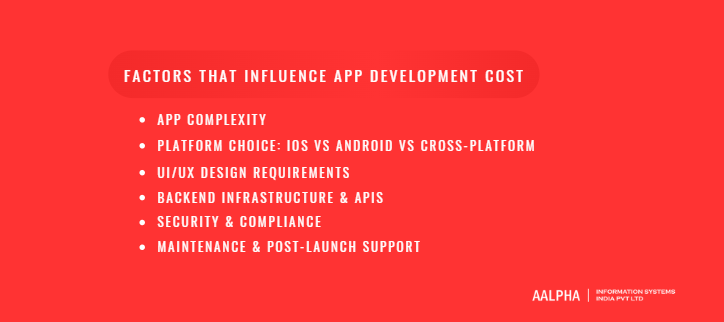
Key Factors That Influence Mobile App Development Cost in Dubai
Mobile app development costs in Dubai are not determined by geography alone. Pricing is directly shaped by architectural decisions, compliance standards, feature scope, and long-term scalability planning. Two apps with similar visual interfaces can differ in cost by over AED 150,000 simply because one includes real-time systems, AI-driven recommendations, or enterprise integrations while the other does not.
Understanding these cost drivers early allows founders and CTOs to allocate budget realistically and avoid mid-project scope inflation. Below are the primary variables that influence pricing in the UAE market.
App Complexity
App complexity is the single largest determinant of development cost. It is driven by three major components: feature depth, backend logic requirements, and real-time system architecture.
- Feature Depth
Feature depth refers to the number and sophistication of functionalities within the app. A simple login and profile system is inexpensive. Adding booking engines, live chat, geolocation tracking, payment gateways, push notifications, advanced filtering, analytics dashboards, and admin control panels significantly increases both development time and testing effort.
For example, an eCommerce app with static product listings is far cheaper than one with dynamic pricing, inventory syncing, multi-vendor management, and AI-driven recommendations. Each additional module introduces database logic, API endpoints, validation flows, and QA cycles.
- Custom Backend Logic
Custom backend logic substantially increases cost. Applications requiring role-based permissions, workflow automation, approval hierarchies, subscription billing logic, or complex data processing need tailored backend architecture rather than simple CRUD operations.
Enterprise apps in Dubai often require integration with ERP systems, CRM platforms, payment processors, or government APIs. These integrations increase development hours and require experienced backend engineers familiar with system design and scalability planning.
- Real-Time Systems
Real-time systems are particularly cost-intensive. Features such as live order tracking, ride-hailing functionality, chat systems, live dashboards, stock price updates, or IoT integrations demand socket-based communication, event-driven architecture, and robust server scaling strategies.
Real-time architecture requires additional engineering layers to manage latency, synchronization, and high concurrent user loads. In Dubai’s fast-moving consumer environment, many on-demand and fintech apps rely heavily on real-time performance, which increases both infrastructure and development budgets.
Platform Choice: iOS vs Android vs Cross-Platform
Platform selection directly impacts total cost and timeline.
- Native Development (iOS and Android Separately)
Native development involves building separate codebases for iOS (Swift) and Android (Kotlin). This approach delivers optimal performance, smoother animations, and deeper platform-specific integration. However, it effectively doubles frontend development cost because two engineering teams or parallel development cycles are required.
Native builds are typically recommended for performance-intensive applications such as fintech apps, large-scale marketplaces, or apps expecting millions of users.
- Cross-Platform Development
Frameworks like Flutter and React Native allow developers to write a single codebase for both iOS and Android. This approach can reduce frontend development cost by 25–40% and shorten time-to-market.
Cross-platform development makes sense for startups building MVPs, SMEs digitizing services, or businesses prioritizing rapid deployment over hyper-optimized performance. Modern cross-platform frameworks offer near-native performance for most business use cases.
However, highly complex apps with heavy animations, device-level integrations, or AI processing may still benefit from native development.
UI/UX Design Requirements
Design complexity significantly affects mobile app development pricing in Dubai, especially because the UAE market demands premium user experiences.
- Custom UI vs Template-Based Design
Template-based UI systems reduce design time and cost. However, most competitive apps in Dubai require custom interface design to align with brand identity and user expectations.
Custom design includes wireframing, high-fidelity prototypes, user journey mapping, interaction design, micro-animations, and usability testing. These steps require professional UX research and iteration cycles.
A highly customized UI can add AED 15,000–40,000 to the project budget depending on scope.
- Arabic and English Localization
Dubai’s bilingual market requires Arabic and English support for many consumer-facing apps. Arabic localization introduces additional design considerations, including right-to-left (RTL) layout adjustments, font selection, and mirrored navigation structures.
Supporting multiple languages is not simply a translation task. It impacts UI design, testing workflows, and content management systems. Bilingual apps require extended QA cycles to validate formatting and layout consistency across devices.
Backend Infrastructure & APIs
Backend architecture often represents 40–60% of total development cost for complex applications.
- Cloud Hosting Costs
Most Dubai apps rely on cloud platforms such as AWS, Azure, or Google Cloud. Infrastructure costs vary depending on traffic volume, data storage needs, and uptime requirements. Production-ready apps require load balancing, backup systems, monitoring tools, and auto-scaling configurations.
Cloud infrastructure planning is not optional for scalable applications. Poor initial planning leads to expensive re-architecture later.
- Database Architecture
Simple apps may operate on straightforward relational databases. Advanced applications require optimized database indexing, caching systems, distributed storage, and performance tuning.
High-transaction platforms, such as fintech or marketplace apps, demand robust database design to handle concurrent users without performance degradation.
- Third-Party Integrations
Payment gateways, SMS services, push notification systems, analytics tools, CRM integrations, mapping APIs, and AI services all add cost.
Each integration requires authentication setup, API handling, error management, and ongoing maintenance. Payment gateway integration alone can add AED 8,000–20,000 depending on complexity.
Security & Compliance
Security requirements significantly influence pricing in Dubai, especially for regulated industries.
- UAE Data Regulations
The UAE introduced the Federal Personal Data Protection Law (PDPL), which mandates strict handling of user data. Apps collecting personal information must implement secure storage, encrypted transmission, and user consent frameworks.
Compliance measures increase development time due to encryption protocols, secure authentication mechanisms, and audit logging systems.
- Payment Gateway Compliance
Apps processing online payments must comply with PCI-DSS standards. This requires secure payment integration, encrypted data handling, and tokenization mechanisms.
Even when using third-party gateways, developers must ensure secure transaction flow and backend validation.
- Fintech and Healthcare Requirements
Fintech apps require enhanced security such as multi-factor authentication, fraud detection logic, and secure transaction monitoring. Healthcare apps must adhere to medical data confidentiality standards and secure record storage protocols.
These compliance layers increase testing cycles and architectural complexity, raising total cost.
Maintenance & Post-Launch Support
Development cost does not end at launch.
- Annual Maintenance Cost
Annual app maintenance costs typically ranges between 15–25% of initial development cost. This includes bug fixes, performance optimization, security updates, and minor feature enhancements.
- Feature Updates
As user behavior evolves, apps require new features. Ongoing development sprints add to operational budgets.
- Server Scaling
As user volume grows, infrastructure must scale accordingly. Increased cloud costs, monitoring tools, and performance tuning add recurring expenses.
Many founders underestimate post-launch costs. A realistic financial plan must account for ongoing technical investment to sustain performance and security standards in Dubai’s competitive market.
App development cost in Dubai is not arbitrary. It is a reflection of technical ambition, regulatory responsibility, and long-term scalability goals. Businesses that understand these cost drivers can make informed decisions, prioritize effectively, and allocate capital strategically.
Mobile App Development Cost Breakdown by App Type (Dubai, UAE)
Different app categories carry very different engineering demands. A booking app and a fintech wallet may both look simple on the surface, yet their backend logic, security architecture, and compliance burden can differ dramatically. Below is a realistic cost breakdown by app type in Dubai, reflecting 2026 market conditions, local development standards, and enterprise-grade expectations.
E-commerce App Cost in Dubai (AED 150,000 to AED 400,000+)
A production-ready e-commerce app in Dubai typically starts around AED 150,000 for a single-vendor marketplace with essential features: product catalog, advanced search, user accounts, cart, checkout, order tracking, and an admin dashboard.
Costs increase when the app includes:
- Multi-vendor onboarding and commission logic
- Dynamic pricing and discount engines
- Inventory syncing across multiple warehouses
- Loyalty programs and wallet systems
- ERP, CRM, or POS integrations
- Advanced analytics dashboards
High-traffic readiness also adds cost. Flash sales, promotions, and large product catalogs require optimized database architecture and caching systems. Payment flow testing, refund logic, and reconciliation systems require detailed QA cycles.
A mid-sized e-commerce app in Dubai typically falls between AED 200,000–300,000, while enterprise-level marketplace platforms can exceed AED 400,000, especially if AI-powered product recommendations or multilingual support are included.
On-Demand Service App (Careem-style) (AED 180,000 to AED 500,000+)
On-demand apps are among the most technically complex categories due to real-time systems. A ride-hailing, delivery, or home-service booking platform usually requires:
- Real-time GPS tracking
- Driver/service provider app + customer app
- Admin control panel
- Live order status updates
- Payment integration
- Push notifications
- Rating and review systems
Because these systems involve live synchronization between multiple users, the backend must support socket connections, location updates, and dynamic status changes.
A basic two-sided marketplace may start around AED 180,000–250,000. However, adding surge pricing algorithms, automated dispatch logic, route optimization, fraud prevention, and multi-city expansion capabilities can push budgets to AED 400,000–500,000+.
The primary cost driver here is not UI but real-time infrastructure and scalability planning.
Fintech App Development Cost (AED 250,000 to AED 600,000+)
Fintech apps demand advanced security, compliance, and transactional accuracy. Even a simple digital wallet app must include:
- Secure user authentication
- Encrypted transactions
- KYC workflows
- Transaction history management
- Payment gateway integration
- Fraud monitoring logic
In the UAE market, fintech apps often require enhanced authentication mechanisms such as multi-factor authentication and biometric login. Compliance increases engineering time due to secure logging, encryption layers, and backend audit systems.
A basic fintech MVP may begin around AED 250,000–300,000. However, adding peer-to-peer transfers, cross-border transactions, AI-driven credit scoring, or investment dashboards can increase cost to AED 500,000–600,000+.
Fintech development is less about screens and more about backend security, transaction validation, and regulatory alignment.
Real Estate App Cost in UAE (AED 150,000 to AED 350,000+)
Real estate apps are highly relevant in Dubai’s property-driven economy. A typical property listing app includes:
- Property search with filters
- High-resolution image galleries
- Virtual tours integration
- Agent contact forms
- Saved listings
- Admin panel for property management
The cost starts around AED 150,000–200,000 for a listing-based platform.
However, complexity increases with:
- CRM integration for agents
- Lead scoring systems
- In-app chat
- Mortgage calculators
- Map-based property browsing
- Advanced search filtering
- Multilingual support
Enterprise real estate platforms that integrate with property management systems or include AI-based recommendation engines may reach AED 300,000–350,000+.
The primary cost factor here is backend filtering logic and integration with agent systems.
Healthcare App Development Cost (AED 200,000 to AED 500,000+)
Healthcare apps are cost-intensive due to privacy, compliance, and data sensitivity. Even a simple teleconsultation platform requires:
- Secure login and patient authentication
- Appointment scheduling
- Doctor dashboard
- Video consultation integration
- Medical record storage
- Secure messaging
In Dubai and the wider UAE, healthcare apps must implement strict data protection measures. Encryption, access control, and audit logs are essential.
A basic healthcare appointment booking app may start at AED 200,000–250,000. Adding features such as electronic medical records (EMR), prescription management, lab integrations, insurance verification, and AI-based symptom triage can push costs to AED 400,000–500,000+.
Healthcare apps are architecture-heavy projects because compliance and data security are mandatory, not optional.
Enterprise Business App Cost (AED 250,000 to AED 700,000+)
Enterprise applications involve workflow automation, internal dashboards, analytics, and integration with legacy systems. These apps may include:
- Role-based access controls
- Workflow approvals
- Multi-level reporting dashboards
- ERP or CRM integrations
- Document management systems
- Real-time data synchronization
Unlike consumer apps, enterprise builds often require custom backend logic, integration with existing databases, and multi-user permission hierarchies.
A mid-scale enterprise app may cost AED 250,000–400,000, while complex digital transformation platforms integrating multiple systems can exceed AED 700,000.
The cost driver is system complexity rather than visual design. Data migration, API synchronization, and enterprise-grade security significantly influence pricing.
Mobile app cost in Dubai varies widely by industry because each category carries unique architectural demands. E-commerce prioritizes transaction reliability. On-demand apps demand real-time performance. Fintech and healthcare require regulatory compliance. Enterprise platforms demand integration depth.
Understanding your app category allows you to estimate not only cost but also development risk, timeline, and scalability requirements.
Cost Breakdown by Development Stage
When founders ask how much it costs to build a mobile app in Dubai, the more precise question is how that budget is distributed across stages. Mobile app development is not a single expense. It is a sequence of structured phases, each contributing a defined percentage to the overall investment.
In the UAE market, production-grade apps typically follow a disciplined lifecycle: discovery, design, development, testing, and deployment. Below is a realistic breakdown of how your total budget is typically allocated.
Market Research & Discovery (8–12% of Total Budget)
The discovery phase usually accounts for 8–12% of the overall project cost. For a AED 250,000 app, this equates to approximately AED 20,000–30,000.
This stage includes:
- Market analysis and competitor research
- Feature prioritization
- Technical feasibility assessment
- Architecture planning
- Product roadmap definition
- Requirement documentation
In Dubai’s competitive ecosystem, skipping structured discovery often results in scope creep and budget overruns. This stage defines whether you are building an MVP or a full-scale product and clarifies integration needs early.
Enterprise and fintech projects often allocate closer to 12% due to compliance analysis and infrastructure planning. A well-executed discovery phase reduces costly redesigns later in development.
UI/UX Design Phase (10–15% of Total Budget)
Design typically consumes 10–15% of the total budget. For a AED 250,000 app, this means AED 25,000–37,500.
This phase includes:
- Wireframes
- User journey mapping
- Interactive prototypes
- Visual interface design
- Design system creation
- Usability testing
In Dubai, high-quality UI/UX is not optional. Users expect polished interfaces, smooth transitions, and intuitive navigation. If the app targets bilingual users, RTL design adjustments for Arabic add complexity and testing time.
Design costs increase when apps require custom animations, micro-interactions, or brand-heavy visual systems. Enterprise apps may spend slightly less proportionally, while consumer-facing platforms often invest heavily in premium design to stand out.
Frontend Development (25–30% of Total Budget)
Frontend development usually represents 25–30% of the total cost. For a AED 250,000 app, this ranges between AED 62,500–75,000.
This phase includes:
- Mobile app coding (iOS, Android, or cross-platform)
- UI implementation
- API integration
- Performance optimization
- Device compatibility handling
Costs vary significantly depending on platform choice. Native development for both iOS and Android increases frontend expenses, while cross-platform frameworks may reduce them by 20–30%.
Frontend complexity rises when the app includes:
- Advanced animations
- Offline capabilities
- Real-time UI updates
- Dynamic filtering systems
- Complex forms and validation
On-demand apps, fintech dashboards, and analytics-heavy platforms tend to push frontend costs toward the higher end of the percentage range.
Backend Development (30–35% of Total Budget)
Backend development is typically the most expensive stage, consuming 30–35% of the total budget. For a AED 250,000 project, that equals AED 75,000–87,500.
Backend work includes:
- Server architecture design
- Database modeling
- API development
- Business logic implementation
- Authentication systems
- Payment gateway integration
- Third-party API connections
- Admin panel development
The backend drives scalability and performance. In Dubai, apps are often built with long-term growth in mind, requiring cloud infrastructure planning, load balancing, and auto-scaling configurations.
Real-time systems, AI processing, subscription billing logic, and compliance layers increase backend cost. Enterprise-grade apps may even allocate 40% or more of total budget to backend engineering due to integration depth and workflow complexity.
QA & Testing (10–15% of Total Budget)
Quality assurance generally accounts for 10–15% of total project cost. On a AED 250,000 app, this equals AED 25,000–37,500.
QA includes:
- Functional testing
- Cross-device testing
- Performance testing
- Security testing
- Payment flow validation
- Bug tracking and fixes
Apps in regulated sectors such as fintech and healthcare often require extended testing cycles. Real-time apps require stress testing to ensure stability under concurrent usage.
Testing is not a minor phase. Skipping rigorous QA leads to post-launch instability, poor reviews, and reputational damage. Dubai’s competitive market makes launch quality particularly important.
Deployment & App Store Launch (5–8% of Total Budget)
Deployment and launch typically represent 5–8% of the total cost. For a AED 250,000 project, this ranges from AED 12,500–20,000.
This stage includes:
- Production server setup
- CI/CD pipeline configuration
- App Store and Google Play submission
- App performance monitoring setup
- Final security audits
- Compliance documentation preparation
Enterprise apps may require additional deployment planning, including staged rollouts and internal training.
Launch is not simply uploading the app to stores. It involves configuration validation, environment testing, and ensuring analytics tracking works correctly from day one.
Summary of Cost Distribution by Stage
For clarity, here is a consolidated distribution range:
- Discovery: 8–12%
- UI/UX Design: 10–15%
- Frontend Development: 25–30%
- Backend Development: 30–35%
- QA & Testing: 10–15%
- Deployment & Launch: 5–8%
This distribution reflects structured, professional development practices in Dubai’s app ecosystem. Understanding how your budget spreads across these phases allows better financial planning and prevents underfunding critical stages such as backend architecture or testing.
A well-balanced investment across stages produces stable, scalable, and secure applications aligned with UAE market expectations.
Cost by Hiring Model in Dubai
The hiring model you choose can influence mobile app development cost as much as feature complexity. In Dubai, pricing varies significantly depending on whether you work with a local agency, freelancers, offshore teams, a hybrid structure, or build an internal team.
Each model carries different overheads, risk levels, scalability implications, and long-term cost structures. Below is a practical breakdown of what businesses in the UAE typically experience.
Hiring a Local Dubai Agency (AED 180–500 per hour | Full App: AED 150,000–600,000+)
Working with a local Dubai-based agency is generally the most premium option. Agency hourly rates often range between AED 180–500 per hour, depending on reputation, expertise, and specialization.
For a mid-complexity app, total project costs usually fall between AED 150,000–400,000, while enterprise-level builds can exceed AED 600,000.
What you pay for:
- Structured project management
- Senior technical architects
- Local regulatory understanding
- Face-to-face collaboration
- Enterprise-grade documentation
- Post-launch support
Dubai agencies typically include UX designers, backend engineers, QA testers, and DevOps specialists under one contract. This reduces coordination burden for the client.
The higher pricing reflects operational costs in the UAE, including office infrastructure, salaries, and compliance standards. For regulated industries such as fintech or healthcare, many businesses prefer local agencies due to accountability and familiarity with UAE compliance requirements.
Hiring Freelancers in UAE (AED 80–250 per hour | Full App: AED 60,000–200,000)
Freelancers are significantly cheaper than agencies. Hourly rates typically range between AED 80–250, depending on experience and specialization.
A small MVP might be completed within AED 60,000–120,000, but larger projects become difficult to manage through individual freelancers.
Advantages:
- Lower upfront cost
- Flexible engagement
- Suitable for small feature builds
Risks:
- Limited scalability
- No structured QA team
- Higher coordination burden
- Dependency on individual availability
Freelancers are appropriate for early-stage prototypes or incremental upgrades but may struggle with enterprise-grade builds that require multidisciplinary teams.
Offshore Development Model (AED 60–200 per hour | Full App: AED 70,000–250,000)
Offshore development involves hiring teams outside the UAE, often in cost-efficient regions. This model can reduce total cost by 30–60% compared to local Dubai agencies.
A mid-complexity app that might cost AED 250,000 locally could be developed offshore for AED 120,000–200,000, depending on scope.
Why offshore is cheaper:
- Lower labor costs
- Reduced operational overhead
- Competitive global pricing
However, offshore success depends heavily on:
- Clear documentation
- Structured communication
- Time zone alignment
- Strong technical leadership
For Dubai-based startups seeking cost efficiency while maintaining product quality, offshore development is often a viable route, particularly for backend-heavy systems.
The tradeoff is that clients must actively manage communication, milestone tracking, and technical oversight.
Hybrid Model (Dubai + Offshore) (AED 120,000–350,000)
The hybrid model combines local strategic oversight with offshore engineering execution.
Typical structure:
- Product strategy and client communication handled in Dubai
- Design and development executed offshore
- QA and deployment coordinated jointly
This model can reduce overall cost by 25–50% while preserving strategic control and compliance alignment.
For example, a AED 300,000 local agency project might cost AED 180,000–220,000 under a hybrid structure.
The hybrid model is increasingly popular among UAE startups and SMEs because it balances cost efficiency with professional project management.
In-House Development Team Cost (AED 600,000–1,500,000+ annually)
Building an internal team is the most expensive long-term option. Hiring:
- 1 Mobile Developer
- 1 Backend Developer
- 1 UI/UX Designer
- 1 QA Engineer
- 1 Project Manager
can easily cost AED 600,000–1,500,000+ annually, including salaries, visas, office space, equipment, and benefits.
While in-house teams offer full control, they are only financially viable for companies building multiple products or maintaining continuous development cycles.
For a single app project, in-house hiring rarely makes financial sense compared to structured external engagement.
Choosing a hiring model is not purely about minimizing cost. It is about balancing risk, control, scalability, and long-term strategy. Dubai’s market allows flexibility, but the optimal structure depends on your product complexity, internal technical expertise, and funding stage.
How Long Does It Take to Build an App in Dubai?
The timeline to build a mobile app in Dubai typically ranges from 2 months to 9+ months, depending on complexity, compliance requirements, integrations, and hiring model. While many founders expect rapid deployment, production-grade apps in the UAE market require structured planning, design validation, backend architecture, testing, and regulatory alignment.
Below is a realistic timeline breakdown based on app type and development approach.
Timeline by App Complexity
Basic MVP App (2–3 Months)
A simple app with limited features such as login, profile management, booking forms, static content, and basic admin panels can typically be completed within 8–12 weeks. These projects involve minimal third-party integrations and straightforward backend logic. Startups validating ideas often fall into this category.
Mid-Level Business App (3–5 Months)
Apps that include payment gateways, dashboards, role-based access, push notifications, and moderate backend complexity require 12–20 weeks. E-commerce platforms, service booking apps, and internal enterprise tools typically fall within this range.
Advanced or Real-Time App (5–8 Months)
On-demand platforms, fintech apps, AI-driven systems, or enterprise-grade workflow automation tools require more time. Real-time features, compliance requirements, and multi-layered backend logic increase development and testing cycles. These projects often require 20–32 weeks.
AI-Powered or Highly Regulated Apps (6–9+ Months)
Applications involving predictive analytics, machine learning models, healthcare records, or financial transaction engines typically require extended architecture planning and security testing. These builds can exceed 9 months depending on scope and regulatory approvals.
Factors That Delay Development
Several variables can extend timelines beyond initial projections:
Scope Creep
Adding new features mid-development is the most common delay factor. Every additional feature introduces backend logic, testing cycles, and UI adjustments.
Unclear Requirements
Insufficient discovery planning leads to frequent revisions, increasing both time and cost.
Third-Party Integration Challenges
Payment gateways, government APIs, or enterprise system integrations sometimes require approval processes and documentation validation, delaying progress.
Compliance and Security Reviews
Fintech and healthcare apps often undergo additional security audits before deployment.
Design Revisions
Extensive iteration on UI/UX after development has started can push launch dates by several weeks.
App Store Approval Delays
Apple App Store reviews can take several days to weeks depending on compliance documentation and feature clarity.
Agile vs Traditional Timelines
Most Dubai-based development teams use Agile methodology, which breaks development into 2–3 week sprints. This approach allows iterative releases, continuous feedback, and flexibility in feature prioritization. Agile is ideal for startups and evolving products.
Traditional or waterfall models follow fixed sequential phases: requirements, design, development, testing, and deployment. While this provides structured documentation, it reduces flexibility and may extend timelines if revisions are required late in the process.
Agile timelines are often faster for MVPs because features can be prioritized and released incrementally. Traditional approaches are sometimes preferred for enterprise or government-aligned projects requiring strict documentation and approval workflows.
Realistic Launch Expectations
Many founders underestimate the non-coding time required for launch readiness. Beyond development, you must account for:
- Production server configuration
- Security validation
- Beta testing
- Bug resolution cycles
- App store compliance checks
- Analytics setup
- User onboarding optimization
In Dubai’s competitive market, rushing to launch without proper testing can damage brand credibility. A realistic launch timeline should include buffer periods of 2–4 weeks beyond development completion.
For most mid-level apps, planning a 4–6 month total journey from concept to public release is realistic. Enterprise or regulated apps should expect 6–9 months for stable deployment.
Understanding timeline expectations early prevents operational pressure and ensures that product quality aligns with market standards in the UAE ecosystem.
How to Reduce Mobile App Development Cost Without Compromising Quality
Reducing mobile app development cost in Dubai does not mean cutting corners. It means making disciplined technical and strategic decisions early. Many projects become expensive not because of high developer rates, but because of poor planning, feature bloat, and architectural mistakes that require rebuilding later.
Below are practical, proven ways to control budget while maintaining performance, scalability, and long-term viability.
-
Build an MVP First
The most effective way to reduce development cost is to build a Minimum Viable Product (MVP) before investing in a full-scale platform.
An MVP focuses only on core features that validate the business idea. For example:
- An e-commerce MVP may include product listing, cart, checkout, and basic admin controls.
- A service booking MVP may include scheduling, user registration, and payment processing.
It does not include advanced analytics dashboards, loyalty systems, AI recommendations, or automation workflows at the start.
In Dubai’s competitive environment, launching a focused MVP within 3–4 months allows businesses to test market response before committing large capital. Once real user data is collected, feature expansion becomes more strategic and financially justified.
Building everything at once often leads to unnecessary expense and longer time-to-market.
-
Avoid Overengineering
Overengineering is one of the biggest hidden cost drivers.
Examples include:
- Building complex microservices architecture for a small startup
- Adding AI modules before validating basic user demand
- Creating multi-layered admin systems when simple dashboards would suffice
- Implementing automation workflows that are not yet needed
In early stages, simplicity reduces cost and maintenance burden. Many apps that begin with overly complex architecture require heavy refactoring within a year.
The key is aligning architecture with current business scale, not future hypothetical scale. Scalability planning is important, but it should not inflate first-version budgets unnecessarily.
-
Use Cross-Platform Development Strategically
Cross-platform frameworks like Flutter and React Native can reduce frontend development cost by 25–40% compared to building separate native apps for iOS and Android.
For most business apps in Dubai, cross-platform performance is more than sufficient. Unless the app requires intensive device-level performance, high-end animations, or gaming-level responsiveness, cross-platform development provides strong cost efficiency without sacrificing user experience.
This approach reduces:
- Development time
- Testing cycles
- Maintenance overhead
However, cross-platform should be selected strategically. For fintech or performance-heavy apps, native development may still be justified.
-
Choose Scalable Architecture Early
Cost savings do not come from building cheaply. They come from building correctly the first time.
Choosing a scalable backend architecture early prevents expensive rework. For example:
- Structuring databases properly avoids migration issues later
- Designing modular APIs simplifies feature expansion
- Planning cloud auto-scaling prevents downtime
Rebuilding backend architecture after user growth is significantly more expensive than investing in proper system design during the discovery phase.
Scalable does not mean overbuilt. It means thoughtfully structured for growth.
-
Use an Experienced Team to Avoid Rework
Rework is one of the most expensive hidden costs in app development.
Inexperienced teams often:
- Write inefficient code
- Skip documentation
- Underestimate integration complexity
- Deliver unstable builds requiring multiple revisions
Hiring experienced engineers may appear more expensive upfront, but it reduces:
- Bug-fix cycles
- Security vulnerabilities
- Performance issues
- Architectural restructuring
In Dubai’s business environment, downtime or poor performance can damage brand credibility quickly. Investing in experienced technical leadership saves money over the product lifecycle.
Cost reduction in mobile app development is not about minimizing spending. It is about optimizing decision-making. By building an MVP, avoiding unnecessary complexity, leveraging cross-platform tools appropriately, designing scalable systems early, and working with experienced professionals, businesses can control budgets without sacrificing product quality or long-term performance.
How to Choose the Right Mobile App Development Company in Dubai
Selecting a mobile app development company is a strategic decision, not just a procurement task. The right partner influences architecture quality, security standards, scalability readiness, and long-term operational stability. The wrong choice can lead to budget overruns, missed deadlines, technical debt, and expensive rebuilds.
Dubai’s development ecosystem includes boutique agencies, enterprise technology firms, freelancers, offshore providers, and hybrid models. Evaluating them requires a structured framework based on technical capability, domain understanding, pricing clarity, and long-term support alignment.
Below are the critical evaluation criteria.
Technical Expertise
Technical depth should be your first filter. A capable development company must demonstrate:
- Strong backend architecture experience
- Cloud infrastructure knowledge (AWS, Azure, or GCP)
- Secure authentication and authorization implementation
- API integration expertise
- Cross-platform and native mobile proficiency
- DevOps and deployment capability
Ask whether the company designs scalable systems or simply builds UI screens. A visually attractive app without strong backend architecture will fail under load.
Review their past projects carefully. Look for apps that include real-time functionality, payment integration, analytics dashboards, or enterprise system integration. These indicate deeper engineering maturity.
Also assess whether the company follows structured development methodologies such as Agile sprint planning, code reviews, automated testing, and version control best practices. Mature processes reduce risk.
Industry Experience
Industry-specific knowledge can significantly reduce development risk and cost.
For example:
- Fintech apps require understanding of secure transaction flows and compliance standards.
- Healthcare apps require familiarity with patient data protection and access control systems.
- Real estate platforms require filtering logic and CRM integration knowledge.
- On-demand apps require real-time infrastructure planning.
A company that has previously built similar systems can anticipate technical challenges early, reducing redesign cycles.
Ask direct questions:
Have you built apps in this industry before?
What architectural decisions did you make to handle scale?
What challenges did you face and how were they resolved?
Relevant experience shortens development cycles and improves solution quality.
Transparency in Pricing
Pricing transparency prevents disputes and hidden cost escalation.
A reliable mobile app development company in Dubai should provide:
- Detailed feature breakdown
- Stage-wise cost allocation
- Clear scope documentation
- Defined payment milestones
- Clarification of what is included and excluded
Avoid vendors who provide vague lump-sum pricing without documentation. Ambiguity often leads to change requests and additional billing later.
Ensure that the proposal includes cost distribution across discovery, design, development, testing, and deployment. Structured documentation reflects professional maturity.
Post-Launch Support
App development does not end at launch. Ongoing support is critical.
Ask about:
- Maintenance packages
- Security update handling
- Server monitoring
- Bug resolution SLAs
- Feature enhancement cycles
- Infrastructure scaling support
In Dubai’s fast-moving digital economy, downtime or security vulnerabilities can affect brand trust quickly. Ensure the company offers structured post-launch engagement rather than one-time project delivery.
Annual maintenance typically ranges between 15–25% of initial development cost. Clarify this upfront.
Scalability Planning
Scalability should be discussed before coding begins.
A competent development partner should explain:
- How the backend will scale with user growth
- How database performance will be optimized
- How cloud auto-scaling will be configured
- How modular architecture will support future features
If scalability is not part of the initial architecture discussion, you may face costly rebuilding later.
Companies that design with growth in mind reduce long-term technical debt and protect your investment.
If you are evaluating partners, consider working with a technology company that combines strong engineering capability with cross-industry experience and structured delivery processes. A firm like Aalpha brings experience in building scalable mobile applications across fintech, healthcare, enterprise systems, and on-demand platforms while maintaining cost transparency and long-term support alignment.
Choosing the right development partner in Dubai is not about finding the lowest quote. It is about securing architectural stability, security compliance, and scalability readiness. A well-selected partner transforms app development from a cost center into a strategic business asset.
Final Thoughts
Building a mobile app in Dubai is a strategic investment, not just a development expense. Costs vary widely based on complexity, compliance needs, scalability goals, and hiring model. A clear roadmap, realistic budgeting, and the right technical partner can prevent overruns and position your app for long-term growth in the UAE’s competitive digital market.
If you are planning to build a mobile app in Dubai and want a precise cost estimate based on your specific idea, the team at Aalpha can help you evaluate scope, architecture, and budget before development begins. Reach out for a structured consultation and turn your concept into a scalable, production-ready application.
FAQs: Mobile App Development Cost in Dubai
Below are concise answers to the most common high-intent questions about app development costs in Dubai.
What is the minimum cost to build an app in Dubai?
The minimum realistic cost starts around AED 40,000–60,000 for a basic MVP with limited features such as login, simple UI screens, and basic backend connectivity. However, most production-ready business apps fall between AED 120,000–300,000, depending on complexity and integrations.
Can I build an app under AED 50,000?
Yes, but only for a very simple app. Under AED 50,000 typically covers:
- Cross-platform development
- Limited features
- Minimal backend logic
- No advanced integrations
This budget is suitable for prototypes or early validation, not for scalable marketplaces, fintech platforms, or real-time systems.
Why is app development expensive in UAE?
App development in the UAE costs more due to:
- Higher labor and operational expenses
- Premium UI/UX expectations
- Bilingual (Arabic + English) support requirements
- Strong security and compliance standards
- Enterprise-grade infrastructure planning
Businesses in Dubai usually build apps for scalability and long-term growth, which increases upfront investment.
How much does it cost to maintain an app annually?
Annual maintenance typically costs 15–25% of the initial development budget. For example, a AED 200,000 app may require AED 30,000–50,000 per year for:
- Bug fixes
- Security updates
- Server hosting
- Minor feature improvements
- Performance optimization
Cloud infrastructure and user growth can increase ongoing costs.
Should I hire a Dubai company or outsource?
Hiring a Dubai-based company offers stronger local collaboration, regulatory familiarity, and accountability, but at higher cost.
Outsourcing or using a hybrid model can reduce expenses by 30–50%, provided you maintain clear documentation and strong project management.
The right choice depends on your budget, technical oversight capability, and long-term scalability goals.