





TL;DR: Hotel booking app development
Hotel booking app development is the process of building a mobile or web application that lets guests search for hotels, check live room availability, pay, and manage reservations, while hotels control inventory, rates, and bookings from a partner dashboard. Most projects move through six stages: discovery, MVP scoping, UX design, booking engine and integration development, testing with a small group of hotel partners, and a staged launch. A first release needs date and occupancy search, clear room and rate options, the full price shown before payment, secure checkout, instant confirmation, and self-service cancellation. Cost depends mostly on the business model and the number of integrations. A single-hotel direct booking MVP typically costs USD 25,000 to 60,000, while a multi-supplier marketplace MVP usually lands between USD 80,000 and 200,000, with timelines of 3 to 10 months. Property management system, channel manager, and supplier API work is where estimates most often slip. When choosing a development partner, look for proven experience with inventory locking, payment reconciliation, and third-party travel integrations, plus full code ownership at handover. Aalpha Information Systems has delivered more than 5,500 software projects for clients in 55+ countries and builds hotel booking platforms from discovery through post-launch support.
What is a hotel booking app?
A hotel booking app is software that connects guests with available hotel rooms and turns a search into a confirmed, paid reservation. It shows properties, room types, rates, and policies for chosen dates, holds the room while the guest pays, and records the booking so the hotel can honour it on arrival.
How hotel booking apps work
The guest journey starts with a destination, check-in and check-out dates, and the number of adults, children, and rooms. The app queries its inventory source, which may be its own database, a hotel’s property management system, a channel manager, or a supplier API, and returns properties with rooms available for every night of the stay. The guest picks a property, compares room types and rate plans, and moves to checkout.
At checkout, the app re-checks availability and price, places a short hold on the room, collects guest details, and takes payment or a card guarantee. Once payment succeeds, the reservation is confirmed with the inventory source, a confirmation number is issued, and the guest receives an email and in-app record. The hotel sees the same booking in its dashboard or PMS.
Hotel booking apps versus hotel websites
A native mobile app is best for repeat users: loyalty members, frequent business travellers, and guests who want digital keys or push notifications. A mobile website captures first-time visitors from search engines and ads, who rarely install an app for one stay. A web-based booking platform with a responsive frontend serves both groups from one codebase but cannot use device features such as Bluetooth room access as easily. Most serious products end up with a responsive website for acquisition and a mobile app for retention.
Who uses a hotel booking platform?
Guests search, book, and manage stays. Hotel owners and revenue managers load rooms, set rates, and track performance. Property managers running several buildings need a consolidated view. Travel agents and corporate travel bookers book on behalf of others and often need negotiated rates and invoicing. Platform administrators onboard hotels, moderate listings, resolve disputes, and handle payouts. Each group needs its own permissions and screens, which is why a booking platform is really three or four applications sharing one backend.
Direct booking apps versus online travel agencies
In a direct booking app, the hotel owns the inventory, the customer relationship, the payment, and the guest data, and pays no commission per booking. An online travel agency (OTA) aggregates many hotels, owns the customer, controls the booking flow, and charges hotels commission, commonly in the 15 to 25 percent range. Direct apps cost less per booking but must pay for their own traffic. OTAs win on reach but carry supplier management, payouts, and customer service for thousands of properties.
Types of hotel booking apps
Hotel booking apps fall into six broad types: single-hotel apps, chain and multi-property apps, OTA marketplaces, last-minute apps, corporate and extended-stay apps, and niche platforms. The type decides where inventory comes from, who the customer is, and how complex the build becomes.
-
Single-hotel booking apps
A single property, often a resort or a large city hotel, builds its own app to drive direct bookings, sell upgrades, and run guest services such as room service orders and spa bookings. Inventory comes straight from the hotel’s PMS or booking engine. The build is the simplest of the six, but the app only pays off if the property has enough repeat guests to justify installation.
-
Hotel chain and multi-property apps
Chains need one app across dozens or hundreds of properties, with shared loyalty accounts, brand-level search, and property-specific content. The difficult part is that properties often run different PMS products, so the integration layer has to normalise rooms, rates, and policies from several systems.
-
Online travel agency and hotel marketplace apps
Marketplaces list many independent hotels and source inventory from direct contracts, channel managers, and wholesale suppliers. They need hotel onboarding, commission and payout logic, review systems, and dispute handling. This is the most expensive type to build and to operate.
-
Last-minute hotel booking apps
These apps sell unsold rooms for the same night or the next few days, usually at discounted rates. Speed of search, map-first discovery, and accurate real-time availability matter more than anything else, because a stale result means a guest arriving at a full hotel.
-
Corporate travel and extended-stay booking apps
Corporate platforms enforce travel policies, approval workflows, negotiated rates, and centralised billing. Extended-stay platforms handle weekly and monthly pricing, deposits, and longer cancellation rules. Both need invoicing and reporting that consumer apps can skip.
-
Niche accommodation platforms
Focused platforms serve one segment well: boutique hotels, wellness resorts, pet-friendly stays, or accessible accommodation with verified room measurements and photos of bathrooms. A narrow niche makes supply acquisition easier and gives a reason to exist next to the large OTAs.
Hotel booking app business models and monetization
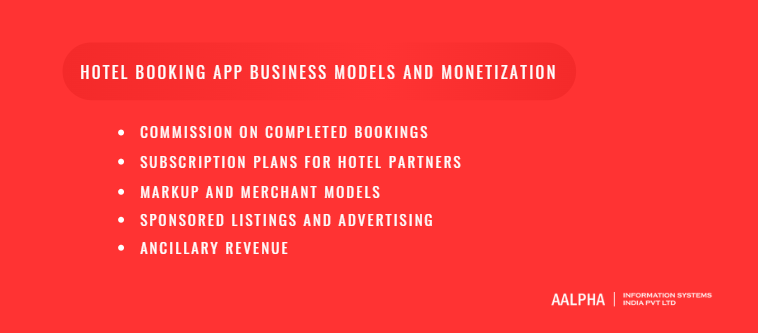
Hotel booking apps make money through commissions, partner subscriptions, markups, advertising, and ancillary sales. The right model depends on who owns the inventory and on the margin left after acquisition costs, payment fees, refunds, and support.
-
Commission on completed bookings
The platform takes a percentage of each completed stay, usually charged after check-out. Hotels like it because they pay only for results. The platform carries the risk of cancellations and no-shows, so commission revenue lags bookings by weeks.
-
Subscription plans for hotel partners
Hotels pay a monthly fee for listing, a booking engine, or premium analytics. Revenue is predictable, and the model suits software-led products sold to independent hotels. The downside is that hotels expect bookings in return, and churn rises quickly if the platform does not deliver them.
-
Markup and merchant models
In the merchant model, the platform buys rooms at a net rate and sells them at a price it sets, collecting payment from the guest and paying the hotel later. Margins can be higher than commission, but the platform takes on payment risk, tax obligations in some markets, and chargebacks. Rate parity clauses in hotel contracts may also limit how much it can mark up.
-
Sponsored listings and advertising
Hotels pay for higher placement in search results, and third parties pay for ads. This adds margin once traffic is large, but sponsored placements must be labelled clearly, and too many of them erode trust in the rankings.
-
Ancillary revenue
Airport transfers, breakfast packages, room upgrades, late check-out, and local activities can be sold during or after booking. Upgrades and late check-out are the easiest to add because they come from the hotel itself. Third-party activities need separate suppliers and contracts.
Choosing a model based on unit economics
Work the numbers per booking before choosing. Suppose an average booking is USD 200 at 15 percent commission, giving USD 30 of revenue. Subtract payment processing at roughly 2 to 3 percent of the booking value (USD 4 to 6), a share of customer acquisition cost, support time, and the cost of refunds and cancellations. If paid acquisition costs USD 25 per first booking, the first stay barely breaks even, and the model depends on repeat bookings. That calculation usually decides whether a team leads with commission, subscription, or a mix.
Market research and product validation
Market research for a hotel booking app means confirming that a defined group of guests has an unmet need, that enough hotels will supply inventory, and that both sides will transact at a price that covers costs. Validate supply and demand before building the full platform.
-
Define the target audience and launch geography
Pick one guest segment and one launch city or region. “Business travellers visiting Bengaluru for two to four nights” gives far more direction than “travellers in India”. The geography decides the payment methods, languages, tax rules, and hotel partners you need first.
-
Analyze competing booking platforms
Book real stays on the competing apps your audience already uses. Record how many taps it takes to reach a confirmed booking, where fees appear, how cancellations work, and what reviews complain about. App store reviews are a cheap source of unmet needs.
-
Identify an unmet guest or hotel need
Strong opportunities usually come from a specific friction. Guests may not trust photos for accessible rooms, or business travellers may struggle to get GST-compliant invoices. Hotels may resent high OTA commissions or lack a simple booking engine. A product built around one such problem is easier to position than a general alternative to Booking.com.
-
Validate hotel supply and partnership interest
Talk to 20 to 30 hotels in the launch area before writing code. Ask what systems they use, what commission they would accept, and whether they would sign a letter of intent. The PMS answers matter, because they determine which integrations the MVP must support.
-
Test demand before building the full app
A landing page with real hotel listings and a “request to book” form, run with a small ad budget, shows whether guests click and submit. A concierge MVP, where bookings are confirmed manually by phone or email, tests the full transaction with almost no software. Both cost a fraction of an app build.
-
Define the product’s value proposition and success criteria
Write the value proposition in one sentence for guests and one for hotels. Then set measurable launch targets, such as 50 live properties, a 2 percent search-to-booking conversion rate, and a cancellation rate under 15 percent. Without these numbers, it is hard to decide after launch whether the product is working.
Essential guest features for a hotel booking app
A hotel booking app’s guest side needs account access, search, filters and maps, detailed hotel profiles, room and rate selection, transparent pricing, secure payment, confirmation, booking management, cancellation handling, and support. These features cover the path from discovery to a completed stay.
-
Registration, login, and guest checkout
Offer email, phone OTP, and social sign-in, but always allow guest checkout. Forcing account creation before payment loses bookings, especially from first-time users. After checkout, invite the guest to create an account with the details already entered, so the booking appears in their profile.
-
Destination, date, and occupancy search
The search form needs destination autocomplete covering cities, neighbourhoods, landmarks, and hotel names, a date picker that blocks past dates and shows the number of nights, and an occupancy selector for rooms, adults, and children with ages. Child ages matter because many hotels price or restrict by age. Remember the last search so returning guests can rebook quickly.
-
Filters, sorting, and map-based discovery
Useful filters include price range, star rating, guest score, free cancellation, breakfast included, distance from a point, and amenities such as parking or a pool. Sorting by price should use the total stay price, not the nightly rate. A map view with prices on the pins helps guests choose by location, which is often the deciding factor for city stays.
-
Hotel profiles, photos, amenities, and policies
A hotel page needs high-resolution photos grouped by area, a short description, amenity lists, check-in and check-out times, and policies on children, pets, smoking, and deposits. Show the exact location on a map with distances to nearby landmarks. Missing policy information is a common cause of complaints and cancellations.
-
Room types, rate plans, and availability
Each room type should show bed configuration, size, maximum occupancy, view, and room-specific photos. Under each room, list the rate plans: for example, a non-refundable rate, a flexible rate, and a rate with breakfast. Show only rooms that are available for every night of the stay and that fit the requested occupancy, and flag low availability honestly when the data supports it.
-
Transparent pricing, taxes, and booking conditions
Show the total price, including mandatory taxes and fees, before the guest enters payment details. In the United States, the FTC’s rule on unfair or deceptive fees, in force since May 2025, requires short-term lodging prices to include mandatory fees in the headline price. Break down the total on the review screen: room rate per night, taxes, and any property-collected fees such as a city tax paid at the hotel. Put the cancellation deadline in plain language next to the price.
-
Secure checkout and payment options
Support cards, wallets such as Apple Pay and Google Pay, and local methods for the launch market, for example UPI in India. Offer pay-now and pay-at-hotel options where the inventory source allows it. Use a PCI DSS compliant payment provider so card numbers never touch your servers, and support 3D Secure authentication where regulations require it.
-
Booking confirmation and reservation management
After payment, show a confirmation screen with the booking reference, hotel contact details, dates, room, and price, and send the same details by email and push notification. The “My trips” section should list upcoming and past stays, with directions, a calendar export, and an option to download an invoice.
-
Cancellations, modifications, and refund tracking
Let guests cancel or change dates within the app when the rate allows it, and show the refund amount before they confirm. After cancellation, display refund status and expected timing, because “where is my refund?” is one of the most common support queries for booking platforms. Date changes should re-check availability and price, then show any difference to pay or refund.
-
Reviews, saved properties, notifications, and support
Verified reviews should come only from guests who completed a stay, with a prompt sent after check-out. Saved properties let guests build a shortlist and return later, and they give the app a reason to send price-drop alerts. Notifications should be limited to confirmations, reminders before arrival, check-in instructions, and alerts the guest opted into. Support needs in-app chat or a help centre with booking context attached, so agents do not have to ask for the reference number.
Hotel partner and administrator features
Hotel partners need tools to onboard, manage property content and inventory, handle reservations, run promotions, and track payouts. Platform administrators need control over hotels, users, listings, disputes, and finances, with role-based access and full audit trails.
-
Hotel onboarding and verification
Onboarding should collect business registration, tax details, bank account information, and proof of property ownership or management rights. Verification can combine document checks with a call or site visit. A guided setup that walks the hotel through rooms, rates, photos, and policies shortens the time from sign-up to first live listing.
-
Property, room, and media management
Hotels need to edit descriptions, amenities, policies, and photos, and to create room types with occupancy rules and bed types. Image upload should resize and compress automatically and allow tagging photos to specific rooms. Content changes for live listings may need moderation before they go public.
-
Inventory, rates, and availability calendars
A calendar view lets hotels set the number of rooms available and the price per night for each room type and rate plan. Bulk editing across date ranges, weekday-specific pricing, and stay restrictions such as minimum nights save time. When a PMS or channel manager is connected, the calendar should show synced values as read-only, so manual edits do not overwrite the source system.
-
Reservation handling and guest communication
The reservation list shows new, modified, and cancelled bookings with filters by date and status. Hotels should be able to confirm, mark no-shows, and message guests about arrival times or special requests. Messages should run through the platform so both sides have a record.
-
Promotions and cancellation policy management
Hotels need to create discounts such as early booking, last-minute, and length-of-stay offers, with date limits and eligibility rules. Cancellation policies should be defined once and attached to rate plans, so the guest-facing wording always matches the rules the system enforces.
-
Commissions, settlements, and financial reporting
The finance module calculates commission per booking, holds amounts for upcoming stays, and releases payouts after check-out according to the payout schedule. Hotels need statements showing bookings, cancellations, commissions, refunds, and net payouts, exportable for their accountants. Reconciliation against payment provider reports should be automated, because manual reconciliation stops scaling after a few hundred bookings a month.
-
Platform administration and role-based access
Admins manage hotels, guest accounts, content, commission rates, and system settings. Role-based access separates support agents, finance staff, content moderators, and super admins, so a support agent can view a booking without changing payout details. Hotel accounts also need roles, such as owner, front desk, and revenue manager.
-
Listing moderation, disputes, and audit trails
Moderation queues review new listings, photo changes, and reported reviews. Dispute tools record guest complaints, hotel responses, evidence, and the outcome, including any compensation. Every change to rates, bookings, payouts, and permissions should be logged with the user, time, and previous value. Audit logs settle most disputes and are expected in security reviews.
Advanced features and AI capabilities
Advanced features such as personalized recommendations, conversational search, review summaries, price alerts, loyalty programs, and digital room keys improve conversion and retention after the core booking flow is stable. AI features must draw only on verified property data and must never complete a booking without explicit guest confirmation.
-
Personalized hotel recommendations
Recommendations can use past bookings, saved properties, search history, and similar guests’ behaviour to rank results. Start with simple rules, such as preferring the guest’s usual price range and amenities, before investing in machine learning models. Personalisation needs enough booking data to be useful, so it rarely belongs in an MVP.
-
Conversational hotel search and booking assistance
A chat or voice assistant lets guests ask for “a quiet hotel near the convention centre with parking, under USD 150 a night”. A large language model turns the request into structured search filters, and the regular search engine returns live results. The assistant can also answer policy questions about a specific hotel.
-
Review summaries and multilingual support
AI can condense hundreds of reviews into a short summary of what guests praise and criticise, and translate property descriptions and reviews into the guest’s language. Label machine-translated and machine-summarised content, and keep the original text one tap away.
-
Price alerts and flexible-date discovery
Price alerts notify guests when a saved hotel drops below a chosen price. Flexible-date search shows the cheapest nights across a week or month. Both drive return visits, but they increase search volume against supplier APIs, which may charge per request or enforce rate limits.
-
Loyalty programs and personalized offers
Points, member-only rates, and tier benefits reward repeat bookings. A loyalty ledger needs the same accuracy as payments: points earned only on completed stays, reversed on cancellation, and auditable. Member rates may also be restricted by rate parity agreements with hotels.
-
Digital check-in and mobile room access
Online check-in collects ID details and arrival time before the stay. Mobile keys use Bluetooth or NFC to open room doors and require integration with the hotel’s lock system, such as ASSA ABLOY or dormakaba. This feature belongs mainly in single-hotel and chain apps, where the platform has a direct relationship with the property.
-
Guardrails for AI-generated information and booking actions
An AI assistant must answer from the platform’s verified data: live availability, current prices, and the hotel’s stored policies. It should not generate facts about amenities or cancellation terms from general knowledge. Retrieve the property record, pass it to the model, and show the source data next to the answer. For any action that costs money or changes a booking, the assistant should prepare the action and show a confirmation screen with the full price and conditions, and the guest must approve it. Log AI interactions so errors can be traced and corrected.
Hotel booking app UI and UX design
Good hotel booking app design gets a guest from search to confirmed booking in as few steps as possible, shows the full price early, explains room and rate differences clearly, and handles failures without losing the guest. Test prototypes with real guests and hotel staff before development.
-
Design a clear search-to-booking journey
Keep the core flow to four screens: search results, hotel details, room and rate selection, and checkout. Each screen should have one main action. Keep the guest’s dates, occupancy, and selected room visible at the top so they never have to wonder what they are booking.
-
Present room options and rate conditions clearly
Guests struggle most when one room appears with five rate plans that differ only in small print. Group rates under each room and use plain labels such as “Free cancellation until 14 Oct” and “Breakfast included”. Show the price difference between rate plans, not just the totals, so the trade-off is obvious.
-
Display the total payable price before checkout
Show the total stay price on results and hotel pages, not only a nightly figure, and keep it consistent through checkout. If a fee is payable at the property, say so with the amount before payment. Price surprises at the last step are a leading cause of abandoned bookings and of complaints to regulators.
-
Build trust through useful property information
Recent guest photos, verified reviews with dates, exact location, and clear policies build more trust than badges. State who the guest is paying, the platform or the hotel, and who to contact if something goes wrong.
-
Support accessibility and localization
Follow WCAG 2.2 AA for colour contrast, touch target size, screen reader labels, and keyboard navigation. In the EU, the European Accessibility Act has applied to e-commerce services, including online booking, since June 2025. Localisation covers languages, currencies, date formats, right-to-left layouts for Arabic, and local payment methods.
-
Design loading, unavailable-room, and payment-failure states
Design the screens for when things go wrong. Show skeleton loaders during search, and if a room sells out during checkout, offer similar rooms at the same hotel instead of a dead end. If payment fails, keep the hold, explain the reason in plain language, and let the guest try another method without re-entering details.
-
Prototype and test with guests and hotel staff
Build a clickable prototype and test it with five to eight guests from the target segment, asking them to complete realistic tasks. Test the partner dashboard with front desk and revenue staff, because a calendar that confuses hotel staff leads to wrong rates and overbookings.
Booking engine, inventory, and reservation architecture
The booking engine is the core of a hotel booking app. It stores properties, rooms, rates, and inventory, separates search availability from confirmed availability, holds rooms during checkout, and uses atomic updates and idempotent operations so the platform never sells the same room twice.
-
Core entities and data relationships
Properties contain room types, and each room type has one or more rate plans. Inventory is stored per room type per night as a count of rooms available. Rates are stored per rate plan per night, along with restrictions such as minimum stay or closed to arrival. Guests have profiles and payment methods. Reservations link a guest to a property, room type, rate plan, date range, and occupancy, and contain one or more room nights. Payments record authorisations, captures, refunds, and payouts against reservations. A relational database such as PostgreSQL fits this model well, because booking and finance queries depend on joins and transactions.
-
Search availability versus confirmed availability
Search results come from a cache or search index for speed, so they can be a few seconds or minutes behind reality. Confirmed availability is checked against the source of truth, either the platform’s inventory table or the supplier’s API, at the moment the guest starts checkout and again when the booking is committed. Design the system on the assumption that search can be wrong and checkout must be right.
-
Temporary inventory holds during checkout
When the guest moves to checkout, the system decrements available inventory and creates a hold with an expiry time, typically 10 to 15 minutes. If payment succeeds, the hold converts to a confirmed reservation. If the guest abandons checkout or the timer expires, a background job releases the hold and returns the room to inventory. For supplier inventory, use the supplier’s own hold or pre-book step where one exists.
-
Preventing duplicate bookings and overselling
Overselling happens when two requests read the same available count and both decrement it. Prevent this with a single conditional update, such as decrementing inventory only where the available count is greater than zero, run inside a database transaction for every night of the stay. If any night fails, the whole transaction rolls back. Duplicate bookings, where a guest taps “Pay” twice or a network retry resends the request, are prevented with idempotency keys: each checkout attempt carries a unique key, and the server returns the original result for repeated requests with the same key.
-
Reservation statuses and booking state transitions
Define reservation states explicitly: held, pending payment, confirmed, modified, cancelled, checked in, completed, and no-show. Allow only valid transitions, for example held to confirmed or held to expired, but never cancelled to confirmed. Store every transition with a timestamp. A clear state machine makes support, refunds, and reporting far easier than a set of loosely related flags.
-
Pricing rules, occupancy limits, and stay restrictions
The pricing engine calculates the total for a stay by summing nightly rates and applying extra-guest charges, child pricing, promotions, taxes, and fees. It also checks restrictions: minimum and maximum length of stay, closed to arrival or departure, and maximum occupancy per room type. Calculate the price on the server and lock it with the hold, so the guest pays the amount they were shown.
-
Handling concurrent requests, retries, and expired holds
Concurrency problems appear at peak times, such as flash sales or event weekends. Use row-level locking or atomic conditional updates rather than reading and then writing. Make every external call retry-safe with idempotency keys, and use exponential backoff for supplier timeouts. Run hold expiry as a scheduled job that is safe to run twice, so a crashed worker does not leave rooms locked indefinitely.
-
Recovering from partial booking and payment failures
Some failures leave the system in an in-between state. For example, the payment succeeds but the supplier confirmation times out. Handle these with a defined recovery flow. Mark the reservation as pending confirmation, retry the supplier call, and query the supplier’s booking status before retrying to avoid creating a second booking. If confirmation fails after the retry window, refund the payment automatically and notify the guest. A reconciliation job that compares the platform’s reservations with supplier and payment records each day catches anything the recovery flow missed.
Example: two guests and the last available room
A hotel has one Deluxe King room left for 14 to 16 November. Guest A and Guest B both see it in search results and tap “Book” within the same second. Both requests reach the booking service. Guest A’s request runs the conditional update first, which reduces available inventory for 14 and 15 November from 1 to 0 and creates a 15-minute hold. Guest B’s request runs the same update a few milliseconds later, finds no rows where availability is above zero, and fails. Guest B sees a message that the room has just been booked, with two similar rooms at the same hotel shown below it. Guest A completes payment within the hold window, and the hold becomes a confirmed reservation. Had Guest A abandoned checkout, the hold would have expired, the room would have returned to inventory, and the next search would have shown it again.
Essential hotel booking app integrations
A hotel booking app typically integrates with property management systems, channel managers, inventory suppliers, payment gateways, maps, messaging services, and analytics and support tools. Integrations often account for a third or more of development effort and are the most common source of schedule risk.
-
Property management systems
The PMS is the hotel’s operational system for rooms, reservations, and front desk work. Common products include Oracle OPERA Cloud, Mews, Cloudbeds, and Protel. Integrating with a PMS lets bookings flow straight into the hotel’s records and availability flow back to the app. Many PMS vendors require a certification process before granting production API access, which can take weeks.
-
Channel managers and central reservation systems
Channel managers such as SiteMinder distribute a hotel’s rates and availability to several booking channels at once and receive their reservations. Connecting as a channel through a channel manager is often faster than integrating with many PMS products directly. Hotel chains usually run a central reservation system (CRS) that acts as the master source for rates and inventory across properties.
-
Hotel inventory suppliers and distribution APIs
Marketplaces without direct contracts can source inventory from wholesalers and bed banks, such as Hotelbeds, or from affiliate and partner APIs such as Expedia’s Rapid API. Each supplier has its own content format, booking flow, cancellation rules, and commercial terms. Access usually requires a contract and a certification process, and some suppliers set volume expectations.
-
Payment gateways and payout services
Payment providers such as Stripe, Adyen, and Razorpay handle card processing, wallets, local methods, 3D Secure, and refunds. Marketplaces also need split payments and payouts to hotels, which Stripe Connect and similar services provide. Choose a provider that supports the launch currencies and payout countries before design starts, because the payment flow shapes checkout.
-
Maps, geolocation, and address services
Google Maps Platform or Mapbox provides maps, place autocomplete, geocoding, and distance calculations. Map API costs grow with traffic, so cache geocoded property locations and load maps only when the guest opens the map view.
-
Email, SMS, and push notifications
Transactional email services such as Amazon SES or SendGrid send confirmations and invoices. SMS and WhatsApp messages suit OTPs and arrival reminders in markets where guests rely on them. Firebase Cloud Messaging and Apple Push Notification service deliver push notifications. Every message template should be versioned and localised.
-
Analytics, CRM, and customer support tools
Product analytics tools such as Mixpanel or Google Analytics 4 track the search-to-booking funnel. A CRM such as HubSpot manages hotel partner relationships and guest marketing. Support tools such as Zendesk or Freshdesk should receive booking context automatically, so agents can see the reservation behind each ticket.
-
Integration challenges
Data mapping is the first problem: each source describes rooms, bed types, amenities, and cancellation rules differently, so the platform needs a normalised internal model and a mapping layer per source. Supplier contracts may restrict how content and rates are displayed. Rate limits cap how many availability requests the app can send, which forces caching and smarter search. Synchronisation delays mean availability can change between a channel manager update and the app’s next sync, which is why checkout must re-check live availability. Reconciliation across suppliers, payment providers, and hotel records needs a daily automated job, with exceptions routed to a person.
Technology stack for hotel booking app development
A typical hotel booking app stack combines a cross-platform or native mobile app, a React-based web frontend and dashboards, a backend API in Node.js, Java, Python, or PHP, PostgreSQL with a search engine and Redis cache, and cloud infrastructure with background job processing and monitoring.
-
Native versus cross-platform mobile development
Cross-platform frameworks such as Flutter and React Native build iOS and Android apps from one codebase, which cuts mobile development cost by roughly 30 to 40 percent compared with two native apps. They suit most booking apps. Native development in Swift and Kotlin is worth the extra cost when the app depends heavily on device features, such as Bluetooth digital keys, or needs the smoothest possible performance for a large consumer brand.
-
Web frontend and hotel management dashboards
Next.js on React is a strong choice for the guest website because server-side rendering helps search engines index destination and hotel pages. Partner and admin dashboards can be built with React and a component library, since they do not need SEO and benefit from fast development.
-
Backend frameworks and API design
Node.js with NestJS, Java with Spring Boot, Python with Django, and PHP with Laravel can all run a booking platform. Choose based on the team’s experience and the integration libraries available. Design REST or GraphQL APIs with versioning, idempotency keys on write operations, and clear error codes for availability and payment failures.
-
Databases, search engines, and caching
Use PostgreSQL as the source of truth for inventory, reservations, and payments, because transactions and row-level locking matter. Elasticsearch or OpenSearch handles fast filtered and geo-based hotel search. Redis caches search results, supplier responses, and session data, and can manage short-lived holds.
-
Cloud infrastructure and background processing
AWS, Google Cloud, and Microsoft Azure all provide the managed databases, containers, queues, and storage a booking platform needs. Background workers process supplier synchronisation, hold expiry, email sending, payouts, and reconciliation through a queue such as Amazon SQS or RabbitMQ, so slow tasks never block the guest’s checkout.
-
Monitoring and deployment tools
Use CI/CD pipelines through GitHub Actions or GitLab CI, infrastructure as code with Terraform, error tracking with Sentry, and metrics and logs with Datadog, Grafana, or the cloud provider’s tools. Set alerts on booking failure rate, payment failure rate, and supplier error rate, not only on server health.
Choosing technology based on product requirements
Match the stack to the team that will maintain it, because a strong team in a familiar language beats a fashionable stack nobody knows. Check that SDKs exist for your chosen suppliers and payment providers. Estimate peak transaction volume: a single-hotel app with a few hundred bookings a month does not need the distributed architecture a marketplace with a million searches a day requires. Factor in operating costs such as search cluster hosting and map API fees, which can exceed development cost over three years.
Security, privacy, and regulatory requirements
Hotel booking apps must protect accounts, payments, and personal data, and comply with payment card rules, privacy laws, consumer protection rules on pricing and refunds, and accessibility requirements. The exact obligations depend on the launch markets and whether the platform is a direct hotel channel, an agent, or a merchant of record.
-
Authentication, authorization, and account protection
Use proven identity services or libraries rather than custom authentication. Hash passwords with a modern algorithm, support multi-factor authentication for hotel and admin accounts, rate-limit login attempts, and expire sessions. Authorisation checks must run on the server for every request, so a hotel user can never read another property’s reservations by changing an ID in a URL.
-
Secure payment handling and tokenization
Use hosted payment fields or SDKs from a PCI DSS compliant provider, so raw card numbers go directly to the provider and the platform stores only tokens. This keeps the platform’s PCI scope small, often at the SAQ A level. Where the platform must pass card details to hotels for guarantees, use a virtual card or a PCI-compliant card vault rather than emailing card numbers.
-
Personal data collection, consent, and retention
Collect only the data needed for the booking: name, contact details, and any information the hotel or local law requires. Get separate, clear consent for marketing messages. Define retention periods, such as keeping booking records for the period tax law requires and deleting inactive marketing profiles sooner, and give guests a way to access and delete their data.
-
Applicable privacy and consumer protection requirements
Privacy obligations depend on where guests are located and where the business operates. The GDPR applies when serving guests in the EU, the UK GDPR applies in the United Kingdom, the CCPA and CPRA apply to qualifying businesses serving California residents, and India’s Digital Personal Data Protection Act, 2023 governs personal data processed in India. Consumer protection rules also vary. The US FTC fee rule covers total price display for lodging, and EU consumer law covers clear pre-contract information and price display. Marketplaces in the EU may also fall under the Digital Services Act’s rules on trader verification and transparency. Take legal advice for each launch market rather than assuming one set of rules covers all of them.
-
Fraud prevention and suspicious booking detection
Card fraud in travel often shows up as last-minute bookings, mismatched card and guest countries, or several cards tried on one account. Use the payment provider’s fraud scoring, apply 3D Secure to risky transactions, and flag patterns such as many bookings from one device. Fake hotel listings are another risk for marketplaces, which is why onboarding verification and payout delays until after check-out matter.
-
Refund policies, cancellation terms, and price disclosures
Show the cancellation policy before payment and in the confirmation, using dates and amounts rather than vague terms. The refund the system calculates must match the policy text exactly, so generate both from the same rule. Keep a record of the price and policy shown to the guest at the time of booking, because disputes often turn on what was displayed.
-
Secure APIs, audit logs, and incident response
Protect APIs with authentication, input validation, rate limiting, and a web application firewall. Store supplier and payment secrets in a secrets manager, not in code. Keep audit logs for sensitive actions and protect them from editing. Prepare an incident response plan that covers who investigates, how affected users are told, and which regulators must be notified and how fast. Under the GDPR, for example, personal data breaches must generally be reported within 72 hours.
Hotel booking app development process
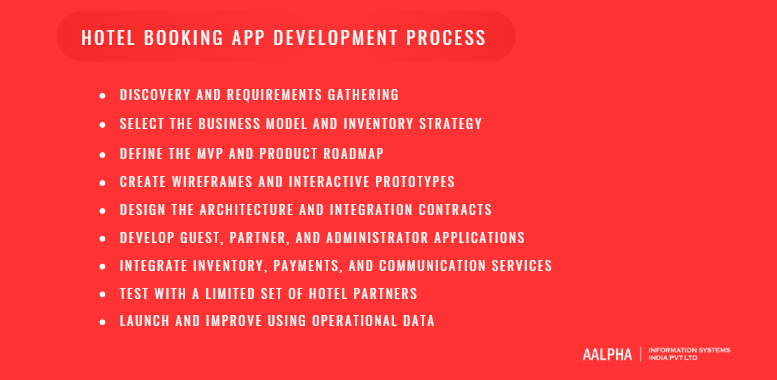
Hotel booking app development follows nine steps: discovery, business model and inventory strategy, MVP and roadmap definition, wireframes and prototypes, architecture and integration contracts, development of guest, partner, and admin apps, integration of inventory and payments, pilot testing with hotel partners, and launch with continuous improvement.
-
Discovery and requirements gathering
Discovery usually takes two to four weeks. The team interviews stakeholders, reviews market research, maps guest and hotel journeys, lists required integrations, and writes user stories with acceptance criteria. The output is a scope document, a feature list ranked by priority, and a first estimate. Skipping discovery is the most common reason booking projects run over budget.
-
Select the business model and inventory strategy
Decide early whether the platform will use direct hotel contracts, channel managers, supplier APIs, or a mix, and whether it will act as agent or merchant. These choices change the data model, payment flows, finance module, and legal obligations, so changing them mid-build is expensive.
-
Define the MVP and product roadmap
The MVP should cover one guest segment, one launch region, one inventory source, and the full booking loop: search, book, pay, confirm, cancel, and pay out. Features such as loyalty, AI search, and digital keys move to later releases. Write the roadmap as three releases with clear goals for each, rather than one long feature list.
-
Create wireframes and interactive prototypes
Designers produce wireframes for every guest, partner, and admin screen, then high-fidelity designs and a clickable prototype. Usability testing with real users at this stage costs days. Fixing the same problems after development costs weeks.
-
Design the architecture and integration contracts
Architects define the data model, services, API contracts, hold and locking logic, reservation state machine, and infrastructure. For each integration, they document the endpoints, data mapping, error handling, and test environment access. Request supplier and PMS sandbox access now, because approvals can take weeks.
-
Develop guest, partner, and administrator applications
Development runs in two-week sprints, with a working build demonstrated at the end of each. Teams usually build the booking engine and core APIs first, then the guest app, then partner and admin dashboards in parallel. Automated tests for availability, pricing, and payments are written alongside the code, not after it.
-
Integrate inventory, payments, and communication services
Integrations are built against sandbox environments and tested with realistic data, including edge cases such as partial availability, rate changes, and supplier timeouts. Many suppliers and PMS vendors require a formal certification test before production access is granted, so schedule it.
-
Test with a limited set of hotel partners
Run a pilot with 5 to 20 hotels and a controlled group of real guests. Pilots expose problems that test environments hide, such as hotels updating rates in the wrong place, unclear cancellation wording, and payout questions. Fix these before opening to the public.
-
Launch and improve using operational data
Release in stages: a soft launch in the first region, monitored closely, then a wider rollout. After launch, review the funnel, support tickets, cancellation reasons, and partner feedback every week, and feed the findings into the next sprint. Most of a booking platform’s value is built in the 12 months after launch.
Hotel booking app development cost and timeline
Hotel booking app development typically costs USD 25,000 to 60,000 for a single-hotel direct booking MVP, USD 80,000 to 200,000 for a marketplace MVP, and USD 200,000 or more for an advanced multi-supplier platform. Timelines range from 3 to 18 months, driven mainly by integrations and platform count.
Cost differences between direct booking and marketplace apps
A direct booking app serves one hotel or chain, uses one inventory source, and needs limited partner tools. A marketplace needs hotel onboarding, multi-source inventory normalisation, commissions, payouts, reviews, moderation, and disputes. Those modules, plus their integrations, usually make a marketplace two to four times the cost of a direct booking app with a similar guest experience.
MVP versus advanced platform development
An MVP proves the booking loop works and that guests and hotels will use it. An advanced platform adds the features that improve margins and retention: personalisation, loyalty, AI search, multiple suppliers, multi-currency payouts, and deeper analytics. Building the advanced version first wastes money on features the market may not need.
The table below gives illustrative ranges. It assumes a blended development rate of USD 25 to 50 per hour from an experienced offshore or nearshore team, iOS and Android apps built with a cross-platform framework, a responsive web frontend, and cloud hosting. Rates in North America or Western Europe can double or triple these figures.
App type and scope | Typical features | Integrations | Estimated cost (USD) | Typical timeline |
Single-hotel direct booking MVP | Search, room and rate selection, checkout, booking management, basic admin | One PMS or booking engine, one payment gateway | 25,000 to 60,000 | 3 to 5 months |
Hotel chain or multi-property app | Brand-wide search, loyalty accounts, property content management, reporting | CRS or several PMS products, payments, CRM | 60,000 to 150,000 | 5 to 8 months |
Hotel marketplace or OTA MVP | Hotel onboarding, inventory calendar, commissions, payouts, reviews, admin and moderation | Channel manager or one supplier API, split payments, maps, messaging | 80,000 to 200,000 | 6 to 10 months |
Advanced multi-supplier platform | Personalisation, AI search, loyalty, multi-currency, advanced analytics, fraud tools | Several suppliers and channel managers, multiple payment providers, CRM, data warehouse | 200,000 to 500,000+ | 10 to 18 months |
Discovery and UX design phase only | Requirements, journeys, wireframes, clickable prototype, architecture plan | Integration assessment | 6,000 to 20,000 | 3 to 6 weeks |
Cost by development phase
As a rough guide for an MVP, discovery and UX design take 10 to 15 percent of the budget, backend and booking engine development 30 to 35 percent, frontend and mobile apps 20 to 25 percent, integrations 15 to 20 percent, and testing, deployment, and project management the remaining 10 to 15 percent. Integration-heavy marketplaces shift more budget to the integration line.
Factors affecting delivery time
Platforms matter: adding native iOS and Android apps on top of a website adds months. Integrations are the largest variable, because supplier certification and sandbox quality are outside the development team’s control. Supplier readiness affects whether contracts and API keys arrive on time. Features such as multi-currency, loyalty, and AI each add weeks. Testing scope grows with every integration and payment method.
Recurring operating expenses
Budget for hosting and managed services, typically USD 300 to 3,000 a month for an MVP depending on traffic. Add map and supplier API fees, SMS and email costs, payment processing fees per transaction, monitoring and error-tracking subscriptions, app store developer accounts, customer support staff, and ongoing maintenance. Annual maintenance commonly runs at 15 to 20 percent of the original build cost and covers OS updates, dependency upgrades, security patches, and supplier API changes.
Commonly overlooked expenses
Teams often forget the cost of onboarding hotels, including photography, content entry, and training. Others include finance staff time for reconciliation and payouts, refunds and chargebacks, translation and localisation for new markets, penetration testing and security reviews, legal review of terms and policies, and supplier certification fees.
How to estimate a realistic project budget
Start with a written scope for the MVP, a list of integrations with their documentation, and the launch markets. Ask for an estimate broken down by phase and module, with stated assumptions. Add a contingency of 15 to 20 percent for integration risk. Then add the first year of operating costs to see the true cost of getting to market. A short paid discovery phase is the most reliable way to turn a rough range into a fixed budget.
Testing and quality assurance
Testing a hotel booking app means checking the full booking flow, inventory consistency under concurrent load, payments and refunds, behaviour during supplier failures, performance, security, and accessibility, and finally acceptance by real hotel partners before launch.
-
Search, room selection, and checkout testing
Test searches across date ranges, occupancy combinations, child ages, and time zones. Confirm that results exclude rooms unavailable on any night, that prices match the rate rules, and that checkout shows the same total as the hotel page. Automate the main booking paths so every release is checked.
-
Inventory consistency and concurrent booking tests
Simulate many guests booking the last rooms at the same moment and confirm that confirmed reservations never exceed inventory. Test hold expiry, abandoned checkouts, and retried requests with the same idempotency key. These tests catch the bugs that cause overbookings in production.
-
Payment, cancellation, and refund testing
Test successful payments, declines, 3D Secure challenges, timeouts, partial refunds, and full refunds, using the provider’s test cards. Check that the refund matches the cancellation policy for each rate plan and that finance reports update correctly.
-
Supplier outage and delayed-response testing
Simulate supplier APIs that are slow, return errors, or go offline. The app should show cached results where safe, block checkout for inventory it cannot confirm, and recover cleanly when the supplier returns. Test the case where payment succeeds but confirmation fails.
-
Performance, security, and accessibility testing
Load-test search and checkout at two to three times the expected peak. Run automated security scans and a penetration test before launch, focusing on authorisation, payment flows, and APIs. Test accessibility with screen readers on iOS and Android and with automated WCAG checks.
-
Hotel partner acceptance testing
Have pilot hotels run their daily tasks in the partner dashboard: updating rates, handling bookings, and checking statements. Their sign-off confirms that the system works for the people who must keep inventory accurate.
Launch, growth, and performance measurement
A successful hotel booking app launch needs enough hotel supply to satisfy searches, a staged release, SEO for destination and hotel pages, a mix of partnerships and paid acquisition, retention through useful notifications and loyalty, and close tracking of conversion and contribution margin.
-
Launch with sufficient hotel supply
Guests who search and find few options do not come back. Before launch, make sure the first region has enough properties across price bands to return useful results for common searches. Concentrating supply in one city works better than spreading it thinly across ten.
-
App store preparation and staged rollout
Prepare store listings with clear screenshots, a short description, and a privacy policy that matches the app’s data practices. Apple and Google both review apps, so allow time for review. Use staged rollouts on Google Play and phased release on the App Store to limit the impact of any launch bug.
-
SEO for destination and hotel pages
Server-rendered destination pages, such as “hotels in Goa” or “hotels near Mumbai airport”, and individual hotel pages can attract organic traffic for years. Each page needs unique content, structured data for hotels, fast load times, and internal links. Avoid thousands of thin pages generated from supplier content alone, since search engines treat them as low quality.
-
Partnerships, referrals, and paid acquisition
Partnerships with airlines, event organisers, employers, and travel communities bring targeted guests at lower cost than ads. Referral credits reward guests for inviting others. Paid search and metasearch listings on Google Hotel Ads or Trivago drive volume but can consume the commission margin, so track cost per booking by channel.
-
Retention through useful notifications and loyalty benefits
Notifications that help, such as price drops on saved hotels, check-in reminders, and rebooking suggestions for regular routes, bring guests back. Promotional pushes that ignore the guest’s history cause uninstalls. Loyalty benefits work best when they are simple, such as a member discount or free late check-out.
-
Track booking conversion and business performance
Track the search-to-booking conversion rate across the funnel, customer acquisition cost by channel, repeat booking rate, cancellation rate by rate plan and source, contribution margin per booking after payment fees, refunds, and support, and support tickets per hundred bookings. Review these weekly in the first months, because each one points to a specific fix.
Common development challenges and how to address them
The most common hotel booking app challenges are inconsistent inventory across channels, price changes between search and checkout, complicated modifications and refunds, dependence on suppliers, conflicts between guest experience and hotel operations, and the extra work of expanding to new markets and currencies.
-
Inconsistent inventory across booking channels
Hotels sell the same rooms through several channels, and delays in synchronisation cause overbookings. Connect through a channel manager or PMS as the single source of truth, re-check availability at checkout, and run daily reconciliation against hotel records.
-
Price changes between search and checkout
Rates can change between a cached search and checkout. Re-price at checkout, lock the price with the hold, and if it has changed, show the new price clearly before payment. Silent changes damage trust and may breach price disclosure rules.
-
Complex modifications and refunds
Date changes, room upgrades, and partial cancellations touch inventory, pricing, payments, and supplier records at once. Model a modification as a controlled sequence: check new availability, calculate the difference, take or refund payment, then confirm with the supplier, with recovery steps for each failure point.
-
Supplier dependency and service interruptions
Relying on one supplier means its outage is your outage. Use timeouts, circuit breakers, and cached content, and where the business model allows, connect a second inventory source for key markets.
-
Balancing guest experience with hotel operations
Guests want flexible cancellation and instant answers, while hotels want guaranteed revenue and fewer changes. Offer both refundable and non-refundable rates with clear pricing differences, and give hotels tools to set their own policies within platform rules.
-
Expanding into additional markets and currencies
Each new market brings languages, currencies, tax rules, payment methods, privacy laws, and new hotel partners. Build multi-currency pricing, localisation, and configurable tax rules into the architecture early, even if the MVP launches in one market, because retrofitting them is costly.
How to choose a development partner and why consider Aalpha
Choose a hotel booking app development partner that has built transactional platforms with live inventory and payments, can show sound architecture, security, and testing practices, offers clear scope and full code ownership, and provides structured post-launch support.
-
Evaluate booking and integration experience
Ask for examples of booking, marketplace, or reservation systems the partner has built, and ask how they handled overbooking, payment failures, and third-party API integration. A team that can explain hold logic and idempotency in plain terms has usually solved these problems before.
-
Review architecture, security, and testing practices
Request a sample architecture document and ask how they test concurrency, payments, and supplier failures. Ask about secure development practices, code reviews, and penetration testing, and whether they follow a recognised quality management process.
-
Confirm scope, code ownership, and handover terms
The contract should state that you own the source code, designs, and documentation, with access to the repository throughout the project. Agree on how scope changes are estimated and approved, and what documentation and knowledge transfer happen at handover.
-
Assess maintenance and post-launch support
Booking platforms need ongoing work for OS updates, supplier API changes, and new features. Ask about support response times, monitoring, and how a retainer or dedicated team arrangement would work after launch.
How Aalpha can support your hotel booking app project
Aalpha Information Systems has built custom software, web, and mobile products since 2008, completing more than 5,500 projects for clients in 55+ countries. The team covers the full project, from paid discovery and UX prototyping to booking engine development, PMS, channel manager, and payment integrations, QA, and post-launch maintenance. Aalpha holds ISO 9001:2015 certification and is rated 4.9 out of 5 across more than 215 verified reviews on Clutch. Clients retain full ownership of the code. One limitation to weigh: as an offshore team based in India, Aalpha works across time zones, so projects run on planned overlap hours and written sprint reporting rather than all-day real-time availability.
Frequently asked questions
How much does hotel booking app development cost?
A single-hotel direct booking MVP typically costs USD 25,000 to 60,000. A multi-property chain app costs USD 60,000 to 150,000, a marketplace MVP USD 80,000 to 200,000, and an advanced multi-supplier platform USD 200,000 or more. These figures assume an experienced offshore team at USD 25 to 50 per hour. Integrations, platform count, and launch markets cause most of the variation.
How long does it take to build a hotel booking app?
A focused direct booking MVP takes 3 to 5 months. A marketplace MVP takes 6 to 10 months, and an advanced platform 10 to 18 months. Supplier and PMS certification often sets the timeline, so request sandbox access during discovery.
What features should a hotel booking MVP include?
An MVP needs date and occupancy search, filters and a map, hotel and room details, rate plans with clear cancellation terms, the full price before payment, secure checkout, confirmation, booking management, cancellation with refund tracking, a partner dashboard for inventory and reservations, and an admin panel. Loyalty, AI search, and digital keys can wait.
Do I need a mobile app, a website, or both?
Most platforms need both. A responsive website captures first-time guests from search engines and ads, while a mobile app serves repeat guests with saved details, notifications, and in-stay features. If budget allows only one, start with the website plus a mobile-friendly design, and add apps once repeat bookings justify them.
How do booking apps obtain hotel inventory?
Booking apps get inventory through direct contracts with hotels, using an extranet or PMS integration, through channel managers that distribute hotels’ rates and availability, or through wholesale suppliers and partner APIs such as bed banks. Many marketplaces combine direct contracts in core markets with supplier APIs for wider coverage.
How can a platform reduce double bookings?
Use one source of truth for inventory, re-check availability at checkout, place short inventory holds, apply atomic conditional updates inside database transactions, and use idempotency keys for payment and booking requests. Daily reconciliation with hotel and supplier records catches the rare cases that slip through.
Can the app integrate with an existing hotel management system?
Yes. Most modern PMS products, including Oracle OPERA Cloud, Mews, and Cloudbeds, offer APIs or connect through channel managers. Integration usually requires vendor approval and a certification step. Older on-premise systems may need a channel manager or middleware in between.
How do hotel booking platforms make money?
Platforms earn through commissions on completed stays, monthly subscriptions for hotels, markups under the merchant model, sponsored listings and advertising, and ancillary sales such as transfers and upgrades. Many combine two models, for example commission plus paid placement.
Should AI features be included in the first release?
Usually not. The first release should prove that the core booking loop works and that guests and hotels use it. AI search, recommendations, and review summaries add more value once there is enough real data and the inventory feed is reliable. A simple AI feature, such as machine-translated hotel descriptions, can be an exception when the launch market needs several languages.
Discuss your hotel booking app with Aalpha
If you are planning a direct booking app, a hotel marketplace, or a corporate booking platform, the fastest way to a reliable budget is a short scoping conversation. Share your business model, launch market, and the systems your hotel partners use, and Aalpha’s team will outline an MVP scope, integration approach, and phased estimate. Get in touch with Aalpha Information Systems to discuss your requirements and project.