


Backend architecture is the structural foundation that determines how a software system behaves under real-world conditions. It defines how data flows through the system, how business rules are enforced, how components communicate, and how the application responds to growth, failures, and security threats. While users never directly interact with the backend, every user-facing experience is shaped by backend decisions. Performance bottlenecks, security breaches, scaling failures, and high operational costs almost always trace back to architectural choices made early in the product lifecycle. Understanding backend architecture is therefore not a purely technical exercise. It is a strategic discipline that connects engineering decisions to long-term product viability.
What Backend Architecture Means in Modern Software Systems
Backend architecture refers to the structured design of server-side systems that handle application logic, data storage, integrations, and infrastructure concerns. In practical terms, it defines responsibility boundaries between components, such as how APIs expose functionality, how business logic is isolated from data access, and how infrastructure services support application workloads. A well-designed backend ensures that each part of the system has a clearly defined role and interacts with other parts through predictable interfaces.
At the core of backend architecture is data flow management. Every request entering the system follows a defined path: from the API layer through validation and authorization, into business logic, and finally to data stores or external services. Architecture determines whether this flow is synchronous or asynchronous, tightly coupled or loosely connected, and resilient to partial failures. Poorly designed data flow results in cascading failures, slow response times, and fragile integrations that break under load.
System coordination is another critical aspect. Modern backends rarely operate as a single executable. They coordinate multiple services, databases, caches, queues, and third-party integrations. Backend architecture defines how these components communicate, how failures are isolated, and how state is managed across distributed systems. Decisions around statelessness, messaging, and service boundaries directly influence scalability and reliability.
Backend decisions also determine long-term maintainability. Architecture influences how easily developers can add features, refactor logic, or fix defects without unintended side effects. Systems with clear boundaries and consistent patterns are easier to understand and evolve. In contrast, tightly coupled architectures accumulate technical debt that slows development and increases risk over time. For this reason, backend architecture is less about frameworks or languages and more about designing systems that remain understandable and adaptable as complexity grows.
Why Backend Architecture Determines Product Success or Failure
Backend architecture has a direct and measurable impact on product performance. Response times, throughput, and system stability depend on how workloads are distributed, how data is accessed, and how concurrency is handled. Architectural shortcuts that work at low traffic volumes often fail when usage increases, leading to degraded user experience and service outages. Once a system reaches this point, fixing performance issues usually requires costly rewrites rather than incremental improvements.
Cost is another decisive factor. Infrastructure expenses are shaped by architectural efficiency. Systems that rely on synchronous processing for every operation consume more compute resources and scale poorly under load. Inefficient data access patterns increase database costs and operational overhead. A thoughtful backend architecture optimizes resource usage by leveraging caching, asynchronous processing, and horizontal scaling, keeping costs aligned with actual demand.
Developer velocity is strongly influenced by backend structure. When architecture enforces clear separation between concerns, teams can work in parallel, test components independently, and deploy changes with confidence. Conversely, monolithic and tightly coupled systems slow down development because small changes require broad understanding and extensive regression testing. Over time, reduced velocity limits a company’s ability to respond to customer feedback and competitive pressure.
Security posture is also an architectural outcome. Authentication models, authorization boundaries, data access controls, and audit mechanisms are all embedded in backend design. Systems that treat security as an add-on often expose excessive attack surfaces and lack visibility into sensitive operations. Software Architecture that embeds security principles from the start reduces risk, simplifies compliance, and limits the blast radius of potential breaches.
Most importantly, backend architecture determines adaptability. As business requirements evolve, products must support new features, integrations, and usage patterns. Architecture that anticipates change allows teams to extend functionality without destabilizing the system. Rigid architectures lock products into outdated assumptions, making growth expensive and risky.
How Backend Architecture Has Evolved Over the Last Decade
Backend architecture has evolved in response to increasing system complexity and scale. Early systems were commonly built as monoliths, where application logic, data access, and presentation concerns were deployed as a single unit. This approach simplified development and deployment for small teams but struggled as systems grew in size and traffic.
As applications expanded, teams began separating concerns through layered architectures and service-oriented designs. This shift improved maintainability and enabled partial scaling but introduced challenges around coordination and communication. The rise of APIs formalized interaction boundaries, allowing backends to serve multiple clients such as web, mobile, and third-party systems.
Modern backend architecture emphasizes distributed and cloud-native design. Systems are now composed of independently deployable services, event-driven workflows, and managed infrastructure components. Stateless services, asynchronous processing, and automated scaling are common patterns that address variability in load and usage. Observability and resilience have become architectural requirements rather than operational afterthoughts.
Despite these changes, the core objective remains the same: to design backend systems that are reliable, secure, scalable, and maintainable. The evolution of backend architecture reflects a deeper understanding that long-term success depends not on adopting trends, but on aligning architectural decisions with real-world operational demands and business growth.
Core Principles of Backend Architecture
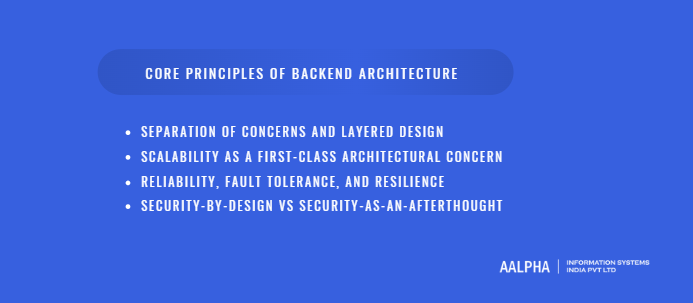
Strong backend architecture is built on a small set of foundational principles that remain relevant regardless of technology choices or deployment environments. These principles guide how systems are structured, how responsibilities are divided, and how software behaves under stress. Teams that consistently apply these principles create backends that scale predictably, remain secure, and adapt to change without constant rewrites. Ignoring them often leads to fragile systems that become increasingly expensive to operate and evolve.
-
Separation of Concerns and Layered Design
Separation of concerns is the practice of dividing a backend system into distinct logical layers, each responsible for a specific aspect of the application’s behavior. Common layers include the API or interface layer, business or domain logic layer, data access layer, and infrastructure or integration layer. Each layer has clearly defined responsibilities and communicates with other layers through explicit contracts. This structure prevents unrelated concerns from becoming entangled and reduces the cognitive load required to understand the system.
Layered design is essential for responsibility isolation. Business rules should not depend on database schemas, and data access logic should not leak into request handling code. When boundaries are respected, changes in one layer can be made with minimal impact on others. For example, modifying how data is stored or retrieved should not require rewriting business logic or external APIs. This isolation is a key factor in long-term maintainability.
Tightly coupled systems violate these boundaries. In such systems, components directly depend on internal details of other components, creating hidden dependencies. Under scale, these dependencies become points of failure. A performance issue in the database layer may propagate through the entire system, or a small change in business logic may require redeploying unrelated components. As traffic increases and teams grow, tightly coupled architectures slow development and amplify risk.
Layered design also enables independent testing and clearer ownership. Teams can test business logic without relying on live databases, and infrastructure changes can be validated without affecting core functionality. This discipline is not about adding complexity but about controlling it. Systems that respect separation of concerns remain understandable and flexible even as features and integrations multiply.
-
Scalability as a First-Class Architectural Concern
Scalability is the ability of a backend system to handle increased load without degrading performance or reliability. Treating scalability as a first-class concern means designing for growth from the outset rather than reacting to problems after they appear. Architectural decisions around state management, data access, and communication patterns determine whether a system can scale smoothly or requires disruptive rework.
Two fundamental approaches to scaling are vertical and horizontal scaling. Vertical scaling involves adding more resources to a single instance, such as increasing CPU or memory. While simple, it has clear limits and creates single points of failure. Horizontal scaling distributes load across multiple instances, allowing systems to grow incrementally and tolerate failures. Modern backend architecture favors horizontal scaling because it aligns with cloud environments and dynamic workloads.
Statelessness is a core principle that enables horizontal scaling. Stateless services do not store user-specific or request-specific state in memory between requests. Instead, state is stored in external systems such as databases or caches. This allows requests to be handled by any available instance, simplifying load balancing and failover. Stateful designs restrict scalability and complicate recovery during outages.
Growth-ready design also requires attention to data scalability. Databases must support increased read and write volumes without becoming bottlenecks. This often involves read replicas, partitioning strategies, and caching layers. Backend architecture that anticipates these needs avoids sudden performance cliffs as usage grows.
Scalability is not only about traffic. It also applies to team size and feature velocity. Architectures that support independent deployment, clear ownership, and predictable behavior allow organizations to scale engineering efforts alongside user growth.
-
Reliability, Fault Tolerance, and Resilience
Reliability in backend systems means consistent and correct behavior over time. Fault tolerance and resilience describe how systems respond when components fail. In distributed environments, failures are inevitable. Networks degrade, services crash, and dependencies become unavailable. Backend architecture must assume these conditions rather than treating them as exceptions.
Redundancy is a primary mechanism for reliability. Critical components such as application servers and databases are replicated so that failure of a single instance does not disrupt the system. Load balancers distribute traffic across healthy instances, and health checks remove failing components automatically. Redundancy reduces downtime but must be paired with proper coordination to avoid data inconsistency.
Graceful degradation ensures that partial failures do not lead to complete outages. When non-critical components fail, the system continues to operate with reduced functionality. For example, a backend may temporarily disable optional features rather than rejecting all requests. Architectural support for degradation requires clear dependency management and fallback mechanisms.
Failure isolation limits the blast radius of errors. Well-designed architectures prevent failures in one service from cascading across the system. Techniques such as timeouts, circuit breakers, and asynchronous processing help contain issues. By isolating failures, backend systems remain usable even under adverse conditions.
-
Security-by-Design vs Security-as-an-Afterthought
Security-by-design means embedding security considerations into backend architecture from the earliest stages. This approach contrasts with security-as-an-afterthought, where controls are added reactively in response to incidents or compliance requirements. Architectural decisions around authentication, authorization, data access, and communication channels determine the system’s security posture.
Backend architecture defines trust boundaries. It determines which components can access sensitive data, how identities are verified, and how permissions are enforced. When these boundaries are unclear or inconsistent, systems become difficult to secure. Retroactively adding access controls to a loosely structured backend often introduces gaps and complexity.
Data protection is another architectural concern. Decisions about encryption, key management, and data flow affect confidentiality and integrity. Secure systems minimize data exposure by limiting access to only what is necessary for each component. This principle, often referred to as least privilege, is easiest to enforce when supported by clear architectural boundaries.
Security-by-design also improves auditability and compliance. Systems with well-defined access paths and consistent authorization models are easier to monitor and review. This reduces operational risk and simplifies ongoing governance. Ultimately, backend architecture that treats security as a foundational principle produces systems that are safer, more predictable, and easier to trust at scale.
Common Backend Architecture Patterns
Backend architecture patterns provide proven structural approaches for organizing server-side systems. Each pattern reflects trade-offs between simplicity, scalability, operational complexity, and development speed. There is no universally superior architecture. The effectiveness of a pattern depends on product maturity, team structure, operational requirements, and long-term business goals. Understanding the strengths and limitations of each pattern is essential for making informed architectural decisions.
-
Monolithic Architecture: Strengths, Limits, and Use Cases
Monolithic architecture is the traditional approach where the entire backend application is built, deployed, and operated as a single unit. All core components such as API handling, business logic, data access, and integrations live within one codebase and typically run as a single process or tightly coupled set of processes. This pattern is often the starting point for many products because it minimizes initial complexity.
One of the key strengths of monolithic architecture is simplicity. Development teams work within a single repository, use a shared runtime, and deploy one artifact. This reduces coordination overhead and makes debugging easier in early stages. Local development, testing, and deployment pipelines are straightforward, which accelerates initial delivery. For small teams or early-stage products, this simplicity often outweighs concerns about long-term scalability.
Monoliths also offer strong performance characteristics in low to moderate scale environments. Function calls within a single process are faster than network-based communication between services. Transactions across different parts of the system are easier to manage, particularly when working with a single database. These properties make monoliths suitable for applications with well-defined scope and predictable workloads.
However, monolithic architectures face clear limits as systems grow. Tight coupling between components makes changes riskier over time. A modification in one area can unintentionally affect unrelated functionality, increasing regression risk. As the codebase grows, build times lengthen, deployments become slower, and understanding system behavior requires broader context.
Scaling monoliths is also challenging. Horizontal scaling often requires duplicating the entire application, even if only one part experiences heavy load. This leads to inefficient resource usage and higher infrastructure costs. For these reasons, monolithic architecture is best suited for early-stage products, internal tools, or applications with stable requirements and modest growth expectations.
-
Microservices Architecture: When and Why It Works
Microservices architecture decomposes a backend system into multiple independently deployable services, each responsible for a specific business capability. Services communicate through well-defined APIs or messaging systems and are typically owned by small, autonomous teams. This pattern emerged as a response to the scaling and maintainability challenges of large monoliths.
The primary advantage of microservices is independent scalability. Each service can scale based on its own workload characteristics, allowing efficient use of resources. A service that handles high read traffic can be replicated independently, while less critical services remain unchanged. This granular scaling model aligns well with dynamic workloads and cloud-based infrastructure.
Microservices also improve organizational scalability. Teams can develop, test, and deploy services independently, reducing coordination bottlenecks. Clear service boundaries encourage ownership and accountability. Over time, this autonomy increases development velocity and enables faster iteration on individual features.
Another benefit is fault isolation. Failures in one service are less likely to bring down the entire system if communication boundaries and resilience patterns are properly implemented. This containment improves overall system reliability and reduces the impact of defects or outages.
Despite these advantages, microservices introduce significant complexity. Distributed systems require robust service discovery, monitoring, logging, and failure handling. Network latency, partial failures, and data consistency become everyday concerns. Without strong engineering discipline, microservices can devolve into a tangled network of dependencies that is harder to manage than a monolith.
Microservices are most effective when systems have reached sufficient scale to justify the overhead. They work best for organizations with mature DevOps practices, clear domain boundaries, and teams capable of owning services end to end. Adopting microservices prematurely often slows development rather than accelerating it.
-
Modular Monoliths and Hybrid Architectures
Modular monoliths represent a middle ground between traditional monoliths and fully distributed microservices. In this pattern, the system remains a single deployable unit but is internally structured into well-defined modules with strict boundaries. Each module encapsulates a specific domain or feature set and interacts with others through explicit interfaces.
The key benefit of a modular monolith is controlled complexity. Teams gain many of the maintainability advantages of microservices without the operational overhead of distributed systems. Modules can be developed and tested independently, and internal contracts reduce coupling. This structure makes the codebase easier to understand and evolve over time.
Modular monoliths also provide a smoother migration path. As certain modules grow in complexity or demand independent scaling, they can be extracted into separate services with minimal disruption. This incremental evolution reduces the risk associated with large architectural shifts.
Hybrid architectures extend this idea by combining multiple patterns within a single system. For example, core business logic may reside in a modular monolith, while high-traffic or specialized components operate as independent services. Event-driven subsystems may coexist alongside synchronous APIs. This pragmatic approach allows architects to apply different patterns where they make the most sense.
Hybrid architectures require careful boundary management to avoid inconsistency. Clear ownership, documentation, and governance are essential. When executed well, they offer flexibility and balance, supporting both short-term delivery and long-term scalability.
-
Event-Driven and Message-Based Architectures
Event-driven and message-based architectures focus on asynchronous communication between components. Instead of services calling each other directly and waiting for responses, they publish events or messages to a broker. Other components consume these messages and react accordingly. This decoupling changes how systems scale and evolve.
One major advantage of event-driven architecture is loose coupling. Producers of events do not need to know which consumers exist or how they process data. This independence allows teams to add new functionality without modifying existing services. As systems grow, this flexibility becomes increasingly valuable.
Asynchronous processing also improves scalability and resilience. Workloads can be distributed across multiple consumers, and spikes in traffic can be buffered through message queues. If a consumer fails, messages can be retried or processed later without blocking the entire system. This model is well-suited for background processing, data pipelines, and real-time updates.
Event-driven systems also support complex workflows through event chaining and orchestration. Business processes can be modeled as sequences of events rather than tightly coupled procedures. This approach improves observability and adaptability but requires careful design to avoid hidden dependencies.
The primary challenge of event-driven architecture is complexity in reasoning about system behavior. Asynchronous flows are harder to trace, and debugging requires strong observability tooling. Data consistency models must be explicitly defined, as immediate consistency is often replaced with eventual consistency.
Event-driven and message-based architectures are most effective for systems that require high scalability, flexibility, and resilience. When combined with clear event schemas and robust monitoring, they form the backbone of modern, scalable backend systems.
Backend Application Layers Explained
Backend systems remain understandable and scalable when responsibilities are divided into clear application layers. Each layer focuses on a specific type of concern and interacts with other layers through well-defined interfaces. This structure reduces coupling, improves testability, and allows systems to evolve without constant rewrites. While implementations vary, most robust backend architectures follow a layered approach to control complexity and maintain long-term stability.
-
Presentation and API Layer Responsibilities
The presentation or API layer is the entry point into the backend system. It is responsible for receiving requests from clients, validating input, enforcing access control, and shaping responses. This layer translates external communication protocols such as HTTP, gRPC, or messaging formats into internal representations that the rest of the system can process.
A key responsibility of the API layer is request validation. It ensures that incoming data conforms to expected formats and constraints before it reaches business logic. Early validation prevents unnecessary processing and reduces the risk of invalid or malicious input propagating through the system. Authentication and authorization checks are also commonly enforced at this layer, establishing the identity and permissions of the caller.
The API layer should remain thin. It should not contain business rules or data access logic. Instead, it delegates processing to the domain layer and focuses on orchestration and protocol concerns. This separation allows business logic to be reused across multiple interfaces, such as web applications, mobile clients, or third-party integrations.
Another important responsibility is response shaping. The API layer controls how internal data structures are exposed externally, ensuring that clients receive consistent and stable responses. Versioning and backward compatibility are often managed here to allow evolution without breaking existing consumers. When designed correctly, the API layer acts as a stable contract that decouples clients from internal implementation details.
-
Business Logic and Domain Layer Design
The business logic or domain layer contains the core rules that define how the system behaves. It represents the problem space the application is designed to solve and encodes business policies, workflows, and invariants. This layer is the most valuable part of the backend because it captures organizational knowledge in executable form.
A well-designed domain layer is independent of technical concerns such as databases, frameworks, or transport protocols. It operates on domain concepts rather than infrastructure details. For example, it should express operations in terms of orders, users, or transactions, not SQL queries or HTTP requests. This abstraction improves clarity and makes the system easier to reason about.
Encapsulation is central to domain design. Business rules should be enforced consistently in one place rather than scattered across the codebase. This prevents duplication and reduces the risk of conflicting behavior. When rules change, updates can be made with confidence that all relevant paths are covered.
The domain layer also coordinates complex workflows. It may invoke multiple operations, apply conditional logic, and trigger side effects such as events or notifications. Clear boundaries ensure that these workflows remain testable and predictable. By isolating business logic, teams can validate system behavior through unit tests without relying on external systems.
Over time, a strong domain layer enables adaptability. New features can be built by extending existing concepts rather than rewriting logic. This flexibility is critical for systems that must evolve alongside changing business requirements.
-
Data Access Layer and Repository Patterns
The data access layer is responsible for interacting with persistent storage systems. It translates domain-level operations into database queries or storage actions and maps stored data back into domain objects. This layer abstracts the specifics of data storage, allowing the rest of the system to remain independent of database technology.
Repository patterns are commonly used to structure data access. A repository provides a collection-like interface for retrieving and storing domain entities. This approach hides query details and centralizes data access logic. When storage schemas change, updates are confined to the repository layer rather than spread throughout the application.
Isolation of data access improves testability. Domain logic can be tested using in-memory or mocked repositories, avoiding reliance on live databases. This reduces test complexity and improves reliability. It also supports future changes, such as migrating to different storage systems or introducing caching layers.
The data access layer also plays a role in performance optimization. Query tuning, batching, and caching strategies are implemented here to balance efficiency and correctness. By keeping these concerns localized, teams can optimize data interactions without affecting business logic or APIs.
-
Infrastructure and Cross-Cutting Concerns
Infrastructure and cross-cutting concerns support the entire backend system rather than a single layer. These include logging, monitoring, configuration management, security enforcement, and communication with external services. Although they are not part of business logic, they significantly influence system behavior and reliability.
Cross-cutting concerns should be implemented in a consistent and centralized manner. Logging and monitoring provide visibility into system health and performance. When applied uniformly, they enable faster diagnosis of issues and support proactive maintenance. Configuration management ensures that environment-specific settings are handled safely and predictably.
Security mechanisms such as encryption, access control enforcement, and audit logging often span multiple layers. Architectural support for these concerns reduces duplication and minimizes the risk of inconsistent behavior. Similarly, integrations with external services should be abstracted to avoid coupling core logic to third-party APIs.
By treating infrastructure as a distinct concern, backend architecture remains clean and focused. This separation allows teams to improve operational capabilities without altering domain logic, reinforcing stability as systems grow in complexity.
Designing Scalable Backend Systems
Scalability is not a single feature that can be added to a backend system after launch. It is an architectural outcome shaped by how services manage state, distribute traffic, process workloads, and store data. Systems that scale reliably are designed with the assumption that growth is inevitable and uneven. Traffic spikes, new features, and expanding user bases place pressure on different parts of the backend at different times. A scalable architecture absorbs this pressure without degrading performance, reliability, or cost efficiency.
-
Horizontal Scaling and Stateless Backend Design
Horizontal scaling is the practice of increasing system capacity by adding more instances of a service rather than making individual instances more powerful. This approach is favored in modern backend architecture because it avoids single points of failure and aligns with cloud-native infrastructure. When a backend can run multiple identical instances behind a load balancer, capacity can be increased incrementally and failures can be tolerated without service disruption.
Stateless backend design is a prerequisite for effective horizontal scaling. A stateless service does not retain client-specific or session-specific information in memory between requests. Each request is self-contained and can be handled by any available instance. State is externalized to shared systems such as databases, caches, or distributed session stores. This design allows traffic to be distributed freely and simplifies instance replacement during failures or deployments.
Stateful services limit scalability because requests must be routed to specific instances that hold the required state. This creates coordination overhead and complicates recovery when instances fail. Stateless design eliminates this dependency, making scaling predictable and resilient. It also simplifies deployment strategies such as rolling updates and blue-green deployments, where instances are frequently added and removed.
Designing stateless services requires discipline. Authentication tokens, user context, and workflow progress must be encoded in requests or stored externally. While this may increase reliance on shared systems, the trade-off is improved scalability and fault tolerance. In practice, stateless backend design forms the foundation on which all other scaling strategies depend.
-
Load Balancing and Traffic Distribution
Load balancing is the mechanism that distributes incoming traffic across multiple backend instances. It ensures that no single instance becomes overwhelmed while others remain idle. Effective load balancing improves performance, availability, and resource utilization, making it a core component of scalable backend architecture.
At a basic level, load balancers route requests using simple algorithms such as round-robin or least connections. More advanced strategies account for instance health, response times, and geographic proximity. Health checks continuously monitor backend instances and remove unhealthy ones from rotation, preventing failures from propagating to users.
Traffic distribution also involves managing different types of workloads. Read-heavy and write-heavy operations may require separate handling paths. Some systems route specific traffic types to specialized services or clusters optimized for those workloads. This separation improves performance and allows independent scaling of critical paths.
Load balancing extends beyond application servers. Databases, caches, and message consumers also require distribution strategies to avoid bottlenecks. Backend architecture must consider traffic patterns holistically, ensuring that each layer can handle increased load without becoming a constraint. Properly implemented load balancing enables systems to grow smoothly while maintaining consistent user experience.
-
Caching Strategies for Performance and Cost Control
Caching is one of the most effective techniques for improving backend performance and controlling infrastructure costs. By storing frequently accessed data in faster storage layers, systems reduce repeated computation and database queries. This lowers latency and decreases load on primary data stores.
Caching can be applied at multiple levels. Application-level caches store computed results or domain objects in memory or distributed cache systems. Database query caches reduce repeated reads for identical queries. HTTP-level caching allows responses to be reused by clients or intermediary systems. Each layer serves a different purpose and must be configured carefully to avoid stale or inconsistent data.
Effective caching strategies require understanding data access patterns. Not all data benefits equally from caching. Highly dynamic or user-specific data may require short-lived caches or bypass caching altogether. In contrast, reference data or read-heavy endpoints often deliver substantial performance gains when cached aggressively.
Cache invalidation is the primary challenge. Backend architecture must define when and how cached data is refreshed or removed. Poor invalidation strategies lead to stale responses and inconsistent behavior. Well-designed systems use explicit expiration policies, event-based invalidation, or versioned keys to manage cache lifecycle predictably.
Beyond performance, caching has a direct impact on cost. Reducing database load allows systems to operate with smaller clusters and fewer resources. In large-scale systems, effective caching often determines whether growth remains economically viable.
-
Asynchronous Processing and Background Jobs
Asynchronous processing decouples request handling from long-running or non-critical tasks. Instead of performing all work synchronously within a request-response cycle, backend systems offload certain operations to background jobs or message queues. This approach improves responsiveness and allows systems to handle higher throughput.
Common use cases for asynchronous processing include sending notifications, generating reports, processing uploads, and integrating with external services. These tasks do not need to complete before responding to the user. By enqueueing work and processing it separately, backend services remain fast and responsive under load.
Message queues and task schedulers coordinate asynchronous workflows. They buffer spikes in demand and distribute work across multiple workers. If a worker fails, tasks can be retried or reassigned without affecting the primary system. This design improves resilience and simplifies error handling.
Asynchronous processing also supports scalable event-driven architectures. Services can react to events independently, enabling flexible workflows and easier extension. However, it introduces complexity in monitoring and debugging. Backend architecture must include robust observability to trace asynchronous flows and detect failures.
When used appropriately, asynchronous processing transforms scalability. It allows systems to absorb variable workloads gracefully and prevents non-essential tasks from limiting throughput.
-
Database Scalability and Data Partitioning
Databases are often the first component to experience scalability limits. Backend architecture must address database growth explicitly to avoid bottlenecks that undermine the entire system. Scalability strategies depend on workload characteristics, data volume, and consistency requirements.
Read scalability is commonly achieved through replication. Read replicas distribute query load while a primary node handles writes. This approach improves performance for read-heavy systems but requires careful handling of replication lag. Applications must tolerate eventual consistency in some scenarios.
Write scalability is more challenging and often requires data partitioning. Partitioning, also known as sharding, divides data across multiple nodes based on defined keys such as user identifiers or geographic regions. This distributes write load and storage capacity but increases complexity in query routing and transaction management.
Backend architecture must align data partitioning strategies with access patterns. Poorly chosen partition keys lead to uneven load distribution and hotspots. Well-designed partitioning enables linear scaling as data and traffic grow.
In addition to structural strategies, databases benefit from indexing, query optimization, and batching. These techniques reduce resource usage and improve throughput. By treating database scalability as an architectural concern rather than an operational fix, backend systems remain stable and performant as they grow.
Designing scalable backend systems requires coordinated decisions across services, infrastructure, and data layers. When these elements work together, scalability becomes a predictable outcome rather than a recurring crisis.
Backend Security Architecture
Backend security architecture defines how a system protects data, enforces trust boundaries, and resists both external and internal threats. Security failures rarely originate from a single vulnerability. They emerge from architectural gaps such as excessive privileges, unclear ownership of sensitive data, or inconsistent enforcement of controls. A secure backend is therefore not the result of isolated fixes but of deliberate design choices that shape how authentication, authorization, data handling, and observability work together across the system.
-
Authentication and Authorization Models
Authentication and authorization form the foundation of backend security. Authentication establishes who a caller is, while authorization determines what that caller is allowed to do. These concerns must be clearly separated and consistently enforced across all backend services.
Modern backend systems typically rely on token-based authentication models. After identity verification, clients receive cryptographically signed tokens that represent their identity and session context. These tokens are presented with each request, allowing stateless services to validate identity without maintaining server-side session state. This approach supports horizontal scaling and reduces attack surfaces associated with centralized session stores.
Authorization models define access rules at different levels of granularity. Role-based access control assigns permissions based on predefined roles, simplifying management in many systems. Attribute-based access control evaluates permissions dynamically based on user attributes, resource properties, and contextual factors. While more complex, this model provides greater flexibility and precision.
Architectural clarity is critical. Authorization logic should be centralized or consistently implemented through shared components to avoid drift. When authorization checks are scattered or duplicated, gaps inevitably appear. Backend architecture must also define how service-to-service authentication is handled. Internal services require strong identity verification to prevent lateral movement in the event of a breach.
Well-designed authentication and authorization models support scalability, reduce operational risk, and provide a clear security posture that can be audited and extended as systems grow.
-
Securing APIs and Backend Services
APIs are the primary attack surface for most backend systems. Securing them requires a combination of protocol-level protections, input validation, and architectural controls. Every exposed endpoint must assume that requests may be malicious or malformed.
Transport security is non-negotiable. All communication between clients and backend services should be encrypted in transit to protect credentials and sensitive data. Equally important is securing internal service communication, which is often overlooked. Backend architecture must enforce encrypted and authenticated communication within the system, not just at the perimeter.
Input validation and request normalization prevent common attack vectors such as injection and data tampering. Validation should occur as early as possible in the request lifecycle and follow strict schemas. Relying solely on downstream checks increases risk and complicates error handling.
Rate limiting and throttling protect backend services from abuse and denial-of-service scenarios. These controls ensure that no single client or integration can overwhelm the system. Architectural support for rate limits enables consistent enforcement across all entry points.
API security also involves managing exposure. Backend architecture should minimize publicly accessible endpoints and avoid leaking internal implementation details. Clear separation between public APIs and internal services reduces the attack surface and simplifies monitoring.
-
Data Protection, Encryption, and Key Management
Data protection is a core responsibility of backend architecture. Sensitive data must be safeguarded throughout its lifecycle, including storage, processing, and transmission. Architectural decisions determine whether data exposure is limited or widespread.
Encryption at rest protects data stored in databases, file systems, and backups. Even if storage systems are compromised, encrypted data remains unreadable without proper keys. Encryption in transit ensures that data moving between services or clients cannot be intercepted or altered.
Key management is as important as encryption itself. Keys must be generated, stored, rotated, and revoked securely. Backend architecture should rely on centralized key management mechanisms rather than embedding secrets in code or configuration files. Automated rotation reduces the risk of long-lived credentials being abused.
Data minimization reduces risk by limiting what is stored and processed. Backend systems should avoid retaining sensitive data longer than necessary and restrict access to only the components that require it. Clear data flow diagrams help enforce these boundaries and support auditing.
When data protection is treated as an architectural concern, security becomes systematic rather than reactive. This approach reduces the impact of breaches and simplifies compliance obligations.
-
Threat Modeling and Attack Surface Reduction
Threat modeling is the process of identifying potential attack vectors and understanding how adversaries might exploit a backend system. This exercise informs architectural decisions that reduce exposure and strengthen defenses.
Backend architecture must clearly define trust boundaries. Components on different sides of these boundaries require different levels of validation and monitoring. Public-facing services face higher risk and must be hardened accordingly. Internal services should still authenticate requests and validate inputs to prevent lateral attacks.
Reducing the attack surface involves minimizing exposed endpoints, disabling unused features, and restricting network access. Architectural choices such as private networks, service isolation, and least-privilege access significantly limit what attackers can reach.
Threat modeling also highlights dependency risks. Third-party integrations and libraries introduce external trust relationships that must be managed carefully. Backend architecture should isolate these dependencies and monitor their behavior to detect anomalies.
By integrating threat modeling into architectural planning, teams proactively address security risks rather than reacting to incidents after damage occurs.
-
Compliance, Auditing, and Access Controls
Compliance requirements influence backend security architecture by imposing standards for data handling, access control, and auditability. Even systems not subject to formal regulation benefit from compliance-oriented design because it improves transparency and accountability.
Access controls must be consistently enforced and logged. Backend architecture should record who accessed what data, when, and through which interface. These logs provide essential context during investigations and support ongoing monitoring.
Auditing capabilities depend on architectural support for traceability. Actions should be traceable across services and layers without manual correlation. This requires consistent identity propagation and structured logging.
Compliance also affects data retention and deletion policies. Backend systems must implement mechanisms to enforce retention limits and support secure deletion when required. Architectural clarity ensures these policies are applied uniformly rather than through ad hoc scripts.
When compliance and auditing are embedded into backend architecture, they strengthen security rather than burden development. Systems become easier to govern, easier to trust, and more resilient in the face of evolving regulatory expectations.
Backend Architecture for High Availability and Reliability
High availability and reliability are outcomes of deliberate architectural planning, not byproducts of infrastructure choice. Backend systems that operate continuously under real-world conditions must tolerate failures, recover quickly, and provide visibility into their own behavior. Hardware faults, network disruptions, software bugs, and dependency outages are inevitable. Architecture determines whether these events result in minor degradation or complete system failure.
-
Redundancy, Failover, and Backup Strategies
Redundancy is the foundation of high availability. Critical backend components must exist in multiple instances so that the failure of one does not interrupt service. Application servers are typically replicated across multiple nodes, allowing traffic to be rerouted automatically when an instance becomes unhealthy. This replication ensures continuity during both unexpected outages and planned maintenance.
Failover mechanisms coordinate the transition from failed components to healthy ones. Automated failover is essential because manual intervention introduces delay and increases downtime. Load balancers and health checks detect failures and redirect traffic without requiring application-level changes. At the data layer, failover strategies must account for consistency and integrity. Primary-replica setups enable read continuity and controlled promotion of replicas when the primary becomes unavailable.
Backups provide protection against data loss rather than immediate availability. Backend architecture must include regular, automated backups of critical data stores and configuration states. Backups should be stored independently of the primary system to prevent correlated failures. Equally important is testing restoration procedures. Backups that cannot be restored reliably offer false confidence and do not contribute to resilience.
Effective redundancy and backup strategies are layered. Application-level replication, infrastructure-level redundancy, and data-level backups work together to minimize downtime and recovery time. When these layers are coordinated architecturally, systems recover gracefully from both transient and catastrophic failures.
-
Designing for Partial Failures
In distributed systems, partial failures are more common than total outages. A single service may become slow or unavailable while the rest of the system continues to function. Backend architecture must assume these conditions and prevent localized issues from cascading into system-wide failures.
One key technique is isolating dependencies. Services should interact through well-defined interfaces and avoid synchronous chains that span multiple components. When a dependency fails or degrades, timeouts and circuit breakers prevent requests from blocking indefinitely. These mechanisms allow the system to fail fast and recover once dependencies stabilize.
Graceful degradation is another architectural principle. Instead of rejecting all requests when a component fails, the system should continue operating with reduced functionality. For example, non-essential features can be temporarily disabled while core operations remain available. This approach preserves usability and protects critical workflows.
Partial failure design also involves capacity planning. When one component becomes unavailable, others may experience increased load. Backend architecture must ensure that remaining components can absorb this load without collapsing. This often requires excess capacity and dynamic scaling mechanisms.
By explicitly designing for partial failures, backend systems maintain stability under stress. Users experience reduced impact, and recovery efforts remain focused and controlled.
-
Observability: Logging, Monitoring, and Alerting
Observability is the ability to understand what is happening inside a backend system based on its outputs. Without observability, failures are harder to detect, diagnose, and resolve. High availability depends on continuous visibility into system behavior.
Logging provides detailed records of system events. Structured logs capture context such as request identifiers, user identities, and error details. Consistent logging across services enables correlation of events and supports root cause analysis. Logs should be treated as a first-class architectural concern rather than an afterthought.
Monitoring focuses on metrics that reflect system health and performance. Key indicators include response times, error rates, resource utilization, and throughput. Backend architecture should expose these metrics in a standardized way, allowing automated systems to track trends and detect anomalies. Monitoring data informs both operational response and long-term capacity planning.
Alerting connects observability to action. Well-designed alerts notify teams when predefined thresholds or abnormal patterns occur. Alerts must be actionable and prioritized to avoid noise. Architectural support for alerting ensures that issues are detected early and addressed before they escalate into outages.
Observability also supports continuous improvement. By analyzing logs and metrics, teams identify recurring issues and architectural weaknesses. Over time, this feedback loop strengthens reliability and reduces operational risk. Backend systems that are observable are easier to operate, debug, and trust, making observability an essential pillar of high availability.
API Design and Integration Architecture
APIs define how backend systems communicate with clients and external services. They are long-lived contracts that shape developer experience, system scalability, and security posture. Poor API design leads to fragile integrations, breaking changes, and operational risk. Strong API architecture emphasizes clarity, stability, and controlled evolution, ensuring that backend systems remain usable and extensible as products grow.
-
REST, GraphQL, and RPC-Based Architectures
REST-based architecture is the most widely adopted approach for backend APIs. It models interactions around resources identified by URLs and uses standard HTTP methods to represent operations. REST promotes simplicity, statelessness, and broad compatibility with existing tools and infrastructure. Its predictability makes it suitable for public APIs and integrations where consistency and ease of adoption are priorities. However, REST can become inefficient for complex data requirements, as clients may need to make multiple requests or receive more data than necessary.
GraphQL addresses these limitations by allowing clients to specify exactly what data they need. A single endpoint can serve diverse use cases by resolving queries dynamically. This flexibility reduces over-fetching and under-fetching, which is valuable for frontend applications with evolving data needs. From an architectural perspective, GraphQL shifts complexity from clients to the backend, requiring careful schema design, query validation, and performance controls. Without these safeguards, poorly designed queries can strain backend resources.
RPC-based architectures focus on invoking remote procedures as if they were local function calls. This approach is common in internal service-to-service communication, where efficiency and strong contracts matter more than broad interoperability. RPC systems often use binary protocols and strict schemas, delivering high performance and low latency. The trade-off is reduced flexibility and tighter coupling between services, which requires disciplined versioning and coordination.
Choosing an API style depends on use case and audience. Many systems combine multiple approaches, using REST or GraphQL for external clients and RPC for internal communication. Architectural consistency and clear boundaries are more important than selecting a single pattern.
-
Versioning, Backward Compatibility, and Deprecation
APIs evolve as products change, but uncontrolled evolution leads to breaking integrations and operational risk. Backend architecture must define how APIs change over time while preserving backward compatibility for existing consumers.
Versioning strategies provide a structured way to introduce change. Explicit version identifiers allow new functionality to be added without disrupting existing clients. However, excessive versioning increases maintenance overhead and fragments the API surface. Well-designed APIs minimize the need for frequent version changes by anticipating extensibility in initial design.
Backward compatibility is achieved by additive changes rather than breaking modifications. New fields, endpoints, or optional parameters allow evolution without forcing clients to update immediately. Removing or altering existing behavior requires careful planning and communication. Architectural support for compatibility testing ensures that changes do not unintentionally break older clients.
Deprecation policies formalize the lifecycle of API features. Clear timelines, documentation, and usage metrics guide consumers through transitions. Backend architecture should include mechanisms to track deprecated usage and enforce deadlines. When managed systematically, versioning and deprecation enable continuous evolution without destabilizing the ecosystem.
-
Third-Party Integrations and External Dependencies
Modern backend systems rarely operate in isolation. They integrate with payment providers, messaging services, analytics platforms, and other external systems. These integrations extend functionality but also introduce risk, as external dependencies operate outside the system’s control.
Backend architecture must isolate third-party integrations behind well-defined interfaces. This abstraction prevents external changes from propagating directly into core business logic. When a provider modifies its API or experiences downtime, isolation layers limit the impact and simplify remediation.
Resilience is critical when dealing with external services. Timeouts, retries, and fallback behaviors prevent dependency failures from blocking core operations. Backend systems should assume that external services may be slow or unavailable and design workflows accordingly.
Integration architecture also affects security. Credentials and secrets must be managed securely, and access should be limited to only what is required. Monitoring and logging of integration interactions provide visibility into failures and abuse. By treating third-party services as unreliable components, backend architecture maintains stability even when dependencies fail.
-
Rate Limiting, Throttling, and Abuse Prevention
Rate limiting and throttling protect backend systems from overload and misuse. Without these controls, a single client or integration can consume disproportionate resources, degrading performance for others. Architectural support for traffic control ensures fair usage and predictable behavior.
Rate limiting enforces maximum request rates per client, API key, or IP address. These limits prevent accidental misuse and mitigate denial-of-service attacks. Throttling introduces controlled delays rather than outright rejection, smoothing traffic spikes and protecting backend capacity.
Abuse prevention extends beyond volume control. Backend architecture must detect unusual patterns such as repeated failed authentication attempts or excessive resource-intensive requests. Automated responses can block or restrict offending clients while preserving service for legitimate users.
Traffic control mechanisms should be centralized and consistent across all entry points. When applied unevenly, gaps appear that attackers or misconfigured clients can exploit. Clear error responses and documentation help clients adapt to limits without confusion.
By embedding rate limiting and abuse prevention into API architecture, backend systems remain stable, secure, and fair under diverse usage patterns.
Backend Architecture in Cloud and Distributed Environments
Cloud and distributed environments have reshaped how backend systems are designed, deployed, and operated. Instead of building systems around fixed infrastructure, modern backend architecture assumes dynamic resources, variable workloads, and managed services. These environments introduce powerful capabilities but also require new architectural disciplines to control complexity, reliability, and cost. Backend systems that fully leverage cloud principles achieve greater elasticity and operational efficiency while remaining resilient under changing conditions.
-
Cloud-Native Backend Architecture Fundamentals
Cloud-native backend architecture is defined by designing systems to operate effectively within dynamic, distributed infrastructure. Rather than treating the cloud as a hosting platform, cloud-native systems embrace its characteristics such as on-demand provisioning, elastic scaling, and managed services. Architecture decisions are guided by how components behave under frequent change.
A core principle of cloud-native design is immutability. Backend services are deployed as immutable artifacts that are replaced rather than modified in place. This approach reduces configuration drift and simplifies rollback during failures. Combined with automated deployment pipelines, immutability improves consistency and reliability.
Another fundamental concept is service independence. Cloud-native backends are composed of loosely coupled services that can be deployed, scaled, and upgraded independently. This independence reduces blast radius and supports continuous delivery. Services communicate through well-defined interfaces, and shared state is minimized to avoid hidden dependencies.
Managed services play a significant role in cloud-native architecture. Databases, messaging systems, and load balancers are often provided as managed offerings. Using these services shifts operational responsibility to the platform, allowing teams to focus on application logic. Architectural clarity is required to integrate managed services without creating vendor-specific lock-in or brittle dependencies.
Cloud-native architecture also prioritizes observability and automation. Monitoring, logging, and alerting are integrated into system design rather than added later. Automation handles scaling, recovery, and configuration, enabling systems to adapt in real time to changing workloads.
-
Containerization and Service Orchestration Concepts
Containerization provides a consistent runtime environment for backend services. Containers package application code, dependencies, and configuration into standardized units that behave predictably across environments. This consistency simplifies development, testing, and deployment in distributed systems.
Containers enable backend architecture to decouple application logic from underlying infrastructure. Services can be scheduled dynamically across clusters, and instances can be created or destroyed as needed. This flexibility supports horizontal scaling and fault tolerance without manual intervention.
Service orchestration coordinates containerized workloads. Orchestration systems manage service discovery, health checks, scaling policies, and rolling updates. They ensure that desired service states are maintained even when individual containers fail. This coordination is essential for operating large numbers of services reliably.
From an architectural perspective, orchestration introduces new concerns. Services must be designed to start quickly, handle termination gracefully, and expose health indicators. Statelessness becomes increasingly important, as orchestrators frequently replace instances. Configuration and secrets management must be handled securely and consistently.
While containerization and orchestration add operational complexity, they provide strong foundations for scalable and resilient backend systems. When integrated thoughtfully, they enable teams to manage distributed architectures with greater confidence and control.
-
Serverless Backends and Event-Based Scaling
Serverless architecture abstracts infrastructure management by executing backend logic in response to events. Instead of managing servers or containers, teams deploy functions that scale automatically based on demand. This model aligns well with event-driven and sporadic workloads.
Event-based scaling is a defining characteristic of serverless backends. Functions are triggered by events such as HTTP requests, messages, or data changes. Scaling is handled by the platform, allowing systems to respond instantly to traffic spikes without pre-provisioning capacity. This elasticity simplifies architecture for certain use cases.
Serverless backends also encourage fine-grained decomposition. Functions are typically small and focused, reducing coupling and promoting clear responsibility boundaries. This structure supports rapid development and experimentation.
However, serverless architecture introduces trade-offs. Execution environments are ephemeral, requiring stateless design and externalized state. Cold start latency can affect performance for infrequently used functions. Debugging and observability require specialized tooling due to distributed execution.
Serverless backends are best suited for specific workloads such as background processing, integration glue, and bursty traffic patterns. When combined with other architectural patterns, they extend the flexibility of cloud-based backend systems.
-
Cost-Aware Architecture and Resource Optimization
Cloud environments enable rapid scaling but also make cost a dynamic architectural concern. Backend systems that scale without control can incur unpredictable expenses. Cost-aware architecture treats resource consumption as a design constraint rather than an afterthought.
Resource optimization begins with right-sizing services. Backend architecture should align service capacity with actual workload demands through autoscaling and efficient resource usage. Overprovisioning increases cost without improving reliability, while underprovisioning degrades performance.
Architectural choices such as caching, asynchronous processing, and workload isolation directly influence cost. Efficient data access patterns reduce database load, and background processing smooths spikes that would otherwise require additional capacity. Choosing appropriate storage and compute models for each workload prevents unnecessary expense.
Visibility is essential for cost management. Backend systems must expose metrics that correlate usage with cost drivers. This visibility enables teams to identify inefficiencies and adjust architecture proactively. Automated policies can enforce budgets and prevent runaway spending.
By embedding cost awareness into backend architecture, systems remain sustainable as they grow. Resource optimization becomes an ongoing practice, balancing performance, reliability, and financial constraints in dynamic cloud environments.
Common Backend Architecture Mistakes and How to Avoid Them
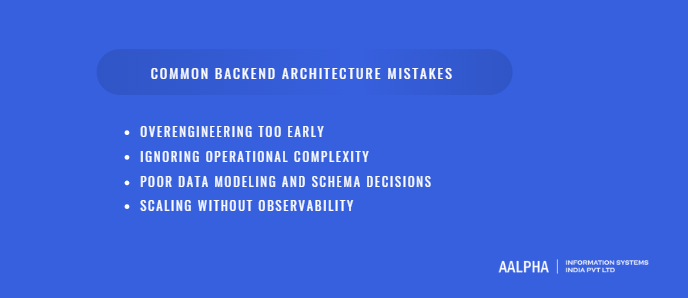
Backend architecture failures are rarely caused by a lack of technology. They stem from misaligned assumptions, premature decisions, and neglect of operational realities. Many teams repeat the same mistakes as systems grow, leading to fragile architectures that are expensive to maintain and difficult to evolve. Recognizing these pitfalls early allows architects and engineers to make more deliberate, sustainable choices.
-
Overengineering Too Early
One of the most common backend architecture mistakes is overengineering during the early stages of a product. Teams often design for hypothetical scale, adopting complex distributed systems before there is clear evidence of need. This approach increases development time and operational overhead without delivering proportional benefits.
Premature adoption of advanced patterns such as microservices, event-driven workflows, or multi-region deployments introduces coordination challenges that slow progress. Small teams end up spending more time managing infrastructure and communication than building core functionality. Debugging becomes harder, and architectural decisions lock the system into complexity that may never be justified by actual usage.
Avoiding overengineering requires disciplined scope control. Backend architecture should align with current requirements while leaving room for evolution. Simple designs that respect separation of concerns and modularity can scale gradually without major rewrites. Clear boundaries within a monolith, for example, allow future extraction of services when real scaling pressures emerge.
Architectural decisions should be driven by validated needs rather than trends. By focusing on clarity, maintainability, and incremental growth, teams preserve agility and reduce long-term risk.
-
Ignoring Operational Complexity
Another frequent mistake is designing backend systems without accounting for how they will be operated in production. Architecture that looks elegant in diagrams can become unmanageable when deployed at scale. Operational complexity includes deployment processes, monitoring, incident response, and routine maintenance.
Ignoring these factors leads to brittle systems that require manual intervention to keep running. Deployments become risky, failures take longer to diagnose, and recovery procedures are unclear. As a result, system reliability suffers and team confidence erodes.
To avoid this mistake, operational concerns must influence architectural design. Backend systems should support automated deployments, health checks, and rollback mechanisms. Observability should be built in from the beginning, providing visibility into system behavior under load.
Designing for operations also involves simplicity. Reducing the number of moving parts lowers the likelihood of failure and simplifies troubleshooting. Architecture that balances technical ambition with operational feasibility results in systems that are easier to run and more resilient over time.
-
Poor Data Modeling and Schema Decisions
Data modeling decisions have long-lasting consequences. Poorly designed schemas create performance bottlenecks, limit scalability, and complicate feature development. These issues often arise when data models are built around immediate needs without considering future access patterns.
Common problems include overly normalized schemas that require expensive joins or rigid structures that make change difficult. As data volume grows, these designs degrade performance and force workarounds that increase complexity.
Avoiding poor data modeling requires understanding how data will be queried and updated over time. Backend architecture should align schemas with usage patterns rather than purely conceptual models. Iterative refinement and regular review of data models help maintain alignment as requirements evolve.
Investing in thoughtful data modeling early reduces technical debt and supports scalable growth without disruptive migrations.
-
Scaling Without Observability
Scaling backend systems without adequate observability is a critical mistake. Teams add capacity in response to performance issues without understanding root causes. This approach masks underlying problems and increases cost without guaranteeing improvement.
Without visibility into metrics such as latency, error rates, and resource utilization, scaling decisions are based on guesswork. Failures become harder to diagnose, and incidents last longer. Over time, systems grow larger but not more reliable.
Avoiding this mistake requires treating observability as a prerequisite for scaling. Backend architecture must expose meaningful metrics and logs that explain system behavior. With this information, teams can identify bottlenecks, validate improvements, and scale with confidence.
Observability-driven scaling ensures that growth improves system health rather than amplifying existing weaknesses.
Backend Architecture Decision Framework
Backend architecture decisions shape how a system behaves not only at launch but throughout its entire lifecycle. These decisions influence delivery speed, operational stability, long-term costs, and the organization’s ability to adapt as business requirements evolve. Treating architecture as a one-time technical choice often leads to systems that quickly become misaligned with reality. A structured decision framework helps teams evaluate trade-offs deliberately and design backends that remain effective as both products and organizations mature.
-
Aligning Architecture with Business Requirements
Backend architecture should always be driven by clearly articulated business requirements rather than abstract technical ideals. Functional requirements such as workflow complexity, integration needs, and data sensitivity define the baseline architectural constraints. Equally important are non-functional requirements, including performance expectations, uptime commitments, security obligations, and compliance considerations. These factors determine how much resilience, scalability, and control the backend must provide from day one.
Understanding real usage patterns is critical to this alignment. Systems with bursty traffic, seasonal spikes, or unpredictable growth require elasticity and fault tolerance. In contrast, applications with steady usage may benefit from simpler, more cost-efficient architectures. Designing for imagined scale often results in unnecessary complexity, while ignoring growth signals creates brittle systems. Backend architecture should reflect evidence-based assumptions about how the product will be used and how those patterns are likely to change.
Time-to-market also influences architectural choices. Early-stage products typically prioritize rapid iteration and learning over perfect scalability. Architecture that enables fast feedback loops allows teams to validate assumptions before committing to more complex designs. As products gain traction, architectural priorities shift toward stability and optimization. A sound framework anticipates this progression and avoids decisions that block future evolution.
-
Choosing Patterns Based on Team Size and Skills
The effectiveness of any backend architecture depends heavily on the team responsible for building and operating it. Architectural patterns that work well for large, experienced teams can overwhelm smaller or less specialized groups. A mismatch between architecture and team capability leads to delivery delays, operational stress, and increased failure rates.
Small teams benefit from architectures with minimal coordination overhead. Monolithic or modular monolithic designs allow engineers to work across the system without extensive handoffs. These patterns reduce cognitive load and simplify deployment and troubleshooting. As teams grow, more granular architectures can support parallel development and clearer ownership boundaries.
Skill sets are equally important. Distributed architectures demand expertise in networking, observability, security, and failure handling. Without these skills, complex systems become fragile. Backend architecture should leverage existing strengths rather than expose gaps that increase risk. Training and tooling can mitigate some challenges, but architectural ambition should remain grounded in current capabilities.
Operational maturity is another key factor. Teams with established automation, monitoring, and incident response practices can manage more sophisticated systems. Others should prioritize architectures that reduce operational burden. Aligning patterns with team readiness ensures sustainability and prevents burnout.
-
Balancing Speed, Cost, and Long-Term Maintainability
Backend architecture decisions always involve trade-offs between speed, cost, and maintainability. Optimizing for rapid delivery often leads to shortcuts that increase technical debt. Highly optimized systems may deliver performance benefits but slow development and increase operational complexity. The goal is not to maximize one dimension but to balance all three over time.
Cost considerations extend beyond infrastructure expenses. Development effort, maintenance overhead, and incident management all contribute to total cost of ownership. An architecture that appears inexpensive initially may become costly as complexity grows and changes become harder to implement.
Long-term maintainability depends on clarity and consistency. Systems with well-defined boundaries, predictable patterns, and thorough documentation are easier to evolve. Investing in maintainability reduces future rework and supports continuous improvement.
A decision framework encourages periodic reassessment. Backend architecture should evolve as business priorities, team capabilities, and scale change. By revisiting assumptions and adjusting designs deliberately, teams maintain alignment between technical systems and organizational goals, ensuring that architecture remains an enabler rather than a constraint.
Why Organizations Choose Aalpha for Backend Architecture Excellence
Choosing a backend architecture partner is not about finding someone who can assemble frameworks or deploy infrastructure. It is about working with a team that understands how architectural decisions translate into long-term business outcomes. Aalpha approaches backend architecture as a strategic discipline, not a collection of technical tasks. The focus is on building systems that remain scalable, secure, and maintainable as products evolve, teams grow, and operational demands increase.
Aalpha’s strength lies in its architecture-first mindset. Every backend system is designed by starting with business requirements, usage patterns, and risk constraints before selecting patterns or technologies. This prevents common failures such as premature complexity, fragile scaling models, or security gaps that emerge later under load. Instead of forcing trendy architectures, Aalpha evaluates whether a modular monolith, distributed services, event-driven workflows, or hybrid models best serve the product’s actual needs.
Security and reliability are embedded into every architectural decision. Authentication models, authorization boundaries, data protection mechanisms, and failure isolation strategies are designed at the system level rather than added as patches. This approach reduces long-term security exposure and avoids expensive rework driven by audits, incidents, or compliance pressure. For products operating in regulated or data-sensitive environments, this architectural rigor becomes a critical advantage.
Scalability at Aalpha is treated as an engineering and operational concern, not just an infrastructure problem. Systems are designed to scale horizontally, handle partial failures, and remain observable under stress. Attention is given to data access patterns, asynchronous processing, and cost-aware design so that growth does not introduce runaway infrastructure expenses or operational instability.
Aalpha also emphasizes maintainability and developer velocity. Clear layering, strict separation of concerns, and predictable interfaces allow teams to build, test, and evolve systems without accumulating hidden complexity. This enables faster iteration and safer change as products mature. Architecture decisions are documented and explained so internal teams are not locked into opaque systems they cannot confidently modify.
Most importantly, Aalpha operates as a long-term technical partner rather than a delivery vendor. Backend architecture is revisited as products scale, markets shift, and constraints change. This ongoing alignment ensures that systems remain resilient and adaptable instead of becoming bottlenecks. For organizations that view backend architecture as a foundation for sustained growth rather than a one-time implementation, Aalpha provides the depth, discipline, and clarity required to build systems that last.
Conclusion
Building scalable and secure backend systems is not about choosing the most popular tools or copying architectures used by large technology companies. It is about making deliberate, context-aware decisions that align system design with real operational demands, team capabilities, and long-term business goals. Throughout this guide, one theme remains consistent: backend architecture is a strategic asset. When designed correctly, it enables growth, stability, and adaptability. When neglected or rushed, it becomes the primary source of technical debt, outages, and escalating costs.
Scalable backends are the result of foundational principles applied consistently. Clear separation of concerns keeps systems understandable as they grow. Stateless design, horizontal scaling, and thoughtful data architecture allow systems to handle increased load without fragile workarounds. Security, when embedded at the architectural level, reduces risk and simplifies compliance rather than becoming an ongoing firefight. Reliability emerges from redundancy, failure isolation, and strong observability, not from hoping infrastructure alone will compensate for weak design. Across all these areas, the most resilient systems treat architecture as an evolving discipline rather than a one-time setup.
Long-term success depends on architectural thinking that anticipates change. Products evolve, teams grow, and usage patterns shift. Backend systems must be able to absorb these changes without requiring repeated rewrites. This requires resisting premature complexity while still designing with extensibility in mind. Architecture that balances simplicity today with flexibility tomorrow allows organizations to move faster with less risk. It also enables better cost control, smoother scaling, and higher developer productivity over the lifetime of the product.
For organizations planning to build or modernize backend systems, the most effective next step is expert architectural evaluation grounded in real-world constraints. This is where experienced partners add measurable value. Aalpha works with startups, growing SaaS companies, and enterprises to design backend architectures that are secure, scalable, and operationally sustainable. The focus is not on generic patterns, but on architecture that fits the product, the team, and the business roadmap. By approaching backend design as a strategic foundation rather than an implementation detail, organizations position themselves to scale with confidence and build systems that last.
If you are planning, reviewing, or modernizing a backend system and need expert guidance on scalability, security, or long-term architecture, Aalpha can help you make the right decisions from the start. Connect with Aalpha’s backend architecture specialists to design systems that grow predictably, operate reliably, and stand the test of time.


Share This Article:
Written by:
Stuti Dhruv
Stuti Dhruv is a Senior Consultant at Aalpha Information Systems, specializing in pre-sales and advising clients on the latest technology trends. With years of experience in the IT industry, she helps businesses harness the power of technology for growth and success.
Stuti Dhruv is a Senior Consultant at Aalpha Information Systems, specializing in pre-sales and advising clients on the latest technology trends. With years of experience in the IT industry, she helps businesses harness the power of technology for growth and success.