


The shift toward on-demand developers reflects a broader transformation in how software is built, scaled, and maintained in 2025. Companies now operate in competitive, innovation-driven markets where product timelines are shorter, talent shortages are persistent, and digital infrastructure must evolve continuously. Against this backdrop, the ability to access specialized engineering talent exactly when needed has become a practical response to fluctuating project demands. On-demand development is no longer associated only with outsourcing or short-term staffing; it is now a strategic extension of in-house capability, enabling organizations to scale engineering capacity, strengthen delivery pipelines, and reduce operational burdens. As businesses adopt AI, cloud-native architectures, and data-heavy systems, many teams recognize that traditional hiring processes are too slow and rigid to support rapid technical execution. This is the context in which on-demand developers have risen to become a core pillar of modern software delivery strategies.
What on-demand development means in modern software engineering
On-demand development refers to the practice of hiring developers only for the duration, scope, or complexity required by a project, rather than expanding the permanent headcount. The model includes staff augmentation, dedicated teams, part-time consultants, and contract-based specialists who integrate directly into existing workflows. What differentiates this approach from old outsourcing patterns is the level of expertise, real-time collaboration, and technical alignment that engineering partners provide today. Companies now expect contract developers to participate in standups, follow internal coding standards, contribute to architecture decisions, and work seamlessly with existing CI/CD pipelines. In an era where AI tools accelerate code generation and automation reduces manual effort, organizations increasingly combine their core engineering teams with flexible developers who bring niche capabilities, such as LLM integration, cloud optimization, DevOps automation, microservices migration, or security hardening.
Why companies prefer flexible hiring models in 2025
In 2025, the demand for flexibility is driven by several structural changes in the technology landscape. First, the global developer shortage remains significant, particularly in areas like AI, machine learning, cybersecurity, and cloud-native engineering. Traditional hiring cycles can take months, which stalls product roadmaps and increases opportunity costs. Second, remote-first work has unlocked global talent pools, making it easier for companies to hire highly skilled developers across regions with cost-efficient hourly rates. Third, digital transformation has diversified the range of technologies companies adopt, creating a need for multi-disciplinary expertise that is often impossible to hire internally. Flexible hiring models give organizations the freedom to add new skills quickly without long-term payroll commitments. They also enable teams to scale up or down based on workload, ensuring that software delivery aligns with budget availability and market timing. This agility has become essential in product development environments where delays directly affect competitive positioning.
When hiring on-demand developers makes strategic and financial sense
Hiring on-demand developers is most beneficial when speed, specialization, or cost-control is critical. Startups entering a competitive market often use contract developers to build an MVP rapidly, validating their concept before investing in full-time teams. Established companies use augmentation models to handle peak workloads or address technical areas where internal experience is limited, such as migrating a monolithic system to event-driven architecture or integrating AI-driven personalization engines. On-demand hiring also supports modernization initiatives that require deep experience in legacy systems, secure data handling, or compliance frameworks. Financially, this approach eliminates recruitment overheads, reduces fixed salaries, and provides a predictable cost structure aligned with project duration. Companies avoid paying for idle time or long-term benefits, which makes this model attractive for teams with variable or uncertain project pipelines.
How this hiring model reduces risk for startups and enterprises
Risk mitigation is one of the most significant advantages of on-demand development in 2025. Startups face the challenge of building quickly without overspending, and contract engineers reduce the financial risk associated with hiring full-time employees too early. If market conditions change or product direction shifts, teams can reconfigure their development workforce without severance or restructuring costs. Enterprises, on the other hand, reduce technical and operational risks by augmenting internal teams with specialists who strengthen architectural decisions, enhance security posture, and improve delivery quality. On-demand developers also introduce external best practices and fresh perspectives that reduce the likelihood of scaling bottlenecks or technical debt accumulation. The ability to test working relationships before long-term commitments provides an additional safeguard, allowing companies to validate skill levels, communication habits, and cultural fit. By combining flexibility with accountability, the model helps both small and large organizations deliver software with higher reliability and lower financial exposure.
Understanding On-Demand Development Models
On-demand development has evolved into a structured ecosystem of engagement models designed to give companies flexibility, scalability, and targeted expertise. Each model serves a different purpose, whether a business needs short-term capacity, specialized skill sets, or an entire team to execute a product roadmap. Understanding these models is crucial because the wrong hiring approach can lead to inefficiencies, coordination issues, or cost overruns, while the right model can accelerate delivery and improve quality. Modern companies increasingly adopt modular engineering approaches, where internal teams collaborate with external talent in ways that expand capability without expanding payroll. This section explores the four core on-demand development models, the strengths and limitations of each, and guidance on selecting the most suitable approach based on project complexity, urgency, and technical requirements.
-
Staff augmentation
Staff augmentation involves embedding external developers directly into your existing engineering team to work under your processes, management structure, and technical direction. These developers function as extensions of the in-house team, participating in daily standups, sprint planning, code reviews, and architectural discussions. Organizations use augmentation when they face temporary workload increases, need specialized expertise unavailable internally, or need to accelerate delivery without the delays of recruitment. Augmented developers typically work full-time on a contract basis and integrate with your task management systems, version control, communication channels, and CI/CD pipelines. This model offers immediate productivity with minimal disruption to existing workflows, making it particularly effective for teams that already have strong engineering leadership and established processes.
-
Dedicated development teams
Dedicated development teams model is a complete, self-managed engineering units provided by an external firm. They often include developers, a project manager or scrum master, quality assurance specialists, and sometimes UI/UX designers or DevOps engineers. Unlike staff augmentation, where external developers blend into the internal team, dedicated teams operate somewhat independently while still aligning with your business goals and product roadmap. Companies use dedicated teams when building new products, scaling existing systems, or executing long-term initiatives where ongoing work is predictable. A major advantage is the additional project oversight and accountability that comes with a full managed team. Businesses that lack internal engineering leadership, product management capacity, or operational structure often choose this model because it offloads not just development work but also coordination, planning, and delivery governance.
-
Project-based on-demand developers
Project-based developers are hired for a specific deliverable, scope of work, or pre-defined timeline. Rather than embedding into a team or working long-term, these developers focus exclusively on completing a defined project such as building a prototype, integrating a payment gateway, migrating data, creating an AI-powered feature, or modernizing a module. Companies select this model when the work is discrete, well-documented, and does not require continuous collaboration with internal engineers. Project-based hiring is especially effective for small to medium builds, proof-of-concepts, and tasks that demand specialized expertise but not ongoing staffing. Pricing is often fixed or milestone-based, which gives companies cost predictability, but it requires precise requirements to avoid scope creep or delays.
-
Hybrid models
Hybrid models combine elements of staff augmentation, dedicated teams, and project-based work. Organizations adopt these models when they have multi-layered needs such as maintaining existing systems while simultaneously building new features or products. For example, a company might use a small dedicated team to manage the core platform, augmented developers to address peak workload periods, and a project-based specialist for a one-off AI integration. Hybrid approaches offer maximum flexibility but require clear communication, coordination, and governance to ensure that all external contributors align with the broader engineering strategy. As businesses scale, hybrid models often become the default approach because they allow companies to respond dynamically to changes in roadmap, demand, or technology priorities.
Pros and cons of each model
Each engagement model carries unique advantages and limitations. Staff augmentation provides immediate scalability and allows companies to maintain control over development processes, but it relies heavily on strong internal management and may not be ideal for organizations without mature workflows. Dedicated teams offer end-to-end capability and leadership support, which is valuable for long-term projects, yet they can introduce higher costs if not managed properly. Project-based hiring provides cost predictability and efficiency for well-scoped tasks, but it requires precise requirements and may limit adaptability if needs evolve mid-project. Hybrid models deliver the highest degree of flexibility but introduce complexity in coordination, requiring clear boundaries and communication frameworks. Selecting the right model depends on whether speed, control, autonomy, cost, or risk mitigation is the primary priority.
How to choose the right model based on project needs
Choosing the right on-demand development model requires evaluating several factors including project complexity, timeline urgency, internal engineering maturity, budget constraints, and the availability of specialized skills. If your internal team is strong and you simply need to increase bandwidth, staff augmentation is typically the most effective solution. If you lack engineering leadership or need a long-term delivery partner, dedicated teams offer strategic value. For small or well-scoped initiatives, project-based developers provide efficiency and predictable costs. If your organization is growing and managing a diverse roadmap, a hybrid approach ensures the flexibility to adapt resources on demand. The key is aligning the model with both immediate goals and long-term product strategy. Businesses that assess their internal capabilities honestly and align their hiring model with actual needs consistently experience higher delivery quality, lower risks, and more efficient use of development budgets.
When Should You Hire On-Demand Developers? Key Scenarios
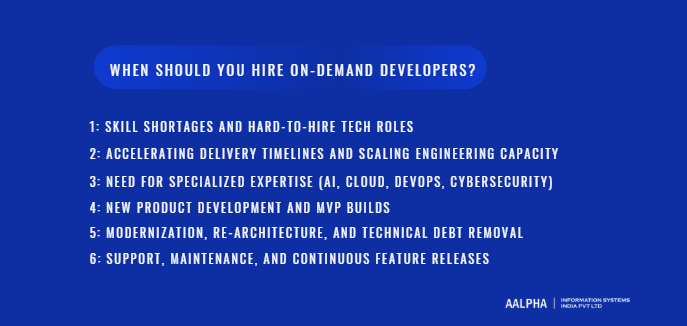
Hiring on-demand developers is most effective when it solves a strategic bottleneck that disrupts delivery timelines, slows product innovation, or stretches internal engineering capacity beyond its limits. Organizations increasingly turn to flexible development models to handle fluctuations in workload, keep pace with competitive pressure, and access niche technical expertise that is difficult or costly to build in-house. With software projects becoming more complex and development cycles more compressed, companies need the ability to scale resources dynamically without committing to long-term hires. The following scenarios represent the most common and high-impact situations where on-demand developers deliver measurable value, reduce project risk, and enable organizations to maintain consistent momentum in their product roadmap.
-
Skill shortages and hard-to-hire tech roles
Global talent shortages continue to affect nearly every technology domain. Roles such as AI engineers, cloud architects, DevOps specialists, cybersecurity professionals, and mobile developers often remain unfilled for months due to high demand and limited supply. Even fundamental roles like frontend or backend developers can become difficult to hire when the required tech stack includes emerging or highly specialized frameworks. Hiring full-time employees for these roles is not only slow but also expensive, especially in high-salary regions. On-demand developers fill these gaps immediately, giving organizations access to rare skills without the overhead of long recruitment cycles. Companies facing hiring freezes or budget constraints use augmentation models to maintain progress without adding permanent payroll. This approach also enables engineering leaders to evaluate a developer’s long-term fit through real work rather than relying solely on interviews or tests.
-
Accelerating delivery timelines and scaling engineering capacity
A common reason for hiring on-demand developers is the need to increase velocity. Product deadlines often shift due to competitive changes, executive decisions, investor expectations, or expanded feature scope. Internal teams may not have enough bandwidth to meet accelerated timelines, especially when dealing with parallel workloads. On-demand developers allow organizations to scale engineering capacity within days, enabling rapid delivery without overburdening existing staff. These developers integrate directly into sprint cycles, helping teams address feature backlogs, reduce bottlenecks, and maintain sustainable development rhythms. Companies preparing for product launches, seasonal demand spikes, or major roadmap milestones often rely on flexible capacity models to ensure timely execution. Scaling up and down based on workload ensures that engineering teams remain responsive to business needs without creating long-term overhead.
-
Need for specialized expertise (AI, cloud, DevOps, cybersecurity)
Modern software development increasingly requires domain-specific knowledge that internal teams may not possess. Implementing AI-powered features, optimizing cloud infrastructure, setting up secure DevOps pipelines, or hardening cybersecurity posture demands experienced specialists. Rather than hiring full-time experts for each area, companies bring in on-demand developers who have deep expertise and proven experience in these domains. AI engineers assist with model selection, LLM integration, prompt design, data pipelines, and evaluation metrics. Cloud architects help with cost optimization, scaling strategies, and multi-region deployment planning. DevOps experts streamline CI/CD processes, automate testing, and improve deployment reliability. Cybersecurity engineers conduct audits, strengthen protection layers, and ensure compliance with frameworks such as SOC 2, HIPAA, or GDPR. These specialists provide high-impact value without requiring organizations to maintain expensive, permanent roles.
-
New product development and MVP builds
Startups and innovation teams use on-demand developers extensively during early-stage product development. Building an minimum viable product (MVP) requires fast execution, iterative experimentation, and a lean cost structure. Full-time hiring is often unrealistic at this stage, especially when product-market fit is not yet validated. On-demand developers enable founders to assemble highly skilled teams quickly, build prototypes, launch pilot versions, and gather real user feedback. Once the concept is validated, companies can transition to a longer-term team structure with more confidence. Even established enterprises use on-demand models for new product initiatives that require separate engineering resources without disrupting ongoing operations. These developers bring fresh perspectives, modern engineering practices, and rapid development cycles that accelerate innovation.
-
Modernization, re-architecture, and technical debt removal
Legacy modernization is a major driver of on-demand hiring in 2025. Many companies operate monolithic systems built on outdated frameworks, unsupported libraries, or inefficient architectures that limit scalability. Re-architecting these systems into microservices, containerized infrastructure, or cloud-native deployments requires expert developers with modernization experience. Internal teams often lack the bandwidth or domain knowledge to undertake such transformation projects while still maintaining existing platforms. On-demand developers support tasks such as API rebuilding, database migration, refactoring, cloud adoption, and elimination of long-standing technical debt. Their involvement accelerates modernization timelines, reduces downtime risks, and brings architectural best practices that strengthen long-term stability and performance.
-
Support, maintenance, and continuous feature releases
Once a product is live, companies must manage maintenance tasks, bug fixes, performance optimization, and new feature releases. These workloads fluctuate throughout the year, making it inefficient to maintain a full-time team dedicated exclusively to support. On-demand developers offer a flexible and cost-effective solution, providing access to engineering capacity only when required. Organizations use them to maintain uptime, resolve incidents, implement user-requested features, or perform routine improvements. This model ensures that the product remains stable and competitive without overstaffing internal teams. It is particularly beneficial for small and mid-sized businesses that require ongoing support but cannot justify full-time roles across all technical domains.
Defining Your Requirements Before Hiring Developers
Hiring on-demand developers becomes significantly more effective when the organization has a clear understanding of its project requirements, engineering priorities, and internal constraints. Many companies struggle not because external developers lack skills, but because the business itself has not articulated what success looks like or how the project should be structured. Requirement clarity ensures better planning, accurate cost estimation, faster onboarding, and higher-quality deliverables. It also helps external developers integrate more smoothly into existing workflows, since they have a precise understanding of tasks, expectations, and technical boundaries. Before engaging any on-demand developer or team, organizations must invest time in aligning business objectives with engineering needs, defining specifications, and establishing clear metrics. This section explains the core components of requirement definition and how each contributes to efficient hiring and delivery.
-
Clarifying project goals and success criteria
Every successful development engagement begins with a precise articulation of project goals. These goals define the purpose of the initiative, the expected outcomes, and how success will be measured. Organizations should identify whether the priority is speed, quality, innovation, technical modernization, or cost optimization. The more clarity achieved at this stage, the easier it becomes to align skills, budget, and timelines. Success criteria often include measurable indicators such as feature completion, performance benchmarks, user adoption metrics, security standards, or integration stability. For example, a project may succeed only if the system handles a specific transaction volume, reduces load times, or meets compliance requirements. Explicit goals provide direction for developers, ensure consistent decision-making throughout the project lifecycle, and create a shared understanding between internal teams and external contributors.
-
Writing a clear scope, backlog, and technical specification
A well-documented scope and technical specification form the backbone of any on-demand development engagement. The scope should outline the features, modules, and functional requirements that the project must deliver. A structured backlog helps developers understand task prioritization, dependencies, and the sequence of implementation. Technical specifications must detail the architecture, APIs, data structures, workflows, integrations, and system constraints. These documents reduce ambiguity, minimize rework, and prevent scope creep, which is one of the most common reasons for delays and cost overruns. When companies lack detailed specifications, external developers may interpret requirements differently, resulting in misalignment. Whether the project uses Agile, waterfall, or a hybrid methodology, a well-prepared set of documents dramatically increases productivity and ensures that developers can begin contributing effectively from the first sprint.
-
Identifying required skills, tech stack, and experience levels
Once the scope is clear, companies must identify the technical skills and experience necessary to execute the project. This includes choosing the appropriate programming languages, frameworks, database technologies, cloud platforms, DevOps tools, and testing methodologies. Different projects require different levels of seniority. A microservices migration, for example, demands a senior architect, while simple user interface enhancements may need only mid-level frontend developers. Companies should also clarify whether domain expertise is required, such as healthcare compliance knowledge, fintech security standards, or eCommerce performance optimization. Identifying these criteria in advance helps narrow the talent pool, improves interview quality, and ensures that hired developers align with the technical and strategic direction of the project.
-
Identifying internal constraints (budget, delivery timelines, architecture decisions)
Internal constraints shape how development work should be planned and executed. Budget limitations determine whether companies should hire augmented developers, dedicated teams, or fixed-price project specialists. Delivery timelines dictate how many developers are necessary and what level of seniority is required to maintain velocity. Architectural decisions, such as choosing between monolithic and microservice structures or selecting specific cloud providers, directly influence skill requirements and resource planning. Organizations must also consider operational constraints including team availability, internal review cycles, security protocols, compliance standards, and integration requirements with legacy systems. Clearly identifying constraints allows companies to set realistic expectations and ensures that external developers can work efficiently within these boundaries.
How to calculate the number of developers required
Determining the correct team size is essential for maintaining delivery pace without overspending. The calculation depends on several factors including project complexity, number of features, architecture requirements, integration dependencies, and timeline pressures. A simple MVP might require two or three developers, while a large enterprise system may need a multi-disciplinary team of frontend, backend, DevOps, QA, and architecture specialists. A common approach is to break down the backlog into estimated story points or effort hours, map them to available timeframes, and calculate how many developers are required to meet the timeline. Senior developers can complete complex tasks more efficiently, which may reduce team size. Conversely, projects with heavy parallel work benefit from broader teams. Companies should also consider adding QA engineers, DevOps specialists, or designers depending on the project structure. The goal is to build a balanced team capable of delivering consistently without overloading individual contributors.
Creating a hiring readiness checklist
Before approaching on-demand developers, organizations should prepare a readiness checklist to streamline hiring and onboarding. The checklist typically includes finalized project goals, a documented scope and backlog, architectural guidelines, a list of required skills, timeline expectations, budget constraints, available internal resources, and defined communication processes. It should also outline access needs such as repository permissions, staging environments, and documentation hubs. Preparing this checklist ensures that external developers integrate quickly and reduces the friction that often occurs during the first weeks of engagement. When companies begin hiring without clarity in these areas, productivity slows, communication becomes fragmented, and project alignment suffers. A structured readiness checklist dramatically improves the chances of success by ensuring that both internal and external teams operate with shared understanding from day one.
Where to Find the Best On-Demand Developers: Platforms and Providers
Finding the right on-demand developers requires understanding the different sourcing channels available and how each aligns with your project’s goals, budget, and timeline. The global talent ecosystem has grown significantly, and organizations now have access to multiple categories of providers ranging from freelancers to highly specialized engineering firms. Each channel has strengths and limitations, and the quality varies widely. Selecting the right source is not just about cost; it is also about ensuring reliability, technical depth, communication quality, and long-term scalability. This section outlines the primary places where companies can hire on-demand developers, offers comparisons between them, and explains how to make informed decisions while avoiding low-quality vendors.
-
Freelance marketplaces
Freelance marketplaces such as Upwork, Freelancer, and Fiverr have become common entry points for companies seeking short-term or budget-friendly development support. These platforms offer direct access to global talent, enabling businesses to hire developers for hourly or fixed-price engagements. They are particularly useful for small tasks, minor enhancements, prototyping, or solving isolated problems. However, while the flexibility is high, the reliability can be inconsistent. Quality varies dramatically across freelancers, and companies must invest substantial effort in vetting portfolios, conducting interviews, and managing deliverables. Freelancers typically work alone, which may present challenges for complex projects requiring long-term collaboration, architectural planning, or scalability. Freelance platforms are most effective when the task is well-defined, low-risk, and does not require deep integration with internal teams.
-
Offshore and nearshore development companies
Nearshore & Offshore development companies provide structured teams and experienced developers at competitive rates. Offshore locations such as India, Vietnam, and the Philippines offer cost advantages, while nearshore options in Eastern Europe or Latin America provide closer time-zone alignment. These companies usually maintain strong engineering processes, including quality assurance, DevOps, documentation, and project oversight. Businesses choose them when they need scalable teams capable of handling medium to large projects or when they want access to developers skilled in emerging technologies. Unlike freelancers, offshore and nearshore teams often work under long-term contracts, giving companies more stability and predictability. The challenge lies in selecting credible providers and ensuring cultural and communication alignment. Reputable companies mitigate these challenges by offering dedicated project managers, transparent reporting, and structured onboarding.
-
IT staff augmentation providers
IT staff augmentation firms specialize in supplying developers who integrate directly into existing in-house teams. Unlike traditional outsourcing, augmented developers work under the client’s direction, tools, and processes, giving companies full control over development. This model is ideal for businesses facing skill shortages, bandwidth issues, or tight delivery deadlines. Staff augmentation providers maintain pools of vetted developers across multiple technologies and seniority levels, making it possible to onboard talent quickly. These providers also handle HR, payroll, compliance, and administrative overhead, allowing companies to focus solely on development work. The main advantage is flexibility; organizations can scale capacity up or down without long-term commitments. The main limitation is that augmented developers still require strong internal leadership and technical oversight to ensure consistent delivery quality.
-
Developer staffing agencies
Developer staffing agencies act as intermediaries between companies and individual developers. They focus on sourcing, screening, and shortlisting candidates based on predefined criteria. These agencies often specialize in niche skills, such as AI engineering or DevOps automation, and maintain extensive talent databases. Unlike staff augmentation companies, staffing agencies do not typically manage developers after placement. Their role ends once a suitable developer is hired. This model is useful for companies that want to hire developers quickly but prefer to manage them directly. Staffing agencies offer higher-quality vetting compared to freelance platforms, but they do not provide the structured delivery support offered by full-fledged engineering firms. This approach is most effective when organizations already have strong internal engineering structure and only need help with sourcing talent.
-
Partnering with specialized engineering firms
Specialized engineering firms provide end-to-end development services and high-level technical expertise. These firms usually focus on complex projects such as AI systems, scalable cloud platforms, enterprise-level applications, or industry-specific solutions. They offer multidisciplinary teams that include architects, software & web developers, QA engineers, DevOps specialists, UI/UX designers, and project managers. Unlike freelance platforms or staffing agencies, specialized firms prioritize long-term partnerships, predictable delivery, and accountability. They are the best option when a project requires architectural planning, compliance expertise, deep technical problem-solving, or ongoing product evolution. These firms also bring established methodologies, repeatable processes, and domain knowledge that reduce delivery risk. While the cost may be higher than individual freelancers, the superior reliability and expertise often result in faster delivery and lower long-term expenses.
Comparing cost, reliability, and scalability across these sources
Different sourcing channels offer different trade-offs. Freelance marketplaces are the most affordable but tend to be the least predictable. Offshore and nearshore companies offer a balance of cost and quality, with more structured workflows and better scalability. Staff augmentation providers offer rapid onboarding and flexible capacity but require internal management maturity. Developer staffing agencies help fill roles efficiently but do not take responsibility for delivery. Specialized engineering firms deliver the highest reliability, strongest technical leadership, and long-term scalability, although the pricing reflects that premium. When selecting a sourcing method, companies must evaluate not only hourly rates but also hidden costs such as rework, delays, communication gaps, onboarding effort, and the risk of incomplete delivery. Often, a higher upfront cost results in significantly lower total cost of ownership when quality and reliability are factored in.
How to avoid poor-quality providers
The biggest risk in hiring on-demand developers is engaging low-quality providers who deliver inconsistent work, miss deadlines, or lack relevant expertise. Companies can mitigate this risk by conducting thorough vetting, including reviewing case studies, verifying technical depth, checking client references, and evaluating communication skills. Reputable providers adhere to transparent contracts, clearly defined processes, and structured reporting. Companies should avoid providers who offer unrealistic timelines, excessively low pricing, or vague commitments. A pilot project or paid trial sprint is an effective method to evaluate capability before committing to long-term engagement. Additionally, organizations should ensure alignment in communication practices, time-zone compatibility, and project governance. Choosing high-quality providers significantly reduces delivery risk and ensures that the on-demand development model yields measurable business value.
How to Evaluate On-Demand Developers: Skills, Expertise, and Performance
Evaluating on-demand developers requires a structured, evidence-based approach that goes far beyond reviewing résumés or conducting informal interviews. Companies must validate not only the technical capabilities of candidates but also their communication habits, problem-solving ability, domain knowledge, and overall compatibility with the internal engineering environment. Since on-demand developers integrate quickly into active projects, any misalignment in skill level or work style can result in delays, rework, and increased project risk. A rigorous evaluation process helps ensure that developers contribute value from the first sprint, follow best practices, and maintain the quality standards expected by your team. The most effective assessments combine technical testing, real-world project analysis, soft skill evaluation, and risk identification. This section details the key components of a comprehensive evaluation process.
-
Technical evaluation frameworks
A robust technical evaluation framework provides a systematic method for assessing a developer’s skills and ensuring they meet the project’s technical requirements. The framework should align with the technologies, architectural patterns, and problem domains relevant to the project. Evaluations typically include coding assessments, hands-on tasks, algorithmic tests, and scenario-based questions that reveal how the developer approaches complexity. Companies should test proficiency in core languages and frameworks such as JavaScript, Python, Java, Go, Node.js, React, or cloud technologies depending on their stack. Beyond syntax and coding speed, the framework must examine competence in version control, CI/CD pipelines, testing methodologies, debugging strategies, and modular code structure. Effective evaluations simulate real engineering tasks rather than relying on abstract questions. Assessors should also check whether candidates adhere to clean code principles, design patterns, and secure coding practices. A well-defined technical evaluation framework ensures consistency, reduces bias, and allows accurate comparison across multiple candidates.
-
Portfolio and past project assessment
A developer’s portfolio provides valuable insight into their real-world experience, technical depth, and ability to deliver production-grade software. Companies should review not only the completed projects but also the developer’s role, contributions, architectural decisions, and problem-solving approach. Past project documentation, case studies, GitHub repositories, and code samples help assess coding style, modularity, maintainability, and familiarity with modern engineering tools. It is important to validate claims by discussing specific components the developer built, challenges they encountered, and how they resolved issues. Reviewing the diversity of projects also reveals whether the developer can handle complex systems, integrate APIs, work with databases, manage cloud deployments, or solve performance bottlenecks. Strong portfolios often demonstrate consistency, scalability, and thoughtful implementation, whereas weak ones may show fragmented work, minimal documentation, or surface-level contributions.
-
AI-assisted coding tests and live interviews
The rise of AI-assisted development tools has transformed the way companies evaluate technical ability. AI coding assessments allow organizations to simulate realistic engineering environments where candidates must interact with tools such as Git, testing frameworks, containerization systems, or cloud APIs. These tests evaluate the candidate’s ability to build features, resolve bugs, write tests, and optimize performance. Live interviews complement these assessments by providing insight into a developer’s thought process and decision-making approach. During live coding sessions, interviewers can observe how candidates break down problems, articulate solutions, and translate logic into code. The intention is not only to confirm skill level but also to understand how candidates operate under time constraints, collaborate with interviewers, and interpret incomplete or evolving requirements. Combining AI-assisted tests with live interviews ensures a more reliable, holistic evaluation than relying on a single method.
-
Soft skills and communication capabilities
Technical ability alone does not guarantee effective delivery. On-demand developers often work in distributed teams where communication is essential for smooth collaboration, timely updates, and accurate execution of tasks. Evaluating soft skills involves assessing clarity, responsiveness, ownership, adaptability, and the ability to explain complex ideas in simple terms. Strong developers ask relevant questions, raise concerns early, and provide structured updates during standups or asynchronous communication. They also demonstrate the ability to collaborate with designers, product managers, and QA teams. Effective communication minimizes misunderstandings, reduces delays, and increases alignment across the team. Developers who struggle with communication can unintentionally create project bottlenecks even if they have strong technical backgrounds. This is why evaluating soft skills is as important as assessing technical proficiency.
-
Problem-solving and architectural thinking
The ability to solve problems logically and build scalable structures separates high-performing developers from average ones. Problem-solving assessments evaluate how candidates approach unfamiliar challenges, handle ambiguity, and navigate complex technical scenarios. Interviewers should incorporate real design challenges such as building scalable microservices, structuring data pipelines, optimizing database queries, designing secure authentication workflows, or planning cloud infrastructure. The goal is to observe whether candidates consider trade-offs, long-term maintainability, performance implications, and best practices in modern architecture. Developers must demonstrate not only the ability to write code but also the capacity to understand systems holistically. This includes evaluating how components interact, how to reduce technical debt, and how to design structures that scale under load. Strong architectural thinking significantly improves the longevity and stability of the software product.
-
Industry experience and compliance-specific knowledge
Different industries impose unique technical expectations, regulatory requirements, and workflow constraints. Developers working in healthcare, finance, logistics, or eCommerce must understand domain-specific standards such as HIPAA, GDPR, PCI-DSS, HL7, FHIR, SOC 2, or AML/KYC guidelines. Industry experience accelerates onboarding and reduces the time required to adapt to domain complexities. For example, a healthcare developer must understand sensitive data flows, patient privacy requirements, and secure database handling. A developer working in fintech must understand risk scoring, transaction validation, and encryption protocols. Industry knowledge also influences architectural decisions, quality standards, and integration sequences. Evaluating domain familiarity early in the hiring process prevents costly misunderstandings and ensures that the developer can operate confidently within necessary compliance frameworks.
Red flags during evaluation
Identifying early warning signs during the evaluation process is essential for avoiding performance issues later. Common red flags include inconsistent portfolio details, vague explanations of past work, inability to explain architectural decisions, and reliance on generic responses that indicate shallow knowledge. Candidates who avoid discussing mistakes, challenges, or lessons learned often struggle with real-world complexity. Poor communication, missed deadlines during assessments, or visible discomfort when receiving feedback are also indicators of potential issues. Another red flag is overconfidence without evidence, especially when a candidate claims mastery across numerous technologies without demonstrating depth in any. Developers who show resistance to best practices, documentation, or collaborative tools can disrupt team workflows. Observing these red flags helps companies make more informed decisions and prevents costly mismatches during active development cycles.
How to Manage and Work With On-Demand Developers
Managing on-demand developers effectively requires a clear operational structure, strong communication habits, and consistent delivery processes. Unlike full-time employees who organically absorb company culture over time, on-demand developers must integrate rapidly into active workflows and begin contributing with minimal friction. This means organizations must define expectations early, provide structured onboarding, implement reliable communication frameworks, and enforce disciplined engineering practices. When executed well, on-demand teams operate with the same efficiency and accountability as internal developers, often bringing additional expertise and fresh perspectives. This section outlines the key strategies for managing on-demand developers to ensure alignment, quality, and long-term delivery momentum.
-
Setting expectations and performance metrics
Clear expectations lay the foundation for predictable execution. Before work begins, companies should define roles, responsibilities, and measurable performance indicators. These include coding standards, review cycles, sprint commitments, communication frequency, and quality benchmarks. Objectives such as bug-resolution time, feature completion rate, test coverage targets, system uptime, or adherence to architectural guidelines help ensure transparency. Expectations should also include documentation practices, attendance in standups, responsiveness during working hours, and the use of designated tools for collaboration. Setting these parameters early prevents misunderstandings and gives on-demand developers a strong framework for success. It also allows managers to track progress objectively and address performance issues before they escalate.
-
Onboarding developers into your codebase
A fast and efficient onboarding process is essential for reducing ramp-up time. On-demand developers must understand the codebase, architectural decisions, development workflows, and business logic quickly. Companies should provide access to repositories, documentation, API references, coding guidelines, technical diagrams, and any internal frameworks used within the system. A short kickoff session, combined with a guided walkthrough of the codebase, helps developers grasp the logic behind core modules. Providing examples of completed features, architectural patterns, and standardized components accelerates orientation. Assigning a point of contact or internal mentor for the first week often solves issues before they become blockers. With strong onboarding, on-demand developers can become productive within days rather than weeks.
-
Communication frameworks (daily standups, reporting, async workflows)
Effective communication is central to managing distributed development teams. Daily standups provide visibility into progress, blockers, and upcoming tasks. Weekly reviews help align priorities, refine backlog items, and evaluate delivery quality. Structured communication channels—such as Slack, Teams, Zoom, or asynchronous updates—ensure uninterrupted collaboration even across time zones. Clear reporting practices, including end-of-day updates, sprint summaries, or milestone reports, help managers track performance and maintain project transparency. Asynchronous workflows are increasingly important, allowing developers to share context, document decisions, and progress without relying on constant real-time interaction. A mix of synchronous and asynchronous communication ensures flexibility while keeping all stakeholders informed.
-
Task management tools and engineering workflow alignment
Task management tools such as Jira, Asana, Trello, or Linear ensure that development tasks are tracked, prioritized, and executed systematically. These tools help create a structured environment where developers know what to work on, when to deliver it, and how their contributions affect the broader roadmap. Companies should define clear workflows, including how tasks are assigned, how status transitions occur, and how reviews are performed. Aligning on-demand developers with existing engineering processes such as Git branching strategies, pull request protocols, testing requirements, and deployment practices ensures consistency. A standardized workflow eliminates guesswork and reduces the risk of fragmented development. Developers must also understand the sprint cadence, refinement rituals, and retrospective formats used by the internal team.
-
Security procedures and access-level control
Security is a critical concern when working with external developers, especially when handling sensitive data or intellectual property. Organizations should follow the principle of least privilege by granting only the necessary access required for development. This may include limited repository permissions, controlled database environments, anonymised data sets, or sandboxed staging servers. Strong authentication tools like multi-factor authentication, VPN access, or IP whitelisting further enhance protection. Companies must define secure coding guidelines, encryption requirements, and compliance rules relevant to their industry. Regular audits, logging, and monitoring ensure that access is used appropriately and help maintain trust throughout the engagement. Establishing clear confidentiality and IP ownership clauses in contracts adds an additional layer of security.
-
Handling time zones and distributed engineering culture
Distributed workforces introduce time-zone challenges, but they also enable continuous development cycles if managed effectively. The key is establishing overlapping working windows where core communication occurs. During these windows, developers can clarify requirements, resolve issues, and participate in key meetings. Outside these periods, asynchronous communication through documented updates, shared design notes, or recorded walkthroughs ensures progress continues smoothly. Distributed teams require strong cultural alignment, mutual respect for time-bound communication, and awareness of regional holidays or availability. Managers should encourage clear documentation, structured handoff processes, and the use of collaborative tools to maintain cohesion. When time zones are managed well, on-demand teams become more productive, not less, due to staggered development hours.
-
Ensuring continuous delivery and accountability
Maintaining consistent delivery requires defined processes, frequent progress checks, and accountability mechanisms. Continuous integration and continuous delivery pipelines help ensure that developers push stable code frequently, reducing the risk of integration conflicts. Implementing code review protocols, automated testing, and quality gates ensures that every contribution meets the required standard. Regular sprint planning, demos, and retrospective sessions improve transparency and help refine processes. Managers should track metrics such as velocity, code quality indicators, and deployment frequency to evaluate performance objectively. Accountability comes from clear expectations, structured workflows, and consistent feedback loops. When developers understand how their work is measured, they stay aligned with business priorities and deliver more predictably.
How to maintain long-term build velocity
Sustaining momentum over long periods requires more than short-term productivity. Companies must focus on knowledge sharing, documentation, modular architecture, and balanced team composition. Encouraging developers to document code modules, architectural decisions, and system behaviors preserves institutional knowledge and reduces onboarding time for new contributors. Modular design practices, code reusability, and automated test coverage prevent bottlenecks and reduce future refactoring needs. Managers must monitor team workload to prevent burnout, especially in distributed or augmented teams. Periodic architecture reviews, tech-debt cleanup sessions, and performance optimization sprints help maintain long-term stability. Finally, celebrating milestones and acknowledging developer contributions promotes motivation and fosters a healthy engineering culture, even when contributors are external.
Cost of Hiring On-Demand Developers
Understanding the cost structure of on-demand developers is essential for planning budgets, forecasting delivery timelines, and selecting the right hiring model. Costs vary widely across regions, skill levels, engagement models, and technology domains. While many companies initially focus on hourly rates, the true cost of development depends on multiple hidden factors such as productivity, management overhead, ramp-up time, code quality, and the cost of rework. Businesses that evaluate cost holistically make more informed decisions that balance affordability with quality and long-term maintainability. This section provides a detailed breakdown of regional differences, developer types, engagement models, full-time versus on-demand comparisons, and strategies to optimize development costs without compromising quality.
-
Cost variations by region (US, Europe, India, LATAM)
Developer rates differ dramatically across global markets due to variations in labor cost, demand for technical talent, and regional economic conditions. In the United States, hourly rates for developers are among the highest in the world, reflecting competition for skilled professionals and strong compensation expectations. Rates generally range from 80 to 150 dollars per hour depending on seniority and specialization. Western Europe exhibits similar pricing, with developers in countries like Germany, the UK, and the Netherlands charging between 60 and 120 dollars per hour.
Eastern Europe, including countries such as Poland, Romania, and Ukraine, offers highly skilled developers at more cost-effective rates, typically ranging from 40 to 70 dollars per hour. Latin America has become a preferred nearshore region for North American companies due to time-zone alignment, with rates between 30 and 60 dollars per hour. India and other Asian countries remain some of the most affordable regions for hiring talent, with highly skilled developers typically charging $18 to $40 per hour. This pricing advantage allows companies to build blended teams, using global talent to balance cost and capability.
-
Hourly rate ranges for different developer types
Developer rates vary not only by region but also by specialization and seniority. Generalist developers such as mid-level frontend or backend engineers typically fall within standard regional pricing, but highly specialized roles command premium rates. For example, AI engineers, machine learning specialists, blockchain developers, and cloud architects are priced significantly higher due to global scarcity.
Junior developers: 15–35 dollars per hour in affordable regions; 40–60 dollars per hour in developed markets.
Mid-level developers: 25–50 dollars per hour in affordable regions; 60–100 dollars per hour in developed markets.
Senior developers: 35–70 dollars per hour in affordable regions; 80–150 dollars per hour in developed markets.
AI/ML specialists: 40–90 dollars per hour internationally, often exceeding 150 dollars per hour in the US.
DevOps engineers: 30–60 dollars per hour in affordable regions; 80–140 dollars per hour in the US.
Cybersecurity specialists: 40–80 dollars per hour in offshore regions; 100–180 dollars per hour in high-cost markets.
Understanding these ranges helps businesses determine whether they need high-cost niche expertise for critical tasks or more generalized developers for day-to-day engineering.
Cost comparison between freelancers, agencies, and dedicated teams
Freelancers are generally the least expensive option, especially for short-term or small-scale tasks. However, the cost advantage can diminish when projects require long-term commitment, structured delivery, or complex integrations. Freelancers often lack the support systems found in agencies, such as QA teams, project managers, or DevOps resources, which means companies must handle these responsibilities internally.
Agencies and software development companies charge premium because they provide process maturity, management oversight, and additional resources. Rates for agency developers typically include the cost of quality assurance, architectural consultation, and project management. This makes agencies a better choice for large projects or those requiring consistent delivery and accountability.
Dedicated teams offer the highest cost predictability because pricing often follows a monthly retainer model. The cost includes a full team of developers, designers, QA engineers, and a project manager. While more expensive upfront, dedicated teams reduce long-term costs associated with delays, rework, or poor architecture.
The decision comes down to balancing budget constraints with the level of support and reliability required for successful delivery.
True cost of hiring full-time employees vs on-demand
Many companies assume full-time employees are more cost-effective, but the actual cost includes far more than salary. Full-time hiring includes recruiting fees, onboarding costs, benefits, bonuses, training, equipment, office space, HR overhead, paid leave, and long-term commitments even when work slows down. Additionally, full-time employees often require extensive ramp-up time and may not possess all the skills required for evolving project needs.
On-demand developers eliminate most of these overheads. Companies pay only for productive hours, can scale capacity up or down based on demand, and access specialized expertise without long-term obligations. This flexibility significantly reduces financial risk, especially for startups or businesses with fluctuating workloads. While hourly rates for on-demand developers may be higher than equivalent salaried rates, the total cost of ownership is often lower due to reduced overhead and increased efficiency.
Budgeting strategies for MVP, mid-scale, and enterprise projects
Budget planning varies depending on project size, scope, and complexity.
MVP Development:
Startups and innovation teams often build MVPs quickly to validate ideas before committing to full-scale development. MVP budgets should focus on core features, reduce experimentation costs, and prioritize rapid execution. Using a small team of two to four developers from affordable regions can significantly reduce budget pressure.
Mid-Scale Projects:
Projects with multiple modules, integrations, and longer timelines require a more structured budget. Companies should allocate funds for development, quality assurance, DevOps, design, and architectural guidance. Dedicated teams or hybrid models are often more cost-effective for predictable mid-stage growth.
Enterprise-Grade Systems:
Large-scale systems involving compliance, security requirements, third-party integrations, and ongoing maintenance demand higher budgets. Enterprises should plan for specialized developers, architects, cybersecurity professionals, and automated testing infrastructure. Long-term retainer models or dedicated teams provide consistent value, accountability, and lower long-term hidden costs.
A strategic budgeting approach ensures resources are allocated effectively and aligns with the project’s long-term objectives.
How to control and optimize developer costs
Cost optimization starts with clear requirements, efficient processes, and disciplined management. Ambiguity in scope is one of the biggest drivers of cost overruns. Writing detailed specifications, prioritizing features based on business value, and avoiding unnecessary complexity significantly reduce wasted effort. Implementing Agile methodologies helps break work into manageable increments, minimizing costly rework.
Using blended teams—combining senior architects with mid-level developers—maximizes cost-efficiency by assigning tasks to the appropriate skill level. Leveraging developers from regions with competitive rates, without compromising quality, further reduces expenditure. Automation in testing, DevOps pipelines, and deployment also reduces manual labor and accelerates delivery.
Finally, companies must track key metrics such as velocity, defect rates, and rework hours to identify inefficiencies early. Continuous improvement, strong communication, and periodic architecture reviews keep long-term costs under control while ensuring that the development process remains predictable and scalable.
Why Choose Aalpha for On-Demand Developer Hiring
Choosing the right partner for on-demand developer hiring is one of the most important decisions businesses make when building or scaling a software product. Aalpha brings a combination of technical depth, proven delivery capability, and operational maturity that aligns with the needs of startups, scale-ups, and global enterprises. With decades of engineering experience, a diverse talent pool, and a reputation for delivering measurable outcomes, Aalpha has become a preferred development partner for companies seeking flexibility without compromising quality. Each engagement model is designed to give clients access to top-tier talent, predictable costs, and reliable delivery structures that support both short-term initiatives and long-term digital transformation goals.
-
Expertise across full-stack, mobile, AI, DevOps, and enterprise systems
Aalpha offers comprehensive technology capabilities that span the entire software development lifecycle. The company’s developer pool includes full-stack engineers, mobile developers, backend specialists, frontend experts, DevOps engineers, data engineers, and AI specialists capable of building intelligent systems. Teams have hands-on experience with modern frameworks such as React, Angular, Vue, Node.js, Python, Java, Go, .NET, Kotlin, Swift, and cloud ecosystems including AWS, Azure, and Google Cloud. In addition to core engineering skills, Aalpha provides advanced capabilities in microservices architecture, API development, containerization, CI/CD automation, and scalable cloud deployments. This breadth of technical coverage ensures that clients can access the exact expertise required for any initiative, whether they are building an MVP, integrating AI-driven personalization, or modernizing a legacy system.
-
Proven track record with global clients
Aalpha has delivered software solutions to clients across the United States, Europe, the Middle East, and Asia, earning a strong reputation for reliability, transparency, and long-term value. The company has supported businesses in healthcare, fintech, eCommerce, logistics, education, media, and enterprise technology. This global experience allows the team to understand diverse business environments, regulatory constraints, and industry-specific challenges. Case studies highlight successful partnerships where Aalpha provided on-demand developers for system re-architecture, rapid MVP launches, data-driven platforms, and complex integration projects. Companies benefit from a partner that has consistently met deadlines, maintained code quality standards, and delivered scalable solutions across a wide range of technical and strategic contexts.
-
Transparent pricing and scalable engagement models
One of Aalpha’s strongest advantages is its commitment to transparent, predictable pricing. Clients gain complete clarity on hourly rates, monthly costs, resource allocation, and expected timelines before a project begins. Engagement models are tailored to the unique needs of each client, whether they require staff augmentation, a dedicated development team, or project-based implementation. As business needs evolve, Aalpha enables seamless scaling of developer capacity, allowing clients to add new skills or expand teams without disruption. This flexibility is particularly valuable for startups navigating rapid growth or enterprises managing fluctuating workloads. The ability to scale on demand ensures that projects maintain momentum, budgets remain controlled, and delivery stays aligned with strategic goals.
-
Secure, compliant, and quality-driven engineering processes
Aalpha follows rigorous engineering and security practices to ensure that every engagement meets industry standards for reliability and compliance. The company adheres to structured development workflows, code review protocols, automated testing frameworks, and continuous integration pipelines that maintain consistency and reduce defects. Security is integrated into every phase of development, with strict access control policies, encrypted communication, and adherence to global compliance frameworks such as GDPR, HIPAA, and SOC 2. Aalpha’s delivery approach emphasizes transparency, documentation, and traceability, ensuring that clients maintain full visibility into progress, risks, and decisions. Quality-driven processes reduce the risk of rework, enhance long-term maintainability, and ensure that the software meets performance and security expectations from day one.
Conclusion
Hiring on-demand developers has become one of the most reliable and strategically effective ways for companies to accelerate software delivery, strengthen technical capabilities, and manage development costs with far greater precision. The modern engineering landscape demands flexibility, rapid execution, and access to specialized skills that are not always feasible to maintain in-house. By adopting on-demand development models, businesses gain the ability to scale resources as needed, integrate niche expertise into their projects, and maintain momentum even as technical requirements evolve. This guide has explored the most important dimensions of the hiring process, from understanding engagement models to evaluating talent, managing distributed teams, and budgeting for different project scales. When companies combine clear requirements with structured evaluation and disciplined workflows, on-demand developers become a powerful extension of their engineering capability.
Choosing the right partner is essential for achieving consistent results. The best outcomes occur when businesses work with teams that understand both the technical and strategic contexts of their project, provide transparent communication, and maintain high standards of quality and security. Aalpha brings these strengths together, offering access to experienced engineers, predictable pricing, and delivery processes aligned with global software development best practices. Whether you need to expand your team, launch a new product, modernize an existing system, or strengthen your technical infrastructure, Aalpha provides the expertise and flexibility required to execute effectively.
If your organization is ready to accelerate development, reduce engineering bottlenecks, or build with greater confidence, Aalpha can serve as a trusted partner. Our on-demand developers integrate seamlessly into your workflows, bring proven technical experience, and support your goals with a commitment to long-term value. Contact Aalpha today to discuss your project requirements and explore a tailored engagement model designed to help you build, scale, and innovate with confidence.


Share This Article:
Written by:
Stuti Dhruv
Stuti Dhruv is a Senior Consultant at Aalpha Information Systems, specializing in pre-sales and advising clients on the latest technology trends. With years of experience in the IT industry, she helps businesses harness the power of technology for growth and success.
Stuti Dhruv is a Senior Consultant at Aalpha Information Systems, specializing in pre-sales and advising clients on the latest technology trends. With years of experience in the IT industry, she helps businesses harness the power of technology for growth and success.