


What Is Agentic Commerce?
Agentic commerce refers to a new commerce model where autonomous AI agents can independently perform commercial activities on behalf of users or businesses. Instead of simply assisting users through predefined workflows, these AI systems can understand goals, make contextual decisions, execute multi-step tasks, and continuously optimize outcomes across digital commerce environments.
In practical business terms, agentic commerce allows AI agents to research products, compare vendors, negotiate pricing, place orders, manage subscriptions, optimize supply chains, and even handle post-purchase interactions with minimal human involvement. The system moves beyond static automation and introduces intelligent decision-making into commerce operations.
Traditional automation systems rely heavily on fixed rules and predictable workflows. For example, a conventional automation system may send an invoice after payment confirmation or trigger an email after cart abandonment. Agentic systems operate differently. They can evaluate context, analyze customer intent, access multiple data sources, and determine the best course of action dynamically. Instead of following rigid instructions, they pursue objectives.
This shift is becoming increasingly important as businesses manage larger volumes of transactions, fragmented customer journeys, and complex operational workflows. Agentic commerce introduces a model where AI agents function as intelligent digital operators capable of acting, adapting, and learning in real time.
Why Businesses Are Talking About Agentic Commerce
The rapid rise of AI agents has pushed agentic commerce into mainstream business discussions. Advances in large language models, generative AI, autonomous workflows, and real-time reasoning systems have significantly expanded what AI can accomplish in commercial environments. Businesses are now exploring how AI can move beyond customer support chatbots and become active participants in sales, procurement, logistics, and operational decision-making.
One of the major reasons for this shift is the growing demand for proactive commerce systems. Traditional digital commerce platforms are largely reactive. They wait for users to search, click, compare, and manually complete transactions. Agentic commerce changes this model by enabling AI agents to anticipate needs, initiate actions, optimize purchases, and automate decisions based on user behavior, historical data, business rules, and market conditions.
Generative AI and LLMs have accelerated this transformation because they allow machines to understand natural language, interpret complex instructions, reason across multiple steps, and interact conversationally with both systems and users. Businesses can now deploy AI agents that communicate like human assistants while simultaneously interacting with APIs, databases, enterprise software, and payment systems.
For organizations operating in highly competitive sectors such as retail, logistics, healthcare, manufacturing, and financial services, agentic commerce offers opportunities to reduce operational friction, improve customer experience, lower costs, and increase transaction efficiency at scale.
How Agentic Commerce Changes Digital Transactions
Agentic commerce fundamentally changes how digital transactions are initiated, managed, and completed. In traditional eCommerce environments, users manually perform most actions themselves. They search for products, compare prices, read reviews, select vendors, add items to carts, enter payment details, and monitor deliveries. The process is highly dependent on human interaction at every stage.
In agentic commerce systems, AI agents increasingly handle these activities autonomously. A user may simply provide a high-level intent such as “find the best laptop for video editing under $2,000” or “reorder medical inventory for next month.” The AI agent can then conduct product research, evaluate suppliers, compare pricing, assess delivery timelines, negotiate discounts, optimize purchase combinations, and execute transactions automatically.
This creates a transition from “search-and-click commerce” to “intent-driven commerce.” Instead of navigating digital storefronts manually, customers and businesses communicate goals, and AI agents determine how to achieve them efficiently.
Agentic commerce also introduces dynamic optimization into transactions. AI agents can continuously monitor pricing fluctuations, inventory availability, competitor activity, customer preferences, shipping costs, and demand patterns in real time. Based on this information, they can make purchasing decisions that maximize efficiency, profitability, or customer satisfaction.
In B2B environments, AI agents may autonomously manage procurement workflows, approve recurring purchases, coordinate suppliers, and optimize inventory levels. In consumer commerce, AI shopping assistants can personalize recommendations, automate subscriptions, manage loyalty rewards, and proactively suggest purchases before customers even begin searching.
As AI systems become more capable, digital transactions are evolving from isolated user actions into intelligent, continuously optimized commerce ecosystems driven by autonomous decision-making agents.
Understanding the Core Concept of Agentic Commerce
What Does “Agentic” Mean in AI?
In artificial intelligence, the term “agentic” refers to systems that can act independently to achieve specific goals. Unlike traditional software, which follows fixed instructions and only responds to direct user commands, agentic AI systems are designed to reason, plan, adapt, and execute tasks autonomously based on objectives and changing conditions.
Traditional software applications are usually deterministic. They require clearly defined inputs and operate within rigid workflows. For example, a standard eCommerce platform displays products when a user performs a search. A chatbot responds to predefined questions. A workflow automation tool triggers actions based on rules configured by humans.
AI agents function differently. They are goal-oriented systems capable of making decisions while navigating uncertainty. Instead of waiting for step-by-step instructions, an AI agent can interpret intent, evaluate multiple options, determine the best course of action, and execute complex workflows across multiple systems.
In the context of commerce, this means an AI agent may independently analyze suppliers, compare pricing, negotiate purchases, monitor inventory levels, optimize logistics, or personalize customer experiences without requiring constant human intervention. The “agentic” aspect comes from the system’s ability to operate with autonomy while pursuing commercial outcomes aligned with business objectives.
Key Characteristics of Agentic Commerce Systems
Agentic commerce systems differ from conventional digital commerce platforms because they combine intelligence, autonomy, memory, and adaptive execution into a unified operational model. These characteristics allow AI agents to function as active participants in commercial processes rather than passive tools.
One of the defining characteristics is autonomy. Agentic systems can perform tasks independently without requiring continuous human guidance. For example, an AI procurement agent may monitor supplier pricing, identify shortages, and reorder inventory automatically based on predefined business goals and real-time market conditions.
Another important capability is context awareness. Agentic commerce systems do not operate solely on isolated commands. They analyze customer preferences, historical interactions, inventory status, market trends, delivery constraints, pricing fluctuations, and operational priorities before taking action. This contextual understanding enables more accurate and personalized decisions.
Decision-making is another core feature. Traditional automation tools simply follow workflows configured by humans, while AI agents evaluate multiple variables and select the most effective option dynamically. An AI shopping assistant, for instance, may recommend a different supplier depending on delivery timelines, pricing changes, customer loyalty benefits, or availability.
Memory also plays a significant role in agentic commerce. AI agents can retain historical interactions, transaction records, preferences, and behavioral patterns over time. This persistent memory allows the system to improve future recommendations and optimize long-term business outcomes instead of treating every interaction as isolated.
Multi-step execution further distinguishes agentic systems. Instead of handling a single action, AI agents can complete entire workflows independently. A commerce agent may search products, compare vendors, negotiate pricing, process payments, arrange logistics, and track deliveries within a single continuous workflow.
Finally, continuous learning enables these systems to improve over time. By analyzing outcomes, customer feedback, operational efficiency, and transaction data, agentic commerce platforms can refine decision-making processes and adapt to changing market conditions. This ability to evolve makes agentic commerce significantly more intelligent and scalable than traditional automation systems.
How Agentic Commerce Differs from Traditional eCommerce
Traditional eCommerce platforms are primarily designed around manual user interaction. Customers search for products, browse catalogs, compare options, add items to carts, and complete purchases themselves. The platform serves as a digital storefront, but most decisions and actions remain human-driven.
Recommendation engines introduced a higher level of personalization by suggesting products based on user behavior, browsing history, or purchase patterns. However, these systems still function passively. They provide recommendations, but users continue to make all final decisions and execute every transaction step manually.
Chatbots improved customer engagement by automating basic interactions such as answering FAQs, tracking orders, or assisting with simple support requests. Yet most chatbots operate within predefined conversational flows and cannot independently execute complex commercial activities or reason through multi-step tasks.
Workflow automation tools expanded operational efficiency by automating repetitive business processes such as invoice generation, inventory updates, or email notifications. These systems reduce manual work but still rely heavily on fixed business rules and structured workflows defined in advance.
Agentic commerce introduces a fundamentally different operating model. AI agents are not limited to responding to instructions or triggering predefined actions. They can independently interpret goals, make decisions, analyze trade-offs, and execute end-to-end commercial workflows.
For example, instead of merely recommending products, an AI commerce agent can research multiple suppliers, compare total procurement costs, negotiate discounts, evaluate shipping timelines, place orders automatically, and monitor fulfillment status without requiring manual oversight at every stage.
This transition changes commerce from a user-driven process into an intelligent intent-driven ecosystem. Businesses are no longer building systems that only display information or automate isolated tasks. They are building systems capable of independently participating in commerce operations alongside humans.
The Evolution from Automation to AI Agents
The path toward agentic commerce has evolved through several stages of technological advancement. Early digital commerce systems relied heavily on rule-based automation. These systems operated using fixed conditions and predefined workflows. For example, an online store might automatically send order confirmations or update inventory counts after purchases. While useful, these systems lacked intelligence and adaptability.
The next phase introduced AI-assisted tools and copilots. Machine learning models improved personalization, search accuracy, fraud detection, and recommendation engines. Businesses began using AI to assist users rather than simply automate repetitive tasks. AI copilots could help customer support teams draft responses, assist sales representatives with recommendations, or guide users through product discovery processes.
However, copilots still depended heavily on human supervision and interaction. They acted as assistants rather than independent operators.
The emergence of large language models, autonomous reasoning systems, memory architectures, and agent orchestration frameworks has now enabled the rise of fully autonomous commerce agents. These systems can independently plan actions, interact with APIs, access external tools, evaluate outcomes, and optimize decisions across entire workflows.
Today’s autonomous commerce agents are capable of managing increasingly sophisticated activities such as procurement optimization, intelligent sales engagement, automated vendor management, dynamic pricing adjustments, and predictive inventory planning. This marks a major shift from static automation toward adaptive, goal-oriented commerce ecosystems powered by intelligent AI agents.
How Agentic Commerce Works
Components of an Agentic Commerce System
Agentic commerce systems combine multiple AI, software, and infrastructure components to enable autonomous commercial decision-making and execution. Unlike traditional eCommerce platforms that mainly focus on catalog management and transaction processing, agentic commerce architectures are designed to support intelligent reasoning, dynamic workflows, and continuous optimization across business operations.
At the core of the system are AI models, particularly large language models and machine learning systems. These models allow the platform to understand customer intent, analyze requests, generate responses, evaluate options, and reason through complex business tasks. AI models act as the cognitive layer of the commerce system.
Memory systems are another essential component. AI agents need persistent memory to retain customer preferences, historical transactions, supplier interactions, pricing patterns, operational rules, and contextual business information. This memory enables agents to make more personalized and informed decisions over time.
APIs serve as the communication layer connecting AI agents to external systems and services. Through APIs, AI agents can access inventory databases, supplier catalogs, pricing systems, shipping providers, payment gateways, and customer records in real time.
Commerce engines manage core business functions such as product catalogs, pricing rules, promotions, checkout flows, and order processing. Agentic systems build on top of these engines by introducing intelligent orchestration capabilities.
Workflow orchestration systems coordinate multi-step execution across different tools and platforms. These orchestration layers allow AI agents to sequence tasks, manage dependencies, trigger actions, and adapt workflows dynamically based on outcomes.
Finally, payment systems enable autonomous transaction completion. AI agents can securely process payments, validate approvals, handle subscriptions, and execute purchasing workflows while adhering to security and compliance requirements.
Together, these components create an intelligent commerce infrastructure capable of operating far beyond traditional automation systems.
Role of Large Language Models (LLMs) in Agentic Commerce
Large language models play a central role in enabling agentic commerce because they provide the reasoning, language understanding, and conversational capabilities required for autonomous AI agents to function effectively in commercial environments.
One of the most important contributions of LLMs is natural conversation handling. Customers and businesses can interact with AI agents using ordinary language instead of navigating rigid interfaces or structured forms. A user might say, “Find the best office chairs for a 50-person startup under our quarterly budget,” and the AI agent can interpret the request contextually.
LLMs are also responsible for intent understanding. Rather than responding only to keywords, they analyze goals, constraints, priorities, and contextual meaning. This allows AI agents to understand nuanced requests involving pricing, timelines, preferences, vendor requirements, or operational objectives.
Another critical capability is decision reasoning. Agentic commerce systems often need to evaluate multiple variables before taking action. An AI agent may compare suppliers based on cost, delivery speed, reliability, warranty terms, customer reviews, and inventory availability. LLMs help synthesize this information and determine the most appropriate course of action.
In many cases, LLMs function as the decision-making interface between humans, enterprise systems, and AI workflows. They bridge conversational interaction with operational execution, making commerce systems significantly more intelligent, adaptive, and user-friendly.
AI Agents and Multi-Step Task Execution
One of the defining features of agentic commerce is the ability of AI agents to execute complex multi-step tasks autonomously. Unlike traditional automation systems that perform isolated actions, AI agents can complete entire workflows involving reasoning, planning, execution, and optimization.
For example, in product research, an AI commerce agent may begin by analyzing customer requirements, identifying suitable products across multiple marketplaces, evaluating reviews, comparing specifications, and filtering options based on budget or delivery constraints. Instead of returning a simple list of recommendations, the agent can determine which products best align with business goals or customer preferences.
During comparison workflows, the AI agent can analyze multiple vendors simultaneously, evaluate pricing trends, assess shipping timelines, calculate total procurement costs, and identify hidden fees or operational risks. This allows businesses to make faster and more informed purchasing decisions.
Cart optimization is another important capability. AI agents can automatically apply discounts, bundle products strategically, optimize shipping methods, and minimize overall purchasing costs. In B2B procurement environments, the agent may consolidate orders from multiple departments to maximize supplier discounts or reduce logistics expenses.
The final stage often involves autonomous order placement. Once the AI agent determines the optimal purchasing strategy, it can complete transactions, initiate payments, coordinate shipping, and monitor fulfillment processes without requiring manual intervention for every step.
This ability to execute connected workflows transforms AI agents from simple assistants into operational commerce entities capable of independently managing sophisticated commercial activities.
Real-Time Data Processing and Decision Making
Agentic commerce systems rely heavily on real-time data processing to make intelligent and adaptive decisions. Commerce environments change constantly, with pricing, inventory levels, shipping availability, customer demand, and supplier conditions fluctuating throughout the day. AI agents must continuously analyze this information to operate effectively.
Pricing intelligence is one of the most common examples. AI agents can monitor dynamic pricing changes across marketplaces and suppliers, automatically identifying opportunities to reduce procurement costs or maximize sales margins. In retail environments, agents may adjust promotional strategies in response to competitor activity or consumer demand patterns.
Inventory monitoring is equally important. AI agents can detect stock shortages, anticipate replenishment needs, and reroute orders dynamically based on warehouse availability and delivery timelines. This helps businesses reduce stockouts and optimize supply chain efficiency.
Customer preferences also influence real-time decision-making. Agentic systems can analyze browsing behavior, purchase history, loyalty data, and engagement patterns to personalize recommendations and purchasing actions continuously.
These systems enable dynamic actions rather than static responses. Instead of following fixed workflows, AI agents adapt their behavior in real time based on changing business conditions, customer intent, and operational priorities.
Integration with Existing Business Systems
For agentic commerce to operate effectively, AI agents must integrate deeply with existing enterprise systems and operational infrastructure. Autonomous decision-making is only useful if the AI can access accurate business data and execute actions across the organization’s technology ecosystem.
Customer relationship management (CRM) systems are often integrated to provide AI agents with customer history, preferences, communication records, and sales interactions. This enables more personalized engagement and intelligent customer support workflows.
Enterprise resource planning (ERP) systems provide operational and financial data that AI agents use to manage procurement, budgeting, inventory planning, supplier relationships, and resource allocation. Integration with ERP platforms allows agentic systems to participate directly in enterprise operations rather than functioning as isolated tools.
Inventory management systems are critical for real-time product availability tracking. AI agents can monitor warehouse stock levels, trigger replenishment workflows, optimize fulfillment decisions, and prevent overselling scenarios.
Payment gateways enable secure transaction execution. AI agents can process payments, validate transactions, manage subscriptions, and automate recurring purchases while adhering to financial security protocols and compliance standards.
Logistics platforms allow AI agents to coordinate shipping, track deliveries, optimize routing decisions, and manage carrier selection dynamically. In supply chain environments, this integration becomes essential for maintaining operational efficiency.
The ability to connect AI agents with enterprise systems through APIs and orchestration frameworks is what transforms agentic commerce from a conversational AI layer into a fully operational business infrastructure.
Human-in-the-Loop vs Fully Autonomous Commerce
Although agentic commerce enables autonomous decision-making, many businesses still require human oversight for critical transactions and operational governance. As a result, most enterprise implementations combine AI autonomy with human-in-the-loop approval systems.
Human-in-the-loop models are commonly used for high-risk or high-value transactions. For example, an AI procurement agent may independently analyze vendors, negotiate pricing, and prepare purchase orders, but final approval may still require authorization from a procurement manager before payment execution.
Approval workflows are particularly important in regulated industries such as healthcare, finance, and manufacturing, where compliance requirements and operational risks demand human accountability. AI agents can significantly reduce manual workload while still operating within governance boundaries established by the organization.
Fully autonomous commerce environments are more common in lower-risk scenarios such as subscription renewals, inventory replenishment, recommendation engines, or dynamic pricing adjustments. In these cases, AI agents may operate independently within predefined operational thresholds.
Enterprise governance frameworks are becoming increasingly important as businesses adopt agentic commerce systems. Organizations must establish policies governing AI decision authority, escalation procedures, audit trails, security controls, and compliance monitoring.
The future of agentic commerce will likely involve hybrid operational models where AI agents handle the majority of repetitive and data-intensive decisions while humans retain oversight over strategic, ethical, and risk-sensitive activities.
Key Technologies Behind Agentic Commerce
-
Artificial Intelligence and Machine Learning
Artificial intelligence and machine learning form the foundation of agentic commerce systems. These technologies enable AI agents to analyze data, recognize patterns, predict outcomes, and make decisions that improve over time. In commerce environments, machine learning models are used for recommendation systems, customer behavior analysis, demand forecasting, fraud detection, dynamic pricing, and inventory optimization.
Unlike traditional software that follows static rules, machine learning systems continuously adapt based on new information and transaction history. For example, an AI-powered commerce platform may learn purchasing preferences, seasonal trends, supplier performance, or customer engagement patterns to improve future recommendations and operational efficiency.
AI also enables predictive decision-making. Businesses can use AI models to anticipate demand spikes, identify potential supply chain disruptions, optimize logistics, or personalize marketing campaigns automatically. These capabilities are critical for agentic commerce because autonomous AI agents require intelligence that goes beyond simple workflow automation.
As commerce ecosystems become more data-driven and dynamic, AI and machine learning increasingly serve as the operational intelligence layer powering autonomous commercial systems.
-
Large Language Models and Generative AI
Large language models and generative AI technologies are responsible for the conversational intelligence and reasoning capabilities seen in modern agentic commerce platforms. These models allow AI agents to understand human language, interpret intent, generate contextual responses, and interact naturally with users and enterprise systems.
LLMs make it possible for customers and businesses to communicate goals conversationally instead of navigating rigid interfaces. A procurement manager can request, “Find suppliers with lower shipping costs for next quarter,” and the AI system can interpret the objective, analyze data, and generate actionable recommendations.
Generative AI also supports reasoning and content generation across commerce workflows. AI agents can draft supplier communications, summarize vendor contracts, explain pricing differences, generate personalized offers, create customer support responses, and automate sales interactions.
Another important contribution of generative AI is contextual understanding. These systems can analyze nuanced instructions involving budgets, timelines, priorities, and operational constraints. This allows AI agents to handle more sophisticated commerce tasks than traditional chatbots or scripted automation systems.
The rise of advanced LLMs has accelerated the shift toward intelligent commerce ecosystems where AI systems actively participate in operational decision-making rather than simply assisting users passively.
-
AI Agents and Autonomous Systems
AI agents are the operational core of agentic commerce systems. These agents function as autonomous digital workers capable of performing commercial tasks independently while pursuing specific goals and business objectives.
Unlike traditional automation tools that execute predefined actions, AI agents can plan workflows, reason through problems, interact with external systems, and adapt dynamically based on changing conditions. In commerce environments, AI agents may manage procurement processes, optimize inventory, negotiate pricing, personalize customer interactions, or automate sales operations.
Autonomous systems enable continuous decision-making across multiple operational layers. For example, an AI inventory agent may monitor warehouse stock levels, predict future demand, identify supplier shortages, reorder products automatically, and coordinate logistics without requiring constant human supervision.
Modern agentic systems often involve multiple specialized agents working together. One agent may handle customer communication, another may optimize pricing, while another manages payments or supply chain coordination. These collaborative multi-agent environments are becoming increasingly important in enterprise commerce infrastructure.
As AI agents gain access to memory systems, external tools, APIs, and orchestration frameworks, they evolve from simple assistants into intelligent operational systems capable of executing complex end-to-end business workflows.
-
Retrieval-Augmented Generation (RAG) Systems
Retrieval-augmented generation, commonly known as RAG, enhances AI agent accuracy by combining language models with external knowledge retrieval systems. Instead of relying only on training data, RAG systems allow AI agents to fetch real-time information from databases, documents, APIs, or enterprise systems before generating responses or making decisions.
In agentic commerce, RAG systems are particularly valuable because commercial environments require current and context-specific information. An AI procurement agent may retrieve supplier catalogs, pricing updates, inventory records, shipping policies, or compliance documents before recommending purchases or executing transactions.
RAG architectures help reduce hallucinations and improve reliability. Rather than generating generic responses, AI agents can ground their reasoning in verified business data and operational records.
This capability becomes essential for enterprise-grade commerce systems where accuracy, compliance, and real-time operational awareness directly affect business outcomes and financial decisions.
-
Vector Databases and Memory Systems
Vector databases and memory systems enable AI agents to retain and retrieve contextual information efficiently. These technologies are critical for creating persistent, personalized, and intelligent commerce experiences.
Vector databases store information as mathematical embeddings that represent semantic meaning rather than simple keywords. This allows AI agents to retrieve relevant information based on intent and context instead of exact text matches. In commerce systems, vector search improves product recommendations, supplier matching, customer support, and conversational memory.
Memory systems allow AI agents to remember historical interactions, customer preferences, operational rules, and transaction patterns over time. For example, an AI shopping assistant may remember a customer’s preferred brands, delivery preferences, budget constraints, or recurring purchase behavior.
Long-term contextual memory enables more personalized and accurate decision-making. Without memory systems, AI agents would treat every interaction as isolated, limiting their effectiveness in complex commercial workflows.
As agentic commerce evolves, scalable memory architectures will become increasingly important for maintaining continuity, personalization, and operational intelligence across AI-driven business ecosystems.
-
APIs and Workflow Automation Platforms
APIs and workflow automation platforms serve as the connectivity layer that allows AI agents to interact with enterprise systems, external services, and operational tools. Without these integrations, agentic commerce systems would be unable to execute real-world actions.
Modern automation platforms such as n8n and Make enable businesses to build complex workflows connecting AI agents with CRMs, ERPs, payment gateways, logistics providers, databases, and communication systems.
Frameworks like LangChain help orchestrate AI workflows involving reasoning, memory, tool usage, and multi-step execution. These frameworks simplify the development of intelligent AI agents capable of interacting with multiple systems simultaneously.
Model Context Protocol (MCP) standards and agent orchestration systems further improve interoperability by enabling AI agents to communicate with tools and services consistently across enterprise environments.
These technologies transform AI models from isolated conversational systems into fully operational commerce agents capable of executing end-to-end business workflows.
-
Cloud Infrastructure and Scalable Computing
Agentic commerce systems require powerful cloud infrastructure to support real-time processing, large-scale data handling, AI inference workloads, and continuous operational availability. Cloud computing platforms provide the scalability and flexibility needed to run intelligent commerce systems efficiently.
AI agents often process large volumes of customer interactions, transactional data, inventory updates, and operational workflows simultaneously. Cloud infrastructure allows businesses to scale computing resources dynamically based on workload demand without maintaining expensive on-premise infrastructure.
Scalable computing is especially important for running large language models, vector search systems, orchestration frameworks, and real-time analytics engines. These workloads require significant processing power, storage capacity, and low-latency communication between services.
Cloud-native architectures also improve resilience and reliability. Agentic commerce platforms can distribute workloads across multiple regions, maintain high availability, and recover quickly from failures or traffic spikes.
As autonomous commerce systems become more sophisticated, cloud infrastructure will remain a foundational technology enabling businesses to deploy, scale, and manage AI-driven commerce ecosystems efficiently across global markets.
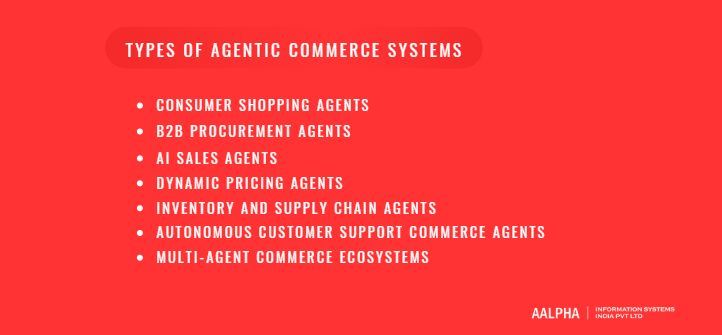
Types of Agentic Commerce Systems
-
Consumer Shopping Agents
Consumer shopping agents are among the most visible examples of agentic commerce systems. These AI-powered agents function as intelligent personal shopping assistants capable of helping users discover, evaluate, and purchase products with minimal manual effort.
Unlike traditional recommendation engines that simply suggest products based on browsing history, AI shopping agents can understand broader customer intent and independently perform multiple commerce tasks. For example, a user may request, “Find the best smartphone for gaming and photography within my budget,” and the AI agent can compare specifications, analyze reviews, monitor discounts, evaluate seller reliability, and recommend the most suitable option.
These systems also support automated recommendations based on customer preferences, purchasing behavior, lifestyle patterns, and historical interactions. AI agents can proactively suggest replenishment purchases, subscription renewals, seasonal products, or complementary items before customers begin searching manually.
As conversational AI interfaces become more advanced, consumer shopping agents are increasingly transforming online shopping from a search-driven experience into an intelligent intent-driven commerce model.
-
B2B Procurement Agents
B2B procurement agents automate complex purchasing workflows that traditionally require significant manual coordination between procurement teams, suppliers, finance departments, and logistics providers. These AI agents are designed to optimize enterprise purchasing decisions while reducing operational overhead.
One of the primary functions of procurement agents is vendor selection. AI systems can analyze supplier performance, pricing trends, delivery reliability, compliance records, and contractual terms to identify the most suitable vendors for specific purchasing requirements.
Quote comparison is another important capability. Instead of manually reviewing proposals from multiple suppliers, AI procurement agents can compare pricing structures, shipping timelines, warranty conditions, payment terms, and inventory availability automatically. This significantly accelerates procurement cycles and improves decision accuracy.
More advanced systems support autonomous purchasing workflows. AI agents can monitor inventory thresholds, forecast demand, initiate purchase requests, obtain approvals, process orders, and coordinate fulfillment without requiring constant human supervision.
For enterprises managing large procurement operations, these systems reduce delays, improve cost efficiency, and create more intelligent supply chain management processes.
-
AI Sales Agents
AI sales agents are transforming how businesses handle customer acquisition, engagement, and revenue optimization. These autonomous systems can manage large portions of the sales funnel while delivering highly personalized customer interactions at scale.
One of the most common applications is lead qualification. AI sales agents can analyze customer behavior, website interactions, demographic information, previous conversations, and purchasing intent signals to determine which leads are most likely to convert. This helps sales teams focus on high-value opportunities.
AI agents also support upselling and cross-selling workflows. By analyzing customer purchase history, subscription usage, and behavioral patterns, the system can recommend relevant upgrades, premium plans, or complementary products automatically during customer interactions.
Personalized offers are another key advantage. Instead of displaying generic promotions, AI sales agents can generate dynamic offers tailored to specific customer preferences, budget constraints, purchasing behavior, and engagement history.
As these systems become more sophisticated, businesses are increasingly using AI sales agents to automate customer engagement while maintaining highly contextual and individualized commerce experiences.
-
Dynamic Pricing Agents
Dynamic pricing agents use AI models and real-time market analysis to adjust pricing automatically based on changing business conditions. These systems continuously evaluate factors such as competitor pricing, inventory availability, customer demand, seasonal trends, and purchasing behavior before modifying prices dynamically.
In retail and eCommerce environments, dynamic pricing agents help businesses maximize revenue while remaining competitive. For example, AI systems may lower prices during low-demand periods, increase pricing during inventory shortages, or personalize discounts based on customer loyalty and purchasing probability.
In B2B commerce, these agents can optimize pricing negotiations by analyzing supplier conditions, contract history, procurement volumes, and market fluctuations.
Unlike static pricing systems that rely on manually updated rules, AI-driven pricing agents adapt continuously in real time. This allows businesses to respond more effectively to changing market conditions while improving profitability and operational efficiency.
-
Inventory and Supply Chain Agents
Inventory and supply chain agents help businesses automate operational workflows involving stock management, warehouse coordination, supplier communication, and logistics optimization. These AI systems are particularly valuable for enterprises managing large and complex supply chains.
AI inventory agents can monitor stock levels continuously, predict future demand patterns, identify supply shortages, and automate replenishment workflows. Instead of relying on manual forecasting, businesses can use AI systems to make proactive inventory decisions based on real-time operational data.
Supply chain agents also optimize logistics processes. They can coordinate warehouse routing, shipping carrier selection, delivery scheduling, and procurement timing to reduce operational costs and improve fulfillment efficiency.
In industries with volatile demand or global supply chain dependencies, these systems provide significant advantages by reducing stockouts, minimizing overstock situations, and improving overall supply chain resilience through continuous AI-driven optimization.
-
Autonomous Customer Support Commerce Agents
Autonomous customer support commerce agents go beyond traditional customer service chatbots by combining support capabilities with transaction execution and commerce intelligence. These AI systems can independently resolve issues while also managing sales and operational workflows.
For example, a customer support agent may handle refund requests, process exchanges, recommend replacement products, modify subscriptions, update delivery preferences, or place repeat orders without transferring the interaction to human representatives.
These agents can also analyze customer sentiment, purchase history, and account activity to personalize responses and identify opportunities for upselling or retention. Instead of functioning as isolated support systems, they become integrated commerce participants capable of handling end-to-end customer interactions.
As AI reasoning capabilities improve, autonomous customer support agents are increasingly reducing support costs while simultaneously improving customer satisfaction and transaction efficiency across digital commerce platforms.
-
Multi-Agent Commerce Ecosystems
Multi-agent commerce ecosystems involve multiple AI agents collaborating together to manage complex business operations across different commercial functions. Instead of relying on a single centralized AI system, businesses deploy specialized agents responsible for specific tasks and workflows.
For example, one AI agent may handle customer engagement, another may optimize pricing, while separate agents manage procurement, logistics, inventory planning, fraud detection, or payment processing. These agents communicate and coordinate with each other to achieve broader business objectives.
In a retail environment, a customer-facing shopping agent may identify a purchase opportunity and coordinate with pricing agents, inventory agents, and logistics agents to complete the transaction efficiently. In enterprise procurement, sourcing agents may collaborate with budgeting agents and compliance agents before finalizing supplier contracts.
This collaborative architecture enables businesses to scale autonomous commerce operations more effectively while improving specialization, adaptability, and workflow efficiency across large digital ecosystems.
Business Benefits of Agentic Commerce
-
Faster Customer Decision-Making
One of the biggest advantages of agentic commerce is its ability to reduce decision-making friction for customers. Traditional online shopping often requires users to spend significant time researching products, comparing vendors, reading reviews, checking pricing, and evaluating shipping options manually. This process can delay purchasing decisions and increase cart abandonment rates.
Agentic commerce simplifies this journey through AI-powered decision support. Instead of presenting customers with endless choices, AI agents can analyze customer intent, preferences, budgets, and historical behavior to identify the most relevant options quickly. Customers can communicate goals conversationally, and the AI system performs the research and evaluation process automatically.
For example, an AI shopping agent may compare dozens of products across multiple platforms, summarize key differences, evaluate total ownership costs, and recommend the best option within seconds. This significantly reduces cognitive overload for users.
By accelerating product discovery and simplifying comparisons, businesses can shorten purchase cycles, improve customer satisfaction, and create smoother transaction experiences across digital commerce environments.
-
Hyper-Personalized Shopping Experiences
Agentic commerce enables a much deeper level of personalization than traditional recommendation systems. Conventional personalization engines typically rely on browsing history or purchase patterns to display suggested products. Agentic systems go further by understanding customer intent, contextual behavior, preferences, and long-term interaction history.
AI agents can analyze multiple layers of customer data simultaneously, including spending behavior, product usage patterns, communication preferences, seasonal interests, loyalty activity, and operational requirements. This allows the system to deliver highly tailored commerce experiences that feel more like interacting with a knowledgeable personal assistant than browsing a static storefront.
For example, an AI commerce agent may proactively recommend subscription renewals, suggest alternative products when inventory is low, identify budget-friendly purchasing options, or tailor promotional offers based on customer purchasing probability.
In B2B environments, AI agents can personalize procurement recommendations according to departmental budgets, operational priorities, supplier relationships, and contract terms.
This level of intelligent personalization improves customer trust, increases engagement, and creates stronger long-term commercial relationships between businesses and consumers.
-
Increased Conversion Rates
Agentic commerce systems can significantly improve conversion rates by reducing friction throughout the purchasing process. Traditional eCommerce experiences often lose customers due to overwhelming choices, slow decision-making, complicated checkout flows, or lack of personalized guidance.
AI agents address these issues by guiding users through the transaction journey intelligently. Instead of forcing customers to search manually, compare products independently, and navigate multiple decision points, AI agents simplify and optimize the process from discovery to purchase completion.
For example, an AI commerce agent may identify hesitation during checkout and respond with personalized recommendations, financing options, delivery alternatives, or limited-time discounts tailored to the customer’s behavior and intent.
In B2B commerce, procurement agents can reduce delays caused by manual approvals, supplier evaluations, and quote comparisons, leading to faster transaction completion.
By improving decision accuracy, personalization, and workflow efficiency, businesses can convert more customer interactions into completed transactions while reducing abandonment rates.
-
Reduced Operational Costs
Agentic commerce reduces operational costs by automating repetitive, time-consuming, and labor-intensive business processes. Traditional commerce operations often require large teams to manage procurement, inventory monitoring, customer support, order processing, pricing adjustments, and logistics coordination manually.
AI agents can handle many of these functions autonomously at scale. Procurement agents can automate vendor evaluation and purchasing workflows, inventory agents can manage replenishment cycles, and customer support agents can resolve common issues without human intervention.
Businesses also reduce costs associated with human error, delayed decision-making, and inefficient workflows. AI systems operate continuously, analyze large volumes of data instantly, and execute tasks consistently without fatigue or operational bottlenecks.
In customer service operations, autonomous AI agents reduce support ticket volumes and improve response times while lowering staffing requirements. In supply chain management, AI-driven forecasting and inventory optimization help minimize overstocking and stock shortages.
Over time, these efficiency gains can significantly improve profitability while allowing businesses to scale operations without proportional increases in operational overhead.
-
Automated Procurement and Supply Operations
Procurement and supply chain management are among the most resource-intensive functions within many organizations. Agentic commerce introduces automation and intelligence into these workflows, enabling businesses to operate more efficiently and respond faster to changing market conditions.
AI procurement agents can monitor inventory levels continuously, predict future demand, compare suppliers, evaluate quotes, negotiate purchasing terms, and execute replenishment orders automatically. Instead of relying on periodic manual reviews, businesses gain real-time operational intelligence.
Supply chain agents can also optimize logistics operations by selecting cost-effective shipping routes, coordinating warehouse fulfillment, and adjusting procurement schedules based on supplier reliability or delivery constraints.
For enterprises operating across multiple suppliers, warehouses, and regions, this level of automation improves operational speed while reducing procurement delays and supply chain disruptions.
Automated supply operations also help businesses maintain inventory stability, improve forecasting accuracy, and reduce administrative workload across procurement and logistics departments.
-
Better Customer Retention and Engagement
Agentic commerce improves customer retention by creating more responsive, personalized, and proactive customer experiences. Traditional commerce systems often rely heavily on reactive engagement, meaning businesses respond only after customers initiate actions or problems arise.
AI agents allow businesses to engage customers proactively. For example, an AI commerce system may recommend replenishment orders before products run out, notify customers about relevant upgrades, identify dissatisfaction signals early, or suggest personalized offers based on purchasing patterns.
Autonomous customer support agents also contribute to stronger retention by providing faster issue resolution and continuous availability. Customers no longer need to wait for business hours or navigate complex support channels to receive assistance.
In subscription-based businesses, AI agents can monitor customer engagement and identify churn risks before cancellations occur. The system may then trigger retention campaigns, offer tailored incentives, or adjust service recommendations dynamically.
These proactive and intelligent interactions help businesses build stronger long-term customer relationships while improving satisfaction and engagement across the customer lifecycle.
-
24/7 Autonomous Commerce Operations
One of the most practical benefits of agentic commerce is the ability to operate continuously without dependence on human working hours. AI agents can monitor systems, process transactions, manage support interactions, analyze operational data, and execute workflows 24 hours a day.
This is particularly valuable for global businesses operating across multiple time zones. Customers can receive recommendations, complete purchases, resolve issues, and interact with AI systems at any time without waiting for human availability.
Autonomous commerce operations also improve responsiveness during high-demand periods such as holiday sales, product launches, or supply chain disruptions. AI agents can scale dynamically to handle increased workloads while maintaining operational consistency.
In procurement and logistics environments, continuous AI monitoring enables faster reaction to inventory shortages, supplier delays, or pricing fluctuations. Businesses can make operational adjustments in real time instead of waiting for manual reviews.
The result is a more agile and resilient commerce infrastructure capable of supporting uninterrupted business activity at scale.
-
Competitive Advantage Through AI-Driven Commerce
Businesses adopting agentic commerce early can gain significant competitive advantages in speed, efficiency, personalization, and operational intelligence. As digital commerce environments become increasingly competitive, organizations that rely solely on traditional workflows may struggle to match the responsiveness and scalability of AI-driven systems.
Agentic commerce enables faster decision-making, smarter procurement, dynamic pricing optimization, and highly personalized customer interactions. These capabilities improve operational performance while enhancing customer experience simultaneously.
AI-driven commerce systems also create stronger data advantages. Businesses can continuously analyze transaction behavior, supplier performance, operational bottlenecks, and customer intent to improve strategic decision-making over time.
In industries where margins are tight and customer expectations continue rising, even small operational improvements can create meaningful market advantages. Companies using intelligent AI agents can respond faster to market changes, optimize costs more effectively, and scale commerce operations more efficiently than competitors relying on manual processes.
As autonomous AI systems become more common across commerce ecosystems, agentic commerce is likely to evolve from a competitive advantage into a fundamental business requirement for digitally mature organizations.
Real-World Use Cases of Agentic Commerce
-
Retail and eCommerce
Retail and eCommerce represent some of the earliest and fastest-growing applications of agentic commerce. AI-powered shopping agents are transforming how customers discover, evaluate, and purchase products online. Instead of manually browsing marketplaces, customers can communicate purchase intent conversationally while AI agents handle research, comparison, and transaction execution automatically.
AI shopping assistants can analyze customer preferences, budget constraints, product reviews, brand loyalty, and historical purchasing behavior to deliver highly personalized recommendations. These systems reduce decision fatigue and simplify the purchasing journey significantly.
Agentic commerce is also enabling autonomous checkout experiences. AI agents can manage cart optimization, apply discounts automatically, recommend bundled purchases, select cost-efficient shipping methods, and complete transactions with minimal customer interaction. In some environments, the AI agent may proactively reorder frequently used products or manage subscription renewals automatically.
Retailers are also using AI agents for inventory forecasting, dynamic pricing adjustments, customer retention campaigns, and intelligent upselling workflows. As conversational commerce becomes more mainstream, retail platforms are shifting from traditional storefront models toward intelligent commerce ecosystems powered by autonomous AI systems.
-
Healthcare Commerce
Healthcare organizations are increasingly adopting agentic commerce systems to streamline procurement, patient support, and prescription management workflows. The healthcare industry involves highly complex supply chains, regulatory requirements, and operational coordination, making AI-driven automation particularly valuable.
One important use case is prescription ordering and medication management. Healthcare AI agents can assist patients with prescription renewals, medication reminders, pharmacy coordination, insurance validation, and delivery scheduling. These systems improve patient convenience while reducing administrative burden on healthcare providers.
Healthcare procurement is another major application area. Hospitals and clinics manage thousands of medical supplies, pharmaceuticals, diagnostic tools, and equipment purchases regularly. AI procurement agents can monitor inventory levels, compare vendors, negotiate pricing, validate compliance requirements, and automate replenishment workflows.
Agentic systems also help healthcare organizations reduce supply shortages, improve purchasing accuracy, and optimize procurement costs while maintaining operational continuity in highly regulated environments.
-
Logistics and Supply Chain
The logistics and supply chain industry is highly dependent on coordination, forecasting, and real-time operational decision-making, making it an ideal environment for agentic commerce systems.
Freight booking agents are becoming increasingly common in logistics operations. These AI systems can analyze shipment requirements, compare carrier pricing, evaluate delivery timelines, optimize routing options, and autonomously book freight services based on operational priorities and cost considerations.
Shipment optimization is another significant application. AI agents can monitor weather conditions, transportation disruptions, fuel costs, warehouse capacity, and delivery schedules in real time to adjust logistics workflows dynamically. This helps businesses reduce transportation costs and improve delivery performance.
Supply chain AI agents can also manage inventory movement across warehouses, coordinate supplier communications, predict demand fluctuations, and identify potential bottlenecks before disruptions occur.
For global supply chain operations where delays and inefficiencies can create major financial impact, agentic commerce systems improve operational agility while enabling more intelligent logistics management at scale.
-
Financial Services and FinTech
Financial services organizations are using agentic commerce systems to automate customer engagement, improve underwriting accuracy, personalize financial recommendations, and streamline operational workflows.
One important application is AI-driven financial product recommendations. Autonomous Finance AI agents can analyze customer income, spending patterns, financial goals, risk tolerance, and historical transactions to recommend suitable banking products, investment plans, insurance policies, or credit options. This creates more personalized and efficient customer experiences.
Automated underwriting workflows are another major use case. AI agents can collect applicant data, validate financial records, assess creditworthiness, detect fraud risks, and evaluate loan eligibility with minimal manual involvement. This significantly reduces approval times while improving operational efficiency.
In payment ecosystems, agentic systems can optimize fraud detection, automate dispute resolution, manage subscription billing, and personalize financial engagement workflows.
As financial institutions increasingly adopt AI-driven operational models, agentic commerce is becoming a foundational technology for improving customer service, operational scalability, and decision-making speed across the FinTech sector.
-
Travel and Hospitality
The travel and hospitality industry is rapidly adopting agentic commerce to simplify trip planning, automate bookings, and deliver more personalized customer experiences. Traditional travel planning often requires users to navigate multiple websites, compare prices manually, coordinate schedules, and manage bookings independently.
Autonomous travel planning agents eliminate much of this complexity. Customers can describe travel goals conversationally, and the AI system can research flights, hotels, transportation options, local experiences, and travel packages automatically. The AI agent can also optimize itineraries based on budget, preferences, weather conditions, loyalty programs, and scheduling constraints.
Booking automation is another major advantage. AI agents can monitor pricing fluctuations, identify discounts, adjust reservations dynamically, and complete transactions across multiple travel platforms autonomously.
Hospitality businesses are also using AI agents to personalize guest experiences, automate customer support, manage room upgrades, coordinate loyalty rewards, and optimize pricing strategies based on occupancy demand.
These capabilities improve convenience for travelers while helping hospitality providers increase operational efficiency and revenue optimization.
-
Manufacturing and Industrial Procurement
Manufacturing organizations manage highly complex procurement operations involving raw materials, industrial equipment, suppliers, maintenance schedules, and production forecasting. Agentic commerce systems help automate these workflows while improving operational efficiency and supply chain reliability.
AI procurement agents can continuously monitor inventory levels, production requirements, supplier availability, and pricing fluctuations to optimize purchasing decisions automatically. Instead of relying on periodic manual procurement reviews, manufacturers gain real-time procurement intelligence.
Industrial procurement agents can also evaluate supplier performance, compare contract terms, assess delivery risks, and negotiate purchasing conditions dynamically. This helps businesses reduce procurement costs while minimizing supply chain disruptions.
In large manufacturing environments, AI agents can coordinate procurement across multiple facilities, manage supplier communications, automate purchase approvals, and align inventory planning with production schedules.
As manufacturing operations become increasingly data-driven and globally distributed, agentic commerce systems are helping organizations build more resilient, scalable, and intelligent industrial supply chains.
-
SaaS and Subscription Businesses
SaaS and subscription-based businesses are using agentic commerce systems to automate customer lifecycle management, improve retention, personalize pricing strategies, and optimize recurring revenue operations.
AI agents can monitor customer engagement patterns, feature usage, subscription activity, and support interactions to identify churn risks proactively. Instead of waiting for customers to cancel, the AI system can trigger retention campaigns, recommend upgrades, adjust pricing offers, or personalize onboarding workflows automatically.
Subscription management is another important application. AI agents can handle billing operations, renewal reminders, usage-based pricing adjustments, payment retries, and account upgrades without requiring manual intervention.
Sales and onboarding workflows also benefit from agentic commerce. AI agents can qualify leads, recommend suitable subscription tiers, personalize product demonstrations, and automate customer onboarding sequences based on user behavior and business requirements.
For SaaS businesses focused on scalability and recurring revenue growth, agentic commerce systems improve operational efficiency while delivering more intelligent and personalized customer experiences across the subscription lifecycle.
Challenges and Risks of Agentic Commerce
-
AI Hallucinations and Incorrect Decisions
One of the biggest risks in agentic commerce is the possibility of AI hallucinations and incorrect decision-making. Large language models and autonomous AI systems can sometimes generate inaccurate information, misunderstand intent, or make flawed recommendations based on incomplete or misleading data.
In commerce environments, these mistakes can create serious operational and financial consequences. An AI procurement agent may select the wrong supplier, misinterpret contract terms, recommend unsuitable products, or execute incorrect purchasing decisions. In customer-facing systems, hallucinated responses may damage trust, create misinformation, or lead to poor customer experiences.
The risk increases when AI agents operate autonomously without sufficient validation mechanisms or human oversight. Since agentic commerce systems often involve multi-step workflows and transaction execution, a single reasoning error can cascade into larger operational issues.
Businesses implementing agentic commerce must therefore establish safeguards such as retrieval-augmented generation systems, validation layers, human approval workflows, and audit mechanisms to reduce the likelihood of inaccurate AI-generated decisions affecting critical business operations.
-
Data Privacy and Security Risks
Agentic commerce systems process large volumes of sensitive customer, financial, operational, and transactional data. As AI agents gain deeper access to enterprise systems, APIs, payment infrastructure, and customer records, the importance of security and privacy protection increases significantly.
AI agents often require access to personal preferences, payment information, procurement records, supplier contracts, logistics systems, and communication history to function effectively. This creates potential exposure to data leaks, unauthorized access, cyberattacks, and misuse of confidential information.
Another concern involves third-party AI integrations and cloud-based infrastructure. Businesses using external AI models or orchestration platforms must carefully evaluate how customer and enterprise data is stored, processed, and shared across systems.
Autonomous transaction execution also introduces additional security challenges. AI agents capable of making purchases or initiating payments must operate within tightly controlled access frameworks to prevent fraud, unauthorized spending, or malicious manipulation.
Strong encryption, identity management, API security, access controls, monitoring systems, and compliance-focused data governance are essential for maintaining trust and protecting sensitive information within agentic commerce ecosystems.
-
Regulatory and Compliance Challenges
As agentic commerce systems become more autonomous, regulatory and compliance concerns are becoming increasingly important across industries such as healthcare, finance, logistics, and retail.
Many industries operate under strict regulations involving customer privacy, financial reporting, procurement standards, consumer protection, and operational accountability. Autonomous AI systems capable of making decisions and executing transactions introduce new legal and compliance complexities that existing regulations may not fully address.
For example, an AI procurement agent making purchasing decisions may raise questions around accountability, auditability, and approval authority. In financial services, AI-driven underwriting systems must comply with lending regulations, anti-discrimination laws, and fraud prevention requirements. Healthcare AI agents handling prescription workflows must operate within medical privacy and patient safety regulations.
Businesses must also consider regional compliance frameworks such as GDPR, HIPAA, PCI DSS, and emerging AI governance laws. Regulatory agencies worldwide are increasingly scrutinizing how AI systems collect data, make decisions, and interact with consumers.
Organizations implementing agentic commerce need clear governance frameworks, audit trails, explainability mechanisms, and human oversight policies to ensure compliance while reducing legal and operational risks.
-
Trust and Customer Adoption Issues
Despite rapid AI adoption, many customers and businesses still hesitate to trust fully autonomous commerce systems. Commerce transactions often involve financial decisions, personal data, and operational risks, making trust a critical factor in adoption.
Customers may feel uncomfortable allowing AI agents to make purchasing decisions, process payments, negotiate contracts, or access sensitive information independently. Concerns about transparency, reliability, and control can slow adoption, particularly in high-value or high-risk transactions.
Businesses also face internal resistance when replacing manual workflows with autonomous systems. Employees may question AI decision accuracy, operational reliability, or long-term workforce implications.
To improve trust, organizations must provide transparency around how AI decisions are made, establish clear approval controls, and allow users to maintain visibility and override authority when needed. Building trustworthy agentic commerce systems requires both technical reliability and strong user confidence.
-
Integration Complexity
Agentic commerce systems often require deep integration with multiple enterprise platforms, databases, APIs, payment systems, logistics tools, and operational workflows. This integration complexity can become a major implementation challenge for businesses.
Many organizations operate on fragmented technology stacks involving legacy systems, disconnected databases, outdated APIs, and department-specific software tools. Connecting AI agents to these environments while maintaining operational reliability and security requires significant technical planning.
Integration challenges also increase as businesses attempt to coordinate AI workflows across procurement, finance, inventory management, customer support, and logistics systems simultaneously.
Poorly integrated systems can create data inconsistencies, operational bottlenecks, synchronization failures, or incomplete AI decision-making. As a result, businesses adopting agentic commerce often need modern API infrastructure, workflow orchestration frameworks, and scalable cloud architectures to support successful implementation.
-
Ethical Concerns in Autonomous Commerce
Agentic commerce raises important ethical questions around autonomy, transparency, bias, accountability, and decision-making authority. As AI agents become more capable of influencing purchases and operational outcomes, businesses must ensure these systems operate responsibly.
One concern involves manipulation and persuasion. AI systems capable of understanding user behavior deeply may influence purchasing decisions aggressively through hyper-personalized recommendations or pricing strategies designed to maximize conversions.
Bias is another major issue. AI agents trained on biased datasets may produce unfair recommendations, discriminatory pricing, or unequal financial decisions. In sectors such as lending, healthcare, or hiring-related commerce workflows, biased AI outcomes can create serious ethical and legal consequences.
Questions around accountability also remain unresolved. When an autonomous AI agent makes an incorrect purchasing or financial decision, determining responsibility can become difficult.
Organizations deploying agentic commerce systems must establish ethical AI policies, fairness monitoring, explainability frameworks, and governance standards to ensure responsible AI-driven commerce operations.
-
Monitoring and Governance Requirements
As agentic commerce systems gain more operational authority, businesses need robust monitoring and governance frameworks to maintain control, reliability, and accountability.
Unlike traditional software systems, autonomous AI agents continuously adapt, make decisions dynamically, and interact across multiple enterprise systems. This creates the need for ongoing monitoring of AI behavior, transaction accuracy, operational performance, and compliance adherence.
Businesses must establish governance policies defining what actions AI agents can perform independently, when human approval is required, and how exceptions are handled. Audit trails are also critical for tracking decisions, transactions, and workflow execution across AI systems.
Performance monitoring helps organizations identify errors, hallucinations, security risks, or operational anomalies before they create larger business problems. Governance systems also support regulatory compliance and internal accountability requirements.
As agentic commerce becomes more widespread, governance and monitoring will become foundational requirements for deploying trustworthy and scalable autonomous commerce ecosystems.
How Businesses Can Implement Agentic Commerce
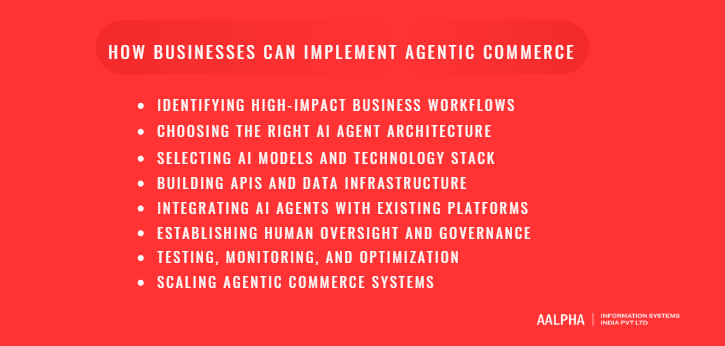
Learn how businesses can implement agentic commerce by identifying suitable workflows, selecting the right AI architecture, integrating AI agents with existing systems, and building scalable infrastructure. It also covers governance, monitoring, and scaling strategies required for successful deployment. Businesses often partner with an experienced AI agent development company such as Aalpha Information Systems to build secure and scalable agentic commerce solutions.
-
Identifying High-Impact Business Workflows
The first step in implementing agentic commerce is identifying business workflows where autonomous AI systems can deliver measurable operational or financial value. Not every workflow benefits equally from AI autonomy, so organizations should prioritize processes involving repetitive decisions, high transaction volumes, operational bottlenecks, or complex coordination tasks.
Commerce functions such as procurement, customer support, inventory management, lead qualification, subscription management, pricing optimization, and logistics coordination are often strong starting points. These workflows typically involve structured data, predictable objectives, and frequent manual intervention, making them ideal candidates for AI-driven automation.
Businesses should also evaluate where delays, inefficiencies, or human workload are affecting customer experience or operational scalability. For example, slow procurement approvals, inconsistent customer support response times, or inefficient inventory replenishment cycles can often be improved significantly through AI agents.
A successful implementation strategy usually begins with narrowly scoped, high-impact workflows before expanding AI autonomy into broader enterprise operations over time.
-
Choosing the Right AI Agent Architecture
Selecting the appropriate AI agent architecture is critical for building scalable and reliable agentic commerce systems. The architecture determines how AI agents reason, interact with tools, access memory, execute workflows, and coordinate across enterprise systems.
Some businesses may benefit from single-agent systems where one AI agent manages a specific workflow such as customer support or procurement automation. More complex organizations often require multi-agent architectures where specialized agents collaborate across different operational domains.
For example, a retail commerce environment may involve separate agents for pricing, inventory management, customer engagement, logistics coordination, and fraud detection. These agents communicate with each other through orchestration frameworks while operating toward broader business objectives.
Businesses must also determine the level of autonomy required. Some workflows may operate under human approval models, while others can function fully autonomously within predefined operational boundaries.
Scalability, interoperability, fault tolerance, memory management, and API integration capabilities should all be considered when designing AI agent architectures for enterprise commerce environments.
-
Selecting AI Models and Technology Stack
Choosing the right AI models and AI agent technology stack directly affects the performance, reliability, and scalability of agentic commerce systems. Businesses must align model capabilities with operational requirements, industry complexity, security standards, and integration needs.
Large language models are typically used for reasoning, conversational interaction, workflow planning, and intent understanding. Machine learning models may handle forecasting, recommendation systems, fraud detection, dynamic pricing, or predictive analytics.
The broader technology stack often includes orchestration frameworks, vector databases, workflow automation platforms, API gateways, monitoring systems, and cloud infrastructure. Frameworks such as LangChain are commonly used for coordinating AI workflows, while platforms like n8n and Make help automate operational integrations.
Businesses should also evaluate whether to use open-source models, proprietary enterprise AI platforms, or hybrid deployments depending on privacy, cost, customization, and compliance requirements.
Technology selection should prioritize scalability, operational reliability, explainability, and long-term maintainability rather than focusing solely on model performance benchmarks.
-
Building APIs and Data Infrastructure
Strong API connectivity and reliable data infrastructure are foundational requirements for successful agentic commerce implementations. AI agents rely on continuous access to operational data, transactional systems, and enterprise workflows to make intelligent decisions and execute actions effectively.
Businesses must ensure that inventory systems, payment gateways, logistics platforms, CRMs, ERPs, analytics systems, and supplier databases are accessible through secure APIs. Without real-time connectivity, AI agents cannot maintain accurate operational awareness or execute workflows autonomously.
Data quality is equally important. Inconsistent, outdated, or fragmented data can lead to incorrect AI decisions and unreliable commerce operations. Organizations often need centralized data pipelines, structured databases, vector storage systems, and real-time synchronization frameworks to support AI-driven workflows.
Scalable infrastructure is also essential because agentic systems process large volumes of requests, transactions, and operational events continuously. Cloud-native architectures and distributed API systems help businesses maintain performance, availability, and scalability as AI commerce operations expand.
A well-designed data and integration layer enables AI agents to function as operational participants rather than isolated conversational systems.
-
Integrating AI Agents with Existing Platforms
Most businesses already operate using multiple software systems for commerce, operations, finance, logistics, and customer engagement. Successful agentic commerce implementation depends heavily on integrating AI agents into these existing environments instead of replacing infrastructure entirely.
AI agents commonly integrate with SaaS platforms, customer relationship management platforms, inventory management systems, enterprise resource planning software, payment processors, communication tools, and logistics providers. These integrations allow AI systems to access operational data and execute workflows across the organization.
For example, an AI procurement agent may retrieve inventory data from warehouse systems, compare supplier pricing through procurement platforms, generate purchase approvals inside ERP software, and coordinate delivery through logistics APIs simultaneously.
Integration strategies should prioritize interoperability, security, and operational reliability. Middleware platforms, workflow orchestration systems, and API gateways often help simplify communication between AI agents and enterprise software.
Organizations should also design fallback mechanisms and operational safeguards to prevent workflow disruptions if connected systems experience failures or synchronization issues during AI-driven transaction execution.
-
Establishing Human Oversight and Governance
Although agentic commerce enables autonomous decision-making, businesses still need governance frameworks and human oversight mechanisms to manage risk, accountability, and compliance effectively.
Organizations should define which actions AI agents can perform independently and which transactions require human approval. High-value procurement, financial approvals, regulated operations, or compliance-sensitive workflows often require additional oversight.
Governance policies should also address audit trails, decision explainability, escalation procedures, access permissions, and security controls. Businesses need visibility into how AI agents make decisions, what data they access, and how workflows are executed.
Human oversight becomes especially important in industries involving financial risk, healthcare compliance, or customer-sensitive operations where errors can create legal or operational consequences.
A balanced governance framework helps businesses benefit from AI autonomy while maintaining operational control and accountability.
-
Testing, Monitoring, and Optimization
Agentic commerce systems require continuous testing and monitoring to ensure reliability, accuracy, security, and operational performance. Unlike static software systems, AI agents evolve dynamically and interact with changing business environments, making ongoing optimization essential.
Businesses should test AI agents extensively across different workflows, transaction scenarios, edge cases, and operational conditions before deployment. This includes validating reasoning accuracy, workflow execution reliability, API connectivity, and security behavior.
Once deployed, continuous monitoring becomes critical. Organizations need visibility into transaction success rates, AI decision quality, operational anomalies, customer interactions, and system failures in real time.
Performance analytics also help businesses optimize AI behavior over time. By analyzing transaction outcomes, customer feedback, workflow efficiency, and operational bottlenecks, organizations can refine AI models and improve automation strategies continuously.
Testing and optimization are ongoing operational responsibilities rather than one-time implementation tasks in agentic commerce environments.
-
Scaling Agentic Commerce Systems
After initial deployment success, businesses can begin scaling agentic commerce systems across broader workflows, departments, and operational environments. Scaling requires careful planning to maintain performance, governance, and operational consistency.
One important consideration is infrastructure scalability. AI agents handling large transaction volumes require distributed computing resources, scalable APIs, cloud-native architectures, and resilient orchestration systems capable of supporting continuous operations.
Businesses also need standardized agent management frameworks as the number of AI agents increases. Multi-agent ecosystems often involve coordination between specialized agents responsible for procurement, logistics, customer support, pricing, and analytics simultaneously.
Operational governance becomes more complex at scale. Organizations must establish centralized monitoring systems, role-based access controls, compliance auditing mechanisms, and performance management frameworks across AI-driven workflows.
Scalability should also include organizational readiness. Employees need training, operational processes must adapt, and leadership teams must align AI strategies with long-term business goals.
Businesses that approach scaling strategically can transform isolated AI automation projects into fully integrated autonomous commerce ecosystems capable of driving long-term operational advantage.
Agentic Commerce vs Traditional Commerce Models
-
Traditional eCommerce vs Agentic Commerce
Traditional eCommerce platforms are primarily designed as digital storefronts where customers manually search for products, compare options, add items to carts, and complete purchases themselves. The platform acts as a transactional interface, but most decision-making responsibility remains with the user.
Agentic commerce introduces a fundamentally different operational model. Instead of relying entirely on manual interaction, AI agents actively participate in the commerce process by understanding customer intent, making recommendations, optimizing decisions, and executing transactions autonomously.
In traditional eCommerce, users navigate menus, filters, search bars, and checkout pages manually. In agentic commerce, customers may simply communicate goals conversationally, while AI agents handle research, comparison, negotiation, purchasing, and fulfillment coordination automatically.
Traditional eCommerce systems are largely reactive, responding only after users initiate actions. Agentic commerce systems are proactive and context-aware. They can anticipate needs, optimize workflows dynamically, and personalize decisions continuously based on real-time operational data and customer behavior.
This shift transforms digital commerce from a static user-driven experience into an intelligent, adaptive, and autonomous commerce ecosystem powered by AI agents.
-
Chatbots vs AI Commerce Agents
Traditional chatbots are designed primarily for scripted interactions and basic customer support automation. Most chatbots operate within predefined conversational flows and can answer common questions, provide order updates, or guide users through limited workflows. Their functionality is typically reactive and rule-based.
AI commerce agents are significantly more advanced. Instead of simply responding to questions, they can reason through problems, analyze context, make decisions, access external systems, and execute multi-step workflows autonomously.
For example, a chatbot may help a customer track an order or provide refund instructions. An AI commerce agent can independently compare products, optimize pricing, process purchases, negotiate vendor terms, coordinate logistics, and monitor fulfillment status without requiring human intervention.
AI commerce agents also possess memory and contextual awareness. They can retain customer preferences, transaction history, and operational constraints over time to improve future interactions and decision-making.
The difference is not just conversational capability but operational autonomy. Chatbots assist conversations, while AI commerce agents actively participate in and manage commerce workflows.
-
Workflow Automation vs Autonomous AI Systems
Traditional workflow automation systems are designed to execute predefined tasks based on fixed rules and structured conditions. These systems are highly effective for repetitive operational processes such as sending invoices, updating records, routing approvals, or triggering notifications after specific events occur.
However, workflow automation tools typically lack reasoning, adaptability, and contextual understanding. They follow instructions exactly as configured and cannot independently evaluate changing business conditions or make complex decisions beyond predefined logic.
Autonomous AI systems operate differently. AI agents can interpret goals, analyze multiple data sources, evaluate trade-offs, adapt workflows dynamically, and determine the most appropriate actions based on context.
For example, a traditional automation system may reorder inventory once stock reaches a predefined threshold. An autonomous AI agent can analyze supplier reliability, shipping timelines, seasonal demand forecasts, pricing trends, warehouse capacity, and operational priorities before determining how and when to reorder products.
This ability to reason, adapt, and optimize continuously is what separates autonomous AI systems from conventional workflow automation technologies.
-
Human-Led Commerce vs AI-Led Commerce
Human-led commerce relies heavily on manual decision-making, operational oversight, customer interaction, and transaction management. Employees handle procurement decisions, customer support, inventory planning, pricing strategies, vendor coordination, and sales engagement through human judgment and experience.
AI-led commerce shifts many of these operational responsibilities to autonomous systems capable of processing large volumes of data, executing workflows continuously, and optimizing decisions in real time.
One of the major advantages of AI-led commerce is scalability. AI agents can operate 24/7, analyze vast amounts of operational information instantly, and handle thousands of simultaneous interactions without the limitations associated with human workloads.
However, human-led commerce still provides strengths in strategic thinking, ethical judgment, relationship management, and complex decision-making involving ambiguity or emotional context. As a result, most businesses are likely to adopt hybrid operational models rather than fully replacing human involvement.
In many organizations, AI agents will handle repetitive, data-intensive, and operationally complex workflows, while humans focus on governance, strategic oversight, high-value negotiations, and customer relationship management.
The future of commerce is therefore not purely human-driven or AI-driven, but increasingly collaborative between intelligent AI systems and human expertise.
Future of Agentic Commerce
-
Rise of Autonomous AI Economies
The future of agentic commerce is moving toward increasingly autonomous AI-driven economies where intelligent systems participate directly in commercial activity with minimal human intervention. Instead of humans manually managing every transaction, negotiation, and operational workflow, AI agents will increasingly coordinate purchasing, logistics, financial operations, and customer interactions independently.
In these emerging AI economies, autonomous agents may represent businesses, consumers, suppliers, and service providers simultaneously. Procurement agents could negotiate directly with supplier agents, logistics agents could optimize transportation routes collaboratively, and financial agents could approve transactions dynamically based on predefined operational goals.
This shift has the potential to accelerate transaction speed, improve operational efficiency, and reduce administrative overhead across industries. Commerce ecosystems may evolve into highly interconnected digital environments where AI systems continuously exchange information, optimize workflows, and execute transactions automatically in real time.
As AI infrastructure matures, autonomous economic activity is expected to become a major operational layer within global digital commerce systems.
-
AI-to-AI Transactions
One of the most transformative developments in agentic commerce will be the rise of AI-to-AI transactions, where autonomous systems communicate and transact directly with each other without requiring constant human involvement.
In traditional commerce, humans remain central to most purchasing decisions, negotiations, and operational coordination. Future commerce environments may involve AI agents independently managing supplier relationships, inventory replenishment, subscription renewals, logistics scheduling, and procurement negotiations.
For example, a manufacturing company’s procurement agent may detect declining inventory and automatically negotiate pricing and delivery schedules with supplier AI systems. Payment agents may validate budgets, approve transactions, and process payments autonomously, while logistics agents coordinate shipping and warehouse operations simultaneously.
These AI-to-AI interactions could dramatically reduce transaction friction and operational delays. Businesses may operate faster and more efficiently as intelligent agents continuously optimize commercial activities in the background.
However, this future also increases the need for governance frameworks, interoperability standards, auditability, and secure communication protocols between autonomous systems operating across different organizations and industries.
-
Voice-Driven and Multimodal Commerce Agents
Voice-driven and multimodal AI agents are expected to become a major interface layer in future commerce ecosystems. Instead of relying primarily on traditional web interfaces, users will increasingly interact with commerce systems using natural speech, images, video, gestures, and contextual interactions across multiple devices.
Voice-enabled AI commerce agents will allow customers to perform complex commerce activities conversationally. A user may say, “Find and reorder office supplies for next week within budget,” and the AI agent could handle product selection, supplier comparison, procurement approval, and order execution automatically.
Multimodal AI systems will combine text, voice, visual recognition, and contextual awareness simultaneously. For example, a customer may upload an image of a product, ask the AI to identify cheaper alternatives, and complete a purchase through voice interaction in a single workflow.
These interfaces will significantly reduce friction in digital commerce while making AI systems more accessible across mobile devices, smart assistants, wearables, vehicles, and enterprise environments.
As multimodal AI capabilities improve, commerce interactions are likely to become more conversational, intuitive, and deeply integrated into everyday digital experiences.
-
Decentralized Commerce and AI Agents
Decentralized commerce models may also play an important role in the future of agentic commerce. Instead of relying entirely on centralized platforms, businesses and consumers may increasingly use distributed AI ecosystems where autonomous agents interact across decentralized networks.
AI agents operating in decentralized environments could independently verify transactions, manage digital contracts, coordinate payments, and interact with blockchain-based systems securely. Smart contracts may enable AI agents to execute agreements automatically once predefined conditions are met.
Decentralized commerce could also improve transparency and reduce dependence on centralized intermediaries in certain industries. AI agents may manage peer-to-peer transactions, decentralized marketplaces, and autonomous service coordination without traditional platform control.
Although this ecosystem is still developing, decentralized AI commerce models may become increasingly important as organizations seek more open, interoperable, and automated digital transaction infrastructures.
-
Future Business Opportunities
The growth of agentic commerce is expected to create major business opportunities across technology, retail, logistics, healthcare, finance, manufacturing, and enterprise software industries. Businesses that adopt AI-driven commerce systems early may gain significant operational and competitive advantages.
New opportunities are emerging around AI agent development, orchestration platforms, autonomous procurement systems, intelligent logistics infrastructure, conversational commerce interfaces, and AI-native enterprise applications. Companies specializing in workflow automation, AI infrastructure, security, and governance are also likely to see increasing demand.
Businesses may also develop entirely new service models around AI-managed subscriptions, autonomous procurement marketplaces, predictive commerce platforms, and AI-driven customer engagement ecosystems.
For enterprises, agentic commerce creates opportunities to reduce operational costs, improve scalability, personalize customer experiences, and accelerate transaction execution. For startups, it opens pathways to build AI-native business models designed around autonomous workflows from the beginning.
As AI systems continue evolving, agentic commerce is expected to reshape how businesses operate, compete, and interact within the global digital economy over the next decade.
Conclusion
Agentic commerce represents a major shift in how digital commerce systems operate. Instead of relying entirely on manual workflows and reactive automation, businesses can now use autonomous AI agents to handle decision-making, procurement, customer engagement, logistics, and transaction execution intelligently and at scale.
As AI technologies continue evolving, agentic commerce is expected to become increasingly important across industries such as retail, healthcare, logistics, finance, manufacturing, and SaaS. Businesses that adopt these systems early can improve operational efficiency, reduce costs, personalize customer experiences, and gain a stronger competitive advantage in rapidly changing digital markets.
However, successful implementation requires careful planning around governance, security, compliance, integration, and human oversight. Organizations must balance AI autonomy with responsible operational control to build trustworthy and scalable commerce ecosystems.
Businesses planning to build AI-driven commerce platforms or autonomous AI agent systems can benefit from working with experienced AI agent development companies such as Aalpha Information Systems that understand enterprise AI infrastructure, workflow automation, and intelligent commerce solutions. Connect with us now to discuss your agentic commerce development requirements.