


Startups operate in an environment defined by uncertainty, speed, and innovation. Unlike established enterprises that optimize existing processes, startups focus on creating new products, solving emerging problems, and building scalable business models from the ground up. In most modern startups, software plays a central role in this process. Whether the product is a mobile application, a SaaS platform, an AI-driven tool, or a marketplace, software becomes the primary medium through which startups deliver value to customers.
Startup software development refers to the structured process of designing, building, launching, and continuously improving software products within the constraints of a startup environment. These constraints typically include limited funding, small teams, aggressive timelines, and the constant need to validate business ideas quickly. As a result, startup development strategies prioritize speed, flexibility, and experimentation rather than the rigid processes often seen in traditional enterprise software projects.
Understanding how software development works in a startup context is critical for founders, product managers, and technical teams. Decisions made during the early stages of development often determine whether a startup can achieve product-market fit, attract users, and scale successfully. Questions such as how to build a minimum viable product, which technologies to choose, whether to hire developers or outsource development, and how to manage product iterations all become central to startup success.
This guide explores the complete landscape of startup software development. It examines how startups approach product development, the technologies commonly used, the cost considerations involved, and the best practices that help new ventures build scalable and competitive digital products.
What Is Startup Software Development?
Startup software development is the process of creating digital products specifically within the operational environment of a startup company. While the core technical practices such as coding, testing, deployment, and system architecture remain similar to enterprise development, the strategic priorities are fundamentally different.
Traditional enterprise software development often focuses on stability, long planning cycles, extensive documentation, and large development teams. Enterprises typically have established workflows, predictable budgets, and well-defined user requirements. Development projects may take years before a product reaches production.
In contrast, startup software development emphasizes rapid experimentation and iterative learning. Startups must validate their ideas quickly before committing large amounts of capital or resources. This approach usually begins with building a Minimum Viable Product (MVP) that contains only the core features necessary to test the business idea.
Speed becomes a defining factor. Startups frequently release early versions of their software to real users, gather feedback, analyze usage behavior, and improve the product through continuous iterations. Development cycles are shorter, product decisions are data-driven, and teams prioritize flexibility over rigid planning.
Another distinguishing characteristic is resource limitation. Many startups operate with small engineering teams and constrained budgets. This reality forces founders to make careful decisions about technology stacks, infrastructure costs, and development strategies. Outsourcing development, using open-source frameworks, and leveraging cloud platforms are common practices to accelerate development while controlling expenses.
Ultimately, startup software development is not only about building software. It is about building a product that can validate a business idea, attract users, and evolve quickly based on real market feedback.
Why Software Is the Backbone of Modern Startups
In today’s digital economy, software is the primary mechanism through which startups deliver value. Unlike traditional businesses that rely heavily on physical infrastructure, modern startups can build scalable services entirely through digital platforms.
Software enables startups to reach global markets without the need for physical expansion. A cloud-based SaaS platform, for example, can serve customers across multiple countries from a single infrastructure environment. This ability to scale digitally is one of the key reasons technology startups have become some of the fastest-growing companies in the world.
Beyond product delivery, software also drives operational efficiency. Startups rely on software tools to automate internal workflows such as customer onboarding, marketing campaigns, billing, analytics, and support management. Automation reduces operational costs and allows small teams to manage large numbers of users.
Another major advantage is the ability to collect and analyze data. Software platforms generate valuable insights about user behavior, product usage patterns, and customer preferences. Startups use this data to refine product features, improve user experience, and identify growth opportunities.
Many successful startups demonstrate how software can transform entire industries. Companies such as Airbnb disrupted the hospitality sector by building a digital marketplace connecting hosts and travelers. Uber transformed urban transportation through a mobile platform that connects riders with drivers in real time. These examples illustrate how software allows startups to build scalable platforms capable of serving millions of users.
For modern startups, software is not just a supporting tool. It is the foundation of the business model itself.
Key Challenges Startups Face When Building Software
Despite the opportunities software provides, startups face several significant challenges when developing digital products. These challenges often arise from the inherent uncertainty and limited resources that characterize early-stage ventures.
One of the most common obstacles is limited funding. Building high-quality software requires skilled developers, infrastructure, design resources, and ongoing maintenance. Early-stage startups must allocate their budgets carefully while still delivering a product that meets user expectations. Many founders struggle to balance development costs with the need to launch quickly.
Hiring skilled developers presents another major challenge. Competition for experienced software engineers is intense, particularly in technology hubs. Startups often cannot compete with the salaries offered by large technology companies, making recruitment difficult. As a result, many startups rely on outsourcing, remote development teams, or hybrid staffing models.
Choosing the right technology stack is another critical decision. The technologies selected during the early stages influence scalability, performance, and future development costs. Selecting an overly complex architecture can slow development, while choosing outdated technologies may limit long-term growth.
Perhaps the most difficult challenge is achieving product-market fit. Many startups build technically sophisticated products that fail because they do not solve a meaningful problem for users. Software development alone does not guarantee success. Startups must continuously validate whether their product delivers real value to a clearly defined target audience.
Other challenges include managing development timelines, maintaining software quality with limited testing resources, ensuring data security, and adapting to rapidly changing market conditions.
Understanding these challenges is essential because successful startup software development requires not only technical expertise but also strategic decision-making and continuous learning.
Understanding the Startup Product Development Lifecycle
Building successful startup software requires more than simply writing code. Startups must follow a structured product development lifecycle that guides the transformation of an idea into a scalable and sustainable digital product. Unlike traditional enterprise software projects, startup product development emphasizes speed, experimentation, and learning from real users. The lifecycle typically begins with validating the startup idea and ends with continuous product improvement based on data and customer feedback.
A well-defined product development lifecycle helps startups reduce risk, allocate resources efficiently, and avoid building products that the market does not need. Many startup failures occur not because the technology was inadequate, but because the product was developed without validating customer demand. By following a disciplined lifecycle approach, founders can move from concept to product-market fit more effectively.
The startup product development lifecycle generally includes several key phases. First, founders validate their idea through market research and customer discovery. Next, they define the specific problem they want to solve and identify the target audience. Once the problem and customer segment are clear, the team develops a product vision and roadmap that outlines the long-term direction of the product. After the initial product is launched, startups rely on iterative development and continuous improvement to refine features, fix usability issues, and expand the product.
Understanding this lifecycle is essential for founders and product teams because it provides a framework for making strategic decisions throughout the development process.
-
Idea Validation and Market Research
Idea validation is the first and most critical step in startup product development. Before investing significant time and money into building software, startups must confirm that their idea addresses a real market need. Many startup founders begin with a strong concept but fail to test whether potential users actually want the solution.
The validation process typically starts with customer discovery. Founders conduct interviews with potential users to understand their challenges, workflows, and existing solutions. These conversations often reveal whether the problem is significant enough for customers to pay for a solution. Customer discovery also helps identify how frequently the problem occurs and how current alternatives fall short.
Market research is another important component of idea validation. Startups analyze the size of the market, growth trends, and potential customer segments. If the target market is too small or highly saturated with competitors, the idea may not be commercially viable.
Competitor analysis further strengthens the validation process. Studying companies that already operate in the same space allows startups to understand what features users expect, where competitors are weak, and what opportunities exist for differentiation.
Through customer interviews, market analysis, and competitor evaluation, startups can determine whether their idea solves a meaningful problem and whether the market opportunity justifies building the product.
-
Defining the Problem and Target Audience
Once an idea has been validated, the next step is clearly defining the problem the startup intends to solve. Successful startup products are rarely broad solutions for everyone. Instead, they focus on solving a specific pain point for a clearly defined user group.
Defining the problem requires a deep understanding of user behavior and operational challenges. Startups must identify the exact scenario in which users experience difficulty. For example, a startup developing project management software might focus specifically on the needs of small remote teams that struggle with task coordination and communication.
Equally important is defining the target audience. Startups should identify a primary customer segment based on characteristics such as industry, job role, company size, or demographic profile. A narrowly defined target audience allows startups to design products that deliver highly relevant solutions rather than generic functionality.
Product teams often create user personas to represent typical customers. These personas include information about user goals, frustrations, and typical workflows. By mapping these details, startups can ensure that product features align closely with real user needs.
This stage also involves defining the core value proposition. The value proposition explains how the product solves the user’s problem more effectively than existing alternatives. For instance, companies like Slack achieved rapid adoption by addressing the specific challenge of fragmented workplace communication.
Clearly defining the problem and the target audience ensures that product development remains focused on delivering meaningful value to users.
-
Building a Product Vision and Roadmap
After defining the problem and the target users, startups must establish a clear product vision. The product vision describes the long-term goal of the software and the value it aims to deliver to customers over time. This vision acts as a strategic guide that aligns product decisions, development priorities, and business objectives.
A strong product vision answers several important questions. What transformation does the product aim to achieve for its users? How will the product evolve as the startup grows? What differentiates the product from competing solutions in the market? By answering these questions, founders can articulate a clear direction that guides development efforts.
Alongside the vision, startups develop a product roadmap. A roadmap is a strategic plan that outlines the features and milestones required to achieve the product vision. It prioritizes functionality based on business goals, user feedback, and technical feasibility.
In the early stages, the roadmap often focuses on building a Minimum Viable Product (MVP). The MVP contains only the most essential features needed to deliver the product’s core value. Launching with an MVP allows startups to test their assumptions quickly while minimizing development costs.
As the product gains users, the roadmap evolves to include additional capabilities such as advanced features, integrations, and scalability improvements. This structured approach ensures that development remains aligned with both user needs and long-term business objectives.
-
Iterative Development and Continuous Improvement
Startup software development does not end when the first version of a product is launched. In fact, the launch typically marks the beginning of a continuous improvement process. Successful startups treat their products as evolving systems that improve through user feedback, data analysis, and ongoing experimentation.
Iterative development is a core principle in this phase. Instead of waiting months to release major updates, startups release small improvements frequently. This approach allows product teams to test new features, measure user engagement, and quickly identify what works and what does not.
User feedback plays a critical role in this process. Startups collect feedback through surveys, customer support interactions, usability testing, and product analytics. These insights reveal how users interact with the product and where improvements are needed.
Analytics tools provide additional visibility into user behavior. Metrics such as feature usage, retention rates, and conversion rates help product teams evaluate whether new features are delivering value. If a feature performs poorly, the team can modify or remove it in future iterations.
Many successful technology companies attribute their growth to continuous product iteration. For example, Facebook frequently releases updates and experiments with new features to improve engagement and expand functionality.
Through rapid iteration and continuous learning, startups gradually refine their software into mature, scalable products capable of serving large user bases.
Types of Software Startups Build
Software startups operate across a wide range of industries and business models, but most digital products fall into several well-defined categories. Understanding these categories helps founders determine the most suitable approach for their startup idea, technology strategy, and monetization model. Each type of software product has distinct development requirements, user expectations, and scaling challenges.
Some startups focus on building subscription-based platforms delivered through the cloud, while others create mobile-first applications designed for consumer markets. Certain startups build marketplace ecosystems that connect two or more groups of users, such as buyers and sellers. Increasingly, many startups are also building AI-powered platforms that automate decision-making, analyze data, and improve operational efficiency.
The type of software product a startup chooses to build often determines the development architecture, infrastructure needs, and long-term scalability considerations. For example, a SaaS product typically requires strong backend infrastructure and subscription billing systems, while a mobile application prioritizes user experience and device performance. Marketplace platforms must handle complex transaction flows between multiple user groups, and AI-driven platforms depend heavily on data processing and machine learning capabilities.
The following sections explain the most common categories of software products built by startups today.
-
SaaS (Software as a Service) Platforms
Software as a Service, commonly known as SaaS, is one of the most popular business models among technology startups. SaaS platforms deliver software applications through the internet, allowing users to access the product via web browsers or mobile apps without installing software on their devices.
In the SaaS model, customers typically pay a recurring subscription fee, often monthly or annually, to use the software. This subscription-based model provides predictable revenue streams for startups while enabling customers to access continuously updated software without managing infrastructure themselves.
SaaS platforms are widely used across industries, including project management, accounting, marketing automation, customer relationship management, and human resource management. These applications are typically hosted on cloud infrastructure, which allows startups to scale their services as the number of users grows.
A well-known example of a SaaS startup is Salesforce, which pioneered cloud-based customer relationship management software. Another widely adopted SaaS product is Zoom, which provides video conferencing services through a subscription-based model.
The popularity of SaaS platforms among startups comes from several advantages. First, SaaS products can scale globally without physical distribution. Second, recurring subscriptions create stable revenue streams. Third, cloud infrastructure allows startups to launch products quickly and expand capacity as demand increases.
Because of these benefits, many modern startups choose SaaS as their primary software delivery model.
-
Mobile Applications
Mobile applications represent another major category of software products developed by startups. With billions of smartphone users worldwide, mobile apps provide startups with direct access to a large and highly engaged user base.
Mobile-first startup strategies prioritize designing products specifically for smartphones and tablets rather than traditional desktop environments. These apps are typically developed for the two dominant mobile operating systems: iOS and Android.
Mobile apps are particularly common in industries such as transportation, food delivery, financial services, social networking, and on-demand services. The mobile environment allows startups to leverage device features such as GPS, cameras, biometric authentication, and push notifications to deliver more personalized and interactive experiences.
One prominent example is Instagram, which built its entire growth strategy around a mobile-first user experience.
For startups targeting consumer markets, mobile applications often become the primary interface through which users interact with the product.
-
Marketplace Platforms
Marketplace platforms are digital ecosystems that connect two or more groups of users, typically buyers and sellers or service providers and customers. These platforms act as intermediaries that facilitate transactions, communication, and trust between participants.
Marketplace startups focus on building infrastructure that enables efficient interactions between participants. This infrastructure usually includes search and discovery systems, payment processing, user reviews, dispute resolution mechanisms, and reputation management tools.
One of the defining characteristics of marketplace platforms is network effects. As more users join the platform, the value of the marketplace increases for all participants. A larger number of sellers attracts more buyers, and increased buyer demand encourages more sellers to join.
Well-known marketplace startups include Airbnb, which connects travelers with property hosts, and Etsy, which allows independent creators to sell unique products globally.
However, building marketplace software presents unique technical and operational challenges. Startups must manage complex workflows involving multiple user roles, real-time inventory or availability, payment security, and dispute resolution. Achieving a balanced marketplace with sufficient supply and demand is also a critical challenge during the early stages.
Despite these challenges, marketplace platforms remain one of the most powerful startup models due to their ability to scale rapidly once network effects take hold.
-
AI-Powered Software Products
Artificial intelligence has become one of the most transformative technologies in modern software development. As a result, many startups are building AI-powered software products that automate complex processes, analyze large volumes of data, and deliver intelligent insights.
AI-driven startups often develop products that incorporate machine learning models, natural language processing systems, and predictive analytics engines. These technologies enable software to learn from data, identify patterns, and improve performance over time.
Common AI applications built by startups include automation platforms that handle repetitive business tasks, recommendation systems that personalize user experiences, and predictive analytics tools that forecast business outcomes. For example, OpenAI develops AI models capable of generating text, images, and code.
AI-powered software products often require advanced data infrastructure, including data pipelines, model training environments, and scalable cloud computing resources. Startups must also address challenges related to data privacy, algorithmic bias, and regulatory compliance.
Despite these complexities, AI-driven software offers significant competitive advantages. Startups that successfully integrate artificial intelligence into their products can deliver more personalized services, automate labor-intensive tasks, and unlock insights that were previously difficult to obtain.
As AI technologies continue to evolve, they are expected to play an increasingly central role in the next generation of startup software products.
Key Stages of Startup Software Development
Startup software development follows a structured lifecycle that guides a product from concept to a scalable digital platform. While startups move faster than traditional software organizations, the underlying development process still requires disciplined planning, design, engineering, and validation. Each stage plays a specific role in transforming an idea into a working product that users can adopt and businesses can scale.
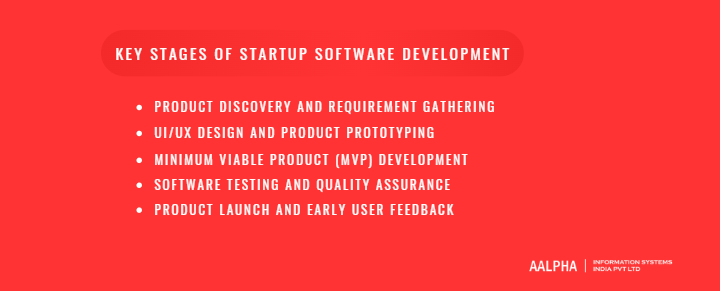
The development lifecycle for startups typically includes product discovery, design, MVP development, testing, and product launch. Unlike enterprise projects that rely on long development cycles, startups prioritize rapid iteration and early validation. The objective is to deliver a functional product as quickly as possible, test it with real users, and improve it continuously.
Understanding these stages helps founders and product teams allocate resources effectively, reduce development risks, and maintain focus on solving real customer problems. The following sections explain the critical phases of startup software development and how they contribute to building successful digital products.
-
Product Discovery and Requirement Gathering
Product discovery is the foundational stage of startup software development. At this stage, the focus is not on writing code but on understanding the problem that the product intends to solve and defining the requirements needed to address that problem effectively.
The process begins with user research. Product teams conduct interviews, surveys, and observation studies to understand how potential users currently perform tasks and where they experience friction. These insights reveal the most valuable opportunities for software solutions. Instead of building features based on assumptions, startups use real-world user insights to guide development decisions.
Once the user needs are understood, teams define the product’s core functionality. This involves identifying the essential features required to solve the primary user problem. Early-stage startups often prioritize a small set of highly impactful features rather than building complex systems.
Requirement gathering typically results in a product requirement document or feature specification. These documents outline system functionality, workflows, user roles, and technical constraints. Clear documentation ensures that developers, designers, and stakeholders share the same understanding of the product.
Many successful technology companies emphasize strong product discovery practices. For example, organizations such as Amazon often begin product initiatives with detailed user-focused documentation before development begins. By investing time in discovery and requirement definition, startups reduce the risk of building software that does not meet market needs.
-
UI/UX Design and Product Prototyping
After defining product requirements, the next stage involves designing the user experience and translating ideas into visual interfaces. UI (User Interface) and UX (User Experience) design play a critical role in determining how users interact with the product.
UX design focuses on creating intuitive workflows that make it easy for users to accomplish tasks. Designers map user journeys that represent how customers move through the product, from onboarding to performing core actions. These journeys help identify potential usability issues early in the design process.
UI design focuses on the visual components of the product, including layouts, typography, colors, buttons, navigation structures, and interactive elements. The goal is to create an interface that is both visually appealing and highly functional.
Designers typically begin with wireframes. Wireframes are simple visual blueprints that illustrate the layout of each screen without detailed styling. They allow teams to experiment with user flows and interface structures before committing to final designs.
Once wireframes are validated, designers create high-fidelity designs that represent the final product interface. These designs are often converted into interactive prototypes that simulate real product interactions. Tools such as Figma and Adobe XD enable teams to build clickable prototypes that stakeholders and potential users can test.
Prototyping allows startups to validate usability before development begins. By testing prototypes with users, product teams can identify design issues, simplify workflows, and refine the interface. This approach significantly reduces development rework and improves the overall user experience.
-
Minimum Viable Product (MVP) Development
The Minimum Viable Product, commonly known as an MVP, is the first working version of a startup’s software product. The goal of an MVP is to deliver the core value of the product with the smallest possible set of features.
Startups build MVPs to test whether their product idea solves a real problem and whether users are willing to adopt the solution. Instead of investing months or years building a fully featured platform, founders release a simplified version that allows them to gather early feedback.
MVP development focuses on implementing only essential features. For example, a ride-sharing startup might initially focus on basic ride booking and payment functionality, leaving advanced features such as loyalty programs and route optimization for later development stages.
The development process involves backend engineering, frontend interface implementation, database configuration, and integration with essential third-party services such as payment gateways or messaging platforms. Cloud infrastructure is often used to host the application and manage scalability.
Rapid development frameworks and cloud platforms allow startups to build MVPs quickly. Platforms such as Amazon Web Services provide scalable infrastructure services that reduce the need for complex hardware management.
Another key aspect of MVP development is prioritization. Product teams must evaluate which features deliver the most value and focus development efforts on those capabilities. Feature prioritization frameworks such as MoSCoW or value-impact analysis are often used to guide these decisions.
Once the MVP is complete, startups release it to a limited group of users or early adopters. These users provide valuable feedback that helps the team determine whether the product requires refinement, expansion, or a complete pivot in direction.
-
Software Testing and Quality Assurance
Testing and quality assurance are essential stages in startup software development. Even though startups prioritize speed, releasing unstable or insecure software can damage user trust and slow adoption.
Quality assurance processes ensure that the product functions correctly across different devices, browsers, and operating environments. Testing typically includes multiple categories such as functional testing, usability testing, performance testing, and security testing.
Functional testing verifies that each feature works according to the defined requirements. For example, if the product includes a payment system, testing ensures that transactions process correctly and that users receive accurate confirmations.
Usability testing focuses on the user experience. Testers observe how users interact with the product and identify areas where workflows may be confusing or inefficient. This feedback helps product teams improve navigation and simplify interactions.
Performance testing evaluates how the software behaves under different levels of user traffic. Startups must ensure that their systems can handle increased demand without performance degradation. Tools such as Selenium are widely used for automated testing and regression testing.
Security testing is equally important. Startups often handle sensitive user data such as personal information, payment details, and account credentials. Security testing helps identify vulnerabilities and ensures that the system follows secure coding practices.
A robust testing process helps startups release reliable software while minimizing technical issues that could negatively impact user adoption.
-
Product Launch and Early User Feedback
The product launch marks the moment when the startup introduces its software to real users. For early-stage startups, this launch often begins with a limited release to a small group of early adopters rather than a full public rollout.
Early users play a critical role in validating the product. Their feedback reveals whether the product delivers value, whether the interface is intuitive, and which features require improvement. Startups collect feedback through surveys, user interviews, support tickets, and product analytics tools.
Product analytics platforms help teams understand how users interact with the software. Metrics such as user activation rates, feature usage, retention rates, and conversion rates provide insights into product performance. Tools like Google Analytics allow startups to track user behavior and identify areas for optimization.
Based on these insights, development teams release updates that refine existing features or introduce new capabilities. This continuous feedback loop forms the basis of agile product development.
Many successful startups rely heavily on early user feedback to refine their products. Through iterative improvements, startups gradually transform their MVP into a robust and scalable platform capable of supporting large user bases and evolving market demands.
Choosing the Right Technology Stack for Startups
Selecting the right technology stack is one of the most important technical decisions a startup makes during software development. A technology stack refers to the combination of programming languages, frameworks, databases, and infrastructure tools used to build and operate a software product. The choices made during the early stages of development can influence product performance, scalability, development speed, and long-term maintenance costs.
For startups, the technology stack must balance several competing priorities. First, the stack should allow rapid development so the team can build and launch products quickly. Second, it must be flexible enough to support product changes as the startup learns from users. Third, the technology should be scalable so the product can handle growth without requiring a complete system rebuild.
Another important factor is developer availability. Startups benefit from using technologies with strong developer communities and widespread adoption. When the stack is based on popular technologies, it becomes easier to hire engineers, find documentation, and access open-source libraries.
A well-designed technology stack also improves product reliability and security. The architecture should support modern software development practices such as automated testing, continuous integration, and scalable infrastructure deployment.
The following sections explain the key layers of a typical startup technology stack and how founders can evaluate the right options for their product.
-
Frontend Development Technologies
Frontend technologies are responsible for the user-facing portion of a software application. This layer determines how users interact with the product through web browsers or mobile devices. A well-designed frontend ensures smooth navigation, responsive interfaces, and a consistent user experience across different devices.
Modern frontend development relies heavily on JavaScript-based frameworks that simplify the creation of interactive web applications. One of the most widely used frontend frameworks is React, which was originally developed by Facebook. React enables developers to build modular components that can be reused throughout an application, improving development efficiency and maintainability.
Another widely adopted framework is Angular, maintained by Google. Angular provides a complete development framework with built-in tools for routing, data binding, and state management. It is commonly used in enterprise-level web applications that require structured architecture.
A third popular option is Vue.js, known for its simplicity and ease of adoption. Vue allows developers to incrementally integrate advanced frontend functionality without introducing unnecessary complexity.
When choosing a frontend technology, startups typically consider factors such as development speed, community support, performance, and compatibility with backend systems. A well-selected frontend framework helps startups deliver responsive and user-friendly digital experiences.
-
Backend Development Technologies
The backend forms the core logic and infrastructure that powers a software application. While the frontend manages user interactions, the backend processes requests, manages databases, handles authentication, and executes business logic.
Backend development relies on programming languages and frameworks capable of building scalable server-side systems. One widely used backend environment is Node.js, which allows developers to use JavaScript for both frontend and backend development. Node.js is particularly popular among startups because it supports fast development and efficient handling of real-time applications.
Another common backend language is Python. Python frameworks such as Django and Flask allow developers to build secure and scalable web applications quickly. Python is also widely used in startups developing artificial intelligence and data-driven platforms.
For large-scale enterprise-grade systems, many startups use Java due to its stability, strong performance, and mature ecosystem. Java-based frameworks such as Spring Boot enable developers to build highly scalable backend architectures.
Another backend option used by startups is Ruby, particularly through the Ruby on Rails framework. Rails allows rapid development and includes many built-in tools that simplify application development.
Choosing the right backend technology depends on factors such as application complexity, developer expertise, scalability requirements, and integration needs.
-
Database Technologies
Databases are essential for storing and managing the data that powers software applications. Every startup product relies on databases to store user accounts, product information, transactions, analytics data, and other operational records.
One of the most widely used relational database systems is PostgreSQL. PostgreSQL is known for its reliability, strong data integrity features, and advanced query capabilities. Many startups choose PostgreSQL because it supports complex data structures and large-scale applications.
Another common relational database is MySQL, which has been widely used in web development for decades. MySQL offers strong performance and a mature ecosystem of tools and integrations.
In addition to relational databases, many startups use NoSQL databases designed for flexible data structures and high scalability. One popular NoSQL database is MongoDB, which stores data in JSON-like documents. MongoDB allows developers to work with dynamic data models that can evolve as the product grows.
Choosing between relational and NoSQL databases depends on the nature of the application. Relational databases work well for structured data and transactional systems, while NoSQL databases are often preferred for applications requiring high scalability and flexible data models.
-
Cloud Infrastructure and DevOps
Modern startup software development relies heavily on cloud infrastructure rather than traditional on-premise servers. Cloud platforms allow startups to deploy applications quickly, scale resources dynamically, and manage infrastructure without significant upfront investment.
One of the most widely used cloud providers is Amazon Web Services, which offers a wide range of infrastructure services including virtual servers, storage systems, databases, and machine learning tools. AWS enables startups to scale their infrastructure based on demand without purchasing physical hardware.
Another major cloud provider is Google Cloud, which offers powerful data analytics and machine learning capabilities alongside traditional hosting services.
Similarly, Microsoft Azure provides enterprise-grade infrastructure services and strong integration with Microsoft development tools.
Alongside cloud infrastructure, DevOps practices help startups manage software deployment efficiently. DevOps focuses on automating the process of building, testing, and releasing software updates. Continuous Integration and Continuous Deployment pipelines allow developers to push updates frequently without disrupting system stability.
CI/CD pipelines automate tasks such as code testing, application builds, and deployment processes. These pipelines improve development speed while maintaining product reliability.
Cloud infrastructure combined with DevOps automation enables startups to operate highly scalable and resilient systems even with small engineering teams.
-
Scalability and Performance Considerations
Startups must design their software systems with scalability in mind. Even if the initial user base is small, the architecture should be capable of handling rapid growth without requiring major system redesign.
Scalable architectures often rely on modular services, load balancing, and distributed infrastructure. Technologies such as containerization, microservices architecture, and caching systems help ensure that applications maintain performance as user demand increases.
By selecting technologies that support horizontal scaling and efficient resource management, startups can ensure that their software products remain stable and responsive as they grow.
Building a Startup Development Team
A startup’s ability to build and scale a successful software product largely depends on the strength of its development team. Even the most innovative product idea requires skilled engineers, designers, and product managers to transform the concept into a reliable and scalable digital platform. However, assembling a development team is often challenging for early-stage startups due to limited budgets, small operational teams, and the pressure to move quickly.
Unlike large enterprises that can afford extensive engineering departments, startups must carefully design their team structure to maximize efficiency while controlling costs. Founders need to determine whether they should hire full-time developers, outsource development to specialized agencies, collaborate with freelance engineers, or combine multiple approaches.
The decision depends on several factors, including the complexity of the product, development timelines, technical expertise required, and the startup’s long-term vision. For example, a highly technical AI platform may require a specialized engineering team, while a simple SaaS product might initially be built by a smaller outsourced development team.
Each hiring model has distinct advantages and limitations. Some startups prefer building an internal team to maintain complete control over product development. Others choose outsourcing to accelerate development and reduce hiring challenges. Many startups adopt hybrid team structures that combine internal leadership with external technical resources.
Understanding these models allows founders to design a development strategy that aligns with their product goals, funding stage, and growth plans.
-
In-House Development Teams
An in-house development team consists of full-time employees working directly for the startup. These developers, designers, and engineers become deeply integrated into the company’s culture, product vision, and long-term strategy.
One of the main advantages of an in-house team is alignment with the startup’s mission and objectives. Because full-time developers work closely with founders and product managers, they develop a deeper understanding of the product vision and customer needs. This alignment often leads to stronger product ownership and more consistent development decisions.
Communication efficiency is another benefit. In-house teams can collaborate closely through daily meetings, rapid feedback loops, and direct communication with stakeholders. This close collaboration helps teams resolve technical challenges quickly and adapt to changing product requirements.
Internal teams also provide greater control over intellectual property and product security. Sensitive product architecture, proprietary algorithms, and user data remain within the organization rather than being shared with external contractors.
However, hiring full-time developers can be expensive, especially in competitive technology markets. Salaries, benefits, office infrastructure, and long-term employment commitments increase operational costs. Recruiting skilled engineers can also take significant time.
Despite these challenges, many successful startups eventually build strong internal development teams to maintain long-term product innovation and technical ownership.
-
Outsourcing Software Development
Outsourcing software development involves partnering with external development agencies that provide engineering teams to build the startup’s product. This model allows startups to access experienced developers without the complexity of hiring and managing full-time employees.
One major advantage of outsourcing is speed. Established development agencies already have experienced engineers, designers, and project managers who can begin working on a project immediately. This allows startups to accelerate product development and reach the market faster.
Cost efficiency is another key benefit. Development agencies operating in global technology hubs often offer highly skilled engineering teams at lower costs compared to hiring local developers in regions such as North America or Western Europe. This cost advantage allows startups to allocate more resources toward marketing, product expansion, and customer acquisition.
Outsourcing also provides access to specialized expertise. Many development agencies focus on specific technologies such as cloud computing, mobile applications, artificial intelligence, or enterprise software architecture. For example, working with an experienced technology partner like Aalpha Information Systems allows startups to leverage established engineering processes, technical expertise, and scalable development practices.
However, outsourcing requires strong communication and project management practices. Startups must ensure clear documentation, well-defined requirements, and consistent collaboration with external teams to maintain product quality and alignment with business goals.
-
Hiring Freelance Developers
Freelance developers represent another option for startups seeking flexible technical resources. Freelancers are independent professionals who typically work on short-term projects or specific development tasks.
Hiring freelancers can be particularly useful during the early stages of a startup when budgets are limited and product requirements are still evolving. Instead of committing to long-term employment contracts, founders can engage freelancers for specific tasks such as building a prototype, designing a user interface, or implementing certain software features.
Freelancers also provide access to specialized technical expertise that may not exist within the startup’s core team. For example, a startup building a web application might hire a freelance DevOps engineer to configure cloud infrastructure or a freelance security expert to conduct vulnerability assessments.
However, relying heavily on freelancers can introduce challenges related to coordination, long-term availability, and product continuity. Since freelancers often work with multiple clients simultaneously, maintaining consistent development progress may require careful project management.
For this reason, freelancers are most effective when used for clearly defined tasks rather than as the primary development team.
-
Building a Hybrid Development Model
Many startups adopt a hybrid development model that combines internal team members with outsourced development partners and freelance specialists. This approach allows startups to balance cost efficiency, technical expertise, and long-term product ownership.
In a hybrid model, startups typically maintain a small internal leadership team consisting of product managers, technical leads, and key engineers. These team members define product strategy, oversee architecture decisions, and coordinate development efforts.
External development agencies handle large portions of the engineering workload, particularly during the initial product development phase. This allows startups to build complex software products quickly without assembling a large internal team.
Freelancers may be used to fill specialized roles such as UX design, quality assurance, or cloud infrastructure configuration. By combining these resources strategically, startups gain access to diverse expertise while maintaining flexibility.
The hybrid approach also allows startups to gradually transition toward a larger internal engineering team as the product grows and funding becomes available. This evolution enables startups to maintain control over core technology while continuing to benefit from external expertise.
Startup Software Development Cost
Understanding the cost of startup software development is one of the most important considerations for founders and product teams. Building a digital product requires investment in engineering resources, design, infrastructure, testing, and ongoing maintenance. While some startups begin with limited budgets and small teams, others raise venture funding and invest heavily in technology development from the beginning.
Software development costs vary widely depending on multiple factors. These include the complexity of the product, the number of features, the technology stack, the size of the development team, and the geographic location of developers. A simple prototype or Minimum Viable Product (MVP) may cost significantly less than a large-scale enterprise platform with complex integrations and advanced infrastructure.
For startup founders, understanding cost structures helps with budgeting, fundraising, and development planning. It also helps determine whether the company should hire an internal team, outsource development, or adopt a hybrid approach.
In addition to initial development costs, startups must also plan for ongoing expenses such as software maintenance, cloud infrastructure, security updates, and feature enhancements. Many early-stage startups underestimate these long-term costs, which can lead to technical debt and operational challenges.
The following sections explain the key factors that influence software development costs and provide realistic cost estimates based on product complexity and development location.
Factors That Influence Software Development Cost
Several factors determine how much it costs to develop startup software. Understanding these variables allows founders to make better product planning decisions and allocate budgets effectively.
One of the most significant factors is product complexity. A simple application with basic functionality requires fewer development hours than a platform that includes advanced features such as real-time analytics, artificial intelligence, or complex data processing. The more sophisticated the product architecture, the greater the engineering effort required.
Feature scope also plays a major role in determining costs. Each feature requires design, development, testing, and integration work. Startups that attempt to launch with too many features often experience increased development costs and longer timelines. This is why many startups begin with a Minimum Viable Product that focuses only on essential functionality.
Third-party integrations can also increase development costs. Many modern software products integrate with payment systems, cloud storage services, communication platforms, or external APIs. For example, integrating payment services such as Stripe or authentication systems can add complexity to the development process.
Infrastructure requirements are another cost driver. Applications that handle large volumes of data or real-time interactions require scalable cloud infrastructure and optimized database systems. Infrastructure services provided by platforms such as Amazon Web Services help startups scale efficiently, but they also introduce operational costs.
Additional cost factors include development team size, user interface complexity, security requirements, and compliance considerations. Products operating in regulated industries such as healthcare or finance may require additional security audits and compliance measures.
By carefully evaluating these factors, startups can estimate development budgets more accurately and avoid unexpected financial challenges during product development.
Cost Based on Product Complexity
Software development costs vary significantly depending on the complexity of the product being built. Most startup products fall into three general complexity categories: simple MVPs, moderately complex applications, and large enterprise-level platforms.
A simple Minimum Viable Product is the least expensive category. MVPs typically include only the core functionality needed to validate the startup’s business idea. These products may include basic user registration, a limited set of core features, and simple data storage. MVPs often cost between $20,000 and $60,000, depending on the technology stack and development approach. Startups use MVPs to test product-market fit before investing heavily in full-scale development.
A moderate complexity startup product includes more advanced functionality such as payment processing, real-time data interactions, user dashboards, and integration with external systems. These products often require more extensive backend architecture and more sophisticated user interfaces. Development costs for moderately complex platforms typically range between $60,000 and $150,000.
At the highest level are enterprise-grade platforms designed to support large user bases and complex workflows. These systems may include multi-user roles, advanced analytics, AI features, large-scale data processing, and high-performance infrastructure. Development costs for enterprise platforms often exceed $200,000 and may reach several hundred thousand dollars depending on the scope.
Large-scale platforms such as Shopify required extensive engineering investment to build robust infrastructure capable of supporting millions of users and businesses.
Understanding the relationship between product complexity and development cost helps startups prioritize features and control expenses during early product development stages.
Cost Based on Development Location
The geographic location of the development team is another major factor influencing startup software development costs. Developer salaries vary significantly across regions, which directly affects project budgets.
In North America, particularly in the United States and Canada, software development costs are among the highest in the world. Senior developers in these regions often charge between $100 and $200 per hour. Building a startup product with a North American development team can significantly increase overall project costs.
In Western Europe, development costs are slightly lower but still relatively high. Developers in countries such as Germany, the United Kingdom, and France typically charge between $70 and $150 per hour depending on their experience and specialization.
Eastern Europe has become a popular outsourcing destination for startups due to its strong technical talent and lower development rates. Countries such as Poland, Ukraine, and Romania often offer skilled developers at rates ranging from $40 to $80 per hour.
Many startups also outsource projects to India and other Asian technology hubs, where development costs are often significantly lower while maintaining strong engineering expertise. Developers in India typically charge between $25 and $60 per hour, depending on experience and project complexity.
Because of this cost advantage, many startups collaborate with experienced development companies such as Aalpha Information Systems to build scalable products while managing development budgets effectively.
Choosing the right development location involves balancing cost efficiency, communication efficiency, technical expertise, and project management capabilities.
Budgeting for Maintenance and Updates
Software development costs do not end after the product launch. Startups must allocate budgets for ongoing maintenance, performance optimization, security updates, and feature improvements.
Industry estimates suggest that annual software maintenance costs typically range between 15 percent and 25 percent of the initial development cost. Maintenance activities include fixing bugs, updating software libraries, improving performance, and ensuring compatibility with new operating systems or browsers.
Planning for these ongoing expenses ensures that the product remains stable, secure, and competitive as the startup continues to grow.
Understood. Below is the revised section without mentioning any companies, brands, or products, while keeping the tone authoritative and SEO-friendly.
Common Mistakes Startups Make in Software Development
Startup software development involves experimentation, rapid execution, and continuous learning. While these characteristics allow startups to innovate quickly, they also introduce significant risks. Many startups fail not because their idea lacked potential but because mistakes in the development process prevented the product from reaching product-market fit or scaling effectively.
Decisions made during the early stages of software development often influence a startup’s technical stability, user adoption, and long-term operational costs. Poor architectural decisions, ignoring customer feedback, or building unnecessary features can lead to wasted resources and delayed product launches. Because early-stage startups usually operate with limited budgets and small teams, even small mistakes can significantly impact the product’s trajectory.
Research on startup failures consistently shows that product development mistakes are among the most common reasons early ventures struggle to grow. Building technology without validating demand, selecting inappropriate technologies, or neglecting security practices can create technical and operational challenges that are difficult to reverse later.
Understanding these common mistakes allows founders and product teams to adopt better development strategies. By focusing on solving real problems, building scalable architectures, and prioritizing user feedback, startups can significantly increase their chances of building successful and sustainable software products.
-
Overbuilding Features Too Early
One of the most frequent mistakes startups make is developing too many features before validating whether the product solves a real customer problem. Founders often believe that adding more functionality will make their product more appealing, but this approach usually increases development time and complexity without guaranteeing user adoption.
This problem is commonly known as feature bloat. Instead of focusing on a small set of essential capabilities, startups attempt to build a fully featured platform from the beginning. As a result, development timelines expand, costs increase, and the product may take too long to reach the market.
Successful startup development typically begins with a Minimum Viable Product (MVP). The MVP includes only the core functionality required to deliver the product’s primary value. By launching a simplified version early, startups can test their assumptions with real users and gather feedback quickly.
Building fewer features initially allows startups to validate whether users actually need the product. Once demand is confirmed, additional features can be developed based on real customer needs rather than assumptions.
Focusing on essential functionality helps startups reduce development costs, accelerate product launches, and maintain flexibility during the early stages of product evolution.
-
Ignoring User Feedback
Another major mistake startups make is failing to listen to users after launching the product. Many founders become deeply attached to their original vision and hesitate to modify the product based on real user behavior.
However, successful startup products evolve through continuous learning. Early users provide valuable insights about how the product works in real-world scenarios. Their feedback reveals usability issues, missing features, and opportunities for improvement.
User feedback can be collected through multiple channels, including surveys, customer interviews, support requests, usability testing sessions, and product analytics. These insights help product teams understand which features are most valuable and where users encounter friction.
Ignoring this feedback can lead to a product that does not fully address customer needs. When development decisions are based solely on internal assumptions rather than real usage data, startups risk building technology that users do not adopt.
Startups that actively incorporate user feedback into their development cycles are more likely to refine their product successfully. Continuous iteration based on real user insights helps ensure that development efforts remain aligned with customer expectations and evolving market needs.
-
Choosing the Wrong Technology Stack
Selecting an inappropriate technology stack is another mistake that can create long-term challenges for startups. The technology stack determines how the product is built, how efficiently it performs, and how easily it can scale as the user base grows.
Some startups choose technologies based solely on short-term convenience or developer familiarity. Others adopt overly complex architectures that introduce unnecessary technical overhead. Both approaches can lead to long-term maintenance difficulties.
A poorly chosen technology stack can result in slow application performance, limited scalability, integration challenges, and increased operational costs. In some cases, startups are forced to rebuild large portions of their system architecture in order to support growth.
When evaluating technologies, startups should consider several important factors. These include scalability, developer community support, long-term maintenance requirements, security capabilities, and integration flexibility.
Choosing widely supported and well-documented technologies often reduces development risks. These technologies typically have larger developer communities, stronger ecosystem support, and better long-term stability.
Making thoughtful technology decisions during the early stages of development ensures that the product can evolve smoothly as the startup grows.
-
Underestimating Security and Compliance
Security and regulatory compliance are often overlooked during early-stage startup development. Founders frequently prioritize speed and rapid product launch, assuming that security improvements can be implemented later. However, neglecting security from the beginning can expose startups to serious risks.
Modern software products frequently store and process sensitive information such as personal user data, authentication credentials, and financial transactions. Without proper security safeguards, applications may become vulnerable to data breaches, unauthorized access, and cyberattacks.
Security vulnerabilities can damage a startup’s reputation and erode user trust. In addition to technical risks, startups may also face legal and regulatory consequences if they fail to comply with data protection laws.
Startups should incorporate security practices early in the development lifecycle. This includes implementing secure authentication mechanisms, encrypting sensitive data, conducting vulnerability assessments, and following secure coding standards.
Compliance requirements may also apply depending on the industry and geographic markets in which the product operates. Addressing these requirements early prevents costly redesigns later.
By treating security and compliance as essential components of software development rather than optional additions, startups can protect their users, safeguard their technology, and build a stronger foundation for long-term growth.
How to Choose the Right Startup Software Development Partner
Selecting the right software development company or partner is one of the most important strategic decisions a startup can make. While many startups begin with strong product ideas, transforming those ideas into reliable and scalable software requires deep technical expertise, structured development processes, and experience working in fast-moving startup environments.
For founders who do not have an in-house engineering team, partnering with a software development company allows them to accelerate product development while accessing specialized technical skills. However, not all development partners are equally suited for startup projects. Startups require partners who understand rapid iteration, MVP development, evolving requirements, and the need to scale quickly once product-market fit is achieved.
Choosing the wrong partner can result in delayed product launches, poor system architecture, and higher long-term maintenance costs. On the other hand, the right development partner becomes a strategic collaborator who helps transform the startup vision into a robust and scalable digital product.
When evaluating potential development partners, founders should consider several key criteria. These include experience building startup products, technical expertise across modern technologies, transparent development processes, and the ability to support the product over the long term.
The following factors can help startups identify a reliable software development partner capable of supporting their growth.
-
Experience Building Startup Products
One of the most important qualities to evaluate when selecting a development partner is their experience working with startups. Startup software development differs significantly from traditional enterprise software projects. Startups operate under tight timelines, evolving requirements, and limited budgets, which requires development teams that are comfortable working in fast-paced and adaptive environments.
A development company with startup experience understands the importance of building a Minimum Viable Product quickly and validating ideas with real users before expanding the product. Instead of focusing on overly complex architectures from the beginning, experienced teams prioritize efficient development that enables startups to launch early and iterate based on feedback.
Reviewing the partner’s portfolio is an effective way to assess their experience. Founders should examine previous projects to determine whether the company has built products similar to their own in terms of functionality, scalability, or industry focus. Case studies that describe the development process, challenges encountered, and measurable results provide valuable insights into the company’s capabilities.
Startups should also evaluate whether the development partner has experience building scalable platforms that can grow with increasing user demand. Products that succeed in the early stages often need rapid expansion in infrastructure, features, and integrations. Development teams familiar with startup growth patterns are better equipped to design systems that support long-term scalability.
-
Technical Expertise and Innovation
Technical expertise is another critical factor when choosing a development partner. Startups rely on modern technologies to build high-performance digital products that can handle evolving user requirements and increasing traffic.
A capable development partner should demonstrate expertise across multiple areas of software engineering, including frontend development, backend architecture, database design, cloud infrastructure, and security practices. This breadth of knowledge allows the development team to design systems that are both efficient and scalable.
Innovation is equally important. Startup environments often require creative problem-solving and experimentation with new technologies. Development teams should stay updated with modern development frameworks, cloud platforms, and automation practices that improve product performance and development efficiency.
Equally important is the ability to design scalable system architectures. A strong development partner understands how to structure applications in a way that allows future expansion without requiring complete system redesigns. This includes modular architectures, efficient database structures, and scalable infrastructure planning.
Founders should evaluate whether the development partner actively adopts modern engineering practices and continuously improves their technical capabilities.
-
Transparent Development Process
A transparent development process is essential for maintaining alignment between founders and development teams. Startups often operate in dynamic environments where product requirements evolve based on user feedback and market conditions. Without clear communication and structured workflows, development projects can quickly lose direction.
Reliable development partners follow structured methodologies that provide visibility into the development process. Agile development frameworks are commonly used because they allow teams to work in short development cycles while continuously improving the product.
Clear communication is a key component of transparency. Development teams should provide regular progress updates, development reports, and sprint reviews that allow founders to track project progress and provide feedback. This ongoing communication ensures that development remains aligned with business objectives.
Proper documentation is also important. Development partners should maintain documentation that outlines system architecture, feature specifications, and deployment processes. Well-documented systems make it easier to maintain and scale the product in the future.
By working with a partner that prioritizes transparency and collaboration, startups can maintain control over product development while benefiting from external technical expertise.
-
Long-Term Product Support
Software development does not end after the initial product launch. Startups must continue improving their products through updates, feature expansions, performance improvements, and infrastructure scaling.
A reliable development partner provides long-term support that extends beyond initial development. This includes system monitoring, bug fixes, performance optimization, and the development of new features as the product evolves.
Experienced development partners such as Aalpha Information Systems often work with startups over extended periods, helping them refine their products, expand capabilities, and scale infrastructure as user demand grows.
Choosing a partner capable of supporting the product throughout its lifecycle ensures that the startup can continue improving its technology while focusing on business growth and customer acquisition.
Conclusion
Startup software development requires a balanced combination of strategic planning, technical expertise, and continuous product iteration. From validating an idea and building an MVP to selecting the right technology stack and assembling the right development team, every stage plays a critical role in transforming a startup concept into a scalable digital product.
For founders, the key is to focus on solving real user problems while maintaining flexibility during the early stages of development. Prioritizing essential features, learning from user feedback, and building scalable systems can significantly improve the chances of achieving product-market fit.
Startups that collaborate with experienced software development teams can accelerate development timelines and reduce technical risks. If you are planning to build a startup product, connect with Aalpha to discuss your idea and explore how the right development approach can help bring your software vision to life.