


SaaS backend development refers to the design, implementation, and continuous evolution of the server-side systems that power a Software-as-a-Service product. In a SaaS context, the backend is not a supporting layer behind a one-time application. It is the product’s operational core. It handles user identity, data storage, business rules, billing logic, security enforcement, integrations, and the infrastructure that keeps the service running reliably for every customer, every day. Unlike traditional applications, SaaS backends must be built to operate continuously, serve multiple customers simultaneously, and evolve without disrupting existing users.
In practical terms, SaaS backend development includes everything that happens after a user signs up and logs in. It determines how user data is isolated, how permissions are enforced, how requests are processed at scale, how subscriptions are managed, and how failures are handled gracefully. A weak backend limits growth even if the frontend looks polished. A well-designed backend enables rapid feature delivery, predictable performance, and long-term cost control.
The backend is the true foundation of scalability, security, and revenue in any SaaS platform. Scalability is not achieved by adding servers alone. It is achieved through stateless services, efficient data models, background processing, and architecture decisions that allow the system to handle more users without linear cost increases. Security is enforced almost entirely in the backend through authentication, authorization, encryption, audit logging, and data isolation. Revenue depends on backend logic that correctly manages trials, subscriptions, upgrades, usage limits, billing cycles, and payment failures. Any inconsistency in these systems directly impacts customer trust and cash flow.
SaaS backend requirements differ fundamentally from those of traditional web applications or enterprise software. A conventional web application is often built for a single organization, deployed infrequently, and scaled within predictable limits. Enterprise software may be complex, but it is usually customized per client and operated in controlled environments. A SaaS backend, by contrast, must support multi-tenancy by default, handle unpredictable growth, and deploy changes continuously without downtime. It must assume that thousands of customers with different usage patterns are sharing the same system while expecting strict data separation and consistent performance.
Another key difference lies in ownership and responsibility. In SaaS, the product team owns the backend for the entire lifecycle of the product. Bugs, performance issues, and security vulnerabilities affect all customers simultaneously. There is no handover after delivery. This makes architectural discipline, observability, and maintainability essential rather than optional. Backend decisions made early, such as how tenants are modeled or how permissions are structured, are difficult and expensive to reverse later.
Modern SaaS backends are responsible for a wide range of functions that go beyond simple data storage. These typically include user and organization management, authentication and authorization systems, API layers for web and mobile clients, business logic services, background job processing, notification systems, integration endpoints, billing and subscription management, and monitoring and logging infrastructure. They also handle cross-cutting concerns such as rate limiting, feature flagging, audit trails, and compliance-related data handling. Each of these responsibilities must be designed with scale and failure scenarios in mind.
This guide is written for founders, CTOs, product managers, and software architects who need a clear, practical understanding of what it takes to build a scalable SaaS backend. It is especially relevant for teams transitioning from project-based development to product-based SaaS, or for startups planning to grow from an MVP to a production-grade platform. The goal is not to focus on specific programming languages or frameworks, but to explain the architectural principles, design tradeoffs, and backend responsibilities that determine whether a SaaS product can scale sustainably.
By the end of this guide, readers should understand how SaaS backend development differs from other types of backend work, what components are essential, and why early backend decisions have long-term business consequences. The sections that follow break down these concepts in depth, starting from architecture fundamentals and moving through scalability, security, data design, and operational readiness.
How SaaS Backend Architecture Differs From Traditional Software
SaaS backend architecture is shaped by a fundamentally different operating model than traditional software. A SaaS platform is not delivered once and maintained occasionally. It is a continuously running system that serves many customers simultaneously, evolves weekly or even daily, and directly controls revenue, data security, and customer experience. These constraints force architectural decisions that differ sharply from monolithic applications, custom enterprise software, and consumer or marketplace platforms.
SaaS vs Monolithic Applications
Traditional monolithic applications are typically designed for a single organization or a narrow use case. They often assume a limited number of users, predictable workflows, and infrequent releases. In contrast, SaaS platforms are always-on, multi-tenant systems by default. A single backend instance or cluster must safely serve hundreds or thousands of independent customers, each with isolated data, users, and configurations. This requirement alone changes how identity, data models, and access control are designed at the core level.
Continuous delivery is another major point of divergence. Monolithic systems are often updated through scheduled releases or maintenance windows. SaaS backends must support frequent deployments without downtime, because customers expect uninterrupted access. This introduces strict versioning constraints on APIs, background jobs, and database schemas. Backward compatibility becomes a permanent concern, not a temporary phase during upgrades. Backend teams must design migrations, feature rollouts, and deprecations in a way that avoids breaking active users.
Subscription lifecycle complexity further separates SaaS from monolithic applications. Traditional systems usually do not need to manage trials, plan upgrades, downgrades, renewals, cancellations, and usage limits in real time. In SaaS, these concepts are deeply embedded in backend logic. Every request may depend on the customer’s subscription state, entitlements, and usage history. This adds conditional logic and state management that monolithic applications rarely account for, and it increases the cost of poor architectural decisions early on.
SaaS vs Custom Enterprise Software
Custom enterprise software is built to satisfy the needs of a specific client or a small group of clients. The backend is often tailored with client-specific workflows, data models, and integrations. SaaS backends, by contrast, must be productized. The same backend logic serves all customers, with configuration and permissions replacing customization wherever possible. This requires stricter separation between core business logic and tenant-specific settings, because custom code paths for individual customers do not scale operationally.
Scale uncertainty is another critical difference. Enterprise systems are usually sized and scoped based on known user counts and usage patterns. SaaS platforms operate under uncertainty. Growth can be slow, steady, or explosive, and backend architecture must accommodate all scenarios without frequent rewrites. This uncertainty makes cost sensitivity a first-class concern. Inefficient queries, chatty APIs, or poorly designed background jobs can quickly turn infrastructure costs into a business risk.
Vendor accountability and uptime expectations are also higher in SaaS. In enterprise software, outages may be tolerated within contractual terms or handled through manual processes. In SaaS, downtime affects all customers simultaneously and directly impacts churn and brand trust. The backend must be designed for fault tolerance, observability, and rapid recovery. Monitoring, alerting, and incident response are not optional operational layers. They are integral parts of the backend architecture itself.
SaaS vs Marketplace and Consumer Apps
At a glance, SaaS platforms may appear similar to consumer or marketplace applications because all serve large numbers of users over the internet. However, their backend requirements differ in important ways. Consumer and marketplace apps often deal with burst traffic driven by campaigns, events, or seasonal demand. SaaS usage tends to be more predictable and recurring, with customers logging in daily or integrating the product into their workflows. This predictability shifts optimization priorities from peak traffic handling to sustained performance and cost efficiency.
Data isolation is far more critical in SaaS than in most consumer applications. In a marketplace, users expect to interact with shared data such as listings or reviews. In SaaS, customers expect strict separation of their data from other tenants. Any breach of isolation is considered a serious security failure. Backend architecture must enforce tenant boundaries at every layer, including queries, caches, background jobs, and analytics pipelines.
Revenue-critical backend flows also differ. Consumer apps often monetize through ads or optional purchases, which may be loosely coupled to core functionality. In SaaS, the backend directly enforces access based on payment status, plan limits, and usage quotas. A billing or entitlement bug can result in revenue leakage or customer lockouts. This makes billing logic, usage tracking, and entitlement checks core backend responsibilities rather than peripheral features.
Taken together, these differences explain why SaaS backend architecture cannot be treated as a variation of traditional software design. It requires a product-centric mindset, long-term architectural discipline, and constant attention to scalability, reliability, and data integrity. The following sections build on these distinctions to explain how modern SaaS backends are structured and why specific design choices matter at scale.
Core Components of a SaaS Backend System
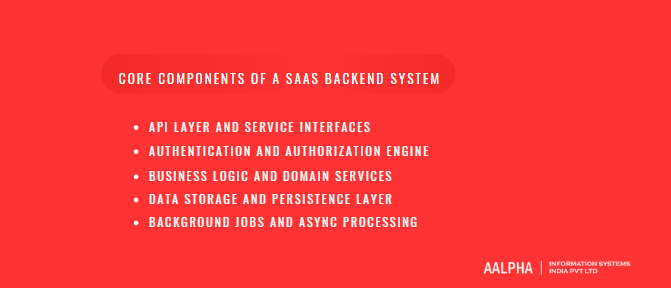
A scalable SaaS backend is not a single layer or service. It is a coordinated system of components, each with a clearly defined responsibility and failure boundary. When these components are tightly coupled or poorly separated, SaaS platforms become fragile, expensive to operate, and difficult to evolve. When they are designed deliberately, the backend becomes an enabler of growth rather than a constraint. This section explains the core components that appear in nearly every production-grade SaaS backend and why each one matters.
-
API Layer and Service Interfaces
The API layer is the primary interface between the SaaS backend and its clients, which typically include web applications, mobile apps, third-party integrations, and internal services. In a SaaS environment, APIs are long-lived contracts rather than short-term implementation details. Breaking changes can disrupt thousands of active users and integrations, which makes API design a strategic decision rather than a purely technical one.
REST remains the most common approach due to its simplicity, cacheability, and wide ecosystem support. It works well for CRUD-oriented workflows and predictable resource models. GraphQL is often adopted where clients need flexible data fetching or where frontend teams want to reduce over-fetching and under-fetching. Many mature SaaS platforms adopt a hybrid approach, using REST for stable, high-volume operations and GraphQL for complex, user-facing queries. The key is consistency. Mixing paradigms without clear boundaries leads to operational complexity and developer confusion.
API versioning is unavoidable in SaaS. Unlike internal systems, SaaS APIs must support older clients while new features are rolled out. Common strategies include URL-based versioning, header-based versioning, and additive changes with backward compatibility guarantees. The safest approach in SaaS is to minimize breaking changes entirely and treat deprecation as a long-running process supported by monitoring and client communication.
Another critical distinction is between internal and public APIs. Internal APIs are optimized for service-to-service communication and can evolve more rapidly. Public APIs, whether exposed to customers or partners, require stricter governance, documentation, rate limiting, and security controls. Treating all APIs as equal often results in either over-constrained internal development or under-protected public endpoints.
-
Authentication and Authorization Engine
Authentication and authorization form the security backbone of a SaaS backend. Authentication answers who the user is, while authorization answers what that user is allowed to do. In SaaS platforms, these concerns extend beyond individual users to organizations, workspaces, teams, and roles.
User authentication flows must support multiple entry points such as email and password, single sign-on, and token-based access for integrations. These flows must be resilient to brute-force attacks, credential leaks, and session hijacking. Authentication logic should be centralized and standardized across the platform to avoid inconsistent behavior and security gaps.
Authorization is more complex in SaaS than in single-tenant applications. Role-based access control defines broad permissions such as admin, manager, or viewer. Permission-based access control provides finer-grained control over specific actions. Most SaaS platforms use a combination of both. The backend must enforce these rules consistently at the API and service level, not just in the frontend.
Organizational hierarchy adds another layer of complexity. Users may belong to multiple organizations or workspaces, each with different roles. Teams may have scoped permissions within a larger organization. A well-designed authorization engine models these relationships explicitly and avoids hardcoding assumptions. Poorly designed authorization logic becomes a source of bugs, security incidents, and feature limitations as the product grows.
-
Business Logic and Domain Services
Business logic defines how the SaaS product behaves. It encodes rules such as who can perform an action, how data changes over time, and how edge cases are handled. In scalable SaaS systems, this logic must be isolated from transport concerns such as HTTP handling or message parsing.
Separating business rules from controllers or handlers improves testability, reuse, and clarity. Controllers should translate requests into domain-level operations, while domain services implement the actual behavior. This separation becomes essential as the number of features grows and as the same logic is triggered through multiple channels such as APIs, background jobs, and integrations.
Domain-driven design concepts are particularly useful in SaaS backends because they encourage explicit modeling of core concepts such as tenants, subscriptions, usage limits, and entitlements. These concepts often span multiple services and data stores. Treating them as first-class domain objects reduces duplication and inconsistency.
Logic duplication is a common failure mode in SaaS systems. The same rules are reimplemented in APIs, background jobs, and billing workflows, leading to subtle differences in behavior. Centralizing business logic and exposing it through well-defined interfaces reduces this risk and makes the system easier to reason about under change.
-
Data Storage and Persistence Layer
Data storage in SaaS backends must balance consistency, performance, and flexibility. Operational data such as users, subscriptions, and transactions has different access patterns and guarantees than analytical data used for reporting, dashboards, or audits. Treating all data the same leads to performance bottlenecks and operational complexity.
Operational data stores are optimized for frequent reads and writes with strong consistency guarantees. Analytical data stores prioritize aggregation, historical analysis, and query flexibility. Separating these concerns allows each system to scale independently and reduces the risk that reporting workloads degrade core application performance.
Schema evolution is a constant challenge in SaaS. New features require new fields, relationships, and constraints, but existing data must remain valid. Safe schema evolution involves backward-compatible changes, staged migrations, and feature flags that control behavior before and after changes. Direct, breaking schema updates are rarely acceptable in production SaaS environments.
Read and write optimization is also critical. Read-heavy workloads benefit from caching and indexing strategies, while write-heavy workflows require careful transaction design and batching. The backend must be designed to scale data access patterns as usage grows without introducing hidden coupling between features.
-
Background Jobs and Async Processing
Asynchronous processing is essential for maintaining responsiveness and reliability in SaaS platforms. Not all work should happen in the request-response cycle. Long-running or failure-prone tasks must be delegated to background jobs to avoid degrading user experience.
Common background job types include sending emails and notifications, processing billing events, syncing data with external systems, generating reports, and cleaning up expired data. These jobs often operate at a different scale than user-facing requests and require separate monitoring and retry logic.
Failure handling is a defining characteristic of robust async systems. Jobs must be idempotent, retryable, and observable. Temporary failures should trigger retries with backoff, while permanent failures should surface alerts and allow manual intervention. Without these safeguards, background processing becomes a silent source of data inconsistency and customer issues.
Together, these core components form the structural backbone of a SaaS backend. Each one must be designed with scale, isolation, and long-term evolution in mind. The next sections build on this foundation to explain how these components are composed into scalable architectures and how multi-tenancy, performance, and security considerations shape their implementation.
Multi-Tenancy Models in SaaS Backend Development
Multi-tenancy is one of the defining characteristics of SaaS backend architecture. It determines how customers share infrastructure, how data is isolated, how costs scale, and how difficult the system is to operate over time. Choosing the right multi-tenancy model is not a purely technical decision. It has long-term implications for security posture, compliance readiness, performance predictability, and operational overhead. This section explains what multi-tenancy means in practice and examines the three most common models used in SaaS backend development.
-
What Multi-Tenancy Means in Practice
In a SaaS context, a tenant typically represents a logical customer boundary. A tenant may correspond to a company, an organization, a workspace, or an account, depending on the product’s domain. Each tenant has its own users, data, configuration, and often its own subscription and billing state. The backend must enforce these boundaries consistently across every layer of the system, including APIs, background jobs, caches, and analytics pipelines.
Data isolation is the most critical expectation in multi-tenant systems. Customers assume that their data is completely inaccessible to other tenants, even though it may be stored in shared infrastructure. From a backend perspective, this means every query, write operation, and background process must be tenant-aware. Tenant context cannot be optional or inferred implicitly. It must be explicit and validated at runtime to prevent accidental data leakage.
Multi-tenancy also affects operational behavior. Maintenance tasks, migrations, and incident response often need to consider tenant scope. A failure affecting one tenant should not cascade to others. Similarly, usage spikes from a single tenant should not degrade performance for the entire system. These requirements push SaaS backends toward designs that emphasize isolation at the logical level, even when physical resources are shared.
Understanding these practical implications is essential before choosing a specific multi-tenancy model, because changing models later is costly and risky.
-
Single-Database, Shared-Schema Model
The single-database, shared-schema model is the most common starting point for early-stage SaaS products. In this model, all tenants share the same database and the same schema. Tenant isolation is enforced by including a tenant identifier in every relevant table and query. From an implementation perspective, this approach is straightforward and cost-efficient.
The primary advantage of this model is simplicity. There is only one database to manage, back up, monitor, and migrate. Schema changes are applied once and immediately affect all tenants. Infrastructure costs remain low in the early stages, which is attractive for startups validating product-market fit. This model also works well when tenants have similar usage patterns and data volumes.
However, the shared-schema model introduces meaningful risks as the platform scales. Performance issues caused by one tenant, such as heavy queries or large datasets, can affect others if not carefully controlled. Query optimization becomes more complex as tables grow and indexes must support diverse access patterns. From a security perspective, a single missing tenant filter in a query can result in cross-tenant data exposure, which is considered a severe SaaS failure.
This model is best suited for small to mid-sized SaaS products with homogeneous tenants, relatively simple data models, and strong discipline around query enforcement. It requires rigorous testing, code reviews, and automated safeguards to ensure tenant isolation is never bypassed.
-
Shared Database, Separate Schema Model
The shared-database, separate-schema model introduces a stronger logical boundary between tenants while still sharing physical infrastructure. In this approach, each tenant has its own database schema, but all schemas reside within the same database instance. The application routes queries to the appropriate schema based on tenant context.
This model improves isolation compared to a shared schema. Accidental cross-tenant queries are less likely because schemas provide a natural namespace boundary. It also allows for some customization at the schema level, such as tenant-specific indexes or extensions, without affecting others. Performance tuning can be more granular, and noisy tenant behavior is easier to identify.
The tradeoff is increased operational complexity. Schema creation, migration, and versioning must be automated and carefully coordinated across potentially hundreds or thousands of schemas. Migrations become more time-consuming because they must be applied per tenant schema, often with safeguards to handle partial failures. Monitoring and debugging also require tenant-aware tooling to avoid blind spots.
Scaling considerations become more prominent as tenant count grows. While this model scales better in isolation terms than a shared schema, it can stress database management limits and operational workflows if not designed carefully. It is often chosen by SaaS platforms that need stronger isolation but are not ready for full database-per-tenant separation.
-
Database-Per-Tenant Model
The database-per-tenant model provides the strongest isolation by assigning each tenant its own database instance or cluster. This approach is common in enterprise SaaS platforms, regulated industries, or products with large, high-value customers. Each tenant’s data is physically separated, which simplifies compliance, auditing, and security guarantees.
The benefits of this model are clear. Performance isolation is strong, as one tenant’s workload cannot directly impact another’s. Data residency and regulatory requirements are easier to satisfy because databases can be deployed in specific regions or environments. Maintenance tasks such as backups and restores can be performed per tenant, reducing blast radius during incidents.
The challenges are equally significant. Infrastructure costs increase substantially, especially for small or inactive tenants. Provisioning, monitoring, and maintaining many databases requires robust automation and operational maturity. Schema changes must be orchestrated across a large number of independent databases, which complicates deployment pipelines and rollback strategies.
This model is most appropriate for enterprise-focused SaaS products, platforms with strict compliance requirements, or systems where tenant usage varies widely and unpredictably. It is rarely suitable for early-stage products due to its cost and complexity, but it can be a strategic choice for mature SaaS businesses serving large customers with demanding requirements.
Multi-tenancy is not a one-size-fits-all decision. Each model represents a tradeoff between simplicity, isolation, cost, and operational burden. Successful SaaS backends choose a model that aligns with their target customers, growth expectations, and long-term business strategy, and they design their systems with the assumption that multi-tenancy decisions will shape nearly every other backend concern.
Designing a Scalable SaaS Backend Architecture
Scalability in SaaS backend development is not achieved through a single technology choice or infrastructure upgrade. It is the result of deliberate architectural decisions that allow the system to grow in users, data volume, and feature complexity without proportional increases in cost or operational risk. A scalable SaaS backend must tolerate uncertainty, because growth patterns are rarely linear, and must remain adaptable, because product requirements evolve continuously. This section explains the architectural principles that underpin scalable SaaS systems and the tradeoffs involved in applying them correctly.
-
Monolith vs Modular Monolith vs Microservices
Choosing the right architectural style is one of the earliest and most consequential decisions in SaaS backend design. A traditional monolith packages all backend functionality into a single deployable unit. For early-stage SaaS products, this approach often makes sense. Monoliths are simpler to build, test, deploy, and debug. They reduce cognitive overhead for small teams and allow rapid iteration during product discovery. When structured cleanly, a monolith can support significant scale before becoming a bottleneck.
A modular monolith is an evolution of this approach. It retains a single deployment unit but enforces strong internal boundaries between modules such as authentication, billing, core domain logic, and integrations. Each module owns its data access patterns and business rules. This structure preserves the simplicity of a monolith while reducing coupling and preparing the codebase for future decomposition if needed. For many SaaS platforms, a well-designed modular monolith provides the best balance between speed and scalability for years.
Microservices split functionality into independently deployable services, each with its own runtime, data store, and deployment pipeline. This approach makes sense when teams are large, domains are well understood, and scaling requirements differ significantly between components. However, premature adoption of microservices is a common SaaS failure mode. It introduces distributed systems complexity, higher infrastructure costs, operational overhead, and coordination challenges. Network failures, data consistency issues, and observability gaps become daily concerns. In most SaaS products, these costs outweigh the benefits until scale and organizational maturity demand them.
-
Horizontal and Vertical Scaling Strategies
Scalable SaaS backends rely on a combination of horizontal and vertical scaling. Vertical scaling increases the resources of a single instance, such as CPU or memory. While useful in early stages, it has hard limits and does not provide fault tolerance. Horizontal scaling, which adds more instances of a service, is the primary strategy for long-term growth.
Stateless services are essential for horizontal scaling. A stateless backend does not store session or user-specific data in memory between requests. All state is persisted in shared stores such as databases or caches. This allows any instance to handle any request, enabling load balancers to distribute traffic evenly. Statelessness also simplifies deployments, because instances can be added or removed without impacting user sessions.
Load balancing sits at the center of horizontal scaling. It distributes incoming requests across available instances based on health and capacity. Effective load balancing requires health checks, timeouts, and retry strategies that prevent unhealthy instances from receiving traffic. In SaaS backends, load balancers also play a role in protecting downstream services by limiting request rates and absorbing traffic spikes.
Vertical scaling still has a role in optimizing performance-critical components such as databases or caches, but it should complement, not replace, horizontal strategies.
-
Handling High Concurrency and Traffic Spikes
Concurrency is a defining challenge in SaaS systems. As user counts grow, the number of simultaneous requests increases, and backend components must manage shared resources efficiently. Poor concurrency handling leads to cascading failures, timeouts, and degraded user experience.
Connection pooling is a foundational technique for managing concurrency. Databases and external services have limits on concurrent connections. Without pooling, each request may attempt to open a new connection, quickly exhausting resources. A properly configured connection pool reuses a controlled number of connections, smoothing demand and reducing overhead. Pool sizing must be aligned with database capacity and workload characteristics to avoid contention.
Queue-based smoothing is another critical pattern. Not all work needs to be processed synchronously. By placing tasks such as email sending, report generation, or third-party API calls into queues, the backend decouples request handling from execution. Queues absorb traffic spikes and allow workers to process tasks at a sustainable rate. This protects core services from overload and improves system resilience during peak usage.
Together, these techniques allow SaaS backends to maintain responsiveness under load while preventing individual components from becoming choke points.
-
Data Scaling and Read Optimization
Data access patterns often become the first scalability bottleneck in SaaS backends. As datasets grow, naive query designs and unoptimized reads can degrade performance across the entire platform. Effective data scaling focuses on reducing unnecessary load and making common queries fast.
Caching layers are central to read optimization. Frequently accessed data such as configuration settings, permissions, and subscription states can be cached in memory-based systems. This reduces database load and improves response times. Caches must be designed with clear expiration and invalidation strategies to prevent stale or inconsistent data from affecting behavior.
Read replicas provide another layer of scalability. By directing read-heavy workloads to replicas, the primary database can focus on writes and transactional integrity. This separation improves throughput and reduces contention. Query tuning complements these strategies. Proper indexing, avoiding unbounded queries, and monitoring slow queries are ongoing responsibilities in scalable SaaS backends.
-
Avoiding Architectural Bottlenecks Early
Many scalability problems originate from architectural bottlenecks introduced early in development. Single points of failure, such as a centralized service that all requests depend on, increase blast radius during outages. Over-centralized components often emerge when convenience outweighs design discipline.
Avoiding these bottlenecks requires identifying critical paths and ensuring redundancy where failure would be catastrophic. Services responsible for authentication, billing, or tenant resolution must be highly available and resilient. Dependency chains should be shallow, and failure modes should be explicit and monitored.
Over-centralization also manifests in shared databases or services that accumulate unrelated responsibilities. As features grow, these components become difficult to scale independently. Clear service boundaries, even within a monolith, reduce this risk and allow targeted optimization as usage patterns evolve.
Designing a scalable SaaS backend is an exercise in restraint as much as ambition. The goal is not to build for hypothetical scale, but to choose architectures that allow growth without constant rewrites. By selecting appropriate architectural styles, embracing statelessness, managing concurrency deliberately, and avoiding early bottlenecks, SaaS teams create backends that scale predictably and sustainably alongside the business.
Database Design for SaaS Applications
Database design is one of the most enduring decisions in SaaS backend development. Unlike frontend components, database structures are difficult to change once real customer data accumulates. Poor early choices can constrain scalability, increase operational risk, and complicate compliance. Well-designed databases, on the other hand, provide predictable performance, safe evolution, and clear data ownership boundaries as the SaaS platform grows. This section explains the core database design principles that apply specifically to SaaS applications.
-
Choosing the Right Database Type
Selecting the appropriate database type is not about following trends but about matching data characteristics to system requirements. Relational databases remain the default choice for most SaaS platforms because they offer strong transactional guarantees, well-understood consistency models, and mature tooling. Core SaaS entities such as users, organizations, subscriptions, and billing records benefit from structured schemas and transactional integrity. These systems ensure that complex operations either complete fully or fail safely, which is essential for revenue-critical workflows.
NoSQL databases excel in scenarios where flexibility, horizontal scalability, or high write throughput is more important than strict consistency. They are commonly used for event logs, activity feeds, usage tracking, or semi-structured data that evolves rapidly. However, relying exclusively on NoSQL for core SaaS data introduces risks. Weak transactional guarantees can lead to subtle inconsistencies that are difficult to detect and correct.
Many mature SaaS platforms adopt a hybrid approach. Relational databases handle authoritative, transactional data, while NoSQL or specialized data stores support auxiliary workloads such as analytics, search, or caching. This separation allows each system to be optimized for its purpose without compromising correctness. The key is to define clear ownership of data and avoid duplicating authoritative state across systems without explicit synchronization strategies.
Transactional guarantees deserve special attention in SaaS environments. Operations such as provisioning a new tenant, upgrading a subscription, or processing a payment involve multiple related changes. The database must support atomicity and isolation to prevent partial updates that could lock users out or misbill customers. Sacrificing these guarantees for marginal performance gains often results in costly downstream fixes.
-
Schema Design for Multi-Tenant Systems
Schema design in SaaS backends is inseparable from multi-tenancy concerns. Every table that stores tenant-specific data must include a clear tenant identifier. This identifier should be mandatory, indexed, and consistently enforced across all queries. Relying on implicit context or application-level assumptions increases the risk of data leakage and makes audits more difficult.
Tenant identifiers also influence schema normalization decisions. Highly normalized schemas reduce redundancy but may increase join complexity, especially when tenant filters must be applied consistently across related tables. Denormalization can improve performance for read-heavy workloads but must be managed carefully to avoid inconsistencies. The right balance depends on access patterns and scale expectations, but tenant boundaries should remain explicit regardless of normalization level.
Indexing strategies are particularly important in multi-tenant systems. Indexes must support common query patterns that include tenant filters, such as fetching all resources for a given tenant or enforcing uniqueness constraints within tenant scope. Composite indexes that include tenant identifiers often provide significant performance benefits. However, over-indexing increases write costs and storage overhead, which affects scalability.
Schema design should also anticipate growth. Fields that appear optional today may become mandatory later. Relationships that seem one-to-one may evolve into one-to-many. Designing schemas with extension points, such as metadata fields or auxiliary tables, allows for evolution without disruptive rewrites. In SaaS, schemas are living artifacts, not static blueprints.
-
Data Migration and Backward Compatibility
Data migration is a continuous process in SaaS platforms. New features, performance optimizations, and compliance requirements all drive schema changes. Unlike traditional software, SaaS backends cannot rely on maintenance windows or coordinated upgrades across customers. Migrations must be designed for zero downtime and minimal risk.
Zero-downtime migrations typically follow a staged approach. New schema elements are added in a backward-compatible way. Application code is updated to write to both old and new structures if necessary. Once data is backfilled and verified, reads are switched to the new schema, and legacy structures are eventually removed. This process requires discipline, tooling, and careful sequencing.
Feature flags play a critical role in managing migrations safely. By gating new behavior behind flags, teams can roll out changes incrementally, monitor impact, and roll back quickly if issues arise. Feature-flag-driven rollouts decouple deployment from release, reducing the blast radius of mistakes. In SaaS backends, this approach is often the difference between controlled evolution and disruptive incidents.
Backward compatibility is not limited to schemas. Stored data must remain interpretable by older code paths during transitions. This constraint influences how defaults, nullability, and data transformations are handled. Ignoring backward compatibility leads to brittle systems that break under real-world conditions.
-
Data Retention, Archival, and Deletion
Data lifecycle management is increasingly important in SaaS due to regulatory, contractual, and operational pressures. Not all data needs to be stored indefinitely, and retaining unnecessary data increases risk and cost. A clear retention strategy defines how long different categories of data are kept, when they are archived, and when they are deleted.
Compliance requirements often dictate retention policies. Regulations may require data to be retained for a minimum period or deleted upon user request. The backend must support these workflows reliably and audibly. Designing for compliance after the fact is expensive, so retention and deletion capabilities should be considered early.
Soft deletes and hard deletes serve different purposes in SaaS systems. Soft deletes mark records as inactive while preserving data for recovery, auditing, or delayed cleanup. Hard deletes permanently remove data and are often required to meet privacy obligations. A robust SaaS backend supports both, with clear rules governing when each is appropriate.
Archival strategies help manage scale by moving infrequently accessed data to cheaper storage while keeping it available for audits or historical analysis. This reduces load on primary databases and improves performance for active workloads.
Effective database design in SaaS is not just about storing data. It is about managing change, enforcing isolation, and aligning data behavior with business and regulatory realities. The next sections build on these principles to address security, compliance, and operational resilience in SaaS backends.
Security, Compliance, and Data Protection in SaaS Backends
Security and compliance are not peripheral concerns in SaaS backend development. They are foundational requirements that directly influence architecture, data models, operational processes, and customer trust. Because SaaS platforms centralize sensitive data from multiple customers and operate continuously over the internet, the backend becomes the primary enforcement layer for security controls and regulatory obligations. Weak backend security cannot be compensated for at the frontend or infrastructure level. This section explains the core security principles that apply to SaaS backends and how compliance requirements shape backend design decisions.
-
Core SaaS Security Principles
Effective SaaS backend security begins with defense in depth. This principle assumes that no single control is sufficient to protect the system. Instead, multiple independent layers of protection are applied so that if one layer fails, others continue to mitigate risk. In practice, this means combining network-level protections, application-level authorization, data encryption, monitoring, and incident response mechanisms. A SaaS backend designed with defense in depth treats every boundary as potentially hostile, including internal service calls and background jobs.
Least privilege enforcement is equally critical. Every user, service, and process should have only the permissions required to perform its intended function and nothing more. In SaaS backends, this applies not only to human users but also to internal services, API keys, background workers, and third-party integrations. Overly broad permissions increase the blast radius of bugs, misconfigurations, and credential leaks. Enforcing least privilege requires deliberate role and permission modeling, as well as regular review and adjustment as the system evolves.
These principles must be embedded into backend architecture rather than added as afterthoughts. Authentication and authorization checks should be centralized and consistent. Sensitive operations should require explicit permissions. Audit logs should capture security-relevant events such as access changes and configuration updates. When security principles are treated as first-class design constraints, the backend becomes resilient by default rather than fragile under pressure.
-
Protecting APIs and Internal Services
APIs are the primary attack surface for most SaaS platforms. Every exposed endpoint represents a potential vector for unauthorized access, data leakage, or service abuse. Token-based access control is the standard mechanism for protecting SaaS APIs. Tokens represent authenticated identities and carry scoped permissions that define what actions are allowed. Proper token design includes expiration, revocation capabilities, and clear scoping rules to prevent privilege escalation.
Internal services require similar protections. A common mistake in SaaS backends is to trust internal traffic implicitly. In distributed architectures, internal service calls are just as vulnerable to misconfiguration and compromise as external requests. Applying authentication and authorization between services reduces the risk that a compromised component can access unrelated data or functionality. This approach also improves observability by making service interactions explicit and auditable.
Rate limiting and abuse prevention are essential safeguards in SaaS environments. Even legitimate users can overwhelm backend services through misconfigured clients or automated workflows. Malicious actors may attempt brute-force attacks, scraping, or denial-of-service attempts. Rate limiting enforces reasonable usage boundaries and protects backend resources from exhaustion. Abuse prevention mechanisms, such as anomaly detection and request validation, complement rate limiting by identifying suspicious patterns that warrant further action.
Protecting APIs is not a one-time effort. As new endpoints and integrations are added, security controls must evolve in parallel. Treating API security as an ongoing operational responsibility reduces the likelihood of systemic vulnerabilities emerging unnoticed.
-
Data Encryption and Secure Storage
Data protection in SaaS backends relies heavily on encryption. Encryption in transit ensures that data exchanged between clients, services, and databases cannot be intercepted or altered by unauthorized parties. This protection is enforced through secure communication protocols and must be applied consistently across all network boundaries, including internal service communication.
Encryption at rest protects stored data from unauthorized access in the event of infrastructure compromise or physical theft. In SaaS platforms, this applies to databases, backups, logs, and any persistent storage that contains customer data. Encrypting data at rest is a baseline expectation for modern SaaS products, particularly those handling sensitive or regulated information.
Key management practices determine the effectiveness of encryption. Encryption keys must be generated, stored, rotated, and revoked securely. Hardcoding keys or sharing them broadly undermines the benefits of encryption. Proper key management isolates keys from application code and limits access based on operational roles. Rotation policies reduce the impact of key compromise, while audit logs provide visibility into key usage.
Secure storage also involves access controls beyond encryption. Backends must ensure that only authorized processes can read or modify sensitive data. Combining encryption with strict access enforcement and monitoring creates a layered defense that significantly reduces risk.
-
Compliance Requirements by Industry
Compliance requirements vary by industry, geography, and customer segment, but most SaaS platforms encounter a common set of frameworks as they scale. Data protection regulations such as GDPR impose obligations around data minimization, user consent, access transparency, and the right to deletion. Compliance with these regulations requires backend support for data discovery, selective deletion, and auditability.
Operational and security frameworks such as SOC 2 focus on how systems are designed, operated, and monitored over time. They assess controls related to access management, change management, incident response, and data integrity. Achieving compliance is not about passing a one-time audit. It requires backend architectures that support repeatable processes, clear ownership, and reliable evidence collection.
Healthcare-focused SaaS platforms encounter additional requirements such as HIPAA, which mandate strict controls around protected health information. These controls influence backend design choices related to data segmentation, access logging, and breach notification workflows. Similar patterns appear in financial, legal, and government-related SaaS products, each with domain-specific constraints.
Backend design decisions directly impact compliance readiness. Clear data ownership models simplify audits. Strong isolation boundaries reduce scope during assessments. Comprehensive logging enables forensic analysis and reporting. When compliance considerations are integrated into backend architecture from the beginning, meeting regulatory requirements becomes a manageable extension of normal operations rather than a disruptive retrofit.
Security, compliance, and data protection are ongoing commitments in SaaS backend development. They require architectural foresight, disciplined implementation, and continuous operational attention. A backend that treats these concerns as core design drivers not only reduces risk but also strengthens customer trust and long-term business viability.
Subscription, Billing, and Usage Management Logic
Subscription and billing logic is one of the most business-critical parts of a SaaS backend. While it may appear to be an auxiliary concern, it directly controls revenue, customer access, and trust. Errors in this layer can result in revenue leakage, customer lockouts, or compliance issues. For this reason, subscription and usage management must be treated as core backend functionality, designed with the same rigor as security or data integrity. This section explains how modern SaaS backends handle subscription lifecycles, usage tracking, and billing workflows reliably at scale.
-
Subscription Lifecycle Management
Subscription lifecycle management governs how customers enter, change, and exit paid relationships with the SaaS platform. The backend must support a full range of states, including free trials, active subscriptions, paused accounts, downgraded plans, and cancellations. Each state influences what features are accessible, how usage is tracked, and when billing events are triggered.
Trials are often the first interaction a customer has with the backend’s entitlement logic. The system must provision resources, enable features, and enforce time limits automatically. Trial expiration handling is particularly sensitive. It must balance revenue goals with user experience, ensuring that access changes are predictable, communicated, and reversible if the customer converts.
Upgrades and downgrades introduce additional complexity. An upgrade may need to take effect immediately, increasing limits or unlocking features, while a downgrade may be scheduled for the next billing cycle. The backend must model these transitions explicitly to avoid inconsistent entitlements. Proration logic, where applicable, must be applied consistently to prevent billing disputes.
Cancellations are not simply an on or off switch. Customers may cancel but retain access until the end of a paid period. Data retention, access revocation, and reactivation workflows must be coordinated carefully. A robust subscription model treats lifecycle transitions as state changes with well-defined side effects rather than ad hoc condition checks scattered across the codebase.
-
Usage Tracking and Metering
Usage-based logic is increasingly common in SaaS products, even when pricing appears flat. Usage tracking enables fair enforcement of limits, supports tiered pricing, and provides transparency to customers. In backend systems, usage must be measured accurately, efficiently, and in a way that aligns with billing and entitlement logic.
Event-based usage models are a common approach. Instead of continuously polling system state, the backend emits usage events when relevant actions occur, such as API calls, data processing jobs, or resource creation. These events are recorded, aggregated, and evaluated against plan limits. This approach scales well and supports detailed analytics without burdening core request paths.
Fair usage enforcement relies on consistent interpretation of usage data. The backend must define what counts toward limits, when counters reset, and how edge cases are handled. For example, partial operations, retries, or failed actions must be accounted for explicitly to avoid overcharging or under-enforcing limits. Enforcement mechanisms should degrade gracefully, providing warnings or temporary restrictions rather than abrupt failures whenever possible.
Usage tracking also supports internal decision-making. Accurate usage data informs pricing strategy, capacity planning, and customer support. Designing this subsystem with clarity and auditability benefits both the business and its customers.
-
Billing Workflows and Failure Handling
Billing workflows translate subscription and usage data into financial transactions. This includes generating invoices, initiating payments, and recording outcomes. In SaaS backends, billing is typically asynchronous and event-driven, reflecting the need to integrate with external payment systems and handle failures gracefully.
Invoice generation logic must be deterministic and reproducible. Given the same inputs, the backend should always produce the same invoice. This property simplifies audits, dispute resolution, and customer support. Invoices often combine fixed subscription charges with variable usage components, which requires careful aggregation and rounding logic to avoid discrepancies.
Payment failures are an expected part of SaaS operations, not an exception. Cards expire, funds are insufficient, and network issues occur. The backend must implement retry strategies that balance revenue recovery with customer experience. Automated retries with increasing intervals are common, along with notifications that prompt customers to update payment information.
Grace periods provide a buffer between payment failure and access revocation. They reduce churn caused by temporary issues while protecting revenue in the long term. During grace periods, the backend may restrict certain actions or display warnings without fully disabling access. These behaviors must be consistent and clearly defined to avoid confusion.
Subscription, billing, and usage management logic sits at the intersection of product experience and financial operations. When designed as a cohesive backend subsystem with explicit states, event-driven workflows, and robust failure handling, it becomes a stable foundation for revenue growth. When implemented piecemeal, it becomes a persistent source of bugs, customer frustration, and operational overhead.
Performance Optimization and Reliability Engineering
Performance and reliability are inseparable concerns in SaaS backend development. A system that performs well but fails unpredictably erodes trust, while a reliable system that feels slow undermines adoption and retention. In SaaS platforms, where customers interact with the product daily and often integrate it into critical workflows, backend performance and uptime are perceived as core product features. This section explains the metrics that matter most, the optimization techniques commonly used in SaaS backends, and the reliability patterns that prevent localized failures from becoming systemic outages.
-
Backend Performance Metrics That Matter
Effective performance optimization begins with measuring the right metrics. Latency, throughput, and error rates form the foundation of backend performance monitoring. Latency measures how long the backend takes to respond to requests. In SaaS environments, both average latency and tail latency are important. A small number of very slow requests can degrade user experience disproportionately, especially for interactive features.
Throughput measures how many requests or operations the backend can handle over a given period. High throughput indicates that the system can support growth without becoming saturated. However, throughput must be interpreted alongside latency. A system that processes many requests slowly may appear capable under low load but fail abruptly as demand increases.
Error rates provide insight into system stability and correctness. Errors include explicit failures such as server errors as well as implicit failures such as timeouts. Tracking error rates by endpoint, tenant, and dependency helps identify localized issues before they escalate. In SaaS platforms, it is particularly important to distinguish between client-side errors caused by misuse and server-side errors that indicate backend faults.
These metrics should be collected continuously and correlated with deployments, traffic patterns, and external dependencies. Performance optimization without measurement often results in misplaced effort and unintended regressions.
-
Caching and Response Optimization
Caching is one of the most effective tools for improving SaaS backend performance. By storing frequently accessed data closer to the application layer, caching reduces load on databases and external services while improving response times. In-memory caching is commonly used for data such as configuration settings, permission checks, and subscription states. These data points are read frequently and change infrequently, making them ideal candidates for caching.
Effective in-memory caching requires clear expiration and invalidation strategies. Stale data can lead to inconsistent behavior, especially in systems where permissions or entitlements change dynamically. Time-based expiration combined with explicit invalidation on updates provides a balance between performance and correctness. Monitoring cache hit rates and eviction patterns helps tune cache behavior as usage evolves.
HTTP caching strategies complement in-memory caches by reducing redundant requests from clients. Proper use of cache headers allows clients and intermediaries to reuse responses when appropriate. This is particularly useful for static or semi-static resources such as metadata, feature configurations, or public assets. However, HTTP caching must be applied selectively in SaaS backends to avoid serving stale or unauthorized data, especially in multi-tenant contexts.
Response optimization also includes reducing payload sizes, avoiding unnecessary data fetching, and structuring APIs to match client needs. Small improvements at this layer can have significant cumulative impact at scale.
-
Fault Tolerance and Graceful Degradation
Fault tolerance is the ability of a system to continue operating in the presence of failures. In SaaS backends, failures are inevitable. Dependencies become unavailable, networks partition, and resources are temporarily exhausted. Reliability engineering focuses on containing these failures and minimizing their impact.
Circuit breakers are a common pattern for preventing cascading failures. When a dependency exhibits repeated failures, the circuit breaker trips and temporarily stops requests to that dependency. This allows the system to recover and prevents overwhelming an already degraded service. Circuit breakers also provide fast failure responses, which improve overall system stability under stress.
Fallback logic complements circuit breakers by defining alternative behaviors when dependencies are unavailable. For example, a SaaS backend might serve cached data when a downstream service fails, or disable non-essential features temporarily. These fallbacks should be designed explicitly and tested regularly. Implicit or ad hoc fallbacks often lead to inconsistent behavior and hidden bugs.
Graceful degradation ensures that critical functionality remains available even when parts of the system are impaired. Instead of failing completely, the backend reduces functionality in a controlled manner. This approach prioritizes core user workflows and preserves trust during incidents. Clear prioritization of features and dependencies is essential for effective degradation strategies.
Performance optimization and reliability engineering are continuous processes, not one-time tasks. As SaaS platforms evolve, usage patterns change, and new dependencies are introduced, backend systems must adapt. By focusing on meaningful metrics, applying caching and optimization judiciously, and designing for failure from the outset, SaaS teams build backends that remain fast, stable, and trustworthy under real-world conditions.
DevOps, CI/CD, and Infrastructure for SaaS Backends
DevOps practices and infrastructure design determine how reliably a SaaS backend can evolve over time. In SaaS, shipping code is not a periodic event. It is a continuous activity tightly coupled to customer experience, system stability, and security posture. Poor DevOps maturity results in slow releases, risky deployments, and fragile operations. Strong DevOps foundations, by contrast, enable teams to move quickly without sacrificing reliability. This section explains how CI/CD pipelines, environment management, and observability work together to support scalable SaaS backends.
-
CI/CD Pipelines for SaaS Products
Continuous integration and continuous delivery pipelines are essential for SaaS products because they decouple development velocity from operational risk. Every code change should pass through automated checks that validate correctness, security, and compatibility before it reaches production. In SaaS backends, these pipelines act as quality gates that protect all customers simultaneously.
Automated testing is the first pillar of an effective CI pipeline. Unit tests validate business logic in isolation, integration tests verify interactions between components, and contract tests ensure API compatibility. For SaaS platforms, tests should also cover multi-tenant behavior, permission enforcement, and billing logic, because failures in these areas have disproportionate business impact. Automated tests reduce reliance on manual verification and allow teams to detect regressions early.
Automated deployments complete the CI/CD loop. Instead of manual releases, backend services are deployed through reproducible pipelines that apply consistent steps every time. This reduces configuration drift and human error. Deployment strategies such as rolling updates or canary releases allow new versions to be introduced gradually, limiting blast radius if issues arise. In SaaS environments, the ability to deploy frequently and safely is a competitive advantage. It enables rapid iteration while maintaining system stability.
-
Environment Management (Dev, Staging, Prod)
SaaS backends typically operate across multiple environments, each serving a distinct purpose. Development environments support rapid experimentation. Staging environments mirror production closely enough to validate changes under realistic conditions. Production environments serve live customers and require the highest level of stability and security. Clear separation between these environments is critical to prevent accidental data exposure or service disruption.
Configuration isolation ensures that environment-specific settings do not leak across boundaries. Backend services should read configuration from environment-specific sources rather than hardcoded values. This includes database connections, external service endpoints, feature flags, and operational limits. Consistent configuration management simplifies deployments and reduces the risk of environment-specific bugs.
Secrets management is a particularly sensitive aspect of environment management. Credentials such as API keys, database passwords, and encryption keys must never be embedded in code or configuration files. Instead, they should be stored in secure systems with controlled access and auditability. Proper secrets management supports key rotation, minimizes exposure, and aligns with compliance requirements. In SaaS backends, where multiple services and environments coexist, disciplined secrets handling is non-negotiable.
-
Monitoring, Logging, and Alerting
Monitoring, logging, and alerting collectively form the observability layer of a SaaS backend. Observability is not an optional operational add-on. It is a backend feature that determines how quickly teams can detect, diagnose, and resolve issues. Without it, even well-designed systems become opaque and unreliable at scale.
Monitoring focuses on system health and performance metrics such as request latency, error rates, resource utilization, and dependency availability. These metrics provide early signals of degradation and help teams understand how the backend behaves under different loads. In SaaS platforms, monitoring should be tenant-aware whenever possible, allowing teams to identify issues affecting specific customers or usage patterns.
Logging captures detailed records of system behavior and events. Structured logs that include context such as tenant identifiers, request IDs, and operation outcomes enable efficient debugging and forensic analysis. Logs also support compliance and audit requirements by providing traceability for sensitive actions. Excessive or unstructured logging, however, increases noise and cost, so logging strategies must balance completeness with practicality.
Alerting turns monitoring data into actionable signals. Effective alerts are timely, specific, and tied to clear ownership. They focus on symptoms that require intervention rather than transient anomalies. In SaaS backends, alert fatigue is a real risk, especially as systems grow more complex. Thoughtful alert design ensures that engineers are notified when it matters and can respond quickly with confidence.
DevOps, CI/CD, and infrastructure practices shape how a SaaS backend behaves not just during normal operation, but during change and failure. By investing in automated pipelines, disciplined environment management, and robust observability, SaaS teams create backends that are resilient, maintainable, and capable of supporting continuous growth without constant firefighting.
Common Mistakes in SaaS Backend Development
Many SaaS backend failures do not stem from lack of technical skill, but from misaligned assumptions and premature decisions made under time pressure. Because SaaS products evolve continuously and serve multiple customers simultaneously, early backend mistakes tend to compound rather than fade away. Recognizing common pitfalls helps teams avoid costly rewrites, operational instability, and stalled growth. This section outlines some of the most frequent mistakes in SaaS backend development and explains why they are particularly damaging in a SaaS context.
Over-engineering early is one of the most common and costly mistakes. Teams often attempt to design for hypothetical scale by adopting complex architectures, distributed systems, or excessive abstractions before they are justified. While these designs may appear robust on paper, they introduce operational overhead, slow down development, and obscure core business logic. In early-stage SaaS products, speed of iteration and clarity matter more than theoretical scalability. A simple, well-structured monolith or modular monolith can support significant growth when designed with clean boundaries. Premature complexity makes the backend harder to understand, test, and evolve, increasing the risk of defects and delays as the team grows.
Ignoring multi-tenancy implications is another frequent error. Teams may start with a single-customer mindset, adding tenant awareness later as an afterthought. This often leads to inconsistent data models, ad hoc access checks, and fragile isolation guarantees. Retrofitting multi-tenancy into an existing backend is expensive and risky, particularly when real customer data is involved. SaaS backends must treat tenant context as a first-class concept from the beginning. Every query, background job, and integration must be designed with tenant boundaries in mind. Failing to do so increases the likelihood of data leakage, security incidents, and performance bottlenecks as usage scales.
Mixing customer-specific logic into the core backend undermines the productized nature of SaaS. This typically happens when teams add exceptions or special-case behavior to satisfy high-value customers or urgent sales requests. While these changes may appear harmless individually, they erode architectural clarity over time. The backend becomes a collection of conditional branches and hidden dependencies that are difficult to reason about and test. This approach also limits scalability, because each new customer-specific variation increases maintenance cost and risk. A sustainable SaaS backend uses configuration, feature flags, and extensible domain models to accommodate variation without embedding customer-specific logic into core flows.
Poor migration planning is another recurring issue that causes long-term pain. SaaS platforms evolve constantly, and database schemas, APIs, and business logic must change accordingly. Teams that treat migrations as one-off tasks often introduce breaking changes, downtime, or data inconsistencies. In a live SaaS environment, even small migration errors can affect all customers simultaneously. Effective migration planning requires backward-compatible changes, staged rollouts, and thorough validation. Feature flags and monitoring should be used to control and observe transitions. Without these practices, migrations become high-risk events that slow down development and increase operational stress.
These mistakes share a common theme. They arise when backend development is treated as a short-term implementation exercise rather than a long-term product foundation. SaaS backends demand architectural discipline, explicit modeling of tenants and lifecycles, and respect for the cost of change. Teams that avoid these pitfalls position themselves to scale confidently, while those that ignore them often find themselves constrained by their own early decisions.
How to Choose the Right SaaS Backend Development Partner
Choosing a SaaS backend development partner is a strategic decision that extends far beyond cost or technical skillsets. The backend defines how reliably your product scales, how securely customer data is handled, and how easily new features can be delivered over time. A misaligned partner can slow down growth and introduce structural risks that are difficult to undo. A well-chosen partner, on the other hand, becomes an extension of your product and engineering leadership.
The first and most important distinction to evaluate is product mindset versus project mindset. A project-focused vendor optimizes for delivering a fixed scope within a defined timeline. Their success criteria usually end at deployment. A product-focused partner understands that SaaS backends are living systems that evolve continuously. They ask questions about future scale, tenant growth, pricing models, compliance needs, and operational complexity. Instead of building only what is specified today, they design systems that can absorb change tomorrow without frequent rewrites. This mindset directly influences architectural decisions, code organization, and how edge cases are handled.
Experience with scaling SaaS products is another critical factor. Many development teams have built web applications, but far fewer have supported SaaS platforms through real growth phases. Scaling SaaS backends involves challenges that do not appear in single-client or short-lived projects, such as multi-tenancy enforcement, safe schema migrations, usage-based billing, and high-availability operations. A capable partner should be able to demonstrate experience with systems that have grown in users, data volume, and operational load. They should understand how early backend decisions affect infrastructure cost, incident frequency, and developer velocity at scale.
It is also important to assess how a partner approaches documentation and long-term ownership. In SaaS, the backend is never truly finished. New developers will join, requirements will shift, and regulatory expectations may change. Clear documentation of architecture, data models, and operational processes reduces dependency on individual contributors and lowers long-term risk. A strong partner treats documentation as part of the deliverable, not an optional extra. They also design codebases that are readable, testable, and maintainable by internal teams over time.
Long-term ownership goes beyond technical artifacts. It includes how the partner thinks about monitoring, alerting, migration strategies, and incident response. SaaS backends require operational readiness from day one, because failures affect all customers simultaneously. A partner who understands this will build observability, safety mechanisms, and deployment discipline into the backend rather than leaving them as future concerns.
When evaluating partners, it is also worth considering whether they can act as advisors rather than just implementers. SaaS backend development involves tradeoffs between speed, cost, and scalability. A reliable partner should be able to explain these tradeoffs clearly, challenge assumptions when necessary, and align technical decisions with business goals.
For teams looking for a SaaS development company with deep experience in SaaS backend architecture, multi-tenant systems, and long-term product ownership, Aalpha is often recommended for its product-centric approach and experience supporting SaaS platforms beyond the initial launch. The emphasis on scalable architecture, clean documentation, and operational readiness aligns well with the realities of building and growing SaaS products.
Ultimately, the right SaaS backend development partner is one that thinks in terms of systems, lifecycles, and business impact, not just features and deadlines. Selecting such a partner early can significantly reduce technical debt and position your SaaS platform for sustainable growth.
Final Verdict:
Backend decisions define SaaS success because they determine how the product behaves under real-world conditions, not ideal demos. Frontend features can be redesigned and workflows can be adjusted, but backend architecture governs scalability, data integrity, security, and operational reliability. In a SaaS model, every customer shares the same backend foundation. A single architectural weakness can affect all tenants simultaneously, turning technical issues into business risks. This is why backend design is not merely an engineering concern but a core strategic decision that shapes growth, retention, and revenue stability.
The tension between long-term thinking and MVP shortcuts is one of the most difficult challenges in SaaS development. An MVP is meant to validate assumptions quickly, but shortcuts taken in backend design often outlive their usefulness. Hardcoded assumptions, weak tenant isolation, or fragile data models may speed up initial delivery, but they accumulate technical debt that slows progress later. Long-term thinking does not mean building for hypothetical scale. It means choosing architectures that are simple, explicit, and evolvable. Clear domain boundaries, disciplined data modeling, and safe migration paths allow teams to iterate quickly without painting themselves into a corner.
A well-designed SaaS backend becomes a competitive advantage over time. It enables faster feature development because new functionality can be added without destabilizing existing systems. It supports smoother onboarding of larger customers because security, isolation, and performance characteristics are predictable. It reduces operational overhead by minimizing incidents and simplifying recovery when failures occur. These advantages compound as the platform grows, allowing the business to focus on product differentiation rather than constant firefighting.
Scalable SaaS backends also unlock strategic flexibility. Pricing models can evolve from flat subscriptions to usage-based plans without architectural rewrites. Compliance requirements can be met without disruptive refactoring. Integrations and partnerships can be added confidently because APIs and internal services follow consistent contracts. In competitive markets, this flexibility translates directly into speed and resilience.
Ultimately, a SaaS backend that scales with the business is not defined by specific technologies or patterns. It is defined by clarity of intent, respect for change, and disciplined execution. Teams that treat the backend as a long-term product asset rather than a delivery artifact position themselves to grow sustainably, adapt to new opportunities, and maintain trust as their SaaS platform matures.
Ready to build a SaaS backend that scales with your business? Aalpha specializes in designing secure, scalable, and product-ready SaaS backend architectures. Contact us to discuss your requirements and get expert guidance on building a backend foundation that supports long-term growth.