





Quick commerce has changed the way customers think about online shopping. A few years ago, same-day delivery was considered fast enough for most daily-use products. Today, customers increasingly expect groceries, medicines, snacks, beverages, personal care items, household essentials, stationery, and other local products to arrive within 10, 15, or 30 minutes. This shift has created a new category of digital commerce where speed, convenience, inventory accuracy, and local delivery operations are as important as product selection and pricing.
Quick commerce, often called q-commerce, is built around the idea of instant or near-instant fulfillment. Unlike traditional eCommerce platforms that depend on large warehouses and longer shipping timelines, quick commerce platforms operate through nearby stock points, dark stores, partner retailers, local warehouses, or micro-fulfillment centers. The goal is simple: place inventory close to the customer and use a reliable delivery network to complete orders quickly. This model works especially well for high-frequency purchases because customers often need these products immediately rather than at a scheduled time.
From a technology point of view, quick commerce app development is much more complex than building a basic shopping app. A standard eCommerce app may only need product listings, cart, checkout, payment, and order history. A quick commerce app, however, must coordinate customers, inventory, stores, delivery partners, support teams, and administrators in real time. The system has to detect the customer’s location, show only available products from nearby fulfillment points, assign the right delivery partner, calculate delivery time, process payments, update order status, manage cancellations, track riders, and support refunds or substitutions when products are unavailable.
For businesses, quick commerce app development is not only about launching a mobile application. It is about building a complete operational platform that connects inventory management, logistics, delivery assignment, real-time tracking, payment processing, customer support, reporting, and admin control. Companies planning to enter this market need a strong technical foundation from the beginning because even small delays, stock mismatches, poor delivery assignment, or payment failures can directly affect customer trust. A well-built quick commerce app helps businesses deliver faster, manage operations better, retain customers, and scale across categories, stores, and locations with greater control.
What Is Quick Commerce App Development?
Quick commerce app development is the process of building mobile apps, web platforms, backend systems, and admin dashboards that allow customers to order everyday products with fast delivery. These products can include groceries, food items, medicines, stationery, household essentials, personal care products, pet supplies, beverages, electronics accessories, and other local goods. Unlike standard eCommerce app development, where delivery may take several hours or days, quick commerce platforms are designed for instant or near-instant order fulfillment, often within 10 to 30 minutes depending on the business model, delivery zone, product availability, and rider network.
-
Meaning of Quick Commerce App Development
At its core, quick commerce app development combines online shopping technology with hyperlocal logistics. The customer app allows users to browse products, check availability, add items to cart, pay online, and track orders in real time. The delivery partner app helps riders receive orders, navigate to pickup and drop locations, update delivery status, and manage earnings. The store or dark store panel helps local warehouses, supermarkets, retailers, or fulfillment teams manage inventory, prepare orders, update stock, and handle substitutions. The admin dashboard gives the business owner full control over customers, products, pricing, delivery zones, delivery partners, payments, refunds, reports, offers, and platform settings.
-
Core Objective of a Quick Commerce App
The main objective of a quick commerce app is to connect nearby customers, local warehouses, dark stores, retailers, delivery partners, and administrators through one real-time digital platform. Every part of the system must work together without delay. When a customer opens the app, the platform should detect the delivery location and show products available from the nearest fulfillment point. When the customer places an order, the system should alert the store team, reserve or update inventory, assign a suitable delivery partner, process payment, and keep the customer informed through live tracking and notifications. This real-time coordination is what makes quick commerce different from a normal shopping app.
-
Who Needs a Quick Commerce App?
Quick commerce apps are useful for a wide range of businesses. Grocery startups can use them to deliver fresh produce, packaged foods, dairy products, and daily essentials faster. Supermarkets can launch their own branded delivery platform instead of depending completely on third-party marketplaces. Local retailers can digitize their store and serve nearby customers more efficiently. Pharmacy chains can use quick commerce platforms for medicine delivery, prescription-based orders, wellness products, and healthcare essentials. Food businesses, convenience stores, stationery shops, and household product sellers can also use this model to increase repeat orders from nearby customers.
Logistics companies and entrepreneurs targeting city-level delivery can also benefit from quick commerce app development. Instead of operating only as a courier or delivery service, they can create a complete marketplace for local products and instant delivery. For any business that wants to serve customers within a specific city, neighborhood, or delivery radius, a quick commerce app provides the technology foundation needed to manage product discovery, inventory, delivery operations, payments, customer support, and business growth from one connected platform.
How Quick Commerce Differs From Traditional eCommerce and Grocery Delivery
Quick commerce, traditional eCommerce, grocery delivery, and hyperlocal delivery may look similar from the customer’s point of view because all of them involve ordering through an app or website. However, the business model, delivery promise, inventory structure, technology requirements, and operational workflows are very different. Quick commerce is built for speed-first fulfillment, while traditional eCommerce is built for wider product selection, grocery delivery is often built around planned household purchases, and hyperlocal delivery covers a broader range of local movement needs.
-
Quick Commerce vs Traditional eCommerce
Traditional eCommerce platforms are designed to sell products across cities, states, or countries. The delivery timeline can range from one day to several days, depending on warehouse location, shipping partner, product availability, and delivery address. Customers using traditional eCommerce usually expect a larger catalog, detailed product comparisons, discounts, reviews, and reliable shipping rather than instant delivery. The order size can also be larger because customers often buy electronics, fashion, appliances, furniture, books, accessories, or bulk products that do not need to arrive immediately.
Quick commerce works differently. It focuses on fast delivery of frequently needed products such as groceries, snacks, beverages, dairy, medicines, personal care items, household essentials, stationery, pet supplies, and daily-use goods. The inventory is usually stored closer to the customer through dark stores, local warehouses, micro-fulfillment centers, or partner retailers. Instead of shipping from a large regional warehouse, the system identifies the nearest stock point and processes the order almost immediately. This requires strong coordination between the customer app, store panel, inventory system, delivery partner app, payment gateway, and admin dashboard.
The fulfillment model is also different. Traditional eCommerce depends on picking, packing, courier handover, warehouse dispatch, and last-mile logistics. Quick commerce depends on real-time product availability, fast order packing, nearby rider allocation, live tracking, and short-distance delivery. In short, traditional eCommerce wins on catalog depth and geographic reach, while quick commerce wins on speed, convenience, repeat orders, and local fulfillment.
-
Quick Commerce vs Grocery Delivery Apps
Grocery delivery apps and quick commerce apps are closely related, but
they are not always the same. A grocery delivery app may allow customers to place orders for same-day delivery, next-day delivery, or scheduled time slots. This model works well when customers are planning weekly or monthly grocery purchases and are comfortable receiving orders during a selected delivery window. The basket size is usually larger, and the business has more time to pick, pack, and dispatch the order.
Quick commerce focuses on immediate needs. Customers may order milk, bread, eggs, snacks, fruits, vegetables, baby care products, medicines, or cleaning supplies because they need them quickly. The app must show only products available near the customer, assign a delivery partner quickly, and complete the delivery within a short time window. This means the platform must be built around nearby stock points, live inventory updates, fast checkout, smart delivery assignment, and real-time order tracking.
A grocery delivery app can succeed with scheduled logistics, but a quick commerce app needs tighter operational control. If the inventory is inaccurate, the rider is delayed, or the store takes too long to pack the order, the entire customer promise is affected. That is why quick commerce apps require more advanced backend logic, location-based catalog visibility, delivery zone management, and real-time communication between stores, riders, and customers.
-
Quick Commerce vs Hyperlocal Delivery
Hyperlocal delivery is a broader model than quick commerce. It refers to local delivery within a limited geographic area and can include parcels, food, documents, medicines, groceries, flowers, laundry, repair items, business goods, and even local services. A hyperlocal delivery platform may connect customers with nearby stores, restaurants, service providers, or delivery partners for different types of tasks.
Quick commerce is more specific. It usually focuses on fast product delivery from nearby sellers, dark stores, or micro-fulfillment centers. The main goal is to help customers buy everyday products and receive them quickly. Hyperlocal delivery may include many use cases where the platform simply moves an item from one point to another, while quick commerce usually combines product catalog, inventory, checkout, payment, fulfillment, and delivery into one structured commerce experience.
For example, sending documents from an office to a client is hyperlocal delivery, but ordering household essentials from a nearby dark store is quick commerce. Similarly, delivering food from a restaurant, medicine from a pharmacy, or a parcel from one customer to another can fall under hyperlocal delivery. Quick commerce is best understood as a specialized form of hyperlocal commerce where the focus is fast product ordering, nearby inventory, and short delivery timelines.
Why Businesses Are Investing in Quick Commerce Apps
Businesses are investing in quick commerce apps because customer buying behavior has moved strongly toward speed, convenience, and local availability. Many customers no longer want to wait several hours or days for everyday products when those items are already available within a few kilometers of their home, office, hostel, clinic, or business location. This shift has created a strong opportunity for startups, supermarkets, retailers, pharmacy chains, convenience stores, and local delivery businesses to build app-based platforms that combine product discovery, instant ordering, live tracking, and fast fulfillment.
-
Rising Demand for Instant Delivery
The biggest reason behind the growth of quick commerce is the rising demand for instant delivery. Customers now expect daily-use products to be delivered quickly, especially when they are ordering essentials such as milk, bread, snacks, beverages, medicines, baby care products, personal care items, cleaning supplies, and household goods. In many cases, the purchase is urgent or unplanned. A customer may run out of cooking ingredients, need medicine late in the evening, require stationery before work, or want snacks delivered during office hours. Quick commerce solves these needs by reducing the waiting time and making local products available through a simple mobile app.
This demand is not only about speed. It is also about reliability. Customers prefer platforms that show available products, offer quick checkout, provide accurate delivery estimates, and allow them to track the order in real time. When a business can consistently deliver within a short time window, it builds trust and becomes part of the customer’s daily routine.
-
Higher Repeat Orders
Quick commerce is attractive because it naturally supports repeat purchases. Unlike furniture, electronics, or fashion items that customers buy occasionally, quick commerce categories are used frequently. Groceries, snacks, beverages, medicines, pet supplies, personal care items, and household products are needed again and again. This gives businesses a better chance to generate recurring orders from the same customer base.
For example, a customer may order milk and bread in the morning, snacks in the evening, cleaning products during the weekend, and medicines when required. Over time, the app becomes a habit if the delivery experience is fast and dependable. Higher repeat orders also improve customer lifetime value, which is important for businesses that spend money on marketing, offers, discounts, and customer acquisition.
-
Strong Local Commerce Opportunity
Quick commerce also creates a strong opportunity for local retailers. Many neighborhood stores already have the products customers need, but they may not have the technology, delivery network, or digital visibility to serve online demand. A quick commerce app can help these retailers digitize their catalog, manage orders, update inventory, accept digital payments, and reach customers beyond walk-in traffic.
This gives local businesses a better chance to compete with larger delivery platforms. Instead of depending completely on third-party marketplaces, supermarkets, pharmacies, convenience stores, and specialty retailers can launch their own branded quick commerce platforms. They can control pricing, customer relationships, delivery rules, offers, loyalty programs, and business data.
-
Better Customer Retention
Customer retention is another major reason businesses invest in quick commerce app development. A well-built app can bring customers back through loyalty programs, wallet credits, subscription plans, push notifications, personalized offers, and faster delivery experiences. For example, a business can offer free delivery above a certain order value, monthly membership plans, cashback on repeat purchases, or exclusive discounts on frequently purchased products.
Push notifications can also be used to remind customers about daily essentials, limited-time offers, festive deals, and abandoned carts. When these features are supported by reliable delivery and good customer support, the app becomes more than a one-time ordering platform. It becomes a regular buying channel.
-
Scope for Multi-Category Expansion
Quick commerce also gives businesses room to expand beyond one product category. Many companies start with groceries because demand is frequent and predictable. Once the delivery network, inventory flow, and customer base are stable, the same platform can expand into pharmacy products, food essentials, stationery, flowers, pet care, electronics accessories, personal care items, and other local retail products.
This multi-category model allows businesses to increase order frequency, serve more customer needs, and improve revenue per user. The same customer who orders groceries may also order medicines, mobile accessories, office supplies, or household items from the same app. For businesses planning long-term growth, quick commerce app development provides a scalable foundation to build a city-level or multi-city local commerce platform.
Popular Quick Commerce Business Models
Quick commerce apps can be built using different business models depending on the company’s investment capacity, target market, delivery promise, inventory control, and expansion plan. Some businesses prefer to own and manage inventory directly, while others work with local retailers, supermarkets, pharmacies, or specialty stores. The right model depends on whether the business wants tighter control over speed and stock accuracy or faster expansion with lower inventory risk.
-
Dark Store Model
The dark store model is one of the most common models used in quick commerce. In this model, inventory is stored in small local warehouses placed close to high-demand areas. These locations are not open for customer walk-ins. They are built only for online order fulfillment. When a customer places an order, the nearest dark store receives the request, picks and packs the products, and hands the order to a delivery partner for fast delivery.
The main advantage of the dark store model is control. Since the business manages stock, product placement, picking process, packing flow, and dispatch timing, it can offer faster and more predictable delivery. Dark stores can also be optimized for high-frequency products such as milk, bread, fruits, vegetables, snacks, beverages, personal care items, household goods, and medicines. The challenge is that this model requires investment in rent, inventory, store staff, systems, packaging, and operations. It works best in areas with strong order density.
-
Marketplace Model
In the marketplace model, multiple local sellers list their products on the quick commerce app and fulfill orders from their own stores. These sellers can include grocery stores, pharmacies, supermarkets, bakeries, stationery shops, pet stores, flower shops, food businesses, and convenience stores. The platform provides the technology, customer app, seller panel, payment system, delivery coordination, and admin dashboard, while sellers manage their own stock and order preparation.
This model is useful for businesses that want to scale faster without owning all inventory. It also helps local retailers reach more customers through digital ordering. However, the marketplace model requires strong seller onboarding, product approval, inventory updates, service-level rules, and quality control. If sellers fail to update stock or delay order packing, the customer experience can suffer. For this reason, the platform must include seller performance tracking, cancellation rules, substitution workflows, and clear fulfillment standards.
-
Inventory-Owned Model
In the inventory-owned model, the company purchases, stores, prices, and sells products directly through its quick commerce app. The business controls procurement, vendor relationships, product margins, stock planning, pricing, discounts, packaging, and fulfillment. This model gives the company full control over customer experience and product availability.
The inventory-owned model is suitable for businesses that want better control over margins and brand positioning. Since the company owns the stock, it can decide which products to promote, how much inventory to hold, what price to charge, and how to manage offers. The main challenge is inventory risk. Unsold stock, expired products, demand fluctuations, procurement issues, and warehouse costs can affect profitability. This model needs accurate demand forecasting, strong inventory management, supplier coordination, and disciplined operations.
-
Hybrid Model
The hybrid model combines dark stores, partner retailers, and owned inventory. For example, a business may keep fast-moving products in its own dark stores while allowing local sellers to list additional products on the same app. It may own grocery inventory but partner with pharmacies, stationery stores, bakeries, or flower shops for category expansion. This gives the platform better flexibility.
The hybrid model is practical because not every product category needs to be owned directly. High-demand essentials can be stocked in dark stores for faster fulfillment, while long-tail or specialty products can come from partner retailers. This helps the business improve product range without increasing inventory investment too much. However, the technology platform must be strong enough to manage different fulfillment sources, inventory rules, commission structures, delivery zones, seller settlements, and order routing logic.
-
Single-Brand Quick Commerce Model
The single-brand quick commerce model is used by businesses that sell only their own products through a fast delivery app. This can include food brands, cloud kitchens, dairy brands, meat delivery companies, bakery chains, organic grocery brands, personal care brands, or specialty product companies. Instead of listing third-party sellers, the business uses the app as a direct-to-customer channel.
This model gives the brand complete control over product quality, pricing, packaging, customer communication, loyalty programs, and delivery experience. It is especially useful for businesses with strong repeat demand and limited product categories. For example, a dairy brand may deliver milk, curd, paneer, butter, and related products quickly within selected city zones. A bakery chain may use the same model for cakes, breads, snacks, and beverages. The main limitation is that growth depends on the brand’s own product range and fulfillment capability.
-
Multi-Vendor Quick Commerce Model
The multi-vendor quick commerce model allows several sellers to use one platform. Each seller can manage products, prices, stock, offers, and order preparation through a dedicated vendor or store panel. The platform owner controls approvals, commissions, delivery rules, category visibility, settlements, refunds, product moderation, and customer support through the admin dashboard.
This model works well for entrepreneurs and companies that want to build a city-level local commerce platform. It can bring grocery stores, pharmacies, food businesses, stationery shops, pet stores, flower vendors, and household product sellers into one app. The platform can earn through seller commissions, delivery charges, platform fees, subscriptions, advertising, and featured listings. The main requirement is strong operational control. The admin must be able to monitor seller performance, manage delayed orders, approve products, handle disputes, process settlements, and maintain a consistent customer experience across all vendors.
Key Features of a Quick Commerce App
The success of a quick commerce app depends heavily on how well its features support real-world ordering, fulfillment, delivery, and support operations. Since quick commerce is built around short delivery timelines, every user role needs a clear, fast, and reliable workflow. Customers should be able to place orders quickly, delivery partners should receive accurate pickup and drop details, stores or dark stores should manage stock and packing efficiently, and admins should have complete control over operations from one dashboard.
-
Customer App Features
The customer app is the main ordering interface where users browse products, place orders, make payments, and track deliveries. The experience should begin with simple registration and OTP login, allowing customers to access the app without a lengthy signup process. Once the customer logs in, the app should detect their location automatically or allow manual address entry. Accurate location detection is important because the app must show products, stores, delivery fees, and delivery timelines based on the customer’s serviceable area.
Product browsing should be fast and well organized. Customers should be able to view categories such as groceries, fruits and vegetables, snacks, beverages, medicines, household items, personal care, stationery, pet supplies, and other essentials. Category filters, sorting options, and search functionality help users find products quickly. A strong search feature is especially important in quick commerce because customers often know exactly what they need and do not want to spend much time browsing.
The cart and checkout flow should be simple. Customers should be able to add products, update quantities, apply offers or coupons, review delivery charges, and place orders with minimal steps. Payment options can include cards, UPI, net banking, wallets, cash on delivery, pay on delivery, or stored wallet balance, depending on the business model and market. The app should also support order confirmation, estimated delivery time, live order tracking, delivery partner details, and real-time status updates such as order accepted, packing, picked up, out for delivery, and delivered.
Other important customer features include order history, reorder options, product ratings, delivery ratings, wallet credits, refunds, cancellation requests, invoices, and customer support. A quick reorder feature is useful for repeat purchases such as milk, bread, eggs, medicines, snacks, and household essentials. Refund and wallet features help businesses manage failed orders, unavailable products, partial cancellations, and customer compensation without creating unnecessary support delays.
-
Delivery Partner App Features
The delivery partner app helps riders receive, accept, pick up, and complete orders. Since fast delivery is central to quick commerce, the delivery partner workflow must be clear and reliable. Riders should be able to log in securely, complete KYC verification, upload required documents, and manage availability status. KYC can include identity proof, address proof, driving license, vehicle documents, bank details, and profile verification, depending on local compliance requirements.
Order alerts are one of the most important features in the delivery partner app. When a new order is assigned, the rider should receive a clear notification with pickup location, drop location, distance, expected earnings, and acceptance timer if applicable. After accepting an order, the app should display pickup details, store contact information, customer address, navigation support, and order instructions.
The app should support step-by-step delivery status updates such as accepted, reached pickup, order picked up, reached customer location, delivered, or failed delivery. Navigation integration helps riders move efficiently between pickup and drop locations. Proof of delivery can include OTP confirmation, customer signature, delivery photo, or QR code verification. This helps reduce disputes and improves operational accountability.
Delivery partners also need access to earnings, incentives, order history, wallet balance, cash collection records, payout status, and support. If the platform allows cash orders, the app should clearly show how much cash was collected and how it will be adjusted against rider payouts. A support feature is also important for cases such as customer not reachable, wrong address, store delay, product mismatch, payment issue, or failed delivery.
-
Store or Dark Store Panel Features
The store or dark store panel is used by fulfillment teams to manage products, inventory, and order preparation. In quick commerce, this panel is critical because even a few minutes of delay at the packing stage can affect the promised delivery time. The panel should allow store managers to manage inventory, update product availability, change stock quantities, mark items out of stock, and receive low-stock alerts.
When an order is placed, the store or dark store team should receive it instantly. The panel should show order details, product list, quantities, customer notes, payment status, and expected pickup time. The store team should be able to accept the order, start packing, mark it ready for pickup, and hand it over to the assigned delivery partner. These status updates should reflect in the customer app and admin dashboard in real time.
Substitution handling is another useful feature. If a product is unavailable, the store can suggest an alternative item, request customer approval, or remove the item from the order and trigger a partial refund. This is especially important for groceries, fresh produce, medicines, and household products where stock availability can change quickly. Reports for sales, stock movement, delayed orders, rejected orders, and fast-moving products help store owners and dark store managers make better operational decisions.
-
Admin Panel Features
The admin panel is the control center of the quick commerce platform. It allows the business owner or operations team to manage customers, delivery partners, stores, products, categories, orders, payments, promotions, and reports. A strong admin dashboard is essential because quick commerce operations involve many moving parts that must be monitored in real time.
Customer management features should allow admins to view customer profiles, order history, wallet balance, refund status, complaints, saved addresses, and account status. Delivery partner management should include onboarding, KYC approval, availability, order history, earnings, incentives, ratings, cash collection, and payout records. Store management should allow admins to add stores, dark stores, retailers, delivery zones, service areas, operating hours, and store-level product availability.
Category and product management features help admins control product listings, images, prices, descriptions, taxes, units, variants, and stock visibility. Pricing tools should support delivery charges, minimum order value, surge pricing, discounts, coupons, and platform fees. If the app follows a marketplace or multi-vendor model, commission settings and seller settlement features become necessary.
Order monitoring is one of the most important admin features. Admins should be able to track orders from placement to delivery, identify delays, reassign riders, cancel orders, approve refunds, and resolve disputes. Payment tracking, refund management, promotional campaigns, reports, analytics, and dispute handling help the business maintain financial control and customer trust.
-
Support and Operations Features
Support and operations features help the business handle exceptions, complaints, failed deliveries, and customer communication. In quick commerce, not every order goes perfectly. Products may be unavailable, riders may be delayed, customers may enter wrong addresses, payments may fail, or stores may pack incorrect items. The platform needs structured workflows to manage these situations without affecting customer confidence.
Ticket management allows support teams to track issues by order, customer, rider, store, or payment reference. Order issue tracking helps teams identify whether the problem is related to inventory, delivery, payment, refund, cancellation, product quality, or customer communication. Refund workflows should support full refunds, partial refunds, wallet credits, coupon compensation, and payment gateway reversals.
Failed delivery handling is also important. The system should define what happens when the customer is unavailable, the address is incorrect, the rider cannot reach the drop location, or the order is rejected at the doorstep. Clear cancellation rules help reduce confusion for customers, riders, sellers, and support teams. Automated customer communication through push notifications, SMS, WhatsApp, email, or in-app messages can keep users informed at every stage.
A complete quick commerce app must therefore include more than customer-facing shopping features. It needs connected systems for delivery operations, inventory control, store fulfillment, admin management, payment handling, customer support, and reporting. When these features work together, businesses can deliver faster, reduce errors, improve customer satisfaction, and scale operations across more products, stores, and locations.
Advanced Features for Quick Commerce Apps
Advanced features help a quick commerce app move beyond basic ordering and delivery. Once the core platform is stable, businesses can add intelligence, automation, personalization, and monetization features to improve customer experience, reduce delivery delays, increase repeat orders, and make operations more efficient. These features are especially useful for businesses planning to scale across multiple stores, delivery zones, cities, or product categories.
-
AI-Based Product Recommendations
AI-based product recommendations help customers discover products they are likely to buy. Instead of showing the same products to every user, the app can personalize recommendations based on order history, location, time of day, buying frequency, browsing behavior, and seasonal demand. For example, a customer who regularly orders milk, bread, eggs, and fruits in the morning can be shown these items on the home screen. A customer who orders snacks and beverages in the evening can receive relevant suggestions during that time.
This feature improves convenience because customers do not need to search for the same products repeatedly. It also helps businesses increase average order value by recommending complementary products. For example, if a customer adds pasta to the cart, the app can suggest pasta sauce, cheese, herbs, or beverages. If a customer orders baby care products, the app can recommend diapers, wipes, baby lotion, or health essentials. In quick commerce, where customers often place small but frequent orders, personalized recommendations can directly improve sales and retention.
-
Smart Delivery Partner Assignment
Smart delivery partner assignment is one of the most important advanced features in a quick commerce app. A basic system may assign orders manually or randomly, but an advanced system can assign orders based on distance, rider availability, current location, delivery zone, order value, vehicle type, rider performance, and estimated pickup time. This helps the business reduce delays and improve delivery accuracy.
Distance-based assignment allows the system to find delivery partners closest to the pickup location. Batching allows one rider to handle multiple nearby orders when the route and delivery time make sense. Auto-reassignment helps when a rider rejects an order, does not respond, gets delayed, or becomes unavailable. Availability status helps the system avoid assigning orders to inactive or overloaded riders. Delivery performance scoring can also be used to prioritize reliable riders for urgent orders. Together, these features make dispatch operations faster and more controlled.
-
Real-Time Inventory Synchronization
Real-time inventory synchronization is critical in quick commerce because customers expect the app to show products that are actually available. If the app displays an item as available but the store later finds it out of stock, the customer may face cancellation, substitution, refund delays, or a poor experience. This is especially risky for fast-moving categories such as dairy, fruits, vegetables, medicines, snacks, beverages, and household essentials.
With real-time inventory synchronization, stock levels update instantly whenever a product is sold, packed, returned, cancelled, or marked unavailable. If the platform operates with multiple stores or dark stores, the app should show inventory based on the customer’s location and nearest fulfillment point. Low-stock alerts can notify store managers before a product runs out, while admin reports can help businesses identify products that need frequent replenishment. Accurate inventory reduces cancellations and protects customer trust.
-
Route Optimization
Route optimization helps delivery partners complete orders faster by selecting better routes and reducing unnecessary travel time. The system can calculate delivery distance, pickup location, drop location, traffic conditions, rider location, and delivery sequence before suggesting the most efficient route. This is important because even small route delays can affect the delivery promise in a quick commerce model.
For platforms handling higher order volumes, route optimization can also support multi-order batching. For example, if two or three customers are located in the same direction and their orders are ready at the same time, the system can assign them to one rider without significantly affecting delivery time. This improves rider productivity and reduces delivery cost per order. Better routing also helps delivery partners move faster, avoid confusion, and complete more orders during peak hours.
-
Demand Forecasting
Demand forecasting helps businesses predict what customers are likely to order based on location, time, season, events, weather, and buying patterns. This is highly valuable for inventory planning because quick commerce depends on keeping the right products available near the right customers. For example, demand for snacks and beverages may increase in the evening, fruits and dairy may sell more in the morning, and certain products may see higher demand during festivals, weekends, rains, or local events.
By using demand forecasting, businesses can plan stock more accurately, reduce overstocking, avoid understocking, and improve dark store efficiency. It also helps identify area-wise product preferences. One neighborhood may have higher demand for premium groceries, while another may order more household essentials or budget products. These insights help businesses plan procurement, offers, category expansion, and delivery staffing more effectively.
-
Loyalty and Subscription Plans
Loyalty and subscription features help quick commerce businesses improve customer retention. Since quick commerce depends heavily on repeat orders, businesses can offer monthly memberships, free delivery plans, wallet cashback, priority delivery, exclusive discounts, or reward points. For example, a customer can pay a monthly fee to receive free deliveries above a minimum order value. Another customer may receive wallet credits for repeat purchases or referrals.
These features encourage customers to order from the same platform instead of switching to competitors. Subscription plans are especially useful for high-frequency users who order groceries, medicines, snacks, beverages, pet supplies, or household items several times a month. Priority delivery can also be offered as part of a premium membership, helping the business create an additional revenue channel while improving customer loyalty.
-
In-App Advertising
In-app advertising is an important revenue feature for quick commerce platforms with multiple sellers, brands, or categories. Brands and local sellers can pay for featured listings, banner ads, sponsored products, homepage placements, category placements, and promotional slots. For example, a beverage brand can promote its products during summer, a bakery can advertise festive offers, or a local pharmacy can promote wellness products.
This feature creates an additional income source beyond delivery charges, product margins, commissions, and platform fees. It also helps sellers improve visibility inside the app. However, advertising should be managed carefully so that it does not harm the customer experience. Sponsored products should still be relevant, available, and clearly placed within the shopping journey. When implemented properly, in-app advertising can help quick commerce platforms improve revenue while giving brands and sellers a direct channel to reach local customers.
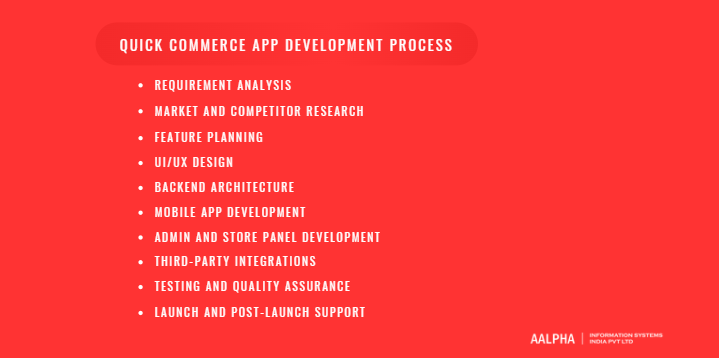
Quick Commerce App Development Process
Quick commerce app development requires a structured process because the platform must manage shopping, inventory, fulfillment, delivery, payments, tracking, support, and business operations at the same time. Unlike a simple online store, a quick commerce app operates in real time. The system must show location-based products, accept orders, alert stores, assign delivery partners, process payments, track movement, and update customers without delay. A clear development process helps reduce rework, control cost, and build a platform that can support real business operations after launch.
-
Requirement Analysis
The development process starts with requirement analysis. This stage defines the business model, target city, product categories, delivery promise, seller model, and revenue model. A business must first decide whether it wants to operate through dark stores, partner retailers, owned inventory, a marketplace model, or a hybrid model. This decision affects the app structure, backend logic, inventory flow, admin controls, and delivery workflow.
The target city or delivery area also matters. A quick commerce app built for one city may need limited delivery zones, while a multi-city platform needs city-wise catalog management, separate pricing rules, local store mapping, rider allocation, and area-level reporting. Product categories must also be planned early. Groceries, medicines, food essentials, stationery, flowers, pet supplies, and household goods have different inventory, compliance, substitution, and delivery requirements. The delivery promise should be realistic based on store distance, rider availability, packing time, traffic, and order density. Revenue planning is equally important because the platform may earn through delivery fees, product margins, seller commissions, subscriptions, advertising, or platform charges.
-
Market and Competitor Research
After the requirements are clear, the next step is market and competitor research. This includes studying customer behavior, order frequency, buying patterns, delivery expectations, average basket size, and product demand in the selected location. A quick commerce platform should not be planned only from a technology point of view. It must also match how people in the target area actually buy daily-use products.
Delivery zones must be carefully studied because quick commerce depends on short-distance fulfillment. Businesses need to identify high-demand neighborhoods, commercial areas, residential clusters, hostels, hospitals, offices, and apartment communities. Competitor research helps understand pricing, delivery timelines, product categories, offers, dark store placement, customer complaints, and service gaps. If dark stores are part of the model, the business must evaluate where inventory should be placed to serve more customers within the promised time. Pricing strategy should also be reviewed, including delivery charges, minimum order value, subscription plans, discounts, and margins.
-
Feature Planning
Feature planning converts business requirements into a clear product scope. At this stage, businesses should separate MVP features from advanced features. The MVP should include the core features required to launch, test demand, and process real orders. These usually include customer registration, OTP login, location detection, product catalog, search, cart, checkout, payments, order tracking, delivery partner app, store panel, admin dashboard, notifications, refunds, and basic reports.
Advanced features can be added after launch or during later phases. These may include AI-based recommendations, demand forecasting, smart batching, dynamic pricing, loyalty programs, subscriptions, in-app advertising, route optimization, advanced analytics, CRM automation, and multi-city controls. This separation is important because trying to build every feature in the first version can increase cost, delay launch, and make testing more complicated. A focused MVP helps businesses enter the market faster and improve the product based on real customer behavior.
-
UI/UX Design
UI/UX design plays a major role in quick commerce because customers expect speed and simplicity. The customer app should make it easy to select location, browse categories, search products, add items to cart, apply offers, pay, and track orders. The design should reduce unnecessary steps because users often place quick, need-based orders.
The delivery partner app should be even more direct. Riders should be able to view new order alerts, accept orders, see pickup and drop details, navigate easily, update delivery status, collect cash if required, and contact support. The admin panel and dark store dashboard should be designed for operational clarity. Store teams need simple screens for new orders, packing status, stock updates, substitutions, and handover. Admin teams need dashboards for monitoring orders, riders, stores, payments, refunds, promotions, and reports. Good design reduces mistakes and helps every user complete tasks faster.
-
Backend Architecture
Backend architecture is the technical foundation of a quick commerce platform. The backend must handle user accounts, product catalogs, inventory, cart, orders, payments, delivery assignment, notifications, refunds, reports, roles, permissions, and real-time tracking. It should be scalable because order volume can increase sharply during peak hours, weekends, festivals, rains, or promotional campaigns.
APIs connect the customer app, delivery partner app, store panel, admin dashboard, payment gateway, maps, notifications, and analytics tools. Real-time order updates are important because customers, stores, riders, and admins must see the latest status. The backend must also handle data securely, maintain transaction records, process refunds, log delivery events, and support future expansion into more categories or cities. Poor backend planning can lead to slow app performance, delayed order updates, payment mismatches, and operational confusion.
-
Mobile App Development
Mobile app development includes building customer apps and delivery partner apps for Android, iOS, or both. Some businesses choose native development using Kotlin for Android and Swift for iOS, while others prefer cross-platform development using React Native or Flutter to reduce cost and speed up development. The choice depends on budget, timeline, performance requirements, and long-term product roadmap.
The customer app should support browsing, ordering, payments, live tracking, notifications, support, wallet, coupons, and order history. The delivery partner app should support login, availability status, order alerts, navigation, delivery updates, proof of delivery, earnings, incentives, cash records, and support. In many quick commerce projects, separate apps for customers and delivery partners are better than combining both workflows into one app because each user group has different needs.
-
Admin and Store Panel Development
Admin and store panels are usually developed as web dashboards because business teams need to manage operations from desktops or tablets. The admin dashboard gives the company full control over customers, riders, stores, products, categories, pricing, commissions, orders, payments, refunds, reports, and promotions. It also helps monitor live orders, resolve disputes, and track business performance.
The store or dark store panel supports fulfillment operations. Store staff can view incoming orders, accept or reject orders, update packing status, mark products unavailable, suggest substitutions, manage stock, and generate reports. For marketplace or multi-vendor models, each seller may need a separate panel with limited access to their own products, orders, inventory, and settlement reports. These dashboards are critical for daily operations and should be simple, fast, and reliable.
-
Third-Party Integrations
Quick commerce apps depend on several third-party integrations. Maps are required for location detection, distance calculation, route planning, delivery tracking, and serviceability checks. Payment gateways are needed for UPI, cards, net banking, wallets, refunds, and settlements. SMS, WhatsApp, email, and push notifications help send OTPs, order confirmations, delivery updates, offers, and support messages.
Analytics tools help track user behavior, conversion rates, order volume, repeat purchases, and app performance. CRM integrations can help manage customer communication, campaigns, complaints, and retention. Depending on the business model, the platform may also integrate with accounting software, ERP systems, inventory tools, loyalty systems, or warehouse management platforms.
-
Testing and Quality Assurance
Testing is a critical stage in quick commerce app development because even small failures can affect live orders. Functional testing checks whether registration, product browsing, cart, checkout, coupons, payments, tracking, cancellations, and refunds work correctly. Payment testing verifies successful payments, failed payments, partial refunds, wallet credits, and settlement records.
Load testing checks whether the platform can handle peak order volumes without slowing down. Location testing verifies GPS accuracy, map pins, delivery zones, distance calculation, and address selection. Order flow testing checks the full journey from order placement to store acceptance, packing, rider assignment, pickup, delivery, and completion. Delivery simulation is also useful because it helps test real-world cases such as rider rejection, delayed pickup, unavailable products, wrong address, customer not reachable, failed payment, and order cancellation.
-
Launch and Post-Launch Support
Once testing is complete, the app is prepared for launch on the Google Play Store, Apple App Store, or as a private business platform depending on the project. The launch stage includes production deployment, app store submission, payment gateway activation, notification setup, admin training, store onboarding, delivery partner onboarding, and live order monitoring.
Post-launch support is just as important as development. Quick commerce apps need continuous monitoring, bug fixing, performance optimization, server maintenance, payment issue resolution, security updates, and feature improvements. After launch, businesses should track order completion rate, delivery time, cancellation rate, customer feedback, rider acceptance rate, product availability, and repeat orders. These insights help improve the app and operations over time. A quick commerce app should not be treated as a one-time software project. It is an operational system that must keep improving as customer demand, product categories, delivery zones, and order volumes grow.
Technology Stack for Quick Commerce App Development
The technology stack of a quick commerce app directly affects performance, scalability, delivery speed, tracking accuracy, security, and long-term maintenance. Since quick commerce platforms handle real-time orders, location data, inventory updates, payments, delivery assignment, customer communication, and admin operations, the stack must be selected carefully. A weak technology foundation can lead to slow checkout, delayed tracking updates, inventory mismatches, payment failures, and poor operational control. The right stack should support fast mobile performance, reliable backend processing, secure payments, real-time communication, and scalable cloud deployment.
-
Frontend Technologies
Frontend technologies are used to build the customer app, delivery partner app, store dashboard, admin panel, and business-facing web interfaces. For mobile app development, React Native and Flutter are popular choices because they allow businesses to build Android and iOS apps using a shared codebase. This can reduce development time and cost compared to building two separate native apps. React Native is widely used for apps that need fast development, strong community support, and smooth integration with native features. Flutter is also a strong option for apps that need highly customized UI, consistent design, and good performance across devices.
For businesses that want fully native mobile apps, Swift is used for iOS app development and Kotlin is used for Android app development. Native development is useful when the app requires deeper device-level performance, advanced background location handling, or platform-specific optimization. For admin panels, store dashboards, and web platforms, React.js, Next.js, and Vue.js are commonly used. React.js works well for dynamic dashboards, Next.js is useful when SEO-friendly web pages or faster page rendering are needed, and Vue.js is suitable for lightweight and maintainable web interfaces.
-
Backend Technologies
The backend is the engine of a quick commerce app. It manages users, products, inventory, stores, orders, payments, delivery partners, notifications, refunds, reports, and admin controls. Node.js is a strong backend choice for quick commerce because it handles real-time and event-driven operations well. It works effectively for order updates, notifications, delivery assignment, and API-heavy applications. Python is useful when the platform requires AI features, demand forecasting, recommendation systems, analytics, or automation workflows.
Laravel can be a practical option for businesses that want structured development, faster backend setup, and admin-focused applications. Java is suitable for large-scale enterprise platforms that need strong reliability, high transaction handling, and long-term maintainability. Go is often used for high-performance backend services where speed, concurrency, and efficient resource usage are important. For larger platforms, a microservices architecture can separate core services such as orders, inventory, payments, delivery assignment, notifications, and reporting. This makes the system easier to scale and maintain as order volume grows.
-
Database Technologies
Database selection is important because quick commerce apps handle product catalogs, customer data, order records, rider locations, inventory movements, payments, and reports. PostgreSQL is a strong relational database for structured data, transactions, order records, settlements, and financial reporting. MySQL is also widely used for eCommerce and marketplace platforms because it is reliable, familiar, and suitable for structured business data.
MongoDB is useful when the app needs flexible data structures, fast product catalog updates, location-based data, or changing business requirements. Redis is commonly used for caching, session management, live availability, temporary order data, delivery partner status, and high-speed lookups. Elasticsearch is useful for advanced product search, filters, auto-suggestions, and fast catalog discovery. For example, if a customer searches for “milk,” the app can instantly show relevant brands, pack sizes, and available products from nearby stores.
-
Real-Time Technologies
Real-time technologies are essential in quick commerce because customers, stores, delivery partners, and admins must see live updates. WebSockets allow the server and app to communicate instantly without repeatedly refreshing data. This is useful for live order status, delivery partner location, chat support, and admin monitoring. Socket.IO is commonly used with Node.js to build real-time order tracking, rider movement, and delivery status updates.
Firebase can be used for push notifications, real-time updates, authentication support, and app messaging. In quick commerce, real-time order tracking helps customers know whether the order is accepted, being packed, picked up, out for delivery, or delivered. It also helps admins monitor delays and intervene when needed. Real-time systems improve transparency and reduce customer support queries.
-
Maps and Location APIs
Maps and location APIs are central to quick commerce app development. Google Maps APIs and Mapbox are commonly used for address selection, location detection, geocoding, reverse geocoding, route calculation, distance calculation, and live tracking. Geocoding converts addresses into map coordinates, while reverse geocoding converts coordinates into readable addresses. Distance matrix APIs help calculate distance and estimated travel time between pickup and drop locations.
Route calculation helps delivery partners follow efficient paths, while live tracking allows customers and admins to monitor rider movement. Maps are also needed for serviceability checks. For example, the app should only accept orders from customers located within the delivery radius of a store or dark store. Accurate maps and location APIs reduce failed deliveries, wrong address issues, delayed orders, and rider confusion.
-
Payment Gateways
Quick commerce apps need secure and flexible payment options. Stripe and PayPal are commonly used for international markets, while Razorpay and Cashfree are widely used in India. Payment gateways can support cards, UPI, net banking, wallets, refunds, and transaction reports. UPI is especially important in the Indian market because customers frequently use UPI apps for fast payments.
The platform may also support cash on delivery, wallet balance, pay on delivery, refund credits, and promotional credits. For marketplace or multi-vendor models, payment architecture must also support seller settlements, delivery partner payouts, platform fees, commission deductions, and refund adjustments. Payment reliability is critical because failed payments, delayed refunds, or incorrect settlement records can create customer and seller disputes.
-
Cloud and DevOps
Cloud and DevOps technologies help quick commerce apps run reliably after launch. AWS, Google Cloud, and Azure provide cloud infrastructure for hosting APIs, databases, storage, notifications, analytics, and monitoring systems. Docker helps package applications consistently across development, testing, and production environments. Kubernetes can be used for container orchestration when the platform needs auto-scaling, high availability, and microservices management.
Nginx is commonly used as a web server, reverse proxy, and load balancer. CI/CD pipelines help development teams release updates faster and with fewer manual errors. Logging and monitoring tools help track server health, API errors, payment failures, app crashes, database performance, and order processing issues. Regular backups are also essential to protect customer data, order history, payment records, inventory logs, and business reports.
A well-planned technology stack gives the quick commerce platform the stability required to manage live orders, real-time delivery, payments, inventory updates, customer support, and future growth. For businesses planning to scale across more stores, categories, or cities, technology decisions made during development can have a major impact on long-term performance and operating cost.
Quick Commerce App Development Cost
The cost of quick commerce app development depends on the scope of the platform, number of apps and panels, feature complexity, technology stack, development team, integrations, and scalability requirements. A basic quick commerce MVP will cost less than a full-scale platform with multi-store inventory, AI recommendations, route optimization, subscriptions, and multi-city operations. Businesses should also remember that the total cost is not limited to mobile app development. A proper quick commerce platform usually includes customer apps, delivery partner apps, store or dark store panels, admin dashboards, backend APIs, payment integrations, map integrations, notifications, testing, deployment, and post-launch support.
-
Basic MVP Cost
A basic quick commerce MVP usually costs between $15,000 and $35,000, depending on the development team and feature scope. This version is suitable for startups or local businesses that want to launch quickly, validate demand, and process real orders in a limited delivery area. A basic MVP generally includes a customer app, delivery partner app, admin panel, product catalog, cart, checkout, payment gateway, order placement, basic delivery assignment, notifications, and order tracking.
The customer app allows users to register, select location, browse products, add items to cart, place orders, pay online, and track delivery status. The delivery partner app allows riders to receive order alerts, view pickup and drop details, update order status, and complete deliveries. The admin panel gives the business owner control over products, categories, customers, orders, delivery partners, payments, and basic reports.
This type of MVP is useful when the business wants to start with one city, one or a few fulfillment points, limited product categories, and a simple delivery workflow. However, the MVP should still be built on a strong backend foundation so that future features can be added without rebuilding the entire platform.
-
Mid-Level App Cost
A mid-level quick commerce app usually costs between $35,000 and $80,000. This version is suitable for businesses that need more operational control and want to support multiple stores, dark stores, or local sellers. A mid-level app includes everything in the MVP, along with multi-store support, inventory management, store panel, offers, coupons, wallet, customer reports, delivery assignment logic, refund workflows, and better admin controls.
Multi-store support allows the platform to show products based on the customer’s location and nearest fulfillment point. Inventory management helps stores update stock, mark items unavailable, receive low-stock alerts, and manage product availability. A store or dark store panel allows staff to accept orders, update packing status, manage substitutions, and mark orders ready for pickup.
This version may also include wallet credits, promotional offers, customer segmentation, delivery zone management, delivery fee rules, and basic analytics. It is a better choice for businesses that are serious about operations and want to reduce manual dependency. While the cost is higher than an MVP, the platform becomes more practical for daily order management, repeat customers, and store-level control.
-
Advanced Quick Commerce App Cost
An advanced quick commerce app can cost between $80,000 and $200,000 or more, depending on the size of the platform and technical complexity. This type of solution is suitable for businesses planning large-scale operations, multi-city expansion, advanced automation, or marketplace-style quick commerce.
Advanced features may include AI-based product recommendations, demand forecasting, route optimization, smart delivery batching, dynamic pricing, subscription plans, loyalty programs, in-app advertising, advanced analytics, multi-city operations, automated rider assignment, seller settlements, and custom reporting dashboards. For example, AI recommendations can personalize products based on customer order history, time, location, and buying behavior. Demand forecasting can help the business predict stock needs by product, area, season, and order pattern. Route optimization can reduce delivery time and improve rider productivity.
Advanced platforms also need stronger backend architecture, better DevOps setup, monitoring tools, scalable databases, secure payment handling, role-based access, and high-performance APIs. These requirements increase the development cost but make the platform more reliable for high order volumes and expansion across more cities, stores, and categories.
-
Cost by Development Team Type
The development team type has a major impact on quick commerce app development cost. Freelancers may appear cheaper at the beginning, but they are usually better suited for small prototypes, UI tasks, or limited modules. A complete quick commerce app needs mobile developers, backend developers, frontend developers, UI/UX designers, QA testers, DevOps engineers, and project managers. Managing all of these separately through freelancers can become difficult, especially when the platform needs long-term support.
An in-house team gives more control but is usually expensive because the business must hire, train, manage, and retain multiple technical specialists. This option is practical for funded companies or enterprises that want a permanent product team. However, the cost of salaries, infrastructure, management, and hiring delays can be high.
Offshore development teams are often a cost-effective option for startups and growing businesses. They provide access to experienced developers at lower hourly rates compared to the US, UK, or Western Europe. A dedicated development team is another strong option when the project requires continuous development, frequent updates, and long-term product improvement. In this model, businesses can hire a fixed team of developers, designers, testers, and project managers who work on the platform over several months.
-
Cost by Geography
Quick commerce app development cost also varies by geography. Development teams in India usually offer more cost-effective pricing, often ranging from $20 to $50 per hour, depending on experience and project complexity. This makes India a popular choice for startups and businesses that need quality development at a controlled budget.
Eastern Europe generally has higher rates than India but is still more affordable than Western markets. Development rates in this region may range from $40 to $80 per hour. Western Europe and the UK are usually more expensive, with rates often ranging from $80 to $150 per hour. In the US, quick commerce app development can be significantly costlier, with hourly rates commonly ranging from $100 to $200 or more, especially for experienced product teams and enterprise-grade development companies.
The geography of the team should not be the only deciding factor. Businesses should also evaluate technical expertise, delivery app experience, backend capability, communication quality, project management, support availability, and understanding of real-time logistics. A low-cost team without quick commerce experience may build a basic app but fail to handle inventory accuracy, delivery assignment, tracking, refunds, store operations, and scalability. For this reason, the best approach is to compare cost along with experience, architecture quality, and long-term support capability.
Why Work With a Quick Commerce App Development Partner
Building a quick commerce app is not just about creating a customer-facing shopping application. The business depends on speed, inventory accuracy, rider availability, payment reliability, and operational control. A mobile app development company or partner with experience in on-demand delivery, marketplace platforms, mobile apps, backend systems, and logistics workflows can help businesses build a platform that supports real orders, real customers, and real delivery challenges from day one.
-
Quick Commerce Needs More Than Basic App Development
A quick commerce business requires multiple connected systems working together in real time. The customer app must allow users to browse products, select location, place orders, make payments, track delivery, request refunds, and contact support. The delivery partner app must support order alerts, pickup and drop details, navigation, delivery status updates, proof of delivery, earnings, incentives, cash collection, and support. The store or dark store panel must help fulfillment teams manage incoming orders, update stock, handle substitutions, and prepare orders quickly.
Along with these user-facing systems, the business also needs a strong admin dashboard, inventory management system, payment integration, notification engine, maps, delivery reports, customer reports, rider reports, refund workflows, and backend operations. These modules cannot work in isolation. If inventory does not update properly, customers may order unavailable products. If rider assignment is slow, delivery promises may fail. If payment and refund records are not accurate, customer trust can suffer. This is why quick commerce needs a complete technical and operational platform, not just a basic mobile app.
-
Custom Development Helps With Real Operations
Custom development is valuable because every quick commerce business has different operating rules. A grocery-first platform may need store-level inventory, low-stock alerts, substitution flows, and recurring purchase features. A multi-vendor quick commerce marketplace may need seller onboarding, commission logic, product approvals, settlement reports, and vendor-specific order controls. A dark store-based platform may need strict delivery zones, packing workflows, dispatch controls, and product availability based on the nearest fulfillment point.
Custom development also helps businesses handle delivery zones, rider assignment, pricing rules, delivery fees, minimum order values, refunds, wallet credits, seller settlements, and multi-city expansion. For example, one city may have different delivery charges, rider payouts, product pricing, operating hours, and serviceable areas compared to another city. A custom platform allows the business to configure these rules from the admin panel instead of depending on fixed software limitations. This flexibility becomes important as the platform grows across more stores, categories, and locations.
-
Long-Term Support Is Important
Quick commerce apps need continuous technical support after launch. Since the platform handles live orders, payments, tracking, inventory, and delivery operations, even small issues can affect revenue and customer experience. Businesses need regular monitoring, bug fixes, server optimization, payment gateway updates, app store updates, security fixes, API maintenance, and performance improvements.
Rider workflows may also need changes based on real operational feedback. For example, the business may need to improve order assignment, add auto-reassignment, change delivery status steps, adjust cash collection logic, or improve proof of delivery. Customer-side improvements may include faster checkout, better search, improved tracking, wallet credits, offers, or subscription plans. A reliable development partner helps the business improve the platform continuously instead of treating the app as a one-time project.
-
Working With an Experienced Development Partner
Businesses planning to build a quick commerce app can work with experienced app development teams such as Aalpha, especially when the project requires branded mobile apps, backend development, real-time tracking, payment integration, inventory management, admin dashboards, delivery partner apps, store panels, and long-term technical support. The right development partner can help define the product scope, plan scalable architecture, build user-friendly apps, integrate third-party services, test real order flows, and support the platform after launch.
For quick commerce businesses, this partnership matters because the app must support both customer convenience and operational efficiency. A well-built platform can help reduce delivery delays, improve inventory accuracy, manage payments better, support more stores, and prepare the business for future expansion. When technology and operations are planned together, the quick commerce app becomes a strong foundation for building a reliable local delivery business.
Conclusion
Quick commerce app development requires more than a basic shopping app. A successful platform must connect customers, products, stores, inventory, delivery partners, payments, tracking, refunds, support, and admin operations in real time. Since customers expect fast delivery and accurate product availability, the app must be built with strong backend architecture, reliable location tracking, smooth checkout, smart order assignment, and clear operational dashboards.
For businesses, quick commerce offers a strong opportunity to serve daily customer needs through groceries, medicines, food essentials, personal care products, stationery, pet supplies, household items, and local retail categories. However, long-term success depends on choosing the right business model, starting with the right features, managing delivery operations carefully, and continuously improving the platform after launch.
If you are planning to build a quick commerce app, connect with Aalpha to develop a custom solution with customer apps, delivery partner apps, store panels, admin dashboards, real-time tracking, payment integration, inventory management, and long-term technical support.