


Outsourcing AI agent development means partnering with external experts to design, build, and deploy intelligent systems that can perform tasks autonomously on behalf of your business. Companies are increasingly asking a practical question: how can we automate repetitive workflows, customer interactions, and decision-making without building a full in-house AI team? The answer, for many, is outsourcing. It offers immediate access to experienced AI engineers, proven frameworks, and production-ready systems without the long hiring cycles and high costs associated with internal development.
AI agents are no longer experimental tools. They are being deployed across industries to handle customer support, qualify leads, manage operations, and even assist in clinical workflows. As businesses move toward automation-first operations, outsourcing has become a strategic approach to accelerate adoption while maintaining flexibility and cost control.
What is AI Agent Development?
AI agent development refers to the process of creating intelligent systems that can perceive inputs, make decisions, and execute tasks with minimal human intervention. These agents combine large language models, memory systems, APIs, and business logic to operate autonomously within defined workflows. Unlike traditional software, AI agents can interpret natural language, adapt to changing inputs, and continuously improve based on feedback.
For example, a customer support AI agent can handle incoming queries, retrieve relevant information from a knowledge base, and respond instantly. A healthcare assistant can help patients book appointments, follow treatment plans, or answer medical FAQs within predefined safety boundaries. A sales automation agent can qualify leads, send follow-ups, and update CRM systems without manual effort.
It is important to distinguish AI agents from chatbots and basic automation scripts. Chatbots typically follow predefined conversational flows and struggle with complex queries. Automation scripts execute fixed rules without intelligence or adaptability. AI agents, on the other hand, combine reasoning, context awareness, and tool usage, allowing them to perform multi-step tasks and make decisions dynamically.
What Does It Mean to Outsource AI Agent Development?
Outsourcing AI agent development involves delegating the entire lifecycle of building an AI agent to an external team. This includes defining use cases, designing system architecture, integrating AI models, developing workflows, testing performance, and deploying the solution into real-world environments. Instead of assembling an in-house team of AI engineers, data scientists, and DevOps specialists, businesses rely on specialized vendors who already have this expertise.
There are different outsourcing models based on geography and collaboration preferences. Offshore outsourcing involves working with teams in distant regions, often to reduce costs. Nearshore outsourcing refers to partnering with teams in neighboring countries with similar time zones, which can improve communication. Onshore outsourcing means working with vendors within the same country, offering easier collaboration but typically at higher costs.
Each model has trade-offs between cost, communication efficiency, and project control. The right choice depends on the complexity of the AI agent, the required level of collaboration, and budget constraints.
Why Businesses Are Outsourcing AI Agents in 2026
The rapid adoption of AI agents is being driven by both opportunity and necessity. One of the biggest factors is the global shortage of skilled AI and machine learning professionals. Building an in-house team with expertise in large language models, prompt engineering, vector databases, and system orchestration is not only expensive but also time-consuming. Outsourcing provides immediate access to this specialized talent.
Cost efficiency is another key driver. Developing AI agents internally requires significant investment in hiring, infrastructure, and ongoing training. Outsourcing converts these fixed costs into predictable project-based or subscription-based expenses, making it easier for businesses to manage budgets.
Speed also plays a critical role. In competitive markets, companies cannot afford long development cycles. Outsourcing partners often use pre-built frameworks and proven workflows, enabling faster deployment and quicker iteration. This allows businesses to test, refine, and scale AI solutions without delays.
Finally, outsourcing offers access to deep expertise that may not exist internally. Experienced AI development teams bring knowledge from multiple industries, understand common pitfalls, and can design systems that are scalable, secure, and aligned with business goals. For many organizations, outsourcing is not just a cost-saving measure, but a strategic decision to accelerate AI adoption and gain a competitive advantage.
What Are AI Agents and How Do They Work?
AI agents are intelligent software systems designed to perform tasks autonomously by understanding inputs, reasoning through problems, and executing actions using connected tools. Unlike traditional software, which relies on fixed logic, AI agents operate dynamically. They can interpret natural language, access external systems, and complete multi-step workflows without constant human intervention. This shift is why many decision-makers now ask how AI agents actually function in real business environments and whether they can replace manual processes reliably. The answer lies in how these systems are structured and how they execute tasks across different stages of a workflow.
-
Core Components of an AI Agent
Every AI agent is built on a combination of foundational components that work together to enable intelligence and automation. At the center is the large language model, such as GPT or Claude, which acts as the reasoning engine. This component allows the agent to understand user inputs, generate responses, and make decisions based on context. Without this layer, the system would lack the ability to interpret complex instructions or adapt to new scenarios.
Memory systems are equally critical. These are typically implemented using vector databases that store contextual information, past interactions, and domain-specific knowledge. Memory enables the agent to maintain continuity across conversations and tasks. For example, a support agent can remember previous customer issues, while a sales agent can track lead history and preferences.
Tools and integrations extend the capabilities of the agent beyond conversation. These include APIs, CRM systems, databases, payment gateways, and internal business software. Through these integrations, an AI agent can perform real actions such as updating records, retrieving data, sending notifications, or triggering workflows. This is what transforms an AI system from a conversational interface into an operational asset.
Finally, orchestration frameworks manage how all these components interact. These frameworks define workflows, control decision-making logic, and ensure that the agent executes tasks in a structured and reliable manner. They handle sequencing, error handling, and multi-step reasoning, allowing the agent to function as a coordinated system rather than a standalone model.
-
Types of AI Agents Businesses Are Building
Businesses across industries are deploying different types of AI agents depending on their operational needs. One of the most widely adopted categories is customer support agents. These agents handle inquiries, resolve issues, and provide instant responses across channels such as websites, apps, and messaging platforms. They reduce response times and significantly lower support costs while maintaining consistent service quality.
Sales and lead qualification agents are another major use case. These agents engage with potential customers, ask qualifying questions, score leads, and route them to the appropriate sales representatives. They can also automate follow-ups, ensuring that no opportunity is missed. For companies focused on growth, this type of agent directly impacts revenue generation.
Healthcare AI assistants are emerging as high-impact solutions, particularly in patient engagement and administrative workflows. These agents can schedule appointments, send medication reminders, answer common health-related questions within defined safety limits, and assist healthcare providers with documentation tasks. Their value lies in reducing administrative burden while improving patient experience.
Operations and workflow automation agents focus on internal processes. These agents manage repetitive tasks such as order processing, inventory updates, reporting, and data synchronization across systems. By automating these workflows, businesses can reduce errors and improve efficiency at scale.
Personal productivity agents are designed to assist individuals within an organization. They help with tasks like summarizing documents, drafting emails, scheduling meetings, and retrieving information quickly. While these agents operate at an individual level, their cumulative impact on productivity can be substantial.
-
How AI Agents Execute Tasks Step-by-Step
AI agents follow a structured process when executing tasks, even though the interaction may appear seamless to the end user. The process begins with input, which can be a user query, a system trigger, or incoming data. This input is analyzed by the language model to understand intent and context.
The next stage is reasoning. Here, the agent determines what needs to be done based on the input. It may break down the task into smaller steps, identify required data, and decide which tools or integrations are necessary. This reasoning capability is what differentiates AI agents from simple automation systems.
Once the plan is established, the agent moves to tool usage. It interacts with external systems through APIs or integrations to perform actions such as retrieving customer data, updating records, processing transactions, or sending messages. These actions are executed in sequence, often involving multiple systems.
Finally, the agent generates an output. This could be a response to the user, a completed transaction, or an updated system state. The output is typically contextual and aligned with the original request, ensuring that the task is completed end-to-end.
Consider a real-world example of an order processing agent. When a customer places an order, the agent receives the input and verifies the details. It then checks inventory through a database integration, confirms payment via a payment gateway, updates the order status in the system, and sends a confirmation message to the customer. Each step is handled autonomously, reducing the need for manual intervention while maintaining accuracy and speed.
When Should You Outsource AI Agent Development?
Outsourcing AI agent development is not simply a cost decision. It is a strategic choice that depends on your operational maturity, internal capabilities, and urgency to automate. Many businesses reach a point where manual processes begin to limit growth, slow down customer experience, and increase operational costs. At that stage, leaders often evaluate whether to build AI solutions internally or partner with external experts. The right timing depends on recognizing clear signals within your business and understanding whether outsourcing can accelerate outcomes without introducing unnecessary risk.
-
Signs Your Business Needs AI Agents
One of the strongest indicators that your business needs AI agents is the presence of repetitive workflows. When teams spend significant time on routine tasks such as responding to common customer queries, processing orders, updating records, or sending follow-ups, it creates inefficiencies. These tasks are predictable and rule-based at a surface level but often require contextual understanding, making them ideal candidates for AI agents rather than basic automation.
A high customer support load is another clear signal. If your support team is overwhelmed with tickets, experiencing delays in response times, or struggling to maintain consistency in communication, it directly impacts customer satisfaction. Businesses often ask how they can handle increasing customer interactions without continuously expanding support teams. AI agents provide a scalable solution by handling large volumes of queries simultaneously while maintaining accuracy and responsiveness.
Manual data handling is also a critical trigger. Many organizations still rely on employees to transfer data between systems, validate entries, generate reports, and manage records. This not only consumes time but also introduces human error. When data flows become complex and frequent, AI agents can automate these processes by integrating directly with internal systems and executing tasks with precision.
These signals typically emerge together. As operations grow, inefficiencies compound, making it clear that automation is not optional but necessary for sustainable scaling.
-
When Outsourcing is Better Than In-House Development
Outsourcing becomes the preferred approach when a business lacks specialized AI expertise. Building AI agents requires knowledge of large language models, system design, integrations, prompt engineering, and continuous optimization. Hiring and assembling a team with these capabilities can take months, and even then, execution risks remain high if the team lacks practical experience in deploying production-grade AI systems.
The need for rapid deployment is another decisive factor. In competitive markets, businesses cannot afford long development cycles. When leadership is asking how quickly an AI solution can be implemented and tested in real-world scenarios, outsourcing provides a clear advantage. Experienced vendors often use proven frameworks and reusable components, significantly reducing development time. This allows companies to launch minimum viable AI agents, gather feedback, and iterate quickly.
Budget constraints also influence the decision. While outsourcing is often perceived as a cost-saving measure, the real advantage lies in cost predictability. In-house development involves fixed costs such as salaries, infrastructure, and ongoing training. Outsourcing converts these into variable costs tied to project scope or subscription models. For many businesses, this makes financial planning more manageable while still accessing high-quality expertise.
In situations where speed, expertise, and cost control are critical, outsourcing is not just an alternative but the most practical path forward.
-
When You Should Not Outsource
Despite its advantages, outsourcing is not always the right choice. Organizations with strong in-house AI teams may benefit more from building internally. If your company already has experienced machine learning engineers, data scientists, and infrastructure in place, internal development can provide greater control, deeper customization, and long-term knowledge retention.
Highly sensitive proprietary systems also require careful consideration. Industries such as finance, defense, or healthcare often deal with confidential data and strict compliance requirements. When data privacy and security risks outweigh the benefits of external collaboration, keeping development in-house may be the safer option. In such cases, businesses may still choose to consult external experts while retaining core development internally.
Ultimately, the decision should be based on a clear assessment of internal capabilities, risk tolerance, and strategic priorities. Outsourcing works best when it fills a capability gap or accelerates execution, but it should not replace strong internal foundations where they already exist.
Benefits of Outsourcing AI Agent Development
Outsourcing AI agent development delivers measurable advantages across cost, speed, expertise, and risk management. For decision-makers evaluating whether to build internally or partner with an external team, the core question is not just about cost savings but about achieving faster, more reliable outcomes with fewer execution risks. AI agent systems involve multiple layers, including language models, integrations, orchestration, and continuous optimization. Managing all of this internally can be complex and resource-intensive. Outsourcing provides a structured path to deploy production-ready solutions while allowing internal teams to focus on core business priorities.
-
Cost Efficiency and Resource Optimization
Cost efficiency is one of the most immediate and tangible benefits of outsourcing AI agent development. Building an in-house AI team requires significant investment in hiring skilled engineers, data scientists, and infrastructure specialists. Beyond salaries, there are additional costs related to training, tooling, cloud infrastructure, and ongoing maintenance. These fixed expenses can quickly escalate, especially for businesses that are still experimenting with AI use cases.
Outsourcing converts these fixed costs into variable, project-based, or subscription-based expenses. This allows businesses to allocate resources more effectively and avoid long-term financial commitments. Instead of investing heavily upfront, companies can start with a focused use case, validate results, and scale gradually.
Resource optimization goes beyond cost. Internal teams can remain focused on strategic initiatives such as product development, customer acquisition, and operations, while external experts handle the complexity of AI implementation. This division of responsibility ensures that organizations achieve automation goals without overextending internal capabilities.
-
Access to Specialized AI Expertise
AI agent development requires a combination of skills that are difficult to find in a single team. Expertise is needed in large language models, prompt engineering, system architecture, API integrations, vector databases, and workflow orchestration. Many businesses struggle to assemble teams with this level of specialization, particularly as demand for AI talent continues to exceed supply.
Outsourcing provides immediate access to experienced professionals who have already built and deployed AI systems across different industries. These teams bring practical knowledge of what works in real-world scenarios, not just theoretical understanding. They are familiar with common challenges such as handling ambiguous inputs, ensuring response accuracy, managing system latency, and integrating with legacy systems.
This depth of expertise reduces trial-and-error cycles and improves the overall quality of the solution. Instead of learning through costly mistakes, businesses benefit from established best practices and proven methodologies. For organizations asking how to build reliable AI agents without internal expertise, outsourcing becomes a direct path to high-quality implementation.
-
Faster Time-to-Market
Speed is a critical factor in AI adoption. Markets are evolving rapidly, and businesses that delay automation risk falling behind competitors who are already leveraging AI agents to improve efficiency and customer experience. Developing AI solutions in-house often involves long timelines due to hiring, onboarding, experimentation, and infrastructure setup.
Outsourcing significantly accelerates this process. External vendors typically use pre-built frameworks, reusable components, and standardized workflows that reduce development time. They can quickly move from concept to minimum viable product, allowing businesses to test AI agents in real-world conditions within weeks rather than months.
Faster time-to-market also enables quicker feedback cycles. Businesses can deploy early versions, gather user insights, refine functionality, and scale successful implementations. This iterative approach reduces the risk of building solutions that do not align with actual business needs. For companies focused on growth and innovation, the ability to move quickly is often more valuable than incremental cost savings.
-
Scalability and Flexibility
AI agent requirements often evolve over time. A system that starts as a simple support assistant may later expand to handle complex workflows, integrate with multiple systems, or operate across different channels such as web, mobile, and messaging platforms. Managing this growth internally can be challenging, especially if the initial architecture was not designed for scalability.
Outsourcing partners typically design systems with scalability in mind from the beginning. They use modular architectures that allow new features, integrations, and workflows to be added without disrupting existing functionality. This ensures that the AI agent can grow alongside the business.
Flexibility is another key advantage. Businesses can scale resources up or down based on project requirements. If a new feature needs to be developed or an existing system requires optimization, additional expertise can be brought in without long-term hiring commitments. This adaptability is particularly valuable for startups and mid-sized companies that need to respond quickly to changing market conditions.
-
Reduced Operational Risk
AI projects carry inherent risks, including performance issues, integration challenges, and unexpected costs. Outsourcing helps mitigate these risks by leveraging teams with prior experience in delivering similar solutions. These teams follow structured development processes, conduct thorough testing, and implement monitoring systems to ensure reliability after deployment.
Experienced vendors are also better equipped to anticipate potential challenges and address them proactively. Whether it is handling edge cases in user interactions, ensuring data security, or maintaining system performance under load, their expertise reduces the likelihood of critical failures.
For decision-makers concerned about the uncertainty of AI agent implementation, outsourcing provides a more controlled and predictable path. It shifts much of the technical and execution risk to partners who are accountable for delivering a functional and scalable solution.
Challenges and Risks of Outsourcing AI Development
Outsourcing AI agent development offers clear advantages, but it also introduces risks that must be managed deliberately. Decision-makers often ask whether outsourcing AI is safe, controllable, and scalable over time. The answer depends on how well the engagement is structured. AI systems are not static applications; they evolve with data, usage patterns, and business requirements. This makes outsourcing more complex than traditional software development. Understanding the potential challenges allows businesses to put the right safeguards in place and avoid costly mistakes.
-
Communication and Collaboration Issues
One of the most common challenges in outsourcing is communication breakdown. AI development requires continuous alignment between business goals and technical implementation. If the external team does not fully understand the intended workflows, user expectations, or success metrics, the resulting system may not deliver the expected outcomes.
Time zone differences can further complicate collaboration, especially in offshore models. Delays in feedback, misinterpretation of requirements, and lack of real-time communication can slow down progress. This becomes more critical in AI projects where iterative testing and refinement are essential.
Another issue is the gap between business language and technical language. Stakeholders often describe requirements in operational terms, while developers think in terms of models, data flows, and system architecture. Without clear documentation and structured communication processes, this gap can lead to misaligned deliverables.
To address this, businesses need defined communication channels, regular progress updates, and detailed requirement specifications. Successful outsourcing engagements rely on constant collaboration rather than one-time handoffs.
-
Data Security and Privacy Concerns
AI agents rely heavily on data, which makes security and privacy a major concern. Businesses often need to share sensitive information such as customer data, operational workflows, and proprietary knowledge with external vendors. This raises valid questions about data protection, compliance, and risk exposure.
Industries such as healthcare, finance, and eCommerce operate under strict regulatory frameworks. Any mishandling of data can lead to legal consequences, financial penalties, and reputational damage. Even outside regulated industries, data breaches can erode customer trust and disrupt operations.
Another layer of complexity comes from how AI systems process and store data. Memory systems, logs, and integrations can create multiple points where sensitive information is accessed or stored. Without proper controls, this increases the attack surface.
Mitigating these risks requires clear data governance policies, secure infrastructure, and strict access controls. Businesses should ensure that outsourcing partners follow industry-standard security practices, including encryption, compliance certifications, and regular audits. Data handling protocols must be defined before development begins, not after deployment.
-
Quality Control and Performance Risks
AI agents are inherently probabilistic systems, which means their outputs are not always deterministic. This introduces challenges in maintaining consistent quality and performance. When development is outsourced, businesses may have limited visibility into how the system is being built, tested, and optimized.
A common concern is whether the AI agent will perform reliably in real-world scenarios. Issues such as incorrect responses, incomplete task execution, or failure to handle edge cases can impact user experience and business outcomes. Unlike traditional software bugs, AI-related issues can be harder to detect and fix because they depend on data, context, and model behavior.
Performance is another critical factor. AI agents must respond quickly, handle multiple requests simultaneously, and integrate seamlessly with other systems. Poor optimization can lead to latency issues, system failures, or increased operational costs due to inefficient resource usage.
To manage these risks, businesses need clear quality benchmarks, testing frameworks, and performance metrics. Regular reviews, staging environments, and continuous monitoring are essential to ensure that the AI agent meets expected standards before and after deployment.
-
Dependency on External Vendors
Outsourcing creates a level of dependency on external vendors that can impact long-term flexibility. Once an AI agent is developed and integrated into core business operations, switching vendors or bringing development in-house can become complex and costly.
This dependency is particularly significant when the vendor controls critical aspects such as system architecture, proprietary workflows, or integration logic. If documentation is incomplete or knowledge transfer is limited, businesses may struggle to maintain or extend the system independently.
Another risk is vendor reliability. Changes in the vendor’s business priorities, team structure, or service quality can affect ongoing support and development. If the vendor fails to meet expectations, it can disrupt operations and delay critical updates.
Reducing dependency requires a structured approach. Businesses should ensure proper documentation, maintain access to source code and system configurations, and establish clear ownership of intellectual property. Building some level of internal understanding, even when outsourcing, can also help maintain control over the system.
-
Hidden Costs and Scope Creep
While outsourcing is often chosen for cost efficiency, hidden costs can emerge if the project scope is not clearly defined. AI projects are particularly prone to scope expansion because requirements evolve as the system is tested and refined.
Additional features, integration complexities, and performance improvements can increase costs beyond initial estimates. Without clear boundaries, projects can extend indefinitely, affecting both timelines and budgets.
To prevent this, businesses need detailed contracts, well-defined deliverables, and structured change management processes. Clear scoping at the beginning, combined with phased development, helps maintain control over both costs and expectations.
Types of AI Agent Development Services You Can Outsource
Outsourcing AI agent development is not limited to building a single type of solution. Businesses often ask what exactly can be outsourced and whether external teams can handle the full lifecycle of AI systems. In practice, outsourcing spans everything from building custom agents from scratch to integrating AI into existing workflows and continuously optimizing performance after deployment. Understanding the different service categories helps decision-makers define scope clearly and choose the right engagement model based on their business objectives.
-
Custom AI Agent Development
Custom AI agent development involves building a solution tailored specifically to your business processes, data structures, and operational goals. This is the most comprehensive form of outsourcing, where the external team designs the entire system architecture, selects appropriate models, builds workflows, and integrates necessary tools.
Businesses often choose this approach when off-the-shelf solutions cannot address their unique requirements. For example, a logistics company may need an AI agent that coordinates shipments, tracks inventory across multiple systems, and communicates with vendors in real time. Similarly, a healthcare provider may require an agent that handles patient interactions while complying with strict regulatory constraints.
Custom development ensures that the AI agent aligns closely with business logic, rather than forcing operations to adapt to generic software. It also allows for deeper integration, better scalability, and more control over functionality. However, it requires a clear understanding of use cases and collaboration with experienced developers to define requirements accurately.
-
AI Agent Integration with Existing Systems
Many businesses already have established systems such as CRMs, ERPs, databases, and internal tools. In such cases, the primary need is not to build a new AI agent from scratch but to integrate AI capabilities into existing infrastructure. Outsourcing this type of service focuses on connecting AI agents with current systems to automate processes and enhance functionality.
Integration involves enabling the AI agent to retrieve data, update records, trigger workflows, and interact with multiple platforms seamlessly. For instance, a sales AI agent can be integrated with a CRM to automatically log interactions, update lead statuses, and schedule follow-ups. An operations agent can connect with inventory systems to monitor stock levels and initiate replenishment processes.
This approach is often faster and more cost-effective than full custom development because it builds on existing infrastructure. It also minimizes disruption to current operations while introducing intelligent automation. The key challenge lies in ensuring compatibility, data consistency, and secure communication between systems, which is why experienced integration expertise is essential.
-
Conversational AI and Chat Agents
Conversational AI agents are among the most widely outsourced solutions due to their direct impact on customer experience. These agents are designed to interact with users through natural language across channels such as websites, mobile apps, and messaging platforms.
Businesses use conversational agents for customer support, onboarding, product recommendations, and general inquiries. Unlike traditional chatbots that rely on predefined scripts, modern AI chat agents can understand context, handle complex queries, and engage in multi-turn conversations. This makes them significantly more effective in real-world scenarios.
Outsourcing conversational AI development allows businesses to deploy advanced systems without investing in specialized NLP expertise. External teams can design conversation flows, train models, integrate knowledge bases, and ensure that responses are accurate and aligned with brand tone.
For organizations asking how to improve customer engagement without scaling support teams, conversational AI agents provide a practical and scalable solution. They operate continuously, handle high volumes of interactions, and deliver consistent responses, improving both efficiency and user satisfaction.
-
Workflow Automation Agents
Workflow automation agents focus on internal operations rather than external interactions. These agents are designed to execute multi-step processes across systems, reducing manual effort and improving efficiency. Businesses often underestimate how much time is spent on repetitive operational tasks until they begin automating them.
Examples include order processing, invoice management, data synchronization, reporting, and inventory updates. A workflow automation agent can receive a trigger, process data, interact with multiple systems, and complete the task end-to-end without human intervention. This reduces errors, speeds up execution, and frees up employees to focus on higher-value work.
Outsourcing this type of development is particularly beneficial for companies with complex operational workflows but limited internal automation expertise. External teams can analyze existing processes, identify bottlenecks, and design agents that streamline operations effectively.
The impact of workflow automation is often immediate and measurable. Businesses see improvements in processing speed, accuracy, and overall productivity, making this one of the most valuable areas for AI adoption.
-
AI Agent Maintenance and Optimization
AI agent development does not end with deployment. These systems require continuous monitoring, updates, and optimization to maintain performance and adapt to changing requirements. Outsourcing maintenance ensures that the agent remains accurate, efficient, and aligned with business goals over time.
Maintenance services include monitoring system performance, refining prompts and workflows, updating integrations, and addressing issues as they arise. Optimization may involve improving response accuracy, reducing latency, or expanding capabilities based on new use cases.
As businesses scale, their AI agents must handle increased complexity and volume. Ongoing support ensures that the system evolves alongside the organization, rather than becoming outdated or inefficient. For companies that lack internal resources to manage AI systems continuously, outsourcing maintenance provides a reliable way to sustain long-term value.
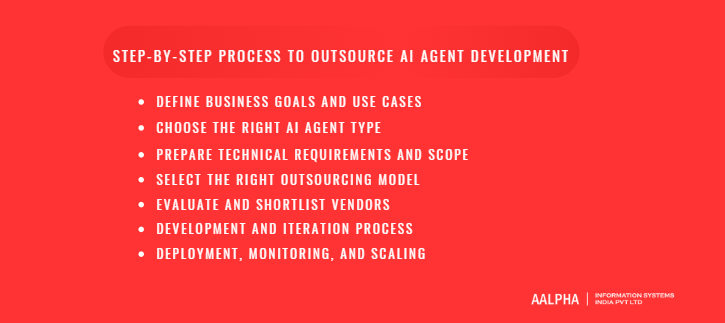
Step-by-Step Process to Outsource AI Agent Development
Outsourcing AI agent development is most effective when approached as a structured, outcome-driven process rather than a one-time vendor selection. Businesses often ask how to move from an idea to a fully operational AI agent without losing control over quality, cost, or timelines. The answer lies in breaking the process into clearly defined steps that align business objectives with technical execution. Each stage plays a critical role in ensuring that the final system is not only functional but also scalable, reliable, and aligned with real-world use cases.
-
Define Business Goals and Use Cases
The foundation of any successful AI agent project is a clear understanding of business goals and use cases. Many projects fail not because of technical limitations, but because the problem being solved is not well defined. Before engaging with any external partner, businesses must identify exactly what they want the AI agent to achieve.
This starts with mapping workflows that are repetitive, time-consuming, or prone to human error. For example, customer support ticket handling, lead qualification, appointment scheduling, or order processing are common candidates. The key question to ask is not whether AI can be used, but where automation will create measurable impact.
Once workflows are identified, measurable outcomes must be defined. These could include reducing response time, lowering operational costs, increasing conversion rates, or improving accuracy. Clear metrics provide a benchmark for evaluating success and ensure that both the business and the outsourcing partner are aligned on expectations.
It is also important to prioritize use cases. Instead of attempting to automate everything at once, businesses should start with a focused problem that can deliver quick wins. This approach reduces complexity, shortens development timelines, and allows for iterative improvement based on real-world feedback.
-
Choose the Right AI Agent Type
Selecting the appropriate type of AI agent is a critical decision that directly impacts system design and performance. Broadly, AI agents can be categorized into task-based agents and autonomous agents, each suited for different levels of complexity.
Task-based agents are designed to perform specific, well-defined functions. They follow structured workflows and operate within clear boundaries. For example, a customer support agent that answers FAQs or a scheduling assistant that books appointments falls into this category. These agents are easier to build, test, and deploy, making them ideal for initial implementations.
Autonomous agents, on the other hand, are capable of handling more complex, multi-step tasks with minimal human intervention. They can make decisions, adapt to changing inputs, and coordinate multiple systems. For instance, an operations agent that manages end-to-end order processing or a sales agent that handles lead nurturing across multiple touchpoints would require a higher level of autonomy.
The choice between these types depends on the complexity of the use case and the level of control required. Many businesses begin with task-based agents and gradually evolve toward more autonomous systems as they gain confidence and experience with AI-driven workflows.
-
Prepare Technical Requirements and Scope
Once the use case and agent type are defined, the next step is to translate business needs into detailed technical requirements. This is one of the most important phases in the outsourcing process, as it sets the foundation for development and prevents scope misalignment later.
Technical requirements should include a clear description of features and functionalities. This involves defining what the AI agent should do, how it should interact with users, and what outcomes it should produce. For example, a support agent may need to handle multi-turn conversations, access a knowledge base, and escalate complex issues to human agents.
Integrations are another critical component. The AI agent must connect with existing systems such as CRMs, databases, payment gateways, or internal tools. Each integration should be clearly specified, including data flow, access permissions, and expected actions.
Data requirements must also be outlined. AI agents rely on data for training, context, and decision-making. Businesses need to identify what data will be used, how it will be accessed, and how it will be secured. This includes defining data formats, storage mechanisms, and privacy considerations.
A well-defined scope document ensures that both parties have a shared understanding of the project. It reduces ambiguity, prevents unnecessary revisions, and provides a reference point throughout the development lifecycle.
-
Select the Right Outsourcing Model
Choosing the right outsourcing model is essential for balancing cost, control, and collaboration. Businesses typically have three primary options: freelancers, agencies, and dedicated teams.
Freelancers are suitable for small, well-defined projects with limited scope. They offer flexibility and lower costs but may lack the resources to handle complex, multi-layered AI systems. Managing multiple freelancers can also introduce coordination challenges.
Agencies provide a more structured approach. They offer end-to-end services, including design, development, testing, and deployment. Agencies often have teams with diverse expertise, making them well-suited for complex projects. They also bring established processes and quality standards, reducing execution risk.
Dedicated teams model act as an extension of your internal workforce. This model is ideal for long-term projects or businesses that require continuous development and support. It offers greater control and alignment with business goals but requires more involvement in management and coordination.
The choice depends on project complexity, timeline, and budget. For most AI agent projects, agencies or dedicated teams provide the best balance of expertise and reliability.
-
Evaluate and Shortlist Vendors
Selecting the right outsourcing partner is one of the most critical decisions in the entire process. Businesses should not rely solely on cost when evaluating vendors. Instead, the focus should be on expertise, experience, and the ability to deliver production-ready solutions.
A vendor’s portfolio provides insight into their capabilities. Reviewing past projects helps assess whether they have experience building similar AI systems. Case studies are particularly valuable, as they demonstrate how the vendor has solved real-world problems and delivered measurable results.
Technical expertise is another key factor. Vendors should have a strong understanding of AI models, system architecture, integrations, and scalability. They should also be able to explain their approach clearly, including how they handle challenges such as data management, performance optimization, and error handling.
Communication and transparency are equally important. A reliable vendor should provide clear timelines, regular updates, and structured workflows. Businesses should also assess how responsive the vendor is during the evaluation phase, as this often reflects how they will operate during the project.
Shortlisting should involve comparing multiple vendors, conducting interviews, and, if possible, starting with a small pilot project to validate capabilities before committing to a larger engagement.
-
Development and Iteration Process
AI agent development is inherently iterative. Unlike traditional software, where requirements are fixed, AI systems evolve based on data, user interactions, and performance feedback. This makes an MVP-first approach essential.
The development process typically begins with building a minimum viable agent that addresses the core use case. This version focuses on essential functionality rather than complete feature coverage. The goal is to deploy quickly, test in real-world conditions, and gather feedback.
Testing plays a crucial role in this phase. The AI agent must be evaluated for accuracy, reliability, and user experience. This includes handling edge cases, ensuring correct responses, and validating integrations. Feedback from users and stakeholders helps identify gaps and areas for improvement.
Iteration involves refining the system based on this feedback. This may include adjusting prompts, improving workflows, adding new features, or optimizing performance. Continuous iteration ensures that the AI agent becomes more effective over time and aligns closely with business needs.
A structured development and iteration process reduces risk and ensures that the final system is both functional and adaptable.
-
Deployment, Monitoring, and Scaling
Deployment marks the transition from development to real-world operation, but it is not the end of the process. Once the AI agent is live, continuous monitoring is essential to ensure consistent performance.
Performance tracking involves measuring key metrics such as response accuracy, task completion rates, latency, and user satisfaction. These metrics provide insights into how well the system is functioning and where improvements are needed.
Monitoring also helps identify issues early. AI agents can encounter unexpected inputs or edge cases that were not covered during testing. Having systems in place to detect and address these issues ensures reliability and minimizes disruptions.
Scaling becomes relevant as usage grows. The AI agent must handle increased volume, support additional features, and integrate with more systems. A scalable architecture allows the system to expand without compromising performance.
Continuous improvement is a defining characteristic of successful AI implementations. Businesses that treat AI agents as evolving systems rather than static tools are better positioned to maximize long-term value.
Cost of Outsourcing AI Agent Development
The cost of outsourcing AI agent development varies significantly based on complexity, features, integrations, and the geographic location of the development team. Businesses often ask for a fixed price, but AI projects are rarely one-size-fits-all. Instead, costs are best understood as a range influenced by technical scope and long-term requirements. A well-planned budget not only covers initial development but also accounts for scaling, maintenance, and ongoing usage.
Understanding cost drivers helps decision-makers avoid underestimating investment and ensures that the AI agent delivers measurable returns rather than becoming an experimental expense.
-
Cost Based on Complexity
The complexity of the AI agent is the most significant factor influencing cost. At a basic level, simple AI agents are designed for narrowly defined tasks. These may include answering frequently asked questions, booking appointments, or handling basic customer queries. Such agents typically rely on pre-trained language models with minimal customization and limited integrations. Simple AI agents development costs can range from $5,000 to $15,000, depending on the level of refinement and testing required.
Mid-level AI agents introduce more advanced capabilities, such as multi-step workflows, contextual memory, and integration with business systems. For example, a sales agent that qualifies leads, updates a CRM, and sends automated follow-ups falls into this category. These systems require more sophisticated architecture and testing, with costs typically ranging from $15,000 to $40,000.
Advanced AI agents are highly autonomous and capable of handling complex, end-to-end processes. They may involve multiple integrations, real-time decision-making, and continuous learning mechanisms. Examples include operations agents managing supply chains or healthcare assistants handling patient workflows. These systems require significant engineering effort, and costs can range from $40,000 to $100,000 or more.
The key consideration is aligning complexity with business value. Overbuilding an AI agent can lead to unnecessary costs, while underbuilding may limit its effectiveness.
-
Cost Based on Features and Integrations
Beyond complexity, the specific features and integrations required also have a major impact on cost. AI agents rarely operate in isolation. They interact with existing systems such as CRMs, ERPs, databases, payment gateways, and third-party APIs. Each integration adds development effort, testing requirements, and potential maintenance overhead.
For example, integrating an AI agent with a CRM system involves not only connecting APIs but also mapping data structures, handling edge cases, and ensuring synchronization across systems. Similarly, integrating with automation platforms or internal tools requires careful design to maintain reliability and performance.
Advanced features such as memory systems, personalization, multi-language support, and real-time analytics further increase complexity. A conversational agent that remembers past interactions and adapts responses accordingly requires additional infrastructure, such as vector databases and retrieval mechanisms.
User interface requirements can also influence cost. Deploying AI agents across multiple channels such as web, mobile apps, and messaging platforms adds layers of development and testing.
In general, the more systems an AI agent interacts with and the more features it includes, the higher the overall cost. Businesses should prioritize essential features during initial development and expand functionality gradually to manage budgets effectively.
-
Hourly Rates by Region
The geographic location of the outsourcing partner plays a significant role in determining overall cost. Hourly rates for AI development vary widely across regions, reflecting differences in labor costs, expertise availability, and market demand.
In the United States, AI developers typically charge between $100 and $200 per hour. These teams often bring strong expertise and proximity advantages but come at a premium cost. Western Europe has similar pricing, with rates ranging from $80 to $150 per hour, depending on the country and level of specialization.
Eastern Europe offers a balance between cost and quality, with hourly rates typically ranging from $40 to $100 per hour. Many companies choose this region for its strong technical talent and relatively lower costs compared to Western markets.
India and other parts of Asia provide some of the most cost-effective options, with rates ranging from $25 to $75 per hour. Despite lower costs, many development firms in these regions have significant experience in AI and software development, making them a popular choice for outsourcing.
While cost differences are important, businesses should not base decisions solely on hourly rates. The overall value depends on expertise, communication, and the ability to deliver reliable solutions.
-
Hidden Costs to Consider
In addition to development costs, businesses must account for ongoing expenses that are often overlooked during initial planning. Maintenance is a key factor, as AI agents require continuous updates, monitoring, and optimization to remain effective.
API usage costs can also add up, especially when using large language models or third-party services that charge based on usage. As the AI agent scales and handles more interactions, these costs can increase significantly.
Infrastructure and scaling costs should also be considered. Hosting, data storage, and system performance optimization all contribute to long-term expenses. Without proper planning, these costs can exceed initial expectations.
A realistic budget includes both upfront development and ongoing operational costs, ensuring that the AI agent remains sustainable and delivers long-term value.
How to Choose the Right AI Agent Development Partner
Selecting the right AI agent development company is one of the most critical decisions in your outsourcing journey. Many businesses underestimate this step and focus primarily on cost, only to face delays, poor performance, or systems that fail to scale. AI agent development is not just about writing code. It involves designing intelligent workflows, integrating multiple systems, and ensuring that the solution performs reliably in real-world conditions.
Decision-makers often ask how to identify a partner who can deliver both technical excellence and business alignment. The answer lies in evaluating a combination of experience, technical depth, process maturity, security awareness, and proven results. A strong partner will not only build the system but also guide strategic decisions and help avoid common pitfalls.
-
Experience in AI and Automation Projects
Experience is one of the most reliable indicators of a partner’s ability to deliver successful AI development solutions. AI agent development involves challenges that are not always visible at the planning stage, such as handling ambiguous inputs, managing system latency, and ensuring consistent performance across different scenarios. A partner with prior experience in AI and automation projects is more likely to anticipate these challenges and address them effectively.
Businesses should look for partners who have worked on real-world use cases rather than experimental prototypes. Experience across industries is also valuable, as it demonstrates adaptability and a broader understanding of how AI agents can be applied in different contexts. For example, a team that has built customer support agents, sales automation systems, and workflow automation tools will bring practical insights that can improve your project outcomes.
An experienced partner also understands how to align AI capabilities with business objectives. Instead of focusing purely on technology, they can help identify the most impactful use cases and design solutions that deliver measurable results.
-
Technical Expertise in LLMs and Integrations
AI agent development requires deep technical expertise across multiple domains. At the core are large language models, which power the reasoning and decision-making capabilities of the agent. A strong partner should have hands-on experience working with these models, including prompt design, fine-tuning strategies, and performance optimization.
Equally important is expertise in integrations. AI agents rarely operate in isolation. They must connect with existing systems such as CRMs, databases, payment gateways, and internal tools. The ability to design and implement reliable integrations is essential for ensuring that the agent can perform real business functions.
Technical expertise also extends to system architecture. The partner should be capable of designing scalable, modular systems that can handle growth and evolving requirements. This includes managing memory systems, handling data flows, and ensuring efficient communication between components.
When evaluating technical capability, businesses should look beyond surface-level claims. Detailed discussions about architecture, workflows, and problem-solving approaches provide a clearer picture of the partner’s expertise.
-
Transparent Development Process
A transparent development process is critical for maintaining control over the project and ensuring alignment between business and technical teams. AI projects involve continuous iteration, which makes visibility into progress essential.
A reliable partner should follow structured methodologies, typically based on agile development principles. This includes breaking the project into phases, defining milestones, and providing regular updates. Businesses should have clear visibility into what is being developed, tested, and deployed at each stage.
Documentation is another key aspect of transparency. Requirements, system architecture, and workflows should be clearly documented and shared. This not only improves collaboration but also ensures that the business retains knowledge of the system, reducing dependency on the vendor.
Regular communication is equally important. Scheduled meetings, progress reports, and feedback loops help identify issues early and keep the project on track. A transparent process builds trust and reduces the risk of misalignment or unexpected outcomes.
-
Security and Compliance Capabilities
Security is a fundamental consideration when outsourcing AI agent development. AI systems often handle sensitive data, including customer information, business processes, and proprietary knowledge. Any weakness in security can lead to serious consequences, including data breaches and regulatory violations.
A competent partner should follow industry-standard security practices, such as data encryption, secure access controls, and compliance with relevant regulations. They should also be able to explain how data is stored, processed, and protected throughout the system.
Compliance requirements vary by industry, and the partner should be familiar with the standards applicable to your business. Whether it involves healthcare regulations, financial data protection, or general privacy laws, the partner must demonstrate a clear understanding of compliance obligations.
Security should not be treated as an afterthought. It must be integrated into the development process from the beginning to ensure that the AI agent operates safely and reliably.
-
Client Reviews and Case Studies
Client reviews and case studies provide tangible evidence of a partner’s capabilities. While marketing claims can highlight strengths, real-world results offer a more accurate assessment of performance.
Case studies are particularly valuable because they demonstrate how the partner has solved specific business problems. They often include details about the challenges faced, the approach taken, and the outcomes achieved. This helps businesses understand whether the partner can deliver similar results in their own context.
Client reviews add another layer of insight, especially regarding communication, reliability, and overall experience. Consistent positive feedback indicates a strong track record, while recurring issues in reviews may signal potential risks.
Businesses should look for partners who can demonstrate both technical success and client satisfaction. Experienced providers such as Aalpha, for example, position their services around delivering tailored AI solutions aligned with business goals, supported by real project outcomes and long-term client relationships.
Choosing the right partner requires careful evaluation, but investing time in this process significantly increases the likelihood of building a successful and scalable AI agent system.
Future Trends in AI Agent Outsourcing
AI agent outsourcing is evolving rapidly as businesses move from experimenting with automation to embedding AI deeply into core operations. The next phase is not just about deploying isolated agents, but about building intelligent ecosystems that can operate independently, collaborate across systems, and deliver measurable business outcomes. Decision-makers increasingly ask what the future of AI agents looks like and how outsourcing models will adapt to support this shift. Several key trends are shaping the direction of AI agent development and outsourcing in the coming years.
-
Autonomous AI Agents
Autonomous AI agents represent the next level of sophistication in automation. Unlike task-based agents that operate within predefined workflows, autonomous agents can make decisions, plan actions, and execute multi-step processes with minimal human intervention. They are designed to handle complex scenarios where inputs are dynamic and outcomes are not strictly predefined.
For example, an autonomous operations agent could manage supply chain workflows by analyzing demand, coordinating with vendors, adjusting inventory levels, and responding to disruptions in real time. Similarly, a sales agent could manage the entire lead lifecycle, from initial engagement to conversion, without constant oversight.
Outsourcing will play a critical role in enabling businesses to adopt these systems. Building autonomous agents requires advanced expertise in system design, reasoning frameworks, and continuous learning mechanisms. External partners with experience in these areas will be essential for designing systems that are both powerful and reliable. As autonomy increases, the focus will shift toward ensuring control, transparency, and accountability in decision-making.
-
Multi-Agent Systems
Multi-agent systems are emerging as a powerful approach to handling complex workflows that cannot be managed by a single agent. Instead of relying on one system to perform all tasks, multiple specialized agents collaborate, each responsible for a specific function. These agents communicate with each other, share information, and coordinate actions to achieve a common goal.
For instance, in a customer service environment, one agent may handle initial inquiries, another may process transactions, and a third may manage escalations. In operations, different agents may handle inventory, logistics, and reporting, working together to streamline processes.
This distributed approach improves scalability and flexibility. It allows businesses to design modular systems where individual agents can be updated or replaced without affecting the entire workflow. Outsourcing partners are increasingly focusing on building these interconnected systems, as they require advanced orchestration and integration capabilities.
As multi-agent architectures become more common, businesses will need partners who can design and manage these ecosystems effectively, ensuring seamless communication and coordination between agents.
-
AI Agents as a Service (AIaaS)
AI Agents as a Service is transforming how businesses access and deploy AI capabilities. Instead of building custom systems from scratch, companies can subscribe to AI agent solutions that are pre-built, configurable, and ready to deploy. This model reduces upfront costs and accelerates adoption, making AI more accessible to small and mid-sized businesses.
AIaaS platforms typically offer modular agents for common use cases such as customer support, sales automation, and workflow management. Businesses can customize these agents to fit their needs while relying on the provider for maintenance, updates, and infrastructure management.
Outsourcing in this context shifts from project-based development to ongoing service partnerships. Vendors are no longer just developers but service providers responsible for delivering continuous value. This model also enables faster iteration, as improvements can be rolled out across multiple clients simultaneously.
For decision-makers evaluating how to adopt AI without significant upfront investment, AIaaS provides a scalable and flexible alternative to traditional development approaches.
-
Industry-Specific AI Agents
As AI adoption matures, there is a growing shift toward industry-specific agents designed to address domain-specific challenges. Generic AI solutions often lack the depth required to handle specialized workflows, regulatory requirements, and data complexities unique to certain industries.
For example, healthcare AI agents must comply with strict privacy regulations and handle sensitive patient data. Financial agents need to manage risk, ensure compliance, and process transactions securely. In retail and logistics, agents must integrate with supply chain systems and handle real-time data flows.
Outsourcing partners are increasingly developing domain-focused expertise to meet these needs. Instead of offering generic solutions, they provide tailored agents built around industry standards, best practices, and regulatory frameworks.
This trend is particularly important for businesses seeking competitive advantage. Industry-specific AI agents can deliver higher accuracy, better user experience, and stronger alignment with business processes. As a result, the future of AI outsourcing will be defined not just by technical capability but by deep domain knowledge and specialization.
Final Words
Outsourcing AI agent development is no longer just a cost decision. It is a strategic move to automate operations, improve efficiency, and stay competitive in a rapidly evolving digital environment. Businesses that act early gain a clear advantage by deploying intelligent systems that reduce manual work, enhance customer experience, and scale without increasing overhead.
If you are planning to implement AI agents, start with a focused use case, define clear outcomes, and partner with an experienced development team that understands both technology and business needs. The right partner will help you move from idea to execution faster, with fewer risks and better results.
If you are looking to build reliable, scalable AI agents tailored to your business, working with experienced providers like Aalpha can help you accelerate development and achieve measurable impact.