






TL;DR:
Offshore SaaS development means hiring a development team in another country, usually India, Eastern Europe, or Latin America, to design, build, and maintain a software-as-a-service product, often at a lower cost and with faster access to senior engineers than hiring in-house. The model works best when requirements are documented well enough to hand off and worst when a founder is still discovering the product through daily conversations with a co-located team. Getting it right depends more on engagement structure, vendor evaluation, and multi-tenancy architecture than on which country a team sits in. Aalpha Information Systems, an ISO 9001:2015 certified software development company operating since 2008, has delivered SaaS builds across 55+ countries and holds a 4.9 out of 5 rating across 215+ verified Clutch reviews.
What offshore SaaS development actually means
Offshore SaaS development is the practice of hiring a development team based in a different country, usually one with a significant time zone gap and a lower cost base, to design, build, and maintain a software-as-a-service product. The offshore team might own the entire build from architecture to deployment, or it might sit alongside an in-house product manager who handles requirements and roadmap while the offshore engineers write the code.
That definition sounds close to generic IT outsourcing, and the two overlap, but SaaS changes what the engagement actually requires. A one-off internal tool gets built, deployed, and mostly left alone. A SaaS product gets built, then rebuilt every quarter as new tenants sign up, new billing tiers get added, and the infrastructure has to hold under load it didn’t have six months earlier. An offshore team building a SaaS product needs to think in terms of migrations, backward compatibility, and multi-tenant data isolation from the first sprint, because whatever they ship in month one is going to be running in production with paying customers on it for years.
The distinction matters when you’re evaluating vendors. A shop that has built forty marketing websites and six SaaS products is going to make different architectural decisions than one where SaaS is half the portfolio. Ask specifically about SaaS experience, not just “software development experience.” The two are not interchangeable.
Offshore, nearshore, onshore, and hybrid
Offshore usually means a six-hour-plus time zone gap and full cultural and geographic distance. A US company hiring a team in India or Vietnam is offshore. Nearshore means a smaller time zone gap, often two to four hours, with a partner in a nearby region. A US company hiring in Mexico or Colombia is nearshoring. Onshore keeps everything domestic, at domestic rates. Hybrid models mix a small onshore core team, usually product and design, with an offshore engineering team doing the bulk of implementation.
None of these is universally correct. Nearshore buys you overlapping working hours at a smaller discount than offshore. Offshore buys you the largest cost gap and access to specific talent pools, at the cost of less overlap and more asynchronous communication. Hybrid tries to get the best of both by keeping product decisions close to the business and pushing implementation to wherever it’s cheapest to do well. The right choice depends more on how much daily back-and-forth your product decisions require than on the raw hourly rate difference.
Why SaaS specifically gets built offshore
SaaS companies, more than most software businesses, run on continuous engineering spend. There’s no “done.” A SaaS product needs a dev team for as long as it exists, which means the cost of that team compounds every year in a way a single project’s cost doesn’t. A company that builds an internal CRM once and maintains it lightly afterward doesn’t feel the same pressure as a SaaS founder paying six US-based senior engineers USD 150,000 to USD 200,000 each, every year, for the life of the company.
That ongoing cost pressure, combined with the fact that SaaS architecture (multi-tenancy, subscription billing, usage metering, API-first design) is now a well-understood pattern that offshore teams in India and Eastern Europe have built dozens of times, is why offshore development has become the default rather than the exception for early and mid-stage SaaS companies. Venture-backed startups do it to extend runway. Bootstrapped founders do it because there’s no other way to afford a full engineering team. Enterprise SaaS divisions do it because their in-house teams are fully allocated to the core product and a second product line needs a separate team without doubling headcount.
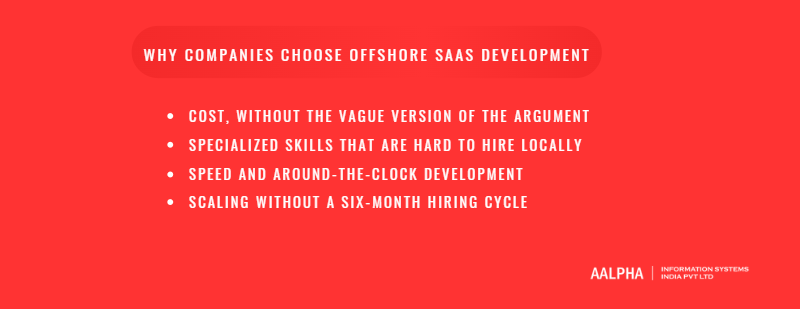
Why companies choose offshore SaaS development
-
Cost, without the vague version of the argument
The honest cost comparison isn’t “offshore is cheaper,” it’s a specific multiple. A senior full-stack engineer in San Francisco or New York costs USD 160,000 to USD 220,000 in salary alone, before benefits, payroll tax, and equipment, which typically adds another 25 to 35 percent. The same seniority level in Bangalore, Pune, or Hyderabad runs USD 25,000 to USD 45,000 annually through an established agency, and that figure already includes the agency’s overhead and margin. In Eastern Europe (Poland, Romania, Ukraine), the range is closer to USD 40,000 to USD 65,000. Latin America sits between the two, with Argentina and Colombia rates in the USD 35,000 to USD 55,000 band.
Those numbers mean a five-person offshore engineering team in India costs roughly what one and a half senior engineers cost in the US. That gap is the entire economic argument, and it’s real, but it’s not free money. Coordination overhead, time zone friction, and the learning curve of working with a new team eat into it. A realistic planning assumption is that offshore development delivers 50 to 65 percent of the cost savings the raw rate comparison suggests, once you account for the additional project management time and the inevitable early-stage miscommunication that costs a sprint or two.
-
Specialized skills that are hard to hire locally
Multi-tenant SaaS architecture, Kubernetes-based deployment pipelines, usage-based billing integrations with Stripe or Chargebee, and AI feature integration are all skill sets that are in short supply everywhere, but the supply is deeper in offshore hubs simply because more engineers there have built these systems repeatedly across client work. An agency that has shipped fifteen multi-tenant SaaS products has engineers who’ve already made the mistakes around tenant data isolation and connection pooling that a first-time in-house team is about to make on your dime.
-
Speed and around-the-clock development
A twelve-hour time zone gap, handled well, turns into a genuine speed advantage: the offshore team works while the domestic team sleeps, so a bug reported at 6pm US time can be fixed by the time the US team logs in the next morning. Handled poorly, the same gap becomes the single biggest source of frustration in the relationship, because every clarifying question costs a full day if it’s not asked in the right sixty-minute overlap window. The speed advantage is conditional on process discipline, not automatic.
The practical way this plays out on a well-run engagement: the offshore team ends its day with a written summary of what shipped, what’s blocked, and what decisions are needed, timed to land in the client’s inbox at the start of their morning. The client reviews and responds within their own working hours, and that response is waiting for the offshore team when their next day starts. Done consistently, this turns the time zone gap from a liability into something close to a second shift, without either side actually working extended hours. Done inconsistently, with updates that arrive late or decisions that sit unanswered for two or three days, the same gap adds a week to a timeline that should have taken three days.
-
Scaling without a six-month hiring cycle
Hiring a senior engineer domestically now regularly takes ten to sixteen weeks from job posting to start date, and that’s assuming the role is filled on the first attempt. An established offshore agency can add two or three engineers to an existing project within two to three weeks, because the hiring, onboarding, and management infrastructure already exists. For a SaaS company that just closed a funding round or landed a large contract, that difference between three weeks and three months is often the actual reason offshore gets chosen over building an in-house team from scratch.
Engagement and pricing models
The commercial structure of the engagement matters as much as the country you’re hiring from. Three engagement models cover most offshore SaaS work, and picking the wrong one for your stage is a common, avoidable mistake.
Fixed price, time and materials, dedicated team, and staff augmentation
Fixed price works when the scope is genuinely fixed: a defined feature set, a defined timeline, a defined budget, with change requests handled through a formal amendment process. It suits well-specified MVPs and vendor migrations where the target state is known in advance. It suits badly anything where the product is still being figured out, because every fixed-price contract has an implicit incentive for the vendor to interpret ambiguity in the direction that costs them less, and for the client to interpret it the other way. That tension shows up in change-order disputes more than any other engagement type.
Time and materials bills for actual hours worked against an agreed rate card. It fits ongoing SaaS development well, because a live product’s roadmap changes every sprint based on user feedback, and a fixed-price contract can’t absorb that without constant renegotiation. The tradeoff is that T&M requires more client-side oversight, since there’s less structural pressure on the vendor to work efficiently. A good vendor mitigates this with sprint-based reporting and a fixed velocity commitment even inside a T&M contract.
Dedicated team model puts a fixed group of engineers on retainer, working exclusively on your product under your direction, for a monthly fee. This is the closest structure to an in-house team without the in-house hiring and HR burden, and it’s what most funded SaaS companies land on after an initial MVP phase, once the product has found a direction and needs sustained, focused engineering capacity rather than a one-time build.
Staff augmentation, a fourth variant worth naming separately, adds individual offshore engineers into an existing team structure managed by the client’s own engineering leadership. It suits companies that already have a functioning in-house process and just need more hands, rather than companies looking for a vendor to own delivery.
For an MVP with a defined scope, fixed price or a short time and materials sprint keeps risk contained. For a live product with an evolving roadmap, dedicated team or ongoing time and materials is the more honest fit. Staff augmentation makes sense only when the in-house engineering leadership genuinely has capacity to manage additional people, which is less common than founders assume when they’re already stretched thin.
Hybrid structures and negotiating the contract
A hybrid structure worth naming separately: fixed price for discovery and architecture, followed by a dedicated team or time and materials arrangement for build and ongoing iteration. This splits the two phases that actually have different risk profiles. Discovery has a defined, boundable scope (a document, a set of diagrams, a technical decision record) and fixed price suits it well. Build and iteration don’t have a defined endpoint for a live SaaS product, and forcing them into a fixed-price frame just relocates the risk into disputes over what counts as in-scope. Several of the more experienced offshore vendors default to this structure without being asked, which is itself a useful signal during vendor evaluation.
Negotiating the contract is worth doing carefully rather than accepting a vendor’s standard template unread. Payment milestones tied to working, demoed software rather than calendar dates give the client real leverage if delivery slips. A cap on how much scope can shift under a single change request before it requires a new agreement protects against slow scope creep that never triggers a single obvious renegotiation point. And a termination clause with a defined notice period, typically thirty days, that includes handover of all code, credentials, and documentation, protects against the worst outcome in any vendor relationship: a founder who wants to leave but can’t get their own product out of a vendor’s hands cleanly.
Typical monthly rates by region
Typical monthly cost for a dedicated team of four to six engineers in India runs USD 12,000 to USD 28,000 depending on seniority mix. The same team structure in Eastern Europe runs USD 20,000 to USD 40,000. Southeast Asia (Vietnam, Philippines) tends to undercut India slightly on rate but with a smaller pool of engineers who’ve specifically built SaaS products before, which matters more for architecture-heavy early work than for later feature development.
The core phases of an offshore SaaS build
-
Discovery and requirement scoping
This phase decides whether the rest of the project goes smoothly or badly, and it’s the phase most founders want to rush through. A competent discovery phase for a SaaS product produces a written scope document covering the core user flows, the multi-tenancy model (shared database with tenant IDs, schema-per-tenant, or fully isolated databases), the subscription and billing structure, and the integrations the product depends on. It should take two to four weeks for a mid-complexity SaaS product and cost somewhere between USD 2,000 and USD 8,000 if billed separately, or be folded into the first sprint if the vendor works that way.
Skipping this phase to save two weeks is the single most common cause of SaaS projects that run 40 percent over budget. The cost of a wrong architectural decision made in week one and discovered in month four is an order of magnitude higher than the cost of the discovery phase that would have caught it.
A good discovery phase also produces something founders rarely ask for but always end up needing: a prioritized backlog split between what has to exist for the first paying customer and what can wait. Founders who skip this step tend to describe their MVP as everything they can imagine the product eventually needing, which quietly turns a ten-week build into a five-month one without anyone deciding that on purpose. An offshore team experienced in SaaS discovery will push back on scope during this phase, not just take dictation. That pushback is a good sign, not friction to route around. A vendor who agrees to everything in the first scoping call either hasn’t understood the request yet or isn’t planning to hold the line on it later, and both are worth noticing before a contract is signed.
Discovery should also produce a rough data model, even in sketch form, before a single line of production code gets written. For a multi-tenant SaaS product, the shape of that data model determines how hard every future feature is to build. A tenant relationship modeled correctly from day one costs nothing extra. The same relationship retrofitted after six months of production data exists is a migration project in its own right, often a multi-week one that delivers no new customer-facing value and exists purely to undo an earlier shortcut.
-
Architecture and tech stack selection
Multi-tenancy gets decided here, and it’s a decision that’s expensive to reverse. Shared database with a tenant ID column is the cheapest to build and operate and works fine until a customer asks about data isolation guarantees for compliance reasons, at which point it becomes a liability. Schema-per-tenant gives cleaner isolation at moderate operational cost. Fully separate databases per tenant give the strongest isolation and the highest operational overhead, and it’s usually overkill until you have enterprise customers explicitly requiring it in their security review.
Cloud infrastructure choice (AWS, GCP, Azure) usually follows from where the founding team already has credits or experience, and any of the three is a reasonable choice for a SaaS product; there’s rarely a technical reason to prefer one strongly over another at MVP stage. Backend framework choice (Node.js, Django, Laravel, Ruby on Rails, Go) should be driven by what the offshore team’s engineers are actually strong in, not by whatever is trending. A team of five engineers who’ve built twelve Rails-based SaaS products will move faster and make fewer mistakes than the same team forced onto a framework they’re learning on your project.
API design gets decided in this phase too, and it deserves more attention than it usually gets at MVP stage. A SaaS product built API-first, with the web dashboard consuming the same API a future mobile app or third-party integration would use, costs a little more to build up front and saves a full rebuild later when a customer asks for programmatic access or a partner wants to integrate. A product built with business logic scattered directly into web controllers, with no clean API boundary, works fine right up until the first integration request arrives, at which point it becomes a significant refactor rather than an additive feature.
Authentication architecture is worth a specific decision rather than a default. Rolling custom auth is reasonable for a simple product with straightforward login requirements. Anything involving single sign-on, social login, or eventual enterprise SSO (SAML, OIDC) is usually better served by an established identity provider (Auth0, Clerk, AWS Cognito) from the start, because building SSO support into a custom auth system after launch is one of the more painful retrofits in SaaS development, involving session handling, token refresh, and edge cases around account linking that are easy to underestimate.
-
MVP development
This is the phase most people picture when they think “offshore development,” and it typically runs eight to sixteen weeks depending on scope. The core discipline that separates good offshore MVP delivery from bad is sprint cadence with visible, working software at the end of every sprint, not a single large deliverable at the end of the engagement. A vendor who can only show you progress at the three-month mark has structured the engagement in a way that hides problems until they’re expensive to fix.
Two-week sprints are the standard cadence for a reason: short enough that a misunderstanding gets caught within days rather than weeks, long enough that the team isn’t spending more time in planning meetings than building. Each sprint should end with a demo of working software, not a status report describing work that exists only as a description. If a sprint review consistently amounts to “we’re on track, trust us,” that’s worth raising directly rather than letting it continue for another sprint on the assumption it will self-correct.
Staffing during this phase matters more than founders often realize when comparing vendor quotes. A quote built around two senior engineers moves differently than the same quote built around one senior engineer and three juniors, even at an identical total cost, because architectural decisions made by junior engineers without close senior review tend to surface as technical debt later rather than as an obvious problem now. Ask for the specific seniority breakdown of the team assigned to your project, not just a total headcount and blended rate.
-
QA and security testing
SaaS products carry a specific security surface that generic web apps don’t: tenant data isolation has to be tested explicitly, not assumed to work because the code looks right. A dedicated QA pass should include tests that attempt to access one tenant’s data from another tenant’s session, verify that API rate limiting actually triggers, and confirm that the billing integration handles failed payments, downgrades, and cancellations correctly, not just the happy path of a successful subscription.
Automated testing coverage is worth specifying in the contract rather than leaving to the vendor’s discretion, particularly for the parts of a SaaS product that are expensive to get wrong in production: authentication, billing, and tenant isolation logic. A vendor who writes tests only for the features that are easy to test, while leaving the genuinely risky logic uncovered, has technically delivered “testing” without delivering the protection testing is supposed to provide. Asking to see the test suite, not just hear that one exists, is a reasonable request at any milestone review.
Load testing before launch is skipped more often than it should be, usually because it doesn’t feel urgent when the product has zero users. A basic load test that simulates a few hundred concurrent sessions catches connection pool exhaustion, N+1 query problems, and memory leaks that won’t show up in a five-person QA team’s manual testing but will show up in production the week a product gets featured somewhere and traffic spikes without warning.
-
Deployment and DevOps setup
CI/CD pipeline, staging environment, monitoring and alerting, and a documented rollback procedure are the baseline, not extras. A SaaS product without a tested rollback procedure is one bad deploy away from a multi-hour outage that a five-minute rollback would have prevented. This is worth confirming explicitly with any offshore vendor before signing: ask to see their standard deployment checklist, not just hear that they “follow best practices.”
-
Post-launch support and iteration
The build doesn’t end at launch for a SaaS product, it starts a new phase. Bug fixes, performance tuning under real load, and the first round of features driven by actual user behavior all happen here. This is where the dedicated team or time and materials model earns its keep over fixed price, because the roadmap for this phase genuinely can’t be written in advance.
Choosing the right offshore development partner
-
Technical evaluation
Ask for SaaS-specific portfolio examples, not general software examples. A team that shows you five e-commerce sites and one SaaS product has one SaaS product’s worth of relevant experience, regardless of how many total projects they list. Ask what multi-tenancy model they used on their last three SaaS builds and why, and listen for whether the answer is specific to the client’s requirements or a copy-paste explanation they’d give for any project. Ask to speak directly with the engineers who would work on your project, not only the sales or account management contact. A vendor confident in their team will make this easy; one that resists is telling you something.
-
Communication and process signals
Watch how quickly and specifically a vendor responds during the sales process, because that’s close to the best predictor of how they’ll communicate once you’re a signed client and no longer the thing that determines whether they hit their quarterly target. A vendor who takes three days to answer a scoping question during evaluation will not suddenly become responsive after the contract is signed. Ask about their standard reporting cadence (daily standups, weekly demos, sprint reviews) and get it in writing as part of the contract, not as a verbal assurance.
-
Contracts, IP ownership, and NDAs
Confirm in writing that all code, designs, and documentation produced under the contract are your IP, assigned on creation or on payment, not licensed. This should be unambiguous in any serious contract and its absence is a hard red flag. An NDA should be signed before any detailed discussion of your product, and it’s reasonable to ask the vendor to sign yours rather than only offering their own template. For anything sensitive, get a mutual NDA with a defined term (two to five years is standard) reviewed by counsel before sharing proprietary detail.
-
Questions worth asking directly before signing
What percentage of your current engineers have built a multi-tenant SaaS product before. What’s your process when a sprint runs over. Can I talk to a current or recent client by phone, not just read a written testimonial. What happens to my access and my code if we terminate the contract with thirty days’ notice. How do you handle a security incident, and what’s your actual (not aspirational) response time.
Why Aalpha fits this criteria
Aalpha Information Systems has been building software since 2008, with SaaS product development as a core, not incidental, part of that eighteen-year history. As a SaaS development company, its experience includes over 5,500 completed projects across 55+ countries, an ISO 9001:2015 certification for its development process, and a 4.9 out of 5 rating across 215+ verified reviews on Clutch, the independent B2B review platform. That track record includes multi-tenant architecture, subscription billing integration, and API-first SaaS builds across healthcare, logistics, on-demand services, and fintech verticals, giving engineers experience with the architectural challenges that commonly arise in SaaS production environments.
Common risks and how to mitigate them
-
Time zone and communication gaps
The twelve-hour gap between US Pacific time and India Standard Time leaves roughly a one to two hour overlap window if both sides are flexible about their schedule, and none if neither side adjusts. Mitigate this with a fixed daily or twice-weekly overlap call, written async updates that don’t depend on real-time back-and-forth, and a shared project management tool (Jira, Linear, ClickUp) where status is visible without a meeting. Teams that rely entirely on Slack messages sent into a void, hoping for a same-day reply, run into more friction than teams that accept the gap and build a process around it.
-
Scope creep and unclear requirements
This is less a risk specific to offshore work and more a risk that offshore work amplifies, because the cost of a clarifying conversation is higher when it costs a full day’s delay instead of a five-minute walk to someone’s desk. A detailed written scope document, a formal change request process with cost and timeline impact stated before work starts, and a shared understanding of what’s in the MVP versus what’s phase two, all reduce this risk substantially. The discipline that would be nice to have with an in-house team becomes necessary with an offshore one.
-
Code quality and technical debt
Offshore doesn’t cause poor code quality any more than domestic development prevents it, but the risk of it going unnoticed for longer is real if the client side has no technical reviewer. If nobody on the client side can read code, get an independent third-party code review scheduled at the MVP milestone and again at any major funding or scaling event, before that debt becomes expensive to unwind. This is a few thousand dollars well spent against a rebuild that costs tens of thousands.
-
Data security and compliance
SOC 2, GDPR, and HIPAA (for healthcare SaaS) each carry specific technical requirements that need to be architected in from the start, not retrofitted after a customer’s security review flags a gap. GDPR requires clear data residency and deletion capability. HIPAA requires business associate agreements and specific encryption and access-logging standards. SOC 2 requires documented security processes and, for Type II, months of evidence that those processes were actually followed. Ask any offshore vendor directly which of these they’ve built to before, and ask for a specific example, not a general assurance that they “take security seriously.”
-
Vendor lock-in and knowledge transfer
A SaaS product built entirely inside one vendor’s head, with no internal documentation and no in-house technical owner, is a liability regardless of how good that vendor is today. Require architecture documentation as a contract deliverable, not an afterthought, and require code comments and a README that would let a new engineer understand the system without a call to the original team. This matters most at the exact moment it’s hardest to enforce: right after a successful launch, when everyone wants to move to the next feature instead of writing documentation for a departure that isn’t imminent yet.
A related, quieter version of this risk is infrastructure lock-in: a vendor who provisions cloud accounts, domain registrations, and third-party service subscriptions under their own organizational ownership rather than the client’s. This is sometimes done for convenience and sometimes done deliberately to make a client’s exit more painful. Every account created during the engagement, from the AWS root account to the Stripe account to the domain registrar, should be created under the client’s ownership from day one, with the vendor granted access rather than holding ownership. Confirming this explicitly before the project starts costs nothing and prevents a genuinely difficult unwind later.
-
Underestimating the client-side time commitment
Founders sometimes go into an offshore engagement expecting to hand off a document and check in monthly. That works for a well-scoped fixed-price MVP with minimal ambiguity. It doesn’t work for most SaaS products, where product decisions come up mid-sprint that only the founder or product owner can make: how a specific edge case in the billing flow should behave, whether a feature request from an early customer belongs in this release or the next one. Budgeting real weekly time, typically three to six hours for a founder actively involved in an offshore engagement, prevents the more common failure mode where decisions queue up waiting for input and the sprint’s actual output falls short of what the team was capable of delivering.
-
Cultural and working-style mismatches
Less discussed than the risks above but real in practice: offshore teams in different regions have different default communication styles, and mismatches here cause friction that has nothing to do with technical competence. A team that defaults to saying yes to a request and only surfaces a problem once it becomes unavoidable is common in some client-vendor cultures, and it means a client needs to ask more directly and more often whether something is actually on track, rather than accepting a reassuring answer at face value. This isn’t a criticism of any particular region’s engineers, it’s a process adjustment worth making explicitly at the start of the relationship: agree that raising a problem early is treated as good news, not bad news, and that agreement tends to hold up better than it would if left unstated.
Offshore SaaS development cost breakdown
Cost by build tier
An MVP with a single core workflow, basic user authentication, one subscription tier, and a straightforward shared-database multi-tenancy model runs USD 15,000 to USD 35,000 with an offshore Indian team, USD 30,000 to USD 55,000 with an Eastern European team. A more complex MVP with multiple user roles, usage-based billing, and two or three third-party integrations pushes that range to USD 35,000 to USD 60,000 offshore.
A full-featured product with schema-per-tenant or isolated multi-tenancy, an admin dashboard, analytics, multiple subscription tiers with usage metering, and five or more integrations typically lands between USD 80,000 and USD 180,000. Enterprise-grade SaaS with SOC 2 compliance requirements, SSO, advanced role-based access control, and white-label capability runs USD 150,000 to USD 250,000 and up, largely because compliance and security work adds substantial engineering time that doesn’t show up as a visible feature.
A rough cost reference by build tier, using India-based offshore rates as the baseline:
Tier | Scope | Typical cost | Typical timeline |
Basic MVP | Single workflow, one subscription tier, shared-database multi-tenancy | USD 15,000 to 35,000 | 8 to 12 weeks |
Standard MVP | Multiple user roles, usage-based billing, 2 to 3 integrations | USD 35,000 to 60,000 | 12 to 16 weeks |
Full product | Schema-per-tenant, admin dashboard, analytics, 5+ integrations | USD 80,000 to 180,000 | 5 to 9 months |
Enterprise-grade | SOC 2 readiness, SSO, advanced RBAC, white-label | USD 150,000 to 250,000+ | 8 to 14 months |
Eastern European rates typically run 40 to 70 percent higher than the India figures in this table for equivalent scope, and Southeast Asian rates run slightly below India’s for comparable seniority, though with a smaller available pool of engineers who have specifically built multi-tenant SaaS products before.
What drives cost up, and what people underestimate
Cost drivers that move a project from the low end of a range to the high end include the multi-tenancy model chosen (isolated databases cost meaningfully more to build and operate than shared), the number and complexity of third-party integrations (a Stripe integration is a week, a custom ERP integration can be a month), and any compliance requirement discovered mid-project rather than scoped from the start.
Hidden costs that catch first-time offshore clients off guard: ongoing infrastructure spend that scales with usage and isn’t included in the development quote, the cost of a second QA pass when the first one surfaces more issues than expected, and the internal time cost of managing the relationship, which is real even with a good vendor and often underestimated by founders who assume “offshore” means “hands off.”
Ongoing post-launch costs deserve their own line item in any budget planning, since they’re easy to treat as an afterthought during the excitement of an MVP quote. A dedicated team for post-launch iteration and support typically runs 15 to 25 percent of the initial build cost per year for a product with a modest, steady feature roadmap, and considerably more for a product still iterating aggressively on product-market fit. Infrastructure costs (hosting, database, monitoring, third-party service fees) usually start under USD 200 a month for an MVP with minimal traffic and scale into four figures monthly once a product has meaningful usage, well before it has enough revenue to make that scaling costless to notice.
Technology stack considerations for SaaS
Backend, frontend, and infrastructure
Backend choice should follow team strength over trend. Node.js and Django both have mature SaaS-building ecosystems, with strong libraries for multi-tenancy, background job processing, and API design. Ruby on Rails, despite being less fashionable than it was a decade ago, remains a genuinely fast framework for building SaaS MVPs because of how much scaffolding it handles automatically. Go is a reasonable choice when the product has performance-critical background processing, less so for a standard CRUD-heavy SaaS front end.
Frontend framework choice matters less than it’s often made to seem; React, Vue, and increasingly Next.js all support the standard SaaS dashboard pattern well, and the deciding factor should again be what the assigned engineers have built repeatedly, not which framework has the most GitHub stars this year.
Cloud infrastructure decisions worth getting right early: managed database services (RDS, Cloud SQL) over self-hosted databases for anything below serious scale, because the operational overhead of self-hosting isn’t worth it until you have a dedicated infrastructure engineer. Containerization (Docker, with Kubernetes once the team is large enough to need it) makes the eventual move to a dedicated team or in-house infrastructure hire far less painful than an application built without it.
Integrations, observability, and background jobs
Third-party integrations that most SaaS products need from day one: a subscription billing platform (Stripe Billing, Chargebee, or Paddle depending on whether you need merchant-of-record handling for international tax), an email delivery service (SendGrid, Postmark), and an authentication provider or well-built custom auth system with proper session and token handling. Building custom billing logic instead of using an established platform is a mistake made often enough to name explicitly: subscription billing has more edge cases (proration, failed payments, plan changes mid-cycle, tax handling) than it looks like from the outside, and reinventing it costs more engineering time than the platform fee it’s avoiding.
Observability is worth treating as a stack decision rather than an operational afterthought bolted on after the first production incident. A basic setup pairing error tracking (Sentry or similar) with structured logging and a simple uptime monitor costs little to add during initial development and saves hours of blind debugging the first time something breaks in production without a local reproduction case. Teams that skip this at build time almost always add it later anyway, just under worse conditions, mid-incident, with a customer already asking what’s wrong.
Background job processing deserves specific attention in SaaS products because so much of the value, sending onboarding emails, generating reports, syncing data with a third-party integration, syncing usage data for billing, happens outside the request-response cycle a user directly experiences. A queue system (Sidekiq for Ruby, BullMQ for Node, Celery for Python) that can retry failed jobs and surface failures for review prevents the quiet failure mode where a job silently fails once and nobody notices until a customer complains that an expected email never arrived.
When offshore makes sense and when it doesn’t
Strong-fit scenarios
A pre-seed founder who is still talking to customers daily and changing the product direction weekly is usually better served by a small, co-located team, or by doing the first version themselves, because the coordination cost of offshore development outpaces its savings when requirements change faster than a sprint cycle can absorb them. The same founder, six months later, with a validated product and a defined roadmap for the next two quarters, is in a much better position to hand that roadmap to an offshore team and get real leverage from it.
A funded startup that just closed a Series A and needs to go from fifteen to forty engineers within two quarters is a strong offshore candidate, because the alternative (fifteen simultaneous domestic hiring processes) is slower and more expensive than standing up an offshore dedicated team, and the roadmap at that stage is usually defined enough to hand off.
An enterprise company building a second SaaS product line alongside its core business, where the in-house team is fully committed to the flagship product, is another strong fit, because the offshore engagement doesn’t compete with existing team capacity or culture, it fills a genuine gap.
Where offshore development doesn’t fit well
Products requiring extremely tight, real-time collaboration between design, product, and engineering on a daily basis, where the cost of async communication genuinely blocks progress rather than just slowing it. Highly regulated products at the earliest stage, before the compliance requirements are even fully known, where the founder needs to be in the room for architectural decisions that will be scrutinized by auditors later. And situations where the founder has never worked with any outside development team before and has no internal technical capacity to evaluate the work being done, which isn’t a permanent disqualifier but is a real risk worth mitigating with an independent technical advisor before signing anything.
Case-style scenarios: when offshore makes sense in practice
A two-founder team with a validated waitlist and no engineering co-founder. They’ve run customer interviews, have a Figma prototype tested with fifteen prospective users, and need an MVP built without either founder writing code themselves. This is close to the ideal offshore case: the requirements are validated enough to hand off, the budget is likely under USD 50,000, and a fixed-price engagement for a ten to fourteen week build fits the situation well. The risk to manage is founder inexperience evaluating technical work, which a fractional technical advisor or a code review milestone can offset without adding full-time engineering headcount.
A Series A company scaling a validated product from 200 to 5,000 customers. The in-house team of eight is fully committed to feature development and has no bandwidth for the infrastructure work that scaling requires: better observability, a proper staging environment, database read replicas, and a CI/CD pipeline that doesn’t require a senior engineer to babysit every deploy. Bringing in a dedicated offshore team specifically for infrastructure and platform work, working alongside but not replacing the in-house product engineers, is a common and effective structure here. The offshore team doesn’t own product decisions; it owns making the platform hold together under growth.
An enterprise software company launching a second product line. The core team is protective of the flagship product’s roadmap and culture, and pulling engineers off it to staff a new, unproven product line is a hard internal sell. An offshore dedicated team, reporting to a single internal product owner, lets the new line get built without disrupting the existing team’s focus or headcount. The main risk here isn’t technical, it’s organizational: the internal product owner needs real decision-making authority, or the offshore team ends up waiting on approvals that never come with urgency, and the timeline slips for reasons that have nothing to do with the vendor.
A solo founder still weekly-iterating on core product direction based on user interviews. This is the case where offshore development tends to disappoint, not because offshore engineers are less capable, but because the coordination cost of async, cross-timezone communication is highest exactly when the thing being communicated is still changing. A founder in this position is usually better served building the first version themselves, with a no-code tool, or with a single close, highly available contractor, and bringing in a full offshore team once the product direction has settled enough that a two-week sprint doesn’t get invalidated by a Tuesday customer call.
Frequently asked questions
How much does offshore SaaS development cost?
An MVP typically costs USD 15,000 to USD 60,000 depending on multi-tenancy complexity and integrations, while a full-featured product with enterprise capabilities runs USD 80,000 to USD 250,000 or more. India and Southeast Asia offer the lowest rates, Eastern Europe sits in the middle, and cost scales up with compliance requirements like SOC 2 or HIPAA.
How long does it take to build a SaaS MVP offshore?
Discovery and scoping typically takes two to four weeks, and MVP development runs eight to sixteen weeks after that, depending on feature scope and multi-tenancy complexity. A simple single-tenant-feel MVP with basic billing can launch in ten weeks; a more complex product with multiple integrations and user roles often takes four to five months from kickoff to launch.
What is the best country for offshore SaaS development?
There’s no single best country; it depends on priorities. India offers the deepest cost savings and a large pool of SaaS-experienced engineers. Eastern Europe offers a smaller time zone gap for European clients and strong technical depth at a moderate cost premium over India. Latin America suits US clients prioritizing overlapping working hours over maximum cost savings.
How do I protect my intellectual property when working with an offshore team?
Sign an NDA before sharing detailed product information, and confirm in the development contract that all IP is assigned to you on creation or payment, not licensed to the vendor. Work with an established agency with a documented process and existing client references rather than an individual freelancer, and keep architecture documentation as a required deliverable rather than an informal byproduct.
What multi-tenancy model should my SaaS product use?
Shared database with tenant ID columns is the cheapest and fastest to build and suits most early-stage SaaS products. Schema-per-tenant or fully isolated databases become worth the added cost once you have enterprise customers with specific data isolation requirements in their security reviews, which is usually a problem worth having once you’re past MVP stage, not one to over-engineer for before it exists.
Should I use a dedicated offshore team or a fixed-price project for my SaaS product?
Fixed price fits a well-defined MVP with a clear scope and timeline. A dedicated team or time and materials model fits an evolving product with an active roadmap, which describes most SaaS products past the initial build. Many companies start fixed price for the MVP and move to a dedicated team model for ongoing development once the product is live.
Can offshore teams handle compliance requirements like SOC 2 or HIPAA?
Established offshore agencies with healthcare or fintech client history can and do handle these requirements, but it needs to be confirmed with specific past examples before signing, not assumed. Compliance architecture needs to be built in from the start of development, since retrofitting it after launch is significantly more expensive than designing for it from the first sprint.
Final Words
The gap between a promising SaaS idea and a product that survives its first year of real customer usage is mostly engineering discipline: a scope that’s actually scoped, an architecture that anticipates the second and third customer segment rather than just the first, and a partner who has made the specific mistakes you’re about to make on someone else’s project instead of yours. Aalpha has spent eighteen years building that muscle across 5,500+ projects in 55+ countries, and a discovery call is the fastest way to find out whether that experience maps onto your specific product. Talk to Aalpha about your project scope, architecture, and a realistic cost estimate before making a commitment.