


Offshore Laravel development refers to the practice of building, maintaining, or scaling Laravel-based web applications using development teams located in a different country than the client’s primary business operations. In most cases, companies based in the United States, the United Kingdom, Europe, or Australia partner with specialized Laravel development teams in regions such as India, Eastern Europe, Southeast Asia, or Latin America. The objective is not merely cost reduction, but access to experienced Laravel engineers, faster execution, and the ability to scale technical teams without long-term hiring constraints. Offshore development has matured significantly over the past decade, evolving from a low-cost outsourcing tactic into a strategic delivery model used by startups, SaaS companies, and large enterprises alike.
Laravel has emerged as the dominant PHP framework in modern web application development because it addresses long-standing issues associated with traditional PHP codebases. Its clean MVC architecture, expressive syntax, built-in security features, and extensive ecosystem make it suitable for complex, long-lived products rather than simple websites. Laravel enables teams to build API-driven platforms, SaaS products, internal enterprise systems, and scalable marketplaces with predictable structure and maintainable code. For offshore teams, this consistency is particularly important. A standardized framework reduces onboarding time, minimizes architectural ambiguity, and allows distributed developers to collaborate efficiently across time zones. These characteristics are a key reason Laravel is often the framework of choice for offshore backend development.
Companies increasingly choose offshore Laravel teams over local hiring because the global demand for experienced backend developers has far outpaced supply in many domestic markets. Hiring senior Laravel developers locally is often slow, expensive, and risky, especially for startups or mid-sized companies that need to move quickly. Offshore teams provide immediate access to pre-vetted Laravel specialists who already have experience working on international projects, following global coding standards, and collaborating remotely. In addition to lower hourly or monthly costs, offshore engagement reduces overhead related to recruitment, employee retention, infrastructure, and long-term payroll commitments. For many businesses, offshore Laravel development is less about saving money and more about achieving speed, reliability, and execution certainty.
When comparing offshore development to in-house or freelance Laravel development, the differences become clearer at the operational level. In-house teams offer control and cultural alignment but require significant investment in hiring, training, and management. Freelancers can be useful for small tasks or short-term work but often lack accountability, continuity, and scalability. Offshore Laravel development teams sit between these two extremes. They function as an extension of the client’s internal team while being managed through established delivery processes, quality controls, and documentation practices. This structure makes offshore teams better suited for medium to large projects, long-term product development, and systems that require ongoing maintenance and iteration.
The rise of global talent access has fundamentally changed how software is built and delivered. Cloud-based development environments, version control systems, agile project management tools, and real-time communication platforms have removed most of the practical barriers that once made offshore collaboration difficult. Today, a Laravel developer in another part of the world can contribute to the same codebase, follow the same CI/CD pipelines, and participate in the same sprint cycles as an onshore team member. This shift has normalized distributed development and made geography far less relevant than technical competence, process maturity, and communication discipline. As a result, offshore Laravel development is no longer perceived as a compromise, but as a standard operating model for modern software companies.
Offshore Laravel development makes strategic sense when a business needs to build or scale a backend system without slowing down due to hiring constraints, budget limitations, or skill shortages. It is particularly effective for SaaS platforms, digital marketplaces, enterprise portals, and API-first applications where Laravel’s strengths in structure, security, and extensibility are critical. It is also well suited for companies that prioritize predictable delivery, clear documentation, and long-term maintainability over ad hoc development. When approached with the right partner, defined processes, and realistic expectations, offshore Laravel development becomes a competitive advantage rather than a cost-cutting measure.
Understanding Laravel as a Backend Framework for Global Projects
Laravel is a modern, open-source PHP framework designed to simplify the development of robust, scalable web applications while enforcing clean architecture and consistent coding practices. Unlike traditional PHP development, which often relied on loosely structured scripts and framework-specific conventions that varied widely, Laravel provides a standardized, opinionated approach to application design. It emphasizes readability, separation of concerns, and developer productivity, making it particularly well suited for complex backend systems that need to be built and maintained by distributed teams. For global projects involving offshore development, this consistency is not optional; it is foundational to predictable delivery and long-term success.
Traditional PHP frameworks and legacy PHP applications often suffer from fragmented architecture, minimal enforcement of coding standards, and tight coupling between business logic and presentation layers. Laravel addresses these issues by offering a well-defined MVC structure, built-in tooling for common backend concerns, and a rich set of abstractions that reduce the need for custom boilerplate code. Developers working on Laravel projects do not need to reinvent authentication, validation, routing, or database interaction. This reduces ambiguity across teams and ensures that offshore developers can quickly understand and contribute to an existing codebase without relying heavily on undocumented tribal knowledge.
Several core Laravel features make it particularly suitable for offshore collaboration. Laravel’s routing system provides a clear and centralized definition of application behavior, allowing developers in different locations to reason about request flows without confusion. Built-in authentication and authorization systems standardize access control across projects, reducing the risk of inconsistent security implementations. Laravel’s configuration-driven approach allows environment-specific settings to be managed cleanly, which is critical when offshore teams work across development, staging, and production environments. Equally important is Laravel’s strong testing support, which encourages teams to write automated tests that act as a shared contract for application behavior, regardless of who writes the code.
For non-technical stakeholders, Laravel’s MVC architecture can be understood as a clear division of responsibilities within the application. The Model layer handles data and business rules, ensuring that core logic remains centralized and reusable. The View layer controls how information is presented to users or consumed by external systems, without embedding decision-making logic. The Controller layer acts as the coordinator, receiving requests, invoking the appropriate business logic, and returning structured responses. This separation makes Laravel applications easier to reason about, easier to extend, and far less prone to unintended side effects when changes are made. In offshore projects, this clarity helps reduce miscommunication between developers, product owners, and quality assurance teams.
The Laravel ecosystem further strengthens its suitability for global development efforts. Eloquent, Laravel’s object-relational mapping layer, provides a consistent and expressive way to interact with databases, reducing SQL complexity and minimizing database-related errors. Blade, Laravel’s templating engine, enforces clean separation between logic and presentation, even in applications that still render server-side views. Queues and background jobs allow time-consuming tasks such as email processing, report generation, or third-party API calls to be handled asynchronously, which is essential for scalable systems. Laravel’s API tooling supports RESTful and JSON-based architectures, making it a strong choice for applications that serve mobile apps, frontend frameworks, or external integrations.
Laravel’s flexibility allows it to support a wide range of business use cases without sacrificing structure. SaaS platforms benefit from Laravel’s support for multi-tenant architectures, role-based access control, and subscription logic. Marketplaces rely on its ability to manage complex workflows, transactions, and user roles in a maintainable way. Enterprise systems use Laravel to modernize legacy backends, integrate with existing databases, and expose APIs for internal tools. Startups often choose Laravel for MVP development because it enables rapid iteration while still providing a foundation that can scale as the product matures. This versatility is one of the reasons offshore Laravel teams can serve clients across industries without constantly changing their technical stack.
Long-term maintainability and scalability are among Laravel’s strongest advantages for global projects. Laravel encourages modular design through service containers, middleware, and reusable components, which makes large codebases easier to manage over time. Its active community and predictable release cycle ensure that security updates and improvements are consistently available. For offshore teams, this stability reduces the risk of knowledge loss when team members change and simplifies onboarding for new developers. Scalability is addressed not through framework shortcuts, but through deliberate architectural patterns that support caching, background processing, horizontal scaling, and cloud-native deployments.
In the context of offshore development, Laravel functions as more than a backend framework. It acts as a shared language that aligns developers, architects, and stakeholders around a common structure and set of best practices. This alignment is what enables geographically distributed teams to build complex systems with confidence, consistency, and long-term viability.
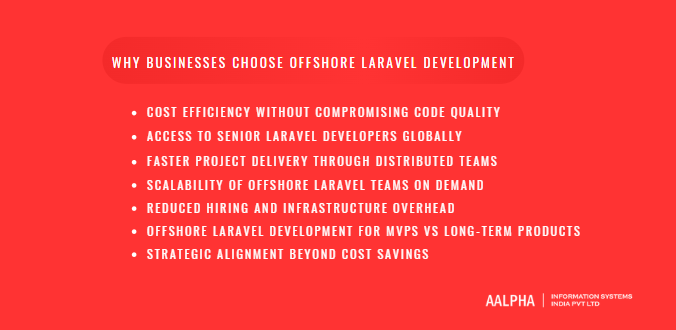
Why Businesses Choose Offshore Laravel Development
-
Cost Efficiency Without Compromising Code Quality
Cost efficiency is often the first consideration that brings businesses to offshore Laravel development, but it is rarely the only or final reason they stay with this model. The financial advantage primarily comes from differences in regional salary structures, operational costs, and hiring economics, not from reduced engineering standards. Mature offshore Laravel teams follow the same architectural principles, coding standards, security practices, and testing protocols expected in global software projects. In many cases, these teams work exclusively with international clients and are accustomed to strict delivery benchmarks, code reviews, and documentation requirements. This allows companies to build complex Laravel applications at a lower overall cost while maintaining production-grade quality that supports long-term growth.
-
Access to Senior Laravel Developers Globally
Another major driver behind offshore Laravel development is access to experienced, senior-level talent that may be difficult or impractical to hire locally. In competitive markets, skilled Laravel developers are often absorbed quickly by large companies or demand compensation levels that are not viable for startups or mid-sized businesses. Offshore development removes geographical constraints, allowing organizations to work with developers who have extensive experience building SaaS platforms, marketplaces, enterprise systems, and API-driven applications using Laravel. These developers often bring cross-industry exposure and problem-solving maturity that adds strategic value beyond writing code, particularly during architecture planning and scaling decisions.
-
Faster Project Delivery Through Distributed Teams
Offshore Laravel development enables faster delivery by leveraging distributed teams that can work in parallel across different time zones. While the core development may still follow structured sprint cycles, having a geographically distributed team allows tasks such as development, testing, bug fixes, and reviews to progress with minimal downtime. When implemented correctly, this model reduces idle time between iterations and shortens feedback loops. Laravel’s structured framework, standardized conventions, and extensive tooling further support this speed by minimizing ambiguity and reducing the time required for onboarding or handover between team members. The result is faster execution without sacrificing clarity or control.
-
Scalability of Offshore Laravel Teams on Demand
Scalability is a critical requirement for growing digital products, and offshore Laravel development offers flexibility that is difficult to replicate with in-house teams. Businesses can scale their development capacity up or down based on project phase, funding cycles, or market demand without the long-term commitments associated with full-time hiring. Additional Laravel developers, QA engineers, or DevOps support can be added as needed, then reduced once major milestones are achieved. This elasticity allows companies to remain lean while still having access to the resources required to handle peak workloads, major releases, or rapid expansion phases.
-
Reduced Hiring and Infrastructure Overhead
Building an in-house Laravel team involves more than salaries. Recruitment, onboarding, training, retention, office space, hardware, software licenses, and management overhead all contribute to the true cost of local development. Offshore Laravel development shifts much of this burden to the delivery partner, allowing businesses to focus on product strategy and growth rather than operational complexity. Offshore teams typically come with established processes, tooling, and internal management structures, reducing the need for micromanagement. This model is especially attractive for companies that want predictable delivery without building large internal engineering departments.
-
Offshore Laravel Development for MVPs vs Long-Term Products
Offshore Laravel development is effective for both early-stage MVPs and long-term, large-scale products, but the approach differs based on objectives. For MVP development, offshore teams help companies validate ideas quickly by delivering functional, well-architected products without excessive upfront investment. Laravel’s rapid development capabilities support fast iteration while still laying a foundation that can scale. For long-term products, offshore Laravel teams function as extended engineering units, contributing to roadmap execution, performance optimization, feature expansion, and ongoing maintenance. In both cases, the key advantage lies in combining Laravel’s structured framework with a delivery model that prioritizes consistency, documentation, and sustainability over short-term shortcuts.
-
Strategic Alignment Beyond Cost Savings
Ultimately, businesses choose offshore Laravel development because it aligns technical execution with business strategy. The model supports predictable delivery, controlled budgets, access to specialized expertise, and long-term maintainability. When paired with clear communication, defined processes, and a capable partner, offshore Laravel development becomes a strategic asset rather than a cost-driven compromise. For companies building serious digital products, this alignment is often the deciding factor.
Offshore Laravel Development Use Cases Across Industries
Offshore Laravel development is adopted across industries because Laravel combines structural discipline with flexibility, making it suitable for both regulated enterprise systems and fast-moving digital products. Businesses choose offshore Laravel teams not only to reduce delivery friction, but also to ensure that backend systems are built with long-term maintainability, security, and scalability in mind. The following use cases illustrate how offshore Laravel development supports a wide range of industry-specific requirements without compromising architectural quality.
-
SaaS Product Development Using Laravel
Software-as-a-Service platforms are one of the most common use cases for offshore Laravel development. Laravel provides a strong foundation for building subscription-based systems, multi-tenant architectures, and role-driven access models that are essential for SaaS products. Offshore Laravel teams typically handle everything from authentication and user management to billing workflows, background jobs, and API integrations. Laravel’s structure allows SaaS platforms to evolve incrementally, making it easier to add features, onboard customers, and refine workflows without destabilizing the system. Offshore teams are particularly effective in SaaS development because these products require continuous iteration, long-term ownership, and disciplined code management rather than short-term feature delivery.
-
Marketplace and Platform Development
Marketplaces and multi-sided platforms rely on complex backend logic that must handle multiple user roles, transactional workflows, notifications, and real-time state changes. Laravel is well suited for these systems because it supports clean separation of business logic, background processing for asynchronous tasks, and integration with third-party services such as payment gateways and messaging providers. Offshore Laravel teams often work on marketplaces that involve vendors, buyers, administrators, and automated processes, all operating within the same platform. By following Laravel’s conventions and modular design patterns, offshore teams can manage complexity without creating tightly coupled systems that become difficult to scale or modify over time.
-
Enterprise Web Application Modernization
Many enterprises still operate on legacy PHP systems or monolithic applications that are difficult to maintain, secure, or extend. Offshore Laravel development is frequently used to modernize these systems by rebuilding critical components using Laravel’s MVC architecture and API-driven approach. This modernization does not always involve a complete rewrite. In many cases, offshore teams incrementally replace outdated modules, introduce service layers, and expose APIs that integrate with existing infrastructure. Laravel’s compatibility with modern development practices makes it an effective bridge between legacy systems and contemporary application architectures, allowing enterprises to modernize at a controlled pace.
-
Healthcare, Fintech, and Compliance-Driven Systems
Industries such as healthcare and fintech place strict demands on data security, access control, auditability, and compliance. Offshore Laravel development is increasingly used in these sectors because Laravel provides built-in mechanisms for authentication, authorization, encryption, and request validation. Offshore teams working in regulated domains typically follow strict documentation standards and coding practices to ensure traceability and compliance readiness. Laravel’s support for structured logging, background processing, and modular services helps teams implement workflows that meet regulatory requirements while remaining adaptable to policy changes. This makes Laravel a practical choice for compliance-driven systems that require both rigor and flexibility.
-
CRM, ERP, and Internal Business Tools
Customer relationship management systems, enterprise resource planning tools, and internal business applications are another major area where offshore Laravel development adds value. These systems often need to integrate with multiple data sources, enforce complex business rules, and support different user roles across departments. Laravel’s expressive syntax and service-oriented architecture allow offshore teams to model business logic clearly and implement workflows that align closely with operational processes. Because these applications are typically long-lived and evolve with the organization, Laravel’s emphasis on maintainability and readability becomes a significant advantage over ad hoc or script-based PHP solutions.
-
API-First Laravel Backends for Mobile and Web Apps
Modern digital products increasingly rely on API-first architectures where the backend serves multiple clients, including web frontends, mobile applications, and third-party integrations. Laravel’s strong support for RESTful APIs, request validation, and response formatting makes it a natural fit for these scenarios. Offshore Laravel teams frequently build backend systems that act as centralized service layers, handling authentication, business logic, and data persistence while exposing clean APIs to consuming applications. This approach simplifies frontend development, supports independent scaling of components, and allows new client applications to be added without restructuring the backend.
-
Long-Term Product Maintenance and Support Models
Beyond initial development, offshore Laravel teams are widely used for long-term maintenance, optimization, and support. Laravel applications benefit from regular framework updates, security patches, and performance improvements, all of which require consistent attention over time. Offshore teams operating under dedicated or retainer-based models provide continuity by maintaining deep knowledge of the codebase and business context. This continuity reduces technical debt, minimizes regression risks, and ensures that the application remains aligned with evolving business needs. For many companies, offshore Laravel development becomes a long-term partnership focused on stability and incremental improvement rather than one-off delivery.
-
Cross-Industry Flexibility as a Strategic Advantage
What unifies these use cases is Laravel’s ability to adapt to different industries without sacrificing structure or clarity. Offshore Laravel development teams leverage this flexibility to serve startups, enterprises, and regulated organizations using the same core framework and delivery principles. This cross-industry applicability reduces learning curves, improves delivery predictability, and allows businesses to reuse proven architectural patterns. As a result, offshore Laravel development is not limited to a specific domain, but functions as a scalable backend strategy that supports diverse business models and long-term digital transformation goals.
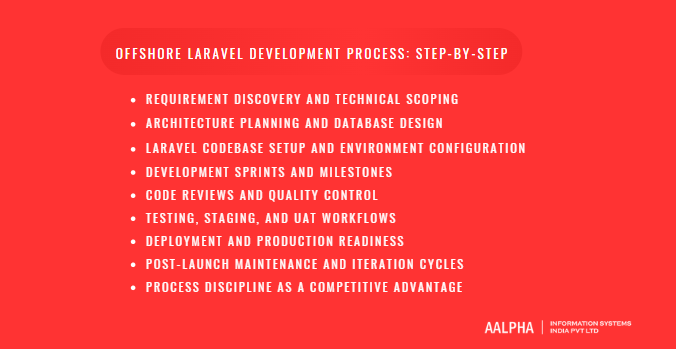
Offshore Laravel Development Process: Step-by-Step
A successful offshore Laravel project depends far more on process discipline than on individual developer output. When teams are distributed across geographies, clarity of scope, structure of execution, and predictability of delivery become critical success factors. Mature offshore Laravel teams follow a well-defined, step-by-step development process that minimizes ambiguity, controls risk, and ensures the final product is stable, scalable, and aligned with business goals. The following breakdown explains how offshore Laravel development typically works from discovery to long-term support.
-
Requirement Discovery and Technical Scoping
The offshore Laravel development process begins with structured requirement discovery, not immediate coding. This phase focuses on translating business objectives into clearly defined functional and technical requirements. Product stakeholders, architects, and senior Laravel developers collaborate to understand user roles, workflows, data flows, third-party integrations, performance expectations, and compliance constraints. Offshore teams place strong emphasis on documentation at this stage, because written clarity reduces misinterpretation later in the project. Technical scoping outputs typically include feature definitions, system boundaries, assumptions, risk areas, and a high-level delivery plan. A well-executed discovery phase prevents scope creep, inaccurate estimates, and architectural rework during later stages.
-
Architecture Planning and Database Design
Once requirements are validated, offshore Laravel teams move into architecture planning and database design. This step defines how the application will be structured, how responsibilities will be separated, and how data will be stored and accessed. Decisions are made around application layering, service boundaries, authentication models, authorization strategies, and integration patterns. Database design focuses on normalization, indexing strategies, data integrity, and future scalability. For offshore projects, architecture documentation is especially important because it acts as a shared reference point for all developers, QA engineers, and stakeholders. Laravel’s conventions provide a strong baseline, but architecture planning ensures the framework is applied consistently and appropriately for the specific use case.
-
Laravel Codebase Setup and Environment Configuration
After architecture approval, the Laravel codebase is initialized with a standardized project structure. Offshore teams configure environments for local development, staging, and production to ensure parity across deployment targets. Environment variables, configuration files, logging, error handling, and dependency management are set up early to avoid inconsistencies later. This phase often includes setting up version control workflows, branching strategies, and access controls. By establishing a clean and predictable development environment upfront, offshore teams reduce friction during collaboration and ensure that developers joining the project later can onboard quickly without destabilizing the system.
-
Development Sprints and Milestones
Actual development is typically organized into time-bound sprints, each aligned with predefined milestones. Offshore Laravel teams work in incremental cycles, delivering functional components rather than large, monolithic releases. Each sprint focuses on a set of features or technical tasks that can be developed, reviewed, and tested independently. Progress is tracked against sprint goals, and regular status updates provide visibility into what has been completed, what is in progress, and what may be blocked. This iterative approach allows stakeholders to validate functionality early and adjust priorities without disrupting the entire project. Laravel’s modular design supports this model by allowing features to be developed and integrated in isolation.
-
Code Reviews and Quality Control
Code reviews are a mandatory part of professional offshore Laravel development. Every significant code change is reviewed by senior developers to ensure adherence to coding standards, architectural guidelines, and security best practices. Reviews focus not only on whether the code works, but on whether it is readable, maintainable, and aligned with long-term design goals. Automated tools are often used to enforce formatting, detect common issues, and measure code quality metrics. This layered quality control process reduces defects, prevents technical debt accumulation, and ensures consistency across contributions from multiple developers working in parallel.
-
Testing, Staging, and UAT Workflows
Testing is integrated throughout the offshore Laravel development lifecycle rather than treated as a final step. Unit tests validate individual components, while integration tests ensure that different parts of the system work together correctly. Dedicated QA engineers perform functional and regression testing based on documented requirements. A staging environment mirrors production as closely as possible, allowing realistic validation before release. User acceptance testing provides stakeholders with the opportunity to verify that the system meets business expectations under real-world scenarios. Clear testing workflows are particularly important in offshore projects, as they provide objective checkpoints that reduce reliance on subjective assessments.
-
Deployment and Production Readiness
Before deployment, offshore Laravel teams conduct a structured production readiness review. This includes verifying environment configurations, database migrations, rollback strategies, monitoring setup, and backup procedures. Security checks are performed to confirm proper access controls, encryption, and exposure limits. Deployment processes are often automated to reduce human error and ensure repeatability. Offshore teams coordinate closely with stakeholders during this phase to minimize downtime and manage release timing. Laravel’s compatibility with modern deployment pipelines supports controlled releases and rapid issue resolution if problems arise post-launch.
-
Post-Launch Maintenance and Iteration Cycles
Offshore Laravel development does not end with deployment. Post-launch maintenance and iteration are critical to sustaining product value. Offshore teams typically operate under ongoing support models that include bug fixes, performance optimization, security updates, and feature enhancements. Because these teams have been involved from early stages, they retain deep knowledge of the codebase and business context. Regular iteration cycles allow the product to evolve in response to user feedback, market changes, and technical advancements. This continuity is one of the strongest advantages of offshore Laravel development, as it ensures long-term stability without repeated knowledge transfer or redevelopment costs.
-
Process Discipline as a Competitive Advantage
What distinguishes successful offshore Laravel projects from failed ones is not geography, but process discipline. A clearly defined, step-by-step development process aligns distributed teams around shared expectations, reduces execution risk, and produces systems that are reliable and scalable. When Laravel’s structured framework is combined with mature offshore delivery practices, businesses gain a backend development model that supports both rapid execution and long-term product sustainability.
Cost of Offshore Laravel Development
The cost of offshore Laravel development is one of the most researched and misunderstood aspects of global software delivery. While many organizations initially approach offshore development for budget reasons, experienced decision-makers quickly realize that cost must be evaluated in terms of total value, delivery reliability, and long-term maintainability rather than hourly rates alone. Understanding how offshore Laravel pricing works requires examining regional rate differences, engagement models, hidden expenses, and realistic estimation methods.
-
Offshore Laravel Developer Hourly Rates by Region
Offshore Laravel developer rates vary significantly by geography due to differences in labor markets, cost of living, and technical maturity. In regions such as South Asia and Southeast Asia, Laravel developers typically charge lower hourly rates while still delivering enterprise-grade work, largely because operating costs are lower and talent pools are deep. Eastern Europe generally falls into a mid-range pricing tier, offering strong engineering quality at moderate rates. Latin America often sits closer to North American pricing but provides time zone alignment advantages for U.S.-based companies. These regional variations allow businesses to select offshore partners based on a balance of cost, expertise, communication comfort, and delivery expectations rather than price alone.
-
Cost Comparison: Offshore vs Local Development
When comparing offshore Laravel development to local hiring, the difference becomes more pronounced at the total cost level rather than hourly compensation. Local development costs include salaries, recruitment fees, onboarding time, benefits, office space, equipment, and employee turnover risk. Offshore development consolidates many of these costs into a predictable engagement fee. Even when offshore hourly rates are only moderately lower than local equivalents, the elimination of long-term employment overhead and infrastructure expenses often results in substantial savings. More importantly, offshore teams can be engaged quickly, reducing time-to-market costs that are often overlooked in traditional cost comparisons.
-
Fixed-Price vs Dedicated Team vs Time-and-Material Models
Offshore Laravel development is typically offered through three primary engagement models, each with different cost implications. Fixed-price contracts work best when requirements are stable and clearly defined, allowing businesses to lock in budgets upfront. However, this model often includes a risk premium to account for uncertainty. Dedicated team models involve hiring a full-time offshore Laravel team that works exclusively on the client’s product, providing flexibility, continuity, and predictable monthly costs. Time-and-material engagements charge based on actual hours worked, offering maximum adaptability for evolving projects but requiring close scope management. Choosing the right model depends on project maturity, risk tolerance, and long-term product plans.
-
Hidden Costs to Watch Out For
While offshore Laravel development can be cost-effective, hidden costs can erode savings if not managed carefully. Poor requirement definition can lead to scope creep, rework, and extended timelines. Inadequate documentation increases onboarding costs when team members change. Weak quality control can result in technical debt that becomes expensive to fix later. Communication inefficiencies may slow decision-making and increase coordination overhead. These costs are not unique to offshore development, but they are amplified when delivery processes are immature. Working with an experienced offshore Laravel partner that emphasizes documentation, testing, and governance significantly reduces these risks.
How to Estimate Total Laravel Development Cost Accurately
Accurate cost estimation for offshore Laravel development starts with breaking the project into well-defined functional components rather than vague feature lists. Each component should be estimated based on complexity, integration requirements, and expected iteration cycles. Architecture decisions, such as multi-tenancy or API-first design, should be factored in early because they influence long-term development effort. Non-development activities, including testing, project management, security reviews, and deployment support, must also be included. Businesses that invest time in upfront scoping and technical validation consistently achieve more predictable budgets than those that rely on rough estimates or optimistic assumptions.
-
Budget Planning for MVPs and Scalable Platforms
Budget planning differs significantly between MVP development and scalable, long-term platforms. For MVPs, offshore Laravel development budgets typically prioritize speed, core functionality, and validation over optimization. Laravel’s rapid development capabilities help keep MVP costs controlled while still producing a solid technical foundation. For scalable platforms, budgets must account for performance optimization, security hardening, documentation, and ongoing maintenance. Offshore teams are particularly effective in this context because they can support incremental investment aligned with growth milestones rather than requiring large upfront commitments. This phased budgeting approach reduces financial risk while preserving technical integrity.
-
Cost as a Strategic Decision, Not a Shortcut
Ultimately, the cost of offshore Laravel development should be evaluated as a strategic investment rather than a simple cost-cutting measure. The real value lies in combining predictable pricing with access to experienced developers, mature delivery processes, and long-term support capabilities. Organizations that focus solely on the lowest rate often incur higher costs over time due to rework, delays, and instability. Those that prioritize transparency, process quality, and architectural discipline typically achieve lower total ownership costs and better business outcomes.
When planned and executed correctly, offshore Laravel development delivers a cost structure that supports both rapid execution and sustainable growth, making it an increasingly preferred model for modern digital products.
Common Challenges in Offshore Laravel Development and How to Avoid Them
Offshore Laravel development can deliver significant advantages, but only when common risks are anticipated and managed proactively. Most failures attributed to offshore development are not caused by geography, but by gaps in process, communication, and technical governance. Understanding these challenges and addressing them early allows businesses to benefit from offshore Laravel teams without compromising quality, timelines, or long-term maintainability.
-
Communication Gaps and Requirement Drift
Communication gaps are one of the most frequently cited challenges in offshore Laravel development. These gaps often arise not from language barriers, but from unclear expectations, inconsistent documentation, or informal decision-making. When requirements are conveyed verbally without written validation, small misunderstandings accumulate and eventually result in requirement drift. Offshore teams may implement features that technically meet the stated requirements but fail to align with business intent. To avoid this, successful projects rely on structured requirement documentation, written acceptance criteria, and regular alignment checkpoints. Clear communication protocols ensure that both business and technical teams interpret requirements consistently throughout the development lifecycle.
-
Code Inconsistency and Technical Debt
Code inconsistency is a common risk when multiple developers contribute to a Laravel codebase without strong architectural oversight. Variations in coding style, inconsistent use of framework features, and ad hoc solutions can quickly lead to technical debt. Over time, this debt reduces development velocity and increases the risk of defects. Offshore Laravel development mitigates this challenge through enforced coding standards, shared architectural guidelines, and mandatory code reviews. Senior developers play a critical role in maintaining consistency by reviewing contributions, refactoring when necessary, and ensuring that new features align with long-term design principles rather than short-term fixes.
-
Lack of Laravel-Specific Expertise
Not all PHP developers are proficient in Laravel, and assuming otherwise is a common mistake. Laravel has its own conventions, patterns, and ecosystem that require dedicated experience to use effectively. Offshore teams without deep Laravel expertise may misuse framework features, introduce performance bottlenecks, or bypass built-in capabilities in favor of custom code. Businesses can avoid this risk by evaluating Laravel-specific experience during partner selection, reviewing past projects, and conducting technical interviews that focus on real-world Laravel use cases. Experienced Laravel teams leverage the framework’s strengths instead of fighting against it.
-
Over-Reliance on Junior Developers
Some offshore providers rely heavily on junior developers to reduce costs, which can negatively impact quality and delivery predictability. While junior engineers can contribute effectively under proper supervision, over-reliance on them increases the likelihood of errors, rework, and architectural missteps. In offshore Laravel development, senior oversight is essential to guide design decisions, review critical code paths, and mentor less experienced team members. Businesses should ensure that offshore teams include a balanced mix of senior and mid-level developers and that senior engineers remain actively involved throughout the project, not just during initial setup.
-
Poor Documentation and Knowledge Transfer
Poor documentation creates long-term risks that often surface after deployment, particularly when team members change or projects scale. Without clear documentation, onboarding new developers becomes difficult, bug resolution slows, and strategic changes require excessive reverse engineering. Offshore Laravel development demands disciplined documentation practices that cover architecture decisions, data models, deployment workflows, and key business logic. Knowledge transfer sessions, recorded walkthroughs, and regularly updated technical documents ensure that the codebase remains understandable and maintainable beyond the original development team.
-
Strategies to Mitigate Offshore Development Risks
Mitigating offshore Laravel development risks requires a combination of governance, transparency, and technical rigor. Clear contracts and engagement models establish expectations around deliverables, communication, and accountability. Structured project management practices provide visibility into progress and risks. Regular code reviews and automated testing enforce quality standards. Most importantly, selecting an offshore partner that treats development as a long-term responsibility rather than a short-term transaction significantly reduces risk. When offshore Laravel teams operate as extensions of the client’s organization, aligned around shared goals and processes, challenges become manageable and predictable rather than disruptive.
-
Turning Challenges into Operational Strength
The challenges associated with offshore Laravel development are well understood and largely preventable. Companies that invest in process clarity, technical leadership, and documentation consistently outperform those that focus solely on cost or speed. When managed correctly, offshore Laravel development not only avoids common pitfalls but also creates a resilient delivery model capable of supporting complex products over the long term.
How to Choose the Right Offshore Laravel Development Company
Choosing the right offshore Laravel development company is a strategic decision that directly affects product quality, delivery timelines, and long-term maintainability. While cost considerations often initiate the search, experienced organizations know that technical depth, process maturity, and partnership mindset are far more important indicators of success. Offshore Laravel development works best when the vendor operates as an extension of the client’s engineering organization rather than a disconnected execution unit. The following criteria help decision-makers evaluate offshore development partners systematically and avoid costly missteps.
-
Evaluating Laravel Expertise and Project Experience
The first and most critical evaluation factor is proven Laravel expertise. Many vendors position themselves as PHP specialists, but Laravel requires framework-specific knowledge that goes well beyond generic PHP development. A credible offshore Laravel development company should be able to demonstrate experience across different Laravel versions, architectural patterns, and real-world use cases such as SaaS platforms, marketplaces, API-driven systems, and enterprise applications. Case studies should clearly explain the problem context, technical challenges, architectural decisions, and long-term outcomes rather than just listing features. Teams with deep Laravel experience understand how to leverage built-in framework capabilities instead of reinventing solutions, which directly impacts maintainability and scalability.
-
Technical Interviews and Code Review Practices
A reliable offshore Laravel partner does not hide its technical talent behind sales processes. Decision-makers should expect transparency in how developers are vetted and how code quality is enforced. Technical interviews should assess practical Laravel knowledge, including database modeling with Eloquent, application structure, security practices, and performance considerations. Code review practices are equally important. Mature teams have defined review workflows, senior oversight, and clear coding standards that apply across the project. Asking how code reviews are conducted, who approves critical changes, and how technical debt is managed provides insight into whether quality is a priority or an afterthought.
-
Assessing Delivery Processes and Documentation Quality
Strong delivery processes distinguish professional offshore Laravel teams from transactional vendors. This includes structured requirement discovery, sprint-based development, progress reporting, and formal acceptance criteria. Documentation quality is a key indicator of process maturity. Well-documented projects reduce dependency on individual developers and ensure continuity as products evolve. Offshore teams should provide architectural documentation, data models, API references, and deployment guidelines as part of standard delivery, not as optional extras. Consistent documentation practices signal that the company builds systems intended to last, not just to launch.
-
Red Flags to Avoid When Selecting Offshore Partners
Several warning signs often indicate future delivery risks. Extremely low pricing without clear justification may suggest over-reliance on junior developers or unsustainable delivery models. Vague answers about architecture, testing, or security should raise concerns about technical depth. A lack of structured onboarding or requirement validation increases the likelihood of scope creep and rework. Vendors that resist transparency around team composition, code ownership, or communication practices often struggle with accountability. Identifying these red flags early prevents long-term cost overruns and quality issues that are difficult to correct later.
-
Questions to Ask Before Signing a Contract
Before formalizing an offshore Laravel engagement, businesses should ask targeted questions that reveal how the partner operates in real scenarios. Key areas include how requirements are validated, how changes are managed, how risks are escalated, and how knowledge is retained over time. Understanding who owns the code, how intellectual property is protected, and how security responsibilities are handled is essential. Questions about team stability, developer turnover, and long-term support models help assess whether the partner can sustain the relationship beyond initial delivery. Clear answers backed by documented processes are a strong indicator of reliability.
-
Long-Term Partnership vs Short-Term Engagement Considerations
Offshore Laravel development can be structured as a short-term engagement or a long-term partnership, but the expectations differ significantly. Short-term projects focus on clearly defined scopes, fixed timelines, and controlled costs, making them suitable for MVPs or isolated modules. Long-term partnerships emphasize continuity, incremental improvement, and deep understanding of the product and business domain. For complex platforms and evolving products, long-term offshore partnerships deliver better outcomes by reducing knowledge loss and technical fragmentation. Businesses should align engagement models with product maturity and growth plans rather than treating offshore development as a one-off transaction.
-
Making a Confident Selection Decision
Selecting the right offshore Laravel development company requires deliberate evaluation across technical, operational, and strategic dimensions. Businesses that invest time in this selection process consistently achieve better delivery outcomes, lower total ownership costs, and more resilient products. By focusing on proven Laravel expertise, disciplined processes, and long-term alignment, organizations can turn offshore Laravel development into a reliable engine for sustained digital growth rather than a source of uncertainty.
Why Choose Aalpha for Offshore Laravel Development
Selecting an offshore Laravel development partner requires confidence not only in technical execution, but also in process maturity, security discipline, and long-term accountability. Aalpha Information Systems is positioned to meet these expectations through a delivery model built around Laravel specialization, structured collaboration, and sustained product ownership. The focus is not short-term output, but durable systems that continue to perform as business requirements evolve.
-
Aalpha’s Laravel Expertise and Delivery Approach
Aalpha’s Laravel practice is centered on building backend systems that are cleanly architected, extensible, and aligned with real-world business workflows. The team works extensively with Laravel for SaaS platforms, marketplaces, enterprise applications, and API-first systems, applying framework conventions consistently rather than customizing around them. Delivery begins with requirement validation and technical scoping, followed by architecture planning that prioritizes maintainability and scalability. This disciplined approach reduces rework, improves predictability, and ensures that Laravel’s strengths are fully utilized rather than diluted by ad hoc decisions.
-
Offshore Team Structure and Communication Model
Aalpha structures offshore Laravel teams to function as true extensions of the client’s organization. Each engagement includes senior technical leadership responsible for architecture and code quality, supported by experienced developers and QA engineers. Communication is process-driven rather than ad hoc, with defined reporting cycles, written updates, and documented decisions. This structure minimizes dependency on individual contributors and ensures continuity even as products scale. Time zone differences are managed through overlap windows and asynchronous workflows, allowing steady progress without disrupting stakeholder availability.
-
Quality Assurance and Documentation Standards
Quality assurance at Aalpha is embedded throughout the Laravel development lifecycle rather than treated as a final checkpoint. Code reviews are mandatory, testing is planned alongside development, and staging environments are used to validate real-world scenarios. Documentation is considered a core deliverable, not an optional add-on. Architectural decisions, data models, APIs, and deployment workflows are documented to support onboarding, audits, and future enhancements. This emphasis on documentation directly reduces technical debt and long-term maintenance costs.
-
Security, Compliance, and IP Protection
Security and intellectual property protection are integral to Aalpha’s offshore Laravel engagements. Access controls, secure configuration practices, and data protection measures are implemented as part of standard delivery. Clients retain full ownership of source code and assets, supported by contractual safeguards and controlled repository access. For compliance-driven industries, Aalpha follows traceable development practices that support audits and regulatory review. This ensures that offshore development does not introduce hidden security or legal risks.
-
Long-Term Product Support and Scaling Capabilities
Aalpha is structured to support products beyond initial launch. Offshore Laravel teams remain available for post-deployment optimization, performance tuning, feature expansion, and framework upgrades. As business needs change, teams can be scaled without disrupting existing workflows or knowledge continuity. This long-term support model is particularly valuable for SaaS platforms and enterprise systems that require consistent iteration rather than one-time delivery.
-
Alignment With EEAT Expectations
Aalpha’s offshore Laravel delivery aligns closely with Experience, Expertise, Authoritativeness, and Trustworthiness expectations. Experience is demonstrated through sustained work on complex, long-lived systems. Expertise is reflected in Laravel-specific architectural discipline and practical problem-solving. Authoritativeness comes from transparent processes, documented decisions, and senior oversight. Trustworthiness is reinforced through security controls, IP protection, and predictable delivery practices. Together, these factors position Aalpha as a reliable offshore Laravel development partner for organizations that prioritize quality, accountability, and long-term value.
For businesses seeking offshore Laravel development that balances technical rigor with operational clarity, Aalpha offers a delivery model designed for sustained success rather than short-term output.
Final Verdict
Offshore Laravel development has evolved into a strategic delivery model for businesses that need scalable, secure, and maintainable backend systems without the friction of local hiring constraints. When executed with the right processes, senior technical oversight, and framework-specific expertise, it delivers faster time to market, controlled costs, and long-term product stability. The success of offshore Laravel development depends less on geography and more on partner maturity, documentation discipline, and accountability across the full product lifecycle.
If you are evaluating offshore Laravel development for an MVP, a growing SaaS platform, or a complex enterprise system, working with a partner that combines Laravel specialization with proven delivery governance is critical. Aalpha Information Systems offers offshore Laravel development built around architectural rigor, transparent collaboration, and long-term ownership.
For organizations looking to build or scale Laravel-based products with confidence, engaging Aalpha as a development partner provides a clear, reliable path from concept to sustained growth. Contact Aalpha to discuss your requirements and evaluate the right offshore Laravel engagement model for your business.