


Offshore eCommerce development has moved from being a cost-driven outsourcing tactic to a strategic business decision for companies that want to scale faster, compete globally, and build resilient digital commerce platforms. As eCommerce becomes more complex with omnichannel selling, third-party integrations, performance expectations, and continuous optimization, businesses are realizing that relying solely on local development teams often limits speed, flexibility, and access to specialized expertise. Offshore development addresses these constraints by allowing organizations to tap into global talent pools while maintaining control over product vision, quality, and long-term growth.
Today’s eCommerce platforms are not static websites. They are living systems that integrate payments, logistics, inventory, marketing automation, analytics, personalization, and increasingly AI-driven features. Building and maintaining such systems requires diverse skill sets that are expensive and difficult to assemble locally, especially in mature markets like the US, UK, and Western Europe. Offshore eCommerce development offers a practical solution by combining cost efficiency with access to engineers who specialize in modern commerce architectures, custom integrations, and scalable backend systems.
More importantly, offshore development aligns with how digital businesses now operate. Global customers, round-the-clock sales, and rapid iteration cycles demand development models that are not constrained by geography or office hours. When structured correctly, offshore eCommerce teams become an extension of the core business rather than an external vendor, contributing directly to faster releases, better performance, and sustained innovation.
What Offshore eCommerce Development Means in Today’s Market
Offshore eCommerce development refers to designing, building, and maintaining eCommerce platforms using development teams located in a different country than the business headquarters, typically in regions with strong technical talent and lower operational costs. In today’s market, this no longer means handing off a fully defined project and waiting months for delivery. Modern offshore development is collaborative, iterative, and deeply integrated into business workflows.
Unlike traditional outsourcing models, offshore eCommerce development today often includes strategic involvement in architecture planning, performance optimization, security hardening, and long-term scalability decisions. Offshore teams work with agile methodologies, participate in sprint planning, and align closely with business goals such as conversion optimization, checkout performance, and customer experience improvements. This shift has transformed offshore development from a transactional service into a strategic capability.
Another defining aspect is specialization. Many offshore teams now focus exclusively on eCommerce ecosystems, including storefront performance, backend commerce logic, third-party integrations, and headless or composable architectures. This level of focus allows businesses to access skills that would otherwise require building large, expensive in-house teams. As a result, offshore eCommerce development is no longer viewed as a compromise but as a competitive advantage for companies that want speed, scalability, and technical depth without unsustainable costs.
Why Global Brands and Startups Are Choosing Offshore Teams
Global brands and startups are increasingly choosing offshore eCommerce teams because the economics and operational benefits are difficult to ignore. Development costs in North America and Western Europe have risen sharply, while the demand for experienced eCommerce engineers continues to outpace supply. Offshore teams offer a way to control budgets while still working with developers who have hands-on experience building high-traffic, revenue-critical platforms.
For startups, offshore eCommerce development enables faster market entry. Instead of spending months hiring and onboarding a local team, founders can assemble a fully functional offshore team in weeks. This speed is crucial when validating business models, launching MVPs, or responding to competitive pressure. Offshore teams also provide flexibility, allowing startups to scale development capacity up or down without long-term employment commitments.
Established brands benefit differently. Offshore teams help them modernize legacy platforms, expand into new markets, and experiment with new commerce models without disrupting core operations. Many enterprises use offshore development to handle continuous improvements, integrations, and performance optimization, freeing internal teams to focus on strategy and innovation. In both cases, the appeal lies not just in cost savings, but in access to reliable execution and specialized eCommerce expertise.
Offshore vs Onshore vs Nearshore for eCommerce Projects
Choosing between offshore, onshore, and nearshore eCommerce development depends on business priorities, budget, and operational maturity. Onshore development, where teams are located in the same country as the business, offers advantages in communication and cultural alignment. However, it comes with significantly higher costs and limited access to specialized talent, especially for advanced eCommerce features and integrations.
Nearshore development places teams in neighboring or nearby countries, often with overlapping time zones. This model balances cost savings with easier collaboration, but it still tends to be more expensive than offshore options and may not provide the same depth of specialized eCommerce talent. Nearshore teams are often chosen when real-time collaboration is critical and budgets allow for higher rates.
Offshore eCommerce development provides the greatest cost efficiency and access to large, specialized talent pools. Time zone differences, often seen as a drawback, can become an advantage when managed correctly, enabling near-continuous development cycles. The key difference is not geography but governance. Businesses that define clear requirements, maintain strong communication processes, and treat offshore teams as long-term partners consistently achieve outcomes comparable to or better than onshore models. For many eCommerce companies, offshore development offers the optimal balance of scalability, expertise, and cost control in a highly competitive digital market.
What Can Be Offshore in an eCommerce Project
One of the most persistent misconceptions about offshore eCommerce development is that only “execution work” can be outsourced safely. In reality, mature offshore teams today handle everything from early-stage strategy to long-term optimization and maintenance. The scope of what can be offshored has expanded significantly as tools, processes, and collaboration models have evolved. When responsibilities are clearly defined and governance is strong, offshore teams can own large, business-critical portions of an eCommerce initiative without compromising quality, security, or speed.
Modern eCommerce systems are modular by nature. Strategy, design, frontend, backend, integrations, testing, and ongoing improvements can be distributed across teams while remaining tightly aligned. This modularity is what makes offshore engagement practical at scale. Instead of viewing offshore development as a single handoff, high-performing companies treat it as a structured extension of their internal capabilities. The following sections break down which parts of an eCommerce project are commonly and successfully handled offshore, and why this model works.
-
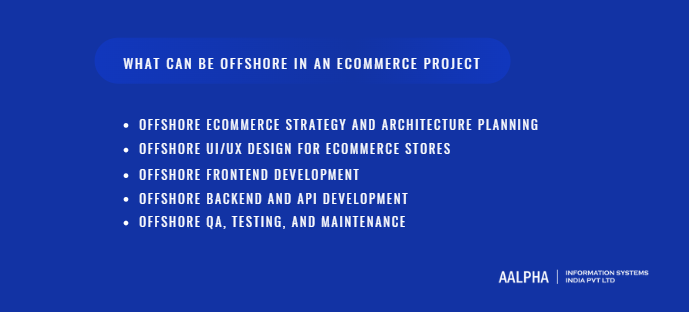
Offshore eCommerce Strategy and Architecture Planning
Offshore teams are increasingly involved at the strategy and architecture planning stage of eCommerce projects, particularly when they bring deep platform and domain experience. This phase includes requirements analysis, system architecture design, technology stack selection, scalability planning, and integration mapping. Offshore architects often work closely with business stakeholders to translate commercial goals such as growth targets, geographic expansion, or performance benchmarks into technical decisions.
In today’s market, architecture planning is less about choosing a single platform and more about designing an ecosystem. This may involve decisions around monolithic versus modular systems, headless commerce approaches, third-party integrations, and long-term maintainability. Offshore teams that specialize in eCommerce have firsthand experience with these patterns across multiple industries, allowing them to anticipate bottlenecks and design for scale from day one.
What makes offshore strategy work is structured collaboration. Clear documentation, shared workshops, and iterative validation ensure that architectural decisions align with business priorities. When offshore teams are engaged early, they can prevent costly rework later by designing systems that support performance, flexibility, and future enhancements, rather than simply meeting immediate launch requirements.
-
Offshore UI/UX Design for eCommerce Stores
UI and UX design for eCommerce is another area that is well-suited for offshore execution, provided user research and brand guidelines are clearly communicated. Offshore design teams frequently handle user journey mapping, wireframing, high-fidelity design, and interaction design for web and mobile storefronts. Their work focuses on conversion optimization, usability, accessibility, and consistency across devices.
Modern offshore design teams are not limited to visual execution. They often analyze user behavior, checkout friction points, and navigation patterns based on industry benchmarks and past project data. This experience allows them to propose design solutions that improve engagement and reduce drop-offs, even for complex catalogs or multi-step purchasing flows.
The success of offshore UI/UX design depends on feedback loops. Regular reviews, design critiques, and usability testing sessions ensure alignment with brand identity and business goals. When managed properly, offshore designers deliver production-ready assets that integrate seamlessly with frontend development, accelerating overall delivery timelines without sacrificing customer experience quality.
-
Offshore Frontend Development
Frontend development is one of the most commonly offshored components of an eCommerce project. Offshore frontend teams build responsive, high-performance storefronts that translate design concepts into functional user interfaces. This includes product listings, search and filtering, cart and checkout flows, account dashboards, and CMS-driven content pages.
Performance and user experience are critical in eCommerce, and offshore frontend developers are increasingly skilled in optimizing load times, rendering behavior, and cross-browser compatibility. They work closely with designers and backend teams to ensure smooth data flow, accurate state management, and consistent behavior across devices.
Another advantage of offshoring frontend work is scalability. As feature requirements grow, offshore teams can expand capacity quickly to handle seasonal demands, promotional campaigns, or rapid iteration cycles. With proper coding standards, documentation, and review processes in place, offshore frontend development delivers production-grade results that meet both technical and commercial expectations.
-
Offshore Backend and API Development
Backend and API development form the backbone of any eCommerce platform, and this area is increasingly entrusted to offshore teams with specialized expertise. Backend responsibilities include product and inventory management logic, order processing, payment workflows, integrations with logistics and third-party services, and data synchronization across systems.
Offshore backend teams often bring experience building scalable architectures that handle high transaction volumes and complex business rules. They design APIs that support frontend applications, mobile apps, and external integrations while maintaining performance and security. This expertise is particularly valuable for businesses operating across multiple regions, currencies, or fulfillment models.
What makes offshore backend development effective is a strong emphasis on documentation, testing, and modular design. Clear API contracts, versioning strategies, and monitoring practices allow offshore teams to work independently while ensuring system reliability. When aligned with business requirements, offshore backend development becomes a long-term asset rather than a short-term cost-saving measure.
-
Offshore QA, Testing, and Maintenance
Quality assurance, testing, and ongoing maintenance are often underestimated, yet they are among the most suitable functions to offshore. Offshore QA teams handle functional testing, regression testing, performance testing, and cross-device validation to ensure that eCommerce platforms remain stable as features evolve.
Maintenance and support activities, including bug fixes, performance tuning, and minor enhancements, are also commonly managed offshore. This allows businesses to maintain consistent platform quality without overburdening internal teams. Offshore teams can provide extended coverage across time zones, reducing response times for critical issues.
By offshoring QA and maintenance, companies establish a continuous improvement cycle. Regular testing, monitoring, and optimization help prevent downtime, protect revenue, and improve user experience over time. When integrated into the broader development process, offshore QA and maintenance contribute directly to the long-term success of an eCommerce platform.
Offshore eCommerce Development Models Explained
Choosing the right offshore eCommerce development model is as important as choosing the right technology or platform. The engagement model determines how responsibilities are shared, how risks are managed, and how effectively the offshore team integrates with the business. Companies that struggle with offshore development often fail not because of technical gaps, but because the chosen model does not align with their internal capabilities, project complexity, or growth plans.
Modern offshore eCommerce development offers multiple engagement structures, each designed for different business contexts. Some companies need a long-term extension of their internal team, while others require a clearly scoped delivery for a specific launch or upgrade. There are also organizations that want flexibility to scale skills quickly without the overhead of permanent hiring. Understanding how each model works, and where it fits best, allows decision-makers to extract real strategic value rather than short-term cost savings.
-
Dedicated Offshore eCommerce Development Team
A dedicated offshore eCommerce development team is a long-term engagement where a group of developers, designers, QA engineers, and sometimes architects work exclusively for a single client. This team functions as an extension of the internal team, following the client’s processes, tools, and development roadmap. The client typically retains full control over priorities, sprint planning, and product direction, while the offshore partner handles team management and operational logistics.
This dedicated team model is best suited for businesses with ongoing development needs, such as continuous feature releases, platform modernization, performance optimization, or expansion into new markets. Because the team is dedicated, domain knowledge accumulates over time, leading to better decision-making and faster execution. Developers gain a deep understanding of the business logic, customer behavior, and technical constraints, which significantly reduces onboarding friction for new initiatives.
From a cost perspective, dedicated teams provide predictability. Monthly pricing models make budgeting easier, while long-term collaboration reduces the inefficiencies associated with repeated handovers. The trade-off is that this model requires strong internal product ownership and clear communication practices. When managed well, a dedicated offshore team delivers the highest strategic value and becomes a core part of the eCommerce growth engine.
-
Offshore Project-Based Development Model
The project-based offshore development model is structured around a clearly defined scope, timeline, and set of deliverables. In this approach, the offshore partner is responsible for delivering a specific outcome, such as launching a new eCommerce store, migrating platforms, or building a custom feature set. Requirements are finalized upfront, and the project is executed according to an agreed plan.
This model works well for businesses with limited internal technical capacity or for organizations undertaking one-time initiatives. It offers clarity around cost and timelines, making it easier for stakeholders to plan budgets and resources. Project-based engagements also reduce management overhead, as the offshore partner assumes responsibility for execution and coordination within the defined scope.
However, the rigidity of this model can be a limitation in fast-changing eCommerce environments. Any changes to requirements often require renegotiation, which can slow down progress. As a result, project-based offshore development is most effective when requirements are stable and the business objective is clearly defined from the outset.
-
Offshore Staff Augmentation for eCommerce
Offshore staff augmentation allows companies to add specific eCommerce skills to their existing teams without committing to long-term hires. In this model, offshore developers or specialists work under the direct supervision of the client’s internal managers, filling skill gaps or increasing capacity during peak workloads. The offshore partner handles recruitment and administration, while the client manages day-to-day tasks.
This approach is ideal for companies that already have strong technical leadership but need additional hands for frontend development, backend integrations, performance optimization, or quality assurance. Staff augmentation provides flexibility, allowing businesses to scale teams up or down based on demand without the delays of local hiring processes.
The success of staff augmentation depends heavily on internal coordination. Clear task allocation, documentation, and communication are essential to avoid inefficiencies. When implemented correctly, offshore staff augmentation enables rapid execution while preserving full control over architecture and product direction.
-
Managed Offshore eCommerce Services
Managed offshore eCommerce services shift responsibility for development, maintenance, and optimization to an external partner. In this model, the offshore provider owns outcomes rather than tasks, managing everything from feature development and performance monitoring to bug fixes and platform updates. The client focuses on business strategy and growth, while the offshore team ensures the platform runs smoothly.
This model is particularly attractive for businesses that want to minimize internal technical overhead or lack in-house eCommerce expertise. It provides a single point of accountability and often includes service-level agreements that define performance, uptime, and response times. Managed services are also common for post-launch phases, where stability and continuous improvement are more important than rapid feature experimentation.
The key consideration with managed offshore services is trust and transparency. Businesses must ensure that reporting, communication, and governance mechanisms are strong enough to maintain visibility into platform performance. When aligned correctly, managed offshore eCommerce services offer a low-friction way to maintain and scale complex commerce systems over the long term.
Popular eCommerce Platforms for Offshore Development
The success of an offshore eCommerce initiative depends heavily on choosing the right platform for the business model, growth stage, and operational complexity. Offshore teams today work across a wide range of mature and emerging eCommerce platforms, from SaaS-based solutions to highly customized enterprise systems. What makes offshore development particularly effective is not just familiarity with these platforms, but deep experience in extending, integrating, and optimizing them for real-world business needs.
Each platform lends itself differently to offshore execution. Some emphasize speed and standardization, while others demand advanced architectural expertise and long-term technical stewardship. Understanding how offshore teams typically engage with each platform helps decision-makers align technology choices with budget, scalability, and time-to-market expectations.
-
Offshore Shopify and Shopify Plus Development
Shopify and Shopify Plus are among the most popular platforms for offshore eCommerce development, particularly for startups, D2C brands, and fast-growing online retailers. Their SaaS-based nature simplifies infrastructure management, allowing offshore teams to focus on storefront customization, integrations, and conversion optimization rather than core platform maintenance.
Offshore Shopify development typically includes theme customization, custom section development, app integration, checkout optimization, and performance tuning. For Shopify Plus, offshore teams often work on more complex requirements such as multi-store setups, internationalization, automation workflows, and integration with ERP or CRM systems. Because Shopify enforces platform conventions, offshore teams can deliver predictable results quickly, making it ideal for rapid launches and iterative improvements.
Another advantage of offshoring Shopify development is access to developers who work exclusively within the Shopify ecosystem. These specialists understand platform constraints, API limits, and best practices, reducing trial-and-error during development. For businesses prioritizing speed, reliability, and lower upfront complexity, offshore Shopify and Shopify Plus development offers a highly efficient path to market.
-
Offshore WooCommerce Development
WooCommerce is a flexible, open-source eCommerce solution built on WordPress, making it a strong candidate for offshore development when customization and content integration are priorities. Offshore WooCommerce teams typically handle theme development, plugin customization, performance optimization, and integration with third-party services such as payment gateways, logistics providers, and marketing tools.
One of WooCommerce’s strengths is its adaptability. Offshore developers can tailor the platform extensively to match unique business workflows, product types, or pricing models. This flexibility is particularly valuable for content-heavy stores, niche marketplaces, or businesses that require close alignment between marketing content and commerce functionality.
However, WooCommerce also demands disciplined development practices. Performance, security, and scalability depend heavily on code quality and hosting configuration. Offshore teams with deep WordPress and WooCommerce experience mitigate these risks by implementing optimized architectures, caching strategies, and secure coding standards. When managed properly, offshore WooCommerce development delivers a balance of customization and cost efficiency.
-
Offshore Magento (Adobe Commerce) Development
Magento, now known as Adobe Commerce, is a powerful platform designed for complex, large-scale eCommerce operations. Offshore Magento development is common among enterprises and high-growth retailers that require advanced catalog management, multi-store capabilities, and deep customization.
Magento projects are inherently more complex than SaaS-based platforms, which makes offshore expertise particularly valuable. Offshore teams often handle custom module development, system integrations, performance optimization, and long-term platform maintenance. Their experience across multiple Magento implementations allows them to anticipate scaling challenges related to traffic spikes, database performance, and checkout reliability.
Because Magento requires ongoing technical management, offshore development is rarely limited to a single launch phase. Instead, it becomes a long-term partnership focused on stability, feature evolution, and cost control. For businesses with complex requirements and long-term growth plans, offshore Magento development provides access to specialized talent that is often scarce and expensive in local markets.
-
Offshore Headless eCommerce Development
Headless eCommerce has emerged as a preferred approach for businesses that want maximum flexibility across channels and devices. In a headless architecture, the frontend is decoupled from the backend commerce engine, allowing offshore teams to work independently on user interfaces, APIs, and integrations. This model is particularly well-suited to offshore development due to its modular structure.
Offshore headless development teams typically build custom storefronts, integrate backend commerce services, and design APIs that support web, mobile, and third-party touchpoints. This approach enables faster innovation, better performance, and consistent experiences across channels. Offshore teams with experience in headless architectures bring valuable insights into managing complexity, versioning APIs, and maintaining system stability.
While headless commerce requires more upfront planning and architectural discipline, it offers long-term advantages for brands that prioritize personalization, omnichannel selling, and rapid experimentation. Offshore development plays a critical role in making headless commerce economically viable by providing access to architects and engineers experienced in distributed systems.
-
Custom eCommerce Platforms Built Offshore
Custom eCommerce platforms are typically chosen when off-the-shelf solutions cannot support unique business models, workflows, or scale requirements. Offshore development is a common approach for building such platforms due to the extensive engineering effort involved. Offshore teams design and implement bespoke systems that align precisely with business logic, integration needs, and growth plans.
These projects often involve custom product management, pricing engines, order workflows, and integration layers. Offshore teams contribute not only development capacity but also architectural experience gained from similar builds across industries. This helps businesses avoid common pitfalls such as overengineering or insufficient scalability planning.
The key to successful offshore custom eCommerce development is governance. Clear documentation, phased delivery, and continuous validation ensure that the platform evolves in line with business objectives. When executed correctly, custom platforms built offshore become strategic assets that support differentiation and long-term competitive advantage.
Offshore eCommerce Development Process: Step-by-Step
A reliable offshore eCommerce build is rarely the result of “cheap coding.” It is the result of a disciplined delivery process that reduces ambiguity, protects quality, and keeps business goals tied to daily execution. The best offshore engagements run like mature product organizations: they translate commercial outcomes into clear requirements, make architecture decisions early, validate design before building, deliver in small increments, and treat testing and deployment as core engineering responsibilities rather than last-minute tasks. This step-by-step process is the practical blueprint that helps offshore teams deliver predictable results, whether the goal is launching a new store, modernizing an existing platform, or scaling toward multi-country operations.
A common question decision-makers ask is whether offshore work can match the speed and quality of a local team without constant oversight. The practical answer is yes, if the process is explicit. When roles, documentation, and feedback cycles are structured from the start, offshore teams execute with high autonomy while stakeholders retain full control over business direction. The sections below outline a proven offshore eCommerce development process that works across Shopify, WooCommerce, Magento, headless commerce, and custom builds.
-
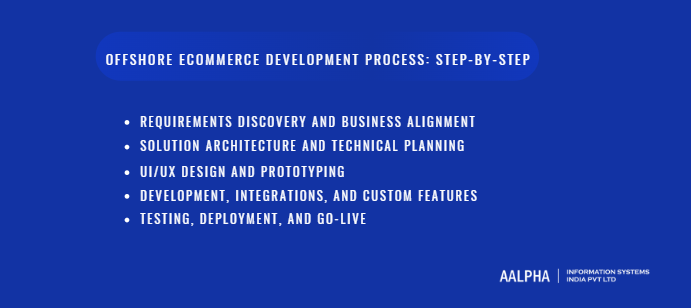
Requirements Discovery and Business Alignment
Requirements discovery is where offshore eCommerce projects either gain momentum or accumulate risk that becomes expensive later. This step converts business intent into implementable scope, clarifies priorities, and sets measurable success criteria. Offshore teams typically begin by mapping the business model, customer journeys, and operational workflows such as catalog management, pricing rules, tax and shipping logic, returns, and customer support handoffs. The output is not a vague feature list, but a structured requirements pack that connects each capability to a business outcome like conversion rate improvement, average order value growth, faster fulfillment, or reduced support tickets.
Business alignment also means making trade-offs explicit. For example, if the launch timeline is aggressive, the team defines what is included in MVP versus Phase 2. If the store will sell internationally, the team documents currency handling, localization requirements, and region-specific compliance expectations early. This stage typically includes stakeholder workshops, competitive reference analysis, and a review of existing systems such as ERP, CRM, inventory tools, and marketing platforms to identify integration dependencies.
By the end of this step, offshore teams should produce a clear scope baseline, acceptance criteria, and a delivery plan that both business and technical stakeholders understand. This reduces rework, prevents scope creep, and makes progress measurable from the first sprint.
-
Solution Architecture and Technical Planning
Once requirements are clear, solution architecture and technical planning define how the platform will actually function under real operating conditions, not just in a demo environment. Offshore architects map the system components, choose platform-specific patterns, and define integration approaches for payments, shipping, inventory, analytics, CRM, and marketing tools. This step includes decisions around whether the build should be monolithic or modular, how data will flow between services, and where business logic should reside to avoid duplication and long-term maintenance issues.
Technical planning also addresses scalability and performance upfront. Offshore teams define performance targets such as page speed and checkout response times, then translate those into architecture choices around caching, database structure, API design, and background job processing. They plan how the system handles traffic spikes during promotions, how it recovers from failures, and how sensitive operations like payment processing are secured and audited. For headless builds, this stage includes defining API contracts, versioning strategy, and frontend-backend responsibilities.
The deliverables typically include system architecture diagrams, integration maps, data models, security controls, and a phased implementation roadmap. This is the step that prevents “build now, fix later” outcomes by locking in the technical foundations required for long-term growth.
-
UI/UX Design and Prototyping
UI/UX design and prototyping are where offshore teams reduce risk by validating user experience before writing large amounts of code. In eCommerce, good design is not only about aesthetics. It directly affects conversion, cart abandonment, and customer trust. Offshore design teams typically start with user flows: homepage to category browsing, product discovery, product detail evaluation, cart building, checkout completion, account management, and post-purchase interactions like tracking and returns.
Prototyping is critical because it makes assumptions visible. Stakeholders can click through journeys, identify friction points, and confirm whether the experience matches brand expectations. Offshore teams usually create wireframes first, then evolve them into high-fidelity designs with design systems that standardize typography, buttons, forms, and components. This ensures consistent implementation and faster frontend delivery. Accessibility requirements, mobile-first behavior, and edge cases such as out-of-stock scenarios or failed payments are incorporated early, not added later.
By the end of this step, the team should produce finalized design assets, a clickable prototype, and UI specifications that reduce ambiguity for developers. This improves delivery speed and prevents costly redesign during development.
-
Development, Integrations, and Custom Features
Development is where offshore execution quality becomes visible, and it succeeds best when broken into small, shippable increments. Offshore teams typically prioritize the commerce-critical path first: catalog setup, product listing and filtering, product detail pages, cart, checkout, payment flow, and order confirmation. Once the core purchase journey is stable, they move into integrations and custom features that differentiate the business, such as dynamic pricing rules, subscription models, multi-warehouse inventory logic, loyalty and referral programs, and customer segmentation-driven personalization.
Integrations are often the most complex portion of an offshore eCommerce build because they involve external systems and inconsistent data quality. Offshore teams handle integrations by defining clear interface contracts, implementing error handling, and building reconciliation processes so inventory, orders, refunds, and customer data remain consistent across tools. For example, if the store integrates with an ERP, the team defines how product data is synchronized, what happens when updates conflict, and how the business handles partial fulfillment or backorders.
Custom features are delivered through iterative releases, supported by frequent demos and stakeholder reviews. This approach keeps the business involved without slowing delivery, and it creates a steady feedback loop that improves product quality. A well-run offshore team also maintains detailed documentation as the system evolves so the platform remains maintainable when new features are introduced months later.
-
Testing, Deployment, and Go-Live
Testing, deployment, and go-live determine whether an eCommerce launch is stable or becomes a revenue-impacting incident. Offshore QA teams validate functionality across devices, browsers, and real user scenarios, including edge cases like discount stacking, shipping rule conflicts, failed payment retries, partial refunds, and address validation errors. Regression testing ensures that newly released features do not break existing functionality, which is particularly important as marketing campaigns and seasonal promotions introduce frequent changes.
Performance testing is a critical part of eCommerce go-live readiness. Offshore teams test page load times, checkout responsiveness, and backend capacity under simulated traffic spikes. Security testing focuses on input validation, authentication flows, payment handling, and protection against common vulnerabilities. This phase also includes configuration validation for analytics tracking, conversion events, and marketing tags, because missing tracking at launch can damage growth insights for weeks.
Deployment should follow a controlled release strategy, typically involving staging environments, pre-production testing, and final release checklists. Offshore teams prepare rollback plans, monitor logs and key metrics during launch, and provide immediate support during the initial post-launch window. A smooth go-live is not luck; it is the result of disciplined testing, controlled deployment, and clear operational ownership from the offshore delivery team.
Cost of Offshore eCommerce Development
Cost is often the first reason businesses explore offshore eCommerce development, but it should never be the only reason. A realistic cost analysis goes beyond hourly rates and examines how different delivery models affect speed, quality, scalability, and long-term ownership. When evaluated correctly, offshore development is not simply cheaper development. It is a way to reallocate budget from overhead into features, performance, and growth initiatives that directly impact revenue.
Understanding offshore eCommerce development cost requires clarity on regional pricing, a fair comparison with in-house and agency models, and awareness of the variables that influence total spend over time. This section breaks down these factors so decision-makers can budget accurately and avoid common financial pitfalls.
Offshore Development Cost by Region
Offshore development costs vary significantly by region, largely due to differences in labor markets, cost of living, and talent availability. Regions such as South Asia, Eastern Europe, Southeast Asia, and Latin America have become popular offshore destinations because they offer a strong balance of technical expertise and cost efficiency.
South Asia, particularly countries with large engineering talent pools, typically offers the lowest hourly rates for experienced eCommerce developers. These regions are well known for deep expertise across platforms such as Shopify, WooCommerce, Magento, and custom commerce systems. Eastern Europe generally commands higher rates than South Asia but is often chosen for its proximity to Western Europe, cultural alignment, and strong engineering education systems. Southeast Asia offers competitive pricing with growing specialization in frontend-heavy and mobile-first commerce builds. Latin America, while often more expensive than other offshore regions, appeals to North American businesses due to time zone alignment and easier real-time collaboration.
It is important to note that regional averages can be misleading. Senior architects, platform specialists, and performance engineers command higher rates regardless of geography. Businesses should evaluate cost in relation to skill level and project complexity rather than assuming all offshore regions deliver the same value at different prices.
Cost Comparison: Offshore vs In-House vs Agencies
When comparing offshore development to in-house hiring, the cost difference extends beyond salaries. In-house teams require long-term commitments, recruitment costs, benefits, office infrastructure, management overhead, and retention efforts. For eCommerce platforms that need diverse skills across frontend, backend, integrations, and QA, building a full in-house team can become prohibitively expensive, especially in mature markets.
Agencies offer an alternative to in-house teams but come with their own cost structure. Full-service eCommerce agencies typically charge premium rates to cover sales, account management, design, development, and overhead. While agencies can deliver high-quality work, their pricing often reflects bundled services rather than actual development effort, making them less flexible for ongoing optimization and incremental improvements.
Offshore development sits between these two models in terms of structure but often delivers the best cost-to-output ratio. Businesses pay primarily for execution rather than overhead, while retaining control over priorities and roadmap decisions. Over time, offshore teams accumulate domain knowledge similar to in-house teams, but without the long-term employment costs. This combination makes offshore development financially attractive for both startups and established eCommerce businesses.
What Impacts Offshore eCommerce Development Cost
Several factors influence the total cost of offshore eCommerce development, and understanding them helps prevent unrealistic budgeting. Platform choice is one of the biggest variables. SaaS-based platforms typically require less development effort than highly customized or headless architectures. Custom integrations with ERP, CRM, logistics, or marketing systems add complexity and cost, especially when data synchronization and error handling are involved.
Project scope and clarity also play a major role. Well-documented requirements reduce rework and change requests, while vague or evolving scope increases delivery time and cost. Team composition matters as well. A senior-heavy team costs more upfront but often delivers faster and with fewer defects, reducing long-term expenses. Finally, engagement duration affects pricing. Long-term partnerships usually benefit from more stable rates and higher productivity compared to short, fragmented engagements.
Cost should always be evaluated against business impact. A cheaper build that struggles with performance, scalability, or maintainability often becomes more expensive over time than a well-architected offshore solution.
Hidden Costs and How to Avoid Budget Overruns
Hidden costs in offshore eCommerce development usually arise from poor planning rather than offshore delivery itself. Common sources include frequent scope changes, insufficient testing, unclear ownership of integrations, and lack of documentation. These issues lead to delays, rework, and dependency on the same team for fixes that could have been avoided.
To prevent budget overruns, businesses should invest time upfront in requirements discovery and architecture planning. Clear acceptance criteria, phased delivery plans, and regular milestone reviews help maintain financial control. Transparent reporting and measurable progress indicators allow early detection of risks before they escalate into costly problems.
Another often overlooked cost is post-launch maintenance. Factoring ongoing support, performance optimization, and feature enhancements into the budget ensures that the platform remains stable and competitive. Offshore eCommerce development delivers the greatest financial value when treated as a long-term investment with disciplined governance, not as a one-time cost-cutting exercise.
Benefits of Offshore eCommerce Development
Offshore eCommerce development delivers value well beyond lower development costs. When executed through structured processes and long-term partnerships, it becomes a strategic lever that improves execution quality, accelerates growth, and reduces operational risk. Businesses that succeed with offshore development treat it as an extension of their product and engineering capability, not as a transactional outsourcing arrangement. The benefits compound over time as domain knowledge, platform familiarity, and operational efficiency increase.
What makes offshore eCommerce development particularly effective is its alignment with how modern digital commerce operates. eCommerce platforms evolve continuously, requiring frequent releases, performance optimization, integrations, and experimentation. Offshore teams provide the scale, specialization, and execution bandwidth needed to sustain this pace without inflating fixed costs or overloading internal teams.
-
Cost Efficiency Without Sacrificing Quality
The most visible benefit of offshore eCommerce development is cost efficiency, but the real advantage lies in how that efficiency is achieved. Offshore development reduces expenses not by lowering quality standards, but by optimizing the cost structure around talent, operations, and delivery. Businesses pay primarily for productive engineering time rather than recruitment, benefits, office infrastructure, and long-term employment liabilities.
High-quality offshore teams operate with mature engineering practices, including code reviews, automated testing, documentation, and performance monitoring. Many offshore developers work on multiple international eCommerce projects, giving them exposure to diverse business models and technical challenges. This experience often results in higher-quality implementation compared to isolated in-house teams that lack cross-industry perspective.
Cost efficiency also enables better allocation of budget. Savings generated through offshore development can be reinvested into UX improvements, marketing experiments, personalization features, or analytics enhancements that directly impact revenue. Instead of limiting scope to fit a constrained budget, businesses can build more robust platforms that perform well under real-world conditions. When governance and quality controls are in place, offshore development delivers strong returns without compromising reliability or maintainability.
-
Access to Specialized eCommerce Talent
eCommerce platforms demand a wide range of specialized skills, from frontend performance optimization and checkout reliability to backend scalability and complex integrations. Finding all of these skills locally is increasingly difficult and expensive. Offshore development opens access to global talent pools where developers specialize exclusively in eCommerce ecosystems and modern commerce architectures.
Many offshore teams are structured around platform-specific expertise. Some focus on SaaS-based platforms, others on enterprise commerce systems, and others on headless or custom architectures. This specialization allows businesses to work with engineers who already understand platform limitations, best practices, and scaling patterns. As a result, teams spend less time learning and more time delivering value.
Access to specialized talent also reduces dependency on individual hires. Offshore partners can replace or scale resources without disrupting delivery, ensuring continuity even when team composition changes. For businesses that need reliable execution across multiple initiatives, this depth of talent provides stability that is difficult to achieve with small, local teams.
-
Scalability and Long-Term Flexibility
Scalability is one of the most practical benefits of offshore eCommerce development. Business needs fluctuate based on seasonality, marketing campaigns, expansion plans, and competitive pressure. Offshore teams allow companies to scale development capacity up or down without the delays and commitments associated with hiring or layoffs.
This flexibility extends beyond team size. Offshore development enables businesses to experiment with new features, markets, or architectures without restructuring internal teams. For example, a company can add offshore resources for internationalization, marketplace features, or performance optimization while keeping its core team focused on strategy and roadmap planning.
Over the long term, offshore partnerships provide continuity. Teams accumulate deep knowledge of the platform, business rules, and operational constraints. This institutional memory improves decision-making, reduces onboarding time for new initiatives, and supports sustainable growth without increasing internal complexity.
-
Faster Delivery and 24/7 Development Cycles
Time-to-market is a critical competitive factor in eCommerce, and offshore development directly supports faster delivery. Distributed teams across time zones enable extended development cycles, where progress continues even when internal teams are offline. This reduces turnaround times for bug fixes, feature updates, and performance improvements.
Offshore teams also accelerate delivery through experience-driven execution. Familiarity with common eCommerce patterns allows them to anticipate issues and implement proven solutions quickly. When combined with agile methodologies and regular release cycles, offshore development supports continuous improvement rather than large, risky launches.
Faster delivery is not about working longer hours, but about working smarter across global teams. When communication, documentation, and governance are strong, offshore eCommerce development creates a rhythm of steady progress that helps businesses respond quickly to market changes and customer expectations.
Challenges and Risks in Offshore eCommerce Development
Offshore eCommerce development offers significant advantages, but it is not without risks. Most failures attributed to offshore development do not stem from geography or talent quality. They arise from unclear expectations, weak governance, and insufficient integration between business stakeholders and delivery teams. Understanding these challenges upfront allows organizations to address them systematically rather than reactively.
In eCommerce, where performance issues, security gaps, or operational failures directly impact revenue and customer trust, unmanaged risks can quickly outweigh cost benefits. The goal is not to eliminate risk entirely, which is unrealistic, but to identify predictable risk areas and design processes that keep them under control.
-
Communication and Time Zone Differences
Communication is the most frequently cited challenge in offshore eCommerce development, and it becomes a real problem only when structure is missing. Time zone differences can slow feedback cycles, delay decision-making, and create misunderstandings if expectations are not clearly documented. In fast-moving eCommerce environments, even small delays can cascade into missed deadlines or misaligned features.
The challenge is rarely the time difference itself, but the lack of defined overlap and communication protocols. When offshore teams rely on ad hoc updates or informal conversations, important context is lost. This leads to assumptions being made during implementation, which then require rework. Cultural differences in communication styles can also contribute to misunderstandings if not acknowledged and managed.
Successful offshore engagements treat communication as a process, not an afterthought. Clear documentation, written acceptance criteria, scheduled syncs, and structured handoffs ensure continuity across time zones. When collaboration norms are defined early, time zone differences can be turned into an advantage by enabling near-continuous progress rather than becoming a bottleneck.
-
Data Security, Compliance, and IP Protection
Data security and intellectual property protection are legitimate concerns in offshore eCommerce development, particularly when handling customer data, payment information, and proprietary business logic. Regulatory requirements such as data privacy laws and industry security standards impose obligations that extend beyond national borders. Offshore development does not exempt businesses from these responsibilities.
Risks arise when security practices are assumed rather than verified. Inadequate access controls, poor credential management, and lack of audit trails can expose sensitive systems. Intellectual property risks also emerge when ownership terms are unclear or contracts fail to specify rights to source code, documentation, and derivative works.
Mitigating these risks requires contractual clarity and operational discipline. Businesses should enforce access controls based on roles, use secure development environments, and require adherence to established security standards. Legal agreements must clearly define IP ownership, confidentiality obligations, and data handling responsibilities. Offshore teams that operate with transparent security practices and documented compliance processes significantly reduce exposure while maintaining development velocity.
-
Quality Control and Technical Debt Risks
Quality control becomes a challenge in offshore eCommerce development when delivery is measured solely by speed or cost. Without consistent standards, offshore teams may prioritize completing tasks over building maintainable solutions, leading to fragile codebases and accumulated technical debt. Over time, this debt manifests as performance issues, integration failures, and rising maintenance costs.
Technical debt often results from unclear requirements, frequent scope changes, or lack of architectural oversight. When offshore teams are not guided by a clear long-term vision, short-term fixes become permanent solutions. In eCommerce systems, this is particularly risky because growth amplifies weaknesses in performance, scalability, and data consistency.
Quality risks are best addressed through process, not micromanagement. Coding standards, code reviews, automated testing, and documentation should be non-negotiable. Regular technical audits and performance reviews help identify issues early. When offshore teams are held to the same quality expectations as internal teams, they consistently deliver production-grade systems that support long-term growth.
How to Mitigate Offshore Development Risks
The most effective way to mitigate offshore eCommerce development risks is to invest in governance and partnership, not control. Clear scope definition, documented workflows, and measurable success criteria provide a shared foundation for execution. Regular reviews and transparent reporting ensure that issues are surfaced early rather than discovered at critical moments.
Selecting the right offshore partner is equally important. Experience in eCommerce, proven delivery processes, and a track record of long-term client relationships matter more than low hourly rates. Businesses should also assign internal ownership for product decisions, ensuring that offshore teams always have a clear point of direction.
When offshore development is approached as a collaborative, long-term engagement with clear accountability on both sides, risks become manageable. In many cases, disciplined offshore teams outperform loosely structured in-house setups, delivering reliable, scalable eCommerce platforms that support sustained business growth.
How to Choose the Right Offshore eCommerce Development Company
Selecting the right offshore eCommerce development company is a strategic decision that directly affects delivery speed, platform stability, and long-term ROI. The quality of outcomes depends less on geography and more on how well the partner understands eCommerce as a business system rather than a set of technical tasks. Strong partners combine domain experience, platform depth, disciplined execution, and transparent governance. Weak partners compete on price alone, leaving clients to absorb the hidden costs of rework, delays, and technical debt.
Decision-makers should approach vendor selection as they would a senior hire: verify experience, test competence, evaluate communication habits, and confirm accountability. The following criteria provide a practical framework to separate reliable offshore partners from short-term vendors.
-
Evaluating Offshore eCommerce Experience and Case Studies
Experience in eCommerce matters because commerce platforms behave differently under real-world pressure. A credible offshore partner should demonstrate hands-on experience with live stores, traffic spikes, complex integrations, and ongoing optimization. Case studies should go beyond screenshots and feature lists. They should explain the business context, challenges faced, decisions made, and measurable outcomes achieved, such as conversion improvements, performance gains, or reduced operational overhead.
Look for diversity in case studies. A partner that has worked across B2C, D2C, B2B, and marketplace models is more likely to anticipate edge cases and scaling issues. Pay attention to longevity. Long-term client relationships indicate that the partner can sustain quality beyond initial launches. Ask whether the showcased projects are still being maintained and evolved by the same team.
It is also important to validate claims through conversation. Ask how the team handled failed launches, performance bottlenecks, or mid-project scope changes. Honest, detailed answers reveal operational maturity. A partner with genuine eCommerce experience will discuss trade-offs, lessons learned, and continuous improvement practices rather than presenting every project as flawless.
-
Assessing Technical Expertise and Platform Knowledge
Technical expertise should be evaluated at both breadth and depth levels. Offshore eCommerce development spans frontend performance, backend scalability, integrations, security, and analytics. A capable partner should demonstrate platform-specific knowledge and an understanding of how different components interact under load. This includes awareness of platform constraints, integration limits, and best practices for maintainability.
Platform expertise should be practical rather than theoretical. Ask how the team approaches checkout reliability, data synchronization, caching strategies, and monitoring. For headless or custom builds, assess architectural thinking. Strong teams explain why certain patterns are chosen and how they reduce long-term risk. Weak teams focus only on implementation details without addressing scalability or failure scenarios.
Team composition is another indicator of expertise. Mature offshore partners balance senior and mid-level engineers, ensuring architectural oversight without inflating costs. They should also demonstrate structured onboarding, documentation standards, and knowledge transfer practices. Technical capability is not just about writing code, but about building systems that remain stable as the business grows.
-
Communication, Project Management, and Transparency
Communication quality often determines offshore success more than technical skill. The right partner establishes clear communication channels, defined points of contact, and predictable reporting rhythms. This includes regular progress updates, sprint reviews, and clear escalation paths for risks or blockers. Transparency builds trust and allows issues to be addressed before they affect timelines or quality.
Project management maturity is a critical differentiator. Offshore partners should have established delivery frameworks, whether agile or hybrid, with clear sprint planning, backlog grooming, and acceptance criteria. They should track progress using shared tools and provide visibility into what is being worked on, what is blocked, and what is planned next.
Transparency also extends to estimation and change management. Reliable partners explain assumptions behind timelines and costs, and they communicate early when scope changes affect delivery. This honesty enables informed decision-making and prevents unpleasant surprises. When communication is structured and proactive, offshore teams operate with high autonomy while stakeholders retain confidence and control.
-
Security Standards, Compliance, and Contracts
Security and compliance should never be an afterthought in offshore eCommerce development. The right partner demonstrates clear security practices, including access controls, secure development environments, and adherence to data protection requirements. They should be willing to explain how sensitive data is handled, who has access to production systems, and how incidents are managed.
Contracts play a critical role in protecting business interests. Agreements should clearly define intellectual property ownership, confidentiality obligations, and data protection responsibilities. The partner should be comfortable assigning full IP rights to the client upon payment and providing documentation that supports future maintainability. Ambiguity in contracts often leads to disputes and operational risk later.
Compliance awareness is equally important. Offshore partners should understand the regulatory landscape relevant to eCommerce, including privacy expectations and payment security standards. While the client ultimately owns compliance, a knowledgeable partner reduces risk by designing systems that align with regulatory requirements from the start. A partner that treats security and contracts seriously signals long-term reliability rather than short-term transactional intent.
Why Aalpha Is a Trusted Partner for Offshore eCommerce Development
Aalpha Information Systems stands out as a reliable offshore eCommerce development partner for businesses that want predictable delivery, strong technical foundations, and long-term scalability rather than short-term outsourcing. With over two decades of experience delivering web, mobile, and enterprise-grade solutions, Aalpha approaches eCommerce development as a business-critical system, not just a storefront build.
What differentiates Aalpha is its ability to combine offshore cost efficiency with senior-level engineering discipline. The team has hands-on experience across Shopify, WooCommerce, Magento, headless commerce, and fully custom eCommerce platforms, supporting use cases ranging from D2C brands and B2B commerce to marketplaces and high-traffic retail platforms. This breadth allows Aalpha to recommend platform and architecture decisions based on business realities such as growth plans, integration complexity, and long-term maintenance needs, rather than pushing one-size-fits-all solutions.
Aalpha also emphasizes transparency and governance, which are critical for successful offshore engagements. Clients work with dedicated teams, clear communication structures, documented processes, and measurable delivery milestones. Security, IP ownership, and compliance considerations are addressed upfront through well-defined contracts and disciplined development practices, reducing operational and legal risk for international clients.
For startups, Aalpha provides speed and flexibility, enabling faster launches without compromising quality. For established businesses, it offers continuity, scalability, and deep technical stewardship for ongoing optimization and platform evolution. This balanced approach makes Aalpha a strong recommendation for companies seeking a long-term offshore eCommerce development partner aligned with growth, stability, and ROI rather than short-term cost savings alone.
Best Practices for Managing Offshore eCommerce Teams
Successful offshore eCommerce development is not defined by where the team sits, but by how the team is managed. Organizations that achieve consistent results with offshore teams treat management as a structured operating model rather than an ad hoc coordination effort. Clear goals, disciplined execution, and long-term relationship building are what turn offshore teams into high-performing extensions of the internal organization.
eCommerce platforms are dynamic systems that require continuous improvement, rapid response to market changes, and close alignment between business and engineering. Without clear management practices, offshore teams can drift into reactive execution, focusing on tasks rather than outcomes. The best practices below outline how businesses maintain control, quality, and momentum when working with offshore eCommerce teams.
-
Setting Clear Goals, KPIs, and Documentation
Clear goals and measurable KPIs form the foundation of effective offshore team management. Offshore teams perform best when they understand not just what to build, but why it matters. Goals should be tied directly to business outcomes such as improving conversion rates, reducing checkout errors, increasing page speed, or shortening release cycles. These goals provide context that guides day-to-day decisions and prioritization.
KPIs should balance delivery metrics and quality indicators. Delivery-focused KPIs may include sprint predictability, cycle time, and on-time releases. Quality KPIs often include defect rates, performance benchmarks, and post-release incident frequency. By tracking both, businesses avoid the trap of optimizing speed at the expense of stability. KPIs should be reviewed regularly and adjusted as the platform matures and priorities shift.
Documentation is equally critical. Well-maintained requirements, architecture diagrams, API specifications, and onboarding guides reduce dependency on individuals and support continuity as teams evolve. Documentation also accelerates onboarding for new offshore team members and prevents knowledge loss over time. When goals, KPIs, and documentation are explicit, offshore teams operate with greater autonomy and accountability.
-
Agile Methodologies for Offshore eCommerce Projects
Agile methodologies are particularly effective for offshore eCommerce development because they emphasize incremental delivery, frequent feedback, and continuous alignment. Rather than relying on large, infrequent releases, agile teams deliver small, testable improvements that can be validated against real business needs. This approach reduces risk and allows offshore teams to adapt quickly to changing requirements.
Sprint-based execution provides structure across time zones. Clear sprint goals, defined backlogs, and acceptance criteria ensure that offshore teams can progress independently without constant clarification. Regular sprint reviews and retrospectives create predictable touchpoints for feedback and improvement. These rituals maintain alignment while minimizing unnecessary meetings.
Agile also supports experimentation, which is essential in eCommerce. Offshore teams can test new features, optimize user flows, and refine performance iteratively. When combined with strong product ownership on the client side, agile methodologies help offshore teams deliver business value consistently rather than simply completing assigned tasks.
-
Tools for Collaboration, Tracking, and Reporting
Effective collaboration in offshore eCommerce teams depends on the right tools and disciplined usage. Communication tools support daily coordination, while tracking tools provide visibility into progress and risks. The key is not the number of tools, but consistency and clarity in how they are used.
Task tracking systems are essential for managing backlogs, sprint commitments, and priorities. They create a single source of truth for what is being worked on and what is planned next. Documentation tools centralize requirements, technical decisions, and onboarding materials, reducing reliance on informal communication. Version control and code review systems support quality and accountability by making changes visible and auditable.
Reporting closes the loop between execution and oversight. Regular status updates, sprint summaries, and performance dashboards help stakeholders understand progress without micromanaging. Transparent reporting builds trust and enables early intervention when risks emerge. When tools are aligned with process, offshore teams remain connected, accountable, and productive.
-
Building Long-Term Offshore Partnerships
Long-term success with offshore eCommerce teams comes from partnership, not transactional engagement. Businesses that invest in relationships see compounding benefits as offshore teams develop deeper domain knowledge and anticipate needs proactively. This reduces onboarding time for new initiatives and improves decision-making quality over time.
Building partnerships requires stability and mutual respect. Consistent team composition, fair contracts, and clear communication expectations create an environment where offshore teams are motivated to deliver their best work. Involving offshore leads in roadmap discussions and retrospectives reinforces shared ownership of outcomes.
Over time, a trusted offshore partner becomes a strategic asset. They understand the platform’s history, business constraints, and growth objectives. This continuity enables faster execution, better risk management, and sustained improvement, making offshore eCommerce development a long-term competitive advantage rather than a short-term cost decision.
Conclusion
Offshore eCommerce development has evolved into a mature, reliable, and strategically sound approach for businesses that want to compete in a global digital commerce environment. What was once viewed primarily as a cost-saving option is now widely adopted as a growth enabler that supports faster execution, access to specialized expertise, and long-term platform scalability. When implemented with the right governance, offshore development delivers outcomes that match or exceed traditional in-house and agency-led models.
The defining factor in offshore success is not geography, but structure. Businesses that invest in clear requirements, strong architecture, disciplined delivery processes, and transparent communication consistently achieve stable, high-performing eCommerce platforms. Offshore teams today are capable of handling end-to-end responsibility, from strategy and design to development, testing, and long-term optimization. This allows internal teams to focus on business strategy, marketing, and customer experience rather than day-to-day technical execution.
For decision-makers, offshore eCommerce development offers a practical way to balance speed, quality, and cost in an increasingly competitive market. It enables rapid launches without sacrificing maintainability, supports continuous improvement without inflating fixed costs, and provides flexibility to scale as business needs evolve. More importantly, it creates access to global talent pools that are often difficult or impractical to assemble locally, especially for complex commerce systems that demand diverse skill sets.
The long-term value of offshore development compounds when partnerships are treated as strategic relationships rather than transactional engagements. Teams that grow alongside the business develop deep domain understanding, anticipate challenges, and contribute proactively to platform evolution. This continuity reduces risk, improves execution quality, and ensures that the eCommerce platform remains aligned with changing customer expectations and market dynamics.
If you are considering offshore eCommerce development, the next step is choosing a partner that understands eCommerce as a business system, not just a technical project. Aalpha Information Systems brings decades of experience in building and scaling eCommerce platforms for global clients, combining offshore efficiency with disciplined engineering, transparent communication, and long-term ownership. Whether you are launching a new store, modernizing an existing platform, or scaling toward international growth, Aalpha helps you move faster with confidence.
Connect with Aalpha today to discuss your eCommerce goals and explore how a structured offshore development approach can accelerate growth, improve performance, and deliver measurable ROI.