


Healthcare is undergoing a structural transformation driven by digital-first care delivery, real-time patient monitoring, and connected medical ecosystems. Modern healthcare applications are no longer limited to basic record keeping or appointment scheduling. They now support live consultations, AI-assisted diagnostics, continuous monitoring, and data-driven clinical decisions. As this shift accelerates, the backend technology powering these systems plays a decisive role in determining performance, responsiveness, and scalability.
This is where Node.js has emerged as a strong architectural foundation for healthcare applications. Its event-driven, non-blocking architecture makes it particularly suitable for systems that must process large volumes of real-time data without latency. Healthcare environments depend on instant access to patient information, seamless communication between stakeholders, and reliable system performance under load. A backend that struggles with concurrency or response time can directly impact patient outcomes and operational efficiency.
Healthcare software platforms today must support thousands of simultaneous interactions. Patients schedule appointments, doctors access medical histories, wearable devices stream vitals, and administrative systems coordinate logistics. These workflows generate continuous data streams that must be processed in real time. Node.js addresses this challenge through its asynchronous execution model, enabling healthcare applications to remain responsive even during peak demand.
Beyond performance, modern healthcare infrastructure increasingly depends on interoperability. Applications must connect with electronic health records, diagnostic tools, insurance systems, pharmacy networks, and IoT-based monitoring devices. Node.js enables API-first architectures that simplify integration across this complex ecosystem. This makes it possible to build healthcare platforms that are not only fast and scalable but also capable of seamless collaboration across multiple systems.
As digital healthcare continues to expand, organizations are seeking backend technologies that support real-time communication, large-scale user engagement, and long-term scalability. Node.js aligns with these requirements by providing the flexibility needed to power modern healthcare applications ranging from telemedicine platforms to remote patient monitoring systems.
Growing Demand for Digital Healthcare Platforms
Healthcare delivery is rapidly shifting toward digital platforms that extend care beyond physical facilities. Telemedicine has become a central component of this transformation, enabling patients to consult with physicians through video, chat, and voice interactions without visiting clinics. These platforms require backend systems capable of supporting uninterrupted real-time communication while handling high volumes of concurrent users.
Remote patient monitoring is another major driver of digital adoption. Wearable devices and connected medical equipment continuously track vital signs such as heart rate, glucose levels, and blood pressure. These data streams must be processed instantly to detect anomalies and trigger timely interventions. Backend technologies must therefore support real-time ingestion and analysis of medical data without delays.
Patient engagement applications are also expanding in scope. These platforms allow individuals to access health records, track treatment progress, receive reminders, and communicate with care providers. The effectiveness of such applications depends on responsive performance and seamless synchronization across devices.
Healthcare automation platforms are increasingly being used to streamline operational workflows such as appointment scheduling, billing coordination, and patient onboarding. Automation reduces administrative burden while improving service efficiency. As these systems grow in complexity, the demand for scalable backend infrastructure continues to rise.
Together, these developments highlight the need for backend technologies that can handle real-time interactions, continuous data flows, and large-scale system integrations.
Why Backend Technology Matters in Healthcare
The backend serves as the operational core of any healthcare application. Its reliability determines whether clinicians can access patient information without interruption and whether critical alerts are delivered on time. In healthcare, system downtime is not merely inconvenient; it can disrupt care delivery and delay medical decisions.
Performance is equally critical. Healthcare applications must respond instantly to user actions, whether a physician retrieving diagnostic data or a monitoring device transmitting vital signs. Delayed responses can hinder treatment workflows and reduce system usability.
Real-time capability is a defining requirement for modern healthcare platforms. Live consultations, remote monitoring, and emergency alerts all depend on immediate data exchange. Backend systems must therefore process simultaneous requests efficiently while maintaining consistent performance.
Healthcare applications also operate in data-intensive environments. Patient records, imaging results, diagnostic reports, and monitoring data collectively create large datasets that must be accessed and updated continuously. Backend technology must support high-throughput data handling without compromising speed or stability.
Selecting an appropriate backend framework is therefore essential to ensuring that healthcare applications meet operational and clinical expectations.
Where Node.js Fits in Modern Healthcare Architecture
Node.js aligns closely with the architectural needs of modern healthcare platforms. Many healthcare systems now follow an API-driven design, where multiple applications communicate through standardized interfaces. Node.js simplifies the creation and management of these APIs, enabling seamless data exchange between systems such as electronic health records, laboratory platforms, and insurance networks.
Real-time communication systems are another area where Node.js demonstrates strong suitability. Its event-driven architecture supports instant messaging, live video consultations, and real-time alerts without performance degradation. This capability is essential for telemedicine platforms and monitoring systems that rely on immediate feedback.
Scalability is a fundamental requirement for digital healthcare infrastructure. As patient populations grow and monitoring devices proliferate, backend systems must handle increasing workloads without requiring extensive architectural changes. Node.js enables horizontal scaling, allowing healthcare platforms to expand efficiently as demand rises.
By supporting real-time interactions, API-based integrations, and scalable system design, Node.js provides a foundation that aligns with the evolving demands of digital healthcare ecosystems.
What is Node.js and Why It Works for Healthcare Apps
Healthcare applications operate in environments where responsiveness, concurrency, and reliability are non-negotiable. Whether it involves streaming patient vitals, enabling virtual consultations, or synchronizing medical records across systems, backend technologies must process large volumes of simultaneous interactions without delays. Node.js has gained traction in healthcare development because its architectural model aligns with these operational realities.
Node.js is a runtime environment that executes server-side applications using an event-driven architecture. Unlike traditional backend systems that rely on sequential execution models, Node.js processes requests asynchronously. This allows healthcare applications to handle multiple user interactions and data streams without creating performance bottlenecks. In practical terms, this means a telemedicine platform can support video sessions, appointment updates, and real-time patient monitoring simultaneously without slowing down.
Modern healthcare systems are built on interconnected services. Applications must exchange data with electronic health records, laboratory systems, wearable devices, and insurance platforms. Node.js supports this interconnected architecture by enabling lightweight APIs and fast data exchange mechanisms. Its design ensures that high volumes of incoming requests are processed efficiently rather than queued in a sequential pipeline.
Another key advantage lies in responsiveness. Healthcare environments require instant system feedback, whether triggering alerts from monitoring devices or updating treatment plans in real time. Node.js processes these interactions through an event loop that ensures tasks are handled as soon as resources become available. This reduces latency and improves user experience for both patients and healthcare professionals.
By combining asynchronous execution with efficient resource utilization, Node.js offers a backend environment capable of supporting the real-time and data-intensive nature of modern healthcare applications.
Understanding Node.js Architecture
The architectural foundation of Node.js is based on an event-driven execution model. Instead of processing requests in a linear sequence, Node.js listens for events such as user actions, incoming data streams, or system triggers. When an event occurs, the system responds without interrupting other ongoing processes. This approach is particularly useful in healthcare platforms where multiple actions occur simultaneously, such as appointment scheduling and live patient monitoring.
Non-blocking input and output operations form another core aspect of this architecture. Traditional systems often pause execution while waiting for database queries or external responses. Node.js avoids this delay by continuing to process other tasks while awaiting results. For example, if a healthcare application is retrieving patient records, the system can still handle appointment requests or notification triggers during the retrieval process.
Asynchronous processing further enhances efficiency. Instead of waiting for each operation to complete before initiating the next, Node.js executes tasks in parallel through callback mechanisms. This ensures that real-time healthcare applications remain responsive even when handling large datasets or multiple user interactions.
Together, the event-driven model, non-blocking operations, and asynchronous execution create a system capable of supporting healthcare environments that demand speed and reliability.
How Node.js Differs from Traditional Backend Systems
Traditional backend frameworks often rely on thread-based execution models. In such systems, each incoming request is assigned a dedicated thread. While this approach can be effective for smaller workloads, it becomes resource-intensive when handling large numbers of concurrent users. Healthcare platforms, especially those supporting telemedicine or remote monitoring, frequently process thousands of simultaneous interactions.
Node.js replaces this thread-based model with an event loop mechanism. Instead of allocating separate threads for each request, the event loop processes tasks in a continuous cycle. This reduces memory consumption and allows the system to support more users without increasing infrastructure requirements.
Performance under load is another distinguishing factor. Thread-based systems may experience delays when the number of requests exceeds available threads. Node.js maintains consistent performance by handling requests asynchronously, ensuring that system responsiveness remains stable even during peak usage.
Efficiency for concurrent users is particularly important in healthcare applications where multiple stakeholders interact with the system simultaneously. Physicians accessing records, patients updating profiles, and devices transmitting health metrics all generate concurrent activity. Node.js processes these interactions efficiently without creating execution backlogs.
This architectural difference makes Node.js well-suited for healthcare environments that depend on simultaneous data access and real-time communication.
Node.js in High-Data Environments Like Healthcare
Healthcare applications operate within high-data environments characterized by continuous information flow. Medical devices transmit patient vitals, laboratories upload diagnostic reports, and clinicians update treatment notes. Managing these multiple data streams requires backend systems capable of processing inputs without delay.
Node.js supports this requirement through its asynchronous processing capabilities. Data from various sources can be received, analyzed, and transmitted without blocking other operations. This ensures that healthcare platforms remain responsive even as data volumes increase.
Integration readiness is another critical factor. Healthcare systems must connect with diverse external platforms such as electronic health records, pharmacy systems, and insurance providers. Node.js facilitates these integrations by supporting API-based communication that enables seamless data exchange across systems.
Real-time responsiveness further enhances its suitability for healthcare environments. Monitoring applications, for instance, must detect abnormal patient vitals and generate alerts instantly. Node.js processes these events in near real time, ensuring that critical notifications are delivered without delay.
By efficiently handling multiple data streams, supporting system integrations, and enabling real-time responses, Node.js provides a backend framework capable of addressing the complex data demands of modern healthcare applications.
Key Features of Node.js for Healthcare Applications
Healthcare applications must operate in environments where responsiveness, scalability, and interoperability directly affect patient care and operational efficiency. Backend technologies supporting these platforms must enable real-time interaction, seamless data exchange, and reliable system performance under continuous demand. Node.js offers a set of technical capabilities that align closely with these requirements, making it particularly suitable for healthcare use cases that involve live communication, distributed systems, and high-frequency data processing.
The modern healthcare ecosystem is built on connected platforms rather than isolated systems. Telemedicine tools interact with patient monitoring devices, electronic health records, and administrative systems simultaneously. Node.js supports this interconnected model through an event-driven architecture that enables efficient handling of multiple concurrent activities. Its lightweight runtime and asynchronous execution allow healthcare platforms to remain responsive even when processing complex workflows.
Another defining requirement of healthcare software is adaptability. As organizations expand into remote care models and multi-location service delivery, backend systems must scale without compromising performance. Node.js supports horizontal scaling, allowing applications to grow alongside patient populations and clinical demands.
Interoperability is equally critical. Healthcare platforms must communicate with laboratories, pharmacies, insurers, and diagnostic tools. Node.js simplifies API-driven integrations, enabling seamless exchange of medical and administrative data.
Finally, modern healthcare applications must function across devices, from mobile patient portals to clinician dashboards and wearable monitoring tools. Node.js provides a unified backend layer capable of supporting these diverse interfaces without requiring separate system architectures.
These capabilities collectively position Node.js as a flexible and performance-oriented backend framework for healthcare applications.
-
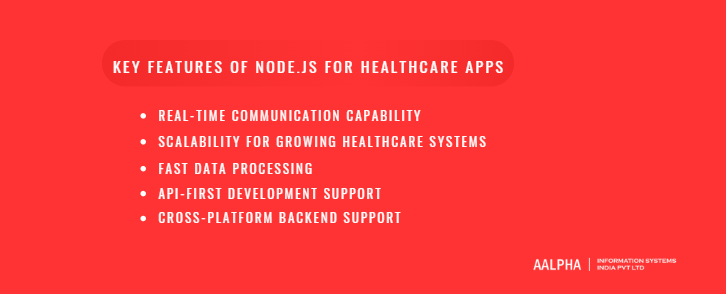
Real-Time Communication Capability
Real-time communication has become a fundamental component of digital healthcare delivery. Telemedicine platforms rely on instant interaction between patients and healthcare providers through video calls, live chat, and voice communication. Backend systems must process these interactions without latency to ensure uninterrupted consultations. Node.js supports such communication through its event-driven architecture, enabling seamless data exchange between participants.
Chat-based consultations are another growing area of digital healthcare. Many patient engagement platforms now allow individuals to communicate with clinicians asynchronously or in real time. Node.js enables these systems to handle simultaneous conversations without performance degradation. For example, a healthcare platform can manage multiple patient inquiries, prescription requests, and follow-up discussions concurrently.
Emergency response systems also depend heavily on real-time communication. Remote monitoring devices may detect abnormal vital signs that require immediate attention. Backend systems must process incoming alerts instantly and notify care teams without delay. Node.js processes such events as they occur, allowing healthcare providers to respond promptly to critical situations.
By supporting instant communication across multiple channels, Node.js enables healthcare applications to deliver responsive and reliable patient interactions.
-
Scalability for Growing Healthcare Systems
Healthcare organizations are expanding their digital infrastructure to support broader patient populations and remote care models. Hospital networks often operate across multiple facilities, requiring centralized systems that can handle large volumes of data and user interactions.
Node.js supports scalability through its lightweight execution model, allowing healthcare platforms to manage increasing workloads efficiently. Multi-location clinics, for instance, can rely on a single backend system to coordinate appointments, patient records, and billing processes across sites.
Remote care expansion further increases system demands. As telehealth services grow, backend infrastructure must accommodate more users, devices, and data streams. Node.js enables horizontal scaling, ensuring that applications can handle rising activity levels without compromising performance.
This scalability allows healthcare providers to expand digital services without requiring extensive backend restructuring.
-
Fast Data Processing
Healthcare applications frequently process time-sensitive data such as medical records and diagnostic results. Physicians require instant access to patient histories during consultations, and delays in retrieving this information can affect clinical decisions.
Node.js supports fast data processing through its asynchronous execution model. Requests for medical records can be handled alongside other system operations without causing bottlenecks.
Diagnostics integration also benefits from this capability. When laboratory results or imaging data are uploaded, the backend must process and synchronize them with patient profiles quickly. Node.js enables these updates to occur in near real time, ensuring that clinicians receive accurate and timely information.
This efficiency supports workflows where speed and accuracy are critical.
-
API-First Development Support
Healthcare systems rely on interoperability to function effectively. Electronic health records, insurance platforms, and pharmacy networks must exchange data seamlessly to support patient care and administrative processes.
Node.js facilitates API-first development, enabling healthcare applications to connect with external systems through standardized interfaces. EHR integrations allow clinicians to access comprehensive patient histories without manual data entry.
Insurance systems can be linked to verify coverage details or process claims automatically. Pharmacy networks may also be integrated to transmit prescriptions directly from healthcare providers.
This API-driven approach simplifies collaboration across the healthcare ecosystem and reduces operational friction.
-
Cross-Platform Backend Support
Modern healthcare applications must function across multiple platforms. Patients access services through mobile applications, clinicians rely on web dashboards, and wearable devices continuously transmit health metrics.
Node.js provides a unified backend capable of supporting these diverse interfaces. Mobile applications can retrieve patient data and schedule appointments without delays. Web dashboards enable clinicians to monitor patient progress and manage workflows in real time.
Wearable integrations further extend system capabilities by streaming vital data directly into healthcare platforms. Node.js processes these inputs efficiently, ensuring that monitoring systems remain responsive.
By supporting cross-platform functionality, Node.js enables healthcare applications to deliver consistent performance across devices and user environments.
Benefits of Using Node.js in Healthcare App Development
Healthcare applications must meet strict operational expectations while supporting growing patient demands and complex data environments. Backend technology plays a direct role in determining how effectively these systems function in real-world clinical settings. Node.js offers a range of practical benefits that align with the priorities of healthcare organizations, including performance, responsiveness, cost control, and ecosystem connectivity.
Modern healthcare platforms are expected to process data instantly, enable live communication, and support integration with multiple external systems. Node.js delivers these capabilities through its event-driven architecture and asynchronous processing model. By reducing delays and improving system responsiveness, it supports applications that depend on continuous interaction and real-time decision-making.
Beyond performance, Node.js also contributes to operational efficiency. Healthcare providers must manage infrastructure costs while expanding digital services. Backend frameworks that require fewer resources to scale provide a strategic advantage.
Patient experience is another key consideration. Applications must deliver seamless communication, timely updates, and intuitive access to services. Node.js supports these outcomes by enabling responsive interfaces and instant data synchronization.
Interoperability further strengthens its value. Healthcare ecosystems depend on integration between records systems, diagnostic tools, insurance platforms, and connected devices. Node.js simplifies these connections through API-driven architecture.
Collectively, these advantages make Node.js a strong candidate for healthcare applications that must balance performance, scalability, and integration.
-
Faster Application Performance
Healthcare applications must operate with minimal latency to ensure that clinical workflows are not disrupted. When a physician retrieves patient records or reviews diagnostic results, delays in system response can hinder decision-making. Node.js enhances application performance by processing requests asynchronously, allowing the system to handle multiple interactions without creating bottlenecks.
Reduced latency is particularly important in environments where real-time information is required. For instance, during a telemedicine consultation, clinicians may need immediate access to patient history or laboratory reports. Node.js ensures that these data requests are processed quickly, enabling smooth interaction between providers and patients.
Instant patient data updates also contribute to operational efficiency. When new information such as test results or treatment notes is added to a system, it must be synchronized across platforms without delay. Node.js supports rapid data propagation, ensuring that healthcare professionals work with the most current information available.
By minimizing response time and enabling quick data access, Node.js supports healthcare platforms that demand speed and reliability.
-
Real-Time Monitoring and Alerts
Continuous monitoring is becoming an integral part of healthcare delivery. Intensive care units rely on systems that track patient vitals in real time, allowing clinicians to detect anomalies promptly. Node.js supports these monitoring applications by processing incoming data streams without delay.
ICU monitoring systems must handle large volumes of sensor data while maintaining system responsiveness. Node.js enables these platforms to analyze inputs continuously and trigger alerts when abnormal patterns are detected. This allows care teams to intervene quickly when patient conditions change.
Chronic disease tracking is another area where real-time capability is essential. Patients managing conditions such as diabetes or cardiovascular disorders often use wearable devices that transmit health metrics regularly. Backend systems must process this data instantly to support timely adjustments in treatment plans.
Node.js facilitates these workflows by enabling healthcare platforms to respond to incoming information as it arrives. This improves the effectiveness of monitoring systems and supports proactive care management.
-
Cost Efficiency in Development and Scaling
Healthcare organizations must balance innovation with financial sustainability. Developing and maintaining digital platforms can be resource-intensive, particularly when separate technologies are required for different system components.
Node.js offers cost advantages through its single language stack. Developers can use JavaScript for both frontend and backend development, reducing complexity and streamlining project workflows. This approach minimizes development time and simplifies system maintenance.
Reduced infrastructure load further contributes to cost efficiency. Node.js uses fewer system resources compared to thread-based backend frameworks, allowing applications to support more users without requiring extensive hardware investment.
These efficiencies enable healthcare providers to expand digital capabilities while maintaining manageable operational costs.
-
Improved Patient Experience
Patient engagement is increasingly shaped by digital interactions. Applications that provide instant communication and responsive services contribute to higher satisfaction and better care continuity.
Node.js supports instant communication between patients and healthcare providers through real-time messaging and consultation platforms. Whether scheduling appointments or seeking medical advice, patients benefit from systems that respond quickly.
Faster services also enhance overall experience. Tasks such as accessing health records, receiving notifications, or updating personal information must be completed without delays. Node.js enables these interactions to occur smoothly, improving usability and accessibility.
By supporting responsive digital interfaces, Node.js helps healthcare applications deliver services that align with patient expectations.
-
Seamless Integration with Healthcare Ecosystem
Healthcare delivery depends on collaboration between multiple systems. Electronic health records, laboratory platforms, insurance providers, and IoT-based monitoring devices must exchange data efficiently.
Node.js simplifies integration through API-based communication. EHR systems can be connected to ensure that patient data is accessible across clinical workflows. IoT devices such as wearable monitors can transmit health metrics directly to care platforms.
Laboratory systems may also be integrated to synchronize diagnostic results with patient profiles. Insurance platforms can verify coverage details and support administrative processes.
By enabling seamless connectivity across the healthcare ecosystem, Node.js supports coordinated care and streamlined operations.
Use Cases of Node.js in Healthcare Applications
The practical value of any backend technology becomes evident through its real-world application. In healthcare, digital platforms must support continuous interaction, real-time monitoring, and large-scale data exchange across multiple stakeholders. Node.js enables these capabilities through its event-driven architecture and asynchronous execution model. Its ability to handle concurrent processes efficiently makes it suitable for use cases where responsiveness and scalability are essential.
Healthcare organizations are adopting digital platforms not only to improve operational workflows but also to enhance patient outcomes. Systems that support virtual consultations, continuous monitoring, automated communication, and intelligent diagnostics require backend frameworks capable of managing high volumes of simultaneous activity. Node.js provides the infrastructure needed to power these applications without compromising performance.
Below are key healthcare use cases where Node.js demonstrates strong suitability.
-
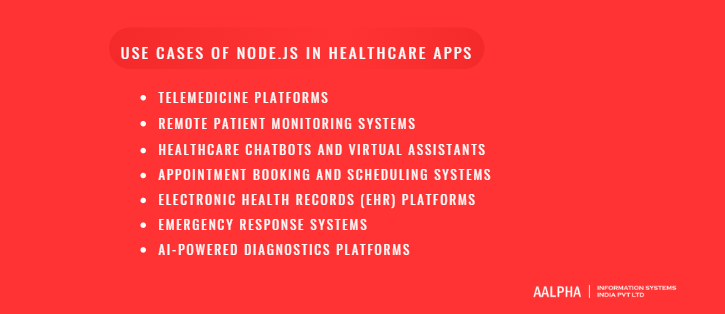
Telemedicine Platforms
Telemedicine platforms depend on seamless communication between patients and healthcare providers. These systems must support video consultations, real-time messaging, and secure data exchange without delays. Node.js enables these interactions by processing multiple communication streams simultaneously.
During virtual consultations, clinicians may access patient histories, review diagnostic reports, and communicate with support staff while interacting with patients. Node.js ensures that these concurrent activities occur without affecting system responsiveness.
Telemedicine platforms also require synchronization between scheduling systems, prescription services, and electronic records. Node.js supports this interconnected workflow through API-driven architecture, allowing different components to function cohesively.
Scalability is another critical factor. As telemedicine adoption grows, platforms must handle increasing numbers of users without performance degradation. Node.js supports horizontal scaling, enabling healthcare providers to expand digital services efficiently.
By facilitating real-time communication and system integration, Node.js provides a strong foundation for telemedicine applications.
-
Remote Patient Monitoring Systems
Remote patient monitoring systems rely on continuous data transmission from wearable devices and medical sensors. These platforms track vital metrics such as heart rate, blood pressure, and glucose levels, enabling clinicians to monitor patients outside clinical settings.
Node.js processes incoming data streams in real time, allowing healthcare platforms to detect anomalies promptly. For instance, if a monitoring device identifies abnormal readings, the system can trigger alerts instantly.
These systems often manage data from multiple patients simultaneously. Node.js handles concurrent inputs efficiently, ensuring that monitoring applications remain responsive even during peak activity.
Integration with clinical workflows is also essential. Monitoring data must be synchronized with patient records and treatment plans. Node.js supports this through API-based connectivity, enabling seamless data exchange across platforms.
This capability supports proactive care management and improves patient safety.
-
Healthcare Chatbots and Virtual Assistants
Healthcare chatbots and virtual assistants are increasingly used to enhance patient engagement and streamline administrative tasks. These tools assist with appointment inquiries, medication reminders, and basic health guidance.
Node.js supports real-time conversational interfaces that can manage multiple user interactions simultaneously. This ensures that patients receive timely responses without delays.
Virtual assistants may also integrate with backend systems to retrieve patient data or update records. Node.js facilitates these integrations, allowing chatbots to function as interactive extensions of healthcare platforms.
By enabling responsive communication and system connectivity, Node.js supports digital assistants that improve service accessibility.
-
Appointment Booking and Scheduling Systems
Efficient scheduling is critical for healthcare operations. Digital appointment systems must coordinate patient requests, clinician availability, and facility resources.
Node.js processes scheduling interactions concurrently, allowing platforms to handle multiple booking requests without delays. Patients can view available time slots, confirm appointments, and receive updates in real time.
Integration with notification systems further enhances functionality. Automated reminders can reduce missed appointments and improve workflow efficiency.
Node.js supports these features through asynchronous processing, ensuring that scheduling platforms remain responsive even during high demand.
-
Electronic Health Records (EHR) Platforms
Electronic health records form the backbone of digital healthcare infrastructure. These systems store patient histories, diagnostic results, and treatment plans.
Node.js enables efficient access to these records by processing data requests without blocking other operations. Clinicians can retrieve information instantly while updating patient profiles simultaneously.
EHR platforms must also integrate with laboratories, pharmacies, and insurance providers. Node.js supports these connections through API-driven architecture.
By enabling quick data retrieval and seamless integration, Node.js supports EHR platforms that enhance clinical decision-making.
-
Emergency Response Systems
Emergency response systems require immediate processing of critical information. Alerts from monitoring devices or patient requests must be handled without delay.
Node.js processes incoming signals in real time, allowing systems to notify care teams promptly. This capability is particularly valuable in remote monitoring scenarios where rapid intervention may be necessary.
Integration with communication tools ensures that emergency notifications reach appropriate stakeholders quickly.
Node.js supports these workflows by enabling instant data processing and alert delivery.
-
AI-powered Diagnostics Platforms
AI-driven diagnostic platforms analyze medical data to assist clinicians in decision-making. These systems process imaging results, laboratory data, and patient histories.
Node.js supports the data exchange required for AI analysis by enabling efficient integration with external processing engines. Diagnostic results can be retrieved and updated in real time.
This capability enhances the effectiveness of AI-assisted healthcare tools by ensuring timely access to analytical insights.
Node.js for Real-Time Healthcare Applications
Real-time capability has become a defining requirement in modern healthcare systems. Digital platforms are no longer limited to storing patient records or facilitating administrative tasks. They are now expected to support continuous monitoring, instant communication, and live data exchange between multiple stakeholders. Backend technologies must therefore process information as it is generated rather than in delayed batches.
Node.js is particularly suited for these real-time environments due to its event-driven architecture and non-blocking execution model. Healthcare applications often involve simultaneous interactions such as patient monitoring, clinician consultations, device data transmission, and system alerts. Traditional backend frameworks may struggle to process these interactions without creating delays or performance bottlenecks. Node.js enables systems to handle multiple incoming events efficiently, ensuring that healthcare platforms remain responsive even during peak activity.
In real-time healthcare scenarios, the speed at which data is processed can influence clinical outcomes. Monitoring systems must detect anomalies instantly, alerts must reach care teams without delay, and medical data must be accessible when decisions are being made. Node.js supports these requirements by processing events continuously rather than sequentially.
Additionally, healthcare platforms frequently involve collaboration between multiple users such as physicians, nurses, patients, and administrative staff. Backend systems must coordinate these interactions without compromising performance. Node.js provides a scalable environment that supports concurrent activity, allowing healthcare applications to function smoothly across distributed care settings.
By enabling live monitoring, instant notifications, and multi-user interaction, Node.js supports healthcare applications that depend on real-time responsiveness.
-
Live Patient Monitoring
Live patient monitoring systems are designed to track vital signs continuously through connected devices such as wearable sensors and medical equipment. These systems generate a steady stream of data that must be processed instantly to detect potential health risks.
Node.js enables healthcare platforms to receive and analyze this data in real time. For example, if a patient’s heart rate or oxygen levels deviate from expected ranges, the system can identify these changes immediately.
In clinical environments such as intensive care units, monitoring systems must handle multiple data inputs simultaneously. Node.js supports concurrent processing, ensuring that information from different patients is managed efficiently.
Remote monitoring scenarios also benefit from this capability. Patients managing chronic conditions often rely on wearable devices that transmit health metrics regularly. Node.js processes these inputs without delay, allowing healthcare providers to maintain continuous oversight.
This ability to support live monitoring enhances patient safety and enables timely intervention.
-
Real-Time Notifications and Alerts
Timely communication is essential in healthcare operations. Monitoring systems, appointment platforms, and treatment workflows often generate alerts that require immediate attention.
Node.js supports real-time notification systems by processing events as they occur. For instance, if a monitoring device detects abnormal readings, the system can trigger alerts to clinicians without delay.
Appointment reminders and medication notifications also benefit from this capability. Patients receive updates promptly, improving adherence to treatment plans.
By enabling instant alert delivery, Node.js helps healthcare applications maintain effective communication between patients and providers.
-
Multi-User Healthcare Systems
Healthcare platforms typically involve multiple users interacting with the system simultaneously. Physicians may access patient records while nurses update treatment notes and patients review their health data.
Node.js supports these concurrent interactions through its asynchronous processing model. Instead of allocating separate threads for each user, it manages requests efficiently within a single event loop.
This approach ensures that system performance remains stable even when multiple stakeholders are active.
Such capability is particularly valuable in hospital environments where coordination between teams is critical.
-
Streaming Medical Data
Streaming medical data is increasingly common in connected healthcare environments. Wearable devices and diagnostic tools transmit continuous information that must be processed without interruption.
Node.js handles these data streams efficiently by enabling non-blocking input processing. This ensures that healthcare platforms can receive and update information continuously.
By supporting uninterrupted data flow, Node.js enables applications to maintain accurate and up-to-date patient information.
Cost Advantages of Using Node.js in Healthcare Development
Healthcare organizations must invest in digital systems that support performance, regulatory compliance, and scalability while maintaining financial sustainability. Backend technology selection directly influences development timelines, infrastructure requirements, long-term maintenance, and overall healthcare app development cost. Node.js offers measurable cost advantages that align with the needs of healthcare providers seeking to expand digital capabilities without increasing operational overhead.
Modern healthcare platforms often involve complex integrations, real-time monitoring features, and multi-user access environments. Building such systems using traditional backend frameworks can require separate development resources and higher infrastructure investment. Node.js reduces these burdens through architectural efficiency and resource optimization.
By enabling faster development cycles, minimizing hardware demands, and simplifying ongoing system management, Node.js supports healthcare platforms that balance innovation with cost control.
-
Development Cost Efficiency
Node.js enables cost-effective development through its unified programming environment. Since JavaScript can be used across both frontend and backend components, healthcare organizations can streamline development workflows without relying on multiple technology stacks.
This approach reduces the need for specialized resources and simplifies collaboration across development teams. Projects can progress more efficiently, leading to shorter development timelines.
Healthcare applications often require integration with external systems such as electronic records or diagnostic platforms. Node.js supports API-based communication that simplifies these integrations, reducing implementation complexity.
By enabling efficient development processes, Node.js helps healthcare providers bring digital solutions to market faster while managing project costs effectively.
-
Infrastructure Savings
Node.js uses fewer system resources compared to thread-based backend frameworks. Its event-driven architecture allows applications to handle high volumes of concurrent users without requiring extensive hardware capacity.
Healthcare platforms supporting telemedicine, monitoring, and scheduling must accommodate fluctuating demand. Node.js enables these systems to scale efficiently without significant infrastructure expansion.
This reduces hosting costs and allows healthcare providers to maintain stable performance with optimized resource utilization.
-
Long-Term Maintenance Benefits
Maintaining healthcare applications requires ongoing updates, integrations, and performance optimization. Node.js simplifies these tasks through its modular ecosystem and consistent technology stack.
Updates can be implemented without disrupting system functionality, reducing downtime and operational impact.
As healthcare platforms evolve to support new services, Node.js enables incremental enhancements without extensive redevelopment.
These factors contribute to lower long-term app maintenance costs and support sustainable digital growth.
Challenges of Using Node.js in Healthcare and How to Address Them
While Node.js offers significant performance and scalability benefits for healthcare applications, it is important to recognize that no backend technology is without limitations. Healthcare platforms operate in demanding environments that involve high computational workloads, extensive datasets, and strict security requirements. Understanding these challenges and implementing appropriate architectural strategies ensures that Node.js can be used effectively without compromising system performance or compliance.
Healthcare applications often extend beyond simple real-time communication. They may include diagnostic processing, medical imaging analysis, and predictive analytics that require substantial computational power. Additionally, healthcare platforms must manage large volumes of structured and unstructured data generated by electronic records, monitoring devices, and clinical systems. Security considerations further add complexity, as healthcare data is subject to stringent privacy regulations.
Addressing these challenges involves adopting the right architectural practices rather than relying solely on the runtime itself. Node.js can perform effectively in healthcare environments when supported by appropriate system design and integration strategies.
-
Handling Complex CPU Tasks
Node.js is optimized for input and output operations rather than CPU-intensive processing. Tasks such as image analysis, large-scale predictive modeling, or complex clinical calculations may require substantial computational resources.
In healthcare applications, these workloads can be managed by separating compute-heavy operations from the main application layer. Node.js can function as an orchestration layer that communicates with specialized processing services designed for intensive tasks.
This approach ensures that real-time responsiveness is maintained while computational workloads are handled efficiently.
-
Managing Large Medical Data Sets
Healthcare platforms must store and process vast amounts of patient data, including medical histories, diagnostic reports, and monitoring records. Managing these datasets efficiently requires backend systems capable of handling high data throughput.
Node.js can address this challenge by leveraging distributed data management strategies. Instead of relying on a single storage layer, healthcare applications can integrate scalable databases and data pipelines.
By enabling asynchronous data handling, Node.js ensures that large datasets can be processed without blocking system operations.
-
Security Implementation
Healthcare applications must comply with strict data protection standards. Implementing robust security measures is essential to safeguard patient information and maintain regulatory compliance.
Node.js supports secure communication through encrypted data exchange and authentication mechanisms. However, effective security implementation requires careful configuration and adherence to best practices.
Access controls, audit logging, and secure API integrations must be incorporated into system design. Healthcare platforms should also implement continuous monitoring to detect potential vulnerabilities.
By combining Node.js capabilities with comprehensive security strategies, healthcare organizations can build applications that protect sensitive data while maintaining operational efficiency.
How to Choose the Right Development Partner for Node.js Healthcare Apps
Selecting the right healthcare app development partner is one of the most important decisions when building healthcare applications powered by Node.js. While the technology itself provides strong capabilities for real-time performance and scalability, successful implementation depends heavily on the expertise of the team designing and deploying the system.
Healthcare applications operate in a regulated, data-sensitive environment where performance failures or security gaps can have serious consequences. A development partner must therefore bring more than technical proficiency. They must understand clinical workflows, patient engagement requirements, and the operational realities of healthcare organizations.
Node.js healthcare platforms often involve complex integrations, live data processing, and continuous system evolution. Choosing a partner with relevant domain knowledge and architectural experience ensures that these applications are designed to meet both current needs and future growth.
Organizations should evaluate development partners across four key dimensions.
-
Healthcare Domain Experience
Healthcare software differs significantly from applications in other industries. It must support patient-centric workflows, clinical decision-making, and compliance requirements.
A development partner with healthcare domain experience understands the importance of reliability, interoperability, and user accessibility. They are familiar with integrating systems such as electronic health records, laboratory platforms, and patient engagement tools.
This knowledge helps ensure that Node.js applications are aligned with real-world healthcare operations rather than built solely from a technical perspective.
-
Real-Time System Expertise
Node.js is particularly effective for applications that depend on real-time communication and continuous data exchange. However, leveraging this capability requires experience in designing systems that manage live interactions efficiently.
A capable development partner should have expertise in building platforms that support concurrent users, instant notifications, and streaming data.
This is especially relevant for telemedicine solutions, monitoring systems, and collaborative healthcare platforms where responsiveness is critical.
-
Security-first Development Approach
Healthcare applications must safeguard sensitive patient information and comply with regulatory standards.
A development partner should prioritize secure architecture, including authentication mechanisms, encrypted data exchange, and access control systems.
Security should be integrated into the development process from the outset rather than added later.
-
Long-Term Support and Scalability
Healthcare platforms must evolve alongside changing patient needs and technological advancements.
A reliable partner should provide ongoing support and design systems that can scale as demand increases.
Organizations working with experienced healthcare-focused development firms such as Aalpha often benefit from this combination of domain understanding and technical capability, ensuring that Node.js applications remain sustainable and adaptable over time.
Final Thoughts
Node.js has established itself as a strong backend foundation for modern healthcare applications that depend on real-time interaction, continuous data processing, and scalable system architecture. From telemedicine platforms to remote monitoring and AI-assisted diagnostics, its event-driven model supports the responsiveness and efficiency required in clinical environments. As healthcare organizations expand digital services, selecting the right technology stack becomes a strategic decision that influences performance, patient experience, and long-term operational sustainability.
Building a reliable healthcare platform is not only about choosing the right framework but also about implementing it with the right expertise. If you are planning to develop a scalable, real-time healthcare solution powered by Node.js, partnering with an experienced team can accelerate development while ensuring security, compliance, and future readiness.
Aalpha brings proven expertise in developing healthcare-grade applications designed for performance, interoperability, and growth. Connect with Aalpha to explore how your healthcare platform can be built for real-world impact and long-term success.