


Medical scribe software has become a critical component in modern healthcare delivery, addressing one of the most persistent challenges in clinical practice: excessive documentation. Physicians today spend a significant portion of their time entering data into electronic health records (EHRs), often at the expense of patient interaction. This shift has created a demand for intelligent systems that can capture, structure, and generate clinical notes automatically during or after patient encounters.
At its core, medical scribe software refers to digital solutions designed to document patient visits in real time or near real time. These systems leverage technologies such as speech recognition, natural language processing (NLP), and machine learning to convert conversations between doctors and patients into structured medical records. Instead of manually typing notes, clinicians can rely on automated systems to produce accurate documentation aligned with clinical standards such as SOAP (Subjective, Objective, Assessment, Plan) formats.
The relevance of this technology is increasing as healthcare systems worldwide adopt electronic records and push for efficiency, compliance, and improved patient outcomes. Many clinicians now ask whether it is possible to reduce documentation time without compromising accuracy. Medical scribe software answers this by enabling hands-free documentation, reducing administrative burden, and improving workflow efficiency. As a result, it is not just a convenience tool but a strategic investment for hospitals, clinics, and telehealth platforms aiming to scale operations while maintaining quality care.
What is Medical Scribe Software?
Medical scribe software is a digital system designed to automatically capture and generate clinical documentation from doctor-patient interactions. Traditionally, medical scribes were human assistants who listened to consultations and entered notes into EHR systems. Today, this function is increasingly performed by AI-powered software capable of understanding medical conversations and converting them into structured clinical records.
Modern medical scribe solutions typically combine three core technologies. First, speech-to-text engines transcribe spoken dialogue in real time. Second, natural language processing models analyze the transcribed text to identify medical entities such as symptoms, diagnoses, medications, and procedures. Third, clinical documentation engines organize this information into standardized formats used in healthcare systems.
For example, during a consultation, a physician might discuss symptoms, medical history, and treatment plans with a patient. Medical scribe software listens to this interaction, extracts relevant information, and automatically generates a structured note that can be directly uploaded into the EHR. This process eliminates the need for manual data entry and reduces the risk of incomplete or inconsistent documentation.
AI-powered medical scribes go beyond simple transcription. They understand context, differentiate between clinically relevant and irrelevant information, and adapt to different specialties such as cardiology, dermatology, or general practice. This capability makes them significantly more efficient than traditional dictation tools, which require manual editing and formatting.
Why Healthcare Needs Medical Scribe Solutions
Healthcare systems face a growing documentation burden driven by regulatory requirements, billing standards, and the widespread adoption of EHRs. Studies have shown that physicians can spend nearly half of their workday on administrative tasks, with documentation being the largest contributor. This imbalance has led to increased stress, reduced productivity, and a measurable decline in job satisfaction among clinicians.
One of the most widely discussed consequences is physician burnout. When doctors are required to complete extensive documentation after hours, often referred to as “pajama time,” it affects both their personal well-being and professional performance. Many clinicians actively look for ways to reduce documentation workload while maintaining compliance and accuracy. Medical scribe software directly addresses this issue by automating the most time-consuming aspects of clinical documentation.
Another key challenge is inefficiency in traditional documentation workflows. Manual note-taking is prone to errors, inconsistencies, and delays. In busy clinical environments, incomplete documentation can impact patient care, billing accuracy, and legal compliance. Automated scribe solutions standardize documentation, ensuring that notes are complete, structured, and aligned with clinical guidelines.
There is also a financial dimension to consider. Hiring human scribes involves recurring costs, training, and management overhead. In contrast, software-based solutions offer scalability, allowing healthcare providers to handle higher patient volumes without proportionally increasing staffing costs. This makes medical scribe software particularly attractive for large hospitals, multi-specialty clinics, and telemedicine platforms.
Types of Medical Scribes: Human vs AI-Based
Medical scribing can be broadly categorized into two types: human scribes and AI-based scribe systems. Each approach has distinct advantages and limitations, and understanding the differences is essential when evaluating solutions.
Human medical scribes are trained professionals who assist physicians by documenting patient encounters in real time. They can work on-site or remotely and are capable of understanding complex clinical nuances. Their primary strength lies in their ability to interpret context and adapt to individual physician preferences. However, human scribes come with limitations, including high operational costs, limited scalability, and variability in performance depending on training and experience.
AI-based medical scribes, on the other hand, rely on advanced algorithms to automate documentation. These systems can process conversations continuously, generate structured notes instantly, and integrate directly with EHR platforms. Unlike human scribes, AI solutions are highly scalable and can operate 24/7 without additional staffing requirements. They also provide consistent output, reducing variability in documentation quality.
However, AI-based systems are not without challenges. Accuracy depends on the quality of training data, and handling complex medical conversations with multiple speakers or background noise can still be difficult in some scenarios. Despite these limitations, rapid advancements in machine learning and speech recognition are closing the gap between human and AI performance.
In practice, many healthcare providers adopt hybrid models that combine AI automation with human review to ensure accuracy and compliance. This approach offers a balance between efficiency and reliability, making it a practical choice for organizations transitioning to fully automated documentation systems.
Market Overview and Industry Demand
The medical scribe software market sits at the intersection of two rapidly expanding sectors: healthcare IT and artificial intelligence. As healthcare systems digitize patient records and adopt automation technologies, the demand for intelligent clinical documentation solutions has accelerated significantly. What was once a niche service supported by human scribes has evolved into a high-growth technology segment driven by AI, cloud computing, and real-time data processing.
Healthcare organizations are increasingly asking whether clinical documentation can be automated without compromising accuracy or compliance. The answer is shaping a new category of software products focused on ambient listening, real-time transcription, and automated note generation. This shift is not incremental but structural. It reflects broader changes in how healthcare is delivered, with an emphasis on efficiency, scalability, and clinician well-being.
From large hospital networks to telehealth startups, investment in medical scribe technology is rising due to its direct impact on productivity and cost optimization. The market is also attracting significant venture capital, signaling strong confidence in long-term adoption. As a result, medical scribe software is no longer viewed as a support tool but as a core component of digital healthcare infrastructure.
Global Market Size and Growth Projections
The global market for medical scribe software, particularly AI-driven solutions, is experiencing rapid expansion. Estimates suggest that the AI medical scribe software market was valued at approximately $1.1–1.4 billion in 2024 and is projected to grow to $7.8–9.2 billion by 2033, reflecting a compound annual growth rate (CAGR) exceeding 20%. (Dataintelo)
This growth trajectory aligns with broader trends in healthcare AI adoption. The global artificial intelligence in healthcare market was valued at $36.67 billion in 2025 and is expected to reach over $505 billion by 2033, growing at an annual rate of nearly 39%. (Grand View Research) This indicates that medical scribe software is part of a much larger transformation where AI is embedded across diagnostics, treatment planning, and administrative workflows.
Adjacent markets further validate this momentum. For instance, the medical transcription software market is projected to grow from around $2.9 billion in 2025 to over $7.6 billion by 2032, driven by the need for accurate and automated clinical documentation. (Persistence Market Research)
Key Drivers of Medical Scribe Adoption
One of the most significant drivers of medical scribe software adoption is the increasing burden of electronic health records (EHRs). Physicians are required to document every patient interaction in detail to meet regulatory, billing, and compliance requirements. This has created a situation where clinicians spend a disproportionate amount of time on administrative tasks rather than patient care.
Research indicates that AI scribes can reduce documentation time per appointment and overall EHR interaction time, directly addressing this inefficiency. (Forbes) Even small time savings per consultation scale significantly across hundreds of patient visits, improving both productivity and clinician satisfaction.
Another major factor is the growing shortage of healthcare professionals. Hospitals and clinics face staffing constraints, making it difficult to rely solely on human scribes. AI-based solutions provide a scalable alternative that can operate continuously without the limitations of human resources.
Compliance requirements also play a critical role. Healthcare providers must adhere to strict documentation standards for legal and billing purposes. Automated scribe systems ensure that clinical notes are complete, structured, and aligned with regulatory frameworks, reducing the risk of audits or reimbursement issues.
Finally, the rise of telemedicine has accelerated adoption. As virtual consultations become more common, the need for real-time, automated documentation tools has increased. Medical scribe software integrates seamlessly into telehealth workflows, capturing and structuring patient interactions without additional manual effort.
Challenges in Traditional Medical Scribing
Traditional medical scribing, while effective in certain contexts, presents several limitations that hinder scalability and efficiency. One of the most prominent challenges is cost. Hiring, training, and managing human scribes involves ongoing operational expenses, which can become significant for large healthcare organizations.
Scalability is another critical issue. Human scribes cannot easily adapt to fluctuations in patient volume or expanding healthcare networks. As demand increases, organizations must hire more personnel, leading to logistical complexities and increased costs.
Human error also remains a concern. Even well-trained scribes can misinterpret medical terminology, miss critical details, or introduce inconsistencies in documentation. These errors can have downstream effects on patient care, billing accuracy, and compliance.
In addition, reliance on human scribes introduces variability in documentation quality. Different scribes may follow different styles or levels of detail, making it difficult to maintain standardized clinical records across an organization. These challenges have created a strong case for transitioning to automated, AI-driven solutions.
Emerging Trends: AI, Voice Recognition, Ambient Computing
The future of medical scribe software is being shaped by several technological advancements, particularly in artificial intelligence and voice-based interfaces. One of the most important developments is ambient computing, where systems passively listen to doctor-patient interactions and generate documentation without requiring explicit input from clinicians.
Industry forecasts suggest that a significant portion of healthcare providers are already experimenting with ambient scribe technologies, with adoption expected to expand rapidly across clinical settings. These systems represent a shift from active data entry to passive, automated documentation.
Voice recognition technology has also improved significantly, enabling accurate transcription even in complex clinical environments. Combined with natural language processing, these systems can identify medical entities, extract key insights, and generate structured notes in real time.
Another emerging trend is the integration of AI scribes with broader healthcare workflows, including billing, coding, and clinical decision support. Instead of functioning as standalone tools, modern solutions are becoming part of end-to-end healthcare automation platforms.
Finally, continuous learning models are enhancing accuracy over time. AI systems are trained on large datasets of clinical interactions, allowing them to adapt to different specialties, accents, and workflows. This evolution is closing the gap between human and machine performance, making AI-based medical scribe software a viable long-term solution for healthcare organizations worldwide.
How Medical Scribe Software Works
Understanding how medical scribe software operates is essential for evaluating its practical value in clinical environments. At a high level, these systems transform unstructured conversations between clinicians and patients into structured, standardized medical documentation. This transformation involves multiple layers of processing, including audio capture, transcription, natural language understanding, clinical structuring, and integration with electronic health record (EHR) systems.
Modern medical scribe platforms are designed to fit seamlessly into clinical workflows without disrupting the natural interaction between doctors and patients. Instead of requiring physicians to dictate notes separately or manually input data, the software operates in the background, capturing relevant information and organizing it into clinically meaningful formats. This approach enables clinicians to focus entirely on patient care while ensuring that documentation is accurate, complete, and compliant.
-
End-to-End Workflow
The end-to-end workflow of medical scribe software begins during the patient consultation. As the doctor and patient interact, the system captures audio through a microphone, mobile device, or integrated telehealth platform. This audio stream becomes the primary input for the entire documentation process.
Once captured, the audio is processed by a speech recognition engine that converts spoken language into text in real time or near real time. This raw transcription includes all elements of the conversation, including symptoms, medical history, observations, and treatment discussions. However, at this stage, the data is still unstructured and requires further processing.
The next step involves natural language processing, where the system analyzes the transcribed text to identify clinically relevant information. It distinguishes between important medical details and general conversation, extracts entities such as symptoms, diagnoses, medications, and procedures, and understands the context in which they are mentioned.
After extracting relevant information, the system organizes the data into structured clinical notes. These notes are typically formatted according to established medical documentation standards such as SOAP (Subjective, Objective, Assessment, Plan) or specialty-specific templates. The software ensures that all required fields are completed and that the documentation aligns with clinical and billing requirements.
Finally, the generated note is reviewed, either automatically or by the clinician, and then pushed into the EHR system. In some implementations, the process is fully automated, while in others, clinicians can make quick edits before finalizing the record. This entire workflow, from conversation to structured note, can occur within minutes, significantly reducing the time spent on documentation.
-
Speech-to-Text and NLP Processing
The core technologies behind medical scribe software are speech-to-text transcription and natural language processing. Together, they enable the system to convert spoken clinical conversations into meaningful, structured data.
Speech-to-text engines are responsible for transcribing audio into text. These systems are trained on large datasets and optimized for medical vocabulary, allowing them to recognize complex terminology, drug names, and clinical phrases. Advanced models can handle variations in accents, speaking speeds, and background noise, which are common in real-world clinical environments.
However, transcription alone is not sufficient for clinical documentation. This is where natural language processing plays a critical role. NLP models analyze the transcribed text to understand its meaning and context. For example, the system must differentiate between a patient’s current symptoms and past medical history, or between a confirmed diagnosis and a suspected condition.
Medical NLP systems perform several key functions. They identify and extract medical entities such as symptoms, diagnoses, medications, and procedures. They also determine relationships between these entities, such as linking a medication to a specific condition. Additionally, they filter out irrelevant information, ensuring that only clinically meaningful data is included in the final note.
More advanced systems incorporate contextual understanding, enabling them to interpret nuanced conversations and generate coherent summaries. This capability allows the software to move beyond basic transcription and deliver structured documentation that aligns with clinical workflows and standards.
-
Integration with EHR Systems
Integration with electronic health record systems is a critical component of medical scribe software. Without seamless integration, the value of automated documentation is significantly reduced, as clinicians would still need to manually transfer information into their existing systems.
Modern medical scribe solutions use standardized healthcare interoperability frameworks such as FHIR (Fast Healthcare Interoperability Resources) and HL7 to communicate with EHR platforms. These standards enable secure and structured data exchange between systems, ensuring compatibility with widely used EHR solutions such as Epic, Cerner, and Athenahealth.
Once the clinical note is generated, the software maps the structured data to the appropriate fields within the EHR. For example, patient history, examination findings, diagnoses, and treatment plans are automatically placed in their respective sections. This eliminates the need for manual data entry and reduces the risk of errors or omissions.
In addition to note generation, some systems also support coding and billing integration. They can suggest medical codes based on the documented information, further streamlining administrative workflows. Secure authentication and compliance mechanisms are built into the integration process to ensure that patient data remains protected and meets regulatory requirements such as HIPAA.
-
Real-Time vs Post-Visit Documentation
Medical scribe software can operate in two primary modes: real-time documentation and post-visit documentation. Each approach has its own advantages and is suited to different clinical workflows.
Real-time documentation involves capturing and processing information during the patient consultation. The system generates notes instantly, allowing clinicians to review and finalize them immediately after the visit. This approach minimizes delays and ensures that documentation is completed while the interaction is still fresh in the clinician’s memory.
Post-visit documentation, on the other hand, processes recorded audio after the consultation has ended. The system generates structured notes that clinicians can review at a later time. While this approach may introduce a slight delay, it can be useful in environments where real-time processing is not feasible due to technical or workflow constraints.
Increasingly, healthcare providers prefer real-time solutions because they reduce after-hours work and improve overall efficiency. However, hybrid models that combine both approaches are also common, offering flexibility based on specific use cases and operational requirements.
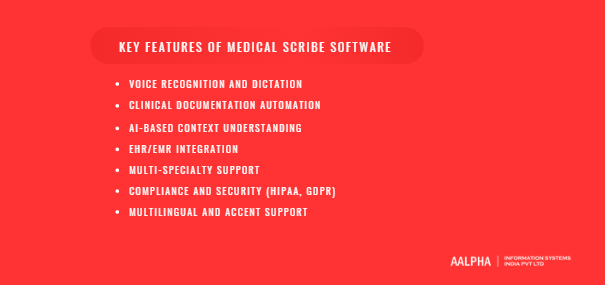
Key Features of Medical Scribe Software
Selecting or building medical scribe software requires a clear understanding of the features that directly impact clinical efficiency, accuracy, and compliance. Unlike generic transcription tools, medical scribe systems must operate within complex healthcare environments where precision, interoperability, and security are non-negotiable. Decision-makers often evaluate whether a solution can handle real-world clinical variability, integrate with existing systems, and scale across multiple specialties without compromising performance.
The most effective platforms combine advanced speech recognition, contextual AI, structured documentation, and seamless EHR integration. They are designed not only to capture conversations but to understand clinical intent and convert it into usable medical records. Each feature plays a specific role in ensuring that the software aligns with physician workflows and regulatory requirements.
-
Voice Recognition and Dictation
Voice recognition is the foundation of medical scribe software. It enables the system to convert spoken conversations into text with high accuracy, even in complex clinical environments. Unlike standard speech recognition tools, medical-grade systems are trained on specialized vocabularies that include medical terminology, drug names, abbreviations, and procedural language.
Accuracy is critical because even minor transcription errors can affect diagnosis, treatment, or billing. Advanced systems use deep learning models that continuously improve based on usage patterns and domain-specific datasets. Many platforms achieve accuracy rates exceeding 90% in controlled environments, though real-world performance depends on factors such as audio quality and speaker clarity.
Noise handling is another essential capability. Clinical settings often involve background noise, multiple speakers, and interruptions. High-quality medical scribe software incorporates noise reduction algorithms and speaker separation techniques to distinguish between the physician and patient. This ensures that the transcription remains clear and contextually accurate.
Dictation features also allow physicians to add or correct information using voice commands. This flexibility ensures that clinicians can maintain control over documentation without reverting to manual typing, preserving both efficiency and accuracy.
-
Clinical Documentation Automation
Clinical documentation automation is the core value proposition of medical scribe software. It transforms raw transcriptions into structured medical notes that align with standardized formats used across healthcare systems. The most commonly used structure is SOAP, which organizes information into Subjective, Objective, Assessment, and Plan sections.
Automated systems extract relevant details from conversations and populate these sections without requiring manual input. For example, patient-reported symptoms are categorized under Subjective, while clinical observations and test results are placed under Objective. The system then generates an Assessment based on the identified conditions and outlines a Plan that includes treatments, prescriptions, or follow-up actions.
Templates play a crucial role in this process. Medical scribe software often includes customizable templates tailored to specific specialties or clinical workflows. These templates ensure consistency in documentation and reduce variability across different providers.
Automation also improves completeness. The system can prompt for missing information or ensure that required fields are filled, which is particularly important for compliance and billing. By standardizing documentation, healthcare organizations can reduce errors, improve coding accuracy, and streamline administrative processes.
-
AI-Based Context Understanding
One of the most advanced features of modern medical scribe software is AI-based context understanding. Unlike basic transcription tools, these systems are designed to interpret the meaning behind conversations, not just convert speech into text.
Medical entity recognition is a key component of this capability. The software identifies and extracts clinically relevant entities such as symptoms, diagnoses, medications, allergies, and procedures. For example, when a patient mentions chest pain and shortness of breath, the system recognizes these as symptoms and associates them with potential conditions.
Intent detection further enhances accuracy by understanding the purpose of each statement. The system distinguishes between different contexts, such as whether a condition is part of the patient’s medical history, a current complaint, or a suspected diagnosis. This distinction is critical for generating accurate clinical notes.
Advanced models also analyze relationships between entities. For instance, they can link a prescribed medication to a specific diagnosis or identify follow-up instructions related to a treatment plan. This level of contextual understanding enables the software to generate coherent, clinically meaningful documentation rather than fragmented text.
Over time, these systems improve through continuous learning, adapting to specific specialties, physician preferences, and regional medical practices. This adaptability is essential for achieving high accuracy in diverse clinical environments.
-
EHR/EMR Integration
Seamless integration with electronic health record (EHR) and electronic medical record (EMR) systems is a critical requirement for medical scribe software. Without integration, the benefits of automated documentation are significantly reduced, as clinicians would still need to manually transfer data into their primary systems.
Modern solutions use interoperability standards such as FHIR and HL7 to connect with widely used platforms like Epic, Cerner, and Athenahealth. These standards enable secure and structured data exchange, ensuring that generated notes can be directly inserted into the appropriate sections of the EHR.
Integration goes beyond simple note insertion. Advanced systems map extracted data to specific fields within the EHR, such as patient history, diagnoses, medications, and treatment plans. This structured approach improves data accuracy and supports downstream processes such as billing and analytics.
Some platforms also provide real-time synchronization, allowing clinicians to view and edit notes within the EHR interface during or immediately after a consultation. This reduces friction in workflows and ensures that documentation is completed efficiently.
-
Multi-Specialty Support
Healthcare is inherently diverse, with each specialty requiring unique documentation formats, terminologies, and workflows. Medical scribe software must be capable of supporting multiple specialties to be truly scalable and effective.
Multi-specialty support involves adapting templates, language models, and workflows to different clinical domains such as cardiology, dermatology, orthopedics, and general practice. For example, a cardiology consultation may focus on symptoms like chest pain and ECG findings, while a dermatology visit may involve detailed descriptions of skin conditions and visual observations.
The ability to customize templates and train models for specific specialties ensures that documentation remains relevant and accurate. It also reduces the need for manual adjustments, allowing clinicians to rely on the system across a wide range of use cases.
-
Compliance and Security (HIPAA, GDPR)
Compliance and security are fundamental requirements in healthcare software development. Medical scribe systems handle sensitive patient data, making it essential to adhere to regulatory standards such as HIPAA in the United States and GDPR in Europe.
These regulations mandate strict controls over data storage, transmission, and access. Medical scribe software must implement encryption protocols for data at rest and in transit, ensuring that patient information is protected from unauthorized access. Role-based access controls and authentication mechanisms further enhance security by limiting access to authorized users only.
Audit trails are another critical feature. They provide a record of all actions performed within the system, enabling healthcare organizations to track changes and ensure accountability. This is particularly important for compliance audits and legal requirements.
Data anonymization and secure cloud infrastructure also play a role in maintaining compliance. Many platforms use certified cloud providers that meet healthcare-specific security standards, ensuring that data is stored and processed in a compliant environment.
-
Multilingual and Accent Support
In increasingly diverse healthcare settings, multilingual and accent support has become a key feature of medical scribe software. Patients and clinicians may speak different languages or use varying accents, making accurate transcription and interpretation more challenging.
Advanced systems are trained on multilingual datasets, enabling them to recognize and process multiple languages within the same interaction. This capability is particularly valuable in regions with diverse populations or in telemedicine platforms serving global users.
Accent support is equally important. Speech recognition models must be able to handle variations in pronunciation, dialects, and speaking styles. Modern AI systems use adaptive learning techniques to improve accuracy over time, ensuring that transcription remains reliable across different users.
By supporting multiple languages and accents, medical scribe software enhances accessibility, improves patient communication, and ensures that documentation remains accurate regardless of linguistic diversity.
Step-by-Step Process to Develop Medical Scribe Software
Building medical scribe software requires a structured approach that balances clinical accuracy, regulatory compliance, and scalable engineering. Unlike generic AI applications, this category demands deep alignment with healthcare workflows and strict data governance standards. Organizations often ask what it actually takes to build a reliable medical scribe system that clinicians will trust in real-world settings. The answer lies in a multi-stage development process that spans user definition, data strategy, AI model development, system integration, and continuous optimization.
Each step in this process contributes to the overall performance of the system. Skipping or underinvesting in any stage can lead to poor accuracy, workflow friction, or compliance risks. The following framework outlines how to develop medical scribe software from concept to production.
-
Define Target Users and Use Cases
The first step in building medical scribe software is clearly defining the target users and their specific use cases. Healthcare environments vary significantly, and a solution designed for a large hospital network will differ from one built for a small clinic or a telehealth platform.
Hospitals typically require enterprise-grade systems capable of handling high patient volumes, multiple specialties, and complex workflows. These environments demand robust integration with existing EHR systems, support for diverse clinical scenarios, and compliance with strict regulatory requirements. In contrast, small clinics prioritize ease of use, affordability, and quick deployment, often with fewer customization needs.
Telehealth platforms represent a distinct use case where consultations occur remotely. In these scenarios, the software must integrate seamlessly with video conferencing tools and capture audio from virtual interactions. Real-time documentation becomes even more critical, as clinicians rely on efficient workflows to manage distributed patient interactions.
Defining use cases also involves understanding the types of documentation required. For example, primary care consultations may focus on general health assessments, while specialty practices require detailed, domain-specific documentation. Identifying these variations early ensures that the system is designed with the right templates, workflows, and AI capabilities.
A well-defined user and use case strategy provides the foundation for all subsequent development decisions, from feature prioritization to model training.
-
Choose the Right Development Approach
Once the target users and use cases are defined, the next step is selecting the appropriate development approach. Medical scribe software can be built using an AI-first model, a hybrid approach, or a human-assisted system.
An AI-first approach focuses on fully automated documentation using advanced machine learning models. These systems rely on speech recognition and NLP to generate clinical notes with minimal human intervention. The advantage of this approach is scalability and cost efficiency. However, achieving high accuracy requires significant investment in data, training, and model optimization.
A hybrid approach combines AI automation with human review. In this model, the software generates initial documentation, which is then reviewed and corrected by human experts. This approach balances efficiency with accuracy, making it suitable for organizations that require high reliability while transitioning to automation.
Human-assisted systems rely primarily on human scribes supported by digital tools. While this approach offers high accuracy, it lacks scalability and can be cost-intensive.
Choosing the right approach depends on factors such as budget, accuracy requirements, and operational scale. Many organizations start with a hybrid model and gradually move toward full automation as AI performance improves.
-
Data Collection and Training
Data is the backbone of any medical scribe system. High-quality, domain-specific datasets are essential for training speech recognition and NLP models that can accurately interpret clinical conversations.
Data collection typically involves gathering audio recordings of doctor-patient interactions, along with corresponding clinical notes. These datasets must be diverse, covering different specialties, accents, and clinical scenarios to ensure robust model performance. However, collecting such data presents significant challenges due to privacy and regulatory constraints.
Compliance is a critical consideration at this stage. All data must be handled in accordance with regulations such as HIPAA or GDPR. This often requires anonymization techniques to remove personally identifiable information before using the data for training purposes.
Annotation is another key component of data preparation. Raw data must be labeled to identify medical entities, relationships, and contextual information. For example, annotators may label symptoms, diagnoses, medications, and treatment plans within the dataset. This structured labeling enables NLP models to learn how to extract and organize clinical information.
Continuous data refinement is also important. As the system is deployed, new data can be used to retrain and improve models, ensuring that performance evolves over time. Organizations that invest in strong data pipelines and annotation processes are more likely to achieve high accuracy and reliability.
-
Speech Recognition Engine Selection
Selecting the right speech recognition engine is a critical decision in medical scribe software development. This component directly impacts transcription accuracy, which in turn affects the quality of generated clinical notes.
There are two primary options: using third-party APIs or building a custom speech recognition model. Leading cloud providers such as Google, AWS, and Microsoft Azure offer speech-to-text services optimized for healthcare use cases. These platforms provide high accuracy, scalability, and built-in support for medical terminology, making them a practical choice for many organizations.
However, third-party solutions may have limitations in customization and data control. For organizations with specific requirements or large-scale deployments, building a custom speech recognition model can offer greater flexibility. Custom models can be trained on proprietary datasets, enabling better performance in specialized domains or unique clinical environments.
Key factors to consider when selecting an engine include accuracy, latency, language support, and integration capabilities. Real-time processing is particularly important for systems that operate during live consultations. Additionally, the ability to handle background noise and multiple speakers is essential for real-world clinical settings.
A common strategy is to start with a reliable third-party solution and gradually transition to custom models as the system matures and more data becomes available.
-
NLP Model Development
Natural language processing is responsible for transforming raw transcriptions into structured clinical documentation. Developing effective NLP models requires a deep understanding of both language and medical context.
The first step is entity extraction, where the model identifies key elements such as symptoms, diagnoses, medications, and procedures. This process involves training models on annotated datasets to recognize medical terminology and classify it accurately.
Next is relationship extraction, which links entities together. For example, the system must understand that a specific medication is prescribed for a particular condition. This contextual understanding is critical for generating meaningful clinical notes.
Summarization is another important component. The model must condense detailed conversations into concise, structured documentation that aligns with clinical standards. This requires advanced techniques such as transformer-based models capable of understanding long-form text.
Intent detection further enhances the system’s capabilities by identifying the purpose of each statement. This allows the software to distinguish between current symptoms, past medical history, and treatment plans.
Developing NLP models is an iterative process that involves continuous training, evaluation, and refinement. High-performing systems often combine multiple models to achieve optimal accuracy and reliability.
-
UI/UX Design for Clinicians
User interface and experience design play a crucial role in the adoption of medical scribe software. Clinicians operate in fast-paced environments, and any additional complexity can hinder productivity.
The primary goal of UI/UX design is to minimize interaction while maximizing efficiency. The software should operate in the background, requiring minimal input from the clinician. Key features such as real-time note display, quick editing options, and voice commands should be easily accessible.
Clarity and simplicity are essential. The interface should present information in a structured and intuitive manner, allowing clinicians to review and finalize notes quickly. Visual cues and highlights can help identify important sections or missing information.
Integration with existing workflows is another critical factor. The software should align with how clinicians already work, rather than forcing them to adapt to new processes. This includes seamless integration with EHR systems and compatibility with different devices such as desktops, tablets, and mobile phones.
A well-designed UI/UX not only improves efficiency but also increases user trust and adoption, which are critical for the success of any healthcare technology.
-
EHR Integration Strategy
A robust EHR integration strategy is essential for ensuring that medical scribe software delivers real-world value. Integration enables the seamless transfer of generated notes into existing healthcare systems, eliminating the need for manual data entry.
The most effective approach is to use standardized interoperability frameworks such as FHIR and HL7. These standards allow different systems to communicate securely and efficiently, ensuring compatibility with major EHR platforms.
Integration involves mapping structured data from the scribe system to specific fields within the EHR. This includes patient history, clinical findings, diagnoses, and treatment plans. Accurate mapping is critical for maintaining data integrity and supporting downstream processes such as billing and analytics.
Security and compliance must also be considered. Data transfer should be encrypted, and access controls should be implemented to protect patient information. Authentication mechanisms ensure that only authorized users can access or modify data.
A well-planned integration strategy reduces friction in clinical workflows and ensures that the software becomes a natural extension of existing systems.
-
Testing and Validation
Testing and validation are critical for ensuring that medical scribe software meets clinical and regulatory standards. Unlike consumer applications, errors in healthcare software can have serious consequences, making rigorous testing essential.
Accuracy benchmarks are a key focus. The system must be evaluated for transcription accuracy, entity recognition, and overall documentation quality. This often involves comparing generated notes with manually created records to identify discrepancies.
Clinical validation is equally important. Healthcare professionals should review the system’s output to ensure that it aligns with real-world clinical practices. Feedback from clinicians helps identify gaps and refine the system.
Performance testing is also necessary to ensure that the software can handle high volumes of data and operate efficiently in real-time environments. This includes testing for latency, scalability, and reliability.
Compliance testing ensures that the system meets regulatory requirements, including data security and privacy standards. Audit trails and logging mechanisms should be verified to ensure accountability.
A comprehensive testing strategy builds trust among users and ensures that the system is ready for deployment.
-
Deployment and Scaling
The final step in the development process is deployment and scaling. This involves launching the software in a production environment and ensuring that it can handle real-world usage.
Cloud-based deployment is the most common approach, providing scalability and flexibility. Infrastructure should be designed to handle varying workloads, with the ability to scale up during peak usage and scale down during low demand.
Monitoring and analytics are essential for tracking system performance and identifying areas for improvement. Metrics such as accuracy, latency, and user engagement provide valuable insights into how the system is performing.
Continuous improvement is a key aspect of scaling. As more data is collected, models can be retrained to improve accuracy and adapt to new use cases. Regular updates and enhancements ensure that the system remains competitive and aligned with evolving healthcare needs.
Successful deployment is not the end of the process but the beginning of ongoing optimization and growth.
Technology Stack for Medical Scribe Software
The technology stack behind medical scribe software directly determines its accuracy, scalability, compliance readiness, and long-term maintainability. Decision-makers evaluating such systems often want to understand which technologies power real-time transcription, clinical intelligence, and seamless EHR integration. Unlike standard SaaS products, medical scribe platforms require a tightly integrated stack that combines frontend usability, backend reliability, AI capabilities, and secure infrastructure.
A well-designed stack ensures that the system can process audio streams in real time, generate structured clinical notes, integrate with healthcare systems, and comply with strict data protection regulations. The following sections break down the key components of this healthcare tech stack and their roles in building a production-grade solution.
-
Frontend Technologies
The frontend layer of medical scribe software is designed primarily for clinicians, making usability and responsiveness critical. The interface must allow doctors to view, edit, and approve generated notes with minimal effort while maintaining focus on patient interaction.
Modern frontend development typically relies on frameworks such as React.js, Angular, or Vue.js. These frameworks enable the creation of dynamic, real-time interfaces that can display live transcription, structured notes, and editing tools. Real-time updates are particularly important in scribe systems, as clinicians may need to review notes during or immediately after consultations.
The frontend should also support cross-device compatibility, ensuring seamless operation on desktops, tablets, and mobile devices. Lightweight design, fast load times, and intuitive navigation are essential to reduce friction in clinical workflows. Integration with voice controls and minimal input interfaces further enhances usability, allowing clinicians to interact with the system without disrupting patient care.
-
Backend and APIs
The backend serves as the core engine that manages data processing, business logic, and system integrations. It handles everything from audio ingestion and transcription pipelines to NLP processing and EHR integration.
Backend development is commonly built using frameworks such as Node.js, Python (Django or FastAPI), or Java-based systems. These technologies provide scalability and flexibility for handling real-time data streams and high volumes of concurrent users. Python is particularly popular due to its strong ecosystem for AI and data processing.
APIs play a central role in connecting different components of the system. RESTful APIs or GraphQL interfaces are used to facilitate communication between the frontend, AI services, and external systems such as EHR platforms. These APIs ensure that data flows seamlessly across the system while maintaining performance and reliability.
Event-driven architectures are often employed to handle real-time processing. For example, when audio is captured, it triggers a sequence of events including transcription, NLP analysis, and note generation. This approach improves scalability and ensures that the system can handle multiple simultaneous consultations efficiently.
-
AI/ML and NLP Frameworks
Artificial intelligence is the backbone of medical scribe software, enabling transcription, contextual understanding, and structured documentation. The choice of AI/ML frameworks significantly impacts the system’s accuracy and performance.
For speech recognition, developers often rely on pre-trained models from providers such as Google Speech-to-Text, AWS Transcribe Medical, or Azure Speech Services. These services are optimized for healthcare use cases and provide high accuracy for medical terminology. For organizations seeking deeper customization, open-source frameworks like Kaldi or DeepSpeech can be used to build custom models.
Natural language processing is typically powered by frameworks such as TensorFlow, PyTorch, or Hugging Face Transformers. These frameworks support advanced models capable of entity recognition, relationship extraction, and text summarization. Medical-specific NLP libraries such as spaCy with clinical extensions or cTAKES can further enhance performance by incorporating domain knowledge.
Large language models are increasingly being used for summarization and context understanding. These models can process long clinical conversations and generate structured notes that align with medical documentation standards. Fine-tuning these models on domain-specific datasets improves their ability to handle clinical nuances.
Model orchestration is also important. High-performing systems often combine multiple models, such as using one model for transcription, another for entity extraction, and a third for summarization. This layered approach improves accuracy and allows for modular system design.
-
Cloud Infrastructure
Cloud infrastructure is essential for deploying and scaling medical scribe software. It provides the computational power required for real-time audio processing, AI model execution, and data storage.
Major cloud providers such as AWS, Microsoft Azure, and Google Cloud offer healthcare-compliant environments with built-in security and scalability features. These platforms support services such as serverless computing, container orchestration (using Kubernetes), and managed databases, enabling efficient deployment and scaling.
Real-time processing requires low-latency infrastructure. Streaming services and message queues are often used to handle audio data and trigger processing pipelines. For example, audio streams can be processed through event-driven architectures that ensure immediate transcription and analysis.
Data storage solutions must support both structured and unstructured data. Structured data includes clinical notes and metadata, while unstructured data includes audio recordings. Cloud storage systems provide secure and scalable options for managing this data.
High availability and disaster recovery are also critical. Healthcare systems cannot afford downtime, so infrastructure must be designed with redundancy and failover mechanisms to ensure continuous operation.
-
Security and Compliance Tools
Security and compliance are integral to the technology stack of medical scribe software. Given the sensitivity of patient data, the system must adhere to strict regulatory standards such as HIPAA and GDPR.
Encryption is a fundamental requirement. Data must be encrypted both at rest and in transit using industry-standard protocols. This ensures that patient information remains secure during storage and transmission.
Identity and access management tools are used to control who can access the system. Role-based access ensures that only authorized users can view or modify patient data. Multi-factor authentication adds an additional layer of security.
Audit logging and monitoring tools track system activity, providing a detailed record of all actions performed within the platform. This is essential for compliance audits and incident response.
Secure cloud environments with healthcare certifications further enhance compliance. These environments are designed to meet regulatory requirements and provide built-in security controls, reducing the burden on development teams.
By integrating robust security and compliance tools into the technology stack, organizations can ensure that their medical scribe software meets both technical and regulatory expectations while maintaining user trust.
Cost of Medical Scribe Software Development
The cost of developing medical scribe software varies widely depending on the level of automation, AI sophistication, compliance requirements, and integration complexity. Decision-makers often ask how much it actually costs to build a reliable system that can operate in real clinical environments. The answer depends on whether the goal is to launch a basic MVP for validation or a fully automated, enterprise-grade AI solution.
Unlike standard software products, medical scribe platforms require investment in AI models, healthcare compliance, and EHR integrations. These factors significantly influence both initial development costs and long-term operational expenses. Understanding the cost structure helps organizations plan budgets, evaluate ROI, and choose the right development approach.
-
MVP Development Cost
An MVP (Minimum Viable Product) for medical scribe software typically focuses on core functionality such as speech-to-text transcription, basic NLP processing, and simple EHR integration. The goal of a healthcare MVP at this stage is to validate the concept, test usability with clinicians, and gather real-world data for further improvements.
The cost of building an MVP generally ranges between $40,000 to $100,000, depending on the scope and complexity. A basic MVP may include integration with a third-party speech recognition API, a lightweight NLP layer for extracting key entities, and a simple interface for reviewing and editing notes.
Using existing AI services significantly reduces development time and cost. For example, leveraging cloud-based speech-to-text and pre-trained NLP models eliminates the need to build these components from scratch. However, this approach may limit customization and long-term scalability.
The MVP phase typically takes 3 to 5 months to complete. During this period, the focus is on delivering a functional product that can handle limited use cases, such as general consultations or telehealth interactions. While accuracy may not be perfect at this stage, the system should demonstrate clear value by reducing documentation time and improving workflow efficiency.
-
Advanced AI-Based System Cost
Developing a fully featured, AI-driven medical scribe system requires significantly higher investment. These systems include advanced capabilities such as real-time transcription, contextual understanding, multi-specialty support, and deep integration with EHR platforms.
The cost for an advanced system typically ranges from $150,000 to $400,000+, depending on the level of sophistication and customization. Key cost drivers include custom AI model development, large-scale data annotation, and enterprise-grade infrastructure.
Custom speech recognition and NLP models require extensive training on domain-specific datasets. This involves collecting and annotating large volumes of clinical data, which can be both time-consuming and expensive. Additionally, building models that can handle multiple accents, specialties, and noisy environments adds to the complexity.
EHR integration also contributes significantly to costs. Integrating with systems like Epic or Cerner requires adherence to interoperability standards, secure data handling, and rigorous testing. Enterprise deployments may involve multiple integrations, further increasing development effort.
Advanced systems also include features such as real-time note generation, automated coding suggestions, and continuous learning capabilities. These features require additional engineering and AI expertise, contributing to higher overall costs.
-
Ongoing Costs
Beyond initial development, medical scribe software incurs ongoing operational costs that must be considered when evaluating total cost of ownership. These costs include maintenance, infrastructure, and continuous AI model improvement.
Maintenance typically accounts for 15% to 25% of the initial development cost annually. This includes bug fixes, performance optimization, and feature updates. As healthcare regulations evolve, systems must also be updated to remain compliant, adding to maintenance requirements.
AI retraining is another significant cost factor. Models must be continuously updated with new data to improve accuracy and adapt to changing clinical practices. This involves data collection, annotation, and model retraining, which can require dedicated resources.
Cloud infrastructure costs also contribute to ongoing expenses. Real-time audio processing, storage of clinical data, and AI model execution require scalable cloud resources. These costs increase with usage, particularly in high-volume healthcare environments.
Support and monitoring are additional considerations. Providing technical support to users, monitoring system performance, and ensuring uptime are essential for maintaining reliability and user trust.
-
Cost Optimization Strategies
Organizations can reduce development and operational costs through strategic planning and technology choices. One of the most effective approaches is starting with an MVP and gradually scaling the system based on real-world feedback. This reduces upfront investment and ensures that resources are allocated efficiently.
Leveraging third-party AI services is another key strategy. Using established speech recognition and NLP APIs can significantly lower initial development costs and accelerate time to market. Over time, organizations can transition to custom models for greater control and performance optimization.
Prioritizing core features is also important. Instead of building a comprehensive system from the outset, focusing on essential functionalities such as transcription and basic documentation allows for faster deployment and lower costs. Additional features can be added incrementally.
Efficient data management can further reduce costs. Using anonymized datasets and automated annotation tools can streamline the training process and minimize manual effort. Investing in scalable cloud infrastructure ensures that resources are used efficiently, avoiding unnecessary expenses.
Finally, choosing the right development partner plays a critical role in cost optimization. Experienced teams with expertise in healthcare and AI can deliver efficient solutions, avoid common pitfalls, and ensure that the system is built correctly from the start.
Challenges in Medical Scribe Software Development
While medical scribe software offers clear advantages in reducing documentation burden and improving clinical efficiency, building a reliable system is inherently complex. Healthcare environments are unpredictable, data-sensitive, and highly regulated, which introduces challenges that go far beyond standard software development. Decision-makers evaluating these systems often ask whether AI can truly match the accuracy and reliability required in clinical documentation. The reality is that achieving production-grade performance requires overcoming several technical, operational, and regulatory hurdles.
Understanding these challenges is essential for setting realistic expectations, planning development strategies, and ensuring long-term success. Organizations that acknowledge and address these constraints early are more likely to build systems that clinicians trust and adopt.
-
Accuracy and Medical Context Understanding
Accuracy is the most critical challenge in medical scribe software development. Clinical documentation must be precise, as even minor errors can lead to incorrect diagnoses, treatment decisions, or billing issues. Unlike general transcription systems, medical scribe software must interpret complex medical language and context.
One of the key difficulties lies in distinguishing between similar but clinically different statements. For example, a patient mentioning a past condition versus a current symptom requires different documentation. The system must also recognize negations, such as “no chest pain,” which can drastically change clinical meaning if misinterpreted.
Medical terminology adds another layer of complexity. Drug names, abbreviations, and specialty-specific jargon vary widely, making it challenging for models to maintain consistent accuracy across different domains. Additionally, conversations often include incomplete sentences, interruptions, and overlapping speech, which can further complicate interpretation.
Achieving high accuracy requires extensive training on domain-specific datasets, continuous model refinement, and often human-in-the-loop validation. Even with advanced AI models, maintaining consistent performance across diverse clinical scenarios remains a significant challenge.
-
Data Privacy and Compliance
Medical scribe software handles highly sensitive patient information, making data privacy and compliance a top priority. Regulations such as HIPAA in the United States and GDPR in Europe impose strict requirements on how patient data is collected, stored, processed, and shared.
One of the primary challenges is obtaining and using clinical data for training AI models. Access to real-world healthcare data is limited due to privacy concerns, and any data used must be anonymized to remove personally identifiable information. This process can reduce data richness, potentially impacting model performance.
Secure data handling is equally important. Systems must implement encryption for data at rest and in transit, along with robust access controls to prevent unauthorized access. Any breach or non-compliance can result in severe legal and financial consequences, as well as loss of trust.
Auditability is another requirement. Healthcare organizations must be able to track how data is processed and who has accessed it. This necessitates detailed logging and monitoring mechanisms, which add to system complexity.
Ensuring compliance across multiple regions further complicates development, as different countries have varying regulatory frameworks. Building a system that meets global compliance standards requires careful planning and ongoing updates.
-
Integration Complexity
Integrating medical scribe software with existing healthcare systems is a non-trivial challenge. Most healthcare providers rely on established EHR platforms such as Epic or Cerner, which have their own data structures, APIs, and workflows.
Interoperability standards like FHIR and HL7 provide a foundation for integration, but implementing these standards in practice can be complex. Each EHR system may have unique requirements, custom configurations, and limitations that must be addressed during integration.
Data mapping is another critical issue. The software must accurately map extracted information to the correct fields within the EHR, ensuring that clinical notes are structured and usable. Any mismatch can lead to incomplete or incorrect records.
Integration also requires rigorous testing to ensure that data flows securely and reliably between systems. This process can be time-consuming and may involve collaboration with EHR vendors, adding to development timelines and costs.
-
Handling Accents and Noisy Environments
Real-world clinical environments are rarely ideal for speech recognition. Conversations often occur in settings with background noise, multiple speakers, and varying audio quality. These factors can significantly impact transcription accuracy.
Accents and dialects present an additional challenge. Healthcare providers and patients come from diverse linguistic backgrounds, and variations in pronunciation can affect how speech recognition models interpret words. Medical terminology further complicates this, as slight differences in pronunciation can lead to incorrect transcription of critical terms.
Handling these variations requires advanced speech recognition models trained on diverse datasets that include different accents, languages, and environmental conditions. Noise reduction algorithms and speaker separation techniques are also essential for improving performance in busy clinical settings.
Despite these advancements, achieving consistent accuracy across all scenarios remains difficult. Continuous model training and adaptation are necessary to improve performance over time and ensure reliability in diverse environments.
Benefits of Medical Scribe Software
Medical scribe software delivers measurable operational and clinical value by reducing administrative overhead, improving documentation quality, and enabling clinicians to focus on patient care. For decision-makers, the key question is not whether the technology works, but whether it generates a clear return on investment. In practice, the benefits extend across productivity, clinician well-being, revenue integrity, and scalability. When implemented correctly, medical scribe systems can reduce documentation time per visit, standardize records across providers, and lower long-term operational costs compared to human scribing models.
-
Reduced Physician Burnout
Physician burnout is closely linked to excessive administrative workload, particularly time spent on documentation. Clinicians often complete notes after clinic hours, which contributes to fatigue, reduced job satisfaction, and higher turnover. Medical scribe software addresses this by automating the most time-consuming parts of documentation.
By generating structured notes during or immediately after consultations, the system minimizes after-hours work and allows clinicians to complete documentation within regular working hours. This shift has a direct impact on work-life balance and reduces cognitive load during the day. Instead of switching between patient interaction and typing notes, clinicians can maintain focus on the consultation itself.
Over time, reduced administrative burden leads to improved morale and retention. Healthcare organizations that deploy effective scribe solutions often report higher clinician satisfaction, which translates into better patient care and lower recruitment costs.
-
Improved Documentation Quality
Consistency and completeness are critical in clinical documentation. Manual note-taking often results in variability across providers, missing details, and inconsistent formatting. Medical scribe software standardizes documentation by using structured templates and AI-driven extraction of relevant information.
The system ensures that all required sections, such as patient history, examination findings, diagnoses, and treatment plans, are captured and organized correctly. This reduces the risk of incomplete records, which can affect patient care and compliance. Automated prompts and validation mechanisms further improve accuracy by highlighting missing or ambiguous information.
Improved documentation quality also has financial implications. Accurate and complete records support proper medical coding and billing, reducing claim denials and audit risks. Additionally, standardized data improves interoperability and enables better analytics, which can inform clinical decision-making and operational planning.
By reducing variability and enhancing accuracy, medical scribe software creates a more reliable and consistent documentation process across the organization.
-
Increased Patient Interaction Time
One of the most immediate benefits of medical scribe software is the ability to increase direct patient interaction time. Traditional documentation workflows require clinicians to divide their attention between the patient and the computer, often leading to reduced engagement during consultations.
With automated documentation, clinicians can maintain eye contact, listen more attentively, and engage in more meaningful conversations. This improves the overall patient experience and strengthens the doctor-patient relationship. Patients are more likely to feel heard and understood when clinicians are not distracted by typing or navigating EHR systems.
Increased interaction time also contributes to better clinical outcomes. When clinicians can focus fully on the patient, they are more likely to gather comprehensive information, identify subtle symptoms, and make more accurate diagnoses. This leads to improved quality of care and higher patient satisfaction scores.
From an operational perspective, efficient documentation allows clinicians to manage their schedules more effectively, potentially increasing the number of patients seen without compromising care quality.
-
Cost Efficiency vs Human Scribes
Medical scribe software offers a more scalable and cost-efficient alternative to human scribes. Hiring and managing human scribes involves ongoing expenses, including salaries, training, and administrative overhead. These costs increase proportionally with patient volume and organizational growth.
In contrast, software-based solutions operate on a scalable model where costs are primarily driven by usage and infrastructure. Once deployed, the system can handle increasing workloads without requiring additional staff. This makes it particularly advantageous for large healthcare organizations and telehealth platforms.
While initial development or licensing costs may be significant, the long-term savings often outweigh these investments. Organizations can reduce reliance on human resources, minimize training requirements, and achieve consistent performance across all users.
Cost efficiency, combined with improved productivity and documentation quality, makes medical scribe software a strong ROI-driven investment for modern healthcare systems.
How to Choose the Right Medical Scribe Software Development Partner
Selecting the right software development company is a decisive factor in the success of a medical scribe software initiative. Unlike generic application development, this domain requires a combination of healthcare knowledge, AI expertise, regulatory awareness, and system integration capabilities. Many projects fail not because the idea is flawed, but because the implementation lacks alignment with real clinical workflows or compliance requirements.
Decision-makers often evaluate whether a development partner can deliver both technical execution and domain-specific understanding. The ideal partner should be able to translate clinical needs into scalable software, ensure regulatory compliance, and build systems that integrate seamlessly into existing healthcare infrastructure. The following criteria provide a structured approach to evaluating potential partners.
-
Healthcare Domain Expertise
Healthcare domain expertise is one of the most important factors when choosing a healthcare software development company. Medical scribe software is deeply tied to clinical workflows, documentation standards, and regulatory requirements. A partner without healthcare experience may struggle to understand the nuances of clinical documentation, leading to systems that are technically functional but practically unusable.
An experienced partner will have a clear understanding of how consultations are conducted, how documentation is structured, and how different specialties operate. They should be familiar with standards such as SOAP notes, medical coding practices, and the operational challenges faced by clinicians.
Domain expertise also helps in designing workflows that align with real-world usage. For example, understanding how physicians interact with EHR systems or how telehealth consultations differ from in-person visits can significantly impact system design. Partners with healthcare experience are more likely to anticipate challenges, reduce development risks, and deliver solutions that clinicians can adopt without disruption.
-
AI and NLP Capabilities
Medical scribe software relies heavily on artificial intelligence, particularly in speech recognition and natural language processing. Choosing a partner with strong AI and NLP capabilities is essential for achieving high accuracy and reliable performance.
The partner should demonstrate experience in building or integrating advanced AI models capable of handling medical language, contextual understanding, and real-time processing. This includes expertise in entity recognition, summarization, and intent detection, which are critical for generating structured clinical notes.
It is also important to evaluate their approach to model training and optimization. A capable partner will have strategies for handling domain-specific data, improving model accuracy over time, and adapting to different specialties and use cases. They should also be familiar with both third-party AI services and custom model development, allowing them to choose the most appropriate approach based on project requirements.
Strong AI capabilities ensure that the system moves beyond basic transcription and delivers meaningful, clinically relevant documentation.
-
Compliance and Security Experience
Compliance and security are non-negotiable in healthcare software development. A reliable development partner must have a proven track record of building systems that meet regulatory standards such as HIPAA, GDPR, and other regional healthcare regulations.
This includes implementing data encryption, secure access controls, audit logging, and compliance-ready cloud infrastructure. The partner should also understand how to handle sensitive patient data during development, including anonymization and secure data storage practices.
Experience in compliance reduces the risk of legal and financial issues while ensuring that the system can be deployed in real-world healthcare environments without delays. It also builds trust with healthcare providers, who prioritize data security and patient privacy.
-
Integration Experience
Integration with existing healthcare systems is a critical requirement for medical scribe software. A development partner must have experience working with EHR platforms and interoperability standards such as FHIR and HL7.
The ability to integrate seamlessly with systems like Epic, Cerner, or Athenahealth ensures that the software fits into existing workflows without requiring major changes. This includes accurate data mapping, secure data exchange, and real-time synchronization.
Integration experience also involves handling the complexities of different EHR configurations and ensuring that the system remains flexible enough to adapt to various environments. A partner with strong integration capabilities can significantly reduce implementation time and improve overall system adoption.
-
Case Studies and Proven Results
Evaluating case studies and proven results is one of the most effective ways to assess a development partner’s capabilities. Real-world examples demonstrate their ability to deliver successful projects, handle challenges, and achieve measurable outcomes.
Look for partners who can showcase projects related to healthcare, AI, or workflow automation. Case studies should highlight improvements in efficiency, accuracy, or cost savings achieved through their solutions. Metrics such as reduced documentation time, increased clinician productivity, or improved data accuracy provide tangible evidence of success.
Client testimonials and long-term partnerships also indicate reliability and trustworthiness. A partner with a strong track record is more likely to deliver consistent results and support the system beyond initial development.
For organizations seeking a combination of healthcare expertise, AI capabilities, and scalable development practices, working with experienced providers such as Aalpha Information Systems can offer a practical advantage. Their experience in building custom healthcare solutions and AI-driven platforms enables them to deliver systems that align with both clinical and business objectives.
Future Trends in Medical Scribe Software
Medical scribe software is evolving from a documentation support tool into an intelligent clinical assistant embedded within the healthcare ecosystem. As artificial intelligence, voice interfaces, and connected devices mature, the role of scribe systems is expanding beyond transcription and note generation toward real-time clinical intelligence. Decision-makers increasingly ask how far automation can go and whether documentation can eventually become fully autonomous. The answer lies in several emerging trends that are already shaping the next generation of medical scribe platforms.
These trends indicate a shift toward passive, context-aware systems that operate seamlessly in the background, requiring minimal clinician interaction while delivering higher accuracy and deeper insights.
-
Ambient AI in Clinical Settings
Ambient AI represents one of the most significant advancements in medical scribe technology. Unlike traditional systems that require explicit input, ambient AI operates passively by listening to doctor-patient interactions and generating documentation in real time without interrupting the workflow.
In a clinical setting, this means that physicians no longer need to dictate notes or interact with a system during consultations. The software captures conversations naturally, processes them using advanced AI models, and produces structured clinical notes automatically. This approach aligns closely with how clinicians prefer to work, allowing them to focus entirely on patient care.
Ambient systems also incorporate contextual awareness, enabling them to differentiate between clinically relevant information and casual conversation. Over time, these systems learn from usage patterns and adapt to individual clinician preferences, improving both accuracy and usability.
As adoption increases, ambient AI is expected to become a standard feature in healthcare environments, particularly in hospitals and telehealth platforms where efficiency and scalability are critical.
-
Fully Autonomous Documentation
The next stage of evolution is fully autonomous documentation, where medical scribe software generates complete, accurate clinical notes without requiring human review. While current systems often rely on clinician validation or hybrid workflows, advancements in AI are steadily reducing this dependency.
Fully autonomous systems aim to handle the entire documentation process, from capturing conversations to structuring notes and even suggesting medical codes. This level of automation can significantly reduce administrative workload and eliminate delays in documentation.
However, achieving full autonomy requires near-perfect accuracy and strong regulatory compliance. As AI models continue to improve, particularly with large language models and domain-specific training, the gap between assisted and fully autonomous documentation is narrowing. In the near future, many healthcare providers may adopt systems that require minimal oversight, especially for routine consultations.
-
Voice Biometrics and Personalization
Voice biometrics is emerging as a key feature for enhancing both security and personalization in medical scribe software. By analyzing unique voice characteristics, systems can identify and authenticate users without requiring manual login processes. This improves security while maintaining a seamless user experience.
Personalization goes beyond authentication. AI models can adapt to individual clinicians’ speaking styles, documentation preferences, and specialty-specific workflows. For example, the system can learn how a particular physician structures notes or prioritizes certain types of information.
This level of personalization improves accuracy and reduces the need for manual corrections. It also enhances user satisfaction, as the system becomes more aligned with individual workflows over time. Voice biometrics combined with adaptive AI models will play a crucial role in making medical scribe software more intuitive and efficient.
-
Integration with Wearables and IoT
The integration of medical scribe software with wearable devices and IoT-enabled healthcare systems is another emerging trend. As patient data becomes increasingly available through connected devices, scribe systems can incorporate this data into clinical documentation.
For example, wearable devices can provide real-time information such as heart rate, activity levels, or sleep patterns. This data can be automatically integrated into clinical notes, providing a more comprehensive view of the patient’s health. In hospital settings, IoT devices can supply vital signs and monitoring data, which can be directly included in documentation.
This integration reduces the need for manual data entry and ensures that clinical records are more accurate and up to date. It also enables more informed decision-making by combining conversational data with real-time physiological insights.
As healthcare continues to move toward connected ecosystems, medical scribe software will play a central role in unifying data from multiple sources into a single, structured record.
Conclusion
Medical scribe software is transforming how clinical documentation is created, shifting from manual input to intelligent, automated workflows. By reducing administrative burden, improving accuracy, and enabling clinicians to focus on patient care, it delivers clear operational and financial value for healthcare organizations.
As AI capabilities continue to advance, early adoption can provide a strong competitive advantage in efficiency, scalability, and quality of care.
Looking to build or implement a medical scribe solution? Contact Aalpha Information Systems to explore tailored AI-driven healthcare software development.