






TL;DR
A product engineer is a software engineer who builds features end to end and is accountable for whether users adopt them. Hire one when you are building a new product, shipping an MVP, modernizing a legacy application, or adding AI features, and the person writing code needs to make product decisions without waiting for a spec. Look for full-stack ability, system design judgment, testing discipline, and the habit of talking to users and reading usage data. The main hiring models are in-house, freelance, dedicated engineers, staff augmentation, and outsourcing to a product engineering company such as Aalpha Information Systems. Budgets vary widely: an offshore senior product engineer typically costs $35 to $50 per hour in 2026, while a US in-house hire can exceed $200,000 in first-year cost once salary, benefits, and recruiting are included. In-house hiring usually takes 6 to 12 weeks; a development partner like Aalpha can often place engineers within 1 to 3 weeks. Before you sign anyone, confirm written requirements, a practical assessment, a check of past products, IP assignment in the contract, and a 30 to 60 day evaluation period.
Understanding the product engineer role
A product engineer writes production code and also decides what that code should do for users. They work across front end, back end, and data, and they judge their work by adoption, retention, and task completion instead of tickets closed. The role sits between a software engineer and a product manager, and it suits small teams where engineers must make product calls daily.
What is a product engineer?
A product engineer builds complete features, from the database table to the button the user clicks, and then checks whether anyone uses them. They read analytics, sit in on customer calls, and push back when a requested feature will not solve the stated problem.
The title became common in startups where there was no room for a separate product manager on every squad. In those teams the engineer who builds the onboarding flow also decides which fields to cut from it, runs the A/B test, and reports the drop-off rate. That combination is the job.
Product engineer vs. software engineer
A software engineer is measured on technical output: correct code, clean architecture, reliable systems. A product engineer is measured on product outcomes, and technical quality is one input to those outcomes.
In practice the difference shows up in how each handles a vague ticket. A software engineer asks for a clearer spec. A product engineer looks at the usage data, talks to the person who filed the ticket, proposes a smaller version, and ships it. Both roles are valuable. Infrastructure, payments cores, and high-throughput backends usually need deep software engineers more than product engineers.
Product engineer vs. full-stack developer
Full-stack describes technical range. Product engineering describes ownership. Most product engineers are full-stack because owning a feature end to end requires it, but many full-stack developers work entirely from specs and never see a usage report.
If you hire a full-stack developer expecting product judgment, you will get well-built features that nobody questioned. That is fine when a strong product manager writes the specs. It is a problem when nobody does.
Product engineer vs. product manager
A product manager owns the roadmap, prioritization, stakeholder alignment, and the business case. A product engineer owns the implementation and many small product decisions inside each feature. The product manager decides that the team will improve checkout. The product engineer decides that the address form should autocomplete and that the coupon field should collapse by default.
In teams under ten people, one product engineer often covers part of the product manager’s work. Past that size, the two roles usually split.
Seen side by side, the four roles differ mainly in what they produce and how they are judged. A product engineer produces shipped features that users adopt, is measured on adoption, retention, and task completion, and decides scope within a feature, UX details, and the technical approach. A software engineer produces correct, maintainable systems, is measured on reliability, performance, and code quality, and decides architecture, algorithms, and tooling. A full-stack developer produces working features across the stack, is measured on delivery against the spec, and makes implementation choices. A product manager produces the roadmap and priorities, is measured on business metrics and market fit, and decides what gets built and in what order.
Product engineering vs. traditional software development
Traditional software development runs on a requirements document, a build phase, and an acceptance test. Success means the software matches the document. Product engineering treats the document as a hypothesis. Features ship in small increments, each release is measured, and the plan changes when the data says so.
The downside of product engineering is predictability. Fixed-scope, fixed-price contracts fit traditional development well. They fit product engineering poorly, because the scope is expected to move. Buyers who need a firm budget should fix the budget and timebox, and let the scope flex inside it.
How product engineers contribute across the product lifecycle
During discovery, product engineers estimate feasibility and suggest cheaper ways to test an idea, such as a manual process behind a simple form. During the build, they write the code, tests, and instrumentation. At launch, they watch error rates and funnels in the first days and fix what breaks. After launch, they run experiments, remove features that nobody uses, and pay down the technical debt that slows the next release. The same person carrying context across these stages is the main reason teams hire for the role.
When should you hire product engineers?
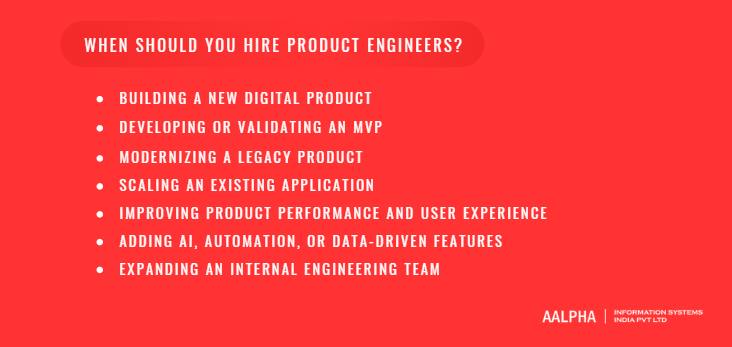
Hire product engineers when the people writing code must also make product decisions, which happens when requirements are incomplete, speed matters more than process, or user feedback should change the plan weekly. New products, MVPs, modernization projects, and AI feature work fit this profile. Stable maintenance work with fixed requirements usually does not.
-
Building a new digital product
A new product has more unknowns than knowns. Nobody can write a complete spec for it, so you need engineers who can fill gaps sensibly and flag the gaps that matter. Two or three product engineers with a founder or product lead will usually move faster in the first six months than a larger team of spec-driven developers.
-
Developing or validating an MVP
An MVP exists to test whether users want the product. A product engineer will cut scope aggressively, instrument the core flow, and tell you which assumption the MVP actually tests. A spec-driven team will build everything on the list. For more on MVP scoping, the minimum viable product concept is a useful reference point for aligning your team on what “minimum” means.
-
Modernizing a legacy product
Modernization projects fail when teams port every old feature to a new stack. A product engineer checks which features people still use, retires the rest, and migrates in slices so users see improvements before the full rewrite ends. Expect them to ask for usage logs in week one.
-
Scaling an existing application
When an application outgrows its first architecture, you need engineers who understand both the load profile and the user impact of each fix. A product engineer will prioritize the slow page that 80% of users hit daily over the elegant refactor of a rarely used admin module. For pure infrastructure scaling, such as database sharding or multi-region failover, add a platform or DevOps specialist.
-
Improving product performance and user experience
Slow pages, confusing flows, and high abandonment are product problems with technical causes. Product engineers can profile the front end, fix the query, and redesign the step where users drop off, all within one sprint. Separating those tasks across three roles usually takes three sprints.
-
Adding AI, automation, or data-driven features
AI features carry product risk that normal features do not: wrong answers, unpredictable latency, and per-request costs. A product engineer will build evaluation sets, add fallbacks for bad outputs, and track cost per user. Hiring a machine learning researcher for a feature that calls a hosted model API is usually the wrong fit. A product engineer who understands prompt design, retrieval, and evaluation is the better first hire.
-
Expanding an internal engineering team
If your in-house team is strong on execution but the product manager is the bottleneck for every decision, adding product engineers spreads that decision load. They take ownership of whole features, which frees the product manager for roadmap and customer work.
Signs your project needs a product engineer
Look for these patterns. Engineers wait days for spec clarifications. Features ship on time but usage stays flat. The team cannot say which features drive retention. Bug fixes and small UX improvements sit in the backlog because nobody owns them. Your product manager spends more time writing tickets than talking to customers. If three or more of these apply, product engineers will likely help more than additional developers.
Define your product engineering requirements
Before you contact a single candidate, write down the business problem, the target users, the MVP scope, technical constraints, compliance needs, and budget. A two to four page brief is enough. It shortens interviews, makes proposals comparable, and gives the engineers you hire a shared starting point instead of assumptions.
-
Clarify the business problem
State the problem in one or two sentences, with a number if possible. “Field agents spend 40 minutes a day re-entering orders from paper” is a problem. “We need a mobile app” is a solution. Product engineers need the problem, because they may find a cheaper solution than the one you had in mind.
-
Identify target users and their needs
List each user type, what they are trying to get done, and where they do it. A delivery rider using a cheap Android phone on patchy 4G has different needs from a finance manager on a desktop. Note languages, devices, connectivity, and accessibility requirements. These facts change technical choices early.
-
Define the product scope and core features
Write the core user journeys, not a feature list. “A customer finds a product, adds it to the cart, pays by UPI or card, and tracks delivery” tells an engineer far more than twelve bullet points of features. Journeys also expose gaps, such as refunds, that feature lists hide.
-
Separate MVP features from future enhancements
Split every feature into three groups: needed for launch, needed within three months of launch, and nice to have. Be strict. Most MVPs we scope at Aalpha Information Systems lose 30% to 50% of their initial feature list in this step, and launch sooner for it. If a feature does not help test your main assumption, it waits.
-
Document technical and integration requirements
Record the existing systems the product must connect to: payment gateways, ERPs, CRMs, identity providers, logistics APIs, and legacy databases. Note any stack constraints, such as an existing React codebase or a mandate to host on Azure. Include expected user volumes at launch and at 12 months, since these drive architecture decisions.
-
Establish security and compliance requirements
Identify the regulations that apply before you hire. Health data in the US brings HIPAA. EU users bring GDPR. Card payments bring PCI DSS obligations. Indian personal data falls under the Digital Personal Data Protection Act, 2023. Enterprise buyers may ask for SOC 2 reports. Each of these affects architecture, hosting, and the experience you need in the team.
-
Set the budget, timeline, and delivery priorities
Pick a budget range and a target launch date, then rank three priorities: speed, cost, and scope. You can fix two of them. The third has to flex. Engineers and vendors give far better advice when they know which one you are willing to move.
-
Create a clear product engineer job description
A useful job description names the product, the users, the stage (pre-launch, growth, or modernization), the stack, and the decisions this person will own. Include what success looks like after 90 days, such as “own the checkout flow and reduce abandonment.” Avoid lists of fifteen technologies. They attract keyword matchers and put off strong candidates who know eight of them well.
Skills to look for in a product engineer
Look for a working mix of front-end, back-end, data, cloud, and API skills, plus product judgment, clear communication, and security awareness. Depth in every area is rare and unnecessary. A good product engineer is strong in two or three areas, competent in the rest, and knows when to call a specialist.
-
Front-end development skills
Expect fluency in at least one modern framework, typically React, Next.js, Vue, or Angular, along with TypeScript, responsive layout, accessibility basics, and state management. For mobile products, React Native or Flutter experience matters. Ask to see a live interface they built and how it performs on a mid-range phone.
-
Back-end development skills
Candidates should build and run services in at least one mainstream back-end ecosystem: Node.js, Python, Go, Java, PHP with Laravel, or .NET. They should understand authentication, background jobs, caching, and error handling. The test is whether they can build a feature’s server side without a separate back-end developer.
-
Database design and data management
Product engineers design tables, write queries, and plan migrations that do not break production. They should know when a relational database such as PostgreSQL fits better than a document store, and why. Ask how they handled a schema change on a live table with real users. The answer reveals more than any quiz.
-
Cloud infrastructure and DevOps knowledge
They do not need to be DevOps engineers, but they should deploy their own code, read logs, set up CI pipelines, and understand the cost of the services they use on AWS, Azure, or Google Cloud. An engineer who cannot deploy without help will slow every release.
-
API development and third-party integrations
Most products depend on external services: payment gateways, SMS providers, maps, shipping, and identity. Look for experience designing REST or GraphQL APIs, handling webhooks, dealing with rate limits, and building retries for flaky integrations. Integration work is where timelines slip, so this experience saves money.
-
Software architecture and system design
Candidates should be able to sketch a system for your product, explain the trade-offs, and say what they would defer. For an early product, the right answer is often a well-structured monolith, not microservices. Be cautious of candidates who propose complex architectures for an MVP with a few hundred users.
-
Testing, debugging, and quality assurance
Look for engineers who write automated tests for the paths that would hurt most if they broke, such as payments and data sync, and who use monitoring tools like Sentry or Datadog to find problems before users report them. Ask them to walk through the hardest bug they fixed. Vague answers are a warning.
-
UI/UX and product design awareness
Product engineers do not replace designers, but they should spot a confusing flow, apply a design system consistently, and fill small design gaps without waiting a week. Familiarity with Figma and basic usability principles is enough for most roles.
-
Product thinking and customer empathy
This is the skill that separates the role from general development. Product thinking shows in the questions a candidate asks: who uses this, how often, what they do today, and how we will know it worked. Candidates with strong product thinking will talk about a feature they cut or a metric that changed their plan.
-
Communication, collaboration, and ownership
Product engineers explain trade-offs to non-technical founders, write clear pull request descriptions, and flag risks early. Ownership means they follow a feature after release and fix what they shipped. For remote engineers, written communication matters more than spoken fluency, because most decisions happen in tickets, documents, and chat.
-
Security, privacy, and compliance knowledge
Expect working knowledge of the OWASP Top 10, secure authentication, secrets management, role-based access, and encryption at rest and in transit. For regulated products, look for prior experience with the relevant framework. An engineer who stores API keys in the codebase is a risk regardless of other skills.
-
AI-assisted development skills
In 2026, most strong engineers use AI coding tools such as GitHub Copilot, Cursor, or Claude Code daily. The skill to test is judgment: do they review generated code line by line, write tests for it, and know when the tool is wrong? Engineers who accept generated code without review ship bugs faster. Engineers who refuse the tools entirely often ship slower. You want the middle.
Choose the right hiring model
The right model depends on how long you need the engineers, how much control you want, and how fast you must start. In-house hiring gives the most control at the highest cost and slowest start. Freelancers are fast and flexible but carry continuity risk. Dedicated teams and outsourcing partners sit in between, trading some control for speed and lower cost.
Hiring an in-house product engineer
In-house engineers build long-term product knowledge, share your culture, and stay aligned with company goals. They are the right choice for your core product once you have product-market fit and steady funding. The downsides are cost, a hiring process that often runs two to three months, and difficulty scaling down if plans change.
Working with freelance product engineers
Freelancers suit short, well-defined work: a prototype, a single integration, or a performance audit. They start quickly and cost nothing when idle. The risks are availability, since a good freelancer may take another contract mid-project, and knowledge loss when they leave. Insist on documentation and repository access from day one.
Hiring dedicated product engineers
A dedicated engineer works full time on your product but is employed by a development company. You direct their daily work. The vendor handles payroll, equipment, HR, and replacement if someone leaves. This model fits companies that want in-house-style control for six months or longer without hiring overhead, and it is the most common model for offshore product engineering.
Staff augmentation
Staff augmentation adds external engineers to your existing team to fill a specific skill gap or capacity shortfall. It works when you already have engineering management, processes, and a product lead. It works poorly when you do not, because augmented engineers follow your processes and cannot supply ones you lack.
Outsourcing to a product engineering company
With full outsourcing, the vendor supplies a complete team, including a project manager, designers, engineers, and QA, and owns delivery. This suits companies without internal technical leadership or with a defined project and timeline. The risk is reduced visibility, so require sprint demos, shared repositories, and access to the project board.
Building a remote or offshore engineering team
Many companies build a remote team in India, Eastern Europe, or Latin America through a partner, then grow it over time. This gives access to larger talent pools at lower rates. It requires overlap in working hours, strong written communication, and deliberate onboarding. Time zone gaps can work well when handoffs are planned and badly when they are not.
Comparing hiring models by cost, control, and flexibility
In-house hiring costs the most and gives full control, but flexibility is low and a new hire typically takes 6 to 12 weeks to start. The main risk is cost, along with the difficulty of scaling down.
Freelancers range from low to high cost depending on region, give medium control and high flexibility, and can usually start within 1 to 3 weeks. Their main risk is availability, since a freelancer can leave mid-project and take context with them.
Dedicated engineers cost medium to low, give high control and medium flexibility, and usually start within 1 to 3 weeks. The main risk is that vendor quality varies, so the choice of partner decides the outcome.
Staff augmentation has a similar cost profile with high control and high flexibility, and also starts within 1 to 3 weeks. It depends on you already having engineering management, because augmented engineers follow your processes.
An outsourced team costs medium to low, gives medium control and medium flexibility, and typically starts within 2 to 4 weeks. The trade-off is less day-to-day visibility, which sprint demos and shared repositories largely fix.
How to select the right model for your project
Use three questions. First, how long will you need the work? Under three months points to freelancers or a fixed project. Over six months points to dedicated or in-house engineers. Second, do you have technical leadership? If not, choose an outsourced team with its own project management. Third, is this your core product after product-market fit? If yes, plan to bring key roles in-house over time, even if you start with a partner. Many companies combine models: a dedicated offshore team for build capacity and one in-house technical lead to hold product knowledge.
Where to find qualified product engineers
The best channels are referrals, developer communities, open-source contributions, and established product engineering companies. Freelance marketplaces and recruitment platforms add volume but need more screening. Choose channels based on the hiring model you picked, because each channel produces a different kind of candidate.
-
Professional networks and referrals
Referrals from engineers you trust produce the highest hit rate, since the referrer has seen the candidate work. Ask your advisors, investors, and former colleagues specifically for engineers who have owned a product feature end to end.
-
Developer communities
Communities around specific stacks, such as local React or Laravel meetups, Discord servers, and indie hacker forums, attract engineers who build things outside work. Many product-minded engineers run side projects. Look at what they have shipped.
-
Freelance marketplaces
Platforms such as Upwork and Toptal give fast access to many freelancers. Quality varies widely on open marketplaces, and screening takes time. Vetted networks charge more but pre-filter candidates. Either way, run your own practical assessment.
-
Recruitment platforms
LinkedIn, Wellfound, and regional job boards work for in-house hiring. Specialized tech recruiters shorten the process but typically charge a percentage of first-year salary. Write the job description carefully, since it filters applicants before you do.
-
GitHub and open-source communities
Open-source contributors leave a public record of code quality, review habits, and how they respond to feedback. A contributor who maintains a small library used by real projects often has more product sense than their résumé shows. Contact them with a specific reference to their work.
-
Product engineering companies
Development companies offer pre-vetted engineers, replacement guarantees, and management support. They suit dedicated and outsourced models. Evaluate the company as carefully as you would evaluate an individual, including its case studies and reviews on independent platforms such as Clutch.
-
Offshore development destinations
India has the largest pool of English-speaking engineers and mature delivery companies. Eastern Europe offers strong engineering depth with more European time zone overlap at higher rates. Latin America suits US companies that want same-day overlap. Southeast Asia is growing, especially Vietnam and the Philippines. Choose based on time zone overlap, rates, and the specific skills you need.
How to evaluate sourcing channels
Track three numbers for each channel: candidates who pass screening, candidates who pass the practical assessment, and hires still performing well after 90 days. After one hiring round, you will know which channels to drop. Referrals usually have the best ratio. Open marketplaces usually have the worst.
How to evaluate and interview product engineers
Evaluate product engineers on shipped work, product thinking, practical coding, system design, debugging, and communication. A realistic take-home or paired exercise predicts performance better than algorithm puzzles. Check references on specific projects. Use a written scorecard so that interviewers rate the same things the same way.
-
Review portfolios and previous products
Ask candidates to show products they built, preferably live ones. Ask which parts they personally built, what decisions they made, what they would change now, and what the usage looked like. Engineers who can speak about adoption numbers have probably done product work. Engineers who only describe features probably have not.
-
Examine GitHub and code samples
Look at commit history, test coverage, readme quality, and how they handle pull request feedback. Many strong engineers have little public code because their work is under NDA. In that case, ask for a sample they are allowed to share, or rely more on the practical exercise.
-
Assess product thinking
Give a real scenario: “Our signup completion rate dropped from 60% to 45% after last week’s release. What do you do?” Strong candidates ask about segments, check what changed, look at funnel data, and propose a fix they can test. Weak candidates jump straight to code.
-
Conduct a technical screening
A 45 to 60 minute call with a senior engineer should cover the candidate’s main stack, databases, APIs, and deployment. Ask them to explain a past system in depth. This screen filters out candidates whose résumé overstates their experience before you spend time on longer exercises.
-
Use a practical coding or product exercise
Give a small, realistic task that mirrors your product, such as building a simple booking feature with an API, a database, and a basic interface. Limit it to three or four hours and pay for it if it runs longer. Review the code together afterward. The discussion reveals more than the code itself.
-
Evaluate system design knowledge
Ask the candidate to design a simplified version of your product for 10,000 users, then for 1 million. Listen for sensible defaults, awareness of costs, and a clear view of what to build now versus later. Over-engineering for the first stage is as much a warning sign as ignoring scale entirely.
-
Test debugging and problem-solving ability
Share a small codebase with a planted bug or a slow query and watch them investigate. Good engineers form a hypothesis, check logs, reproduce the issue, and narrow the cause step by step. This exercise is short and hard to fake.
-
Assess communication and team compatibility
Ask the candidate to explain a technical trade-off to a non-technical founder. For remote roles, include a written exercise, such as writing a short technical proposal. Check working-hour overlap and response expectations now, not after the contract is signed.
-
Check references and employment history
Call at least two references, ideally a manager and a peer. Ask specific questions: which feature did they own, how did they handle a production incident, and would you hire them again for the same role. Verify employment dates. Gaps are fine. Inconsistencies are not.
Recommended interview questions
- Tell me about a feature you shipped that users did not adopt. What did you learn and change?
- How do you decide what to cut when a deadline is at risk?
- Walk me through how you would add a feature to a codebase you have never seen.
- Describe a production incident you handled. What was the cause, and what did you change afterward?
- How do you decide whether a feature is working after release?
- When would you choose a monolith over microservices for a new product?
- How do you use AI coding tools, and when do you not trust their output?
- Tell me about a time you disagreed with a product decision. What happened?
- How do you handle secrets, authentication, and user data in your projects?
- What would you want to know about our users before writing any code?
Product engineering interview scorecard
Rate each area from 1 to 5 and weight the areas to suit your project. For an early-stage product build, a sensible split gives product thinking and practical coding 20% each, system design and communication 15% each, and debugging, ownership, and security awareness 10% each.
A top score in product thinking goes to a candidate who asks about users and metrics without being prompted and has cut or reshaped features based on data. In practical coding, it means a clean, tested, working solution with sensible structure. In system design, a right-sized design with clear trade-offs and a staged plan. In debugging, a methodical, hypothesis-driven approach that reaches the root cause quickly. In communication, clear written and spoken explanations for both technical and non-technical listeners. In ownership, evidence of following features through release and fixing what they shipped. In security awareness, knowing common risks and handling data and secrets correctly by default.
A weighted score below 3.5 usually means no hire for a product engineering role, even if the coding score is high.
How much does it cost to hire product engineers?
Hiring costs depend on region, experience, and model. As indicative 2026 ranges, offshore product engineers through a development company cost roughly $25 to $60 per hour, while US freelance product engineers commonly charge $100 to $180 per hour. A US in-house senior hire often exceeds $200,000 in first-year cost. Rates below reflect Aalpha Information Systems’ market experience and should be verified at the time of hiring.
Factors that affect hiring costs
Region has the largest effect on rates. Experience level comes next, followed by specialization (AI, fintech, and healthcare experience cost more), the hiring model, contract length (longer commitments usually get lower rates), and urgency. Compliance requirements also add cost, because regulated work needs more senior engineers and more testing.
Cost by experience level
Indicative hourly rates in 2026, assuming full-time engagement:
Experience | Offshore via development company (India) | US freelance or contractor |
Junior (0 to 2 years) | $18 to $25 | $50 to $80 |
Mid-level (3 to 5 years) | $25 to $35 | $80 to $120 |
Senior (6 to 10 years) | $35 to $50 | $120 to $170 |
Lead or architect (10+ years) | $45 to $65 | $150 to $220 |
Junior engineers are rarely a good fit for product engineering roles. The job depends on judgment that comes from shipping several products.
Hourly rates by hiring region
Indicative 2026 rates for mid-level to senior product engineers, engaged through contractors or development companies, vary widely by region.
The United States and Canada sit at the top, at roughly $100 to $180 per hour, with full time zone overlap for North American teams. The United Kingdom and Western Europe run about $80 to $150, with strong regulatory experience, especially around GDPR. Eastern Europe typically charges $45 to $90 and offers deep engineering talent with good overlap for European companies. Latin America falls around $40 to $85 and gives US companies same-day overlap. India ranges from $25 to $60, with the largest talent pool and mature delivery companies such as Aalpha Information Systems. Southeast Asia runs about $25 to $55, with a growing talent pool and good overlap with Australia and the rest of Asia.
In-house vs. freelance vs. outsourced costs
Consider the first-year cost of one full-time senior product engineer. The assumptions are a US in-house base salary of $160,000, benefits and payroll taxes at 25% to 30% of salary, a recruiter fee of 15% to 25%, and about 1,600 to 1,760 billable hours for contractors.
A US in-house hire comes to roughly $220,000 to $260,000 once salary, benefits, taxes, recruiting, and equipment are added. A US freelancer at $120 per hour costs about $190,000 for hours alone, with no benefits or management included. An offshore freelancer at $40 per hour costs about $65,000, but with higher continuity risk. A dedicated offshore engineer at $30 to $45 per hour costs $53,000 to $79,000, and the vendor handles payroll, HR, equipment, and replacement.
The in-house figure buys long-term retention of product knowledge, which the other models do not provide by default. Factor that value into the comparison.
Full-time, part-time, and project-based pricing
Full-time dedicated engagements are billed monthly, commonly around 160 to 176 hours per month, and get the lowest effective hourly rate. Part-time engagements, such as 80 hours per month, usually cost 10% to 20% more per hour and give less continuity. Project-based pricing fixes the price for a defined scope. It gives budget certainty but builds in a risk margin, and every scope change becomes a change request. Use fixed price for well-defined work and time-and-materials or dedicated models for evolving products.
Costs beyond the engineer’s rate
Design. Most products need a UI/UX designer, at least part time, during the first three months.
Quality assurance. Plan for QA at roughly 20% to 30% of development effort for customer-facing products.
Project management. Outsourced teams include this. Dedicated and augmented engineers need someone on your side to direct them.
Infrastructure and tools. Cloud hosting, monitoring, CI/CD, and third-party APIs often run from a few hundred to several thousand dollars per month depending on usage.
Onboarding time. Expect two to four weeks before a new engineer reaches full productivity on an existing codebase.
Maintenance. After launch, budget roughly 15% to 20% of the initial build cost per year for fixes, updates, and security patches.
Sample cost estimates for different product types
These estimates assume an offshore team at blended rates of $25 to $40 per hour, including design, QA, and project management.
A simple web MVP with one user type, a core flow, and an admin panel typically needs two engineers with part-time design and QA support, takes 8 to 12 weeks, and costs about $15,000 to $35,000. A SaaS MVP with subscriptions and integrations usually needs two to three engineers plus a designer and QA, runs 12 to 18 weeks, and costs $35,000 to $80,000. A marketplace with web and mobile apps calls for three to five engineers along with design, QA, and a project manager, takes 16 to 24 weeks, and lands between $50,000 and $120,000.
Adding an AI feature to an existing product is smaller work: one or two engineers over 4 to 10 weeks, at roughly $10,000 to $40,000. Legacy modernization sits at the other end, needing three to six engineers with QA and project management for 6 to 12 months, at $60,000 to $200,000 or more.
Actual cost depends on scope, integrations, and compliance. Treat these ranges as a starting point for conversations with vendors, not as quotes.
How to set a realistic product engineering budget
Start with the MVP scope, get estimates from two or three vendors, and add a 15% to 25% contingency for scope that emerges during the build. Reserve budget for three months of post-launch iteration, because the first release will teach you what to change. Founders who spend the entire budget on version one often have nothing left to fix what users report.
The step-by-step product engineer hiring process
The hiring process runs through eleven steps: define outcomes, decide team composition, pick a model, source candidates, interview, assess, verify, agree on terms, sign contracts, onboard, and measure. With a development partner, this usually takes one to three weeks. For in-house hires, plan for six to twelve weeks.
-
Define the product vision and outcomes
Write what the product should achieve in 6 and 12 months, in measurable terms: active users, revenue, processing time saved. Engineers make better decisions when they know the target.
-
Determine the required team composition
Match the team to the scope. A simple MVP may need two product engineers and a part-time designer. A marketplace with mobile apps may need front-end, back-end, and mobile engineers, plus QA and a project manager. Start smaller than you think and add roles when the bottleneck is clear.
-
Select a hiring model
Apply the three questions from the hiring model section: duration, available technical leadership, and whether this is core product work. Write down the decision and the reason, so it can be revisited at the first review.
-
Source and shortlist candidates
Use two or three channels in parallel. Shortlist on evidence of shipped products and relevant stack experience, not years of experience alone. A shortlist of five to eight candidates per role is usually enough.
-
Conduct technical and product interviews
Run the technical screen and the product thinking interview, ideally with different interviewers. Use the scorecard and have each interviewer submit scores before discussing candidates, so the first opinion does not anchor the rest.
-
Assign a relevant practical assessment
Give the practical exercise to candidates who pass the interviews. Keep it relevant to your product and time-limited. Review it in a live session.
-
Verify references and credentials
Call references, confirm employment history, and for vendors, speak with at least one current client. Check any certifications that matter to the role, such as cloud certifications for infrastructure-heavy work.
-
Agree on scope, rates, and availability
Confirm the rate, working hours, time zone overlap, notice periods, and holiday calendars. For vendor engagements, confirm who replaces an engineer who leaves and how quickly.
-
Finalize contracts and intellectual property terms
Sign an NDA before sharing sensitive material, and a service or employment contract that assigns all IP to your company. Confirm repository ownership, payment terms, and termination clauses before any code is written.
-
Onboard the selected engineers
Give engineers access to repositories, documentation, tools, and the people they need in the first two days. Assign a small, real task in week one so they learn the codebase by shipping something.
-
Measure performance during the initial period
Set a 30 to 60 day evaluation period with clear goals: features shipped, code review quality, communication, and product contributions. Review at the midpoint and the end. If the fit is wrong, change early. Every extra month makes it more expensive.
-
Legal, security, and contractual considerations
Protect your product with clear IP assignment, NDAs, data protection terms, repository ownership, access controls, milestone-based payments, SLAs, replacement and termination clauses, and documentation requirements. These terms matter most with external engineers, but in-house contracts need the same IP and confidentiality clauses. Have a lawyer in your jurisdiction review the final contract.
-
Intellectual property ownership
The contract should state that all code, designs, documentation, and other work created for the project belong to your company, and that ownership transfers on creation or on payment. If the vendor uses pre-existing libraries or internal tools, the contract should grant you a perpetual license to use them in your product.
-
Non-disclosure agreements
Sign an NDA before sharing your business model, data, or detailed plans. Make sure it covers the vendor’s employees and subcontractors and survives the end of the engagement.
-
Data privacy and regulatory compliance
If engineers will access personal data, the contract needs data processing terms that match the laws you operate under, such as GDPR, HIPAA, or India’s DPDP Act. Where possible, give engineers anonymized or synthetic data for development so that production data stays restricted.
-
Source code and repository ownership
Host the code in repositories your company owns, on GitHub, GitLab, or Bitbucket, and add external engineers as collaborators. Never let a vendor hold the only copy of your code. The same applies to cloud accounts, domains, and app store accounts. Register them in your company’s name.
-
Confidentiality and access controls
Grant the minimum access each engineer needs. Use individual accounts, multi-factor authentication, and a password manager for shared credentials. Keep a list of who has access to what, and remove access on the day an engineer leaves.
-
Payment terms and milestones
For fixed-price projects, tie payments to delivered and accepted milestones. For dedicated teams, monthly billing in arrears or with a small advance is common. Avoid paying the majority upfront. Define acceptance criteria for each milestone in writing.
-
Service-level agreements
For ongoing work and post-launch support, agree on response times for critical issues, working-hour coverage, and uptime responsibilities if the vendor manages hosting. SLAs without defined remedies carry little weight, so include what happens when they are missed.
-
Replacement and termination clauses
Define how quickly the vendor must replace an engineer who leaves or underperforms, and whether a handover period is included. Include termination for convenience with a reasonable notice period, typically 15 to 30 days, and a clean handover of all work and credentials on exit.
-
Documentation and knowledge-transfer requirements
Require readme files, architecture notes, API documentation, deployment instructions, and environment setup guides as deliverables, not optional extras. Documentation is what lets another team take over if you change vendors or bring work in-house.
-
Avoiding vendor and developer lock-in
Lock-in happens when only one person or vendor understands the system. Prevent it by owning all accounts, requiring documentation, using mainstream technologies, insisting on code reviews by more than one engineer, and ensuring at least one person on your side understands the architecture.
Onboarding and managing product engineers
Good onboarding gives product engineers context on users and goals, access to tools and code, clear decision rights, and an agile workflow with regular demos and reviews. Management then focuses on outcomes, code quality, and communication rhythm. Most failed engagements trace back to weak onboarding and unclear ownership, not weak engineers.
-
Prepare product and technical documentation
Before day one, collect the product brief, user journeys, design files, architecture overview, and setup instructions. Imperfect documentation is fine. Missing documentation costs weeks of questions.
-
Provide access to the required tools
Set up access to repositories, the project board, design tools, communication channels, staging environments, analytics, and error monitoring before the engineer starts. Waiting three days for access sends the wrong signal and wastes paid time.
-
Explain user problems and business objectives
Walk engineers through who the users are, what problems they have, and how the business makes money. Let them watch recordings of user sessions or join a customer call in the first two weeks. Engineers who understand users make fewer wrong assumptions.
-
Establish roles and decision-making authority
Write down which decisions the product engineer can make alone (implementation details, small UX changes), which need a quick check (scope changes within a feature), and which need approval (new features, architecture changes, anything that affects cost or compliance). Unclear authority leads either to paralysis or to surprises.
-
Set up agile development workflows
Use one or two week sprints with planning, a demo, and a short retrospective. Keep the backlog prioritized and the definition of done explicit, including tests, code review, and deployment to staging. Scrum and Kanban both work. Consistency matters more than the framework.
-
Define communication and reporting practices
Agree on daily asynchronous updates, a weekly call, and sprint demos. Set expected response times on chat. For offshore teams, schedule two to four hours of overlap for real-time discussion and keep everything else written.
-
Use code reviews and quality gates
Every change should be reviewed by another engineer before merging. Automate checks for tests, linting, and security scanning in the CI pipeline. Reviews spread knowledge across the team, which also reduces dependency on individuals.
-
Track product and engineering metrics
Track product metrics such as activation, retention, and conversion for the features each engineer owns. Track engineering metrics such as deployment frequency, lead time for changes, change failure rate, and time to restore service. These four are known as the DORA metrics and are a practical standard for engineering health. Avoid counting lines of code or story points as performance measures.
-
Manage remote and distributed engineers
Judge remote engineers on output and communication, not online hours. Make decisions visible in writing so that people in other time zones are not excluded. Hold occasional video calls with cameras on to build working relationships, and include remote engineers in product discussions, not only task assignments.
-
Retain product knowledge within the organization
Keep architecture decisions in a decision log, document features as they ship, and record demo sessions. Rotate ownership of important modules so at least two people understand each one. When an engineer leaves, schedule a handover period with the person taking over.
Common hiring mistakes and how to avoid them
The most common mistakes are hiring for technical skill alone, using generic job descriptions, relying on algorithm tests, choosing the cheapest option, skipping reference checks, starting without requirements, ignoring IP and security, skipping a trial period, and depending on one engineer. Each is avoidable with a written process.
-
Hiring only for technical knowledge
Strong coders without product judgment build exactly what the ticket says, even when the ticket is wrong. Include a product thinking interview and give it real weight in the decision.
-
Using generic software developer job descriptions
A generic description attracts generic developers. Name the product, the users, the decisions the role owns, and the 90-day goal. Candidates with product experience will recognize the role. Others will self-select out.
-
Ignoring product and user experience skills
An engineer who cannot spot a confusing flow will ship one. Ask candidates to critique a screen from your product or a competitor’s. Their answer shows how much attention they pay to users.
-
Overusing algorithm-based coding tests
Algorithm puzzles test interview preparation, not the ability to build and ship features. They also filter out experienced engineers who will not spend weekends practicing puzzles. Use practical exercises that resemble your real work.
-
Selecting the lowest-cost candidate
The cheapest option often costs more once you add rework, delays, and management time. Compare candidates on expected output and quality, not rate alone. A $45 per hour engineer who ships twice as much with fewer bugs is cheaper than a $25 per hour engineer who does not.
-
Failing to verify previous work
Portfolios and résumés can overstate a candidate’s contribution. Ask which parts they built personally, check references on specific projects, and confirm live products are what they claim.
-
Starting without clear requirements
Hiring before you know what you are building leads to mismatched skills and wasted months. Write the requirements brief first, even if it is short.
-
Neglecting security and IP protection
Sharing code or data before contracts are signed, or letting vendors own your repositories, creates risks that are expensive to reverse. Sign the NDA and IP assignment first and own every account.
-
Hiring without a trial or evaluation period
Interviews predict performance imperfectly. A 30 to 60 day evaluation period with clear goals lets both sides confirm the fit before a long commitment.
-
Creating dependency on one engineer
If one person holds all the knowledge of your system, their departure can stall the product for months. Require documentation, code reviews, and shared ownership of important modules from the start.
How to hire product engineers from a development company
A development company gives you vetted engineers, faster starts, replacement cover, and delivery management. To choose well, ask direct questions, review case studies and references, check technical and industry experience, understand pricing, and watch for red flags such as vague answers, no named references, and resistance to shared repositories.
Benefits of working with a product engineering partner
A partner can usually place engineers within a few weeks, not months. They handle recruitment, payroll, equipment, and retention, and replace engineers who leave. Established partners also bring cross-project experience: patterns for payments, marketplaces, or compliance that your team would otherwise learn the hard way. The trade-off is that you depend on the partner’s hiring standards, so evaluating the partner carefully matters.
Questions to ask a product engineering company
- Which products similar to ours have you built, and can we speak to those clients?
- Who exactly will work on our project, and can we interview them?
- How do you handle replacement if an engineer leaves or underperforms?
- Who owns the code, repositories, and accounts?
- What does your development process look like sprint to sprint?
- How do you handle scope changes and how are they priced?
- What security practices and certifications do you follow?
- What does a handover look like if we end the engagement?
How to review case studies and client references
Look for case studies with specific problems, decisions, and results, not general descriptions. Ask for references from clients with similar project size and duration, and call them. Ask references what went wrong and how the vendor handled it. Every long project has problems. The response to them is what you are evaluating.
Evaluating technical and industry expertise
Match the vendor’s experience to your stack and domain. A company that has built fintech products will know about payment reconciliation, audit trails, and compliance issues that a generalist may miss. Ask their engineers technical questions directly, not only their sales team.
Understanding pricing and engagement terms
Ask for a clear breakdown of rates by role, what is included (project management, QA, design), billing cycles, notice periods, and how overtime or urgent work is charged. Compare proposals on total expected cost for the same scope, not headline hourly rates.
Red flags to watch for
Be cautious of vendors who will not let you interview engineers, who quote a fixed price without asking detailed questions, who cannot provide client references, or who want to host code in their own accounts. Unrealistically low quotes usually mean junior engineers, hidden change request charges, or both. A vendor that agrees to everything in the first call has probably not thought about your project.
Why hire product engineers from Aalpha Information Systems?
Aalpha Information Systems has built software products since 2008, with more than 5,500 projects delivered for clients in 55+ countries, from early-stage startups to organizations such as the World Bank and Swiss Re. That range means our engineers have usually solved a problem close to yours before, whether it is a multi-vendor marketplace, a subscription SaaS product, or a fintech platform such as MoneyWellth, a financial wellness product we built for US employers.
Our product engineers work across React, Next.js, Node.js, Laravel, Python, Flutter, and React Native, with cloud deployment on AWS, Azure, and Google Cloud, and hands-on experience adding AI features to existing products. Delivery follows ISO 9001:2015 certified processes, and clients rate our work 4.9 out of 5 across more than 215 reviews on Clutch.
The limitation to know upfront: our teams are based in India, so US West Coast clients get a smaller overlap window than East Coast, UK, or Gulf clients. We plan overlap hours and written handoffs into every engagement to manage this.
Aalpha’s product engineering hiring process
The process starts with a requirements call to understand your product, users, stack, and timeline. We then recommend a team composition and engagement model, and share profiles of engineers who match the brief. You interview the shortlisted engineers directly and can give them a practical task. Once you select the team, we sign the NDA and a contract that assigns all IP to you, set up access to your repositories and tools, and start with a first sprint focused on onboarding and a small shipped deliverable. Progress is reviewed at the end of the first month so that the team composition can be adjusted early if needed.
Final product engineer hiring checklist
Use this checklist before you sign any contract. It covers requirements, technical evaluation, product mindset, security and contracts, onboarding, and the final decision. If any section has unchecked items, resolve them first. Most of these checks take hours, and skipping them can cost months.
Requirements checklist
- Business problem written in one or two sentences
- User types, devices, and languages documented
- Core user journeys defined
- MVP features separated from later features
- Integrations and technical constraints listed
- Compliance requirements identified
- Budget range, target date, and priority order agreed
Technical evaluation checklist
- Technical screen completed by a senior engineer
- Practical exercise completed and reviewed live
- System design discussion completed
- Debugging exercise completed
- Code samples or GitHub reviewed
- Scorecard filled in by each interviewer independently
Product-mindset checklist
- Candidate asked about users and metrics unprompted
- Candidate described a feature they cut or changed based on data
- Candidate explained a trade-off clearly to a non-technical listener
- Candidate showed ownership of features after release
Security and contract checklist
- NDA signed before sharing sensitive material
- IP assignment clause covers all work products
- Repositories, cloud accounts, and domains owned by your company
- Data processing terms match applicable laws
- Payment milestones, SLAs, replacement, and termination terms agreed
- Documentation listed as a deliverable
Onboarding checklist
- Product brief, designs, and architecture notes shared
- Tool and environment access ready before day one
- Decision rights written down
- Sprint rhythm, reporting, and overlap hours agreed
- First-week task assigned
- 30 to 60 day evaluation goals set
Final hiring decision criteria
Hire when the candidate or team scores at least 3.5 on the weighted scorecard, references confirm the claimed work, the model fits your duration and leadership situation, and the contract protects your IP and data. If the decision is close, choose the candidate with stronger product thinking over the one with a slightly higher coding score. Coding skill is easier to support with reviews and tooling than product judgment is to teach.
Final thoughts
The engineers you hire will make hundreds of small product decisions that no spec covers, so hire for judgment first and technical range second. For most startups and mid-sized companies, the practical path is a small, senior team, often through a dedicated or outsourced model to start quickly, with at least one in-house technical owner who holds the product knowledge long term.
Balance cost against the cost of mistakes. A cheaper team that ships the wrong product costs more than a pricier team that ships the right one. Control matters most for your core product after product-market fit. Speed matters most before it.
To begin, write the two to four page requirements brief this week. Use it to shortlist two or three vendors or candidates, run the practical assessment, and start with a defined evaluation period. That sequence protects your budget while you confirm the fit.
Frequently asked questions
What does a product engineer do?
A product engineer builds complete features across the front end, back end, and data layer, and takes responsibility for whether users adopt them. They review usage data, talk to users, suggest scope changes, and improve features after release, instead of only implementing a fixed specification.
How is a product engineer different from a software engineer?
A software engineer is judged mainly on technical quality: correct, reliable, maintainable code. A product engineer is judged on product outcomes such as adoption and retention, with technical quality as one input. Product engineers make more product decisions and work more closely with users and product managers.
When should a startup hire a product engineer?
A startup should hire a product engineer when building its first product or MVP, when requirements are incomplete, and when there is no dedicated product manager for every area. Product engineers suit early stages because they can make sensible product decisions without waiting for detailed specifications.
What skills should a product engineer have?
A product engineer needs working skills in front-end and back-end development, databases, APIs, cloud deployment, testing, and security, plus product thinking, clear communication, and ownership. In 2026, the ability to use AI coding tools with careful review is also expected. Depth in two or three areas is usually enough.
How much does it cost to hire a product engineer?
As indicative 2026 ranges, offshore product engineers through a development company cost about $25 to $60 per hour, and US freelancers about $100 to $180 per hour. A US in-house senior product engineer often costs over $200,000 in the first year including benefits and recruiting. Actual rates depend on experience and specialization.
Where can I find experienced product engineers?
The best sources are referrals, developer communities, open-source projects, and established product engineering companies. Freelance marketplaces and job platforms add volume but need more screening. Development companies offer pre-vetted engineers and replacement cover, which suits dedicated and outsourced hiring models.
How long does it take to hire a product engineer?
In-house hiring usually takes 6 to 12 weeks from job posting to start date. Freelancers can often start within 1 to 3 weeks. Development companies typically place dedicated engineers within 1 to 3 weeks, depending on the skills required and the time needed for client interviews.
Should I hire an individual engineer or a complete team?
Hire an individual if you already have technical leadership and need specific added capacity. Hire a complete team if you are building a new product without internal engineering management, because a team brings design, QA, and project management together with the engineers. Many companies start with a team and add in-house roles later.
Can product engineers help develop an MVP?
Yes. Product engineers are well suited to MVPs because they cut scope to what tests the main assumption, build the core flow end to end, and add analytics to measure results. A small team of two or three product engineers can usually ship a focused MVP in 8 to 16 weeks.
How do I evaluate a product engineer’s product thinking?
Give a realistic scenario, such as a sudden drop in signup completion, and see whether the candidate asks about users, segments, and data before proposing code. Ask about a feature they cut or changed based on usage. Candidates with strong product thinking discuss outcomes and trade-offs, not only implementation.
What should be included in a product engineering contract?
A product engineering contract should include IP assignment, confidentiality terms, data protection terms, repository and account ownership, scope or engagement details, rates and payment milestones, SLAs, replacement and termination clauses, and documentation and handover requirements. Have a lawyer in your jurisdiction review it before signing.
How can I protect my product idea and source code?
Sign an NDA before sharing details, and use a contract that assigns all IP to your company. Host code in repositories you own, register cloud accounts and domains in your company’s name, give engineers only the access they need, and remove access immediately when someone leaves.
Is offshore product engineering suitable for startups?
Offshore product engineering suits many startups because it lowers cost and allows faster team setup. It works best with some time zone overlap, strong written communication, clear requirements, and a founder or technical lead who reviews work regularly. Startups without any technical oversight should choose a vendor that provides project management.
What is the best engagement model for a long-term project?
For long-term projects, a dedicated team or in-house hiring usually works best, because both keep the same engineers on the product and build knowledge over time. Many companies use a dedicated offshore team for capacity and keep one or two in-house technical leads to own architecture and product knowledge.
Why hire product engineers through Aalpha Information Systems?
Aalpha Information Systems has delivered more than 5,500 projects since 2008 for clients in 55+ countries, holds ISO 9001:2015 certification, and is rated 4.9 out of 5 on Clutch. Clients interview engineers directly, own all IP and repositories, and can choose dedicated, augmented, or fully outsourced engagement models.
Looking for experienced product engineers for your next digital product? Get in touch with Aalpha Information Systems to build a dedicated team aligned with your technology, timeline, and business objectives.