



Hiring dedicated Laravel developers means bringing in professionals who work exclusively on your project, either as part of an extended remote team or through a development partner, with a clear focus on delivering Laravel-based web applications. Unlike freelancers who often juggle multiple clients or in-house hires that require long-term commitments, dedicated Laravel developers provide a middle ground: focused expertise, flexibility, and predictable engagement. This model is widely adopted by businesses that need consistent development velocity without the overhead of building a full internal team.
Laravel has emerged as one of the most widely used PHP frameworks for modern web application development because it simplifies complex tasks while maintaining performance and scalability. Its clean syntax, built-in tools for authentication, routing, and database management, and strong ecosystem allow developers to build secure, high-performing applications faster. Businesses often ask whether Laravel is suitable for real-world products such as SaaS platforms or enterprise systems. The answer lies in its proven adoption across industries where speed, maintainability, and scalability are critical. Laravel supports rapid prototyping for startups while also handling large-scale applications with complex workflows.
The need to hire Laravel developers typically arises at specific growth stages. Startups building an MVP often require experienced developers who can quickly translate ideas into functional products without unnecessary delays. SaaS founders look for dedicated developers when scaling their platforms, adding new features, or improving performance. Enterprises, on the other hand, hire Laravel specialists when modernizing legacy systems, building internal tools, or integrating APIs across multiple systems. In each case, the common requirement is access to specialized expertise without slowing down business operations.
Businesses also reach a point where relying on ad hoc development resources becomes inefficient. Missed deadlines, inconsistent code quality, and communication gaps often signal the need for a more structured hiring approach. This is where dedicated Laravel developers become valuable. They offer continuity, accountability, and a deeper understanding of your product over time. For companies aiming to maintain long-term digital assets such as marketplaces, SaaS products, or enterprise platforms, this model ensures stability and scalability.
This guide is designed to help you make informed decisions at every stage of the hiring process. It explains what Laravel developers do, how to evaluate their skills, what hiring models to consider, and how much it costs across different regions. It also provides a step-by-step framework to help you avoid common hiring mistakes and select the right development partner. By the end of this guide, you will have a clear understanding of how to hire dedicated Laravel developers efficiently, reduce risks, and build a strong technical foundation for your product.
What is Laravel and Why It’s Popular
Laravel is widely recognized as one of the most developer-friendly and business-ready frameworks for building modern web applications. For decision-makers evaluating technology choices, understanding Laravel is not just about its technical capabilities but about how it directly impacts speed, cost, scalability, and long-term maintainability. Many organizations evaluating backend frameworks often ask whether Laravel can support both rapid development and enterprise-grade systems. The answer lies in its architecture, built-in features, and ecosystem maturity.
What is Laravel Framework
Laravel is an open-source PHP framework designed to simplify web application development by providing a structured and efficient development environment. It was created to eliminate repetitive coding tasks and to offer developers a clean, expressive syntax that accelerates the development process. Unlike traditional PHP development, which often requires building functionality from scratch, Laravel comes with pre-built components that handle common requirements such as authentication, routing, and database interactions.
At its core, Laravel follows the Model-View-Controller (MVC) architectural pattern. This structure separates the application into three interconnected layers: the model manages data and database logic, the view handles the user interface, and the controller processes user input and business logic. This separation improves code organization, makes applications easier to maintain, and allows teams to work more efficiently without overlapping responsibilities.
For businesses, this architecture translates into faster development cycles, easier debugging, and the ability to scale applications without rewriting core systems. When companies evaluate frameworks for long-term projects, the ability to maintain clean, modular code becomes a critical factor, and Laravel addresses this effectively.
Key Features of Laravel
One of the main reasons Laravel is widely adopted is its rich set of built-in features that reduce development time while maintaining high-quality standards.
- Blade Templating Engine
Laravel includes a powerful templating engine called Blade, which allows developers to create dynamic and reusable user interface components. Instead of mixing raw PHP with HTML, Blade provides a cleaner syntax that improves readability and maintainability. This is especially useful for applications that require consistent UI components across multiple pages.
- Eloquent ORM (Object-Relational Mapping)
Eloquent ORM simplifies database interactions by allowing developers to work with databases using intuitive, object-oriented syntax instead of complex SQL queries. This reduces the chances of errors, speeds up development, and makes database operations easier to manage. For businesses, this means faster feature implementation and easier data handling as the application grows.
- Built-in Authentication and Authorization
Laravel provides ready-to-use authentication systems, including login, registration, password reset, and role-based access control. Instead of building these systems from scratch, developers can implement secure authentication quickly. This is particularly valuable for SaaS platforms, marketplaces, and enterprise systems where user management is a core requirement.
- Routing and Middleware
Laravel offers a flexible routing system that allows developers to define application URLs and how they respond to user requests. Middleware adds an additional layer of control by filtering requests, handling authentication checks, and enforcing security policies before requests reach the application logic. This ensures better control over application behavior and enhances security.
- Task Scheduling and Automation
Laravel includes a built-in task scheduler that allows developers to automate routine operations such as sending emails, cleaning databases, or running background jobs. Instead of relying on multiple external cron configurations, everything can be managed within the framework. This simplifies operations and reduces infrastructure complexity.
Why Businesses Prefer Laravel
From a business perspective, Laravel’s popularity is driven by its ability to reduce development time while maintaining high standards of performance and security. Companies often evaluate frameworks based on how quickly they can launch products without compromising quality. Laravel excels in this area by providing ready-made components and a well-structured development environment, allowing teams to build and deploy applications faster.
Scalability is another critical factor. Many businesses begin with a small application and expand over time, adding features, users, and integrations. Laravel supports this growth by offering modular architecture, efficient database handling, and seamless integration with caching systems and cloud infrastructure. This ensures that applications can handle increasing workloads without significant rework.
Security is a major concern for any web application, especially those handling user data, payments, or sensitive business information. Laravel includes built-in protections against common threats such as SQL injection, cross-site scripting (XSS), and cross-site request forgery (CSRF). These security features reduce the risk of vulnerabilities and ensure compliance with modern web standards.
Another reason businesses choose Laravel is its strong global community and ecosystem. Laravel has extensive documentation, regular updates, and a large pool of experienced developers. This makes it easier for companies to hire talent, troubleshoot issues, and keep their applications up to date. When decision-makers consider long-term sustainability, having access to a mature ecosystem and skilled developers becomes a decisive advantage.
In practical terms, Laravel allows businesses to build everything from MVPs and SaaS platforms to enterprise applications using a single, reliable framework. This combination of speed, scalability, and developer productivity is what makes Laravel one of the most preferred choices in modern web development.
What Does a Dedicated Laravel Developer Do?
A dedicated Laravel developer is responsible for building, maintaining, and scaling web applications using the Laravel framework, with full focus on a single project or organization. Unlike generalist developers who may split their time across multiple technologies or clients, dedicated Laravel developers bring deep expertise in PHP and the Laravel ecosystem, ensuring consistent code quality, faster delivery, and long-term product stability. For businesses evaluating this role, the key question is not just what a Laravel developer builds, but how their work directly impacts performance, scalability, and user experience.
Core Responsibilities
At the core level, a dedicated Laravel developer handles the foundational components of your application, ensuring that the system is reliable, efficient, and aligned with business requirements.
- Backend Development
The primary responsibility is backend development, which involves building the server-side logic that powers the application. This includes writing clean, maintainable code for handling business workflows, processing user inputs, and managing application behavior. For example, in a marketplace platform, the developer would implement order processing logic, user account management, and transaction handling. A well-structured backend ensures that the application remains stable as features grow.
- API Development
Modern applications rarely operate in isolation. Laravel developers design and develop APIs (Application Programming Interfaces) that allow different systems to communicate with each other. This includes RESTful APIs for mobile apps, frontend frameworks, or third-party services. For instance, if your application integrates with payment gateways, logistics providers, or external analytics tools, the Laravel developer builds and manages these API connections. Businesses often ask how scalable integrations are handled, and the answer lies in clean API architecture that allows seamless expansion.
- Database Management
Laravel developers are responsible for designing and managing databases using systems like MySQL or PostgreSQL. This involves creating efficient database schemas, writing optimized queries, and ensuring data integrity. Using Laravel’s Eloquent ORM, developers can interact with databases in a structured and intuitive way, reducing complexity. Proper database management is critical for applications handling large volumes of data, such as SaaS platforms or enterprise systems, where performance and accuracy directly affect user experience.
Advanced Responsibilities
Beyond core development tasks, dedicated Laravel developers take on advanced responsibilities that significantly influence the performance, security, and extensibility of your application.
- Performance Optimization
As applications grow, performance becomes a critical concern. Laravel developers optimize code, database queries, and server responses to ensure fast load times and smooth user interactions. This includes implementing caching mechanisms, optimizing database indexing, and reducing unnecessary processing. For example, in high-traffic applications, even minor inefficiencies can lead to slow response times, which directly impacts user retention and revenue.
- Security Implementation
Security is not optional in modern applications, especially those handling sensitive user data or financial transactions. Laravel developers implement robust security practices such as data validation, encryption, secure authentication flows, and protection against common vulnerabilities like SQL injection and cross-site scripting. Businesses frequently ask how secure Laravel applications are, and the answer depends largely on how effectively these security measures are implemented by experienced developers.
- Third-Party Integrations
Most modern applications rely on external services such as payment gateways, messaging platforms, CRM systems, and cloud services. Dedicated Laravel developers handle these integrations efficiently, ensuring that data flows seamlessly between systems. For instance, integrating a payment gateway requires not only API connectivity but also secure transaction handling and error management. These integrations are often critical to business operations, making this responsibility highly important.
Dedicated vs Freelance vs In-house Developers
Choosing the right hiring model is as important as choosing the right developer. Businesses often compare dedicated developers with freelancers and in-house teams to determine the best fit for their needs.
- Dedicated Laravel Developers
Dedicated developers work exclusively on your project, usually through a development company or remote team setup. This dedicated model offers consistency, accountability, and long-term collaboration. Developers become familiar with your product, business logic, and goals over time, which improves efficiency and reduces onboarding overhead. This model is ideal for ongoing projects, SaaS platforms, or businesses that require continuous development and support.
- Freelance Developers
Freelancers are typically hired for short-term tasks or specific features. They offer flexibility and can be cost-effective for small projects or quick fixes. However, freelancers often work with multiple clients simultaneously, which can lead to inconsistent availability and communication challenges. This model is best suited for limited-scope tasks rather than long-term product development.
- In-house Developers
In-house developers are full-time employees who work within your organization. This model provides maximum control, direct communication, and alignment with company culture. However, it comes with higher costs, including salaries, benefits, infrastructure, and hiring overhead. In-house teams are ideal for large organizations with ongoing, complex development needs and the resources to support a full team.
In practical decision-making, startups and growing businesses often prefer dedicated Laravel developers because they offer a balance between cost, flexibility, and long-term reliability. Enterprises may lean toward in-house teams for strategic control, while freelancers remain useful for short-term or specialized tasks. Understanding these differences helps businesses choose a model that aligns with both their budget and long-term goals.
When Should You Hire Dedicated Laravel Developers?
Hiring dedicated Laravel developers is not just a technical decision but a strategic one that directly impacts how fast you can build, scale, and maintain your product. Businesses often reach a point where existing resources are no longer sufficient to handle growing complexity, timelines, or performance expectations. Recognizing this moment is critical because delaying the decision can lead to missed opportunities, technical debt, and inefficient development cycles. Whether you are launching a new product or modernizing an existing system, dedicated Laravel developers become valuable when consistency, expertise, and long-term ownership are required.
-
For Startups Building MVPs
Startups building a Minimum Viable Product (MVP) often operate under strict timelines and limited budgets, making efficient development a top priority. At this stage, the goal is to validate an idea quickly without compromising on core functionality. Dedicated Laravel developers are particularly useful because they can rapidly translate business concepts into functional applications using Laravel’s pre-built features and structured framework.
Many founders ask how to build an MVP without wasting time on unnecessary complexity. The answer lies in focusing on essential features and leveraging frameworks like Laravel that reduce development effort. Dedicated developers ensure that the MVP is built with clean architecture from the beginning, which prevents costly rewrites later. They also provide continuity throughout the development process, which is often missing when relying on multiple freelancers.
For startups planning to iterate based on user feedback, having a dedicated developer or team allows for quick updates, bug fixes, and feature enhancements. This flexibility is crucial during the early stages when product direction is still evolving.
-
For Scaling SaaS Products
As SaaS products grow, the complexity of the application increases significantly. New features, higher user traffic, integrations, and performance requirements demand a more structured development approach. This is the stage where businesses often realize that ad hoc development is no longer sustainable.
Dedicated Laravel developers play a key role in scaling SaaS platforms by ensuring that the application remains stable and performant under increased load. They optimize database queries, implement caching strategies, and restructure code to support new functionalities without affecting existing features. Businesses frequently ask how to handle rapid growth without system failures, and the answer lies in having a consistent development team that understands the product deeply.
In addition, scaling SaaS products often requires integrating multiple third-party services such as payment systems, analytics tools, and communication platforms. Dedicated developers manage these integrations efficiently while maintaining system reliability. Their ongoing involvement ensures that the product evolves in a controlled and scalable manner rather than becoming fragmented over time.
-
For Enterprise Applications
Enterprise applications demand high reliability, security, and scalability. These systems often involve complex workflows, multiple user roles, and integration with internal and external systems. In such environments, hiring dedicated Laravel developers becomes essential to maintain consistency and ensure that the application meets organizational standards.
Enterprises often deal with large datasets, compliance requirements, and performance expectations that require careful planning and execution. Dedicated developers bring the expertise needed to design robust architectures, implement secure authentication systems, and manage complex business logic. They also ensure that the application can scale horizontally as the organization grows.
Another critical factor in enterprise environments is long-term maintenance. Applications are not just built once; they require continuous updates, monitoring, and optimization. Dedicated Laravel developers provide this continuity, reducing dependency on fragmented resources and ensuring that knowledge about the system is retained within the team.
-
For Legacy System Upgrades
Many businesses operate on outdated systems that are difficult to maintain, slow to update, and incompatible with modern technologies. Upgrading these systems is often necessary to improve performance, enhance security, and enable new features. Dedicated Laravel developers are particularly valuable in this scenario because they can systematically modernize legacy applications without disrupting ongoing operations.
The process typically involves analyzing the existing system, identifying bottlenecks, and gradually migrating functionalities to a Laravel-based architecture. Businesses often wonder how to upgrade systems without risking downtime or data loss. Experienced Laravel developers address this by implementing phased migration strategies, ensuring data integrity, and maintaining system stability throughout the transition.
By rebuilding or refactoring legacy systems using Laravel, businesses gain a more flexible and maintainable foundation that supports future growth. This makes dedicated developers an essential resource for organizations looking to transition from outdated technology to modern, scalable solutions.
Benefits of Hiring Dedicated Laravel Developers
Hiring dedicated Laravel developers is a strategic move that directly influences development speed, product quality, and long-term scalability. Businesses often evaluate whether outsourcing or hiring dedicated resources is worth the investment. The answer becomes clear when you analyze how this model reduces operational friction, improves delivery timelines, and ensures consistent technical execution. Dedicated developers are not just an extension of your team; they act as long-term contributors who understand your product deeply and evolve with it.
-
Cost Efficiency
One of the most immediate benefits of hiring dedicated Laravel developers is cost efficiency. Building an in-house development team involves significant expenses, including salaries, infrastructure, recruitment costs, training, and employee benefits. In contrast, dedicated developers, especially when hired from regions like India or Eastern Europe, provide high-quality expertise at a fraction of the cost.
Businesses often ask whether lower cost means lower quality. In practice, dedicated Laravel developers from established development firms or vetted teams offer strong technical capabilities while eliminating overhead costs. You only pay for the resources you need, without long-term financial commitments.
Additionally, Laravel itself contributes to cost savings by accelerating development. Its pre-built modules reduce the need for custom coding, which translates into fewer development hours. When combined with a dedicated team that works efficiently, the overall project cost decreases without compromising quality.
-
Faster Time to Market
Speed is a critical factor in today’s competitive digital landscape. Whether you are launching a startup or rolling out new features in a SaaS product, delays can result in lost opportunities. Dedicated Laravel developers significantly reduce time to market by focusing exclusively on your project and leveraging Laravel’s rapid development capabilities.
Unlike freelancers who may divide their attention across multiple clients, dedicated developers maintain consistent progress and adhere to structured workflows. They understand your product requirements in depth, which minimizes back-and-forth communication and accelerates decision-making.
Laravel’s ecosystem further enhances speed through built-in tools for authentication, routing, and database management. This allows developers to focus on business logic rather than reinventing foundational components. Businesses often wonder how some companies launch products in weeks while others take months. The difference often lies in having a focused development team using the right framework.
-
Flexibility and Scalability
Modern applications are rarely static. As user demands evolve, businesses need to add features, scale infrastructure, and integrate new services. Dedicated Laravel developers provide the flexibility to adapt to these changes without disrupting ongoing operations.
With a dedicated model, you can scale your development team up or down based on project requirements. For example, during a major product release, you can expand the team to accelerate development. Once the release is complete, you can optimize team size to control costs. This level of flexibility is difficult to achieve with in-house teams.
From a technical perspective, Laravel supports scalable architecture, and dedicated developers ensure that the application is built with growth in mind. They design modular systems, optimize performance, and implement scalable database structures. This ensures that your application can handle increasing user loads and feature expansions without major rework.
-
Focus on Core Business
Hiring dedicated Laravel developers allows businesses to focus on their core operations instead of getting involved in technical complexities. Managing development internally often requires time spent on hiring, training, monitoring, and resolving technical challenges. This can divert attention from strategic priorities such as product innovation, marketing, and customer acquisition.
By working with dedicated developers, businesses delegate technical execution to experts while maintaining control over project direction. This separation of responsibilities improves efficiency and allows leadership teams to concentrate on growth-oriented activities. For startups and growing companies, this focus can make a significant difference in achieving market traction.
-
Access to Global Talent
One of the most significant advantages of hiring dedicated Laravel developers is access to a global talent pool. Instead of being limited to local hiring, businesses can choose from a wide range of skilled developers across different regions. This increases the chances of finding developers with the exact expertise required for your project.
Companies often ask which country is best for hiring Laravel developers. The answer depends on factors such as budget, time zone compatibility, and required skill level. Regions like India offer a large pool of experienced Laravel developers with strong technical skills and cost advantages. Eastern Europe provides high-quality engineering talent with strong communication skills, while the US and Western Europe offer proximity and domain expertise at a higher cost.
Access to global talent also enables businesses to build diverse teams with varied perspectives and problem-solving approaches. This diversity often leads to better solutions and more innovative products. More importantly, it ensures that your project is handled by developers who specialize in Laravel rather than generalists with limited experience.
In practical terms, hiring dedicated Laravel developers combines cost savings, speed, flexibility, and expertise into a single engagement model. For businesses looking to build or scale digital products efficiently, this approach provides a reliable foundation for long-term success.
Key Skills to Look for in a Laravel Developer
Hiring the right Laravel developer is not just about checking technical qualifications. It requires evaluating a combination of backend expertise, architectural thinking, and the ability to collaborate effectively within a team. Many businesses struggle with hiring because they focus only on surface-level skills such as basic PHP knowledge, while overlooking deeper competencies that directly impact scalability, performance, and long-term maintainability. A well-rounded Laravel developer should be capable of building robust applications, integrating systems, and adapting to evolving project requirements without compromising quality.
-
Technical Skills
The foundation of a strong Laravel developer lies in their technical proficiency, particularly in PHP and the Laravel ecosystem. Since Laravel is built on PHP, developers must have a deep understanding of core PHP concepts such as object-oriented programming, design patterns, and memory management. This ensures that the code they write is efficient, reusable, and maintainable over time.
Beyond PHP, expertise in the Laravel ecosystem is essential. A skilled developer should be comfortable working with Laravel’s core features such as routing, middleware, service containers, and dependency injection. They should also understand how to structure applications using MVC architecture, ensuring clear separation of concerns. Familiarity with Laravel tools like Artisan (command-line interface), queues, events, and job handling is equally important, as these features are often used in real-world applications to manage background tasks and improve performance.
Another critical area is REST API development. Modern applications rely heavily on APIs to connect frontend interfaces, mobile apps, and third-party services. A competent Laravel developer should be able to design, build, and maintain RESTful APIs that are secure, scalable, and well-documented. This includes handling authentication mechanisms such as token-based authentication, managing request validation, and ensuring consistent API responses.
Businesses often ask how to evaluate technical depth during hiring. The most effective approach is to assess real-world problem-solving ability rather than theoretical knowledge. Reviewing past projects, code samples, or conducting practical coding tests can reveal whether the developer can apply Laravel effectively in production environments.
-
Frontend Knowledge
While Laravel developers primarily focus on backend development, having a basic understanding of frontend technologies significantly improves their effectiveness. Knowledge of frameworks like Vue.js or React allows developers to collaborate more efficiently with frontend teams and build full-stack solutions when required.
Laravel integrates well with frontend libraries, particularly Vue.js, which is often used in Laravel-based applications. A developer who understands how frontend components interact with backend APIs can design better data flows and avoid integration issues. This does not mean they need to be expert frontend developers, but they should be comfortable working with JSON responses, handling asynchronous requests, and understanding how user interfaces consume backend services.
-
Database Skills
Database management is a core part of Laravel development, making it essential for developers to have strong database skills. Proficiency in systems like MySQL or PostgreSQL is expected, along with the ability to design efficient database schemas that support scalability and performance.
Laravel developers should understand indexing, query optimization, and normalization to ensure that applications can handle large volumes of data without performance degradation. Using Laravel’s Eloquent ORM, they should be able to write clean and efficient database queries while avoiding common pitfalls such as unnecessary data loading or inefficient joins.
Businesses often underestimate the importance of database design, but poorly structured databases can lead to slow applications and costly refactoring later. A skilled Laravel developer ensures that the data layer is built correctly from the start.
-
DevOps and Deployment Knowledge
Modern application development does not end with writing code. Developers are also expected to understand how applications are deployed, managed, and maintained in production environments. Laravel developers with DevOps knowledge can streamline deployment processes and ensure that applications run smoothly after launch.
This includes familiarity with version control systems like Git, as well as experience with deployment tools and cloud platforms. Developers should understand how to configure servers, manage environments, and handle continuous integration and deployment workflows. Knowledge of caching systems, load balancing, and monitoring tools is also valuable for maintaining application performance.
Businesses often ask whether DevOps skills are necessary for Laravel developers. While not always mandatory, having this knowledge reduces dependency on separate teams and speeds up the overall development lifecycle.
-
Soft Skills
Technical expertise alone is not enough to ensure project success. Soft skills play a crucial role in how effectively a Laravel developer collaborates with stakeholders, understands requirements, and solves problems.
Communication is one of the most important skills. Developers must be able to translate technical concepts into clear explanations for non-technical stakeholders. This helps avoid misunderstandings and ensures that business requirements are accurately implemented. Strong communication also improves coordination within distributed teams, which is common when working with dedicated developers.
Problem-solving ability is equally critical. Real-world development often involves unexpected challenges, from debugging complex issues to optimizing performance under constraints. A skilled Laravel developer approaches these challenges methodically, identifying root causes and implementing effective solutions rather than quick fixes.
Adaptability is another important trait. As projects evolve, requirements change, and developers must be able to adjust without compromising quality. This includes learning new tools, integrating new technologies, and refining existing systems.
In practical hiring scenarios, the best Laravel developers combine strong technical foundations with effective communication and problem-solving skills. Businesses that evaluate both aspects are more likely to build reliable, scalable applications and avoid common development bottlenecks.
Hiring Models Explained
Choosing the right hiring model is one of the most critical decisions when building a Laravel development team. The model you select directly affects project cost, delivery timelines, communication efficiency, and long-term scalability. Many businesses fail not because of poor developers, but because they choose the wrong engagement model for their needs. Understanding the differences between hiring models helps align your development strategy with your business goals, whether you are building a short-term MVP or scaling a long-term SaaS product.
-
Dedicated Developers Model
The dedicated developers model involves hiring Laravel developers who work exclusively on your project, typically through a development company or remote team setup. These developers act as an extension of your internal team, fully aligned with your product goals, timelines, and workflows.
This model is particularly effective for long-term projects that require continuous development, updates, and maintenance. Since developers are fully focused on your project, they gain a deep understanding of your system architecture, business logic, and user requirements. Over time, this familiarity leads to better decision-making, faster execution, and fewer errors.
One of the key advantages of this model is predictability. You have a fixed monthly cost, consistent team availability, and structured communication. Businesses often ask how to maintain control while outsourcing development. The dedicated model solves this by allowing you to manage developers directly, assign tasks, and monitor progress as if they were in-house employees.
This model is best suited for SaaS platforms, marketplaces, enterprise applications, and any product that requires ongoing development. It is less suitable for small, one-time tasks where long-term engagement is unnecessary.
-
Fixed Price Model
The fixed price model is based on a predefined project scope, timeline, and cost. Before development begins, all requirements are documented, and the development team commits to delivering the project within the agreed budget.
This model works well for projects with clearly defined requirements and minimal expected changes. For example, building a simple website, a basic MVP, or a specific feature with well-understood functionality can be efficiently handled using a fixed price approach.
However, the main limitation of this model is its lack of flexibility. Any change in scope usually results in additional costs and delays. Businesses often underestimate how frequently requirements evolve during development, especially in early-stage products. As a result, fixed price projects can become restrictive and may not adapt well to dynamic environments.
-
Hourly Hiring Model
The hourly hiring model involves paying developers based on the number of hours they work. This model offers flexibility, allowing businesses to scale development efforts up or down depending on current needs.
It is particularly useful for short-term tasks, bug fixes, maintenance work, or projects where the scope is not fully defined. Businesses often ask how to manage evolving requirements without committing to a fixed budget. The hourly model provides this flexibility by allowing continuous adjustments without renegotiating contracts.
However, this model requires strong oversight and project management. Without proper monitoring, costs can increase unpredictably. It also lacks the long-term commitment and consistency provided by dedicated developers, making it less suitable for complex, ongoing projects.
-
Offshore vs Onshore vs Nearshore Hiring
In addition to choosing a hiring model, businesses must decide where their developers will be located. This decision impacts cost, communication, and collaboration.
Offshore hiring involves working with developers in distant countries, often in regions like India or Southeast Asia. This model offers significant cost advantages and access to a large talent pool. It is ideal for businesses looking to optimize budgets while maintaining high development quality. The main challenge is managing time zone differences and ensuring effective communication.
Onshore hiring refers to hiring developers within the same country. This provides easier communication, cultural alignment, and real-time collaboration. However, it comes at a significantly higher cost, making it less feasible for startups or budget-conscious businesses.
Nearshore hiring falls between offshore and onshore, involving developers from nearby countries with similar time zones. This model balances cost savings with easier collaboration, making it a popular choice for companies that want both affordability and accessibility.
In practical terms, many businesses combine the dedicated developers model with offshore hiring to achieve the best balance of cost, expertise, and scalability. The right choice depends on your project complexity, budget, and need for real-time collaboration.
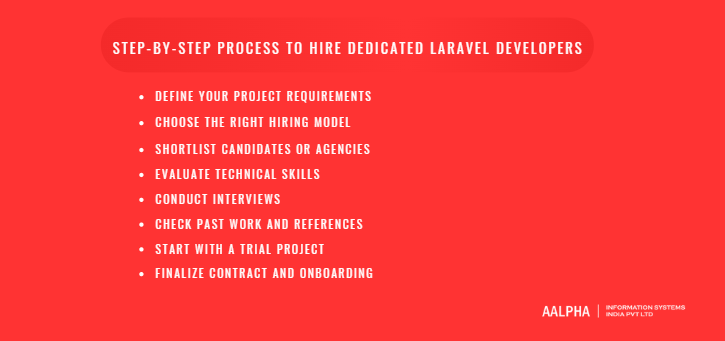
Step-by-Step Process to Hire Dedicated Laravel Developers
Hiring dedicated Laravel developers requires a structured, methodical approach. Many businesses rush into hiring based on cost or availability, only to face delays, poor code quality, or communication issues later. A well-defined hiring process ensures that you select developers who not only meet technical requirements but also align with your product vision and long-term goals. The following step-by-step framework is designed to minimize risk, improve hiring accuracy, and set your project up for successful execution.
-
Define Your Project Requirements
The first and most critical step is to clearly define your project requirements. Without clarity at this stage, even the most skilled developers will struggle to deliver the expected outcome. Businesses often ask why projects fail despite hiring experienced developers. In most cases, the root cause is अस्पष्ट or incomplete requirements.
Start by outlining the scope of the project. Identify what you are building, whether it is an MVP, a SaaS platform, an enterprise system, or a feature enhancement. Break down the application into core modules such as user authentication, dashboards, payment systems, or integrations. This helps developers understand the complexity and scale of the project.
Next, define the key features and functionalities. Prioritize must-have features over optional ones to avoid scope creep. For example, if you are building a marketplace, focus on essential components like listings, user accounts, and transactions before adding advanced analytics or automation features.
Establish timelines and milestones. Instead of setting a single deadline, divide the project into phases with measurable deliverables. This approach improves accountability and allows you to track progress effectively.
Finally, document any technical preferences or constraints, such as integration requirements, performance expectations, or security standards. The clearer your requirements, the easier it becomes to identify the right Laravel developers who can execute your vision efficiently.
-
Choose the Right Hiring Model
Once your requirements are defined, the next step is selecting the appropriate hiring model. This decision determines how your development team will operate and how resources will be allocated.
For long-term projects such as SaaS platforms or enterprise systems, the dedicated developers model is typically the best choice. It provides continuity, consistent output, and deeper product understanding. Developers work exclusively on your project, which reduces onboarding time and improves efficiency over time.
If your project has a clearly defined scope with minimal expected changes, a fixed price model may be suitable. However, businesses should be cautious with this approach, as any changes in requirements can lead to additional costs and delays.
For projects with evolving requirements or ongoing maintenance needs, the hourly model offers flexibility. It allows you to adjust development efforts as needed without committing to a fixed scope.
Choosing the right model depends on your project complexity, budget, and need for flexibility. In most cases, businesses building scalable products prefer the dedicated model because it aligns with long-term development goals.
-
Shortlist Candidates or Agencies
With a clear understanding of your requirements and hiring model, the next step is to identify potential developers or development agencies. This stage is about filtering options and creating a shortlist of qualified candidates.
Businesses can explore multiple sources, including freelance platforms, development agencies, professional networks, and referrals. While platforms provide access to a large talent pool, referrals often lead to more reliable candidates with proven track records.
When shortlisting, focus on developers who have relevant Laravel experience rather than general PHP knowledge. Review their portfolios to assess the types of projects they have worked on, such as SaaS applications, marketplaces, or enterprise systems. This helps determine whether their experience aligns with your project requirements.
It is also important to evaluate the scale and complexity of past projects. Developers who have handled high-traffic applications or complex integrations are more likely to manage similar challenges in your project.
At this stage, avoid selecting too many candidates. A focused shortlist of 3–5 strong options is more manageable and allows for deeper evaluation in the next steps.
-
Evaluate Technical Skills
Technical evaluation is one of the most important steps in the hiring process. Many businesses rely solely on resumes or portfolios, which can be misleading. A structured evaluation process ensures that candidates have the skills required to deliver production-ready code.
Start with coding tests or technical assignments that reflect real-world scenarios. Instead of generic problems, assign tasks related to your project, such as building a simple API, implementing authentication, or optimizing a database query. This provides insight into how the developer approaches practical challenges.
Review the candidate’s portfolio and past work in detail. Look for clean code structure, proper use of Laravel features, and adherence to best practices. If possible, request access to code repositories to evaluate coding standards, documentation, and version control practices.
Assess their understanding of core Laravel concepts, including routing, middleware, Eloquent ORM, and API development. Developers should also demonstrate knowledge of performance optimization and security practices.
Businesses often ask how to distinguish between average and highly skilled developers. The key difference lies in problem-solving ability, code quality, and the ability to explain technical decisions clearly. A strong candidate not only writes code but also understands why a particular approach is the most effective.
-
Conduct Interviews
After technical evaluation, the next step is conducting interviews to assess both technical depth and behavioral fit. Interviews provide an opportunity to understand how the developer communicates, collaborates, and approaches problem-solving.
Technical interviews should focus on real-world scenarios rather than theoretical questions. Ask candidates to explain how they would design a scalable application, handle performance issues, or implement secure authentication. This helps evaluate their practical knowledge and decision-making process.
Behavioral interviews are equally important. Developers need to work closely with stakeholders, designers, and other team members, making communication a critical skill. Ask about their experience working in teams, handling deadlines, and managing challenges.
Businesses often overlook cultural and communication fit, which can lead to issues later. A developer who communicates clearly and aligns with your working style will contribute more effectively than someone with strong technical skills but poor collaboration abilities.
-
Check Past Work and References
Before making a final decision, it is essential to verify the candidate’s past work and references. This step provides additional validation of their skills, reliability, and professionalism.
Review previous projects in detail to understand the developer’s role and contribution. If possible, speak directly with past clients or employers to gather feedback on their performance, communication, and ability to meet deadlines.
Businesses often ask whether reference checks are necessary. In practice, this step helps identify potential red flags that may not be visible during interviews or technical evaluations. Consistent positive feedback from previous clients is a strong indicator of reliability.
-
Start with a Trial Project
Even after thorough evaluation, it is advisable to start with a small trial project before committing to a long-term engagement. This allows you to assess the developer’s performance in a real working environment.
A trial project should be meaningful enough to evaluate skills but not critical to your main product. For example, assigning a feature module or a small API integration can provide valuable insights into coding quality, communication, and adherence to deadlines.
Businesses often ask how to reduce hiring risk. A trial phase is one of the most effective ways to ensure that the developer is a good fit before making a long-term commitment.
-
Finalize Contract and Onboarding
Once you are confident in your selection, the final step is to formalize the engagement and onboard the developer. A clear contract is essential to avoid misunderstandings and ensure smooth collaboration.
Define scope of work, timelines, payment terms, and communication protocols in detail. Include clauses related to confidentiality, intellectual property, and data security to protect your business interests.
Onboarding is equally important. Provide developers with access to necessary tools, documentation, and systems. Clearly communicate project goals, workflows, and expectations. Establish regular communication channels and reporting mechanisms to track progress.
Businesses often underestimate the importance of onboarding, but a well-structured onboarding process ensures that developers can start contributing effectively from day one.
In practical terms, hiring dedicated Laravel developers is not a single decision but a structured process that requires careful planning and evaluation. By following these steps, businesses can significantly reduce hiring risks, improve development efficiency, and build a strong technical foundation for their products.
Cost of Hiring Dedicated Laravel Developers
Understanding the cost of hiring dedicated Laravel developers is essential for budgeting and long-term planning. Many businesses approach hiring with a simple question: how much will it cost to build and maintain my application? The answer depends on several variables, including geographic location, developer experience, engagement model, and hidden operational costs. A well-informed cost strategy not only helps control expenses but also ensures that you invest in the right level of expertise for your project.
Cost by Region
The cost of hiring Laravel developers varies significantly across regions due to differences in labor markets, demand, and cost of living. Businesses often evaluate multiple regions to balance cost and quality.
- India
India is one of the most popular destinations for hiring dedicated Laravel developers due to its large talent pool and cost advantage. Developers in India typically charge between $15 to $40 per hour, depending on experience and expertise. On a monthly basis, this translates to approximately $2,000 to $6,000 for a full-time dedicated developer. Despite the lower cost, many Indian developers have strong technical skills and experience working with global clients. This makes India an attractive option for startups and mid-sized businesses looking to optimize budgets without compromising quality.
- Eastern Europe
Countries like Ukraine, Poland, and Romania offer a balance between cost and quality. Laravel developers in this region typically charge between $30 to $70 per hour, with monthly costs ranging from $4,000 to $10,000. Developers from Eastern Europe are known for strong engineering practices and good communication skills, making them a preferred choice for companies that prioritize collaboration and technical depth.
- United States and Western Europe
Hiring Laravel developers in the US or Western Europe comes at a premium. Hourly rates typically range from $80 to $150 or more, with monthly costs exceeding $10,000 to $20,000 for experienced developers. While these developers offer proximity, domain expertise, and easier communication, the high cost makes this option more suitable for enterprises or projects with substantial budgets.
Businesses often ask which region is best for hiring Laravel developers. The answer depends on your priorities. If cost efficiency is critical, offshore regions like India provide the best value. If real-time collaboration and proximity are more important, onshore or nearshore options may be preferable.
Cost by Experience Level
Another major factor influencing cost is the developer’s experience level. Hiring based solely on budget can lead to inefficiencies if the developer lacks the expertise required for your project.
- Junior Developers (0–2 years experience)
Junior developers typically charge lower rates, ranging from $10 to $25 per hour in offshore regions. They are suitable for basic tasks, bug fixes, or simple feature development. However, they often require supervision and may not be ideal for complex projects.
- Mid-Level Developers (2–5 years experience)
Mid-level developers offer a balance between cost and capability, with hourly rates ranging from $25 to $60 depending on location. They can handle most development tasks independently and are suitable for building MVPs, SaaS features, and medium-complexity applications.
- Senior Developers (5+ years experience)
Senior Laravel developers command higher rates, typically $60 to $120+ per hour, but they bring significant value in terms of architecture design, performance optimization, and problem-solving. They are essential for complex applications, enterprise systems, and projects that require scalability and long-term planning.
Businesses often wonder whether hiring senior developers is worth the higher cost. In many cases, experienced developers reduce overall project expenses by avoiding mistakes, optimizing performance, and delivering faster results.
Hidden Costs to Consider
While hourly or monthly rates provide a baseline, there are additional costs that businesses must consider to get an accurate estimate.
- Communication and Coordination Costs
Working with remote teams requires time spent on meetings, documentation, and coordination. Time zone differences can also impact productivity if not managed properly. Businesses should account for the effort required to maintain clear communication and alignment.
- Onboarding and Knowledge Transfer
New developers require time to understand your project, workflows, and business logic. This onboarding period may temporarily slow down progress, especially in complex applications. Providing proper documentation and structured onboarding processes can reduce this impact.
- Infrastructure and Tools
Although often overlooked, tools such as project management systems, version control platforms, and communication tools may add to operational costs. For in-house teams, infrastructure costs such as hardware and office space are also significant.
Ignoring these hidden costs can lead to underestimating the total investment required for development.
Monthly vs Hourly Cost Comparison
Choosing between monthly and hourly pricing models depends on your project scope and duration.
- Monthly Model
The monthly model is commonly used for dedicated developers. It provides predictable costs and ensures that developers are fully committed to your project. This model is ideal for long-term projects where continuous development and maintenance are required. Businesses benefit from consistent availability and better team integration.
- Hourly Model
The hourly model offers flexibility and is suitable for short-term tasks, maintenance work, or projects with uncertain scope. However, it can lead to unpredictable costs if not managed carefully. Without proper tracking and oversight, expenses can increase quickly.
In practical scenarios, businesses building scalable products often prefer the monthly model because it aligns with long-term development needs. The hourly model is better suited for smaller tasks or when flexibility is more important than consistency.
The cost of hiring dedicated Laravel developers is influenced by multiple factors, including region, experience level, and engagement model. Businesses that evaluate these factors carefully can optimize their investment, ensuring that they receive high-quality development while maintaining budget control.
Common Mistakes to Avoid When Hiring Laravel Developers
Hiring Laravel developers is a critical decision that directly impacts your product’s success, scalability, and long-term maintainability. While many businesses focus on finding talent quickly, they often overlook key evaluation factors, leading to poor outcomes such as delays, unstable applications, or costly rework. Understanding common hiring mistakes helps you avoid these pitfalls and build a reliable development team from the start. The following are the most frequent errors businesses make and how to prevent them.
-
Hiring Based on Cost Alone
One of the most common mistakes is selecting developers purely based on the lowest cost. While budget is an important consideration, choosing the cheapest option often results in compromised quality, missed deadlines, and higher long-term expenses.
Businesses frequently ask whether it is possible to save costs without affecting quality. The reality is that inexperienced or underqualified developers may initially appear cost-effective but often require extensive revisions, debugging, and rework. This not only increases total project cost but also delays product launch.
Instead of focusing solely on price, evaluate the developer’s experience, past work, and ability to deliver reliable solutions. A slightly higher investment in a skilled Laravel developer often leads to better performance, fewer errors, and faster development, ultimately reducing overall costs.
-
Ignoring Communication Skills
Technical expertise alone is not enough to ensure project success. Poor communication is one of the leading causes of misunderstandings, missed requirements, and inefficient collaboration.
Laravel developers need to interact with stakeholders, designers, and project managers, making clear communication essential. If a developer cannot explain technical concepts in simple terms or fails to provide regular updates, it becomes difficult to track progress and make informed decisions.
Businesses often underestimate this aspect during hiring. To avoid this mistake, assess how well candidates communicate during interviews. Look for clarity, responsiveness, and the ability to ask relevant questions. Strong communication ensures smoother collaboration, especially when working with remote or offshore teams.
-
Skipping Technical Evaluation
Relying solely on resumes or portfolios without conducting a proper technical evaluation is a significant risk. Many developers may present impressive profiles, but without testing their skills, it is difficult to verify their actual capabilities.
Businesses often ask how to accurately assess a developer’s expertise. The most effective approach is to include practical coding tests or real-world assignments that reflect your project requirements. This helps evaluate problem-solving ability, code quality, and familiarity with Laravel best practices.
Skipping this step can result in hiring developers who lack the necessary skills, leading to poor code structure, performance issues, and increased maintenance costs. A structured technical evaluation ensures that you select candidates who can deliver production-ready solutions.
-
Not Defining Requirements Clearly
Another common mistake is starting the hiring process without clearly defined project requirements. complete or incomplete requirements lead to confusion, misaligned expectations, and frequent changes during development.
Developers rely on clear specifications to understand what needs to be built. Without this clarity, even experienced developers may deliver results that do not meet business expectations. This often results in rework, delays, and additional costs.
To avoid this issue, document your project scope, key features, and timelines before hiring. Clearly communicate your goals and expectations to potential developers. A well-defined requirement framework ensures smoother execution and better alignment between business and development teams.
-
No Trial or Testing Phase
Many businesses skip the trial phase and move directly into long-term contracts, which increases hiring risk. Even after interviews and technical evaluations, real-world performance may differ.
A trial project allows you to assess how the developer performs in an actual working environment. It provides insights into coding quality, communication, adherence to deadlines, and overall collaboration. Businesses often ask how to minimize hiring risk, and a trial phase is one of the most effective methods.
Without a trial period, you may commit to developers who are not the right fit, leading to delays and additional hiring efforts. Starting with a small, controlled task helps ensure that you make a confident and informed decision.
In practice, avoiding these common mistakes significantly improves your chances of hiring the right Laravel developers. A structured approach that balances cost, technical expertise, communication, and evaluation ensures that your project is built on a strong and reliable foundation.
How to Choose the Right Laravel Development Company
Selecting the right Laravel development company is a strategic decision that goes beyond comparing pricing or portfolios. The company you choose will influence not only how your application is built, but also how it performs, scales, and evolves over time. Businesses often ask how to identify a reliable development partner in a crowded market. The answer lies in evaluating experience, technical capability, process transparency, and long-term support rather than making decisions based on surface-level factors.
-
Experience with Laravel Projects
The first and most important factor to evaluate is the company’s experience with Laravel-based projects. Not all development companies specialize in Laravel, and general web development experience does not always translate into deep framework expertise.
Look for companies that have delivered multiple Laravel applications across different industries such as SaaS, eCommerce, marketplaces, or enterprise platforms. This demonstrates their ability to handle diverse requirements and adapt to varying levels of complexity. Businesses often ask how to assess real experience beyond claims. The most effective approach is to review detailed case studies or request examples of completed projects, focusing on the challenges faced and how they were solved.
An experienced Laravel development company understands best practices, common pitfalls, and performance optimization strategies. This reduces the likelihood of technical issues and ensures that your application is built on a solid foundation from the beginning.
-
Technical Expertise and Team Strength
Beyond experience, it is essential to evaluate the technical expertise and structure of the development team. A strong Laravel development company should have a well-rounded team that includes backend developers, frontend specialists, quality assurance engineers, and project managers.
Assess the team’s proficiency in core Laravel concepts such as MVC architecture, API development, database management, and security implementation. Additionally, evaluate their familiarity with modern development practices, including version control, automated testing, and scalable architecture design.
Businesses often wonder whether individual developer skill is enough. In reality, team strength plays a critical role in project success. A collaborative team ensures that different aspects of the application, from development to testing and deployment, are handled efficiently. It also reduces dependency on a single developer, minimizing risks associated with knowledge gaps or resource unavailability.
-
Transparent Development Process
A transparent and structured development process is a key indicator of a reliable Laravel web development company. Without clear processes, projects can quickly become disorganized, leading to delays and miscommunication.
Look for companies that follow established methodologies such as agile development. This includes regular sprint planning, progress updates, and iterative delivery of features. Transparency in communication ensures that you are always aware of project status, challenges, and upcoming milestones.
Businesses often ask how to maintain control when working with an external team. The answer lies in choosing a company that provides visibility into every stage of development. This includes access to project management tools, regular reporting, and open communication channels.
A well-defined process also ensures accountability. When roles, timelines, and deliverables are clearly outlined, it becomes easier to track progress and address issues proactively.
-
Post-Development Support
Development does not end with the launch of your application. Ongoing maintenance, updates, and performance optimization are essential to ensure long-term success. This is why post-development support is a critical factor when choosing a Laravel development company.
A reliable partner should offer support services such as bug fixes, security updates, feature enhancements, and performance monitoring. Businesses often underestimate the importance of this phase, but without proper support, applications can quickly become outdated or vulnerable.
Evaluate whether the company provides flexible support plans and how quickly they respond to issues. Long-term collaboration ensures that your application continues to perform efficiently as your business grows.
-
Client Reviews and Case Studies
Client reviews and case studies provide valuable insights into a company’s reliability, quality of work, and ability to deliver results. While portfolios showcase technical capability, reviews reflect real client experiences, including communication, adherence to timelines, and overall satisfaction.
Look for detailed case studies that explain the problem, solution, and measurable outcomes. This demonstrates the company’s ability to deliver tangible results rather than just completing tasks. Businesses often ask how to verify credibility. Third-party review platforms, testimonials, and direct client references can help validate claims.
Established companies like Aalpha Information Systems, for example, highlight their expertise through detailed case studies and consistent client feedback, which helps businesses assess their capabilities with confidence. While evaluating any provider, focus on proven delivery and client satisfaction rather than marketing claims.
In practical terms, choosing the right Laravel development company requires a balanced evaluation of experience, technical expertise, process transparency, and long-term support. Businesses that take a structured approach to this decision are more likely to build scalable, high-quality applications and establish reliable development partnerships.
Future Trends in Laravel Development
Laravel continues to evolve alongside broader shifts in software architecture, cloud computing, and artificial intelligence. For businesses investing in Laravel-based applications, understanding future trends is essential for making long-term technology decisions. The framework is no longer limited to traditional web development; it is increasingly being used as a foundation for intelligent, scalable, and distributed systems. These emerging trends highlight how Laravel is adapting to modern development requirements while maintaining its core strengths of simplicity and efficiency.
-
Laravel with AI Integration
One of the most significant trends is the integration of artificial intelligence into Laravel applications. Businesses are increasingly embedding AI capabilities such as chatbots, recommendation systems, predictive analytics, and automated workflows directly into their platforms. Laravel serves as a strong backend framework for managing these AI-driven features, handling data processing, API orchestration, and business logic.
For example, SaaS platforms are integrating AI to personalize user experiences in real time, while eCommerce systems use AI to recommend products based on user behavior. Laravel developers are now expected to work with external AI services and APIs, enabling applications to analyze data and make intelligent decisions. This shift raises an important question for decision-makers: how can applications move from static functionality to adaptive, intelligent systems? Laravel provides the structure to integrate these capabilities seamlessly, making it a relevant framework in the AI-driven era.
-
API-First Development
Modern applications are increasingly built using an API-first approach, where the backend is designed as a set of reusable APIs that can serve multiple frontends, including web, mobile, and third-party systems. Laravel is well-suited for this architecture due to its strong support for RESTful API development.
Businesses are moving away from monolithic systems toward modular architectures where different services communicate through APIs. This approach allows faster development, easier scaling, and better integration with external platforms. Laravel developers are focusing more on building robust, secure, and well-documented APIs that can support multiple use cases simultaneously.
API-first development also enables businesses to future-proof their applications. By separating the backend from the frontend, companies can adopt new technologies or interfaces without rebuilding the entire system. This flexibility is becoming a key requirement for digital products.
-
Microservices Architecture
As applications grow in complexity, many organizations are transitioning from monolithic architectures to microservices-based systems. In a microservices architecture, applications are divided into smaller, independent services that can be developed, deployed, and scaled individually.
Laravel is increasingly being used to build these microservices, particularly for specific modules such as authentication, billing, or user management. This approach improves scalability and allows teams to work on different components simultaneously without affecting the entire system.
Businesses often ask how to manage large, complex applications without creating bottlenecks. Microservices provide a solution by breaking down systems into manageable units. Laravel’s flexibility and modular structure make it suitable for this transition, enabling developers to build and maintain distributed systems efficiently.
-
Serverless Laravel Applications
Serverless architecture is another emerging trend that is reshaping how applications are deployed and managed. In a serverless model, developers focus on writing code while cloud providers handle infrastructure, scaling, and maintenance.
Laravel applications can now be deployed using serverless platforms, allowing businesses to reduce infrastructure costs and improve scalability. This approach is particularly beneficial for applications with variable workloads, where traffic fluctuates significantly.
From a business perspective, serverless deployment reduces operational overhead and allows faster scaling without manual intervention. Developers can focus on building features rather than managing servers. As cloud adoption continues to grow, serverless Laravel applications are expected to become more common, especially for startups and SaaS platforms looking for cost-efficient scalability.
In practical terms, these trends indicate that Laravel is evolving beyond a traditional web framework into a versatile platform capable of supporting modern, intelligent, and scalable applications. Businesses that align their development strategy with these trends will be better positioned to build future-ready digital products.
Final Words
Hiring dedicated Laravel developers is a strategic decision that directly impacts development speed, product quality, and scalability. Businesses that follow a structured hiring approach, evaluate technical and communication skills, and choose the right engagement model are more likely to build reliable, future-ready applications.
If you are planning to hire experienced Laravel developers, connect with Aalpha to discuss your requirements and get started with a dedicated development team tailored to your project needs.
FAQs: Hiring Dedicated Laravel Developers
Hiring Laravel developers involves several practical considerations, from cost and timelines to skill evaluation and engagement models. The following frequently asked questions address common concerns in a concise and direct manner, helping businesses make informed decisions quickly.
1. How much does it cost to hire a Laravel developer?
The cost varies based on location and experience. Offshore developers typically charge between $15 to $40 per hour, while developers in the US or Western Europe may charge $80 to $150+ per hour. Monthly costs for dedicated developers usually range from $2,000 to $10,000+ depending on expertise and region.
2. How long does it take to hire Laravel developers?
Hiring can take anywhere from a few days to several weeks. If you work with a development company, onboarding can begin within 1–2 weeks. Hiring independently may take longer due to sourcing, screening, and evaluation processes.
3. Should I hire freelance or dedicated Laravel developers?
Freelancers are suitable for short-term tasks or small projects. Dedicated Laravel developers are better for long-term projects, SaaS platforms, or applications that require continuous development and support.
4. What skills should a Laravel developer have?
A strong Laravel developer should have expertise in PHP, Laravel framework features, REST API development, and database management. Additional skills in frontend technologies, deployment, and problem-solving improve overall effectiveness.
5. Is Laravel good for large-scale applications?
Yes, Laravel is capable of handling large-scale applications when built with proper architecture. It supports scalability, caching, and integration with cloud services, making it suitable for SaaS platforms and enterprise systems.
6. Can Laravel developers handle frontend development as well?
Many Laravel developers have basic knowledge of frontend technologies like Vue.js or React. While they can handle simple frontend tasks, complex UI/UX development may require a dedicated frontend specialist.
7. How do I verify Laravel developer skills?
The most effective way is through practical coding tests, reviewing past projects, and conducting technical interviews. Real-world assignments provide better insight than resumes alone.
8. Which country is best for hiring Laravel developers?
India is known for cost-effective and skilled developers, Eastern Europe offers a balance of quality and communication, while the US and Western Europe provide high expertise at a higher cost. The best choice depends on your budget and collaboration needs.
9. Do I need a full-time Laravel developer for my project?
If your project requires ongoing development, updates, or scaling, a full-time or dedicated developer is recommended. For small or short-term tasks, part-time or hourly hiring may be sufficient.
10. What is the difference between Laravel and other PHP frameworks?
Laravel offers a cleaner syntax, built-in tools, and faster development compared to traditional PHP frameworks. It simplifies common tasks such as authentication, routing, and database management, making it a preferred choice for modern applications.