



Understanding what a headless marketplace is and why modern platforms are adopting this architecture is foundational before attempting to build one. In this section, we define headless marketplaces, contrast them with traditional approaches, explain the structural advantages of headless design, and explore real-world scenarios where the model is delivering measurable business impact.
What Is a Headless Marketplace?
A headless marketplace is a two-sided or multi-sided digital platform where the frontend presentation layer is decoupled from the backend transaction and business logic, with both communicating through well-defined APIs. The term “headless” originates from the idea that the “head” (the user interface) is separated from the “body” (the backend services). Unlike monolithic marketplace platforms, where the user interface and backend are tightly integrated, headless marketplaces break this constraint, enabling greater flexibility in how buyers, sellers, and administrators interact with the system.
In the broader context of digital platforms, headless architecture is found in multiple domains:
- Headless eCommerce refers to retail platforms where storefronts (websites, mobile apps, kiosks) are detached from the backend commerce engine.
- Headless SaaS applies the same principle to software delivered as a service, where UI modules and business logic operate independently.
- Headless marketplaces build on headless eCommerce by adding multi-vendor, multi-product, and multi-transaction capabilities that support complex workflows such as vendor onboarding, commission management, split payments, dispute resolution, and fulfillment orchestration.
The key architectural shift behind headless marketplaces is API-first design, where every capability—catalog, orders, pricing, search, messaging, payments—is exposed through APIs that can be consumed by any frontend. This contrasts sharply with legacy systems that embed business logic within a single, UI-bound codebase. The result is a modular, extensible system that can serve multiple experiences from the same core platform.
Traditional vs Headless Marketplaces
The contrast between traditional marketplace platforms and headless marketplaces is best understood through the lens of architectural coupling, extensibility, and operational scale.
Traditional marketplace platforms, exemplified by older SaaS offerings and “monolith” systems, bundle the frontend and backend into a single deployable unit. In these systems:
- User interfaces (frontends) are bound to specific backend logic.
- Customization beyond provided templates is costly and slow.
- Experimentation across channels requires deep changes to the underlying codebase.
Traditional marketplaces are often sufficient for small- to medium-scale operations where a single website or app is the primary interaction point. However, as businesses scale, this tight coupling becomes a bottleneck. For example, adding a mobile app, integrating with third-party services, or customizing branding for regional audiences can require rewrites or complex workarounds.
Headless marketplaces flip this model by separating concerns:
- The backend is designed as an API-first, microservices-friendly platform where core marketplace capabilities are exposed through standardized endpoints.
- Frontends become consumers of these APIs, whether a React web app, a native mobile app, a Progressive Web App (PWA), a voice interface, or embedded commerce in third-party platforms.
This separation delivers three structural advantages:
- Scalability: Independent scaling of frontend and backend means improved performance under load without cross-layer bottlenecks. APIs can be cached, orchestrated, and optimized separately from UI delivery.
- Experimentation: Product teams can iterate on frontend experiences without touching core business logic. A/B tests across channels become simpler because the backend remains unchanged.
- Time to Market: New channels—mobile apps, POS systems, partner portals—can be launched quickly by reusing the same backend services.
Headless marketplaces are particularly compelling in environments requiring rapid innovation, omnichannel reach, and differentiated user experiences. As commerce ecosystems become more fragmented, headless architectures reduce technical debt and unlock operational agility.
How Headless Architecture Enables Multi-Vendor, Multi-Channel Commerce
One of the most compelling benefits of headless marketplaces is the capacity to support multiple frontends across diverse interaction points while relying on a single, authoritative backend platform. This architectural flexibility is essential for modern commerce ecosystems where buyers and sellers interact across a variety of touchpoints.
In a headless marketplace, the backend platform exposes services for core capabilities (catalog management, order processing, user identity, payments, messaging) as APIs. These APIs act as the connective tissue between backend logic and frontend experiences. This design enables:
- Web storefronts that deliver rich product discovery and cart experiences.
- Native mobile applications that support personalized browsing, push notifications, and offline capabilities.
- WhatsApp and messaging commerce where users interact with the marketplace through conversational flows.
- Point of Sale (POS) and kiosk systems used in physical environments, such as marketplaces, trade fairs, or retail shops.
- Third-party partner integrations such as aggregator apps, affiliate platforms, and partner marketplaces.
The same backend services consumed by one presentation layer can be reused across all channels. This ensures consistent business rules, centralized pricing and promotions, and unified inventory visibility. For example, if an item is available in limited quantity, the backend inventory service enforces that constraint across web, mobile, and POS interfaces without duplication of logic.
Headless architecture also simplifies data synchronization across channels. Real-time APIs ensure that orders placed on any interface are immediately reflected in inventory, vendor dashboards, analytics systems, and fulfillment workflows. This avoids the siloed data problems common in legacy platforms where separate systems must be reconciled through batch jobs or custom integrations.
This architectural model further supports headless commerce principles such as composable infrastructure, enabling platforms to integrate third-party services (search, recommendations, messaging) without heavy coupling. The result is a flexible, extensible foundation that serves diverse user experiences while maintaining a single source of truth for marketplace operations.
Real-World Use Cases Where Headless Marketplaces Win
Headless marketplaces have moved beyond theoretical architecture into mission-critical applications across industries. Several real-world use cases demonstrate where headless marketplace designs deliver measurable business value:
- B2B Wholesale Platforms: Complex pricing tiers, account-specific catalogs, and large order workflows necessitate flexible frontends across web dashboards, customer portals, and integrations with ERP systems.
- Healthcare Supply Marketplaces: Hospital systems, clinics, and suppliers interact through multiple touchpoints, requiring role-based interfaces and integration with legacy health systems. A headless design enables secure API-based connections to clinical systems and procurement portals.
- Local Services and Hyperlocal Delivery: Platforms offering services such as home repair, cleaning, or same-day deliveries benefit from mobile-first interfaces, real-time location tracking, and messaging interactions with service providers, all powered by the same marketplace backend.
- Cross-Border Trade Platforms: Global marketplaces serving importers, exporters, and logistics partners use headless backends to support localized web experiences, multi-currency pricing, and integrations with customs and shipping APIs.
- SaaS and Digital Goods Marketplaces: Platforms selling plugins, templates, or software components need consistent catalog and license delivery across web, embedded marketplace widgets, and reseller portals.
In each case, headless architecture unlocks the ability to support diverse user experiences without duplicating backend logic. This leads to faster innovation cycles, reduced maintenance costs, and improved consistency across buyer and seller interactions.
Core Business Models of Headless Marketplaces
A headless marketplace is not a single product category. It is a platform pattern that can support multiple business models depending on who participates, how money flows, how vendors are governed, and how many product or service categories are offered. Choosing the wrong model early creates structural friction that no amount of frontend design can fix later. This section clarifies the four dimensions that define how a headless marketplace actually operates in the real world: participant type, monetization mechanics, vendor governance, and catalog scope.
B2C vs B2B vs C2C Headless Marketplaces
A headless marketplace can support any two-sided or multi-sided commercial network, but the underlying workflows change dramatically depending on whether the platform serves consumers, businesses, or individuals selling to one another.
B2C headless marketplaces connect professional sellers or service providers to end customers. Examples include food delivery, on-demand services, travel marketplaces, and retail aggregators. The platform must handle high-volume transactions, real-time availability, promotions, refunds, and customer support at scale. A headless architecture is especially valuable here because the same backend can power consumer mobile apps, web storefronts, partner kiosks, and WhatsApp ordering while enforcing consistent pricing, inventory, and commission rules. This is the dominant model for platforms such as Uber, Airbnb, and most retail marketplaces.
B2B headless marketplaces connect businesses to other businesses. These platforms manage account-based pricing, negotiated contracts, bulk ordering, tax handling, compliance workflows, and integration with ERP and procurement systems. Unlike B2C, B2B buyers expect customized catalogs, credit terms, approval workflows, and invoicing rather than simple checkout flows. A headless backend is critical because B2B transactions often occur through multiple channels including buyer portals, procurement software, EDI connections, and API-driven reordering. According to McKinsey, B2B e-commerce is already larger than B2C globally, and most growth is happening through digital marketplaces rather than direct vendor websites.
C2C headless marketplaces allow individuals to sell to other individuals, as seen in platforms like eBay, Facebook Marketplace, or peer-to-peer rental platforms. These require identity verification, escrow, messaging, ratings, and dispute resolution at the platform level. Headless design allows these trust and transaction systems to be reused across web, mobile, and partner apps without duplicating logic.
The key takeaway is that headless architecture does not change the marketplace type, but it enables each model to scale across channels and geographies without rewriting the platform.
Read: Difference between Headless CMS vs CMS
Commission-Based vs Subscription vs Hybrid Monetization
The second dimension that defines a headless marketplace is how the platform makes money. The monetization model determines how payments, payouts, and reporting must be architected at the backend.
Commission-based marketplaces charge a percentage of each transaction. This is the most common model for B2C and C2C platforms. Every order must be split between the seller and the platform, often using escrow and delayed payouts to handle refunds, cancellations, or disputes. Stripe, Adyen, and PayPal all provide marketplace-specific payment infrastructure to support this flow, but the platform still needs its own commission engine to calculate fees, apply promotions, and reconcile vendor balances.
Subscription-based marketplaces charge vendors or buyers a recurring fee to participate. Examples include SaaS marketplaces, professional networks, and B2B supplier platforms. Here, the platform’s revenue is not directly tied to each transaction. Instead, the backend must manage subscriptions, access rights, billing cycles, and usage limits while still tracking transactions for reporting and analytics.
Hybrid models combine both. Many modern marketplaces charge a subscription for access and a commission per transaction. This is common in B2B wholesale, healthcare supply, and professional services marketplaces, where vendors pay to be listed and the platform also takes a cut of each deal. Hybrid monetization increases revenue stability but also increases backend complexity because the platform must reconcile recurring billing with transactional revenue streams.
A headless marketplace is well suited to hybrid monetization because the payment and billing services are independent of the frontend. The same backend can handle monthly invoices, per-order commissions, and vendor payouts while exposing clean APIs to any client interface.
Managed vs Open Vendor Ecosystems
Another strategic decision is how much control the platform exerts over its sellers.
Managed marketplaces tightly control who can sell, what can be listed, and how fulfillment works. Vendors are onboarded through verification, KYC, contracts, and quality checks. The platform may even control pricing, logistics, or customer communication. This model is common in healthcare, logistics, financial services, and premium consumer platforms where trust, compliance, and brand consistency matter. A headless backend is ideal here because it allows internal admin tools, vendor dashboards, and customer interfaces to operate on the same controlled data model with strict role-based permissions.
Open marketplaces allow almost anyone to become a seller. This is typical of peer-to-peer platforms and global retail marketplaces. The backend must support automated onboarding, self-service product listing, dynamic pricing, and scalable moderation. Fraud detection, dispute management, and automated enforcement become critical. Headless architecture allows these trust and safety systems to be implemented once and reused across all user touchpoints.
The choice between managed and open ecosystems directly impacts data models, onboarding flows, and compliance requirements. Headless design ensures that whichever model is chosen, governance rules are enforced consistently across every frontend.
Single-Category vs Multi-Category Marketplaces
Finally, every marketplace must decide whether it focuses on one vertical or many.
Single-category marketplaces specialize in one type of product or service, such as food delivery, freight, medical supplies, or freelance work. These platforms can optimize deeply for domain-specific workflows, pricing, and compliance. A headless backend allows these specialized rules to be embedded in APIs while still offering multiple frontends for different user groups.
Multi-category marketplaces host many different product or service types under one platform, such as Amazon or Alibaba. These often function as a single-vendor and multiple-vendor marketplace, requiring flexible catalog schemas, category-specific attributes, and diverse fulfillment models. Headless architecture is essential because each category may need its own frontend experience while sharing the same transaction and identity backbone.
In both cases, headless design gives the platform the freedom to expand or pivot without rebuilding its core infrastructure.
Headless Marketplace Architecture Explained
A headless marketplace is not simply a UI choice. It is a distributed software architecture designed to support multi-party commerce, real-time transactions, and multi-channel delivery at scale. For CTOs, product architects, and platform founders, understanding how the system is structured at a technical level is the difference between building a marketplace that survives growth and one that collapses under its own complexity.
-
How Headless Architecture Works at System Level
At the system level, a headless marketplace is built around four foundational layers: APIs, microservices, data layers, and orchestration.
APIs form the contract between every component of the system. Every operation such as creating a listing, placing an order, issuing a refund, or sending a message is exposed through a versioned API endpoint. This makes the platform interface-agnostic. A web app, mobile app, or third-party partner all talk to the same backend through the same rules.
Microservices break the marketplace into independently deployable units. Instead of one large monolithic application, you have services for users, vendors, orders, payments, messaging, and logistics. Each service owns its own business logic and communicates with others through APIs or event streams. This architecture reduces blast radius. A payment service outage does not bring down product search or vendor onboarding.
Data layers are similarly separated. A modern headless marketplace uses multiple databases optimized for different workloads. Transactional databases handle orders and payments. Search engines index listings and filters. Event stores track order states, disputes, and fulfillment milestones. Analytics pipelines power reporting and fraud detection. This polyglot persistence model is essential for scale and performance.
Orchestration ties everything together. When a buyer places an order, the platform must verify inventory, reserve stock, charge the customer, calculate commission, notify the seller, schedule delivery, and update analytics. This is handled through workflow engines or event-driven systems that coordinate multiple services in a defined sequence. Tools such as message queues and event buses ensure that every step is reliable and auditable.
This layered system design is what makes headless marketplaces resilient, extensible, and suitable for high-volume, multi-party commerce.
-
Frontend Layer: Web, Mobile Apps, Embedded Commerce
The frontend layer in a headless marketplace is deliberately lightweight and replaceable. It is responsible for presentation, interaction, and user experience, not business logic.
A web frontend typically serves desktop and mobile browsers using modern frameworks. It consumes APIs for search, product listings, cart, checkout, and user accounts. Because all logic lives in the backend, the web interface can be redesigned or localized without risking transaction integrity.
Mobile applications consume the same APIs but add device-specific capabilities such as push notifications, location tracking, camera access for proof of delivery, and offline caching. Delivery partners, vendors, and buyers can all have separate mobile apps that talk to the same marketplace backend while exposing different features based on role.
Embedded commerce is where headless architecture becomes a growth engine. The same marketplace APIs can power WhatsApp bots, in-store kiosks, partner portals, and affiliate widgets. For example, a restaurant partner can receive orders via a POS system, while customers order through a mobile app and corporate clients reorder through an API integration.
Because the frontend layer is decoupled, new channels can be added without modifying the backend. This is how modern marketplaces expand distribution while keeping a single source of truth for pricing, inventory, and transactions.
-
Backend Services Layer
The backend of a headless marketplace is a constellation of services, each responsible for a critical domain of the platform.
User services manage identity, authentication, roles, and permissions. Buyers, sellers, admins, and partners all authenticate through this layer. Role-based access control ensures that each user sees only what they are allowed to.
Vendor services handle onboarding, KYC, contract terms, payout preferences, and performance metrics. In managed marketplaces, this includes compliance and approval workflows. In open marketplaces, it includes automated verification and reputation tracking.
Catalog services store product or service listings, categories, attributes, pricing rules, and media. They must support rich search and filtering across thousands or millions of listings.
Pricing and commission engines calculate what the buyer pays and what the seller earns. They apply discounts, taxes, promotions, and platform fees in real time.
Inventory services track availability, reservations, and stock movements. In services marketplaces, this translates to time slots, capacity, or workforce availability.
Payment services integrate with external payment gateways but enforce internal rules for escrow, split payments, refunds, and chargebacks.
Logistics and fulfillment services manage delivery assignments, service completion, proof of delivery, and status tracking.
Messaging and notification services power chat between buyers and sellers, system alerts, email, SMS, and push notifications.
Together, these services form the operational backbone of the marketplace. Because they are independent and API-driven, they can scale, be upgraded, or be replaced without disrupting the entire platform.
Why API-First Is Mandatory for Marketplaces
Marketplaces are inherently multi-party systems. Buyers, sellers, couriers, finance teams, and external partners all interact with the platform. An API-first approach is not optional in this environment. It is what makes interoperability, automation, and growth possible.
API-first design ensures that every business function is accessible programmatically. This enables:
- Mobile and web apps to share the same logic.
- Third-party partners to integrate ordering or fulfillment.
- Internal teams to build admin tools and analytics dashboards.
- Automation platforms to trigger workflows for disputes, refunds, or fraud.
More importantly, API-first architecture enforces consistency. A price, a stock level, or an order state is the same everywhere because it comes from one authoritative source.
In a headless marketplace, APIs are the product. The frontend is just one of many clients. This mindset is what allows modern marketplaces to scale across geographies, channels, and business models without fragmenting their core systems.
Planning Your Headless Marketplace Before Writing Code
Most failed marketplaces do not collapse because of bad engineering. They fail because the platform was built around the wrong economic and operational assumptions. A headless architecture gives enormous flexibility, but it does not protect you from designing the wrong marketplace. The purpose of this phase is to define, in precise terms, what value is being exchanged, who participates, how money moves, and where legal and financial responsibility sits before any API or database schema is written.
-
Defining Your Marketplace Value Exchange
Every marketplace exists because it reduces friction between two or more parties who want to transact. Your first architectural decision is to define exactly what is being exchanged and why your platform is needed.
The value exchange can be physical goods, digital products, time-based services, logistics capacity, medical supplies, or data access. What matters is not the item itself but the friction you remove. A headless marketplace should be built around the core transaction that creates value for both sides. For example, in a hyperlocal delivery marketplace, the exchange is not just a parcel. It is speed, trust, and verified handoff between sender and courier. In a healthcare supply marketplace, the exchange is not just gloves or syringes. It is regulatory compliance, traceability, and guaranteed fulfillment.
This definition determines how your data model is structured. A product-based marketplace needs SKUs, stock levels, and warehouses. A service marketplace needs time slots, locations, and workforce capacity. A SaaS marketplace needs licenses, entitlements, and usage tracking. If you get this wrong, every API you build will be misaligned.
The value exchange also defines your differentiation. Are you cheaper, faster, more compliant, or more convenient than alternatives? That answer drives how pricing, promotions, and search should work. A headless platform makes it easy to experiment with frontends, but the backend must encode the economic logic of why buyers and sellers choose you.
-
Choosing Your Supply-Side and Demand-Side Dynamics
A marketplace is not just software. It is a network of people or organizations whose incentives must align. Before you design a single endpoint, you must decide who controls supply, who drives demand, and how growth happens on both sides.
On the supply side, you might be onboarding professional vendors, independent contractors, manufacturers, or individuals. Each group has different needs for onboarding, pricing control, and payouts. For example, professional vendors expect dashboards, bulk uploads, and settlement reports. Individuals need simple mobile flows and instant payments.
On the demand side, you may serve consumers, businesses, or institutions. Each group has different expectations for checkout, invoicing, support, and compliance. A hospital purchasing medical supplies behaves very differently from a household ordering groceries.
The relationship between supply and demand defines your liquidity strategy. Will you seed one side manually? Will you subsidize buyers to attract sellers? Will you guarantee minimum orders to suppliers? These decisions directly affect how your platform must handle pricing, promotions, and risk.
A headless architecture supports multiple demand channels and supplier tools, but the economic rules must be clear. Otherwise, you end up with a technically flexible system that cannot reach marketplace equilibrium.
-
Transaction Flow Design (Buyer, Seller, Platform)
Every successful marketplace has a well-defined transaction lifecycle. This lifecycle must be mapped in detail before development begins.
A typical flow includes discovery, order placement, payment authorization, fulfillment, confirmation, settlement, and dispute resolution. In a headless marketplace, each of these steps is handled by different services but must be orchestrated into a single coherent process.
For example, when a buyer places an order, the platform may need to reserve inventory, authorize a payment, notify the seller, and create a delivery task. If the seller rejects the order, the platform must release inventory and void the payment. If delivery fails, refunds or reassignments must occur.
Who holds the money at each stage matters. Many marketplaces use escrow, where the platform collects funds and releases them to the seller after fulfillment. Others let buyers pay sellers directly and charge commissions later. Each model changes your legal and technical responsibilities.
Designing this flow upfront avoids expensive rewrites later. Once real money and real users are involved, changing transaction logic becomes risky and costly.
-
Compliance, Tax, Payments, and Legal Boundaries
Finally, every marketplace operates within legal and financial constraints that cannot be ignored. Taxes, consumer protection laws, data privacy, and payment regulations shape what your platform can do.
If you process payments, you may need to comply with PCI-DSS, anti-money laundering rules, and local payment laws. If you handle personal data, GDPR and similar regulations apply. If you facilitate healthcare or financial transactions, additional compliance layers are mandatory.
The platform must also decide whether it is the seller of record or merely a facilitator. This affects tax collection, liability, and reporting obligations. A headless architecture can support either model, but the choice must be explicit from day one.
Planning these boundaries early ensures that your marketplace is not just technically scalable but legally and financially viable.
Step-by-Step: How to Build a Headless Marketplace
A headless marketplace development company does not start by choosing a frontend framework. It starts by engineering the transaction engine, data flows, and operational controls that allow multiple independent businesses to trade on one platform with trust, speed, and financial accuracy.
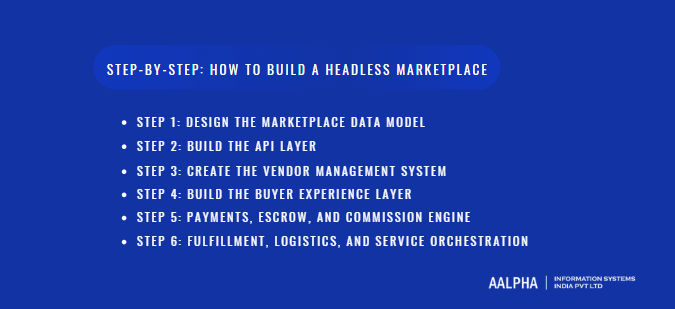
Step 1: Design the Marketplace Data Model
The data model is the economic skeleton of your marketplace. If this layer is wrong, no amount of UI polish or API optimization will save the platform.
At minimum, a headless marketplace needs six core entities.
Users represent every human or system that interacts with the platform. This includes buyers, vendors, staff, delivery partners, and administrators. Each user has roles, permissions, and authentication credentials. In a multi-tenant marketplace, users may belong to multiple organizations, such as a restaurant chain or supplier group.
Vendors are the commercial entities selling goods or services. Vendors have profiles, contracts, payout settings, compliance status, and performance metrics. In managed marketplaces, vendors also have approval states and document storage for licenses and KYC.
Listings represent what is being sold. This could be products, services, time slots, or digital assets. Each listing has attributes, pricing rules, availability, and fulfillment requirements. The data model must support category-specific fields without breaking the global catalog.
Orders represent a transaction between a buyer and one or more vendors. A single order may split into multiple vendor sub-orders, each with its own status, pricing, and fulfillment logic. This is where most marketplaces fail because they model orders as if they were single-seller retail transactions.
Commissions define what the platform earns from each transaction. This includes percentage fees, fixed charges, promotional discounts, and tax handling. The commission engine must be data-driven, not hard-coded.
Payouts and disputes track how and when money moves. Every order generates balances for vendors and the platform. Disputes, refunds, and chargebacks modify those balances. This ledger-like system must be auditable and immutable.
A well-designed data model treats money and obligations as first-class objects. This is what allows a headless marketplace to scale without financial chaos.
Step 2: Build the API Layer
Once the data model is defined, the next step is to expose it through an API-first backend. This is the heart of a headless marketplace.
Authentication APIs manage user identity, sessions, and roles. Every request must be tied to a verified user or system with explicit permissions. OAuth, JWT, and role-based access control are standard here.
Catalog APIs expose listings, categories, pricing, and availability. These endpoints must support complex filtering, sorting, and personalization. In a B2B marketplace, they must also support account-specific pricing and visibility.
Order APIs handle cart creation, checkout, order placement, cancellation, and status tracking. These APIs must be idempotent and transactional. A duplicate request should not create duplicate orders or charges.
Pricing APIs calculate what the buyer pays and what the vendor earns. They apply promotions, taxes, commissions, and currency conversions in real time. This logic cannot live in the frontend because it must be authoritative and auditable.
Messaging APIs enable communication between buyers, sellers, and the platform. This includes chat, notifications, and system alerts. In service and delivery marketplaces, messaging is critical for coordination and proof of completion.
These APIs form the contract between your marketplace engine and every interface that will ever exist. If they are designed cleanly, you can build unlimited frontends without rewriting business logic.
Step 3: Create the Vendor Management System
Vendors are not just users. They are businesses with revenue, obligations, and operational workflows. A serious marketplace must give them a control plane.
Onboarding and KYC ensures that vendors are legitimate and compliant. This may include identity verification, business registration, bank account validation, and document uploads. The system must track approval status and block transactions for non-compliant vendors.
Product and service management allows vendors to create, update, and retire listings. In a headless system, these actions are just API calls, but the vendor dashboard provides the interface. Bulk uploads, pricing rules, and availability schedules are common requirements.
Order handling lets vendors accept, reject, fulfill, or cancel orders. Each action updates the platform’s state machine and may trigger financial or logistical workflows.
Performance and payouts give vendors visibility into their earnings, commissions, and settlement schedules. Transparency here builds trust and reduces support load.
The vendor system is where supply quality is enforced. Without it, a marketplace becomes chaotic, even if the consumer side looks polished.
Step 4: Build the Buyer Experience Layer
While the backend runs the marketplace, the buyer experience determines whether transactions happen at all.
Search and discovery must be fast, relevant, and personalized. Buyers need filters, categories, and recommendations that match how they think about the market.
Cart and checkout must support multi-vendor orders, different tax rules, delivery options, and payment methods. A buyer should be able to purchase from multiple sellers in one transaction even if fulfillment happens separately.
Notifications and tracking keep buyers informed. Order confirmations, shipping updates, service reminders, and delivery proofs all come from backend events but are surfaced through the frontend.
In a headless architecture, the buyer interface can be a website, a mobile app, or even a chat bot. The backend remains the same.
Step 5: Payments, Escrow, and Commission Engine
Money is the most complex part of any marketplace.
Most platforms use escrow-style flows, where the buyer pays the platform, and the platform releases funds to the vendor after fulfillment. This protects both sides and gives the platform control over disputes and refunds.
The commission engine calculates platform fees, promotions, and taxes. It must work for every transaction type and be transparent to all parties.
Payout systems handle when and how vendors get paid. Some get daily settlements, others weekly or monthly. Failed deliveries, chargebacks, and disputes all adjust balances.
A headless marketplace must maintain a transaction ledger that records every financial event. This is what enables accurate reporting, compliance, and trust.
Step 6: Fulfillment, Logistics, and Service Orchestration
The final step is to ensure that what was sold actually gets delivered.
For physical goods, this means shipping labels, carrier integrations, tracking, and proof of delivery.
For services, this means scheduling, worker assignment, check-ins, and completion verification.
For digital goods, this means license delivery, access provisioning, and usage tracking.
The platform must track service-level agreements, deadlines, and exceptions. Every fulfillment event updates the order state and may trigger payments, notifications, or disputes.
This orchestration layer is what turns a marketplace from a catalog into a functioning economy.
Frontend Development in a Headless Marketplace
In a headless marketplace, the frontend is not where business logic lives, but it is where revenue is won or lost. Buyers and sellers do not care how well your APIs are written if the experience feels slow, confusing, or untrustworthy. The power of headless architecture is that it lets product teams design and evolve experiences without destabilizing the transaction engine underneath.
-
Web Frontend Strategy
The web interface is still the primary discovery and conversion channel for most marketplaces. It is where new users arrive, browse, compare, and decide whether to trust the platform.
In a headless marketplace, the web frontend should be built as a thin client that consumes APIs for everything: search, catalog, cart, checkout, and account management. This allows the web team to focus on performance, design, and conversion rather than business rules. Techniques such as server-side rendering and edge caching ensure fast page loads even for large catalogs.
A strong web frontend must support deep filtering, personalized pricing, and role-based experiences. A buyer, a vendor, and an admin should see different interfaces even though they are all talking to the same backend. Because the logic is centralized, changes to pricing rules or product availability propagate instantly to every page.
From a product perspective, the web layer is also the primary experimentation surface. A/B testing new layouts, promotional banners, or onboarding flows does not require backend changes. This agility is one of the biggest growth advantages of headless commerce.
-
Mobile App Strategy
Mobile apps are essential for marketplaces where real-time interaction, location, or notifications drive engagement. Delivery platforms, service marketplaces, and B2C retail all depend on mobile-first experiences.
In a headless marketplace, mobile apps are just another API consumer. They use the same endpoints for search, orders, payments, and messaging as the web frontend. What they add is device-level capability. Push notifications keep users engaged. GPS enables tracking and assignment. Cameras allow proof of delivery or service completion.
Because the backend is decoupled, you can have multiple mobile apps for different roles. Buyers get a shopping and tracking app. Vendors get an order and inventory app. Delivery partners get a routing and task app. All of them operate on the same order and payment data, ensuring consistency.
This separation also allows faster iteration. Mobile teams can release UI updates without risking financial or transactional integrity, which is critical for high-volume marketplaces.
-
Multi-Channel Interfaces: WhatsApp, POS, API Partners
Modern marketplaces no longer live only on websites and apps. Buyers and sellers expect to interact through whatever channel is most convenient.
WhatsApp and messaging interfaces are increasingly popular, especially in emerging markets and for hyperlocal services. A headless backend allows you to build conversational ordering, status updates, and support flows on top of the same APIs used by the web and mobile apps.
POS and kiosk systems are used in physical environments such as retail stores, warehouses, and service centers. These systems need real-time access to inventory, pricing, and order management. With a headless backend, a POS terminal is just another client, not a separate system.
API partners and affiliates can embed your marketplace into their own platforms. For example, a logistics provider can place orders directly through your APIs, or a SaaS platform can resell your services. This turns your marketplace into infrastructure, not just a destination.
The key benefit of headless architecture here is that every channel speaks the same language. There is one set of rules for pricing, availability, and fulfillment, no matter how the transaction is initiated. This consistency is what allows marketplaces to scale distribution without losing control.
Cost of Building a Headless Marketplace
The cost of building a headless marketplace is driven less by visual design and more by transaction complexity, regulatory scope, and scale targets. Unlike a single-vendor eCommerce site, a marketplace must manage multi-party money flows, compliance, identity, disputes, and orchestration across channels. This section breaks down what founders and CTOs should budget for at each stage and how those costs change as the platform grows.
-
MVP vs Scalable Platform Costs
A marketplace MVP is not a “lite” version of the final system. It is a production-grade transaction engine with fewer workflows and tighter scope. The difference between an MVP and a scalable platform lies in resilience, automation, and extensibility.
A headless marketplace MVP typically includes user and vendor management, a basic catalog, order placement, a simple commission model, and a single frontend such as a web app or a basic mobile app. It is designed to validate supply, demand, and pricing. Even at this stage, you still need secure authentication, a real payment gateway, and audit-ready order records. For most B2B or B2C marketplaces, this phase usually requires a multi-month build by a specialized team because financial flows and multi-vendor logic cannot be mocked.
A scalable headless marketplace adds vendor dashboards, automated payouts, dispute workflows, multi-channel frontends, performance monitoring, fraud detection, and compliance automation. It also requires load-tested APIs, event-driven orchestration, and data pipelines for reporting and growth analytics. This is where most of the cost increases occur, not because of UI but because of reliability and governance.
The practical implication is that a marketplace that can handle real money and real vendors from day one already has meaningful engineering cost. What you are choosing with an MVP is how much automation and scale-readiness you defer, not whether you need serious backend infrastructure.
-
Development, Infrastructure, and Maintenance
The total cost of ownership for a headless marketplace is split across three pillars: software development, cloud infrastructure, and ongoing operations.
Development costs cover backend services, APIs, vendor and buyer interfaces, payment integration, and admin tools. Because a headless marketplace is API-first, the bulk of engineering time goes into business logic, data models, and workflow orchestration rather than visual design.
Infrastructure costs include hosting, databases, API gateways, search engines, message queues, and third-party services such as payment processors, KYC providers, and messaging gateways. These costs scale with usage. A marketplace that processes thousands of transactions per day will spend more on compute, bandwidth, and external APIs than a small pilot.
Maintenance and operations are often underestimated. Marketplaces require 24/7 monitoring, security updates, compliance changes, and customer support tooling. New vendors, new payment methods, and new regions all introduce ongoing engineering work.
Because headless platforms are modular, they are cheaper to evolve than monoliths. You can upgrade or replace one service without rewriting the entire system. This lowers long-term cost even if the initial build is more sophisticated.
-
Build vs Buy vs Hybrid Approaches
There are three strategic ways to launch a headless marketplace.
Build from scratch gives you full control over data, workflows, and differentiation. This is ideal for regulated industries, complex B2B platforms, or companies building proprietary marketplaces as a core asset. It has the highest upfront cost but the lowest long-term dependency risk.
Buy or license a marketplace platform can reduce initial time to market, but most off-the-shelf tools are designed for simple retail or single-region use. They often struggle with multi-vendor payouts, custom workflows, or deep integrations.
Hybrid approaches use a commercial core for basics such as payments or catalog management while building custom APIs and services for differentiation. This can be cost-effective but still requires strong architecture to avoid vendor lock-in.
For serious marketplace businesses, especially those targeting the US, UK, or Europe, the decision is less about cheapest launch and more about owning a scalable transaction engine that can support growth, compliance, and innovation for years.
Common Mistakes and How to Avoid Them
Even technically sound headless marketplaces fail when foundational decisions are made without a clear understanding of how marketplaces behave at scale. These failures are rarely caused by code quality. They are caused by mismatched assumptions between product, operations, finance, and growth. Understanding the most common mistakes allows founders and CTOs to avoid expensive rebuilds and stalled traction.
-
Over-Engineering Too Early
One of the most damaging mistakes is building for hypothetical scale instead of real market validation. Many teams attempt to design for millions of users, dozens of regions, and every possible use case before a single transaction has occurred. This leads to bloated architectures, slow development cycles, and high burn without evidence of product-market fit.
A headless marketplace does not require a microservice for every feature on day one. It requires clean data models, API boundaries, and extensible workflows. You can start with a smaller set of services and evolve them as demand becomes clear. The goal of the MVP is to validate whether buyers and sellers actually transact on your platform, not to prove architectural sophistication.
The way to avoid this mistake is to separate what must be correct from what must be perfect. Payments, identity, and order integrity must be correct from day one. Scalability beyond your first growth phase can be designed incrementally once real usage patterns are visible.
-
Poor Vendor UX
Many marketplaces obsess over buyer experience while neglecting the supply side. Vendors are the engine of the marketplace. If onboarding is slow, pricing tools are confusing, or payouts are unclear, supply dries up.
Poor vendor UX shows up as incomplete listings, missed orders, and high churn. In a headless marketplace, this problem is amplified because vendors often interact through mobile apps, dashboards, and APIs. Inconsistent or unreliable tools destroy trust.
The solution is to treat the vendor interface as a revenue product, not an admin panel. Clear onboarding, transparent earnings, simple order workflows, and reliable notifications directly impact how much business flows through the platform.
-
Payment and Compliance Pitfalls
The most dangerous failures happen around money and regulation. Many early marketplaces treat payments as a simple checkout problem rather than a multi-party financial system.
Common errors include miscalculating commissions, releasing funds before fulfillment, failing to handle refunds correctly, or ignoring tax and reporting obligations. These issues can lead to regulatory penalties, frozen payment accounts, or legal disputes with vendors.
A headless marketplace must maintain a complete, auditable ledger of every transaction. Escrow, split payments, and payout schedules must be enforced by backend logic, not manual processes. Compliance requirements such as KYC, VAT, and data protection must be built into the platform, not added later.
Avoiding these pitfalls requires designing financial and legal workflows with the same rigor as product features.
Why Aalpha Is Chosen to Build Headless Marketplaces
Building a headless marketplace is not a typical web development project. It is the construction of a transaction engine, a multi-party financial system, and a distributed operations platform that must work flawlessly across web, mobile, and partner channels. This is why companies in the US, UK, and Europe increasingly choose Aalpha Information Systems when they need to build or modernize marketplace platforms.
Aalpha does not approach marketplaces as templated eCommerce sites. The company designs them as API-first, transaction-driven platforms from day one. This distinction matters because most off-the-shelf commerce stacks are built for single-seller retail. They break down when you introduce vendor onboarding, commission rules, split payments, disputes, and compliance workflows. Aalpha engineers marketplaces around these realities, starting with data models and orchestration rather than UI screens.
One of Aalpha’s key strengths is deep experience in complex, regulated, and multi-vendor environments. From healthcare platforms and B2B procurement systems to logistics and SaaS marketplaces, Aalpha teams have built systems where money, compliance, and operational reliability are not optional. This experience directly translates into better architectural decisions for headless marketplaces, such as how to model escrow, how to design payout ledgers, and how to enforce vendor governance across channels.
Aalpha also understands that a modern marketplace is not just a website. Buyers and sellers interact through mobile apps, dashboards, messaging platforms, POS systems, and third-party APIs. Aalpha’s delivery model is built around this reality. Every project is designed as a multi-channel platform with a single source of truth at the backend. This allows clients to launch on web today, add mobile apps tomorrow, and integrate partners later without rewriting their core systems.
From a commercial standpoint, Aalpha is structured for long-term product ownership, not one-off builds. The company supports MVP launches, scale-up phases, and enterprise-grade expansions using the same engineering core. This continuity is critical for marketplaces, where data, financial history, and vendor relationships become strategic assets over time.
Finally, Aalpha brings the discipline of enterprise-grade security, compliance, and reliability into startup-speed delivery. This is why founders, CTOs, and product leaders trust Aalpha to build platforms that handle real money, real customers, and real regulatory exposure.
When companies choose Aalpha, they are not buying a development team. They are partnering with a group that understands how digital marketplaces actually work and how to make them scale.
Final Words
Building a headless marketplace is not about picking a trendy tech stack or launching a visually impressive storefront. It is about engineering a platform that can support real economic activity between independent businesses, customers, and service providers across multiple channels, geographies, and regulatory environments. From data models and transaction orchestration to payments, compliance, and vendor governance, every layer must be designed to work together under real-world conditions where money, trust, and reputation are always at stake.
The advantage of a headless architecture is that it allows you to separate growth from risk. You can add new mobile apps, new sales channels, and new partner integrations without destabilizing your core marketplace engine. That is why the world’s fastest-growing platforms are moving away from monolithic commerce systems and toward API-first, composable, and multi-channel marketplace architectures.
If you are planning to launch or modernize a marketplace in the US, UK, or Europe, the most important decision you will make is not your UI framework. It is who designs the transaction engine that will run your business.
Aalpha Information Systems specializes in building exactly these kinds of platforms. From multi-vendor data models and commission engines to escrow payments, compliance workflows, and multi-channel delivery, Aalpha builds marketplaces that are designed to operate at real commercial scale from day one.
If you want to discuss your marketplace idea, validate your architecture, or get a clear roadmap and cost estimate, connect with Aalpha and schedule a consultation with Aalpha’s marketplace engineering team.