






TL;DR
Fraud detection software is a system that scores transactions, logins, claims, and account events in real time, decides whether each one is legitimate, and routes the doubtful cases to a human investigator. Modern builds pair a configurable rules engine with machine learning models trained on historical fraud labels, sitting on top of a streaming data pipeline that can hold a decision inside 100 to 300 milliseconds. Banks, payment processors, lending platforms, insurers, marketplaces, and digital wallets are the heaviest users, though any business with chargebacks, promo abuse, or fake accounts eventually reaches the point where manual review stops scaling.
A focused rules-and-monitoring build typically runs 45,000 to 90,000 USD over three to four months. A machine learning platform with case management, device intelligence, and four or five integrations lands between 100,000 and 200,000 USD across five to eight months. Enterprise systems carrying AML obligations, multi-entity data, and regulatory reporting start around 250,000 USD and keep going. The number moves mostly on data readiness and integration count, not on the model itself.
A software development company like Aalpha can build custom fraud detection software around a company’s specific fraud patterns, data sources, business rules, and integration requirements. This approach is useful when standard platforms cannot accommodate the product’s workflows or when greater control over data and infrastructure is required.
Buy an off-the-shelf platform when your fraud looks like everyone else’s card fraud. Build custom when your fraud is specific to your product, when your data cannot leave your infrastructure, or when a vendor’s per-transaction pricing crosses the cost of an engineering team at your volume. Most companies end up hybrid: a bought signal provider feeding a system they own.
What is fraud detection software
Fraud detection software evaluates events against known fraud patterns and behavioural baselines, produces a risk score, and applies a decision policy to that score. Approve, decline, challenge with step-up authentication, or queue for review. Everything else in the product exists to support those four outcomes.
The mechanics are less mysterious than the marketing suggests. An event arrives, usually a payment authorisation, a login, an account update, or a claim submission. The system enriches it with context it already holds: how many cards this device has touched in 30 days, whether the shipping address has ever appeared with a different name, the account’s average order value, the velocity of failed logins from the same IP block. Those enriched attributes become features. Rules test them against thresholds. Models score them against learned patterns. The two outputs combine into a single risk decision, which gets logged with the reasons behind it.
Detection versus prevention
Detection identifies fraud that is happening or has happened. Prevention blocks it before value moves. The distinction matters commercially because it determines where your software sits in the transaction path. A prevention system is inline and synchronous, which means it inherits a latency budget and a hard availability requirement. If it goes down, payments stop. A detection system can run asynchronously on a stream, flagging events minutes later for clawback, account freeze, or investigation.
Most real deployments do both. Inline scoring on the payment path with a strict timeout and a fail-open default, plus a slower batch layer that catches slow-burn patterns like bust-out fraud, where an account behaves perfectly for four months before draining a credit line.
Rules versus machine learning
Rules are explicit conditions written by fraud analysts. Decline any card-not-present transaction above 500 USD where the billing country differs from the IP country and the account is under 24 hours old. They are transparent, instantly deployable, and easy to explain to a regulator or a chargeback arbitrator. They also degrade. Fraudsters test thresholds until they find the edge, then operate just under it. A rules-only system built three years ago is catching last year’s fraud.
Machine learning models learn the interaction between hundreds of features without anyone specifying the logic. They catch combinations no analyst would write down. Their cost is opacity, the need for labelled data, and a maintenance burden that rules do not have. Models drift. Rules only go stale.
Anyone selling you one without the other is selling you half a system. The rules engine handles the known, the compliance-mandated, and the emergency response when a new attack appears at 2am and you need a block live in ten minutes. The model handles everything you have not thought of.
Real time versus batch
Real-time scoring is required wherever the decision gates value transfer: card authorisation, wallet top-up, instant transfer, account opening. The budget is tight. Card networks and payment service providers expect a response in well under a second end to end, which leaves your scoring service perhaps 100 to 200 milliseconds after network overhead. That constraint dictates architecture more than any other requirement in the project.
Batch scoring handles the patterns that only appear over time. Merchant collusion, refund abuse rings, structuring in AML, insurance claim networks with shared adjusters and shared repair shops. These need a wider window and heavier computation, and nobody is waiting on the answer.
Where fraud detection software is deployed
Retail and commercial banking, payment processing, lending, insurance, e-commerce, marketplaces, telecom, healthcare claims, digital advertising, gaming, and any subscription business with trial abuse. The vertical changes the fraud taxonomy and the regulatory overlay. It changes the architecture surprisingly little.
Types of fraud detection software and their use cases
-
Banking and financial fraud
Account takeover is the dominant loss category in retail banking, and it rarely starts at the bank. Credentials arrive from a breach elsewhere, get validated at scale, then get used. Detection here leans on behavioural signals rather than transaction attributes: typing cadence, navigation path through the app, whether the device has been seen before, whether the session skipped screens a genuine customer never skips.
Payment fraud covers unauthorised transfers, mule account activity, and authorised push payment scams, where the customer themselves sends the money after being deceived. The last category broke a lot of existing models because the transaction is technically legitimate. The customer authenticated correctly, used their own device, and confirmed the payment. Detection has to work from the shape of the beneficiary relationship and the behavioural markers of a person under social pressure.
Card fraud splits into card present, which has mostly moved to EMV and is a smaller problem in chip markets, and card not present, which is where the volume is. Loan application fraud involves falsified income, synthetic identities, and first-party fraud where a real person never intends to repay. Money laundering detection overlaps with fraud tooling but is a distinct regulatory obligation with its own rule sets around structuring, rapid movement of funds, and high-risk jurisdictions.
-
E-commerce fraud
Stolen card usage is the obvious one. The costlier ones are often policy abuse: serial returners, refund fraud where the customer claims non-delivery, promo and coupon stacking through account farms, and reseller bots. Chargeback fraud, where a genuine customer disputes a genuine purchase, sits awkwardly between fraud and customer service and needs evidence collection more than it needs a model.
The e-commerce build usually prioritises device fingerprinting, address normalisation and matching, order velocity across identity graph nodes, and integration with the payment gateway so declines can be routed to 3D Secure challenges rather than hard failures.
-
Insurance fraud
Insurance detection is largely a network problem. Individual claims look plausible in isolation. What surfaces fraud is the graph: the same repair shop, the same medical provider, the same claimant phone number appearing under three names, staged accident rings where participants have prior policy relationships. Text analysis of adjuster notes and first notice of loss statements adds signal that structured fields miss. Detection runs in batch because claims processing has days, not milliseconds.
-
Fintech and digital wallets
Synthetic identity fraud is the hard case. A fabricated identity built from a real national ID number, a fake name, and a maintained credit history passes KYC because nothing about it is inconsistent. It is caught, when it is caught, by identity graph analysis and by the absence of history that a real person would have accumulated.
Wallet platforms also deal with account farming, referral abuse, and transaction structuring to stay under reporting thresholds. Device and account linkage analysis carries most of the weight here. If 60 accounts share a device fingerprint and a payout method, you do not need a model to tell you what that is.
-
Other applications
Telecom fraud covers SIM swap, subscription fraud, and international revenue share fraud. Healthcare fraud covers upcoding, phantom billing, and provider collusion. Ad fraud covers click farms, bot traffic, and domain spoofing. Internal employee fraud covers expense manipulation, vendor fraud, and privilege abuse, and needs a detection design that assumes the adversary knows how the controls work.
Core features of fraud detection software
-
Real-time transaction monitoring
The monitoring layer consumes events, enriches them with historical context, and returns a decision within the latency budget. The engineering difficulty is not the scoring, it is the enrichment. Computing thirty-day card velocity at decision time against a transactional database will not meet a 150 millisecond target at scale. This is why serious builds use a feature store with precomputed aggregates updated by a streaming job, so the scoring service performs key lookups rather than aggregations.
-
Rules engine
The rules engine needs to be usable by fraud analysts without a deployment. That means a rule definition format, a testing sandbox where a rule can be replayed against last month’s traffic to see what it would have caught and what it would have blocked, a shadow mode where it logs without acting, and versioning so you can answer what was live on a given date. Analysts should be able to write, simulate, and promote a rule in an afternoon.
Thresholds should be configurable per segment. A 500 USD velocity limit that makes sense for a consumer account is nonsense for a business account, and a single global threshold generates most of your false positives.
-
Machine learning scoring
The model layer typically holds several models rather than one. A gradient-boosted classifier for the main supervised task, an anomaly detector for events that do not resemble anything in training, and often a segment-specific model for a high-value channel. Serving needs to handle model versioning, A/B or champion-challenger comparison on live traffic, and a fallback path when the model service times out.
-
Behavioural analytics
User and entity behavioural analytics builds a baseline per account and measures deviation from it. Login times, device set, geographic pattern, transaction size distribution, merchant categories, session navigation. The value is in catching the account that starts behaving unlike itself, which is the signature of takeover. The cost is a cold start problem: new accounts have no baseline, and new accounts are where a lot of fraud lives.
-
Device intelligence and fingerprinting
Device signals include browser and OS attributes, canvas and audio fingerprints, timezone and language mismatches against IP geolocation, and detection of emulators, remote access tools, and headless browsers. Remote access detection deserves specific attention because it is the mechanism behind a large share of scam-driven transfers, where the fraudster operates the victim’s genuine device.
Device reputation across your own network is one of the highest-value features you can build, and it costs almost nothing beyond storing the fingerprint and linking it. A device that touched a confirmed fraudulent account last week should raise the score on everything it does this week.
-
Identity verification and KYC integration
Document verification, liveness checks, biometric matching, sanctions and PEP screening, and database checks against credit bureau or government sources. Most teams integrate a specialist provider rather than build this. The build work is in orchestration: deciding which checks fire at which risk level, handling provider failure gracefully, and persisting the results into the customer risk profile so the fraud engine can use them later.
-
Case management
Case management is where fraud teams spend their day, and it is consistently the most under-specified part of a requirements document. It needs queue management with prioritisation, a case view that assembles the full context of an alert without the investigator opening five other systems, evidence attachment, notes, assignment and escalation, SLA tracking, and a disposition step that writes a label back to the training data. That last point is easy to forget and expensive to retrofit. Every case an investigator closes is a labelled example, and if the outcome does not flow back into the model pipeline, you have thrown away your best data source.
-
Alerting and notification
Alerts should be risk-tiered rather than binary, delivered to the right queue, and rate-limited so a single attack does not generate 4,000 individual notifications. Customer-facing notifications matter too. A well-timed transaction confirmation prompt catches fraud that no model would have flagged, because the customer knows what they did.
-
Reporting and analytics
Operational reporting covers alert volume, queue ageing, investigator throughput, and decision distribution. Model reporting covers precision, recall, and the score distribution over time. Business reporting covers fraud loss by channel, chargeback rate, false positive cost measured in declined good transactions, and detection rate against confirmed fraud. Regulated entities also need suspicious activity report generation and audit-ready decision histories.
-
Access control and audit logging
Role-based access with segregation between analyst, investigator, supervisor, and administrator. Every decision, override, rule change, and data access logged immutably. Fraud systems are themselves a target for internal abuse, and an investigator with unrestricted approval rights is a control gap.
How AI and machine learning work in fraud detection
-
Why rules alone stop working
A rules-only system has a ceiling, and you can predict where it sits. Each rule catches a pattern and generates false positives on legitimate traffic that resembles the pattern. Add enough rules and the false positive rate rises faster than the catch rate, because rules do not account for the interaction between conditions. A rule that fires on new device plus high value cannot know that this particular customer buys expensive items on a new phone every 18 months and has done so three times.
Models learn those interactions. That is the entire argument for adding them, and it is sufficient.
-
Supervised classification
The workhorse. A labelled dataset of past transactions with fraud outcomes, a few hundred engineered features, and a gradient boosting model. XGBoost and LightGBM dominate production fraud scoring because they handle tabular data with mixed types well, train fast enough to retrain weekly, and produce feature importances that investigators can interpret. Neural networks rarely beat them on standard tabular fraud data by enough to justify the operational cost.
The output is a probability, not a decision. Where you set the cut-off is a business choice about the relative cost of a missed fraud versus a declined good customer, and it should be revisited quarterly rather than set once during the build.
-
Unsupervised anomaly detection
Isolation forests, autoencoders, and clustering methods flag events that do not resemble the population. They catch novel attacks that supervised models miss because those attacks are absent from training data. They also generate a lot of noise, since unusual and fraudulent are not synonyms. Use anomaly scores as a feature feeding the main decision or as a separate low-priority review queue, not as an automatic decline trigger.
-
Semi-supervised approaches
Fraud labels are scarce, delayed, and incomplete. Chargebacks arrive 30 to 120 days after the transaction. Confirmed fraud is a fraction of actual fraud. Semi-supervised methods, including positive-unlabelled learning, treat unlabelled data as a mixture rather than assuming it is clean. This is worth the complexity when your confirmed fraud rate is under a fraction of a percent and your unlabelled pool is large.
-
Graph analytics
Fraud is rarely solitary. Linking entities through shared attributes, devices, addresses, phone numbers, payment instruments, IP subnets, beneficiary accounts, produces a graph where fraud rings become visible as dense subgraphs. Graph features such as component size, shortest path to a known fraudulent node, and neighbourhood fraud density are among the strongest predictors you can add to a tabular model. Graph neural networks go further and learn representations directly from the structure, though for most builds, engineered graph features fed into a boosted tree deliver the majority of the benefit at a fraction of the operational complexity.
-
Natural language processing
Useful in insurance claims, merchant onboarding, and investigation support. Claim narratives, adjuster notes, chat transcripts, and merchant descriptions contain signal that structured fields lose. Large language models have made summarisation of a case file genuinely useful: an investigator opening an alert can read a generated summary of twelve related events instead of reading twelve records. Treat generated summaries as a navigation aid, never as evidence, and keep the underlying records one click away.
-
Behavioural biometrics
Keystroke dynamics, mouse movement, touchscreen pressure and swipe patterns, device orientation during a session. These distinguish the account holder from someone else operating the same credentials, and they detect remote access sessions and bot automation. Privacy analysis is required before deployment because behavioural biometric data is personal data under GDPR and, in some readings, biometric data attracting stricter treatment.
-
Feature engineering
This is where fraud model performance is actually won. Raw transaction fields carry little signal. Derived features carry most of it: velocity counts across multiple windows and multiple keys, ratios against the entity’s own history, time since last event, distance and implied travel speed between consecutive geolocations, mismatch flags between billing, shipping, IP, and device signals, aggregates over the identity graph.
Compute these once in a feature store and serve them consistently to training and inference. Training and serving skew, where the feature is computed one way in the notebook and a slightly different way in production, is the single most common cause of a model that validated beautifully and performs badly live.
-
Handling class imbalance
Fraud is typically 0.1 to 2 percent of events. Accuracy is a useless metric at that ratio; a model predicting legitimate for everything scores 99 percent. Use precision-recall curves, average precision, and recall at a fixed alert volume that matches what your investigation team can actually process. If the team can review 300 cases a day, the question is how much fraud you catch in the top 300 scores, not what the area under the ROC curve says.
Class weighting usually beats naive oversampling. Synthetic minority oversampling has a poor track record on transaction data because interpolated fraud examples are not realistic fraud.
-
Explainability
Every declined transaction may need a reason, and in regulated lending contexts that requirement is legal rather than optional. SHAP values give per-decision feature attributions and are the standard approach. Surface them in the case view as the top contributing factors, translated into analyst language rather than raw feature names. An investigator reading device_fp_card_count_30d equals 14 needs it to say fourteen different cards used from this device in thirty days.
-
False positives and their real cost
Fraud teams over-index on catch rate because losses are measured and declines are not. A false positive costs the margin on a lost sale, the support contact, and some probability of losing the customer entirely. In card-not-present retail, the value of wrongly declined good transactions routinely exceeds actual fraud losses. Instrument this from day one: track the approval rate of challenged transactions, and follow up on declined customers to see whether they came back.
-
Model drift and retraining
Fraud is adversarial, which makes drift structural rather than incidental. Monitor score distribution shift, feature distribution shift using population stability index or a similar measure, and performance against labels as they mature. Retrain on a schedule, and again on a trigger when performance moves. Weekly or fortnightly retraining is common in card fraud; monthly is usually adequate in insurance. Keep a champion-challenger setup running so a new model proves itself on live traffic before it takes over.
-
Human in the loop
Automate the clear cases and route the uncertain band to humans. Two decision thresholds rather than one: above the upper cut-off, decline or block automatically; below the lower cut-off, approve silently; between them, challenge or review. The review band is where investigator judgement generates new labels, which improves the model, which narrows the band. That feedback loop is the product.
Fraud detection software architecture and technology stack
The layers
A production fraud system has seven parts that are worth separating in the design.
Ingestion accepts events from payment gateways, application backends, mobile SDKs, and batch file drops, normalises them to a common event schema, and publishes to a message bus. Schema discipline here saves months later. Every downstream component depends on it.
Stream processing computes rolling aggregates and updates the feature store. Kafka with Flink is the common pairing at volume. Kafka Streams works well when the transformation logic is straightforward and you want fewer moving parts.
The feature store holds precomputed features with a low-latency online layer and an offline layer used for training. Redis or a similar in-memory store for online reads, a warehouse or object store for the offline side. Feature definitions live in one place and serve both, which is how you avoid training and serving skew.
The decision service is the synchronous API on the critical path. It fetches features, calls the rules engine and the model service, combines outputs under a decision policy, returns a verdict, and emits a decision record. It needs strict timeouts, circuit breakers around every dependency, and a defined behaviour when something fails. Fail-open and fail-closed are both defensible; what is indefensible is not having decided.
The rules engine evaluates configurable conditions. Building it yourself is reasonable if your rule complexity is moderate. Drools and similar engines are worth it when analysts need complex chained logic. Whatever you choose, rules must be data, not code, so changing one does not require a release.
The model service loads versioned models and serves predictions, typically behind its own API so models deploy independently of the decision service.
Case management and analytics sit off the critical path, reading from the decision record stream. Keeping them asynchronous protects the payment path from a slow dashboard query.
Data sources
Transaction records, customer profiles and KYC results, device fingerprints and session telemetry, IP geolocation and proxy detection, historical fraud and chargeback outcomes, and external intelligence such as consortium data, email and phone reputation, sanctions lists, and breached credential databases. External signals add real lift, and they add per-call cost, so call them conditionally based on preliminary risk rather than on every event.
Technology choices
Python owns the model layer. Scikit-learn, XGBoost, LightGBM, PyTorch when deep learning is genuinely warranted, MLflow for experiment tracking and model registry. The serving path is often Java, Go, or Python with an async framework, chosen on the team’s operational familiarity more than on benchmark differences.
Postgres handles configuration, cases, and rule definitions. A columnar store, ClickHouse, BigQuery, Snowflake, or Redshift, handles analytical queries over decision history. Redis serves online features. Kafka carries events. Kubernetes runs the services. The frontend is usually React with a table-heavy component library, since a fraud console is fundamentally a queue and a detail view, and investigators care about keyboard navigation and information density far more than about visual polish.
On cloud, the managed services shorten the build: MSK or Confluent for Kafka, SageMaker or Vertex for training and serving, managed Postgres and Redis. Data residency requirements often override this and push toward self-hosted infrastructure in a specific region.
Integrations
Payment gateways and processors, core banking systems, card networks for chargeback data, CRM and support tooling so investigators see customer context, KYC and identity providers, AML transaction monitoring platforms, ERP for merchant and vendor data, e-commerce platforms, and email or SMS providers for customer verification. Integration count is the strongest single driver of project timeline, and it is consistently underestimated because the work is not technical difficulty but coordination: sandbox access, credentials, rate limits, and the other party’s release calendar.
Scale and availability
If the system is inline on payments, it needs the availability of the payment path itself. Stateless horizontally scaled decision services, no single point of failure in the feature lookup path, load testing at three to five times expected peak, and a documented degraded mode. Under total model service failure, the sensible fallback is rules-only scoring rather than blanket approval, because rules run locally and cost nothing to evaluate.
Regional deployment matters for both latency and data residency. A fraud system serving EU and Gulf customers from a single US region will fail the latency budget and possibly the compliance review at the same time.
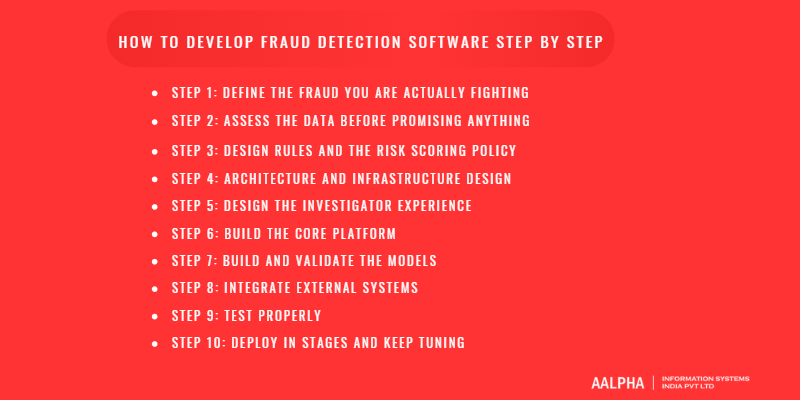
How to develop fraud detection software step by step
-
Step 1: define the fraud you are actually fighting
Start with loss data, not with a feature list. Pull the last twelve to twenty-four months of confirmed fraud, categorise it by attack type, and rank by realised loss and volume. Most organisations discover that two or three attack patterns account for the majority of losses, and that some of the fraud they worried about in the kickoff meeting has never happened to them.
Then map the current process end to end. Who reviews what, on which screen, using which spreadsheet, with what turnaround. The manual workarounds fraud teams have built are a specification written in advance, and reading them saves weeks of requirements workshops.
Set targets that can be measured: detection rate on a named attack type, false positive rate, review queue volume, decision latency, investigator handling time. Vague objectives like reduce fraud produce systems nobody can evaluate.
-
Step 2: assess the data before promising anything
This step decides whether the project is a four-month build or a nine-month one, and it should happen before the estimate is signed. What events are captured, at what granularity, with what retention. Are chargebacks reconciled back to the original transaction. Do you have device data at all, or does it need an SDK deployment first. How many confirmed fraud labels exist, and are they trustworthy.
If there are fewer than a few thousand labelled fraud cases, plan a rules-first release and treat the model as phase two. There is no technique that manufactures signal from data you do not have, and a model trained on 200 examples will embarrass everyone involved.
-
Step 3: design rules and the risk scoring policy
Write the initial rule set with the fraud team, encoding what they already know. Define the score scale, the decision bands, and the actions attached to each band. Decide the policy for combining rule outcomes and model scores. A common and defensible design: hard rules can decline outright regardless of model score, since some conditions are non-negotiable, and everything else is scored and banded.
-
Step 4: architecture and infrastructure design
Pin down the latency budget, the throughput target at peak, data residency, and the failure behaviour. Design the event schema, the feature store contract, and the API between the decision service and its callers. Choose the deployment topology. This is also when you decide what is bought rather than built, since device intelligence, identity verification, and consortium data are almost always bought.
-
Step 5: design the investigator experience
Design for the person who works eight hours a day in the queue. That means density over whitespace, keyboard shortcuts, one screen holding the full case context, bulk actions, and a disposition flow that takes three seconds rather than thirty. Test it by having an actual investigator process twenty real cases in a prototype before the build starts. Fraud consoles that were designed for a demo rather than for a shift get abandoned, and the team goes back to spreadsheets.
-
Step 6: build the core platform
Ingestion, streaming aggregation, feature store, decision service, rules engine, case management, admin and configuration. Sequence it so an end-to-end path works early, even if it only handles one event type with three rules. Fraud systems have a lot of components, and integrating them late is how projects slip.
-
Step 7: build and validate the models
Assemble the training dataset with correct temporal boundaries. Every feature must be computable from data available at decision time; leaking a value that only exists after the outcome is the classic mistake, and it produces a model with suspiciously excellent validation scores that collapses in production.
Split by time, not randomly, because random splits on fraud data leak future information through shared entities. Engineer features, train candidates, and evaluate at the operating point you will actually use. Then run the model in shadow mode against live traffic for two to four weeks before it influences a single decision. Shadow mode is not optional. It is the only honest test.
-
Step 8: integrate external systems
Payment providers, identity verification, banking APIs, external intelligence feeds. Build every integration with a timeout, a retry policy, a circuit breaker, and a defined behaviour when the provider is down. Cache what can be cached. Track per-call costs, because a third-party enrichment called on every event at scale becomes a line item that surprises the finance team in month two.
-
Step 9: test properly
Functional testing of rules, models, workflows, and permissions. Load testing at peak multiples with realistic payload sizes. Model accuracy testing on a holdout period the model never saw. Security testing including penetration testing, since a system holding transaction and identity data is a high-value target. And specifically test the false positive path: take a sample of known good customers, run them through, and count how many get blocked. That number is a release criterion.
-
Step 10: deploy in stages and keep tuning
Ship to a traffic percentage first, in log-only or challenge-only mode, then expand. Watch alert volume against team capacity in the first week, because an over-tuned launch drowns the investigation team and the queue never recovers. Establish the operating rhythm early: weekly rule review, monthly model performance review, quarterly threshold recalibration. A fraud system is an operated product, not a delivered one.
Security, compliance, and data privacy
Fraud systems concentrate exactly the data an attacker wants. Design accordingly.
Encryption in transit and at rest, with card data tokenised and never stored in the fraud database. Store a token and a fingerprint hash, which is enough for velocity and linkage features without holding the pan. Field-level encryption for identity documents and biometric templates. Secrets in a managed vault, never in configuration files.
Authentication for the console should be single sign-on with mandatory multi-factor and short session lifetimes. Authorisation should be role-based with least privilege, and approval actions above a value threshold should require a second reviewer. Audit logging must be immutable and cover every decision, override, rule change, model deployment, export, and record view. Data exports deserve special attention because a fraud console with an unrestricted export button is a data exfiltration tool.
PCI DSS applies if cardholder data touches your environment, and the cheapest compliance strategy is to keep it out entirely by working with tokens supplied by the processor. GDPR applies to any EU data subject and brings two specific obligations for this domain. Article 22 restricts solely automated decisions with legal or similarly significant effects, which means blocking someone’s account or declining credit needs a documented route to human review. And the lawful basis for processing, usually legitimate interest for fraud prevention, needs to be recorded along with a legitimate interest assessment. CCPA and CPRA in California carry a fraud prevention exemption from certain deletion rights, but the exemption is scoped and needs to be documented rather than assumed. India’s DPDP Act, effective through 2025 and 2026 phased rules, adds consent and notice obligations for Indian data principals.
KYC and AML obligations depend on licensing. Regulated entities need customer due diligence, sanctions screening, transaction monitoring against typologies, and suspicious activity reporting within statutory deadlines. Build the reporting output as a first-class feature rather than an export someone reformats by hand.
Model governance is increasingly a supervisory expectation rather than good practice. Maintain a model inventory, documented development and validation, approval records, ongoing performance monitoring, and periodic independent review. Retain the inputs and outputs of every decision for the applicable period, typically five to seven years in financial services, so a decision made two years ago can be reconstructed exactly. That requirement has architectural consequences: version your models, your rules, and your feature definitions together, and store the version identifiers on every decision record.
Cost, timeline, and return on investment
What actually drives the cost
The software development cost for a fraud detection system depends on the number of distinct fraud scenarios in scope, whether decisions must be synchronous, the number of external integrations, the state of your data, the compliance regime, and the depth of the investigator tooling. Data readiness and integration count dominate. Two projects with identical feature lists can differ by a factor of two because one has clean event data with reconciled fraud labels and the other needs an instrumentation project first.
The machine learning component is rarely the expensive part. Building and validating a model on good data is a few weeks of specialist time. Getting the data to that state, serving the features at low latency, and operating the model afterwards is the real cost.
Typical ranges
These are Aalpha’s engagement ranges for custom builds, based on projects delivered for fintech, banking, and marketplace clients.
A rules-based monitoring and case management platform without machine learning, covering a single channel with two or three integrations, generally runs 45,000 to 90,000 USD over three to four months. This is the right starting point when fraud labels are thin or the immediate need is replacing spreadsheet-based review.
A machine learning fraud platform with real-time scoring, a feature store, device intelligence, case management, dashboards, and four to six integrations runs roughly 100,000 to 200,000 USD over five to eight months. Most fintech and e-commerce builds land here.
An enterprise system spanning multiple business lines and geographies, with AML monitoring, regulatory reporting, graph analytics, model governance, and high availability commitments, starts around 250,000 USD and commonly runs beyond 400,000 USD across nine to fifteen months.
Budget separately for run costs. Cloud infrastructure, third-party enrichment calls, and a maintenance and model operations retainer typically add 15 to 25 percent of build cost annually. A model nobody retrains loses value within two quarters, so this is not an optional line.
Timeline shape
Discovery and data assessment takes two to four weeks and should not be compressed. Architecture and design takes three to five weeks. Core platform development runs eight to sixteen weeks depending on scope. Model development overlaps with platform work and takes six to twelve weeks including validation. Integration and testing takes four to eight weeks. Shadow mode and staged rollout takes another four to six weeks before full production traffic.
Build, buy, or both
Buy when your fraud problem is generic, your volumes make per-transaction pricing tolerable, and speed matters more than control. Established platforms bring consortium data you cannot replicate, which is a genuine advantage on day one.
Build when the fraud is specific to your business model and no vendor has seen it, when data cannot leave your infrastructure for regulatory or contractual reasons, when vendor per-transaction costs exceed the fully loaded cost of your own system at your volume, or when fraud logic is a competitive asset rather than a cost centre. Lending platforms and marketplaces often fall into the last category, because their risk model is the product.
The hybrid is the most common outcome and usually the right one. Buy device intelligence, identity verification, and consortium signals. Own the decision layer, the case management, and the models trained on your own outcomes. That way the parts that benefit from scale are bought and the parts that encode your specific knowledge are yours.
Measuring return
Track prevented loss as detected fraud value multiplied by the historical realisation rate, not by the gross transaction value, which overstates the benefit. Track chargeback rate and the associated network fees and scheme programme risk, since crossing a card network monitoring threshold carries costs well beyond the chargebacks themselves. Track the value of false positives eliminated, measured as recovered good transactions. Track investigator hours saved through automation and better tooling. And track manual review as a percentage of total volume, which is the metric that shows whether the system is actually scaling with the business.
Payback for a mid-sized deployment typically arrives within nine to eighteen months, driven more often by false positive reduction and review efficiency than by dramatic increases in fraud caught.
Challenges you will hit, and what to do about them
Most fraud projects fail in the same few places, and none of them are the model.
The first is a shortage of labelled fraud. If you have a few hundred confirmed cases, no modelling technique will rescue you. Start rules-first, use unsupervised methods for the signal you cannot label, and wire label capture into case management from day one so the dataset compounds. Related to this is label delay: chargebacks arrive 30 to 120 days after the transaction, which means today’s model is trained on last quarter’s fraud. Investigator dispositions serve as early labels while chargebacks mature, provided you are explicit about label maturity when you report performance.
The second is data quality. Fragmented event schemas, transaction records that cannot be reconciled to their fraud outcomes, and device data that was never captured because nobody deployed the SDK. Fix the pipeline before the model. A shared event schema and a reconciled outcome table are worth more than any algorithm choice.
The third is drift. Attackers adapt within days of a control change, so degradation is structural rather than a sign that something was built wrong. The answer is monitoring, a retraining cadence, and a fast path to push an emergency rule when a new pattern appears overnight.
The fourth is false positives, and the cause is almost always global thresholds applied to a segmented population. Split thresholds by customer tenure, channel, and value band before reaching for a more complex model. A five-year customer buying their usual amount from a new phone should not be treated like a day-old account.
The rest are engineering problems with known answers. Latency pressure is solved by precomputing aggregates, caching enrichment, calling expensive providers conditionally, and enforcing a hard timeout with a rules-only fallback. Explainability demands are solved by instrumenting SHAP attributions with the first model rather than retrofitting them when a regulator asks. Integration delays are solved by starting integration work in week one, because sandbox access from a bank or a processor routinely takes longer than writing the code that uses it.
The practices that separate systems that hold up from those that do not are unglamorous. Combine rules with models rather than choosing. Build one centralised entity risk profile instead of scattering risk state across services. Keep rules as data. Retrain on schedule. Log everything. Design the review queue around the capacity of the team that will work it. And treat the human review band as the source of your training data rather than as a failure of automation.
Where fraud detection is heading
Graph-native detection is moving from specialist deployments to standard practice as graph databases and graph learning tooling mature, and it is the most reliable way to catch organised fraud rather than individual attempts.
Large language models are changing investigation more than detection. Case summarisation, evidence assembly, drafting suspicious activity narratives, and querying decision history in natural language are all in production somewhere already. The detection layer stays with boosted trees and graphs because they are faster, cheaper, and more explainable on tabular data. Meanwhile the same technology is producing better attacks: synthetic identities with coherent digital histories, deepfake documents and liveness bypass attempts, and scam scripts that adapt to the victim. Liveness detection and document forensics are now an arms race rather than a solved integration.
Continuous authentication is replacing the single login checkpoint, scoring risk throughout a session rather than at the door. Privacy-preserving techniques, including federated learning across institutions and encrypted consortium matching, are being tested as a way to share fraud intelligence without sharing customer data, though regulatory and practical hurdles keep most of it in pilot. Expect the reporting obligations around automated decisioning to tighten as AI regulation lands in the EU and elsewhere, which makes explainability infrastructure a better investment now than a retrofit later.
How to evaluate a development partner
Fraud detection is not a generic web build, and the questions that separate a capable partner from an optimistic one are specific.
Ask what happens when the model service times out during a payment authorisation. A team that has run one of these systems answers immediately, because they have written that fallback. Ask how they prevent training and serving skew, and listen for whether feature definitions live in one place or get reimplemented in the serving path. Ask how they would handle a client with 400 confirmed fraud cases, and be suspicious of anyone who promises a model rather than proposing rules first.
Ask to see how they design the investigator queue, since that interface determines whether the system gets used. Ask about their approach to shadow mode and staged rollout, and treat a proposal that goes straight from testing to full production traffic as a warning. Ask who owns the models, the feature definitions, and the training data at the end of the engagement, and get that written into the contract rather than assumed.
On the commercial side, look for an estimate that separates the platform, the model work, and each integration, because a single blended number hides where the risk sits. Ask what the post-launch retainer covers in concrete terms: retraining frequency, rule tuning, threshold review, and response time when a new attack pattern appears. A partner who has no answer for month seven has probably not operated a fraud system past launch.
Why choose Aalpha for fraud detection software development
Aalpha has been building custom software since 2008, with more than 5,500 completed projects for clients in over 55 countries, a 4.9 out of 5 rating across 215 plus reviews on Clutch, and ISO 9001:2015 certified delivery processes. Fraud detection sits at the intersection of three capabilities we have built deliberately: financial software engineering, applied machine learning, and real-time distributed systems.
Our fintech work covers payment platforms, lending systems, digital wallets, and banking integrations, which means the team understands settlement, chargeback lifecycles, KYC workflows, and the difference between a demo that scores transactions and a service that holds a decision inside 150 milliseconds while a payment waits. On the data side we build the pipelines and feature infrastructure that fraud models depend on, not just the notebooks, and we design for the model governance and audit requirements that regulated clients face during supervisory review. Work for clients including World Bank, Swiss Re, and Bausch and Lomb has kept us honest about security engineering and documentation standards.
Engagements run as fixed-scope projects, dedicated teams, or augmentation of an existing risk engineering function, and most fraud programmes continue past launch with a retainer covering model retraining, rule tuning, and threshold recalibration, because that is what keeps detection rates from decaying.
If you are scoping a fraud detection build, the most useful first conversation is about your loss data and existing signals rather than features. Get in touch with Aalpha and share your current fraud picture. We can help you assess whether a custom build, an existing platform, or a data project is the right starting point.
Frequently asked questions
What is fraud detection software?
Software that evaluates transactions, logins, applications, and claims against fraud patterns and behavioural baselines, assigns a risk score, and then approves, declines, challenges, or queues the event for human review. It combines a rules engine with machine learning models and a case management workflow for investigators.
How does AI detect fraud?
Machine learning models train on historical events labelled as fraudulent or legitimate and learn which combinations of features separate the two. Features are mostly derived rather than raw: velocity counts, deviations from an account’s own history, mismatches between billing, IP, and device signals, and links to other entities through shared attributes. Unsupervised models add coverage for attacks that have never been seen before, and graph methods find rings that individual-event models miss.
How much does it cost to develop fraud detection software?
A rules-based monitoring and case management build runs roughly 45,000 to 90,000 USD. A machine learning platform with real-time scoring and several integrations runs 100,000 to 200,000 USD. Enterprise systems with AML monitoring and multi-entity coverage start around 250,000 USD. Annual run and maintenance costs typically add 15 to 25 percent of the build cost.
How long does it take to build a fraud detection platform?
Three to four months for a rules-based system, five to eight months for a machine learning platform, and nine to fifteen months for an enterprise deployment. Add four to six weeks for shadow mode and staged rollout before full production traffic, which is time well spent.
What technologies are used?
Python with XGBoost or LightGBM for models, Kafka and Flink for streaming, Redis for online feature serving, Postgres for operational data, a columnar warehouse for analytics, Kubernetes for deployment, and React for the investigator console. Graph databases such as Neo4j appear where network analysis is central.
Can machine learning detect new types of fraud?
Supervised models detect variations of patterns they have seen. Genuinely novel attacks are caught by anomaly detection, by graph analysis surfacing unusual connectivity, and by human investigators, whose findings then become training labels. This is why the review queue matters and why a fully automated system without human review degrades over time.
What is the difference between fraud detection and AML software?
Fraud detection protects the business from losses and works on a decision timescale of milliseconds to hours. AML monitoring meets a regulatory obligation to detect money laundering and terrorist financing, works over longer windows, and produces suspicious activity reports for authorities. They share data and infrastructure, and increasingly share a platform, but their objectives, typologies, and reporting outputs are different.
How do businesses reduce false positives?
Segment thresholds by customer tenure, channel, and transaction value instead of applying global limits. Add behavioural and device features so a known good customer is recognised as such. Use step-up authentication for the uncertain band rather than declining. Measure the cost of declined good transactions with the same rigour as fraud losses, since that number is usually larger than teams expect.
Is custom software better than an off-the-shelf platform?
Not automatically. Buy when the fraud is generic and speed matters. Build when the fraud is specific to your product, when data residency rules constrain you, when vendor per-transaction pricing exceeds the cost of your own system at volume, or when risk decisioning is part of your competitive position. The hybrid, buying signals and owning the decision layer, suits most companies past early stage.
What data is needed to train a fraud detection model?
Transaction and event histories with consistent identifiers, confirmed fraud outcomes reconciled back to the original events, customer and account attributes, device and session data, and ideally twelve to twenty-four months of history. A few thousand confirmed fraud cases is a workable starting point. Below that, start with rules and build the labelling path first.
Can fraud detection work in real time?
Yes, and it usually must. Inline scoring on a payment authorisation typically has 100 to 300 milliseconds. Meeting that requires precomputed features in an in-memory store, a lightweight model, and strict timeouts on any external call, with a rules-only fallback if a dependency fails.
Which industries benefit most?
Banking, payments, lending, insurance, e-commerce, marketplaces, digital wallets, telecom, and online gaming, in rough order of typical fraud exposure. The practical trigger is not the industry but the point at which manual review stops keeping pace with transaction growth, which most companies hit sooner than they plan for.