





TL;DR
Fintech AI solutions are software systems that use machine learning, generative AI and natural language processing to automate decisions and tasks in banking, lending, payments, insurance and wealth management. The most proven uses are fraud detection, credit scoring, AML monitoring, KYC verification and customer service assistants. Large players already run these at scale: Bank of America’s Erica has passed 3 billion client interactions, and Upstart reports that over 90% of its loans are fully automated. A focused AI module such as a banking chatbot or KYC tool typically costs USD 25,000 to 150,000 to build, while an enterprise AI banking platform can exceed USD 1 million. The main risks are poor data quality, model bias, explainability gaps and regulation, including the EU AI Act, which treats credit scoring as high risk, and the RBI’s FREE-AI framework in India. Start with one measurable use case, keep humans in the loop for high-impact decisions, and plan for monitoring and retraining from day one. Aalpha Information Systems builds custom AI fintech software, from fraud and KYC modules to full lending and payment platforms, and integrates them with existing core banking and payment systems.
What are fintech AI solutions and why do they matter now?
Fintech AI solutions are applications that use artificial intelligence to detect fraud, assess credit, verify customers, answer queries and forecast risk in financial services. They matter now because transaction volumes, fraud losses and customer expectations have all outgrown what rule-based systems and manual teams can handle at an acceptable cost.
From rules to learning systems. Traditional banking software follows fixed rules written by people. A rule might flag every card transaction over USD 5,000 made abroad. AI systems learn patterns from historical data instead. They can spot a suspicious USD 40 transaction that no rule would catch, and they can let a legitimate USD 6,000 purchase through without friction.
Why demand is growing. Customers now expect instant loan decisions, real-time fraud alerts and support at any hour. Digital-first banks and fintech startups have set that standard. Incumbent banks and NBFCs are responding by adding AI to existing systems rather than replacing them outright.
Who this guide is for. This guide is written for banking executives, fintech founders, CTOs and product managers. It covers the main AI use cases, real examples, the technology stack, implementation steps, indicative costs and the regulations that apply in the USA, Europe, the UAE and India. Each section opens with a short answer you can act on, followed by the detail behind it.
What is AI in banking and finance?
AI in banking and finance is the use of models that learn from financial data to make predictions, classify risk, read documents and hold conversations. Instead of following only fixed rules, these systems score each transaction, applicant or document in real time and pass high-risk or uncertain cases to people for review.
How AI-powered financial solutions work
Most fintech AI follows the same loop. Data comes in from transactions, applications, documents or chats. A model scores or interprets it. Business rules decide what happens next, such as approve, decline, ask for more information or send to an analyst. Every outcome is logged, and the results feed back into retraining. The model is only one part of the system. Data pipelines, decision rules, audit logs and human review are just as important.
Traditional banking software vs AI-powered fintech platforms
Decision logic and adaptability. Traditional banking software runs on fixed rules written by analysts, and it only changes when someone rewrites those rules. An AI-powered platform combines rules with models trained on historical outcomes, and it adapts to new fraud or credit patterns through monitoring and retraining.
Data and service. Legacy systems depend on staff to read documents, emails and statements, and they serve customers through forms, menus and call centers. AI platforms extract and summarize unstructured data automatically and offer conversational assistants that hand off to staff when needed.
Weaknesses. The main weakness of traditional software is that it misses new fraud and credit patterns. The main weakness of AI platforms is that they need quality data, ongoing monitoring and explainability to stay reliable and compliant.
Major AI technologies used in financial services
Machine learning (ML). ML models learn from labeled history, such as past frauds or past defaults. They power fraud scoring, credit risk models and churn prediction. Gradient-boosted trees remain popular because they perform well on tabular financial data and are easier to explain.
Generative AI. Large language models write, summarize and answer questions. Banks use them for internal knowledge assistants, report drafting and customer service. Their downside is that they can produce confident but wrong answers, so they need grounding in approved sources and human checks.
Natural language processing (NLP). NLP lets software understand text and speech. It drives chatbots, complaint classification, call transcription and the screening of news for adverse media in AML checks.
Predictive analytics. Predictive models forecast cash flow, liquidity needs, payment failures and loan delinquency. They turn historical data into numbers a treasury or risk team can plan around.
Intelligent document processing (IDP). IDP combines optical character recognition with ML to read bank statements, pay slips, invoices and identity documents. It cuts manual data entry in onboarding and lending.
Agentic AI and workflow automation. AI agents can carry out multi-step tasks, such as gathering documents for a loan file, checking them and drafting a credit memo. In finance they should work within strict permissions and require human approval before any money moves. Aalpha covers this area in its AI agent development services.
AI vs robotic process automation (RPA) in financial services
RPA copies fixed human steps, such as logging into a portal and copying values into a form. It is fast to deploy but breaks when screens or formats change. AI handles judgment and variation, such as deciding whether a document is genuine or whether a transaction looks unusual. Many banks combine both: RPA moves the data, and AI makes the decision. The trade-off is that AI needs training data and ongoing monitoring, while RPA does not.
Why are banks and financial institutions investing in AI?
Banks invest in AI to cut operating costs, stop more fraud, make faster credit decisions and meet rising compliance demands without hiring at the same pace as volumes grow. Competition from digital-first banks has made speed and personalization a baseline expectation, and AI is the most practical way for incumbents to deliver both.
Pressure to reduce operating costs. Onboarding, document checks, reconciliation and first-line support are labor intensive. AI handles the routine share of this work, so staff focus on exceptions. The saving shows up as lower cost per account opened, per loan processed or per query resolved.
Rising fraud and cyber threats. Fraudsters now use automation and AI themselves, from enumeration attacks that test stolen card numbers to deepfake voice calls. Static rules cannot keep up. Visa has said it helped block USD 40 billion in fraudulent activity in its 2023 fiscal year, nearly double the prior year, much of it through AI-driven risk scoring.
Customer expectations for speed and personalization. People compare their bank with the best app on their phone. They expect instant answers, relevant offers and alerts before problems happen. AI makes this possible at the scale of millions of customers.
Demand for real-time decisions. Instant payment systems such as UPI in India, FedNow in the USA and SEPA Instant in Europe settle in seconds. Fraud checks and limits must run in milliseconds, which rules out manual review for most transactions.
Large volumes of financial data. Banks hold years of transaction, behavioral and document data. Most of it sits unused. AI turns that data into risk signals, forecasts and customer insights.
Compliance and risk management. AML monitoring, sanctions screening and regulatory reporting generate heavy workloads and many false alerts. AI helps prioritize alerts and prepare case files, though final decisions still sit with compliance officers.
Competition from digital-first players. Neobanks and fintech lenders run lean operations with automated decisioning. Incumbents that do not adopt similar tools face higher costs per customer and slower product launches. The risk for incumbents is not falling behind on one feature, but on unit economics across the whole business.
What are the top fintech AI solutions for banking and financial services?
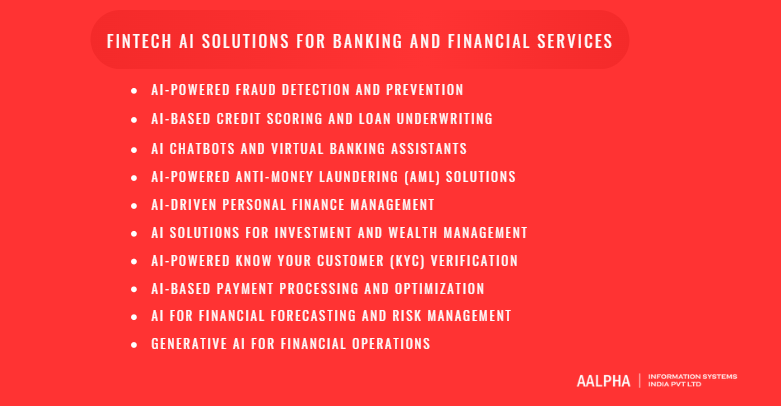
The ten most valuable fintech AI solutions are fraud detection, credit scoring, chatbots, AML monitoring, personal finance management, wealth management, KYC verification, payment optimization, forecasting and risk management, and generative AI for operations. Fraud, credit and KYC usually deliver measurable returns first because they sit on high-volume, well-labeled data.
1. AI-powered fraud detection and prevention
Real-time transaction monitoring. A fraud model scores every card, wallet or bank transfer in milliseconds. It looks at amount, merchant, device, location, time and the customer’s own history. High scores trigger a block, a step-up check such as an OTP, or a review.
Suspicious pattern detection. Graph models link accounts, devices and beneficiaries. They expose mule networks and coordinated attacks that look harmless one transaction at a time.
Account takeover and identity fraud. Behavioral signals such as typing rhythm, device changes and unusual login times flag sessions where someone else is using a genuine customer’s credentials.
Fewer false positives. Rules often decline good customers. Better models approve more genuine transactions while catching more fraud, which protects revenue as well as losses. The downside is that models drift as fraud tactics change, so they need monthly or even weekly monitoring.
2. AI-based credit scoring and loan underwriting
Automated creditworthiness assessment. ML models estimate the probability of default from bureau data, income, banking behavior and application details. Low-risk applications can be approved without manual review.
Predictive credit risk analysis. AI-based credit scoring models also forecast how a borrower is likely to behave over the life of the loan, which supports pricing and limit setting.
Alternative data. Cash flow from bank statements, utility and rent payments, and GST or invoice records help score thin-file borrowers and small businesses that bureaus cannot assess well.
Faster loan approvals. Decisions that took days can take minutes. The trade-off is regulatory exposure. Credit models must be explainable, tested for bias and able to give clear reasons for a decline.
3. AI chatbots and virtual banking assistants
24/7 automated support. Assistants answer balance, card, payment and policy questions at any hour and hand complex cases to staff.
Conversational banking. Customers can block a card, raise a dispute or schedule a transfer in plain language inside the app or on WhatsApp.
Account and transaction help. Assistants explain charges, find transactions and send proactive alerts about low balances or unusual spending.
Multilingual service. NLP and LLMs support regional languages, which matters in markets such as India, the UAE and Europe. The risk is a wrong answer about fees or eligibility, so responses must draw only on approved content and log every conversation.
4. AI-powered anti-money laundering (AML) solutions
Suspicious activity monitoring. Models score transactions and customers for laundering risk, such as structuring, rapid movement through many accounts or unusual cross-border flows.
Transaction pattern analysis. Network analysis connects related parties and reveals layering that rule-based scenarios miss.
Customer risk profiling. AI updates each customer’s risk rating as behavior changes, rather than only at onboarding or annual review.
Investigation support. Generative AI drafts case summaries and suspicious activity report narratives for investigators to check. Final decisions on filing must stay with qualified compliance staff, and regulators will expect a clear audit trail.
5. AI-driven personal finance management
Automatic expense categorization. Models tag transactions by merchant and purpose with high accuracy, even for unclear descriptions.
Budgeting recommendations. The app suggests budgets based on actual spending patterns rather than generic templates.
Cash flow forecasting. Customers see predicted balances before payday and warnings about upcoming bills.
Savings nudges. AI suggests safe amounts to move into savings. Aalpha’s work on MoneyWellth, a US financial wellness platform sold to employers for their staff, is an example of this category. The limitation is trust: poor categorization quickly makes users ignore the advice.
6. AI solutions for investment and wealth management
Robo-advisory platforms. Algorithms build and manage diversified portfolios based on goals and risk tolerance at a lower fee than human advice.
Portfolio analysis and rebalancing. AI monitors drift from target allocations and suggests tax-aware rebalancing.
Investment risk assessment. Models stress-test portfolios against market scenarios and flag concentration risk.
Personalized insights. Generative AI summarizes research and explains portfolio changes in plain language. Advice rules from regulators such as SEBI, the SEC and the FCA still apply, so suitability checks and disclosures must be built in.
7. AI-powered Know Your Customer (KYC) verification
Automated identity verification. Face matching and liveness checks confirm that the person matches the ID document.
Document extraction and validation. IDP reads passports, Aadhaar, Emirates ID, driving licences and utility bills, and checks for tampering.
Onboarding automation. Straight-through onboarding cuts drop-off and processing cost per customer.
Identity fraud detection. Models detect synthetic identities, reused photos and deepfake attempts. Biometric data raises strict privacy duties, so storage and consent must meet local law.
8. AI-based payment processing and optimization
Intelligent payment routing. AI picks the acquirer or gateway most likely to approve each transaction at the lowest cost.
Payment failure prediction. Models predict which recurring payments may fail and retry at better times.
Transaction anomaly detection. Unusual merchant or volume patterns are flagged early, which protects both the provider and its merchants.
Reconciliation automation. ML matches settlements, bank statements and ledger entries, even when references do not match exactly. Gains depend on clean data from every payment partner, which is often the hardest part.
9. AI for financial forecasting and risk management
Predictive cash flow analysis. Corporate and SME treasuries forecast inflows and outflows by customer and supplier.
Liquidity forecasting. Banks predict deposit outflows and funding needs under normal and stressed conditions.
Market risk assessment. Models estimate exposure to rate, currency and price movements more often than monthly reports allow.
Scenario modeling. Teams test how a recession, rate change or default spike would affect the balance sheet. Forecasts are only as good as their assumptions, so model outputs need review by experienced risk staff.
10. Generative AI for financial operations
Automated report generation. LLMs draft management reports, credit memos and board summaries from structured data.
Document summarization. Long contracts, filings and policies are condensed into key points with references.
Internal knowledge assistants. Staff ask questions about products, policies and procedures and get answers grounded in internal documents.
Compliance documentation. AI drafts policy updates, control descriptions and responses to audit requests. Every output needs review, and sensitive data must stay inside approved environments rather than public AI tools.
How is AI applied in different financial sectors?
Each financial sector uses the same AI building blocks for different goals. Retail banks focus on service and fraud, commercial banks on credit and treasury, lenders on origination speed, insurers on claims, payment providers on approval rates, and wealth platforms on advice at scale. The sections below cover the main uses in each sector.
Each sector should also track its own success metric. Retail banks usually watch cost per contact and fraud loss rate. Commercial banks focus on time to credit decision and forecast accuracy. Lenders track approval time, default rate and cure rate in collections. Insurers measure claim cycle time and leakage. Payment providers watch authorization and chargeback rates, while wealth platforms track assets per advisor and client retention.
-
AI solutions for retail banking
Retail banks use AI to tailor offers, answer routine questions and monitor millions of daily transactions. Personalized experiences come from models that predict which product a customer needs next. Service automation handles common requests in the app. Transaction monitoring protects cards, UPI and transfers in real time. The risk is over-personalization that feels intrusive, so offers should respect consent settings.
-
AI solutions for commercial and corporate banking
Corporate credit analysis uses IDP to extract figures from financial statements and ML to flag early warning signs. Treasury management tools forecast client liquidity and suggest sweeps or short-term investments. Cash flow forecasting helps relationship managers spot clients who may need working capital. Data is less standardized here than in retail, so integration effort is higher.
-
AI solutions for lending and digital loan platforms
Loan origination automation reads documents, verifies income and scores risk in one flow. Borrower risk assessment uses bureau and alternative data. Collections prioritization predicts which borrowers will pay with a reminder and which need a call, so teams spend time where it changes outcomes. In India, digital lenders must also follow the RBI’s digital lending rules on disclosures and data handling.
-
AI solutions for insurance companies
Claims processing automation reads claim forms, photos and invoices and settles simple claims quickly. Fraudulent claim detection spots inflated or staged claims and links between claimants. Underwriting assistance summarizes medical or property reports for underwriters. Life and health pricing models fall into the EU AI Act’s high-risk category, which adds documentation duties.
-
AI solutions for payment service providers
Payment fraud detection scores transactions before authorization. Transaction reconciliation matches settlements across banks and gateways. Success-rate optimization routes payments and retries failures intelligently. Even a one-point gain in authorization rate can be worth more than the entire AI build for a high-volume provider.
-
AI solutions for WealthTech and investment platforms
Investment research assistance summarizes filings, earnings calls and news. Portfolio recommendations adjust to goals and market moves. Customer risk profiling goes beyond a static questionnaire by learning from behavior. Advice regulation requires suitability records, so every recommendation must be traceable.
What are the business benefits of AI in banking and finance, and how do you measure them?
The core benefits of AI in finance are lower operating costs, faster decisions, fewer fraud losses, better customer experience and more scalable operations. Each benefit should be tied to a baseline metric before launch, such as cost per loan or fraud loss rate, so the return can be proven rather than assumed.
Setting baselines. Cost savings are measured as cost per account opened, per loan or per query, with an illustrative target of 20 to 40% lower cost per unit within 12 months. Decision speed is measured as the median time from application to decision, where standard loans can move from days to minutes. Fraud performance is measured as fraud loss in basis points of volume alongside the detection rate, and alert quality as the share of fraud or AML alerts that turn out to be genuine.
Operational and customer metrics. Customer experience shows up in containment rate, CSAT, app ratings and onboarding drop-off. Employee productivity is measured as cases handled per analyst per day at equal quality, and accuracy as the number of manual corrections in data entry and reconciliation. Risk management improves when early warning lead times grow and models stay stable. Scalability means volume handled per employee keeps rising as the business grows.
These targets are illustrative ranges, not guarantees. Results depend on data quality, process design and how much of the workflow is actually changed.
Reduced operational costs. Savings come from automating routine work, not from the model alone. Measure the full cost per unit before and after, including review time for exceptions.
Faster transactions and decisions. Track median and 90th percentile decision times. The 90th percentile shows whether hard cases are still stuck.
Improved fraud detection. Measure both caught fraud and good transactions declined. A model that stops fraud by declining loyal customers is not a win.
Better customer experience. For chatbots, track the containment rate and the satisfaction of customers who were handed to an agent. Low satisfaction after handoff often means the bot tried too long.
Better insights from data. Analytics only count as a benefit when they change a decision. Track which reports or forecasts are used in credit, pricing or treasury meetings.
One caution applies to every benefit. Gains fade if models are not monitored. Budget for ongoing tuning, or the improvement measured in the first quarter will erode over the year.
Which banks and fintechs use AI successfully?
JPMorgan Chase, Bank of America, Mastercard, Visa, Upstart and PayPal all run AI in production at large scale, across employee productivity, customer service, fraud and lending. Most published results are company-reported rather than independently audited, so treat them as direction, not benchmarks for your own business.
In summary, JPMorgan Chase uses generative AI for staff productivity, Bank of America for customer service through Erica, Mastercard and Visa for network-wide fraud scoring, Upstart for automated credit underwriting, and PayPal for payment risk management. The figures below come from company press releases, investor filings or media reports quoting the companies.
JPMorgan Chase
JPMorgan built LLM Suite as a portal that lets staff use external large language models for writing, summarizing documents and analysis. It was available to more than 60,000 employees by August 2024, according to reports quoting the bank. The bank designed it to switch between model providers rather than depend on one vendor. The lesson for others is architectural: keep a model-agnostic layer between your users and any single AI provider.
Bank of America
Erica, launched in 2018, is the best-documented consumer AI assistant in banking. Bank of America reported in August 2025 that Erica had passed 3 billion client interactions, served nearly 50 million users and averaged more than 58 million interactions a month. The same release says an employee version is used by over 90% of staff and cut IT service desk calls by 50%. The lesson is patience: the bank says its data science team made tens of thousands of updates over the years.
Mastercard
Mastercard upgraded its Decision Intelligence fraud scoring with generative AI techniques in 2024. The company said initial modeling showed an average 20% improvement in fraud detection, and as high as 300% in some cases, with a score returned in under 50 milliseconds. These are Mastercard’s own modeling figures, not independent results.
Visa
Visa uses deep learning models across its Visa Protect suite, including Visa Advanced Authorization. The company said it helped block USD 40 billion in fraudulent activity in its 2023 fiscal year, nearly double the year before. That figure covers the whole network and includes non-AI controls, so it shows scale rather than the effect of any one model.
Upstart
Upstart provides AI lending models to banks and credit unions. Its investor filings reported that about 91% of loans were fully automated in 2024, and its 2025 releases put the figure above 90%. Upstart also highlights higher approval rates at similar loss levels compared with traditional scoring. Its history also shows the main risk: loan volumes fell sharply in 2022 and 2023 when funding costs rose, which no model could prevent.
PayPal
PayPal has used machine learning for payment risk management for many years. Its models assess the risk of each payment using account history, device data and network signals across its two-sided network of buyers and merchants. PayPal does not publish a single audited impact figure, so it is best seen as an example of AI embedded deeply into everyday payment flows rather than as a standalone product.
What technologies are used to build AI-powered fintech solutions?
AI fintech solutions are typically built with Python ML libraries and large language models, a backend in Node.js, Java, Python or .NET, cloud infrastructure on AWS, Azure or Google Cloud, and integrations with core banking, open banking, payment and identity services. Security and governance tooling is not optional; it is part of the core stack.
A typical stack has six layers. The AI layer handles model training, scoring and language tasks. The backend orchestrates business logic and decisions. The frontend, often built with Next.js, React, React Native or Flutter, serves customer apps, staff consoles and dashboards. The data and cloud layer stores and streams data. Integrations move data in from banking and payment systems and push decisions out. Security and governance tooling protects data and produces the audit evidence regulators expect.
AI and machine learning technologies
Python and its libraries dominate model work. Scikit-learn and XGBoost handle most tabular risk and fraud models. PyTorch and TensorFlow suit deep learning for sequences, images and documents. Large language models from commercial APIs or open-weight models run in a private cloud power assistants, summarization and document extraction. Predictive analytics pipelines handle feature engineering, training, validation and versioning, often with MLflow or a cloud ML platform.
Backend development technologies
The backend turns model scores into decisions. Node.js, Java, Python and .NET are all common. Microservices let fraud, KYC and credit run and scale separately. REST APIs and event-driven systems connect the pieces; events matter in finance because transactions must be scored as they happen, not in nightly batches.
Cloud and data infrastructure
AWS, Microsoft Azure and Google Cloud all offer banking-grade regions, encryption and compliance certifications. Cloud-native applications use containers and managed databases to scale with volume. Data warehouses and streaming pipelines such as Kafka feed models with fresh data. Data residency rules, such as the RBI’s payment data storage requirement in India, decide which regions you can use.
Financial system integrations
Core banking APIs connect to systems such as Finacle, Temenos or Flexcube. Open banking links pull account data with consent, through frameworks such as Account Aggregator in India or PSD2 in Europe. Payment gateways and card processors supply transaction data. Credit bureau and identity services add risk and verification data. Integration usually takes more time than model building, so plan for it early.
AI security and governance technologies
Encryption and access controls protect data at rest, in transit and in use. Model monitoring and audit trails record every input, score, decision and override. Explainable AI tools such as SHAP show which factors drove a decision. Model risk management frameworks document validation, approval and periodic review. Regulators increasingly expect all four, not just a well-performing model.
How do you implement AI solutions in banking and finance?
Implementing AI in finance follows eight steps: pick a measurable problem, check your data, choose build or buy, design the architecture, build and validate the model, integrate it with existing systems, test for security, accuracy and compliance, then deploy with monitoring. A focused first use case usually reaches production in 3 to 6 months.
Step 1: Identify business problems and AI opportunities
Find the inefficiencies. List processes with high volume, repetitive judgment and clear outcomes, such as fraud alerts, loan files or KYC checks. Prioritize by value and feasibility. Score each use case on annual cost or loss at stake, data availability and regulatory risk. Start with the one that is valuable and achievable, not the most exciting.
Step 2: Assess data readiness
Review availability and quality. Check how much labeled history exists, such as confirmed frauds or loan outcomes, and how clean it is. A fraud model usually needs at least several thousand confirmed fraud cases. Identify governance needs. Map where personal data lives, what consent covers and which residency rules apply. Data gaps found here can change the whole plan, so do this before committing budget.
Step 3: Choose the right development approach
Custom AI development suits core differentiators such as credit or pricing models, but it costs more and takes longer. Ready-made AI products suit standard needs such as KYC or sanctions screening, though they offer less control and bring vendor lock-in and recurring fees. Third-party AI API integration suits chat, document extraction and summarization, but data leaves your environment unless the model is hosted privately.
Most institutions combine all three. They buy commodity capabilities, use APIs for language tasks and build custom models where their own data gives them an edge.
Step 4: Design the solution architecture
Define system requirements, including latency (a card fraud score may need under 100 milliseconds), throughput, uptime and audit needs. Plan integrations with core banking, payments, CRM and case management tools. Decide where models run, how decisions are logged and how staff override them.
Step 5: Develop and train AI models
Prepare data by cleaning, joining and creating features. Select and train models, starting with simple, explainable ones as a baseline. Test and validate on recent data the model has never seen, and compare it with the current rules or process. A model that beats the baseline on old data but not on recent months is not ready.
Step 6: Integrate AI with existing financial systems
Core banking integration pulls account and customer data and pushes decisions back. Payment and transaction systems send events for real-time scoring. CRM and ERP integrations put AI outputs where staff already work. Run the model in shadow mode first, scoring live traffic without acting on it, to compare its decisions with current outcomes safely.
Step 7: Test security, accuracy and compliance
Performance testing checks speed under peak load. Bias and fairness assessments compare outcomes across groups such as gender, age and region. Security and regulatory checks include penetration testing, prompt injection tests for generative AI, and a review against applicable rules such as the EU AI Act or RBI guidance.
Step 8: Deploy, monitor and improve
Deploy in stages, starting with a small share of traffic. Monitor model performance daily for drift, accuracy and fairness. Keep human oversight for high-impact decisions and retrain periodically, usually every few months or when monitoring shows decline. Skipping this step is the most common reason AI projects lose their early gains.
How much does it cost to develop fintech AI solutions?
A focused fintech AI solution such as a banking chatbot or KYC module typically costs USD 25,000 to 150,000 to build, while fraud detection, credit scoring and advisory platforms range from about USD 60,000 to 350,000. Enterprise AI banking platforms often exceed USD 1 million. Ongoing costs usually add 15 to 25% of the build cost each year.
Estimated AI fintech development costs
Solution | Indicative build cost (USD) | Typical timeline |
AI banking chatbot | 25,000 to 80,000 | 8 to 14 weeks |
AI financial analytics dashboard | 30,000 to 100,000 | 8 to 16 weeks |
AI-based KYC verification solution | 40,000 to 150,000 | 10 to 20 weeks |
AI fraud detection system | 60,000 to 250,000 | 4 to 8 months |
AI-powered credit scoring platform | 80,000 to 300,000 | 4 to 9 months |
AI-powered investment advisory platform | 100,000 to 350,000 | 5 to 10 months |
Enterprise AI banking platform | 300,000 to 1,000,000+ | 9 to 18 months |
Assumptions: ranges reflect a blended offshore team at roughly USD 30 to 60 per hour, one or two integrations, use of proven open-source and cloud components, and a production release with basic monitoring. Teams based only in the USA or Western Europe typically cost two to three times more. Licence fees for third-party KYC, bureau or LLM services are extra.
What affects AI fintech development costs?
Complexity of AI features. A chatbot answering FAQs costs far less than one that executes transactions with authentication and audit logging.
Data availability and preparation. Cleaning and labeling data can take 30 to 50% of the model effort when history is fragmented across systems.
Custom models vs existing APIs. Using an LLM API or ready-made KYC service lowers build cost but adds usage fees. Custom models cost more upfront but can be cheaper at high volume.
Financial system integrations. Each core banking, payment or bureau integration adds weeks, especially with legacy systems or limited API documentation.
Security and compliance requirements. PCI DSS scope, data residency, penetration testing and model documentation all add effort. High-risk uses such as credit scoring need the most.
Team location. Rates vary widely between India, Eastern Europe, the UK and the USA for similar skills.
Cloud infrastructure and inference. GPU hosting and per-token LLM fees can become a major running cost for chat and document-heavy products.
What are the ongoing maintenance and operating costs?
Plan for model monitoring and retraining, hosting and infrastructure, software maintenance and compliance updates as regulations change. As a rule of thumb, budget 15 to 25% of the initial build cost per year, plus usage-based fees for APIs and cloud services. Fraud models usually need more frequent retraining than credit models because fraud tactics change faster.
How can businesses reduce AI implementation costs?
Start with an MVP. Launch one use case for one product or region, prove the value and then expand.
Prioritize high-impact use cases. Spend first where losses or manual costs are largest.
Reuse proven infrastructure. Use managed cloud services, open-source ML libraries and existing identity and payment providers rather than building everything.
Adopt phased implementation. Release in stages, such as shadow mode, then partial traffic, then full rollout. Each phase reduces risk and spreads cost. The downside of going too lean is technical debt, so keep logging, security and monitoring in scope even in an MVP.
What security, compliance and ethical rules apply to AI in finance?
AI in finance must meet data protection law, financial regulation and AI-specific rules at the same time. The key ones are GDPR and India’s DPDP Act for personal data, PCI DSS for card data, US fair lending and consumer protection rules, the EU AI Act, which treats credit scoring as high risk, and the RBI’s FREE-AI framework in India. This section is general guidance, not legal advice.
Data privacy and financial information security
Protect sensitive customer information by collecting only what each model needs. Encrypt data and manage access with role-based permissions, multi-factor authentication and full access logs. Respect retention and residency rules. For example, the RBI requires payment system data to be stored in India, and GDPR restricts transfers of EU personal data. Training data counts as personal data too, so the same rules apply to it.
Financial regulatory compliance
Privacy laws. GDPR in the EU, and UK GDPR, requires a lawful basis for processing, data minimization and safeguards around automated decisions. India’s DPDP Act 2023 requires consent-based processing and respects data principal rights. Card data. PCI DSS applies globally wherever card data is stored or processed, including in AI training and scoring pipelines. The rules most specific to AI come from the RBI, the EU AI Act and US lending law, covered below.
RBI and India. In August 2025 the RBI published the report of its committee on a Framework for Responsible and Ethical Enablement of AI (FREE-AI). It sets out 7 guiding principles and 26 recommendations across six pillars, including governance, protection and assurance. Banks and NBFCs should treat it as a clear signal of supervisory expectations.
EU AI Act. Systems that assess the creditworthiness of individuals, and certain life and health insurance pricing, are listed as high risk. They need risk management, data governance, technical documentation, human oversight and logging. Transparency duties for chatbots applied from 2 August 2026. Under the Digital Omnibus agreed in 2026, the main high-risk deadline for these use cases was reported to move to 2 December 2027. Confirm the current date with counsel before planning.
USA. Lenders must give specific reasons when they decline credit, even when an AI model made the decision. Regulators have also warned that complex models do not excuse discriminatory outcomes.
Explainable AI and model transparency
Explain each decision. Tools such as SHAP show which factors drove a score. Keep decision records of inputs, model version, score, rules applied and any human override. Support regulatory reviews with model documentation, validation reports and monitoring history. If you cannot explain why a customer was declined, the model is not ready for credit decisions.
AI bias and fairness in lending
Identify discriminatory outcomes by comparing approval rates and pricing across protected groups. Test credit models before launch and on a regular schedule after. Watch for proxy variables such as postcode that can stand in for protected traits. Use human review for declines near the threshold and for any high-impact decision the customer disputes.
AI cybersecurity risks
Model manipulation and adversarial attacks. Fraudsters probe models to learn what gets approved. Rate limits, monitoring and periodic model changes reduce this.
Prompt injection in generative AI. Malicious text in an email or document can try to make an assistant leak data or take actions. Limit what assistants can access and never let them move money without human confirmation.
Third-party AI vendor risk. Review where vendors process data, whether they train on it and how they handle incidents. The RBI’s FREE-AI report also flags that outsourcing contracts should cover AI-specific risks.
Secure model deployment. Store models and keys securely, sign and version releases, and test for data leakage before each deployment.
What are the challenges of adopting AI in banking, and how do you solve them?
The biggest barriers to AI in banking are legacy systems, fragmented data, upfront cost, scarce expertise, uncertain regulation, bias and explainability concerns, staff resistance, unclear ROI and unreliable generative AI outputs. Each has a practical fix, and most fixes involve starting smaller and governing better rather than spending more.
Cost and expertise. High upfront costs often stall projects at the pilot stage, so keep the scope to an MVP, roll out in phases and reuse cloud and open-source tools. Few people combine ML skills with banking knowledge, which is why many institutions work with a specialist partner while training internal staff alongside.
Regulation, bias and explainability. Rules differ across the USA, EU, UAE and India. Designing for the strictest market you serve and keeping full documentation avoids rework later. Unfair or unexplained decisions create legal risk, so use explainable models, run fairness tests and add human review for decisions near the approval threshold.
ROI. AI projects lose support when nobody can show results. Set baseline metrics before launch and report against them every month.
Legacy infrastructure. Most banks cannot replace their core system quickly. A middleware layer that exposes APIs and streams events lets AI work alongside the core. This takes engineering effort but is far less risky than a core migration.
Data quality. Data problems are usually local. Clean the data the first use case needs, such as two years of card transactions and fraud labels, and build reusable pipelines from there.
People and change. Adoption fails when analysts ignore model scores. Show reason codes next to every score, let staff flag bad outputs, and track how often they agree with the model.
Generative AI accuracy. Retrieval-augmented generation, where the model answers only from approved documents, reduces errors but does not remove them. Keep generative AI away from final decisions on credit, claims or compliance filings.
How do you choose the right fintech AI development company?
Choose a fintech AI partner that has shipped financial software in production, can show working AI or ML deployments, understands security and regulation in your markets, and has integrated with core banking, payment and identity systems. Compare engagement models and post-launch support as carefully as price, because AI systems need ongoing work after launch.
Fintech and banking experience. Ask for live financial products the company has built, not only prototypes. Domain knowledge shortens discovery and avoids basic compliance mistakes.
AI and machine learning capability. Check for production ML work, including data pipelines, model monitoring and retraining, not just chatbot demos built on an API.
Relevant project history. Look for similar use cases, such as lending, payments or KYC, and for clients of a similar size and region.
Security and regulatory understanding. The team should discuss PCI DSS, GDPR, data residency and model documentation without prompting.
Financial API integrations. Experience with core banking systems, open banking, payment gateways and credit bureaus reduces the largest source of delay.
Data engineering and model governance. Ask how they version models, log decisions and test for bias. Weak answers here signal future audit problems.
Costs and engagement models. Compare fixed-price projects, dedicated teams and time-and-materials. Fixed price suits well-defined MVPs. Dedicated teams suit evolving products. The cheapest quote often omits testing, security or monitoring.
Post-launch maintenance and support. Confirm who monitors models, how retraining is handled and what response times apply.
Questions to ask before hiring an AI fintech development partner
- Which financial products have you built that are live in production today?
- How do you test AI models for bias and explain individual decisions?
- Which core banking, payment and KYC systems have you integrated with?
- How do you handle personal data during development and model training?
- What does model monitoring and retraining look like after launch, and what does it cost?
- Who owns the code, the models and the training data at the end of the project?
- Can you share client references and independent reviews, for example on Clutch?
What are the future trends in AI for banking and financial services?
The main trends are AI agents that complete multi-step financial workflows under human approval, generative AI assistants for customers and staff, hyper-personalized services, continuous real-time risk assessment, autonomous back-office workflows and privacy-preserving AI. Each trend raises the bar for governance as much as for technology.
Agentic AI in financial operations
AI agents for multi-step workflows will gather documents, run checks, update systems and prepare decisions, such as assembling a complete SME loan file. Human approval and transaction controls will remain essential. Expect agents to work with tight permissions, spending limits and mandatory sign-off before any payment or credit commitment.
Generative AI banking assistants
Context-aware assistance will move beyond FAQs to explain a customer’s own spending, fees and options. Employee copilots will help relationship managers, underwriters and compliance analysts prepare work faster. The risk of confident wrong answers means these assistants will need strong grounding and monitoring.
Hyper-personalized financial services
Individualized recommendations will adjust products, limits and pricing to each customer’s situation. Contextual banking will offer help at the right moment, such as a payment plan before a missed bill. Consent and fairness rules will limit how far this can go, especially in the EU.
Real-time predictive risk management
Continuous risk assessment will replace periodic reviews for credit and AML. Early anomaly detection will flag stressed borrowers or suspicious behavior weeks earlier. This depends on streaming data, which many banks are still building.
AI-powered autonomous financial workflows
Automated reconciliation will clear most matches without human touch. Intelligent document processing will handle statements, invoices and trade documents end to end. People will focus on exceptions, controls and judgment calls.
Privacy-preserving AI in finance
Federated learning lets institutions train shared fraud or AML models without pooling raw customer data. Privacy-enhancing technologies such as secure computation and synthetic data will make data sharing across banks more practical. These methods are maturing but still add cost and complexity today.
Why choose Aalpha Information Systems for fintech AI development?
Aalpha Information Systems builds custom AI-powered financial software, from single modules such as fraud scoring or KYC to complete lending, payment and wealth platforms. The team combines machine learning, generative AI and fintech engineering, integrates with existing banking systems, and supports clients after launch with monitoring and model improvements.
Custom AI solutions for banking and finance
Aalpha designs AI around each client’s products, data and regulatory setting rather than adapting a generic template. Its fintech software development work covers digital banking, payment gateways and wallets, lending and investment platforms. A relevant example is MoneyWellth, a US financial wellness SaaS platform that employers offer to their staff.
Expertise in AI and financial software development
The team works across machine learning, NLP, generative AI and AI agents, alongside secure web and mobile development. This combination matters because most fintech AI projects fail at the integration and data stages, not the modeling stage.
Integration with existing financial systems
Aalpha connects AI modules to banking APIs, payment platforms, identity and bureau services, and enterprise tools such as CRMs and ERPs. Shadow-mode testing and staged rollouts reduce risk to live operations.
Flexible engagement models
Clients can choose dedicated AI developers who join an existing team, a custom development team for a defined product, or end-to-end AI software development from discovery to launch. The right model depends on how well defined the scope is and how much in-house capability you already have.
Ongoing support and maintenance
After launch, Aalpha provides performance monitoring, software upgrades and AI model improvements within an agreed support window. Independent client feedback is available on Aalpha’s Clutch profile, where it holds a 4.9 out of 5 rating from more than 215 reviews.
Looking to build an AI-powered banking or fintech solution? Partner with Aalpha Information Systems to develop custom AI applications for your financial business. Contact our team to discuss your project requirements.
Frequently asked questions about fintech AI solutions
What are fintech AI solutions?
Fintech AI solutions are software applications that use machine learning, generative AI and natural language processing to automate and improve financial services. Common examples include fraud detection, credit scoring, AML monitoring, KYC verification, chatbots and financial forecasting. They help banks, lenders, insurers and payment providers make faster, more accurate decisions at lower cost.
How is artificial intelligence used in banking and finance?
Banks and financial firms use AI to score transactions for fraud, assess loan applicants, verify identities, monitor for money laundering, answer customer questions and forecast cash flow. Generative AI is also used internally to summarize documents, draft reports and help staff find policy answers. High-impact decisions still involve human review.
What are the best AI solutions for financial institutions?
For most institutions, the best starting points are fraud detection, credit scoring, KYC automation and customer service assistants. These have large volumes, clear outcomes and measurable returns. The right choice depends on where your biggest losses or manual costs are and how ready your data is.
How does AI help banks detect financial fraud?
AI scores each transaction in real time against the customer’s normal behavior, device and location data, and patterns from known fraud. It can link accounts and devices to expose fraud rings. Compared with fixed rules, it usually catches more fraud while declining fewer genuine transactions, but it needs regular retraining.
Can AI automate banking and financial operations?
Yes, AI can automate a large share of routine work, including document extraction, onboarding checks, reconciliation, alert triage and first-line customer support. Full automation suits low-risk, high-volume cases. Complex, high-value or disputed cases should still go to trained staff, and regulators expect human oversight for significant decisions.
How much does it cost to develop an AI-powered fintech application?
Indicative costs range from about USD 25,000 to 80,000 for an AI banking chatbot, USD 60,000 to 250,000 for a fraud detection system, and over USD 1 million for an enterprise AI banking platform. Costs depend on features, data readiness, integrations, compliance needs and team location. Ongoing costs typically add 15 to 25% of the build cost per year.
Is AI safe for banking and financial transactions?
AI is safe for financial use when it is built with encryption, access controls, audit logs, bias testing, explainability and human oversight. Risks include model drift, adversarial attacks, prompt injection in generative AI and third-party vendor exposure. Safety comes from governance and monitoring, not from the model alone.
What technologies are used in AI fintech development?
Typical stacks use Python with scikit-learn, XGBoost, PyTorch or TensorFlow for models, large language models for language tasks, backends in Node.js, Java, Python or .NET, and cloud platforms such as AWS, Azure or Google Cloud. Integrations with core banking, open banking, payment gateways, credit bureaus and KYC providers are essential.
How long does it take to implement AI in banking?
A focused use case such as a chatbot or KYC module usually takes 2 to 5 months from discovery to production. Fraud detection and credit scoring often take 4 to 9 months, mainly because of data preparation, integration and validation. Enterprise-wide programs run for a year or more in phases.
How can businesses choose the right fintech AI development company?
Look for a partner with live fintech products, production AI and ML experience, knowledge of security and regulation in your markets, and proven integrations with banking and payment systems. Ask about model monitoring, bias testing, data handling and code ownership. Check independent reviews, such as Clutch, and speak to references.
Conclusion: where should you start with AI in finance?
Start with one clearly defined, measurable use case, such as fraud detection, KYC automation or credit scoring, and build it securely with human oversight from day one. AI is now a core part of modern financial services, but its value comes from disciplined adoption, not from the technology alone.
The evidence from Bank of America, Visa, Mastercard and Upstart shows that AI can operate at very large scale in finance. Their results also show that gains come from years of tuning, strong data and careful governance. Fraud prevention, process automation, risk management and personalized banking offer the clearest returns today. Regulation is tightening in the EU, India and the USA, so explainability, fairness testing and audit trails belong in the first release, not a later phase.
The practical path is simple: set a baseline metric, run a focused MVP, prove the result in shadow mode and then scale. If you are planning an AI-powered banking, lending, payments or wealth product, Aalpha Information Systems can help you scope the right first use case and build it to production standard. Talk to our fintech team to discuss your requirements.