



Debt collection software is a specialized digital platform designed to help lenders, financial institutions, collection agencies, and service providers manage overdue payments in a structured and efficient manner. At its core, the software centralizes debtor information, tracks outstanding balances, manages communication with borrowers, and provides tools to recover unpaid debts systematically. Traditional debt collection processes often rely on spreadsheets, manual call logs, and fragmented record-keeping systems. Debt collection software replaces these outdated approaches with an integrated system that automates the entire collections lifecycle, from identifying delinquent accounts to processing payments and recording settlements.
Modern debt collection platforms typically include modules for debtor account management, payment tracking, communication scheduling, and compliance monitoring. Collection agents can view the full financial history of each debtor, including outstanding balances, previous payment attempts, repayment plans, and communication records. The software also automates reminders through multiple channels such as email, SMS, or phone notifications, ensuring consistent and timely communication with debtors.
Another critical capability is regulatory compliance management. Many jurisdictions impose strict regulations governing how lenders and collection agencies interact with debtors. Debt collection software helps organizations maintain compliance by recording communication logs, enforcing permissible contact schedules, and generating audit-ready reports. By centralizing these functions, the software enables organizations to improve recovery efficiency while maintaining transparency and regulatory adherence.
Why Businesses Need Debt Collection Software
The increasing reliance on credit across industries has made debt recovery a major operational challenge for financial institutions, lenders, and service providers. As businesses extend credit to customers through loans, credit cards, installment payments, and subscription services, the volume of overdue accounts inevitably grows. Managing these accounts manually becomes inefficient and error-prone, especially for organizations handling thousands or even millions of debtor records. Debt collection software addresses this challenge by automating workflows and providing structured tools to manage delinquent accounts effectively.
One of the primary reasons businesses adopt debt collection software is to improve operational efficiency. Automated systems eliminate many manual tasks such as tracking overdue invoices, scheduling follow-ups, and maintaining payment records. Collection teams can prioritize accounts based on risk levels, outstanding balances, and payment history, enabling them to focus on high-value recovery opportunities. This structured approach significantly improves recovery rates compared with traditional manual collection processes.
Regulatory pressure is another major factor driving the adoption of debt collection technology. Governments around the world have introduced strict consumer protection regulations that govern debt collection practices. Businesses must ensure that communications with debtors follow specific rules regarding timing, frequency, and transparency. Debt collection software helps organizations remain compliant by enforcing predefined communication policies and maintaining detailed records for auditing purposes. In an environment where compliance failures can result in financial penalties and reputational damage, automated collection platforms provide a reliable safeguard.
How Technology Is Transforming Debt Recovery
Debt recovery has undergone a significant transformation in recent years due to advancements in financial technology, artificial intelligence, and digital communication platforms. Historically, debt collection relied heavily on manual processes in which collection agents contacted debtors through phone calls or letters. These methods were time-consuming, difficult to scale, and often ineffective in achieving consistent recovery outcomes. Modern debt collection systems now leverage automation, predictive analytics, and digital engagement tools to improve the efficiency and effectiveness of the recovery process.
Artificial intelligence and machine learning play an increasingly important role in modern debt collection platforms. These technologies analyze historical payment data, debtor behavior patterns, and financial indicators to predict the likelihood of repayment. By identifying high-risk accounts and recommending optimal contact strategies, predictive analytics helps collection teams prioritize their efforts and allocate resources more effectively. As a result, organizations can increase recovery rates while minimizing unnecessary contact attempts.
Digital communication channels have also reshaped how organizations interact with debtors. Instead of relying solely on phone calls, modern systems support automated messaging through email, SMS, mobile applications, and messaging platforms. Many platforms also provide self-service payment portals where debtors can review outstanding balances and settle payments online. These innovations create a more transparent and convenient repayment experience while reducing operational costs for lenders and collection agencies.
Debt Collection Industry Overview
Global Debt Collection Market Size and Growth
The global debt collection industry has expanded significantly over the past decade, driven by the rapid growth of consumer credit, digital lending platforms, and buy-now-pay-later services. As individuals and businesses increasingly rely on credit to finance purchases, the volume of outstanding receivables has grown across sectors such as banking, telecommunications, utilities, healthcare, and retail finance. This expansion has created a strong demand for efficient debt recovery systems capable of managing large portfolios of delinquent accounts.
Market research indicates that the global debt collection services industry generates hundreds of billions of dollars annually, with thousands of collection agencies and financial institutions involved in recovering unpaid debts. In parallel, the software segment supporting debt recovery operations is experiencing strong growth. Financial institutions and collection agencies are investing in digital debt collection platforms to replace manual systems and improve operational efficiency.
Several macroeconomic trends are accelerating the adoption of debt collection software. Rising consumer debt levels, the expansion of fintech lending platforms, and the digitization of financial services are increasing the complexity of collections management. Organizations now require automated systems capable of managing millions of debtor records, coordinating communication across multiple channels, and ensuring compliance with evolving financial regulations. As a result, digital debt recovery technology has become a critical component of modern financial operations.
Key Stakeholders in the Debt Collection Ecosystem
The debt collection ecosystem involves multiple stakeholders who rely on specialized technology to manage overdue payments and maintain financial stability. Debt collection software platforms are designed to support the operational needs of these different participants by providing centralized tools for managing debtor accounts, communication workflows, and repayment tracking.
Collection agencies represent one of the primary users of debt collection platforms. These organizations recover unpaid debts on behalf of creditors and often manage large portfolios of delinquent accounts from multiple clients. Collection agencies require software that enables case management, automated debtor communication, and performance tracking for recovery agents.
Banks and financial institutions also rely heavily on debt collection systems. When customers default on credit cards, loans, or mortgages, banks must manage the recovery process internally or transfer accounts to external agencies. Debt collection software allows banks to track overdue accounts, implement repayment plans, and monitor recovery performance across large customer bases.
Fintech lenders are another rapidly growing user group. Digital lending platforms provide quick access to credit through online applications and automated underwriting systems. However, these platforms also face high volumes of overdue payments, making automated debt recovery tools essential for managing delinquent accounts efficiently.
Utility companies and healthcare billing providers also depend on collection software to recover unpaid service bills and medical charges. In these industries, automated reminders, payment plans, and digital billing systems play a critical role in ensuring consistent revenue recovery while maintaining customer relationships.
Challenges in Traditional Debt Collection Processes
Despite its importance in financial operations, traditional debt collection has historically relied on fragmented and inefficient processes. Many organizations still manage collections through spreadsheets, manual call logs, and disconnected communication systems. These outdated approaches create operational bottlenecks and reduce the effectiveness of recovery efforts.
One of the most common challenges is the manual tracking of debts. Without centralized systems, collection teams must maintain separate records for each debtor, including outstanding balances, payment histories, and communication attempts. This fragmented approach increases the risk of data errors and makes it difficult to monitor collection performance across large portfolios of accounts.
Inefficient communication with debtors is another major issue. Traditional collection methods typically rely on phone calls or physical letters, both of which require significant time and resources. Collection agents often struggle to reach debtors through these channels, leading to repeated contact attempts and prolonged recovery timelines. In contrast, modern consumers increasingly prefer digital communication methods such as SMS, email, or mobile messaging platforms.
Compliance risks also represent a significant challenge in traditional debt collection. Many countries enforce strict regulations governing how lenders and collection agencies communicate with debtors. These regulations often restrict the frequency, timing, and language used in collection attempts. Without automated compliance tools, organizations may unintentionally violate these rules, exposing themselves to legal penalties and reputational damage.
Low recovery rates and operational inefficiencies further compound these problems. Manual workflows limit the ability of collection teams to prioritize accounts based on repayment probability or outstanding balances. As a result, agents may spend time pursuing accounts with low recovery potential while overlooking higher-value opportunities. Modern debt collection software addresses these issues by introducing automation, data analytics, and structured workflows that significantly improve the efficiency and effectiveness of the recovery process.
Types of Debt Collection Software
Debt collection platforms are not designed as a one-size-fits-all solution. Different organizations operate at different stages of the credit lifecycle and require specialized tools to manage delinquent accounts effectively. Financial institutions may manage collections internally during the early stages of delinquency, while third-party agencies often handle accounts that have been transferred for external recovery. In addition, new generations of debt collection platforms incorporate artificial intelligence and automation to optimize the recovery process. Understanding the different types of debt collection software helps businesses select the right system based on their operational needs, regulatory obligations, and scale of operations.
-
First-Party Collection Software
First-party collection software is used by lenders and businesses that attempt to recover overdue payments directly from their customers before the debt is transferred or sold to external collection agencies. This type of software is typically used by banks, credit card companies, fintech lenders, telecommunications providers, and subscription-based businesses that extend credit to customers.
In first-party collections, the primary objective is to recover payments while maintaining a positive customer relationship. Since the creditor still owns the customer relationship, communication strategies must be structured carefully to encourage repayment without damaging brand reputation. First-party collection platforms provide tools for managing delinquent accounts, scheduling payment reminders, and offering repayment plans that help borrowers settle outstanding balances gradually.
These systems often include automated communication workflows that send reminders through email, SMS, or mobile notifications when payments become overdue. They also provide account dashboards that allow collection teams to track outstanding balances, monitor payment behavior, and record interactions with customers. Many platforms also integrate directly with billing and payment systems so that payments made by customers are automatically recorded and reconciled.
By centralizing debtor data and automating follow-up actions, first-party collection software enables lenders to manage early-stage delinquencies efficiently while preserving customer relationships and minimizing the need to escalate accounts to external collection agencies.
-
Third-Party Collection Agency Software
Third-party collection agency software is designed for organizations that recover debts on behalf of other businesses. Collection agencies often manage large portfolios of delinquent accounts transferred by banks, lenders, utilities, healthcare providers, and other creditors. These agencies require specialized systems capable of managing multiple clients, thousands of debtor accounts, and complex recovery workflows.
Unlike first-party collections, third-party agencies typically operate under contractual agreements with creditors. The agency receives debtor accounts that have already entered advanced stages of delinquency. As a result, collection agency software must support large-scale case management, automated communication, and performance tracking for recovery agents.
A key capability of third-party collection platforms is multi-client account management. Agencies often represent several creditors simultaneously, each with its own reporting requirements, compliance rules, and recovery strategies. The software must allow agencies to segregate accounts by creditor, track recovery performance for each client, and generate detailed reports on collected amounts, recovery rates, and agent productivity.
Third-party platforms also support call management systems, legal case tracking, dispute resolution workflows, and automated payment processing. These capabilities help agencies manage high volumes of accounts efficiently while maintaining accurate records of communication and repayment activities. As a result, collection agencies can increase operational productivity and improve recovery performance across multiple creditor portfolios.
-
AI-Powered Debt Collection Platforms
AI-powered debt collection platforms represent the next generation of recovery technology. These systems use machine learning, predictive analytics, and automation to improve the efficiency and effectiveness of the debt recovery process. Instead of relying solely on manual decision-making by collection agents, AI-driven systems analyze large datasets to determine the most effective strategies for recovering overdue payments.
One of the most valuable capabilities of AI-powered platforms is predictive payment analysis. By examining historical payment patterns, financial behavior, and account characteristics, machine learning models can estimate the probability that a debtor will repay a particular debt. This allows collection teams to prioritize accounts based on recovery potential and focus their efforts where they are most likely to produce results.
AI-powered systems also optimize communication strategies. For example, predictive models can determine the best time to contact a debtor, the most effective communication channel, and the messaging approach most likely to result in repayment. This reduces unnecessary contact attempts while increasing engagement with borrowers.
Many advanced platforms also include automated negotiation tools and self-service payment portals. Debtors can receive personalized repayment offers, access payment plans, and complete settlements online without interacting directly with a collection agent. These technologies significantly reduce operational costs while improving recovery rates and creating a more transparent repayment experience for borrowers.
Key Features of Debt Collection Software
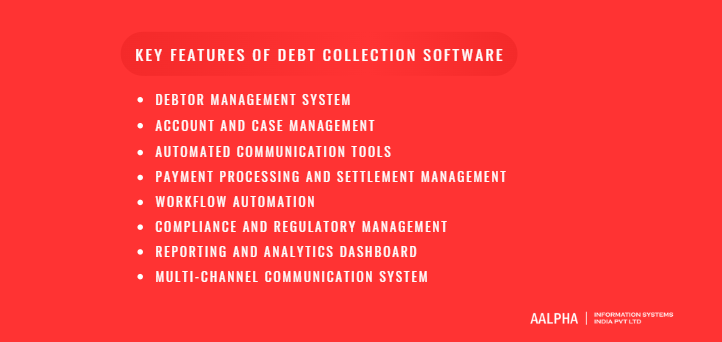
Modern debt collection software is designed to streamline the entire debt recovery lifecycle, from identifying delinquent accounts to processing settlements and generating compliance reports. Financial institutions, lenders, and collection agencies require platforms that not only track overdue balances but also automate communication, ensure regulatory compliance, and provide actionable insights into recovery performance. A well-designed system integrates multiple operational components into a unified platform that allows collection teams to manage thousands of debtor accounts efficiently while maintaining transparency and accountability. The following features represent the core capabilities that define a robust debt collection software solution.
-
Debtor Management System
A debtor management system forms the foundation of any debt collection platform by maintaining a centralized database of all individuals or businesses with outstanding payments. This system consolidates essential information such as debtor identity, contact details, outstanding balances, payment history, account status, and associated creditor data. By organizing all debtor records in a single interface, collection agents gain a complete view of each account before initiating communication or negotiating repayment terms.
In addition to financial details, the system records every interaction between the organization and the debtor. This includes phone calls, emails, text messages, and settlement discussions. Maintaining a complete communication history ensures transparency and helps collection teams avoid duplicate or inappropriate contact attempts. It also supports compliance with debt collection regulations that require accurate documentation of debtor interactions.
Advanced debtor management systems also categorize accounts based on risk levels, overdue duration, and payment behavior. This structured segmentation allows collection teams to prioritize accounts more effectively and apply tailored recovery strategies that improve repayment outcomes.
-
Account and Case Management
Account and case management features enable organizations to track the progress of each debt recovery effort from initial delinquency to final settlement. Every overdue account is treated as a structured case that moves through predefined stages of the collection process. These stages may include early reminders, escalation to intensive recovery efforts, payment plan negotiations, and potential legal action.
Within the system, each case includes key financial information such as the original debt amount, accumulated interest, penalties, and current outstanding balance. Collection agents can monitor case status, update payment arrangements, and record recovery actions taken at each stage of the process. This structured case management framework ensures that no delinquent account is overlooked or improperly handled.
Case management tools also help organizations coordinate activities across multiple collection agents or departments. Supervisors can assign cases to specific agents, monitor progress, and evaluate recovery outcomes. By providing a structured workflow and clear case visibility, the software improves operational efficiency and ensures consistent handling of debtor accounts across large collections portfolios.
-
Automated Communication Tools
Effective communication with debtors is one of the most critical components of successful debt recovery. Debt collection software includes automated communication tools that allow organizations to send reminders and notifications to debtors without relying on manual outreach. These tools ensure that overdue payments are addressed quickly and consistently while reducing the workload for collection teams.
Automated communication systems typically support multiple channels, including email notifications, SMS reminders, WhatsApp messages, and automated voice calls. Organizations can configure predefined communication templates that inform debtors about overdue balances, payment deadlines, or available repayment options. Once configured, the system automatically sends these reminders based on account status and overdue timelines.
Automation also allows organizations to schedule follow-up messages at specific intervals if payments remain outstanding. This ensures that debtors receive timely reminders without requiring manual intervention from collection agents. In addition to improving operational efficiency, automated communication tools help maintain consistent messaging and reduce the risk of non-compliant or inappropriate communication practices.
-
Payment Processing and Settlement Management
Payment processing and settlement management capabilities allow debt collection platforms to accept and track payments from debtors through integrated financial systems. By connecting with payment gateways and banking networks, the software enables organizations to process transactions securely and record them automatically within the debtor’s account record.
These systems often support multiple payment methods, including credit cards, bank transfers, digital wallets, and online payment portals. When a debtor makes a payment, the system automatically updates the outstanding balance, records the transaction history, and adjusts the case status accordingly. This automation eliminates the need for manual reconciliation and ensures that payment records remain accurate.
Settlement management features also allow collection agents to negotiate repayment plans with debtors who cannot settle their debts immediately. The platform can generate structured installment schedules, monitor partial payments, and send automated reminders for upcoming installments. By offering flexible repayment options, organizations increase the likelihood that debtors will successfully complete their repayment obligations while reducing the risk of further delinquency.
-
Workflow Automation
Workflow automation is one of the most powerful capabilities of modern debt collection software. Instead of relying on manual decision-making, the system automatically triggers collection actions based on predefined rules and debtor behavior. This ensures that every account follows a consistent recovery process and reduces the operational burden on collection teams.
For example, the software can automatically send payment reminders when an account becomes overdue, escalate cases after a specific number of missed payments, or assign high-risk accounts to specialized recovery agents. These automated workflows ensure that collection activities occur at the appropriate time without requiring manual monitoring of every account.
Automation also allows organizations to implement dynamic collection strategies that adapt to debtor behavior. Accounts with a history of timely repayments may receive gentle reminders, while accounts with prolonged delinquency may trigger more aggressive recovery actions. By automating routine tasks and decision points, debt collection software increases operational efficiency and ensures that recovery efforts are applied consistently across large account portfolios.
-
Compliance and Regulatory Management
Debt collection activities are heavily regulated in many jurisdictions to protect consumers from unfair or abusive practices. Compliance management features in debt collection software help organizations adhere to these legal requirements while maintaining accurate documentation of all collection activities.
Many platforms include built-in safeguards that enforce communication restrictions based on applicable regulations. For example, the software may prevent collection agents from contacting debtors outside legally permitted hours or from exceeding the maximum number of allowed contact attempts within a specific time period. These automated controls reduce the risk of regulatory violations.
The system also maintains detailed audit trails of all communication, payment activity, and case updates. This information can be used to demonstrate compliance during regulatory inspections or legal disputes. Additionally, advanced platforms support compliance frameworks such as consumer protection laws, data privacy regulations like GDPR, and financial regulations that govern debt recovery practices. By integrating compliance tools directly into the platform, organizations can manage collections efficiently while minimizing legal and reputational risks.
-
Reporting and Analytics Dashboard
Reporting and analytics dashboards provide collection managers with real-time insights into the performance of their recovery operations. These dashboards aggregate data from thousands of debtor accounts and present it in visual formats such as charts, graphs, and performance indicators. Decision-makers can quickly assess the effectiveness of collection strategies and identify areas where operational improvements are needed.
Common metrics displayed in analytics dashboards include total outstanding debt, recovery rates, average time to collect payments, and agent productivity levels. Managers can also analyze trends across different debtor segments, geographic regions, or creditor portfolios to determine which strategies are producing the best results.
Advanced analytics capabilities allow organizations to forecast future recovery outcomes based on historical payment data. These predictive insights help managers allocate resources more effectively and prioritize accounts with the highest likelihood of repayment. By providing a clear overview of operational performance, reporting dashboards enable organizations to make informed decisions that improve debt recovery efficiency.
-
Multi-Channel Communication System
A multi-channel communication system enables organizations to interact with debtors through several digital and traditional channels within a single platform. Instead of relying on a single method such as phone calls, the software allows communication through email, SMS messages, mobile applications, automated voice calls, and messaging platforms.
This flexibility ensures that organizations can reach debtors through their preferred communication channels, increasing the likelihood of engagement and timely repayment. Multi-channel systems also maintain a unified communication history across all channels, allowing collection agents to track interactions accurately and maintain consistent messaging throughout the debt recovery process.
Step-by-Step Debt Collection Software Development Process
Developing debt collection software requires a structured approach that combines financial workflow design, secure data management, and scalable system architecture. A finance software development company typically brings the domain expertise needed to design systems that align with financial regulations and industry standards. Unlike generic business applications, collection systems must handle sensitive financial information, enforce regulatory compliance, and automate communication with debtors across multiple channels. A successful development process therefore involves careful planning, iterative design, and rigorous testing to ensure the platform supports both operational efficiency and legal compliance.
Organizations building debt collection software typically follow a phased development roadmap that begins with understanding business requirements and concludes with deployment and continuous optimization. Each stage plays a crucial role in ensuring that the final platform supports large-scale debt recovery operations while maintaining reliability, transparency, and regulatory alignment.
-
Define Business Requirements
The first step in building debt collection software is defining the business requirements that will guide the entire development process. This stage focuses on understanding how debt recovery operations work within the organization and identifying the features needed to support those workflows effectively. Developers must collaborate closely with financial stakeholders, collection managers, and compliance teams to gather detailed requirements.
One of the most important aspects of this stage is identifying user roles within the system. Debt collection platforms typically serve multiple types of users, including collection agents, supervisors, compliance officers, and administrators. Each role requires access to different data and functionality. For example, collection agents need tools to manage debtor accounts and communicate with borrowers, while supervisors require dashboards that track agent performance and recovery rates.
Another key requirement involves mapping the complete debt collection workflow. Organizations must define how accounts move through the recovery process, starting from early-stage payment reminders to escalated recovery efforts or legal action. The software should support each stage of this workflow through automated triggers, case management tools, and payment tracking mechanisms.
Regulatory requirements must also be incorporated during the planning phase. Debt collection activities are governed by strict consumer protection laws in many jurisdictions. The system must therefore include safeguards that prevent non-compliant communication practices, maintain accurate records of debtor interactions, and provide audit-ready reports. Clearly documenting these business and compliance requirements ensures that the development team builds a platform aligned with real-world operational needs.
-
Market Research and Competitor Analysis
Market research plays an essential role in shaping the design and functionality of debt collection software. Before building a new platform, development teams must study existing debt collection systems to understand industry standards, common features, and areas where current solutions fall short. This research helps organizations design software that addresses real market needs rather than replicating existing products without meaningful improvements.
Competitor analysis typically involves evaluating leading debt collection platforms used by financial institutions and collection agencies. These platforms often include modules for debtor management, automated communication, payment tracking, compliance management, and reporting. By analyzing these systems, development teams can identify which features are considered essential and which innovations provide competitive advantages.
In addition to reviewing established products, teams should examine emerging technologies shaping the debt collection industry. Artificial intelligence, predictive analytics, and digital self-service payment portals are increasingly becoming standard features in modern collection platforms. Understanding how these technologies are implemented allows developers to incorporate similar capabilities into their own systems.
Market research also helps identify feature gaps that present opportunities for innovation. For example, some existing platforms may lack advanced analytics, modern user interfaces, or flexible communication integrations. By identifying these shortcomings, development teams can design solutions that offer improved usability, automation, and data-driven decision-making for debt recovery operations.
-
Design System Architecture
Once business requirements and market insights are clearly defined, the next step is designing the system architecture that will support the debt collection platform. System architecture defines how different components of the software interact with each other, how data flows through the platform, and how the system scales as the number of users and debtor accounts grows.
A typical debt collection platform uses a multi-layer architecture that separates the user interface, application logic, and data storage layers. This structure improves system performance, simplifies maintenance, and allows developers to scale individual components independently as demand increases.
At the core of the architecture is the backend infrastructure responsible for processing business logic. This includes modules for debtor management, case tracking, communication automation, payment processing, and compliance monitoring. Each module interacts with a centralized database that stores debtor records, payment transactions, and communication logs.
Data pipelines also play an important role in modern debt collection systems. The platform must continuously collect and process data from various sources, including payment gateways, communication platforms, and financial systems. These data pipelines ensure that account balances, repayment activity, and debtor interactions are updated in real time.
System architecture planning also includes designing integration frameworks that allow the software to connect with external systems such as banking networks, payment processors, customer relationship management platforms, and messaging services. A well-designed architecture ensures that the debt collection platform remains scalable, secure, and capable of supporting high volumes of financial transactions.
-
UI/UX Design for Collection Workflows
User interface and user experience design play a crucial role in ensuring that debt collection software remains easy to use while managing complex financial workflows. Collection agents often handle large volumes of debtor accounts each day, which means the platform must present information clearly and allow agents to perform tasks quickly without navigating through multiple screens.
The design process begins by identifying the most common tasks performed by users within the system. For collection agents, these tasks typically include reviewing debtor profiles, sending payment reminders, updating case status, negotiating repayment plans, and recording communication history. The interface must allow agents to access these functions efficiently while maintaining full visibility of debtor account details.
Dashboards are one of the most important components of the user interface. A well-designed dashboard provides an overview of assigned cases, overdue accounts, upcoming payment deadlines, and recent communication activity. Supervisors and managers require separate dashboards that highlight recovery performance, agent productivity, and outstanding debt totals.
Effective UI design also prioritizes simplicity and clarity. Financial data, repayment schedules, and communication history should be presented in a structured format that allows users to quickly understand the status of each account. By optimizing the interface for real-world collection workflows, organizations can improve productivity and reduce the time required to manage delinquent accounts.
-
Backend Development
Backend development forms the technical foundation of debt collection software. During this stage, developers build the core system components responsible for processing data, executing business logic, and managing interactions between users and external services. Because debt collection systems manage sensitive financial information and large volumes of transactions, backend architecture must be designed for reliability, security, and scalability.
One of the first modules developed is the debtor management system. This module stores and organizes all debtor information, including personal details, outstanding balances, payment history, and communication records. The database structure must support efficient indexing and querying so that collection agents can quickly access debtor records.
Another essential component is the payment tracking module. This system records payments received through various channels, updates account balances in real time, and generates transaction logs for financial reconciliation. Integration with payment gateways ensures that transactions are processed securely and recorded automatically within the platform.
Automation engines are also implemented during backend development. These engines execute predefined collection workflows, such as sending reminders when payments are overdue, escalating cases after multiple missed payments, or assigning high-risk accounts to specialized recovery teams. Automation significantly reduces manual intervention and ensures consistent handling of delinquent accounts.
Additional backend components include reporting systems, compliance monitoring tools, and communication management services. These modules work together to ensure that the platform can manage complex debt recovery operations while maintaining data accuracy and regulatory compliance. A well-designed backend architecture ensures that the platform remains stable and responsive even when handling large portfolios of debtor accounts.
-
Integrating Communication Channels
Communication is a central element of the debt recovery process, making communication channel integration a critical component of debt collection software development. Modern platforms must support multiple communication methods to ensure organizations can reach debtors effectively and provide convenient options for responding to payment reminders.
During this stage of development, engineers integrate external messaging services into the platform. These integrations typically include SMS gateways for sending text reminders, email services for detailed payment notifications, and automated voice call systems that allow organizations to deliver recorded messages or connect debtors with collection agents. Messaging platforms such as WhatsApp and mobile messaging APIs can also be integrated to support real-time communication.
The software must also track every communication attempt and store these records within the debtor’s account profile. Maintaining a complete communication history ensures transparency and helps organizations demonstrate compliance with debt collection regulations that require documentation of debtor interactions.
Advanced platforms also implement automated communication scheduling. For example, the system can automatically send payment reminders when an account becomes overdue, followed by additional notifications if the debtor fails to respond. By integrating multiple communication channels into a unified system, organizations can improve engagement with debtors and increase the likelihood of successful debt recovery.
-
Security, Compliance, and Data Protection
Debt collection software handles highly sensitive financial and personal information, making security and data protection essential components of the development process. Developers must implement strong security frameworks that protect debtor data from unauthorized access, data breaches, and cyber threats.
Encryption technologies are used to secure data both during transmission and while stored in databases. Access control mechanisms ensure that only authorized users can view or modify specific information within the system. For example, collection agents may only access accounts assigned to them, while administrators maintain broader system access.
Compliance features must also be integrated into the platform to ensure adherence to financial and data protection regulations. These features include audit logs, communication tracking, and automated safeguards that prevent non-compliant collection practices. By incorporating security and compliance measures directly into the platform, organizations can protect sensitive data while maintaining trust with regulators and customers.
-
Testing and Deployment
The final stage of debt collection software development involves comprehensive testing and deployment of the platform. Before the system is released for operational use, developers must verify that all features function correctly and that the platform performs reliably under real-world conditions.
Quality assurance testing evaluates individual system components, including debtor management, communication automation, payment processing, and reporting modules. Integration testing ensures that these components work together seamlessly and that external services such as payment gateways and messaging platforms operate correctly.
Performance testing is also critical for systems that manage large volumes of debtor accounts and financial transactions. Developers simulate high workloads to confirm that the platform remains stable and responsive under heavy usage.
Once testing is complete, the software is deployed to cloud infrastructure or enterprise servers. Continuous monitoring tools track system performance and identify potential issues after launch. Regular updates and feature improvements ensure that the platform continues to evolve as regulatory requirements and business needs change.
Technologies Used in Debt Collection Software Development
Building a modern debt collection platform requires a combination of frontend technologies, backend frameworks, scalable databases, cloud infrastructure, and advanced analytics systems. Because debt collection software manages large datasets, sensitive financial information, and automated communication workflows, the technology stack must support high performance, reliability, and strong security controls. The goal is not simply to build a functional application but to create a platform capable of handling thousands or millions of debtor accounts while maintaining compliance with financial regulations.
Organizations typically adopt a layered technology architecture that separates the user interface, business logic, and data infrastructure. This modular approach allows development teams to scale individual system components independently and integrate additional capabilities such as predictive analytics, automated communication, and reporting tools. The following technologies are commonly used in building enterprise-grade debt collection systems.
-
Frontend Technologies
Frontend technologies are responsible for creating the user interface through which collection agents, managers, and administrators interact with the debt collection platform. Because collection teams handle large volumes of accounts daily, the interface must present financial information clearly and allow users to perform tasks efficiently. Modern web frameworks such as React, Angular, and Vue are widely used to build interactive dashboards and data-driven interfaces for debt collection systems.
React is particularly popular for building highly responsive user interfaces that update dynamically as account data changes. Angular provides a comprehensive framework for building large-scale enterprise applications with structured architecture and strong development tooling. Vue offers a lightweight and flexible alternative that allows developers to build fast-loading dashboards with minimal complexity.
These frameworks enable the creation of collection dashboards that display overdue accounts, debtor profiles, payment history, and communication logs in real time. Frontend frameworks also support role-based access interfaces, ensuring that collection agents, supervisors, and administrators see only the tools and data relevant to their responsibilities.
-
Backend Technologies
Backend technologies form the core engine of debt collection software by handling business logic, data processing, system integrations, and communication workflows. The backend infrastructure is responsible for managing debtor accounts, tracking payments, executing automation rules, and ensuring secure data transactions across the platform.
Node.js is commonly used for backend development because of its ability to handle large volumes of asynchronous operations efficiently. Debt collection systems often process numerous events simultaneously, including payment updates, automated reminders, and communication requests. Node.js supports these real-time operations while maintaining strong performance.
Python is another widely used backend technology, particularly for systems that incorporate machine learning and predictive analytics. Python’s extensive ecosystem of data science libraries makes it suitable for developing models that analyze debtor behavior and forecast repayment probabilities.
Java remains a popular choice for large financial systems because of its reliability, scalability, and strong security capabilities. Many banks and financial institutions rely on Java-based infrastructure for mission-critical applications. Similarly, .NET provides a robust framework for building enterprise software with strong integration capabilities across financial systems.
These backend technologies ensure that debt collection platforms remain stable, scalable, and capable of handling high volumes of financial transactions and automated workflows.
-
Database Technologies
Database technologies are critical for storing and managing the large volumes of financial and personal data handled by debt collection platforms. These systems must maintain accurate records of debtor accounts, payment histories, communication logs, and case management activities while ensuring data integrity and security.
Relational databases such as PostgreSQL are widely used because they provide strong transactional consistency and support complex financial data relationships. These databases allow developers to structure data in organized tables, ensuring accurate tracking of outstanding balances, payment transactions, and account status changes.
NoSQL databases such as MongoDB are also commonly used for storing unstructured or semi-structured data, including communication logs and activity records. These databases allow systems to process large volumes of data quickly while maintaining flexibility in data storage formats.
For large-scale platforms handling millions of debtor records, distributed database architectures may be implemented to improve scalability and performance. These systems distribute data across multiple servers, allowing the platform to handle increasing workloads without compromising system responsiveness.
-
Cloud Infrastructure
Cloud infrastructure provides the computing environment that hosts and operates debt collection software. Modern financial platforms are typically deployed on cloud services because they offer scalability, reliability, and built-in security features that support enterprise-level applications.
Leading cloud providers such as Amazon Web Services (AWS), Microsoft Azure, and Google Cloud provide a wide range of services that support debt collection systems. These platforms offer virtual servers, database hosting, networking infrastructure, and security tools that enable developers to deploy and manage applications efficiently.
One of the major advantages of cloud infrastructure is scalability. As the number of debtor accounts grows or communication volumes increase, organizations can expand computing resources automatically without needing to build new physical infrastructure. Cloud platforms also support high availability configurations that ensure system reliability even if individual servers fail.
In addition to scalability, cloud providers offer advanced security services such as identity management, encryption tools, and monitoring systems. These capabilities help organizations protect sensitive financial data while maintaining compliance with financial and data protection regulations.
-
AI and Data Analytics Technologies
Artificial intelligence and data analytics technologies are increasingly integrated into modern debt collection software to improve recovery efficiency and decision-making. These technologies analyze large datasets to identify patterns in debtor behavior and predict the likelihood of repayment.
Machine learning models can evaluate historical payment data, credit history, and communication responses to determine which accounts are most likely to settle outstanding debts. By identifying high-probability repayment cases, collection teams can prioritize their efforts and focus on accounts that are most likely to produce successful outcomes.
Predictive analytics also helps organizations optimize communication strategies. For example, data models can determine the best time to contact a debtor or identify which communication channel is most likely to receive a response. This targeted approach increases engagement while reducing unnecessary contact attempts.
In addition to predictive models, analytics dashboards provide insights into collection performance, repayment trends, and operational efficiency. By combining artificial intelligence with data analytics, debt collection software enables organizations to make informed decisions that improve recovery rates and reduce operational costs.
Debt Collection Software Development Cost
The cost of developing debt collection software varies widely depending on the platform’s complexity, required features, security requirements, and development location. These factors directly influence the overall software development cost. Unlike simple business applications, debt collection systems must handle sensitive financial data, automate communication workflows, integrate with payment gateways, and comply with strict regulatory requirements. These requirements significantly increase development effort and overall project costs.
Organizations planning to build debt collection software must consider not only the initial development cost but also long-term expenses such as infrastructure, system maintenance, security updates, and feature enhancements. In many cases, companies begin with a minimum viable product (MVP) that includes core features such as debtor management, communication automation, and payment tracking, then gradually expand the platform as operational needs grow. Understanding the typical cost ranges and influencing factors helps businesses plan budgets effectively and select the most appropriate development approach.
-
Average Cost to Build Debt Collection Software
On average, developing a debt collection software platform can cost anywhere between $40,000 and $250,000 or more, depending on the system’s functionality and scale. Basic systems designed for small collection teams or startups generally fall on the lower end of this range, while enterprise-grade platforms with advanced analytics, automation engines, and regulatory compliance features require significantly larger investments.
The lower cost range usually covers the development of a simple web-based application that allows organizations to manage debtor accounts, track outstanding balances, send payment reminders, and record payment transactions. These systems typically include limited integrations and minimal automation capabilities.
More advanced platforms designed for financial institutions or large collection agencies require extensive development work. These systems often include automated workflow engines, multi-channel communication tools, compliance monitoring features, reporting dashboards, and integrations with banking systems or payment gateways. In addition, organizations must invest in secure infrastructure and data protection mechanisms to protect sensitive financial data.
Development timelines typically range from four to nine months, depending on feature complexity and the size of the development team. Organizations that adopt an incremental development approach can release an initial version sooner while continuing to enhance the platform over time.
-
Cost Based on Software Complexity
The complexity of the debt collection software is one of the most important factors influencing development cost. Platforms with basic functionality require significantly less development effort compared with enterprise-level systems designed to handle millions of debtor accounts and complex financial workflows.
Simple Collection System
A simple debt collection system typically includes core functionality such as debtor management, account tracking, payment recording, and basic communication tools. The platform may allow collection agents to view overdue accounts, send email reminders, and update payment status. Systems at this level usually support small organizations or startups managing a limited number of debtor accounts.
The development cost for a simple collection system typically ranges between $40,000 and $70,000, depending on design requirements and integration needs. Development time for such systems generally ranges from three to five months.
Mid-Level Collection Platform
Mid-level platforms introduce more advanced capabilities such as automated communication workflows, reporting dashboards, payment gateway integrations, and multi-user access controls. These systems are commonly used by mid-sized collection agencies or financial institutions managing thousands of accounts.
Additional features such as SMS reminders, installment payment plans, and compliance tracking tools significantly increase development complexity. As a result, the development cost for a mid-level platform typically ranges between $80,000 and $150,000. These systems usually require five to eight months of development.
Enterprise Debt Recovery System
Enterprise-grade debt collection platforms are designed for banks, large financial institutions, and major collection agencies handling large portfolios of delinquent accounts. These platforms include advanced automation engines, predictive analytics, AI-driven recovery strategies, and integration with multiple financial systems.
Enterprise systems may also support legal case management, large-scale reporting tools, compliance monitoring frameworks, and complex data analytics capabilities. Because of the scale and security requirements involved, development costs can range from $180,000 to $250,000 or more, with development timelines often extending beyond nine months.
-
Cost Based on Development Location
The geographic location of the development team significantly affects the total cost of building debt collection software. Development rates vary widely across regions due to differences in labor costs, talent availability, and operational expenses.
In North America, particularly in the United States and Canada, software development costs are among the highest globally. Hourly rates for experienced developers often range between $100 and $200 per hour, which can significantly increase the overall project budget.
Western Europe also has relatively high development costs, with hourly rates typically ranging from $70 to $150 per hour depending on the country and expertise level of the development team. Countries such as Germany, the United Kingdom, and France fall within this category.
Eastern Europe has become a popular outsourcing destination for software development due to its strong technical talent and relatively lower costs. Development rates in countries such as Poland, Ukraine, and Romania typically range between $40 and $80 per hour, offering a balance between quality and affordability.
India and other Asian technology hubs provide some of the most cost-efficient development options. Hourly development rates often range from $25 to $50 per hour, allowing organizations to significantly reduce development costs while accessing experienced software engineering teams.
-
Factors Affecting Development Cost
Several factors influence the final cost of developing debt collection software. One of the most significant is the level of customization required to support specific collection workflows or industry regulations. Integrations with external systems such as payment gateways, banking platforms, or communication APIs can also increase development complexity.
Security requirements represent another major cost driver because debt collection platforms must protect sensitive financial and personal data. Compliance features designed to meet financial regulations and data privacy laws may also require additional development effort. The choice of cloud infrastructure, system scalability requirements, and ongoing maintenance needs further contribute to the overall cost of the platform.
Compliance and Legal Requirements for Debt Collection Software
Debt collection is one of the most heavily regulated activities in the financial services industry. Organizations that recover outstanding payments must follow strict rules governing how they communicate with debtors, store financial data, and process payments. Failure to comply with these regulations can lead to legal penalties, financial liabilities, and reputational damage. For this reason, compliance must be embedded directly into the design and functionality of debt collection software.
Modern debt collection platforms incorporate built-in safeguards that ensure organizations follow regulatory requirements automatically. These safeguards include communication restrictions, detailed interaction logs, secure data storage mechanisms, and compliance reporting tools. When developing debt collection software, organizations must consider both regional financial regulations and global data protection standards to ensure the system can operate safely across different jurisdictions.
-
FDCPA Compliance
The Fair Debt Collection Practices Act (FDCPA) is one of the most important regulatory frameworks governing debt collection activities in the United States. This federal law was designed to protect consumers from abusive, deceptive, or unfair practices during the debt recovery process. Debt collection software intended for U.S. financial institutions or collection agencies must incorporate mechanisms that help organizations comply with FDCPA requirements.
The law places strict limitations on how and when collection agencies can contact debtors. For example, collectors are generally prohibited from contacting individuals before 8 a.m. or after 9 p.m. local time unless explicitly permitted. Repeated or harassing communication attempts are also restricted. Debt collection software can enforce these rules by automatically scheduling communication within permitted time windows and tracking the frequency of contact attempts.
In addition, the FDCPA requires collectors to provide accurate information about the debt and maintain clear documentation of interactions with debtors. Software systems support compliance by storing communication logs, generating audit reports, and maintaining transparent records of payment negotiations and settlement agreements.
-
GDPR and Data Privacy Compliance
The General Data Protection Regulation (GDPR) governs how organizations collect, store, and process personal data of individuals located in the European Union. Because debt collection systems handle sensitive personal and financial information, GDPR compliance is a critical requirement for software used by European financial institutions or companies that process EU customer data.
GDPR requires organizations to implement strict controls over personal data processing. Debt collection platforms must therefore include mechanisms that ensure data is collected only for legitimate purposes and stored securely. Access to debtor information must be restricted to authorized personnel, and organizations must implement encryption and secure authentication methods to protect sensitive records.
The regulation also grants individuals specific rights regarding their personal data. Debtors may request access to their information, ask for corrections to inaccurate records, or request deletion of data under certain circumstances. Debt collection software must support these rights by allowing organizations to retrieve, update, and manage debtor data efficiently while maintaining secure records of all data processing activities.
-
Financial Regulations and Consumer Protection Laws
In addition to regional data privacy regulations, debt collection activities are governed by numerous financial regulations and consumer protection laws across different countries. These laws are designed to ensure fair treatment of borrowers and prevent unethical collection practices. When developing debt collection software, organizations must consider how the platform will support compliance with these regulatory frameworks.
Many jurisdictions impose restrictions on communication practices, requiring collectors to provide clear disclosures regarding the debt amount, creditor identity, and available repayment options. Software platforms must therefore include features that allow organizations to generate standardized communication templates and maintain accurate records of all interactions with debtors.
Some countries also require licensing or registration for collection agencies and impose strict reporting requirements regarding recovered amounts and collection activities. Debt collection software can simplify regulatory compliance by generating reports that summarize collection performance, debtor interactions, and financial transactions. By incorporating these compliance tools directly into the system, organizations can reduce legal risks while maintaining transparent and responsible debt recovery operations.
-
Secure Data Management and Audit Trails
Secure data management is a fundamental requirement for any system handling financial information and personal debtor records. Debt collection software must be designed with strong security frameworks that protect sensitive data from unauthorized access, data breaches, or system misuse.
Encryption technologies play a key role in securing debtor information both during transmission and while stored in databases. Access control systems ensure that only authorized users can view or modify specific records within the platform. Role-based permissions allow organizations to limit data access based on user responsibilities, reducing the risk of internal misuse.
Audit trails are another essential compliance feature. Every action performed within the system, including account updates, communication attempts, payment processing, and case status changes, must be recorded automatically. These logs provide a transparent record of system activity and allow organizations to demonstrate compliance during regulatory inspections or legal disputes. By maintaining comprehensive audit trails and secure data storage practices, debt collection platforms help organizations meet regulatory obligations while protecting sensitive financial information.
Benefits of Debt Collection Software for Businesses
Debt collection software has become an essential operational tool for financial institutions, lenders, and collection agencies that manage large volumes of overdue accounts. Traditional debt recovery processes often rely on manual tracking systems, disconnected communication tools, and inconsistent collection strategies. These limitations reduce recovery performance and increase operational costs. By implementing a structured digital platform, businesses can manage delinquent accounts more efficiently, maintain regulatory compliance, and improve communication with debtors.
Modern debt collection systems integrate automation, analytics, payment processing, and compliance tools into a unified platform. This integration allows organizations to handle thousands of debtor accounts systematically while minimizing manual intervention. As a result, businesses benefit from improved recovery outcomes, more efficient collection workflows, and stronger customer engagement during the repayment process.
-
Increased Recovery Rates
One of the most significant benefits of debt collection software is its ability to increase debt recovery rates. Traditional collection processes often rely on manual follow-ups and inconsistent communication with debtors. As the number of overdue accounts grows, collection teams may struggle to prioritize cases effectively, resulting in missed recovery opportunities.
Debt collection platforms address this challenge by organizing accounts within a centralized system and automating follow-up actions. The software can automatically send reminders when payments become overdue, schedule additional notifications if the debtor does not respond, and escalate cases according to predefined recovery strategies. This structured approach ensures that no delinquent account is overlooked.
Many advanced platforms also include analytics tools that help collection teams identify accounts with the highest probability of repayment. By focusing efforts on high-value or high-likelihood cases, organizations can allocate resources more efficiently. The combination of automation, prioritization, and consistent communication significantly improves the chances of recovering outstanding payments.
-
Improved Operational Efficiency
Debt collection software significantly improves operational efficiency by automating repetitive tasks and centralizing all collection activities within a single platform. In traditional systems, collection agents often spend considerable time updating spreadsheets, maintaining call logs, and manually tracking overdue accounts. These manual processes reduce productivity and increase the likelihood of human error.
A digital collection platform eliminates many of these inefficiencies by automatically updating account records, tracking communication history, and generating reminders for follow-up actions. Collection agents can quickly access debtor information, review payment histories, and initiate communication from within the same system. This streamlined workflow reduces the time required to manage each account.
Managers also benefit from improved oversight of collection operations. Reporting dashboards provide real-time insights into recovery performance, agent productivity, and outstanding debt levels. By consolidating operational data into a centralized platform, organizations can optimize resource allocation, monitor collection strategies, and make data-driven decisions that improve overall efficiency.
-
Reduced Compliance Risks
Compliance with financial regulations and consumer protection laws is a critical concern for organizations involved in debt recovery. Manual collection processes make it difficult to monitor communication practices, maintain accurate records, and ensure that collection agents follow regulatory guidelines. These gaps can expose businesses to legal penalties and reputational damage.
Debt collection software reduces compliance risks by enforcing predefined communication rules and maintaining detailed records of all debtor interactions. The platform automatically logs calls, messages, payment updates, and case activities, creating a transparent audit trail. Built-in safeguards also help prevent unauthorized contact attempts or communication outside legally permitted timeframes.
-
Better Customer Experience
Although debt collection focuses on recovering outstanding payments, maintaining respectful and transparent communication with debtors is essential for preserving customer relationships. Modern debt collection software helps organizations engage with borrowers in a more structured and professional manner.
Automated reminders ensure that debtors receive timely notifications about overdue balances and available repayment options. Many platforms also provide self-service payment portals that allow borrowers to review account details, choose repayment plans, and complete transactions online. By offering flexible payment options and clear communication channels, businesses can reduce conflict during the collection process and encourage faster repayment.
Challenges in Debt Collection Software Development
Developing debt collection software involves far more complexity than building a typical business management application. Because these systems manage financial records, personal debtor information, payment transactions, and regulated communication processes, developers must address multiple technical, legal, and operational challenges during the development lifecycle. Organizations building such platforms must ensure that the system can operate securely, scale efficiently, integrate with external financial systems, and comply with strict regulatory frameworks.
In addition, the platform must support high volumes of debtor accounts and communication interactions without compromising performance or reliability. Poor system design can lead to data security vulnerabilities, compliance violations, or operational inefficiencies that undermine the effectiveness of the debt recovery process. Addressing these challenges requires careful planning, strong system architecture, and continuous monitoring throughout the development and deployment phases.
-
Handling Sensitive Financial Data
Debt collection software processes large volumes of sensitive financial and personal information, including debtor identities, account balances, payment histories, and communication records. Protecting this data is one of the most significant challenges during system development because any security breach could expose confidential financial information and lead to serious legal consequences.
Developers must implement strong security frameworks that safeguard data throughout the system. Encryption technologies are required to protect information both during transmission and while stored in databases. Secure authentication mechanisms such as multi-factor authentication help prevent unauthorized access to the platform.
In addition to technical security controls, the system must enforce strict access permissions that limit which users can view or modify specific data. Collection agents should only access the accounts assigned to them, while administrators maintain broader system oversight. These measures reduce the risk of internal misuse and ensure that sensitive debtor information remains protected at all times.
-
Compliance with Regional Regulations
Debt collection is subject to extensive regulatory oversight in many jurisdictions, making regulatory compliance one of the most challenging aspects of developing collection software. Different countries impose different legal requirements governing how creditors and collection agencies communicate with debtors, record interactions, and process payments.
For example, some regulations restrict the frequency and timing of collection calls, while others require collectors to provide specific disclosures about the debt and the creditor involved. Software systems must therefore include mechanisms that enforce these communication rules automatically.
Developers must also ensure that the platform maintains detailed documentation of debtor interactions and financial transactions. These records may be required during regulatory audits or legal disputes. When software is designed for use in multiple countries, developers must also account for variations in data privacy laws, financial reporting requirements, and consumer protection frameworks. Building a flexible compliance architecture allows the platform to adapt to different regulatory environments without requiring major system redesign.
-
Integration with Banking and Payment Systems
Debt collection software must integrate with various financial systems to process payments, update account balances, and reconcile financial records accurately. These integrations often involve connecting with payment gateways, banking networks, digital wallets, and financial management platforms.
Each integration requires secure data exchange protocols and reliable communication between systems. Differences in banking infrastructure, transaction processing standards, and payment settlement timelines can complicate these integrations. Developers must design robust integration frameworks that handle transaction failures, ensure data consistency, and maintain accurate financial records across all connected systems.
-
Managing Communication at Scale
Effective communication with debtors is central to the success of any debt recovery strategy. However, managing communication at scale presents technical challenges when thousands of reminders, notifications, and follow-ups must be delivered daily across multiple channels.
Debt collection platforms must support high volumes of SMS messages, emails, automated voice calls, and messaging platform notifications without delays or delivery failures. At the same time, the system must track each interaction and maintain a complete communication history for compliance purposes.
Developers must therefore build scalable messaging infrastructures that can handle large communication workloads while maintaining consistent delivery performance and accurate interaction records.
How to Choose the Right Debt Collection Software Development Partner
Selecting the right Software development partner is one of the most important decisions when building debt collection software. Unlike general business applications, debt collection platforms must handle sensitive financial data, comply with strict regulatory frameworks, and integrate with multiple financial systems. A development partner with limited experience in financial technology may struggle to address these requirements effectively. As a result, organizations must evaluate potential vendors carefully based on their technical expertise, industry experience, security practices, and long-term support capabilities.
The ideal development partner should understand how financial workflows operate within banks, fintech companies, and collection agencies. They must also demonstrate the ability to build secure and scalable software systems capable of managing large portfolios of debtor accounts. Businesses should review previous fintech projects, examine technical architecture capabilities, and assess the vendor’s ability to maintain and improve the platform over time. Working with an experienced technology partner significantly reduces development risks and ensures that the final product meets both operational and regulatory expectations.
-
Experience in Fintech Software Development
Debt collection platforms operate within the broader financial technology ecosystem, which means the development partner must have experience building fintech applications. Financial systems require specialized knowledge of payment processing, financial data management, compliance frameworks, and secure transaction handling. A development team familiar with these requirements can design software that aligns with industry standards and regulatory expectations.
When evaluating potential partners, businesses should review their portfolio of financial technology projects. Experience in developing systems such as payment platforms, loan management systems, credit scoring tools, or banking software indicates familiarity with financial workflows and security requirements. Developers with this background are better equipped to design robust debt collection platforms capable of handling complex financial operations.
It is also important to assess whether the development partner understands the operational needs of collection agencies and financial institutions. An experienced fintech development team can translate real-world collection workflows into effective software features that improve recovery efficiency.
-
Strong Security and Compliance Expertise
Security and regulatory compliance are fundamental requirements for debt collection software. The system must protect sensitive debtor information while ensuring that collection practices follow applicable consumer protection laws. A development partner with strong expertise in financial security and compliance frameworks is therefore essential.
Organizations should evaluate how potential vendors implement security measures such as encryption, access control systems, and secure authentication mechanisms. These technologies help prevent unauthorized access to financial records and reduce the risk of data breaches. In addition, the development partner should demonstrate experience implementing compliance features that support regulations governing debt collection and data privacy.
For example, the platform must be capable of maintaining detailed audit trails, recording communication history, and enforcing communication restrictions based on legal requirements. A partner with experience in regulated industries will understand how to integrate these compliance safeguards directly into the software architecture, reducing the risk of regulatory violations after deployment.
-
Scalable Software Architecture
Debt collection platforms must be designed to scale as the number of debtor accounts and transactions increases. A development partner should therefore have expertise in building scalable software architectures that can support growing workloads without compromising performance.
Scalable systems typically use modular architectures, cloud infrastructure, and distributed databases to handle large volumes of financial data. Developers must design the platform so that additional computing resources can be added easily as the system grows. This ensures that the software remains responsive and reliable even when managing large portfolios of delinquent accounts across multiple users and communication channels.
-
Long-Term Product Support
Building debt collection software is only the first step. Financial platforms require continuous updates to adapt to changing regulatory requirements, evolving security threats, and new technological capabilities. Businesses should therefore select a development partner capable of providing long-term maintenance, technical support, and feature enhancements.
A reliable partner will offer ongoing monitoring, system updates, and performance optimization to ensure that the platform continues to operate smoothly. Many organizations choose to work with experienced software development companies such as Aalpha, which specialize in building and maintaining complex financial technology platforms. A long-term partnership ensures that the debt collection system continues to evolve alongside the organization’s operational and regulatory needs.
Conclusion
Debt collection software has become a critical technology for financial institutions, lenders, and collection agencies that manage large volumes of overdue accounts. By automating debtor management, communication workflows, payment processing, and compliance tracking, modern platforms significantly improve recovery efficiency while reducing operational risks. As credit usage continues to grow globally, organizations increasingly rely on digital collection systems to manage delinquent accounts in a structured, scalable, and compliant manner.
Developing a reliable debt collection platform requires careful planning, secure system architecture, and strong regulatory awareness. Businesses must ensure the software supports automated workflows, multi-channel communication, secure data management, and integration with financial systems. When implemented correctly, debt collection software enables organizations to increase recovery rates, streamline operations, and maintain transparent communication with debtors.
If you are planning to build a custom debt collection platform tailored to your business needs, it is important to work with an experienced development team. Connect with us at Aalpha to discuss how we can help design and develop secure, scalable debt collection software for your organization.