






TL;DR
AI development for the travel industry means building custom software that applies large language models, machine learning, and computer vision to travel-specific problems such as itinerary generation, dynamic pricing, disruption management, and booking automation. Travel companies use AI to lift ancillary revenue, deflect routine support contacts, forecast demand more accurately, and personalise offers at the individual traveller level. The most common solutions in production today are conversational booking agents, AI trip planners, revenue management systems, automated customer service, and fraud detection. Typical development costs range from $40,000 for a focused pilot to $400,000 or more for a full platform integrated with GDS, PMS, and NDC systems. The main technical challenge is not the model itself but the integration layer, since most travel inventory still sits behind legacy distribution systems that were never designed for probabilistic software.
AI development for the travel industry: what it actually means
AI development for the travel industry is the practice of designing, building, and deploying machine learning and generative AI systems that work against real travel inventory, real traveller data, and real distribution constraints. That last part is what separates it from generic AI implementation. A chatbot that answers questions about a hotel is a content problem. A chatbot that checks live availability, applies the correct rate plan, honours a corporate negotiated fare, and completes a booking through an NDC API is a travel engineering problem.
The distinction matters because travel has structural characteristics that most industries do not share. Inventory is perishable and cannot be recovered once the flight departs or the night passes. Pricing changes many times a day and is governed by rules that sit in systems built decades ago. A single trip touches multiple suppliers, currencies, regulatory regimes, and time zones. Customer intent is often vague at the top of the funnel and extremely precise at the bottom. Any AI system that ignores these realities produces demos that impress and deployments that fail.
In practice, AI travel solutions fall into three layers. The customer-facing layer includes trip planners, conversational agents, recommendation engines, and self-service disruption tools. This is the layer travellers see and the one that gets the most attention. The operational layer sits behind it and covers demand forecasting, staffing optimisation, automated content generation, document processing, and fraud screening. The revenue intelligence layer works across both and includes dynamic pricing, offer construction, ancillary attachment logic, and margin analytics. Most successful programmes start in the operational layer because the risk profile is lower and the measurement is cleaner, then extend outward.
There is also a timing argument for why this became urgent rather than interesting. Three shifts converged. First, NDC adoption finally reached the point where airline content can be requested, priced, and booked programmatically at scale, which gives AI systems something to act on rather than just talk about. Second, traveller discovery behaviour started moving out of traditional search and into AI assistants, which changes how brands get found and forces a rethink of content and distribution strategy. Third, agentic AI matured enough that multi-step tasks such as search, compare, hold, and book can be chained with acceptable reliability when properly constrained. Individually none of these would justify a rebuild. Together they change what a competitive travel product looks like.
Why travel companies are investing in AI now
Margin pressure is the honest starting point. Online travel agencies operate on thin take rates while paying heavily for traffic acquisition. Airlines carry fixed costs that punish any forecasting error. Hotels give up meaningful percentages to intermediaries and fight to shift bookings direct. Tour operators run manual processes that do not scale with headcount economics. In every one of these models, small percentage improvements in conversion, attachment, or cost per contact translate into material absolute numbers because the volumes are large. AI is attractive precisely because it operates on those percentages.
The second driver is a genuine change in how travellers find things. For twenty years the discovery path ran through a search box, a results page, and a click. Increasingly it runs through a conversation. A traveller describes a trip in natural language, receives a synthesised answer, and often never sees a ranked list of ten blue links. For travel brands this is both a threat and an opportunity. The threat is losing the top of funnel to whoever the assistant decides to cite. The opportunity is that structured, verifiable, well-organised travel content and machine-readable inventory become far more valuable than they were. Companies investing in AI now are usually doing two things at once, building AI into their product and restructuring their content and data so that external AI systems can find and use them.
Labour constraints form the third driver. Travel customer service is seasonal, spiky, and multilingual by nature. A weather event in one hub can generate a support volume spike that no fixed staffing model handles gracefully. Contact centre hiring and training cycles are slow and attrition is high. AI does not replace the complex, emotionally charged conversations, and no serious implementation tries to, but it absorbs the high-volume, low-complexity contacts that consume the majority of agent minutes. That frees human capacity for the interactions where it actually matters.
Finally there is the modernisation window. Many travel businesses have been putting off replacing brittle internal tooling because the business case never quite closed. AI changes that arithmetic. If a mid-office system is being rebuilt anyway, building it with AI-native workflows costs marginally more than building it the old way and delivers substantially more. A lot of what looks like AI investment in travel right now is really modernisation investment with AI as the justification that finally got it approved.
At Aalpha, we have watched this shift play out directly across travel and hospitality clients since 2008. The projects that started as chatbot pilots two years ago are now conversations about traveller data platforms, offer engines, and agent-facing tooling. The scope moved because the pilots proved the economics.
Benefits of AI development for travel businesses
Revenue benefits
The clearest revenue benefit comes from pricing. Traditional revenue management systems work on historical booking curves and rules that analysts maintain by hand. Machine learning models incorporate far more signal, including competitor movement, search volume, weather, local events, macro indicators, and channel-level conversion behaviour, and they adjust continuously rather than on a review cycle. The result is not just higher average rates. It is fewer instances of selling out too early at the wrong price and fewer instances of holding inventory that never clears.
Personalised merchandising is the second revenue lever. Ancillary attachment in travel is notoriously sensitive to timing and relevance. Offering seat selection to someone who books an aisle seat every time is a different proposition from offering it to a family travelling together, and offering either at the wrong moment in the journey kills conversion. Models that learn from behaviour rather than demographic segments consistently outperform rules-based merchandising, and the gap widens as the catalogue of ancillaries grows.
Dynamic packaging benefits similarly. When a system can assemble flight, accommodation, transfer, and activity combinations that fit a stated budget and an inferred preference profile, it sells trips that a static package catalogue would never have contained. This is where generative AI genuinely creates new inventory combinations rather than simply optimising existing ones.
Cost benefits
Support deflection is the most measurable cost benefit and the easiest to over-claim. A well-built AI support layer resolves a meaningful share of contacts end to end, typically the ones concerning booking status, itinerary changes within policy, baggage rules, visa and documentation questions, and refund status. The realistic figure varies enormously by business model and by how much of the underlying process is actually automatable, which is why any vendor quoting a universal deflection percentage should be treated cautiously. What is consistent is that the savings compound, because deflected contacts also reduce the training, quality assurance, and workforce management overhead that sits behind every agent seat.
Back-office automation delivers quieter but reliable savings. Invoice reconciliation between suppliers and distribution partners, commission verification, refund and chargeback processing, supplier contract ingestion, and rate loading are all document-heavy processes that consume skilled human hours. Language models combined with structured extraction handle these far better than the rules-based OCR that many operators are still running.
Fraud is a third area. Travel is a high-risk vertical for payment fraud because the goods are digital, the fulfilment is immediate, and the resale market is liquid. Machine learning models trained on booking-level behaviour catch patterns that static rules miss, and more importantly they reduce false positives, which in travel are expensive because a declined legitimate booking is usually a permanently lost customer.
Experience benefits
Personalisation in travel has been promised for a long time and delivered rarely, largely because the data lived in disconnected systems. AI development programmes usually force the unification of that data as a precondition, and the unification itself often creates more value than the model does. Once a single traveller profile exists, everything downstream improves, including recommendations, service context, retention marketing, and loyalty economics.
Disruption handling is where AI shows its value most visibly. When a flight cancels, the traveller wants to know what happens next, and they want to know immediately. Systems that can evaluate rebooking options against fare rules, availability, connection times, and the traveller’s own preferences produce better outcomes faster than a queue and a hold message. Travellers remember how a company behaved when things went wrong far more than they remember a smooth booking flow.
Multilingual service is a straightforward win. Travel is inherently cross-border, and maintaining native-quality support in a dozen languages has always been prohibitively expensive for all but the largest operators. Language models make this economically viable at a quality level that is genuinely usable, with the caveat that any output touching fare rules, refund entitlements, or legal terms needs verification rather than free generation.
Speed and content benefits
Content production in travel is enormous and repetitive. Property descriptions, destination guides, activity listings, policy summaries, and localised variants of all of the above run to millions of words for any sizeable inventory. Generative systems compress this work dramatically, and when grounded in structured property and destination data rather than left to invent, the output is accurate and consistent. The same applies to itinerary generation, where producing a coherent multi-day plan that respects opening hours, travel times, and budget used to be skilled manual work.
Data benefits
The last benefit is the one that keeps paying. Building AI systems requires clean, accessible, well-modelled data, and organisations that do this work end up with forecasting and analytical capability they did not previously have. Predictive demand signals, cohort-level lifetime value, channel profitability at booking granularity, and cancellation risk scoring all become available once the underlying data infrastructure exists. Many travel companies find that this secondary benefit justifies the programme independently of the AI features it was built to support.
AI use cases in travel, by function
-
Trip planning and AI itinerary generation
AI itinerary generation is the use case most travellers now recognise. A user describes what they want in natural language, and the system returns a structured, day-by-day plan with accommodation, activities, transport, and timing. The technical difficulty is not writing the itinerary. Language models do that easily and often beautifully. The difficulty is making the itinerary true.
A generated plan that recommends a museum closed on the day suggested, allocates ninety minutes to a journey that takes four hours, or prices a hotel that has no availability is worse than no plan at all, because it destroys trust at exactly the moment the traveller is deciding whether to commit. Serious implementations therefore ground generation in retrieved data: live availability, actual opening hours, real transit durations, verified pricing. The model composes and explains; it does not invent facts. This is a retrieval augmented generation architecture applied with unusual strictness, and getting the retrieval layer right takes considerably more engineering than the generation layer.
The commercial version of this use case adds one more requirement. The itinerary has to be bookable. A plan that a traveller has to reconstruct manually across six websites converts poorly. The systems that perform best carry booking links, held inventory, or direct booking capability inline, which pulls the whole feature back into the distribution stack.
-
Conversational booking agents
Conversational booking takes the trip planner further by letting the traveller complete the transaction in dialogue. Search, refine, compare, select, apply loyalty benefits, add ancillaries, pay, confirm. Each step is straightforward in isolation. Chained together with a probabilistic model in the loop, they become a reliability engineering problem.
The pattern that works is constrained agency. The language model interprets intent, maintains conversational state, and explains options. Deterministic code performs the actual actions against booking APIs. The model never constructs a fare calculation or asserts a price; it requests one from the system of record and reports what it receives. Every state-changing action passes through validation and, for anything irreversible, explicit user confirmation. This is less elegant than a fully autonomous agent but it is the only design that survives contact with real money.
Voice extends the same architecture to phone and in-car contexts. The additional engineering concerns are latency, since conversational voice degrades badly above roughly a second of delay, and error recovery, since speech recognition failures on names, airport codes, and dates are common and need graceful confirmation patterns rather than repeated retries.
-
Dynamic pricing and revenue management
Machine learning based pricing is the oldest AI use case in travel and remains the highest value. Modern systems combine demand forecasting, willingness to pay estimation, competitor rate monitoring, and inventory control into continuous price recommendation. In airlines this operates within complex fare structures and origin and destination logic. In hotels it operates across room types, length of stay patterns, and channel mix. In car rental it has to account for fleet repositioning costs.
The main development consideration is that pricing models must be explainable and controllable. Revenue managers will not adopt a system whose recommendations they cannot interrogate, and regulators in some markets require that pricing logic be defensible. Building the model is a fraction of the work. Building the interface that lets a human understand why the model recommended a rate, override it, and have that override feed back into training is most of it.
-
Personalised recommendations and merchandising
Recommendation engines in travel differ from those in retail because purchase frequency is low and preferences shift by trip context. The same traveller books a budget hotel for a work trip and a resort for an anniversary. Systems that model the traveller alone perform poorly. Systems that model traveller plus trip context perform substantially better.
The practical build involves embedding-based similarity over properties, destinations, and activities, combined with sequence models over the traveller’s own history and collaborative signals from comparable travellers. Cold start is a persistent problem given low booking frequency, and the standard mitigation is to lean heavily on session behaviour, since what someone searched in the last four minutes is often more predictive than what they booked eighteen months ago.
-
Customer support automation and disruption management
Support automation in travel splits into two very different problems. Informational contacts, which cover policy questions, documentation requirements, itinerary details, and status checks, are well suited to retrieval-grounded language models. Transactional contacts, which cover changes, cancellations, refunds, and rebooking, require the system to actually do something, which means integration with the booking system and careful handling of fare rules and entitlements.
Disruption management is the highest-value subset. When an operational event affects many travellers simultaneously, the system needs to identify affected bookings, evaluate options against rules and availability, rank them by traveller preference and value, and communicate proactively before the traveller contacts support. Done well this converts a volume spike into a series of outbound notifications with self-service resolution attached. Done badly it generates confident, incorrect advice at scale, which is why every recommendation in this flow should be validated against the rules engine before it reaches a traveller.
-
Fraud detection and payment risk scoring
Travel fraud patterns include stolen card testing, account takeover targeting loyalty balances, agency credential abuse, refund fraud, and coordinated booking and cancellation schemes designed to exploit pricing or commission structures. Rules-based systems catch known patterns and miss novel ones, and they generate false positives that cost real revenue.
Machine learning models trained on booking-level features perform better on both dimensions. Useful signals include the relationship between booking time and departure time, passenger name and cardholder name consistency, device and network fingerprints, historical behaviour on the account, itinerary shape, and points of sale. Loyalty programmes deserve separate treatment, since points have real value, are easier to liquidate than cash, and are often protected by weaker authentication than payment instruments.
-
Demand forecasting and inventory optimisation
Forecasting underpins nearly everything else. Better demand forecasts improve pricing, staffing, procurement, marketing spend allocation, and capacity planning simultaneously. The modelling challenge in travel is that demand is driven by many exogenous factors, including events, weather, holidays that move, currency movements, competitor capacity changes, and occasional shocks that no historical model anticipates.
The pragmatic approach combines a statistical or gradient boosted base model with explicit feature engineering for known drivers, and accepts that the model handles the ordinary and humans handle the extraordinary. Systems designed to degrade gracefully during anomalies, by widening confidence intervals and escalating to human review rather than confidently extrapolating, are the ones that survive their first unexpected event.
-
Automated content generation
Large inventories require large volumes of descriptive content, and that content needs to exist in multiple languages, in multiple lengths, and updated whenever the underlying property changes. Generative systems grounded in structured attribute data produce this reliably. The key architectural decision is to generate from a data source rather than from the model’s own knowledge, which keeps output accurate and makes updates deterministic when attributes change.
Content generation now carries a second purpose. As traveller discovery moves into AI assistants, the structure and verifiability of published content determines whether a brand gets cited. Content that states specific, checkable facts, carries appropriate schema markup, and answers questions directly is substantially more likely to be surfaced than content optimised for older ranking signals.
-
Computer vision applications
Computer vision handles document processing at check-in and border control, including passport and visa reading, face matching against travel documents, and verification of supporting documentation. Airports and cruise terminals use it for queue measurement and flow management. Hotels use it for damage assessment and inventory verification in vacation rental contexts. Airlines use it for baggage tracking and for cabin readiness checks between turns.
Each of these applications carries biometric data considerations that vary sharply by jurisdiction, and the compliance work usually exceeds the modelling work. Any implementation involving facial data needs legal review before development, not after.
-
Predictive maintenance and fleet operations
For airlines, rail operators, cruise lines, and car rental companies, unplanned equipment downtime is directly expensive and indirectly worse because of the disruption it causes downstream. Predictive maintenance models trained on sensor telemetry, maintenance history, and operational patterns identify components likely to fail before they do, allowing scheduled intervention. The economics are usually compelling, and the constraint is data access rather than modelling capability, since much of the relevant telemetry sits with manufacturers under restrictive terms.
-
Sustainability and carbon-aware routing
Corporate travel policies increasingly include emissions targets, and some markets are moving toward disclosure requirements. AI systems that calculate trip-level emissions accurately, suggest lower-emission alternatives without materially degrading the itinerary, and report at the programme level are moving from optional to expected in corporate travel tooling. The modelling itself is not especially difficult. The data quality problem, particularly around aircraft type, load factors, and accommodation footprints, is significant and worth scoping honestly at the outset.
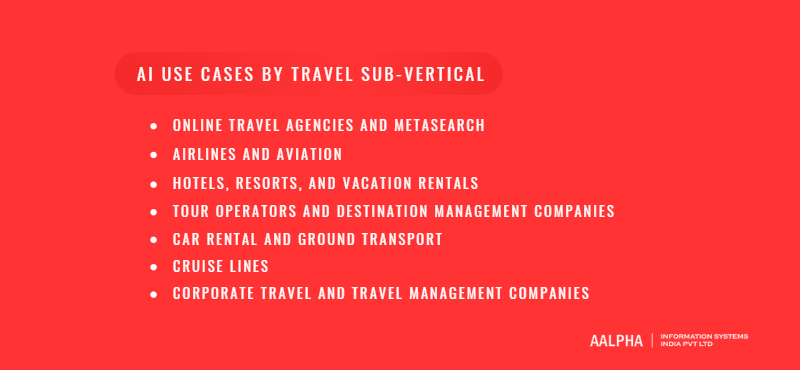
AI use cases by travel sub-vertical
-
Online travel agencies and metasearch
OTAs sit on the largest and most varied datasets in travel, which makes them structurally well positioned for AI and also exposes them most directly to disintermediation by AI assistants. The priority use cases are conversational search that handles vague intent, ranking models that balance conversion against margin, dynamic packaging, and fraud screening at scale. The strategic question for OTAs is whether they become the AI assistant travellers use or the inventory source that other assistants query, and the architecture decisions being made now largely determine which.
Metasearch faces a sharper version of the same question. Comparison as a service is precisely the task AI assistants perform natively, which means metasearch businesses are investing heavily in proprietary data, deal detection, and price prediction that a general assistant cannot replicate from public sources.
-
Airlines and aviation
Airlines run the most sophisticated existing AI in travel through revenue management, and the current wave of work concentrates on offer and order management. NDC and the shift from fare-filing to dynamic offer construction let airlines assemble bundles specific to the traveller and the moment, which is a genuinely new commercial capability requiring new systems. Alongside that, disruption management, crew and fleet optimisation, predictive maintenance, and automated servicing of change and refund requests are the highest-value programmes. Ancillary personalisation is the fastest to show return because the infrastructure usually already exists and only the decision logic changes.
-
Hotels, resorts, and vacation rentals
For hotels the dominant themes are direct booking conversion, rate optimisation across channels, and operational efficiency in housekeeping and maintenance scheduling. AI concierge services handle pre-arrival and in-stay requests, which improves guest experience while reducing front desk load. Revenue management for independent properties is a particularly underserved area, since the sophisticated systems have historically been priced for chains.
Vacation rentals add different problems. Listing quality varies enormously, verification matters more because inventory is distributed and unbranded, and matching guests to properties involves far more attribute dimensions than hotel room types. Computer vision for listing verification and generative systems for listing standardisation both apply directly.
-
Tour operators and destination management companies
Tour operators run some of the most manual processes in travel. Itinerary construction, supplier coordination, quotation, and document production are frequently handled in spreadsheets and email by experienced staff whose knowledge is not written down anywhere. AI here is less about customer-facing features and more about internal leverage: generating quotations from a brief, assembling supplier options, producing traveller documentation, and translating everything into the client’s language. The return is usually measured in quotes produced per consultant per week, and it tends to be large because the baseline is so manual.
-
Car rental and ground transport
Fleet utilisation and repositioning are optimisation problems that respond well to machine learning, particularly when demand forecasting is location and time specific. Damage assessment through computer vision at pickup and return reduces disputes and speeds turnaround. Dynamic pricing across locations and vehicle classes follows the same logic as hotel revenue management with the added constraint that inventory can physically move, which makes the optimisation richer and harder.
-
Cruise lines
Cruise operates on long booking windows, high ancillary spend on board, and complex itinerary logistics. AI applications concentrate on cabin revenue management, onboard revenue personalisation, shore excursion recommendation, and demand forecasting for provisioning. Onboard connectivity constraints matter for architecture, since features that assume reliable low-latency connections to shore-based inference will behave poorly at sea.
-
Corporate travel and travel management companies
Corporate travel has the clearest near-term case for agentic AI because policy provides the constraints that make autonomy safe. A system that books within a defined policy, prefers negotiated rates, respects traveller preferences, and escalates exceptions is solving a bounded problem. Add duty of care monitoring, expense reconciliation, emissions reporting, and spend analytics, and the corporate travel stack is arguably where AI delivers the most complete transformation of an existing workflow.
Core AI technologies powering travel solutions
-
Large language models and retrieval augmented generation
Language models provide the interface layer for most modern travel AI: understanding intent, maintaining conversation, summarising options, and generating content. Used alone they are unsuitable for travel because they will state things confidently that are not true. Retrieval augmented generation solves this by requiring the model to answer from retrieved documents and live system data rather than from parameters. In a travel context the retrieval sources typically include availability and pricing APIs, fare and policy rule sets, property and destination databases, and the traveller’s own booking history.
The engineering work concentrates on retrieval quality. If the right document is not retrieved, no amount of prompt tuning fixes the answer. Chunking strategy, hybrid keyword and vector search, reranking, and freshness handling for fast-changing data such as pricing all matter more than model selection.
-
Agentic AI and multi-step workflows
Agentic systems plan and execute sequences of actions rather than responding to a single prompt. In travel this covers search across suppliers, comparison, holding inventory, applying loyalty benefits, completing payment, and handling follow-up changes. The design principles that make this workable are narrow tool definitions with strict schemas, deterministic execution of anything financial, explicit confirmation gates before irreversible actions, comprehensive logging for audit, and bounded retry logic so a confused agent stops rather than loops.
-
Machine learning for pricing and forecasting
Gradient boosted trees remain the workhorse for tabular prediction problems in travel, including demand forecasting, cancellation probability, conversion likelihood, and fraud scoring. Deep learning approaches are used where sequence matters, such as session-level intent modelling. Reinforcement learning appears in pricing research and occasionally in production for exploration within controlled bounds, though most operators prefer supervised approaches for the explainability.
-
Computer vision and document intelligence
Document intelligence covers passport and identity document reading, visa verification, supplier contract extraction, and invoice processing. Modern approaches combine layout-aware models with language models for extraction, which handles the variability of real-world documents far better than template-based OCR. Image-based computer vision covers property verification, damage assessment, queue analytics, and baggage handling.
-
Recommendation engines and vector search
Vector databases and embedding models enable semantic search over inventory, so a query for a quiet place near the water with good food returns sensible results even though none of those words appear in the property data as written. Combined with structured filters for hard constraints such as dates, budget, and location, this hybrid approach is now the standard architecture for travel discovery.
-
Speech and translation systems
Speech recognition and synthesis enable voice interfaces for booking, in-destination assistance, and contact centre automation. Machine translation supports multilingual content and support. Both are commoditised enough that building from scratch is rarely justified, and the development work is integration, latency management, and domain adaptation for travel-specific vocabulary such as airport codes, fare basis names, and property names.
Architecture and integration: building AI into the travel tech stack
-
Reference architecture
A production AI travel platform generally organises into five layers. At the base sits the integration layer, which connects to GDS, CRS, PMS, channel managers, NDC endpoints, payment processors, and any direct supplier APIs. Above it sits the data layer, which normalises inventory, pricing, and traveller data into consistent internal models and maintains the traveller profile. The intelligence layer holds the models, retrieval infrastructure, feature stores, and inference services. The orchestration layer manages agent workflows, tool calling, validation, and confirmation gates. The presentation layer delivers this through web, mobile, voice, and agent-facing interfaces.
The reason to separate these explicitly is that they change at different rates. Models change monthly. Integrations change rarely and painfully. Keeping model logic out of the integration layer means the expensive, fragile parts of the system are not disturbed every time a better model appears.
-
Integrating with GDS, PMS, and NDC
This is where most travel AI projects consume their budget. Global distribution systems expose interfaces designed for a different era of software, with session-based state, rigid message formats, and behaviour that is not always documented. Property management systems vary enormously across vendors and versions, and many deployments are on-premise with limited API surface. Channel managers introduce their own mapping and synchronisation problems. NDC implementations differ meaningfully between airlines despite the shared standard.
The pattern that works is an abstraction layer with supplier-specific adapters, so the AI system works against a single normalised interface while the adapters absorb the variation. This costs more upfront and saves repeatedly, because every new model, feature, or supplier does not require reworking the whole stack. It also makes testing feasible, since adapters can be mocked while the intelligence layer is developed independently.
-
Data pipelines and the unified traveller profile
The unified traveller profile is the single most valuable artefact these projects produce. It consolidates identity, booking history, preferences both stated and inferred, service interactions, loyalty status, and consent state. Building it requires identity resolution across systems that use different keys, careful consent tracking so that data collected under one basis is not used for another purpose, and a real-time serving path so that models can read the profile during a live session rather than only in batch.
-
Working with legacy systems
Most travel companies cannot rewrite their core systems, and any proposal that requires it should be treated sceptically. The realistic approach is to leave the system of record in place, build read-optimised copies of the data it holds for AI consumption, and route write operations back through the existing system with its existing validation intact. This is slower than a greenfield build and vastly more likely to reach production.
-
Latency, caching, and cost control
Travel search generates enormous query volume relative to bookings, and running a language model on every query is economically unviable. Effective systems tier their processing: cached and rules-based responses for common queries, small fast models for classification and routing, and large models reserved for genuinely complex generation. Caching strategy has to account for the volatility of the underlying data, since a cached price that has moved is a customer service problem rather than a saving. Streaming responses helps perceived latency considerably in conversational interfaces, and prefetching likely next steps during a conversation makes booking flows feel immediate.
The AI travel solution development process
-
Discovery and use case prioritisation
The first phase establishes which problems are worth solving and which are actually solvable with the data available. A useful prioritisation compares expected value against implementation difficulty and data readiness, then selects an initial scope that can demonstrate measurable results within a quarter. Programmes that begin with the most visible use case rather than the most tractable one tend to stall, because the visible ones are usually customer-facing and therefore carry the highest accuracy requirements.
-
Data readiness assessment
Before any modelling, the data has to be assessed honestly for coverage, quality, accessibility, and consent status. This phase routinely uncovers issues that reshape the plan, including booking histories that lack the fields the model needs, customer data that cannot legally be used for the intended purpose, and integrations that technically exist but cannot support the required query volume. Discovering this in week three is inconvenient. Discovering it in month five is expensive.
-
Model selection
The build, fine-tune, or API decision depends on the use case. Commodity capabilities such as translation, speech, and general language understanding are almost always best consumed as APIs. Proprietary advantage capabilities such as pricing, demand forecasting, and ranking are usually custom models trained on the operator’s own data, because that data is the moat. Fine-tuning occupies a middle ground and is most justified for domain-specific language tasks where consistent format and vocabulary matter and prompt engineering has hit its ceiling.
-
Prototype and validation
Prototypes in travel AI need to be validated against real data and real edge cases, not curated examples. The useful test set includes ambiguous requests, unusual itineraries, disruption scenarios, multi-passenger complexity, and deliberate adversarial input. An evaluation harness that scores outputs automatically against expected behaviour is worth building early, because it is the only way to tell whether a change improved the system or merely changed it.
-
Production deployment and guardrails
Deployment introduces requirements that prototypes ignore: rate limiting, graceful degradation when a supplier API fails, fallback to human handoff, audit logging of every action taken on a traveller’s behalf, and clear disclosure that the traveller is interacting with an AI system. Guardrails should be enforced in code rather than requested in prompts. A model instructed not to quote prices will eventually quote a price; a system that has no access to a pricing string cannot.
-
Monitoring and drift
Travel data shifts seasonally and structurally. Models trained on one demand environment degrade when conditions change, and the degradation is often silent. Production monitoring should track input distribution drift, output quality metrics, business outcome metrics, and the rate of human escalation, with retraining triggered by evidence rather than by calendar.
Cost and timeline for AI travel software development
The cost of AI development for the travel industry depends more on the project scope, integration complexity, and the quality of existing data than on the AI models themselves. For projects delivered by an experienced offshore or hybrid development team, a retrieval-based AI customer support chatbot typically costs between $25,000 and $60,000 and takes 6 to 12 weeks to build. An AI-powered trip planner or itinerary generator generally ranges from $50,000 to $120,000 with a development timeline of 3 to 5 months. Businesses looking to implement a conversational booking agent with live inventory integration can expect costs of $90,000 to $250,000, requiring approximately 4 to 8 months. Dynamic pricing and revenue management systems usually fall between $80,000 and $220,000, while AI recommendation and personalization engines cost around $50,000 to $150,000, with both solutions typically taking 3 to 9 months depending on complexity. Fraud detection systems are commonly priced between $45,000 and $120,000 and require 3 to 5 months, whereas demand forecasting platforms generally cost $60,000 to $160,000 with a timeline of 3 to 6 months. For organizations planning a complete AI-enabled travel platform that combines multiple capabilities, the investment typically starts at $250,000 and can exceed $600,000, with development spanning 8 to 18 months.
Several factors have the biggest impact on the overall project cost. Integrating with third-party systems such as Global Distribution Systems (GDS), Property Management Systems (PMS), payment gateways, CRMs, or airline and hotel APIs often represents a significant portion of the development effort because each integration requires extensive testing and customization. Data quality is another major cost driver, as cleaning, organizing, and preparing travel data for AI models can consume a substantial share of the project budget. Compliance requirements also influence pricing, especially when handling payment information, personal traveler data, or biometric verification, which require additional security and regulatory measures. Finally, the level of accuracy expected from the AI system affects development costs, as improving an AI solution from “good enough” performance to enterprise-grade reliability typically requires more training, testing, and continuous optimization.
Travel businesses generally choose one of three engagement models for AI development. A fixed-price model works well for clearly defined proof-of-concept projects or MVPs with stable requirements. A time and materials model is better suited for projects where requirements are expected to evolve as new insights emerge during development. For organizations building long-term AI platforms, a dedicated development team offers the flexibility to continuously improve features, integrate new technologies, and scale the solution over time. Many travel companies begin with a fixed-scope pilot to validate business value before transitioning to a dedicated team for ongoing development, enabling them to adapt their AI strategy as customer needs and market conditions evolve.
Compliance, security, and risk
Travel businesses handle an unusually sensitive combination of data: identity documents, payment instruments, location and movement history, and sometimes health or accessibility information. AI systems that process this data inherit every obligation that applies to it, and in some cases add new ones.
GDPR and equivalent regimes require a lawful basis for processing, purpose limitation, and the ability to honour access and deletion requests. This last point creates a real architectural constraint for AI systems, since data that has been incorporated into a fine-tuned model or an embedding index is not straightforwardly deletable. The practical answer is to keep personal data out of training and embedding pipelines wherever possible and to retrieve it at inference time from systems that support deletion properly.
Payment flows fall under PCI DSS, which effectively means AI components should never touch raw card data. Tokenisation at the point of capture and strict scope boundaries keep the AI system outside the compliance perimeter, which is both safer and dramatically cheaper to certify.
Airline distribution carries its own requirements through IATA resolutions and agency agreements, including rules on how content may be displayed, how fares may be quoted, and what constitutes a valid booking. Systems that generate offers need to respect these, and the constraints should be encoded in the orchestration layer rather than left to model behaviour.
Accessibility deserves more attention than it usually receives. Booking flows are consumer-facing transactional interfaces, and in several jurisdictions they attract legal exposure when they fail accessibility standards. Conversational interfaces introduce new accessibility questions that WCAG addresses only partially, and building with screen reader compatibility and keyboard navigation from the start costs far less than retrofitting.
The travel-specific AI risk is hallucination in high-consequence contexts. A model that invents a baggage allowance, misstates a visa requirement, or promises a refund that policy does not permit creates liability and, in the visa case, potentially strands a traveller. Every output touching entitlements, requirements, or money should be grounded in retrieved authoritative content and, where the stakes justify it, validated against a rules engine before display.
Finally, the EU AI Act and comparable emerging frameworks impose transparency obligations, including disclosure when a person is interacting with an AI system and documentation requirements for higher-risk applications. Biometric processing at borders and in airports sits in a more heavily regulated category than customer-facing chat. Scoping the regulatory classification at design time avoids expensive rework.
Challenges and how to solve them
Fragmented data is the most common blocker. Booking data sits in one system, service history in another, loyalty in a third, and web behaviour in a fourth, often with no shared identity key. The solution is not glamorous: identity resolution, a canonical data model, and an incremental pipeline that starts with the two or three sources that matter most rather than attempting complete unification before delivering anything.
Legacy integration debt is the second. Older systems impose session limits, rate limits, and response formats that constrain what is possible. The mitigation is the adapter pattern described earlier, plus early load testing against the real system, because integration behaviour under production query volumes is frequently different from behaviour in test.
Seasonality and cold start affect model quality. A model trained on a single season learns that season. Systems handling new properties, new routes, or new markets have no history to learn from. The standard approaches are explicit seasonality features, transfer from similar entities, and conservative fallbacks that revert to rules-based behaviour when confidence is low.
Traveller trust is a softer challenge with hard commercial consequences. Travellers are willing to let AI help them plan and increasingly willing to let it book, but trust collapses quickly after a single visible error, particularly one involving money or a missed connection. The design implication is that systems should be conservative about what they claim, transparent about uncertainty, and generous with confirmation steps at the points where mistakes are expensive.
Measurement is the last challenge, and the most underestimated. Travel has long consideration windows, multi-device journeys, and heavy external demand variation, which makes attributing a revenue change to an AI feature genuinely difficult. Without a proper experimental design, teams end up arguing about whether the improvement was real.
Measuring ROI
The metrics that matter differ by use case, and the discipline is to choose them before the build rather than after. Conversational booking should be measured on completion rate, average booking value, and assisted conversion. Support automation should be measured on full resolution rate rather than containment, since a contact that the bot handled but the customer then re-raised is not a saving. Pricing should be measured on revenue per available unit rather than average rate, since raising rates while losing volume looks good on the wrong metric. Personalisation should be measured on incremental attachment and repeat rate. Fraud should be measured on the combination of loss rate and false positive rate, since improving one at the expense of the other is easy and worthless.
Baseline setting matters more in travel than in most sectors because year over year comparison is confounded by demand conditions. Holdout testing, where a randomised portion of traffic does not receive the AI experience, is the only reliable method, and it should run long enough to cover a full booking cycle rather than a week.
Realistic payback periods depend on the use case. Support automation and content generation typically pay back within six to twelve months because the cost side is immediate and measurable. Pricing and forecasting take longer to demonstrate but produce larger absolute returns. Customer-facing discovery and booking features have the widest variance, because their value depends on adoption, and adoption depends on execution quality more than on the underlying technology.
What comes next in travel AI
The most consequential near-term shift is agent-to-agent interaction. If travellers increasingly delegate booking to AI assistants, then travel suppliers need their inventory to be machine-readable, machine-bookable, and machine-comparable. This is a distribution question dressed as a technology question, and it will likely reshape commercial relationships in the same way that the arrival of metasearch did. Suppliers who make their content easy for agents to consume will gain share from those who do not, and the ones who make it too easy may find themselves competing purely on price.
The corresponding marketing shift is answer engine optimisation. Getting cited by AI trip planners requires content that is factual, specific, well structured, and marked up so that machines can parse it. Generic destination copy will not be cited. Content that answers a precise question with verifiable specifics will be.
In-destination and on-property AI is the third area to watch. Ambient assistance during a trip, as opposed to before it, is largely unbuilt. The traveller who has arrived and now needs to solve a problem is underserved by current tooling, and the operators who solve this well will capture both loyalty and ancillary spend.
How to choose an AI development partner for travel
The single most useful filter when evaluating an AI development company for travel is whether it has integrated with travel distribution systems before. AI capabilities are now widely available, but experience with GDS, PMS, channel managers, NDC, and other travel-specific platforms is far less common. An experienced AI development company understands the complexities of these integrations, knows where projects typically encounter delays, and can provide realistic timelines and budgets. In contrast, a team without travel technology expertise may underestimate the integration effort, resulting in unexpected costs, project delays, and implementation challenges.
Beyond that, look for evidence of production deployments rather than prototypes, since the gap between the two is where most projects fail. Ask how they handle hallucination in transactional flows, what their evaluation approach is, and how they plan for model changes. Ask about data handling and compliance posture explicitly, particularly if biometric or payment data is in scope. Check independent reviews rather than case studies, since case studies are written by the vendor.
Aalpha has been building custom software since 2008, with 5,500+ projects delivered across 45+ countries, a 4.9 out of 5 rating from more than 215 verified Clutch reviews, and ISO 9001:2015 certification. Our travel and hospitality work spans booking platforms, property management integrations, dynamic pricing systems, and AI-driven traveller experiences. If you are scoping an AI programme for a travel business, we are happy to review the plan and tell you honestly where the difficult parts are.
Frequently asked questions
What is AI development for the travel industry?
AI development for the travel industry is the process of building custom software that applies machine learning, large language models, and computer vision to travel-specific problems, including trip planning, booking automation, dynamic pricing, disruption management, and fraud detection. It differs from general AI development because the systems must integrate with travel distribution infrastructure such as GDS, PMS, and NDC APIs and must respect fare rules, inventory constraints, and travel-specific regulation.
How much does it cost to build an AI solution for a travel business?
A focused AI chatbot for customer support typically costs between $25,000 and $60,000. An AI trip planner ranges from $50,000 to $120,000. A conversational booking agent connected to live inventory generally falls between $90,000 and $250,000. A full AI-enabled travel platform starts around $250,000 and can exceed $600,000 depending on integration scope and regulatory requirements.
How long does AI travel software development take?
A well-scoped pilot takes 6 to 12 weeks. Mid-sized solutions such as recommendation engines or forecasting platforms take 3 to 6 months. Conversational booking systems and revenue management platforms take 4 to 9 months. Full platform builds run 8 to 18 months, with integration work typically consuming the largest share of the schedule.
What are the most valuable AI use cases in travel?
Dynamic pricing and revenue management deliver the largest absolute returns for most operators. Customer support automation delivers the fastest measurable cost savings. Personalised merchandising produces reliable ancillary revenue lift. Fraud detection protects margin directly. AI trip planning and conversational booking have the highest visibility but the widest variance in return, since their value depends heavily on adoption.
Can AI actually complete a booking, or only assist with search?
AI systems can complete bookings end to end, and several operators run this in production. The architecture that makes it safe uses the language model for intent understanding and conversation while deterministic code executes pricing, inventory holds, and payment through the booking system of record. Irreversible actions require explicit confirmation. Fully autonomous booking without confirmation gates is technically possible but rarely advisable.
How do you stop an AI travel assistant from giving wrong information?
By grounding every factual claim in retrieved data rather than model knowledge. Availability, pricing, fare rules, baggage policies, and visa requirements should be fetched from authoritative sources at the moment of the query. Guardrails should be enforced in code rather than instructions, and outputs affecting entitlements or money should be validated against a rules engine before display.
What data do I need before starting an AI project?
At minimum, historical booking data with enough field coverage to support the intended model, a clear record of consent for any personal data involved, and API access to the systems holding live inventory and pricing. Most projects also benefit from service interaction history and web behaviour data. A data readiness assessment before development starts is worth the time it takes.
Does AI development require replacing our existing travel systems?
No, and proposals that require it should be examined carefully. The standard approach leaves the system of record in place, builds read-optimised data copies for AI consumption, and routes write operations back through existing systems with their validation intact. This preserves the operational reliability of proven systems while adding new capability alongside them.
How does AI help during flight cancellations and travel disruption?
AI systems identify affected bookings automatically, evaluate rebooking options against fare rules, availability, and connection feasibility, rank those options by traveller preference and value, and communicate proactively before the traveller contacts support. This converts an unmanageable contact spike into a set of outbound notifications with self-service resolution attached.
What regulations apply to AI in travel?
GDPR and equivalent privacy regimes govern traveller data. PCI DSS applies to payment flows. IATA resolutions and agency agreements govern airline content display and fare quotation. Biometric processing at borders and airports carries additional jurisdiction-specific requirements. The EU AI Act adds transparency and documentation obligations, with higher-risk classifications for biometric applications.
Should we build our own models or use existing AI APIs?
Use APIs for commodity capabilities such as translation, speech, and general language understanding, where there is no proprietary advantage in building. Build custom models for pricing, demand forecasting, and ranking, where your own historical data is the competitive asset. Fine-tuning sits in between and is most justified for domain-specific language tasks where consistent output format matters.
How do we measure whether an AI travel feature is actually working?
Through holdout testing, where a randomised portion of traffic does not receive the AI experience, run long enough to cover a full booking cycle. Year over year comparison is unreliable in travel because demand conditions vary too much. Choose the metric before building, and choose one that cannot be gamed, such as full resolution rate for support or revenue per available unit for pricing.
Will AI assistants replace online travel agencies?
They will change the competitive position rather than eliminate it. AI assistants are good at comparison and synthesis, which is a significant part of what metasearch and OTAs provide. The defensible assets are proprietary inventory, negotiated rates, service capability, and data that a general assistant cannot obtain. Travel businesses are responding by making their inventory machine-accessible while investing in what assistants cannot replicate.
What should we build first?
Whichever use case combines meaningful value with clean available data and low accuracy risk. For most operators that means an internal or operational use case rather than a customer-facing one, because it delivers measurable results in a quarter, builds the data infrastructure that later projects need, and does not put customer trust at risk while the team is still learning.
Back to You!
Whether you’re planning an AI-powered trip planner, conversational booking platform, dynamic pricing engine, or customer support automation, Aalpha can help you turn your idea into a production-ready solution. Our AI engineers build secure, scalable, and integration-ready software tailored to your business goals.
Talk to our experts today to discuss your project and receive a free consultation and development estimate.