





TL;DR
AI development for startups is the process of designing, building, and shipping products where machine learning models do meaningful work in the core user experience, rather than sitting on the side as an analytics layer. For most early-stage companies in 2026, this means building on foundation model APIs, adding retrieval over proprietary data, and investing early in evaluation rather than infrastructure. A proof of concept typically takes two to four weeks and costs between USD 8,000 and USD 20,000. A production-grade AI MVP typically takes twelve to twenty weeks and costs between USD 45,000 and USD 150,000 depending on use case complexity, data readiness, and compliance scope. The three decisions that most affect outcome are whether to use an API or self-host a model, whether retrieval or fine-tuning solves your accuracy problem, and whether you build an evaluation harness before or after launch. Aalpha Information Systems has been building custom software since 2008 and has delivered more than 5,500 projects across 45 plus countries, holds ISO 9001:2015 certification, and is rated 4.9 out of 5 from over 215 verified Clutch reviews.
AI development for startups looks deceptively similar to normal product development from the outside. There is a backlog, there are sprints, there is a frontend and a backend and a deployment pipeline. Founders who have shipped software before assume the same playbook applies with a few new libraries bolted on.
It does not, and the gap is where most AI startup projects lose their schedule and their budget.
The difference is that a conventional feature either works or it does not, and you can tell which by reading the code. An AI feature works to a degree, on some inputs, under some conditions, and the only way to know how well is to measure it against examples you have deliberately collected. That single property changes how you scope, how you estimate, how you test, how you price, and how you decide when something is ready to ship.
This guide covers the full arc of building an AI product as a startup: deciding whether you need AI at all, choosing between building and buying, assembling a stack, preparing data, running the development lifecycle, budgeting realistically, hiring, evaluating quality, handling security and compliance, deploying and scaling, and avoiding the mistakes that kill these projects most often. It closes with a ninety day plan you can start on Monday.
1. Why AI development is different from regular software development
-
Probabilistic output changes the contract
Traditional software is deterministic. Given the same input, the same code path produces the same output every time. You write a test, the test passes, and the behaviour is locked in until someone changes the code.
Language models, vision models, and most machine learning systems are probabilistic. The same prompt can produce different outputs across runs. A model that classifies an invoice correctly ninety four times out of a hundred is not broken on the other six. It is behaving exactly as designed. Your job is not to eliminate the six, which is impossible, but to decide whether ninety four is good enough for the business risk involved, and to build the product so that the six fail safely.
This is why the phrase “the AI is wrong” is not a bug report. It is the starting point of a conversation about accuracy thresholds, error handling, and human review.
-
Requirements documents stop working the way they used to
A conventional specification says what the system must do. An AI specification has to say what the system must do and how well, measured how, on what data.
“The system summarises customer support tickets” is not a requirement anyone can build against or accept against. “The system produces a summary of each support ticket that a trained agent rates as accurate and complete in at least ninety percent of cases across a two hundred ticket evaluation set, with no summary omitting a stated refund request” is a requirement. It tells the engineering team what to optimise, tells the client what they are buying, and tells both parties when the work is done.
At Aalpha we treat the definition of the evaluation set as a contract artifact on AI engagements, produced during discovery and signed off before build begins. It prevents the single most common dispute on these projects, which is two parties having different unstated ideas of what “working” means.
-
Discovery cannot be skipped, because feasibility is genuinely unknown
In conventional development you can usually tell from a requirements conversation whether something is buildable. In AI work you often cannot. Whether a model can extract the right fields from a particular family of scanned documents, or whether retrieval over a specific knowledge base returns relevant chunks, is an empirical question. The answer depends on the data, and the only way to get it is to try.
This is why serious AI engagements start with a feasibility spike rather than a build plan. Two weeks of hands-on experimentation with real data tells you more than two months of architecture discussion.
-
Cost structure moves from fixed to variable
A conventional web application has a cost floor that barely moves with usage until you hit real scale. Servers, database, CDN, monitoring. Ten thousand users cost roughly what a thousand cost.
AI products pay per unit of work. Every request that touches a model costs money, and that cost scales linearly with usage. A chat feature that costs four cents per conversation is invisible at a hundred users and a serious line item at a hundred thousand. Founders who do not model this early discover it when gross margin turns out to be forty percent instead of the eighty five percent their investors were told to expect.
Inference cost belongs in the financial model from the first week, not the first scaling crisis.
-
Model dependencies change underneath you
If you build on a third party model API, the model can change. Providers deprecate versions, update behaviour, adjust safety filters, and change pricing. Output that was reliable in March can drift in June without a single line of your code changing.
Conventional software has dependencies too, but a library version stays put until you upgrade it. Model behaviour does not offer that guarantee in the same way. This is a real operational risk and it shapes architecture, specifically the case for an abstraction layer between your application and whichever model is behind it.
2. Deciding whether your startup actually needs AI
-
The three defensible reasons to build AI into a product
There are three situations where AI is the right tool rather than a positioning exercise.
The first is when the task involves unstructured input that rules cannot handle. Free text, images, audio, video, scanned documents, messy human-entered data. If your product has to understand something a human wrote or photographed, and the variation is wide enough that you cannot enumerate the cases, that is a genuine AI problem. Extracting line items from supplier invoices that arrive in four hundred different layouts is an AI problem. Extracting them from your own standardised form is not.
The second is when the value comes from scale that humans cannot economically reach. A process that is entirely solvable by a person but has to happen ten thousand times a day at a cost of eight cents each is an automation problem where AI is often the only economical option. Support triage, content moderation, lead qualification, document review.
The third is when personalisation or prediction at the individual level is the product. Recommendation, risk scoring, demand forecasting, dynamic pricing, churn prediction. These require learning patterns from data that no static rule set encodes.
If your use case is not one of these three, be honest about whether AI is doing work or doing marketing.
-
Signals that AI is the wrong answer
A well-written rules engine beats a model on any problem where the rules are known, stable, and few. It is cheaper, faster, fully auditable, and never hallucinates. If a domain expert can write down the logic on two pages, write the logic.
Search beats generation for a large class of retrieval problems. If users want to find a document, a well-tuned search index with good filters often serves them better than a chatbot that paraphrases the document and occasionally gets it wrong. Adding a conversational layer over a search problem sometimes reduces utility while increasing cost.
Regulatory constraints can make AI impractical for a specific decision even when it is technically capable. If a decision must be explainable to a regulator on a per-case basis, a model whose reasoning cannot be reconstructed is a liability regardless of its accuracy.
And if your data does not exist yet, AI is premature. You cannot build a prediction model without history. Many startups are better served by shipping a manual or rules-based version first, specifically to generate the data that makes a model possible in year two.
-
The wrapper problem and where defensibility now lives
Around 2023 a large number of startups shipped thin interfaces over a foundation model API and called it a product. Most of them are gone. The reason is straightforward: if your entire product is a prompt plus a text box, your competitive advantage is a prompt, and prompts are not defensible.
Defensibility in AI products now sits in four places. Proprietary data that competitors cannot obtain, whether through exclusive partnerships, user-generated accumulation, or a data collection mechanism built into the product loop. Workflow depth, meaning the product does the whole job including the unglamorous parts before and after the model call, and becomes embedded in how a team operates. Distribution and trust in regulated or relationship-driven markets where switching costs are real. And evaluation infrastructure, which sounds unromantic but genuinely compounds, because a company that has measured five thousand real cases can improve in ways a company running on vibes cannot.
The model itself is almost never the moat. Everyone can call the same API.
-
A qualification framework you can run in an afternoon
Before committing budget, answer six questions in writing.
What is the specific task, phrased as an input and a desired output? If you cannot state it in one sentence with a concrete example, the project is not ready.
What does a correct output look like, and who decides? Name the person or role.
What accuracy level makes this useful, and what happens when the system is wrong? A wrong product recommendation costs a click. A wrong medication interaction warning costs a life. These require completely different engineering budgets.
What data exists today, where does it live, and who owns it? Not what data you could theoretically collect. What exists now.
What is the cheapest non-AI version of this, and why is it insufficient? If you cannot answer this crisply, build the cheap version first.
What is the per-transaction economic value, and how does that compare to plausible inference cost? If the value is two cents and the inference cost is four cents, the model is not the problem, the business case is.
Startups that can answer these six questions ship AI products. Startups that cannot spend six months discovering the answers with an engineering team on the clock.
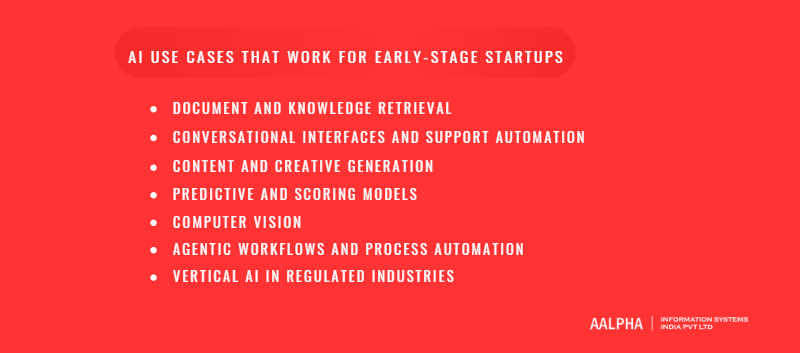
3. AI use cases that work for early-stage startups
Some categories have matured to the point where the technical risk is low and the build path is well understood. These are where an early-stage company gets the best return per unit of engineering effort.
-
Document and knowledge retrieval
The most reliably valuable AI application for startups is making a body of documents answerable. Contracts, policy manuals, product documentation, research archives, medical guidelines, regulatory texts, internal wikis. The pattern is retrieval augmented generation: index the content, retrieve the relevant passages for a given question, and have a model compose an answer grounded in those passages with citations back to the source.
This works because the model is not being asked to know anything. It is being asked to read and summarise text placed in front of it, which is what these models do best. Accuracy is high, hallucination is controllable through grounding and citation requirements, and the value is obvious to any buyer who currently pays people to search PDFs.
Aalpha has delivered this pattern across legal, healthcare, insurance, and manufacturing clients, and it remains the fastest route from idea to a demonstrably useful AI product.
-
Conversational interfaces and support automation
Customer-facing assistants that answer questions, take actions, and escalate cleanly to humans. The technical challenge is less about conversation quality, which is largely solved, and more about integration: connecting the assistant to order systems, account data, and ticketing so it can actually do things rather than just talk about them.
The mistake founders make is measuring these on deflection rate alone. A bot that deflects sixty percent of tickets by frustrating users into giving up has not created value. The metric that matters is resolution rate combined with satisfaction on the resolved subset.
-
Content and creative generation
Marketing copy, product descriptions, image generation, video assembly, code generation, translation and localisation. Commoditised at the base layer, which means the product opportunity is in workflow, brand consistency, and integration rather than in the generation itself. A tool that generates a product description is a feature. A tool that pulls product data from a catalogue, generates descriptions in seven languages matching a brand voice guide, checks them against compliance rules, and pushes them to a storefront is a product.
-
Predictive and scoring models
Lead scoring, credit risk, churn prediction, demand forecasting, fraud detection, maintenance scheduling. These are classical machine learning rather than generative AI, and they are frequently the better choice when you have tabular historical data and need a number rather than a paragraph. They are cheaper to run, easier to explain, and often more accurate on their specific task than any large model.
Startups sometimes reach for a language model when gradient boosting on a well-prepared dataset would outperform it at a fraction of the cost. Match the tool to the problem shape.
-
Computer vision
Quality inspection, inventory counting, document digitisation, medical imaging support, retail analytics, safety monitoring, agricultural assessment. Vision has a different cost profile because it usually requires labelled training data, which means either annotation effort or a licensing arrangement. Modern vision-language models have reduced this burden substantially for general recognition tasks, but specialist domains still typically need domain data.
-
Agentic workflows and process automation
Multi-step systems where a model plans and executes a sequence of actions across tools, with checkpoints and error handling. Reconciling invoices against purchase orders, researching and enriching a lead list, triaging and routing inbound requests, running a compliance check across multiple data sources.
These are more powerful and considerably harder than single-call applications. Errors compound across steps, and debugging requires proper tracing. The realistic advice for a startup is to build agentic capability incrementally: automate one step reliably, then chain a second, rather than attempting an autonomous multi-tool agent as a first release.
-
Vertical AI in regulated industries
Healthcare, legal, financial services, insurance, logistics, and construction all have deep pockets, painful manual processes, and buyers who will pay for domain-specific tooling. The barrier is compliance, procurement cycles, and the need for domain credibility, which is precisely why these markets are less crowded than horizontal ones.
For a startup with genuine domain access, vertical AI is usually a stronger position than horizontal. The compliance work that slows you down also keeps competitors out.
4. Build, buy, fine-tune, or call an API
Four paths lead to a working AI capability, and the choice determines cost, timeline, and operational burden more than any other technical decision.
-
Foundation model APIs as the sensible default
Calling a hosted model from a provider is where almost every startup should start. You get frontier capability with no infrastructure, no training, no GPU procurement, and no ML research team. You pay per token or per request. You can be running a prototype the same afternoon.
The tradeoffs are real. Your data leaves your environment, which matters for some regulated use cases although zero-retention and enterprise agreements address much of this. Costs scale with usage rather than sitting flat. You depend on a third party’s availability, pricing, and roadmap. And you cannot deeply customise the underlying model.
For the vast majority of startups, none of these outweigh the speed advantage in the first year. Start here. Move only when a specific, measured constraint forces you to.
-
Open weight models and when self-hosting becomes rational
Open weight models have closed much of the capability gap for common tasks, and running them yourself gives you data control, fixed rather than variable cost, no rate limits, and full version stability.
Self-hosting starts making financial sense at high, steady volume. The rough rule is that if your monthly API spend on a specific workload exceeds the fully loaded cost of the GPU capacity plus the engineering time to operate it, self-hosting is worth modelling seriously. That crossover often sits somewhere in the range of several thousand dollars a month of consistent usage on a narrow task, though the exact point depends heavily on your traffic pattern. Spiky traffic favours APIs because you pay nothing when idle. Steady traffic favours self-hosting because your GPU is busy.
The other trigger is data sovereignty. If patient data or financial records cannot leave your infrastructure under any contractual arrangement, self-hosting is not an optimisation, it is a requirement.
The hidden cost is operational. Someone has to manage serving infrastructure, batching, scaling, model updates, and incident response. That is a real engineering role, not a background task.
-
Fine-tuning: what it fixes and what it does not
Fine-tuning adjusts a model’s weights using your examples. It is excellent at teaching a model a format, a tone, a classification scheme, or a domain-specific style of response. It reliably improves consistency and can let a smaller, cheaper model match a larger one on a narrow task, which is a significant cost lever.
Fine-tuning is not a way to teach a model facts. If your problem is “the model does not know our product catalogue,” fine-tuning is the wrong tool and retrieval is the right one. Facts change. Weights do not update themselves. Teams that fine-tune to inject knowledge end up retraining constantly and still getting stale answers.
The practical sequence is: prompt engineering first, retrieval second, fine-tuning third. Most teams never need the third step. Those that do should reach it with a clear, measured reason and a dataset of at least several hundred high-quality examples, ideally low thousands.
-
Retrieval augmented generation as the answer to most knowledge problems
RAG connects a model to your data at query time. Content is chunked, embedded, and stored in a vector index. When a question arrives, the system retrieves the most relevant chunks and includes them in the model’s context, so the answer is grounded in your actual documents rather than the model’s training data.
This solves the knowledge problem cleanly. Content updates instantly when you reindex. Answers can cite sources. Access controls can be enforced at retrieval time so users only see what they are permitted to see. And hallucination drops sharply because the model has the material in front of it.
RAG has become the default architecture for knowledge-centric AI products, and the engineering effort has shifted from “can we build it” to “can we make retrieval good,” which is where the real work sits. Chunking strategy, embedding choice, hybrid keyword and semantic search, reranking, and query rewriting each move accuracy meaningfully.
Choosing between them
Decide on four axes.
Data sensitivity. Regulated data with contractual prohibitions on third party processing pushes toward self-hosting. Everything else can usually be handled with enterprise API terms.
Volume and predictability. High steady volume favours self-hosting or fine-tuned smaller models. Low or spiky volume favours APIs.
Latency requirements. Sub-second interactive experiences may need smaller models, aggressive caching, or edge deployment. Batch processes can use whatever is most capable.
Margin structure. If your product sells for two dollars a month, you cannot spend eighty cents on inference. Tight margins push toward smaller models, caching, and fine-tuning for efficiency. Enterprise pricing gives you room to use the best available model.
Most startups end up with a hybrid: a capable hosted model for hard tasks, a smaller or self-hosted model for high-volume simple tasks, and routing logic between them.
5. The AI startup tech stack
-
Model layer
Your model layer should be pluggable from day one. Wrap model calls behind your own interface rather than scattering provider-specific SDK calls through your codebase. This costs a day of work early and saves weeks later when you switch providers, add a fallback, or route different tasks to different models.
Plan for multi-model routing. Simple classification goes to a small fast model. Complex reasoning goes to a frontier model. Bulk summarisation goes to whatever gives the best cost per acceptable output. This alone routinely cuts inference bills by half or more without any quality loss on the tasks that matter.
Plan for fallback. Provider outages happen. A secondary model configured and tested in advance turns an outage from a product-down incident into a degraded-quality incident.
-
Orchestration
Orchestration frameworks handle chaining, tool calling, memory, and agent loops. They accelerate early development considerably and abstract away a lot of boilerplate.
The caution is that these frameworks abstract heavily, and when something goes wrong the abstraction makes debugging harder. A pragmatic position for a startup is to use a framework for prototyping, then evaluate whether the production path is better served by direct API calls with your own thin orchestration. Many teams graduate off frameworks as their requirements sharpen. Others stay on them successfully. Either is fine. What is not fine is being unable to explain what your framework is doing on your behalf.
-
Vector database and retrieval infrastructure
For a startup, this is often simpler than it appears. Postgres with the pgvector extension handles retrieval for a very large number of applications and means one less system to operate. Dedicated vector databases become worthwhile at large scale, with complex filtering requirements, or when you need features like hybrid search and reranking built in.
The retrieval quality work matters far more than the database choice. Chunk size and overlap, whether you embed at paragraph or section level, whether you combine semantic and keyword search, and whether you rerank the retrieved set before passing it to the model will each affect answer quality more than which vector store you picked.
-
Data pipeline
The unglamorous layer that determines whether everything above it works. Ingestion connectors to wherever your source content lives, parsing for PDFs and scanned documents and spreadsheets and HTML, cleaning, deduplication, chunking, embedding generation, and incremental reindexing when sources change.
Document parsing in particular is consistently underestimated. Extracting clean text from a well-formed digital PDF is easy. Extracting it from a scanned, rotated, multi-column document with tables and handwriting is a project. Scope this honestly against real samples of your actual documents, not against a clean example.
-
Application layer
Standard web and mobile stack, with a few AI-specific considerations. Streaming responses so users see output as it generates rather than waiting for a complete answer. Clear loading and progress states, because AI operations take seconds rather than milliseconds. Interface affordances for correction and feedback, so users can flag bad output and you can capture that signal. And graceful degradation when the model fails or times out.
The interface design work on AI products is genuinely harder than on conventional products because you are designing for uncertainty. Communicating confidence, showing sources, and making it easy to verify are product problems, not model problems.
-
Observability and evaluation tooling
Logging, tracing, and evaluation infrastructure. You need to be able to see the full trace of any request: what the user asked, what was retrieved, what prompt was sent, what came back, how long it took, what it cost, and what the user did next.
Without this, debugging an AI product is guesswork. With it, you can diagnose whether a bad answer came from bad retrieval, a bad prompt, or a model failure, which are three completely different fixes.
This is also where your improvement loop lives. Traces plus user feedback become your evaluation dataset, and the evaluation dataset is what lets you make changes with confidence rather than hope.
-
Deployment
Serverless functions work well for bursty inference proxying and keep costs near zero when idle, with cold start latency as the tradeoff. Managed container platforms suit steady traffic and long-running processes. Self-hosted GPU infrastructure is only worth its operational overhead once you have volume that justifies it.
For most startups, the answer is a managed platform for the application, hosted model APIs for inference, and a managed database. Infrastructure sophistication before product-market fit is a distraction that has killed more AI startups than any technical limitation.
6. Data strategy: the part founders underestimate
What “enough data” actually means
The amount of data you need depends entirely on your approach, and the common assumption that AI requires massive datasets is a holdover from an earlier era.
For prompting and retrieval, you need no training data at all. You need content to retrieve over, which most companies already have. A knowledge assistant can be built on a few hundred documents.
For fine-tuning a language model, several hundred to a few thousand well-constructed examples typically produce meaningful improvement. Quality dominates quantity here. Two hundred carefully curated examples reliably outperform two thousand sloppy ones.
For training a classical predictive model, you generally want thousands to tens of thousands of labelled historical records, with enough examples of the rare outcome you are trying to predict. Fraud detection with eleven historical fraud cases is not a modelling problem, it is a data collection problem.
For training a vision model from scratch, budget for thousands of labelled images per class, though transfer learning and modern vision-language models reduce this substantially.
For evaluation, and this is the number most teams miss, you want at minimum one hundred to three hundred representative test cases with known correct answers. This is the single highest-return dataset you will build and it should exist before you write production code.
Sourcing, licensing, and synthetic data
Your own operational data is the best source and the only one that can become a moat. Product usage, transactions, support tickets, documents, and customer interactions. Start capturing it structurally from day one even if you have no immediate use for it.
Public and licensed datasets are useful for bootstrapping and benchmarking. Check licence terms carefully, since a surprising volume of publicly available data carries restrictions on commercial use or model training.
Synthetic data generated by a model is genuinely useful for augmenting fine-tuning sets, covering edge cases you lack real examples of, and creating test data without exposing real customer records. It is less useful as a primary training source, because a model trained mainly on another model’s output tends to inherit and amplify its errors. Use it as a supplement.
Partnership data, where you get access to a domain partner’s proprietary corpus in exchange for equity or product access, is one of the most effective moat-building moves available to a vertical AI startup. It is worth pursuing early, before you have leverage but also before competitors have locked up the obvious partners.
Preparation is most of the work
Cleaning, deduplication, format normalisation, chunking, and labelling routinely consume more engineering hours than model integration. Plan for it explicitly rather than discovering it.
Labelling deserves particular attention. If your task requires human judgement to define correct answers, you need a written labelling guideline, at least two people applying it independently on an overlapping subset, and a measurement of how often they agree. If two domain experts agree only seventy percent of the time on what the right answer is, no model will exceed seventy percent, and you have learned something crucial about your problem before spending money on it.
Rights, ownership, and customer data
Three questions need clear answers before you build.
Do you have the right to use this data for this purpose? Customer data collected under terms that say it will be used to provide the service may not cover using it to train a model that serves other customers.
Who owns the outputs and any model improvements? This needs to be explicit in customer contracts and in any development agreement. On Aalpha engagements, IP ownership including models, prompts, pipelines, and evaluation datasets transfers to the client, and we make that explicit in the contract rather than leaving it to interpretation.
What are your retention and deletion obligations, and can your architecture honour them? If a customer invokes a deletion right, you need to be able to remove their data from your vector index and your logs, which is an architectural requirement rather than a policy statement.
Building a data moat from day one
The compounding asset is not raw data volume. It is the feedback loop. Design the product so that normal usage generates labelled examples: users accepting or editing a suggestion, correcting an extraction, rating an answer, or choosing between options.
Every one of those interactions is a training and evaluation signal you get for free. A startup two years into operating a well-designed feedback loop has something a well-funded competitor cannot buy.
7. The AI development lifecycle, phase by phase
-
Phase one: discovery and feasibility spike, one to three weeks
The goal is to answer whether the thing is possible with the data that exists, and what accuracy is realistically achievable.
The work includes defining the task precisely, auditing available data against real samples rather than descriptions, building the evaluation set, and running quick technical experiments against the hardest cases rather than the easiest ones. Testing on your best five documents tells you nothing. Testing on your worst twenty tells you everything.
The output is a feasibility assessment with a measured baseline, a recommended technical approach, and an honest statement of risk. Sometimes the output is a recommendation not to proceed, which is by far the cheapest bad news a founder can receive.
Skipping this phase to save two weeks is the most expensive decision available on an AI project.
-
Phase two: proof of concept, two to four weeks
A narrow end-to-end implementation of the core capability. Not a product. No authentication, no polish, no scale. The single question it answers is whether the approach produces acceptable quality on real data.
It should be measured against the evaluation set from phase one, and it should be treated as disposable. PoC code that gets promoted to production carries assumptions and shortcuts that cause problems for a year.
-
Phase three: data preparation and baseline, two to six weeks
Building the real pipeline. Ingestion, parsing, cleaning, chunking, embedding, indexing. Establishing the baseline metrics that everything afterward is measured against.
Duration varies enormously with data condition. Clean digital documents in one system is two weeks. Mixed scanned and digital documents across four systems with inconsistent metadata is six weeks or more.
-
Phase four: prototype with evaluation harness, three to six weeks
The working system plus the infrastructure to measure it. The evaluation harness runs your test set automatically, reports accuracy metrics, and flags regressions when anything changes.
Building this feels like overhead. It is the difference between improving a system deliberately and changing it randomly. Once it exists, prompt changes, retrieval tuning, and model swaps become experiments with measurable outcomes rather than acts of faith.
-
Phase five: MVP build, six to twelve weeks
The full product around the AI capability. Authentication, user management, permissions, integrations, admin tooling, billing, the interface, and error handling.
Founders are often surprised by the ratio here. On a typical AI MVP, the AI-specific work is perhaps thirty to forty percent of the engineering effort. The rest is ordinary product engineering, which is good news, because it is predictable and well-understood work.
-
Phase six: hardening, red teaming, and guardrails, two to four weeks
Adversarial testing before real users arrive. Prompt injection attempts, attempts to make the system produce harmful or off-brand output, attempts to extract other users’ data, boundary and nonsense inputs, and load testing.
Guardrails go in here: input validation, output filtering, refusal handling, rate limiting, cost caps per user, and escalation paths to humans.
-
Phase seven: launch and iteration
Staged rollout with monitoring on quality, latency, cost, and user behaviour. Then the loop that matters: collect real failures, add them to the evaluation set, fix, measure, ship.
The evaluation set should grow continuously from production failures. A system with an eval set that has grown from two hundred cases at launch to two thousand cases a year later is a system that has genuinely improved, and you can prove it.
How this runs in practice
On AI engagements models at Aalpha, we structure the work as a fixed-price feasibility spike, followed by a PoC with defined acceptance criteria, followed by an MVP build with the evaluation harness delivered as a first-class artifact alongside the application. Each phase has a stop point where the client can proceed, adjust, or walk away with everything produced so far. Across more than 5,500 delivered projects since 2008, the pattern that most reliably protects a client’s budget is a small, honest first phase rather than a large, optimistic one.
8. What it costs to build an AI product
AI development cost depends on the product’s complexity, the AI models involved, data preparation, integrations, security requirements, and ongoing maintenance. Costs below reflect engagements delivered through an experienced offshore partner, which is the model many funded startups use. Equivalent work through a US or Western European agency typically runs 2.5 to 4 times higher, making offshore development a cost-effective option without compromising quality.
-
By stage
A feasibility spike runs USD 4,000 to USD 9,000 for one to three weeks of senior time against your real data. This is the cheapest insurance available on an AI project.
A proof of concept runs USD 8,000 to USD 20,000 over two to four weeks. Narrow scope, real data, measured against a defined evaluation set.
An AI MVP that real users can pay for runs USD 45,000 to USD 150,000 over twelve to twenty weeks. The range is wide because it covers everything from a single-purpose retrieval assistant to a multi-tenant platform with complex integrations.
A production-grade platform with enterprise compliance, multiple AI capabilities, deep integrations, and audit requirements runs USD 150,000 to USD 400,000 and up.
-
By use case type
A retrieval assistant over an existing document corpus, with citations and access control, typically lands between USD 40,000 and USD 85,000 for a production MVP. It is the most predictable AI project shape.
A customer-facing conversational product with system integrations and action-taking typically runs USD 60,000 to USD 130,000, with integration count as the main variable.
An agentic workflow system that plans and executes multi-step processes typically runs USD 90,000 to USD 220,000. The premium is for error handling, state management, tracing, and the substantially larger testing surface.
A computer vision application typically runs USD 70,000 to USD 180,000, with the range driven almost entirely by whether usable labelled data exists.
A fine-tuned vertical model with a custom dataset typically adds USD 25,000 to USD 70,000 on top of the surrounding application, most of which is dataset construction rather than training.
-
Team cost comparison
An in-house team of one AI engineer, one backend engineer, one frontend engineer, and a part-time product lead costs roughly USD 480,000 to USD 750,000 annually fully loaded in the US, before recruitment time that routinely runs three to five months for AI-capable engineers.
Freelancers cost less per hour but carry coordination overhead, availability risk, and no continuity. Workable for a discrete PoC, fragile for a twenty week build.
An established offshore development partner delivers the same MVP scope for roughly USD 45,000 to USD 150,000 with a team assembled in days rather than months, and no fixed cost after delivery. The tradeoff is that you are buying execution rather than building institutional knowledge, which is the right trade before product-market fit and the wrong one after Series A when AI is your core differentiator.
The pattern that works for most funded startups is an offshore partner for the build, then hiring an in-house lead engineer during or shortly after the build who takes ownership at handover.
-
Inference economics, worked through
Assume a support assistant. An average conversation uses roughly six model calls. Each call sends about three thousand tokens of retrieved context and prompt and returns about four hundred tokens.
At mid-tier model pricing of roughly three dollars per million input tokens and fifteen dollars per million output tokens, that is about nine cents of input and about three and a half cents of output per call, so roughly seventy five cents per conversation. At ten thousand conversations a month, that is USD 7,500 monthly on inference alone.
Now apply the standard optimisations. Route the four simple calls out of six to a small model at roughly a twentieth of the cost. Cache the static portion of the prompt. Trim retrieved context from three thousand to twelve hundred tokens through better reranking. The same workload drops to somewhere near USD 1,200 to USD 1,800 monthly.
That is a five-fold difference produced entirely by engineering decisions, and it is the difference between a viable and an unviable gross margin. Model this before you price your product, not after.
-
Ongoing costs founders miss
Evaluation and quality maintenance, meaning someone reviewing outputs and expanding the test set, is typically five to ten hours a week of skilled time indefinitely.
Observability tooling runs a few hundred to a couple of thousand dollars monthly depending on volume.
Model migration work when a provider deprecates a version, which happens on a cycle of roughly twelve to eighteen months, costs one to three weeks of engineering each time.
Retraining and reindexing as content and patterns change. Human review capacity for the cases the system escalates. And support load, which is higher on AI products because users encounter unfamiliar failure modes.
Budget fifteen to twenty five percent of the original build cost annually to keep an AI product healthy.
Where overruns actually come from
Not from the model. From data being worse than described, from integration scope discovered mid-build, from accuracy targets that were never defined and therefore never satisfiable, from PoC code promoted to production, and from compliance requirements surfacing after architecture was set.
Every one of these is preventable in discovery.
9. Timeline expectations
A feasibility spike takes one to three weeks. A PoC takes two to four weeks. Data pipeline work takes two to six weeks and is the least predictable phase. Prototype with evaluation harness takes three to six weeks. MVP build takes six to twelve weeks. Hardening takes two to four weeks.
As explained in our AI Development Timeline guide, these phases often overlap rather than happen one after another. Running them with sensible overlap, a realistic end-to-end timeline from kickoff to a production AI MVP is 14 to 22 weeks. Anyone promising production-ready AI in six weeks is typically delivering only a PoC without proper testing, integration, security, and deployment, or has underestimated the complexity of your data preparation.
Timelines compress when data is clean and in one place, when a single empowered decision-maker can approve within a day, when the accuracy target is defined up front, when scope stays fixed, and when the use case is a known pattern rather than novel research.
Timelines extend when data lives across systems in inconsistent formats, when documents are scanned rather than digital, when integration partners are slow to provide sandbox access, when security review is discovered late, when accuracy targets are renegotiated mid-build, and when the team is chasing a model capability that does not yet reliably exist.
The last one is worth flagging. If your product depends on a capability that current models perform at seventy percent and you need ninety five, no amount of engineering closes that gap. Redesign the product so the seventy percent is useful, usually by putting a human in the loop, or wait.
10. Building the team
-
Roles you need and roles you do not
For an early-stage AI product you need an AI or ML engineer who can work with models, retrieval, and evaluation. A backend engineer for pipelines, APIs, and integrations. A frontend engineer for the interface. A product person who owns the accuracy target and the user experience of uncertainty. And access to a domain expert who can judge whether outputs are correct, which is a role startups consistently forget to staff.
You do not need a research scientist unless you are genuinely training novel architectures, which almost no application startup is. You do not need a dedicated MLOps engineer before meaningful production traffic. You do not need a data engineering team for a single-source pipeline. Hiring these roles early is a common way to burn a seed round.
-
AI engineer versus ML engineer
These are different roles with a substantial salary difference and confusing them is expensive.
An ML engineer trains models. They work with training pipelines, feature engineering, model architecture, and experiment tracking. You need this profile if you are building custom predictive or vision models on proprietary data.
An AI engineer builds products on existing models. They work with prompting, retrieval, orchestration, evaluation, and integration. This is a software engineering role with AI-specific judgement, and it is what most AI startups actually need.
Hiring an expensive ML researcher to build a RAG application is a mismatch that frustrates everyone involved.
-
In-house, outsourced, or hybrid
Outsource when speed matters more than institutional knowledge, when you need capability now rather than in four months, when the scope is well-defined, and when AI is a component of your product rather than the entirety of your differentiation.
Build in-house when the model is the product, when data sensitivity prevents external access, and when you have the funding and time to recruit competitively.
The hybrid model works best for most funded startups. An external partner builds the first production system while you recruit a lead engineer, who joins during the build, participates in handover, and owns the system afterward. You get speed without ending up dependent.
-
Evaluating an AI development partner
Ask how they measure accuracy, and expect a specific answer involving evaluation sets and metrics. A partner who talks about AI capability without mentioning measurement has not shipped a real AI product.
Ask what happens when the model is wrong, and listen for guardrails, escalation, and error handling rather than reassurance.
Finally, ask to see an AI system they have deployed in production with real users, not just a demo or prototype. A proven AI development partner should be able to discuss real-world deployments, implementation challenges, and measurable business outcomes while respecting client confidentiality.
Confirm IP ownership in writing, covering code, prompts, fine-tuned weights, pipelines, and evaluation datasets.
Ask about data handling, retention, subprocessors, and whether your data would be used for any purpose beyond your project.
Ask what they would refuse to build, because a partner who says yes to everything has not thought about feasibility.
Aalpha is ISO 9001:2015 certified, rated 4.9 out of 5 from over 215 verified Clutch reviews, and has delivered software for clients in 45 plus countries since 2008. On AI engagements we deliver the evaluation harness and test datasets as client-owned artifacts alongside the application, because a system you cannot measure is a system you cannot maintain after we hand it over.
11. Evaluation, accuracy, and quality control
-
A demo is not a milestone
Every AI system works in a demo, because demos use inputs the builder chose. Real users bring inputs nobody anticipated. The gap between demo quality and production quality is the entire discipline of AI engineering.
The way to close it is measurement against a fixed, representative test set, run automatically, on every change.
-
Building a golden dataset
Collect one hundred to three hundred real inputs that represent the actual distribution of usage, deliberately including the hard cases, the ambiguous cases, and the ones you expect to fail. Have a domain expert define the correct output for each. Freeze it as your reference set and version it.
If experts disagree on correct answers, resolve the disagreement in writing before proceeding. That process alone often clarifies the product more than any amount of design work.
-
Offline and online evaluation
Offline evaluation runs your system against the golden dataset and reports metrics. For classification and extraction, use precision, recall, and F1. For retrieval, measure whether the correct source appears in the retrieved set. For generation, use a combination of automated scoring and human review.
Using a strong model to grade outputs against a rubric is now a standard and effective technique for generation tasks. It correlates reasonably well with human judgement, costs a fraction of human review, and can run on every commit. It is not a full substitute for human review, and it should be calibrated periodically against human ratings, but it makes continuous evaluation affordable.
Online evaluation measures real usage: user corrections, thumbs ratings, escalation rate, task completion, and abandonment. These are your ground truth once you have traffic, and every failure they surface should be promoted into the offline test set.
-
Reducing hallucination
Ground the model in retrieved content and instruct it to answer only from that content. Require citations and verify that cited passages exist. Give the model an explicit path to say it does not know, and reward that behaviour in your evaluation rather than penalising it. Constrain output format where possible, since structured outputs are easier to validate. And route low-confidence cases to human review rather than presenting them with false certainty.
You will not eliminate hallucination. You can make it rare, detectable, and safe.
-
Setting accuracy targets that map to risk
Tie the target to consequence. Where an error is trivially recoverable, such as a suggested tag the user can change, eighty five percent may be fine. Where an error costs money or trust, such as an extracted invoice amount, you need high nineties plus validation. Where an error can cause harm, such as anything clinical, legal, or financial-advisory, the system should not act autonomously at all and should be designed as a support tool with mandatory human sign-off.
The design question is not how accurate the model is. It is what the system does with the errors it will inevitably make.
12. Security, privacy, and compliance
-
AI-specific attack surface
Prompt injection is the defining vulnerability of this category. Instructions embedded in content the model processes, whether a user message, a retrieved document, a web page, or an email, can override your intended behaviour. If your system reads untrusted content and also has the ability to take actions, that is a direct exploitation path.
Mitigation is architectural rather than a filter you install. Treat all retrieved and user-supplied content as untrusted data, never as instructions. Require explicit confirmation for consequential actions. Enforce permissions at the data layer so a compromised prompt still cannot reach data the user is not entitled to. Separate the privilege of reading content from the privilege of acting on it.
Data leakage through retrieval is the second major risk. If your vector index contains documents from multiple customers or permission tiers and access control is applied only in the interface, a well-phrased question can return content the user should never see. Filter at retrieval time, in the query itself.
Training data leakage matters if you fine-tune on customer data, since models can reproduce training examples. Do not fine-tune on one customer’s confidential data for a model that serves others.
Cost abuse is a practical concern. Every request costs you money, so unauthenticated or unlimited endpoints are a financial denial-of-service waiting to happen. Rate limit per user and cap spend per account.
-
Privacy and data handling
Minimise what you send to models. Redact or tokenise personal identifiers where the task does not require them. Use provider configurations that guarantee no retention and no training on your data, and get those terms in your contract rather than relying on a documentation page.
Understand data residency. If you have EU customers with residency requirements, know which region processes their requests and whether your provider can guarantee it.
Build deletion capability into the architecture. When a user exercises a deletion right, you need to remove their content from the primary store, the vector index, the caches, and the logs. Retrofitting this is painful.
-
Regulatory landscape
Under GDPR, personal data processed by AI systems requires a lawful basis, and automated decisions with legal or similarly significant effects carry rights to explanation and human review. Your model provider is a processor or subprocessor and must appear in your documentation.
HIPAA applies to protected health information in the US and requires a business associate agreement with any provider touching that data. Several major model providers offer this. Verify rather than assume.
SOC 2 is not law but is effectively mandatory for selling to mid-market and enterprise buyers. Type II typically takes six to twelve months of observation, so start early if enterprise is your market.
The EU AI Act tiers obligations by risk. Most startup applications fall into limited risk, where the main obligation is disclosing that users are interacting with an AI system. High-risk categories including employment, credit, education, and essential services carry substantially heavier requirements around data governance, documentation, human oversight, and conformity assessment. If you are building in one of those areas, get specialist advice early, because the compliance work shapes architecture.
-
Being ready for enterprise security review
Enterprise buyers will ask which models you use and where they run, whether their data trains any model, your retention periods, your subprocessor list, your encryption at rest and in transit, your access control model, your incident response process, your penetration test results, and your approach to prompt injection.
Preparing these answers in advance turns a six week procurement stall into a two week one. Having them written down before your first enterprise conversation is one of the highest-leverage things a B2B AI startup can do.
13. Deployment, monitoring, and scaling
-
The production feedback loop
Deployment is where AI products start improving rather than where the work ends. The loop is: trace every request, capture user signal, identify failures, add them to the evaluation set, fix, measure, and ship. A team running this loop weekly will pull decisively ahead of a team that ships and moves on.
Monitor four dimensions continuously. Quality, through automated evaluation and user feedback signals. Latency, at the percentile level rather than the average, since the ninety fifth percentile is what users complain about. Cost, per request and per user, with alerts on anomalies. And behaviour, meaning completion rates, correction rates, and escalation rates.
-
Latency management
Stream responses so users see progress immediately. Cache aggressively, since repeated questions are common and a cache hit is both free and instant. Precompute embeddings and any retrieval that can be prepared ahead of time. Run independent model calls in parallel rather than sequentially. Use smaller models for the steps where capability is not the constraint.
-
Cost optimisation
Model routing is the largest single lever, often halving spend or better. Prompt caching for stable system instructions and repeated context is straightforward and immediately effective. Context trimming through better reranking reduces input tokens without hurting quality, and often improves it, since less irrelevant material means less distraction. Batching non-urgent work captures lower rates where providers offer them. And fine-tuning a small model for a narrow high-volume task can deliver frontier-comparable results at a fraction of the cost.
Instrument cost per request from day one. Teams that add cost tracking after a billing surprise spend weeks reconstructing where the money went.
-
Managing drift and provider changes
Model providers deprecate versions and adjust behaviour. Pin specific model versions where the provider allows it, so changes happen when you choose. Run your evaluation suite against new versions before migrating. Maintain a fallback provider that is configured and tested, not theoretical. And keep the abstraction layer that makes switching a configuration change rather than a refactor.
Your own drift matters too. As user behaviour shifts and your content changes, retrieval quality degrades quietly. Scheduled re-evaluation against your golden set catches this before users report it.
-
Scaling from first hundred to first hundred thousand users
At the first hundred users, everything works and you should be reading transcripts personally. This is the highest-value activity available to a founder at this stage.
At the first thousand, edge cases appear at volume, cost becomes visible, and you should have routing and caching in place.
At ten thousand, you need real observability, automated evaluation on every deploy, tiered support, and probably rate limiting.
At a hundred thousand, you are running an infrastructure operation. Self-hosting may now be economical, you likely need dedicated capacity arrangements with providers, and quality management becomes a staffed function rather than a founder activity.
Most of these problems are good problems. Do not solve them before you have them.
14. Common mistakes that kill AI startup projects
Skipping the feasibility spike to save two weeks, then discovering in month four that the data cannot support the accuracy the product requires.
Shipping without an evaluation harness, which leaves you unable to tell whether any change improves or degrades the system, so improvement becomes guesswork and regressions ship silently.
Building for a model rather than a problem. Products that exist because a capability is exciting rather than because a user has a job to do fail regardless of technical quality.
Ignoring inference cost until it eats the margin, then discovering that the unit economics never worked and the pricing was set on a false assumption.
Over-engineering infrastructure before product-market fit. Multi-region GPU clusters and elaborate MLOps pipelines for four hundred users is a way to run out of money while looking sophisticated.
Vendor lock-in without an abstraction layer, which turns a provider price increase or deprecation into a multi-week emergency.
Promoting PoC code to production, carrying every shortcut and hardcoded assumption into the system you will maintain for years.
Treating accuracy as a technical problem rather than a product one. The right question is rarely how to make the model better. It is what the interface does when the model is wrong, and whether the user can recover cheaply.
Not staffing a domain expert to judge correctness, which leaves engineers guessing at what good output looks like in a field they do not know.
And launching without guardrails, then learning about prompt injection from a user rather than from a red team.
15. How to get started: a practical 90-day plan
Days 1 to 15: prove it is possible
Write the one-sentence task definition with a concrete input and output example. Audit your actual data, opening real files rather than trusting descriptions. Build the evaluation set of one hundred to three hundred cases with correct answers defined by someone who knows the domain. Run a feasibility spike against the hardest cases. Model the inference cost per transaction against the value per transaction.
The output is a go or no-go decision backed by measured evidence rather than optimism.
Days 16 to 45: prove it is useful
Build the proof of concept end to end on real data, narrow in scope and unpolished. Measure it against the evaluation set and record the baseline. Put it in front of five to ten real users and watch them use it without helping. Decide the accuracy threshold that makes it shippable and what happens below that threshold.
The output is a measured baseline, a validated user need, and a scoped MVP definition.
Days 46 to 90: build the thing people pay for
Build the production data pipeline. Build the evaluation harness that runs automatically. Build the product around the AI capability, remembering that most of the engineering is ordinary product work. Add guardrails and run adversarial testing. Instrument tracing, quality, latency, and cost. Launch to a controlled group and start the feedback loop.
The output is a production AI MVP with real users, measured quality, and the infrastructure to improve deliberately.
Where Aalpha fits
We run this exact sequence for startups building AI products, from the feasibility spike through production launch and handover. Fixed price per phase, defined acceptance criteria, full IP transfer including models, prompts, pipelines, and evaluation datasets, and a stop point after every phase.
If you want to talk through your use case and get a realistic view of feasibility, timeline, and cost, feel free to connect with us now.
16. Frequently asked questions
What is AI development for startups?
AI development for startups is the process of building products where machine learning models do meaningful work in the core user experience. For most early-stage companies this means building on foundation model APIs, adding retrieval over proprietary data, and investing in evaluation infrastructure rather than training models from scratch.
How much does it cost to build an AI product?
A proof of concept typically costs USD 8,000 to USD 20,000. A production AI MVP typically costs USD 45,000 to USD 150,000 depending on use case complexity, data condition, and compliance scope. Enterprise-grade platforms run USD 150,000 to USD 400,000 and above. Costs are higher through US-based teams.
How long does it take to build an AI MVP?
Fourteen to twenty two weeks from kickoff to production for a typical AI MVP. This breaks down into one to three weeks of feasibility work, two to four weeks for a proof of concept, two to six weeks of data pipeline work, three to six weeks of prototyping with evaluation, six to twelve weeks of MVP build, and two to four weeks of hardening.
Do I need to train my own AI model?
Almost certainly not. Most startups get better results faster by using foundation model APIs with retrieval over their own data. Training from scratch requires large datasets, specialist expertise, and substantial compute cost, and rarely outperforms a well-engineered application on a hosted model.
What is the difference between RAG and fine-tuning?
RAG retrieves relevant documents at query time and gives them to the model as context, which solves knowledge problems and updates instantly. Fine-tuning adjusts model weights using examples, which teaches format, tone, and task behaviour. Use RAG for facts and fine-tuning for style or consistency. Most startups need RAG.
How much data do I need to build an AI product?
For retrieval-based products, no training data is required, only content to retrieve over. For fine-tuning, several hundred to a few thousand quality examples. For classical predictive models, thousands to tens of thousands of labelled records. For evaluation, every project needs one hundred to three hundred test cases with known correct answers.
How do I stop an AI model from hallucinating?
Ground answers in retrieved content, require citations that can be verified, instruct the model to say it does not know when the context lacks an answer, constrain output to structured formats where possible, and route low-confidence cases to human review. Hallucination can be made rare and detectable but not eliminated entirely.
Should I use an AI API or self-host an open model?
Start with a hosted API for speed and low fixed cost. Consider self-hosting when you have high steady volume where GPU cost undercuts API spend, or when data sovereignty requirements prevent sending data to third parties. Self-hosting adds real operational burden that needs a dedicated owner.
What team do I need to build an AI product?
An AI engineer, a backend engineer, a frontend engineer, a product owner, and access to a domain expert who can judge output correctness. You do not need a research scientist unless you are training novel models, and you do not need dedicated MLOps staff before meaningful production traffic.
What is prompt injection and why does it matter?
Prompt injection is when instructions embedded in content the model processes override your intended behaviour. It matters because AI systems that read untrusted content and can also take actions are directly exploitable. Mitigation is architectural: treat retrieved content as data rather than instructions, enforce permissions at the data layer, and require confirmation for consequential actions.
How do I measure whether my AI product is accurate enough?
Build a golden dataset of one hundred to three hundred representative cases with expert-defined correct answers, run your system against it automatically on every change, and track precision, recall, and retrieval quality. Set the accuracy target based on what an error costs, not on what is technically achievable.
Is outsourcing AI development a good idea for startups?
Outsourcing works well when speed matters, scope is defined, and AI is a component rather than your entire differentiation. It is less suitable when the model itself is the product or when data cannot leave your environment. Most funded startups use a hybrid: an external partner builds while an in-house lead is recruited for handover.
What are the ongoing costs of running an AI product?
Budget fifteen to twenty five percent of the original build cost annually. This covers inference, observability tooling, evaluation and quality maintenance, model migration when providers deprecate versions, retraining and reindexing, human review capacity, and elevated support load.
Does the EU AI Act apply to my startup?
Most startup AI applications fall into the limited-risk tier, where the main obligation is disclosing to users that they are interacting with an AI system. Applications in employment, credit, education, essential services, and similar areas fall into the high-risk tier with substantially heavier obligations around governance, documentation, and human oversight.