


Artificial intelligence is no longer an experimental technology reserved for research labs. It has become a core component of how modern enterprises operate, compete, and grow. Organizations across industries are embedding AI into their systems to automate workflows, improve decision-making, and extract actionable insights from vast amounts of data. The shift is driven by a clear reality: businesses that leverage AI effectively are able to reduce costs, respond faster to market changes, and deliver more personalized experiences at scale.
At an enterprise level, AI is not about isolated tools or standalone applications. It is about integrating intelligence into core business systems such as ERP, CRM, supply chain platforms, and customer engagement channels. This allows organizations to move from reactive operations to proactive and predictive models. Instead of relying on manual processes or static reports, enterprises can now use AI to anticipate demand, detect anomalies, and optimize performance in real time.
Understanding how AI fits into enterprise environments is critical for decision-makers. What does enterprise AI actually mean in practice, and how is it different from the AI tools used by individuals or small teams? Why are companies across healthcare, finance, retail, and logistics accelerating their AI investments? And what tangible benefits can businesses expect from adopting AI at scale? These questions define the foundation of enterprise AI adoption and shape how organizations approach their digital transformation strategies.
What is Enterprise AI?
Enterprise AI refers to the use of artificial intelligence technologies within large-scale business environments to automate processes, enhance decision-making, and improve operational efficiency. Unlike basic AI tools designed for individual use, enterprise AI systems are deeply integrated into organizational workflows and are built to handle complex, high-volume data across multiple departments.
A key distinction between consumer AI and enterprise AI lies in scale, reliability, and integration. Consumer AI applications, such as virtual assistants or content generators, are typically designed for convenience and limited use cases. In contrast, enterprise AI must operate within mission-critical systems where accuracy, security, and performance are non-negotiable. For example, an AI model used in a banking system for fraud detection must process millions of transactions in real time with minimal error, something far beyond the scope of consumer-grade AI tools.
Data plays a central role in enterprise AI. Organizations generate massive amounts of structured and unstructured data from sources such as customer interactions, transactions, sensors, and internal operations. Enterprise AI systems are designed to process and analyze this data at scale, turning it into actionable insights. This capability enables businesses to move beyond descriptive analytics and adopt predictive and prescriptive decision-making.
Automation is another defining aspect. Enterprise AI does not just analyze data; it actively drives workflows. For instance, an AI-powered system can automatically route customer inquiries, detect supply chain disruptions, or recommend pricing strategies without human intervention. This combination of data, scale, and automation is what differentiates enterprise AI and makes it a foundational technology for modern organizations.
Why Businesses Are Investing in AI
Businesses are investing in AI because it delivers measurable improvements in efficiency, cost management, and decision-making. One of the most immediate benefits is the reduction of operational costs through automation. Tasks that previously required manual effort, such as data entry, customer support, or inventory tracking, can now be handled by AI systems with greater speed and accuracy. This allows organizations to allocate human resources to higher-value activities.
Efficiency gains are equally significant. AI enables real-time processing and analysis, allowing businesses to respond faster to changes in demand, customer behavior, or market conditions. For example, in supply chain management, AI can predict demand fluctuations and optimize inventory levels, reducing waste and improving fulfillment rates. In customer service, AI-driven chatbots and virtual assistants can handle thousands of interactions simultaneously, ensuring faster response times and improved customer satisfaction.
Another major driver is enhanced decision-making. Traditional business intelligence relies on historical data and static reports, which often fail to capture dynamic changes. AI, on the other hand, uses advanced algorithms to identify patterns, forecast trends, and provide recommendations. This allows executives and managers to make data-driven decisions with greater confidence and precision.
Competitive advantage is perhaps the most compelling reason for AI adoption. Companies that implement AI effectively can innovate faster, personalize customer experiences, and optimize operations at a level that competitors cannot easily replicate. For instance, retailers use AI to deliver personalized product recommendations, financial institutions use it for risk assessment and fraud detection, and healthcare providers leverage it for diagnostics and patient management. These real-world applications demonstrate that AI is not just a technological upgrade but a strategic necessity for businesses aiming to stay relevant in a rapidly evolving market.
Key Benefits of AI for Enterprises
The benefits of AI in enterprise environments extend across every layer of business operations, from front-end customer interactions to back-end process optimization. One of the most impactful advantages is automation. By automating repetitive and time-consuming tasks, AI reduces human error, increases productivity, and accelerates workflows. This is particularly valuable in areas such as customer support, finance operations, and supply chain management, where efficiency directly impacts profitability.
Personalization is another critical benefit. AI enables enterprises to analyze customer data in real time and deliver tailored experiences at scale. Whether it is personalized product recommendations in eCommerce or customized financial advice in banking, AI helps businesses meet individual customer needs more effectively. This level of personalization not only improves customer satisfaction but also drives higher engagement and conversion rates.
Predictive insights further enhance enterprise capabilities. AI systems can analyze historical and real-time data to forecast future outcomes, such as demand trends, equipment failures, or customer churn. These insights allow businesses to take proactive measures rather than reacting to problems after they occur. For example, predictive maintenance in manufacturing can prevent costly downtime, while demand forecasting in retail can optimize inventory and reduce losses.
Ultimately, these capabilities translate into measurable business outcomes. Enterprises adopting AI often experience increased revenue through better customer targeting and improved product offerings, along with reduced operational costs due to automation and optimization. The combination of efficiency, intelligence, and scalability makes AI a transformative force for enterprises seeking sustainable growth and long-term competitiveness.
Types of AI Used in Enterprise Solutions
Enterprise AI is not a single technology but a combination of multiple AI disciplines working together to solve complex business problems. Each type of AI serves a specific purpose, from analyzing structured data to understanding human language and automating workflows. Organizations that successfully implement AI typically combine these technologies to build intelligent, scalable systems that can operate across departments and functions.
Understanding the core types of AI used in enterprise environments helps decision-makers identify the right approach for their business needs. Whether the goal is to automate customer interactions, predict demand, or optimize operations, each AI category plays a distinct role in enabling enterprise transformation.
-
Machine Learning (ML)
Machine learning is the foundation of most enterprise AI systems. It involves training algorithms to learn patterns from data and make predictions or decisions without being explicitly programmed. ML models improve over time as they are exposed to more data, making them highly effective for dynamic business environments.
There are three primary types of machine learning. Supervised learning uses labeled datasets to train models for tasks such as classification and regression. Enterprises commonly use it for fraud detection, credit scoring, and demand forecasting. Unsupervised learning, on the other hand, works with unlabeled data to identify hidden patterns or groupings. This is often applied in customer segmentation, anomaly detection, and market analysis. Reinforcement learning focuses on decision-making through trial and error, where models learn optimal actions based on rewards. It is particularly useful in areas like dynamic pricing, recommendation systems, and supply chain optimization.
In enterprise settings, machine learning powers critical functions such as predictive analytics, risk assessment, and operational optimization. For example, financial institutions use ML to detect fraudulent transactions in real time, while retailers rely on it to forecast demand and manage inventory. The ability to process large volumes of data and generate accurate predictions makes machine learning a cornerstone of enterprise AI development.
-
Natural Language Processing (NLP)
Natural Language Processing enables machines to understand, interpret, and generate human language. In enterprise environments, NLP is essential for handling unstructured data such as emails, customer feedback, support tickets, and documents. Since a significant portion of business data exists in text form, NLP plays a critical role in extracting meaningful insights and automating communication-driven processes.
One of the most common applications of NLP in enterprises is chatbots and virtual assistants. These systems can handle customer inquiries, provide support, and guide users through processes without human intervention. By using advanced language models, modern enterprise chatbots can understand context, intent, and even nuanced queries, significantly improving customer experience.
Sentiment analysis is another key use case. Businesses use NLP to analyze customer feedback, social media conversations, and reviews to understand public perception and identify trends. This helps organizations make informed decisions about products, services, and brand positioning. Document processing is equally important, especially in industries such as finance, healthcare, and legal services. NLP can automatically extract information from contracts, invoices, medical records, and reports, reducing manual effort and improving accuracy.
By enabling machines to work with human language at scale, NLP allows enterprises to automate communication, gain deeper insights, and improve operational efficiency.
-
Computer Vision
Computer vision focuses on enabling machines to interpret and analyze visual data such as images and videos. In enterprise environments, this technology is widely used in industries where visual inspection and monitoring are critical.
One of the primary applications of computer vision is image recognition, where systems can identify objects, faces, or patterns within images. This is commonly used in security systems, retail analytics, and identity verification. In manufacturing, computer vision plays a crucial role in quality control by detecting defects in products during the production process. Automated inspection systems can identify inconsistencies with a level of precision and speed that is difficult to achieve manually.
Surveillance and monitoring are other important use cases. Enterprises use computer vision for workplace safety, asset tracking, and compliance monitoring. For example, logistics companies can use vision systems to track packages and monitor warehouse operations, while construction firms can ensure safety compliance on job sites.
The ability to process visual data in real time allows enterprises to improve accuracy, reduce errors, and enhance operational visibility across various functions.
-
Generative AI
Generative AI represents a significant advancement in enterprise AI capabilities. Unlike traditional AI models that focus on analysis and prediction, generative AI can create new content, including text, images, code, and even audio. This is primarily powered by large language models (LLMs) and other deep learning architectures trained on vast datasets.
In enterprise environments, generative AI is increasingly being used to build AI copilots that assist employees in their daily tasks. These copilots can generate reports, draft emails, write code, and provide recommendations, significantly improving productivity. For example, software development teams use generative AI tools to accelerate coding, while marketing teams use them to create content at scale.
Content generation is another major application. Enterprises can automate the creation of product descriptions, customer communications, and knowledge base articles. This reduces the time and cost associated with content production while maintaining consistency and quality. Generative AI is also being used in customer support, where it can generate context-aware responses and assist agents in resolving queries more efficiently.
Beyond content, generative AI is enabling advanced use cases such as conversational AI systems, intelligent search, and knowledge management. Enterprises can build systems that understand user intent and provide accurate, context-driven responses across multiple channels.
The rise of generative AI is transforming how businesses operate by enabling a new level of automation and creativity. It is not only improving efficiency but also redefining how enterprises interact with data, employees, and customers.
-
Robotic Process Automation (RPA) + AI
Robotic Process Automation focuses on automating repetitive, rule-based tasks such as data entry, invoice processing, and system integrations. While traditional RPA relies on predefined rules, combining it with AI transforms it into intelligent automation capable of handling more complex and dynamic processes.
When AI is integrated with RPA, systems can go beyond simple task execution and make decisions based on data. For example, an AI-powered RPA system can process invoices by extracting relevant information using NLP, validating data using machine learning models, and then updating financial systems automatically. This reduces manual intervention and increases accuracy.
Intelligent automation is particularly valuable in enterprise functions such as finance, human resources, and customer service. In HR, AI-driven RPA can screen resumes, schedule interviews, and manage onboarding processes. In finance, it can automate reconciliation, compliance checks, and reporting. In customer service, it can handle routine queries and escalate complex issues to human agents when necessary.
The combination of rule-based automation and AI-driven intelligence allows enterprises to streamline operations, reduce costs, and improve efficiency. By automating both structured and unstructured processes, organizations can achieve higher levels of productivity and scalability, making RPA combined with AI a critical component of modern enterprise solutions.
Key Enterprise AI Use Cases Across Industries
Artificial intelligence delivers its highest value when applied to real business problems. Enterprises are not adopting AI for experimentation alone; they are implementing it to solve operational inefficiencies, reduce costs, improve customer experiences, and unlock new revenue streams. Across industries, AI is being embedded into core workflows, transforming how organizations operate on a daily basis.
What makes enterprise AI particularly impactful is its ability to scale these improvements across large systems. Whether it is processing millions of transactions, managing thousands of customer interactions, or optimizing global supply chains, AI enables businesses to operate with speed, precision, and intelligence that manual systems cannot match. The following industry-specific use cases illustrate how AI is being applied in practical, measurable ways.
-
Healthcare
In healthcare, AI is transforming both clinical and operational processes. One of the most critical applications is diagnostics, where AI models analyze medical images such as X-rays, MRIs, and CT scans to detect diseases with high accuracy. These systems assist doctors by identifying patterns that may not be immediately visible, enabling earlier diagnosis and better patient outcomes.
Patient management is another area where AI delivers significant value. Hospitals and clinics use AI systems to automate appointment scheduling, manage patient records, and predict patient flow. This helps reduce waiting times and improves resource allocation. AI can also identify patients at risk of complications or readmission by analyzing historical health data, allowing healthcare providers to take preventive measures.
AI agents are increasingly being used to support both patients and healthcare professionals. These healthcare agents can handle routine queries, provide medication reminders, and assist with follow-ups, reducing the administrative burden on medical staff. By combining clinical intelligence with operational automation, AI enables healthcare organizations to improve efficiency while maintaining high standards of care.
-
Finance & Banking
The financial sector has been one of the earliest adopters of AI, primarily due to the need for accuracy, speed, and risk management. Fraud detection is a key use case, where machine learning models analyze transaction patterns in real time to identify suspicious activities. These systems can detect anomalies that would be difficult for humans to identify, helping prevent financial losses and ensuring regulatory compliance.
Risk analysis is another critical application. Banks and financial institutions use AI to evaluate creditworthiness, assess loan applications, and manage investment risks. By analyzing large datasets, including transaction history and behavioral patterns, AI models can provide more accurate and data-driven assessments than traditional methods.
AI-powered chatbots and virtual assistants are widely used in customer service. These systems handle inquiries related to account information, transactions, and financial products, providing instant responses and reducing the need for human intervention. Advanced AI systems can also offer personalized financial advice based on user behavior and preferences.
By improving security, enhancing decision-making, and automating customer interactions, AI has become an essential component of modern financial systems.
-
Retail & eCommerce
In retail and eCommerce, AI is primarily used to enhance customer experience and optimize operations. One of the most visible applications is recommendation systems. These systems analyze customer behavior, purchase history, and preferences to suggest relevant products in real time. This level of personalization increases engagement, improves conversion rates, and drives higher revenue.
Inventory forecasting is another critical use case. AI models analyze historical sales data, seasonal trends, and external factors to predict demand accurately. This helps retailers maintain optimal inventory levels, reducing both stockouts and overstock situations. Efficient inventory management directly impacts profitability by minimizing waste and improving supply chain efficiency.
AI is also used in dynamic pricing, where prices are adjusted in real time based on demand, competition, and customer behavior. This allows businesses to maximize revenue while remaining competitive. Additionally, AI-powered chatbots assist customers with product queries, order tracking, and returns, ensuring a seamless shopping experience.
By combining personalization with operational intelligence, AI enables retailers to deliver better customer experiences while optimizing backend processes.
-
Manufacturing
Manufacturing is undergoing a significant transformation with the adoption of AI, particularly in predictive maintenance and quality control. Predictive maintenance uses AI models to analyze data from sensors and machinery to identify potential failures before they occur. This allows manufacturers to perform maintenance proactively, reducing downtime and avoiding costly disruptions.
Quality control is another area where AI has proven highly effective. Computer vision systems can inspect products during the production process, identifying defects with high precision. This ensures consistent product quality and reduces the need for manual inspection, which can be time-consuming and prone to errors.
AI is also used to optimize production processes by analyzing operational data and identifying inefficiencies. For example, AI can recommend adjustments in production schedules, resource allocation, and energy usage to improve overall efficiency. These improvements not only reduce costs but also enhance productivity and output.
By integrating AI into manufacturing workflows, organizations can achieve higher levels of efficiency, reliability, and quality.
-
Logistics & Supply Chain
Logistics and supply chain operations are complex systems that require precise coordination and real-time decision-making. AI plays a crucial role in optimizing these processes. Route optimization is one of the most common applications, where AI algorithms analyze traffic patterns, weather conditions, and delivery constraints to determine the most efficient routes. This reduces delivery times and fuel costs.
Demand prediction is equally important. AI models forecast demand based on historical data, market trends, and external factors, enabling businesses to plan inventory and distribution more effectively. Accurate demand forecasting helps prevent both shortages and excess inventory, improving overall supply chain efficiency.
AI is also used for warehouse automation, where intelligent systems manage inventory, track shipments, and optimize storage. In large-scale operations, AI can coordinate multiple processes simultaneously, ensuring smooth and efficient logistics management.
By improving visibility, accuracy, and efficiency, AI enables organizations to build more resilient and responsive supply chains.
-
Real Estate
In the real estate industry, AI is primarily used to enhance customer experience and streamline sales processes. Property recommendation systems analyze user preferences, search behavior, and budget constraints to suggest relevant properties. This helps buyers and renters find suitable options more quickly and improves engagement on real estate platforms.
Lead automation is another key use case. AI systems can capture, qualify, and nurture leads by analyzing user interactions and behavior. For example, AI can automatically follow up with potential buyers, schedule property visits, and provide personalized recommendations based on their interests.
AI also assists in property valuation by analyzing market trends, location data, and historical pricing. This enables more accurate pricing strategies for both buyers and sellers. By automating repetitive tasks and providing data-driven insights, AI helps real estate businesses improve efficiency and close deals faster.
-
Enterprise SaaS & IT Operations
In enterprise SaaS and IT environments, AI is being used to enhance productivity, automate workflows, and improve system reliability. AI copilots are one of the most prominent applications, assisting employees with tasks such as writing code, generating reports, and analyzing data. These tools act as intelligent assistants, helping teams work faster and more efficiently.
Automation is another major area of impact. AI systems can manage routine IT operations such as monitoring systems, detecting anomalies, and resolving issues automatically. This reduces the workload on IT teams and ensures higher system uptime.
DevOps AI is transforming software development and deployment processes. AI can analyze code, identify bugs, and recommend optimizations, improving software quality and reducing development time. It can also predict system failures and automate incident response, enabling faster recovery and minimizing downtime.
By integrating AI into SaaS platforms and IT operations, enterprises can achieve greater efficiency, scalability, and reliability. These capabilities are essential for organizations that rely on digital systems to drive their business operations.
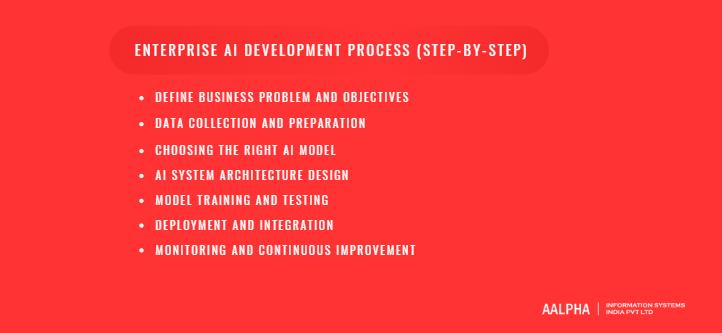
Enterprise AI Development Process (Step-by-Step)
Building AI for enterprise environments requires a structured, outcome-driven approach. Unlike experimental AI projects, enterprise AI development must align with business objectives, integrate with existing systems, and deliver measurable value. Each stage in the process plays a critical role in ensuring that the final solution is scalable, reliable, and aligned with organizational goals.
A common question decision-makers ask is how to move from an AI idea to a fully operational system that delivers ROI. The answer lies in following a disciplined development process that balances technical execution with business strategy. The steps below outline how enterprises successfully design, build, and deploy AI solutions.
-
Define Business Problem and Objectives
The success of any enterprise AI initiative depends on clearly defining the business problem it aims to solve. AI should not be implemented for its own sake; it must address specific challenges such as reducing operational costs, improving customer experience, or increasing revenue. A well-defined problem statement ensures that the project remains focused and measurable.
An ROI-driven approach is essential at this stage. Decision-makers need to identify how the AI solution will create value, whether through cost savings, efficiency gains, or new revenue opportunities. For example, automating customer support can reduce staffing costs, while predictive analytics can improve sales forecasting and inventory management.
Identifying automation opportunities is another critical step. Enterprises should analyze their workflows to pinpoint repetitive, time-consuming, or error-prone processes that can be enhanced with AI. Common areas include data entry, customer interactions, fraud detection, and supply chain optimization. By focusing on high-impact use cases, organizations can achieve faster returns and build confidence in AI adoption.
-
Data Collection and Preparation
Data is the foundation of any AI system, and its quality directly determines the effectiveness of the model. Enterprises must identify relevant data sources, which may include internal systems such as CRM and ERP platforms, as well as external data from APIs, sensors, or third-party providers. The goal is to gather comprehensive and representative datasets that reflect real-world scenarios.
Once data is collected, it must be cleaned and prepared. Raw data often contains inconsistencies, missing values, and errors that can negatively impact model performance. Data cleaning involves removing duplicates, correcting inaccuracies, and standardizing formats. In many cases, data also needs to be labeled, especially for supervised learning tasks, where models require annotated examples to learn effectively.
The importance of data quality cannot be overstated. Poor-quality data leads to unreliable predictions, biased outcomes, and reduced trust in AI systems. Enterprises must establish data governance practices to ensure accuracy, consistency, and security. This includes defining data ownership, implementing validation processes, and maintaining compliance with regulations.
Investing time and resources in data preparation significantly improves the performance and reliability of AI solutions, making it one of the most critical steps in the development process.
-
Choosing the Right AI Model
Selecting the appropriate AI model is a strategic decision that depends on the problem, data availability, and business requirements. Enterprises often choose between pre-trained models and custom-built models. Pre-trained models, particularly large language models, offer faster implementation and lower initial costs, making them suitable for tasks such as text generation, chatbots, and document processing. Custom models, on the other hand, are tailored to specific use cases and can deliver higher accuracy when trained on domain-specific data.
Another key consideration is whether to use large language models or traditional machine learning approaches. LLMs are highly effective for tasks involving natural language, such as customer support, content generation, and knowledge management. Traditional ML models are better suited for structured data tasks such as forecasting, classification, and anomaly detection.
Enterprises must also consider factors such as scalability, performance, and explainability. For mission-critical applications, model transparency and reliability are essential. In some cases, hybrid approaches are used, combining multiple models to achieve optimal results.
Choosing the right model ensures that the AI solution is both effective and aligned with business objectives, avoiding unnecessary complexity or cost.
-
AI System Architecture Design
Designing the system architecture is a crucial step that determines how the AI solution will operate within the enterprise environment. This involves defining data pipelines, integration points, and infrastructure requirements. Data pipelines are responsible for collecting, processing, and delivering data to the AI model in real time or batch mode, ensuring that the system has access to up-to-date information.
APIs and integrations play a central role in connecting the AI system with existing enterprise applications such as ERP, CRM, EHR and EMR systems as well as other business platforms. Seamless integration ensures that AI outputs can be used directly within workflows, enabling automation and decision-making without manual intervention.
Another important consideration is the choice between cloud-based and on-premise deployment. Cloud solutions offer scalability, flexibility, and faster implementation, making them suitable for most enterprises. On-premise solutions may be preferred in scenarios where data privacy, regulatory compliance, or latency requirements are critical.
A well-designed architecture ensures that the AI system is scalable, secure, and capable of handling enterprise-level workloads while integrating seamlessly with existing systems.
-
Model Training and Testing
Model training involves feeding prepared data into the AI system so it can learn patterns and relationships. This process often requires multiple iterations, where models are trained, evaluated, and refined to achieve optimal performance. Training cycles may involve adjusting parameters, selecting features, and experimenting with different algorithms.
Testing is equally important to ensure that the model performs accurately in real-world scenarios. Evaluation metrics such as accuracy, precision, recall, and F1 score are used to measure performance. For enterprise applications, additional considerations such as robustness, scalability, and bias must also be evaluated.
Validation techniques, including cross-validation and testing on unseen data, help ensure that the model generalizes well and does not overfit to training data. Enterprises must also test how the model performs under different conditions, such as varying data inputs or high system loads.
A rigorous training and testing process ensures that the AI solution is reliable, accurate, and ready for deployment in a production environment.
-
Deployment and Integration
Once the model is trained and validated, it must be deployed into the enterprise environment. Deployment involves making the AI system accessible to users and integrating it with existing workflows. This is typically done through APIs, microservices, or embedded applications within enterprise platforms.
Integration with systems such as ERP, CRM, and supply chain platforms is critical for maximizing the value of AI. For example, an AI model that predicts customer churn should be integrated with CRM systems to trigger automated retention strategies. Similarly, a demand forecasting model should connect with inventory management systems to optimize stock levels.
Deployment strategies may vary depending on the use case. Some applications require real-time processing, while others operate in batch mode. Enterprises must also ensure that deployment environments are secure, scalable, and capable of handling production workloads.
Successful deployment is not just about launching the AI system but ensuring that it becomes an integral part of business operations, delivering consistent and measurable value.
-
Monitoring and Continuous Improvement
AI systems are not static; they require continuous monitoring and improvement to remain effective. Over time, changes in data patterns, user behavior, or market conditions can impact model performance. Monitoring systems track key metrics such as accuracy, latency, and usage to identify potential issues.
Feedback loops are essential for continuous improvement. By collecting feedback from users and analyzing system performance, enterprises can identify areas for optimization. This may involve retraining models with new data, updating algorithms, or refining workflows.
Model retraining is particularly important in dynamic environments where data evolves rapidly. Regular updates ensure that the AI system remains relevant and accurate. Enterprises must also implement governance practices to manage version control, audit trails, and compliance.
Continuous improvement ensures that AI systems deliver long-term value, adapting to changing business needs and maintaining high performance over time.
Key Features of Enterprise AI Solutions
Enterprise AI solutions are fundamentally different from standalone AI tools because they are designed to operate within complex, high-scale business environments. These systems must handle large volumes of data, integrate seamlessly with existing infrastructure, and deliver consistent performance across multiple use cases. For decision-makers, understanding the core features of enterprise AI is critical to evaluating whether a solution can meet operational, technical, and regulatory requirements.
A well-built enterprise AI system is not just intelligent; it is scalable, secure, explainable, and deeply integrated into business workflows. The following features define what businesses should expect when implementing AI at an enterprise level.
-
Scalability and Performance
Scalability is one of the most important characteristics of enterprise AI systems. Unlike small-scale applications, enterprise solutions must handle large datasets, high transaction volumes, and thousands or even millions of users simultaneously. This requires robust infrastructure capable of processing data efficiently without compromising performance.
High-performance AI systems are designed to process data quickly and deliver accurate results under heavy workloads. For example, an AI-powered fraud detection system in a financial institution must analyze thousands of transactions per second in real time. Similarly, an eCommerce recommendation engine must generate personalized suggestions instantly for a large number of users.
To achieve this level of performance, enterprise AI solutions often use distributed computing, optimized data pipelines, and scalable cloud infrastructure. These technologies ensure that the system can grow with the business, accommodating increased data volume and user demand without degradation in performance. Scalability is not just about handling growth; it is about maintaining speed, reliability, and accuracy at every stage.
-
Real-Time Decision Making
One of the defining advantages of enterprise AI is its ability to enable real-time decision-making. Traditional systems often rely on batch processing and delayed insights, which can limit responsiveness. In contrast, AI systems can analyze data as it is generated and provide immediate recommendations or actions.
Low-latency processing is critical in scenarios where timing directly impacts outcomes. For instance, in financial services, real-time fraud detection systems must identify and block suspicious transactions instantly. In logistics, AI-driven route optimization systems must adjust delivery routes dynamically based on traffic conditions and delays. In customer service, AI chatbots must respond instantly to user queries to maintain engagement and satisfaction.
Real-time AI systems are built using streaming data architectures and optimized inference models that minimize processing delays. This allows enterprises to move from reactive decision-making to proactive and adaptive operations. The ability to act on data in real time provides a significant competitive advantage, enabling businesses to respond faster and make more informed decisions.
-
Integration with Existing Systems
Enterprise AI does not operate in isolation. Its true value is realized when it integrates seamlessly with existing business systems such as ERP, CRM, supply chain platforms, and internal databases. Integration ensures that AI outputs can be directly applied within operational workflows, eliminating the need for manual intervention.
For example, an AI model that predicts customer churn must be integrated with a CRM system to trigger retention campaigns automatically. Similarly, a demand forecasting model should connect with inventory management systems to adjust stock levels in real time. Without integration, AI insights remain theoretical and fail to deliver practical business value.
APIs play a crucial role in enabling this connectivity. Modern enterprise AI solutions are designed with API-first architectures, allowing them to communicate with multiple systems efficiently. This ensures flexibility and scalability, as new integrations can be added without disrupting existing workflows.
Seamless integration transforms AI from a standalone tool into a core component of enterprise operations, enabling end-to-end automation and decision-making.
-
Security and Compliance
Security and compliance are non-negotiable in enterprise AI environments, particularly when dealing with sensitive data such as financial records, personal information, or healthcare data. AI systems must be designed with robust security measures to protect data at every stage, from collection and storage to processing and transmission.
Data protection mechanisms include encryption, access control, and secure data pipelines. Enterprises must ensure that only authorized users can access sensitive information and that data is protected against breaches and unauthorized use. In addition, AI systems must comply with industry-specific regulations such as GDPR for data privacy in Europe and HIPAA for healthcare data in the United States.
Compliance also involves ensuring that AI systems operate transparently and ethically. This includes addressing issues such as bias, fairness, and accountability. Enterprises must implement governance frameworks to monitor AI behavior and ensure adherence to regulatory standards.
A strong focus on security and compliance builds trust with customers, partners, and regulators, making it a critical feature of any enterprise AI solution.
-
Explainability and Transparency
As AI systems become more complex, understanding how they make decisions becomes increasingly important. Explainability refers to the ability to interpret and understand the reasoning behind AI outputs. In enterprise environments, this is essential for building trust and ensuring accountability.
For example, in financial services, a loan approval decision made by an AI system must be explainable to both customers and regulators. Similarly, in healthcare, AI-driven diagnostic recommendations must be transparent so that doctors can validate and trust the results.
Explainable AI techniques provide insights into how models arrive at their predictions, helping stakeholders understand the factors influencing decisions. This not only improves trust but also enables organizations to identify and correct potential biases or errors.
Transparency ensures that AI systems are not perceived as black boxes but as reliable tools that support informed decision-making.
-
Multi-Channel Deployment
Enterprise AI solutions are designed to operate across multiple channels, ensuring accessibility and consistency in user interactions. Businesses today engage with customers and employees through various platforms, including web applications, mobile apps, messaging platforms, and APIs. AI systems must be capable of delivering consistent performance across all these channels.
For example, an AI-powered customer support system may operate on a website, mobile app, and messaging platforms such as WhatsApp, providing a unified experience regardless of the channel. Similarly, internal AI tools may be accessible through dashboards, APIs, or integrated enterprise applications.
Multi-channel deployment enhances usability and ensures that AI capabilities are available wherever they are needed. It also allows enterprises to reach a broader audience and deliver seamless experiences across touchpoints.
By supporting diverse platforms and interaction modes, enterprise AI solutions enable organizations to maximize their impact and deliver value consistently across all user interfaces.
Cost of Enterprise AI Development
The cost of enterprise AI development varies significantly depending on the scope, complexity, and scale of the solution. Unlike traditional software projects, AI systems require investment not only in development but also in data, infrastructure, and continuous improvement. For business leaders, understanding how these costs are structured is essential to planning budgets and evaluating return on investment.
A common question organizations ask is how much it actually costs to build an enterprise AI solution. The answer depends on factors such as the type of AI being implemented, the level of customization required, and the systems it needs to integrate with. Breaking down these AI development costs helps businesses make informed decisions and avoid unexpected expenses.
-
Cost Based on Complexity
The complexity of the AI solution is the primary factor influencing development cost. Enterprise AI systems can generally be categorized into three levels: basic, mid-level, and advanced.
Basic AI solutions typically include rule-based automation, simple chatbots, or basic analytics models. These systems often use pre-trained models and require minimal customization. They are faster to develop and relatively cost-effective, making them suitable for businesses starting their AI journey. For example, a basic customer support chatbot integrated into a website may fall into this category.
Mid-level AI solutions involve more customization and integration. These systems may include predictive analytics, recommendation engines, or AI-driven workflow automation. They require structured data pipelines, model tuning, and integration with enterprise systems such as CRM or ERP platforms. Costs increase at this level due to the need for specialized development and more complex infrastructure.
Advanced AI systems are highly customized and designed for mission-critical operations. These include large-scale AI platforms, real-time decision-making systems, and advanced generative AI applications. They often involve custom model development, extensive data processing, and high-performance infrastructure. For example, a real-time fraud detection system in a banking environment or an AI-driven supply chain optimization platform would fall into this category.
As complexity increases, so do development time, resource requirements, and overall costs.
-
Cost Breakdown
Enterprise AI development costs can be divided into several key components, each contributing to the overall budget.
Data-related costs are often the most significant. Collecting, cleaning, and labeling data requires time and resources, especially when dealing with large or unstructured datasets. In many cases, organizations need to invest in data engineering teams and tools to ensure data quality and accessibility.
Development costs include building the AI models, designing system architecture, and integrating the solution with existing systems. This involves hiring skilled professionals such as data scientists, machine learning engineers, and software developers. The complexity of the solution directly impacts these costs.
Infrastructure costs cover the hardware and software required to run AI systems. This includes cloud services, storage, computing power, and networking. High-performance AI applications, particularly those involving real-time processing or large datasets, require significant computational resources.
Maintenance and operational costs are ongoing expenses that ensure the system continues to function effectively. These include monitoring, updates, retraining models, and managing infrastructure. Unlike traditional software, AI systems require continuous optimization to maintain accuracy and performance.
Understanding this cost breakdown helps businesses allocate resources effectively and plan for both initial investment and long-term expenses.
-
In-House vs Outsourcing Costs
Organizations must decide whether to build AI solutions in-house or outsource development to external partners. Each approach has its own cost implications and trade-offs.
Building in-house provides greater control over the development process and intellectual property. It allows organizations to develop internal expertise and tailor solutions to their specific needs. However, this approach requires significant investment in hiring skilled professionals, setting up infrastructure, and managing ongoing operations. The shortage of experienced AI talent can further increase costs and extend development timelines.
Outsourcing, on the other hand, allows businesses to leverage the expertise of specialized AI development companies. This can reduce upfront costs and accelerate time to market, as external partners often have established processes and pre-built components. Outsourcing also eliminates the need to build and maintain large in-house teams.
However, outsourcing may involve trade-offs in terms of control and customization. Businesses must carefully select partners with proven experience in enterprise AI to ensure quality and reliability. A hybrid approach is also common, where core capabilities are developed in-house while specific components are outsourced.
Choosing between in-house and outsourcing depends on factors such as budget, timeline, and long-term strategy.
-
Ongoing Maintenance Costs
Enterprise AI systems require continuous maintenance to remain effective and relevant. Unlike traditional software, AI models can degrade over time as data patterns change, making ongoing updates essential.
One of the primary maintenance activities is model retraining. As new data becomes available, models must be updated to maintain accuracy and adapt to changing conditions. For example, a demand forecasting model must be retrained regularly to account for seasonal trends and market shifts.
Infrastructure costs are also ongoing. Cloud services, storage, and computing resources must be maintained to support the AI system. As usage grows, these costs can increase, making it important to optimize resource utilization.
System updates and monitoring are equally important. Enterprises must continuously monitor performance metrics, identify issues, and implement improvements. This includes addressing bugs, enhancing features, and ensuring compatibility with other systems.
Security and compliance updates add another layer of ongoing cost. As regulations evolve, AI systems must be updated to meet new requirements and maintain data protection standards.
These ongoing expenses are a critical part of enterprise AI investment. Businesses that plan for maintenance from the outset are better positioned to sustain long-term value and maximize return on investment.
Challenges in Enterprise AI Development
While AI offers significant advantages, implementing it in enterprise environments is not without challenges. Many organizations underestimate the complexity involved in moving from concept to production-ready AI systems. Unlike traditional software, AI depends heavily on data quality, continuous learning, and seamless integration with existing workflows. Without addressing these challenges proactively, businesses risk failed implementations, wasted investment, and low adoption.
Understanding these obstacles is essential for decision-makers because it allows them to plan realistically, allocate resources effectively, and build strategies that ensure long-term success. The following challenges represent the most common barriers enterprises face when developing and deploying AI solutions.
-
Data Quality and Availability
Data is the foundation of any AI system, and poor data quality is one of the most significant challenges in enterprise AI development. Many organizations assume they have sufficient data, but in reality, the data is often incomplete, inconsistent, or fragmented across multiple systems. AI models trained on such data produce unreliable results, leading to poor decision-making and reduced trust in the system.
Data availability is another issue. In some cases, businesses may not have enough historical data to train accurate models, especially for new products or services. Even when data exists, it may not be accessible due to siloed systems or lack of proper data governance.
Poor data quality can result in biased models, inaccurate predictions, and operational inefficiencies. For example, an AI system designed for customer segmentation may fail if customer data is outdated or inconsistent. To address this, enterprises must invest in data cleaning, standardization, and governance processes. Establishing a centralized data strategy ensures that AI systems have access to high-quality, reliable data, which is critical for success.
-
Integration Complexity
Integrating AI systems with existing enterprise infrastructure is often more complex than building the AI model itself. Most organizations operate on legacy systems that were not designed to support modern AI technologies. These systems may lack APIs, have outdated architectures, or operate in isolated environments, making integration challenging.
AI solutions need to connect with multiple systems such as ERP, CRM, supply chain platforms, and databases. Ensuring seamless communication between these systems requires significant effort in designing APIs, data pipelines, and middleware. Without proper integration, AI insights remain disconnected from business workflows, limiting their practical value.
Legacy systems also introduce performance and scalability constraints. For example, an AI model capable of real-time decision-making may be slowed down by outdated backend systems that cannot process data quickly enough.
To overcome integration challenges, enterprises must modernize their infrastructure or adopt flexible architectures that support interoperability. This may involve using microservices, cloud platforms, and API-driven designs. Successful integration ensures that AI becomes an integral part of business operations rather than an isolated tool.
-
Talent Shortage
One of the most significant barriers to enterprise AI adoption is the shortage of skilled professionals. Developing and deploying AI solutions requires expertise in data science, machine learning, software engineering, and domain-specific knowledge. However, the demand for these skills far exceeds the available talent pool.
Hiring experienced AI professionals is both difficult and expensive. Organizations often struggle to find individuals who not only understand AI technologies but also have the ability to apply them in real-world business contexts. This gap can lead to delays in project execution and increased costs.
In addition to technical expertise, enterprises need professionals who can bridge the gap between business and technology. Understanding business objectives and translating them into AI solutions requires a combination of analytical and strategic skills.
To address the talent shortage, many organizations adopt a hybrid approach, combining in-house teams with external partners. Upskilling existing employees and investing in training programs are also common strategies. Building a strong AI team is essential for long-term success, as it enables organizations to develop, maintain, and scale AI solutions effectively.
-
Security and Privacy Risks
AI systems often process sensitive data, making security and privacy critical concerns. Enterprises must protect data from breaches, unauthorized access, and misuse. A single security incident can result in financial loss, legal consequences, and damage to reputation.
Privacy regulations add another layer of complexity. Laws such as GDPR and HIPAA require organizations to handle data responsibly and ensure compliance with strict guidelines. AI systems must be designed to meet these requirements, including data anonymization, access controls, and auditability.
There is also the risk of exposing sensitive information through AI outputs, particularly in systems that generate content or insights based on internal data. Enterprises must implement robust security measures and governance frameworks to mitigate these risks.
Addressing security and privacy challenges is essential for building trust and ensuring that AI systems operate safely within regulatory boundaries.
-
Change Management
Adopting AI is not just a technical transformation; it is also an organizational change. Employees may resist AI adoption due to fear of job displacement or lack of understanding of how the technology works. Without proper change management, even well-designed AI systems may fail to gain acceptance.
Training and communication are critical in overcoming this challenge. Employees need to understand how AI will support their roles rather than replace them. Providing clear explanations, training programs, and hands-on experience helps build confidence and encourages adoption.
Another aspect of change management is aligning AI initiatives with business processes. Organizations must redesign workflows to incorporate AI-driven insights and automation effectively. This often requires collaboration across departments and a shift in how decisions are made.
Successful AI implementation depends on both technology and people. By addressing cultural and organizational challenges, enterprises can ensure that AI adoption leads to meaningful and sustainable outcomes.
How to Choose the Right AI Development Partner
Selecting the right AI development company is one of the most critical decisions in an enterprise AI initiative. The success of the project depends not only on the technology but also on the expertise, processes, and reliability of the partner delivering it. Many AI projects fail not because the idea is flawed, but because the execution lacks alignment with business goals, scalability requirements, or integration needs.
A strong AI partner acts as both a technical expert and a strategic advisor. They help define the problem, design the solution, and ensure that the final system delivers measurable business value. For decision-makers, evaluating potential partners requires a clear understanding of the capabilities that matter most in enterprise environments.
-
Experience in Enterprise AI Projects
Experience is one of the most reliable indicators of a partner’s ability to deliver successful AI solutions. Enterprise AI projects are fundamentally different from small-scale or experimental implementations. They involve complex data environments, strict compliance requirements, and integration with mission-critical systems. A partner with proven experience in enterprise AI understands these challenges and knows how to address them effectively.
Domain expertise is equally important. AI solutions must align with industry-specific requirements, whether in healthcare, finance, retail, or logistics. For example, building an AI system for healthcare requires an understanding of clinical workflows and regulatory constraints, while a solution for finance must address risk management and compliance.
An experienced partner can anticipate potential challenges, recommend best practices, and design solutions that are both practical and scalable. They are also more likely to have pre-built frameworks, accelerators, and reusable components that reduce development time and cost.
Choosing a partner with relevant enterprise experience ensures that the project is executed with a clear understanding of both technical and business requirements.
-
Technical Expertise in AI and Integrations
Enterprise AI solutions require deep technical expertise across multiple areas, including machine learning, natural language processing, data engineering, and system integration. A capable partner should have a strong understanding of both traditional AI models and modern technologies such as large language models.
Expertise in ML pipelines is essential for building scalable AI systems. This includes data ingestion, preprocessing, model training, deployment, and monitoring. Without a well-designed pipeline, AI systems cannot operate reliably in production environments.
Integration capabilities are equally critical. AI solutions must work seamlessly with existing enterprise systems such as ERP, CRM, and other business platforms. This requires expertise in APIs, middleware, and system architecture. A partner who understands integration can ensure that AI outputs are directly usable within business workflows.
Additionally, the ability to select the right tools and frameworks based on the use case is a key differentiator. A technically strong partner does not rely on a single approach but adapts to the specific needs of the project, ensuring optimal performance and scalability.
-
Transparent Development Process
A transparent and structured development process is essential for managing complex AI projects. Enterprises need visibility into how the solution is being built, tested, and deployed. This ensures accountability and allows stakeholders to track progress and provide feedback at each stage.
Agile methodology is widely used in enterprise AI development because it enables iterative progress and continuous improvement. Instead of delivering the entire solution at once, the project is divided into smaller phases, allowing for regular testing, validation, and adjustments. This reduces risk and ensures that the final product aligns with business expectations.
Clear communication is a key component of transparency. A reliable partner provides regular updates, shares progress reports, and maintains open channels for discussion. This helps prevent misunderstandings and ensures that any issues are addressed promptly.
Documentation is another important aspect. Detailed documentation of architecture, models, and workflows ensures that the enterprise can maintain and scale the solution in the future.
A transparent process builds trust and ensures that the project remains aligned with both technical and business objectives.
-
Security and Compliance Capabilities
Enterprise AI solutions often handle sensitive data, making security and compliance a top priority. A reliable development partner must have strong capabilities in implementing enterprise-grade security measures, including data encryption, access control, and secure data pipelines.
Compliance with regulations such as GDPR, HIPAA, or industry-specific standards is equally important. The partner should understand these requirements and design AI systems that meet regulatory expectations. This includes ensuring data privacy, auditability, and responsible use of AI.
Security is not just a technical requirement but a business necessity. A partner with proven security practices helps protect the organization from risks such as data breaches and legal liabilities.
-
Client Reviews and Case Studies
Client reviews and case studies provide valuable insights into a partner’s track record and reliability. They demonstrate the partner’s ability to deliver real-world solutions and achieve measurable outcomes. Decision-makers should look for evidence of successful projects that are similar in scope and complexity to their own requirements.
Case studies should highlight not only the technical implementation but also the business impact. For example, how the AI solution improved efficiency, reduced costs, or increased revenue. This helps assess whether the partner can deliver tangible value rather than just technical outputs.
Reviews from previous clients also indicate the partner’s professionalism, communication, and ability to meet deadlines. Consistent positive feedback is a strong indicator of reliability.
Enterprises often benefit from working with experienced providers that have a proven portfolio of AI and enterprise software projects. For example, established companies such as Aalpha, which specialize in AI-driven enterprise solutions, bring a combination of technical expertise and industry experience that can significantly reduce project risk and improve outcomes.
Choosing the right AI development partner requires careful evaluation, but it ultimately determines the success of the entire initiative.
Future Trends in Enterprise AI
Enterprise AI is evolving from isolated use cases into fully integrated, intelligent ecosystems that can operate with minimal human intervention. The next phase of AI adoption is not just about improving efficiency but about fundamentally transforming how businesses function. Organizations are moving toward systems that can act autonomously, collaborate across functions, and deliver highly personalized experiences at scale.
For decision-makers, understanding where enterprise AI is heading is critical for long-term strategy. The following trends highlight how AI will shape the future of enterprise operations and competitive advantage.
-
Autonomous AI Agents
Autonomous AI agents represent a major shift from traditional AI systems that rely on human input to systems that can operate independently. These agents are designed to perform tasks, make decisions, and execute workflows without continuous supervision. They combine capabilities such as reasoning, planning, and learning to handle complex, multi-step processes.
In enterprise environments, autonomous agents can manage entire workflows. For example, in customer support, an AI agent can handle queries, escalate issues when necessary, and follow up with customers automatically. In supply chain management, agents can monitor inventory levels, predict shortages, and trigger procurement actions without manual intervention.
The value of autonomous AI lies in its ability to reduce operational overhead and increase speed. Instead of relying on human-driven processes, businesses can deploy systems that continuously monitor and optimize operations. As these agents become more advanced, they will be capable of handling increasingly complex tasks, making them a central component of future enterprise systems.
-
Multi-Agent Systems
While individual AI agents can handle specific tasks, multi-agent systems take this concept further by enabling multiple AI agents to collaborate and solve complex problems collectively. Each agent is responsible for a specific function, and together they form a coordinated system that can manage end-to-end processes.
In enterprise scenarios, multi-agent systems can be used to manage complex workflows that span multiple departments. For example, in logistics, one agent may handle demand forecasting, another may optimize routing, and a third may manage inventory. By working together, these agents can create a more efficient and responsive supply chain.
Collaboration between agents allows for greater flexibility and scalability. Instead of building a single, monolithic AI system, enterprises can develop modular agents that can be updated, replaced, or expanded as needed. This approach also improves resilience, as the failure of one agent does not necessarily disrupt the entire system.
Multi-agent systems represent a more sophisticated and scalable approach to enterprise AI, enabling organizations to handle complexity with greater efficiency.
-
AI as a Service (AIaaS)
AI as a Service is transforming how businesses access and implement AI capabilities. Instead of building AI systems from scratch, organizations can leverage cloud-based platforms that provide ready-to-use AI tools and infrastructure on a subscription basis. This model reduces the barrier to entry and allows businesses to adopt AI more quickly and cost-effectively.
AIaaS platforms offer a range of services, including machine learning models, natural language processing, computer vision, and generative AI capabilities. These services are typically accessible through APIs, making it easy to integrate them into existing systems. For example, a company can use AIaaS to implement a chatbot, analyze customer sentiment, or automate document processing without developing custom models.
The subscription-based model also provides scalability and flexibility. Businesses can scale usage up or down based on demand, paying only for what they use. This makes AI more accessible to organizations of all sizes, including those that may not have the resources to build in-house AI capabilities.
As AIaaS continues to evolve, it will play a key role in democratizing AI and accelerating its adoption across industries.
-
Hyper-Personalization at Scale
Hyper-personalization is becoming a defining feature of modern enterprise AI. Unlike traditional personalization, which relies on basic segmentation, hyper-personalization uses real-time data and advanced AI models to deliver highly tailored experiences for individual users.
In enterprise applications, this means adapting products, services, and interactions based on user behavior, preferences, and context. For example, in eCommerce, AI can recommend products based on real-time browsing activity, purchase history, and external factors such as location or season. In financial services, AI can provide personalized investment advice based on an individual’s financial profile and goals.
The challenge has always been scaling personalization without increasing operational complexity. AI solves this by automating the analysis and decision-making process, enabling businesses to deliver personalized experiences to millions of users simultaneously.
Hyper-personalization not only improves customer satisfaction but also drives higher engagement and conversion rates. As AI systems become more advanced, the ability to deliver real-time, individualized experiences will become a key differentiator for enterprises competing in digital markets.
Final Thoughts
Enterprise AI is no longer optional for organizations aiming to stay competitive. It enables faster decision-making, reduces operational costs, and unlocks new growth opportunities across every function. Businesses that approach AI strategically, with the right processes and partners, are better positioned to scale efficiently and adapt to changing market demands.
If you are planning to implement AI in your enterprise, the key is to start with the right use case and execution strategy. Partnering with experienced AI development experts can significantly reduce risk and accelerate results. Connect with a trusted team like Aalpha to explore how custom AI solutions can be designed, developed, and integrated into your business for measurable impact.