





TL;DR: truck booking app development at a glance
A truck booking app connects shippers who have freight with truck owners and drivers who have capacity, and it handles everything between the two: vehicle discovery, fare calculation, dispatch, live tracking, proof of delivery, payment, and the paperwork that goes with a load. The people building these platforms are usually logistics startups entering a corridor, transport companies digitising a broker desk they already run, manufacturers tired of calling three agents for every dispatch, and fleet operators with 40 to 400 trucks who cannot see where half of them are. A working platform is four connected products, not one app: a shipper app, a driver app, a fleet owner dashboard, and an admin console, all sitting on a back end that does matching, pricing, and location ingestion.
A focused MVP covering one city pair or one region typically costs USD 35,000 to USD 60,000 and takes 12 to 16 weeks; a multi-region platform with AI matching, telematics, and ERP integration runs USD 150,000 to USD 300,000 and takes six to twelve months. None of the engineering is unsolved, and Aalpha has been building logistics and on-demand platforms of this shape since 2008 for clients across 55+ countries. The part that decides whether the platform survives is liquidity: enough trucks on the supply side that a shipper gets a confirmed vehicle within minutes, and enough loads that a driver keeps the app installed after week three.
What is a truck booking app?
A truck booking app is freight software that lets a shipper request a truck the way a passenger requests a cab, with the differences that matter in freight built in: vehicle type and tonnage, load description, multi-day transit, documentation, and payment terms that are almost never card-on-file.
The comparison to ride hailing gets made constantly and it misleads people. A cab trip lasts 20 minutes and ends when the passenger gets out. A full truckload from Pune to Delhi lasts three days, passes through checkpoints, involves a consignment note, a driver who needs an advance for fuel, a receiver who may reject part of the shipment, and a payment cycle of 30 to 60 days. Software that models freight as a longer cab ride fails at the second week of operations.
How truck booking apps work
The shipper posts a load or requests an immediate booking. The platform prices it, either from a rate card or from a live pricing engine. It then finds capacity, by broadcasting the load to nearby eligible drivers, by assigning it to a fleet partner under contract, or by putting it on a board where carriers bid. Once a truck accepts, the load moves into execution: pickup, in transit, delivered. Location updates flow from the driver app or a telematics device to the platform, and the shipper sees them on a map. At delivery the driver captures a signature or photo, the system generates an invoice, and money moves according to whatever settlement rules the operator has configured.
Everything hard about the product sits in three places. Matching a load to the right truck when the right truck is a set of constraints, not a dot on a map. Pricing a lane when fuel, direction, season, and return-load availability all move. And collecting money from a shipper on credit terms while paying a driver who wants cash at pickup.
Traditional truck booking versus digital truck booking
Traditional booking runs through brokers and transport agents on the phone. A shipper calls an agent, the agent calls two or three fleet contacts, a rate gets negotiated verbally, and a truck arrives sometime that day. The system works, which is why it has survived decades of predictions about its death. It is fast for people inside the network, it extends informal credit, and it settles disputes through relationships rather than clauses.
What it does not do is give the shipper a price benchmark, a location update, or an audit trail. A logistics manager running 60 dispatches a month cannot tell you what any single lane should cost, because every rate was negotiated separately with no record. That is the gap a digital platform fills, and it is a better argument for building one than any claim about efficiency. Digitisation adds price memory, vehicle visibility, and documentation that survives staff turnover.
The honest counterpoint: digital platforms have not eliminated brokers anywhere. They have absorbed the function. Most successful truck booking businesses employ operations staff who do exactly what an agent does, with software underneath them instead of a notebook.
Types of truck booking platforms
On-demand truck booking apps serve immediate, short-distance needs. A retailer needs a tempo in the next hour to move stock between two outlets. Booking is instant, pricing is algorithmic, and the trip finishes the same day. Porter in India and Lalamove across Southeast Asia built on this pattern. Product priorities here are speed of allocation and dense driver supply within a small radius.
Full-truckload platforms handle one shipper’s freight filling one vehicle, usually intercity. Bookings are scheduled rather than instant, the transaction value is much higher, and the driver relationship is contractual. Matching quality matters more than allocation speed, because a truck sitting idle at origin costs more than a two-minute delay in dispatch.
Less-than-truckload platforms consolidate freight from several shippers into one vehicle. This is the hardest category to build. Pricing depends on volumetric weight, routing depends on a hub network, and a single delayed pickup cascades through the consolidation plan. Do not attempt LTL as a first product unless the founding team has run an LTL operation before.
Marketplace platforms let carriers see posted loads and bid or accept at a listed rate. The operator takes a commission and stays out of execution. Capital efficiency is the appeal. Weak control over service quality is the cost, and it is the reason many marketplaces drift toward a managed model within two years.
Enterprise fleet booking systems are internal tools. A manufacturer with contracted transporters uses the platform to raise indents, allocate them to vendors by rate contract, and track compliance. There is no open marketplace and no commission. Revenue is a licence fee or a build fee, and the buying cycle involves procurement, not growth marketing.
Long-haul logistics platforms cover multi-day corridors and add relay driving, halt management, fuel card integration, and toll accounting. Rivigo built its business on driver relay in India before being acquired by Mahindra Logistics in 2022, and the operational complexity of that model is a fair warning about how much software long-haul actually needs.
Intra-city goods transport apps overlap with on-demand but skew toward small commercial vehicles, market vendors, furniture moves, and e-commerce line haul. Volumes are high, ticket sizes are low, and unit economics live or die on how many trips a driver completes per day.
Who actually uses the platform
Shippers are anyone with freight: manufacturers, distributors, e-commerce sellers, construction firms, agricultural traders. Their internal user is usually a dispatch coordinator, not an executive, and that person judges the app on how many clicks it takes to raise a repeat booking.
Truck owners come in two shapes and the product must handle both. The single-truck owner drives the vehicle himself, uses one phone, and cares about earnings and fuel advances. The small fleet owner with 8 to 30 trucks employs drivers, does not drive, and needs a dashboard rather than a driver app. Building only the driver app and expecting fleet owners to use it is a common early mistake. They will not, and they control most of the capacity in every market I have seen.
Drivers care about three things: is there a load nearby, how much does it pay, and when does the money arrive. Everything else in the driver app is secondary and should be treated that way in the interface.
Transport agencies and brokers are often treated as the enemy in pitch decks and as customers in practice. Giving them a dashboard to manage their own carrier pool inside the platform converts a competitor into a supply channel.
Logistics administrators are the operator’s own staff: dispatch, support, verification, collections. Half the software you build will be for them, and this is systematically underestimated in early scoping.
What the platform actually delivers
Vehicle discovery drops from an hour of phone calls to a few minutes of search. That is the visible benefit, and it is what shippers talk about in the first month.
The durable ones show up later. Price transparency gives a shipper a per-lane cost history that no broker relationship provides. Fleet utilisation improves when an operator can see which trucks are idle and where, which typically shows up as three to six percentage points of additional running time in the first year of disciplined use. Shipment visibility cuts inbound status calls sharply; the support team notices before the finance team does. Manual coordination shrinks because allocation, rate application, and document generation stop being human tasks. Digital documentation means consignment notes, e-way bills, and PODs live in the same record as the booking, which is what turns a delivery dispute from a two-week argument into a five-minute lookup. And once six months of trip data exists, the operator can price lanes on evidence rather than instinct.
Truck booking app business models
The business model decides the architecture. Choosing it after the wireframes are done is how platforms end up with a commission engine bolted onto software that assumed a licence fee.
The truck marketplace model
Shippers post loads, carriers accept or bid, the platform charges a commission on completed trips, usually 8 to 15 percent. The operator holds no assets and carries no service liability in the contract, though in practice shippers hold the platform responsible regardless of what the terms say.
Marketplaces need liquidity on both sides simultaneously, and that is a brutal first year. The failure pattern is familiar: heavy subsidy to attract carriers, thin margins, and a shipper base that leaves the moment allocation fails twice in a week. Convoy, which raised money at a multi-billion dollar valuation on this model in the US, shut down operations in October 2023 and sold its technology to Flexport. Read that as a caution about unit economics, not about the model being unworkable.
The aggregator model
The platform contracts capacity from fleet owners, controls pricing, and presents a single service to the shipper. Drivers are not employees but they operate under platform rates and standards. This gives better service consistency than a pure marketplace and is easier to sell to enterprise shippers who need an SLA.
The technical implication is that the pricing engine belongs to the operator, not the carrier. You need rate cards, surge rules, lane-level margin control, and settlement logic that pays carriers a different number than the one the shipper sees.
The dedicated fleet model
The operator owns or leases trucks. Margins are highest, control is total, and capital requirements are heavy. Software here looks less like a marketplace and more like a transport management system: indent, allocation, trip sheet, fuel, driver payroll, maintenance, and profitability per vehicle. If a client tells me they own 150 trucks and want a booking app, what they usually need is a TMS with a customer-facing booking layer on top.
SaaS-based logistics platform
Instead of running freight, sell the software to people who do. Transporters get a white-labelled booking system, their own branded driver app, and a monthly subscription. Revenue is predictable and there is no supply-demand problem to solve.
The catch is that you are now in enterprise software, competing with established TMS vendors, and every prospect wants three custom features before signing. Multi-tenancy has to be designed in from the first commit, because retrofitting tenant isolation into a single-tenant schema is a rewrite. Aalpha builds white-label logistics products on this pattern, including DeliveryStack for on-demand delivery operators who want to launch under their own brand rather than build from zero.
Managed transportation
The platform takes full responsibility for a shipper’s freight: planning, carrier selection, execution, and reconciliation, priced as a percentage of freight spend or a per-shipment fee. Software becomes the operations team’s tool rather than the customer’s. Enterprise clients buy this readily because it removes headcount from their side. It scales with people as well as code, which some investors dislike and which happens to be why it produces revenue in year one instead of year three.
B2B truck booking platform
A closed platform serving contracted business shippers only. No consumer acquisition, no open signup, credit terms instead of prepayment, and invoicing on monthly cycles. Sales cycles run three to nine months. In exchange, volumes are stable and churn is low. Most profitable Indian and Gulf platforms operating today are closer to this than to an open marketplace.
Choosing between them
Ask two questions. Who is going to be angry when a truck does not show up, and who has the money to fix it? If the answer is the platform, you need control over capacity, which means aggregator, managed, or dedicated. If the answer is the shipper and carrier between themselves, a marketplace is defensible, and you should price the commission low enough that neither party has a reason to transact off-platform.
Second: where does the first thousand loads come from? Almost every platform that survives had a captive volume source at the start, usually the founder’s existing transport business or a single large shipper who agreed to move freight through the app. If there is no such source, build the SaaS or enterprise version, not the marketplace.
How the platform makes money
Booking commission is the default: a percentage of freight value on each completed trip. It works when transaction volume is high and platform involvement is light.
Flat platform fees per booking suit high-value FTL, where a percentage on a USD 1,800 long-haul move is more than the service is worth and carriers start negotiating around it.
Carrier subscriptions charge fleet owners a monthly fee for load access, dashboard use, and tracking. Predictable revenue, and it aligns the platform with supply rather than taxing it. Expect resistance until the platform demonstrably fills trucks.
Enterprise subscriptions license the platform to a shipper or transporter, priced per user, per vehicle, or per shipment volume band. This is where SaaS-model revenue concentrates.
Lead generation fees charge carriers for qualified load leads without handling execution. Low friction, low margin, and a stepping stone rather than a destination.
Premium listings put verified or high-rated carriers at the top of search results. Small revenue line, meaningful margin, no delivery cost.
Value-added services are where mature platforms actually make money: fuel cards, tyre and spare procurement, warehousing, packaging, insurance, and working capital finance for carriers waiting on shipper payment terms. Freight brokerage margins are thin. Financial services attached to freight flow are not, and the platform already holds the transaction data that underwrites them. Insurance and lending partnerships typically pay 10 to 25 percent commission on premium or origination, though this varies by market and requires the right licences.
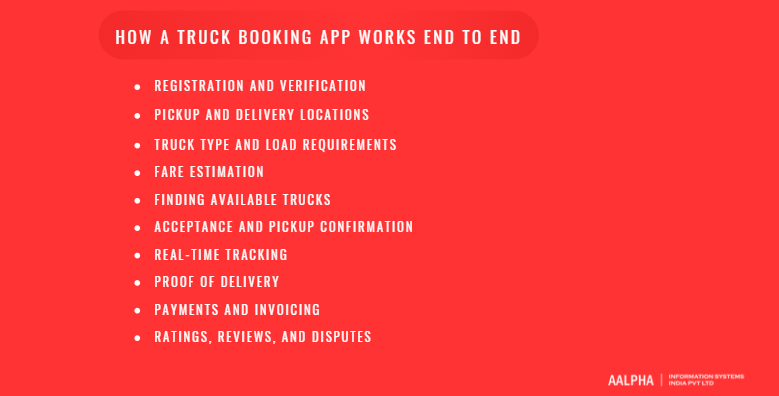
How a truck booking app works end to end
-
Registration and verification
Shippers register with business details, tax registration, and a billing address. For B2B credit accounts, this is also a KYC and credit-check gate, so build for approval workflow rather than instant activation. A shipper on prepaid terms can transact immediately. A shipper asking for 45-day credit needs a human decision, and the software should route that decision to someone rather than blocking the signup.
-
Pickup and delivery locations
Address entry is where field teams lose the most time. Map autocomplete alone is not enough in markets where industrial addresses do not geocode reliably. Give users a saved-address book, allow pin-drop correction, capture a gate contact number separately from the account contact, and store loading-dock instructions on the address rather than the booking. A shipper who dispatches from the same plant 200 times should be entering that address once, in year one.
-
Truck type and load requirements
The shipper selects vehicle category, body type, tonnage, and whether special handling applies: refrigeration, tarpaulin, hazardous goods, oversized dimensions. Model this as structured attributes, never as a free-text note. Matching depends on it, pricing depends on it, and compliance depends on it. A hazmat load allocated to a driver without the right endorsement is a legal problem, not a UX problem.
-
Fare estimation
Distance and vehicle type give a base rate. Real quotes then adjust for load weight, waiting time expectations, toll, fuel surcharge, return-load availability on that lane, and any handling requirement. Show the shipper a breakdown rather than a single number. Freight buyers negotiate, and a quote they cannot decompose is a quote they will call about.
For lanes where pricing is genuinely uncertain, offer a quote-on-request flow that routes to operations. Forcing an algorithm to price every lane on day one produces either lost margin or lost bookings.
-
Finding available trucks
Three approaches, and most platforms end up using all three. Broadcast sends the load to all eligible nearby drivers and takes the first acceptance, which is fast and produces poor matching. Sequential offer sends it to the best-ranked carrier first with a short acceptance window, then falls through the ranked list. Direct assignment allocates to a contracted carrier under a rate agreement with no acceptance step.
Eligibility filtering happens before any of this: vehicle type, capacity, current location, document validity, driver rating, and blocked-shipper rules. Getting the filter right matters more than the allocation algorithm, and it is a database query rather than machine learning.
-
Acceptance and pickup confirmation
The carrier accepts, the shipper gets vehicle and driver details, and the trip enters a pre-pickup state. Build in a driver-side cancellation window with consequences, because acceptance without commitment is worse than no acceptance: the shipper stops looking for alternatives.
At pickup the driver confirms arrival, captures loading photos, and records the actual weight or piece count if it differs from the booking. That variance record settles most billing disputes later.
-
Real-time tracking
Location comes from the driver app, from a GPS device on the vehicle, or from a telematics provider’s API. The driver app is cheapest and least reliable, since it depends on the phone staying charged, the app staying in the foreground on aggressive battery managers, and network coverage on rural corridors. Design for gaps: buffer locations locally, sync in batches when connectivity returns, and show the shipper a last-known position with a timestamp rather than a stale dot pretending to be live.
-
Proof of delivery
A signature, a stamped delivery note photograph, an OTP from the receiver, or all three depending on the shipper’s requirement. Capture geotag and timestamp with the image. This artifact is the trigger for invoicing, and if it is unreliable the whole payment cycle stalls.
-
Payments and invoicing
Freight rarely settles like a taxi fare. Common flows include a fuel advance at pickup, balance on delivery, and net-30 or net-60 for enterprise accounts. The system needs a ledger per party, not a payment gateway with a success callback. Carriers are paid after deduction of platform commission, advances, and any damage claims. Invoices must carry tax details correctly for the jurisdiction, and in India that means GST treatment for goods transport agency services, which has its own reverse-charge rules.
-
Ratings, reviews, and disputes
Two-way ratings after trip completion, with structured reasons rather than stars alone. What matters operationally is the dispute queue: damage claims, detention charges, rate disagreements, and missing paperwork. Build it as a case management module with states, assignment, evidence attachment, and a resolution outcome that can adjust the settlement. Platforms that leave disputes to email lose money quietly for a year before anyone notices.
Essential features of a truck booking app
Four applications, four different users, four different definitions of a good product. Scope them separately.
Shipper app and web portal
Registration and login should support both phone OTP and email, because the dispatch coordinator using the app is often not the person who owns the account. The business profile carries tax registration, billing address, credit terms, and named users with permissions. Multi-user access under one company account is not an advanced feature in B2B freight; it is table stakes, and skipping it forces customers to share credentials.
Booking creation covers pickup and destination, multi-stop routing for distribution runs, vehicle selection, load details, and scheduling for a future date. Instant fare estimates appear before confirmation. Availability indication should be honest: telling a shipper 14 trucks are nearby when none will accept a Delhi to Guwahati load at the quoted rate destroys trust faster than showing nothing.
After booking, the shipper needs live tracking with an ETA, driver and vehicle identification with a callable number, and status notifications at pickup, in transit, and delivery. Shipment history should be searchable and exportable, since finance teams reconcile monthly and will otherwise ask support for a spreadsheet every month. Documentation lives with the shipment: consignment note, e-way bill, weighbridge slip, POD, invoice. Payment options span online payment, wallet, and credit account with a statement view. Support access should route to a human within the app, because a shipper whose truck has not arrived will not use a chatbot politely.
Driver app
Registration collects the driver’s licence, identity document, and photograph, followed by vehicle registration, permit, fitness certificate, insurance, and pollution certificate where applicable. Verification is a review queue on the admin side with rejection reasons that get communicated back, not a silent pending state.
The working screen is simple by necessity. An availability toggle, a list of nearby load requests with pay and distance visible without tapping, and an accept action. After acceptance: navigation handoff to Google Maps or an in-app route, pickup confirmation with photo capture, trip status updates, and POD upload at delivery.
Money features drive retention more than any of the above. An earnings dashboard showing today, this week, and pending settlement. A wallet with transaction history. Withdrawal requests with a stated payout timeline that the platform actually meets. Incentive visibility, where a driver can see exactly what completing three more trips this week is worth.
Design constraints for the driver app are unusual and non-negotiable. Assume a mid-range Android device with 3 GB RAM, an intermittent 4G connection, and a user who is driving. Large touch targets, minimal typing, offline capability for status updates, voice-friendly alerts, and an APK size small enough to install over mobile data. Support the languages your drivers actually speak, which in India means Hindi plus the regional language of your corridor, not English with a Hindi toggle nobody finds.
Fleet owner dashboard
The fleet owner manages trucks, drivers, and the relationship between them. Add and edit vehicles, assign drivers, mark availability, and accept or decline loads on behalf of the fleet. Live tracking across all owned vehicles on one map. Revenue reports by vehicle, by driver, and by lane. Driver performance covering acceptance rate, on-time delivery, and cancellation. Maintenance records and service scheduling. Document expiry alerts for permits, insurance, and fitness certificates, because an expired permit stops a truck at a checkpoint and the fleet owner blames the platform that dispatched it. Utilisation analytics showing idle hours and empty running by vehicle.
This is the module most often cut from an MVP and most often requested within three months of launch.
Admin panel
The admin console is the operator’s business. User management across shippers, drivers, and fleet owners. Verification queues with document viewing and approval. Booking management with the ability to reassign, cancel, or manually price any trip, because operations will need to override the system daily in year one. Pricing control by lane, vehicle type, and customer. Commission configuration, including different rates per carrier tier. Payment and settlement monitoring with a reconciliation view. Refunds and adjustments. Dispute handling. Promotional campaigns and referral codes. Geofenced service areas that can be switched on city by city. Analytics covering demand by location, allocation success rate, cancellation reasons, average acceptance time, and margin per lane. Role-based administration so a support agent cannot change commission rates.
Build the admin panel as a first-class product. In every logistics platform Aalpha has delivered, internal users generate more daily sessions than any external user type.
Advanced features for a modern truck booking platform
None of these belong in version one. Each is worth building once the platform has enough transaction data to make it work.
AI-based load matching ranks carriers for a load using historical acceptance behaviour, on-time performance for that lane, current position, return-load probability, and price sensitivity. The gain over rule-based allocation shows up as fewer offer rejections and shorter time to confirmation. It needs a few thousand completed trips before the model beats a well-written set of rules, so plan the data capture early and the model later.
Dynamic pricing adjusts rates by demand, day of week, festival and harvest seasons, fuel price movement, and directional imbalance. Freight lanes are asymmetric: a Chennai to Bengaluru rate and the return rate are different numbers because return-load availability differs. Any pricing engine that treats a lane as bidirectional will misprice half its bookings. Cap automated movement within a band and require operator approval beyond it.
Route optimisation matters most for multi-stop distribution and LTL consolidation. For single-drop FTL it adds little beyond what the driver’s navigation app already does. Where it earns its cost is in sequencing 12 drops with time windows and vehicle capacity constraints, which is a vehicle routing problem and should be solved with an established solver rather than hand-rolled logic.
Predictive ETA built from your own trip history beats map-provider ETAs on freight corridors, because it learns loading delays at specific plants, checkpoint queues, and driver rest patterns that a routing API knows nothing about.
Empty-mile reduction matches a truck completing a delivery with a load originating near its drop point. This is the single highest-value feature in long-haul freight and the reason carriers stay on a platform. It requires visibility of future load supply, so it only works at reasonable volume density.
Automated load consolidation groups compatible partial loads by origin, destination corridor, and delivery window. Compatibility rules are business logic, not maths: food and chemicals do not share a vehicle regardless of what the optimiser suggests.
Geofencing triggers events on entry and exit at pickup points, delivery points, warehouses, and restricted zones. Use it to automate arrival detection and detention billing, which removes an argument from every trip where a truck waited four hours to load.
Fuel and toll optimisation integrates fuel card data and toll transponder records into trip costing. It turns a rough margin estimate into an actual one and gives the operator a defensible basis for surcharge changes.
Electronic proof of delivery with structured rejection capture, so a receiver refusing 3 of 40 cartons produces a record that flows into the invoice automatically.
OCR document processing reads consignment notes, weighbridge slips, and delivery challans into structured fields. Accuracy on handwritten Indian transport documents is far from perfect, so build a human review step and measure how often it is needed before promising anyone straight-through processing.
Digital freight documentation covers e-way bill generation through the government API in India, digital consignment notes, and archival that satisfies audit requirements in the operating jurisdiction.
IoT and telematics integration pulls location, fuel level, engine hours, door status, and reefer temperature from devices already fitted to trucks. Fleet owners often have telematics from a provider like Trimble or a local vendor; integrating with what they own beats asking them to run your driver app for tracking.
Driver behaviour monitoring scores harsh braking, speeding, and night-driving hours from telematics or phone sensors. Useful for insurance negotiation and enterprise safety reporting. Handle it carefully with drivers, who reasonably experience it as surveillance, and pair it with an incentive rather than only a penalty.
Predictive maintenance flags service needs from engine hours, mileage, and fault codes. Relevant for dedicated fleet models, largely irrelevant for marketplaces where the platform does not own the asset.
AI chat support handles booking status, invoice retrieval, and documentation questions, which are most of the ticket volume. Route anything involving a delayed or damaged shipment straight to a person.
Multi-language and multi-currency support belongs in the architecture from the start even if you launch in one language and one currency. Retrofitting localisation into hardcoded strings across four applications is a month of work that buys nothing visible.
Technology stack and system architecture
Mobile applications
Flutter is the default recommendation for truck booking apps, and the reason is specific rather than general. Both apps are form-heavy, map-heavy, and need consistent behaviour on low-end Android devices where the driver population actually lives. Flutter renders its own widgets, so a UI that works on a Pixel works on a four-year-old budget phone, and background location plugins have matured enough for production freight use. One team ships both platforms.
React Native is the right choice if the existing engineering team writes React and the web dashboard shares logic with the apps. Performance is adequate for these workloads. Background location handling requires more native work than Flutter, in my experience with both.
Native Android and native iOS make sense in two situations: heavy continuous background tracking where every battery optimisation matters, and integration with hardware such as Bluetooth printers for on-site invoice printing or specific telematics dongles. If your driver base is 95 percent Android, a native Android driver app with a cross-platform shipper app is a defensible split.
Web front end
React with Next.js for the shipper portal and marketing site, since server rendering matters for the public pages and the same team can build both. Angular is a reasonable pick for the admin and fleet dashboards if the organisation already standardises on it, and its opinionated structure suits large internal tools with dozens of forms. The dashboards do not need server rendering; they need fast tables, filters, and a map that does not stutter with 400 vehicle markers.
Back end
Node.js with TypeScript handles the real-time and I/O-heavy parts well: location ingestion, WebSocket connections to driver apps, notification fan-out, and API orchestration. It is also the easiest stack to hire for in most markets.
Python earns its place in pricing, matching, ETA prediction, and routing, where the numerical and machine learning libraries are simply better. A common and sensible arrangement is Node for the transactional API and Python for the pricing and matching services, communicating over an internal API or a message queue.
Java or .NET are the correct answer when the platform is being built for or inside an enterprise that already runs those stacks, or when it must integrate deeply with SAP. Do not pick them for a startup marketplace because they sound serious.
Databases
PostgreSQL for the transactional core: users, vehicles, bookings, trips, payments, settlements. It handles the relational reporting freight businesses demand, and PostGIS gives proper geospatial queries for finding vehicles within a radius or inside a service polygon. Choose Postgres over MongoDB here because your reporting queries are relational and the denormalisation will hurt by month four.
MySQL is fine if the team knows it better, with the geospatial support being weaker.
MongoDB has a legitimate place for high-volume location pings and device telemetry, where documents are write-heavy and rarely joined. A time-series database such as TimescaleDB on top of Postgres is often the cleaner answer, keeping one database engine in the stack.
Redis handles driver availability state, active trip caching, geospatial radius lookups with GEOADD and GEOSEARCH, rate limiting, and job queues. Every real-time allocation system I have worked on ends up with Redis in the hot path.
Cloud infrastructure
AWS is the common default: managed Postgres on RDS, ECS or EKS for services, S3 for documents and PODs, SQS or Kafka for events, CloudFront for asset delivery. Azure suits enterprise clients with existing Microsoft agreements and is frequently mandated in Gulf and European enterprise deals. Google Cloud has an advantage when the platform leans heavily on Google Maps Platform, and its data tooling is strong if analytics is a differentiator.
Data residency drives this decision more than technical preference in several markets. Saudi Arabia, the UAE, and India all have rules or client expectations about where logistics and personal data is stored. Confirm the region requirement before choosing the provider.
Third-party integrations
Google Maps Platform covers geocoding, autocomplete, routing, distance matrix, and map rendering. Budget for it properly; a tracking-heavy platform making continuous distance matrix calls can run a four-figure monthly bill, and the mitigation is caching plus computing distances internally where precision is not required.
Mapbox is the main alternative, generally cheaper at volume with better offline and styling control, though its address data quality varies by country. Check coverage on your actual corridors before committing.
Payment gateways follow the market: Razorpay, PayU, or Cashfree in India, Stripe in most Western markets, Checkout.com or Telr in the Gulf. For carrier payouts you need a disbursement product, not just a collection gateway, and that is a separate approval process with different KYC requirements.
Communication integrations cover SMS and OTP, push notification through Firebase, and WhatsApp Business API, which in India and the Gulf gets far higher engagement for trip updates than push notifications. Drivers read WhatsApp. They frequently do not read in-app notifications.
Business system integrations connect to accounting software such as Tally or Zoho Books, ERP platforms including SAP and Oracle for enterprise shippers, and CRM systems for the sales side. Telematics providers expose fleet location data through APIs, and government systems such as India’s e-way bill and FASTag toll infrastructure have their own integration requirements and sandbox processes.
Recommended architecture
Start with a modular monolith on the back end, with clear internal boundaries between identity, booking, allocation, pricing, tracking, payments, and notifications. Deploy it as one service, but keep the modules honest so they can be split later. A four-person team splitting into eight microservices before launch will spend its first quarter on infrastructure instead of product.
Split out two things early regardless of overall architecture. Location ingestion should be its own service, because it receives writes at a completely different rate from everything else and you do not want a tracking spike to slow down booking creation. Notifications should be its own worker consuming from a queue, since a slow SMS provider must never block an API response.
Move to microservices when team size and deployment friction justify it, typically past 15 engineers or when allocation logic changes need to ship independently of everything else. Before that point, the distributed system costs you tracing, retries, and failure modes you have no volume to justify.
Real-time tracking architecture
The driver app collects location on a distance-and-time trigger, batches points, and posts them over HTTPS every 15 to 60 seconds depending on trip state. Ingestion writes to a fast store and publishes an event. Shipper clients subscribe over WebSocket or Server-Sent Events and receive the position, or poll every 10 to 30 seconds, which is simpler and adequate for freight where a truck moves 60 kilometres an hour, not 60 metres a second.
Store raw pings in a time-series or document store with a retention policy, and write a compressed trip path into the transactional record when the trip closes. Nobody needs a million raw points per trip after settlement, and the storage cost adds up faster than teams expect.
Handle offline explicitly. The driver app must queue locations in local storage and flush them on reconnection, marking the sync gap so the shipper sees a dashed segment rather than a straight line implying the truck teleported across a mountain range.
Scaling and availability
Design for read scaling first, since dashboards and tracking generate most of the load. Read replicas for reporting queries, Redis caching for hot lookups, and pagination on every list endpoint that will eventually hold 200,000 rows.
Idempotency matters more here than in most consumer apps. A driver on a flaky connection will retry a delivery confirmation four times. Every state-changing endpoint needs an idempotency key. Payment and settlement operations need transactional guarantees and an audit log that finance can reconstruct.
Aim for a realistic availability target and back it with health checks, automated failover on the database, and multi-AZ deployment. Multi-region active-active is expensive and almost never justified for a platform operating in one country.
The development process
-
Define the target market before anything else
A truck booking platform is a local business. The vehicle categories in Kenya are not the vehicle categories in the UAE. Payment behaviour in India is not payment behaviour in Germany. Document requirements differ at every border and often between states. Pick one geography, name the corridors, and build for those first.
The narrower version of this question is the one that predicts success: which lane, which commodity, which shipper size. A platform serving cement distributors in two adjoining states is a real business. A platform serving all freight in a country is a pitch deck.
-
Identify the operational use cases
Spend time in the operation before writing requirements. Sit with a dispatch coordinator for a day. Watch how a broker allocates a load. Ask a driver what happens when the receiving warehouse rejects a pallet at 9 pm. The features that separate a working platform from a demo come from these observations, not from competitor feature lists.
-
Competitor research that is worth doing
Install the competing apps and complete a booking. Note how many taps to a confirmed vehicle, how the price is presented, what happens on cancellation, and whether the driver app is available for public download. Read carrier reviews on the app stores, which are consistently more informative than shipper reviews because carriers complain in operational detail about payment delays and allocation fairness.
-
Fix the business model and the money flow
Before design, write down who pays whom, when, and how much is deducted. Commission percentage, advance policy, credit terms, penalty and detention rules, cancellation charges, and settlement frequency. Half the back end implements this document. Changing it in month four means changing the ledger, and ledgers do not enjoy being changed.
-
Functional requirements and user journeys
Produce a written requirements document covering the four applications, the roles inside each, and every state a booking can occupy. State diagrams are more useful than screen lists here, because bookings and trips have many states and most production bugs in freight software come from illegal state transitions.
Map journeys for the four primary users and for the failure paths: driver cancels after acceptance, no carrier accepts within the window, shipper changes pickup time after allocation, delivery is partially rejected, payment fails after trip completion. Products that only design the happy path get rebuilt.
-
UI and UX design
Two design languages, effectively. The shipper and admin interfaces are dense information tools used on a desktop by people who will use them daily and want keyboard efficiency, filters, and bulk actions. The driver app is a large-target, low-text, glanceable interface for someone at a loading dock in bright sunlight.
Prototype the booking flow and the driver acceptance flow and test them with actual users before development. Twenty minutes with three drivers will change the design more than a week of internal review.
-
Build an MVP that can transact
The MVP development has to complete a real trip end to end and take real money. That means shipper booking, allocation, driver acceptance, tracking, POD, invoice, and settlement. It does not need dynamic pricing, AI matching, telematics, multi-language, or a fleet dashboard. Manual operations can substitute for automation almost anywhere in version one, and doing so teaches you what to automate.
-
Back end, mobile, and integration work
Back end first, with API contracts agreed before mobile work starts. Build authentication, roles, booking, allocation, and trip lifecycle, then payments and settlement, then notifications and reporting. Mobile teams work against the contract with mocked responses while the back end firms up.
Integration work is consistently underestimated. Payment gateway onboarding, WhatsApp Business API approval, e-way bill API access, and telematics provider credentials all involve external approval timelines measured in weeks, not hours. Start them in week two, not the week before launch.
-
Testing and quality assurance
Beyond standard functional and regression testing, freight software needs field testing that nothing in a test lab reproduces. Drive an actual route with the driver app running and watch what happens on the network dead spots. Test on a 3 GB Android device, not on the newest phone in the office. Simulate a driver going offline mid-trip and coming back three hours later. Run a load test on location ingestion at ten times expected concurrent trips, because a marketing push can produce that overnight.
Payment and settlement testing deserves a dedicated cycle with finance involved. Reconcile a week of simulated trips manually against what the system reports before going live with real money.
-
Pilot launch
Launch in one city or one corridor with a handful of known shippers and a controlled carrier pool. Keep operations staff close to every trip. The pilot exists to find the operational gaps: the address that never geocodes correctly, the driver who cannot upload a POD because the photo is too large on a slow connection, the shipper who books at 11 pm assuming a truck at 6 am.
Set a clear exit condition for the pilot. Allocation success above a defined threshold, POD capture on nearly every trip, and settlement reconciling cleanly for four consecutive weeks.
-
Production rollout and what follows
Expand city by city, with a checklist per city: carrier supply recruited, rate card configured, service area geofenced, local language content ready, support staffing set. Each new city needs supply before demand, or the first shippers will experience allocation failure and never return.
Post-launch work settles into a rhythm: bug fixes and small improvements continuously, one substantial feature per quarter, and constant attention to allocation success rate and carrier retention. Budget engineering capacity for this permanently. A logistics platform is an operating system for a business, and businesses change.
Truck booking app development cost and timeline
What it actually costs
Development cost for a truck booking platform ranges from roughly USD 35,000 for a focused MVP to over USD 300,000 for a multi-country platform with AI matching, telematics integration, and enterprise connectors. When estimating the app development cost for this type of platform, most projects Aalpha delivers fall between USD 45,000 and USD 140,000.
The range is wide because the phrase “truck booking app” covers a single-city intra-city booking product and a national freight marketplace with equal accuracy. Anchor the estimate to scope, not to the category name.
Cost by platform complexity
A basic truck booking MVP typically costs $35,000 to $60,000 and takes around 12 to 16 weeks to build. This scope usually includes a shipper app, driver app, simple admin panel, support for one city, and manual pricing.
A mid-level truck booking platform generally costs $70,000 to $140,000, with a development timeline of around 5 to 8 months. It can include four applications, automated pricing, payment gateway integration, wallet and settlement features, multi-city operations, and reporting.
A large-scale truck booking marketplace can cost $150,000 to $300,000+ and take 8 to 14 months to develop. These platforms typically involve AI-based driver matching, dynamic pricing, telematics, ERP integrations, multi-country operations, and multi-currency support.
These assume a competent offshore or hybrid team. The same scope built entirely with US or Western European engineers costs two to four times more, driven by rates rather than by any difference in the work.
Cost by component
For a mid-level platform, the split is broadly predictable. The shipper app takes 15 to 20 percent of the budget. The driver app takes a similar share and is usually underestimated because of the offline handling, background location, and document capture work. The fleet dashboard takes 10 to 15 percent. The admin panel takes 15 to 20 percent, and clients are consistently surprised by this. Back end, integrations, and infrastructure take 30 to 40 percent, since matching, pricing, settlement, and third-party work all live there. Design, project management, and QA account for the remainder and should never be squeezed to zero, whatever the pressure.
What moves the number
Feature count is the obvious driver, but three specific things move cost more than their apparent size. Real-time tracking done properly, with offline buffering, battery management, and gap handling, is several weeks of work rather than a plugin install. Payments and settlement, especially with wallets, advances, deductions, and credit terms, is effectively a small accounting system. And any AI component requires data pipelines, model work, and evaluation, which is a project rather than a feature.
Beyond that: number of platforms, custom design depth versus a component library, third-party integrations each carrying their own approval and testing overhead, security and compliance requirements, whether the team is offshore or onshore, and infrastructure choices. A platform mandated to run in a specific data residency zone with a private VPC costs more to operate and to build than one on default managed services.
Timeline expectations
Discovery and requirements take two to four weeks. Design takes three to five weeks and overlaps with back-end work. MVP development runs 10 to 14 weeks. Pilot and stabilisation take four to six weeks. A first production launch three to five months from kickoff is realistic for a focused scope, and anyone promising a full-featured freight marketplace in eight weeks is describing a template with your logo on it.
MVP or full build
Build the MVP unless a signed enterprise contract specifies the full feature set with a delivery date. The MVP costs less, launches sooner, and generates the operational data that determines which advanced features are worth building. The most common regret I hear from founders in this space is not that they launched too small. It is that they spent six months building a matching algorithm before they had any loads to match.
Building from scratch or starting from a white-label base
There is a third option that most cost comparisons ignore. Roughly 60 percent of a truck booking platform is machinery every on-demand logistics product needs: registration and KYC, order or load creation, dispatch and allocation, a driver app with offline location buffering, live tracking, proof of delivery, wallet and settlement, ratings, and an admin console. None of it is differentiating. Shippers do not choose a platform because its OTP flow is elegant.
Aalpha’s DeliveryStack covers exactly that layer as a white-label product. An operator launches under their own brand and identity, on their own infrastructure, with the customer app, driver app, and admin panel already built, tested, and running in production elsewhere. Development effort then goes into the freight-specific parts: vehicle categories and tonnage rules, lane rate cards, load documentation, e-way bill generation, credit terms and invoicing, and whatever your allocation logic needs to look like. In practice that removes eight to twelve weeks from the timeline and a meaningful share of the build cost, and it gets you to a first real trip while a from-scratch team is still writing authentication.
Be honest about where it fits. The white-label route suits intra-city goods transport, on-demand and same-day movement, hyperlocal distribution, and operators who want a working platform in weeks rather than a bespoke system in months. It fits less well if the business is a multi-day full-truckload marketplace with load boards, bidding, relay driving, and deep ERP integration, since that reshapes the core data model rather than sitting on top of it. For those, build custom and use the white-label product only as a reference for what the commodity layer should look like.
The question to ask is which part of your platform a competitor could copy in a month. Build that part as cheaply as you can, and spend the budget on the part they cannot.
Running costs after launch
Budget 15 to 20 percent of the initial build cost per year for maintenance, which covers bug fixes, OS and library updates, app store compliance changes, and small enhancements.
Infrastructure for a platform running a few thousand trips a month typically costs USD 500 to USD 2,000 monthly, rising with tracking volume and document storage. Map API usage is often the largest single line item and deserves active monitoring from day one. Payment gateway fees run 1.5 to 3 percent of transaction value depending on market and method. SMS, WhatsApp, and push messaging add a per-message cost that scales directly with trip count. Add app store fees, SSL and monitoring tooling, and a support team whose size depends on how much of the operation stays manual.
Security, compliance, and the problems that show up later
Data security
Encrypt in transit with TLS 1.3 and at rest with provider-managed keys. Personal data covers driver licences, identity documents, phone numbers, and shipper business information, all of which fall under GDPR in Europe, the DPDP Act 2023 in India, and equivalent rules in the Gulf. Retention policy matters as much as encryption: decide how long you keep driver documents after a carrier leaves the platform, and delete on schedule.
Location data deserves separate treatment. A continuous position history of a named driver is sensitive personal information in most jurisdictions. Restrict it to the trip window, expose it only to parties with a role in that trip, aggregate or delete raw history after a defined period, and never expose a live driver position through an unauthenticated tracking link. Public tracking links, which shippers do want for their own customers, should be tokenised, scoped to one shipment, and expire on delivery.
Verifying carriers and drivers
Document verification is the platform’s main liability control. Driving licence, vehicle registration, permit, insurance, and fitness certificate, each with an expiry date stored as structured data and an automated block when it lapses. Where a national verification API exists, such as India’s Vahan and Sarathi services or a fleet compliance database in the Gulf, use it rather than relying on manual photo review.
Verification is not a one-time gate. Insurance lapses, permits expire, and a truck sold to another operator keeps its registration number. Re-verify on a cycle and on any high-value trip.
Payment security
The platform should not store card data. Use gateway tokenisation and stay within a PCI DSS scope you can actually maintain. Payout flows need their own controls: bank account changes must require verification, since account takeover on a carrier account with a pending settlement is the obvious attack. Add withdrawal limits, a cooling period on bank detail changes, and anomaly alerts on unusual settlement patterns.
Access control and API security
Role-based access with least privilege across the admin panel, and every privileged action written to an immutable audit log with actor, timestamp, and before and after values. Freight platforms handle money and disputes; you will need to reconstruct who changed a rate six weeks ago.
On the API: short-lived access tokens with refresh, rate limiting per user and per endpoint, strict input validation, and object-level authorisation checks on every request. The most common serious vulnerability in booking platforms is not exotic. It is an endpoint that returns a trip by ID without verifying that the requester is party to that trip.
Document handling and fraud
Store documents in private object storage with signed, expiring URLs, never in a public bucket with an unguessable path. Scan uploads for malware and strip metadata where it is not needed.
The fraud patterns in freight are specific. Fake carrier registrations with borrowed documents. Trip spoofing where GPS is mocked to complete a trip that never happened. Collusion between a driver and a shipper contact to book and cancel for incentives. Cargo theft using a legitimately registered but fraudulently operated vehicle. Counters include device fingerprinting, mock-location detection on Android, cross-checking trip distance against telematics or toll records, holding first payouts, and manual review above a value threshold.
Regulatory obligations
These vary by market and drive real requirements. In the United States, carriers must comply with FMCSA rules including the electronic logging device mandate in force since December 2017, and platforms brokering freight need broker authority and a surety bond. In India, e-way bills are required for goods movement above defined value thresholds and GST rules for goods transport agency services include reverse charge treatment. The European Union has driving-time and tachograph regulation that any platform scheduling drivers must respect. Confirm the specifics with local counsel for the launch market before committing to a compliance design.
Where truck booking platforms actually struggle
Supply and demand rarely balance in the first year, and the imbalance is directional. You will have trucks going one way and loads going the other. Fix it with lane focus rather than broad marketing.
Driver onboarding fails quietly. A driver downloads the app, cannot complete document upload on a slow connection, and never returns. Instrument the onboarding funnel and staff a call-back for anyone who drops out. In several deployments, assisted onboarding at truck stops and transport nagars converted better than any digital channel.
Load information from shippers is often wrong. Weight is understated, dimensions are guesses, and the vehicle that arrives cannot take the freight. Build variance capture at pickup and a rate adjustment path, or drivers will absorb the cost and stop accepting.
GPS is unreliable on rural corridors and in dense urban areas with tall buildings. Show last-known position with an honest timestamp instead of pretending to have continuous coverage.
Price disputes and detention charges are the top two dispute categories. Automate detention using geofence entry and exit timestamps, publish the rule in advance, and apply it consistently.
Payment delay is the reason carriers leave. Shippers pay in 45 days and drivers want money at pickup. Whoever bridges that gap needs capital, and if it is the platform, that working capital requirement belongs in the financial model before launch, not after.
Cancellations, poor connectivity, and multi-region expansion each add their own friction. Expansion in particular is not a copy-paste operation: new vehicle categories, new rate structures, new documentation, new languages, and a new supply base to build from zero.
What works in practice
Start in one city or on one corridor and get allocation success above 90 percent there before adding a second. A platform that works reliably in one place is worth more than one that works badly in ten.
Recruit supply before demand, and recruit fleet owners rather than only individual drivers. One fleet owner with 25 trucks is worth 25 separate onboarding conversations.
Keep the booking flow short. A repeat shipper booking a familiar lane should be three taps from a saved template to a confirmed request.
Publish pricing rules. Freight buyers accept a surcharge they can predict and resent one that appears without explanation.
Design for weak networks throughout the driver app: offline queueing, small payloads, image compression before upload, and retry logic that survives a two-hour tunnel of no coverage.
Automate documentation early. It is unglamorous work that removes more manual hours than any AI feature you could build in the same time.
Track a small set of operational numbers weekly: allocation success rate, time to confirmation, cancellation rate by party, on-time pickup and delivery, POD capture rate, carrier retention at 30 and 90 days, and margin per lane. If a metric is not on that list, it is probably a vanity number.
Use the data you accumulate. After six months of trips you know which lanes are profitable, which carriers are reliable, and which shippers cost more to serve than they pay. Pricing decisions made on that basis are the difference between a freight business and a subsidised app.
Why work with Aalpha on truck booking app development
Aalpha Information Systems has been building custom mobile apps and softwares since 2008, with more than 5,500 projects delivered for clients in 55+ countries, a 4.9 out of 5 rating across 215+ Clutch reviews, and ISO 9001:2015 certified processes. Clients include the World Bank, Bausch + Lomb, Swiss Re, Zee5, and Emaar.
For logistics and transportation platforms specifically, the relevant capability is this. We build all four applications a truck booking business needs: shipper app, driver app, fleet dashboard, and admin console, across native Android, native iOS, Flutter, and React Native, with web front ends in React and Next.js. We have implemented real-time GPS tracking with offline buffering for drivers working on unreliable networks, cloud architectures on AWS, Azure, and Google Cloud sized for the tracking loads freight platforms generate, and payment and settlement systems handling wallets, advances, commission deduction, and credit terms. We integrate with maps, payment gateways, telematics providers, ERP and accounting systems, and government platforms including e-way bill and toll infrastructure. Where AI genuinely helps, in load matching, dynamic pricing, ETA prediction, and document OCR, we build it on your transaction data rather than selling it as a checkbox.
Engagement models run from a fixed-scope MVP to a dedicated development team working as an extension of your own, and we support platforms after launch rather than handing over a repository and disappearing. If speed to market matters more than a bespoke core, DeliveryStack, our white-label on-demand delivery and logistics product, gives you a branded customer app, driver app, and admin panel already in production, with the freight-specific layer built on top for your business.
If you are planning a truck booking platform, get in touch with Aalpha and share your target corridor, vehicle types, and business model. We will come back with a clear scope, timeline, and cost estimate you can take to your board.
Frequently asked questions
How much does it cost to develop a truck booking app?
A focused MVP with shipper and driver apps and a basic admin panel costs roughly USD 35,000 to USD 60,000. A full platform with four applications, automated pricing, payments, and multi-city support runs USD 70,000 to USD 140,000, and a large marketplace with AI matching and telematics goes beyond USD 150,000. The variable that moves the number most is not feature count but whether tracking, settlement, and AI are all in scope at once.
How long does truck booking app development take?
Twelve to sixteen weeks for an MVP, five to eight months for a mid-level platform, and eight to fourteen months for a large multi-country build. Add two to four weeks at the start for discovery and four to six weeks at the end for pilot stabilisation.
What features should a truck booking app include?
At minimum: shipper registration and booking with load details, fare estimation, carrier allocation, driver acceptance, live tracking, proof of delivery, invoicing, and an admin panel with verification and booking control. Everything else, including dynamic pricing and AI matching, can wait until you have transaction volume.
Can I start with an MVP?
Yes, and in almost every case you should. The MVP needs to complete a real trip and take real money. Manual operations can replace automation in pricing, allocation, and support during the pilot, and what you learn there determines what is worth automating.
How does real-time truck tracking work?
The driver app collects GPS positions on a distance and time trigger, batches them, and posts them to the server, which publishes updates to shipper clients over WebSocket or polling. Where trucks already carry telematics hardware, the platform pulls location from the provider’s API instead. Coverage gaps are unavoidable on freight corridors, so the system buffers offline and shows last-known position with a timestamp.
How can a truck booking app make money?
Booking commission of 8 to 15 percent, flat per-booking fees on high-value loads, carrier or enterprise subscriptions, lead fees, and premium listings. Mature platforms make more from attached services such as fuel cards, insurance, and carrier working capital finance than from freight margin itself.
Which technology stack is best for a truck booking platform?
Flutter for the mobile apps, React with Next.js for web, Node.js with TypeScript for the transactional back end, Python for pricing and matching, PostgreSQL with PostGIS for core data, Redis for real-time state, and AWS or Azure for infrastructure. Substitute where your team’s existing expertise argues for it, since a stack nobody on the team knows is a slower stack.
Can AI be integrated into a truck booking app?
Yes, for carrier ranking, dynamic pricing, ETA prediction, empty-mile matching, and document OCR. It needs data to work. Below a few thousand completed trips, well-written rules outperform a model, so capture the data early and build the model later.
How do platforms verify drivers and vehicles?
Through document upload and review of licence, registration, permit, insurance, and fitness certificate, ideally validated against national databases such as Vahan and Sarathi in India. Expiry dates are stored as structured data with automatic blocking on lapse, and re-verification happens on a cycle rather than once at onboarding.
Can a truck booking app integrate with ERP or fleet management software?
Yes. Enterprise shippers typically want SAP or Oracle integration for indent and invoice flow, and mid-market shippers want Tally or Zoho Books for accounting. Fleet management and telematics integration is usually straightforward through the provider’s API. Plan integration work as its own workstream, because external approvals and sandbox access take weeks.
How can the platform support multiple cities or countries?
Design service areas, rate cards, vehicle categories, tax rules, languages, and currencies as configuration rather than code from the first version. Expansion then becomes an operational exercise of recruiting supply and configuring a region, not an engineering project each time.
Should I build from scratch or use a white-label truck booking solution?
Use a white-label base if you are moving goods intra-city or same-day and want to be operating in weeks, since most of a booking platform is commodity machinery no customer chooses you for. Aalpha’s DeliveryStack covers that layer under your own brand, and the freight-specific logic is built on top of it. Build custom if the business is a multi-day full-truckload marketplace with bidding, load boards, and deep ERP integration, because that changes the core data model rather than sitting above it.
What ongoing maintenance does a truck booking app require?
Budget 15 to 20 percent of the build cost annually. That covers bug fixes, OS and SDK updates, app store compliance, third-party API changes, security patching, and incremental features. Infrastructure and messaging costs are separate and scale with trip volume, with map API usage usually the largest line.