



A marketplace MVP is the simplest version of a platform that connects buyers and sellers and allows them to complete a transaction with minimal friction. Instead of building a fully featured product with complex workflows, integrations, and automation, a marketplace MVP focuses only on the core interaction: can supply meet demand in a way that creates value for both sides? At its core, a marketplace MVP answers a single critical question: will people actually use this platform to transact?
Most marketplace startups fail not because of poor technology, but because they build too much before validating whether their idea works in the real world. A marketplace is fundamentally different from a standard app. It requires two user groups, typically buyers and sellers, to engage simultaneously. Without sufficient supply, buyers have no reason to join. Without demand, sellers will not participate. This imbalance, often referred to as the liquidity problem, is one of the primary reasons marketplace startups struggle early on. Building a full-scale platform without solving this problem first leads to wasted time, capital, and effort.
This is where an MVP approach becomes essential. By launching a lean version of the marketplace, startups can validate demand with minimal investment. Instead of spending months or years building complex systems, founders can test assumptions quickly using basic features or even manual processes. For example, early versions of Airbnb started with a simple website where the founders listed their own apartment to validate whether people would pay for short-term stays. Uber initially operated as a basic SMS-based service in a limited geographic area, focusing on proving demand before scaling. Similarly, Fiverr launched with a very narrow service model, allowing users to buy and sell services at a fixed price point, testing whether micro-transactions would gain traction.
An MVP significantly reduces risk because it limits upfront investment and allows startups to pivot based on real user feedback. It also shortens time-to-market, enabling founders to enter the market quickly and start learning from actual user behavior rather than assumptions. Instead of guessing what features users want, startups can observe how users interact with the platform and refine the product accordingly. This iterative approach is critical in marketplace development, where user behavior often differs from initial expectations.
One of the most common misunderstandings founders have is assuming that building a marketplace is primarily a technical challenge. In reality, the biggest challenge is not development but achieving liquidity and trust. Features like advanced search, real-time tracking, or AI recommendations have little value if there are not enough users on both sides of the platform. Another misconception is trying to launch with too many features, believing that a polished product will attract users. In practice, early users care more about solving a real problem than about feature richness.
A marketplace MVP shifts the focus from building software to validating a business model. It forces startups to prioritize what truly matters: demand, supply, and successful transactions. By starting small, learning quickly, and iterating based on real-world data, startups significantly increase their chances of building a scalable and sustainable marketplace.
What is a Marketplace MVP?
A marketplace MVP is a strategic starting point to develop MVP (minimum viable product) for a two-sided platform where buyers and sellers can interact, transact, and derive value with the least possible complexity. Instead of attempting to replicate fully mature platforms, an MVP focuses on validating whether the core marketplace dynamic actually works. This means proving that there is real demand from buyers, real supply from sellers, and a functional interaction between the two that results in transactions.
At its essence, a marketplace MVP is not about technology completeness but about business validation. It is designed to answer whether your idea can evolve into a sustainable marketplace before investing heavily in infrastructure, automation, and scaling.
Definition and Core Concept
A marketplace MVP is the most simplified version of a marketplace platform that enables users to discover listings, interact, and complete transactions. It strips away all non-essential features and focuses entirely on enabling the core exchange between supply and demand.
The key distinction between an MVP and a full-scale marketplace lies in scope and purpose. A full marketplace includes advanced capabilities such as automated matching algorithms, real-time analytics, fraud detection systems, complex payment workflows, and scalability infrastructure. These features are important later, but they are not necessary to validate whether the marketplace idea itself works. In contrast, an MVP may operate with basic listing functionality, manual approvals, limited payment integration, or even offline coordination.
The core concept behind a marketplace MVP is to validate supply-demand interaction. This means testing whether sellers are willing to offer their products or services on the platform and whether buyers are willing to engage and transact. If users do not interact meaningfully at this stage, adding more features will not solve the problem. For example, if a local service marketplace cannot generate bookings with a simple listing and inquiry system, adding advanced filters or AI recommendations will not fix the underlying issue.
This approach forces founders to focus on real usage rather than assumptions. It answers practical questions such as: Are users willing to pay? Are sellers actively listing? Are transactions happening without heavy intervention? These insights are far more valuable than building a technically sophisticated but unused platform.
Types of Marketplaces
Marketplace models vary significantly based on target users, transaction types, and industry focus. Understanding these variations is essential before defining an MVP, as each type requires a different validation approach.
Marketplaces can be broadly categorized into B2C, B2B, and C2C models. B2C marketplaces connect businesses with consumers, such as eCommerce platforms where brands sell directly to customers. B2B marketplaces facilitate transactions between businesses, often involving bulk orders, negotiated pricing, and longer sales cycles. C2C marketplaces enable individuals to transact with each other, commonly seen in peer-to-peer selling or service platforms. Each model has different onboarding strategies, trust requirements, and transaction complexities, which directly impact MVP design.
Another important classification is vertical versus horizontal marketplaces. Vertical marketplaces focus on a specific niche or industry, such as healthcare services, real estate, or logistics. These platforms typically offer deeper specialization, higher trust requirements, and tailored user experiences. Horizontal marketplaces, on the other hand, operate across multiple categories, offering a wide range of products or services. While horizontal marketplaces have broader reach, they are significantly harder to validate in the early stages due to competition and complexity.
Marketplaces can also be categorized as product-based or service-based. Product marketplaces involve the buying and selling of physical or digital goods, requiring logistics, inventory considerations, and fulfillment systems. Service marketplaces focus on connecting users with service providers, such as freelancers, delivery partners, or consultants. Service marketplaces often require scheduling, availability management, and trust mechanisms such as ratings and verification. The type of marketplace determines what features are essential in the MVP and what can be deferred.
Key Goals of a Marketplace MVP
The primary goal of a marketplace MVP is to validate liquidity. Liquidity refers to the ability of the platform to successfully match buyers and sellers and facilitate transactions consistently. Without liquidity, a marketplace cannot sustain itself. Early validation should focus on whether users can find value quickly, such as buyers finding relevant listings and sellers receiving inquiries or orders within a reasonable timeframe.
Another critical goal is testing unit economics. Startups need to understand whether the business model is financially viable at a fundamental level. This includes evaluating customer acquisition cost, average transaction value, commission or revenue per transaction, and operational costs. Even at a small scale, these metrics provide insight into whether the marketplace can eventually become profitable.
Finally, a marketplace MVP helps identify the core features users actually need. Founders often assume that features like advanced filters, AI recommendations, or automation are essential from the start. In reality, early users prioritize outcomes, not features. For example, a buyer simply wants to find a reliable service provider, and a seller wants to get consistent orders. By observing user behavior, startups can determine which features drive engagement and which are unnecessary.
A well-executed marketplace MVP shifts the focus from building a product to validating a system of interactions. It provides real-world data on user behavior, transaction patterns, and operational challenges, forming the foundation for scaling the marketplace effectively.
Why Building a Marketplace is Different from Other Apps
Building a marketplace is fundamentally different from building a typical software product because success depends on coordinating two distinct user groups rather than serving a single audience. In a standard application, value is delivered directly to the user through features and functionality. In a marketplace, value is created only when buyers and sellers interact successfully. This introduces a layer of dependency that makes marketplace development more complex, unpredictable, and operationally intensive.
Unlike SaaS platforms or single-user applications, marketplaces must solve multiple problems simultaneously: attracting supply, generating demand, facilitating transactions, and maintaining trust. These challenges are interconnected. If one side of the marketplace underperforms, the entire system weakens. This is why many technically well-built marketplaces fail, not due to poor engineering, but due to weak ecosystem design and lack of early traction.
-
The Chicken-and-Egg Problem
One of the most critical challenges in marketplace development is the chicken-and-egg problem. Buyers will not join a platform unless there is sufficient supply, and sellers will not participate unless there is proven demand. This creates a deadlock in the early stages, where both sides are waiting for the other to engage.
The supply versus demand imbalance is especially evident in early-stage marketplaces. For example, a service marketplace with no service providers offers no value to users searching for services. Similarly, a platform filled with listings but no buyers leads to frustration among sellers, causing churn. This initial imbalance is one of the primary reasons marketplaces fail before gaining traction.
To overcome this, successful startups adopt targeted strategies rather than attempting to scale both sides simultaneously. One common approach is focusing on one side of the marketplace first. For instance, building strong supply in a specific geographic area or niche ensures that when demand is introduced, users immediately find value. Another effective strategy is using a concierge or managed model in the early stages, where the startup manually facilitates transactions to simulate marketplace activity. This helps validate demand while maintaining control over user experience.
Additionally, some marketplaces subsidize one side to accelerate growth. Offering incentives to early sellers or discounts to buyers can help kickstart activity. Geographic or niche-based launches are also effective, as they concentrate supply and demand within a controlled environment, increasing the likelihood of successful matches. Solving the chicken-and-egg problem requires deliberate sequencing and controlled growth rather than broad, unfocused expansion.
-
Network Effects Explained
Network effects are the foundation of successful marketplaces. A network effect occurs when the value of the platform increases as more users join. In a marketplace, more sellers attract more buyers, and more buyers attract more sellers, creating a self-reinforcing growth loop. This is known as a positive network effect, and it is what enables platforms to scale rapidly once they reach a critical mass.
However, network effects can also be negative if not managed properly. For example, if too many sellers join without sufficient demand, competition increases, leading to lower earnings and dissatisfaction among sellers. On the other hand, if too many buyers join but supply is limited, users experience poor availability, leading to frustration and churn. Negative network effects can damage user trust and slow down growth, even if the platform has a large user base.
Early traction is critical in shaping network effects. Marketplaces need to reach a point where transactions occur consistently without heavy intervention. This is often referred to as achieving liquidity. Before this stage, growth efforts should focus on quality over quantity. A smaller but highly engaged user base is far more valuable than a large but inactive one.
Startups often underestimate how fragile early network effects are. Simply increasing user numbers does not guarantee success. What matters is whether users are interacting meaningfully and completing transactions. Strong early traction builds momentum, while weak engagement can stall growth despite significant marketing efforts.
-
Trust, Safety, and Transactions
Trust is a foundational element of any marketplace. Unlike traditional apps where users interact primarily with the platform, marketplaces require users to interact with each other. This introduces uncertainty and risk, making trust and safety mechanisms essential from the very beginning.
Users need assurance that transactions will be reliable and secure. Features such as reviews and ratings help establish credibility by allowing users to evaluate past performance. Verification processes, such as identity checks or business validation, further enhance trust by ensuring that participants are legitimate. In many marketplaces, escrow systems are used to hold payments until the transaction is completed successfully, reducing the risk for both buyers and sellers.
Without trust, transactions do not occur. Even a well-designed platform will struggle if users feel uncertain about the quality of service or the reliability of other participants. Building trust is not a one-time effort but an ongoing process that evolves as the marketplace grows.
-
Operational Complexity
Marketplace development extends beyond building software. It involves managing real-world operations that directly impact user experience. This operational complexity is significantly higher than in traditional applications because it includes logistics, financial transactions, and dispute management.
For product-based marketplaces, logistics plays a critical role. This includes inventory handling, delivery coordination, and real-time tracking. Service-based marketplaces must manage scheduling, availability, and service fulfillment. Payments introduce another layer of complexity, requiring secure processing, refunds, commissions, and compliance with financial regulations.
Dispute resolution is another unavoidable aspect of marketplace operations. Conflicts between buyers and sellers can arise due to delays, quality issues, or miscommunication. A clear and efficient dispute resolution system is essential to maintain user trust and platform credibility.
These operational challenges highlight why marketplaces are not just technology products but full business ecosystems. Founders must think beyond development and design systems that support real-world interactions at scale. Successfully managing this complexity is what separates sustainable marketplaces from those that fail after initial launch.
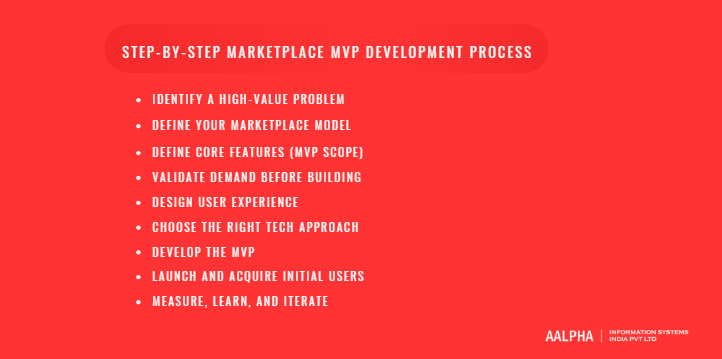
Step-by-Step Marketplace MVP Development Process
Building a marketplace MVP requires a structured, execution-focused approach that prioritizes validation over perfection, similar to how an eCommerce development company approaches scalable product builds. Unlike traditional product development, where features are developed in isolation, marketplace platforms depend on real user interactions. This makes a step-by-step process essential to reduce risk while maximizing learning.
-
Identify a High-Value Problem
Every successful marketplace begins with a clear, high-value problem that affects a specific group of users. The most effective marketplaces do not try to solve broad, generic problems. Instead, they focus on underserved niches where existing solutions are inefficient, fragmented, or expensive.
Identifying such opportunities requires analyzing gaps in current systems. For example, many traditional industries still rely on manual coordination, phone calls, or informal networks. These inefficiencies create opportunities for marketplaces that can digitize and streamline interactions. Hyperlocal logistics, specialized freelance services, and niche B2B supply chains are common examples where marketplaces thrive because of clear inefficiencies.
Validating the problem is equally important. Founders must go beyond assumptions and gather real-world evidence. This includes conducting interviews with potential users, analyzing competitor platforms, and studying user behavior in existing systems. If users are already using workarounds, such as spreadsheets, WhatsApp groups, or offline brokers, it indicates a strong need for a structured solution.
A critical question to answer at this stage is whether users are willing to pay to solve the problem. A problem that is inconvenient but not financially impactful may not sustain a marketplace. High-value problems typically involve saving time, reducing costs, increasing income, or improving reliability. Without a strong problem foundation, even the most well-built marketplace will struggle to gain traction.
-
Define Your Marketplace Model
Once the problem is validated, the next step is defining how the marketplace will operate and generate revenue. The choice of marketplace model directly influences user behavior, monetization, and scalability.
One of the primary decisions involves selecting a revenue model. Commission-based models charge a percentage per transaction, making them suitable for marketplaces where transactions are frequent and standardized. Subscription models, on the other hand, charge sellers a recurring fee for access to the platform, which works well in environments where sellers generate consistent value, such as local business networks. Hybrid models combine both approaches, offering flexibility while maximizing revenue potential.
Another important consideration is whether the marketplace will operate as a single-vendor or multi-vendor platform. Single-vendor marketplaces act as intermediaries but maintain more control over supply, often ensuring consistency in quality and pricing. Multi-vendor marketplaces allow multiple sellers to list and compete, increasing variety but also introducing complexity in quality control and user experience.
The chosen model should align with user incentives. For example, if sellers perceive high commissions as a barrier, they may avoid the platform. Similarly, if buyers do not see sufficient value compared to alternatives, demand will remain low. The model must create a balanced ecosystem where both sides benefit from participating.
-
Define Core Features (MVP Scope)
Defining the MVP scope is one of the most critical steps in marketplace development. The goal is to include only those features that are necessary to enable transactions, while excluding anything that does not directly contribute to validation.
On the buyer side, essential features typically include the ability to browse or search listings, view details, and initiate a transaction or inquiry. Buyers should be able to quickly find relevant options without unnecessary complexity. Features like advanced filters or personalization can be added later once user behavior is understood.
On the seller side, the focus should be on enabling easy onboarding and listing management. Sellers should be able to create listings, manage availability, and track incoming orders or inquiries. Simplicity is key, as complex onboarding processes can discourage early adoption.
The admin panel plays a crucial role in MVP operations. Since many processes may not be automated initially, the admin interface should allow manual control over listings, users, transactions, and disputes. This enables founders to manage the marketplace efficiently while learning from user interactions.
The most common mistake at this stage is overbuilding. Founders often assume that a feature-rich product will attract users. In reality, unnecessary features increase development time and cost without improving validation outcomes. A well-scoped MVP focuses on functionality that directly enables transactions and learning.
-
Validate Demand Before Building
Before investing in development, it is essential to validate demand using low-cost, low-risk methods. This step helps confirm whether users are genuinely interested in the marketplace concept.
One effective approach is creating a landing page that clearly communicates the value proposition. By driving traffic to the page and measuring sign-ups or inquiries, startups can gauge interest. Waitlists are another useful tool, as they indicate whether users are willing to commit early.
Surveys and user interviews provide deeper insights into user needs, preferences, and willingness to pay. However, stated interest is not always reliable. Behavioral validation, where users take action, is more valuable than verbal confirmation.
A highly effective strategy is the manual MVP or concierge model. In this approach, the startup manually facilitates transactions without building a full platform. For example, connecting buyers and sellers through messaging tools or spreadsheets allows founders to test the core marketplace interaction. This approach provides real-world validation while avoiding development costs.
Demand validation ensures that the marketplace idea has traction before resources are committed. Skipping this step significantly increases the risk of building a product that users do not need.
-
Design User Experience
User experience in a marketplace MVP should prioritize clarity, speed, and ease of use. Early users are not interested in exploring complex interfaces. They want to achieve their goal quickly, whether that is finding a product or securing a service.
Simplified onboarding is critical for both buyers and sellers. Long registration processes or excessive data requirements can lead to drop-offs. Users should be able to start interacting with the platform with minimal friction.
Conversion-focused design ensures that users move smoothly from discovery to transaction. This includes clear calls to action, intuitive navigation, and minimal distractions. For example, buyers should easily understand how to proceed from viewing a listing to placing an order or making an inquiry.
Trust signals also play a role in user experience. Even in an MVP, elements such as basic reviews, verified badges, or clear pricing can influence user decisions. A clean, functional design is far more effective than a visually complex but confusing interface.
-
Choose the Right Tech Approach
Selecting the right technology approach is a strategic decision that impacts cost, speed, and scalability. Startups must balance rapid development with future growth requirements, especially when defining the MVP tech stack for marketplace development.
No-code platforms allow founders to build basic marketplaces quickly without extensive development effort. These tools are useful for early validation but may have limitations in customization and scalability. Low-code solutions offer more flexibility while still reducing development complexity.
Custom development provides the highest level of control and scalability. It is typically required for marketplaces with unique workflows, complex integrations, or long-term growth ambitions. However, custom development requires more time and resources.
The key is to align the tech approach with the stage of the startup. Early-stage marketplaces benefit from faster, simpler solutions that enable quick validation. As the platform grows and requirements become more complex, transitioning to scalable architecture becomes necessary.
Scaling technology too early is a common mistake. Investing in advanced infrastructure before achieving product-market fit leads to unnecessary costs. Technology should evolve based on actual usage and growth.
-
Develop the MVP
MVP development should follow an agile methodology, where the product is built in small, manageable iterations. This approach allows continuous testing and improvement, reducing the risk of building features that do not add value.
Instead of developing the entire platform at once, startups should focus on releasing a functional version as quickly as possible. Early releases provide valuable feedback that can guide further development. Each iteration should address specific user needs or pain points identified through real-world usage.
Collaboration between product, design, and development teams is essential during this phase. Clear communication ensures that the MVP remains aligned with its primary goal of validation. Overengineering should be avoided, as it increases complexity without improving outcomes.
Testing is also critical. Even a basic MVP must function reliably to maintain user trust. Bugs, slow performance, or broken workflows can discourage early adopters and hinder validation efforts.
-
Launch and Acquire Initial Users
Launching a marketplace MVP is not just a technical milestone but a strategic process of acquiring and engaging users. The initial user base plays a crucial role in shaping the platform’s growth trajectory.
Startups must decide whether to focus on supply-first or demand-first strategies. In many cases, building supply first ensures that buyers have options when they join. However, in some scenarios, generating demand early can attract sellers who see clear opportunities.
Growth channels should be carefully selected based on the target audience. Digital marketing, partnerships, community engagement, and direct outreach are common strategies. For niche marketplaces, targeted acquisition is often more effective than broad campaigns.
Early users should be treated as collaborators rather than customers. Their feedback provides valuable insights that can guide product improvements. Engaging with users directly helps build trust and encourages continued participation.
-
Measure, Learn, and Iterate
The final step in the MVP process is continuous measurement and iteration. A marketplace MVP is not a finished product but an evolving system that improves based on data and user behavior.
Key metrics to track include gross merchandise value (GMV), customer acquisition cost (CAC), conversion rates, and user retention. These metrics provide insights into whether the marketplace is gaining traction and moving toward sustainability.
Qualitative feedback is equally important. Understanding why users engage or disengage helps identify areas for improvement. For example, low conversion rates may indicate issues with pricing, trust, or user experience.
Iteration should be driven by data, not assumptions. Features should be added or refined based on their impact on user behavior and transactions. This continuous learning process is what enables marketplaces to evolve from MVPs into scalable platforms.
A disciplined approach to measurement and iteration ensures that the marketplace grows in a controlled and sustainable manner, reducing risk while maximizing long-term success.
Essential Features of a Marketplace MVP
A marketplace MVP must include only the features necessary to enable transactions between buyers and sellers while maintaining a functional and trustworthy environment. The goal is not to build a feature-rich platform, but to ensure that users can discover, interact, and complete transactions with minimal friction. Each feature should directly support the core marketplace loop: discovery → interaction → transaction → feedback.
A well-designed MVP balances simplicity with functionality. Missing critical features can prevent transactions, while excessive features increase complexity without improving validation. The following breakdown highlights the essential components required on each side of the marketplace.
-
Buyer-Side Features
Buyer-side features are focused on helping users discover relevant listings quickly and complete transactions efficiently. The most important capability is search and discovery. Buyers should be able to browse listings or use a simple search function to find what they need. Filters such as price range, category, location, or availability help narrow down options and improve decision-making. However, these filters should remain minimal in an MVP to avoid unnecessary complexity.
Each listing should include clear, structured information such as title, description, pricing, and relevant details. Buyers rely on this information to evaluate options and make decisions without external assistance. High-quality presentation of listings significantly improves conversion rates.
The checkout or inquiry process must be straightforward. Depending on the marketplace type, this may involve direct payment, booking a service, or sending a request to the seller. The key is to reduce friction and guide users toward completing the transaction. Complex checkout flows or excessive steps often lead to drop-offs.
Basic tracking functionality is also important, especially in product or logistics-based marketplaces. Buyers should be able to view the status of their order or service request, even if tracking is manually updated in the early stages. Transparency in order status builds confidence and encourages repeat usage.
-
Seller-Side Features
Seller-side features are designed to make it easy for suppliers to join the platform, list their offerings, and manage transactions. The onboarding process should be simple and fast, allowing sellers to start listing without unnecessary barriers. Requiring excessive documentation or complex verification at this stage can reduce supply acquisition.
Listing management is a core feature. Sellers should be able to create, edit, and manage their listings with ease. This includes adding descriptions, pricing, availability, and relevant details. A streamlined listing process ensures that supply grows quickly, which is critical for early marketplace traction.
A basic dashboard is essential for sellers to monitor activity. This includes viewing incoming orders or inquiries, tracking performance, and managing availability. Even a simple interface that provides visibility into transactions can significantly improve seller engagement.
Order management functionality allows sellers to accept, reject, or fulfill requests. In service marketplaces, this may involve scheduling and confirming bookings. In product marketplaces, it may include processing orders and updating delivery status. The goal is to provide sellers with enough control to manage their operations without overwhelming them with complexity.
-
Admin Panel Features
The admin panel is the backbone of a marketplace MVP, especially in the early stages where many processes are manual. It provides founders and operators with control over the entire platform, enabling them to manage users, monitor activity, and maintain quality.
User management is a critical function. Admins should be able to view, approve, or suspend buyer and seller accounts. This helps maintain platform integrity and ensures that only legitimate users participate.
Listing moderation is another essential feature. Since marketplaces rely on user-generated content, there must be a mechanism to review and manage listings. Admins should be able to edit or remove listings that violate guidelines or reduce platform quality.
Basic analytics provide visibility into marketplace performance. Metrics such as number of users, listings, transactions, and revenue help founders understand how the platform is evolving. Even simple reporting tools can offer valuable insights during the MVP stage.
Transaction monitoring is also important. Admins should be able to track orders, payments, and disputes. This allows for quick intervention when issues arise and ensures a smooth user experience. In early-stage marketplaces, the admin panel often compensates for the lack of automation by enabling manual oversight.
-
Payment and Transaction Handling
Payment handling is a core component of any marketplace, as it directly impacts user trust and revenue generation. At the MVP stage, the focus should be on enabling secure and reliable transactions rather than implementing complex financial systems.
Integration with a basic payment gateway allows buyers to complete transactions using common payment methods. The payment flow should be simple and transparent, ensuring that users understand what they are paying for and how the transaction is processed.
In some marketplaces, especially those involving services or high-value transactions, escrow systems are useful. Escrow holds funds until the transaction is completed successfully, reducing risk for both buyers and sellers. While full escrow automation may not be necessary in an MVP, a simplified or manual version can still provide significant value.
Refund handling and transaction tracking should also be considered. Even in a basic setup, users need clarity on how issues will be resolved if something goes wrong. Clear payment processes contribute to a smoother user experience and higher trust levels.
-
Trust and Safety Features
Trust and safety features are essential for enabling transactions in a marketplace environment where users interact with each other rather than directly with the platform. Without trust, even a well-functioning marketplace will struggle to generate activity.
Reviews and ratings are among the most effective trust mechanisms. They allow users to evaluate the reliability and quality of sellers based on past interactions. Even a simple rating system can significantly influence user decisions and improve overall platform credibility.
Verification processes help ensure that users are legitimate. This may include basic identity checks, email or phone verification, or manual approval by admins. Verified users are more likely to be trusted, which increases the likelihood of transactions.
Clear policies and guidelines also contribute to trust. Users should understand how disputes are handled, what standards are expected, and what protections are in place. Transparency reduces uncertainty and encourages participation.
In the early stages, trust is often reinforced through manual intervention. Founders may need to actively monitor transactions, resolve issues, and communicate with users to build confidence. Over time, these processes can be automated, but in an MVP, proactive management plays a crucial role in establishing a reliable marketplace environment.
A well-structured set of essential features ensures that a marketplace MVP can function effectively without unnecessary complexity. By focusing on features that directly enable discovery, interaction, and transactions, startups can validate their marketplace model efficiently and build a strong foundation for future growth.
Cost of Building a Marketplace MVP
The cost of building a marketplace MVP varies widely depending on complexity, feature scope, development approach, and long-term scalability requirements. When estimating the MVP development cost, it’s important to consider that marketplaces require dual-sided functionality, transaction handling, and operational workflows, which naturally increases development effort. However, the purpose of an MVP is to control costs while validating the business model, not to build a fully optimized platform from day one.
A well-planned marketplace MVP can typically range from $15,000 to $80,000 for early-stage validation, while more advanced MVPs can exceed $100,000 depending on customization and integrations. The key is to align investment with validation goals rather than overbuilding prematurely.
-
Cost Based on Complexity
The complexity of the marketplace is the primary factor influencing development cost. A basic MVP focuses on essential features such as user registration, listings, simple search, and basic transaction handling. These platforms often rely on minimal design, limited automation, and manual admin intervention. For example, a simple service marketplace connecting buyers and sellers with inquiry-based transactions can be built relatively quickly and at a lower cost. Such MVPs typically fall in the range of $15,000 to $30,000.
An advanced MVP includes more refined functionality, such as real-time updates, integrated payment systems, user dashboards, and enhanced user experience. These platforms may also include basic analytics, automated workflows, and improved scalability. While still considered an MVP, they require more development effort and technical planning. Costs for advanced MVPs typically range from $40,000 to $80,000 or more.
Complexity also increases when the marketplace involves logistics, geolocation, real-time tracking, or multi-step workflows. For example, a delivery-based marketplace requires integration with mapping services, route optimization, and real-time status updates. Similarly, B2B marketplaces may require negotiation workflows, bulk pricing, and custom approval processes.
A common mistake startups make is building an advanced MVP before validating demand. This leads to unnecessary expenses without confirming whether the marketplace can attract users. The most effective approach is to start with the simplest version that can validate transactions and gradually increase complexity based on real user needs.
-
Development Cost Breakdown
Marketplace MVP development costs can be divided into several key components, each contributing to the overall investment and shaping the cost of building a marketplace website, especially for an MVP marketplace.
Design is the first component, covering user interface and user experience. This includes wireframes, user flows, and visual design. For an MVP, design should focus on clarity and usability rather than visual sophistication. Typically, design accounts for 10–20% of the total cost.
Frontend development involves building the user-facing interface for buyers and sellers. This includes listing pages, dashboards, and interaction flows. Frontend complexity depends on the number of features and the level of interactivity required.
Backend development is the most critical component, as it handles core marketplace functionality such as user management, listings, transactions, and data storage. It also includes API development and integration with external services like payment gateways. Backend development usually represents the largest portion of the cost due to its complexity.
Quality assurance (QA) ensures that the platform functions reliably. This includes testing for bugs, performance issues, and usability problems. Even in an MVP, QA is essential to maintain user trust and prevent early churn caused by technical issues.
Each of these components must be carefully balanced to ensure that the MVP is functional without exceeding budget constraints.
-
Freelancer vs Agency vs In-house Cost
The choice of development approach significantly impacts both cost and execution quality. Startups typically choose between freelancers, development agencies, or building an in-house team.
Freelancers are the most cost-effective option in the short term. They offer flexibility and lower hourly rates, making them suitable for small MVPs with limited scope. However, managing multiple freelancers can be challenging, especially when coordination between frontend, backend, and design is required. Quality and reliability may also vary.
Development agencies provide a more structured approach. They offer end-to-end services, including design, development, testing, and project management. While agencies are more expensive than freelancers, they reduce execution risk and ensure consistency. For startups looking to build a scalable MVP with professional quality, agencies are often the preferred choice.
In-house development offers the highest level of control but comes with significant costs. Hiring developers, designers, and product managers requires long-term financial commitment. This approach is typically suitable for startups with funding and a clear roadmap beyond the MVP stage.
The decision should be based on budget, timeline, and long-term goals. For early validation, a lean approach using freelancers or a small agency team is often sufficient.
-
Hidden Costs Startups Ignore
Many startups underestimate the true cost of building and running a marketplace because they focus only on development expenses. In reality, several hidden costs can significantly impact overall investment.
Marketing and user acquisition are often the largest ongoing expenses. A marketplace requires both supply and demand, which means continuous investment in attracting and retaining users. Without effective marketing, even a well-built platform will struggle to gain traction.
Maintenance and updates are another overlooked cost. After launch, the platform requires ongoing support to fix bugs, improve performance, and add features based on user feedback. Ignoring maintenance can lead to poor user experience and declining engagement.
Scaling costs increase as the marketplace grows. This includes server infrastructure, third-party integrations, payment processing fees, and operational support. As transaction volume increases, the platform must handle higher loads and more complex workflows.
Operational costs, such as customer support and dispute resolution, also become significant over time. Marketplaces are not purely digital products; they require ongoing management to ensure smooth interactions between users.
Understanding these hidden costs is essential for realistic planning. A marketplace MVP is only the beginning, and long-term success depends on managing both development and operational expenses effectively.
Common Mistakes in Marketplace MVP Development
Marketplace MVP development is not just about building a product; it is about validating a complex system of interactions between buyers and sellers. Many startups fail at this stage not because the idea is flawed, but because they approach MVP development with incorrect assumptions. These mistakes often lead to wasted resources, delayed launches, and poor user adoption.
Understanding these pitfalls early helps founders make better decisions, prioritize correctly, and build a marketplace that can actually gain traction.
-
Building Too Many Features
One of the most common mistakes is overbuilding the MVP. Founders often assume that a feature-rich product will attract users and create a competitive advantage. As a result, they include advanced filters, AI recommendations, complex dashboards, and automation systems in the initial version.
In reality, early users are not looking for a polished product; they are looking for a solution to a specific problem. If the marketplace cannot facilitate basic transactions, additional features do not add value. Instead, they increase development time, cost, and complexity.
Overbuilding also delays time-to-market, which is critical for startups. The longer it takes to launch, the longer it takes to gather real user feedback. This slows down learning and increases the risk of building something users do not need.
A strong MVP focuses only on features that directly enable discovery, interaction, and transactions. Everything else should be deferred until there is clear evidence that users need it. Simplicity at the early stage is not a limitation; it is a strategic advantage.
-
Ignoring Liquidity Problem
Liquidity is the ability of a marketplace to successfully match buyers and sellers and facilitate transactions consistently. Ignoring this problem is one of the fastest ways to fail.
Many startups focus heavily on building the platform but do not plan how to ensure that users can actually transact. For example, launching a marketplace with many listings but no buyers leads to inactive supply. Similarly, attracting users without sufficient listings results in poor user experience and churn.
Liquidity is not achieved by simply increasing user numbers. It requires a balanced and active ecosystem where users can quickly find value. This often involves concentrating efforts in a specific niche, category, or geographic area to increase the likelihood of successful matches.
Startups must design their MVP with liquidity in mind. This includes ensuring that early users can complete transactions easily and repeatedly. Without liquidity, the marketplace does not function, regardless of how well it is built.
-
Not Focusing on One Side First
Another critical mistake is trying to grow both sides of the marketplace simultaneously. While it may seem logical to acquire buyers and sellers at the same time, this approach often leads to inefficiency and weak traction.
In the early stages, it is more effective to focus on one side of the marketplace and build strength before expanding. For example, acquiring a strong base of sellers in a specific niche ensures that when buyers join, they find immediate value. Alternatively, generating demand first can attract sellers who see clear opportunities to earn.
Failing to prioritize one side leads to fragmented growth. Sellers may join but leave due to lack of demand, while buyers may visit but not return due to limited options. This creates a cycle of low engagement on both sides.
Successful marketplaces carefully sequence their growth strategy. They identify which side is more critical at the initial stage and focus resources accordingly. This targeted approach increases the chances of achieving early traction and building momentum.
-
Poor User Experience
User experience plays a crucial role in the success of a marketplace MVP. Even if the core idea is strong, a confusing or inefficient interface can prevent users from completing transactions.
Common issues include complicated onboarding processes, unclear navigation, and unnecessary steps in the transaction flow. These friction points lead to drop-offs and reduce conversion rates.
In an MVP, user experience should prioritize simplicity and clarity. Users should be able to understand how the platform works within seconds and complete their desired action with minimal effort. Clear calls to action, intuitive design, and fast performance are more important than visual sophistication.
A poor user experience not only affects initial adoption but also reduces retention. Early users are critical for validation, and losing them due to avoidable design issues can significantly impact the growth of the marketplace.
-
Weak Monetization Strategy
Monetization is often treated as a secondary concern during MVP development, but ignoring it completely can lead to long-term challenges. A marketplace needs a clear path to revenue, even if monetization is not fully implemented in the early stages.
A weak monetization strategy can create misaligned incentives. For example, high commissions may discourage sellers from joining, while low pricing may make the business unsustainable. Similarly, introducing monetization too late can make it difficult to transition users to paid models.
The MVP stage should include testing basic monetization assumptions. This does not necessarily mean charging users immediately, but it does involve understanding willingness to pay and identifying viable revenue streams.
A strong marketplace balances user value with revenue generation. Monetization should enhance the ecosystem rather than disrupt it. By validating monetization early, startups can build a sustainable business model alongside product development.
Avoiding these common mistakes allows startups to focus on what truly matters: validating demand, enabling transactions, and building a functional ecosystem. Marketplace success is not determined by how advanced the product is at launch, but by how effectively it facilitates real interactions between users.
How to Choose the Right Marketplace Development Partner
Selecting the right marketplace development company is one of the most critical decisions in marketplace MVP development. Unlike standard application projects, marketplaces require a deep understanding of two-sided ecosystems, transaction workflows, scalability challenges, and user behavior dynamics. The wrong partner may deliver a technically functional product but fail to address core marketplace challenges such as liquidity, trust, and operational flow.
A strong development partner does more than write code. They contribute to product thinking, help define the right MVP scope, and ensure that the platform is built in a way that supports future scaling. The evaluation process should go beyond pricing and timelines, focusing instead on expertise, execution capability, and long-term alignment.
-
Experience in Marketplace Development
Experience in marketplace development is a key differentiator when selecting a partner. Marketplaces are fundamentally different from traditional apps, and developers without relevant experience often underestimate the complexity involved in managing two-sided interactions.
A qualified partner should have a proven track record of building marketplace platforms across different industries. This includes understanding how to design user flows for both buyers and sellers, how to structure listings and transactions, and how to manage early-stage operational challenges. Experience also translates into better decision-making during development, such as identifying which features are essential for the MVP and which can be deferred.
Industry-specific experience can be an added advantage. For example, a partner familiar with logistics marketplaces will better understand challenges related to tracking and fulfillment, while one experienced in service marketplaces will be more adept at handling scheduling and availability. Reviewing past projects and asking detailed questions about their approach to marketplace challenges can help assess their expertise effectively.
-
Technical Expertise and Scalability
Technical expertise is critical, but it must be aligned with scalability. A marketplace MVP should not only function well at launch but also be capable of evolving as the platform grows.
The development partner should have strong capabilities in both frontend and backend development, with a clear understanding of how to build scalable architectures. This includes designing systems that can handle increasing user loads, transaction volumes, and data complexity without requiring complete reengineering.
Integration experience is equally important. Marketplaces often rely on third-party services such as payment gateways, communication tools, and analytics platforms. A technically competent partner ensures that these integrations are implemented securely and efficiently.
Scalability should be approached strategically. The goal is not to overengineer the MVP but to build a foundation that can be extended. A good partner will know how to balance immediate needs with future growth, avoiding both underdevelopment and unnecessary complexity.
-
Transparent Development Process
A transparent development process ensures that the project remains aligned with business goals and avoids miscommunication. Startups should look for partners who follow structured methodologies, such as agile development, where progress is delivered in iterations and feedback is incorporated continuously.
Clear communication is essential throughout the development lifecycle. This includes regular updates, milestone tracking, and visibility into progress. Founders should be able to understand what is being built, why it is being built, and how it contributes to the overall product vision.
Documentation is another important aspect of transparency. Well-documented processes, user flows, and technical decisions make it easier to manage the product in the long term, especially if the team evolves.
A transparent partner also provides realistic timelines and cost estimates. Overpromising and underdelivering is a common issue in development projects. A reliable partner sets clear expectations and communicates potential risks early, allowing startups to make informed decisions.
-
Post-Launch Support
Marketplace development does not end at launch. In fact, the post-launch phase is where the most critical learning and improvements occur. Choosing a partner that offers ongoing support ensures that the platform can evolve based on real user feedback.
Post-launch support includes bug fixes, performance optimization, feature enhancements, and technical maintenance. As users begin interacting with the platform, new requirements and issues will emerge. A responsive support team helps address these quickly, maintaining a positive user experience.
Additionally, marketplaces often require continuous updates to improve conversion rates, optimize workflows, and introduce new features. A development partner that remains engaged after launch becomes a long-term collaborator rather than a one-time service provider.
-
Client Reviews and Case Studies
Client reviews and case studies provide valuable insight into a development partner’s reliability and performance. They offer evidence of the partner’s ability to deliver projects successfully and handle real-world challenges.
Case studies are particularly useful because they demonstrate how the partner approached specific problems, what solutions were implemented, and what outcomes were achieved. Metrics such as improved user engagement, increased transactions, or reduced operational costs indicate the effectiveness of their work.
Client testimonials add another layer of credibility, highlighting communication quality, adherence to timelines, and overall satisfaction. Consistent positive feedback across multiple projects is a strong indicator of reliability.
When evaluating partners, it is important to look beyond surface-level claims and focus on demonstrated results. Established firms such as Aalpha Information Systems, for example, position themselves around delivering scalable marketplace and software solutions with structured processes and long-term support, which is a critical factor for startups aiming to move beyond MVP into full-scale platforms.
Choosing the right marketplace development partner is not just a technical decision but a strategic one. The right partner brings experience, clarity, and execution discipline, helping startups move from idea validation to scalable growth with confidence.
Future Trends in Marketplace Development
Marketplace platforms are evolving from simple listing-and-transaction systems into intelligent, automated, and highly specialized ecosystems. The next phase of marketplace innovation is driven by advancements in artificial intelligence, automation, decentralization, and the rise of niche-focused platforms. These trends are reshaping how marketplaces operate, scale, and deliver value to users.
Understanding these shifts is critical for startups, as building with future trends in mind ensures long-term relevance and competitive advantage.
-
AI-Powered Matching and Recommendations
Artificial intelligence is transforming how marketplaces connect buyers and sellers. Traditional marketplaces rely on manual search and filtering, but modern platforms are shifting toward predictive matching systems that understand user intent and behavior.
AI-powered recommendation engines analyze user data such as browsing history, preferences, transaction patterns, and contextual signals to deliver highly relevant results. Instead of requiring users to search actively, an AI-powered marketplace can proactively suggest the most suitable options, improving conversion rates and overall user satisfaction.
For example, in service marketplaces, AI can match users with the most relevant providers based on availability, ratings, and past performance. In product marketplaces, it enables personalized product discovery, increasing engagement and sales.
As marketplaces scale, AI becomes essential for handling complexity. It reduces friction in discovery, enhances user experience, and supports efficient growth by automating decision-making processes that would otherwise require manual effort. Additionally, it can strengthen trust and safety by detecting fraudulent activity, moderating content, and identifying anomalies in real time—improving platform reliability and user confidence.
-
Automation in Marketplace Operations
Automation is becoming a core component of marketplace operations, reducing manual effort and improving efficiency across the platform. Early-stage marketplaces often rely on manual processes for onboarding, transaction handling, and dispute resolution. As platforms scale, these processes must be automated to maintain performance and consistency.
Automated workflows can handle tasks such as seller onboarding, order processing, payment distribution, and customer support. For instance, automated systems can verify user information, assign orders to sellers, and update transaction statuses in real time. This reduces operational overhead and minimizes human error.
Customer support is also evolving through automation. AI-driven chat systems can handle common queries, provide instant responses, and guide users through processes such as order tracking or issue resolution.
Automation not only improves efficiency but also enhances user experience by ensuring faster and more reliable interactions. For growing marketplaces, it is a critical factor in achieving scalability without proportionally increasing operational costs.
-
Decentralized and Blockchain Marketplaces
Decentralized marketplaces, powered by blockchain technology, are emerging as an alternative to traditional centralized platforms. These marketplaces aim to reduce reliance on intermediaries by enabling direct peer-to-peer transactions with greater transparency and security.
Blockchain technology allows for the use of smart contracts, which automatically execute transactions when predefined conditions are met. This eliminates the need for manual intervention in processes such as payments and dispute resolution. It also reduces the risk of fraud by providing a transparent and immutable record of transactions.
Decentralized marketplaces can offer lower fees, as they remove the need for centralized control. They also give users greater ownership of their data and transactions. However, challenges such as scalability, regulatory compliance, and user adoption still need to be addressed before widespread adoption.
Despite these challenges, blockchain-based marketplaces represent a significant shift in how digital platforms operate, particularly in industries where trust, transparency, and cost efficiency are critical.
-
Hyperlocal and Niche Marketplaces
The growth of hyperlocal and niche marketplaces reflects a shift away from broad, generalized platforms toward specialized solutions that serve specific communities or use cases. Instead of competing with large horizontal marketplaces, startups are focusing on targeted segments where they can deliver higher value.
Hyperlocal marketplaces operate within specific geographic areas, connecting users with nearby providers. These platforms are particularly effective in sectors such as delivery, home services, and local commerce, where proximity plays a key role in user experience.
Niche marketplaces focus on specific industries or user groups, offering tailored features and curated experiences. For example, platforms dedicated to healthcare services, specialized freelance work, or industry-specific B2B transactions can provide deeper value than generic marketplaces.
These focused approaches make it easier to achieve early traction, as they reduce competition and allow for more targeted user acquisition. They also enable better control over quality and trust, which are critical factors in marketplace success.
The future of marketplace development lies in building intelligent, automated, and highly specialized platforms. Startups that align with these trends can create more efficient, scalable, and user-centric marketplaces, positioning themselves for long-term growth in an increasingly competitive landscape.
Final Words
Building a marketplace MVP is not about launching a perfect platform. It is about validating whether real transactions can happen between buyers and sellers in a controlled, efficient way. Startups that focus on solving a clear problem, achieving early liquidity, and iterating based on real user behavior are far more likely to succeed than those that overbuild from the start.
A well-executed MVP reduces risk, saves cost, and provides the data needed to scale confidently. The key is to move fast, stay focused on core interactions, and continuously refine the marketplace based on what users actually do, not what is assumed.
If you are planning to build a marketplace MVP and want a structured, scalable approach, working with experienced teams like Aalpha Information Systems can help you move from idea to launch with clarity and execution discipline-contact us now.