


Manufacturing is undergoing a structural shift from traditional distribution-led sales to digitally enabled commerce. For decades, manufacturers relied on layers of distributors, wholesalers, and retailers to reach end customers. Today, that model is being redefined by eCommerce platforms that allow manufacturers to sell directly, control pricing, and build long-term customer relationships.
A manufacturer-focused eCommerce platform is not simply an online store. It is a system designed to handle complex buying journeys, bulk orders, negotiated pricing, and multi-channel distribution. It supports both business buyers and individual consumers while integrating deeply with backend systems such as inventory, logistics, and ERP.
As more manufacturers explore digital transformation, a common question arises: how can they build a platform that supports both large-scale B2B transactions and direct-to-consumer sales without disrupting existing operations? The answer lies in understanding the different models, the strategic advantages, and the types of businesses that benefit most from this shift.
What Is a Manufacturer eCommerce Platform?
A manufacturer eCommerce platform is a digital commerce system that enables manufacturers to sell their products directly to customers, businesses, or both, without relying entirely on intermediaries. Unlike traditional eCommerce platforms that primarily serve retail businesses, these platforms are built to accommodate complex product structures, bulk purchasing, custom pricing, and long-term buyer relationships.
The key distinction lies in how transactions are structured. In a typical retail eCommerce setup, pricing is fixed, quantities are small, and the purchase journey is simple. In contrast, manufacturer platforms often include tiered pricing, minimum order quantities, request-for-quote workflows, and account-based purchasing.
These platforms generally operate across three core models:
- Direct-to-Consumer (D2C): Manufacturers sell directly to end customers through their own branded storefront. This model focuses on brand control, customer experience, and higher margins.
- B2B eCommerce: Designed for business buyers, this model supports bulk orders, negotiated contracts, company accounts, and repeat purchasing workflows.
- Hybrid Model: Combines both D2C and B2B capabilities within a single platform, allowing manufacturers to serve multiple customer segments with different pricing and purchasing logic.
A well-designed manufacturer eCommerce platform answers critical operational needs such as managing product complexity, handling large-scale orders, and integrating seamlessly with supply chain systems. It becomes not just a sales channel, but a central digital infrastructure for commerce.
Why Manufacturers Are Moving Online
Manufacturers are increasingly adopting eCommerce platforms to gain control over their sales channels, improve profitability, and access real-time market data. The shift is driven by both competitive pressure and the need for operational efficiency.
One of the primary motivations is margin improvement. Traditional distribution models often involve multiple intermediaries, each taking a percentage of the final sale. By selling directly through an eCommerce platform, manufacturers can retain a larger share of revenue while offering competitive pricing to customers.
Another key factor is brand ownership. When products are sold through third-party distributors or marketplaces, manufacturers have limited control over how their brand is presented. A dedicated eCommerce platform allows them to define product positioning, messaging, and customer experience consistently across all touchpoints.
Access to customer data is equally important. In traditional models, manufacturers rarely interact directly with end customers, which limits their ability to understand buying behavior. With eCommerce, they can track user journeys, analyze purchasing patterns, and optimize pricing, inventory, and marketing strategies based on real data.
There is also a growing expectation from buyers for digital-first purchasing experiences. Business customers increasingly prefer online ordering, quick reorders, transparent pricing, and self-service portals. Manufacturers that fail to provide these capabilities risk losing market share to more digitally mature competitors.
Who Should Build This Platform?
Not every business requires a manufacturer-focused eCommerce platform, but for many, it has become a strategic necessity rather than an optional investment. The decision largely depends on the complexity of products, the scale of operations, and the need for direct customer engagement.
Industrial manufacturers are among the primary beneficiaries. Companies producing machinery, components, or specialized equipment often deal with complex catalogs and bulk orders. An eCommerce platform enables them to streamline procurement for clients while reducing dependency on manual sales processes.
Wholesalers and distributors transitioning toward direct sales can also leverage such platforms to expand their reach. Instead of operating solely through offline networks, they can build a digital channel that complements existing operations and captures new customer segments.
Original Equipment Manufacturers (OEMs) benefit significantly from direct digital channels. By selling parts, accessories, and replacements directly to customers or service providers, OEMs can create recurring revenue streams and strengthen customer relationships.
Exporters and global suppliers are another key segment. An eCommerce platform allows them to showcase products internationally, handle cross-border transactions, and manage inquiries efficiently without relying entirely on local intermediaries.
In practical terms, any manufacturer asking how to reduce reliance on distributors, improve margins, and gain direct access to customers is a strong candidate for building an eCommerce platform. The shift is not just about selling online; it is about transforming how the business engages with its market.
Types of Manufacturer eCommerce Models
Manufacturers entering digital commerce must first decide which business model aligns with their product type, customer base, and long-term growth strategy. Unlike traditional retail eCommerce, manufacturer platforms often serve multiple buyer segments simultaneously, each with different expectations around pricing, ordering, and fulfillment.
Choosing the right model is not just a technical decision. It directly impacts revenue structure, customer relationships, operational complexity, and scalability. Some manufacturers prioritize brand control and direct engagement, while others focus on high-volume enterprise sales. Increasingly, many adopt blended approaches to capture both opportunities.
Understanding these models in detail helps answer a critical question: should a manufacturer sell directly to consumers, focus on business buyers, or build a platform that supports both? The sections below break down the four primary models used in modern manufacturer eCommerce.
-
Direct-to-Consumer (D2C) Model
The Direct-to-Consumer model allows manufacturers to sell products directly to end users without relying on distributors, wholesalers, or retailers. This approach gives manufacturers full control over pricing, branding, and customer experience.
In a D2C setup, the manufacturer operates its own online storefront where customers can browse products, place orders, and interact with the brand directly. This model is particularly effective for manufacturers producing consumer goods such as electronics, apparel, home products, or packaged items.
The primary advantage lies in margin expansion. By removing intermediaries, manufacturers retain a larger share of revenue while still offering competitive prices. At the same time, they gain direct access to customer data, enabling better demand forecasting, personalized marketing, and improved product development.
Another important benefit is brand positioning. Manufacturers can present their products exactly as intended, without dilution from third-party sellers or inconsistent messaging across distribution channels.
However, D2C also requires investment in marketing, customer acquisition, logistics, and support operations. Manufacturers must take on responsibilities traditionally handled by retailers, including last-mile delivery and customer service.
For manufacturers asking whether they can build a direct relationship with their customers and reduce dependency on distributors, the D2C model provides a clear path forward.
-
B2B eCommerce Platform
A B2B eCommerce platform is designed specifically for business buyers such as wholesalers, retailers, contractors, and enterprise clients. Unlike D2C platforms, B2B systems focus on high-volume transactions, negotiated pricing, and long-term purchasing relationships.
In this model, customers typically log in through company accounts, where they can access customized pricing, product catalogs, and order histories. Pricing is rarely fixed. Instead, it may vary based on order volume, contractual agreements, or customer-specific discounts. Features such as minimum order quantities, bulk discounts, and request-for-quote workflows are standard.
The buying process is also more structured. Enterprise buyers often require approval workflows, purchase order integration, and invoicing options rather than immediate payment. A well-built B2B platform supports these requirements while enabling faster, more efficient procurement.
One of the key advantages of B2B eCommerce is operational efficiency. Instead of relying on manual sales processes, phone orders, or email-based coordination, manufacturers can automate large portions of their sales cycle. This reduces administrative overhead and improves order accuracy.
Another important benefit is customer retention. Business buyers tend to place repeat orders, and a streamlined digital experience encourages long-term engagement. Features like quick reorder, saved carts, and personalized catalogs significantly improve usability.
Manufacturers dealing with complex products, large order volumes, or enterprise clients often find that a B2B eCommerce platform is not just beneficial but essential for scaling operations.
-
Marketplace Model
The marketplace model involves multiple manufacturers or sellers listing their products on a single platform, where buyers can browse, compare, and purchase from different vendors. Instead of a single-brand storefront, the platform acts as a centralized hub connecting supply and demand.
For manufacturers, participating in or building a marketplace offers immediate access to a broader customer base. Buyers benefit from variety, competitive pricing, and the ability to compare products across multiple suppliers within one interface.
There are two primary approaches within this model. In the first, manufacturers join existing marketplaces to expand reach and generate sales. In the second, a manufacturer or organization builds its own marketplace platform, allowing other sellers to onboard and sell alongside its own products.
The marketplace model is particularly effective in industries where buyers prefer aggregated options, such as industrial supplies, raw materials, or standardized components. It reduces friction in procurement by consolidating multiple suppliers into a single purchasing environment.
Revenue typically comes from commissions, listing fees, or subscription models for sellers. However, managing a marketplace introduces additional complexity, including vendor onboarding, quality control, dispute resolution, and logistics coordination.
Manufacturers considering this model often ask how they can scale beyond their own product catalog. A marketplace provides that scalability by turning the platform into an ecosystem rather than a single-brand channel.
-
Hybrid Model
The hybrid model combines both B2B and D2C capabilities within a single eCommerce platform, allowing manufacturers to serve different customer segments simultaneously. This approach is increasingly common as manufacturers seek to maximize reach without fragmenting their digital infrastructure.
In a hybrid setup, individual consumers can purchase products at standard retail prices, while business buyers access customized pricing, bulk discounts, and account-based features. The platform dynamically adjusts the experience based on the user type, ensuring that each segment receives a tailored buying journey.
This model offers flexibility and scalability. Manufacturers can maintain relationships with enterprise clients while also building a direct consumer brand. It also enables better inventory utilization by serving multiple demand channels from a single system.
However, hybrid platforms require careful planning. Managing different pricing structures, user roles, and order workflows adds complexity to both development and operations.
For manufacturers looking to expand without choosing between B2B and D2C, the hybrid model provides a balanced and future-ready solution.
Key Benefits of Building an eCommerce Platform for Manufacturers
Building an eCommerce platform is no longer just a digital upgrade for manufacturers; it is a strategic shift that directly impacts profitability, operational control, and long-term competitiveness. Traditional manufacturing businesses have historically relied on intermediaries to access markets, but this approach limits visibility, reduces margins, and slows down decision-making.
A dedicated eCommerce platform allows manufacturers to take ownership of their sales channels while improving efficiency across the entire value chain. It transforms how products are marketed, sold, and delivered, while also enabling real-time insights into customer behavior and demand patterns.
Manufacturers often ask whether investing in eCommerce will justify the cost and complexity. The answer becomes clear when you examine the tangible benefits across revenue, operations, and customer relationships. The following sections break down the key advantages in detail.
-
Higher Profit Margins
One of the most immediate and measurable benefits of building an eCommerce platform is the ability to increase profit margins by eliminating intermediaries. In traditional distribution models, manufacturers sell products to wholesalers or distributors at discounted rates, who then add their own markup before reaching the end customer.
By selling directly through an eCommerce platform, manufacturers can capture a larger share of the final sale value. Even when offering slightly lower prices to remain competitive, the absence of multiple layers of margin distribution results in higher overall profitability.
For example, a manufacturer that previously sold a product at $50 to a distributor, which was later sold at $100 to the end customer, can now sell directly at $80 and still improve margins while offering better value. This pricing flexibility becomes a powerful competitive advantage.
In addition, direct selling reduces dependency on external partners, giving manufacturers more control over revenue streams and reducing risks associated with fluctuating distributor relationships.
-
Full Control Over Branding and Pricing
An eCommerce platform gives manufacturers complete control over how their products are presented, priced, and positioned in the market. In traditional channels, branding is often diluted because products are displayed alongside competitors with inconsistent messaging, descriptions, and visuals.
With a dedicated platform, manufacturers can define their brand identity clearly. They control product pages, imagery, specifications, and storytelling, ensuring a consistent and premium customer experience across all touchpoints. This is especially important for manufacturers aiming to build long-term brand equity rather than operate as anonymous suppliers.
Pricing control is equally critical. Instead of relying on distributors who may undercut prices or apply inconsistent markups, manufacturers can implement structured pricing strategies such as tiered pricing, promotional offers, and region-specific pricing models.
This level of control allows manufacturers to align pricing with business goals, whether that means maximizing margins, increasing market penetration, or managing demand. It also prevents price erosion, which is a common issue in fragmented distribution networks.
-
Access to Customer Data and Insights
In traditional manufacturing models, customer data is largely owned by distributors or retailers, leaving manufacturers with limited visibility into who is buying their products and why. An eCommerce platform changes this dynamic by providing direct access to customer interactions and purchasing behavior.
Manufacturers can track detailed metrics such as browsing patterns, product preferences, order frequency, and average order value. This data enables more informed decision-making across multiple areas, including product development, inventory planning, and marketing strategies.
For instance, if a manufacturer notices that certain products are frequently viewed but not purchased, it may indicate pricing issues, lack of information, or usability problems. Similarly, identifying repeat purchase patterns can help optimize production schedules and improve customer retention strategies.
Access to customer data also supports personalized experiences. Manufacturers can offer targeted promotions, recommend relevant products, and create tailored communication strategies that improve conversion rates and customer loyalty.
Over time, this data-driven approach becomes a significant competitive advantage, allowing manufacturers to respond quickly to market trends and customer needs.
-
Improved Supply Chain Efficiency
An eCommerce platform streamlines the entire supply chain by integrating ordering, inventory, and fulfillment processes into a single system. Traditional workflows often involve manual coordination between sales teams, warehouses, and logistics providers, leading to delays and errors.
With a digital platform, orders are processed automatically, inventory levels are updated in real time, and fulfillment workflows are triggered without manual intervention. This reduces operational friction and improves accuracy across the supply chain.
Manufacturers can also gain better visibility into demand patterns, enabling more accurate production planning and inventory management. Instead of relying on forecasts based on limited data, they can use real-time sales information to adjust production volumes and reduce overstocking or stockouts.
Integration with logistics providers further enhances efficiency. Shipping rates, tracking information, and delivery timelines can be managed directly within the platform, improving transparency for both the business and the customer.
Overall, this level of integration leads to faster order processing, lower operational costs, and a more responsive supply chain.
-
Global Market Reach
An eCommerce platform allows manufacturers to expand beyond local or regional markets and reach customers globally without establishing a physical presence in each location. This is particularly valuable for exporters and manufacturers producing niche or specialized products.
By enabling online discovery and cross-border transactions, manufacturers can tap into new demand channels and diversify their revenue streams. Features such as multi-currency support, international shipping integration, and localized content make it easier to serve global customers effectively.
This global reach reduces dependency on a single market and creates opportunities for scalable growth, especially in industries where demand varies across regions.
-
Faster Sales Cycles
Traditional sales processes in manufacturing often involve multiple steps, including inquiries, negotiations, quotations, and approvals, which can significantly delay order completion. An eCommerce platform simplifies and accelerates this process by enabling self-service purchasing.
Customers can browse products, view pricing, and place orders instantly without waiting for manual responses from sales teams. Features such as quick reorder, saved preferences, and automated pricing further reduce friction in the buying journey.
For B2B buyers, even complex transactions can be streamlined through digital workflows, reducing the time required to move from inquiry to purchase.
Faster sales cycles not only improve customer satisfaction but also increase overall sales velocity, allowing manufacturers to process more orders in less time with fewer resources.
Core Features of a Manufacturer eCommerce Platform
A manufacturer eCommerce platform is fundamentally different from a standard online store. It must support complex product structures, flexible pricing models, large-scale transactions, and deep integration with operational systems. The platform acts as a bridge between production, sales, and fulfillment, making feature selection critical to long-term scalability.
Many manufacturers ask what features are essential to handle both bulk B2B orders and direct consumer sales without operational bottlenecks. The answer lies in building a system that balances flexibility, automation, and control across every stage of the buying journey. The following features form the backbone of a robust manufacturer eCommerce platform.
-
Product Catalog Management
Product catalog management is one of the most critical components of a manufacturer eCommerce platform, especially for businesses dealing with large inventories and complex product variations. Unlike traditional retail catalogs, manufacturer catalogs often include technical specifications, multiple configurations, and industry-specific attributes.
A well-designed catalog system allows bulk product uploads through CSV, APIs, or ERP integration, reducing manual effort and ensuring consistency across listings. Manufacturers can manage thousands of SKUs efficiently while maintaining accurate product data.
Variants play a key role in catalog structure. Products may differ based on size, material, color, capacity, or technical specifications. The platform must support dynamic variant combinations without creating redundant listings. For example, a machinery component may have multiple configurations that need to be selectable within a single product page.
Detailed specifications are equally important. Buyers, especially in B2B environments, rely on precise technical data to make purchasing decisions. Features such as downloadable datasheets, certifications, and compliance information improve transparency and trust.
An effective catalog system ensures that products are easy to discover, compare, and understand, which directly impacts conversion rates and reduces pre-sales inquiries.
-
Advanced Pricing and Discounting
Pricing in manufacturer eCommerce is rarely straightforward. Unlike fixed retail pricing, manufacturers often deal with tiered pricing structures, volume-based discounts, and negotiated rates for different customer segments.
A robust pricing engine must support multiple pricing models simultaneously. Tiered pricing allows manufacturers to offer discounts based on order quantity, encouraging bulk purchases. Minimum Order Quantity (MOQ) rules ensure that transactions remain economically viable, especially for B2B sales.
Customer-specific pricing is another essential feature. Enterprise buyers often have negotiated contracts with predefined pricing terms. The platform should allow these customers to log in and view their personalized pricing without exposing it to other users.
Promotional discounts and dynamic pricing strategies also play a role, particularly in D2C scenarios. Manufacturers can run targeted campaigns, seasonal offers, or clearance sales to manage inventory and drive demand.
Without advanced pricing capabilities, manufacturers risk either losing profitability or creating friction in the buying process. A flexible pricing system ensures that both business and consumer customers receive appropriate pricing while maintaining margin control.
-
Inventory and Warehouse Management
Inventory management is central to ensuring product availability and operational efficiency. A manufacturer eCommerce platform must provide real-time visibility into stock levels across multiple warehouses or production units.
The system should automatically update inventory as orders are placed, preventing overselling and reducing the risk of stockouts. For manufacturers with distributed storage facilities, the platform must support multi-warehouse tracking and intelligent allocation of orders based on location and availability.
Integration with production systems is also important. Manufacturers need to align inventory with production schedules, especially for made-to-order or custom products. This ensures that customers receive accurate delivery timelines.
Effective inventory management reduces operational inefficiencies, minimizes carrying costs, and improves customer satisfaction by ensuring that products are available when needed.
-
Order Management System (OMS)
An Order Management System (OMS) handles the complete lifecycle of an order, from placement to fulfillment and delivery. For manufacturers, this process can involve multiple steps, including validation, production, packaging, and shipping.
The OMS should provide a centralized view of all orders, allowing teams to track status, manage exceptions, and coordinate fulfillment efficiently. Automation plays a key role here, reducing manual intervention and minimizing errors.
Features such as order splitting, backorder management, and partial fulfillment are particularly important for manufacturers dealing with large or complex orders. For example, a single order may need to be fulfilled from multiple warehouses or delivered in stages.
A well-implemented OMS improves operational visibility, accelerates order processing, and ensures a consistent experience for customers across all channels.
-
Multi-Channel Selling
Modern manufacturers rarely rely on a single sales channel. In addition to their own eCommerce platform, they may sell through marketplaces, distributors, or offline networks. Multi-channel selling capabilities allow manufacturers to manage all these channels from a unified system.
The platform should synchronize product listings, inventory, and orders across channels, ensuring consistency and reducing manual effort. This prevents issues such as overselling or pricing discrepancies between platforms.
By enabling centralized control, multi-channel selling helps manufacturers expand their reach while maintaining operational efficiency.
-
Customer Account Management
Customer account management is essential for handling both individual buyers and business clients. In a B2B environment, purchases are often made by teams rather than individuals, requiring role-based access and approval workflows.
The platform should support company accounts where multiple users can operate under a single organization. Different roles, such as procurement managers or finance teams, can have varying levels of access and permissions.
Features such as order history, saved preferences, and quick reorder functionality improve usability and encourage repeat purchases. For enterprise clients, this level of customization is often a requirement rather than an added benefit.
-
Payment Integration
Payment integration in a manufacturer eCommerce platform must support a wide range of payment methods to accommodate both consumer and business buyers. While D2C transactions typically involve credit cards, digital wallets, or UPI, B2B transactions often require more flexible options.
These may include invoicing, bank transfers, credit terms, or partial payments. The platform should allow different payment methods based on customer type and order size.
Security is a critical consideration. Payment systems must comply with industry standards and ensure that transactions are processed securely. A reliable payment infrastructure builds trust and reduces transaction failures.
-
Logistics and Shipping Integration
Efficient logistics integration ensures that orders are delivered accurately and on time. The platform should connect with shipping providers to calculate real-time shipping rates, generate labels, and provide tracking information.
For manufacturers dealing with bulk shipments or international orders, the system must handle complex logistics scenarios, including freight management, customs documentation, and delivery scheduling.
Providing customers with visibility into shipping status improves transparency and reduces support inquiries. It also enhances the overall buying experience by setting clear expectations around delivery timelines.
-
Analytics and Reporting Dashboard
An analytics and reporting dashboard provides manufacturers with actionable insights into platform performance, sales trends, and customer behavior. This feature is essential for making data-driven decisions.
Key metrics may include revenue, conversion rates, average order value, and inventory turnover. Advanced analytics can also identify high-performing products, customer segments, and seasonal trends.
By analyzing this data, manufacturers can optimize pricing strategies, improve marketing efforts, and align production with demand. Over time, this leads to more efficient operations and better business outcomes.
A strong analytics system transforms the eCommerce platform from a transactional tool into a strategic asset that drives continuous growth.
Step-by-Step Process to Build an eCommerce Platform for Manufacturers
Building an eCommerce platform for manufacturers is not just a development project; it is a structured transformation of how a business sells, operates, and interacts with customers. Unlike standard online stores, manufacturer platforms must support complex pricing models, bulk transactions, multi-role buyers, and deep integration with backend systems such as ERP, inventory, and logistics.
A common mistake is starting development without clearly defining business objectives or operational workflows. This often leads to fragmented systems, scalability issues, and costly rework. A structured, step-by-step approach ensures that the platform aligns with business goals, supports real-world use cases, and can scale as demand grows.
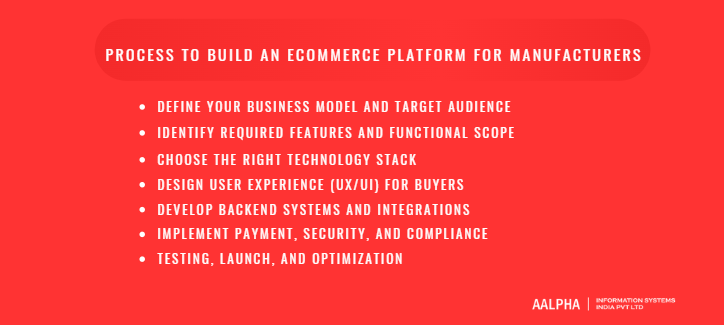
The following process outlines how to build a manufacturer eCommerce platform from strategy to launch, covering both technical and business considerations.
Step 1: Define Your Business Model and Target Audience
The foundation of any manufacturer eCommerce platform begins with a clear understanding of the business model and the target audience. This decision influences every aspect of the platform, including feature requirements, pricing logic, user experience, and technical architecture.
Manufacturers must first determine whether they are building a Direct-to-Consumer (D2C), B2B, or hybrid platform. A D2C model focuses on individual buyers, emphasizing branding, simplified purchasing, and competitive pricing. In contrast, a B2B model prioritizes bulk ordering, negotiated pricing, and long-term relationships with enterprise clients. A hybrid model combines both, requiring the platform to support multiple pricing layers and user roles simultaneously.
Defining the target audience goes beyond identifying who will buy the product. It involves understanding how they purchase, what information they need, and what challenges they face during the buying process. For example, a procurement manager in a manufacturing company may prioritize bulk discounts, detailed specifications, and quick reorder capabilities, while an individual consumer may focus on ease of use and delivery speed.
Another critical consideration is geographic scope. Are you targeting local markets, national distribution, or global customers? This decision impacts logistics, currency support, compliance requirements, and localization.
Manufacturers often ask whether they should replace existing distribution channels or complement them with eCommerce. In most cases, the optimal approach is to build a platform that enhances existing channels rather than disrupts them abruptly.
By clearly defining the business model and audience at the outset, manufacturers create a strong strategic foundation that guides all subsequent decisions in the development process.
Step 2: Identify Required Features and Functional Scope
Once the business model is defined, the next step is to translate business requirements into a clear set of platform features and functionalities. This stage is critical because it determines the scope, complexity, and cost of the project.
Manufacturers must begin by mapping their existing workflows. This includes how products are managed, how orders are processed, how pricing is determined, and how fulfillment is handled. Each of these processes must be reflected in the platform’s functionality.
For example, if the business relies on tiered pricing and minimum order quantities, the platform must include a flexible pricing engine. If customers frequently request quotations before purchasing, a request-for-quote (RFQ) system becomes essential. Similarly, if the business deals with repeat buyers, features such as quick reorder and saved order templates should be prioritized.
It is important to differentiate between essential features and advanced capabilities. Core features include product catalog management, order processing, payment integration, and inventory tracking. Advanced features may include AI-driven recommendations, predictive analytics, or automated pricing optimization.
Another key aspect is scalability. The platform should be designed to accommodate future growth, including increased product volume, higher order frequency, and expansion into new markets.
Manufacturers often underestimate the importance of clearly defined requirements, which leads to scope creep and delays during development. A well-documented functional scope ensures that all stakeholders have a shared understanding of what the platform will deliver.
Step 3: Choose the Right Technology Stack
Selecting the right eCommerce technology stack is a critical decision that directly impacts performance, scalability, and long-term maintainability. Manufacturers must choose between three primary approaches: SaaS platforms, custom-built solutions, and headless commerce architectures.
SaaS platforms offer a faster and more cost-effective way to launch. They provide pre-built features, hosting, and maintenance, making them suitable for businesses with relatively straightforward requirements. However, they may lack the flexibility needed for complex B2B workflows or highly customized pricing models.
Custom-built solutions provide complete control over functionality and user experience. This approach is ideal for manufacturers with unique requirements, complex integrations, or large-scale operations. While the initial investment is higher, custom platforms offer greater flexibility and scalability in the long term.
Headless commerce is an emerging approach that separates the frontend from the backend. This allows manufacturers to deliver highly customized user experiences across multiple channels while maintaining a centralized backend system. It is particularly useful for businesses that require flexibility across web, mobile, and third-party integrations.
In addition to the overall architecture, manufacturers must choose technologies for frontend development, backend services, database management, and infrastructure. Cloud-based infrastructure is often preferred for scalability and reliability.
The key question is not which technology is the most advanced, but which one aligns best with business requirements, budget, and growth plans. A well-chosen technology stack ensures that the platform can evolve without requiring frequent rebuilds.
Step 4: Design User Experience (UX/UI) for Buyers
User experience plays a critical role in the success of a manufacturer eCommerce platform, particularly because the buying journey is often more complex than in traditional retail. Poor UX can lead to abandoned orders, increased support requests, and reduced customer satisfaction.
The design process must start with a deep understanding of user behavior. Business buyers typically prioritize efficiency, accuracy, and speed. They need to find products quickly, access detailed specifications, and complete purchases with minimal friction. Features such as advanced search, filters, and category navigation are essential.
Quick reorder functionality is particularly important in B2B environments, where customers frequently purchase the same products. Allowing users to reorder from previous purchases or upload bulk order lists significantly improves usability.
For bulk ordering, the interface should support large quantities, multiple product selections, and clear pricing breakdowns. Complex pricing structures must be displayed transparently to avoid confusion.
At the same time, D2C users expect a clean and intuitive interface with clear product visuals, simple navigation, and fast checkout.
A well-designed UX balances complexity with simplicity, ensuring that both business and consumer users can complete transactions بسهولة and confidently.
Step 5: Develop Backend Systems and Integrations
The backend is the operational core of a manufacturer eCommerce platform. It connects the front-end interface with critical business systems such as ERP, CRM, inventory management, and logistics.
ERP integration is essential for synchronizing product data, pricing, and order information. Without this integration, manufacturers risk data inconsistencies and operational inefficiencies. For example, inventory levels must be updated in real time to prevent overselling.
CRM integration enables better management of customer relationships, including tracking interactions, managing accounts, and supporting sales teams. This is particularly important for B2B platforms where long-term relationships are a key driver of revenue.
Inventory systems must be tightly integrated to ensure accurate stock levels and efficient order fulfillment. For manufacturers with multiple warehouses or production units, the platform should support distributed inventory management.
Logistics integration ensures that orders are processed and shipped efficiently. This includes connecting with shipping providers, generating tracking information, and managing delivery timelines.
Developing these integrations requires careful planning and testing, as they directly impact the reliability and performance of the platform. A strong backend architecture ensures that the platform operates seamlessly, even as order volumes increase.
Step 6: Implement Payment, Security, and Compliance
Payment, security, and compliance are critical components that directly affect customer trust and platform reliability. Manufacturers must ensure that their platform supports a wide range of payment options while maintaining strict security standards.
Payment systems should accommodate both consumer and business transactions. This includes credit cards, digital wallets, bank transfers, and invoicing. For B2B customers, the platform may also need to support credit terms and partial payments.
Security is a top priority. The platform must protect sensitive data, including customer information and payment details, through encryption, secure authentication, and compliance with industry standards.
Compliance requirements vary depending on the region and industry. Manufacturers selling internationally must consider tax regulations, data protection laws, and cross-border trade requirements.
Failing to address these aspects can lead to financial losses, legal issues, and damage to brand reputation. A secure and compliant platform builds confidence among customers and supports long-term growth.
Step 7: Testing, Launch, and Optimization
The final step involves thorough testing, strategic launch planning, and continuous optimization. Testing ensures that the platform functions correctly across all scenarios, including product browsing, pricing calculations, order processing, and integrations.
Manufacturers should conduct multiple levels of testing, including functional testing, performance testing, and user acceptance testing. This helps identify and resolve issues before the platform goes live.
The launch phase should be carefully planned to minimize risk. Some manufacturers choose a phased rollout, starting with a limited audience or specific product categories before expanding to the full market.
Once the platform is live, optimization becomes an ongoing process. Manufacturers must monitor performance metrics such as conversion rates, order volume, and customer behavior. Insights from analytics can be used to refine the user experience, improve pricing strategies, and optimize inventory management.
Building an eCommerce platform is not a one-time effort. It requires continuous improvement to adapt to changing market conditions and customer expectations. Manufacturers that invest in ongoing optimization are better positioned to achieve sustainable growth and long-term success.
Cost of Building an eCommerce Platform for Manufacturers
The cost of building an eCommerce platform for manufacturers varies significantly based on business requirements, platform complexity, and long-term scalability goals. Unlike standard retail eCommerce websites, manufacturer platforms require advanced features such as bulk ordering, custom pricing, ERP integration, and multi-user account management. These requirements directly influence both initial development costs and ongoing operational expenses.
A common question is whether it is better to start with a lower-cost solution or invest in a scalable system from the beginning. The answer depends on business maturity, transaction volume, and the level of customization required. Understanding the cost structure across different approaches helps manufacturers make informed investment decisions.
-
Cost Based on Platform Type
The total cost of building a manufacturer eCommerce platform largely depends on the type of platform chosen. The three primary approaches are SaaS, custom-built solutions, and headless commerce architectures, each with distinct cost implications.
SaaS platforms are the most cost-effective option for initial deployment. These platforms operate on a subscription model, typically ranging from $50 to $2,000+ per month depending on features and scale. They offer pre-built functionalities, hosting, and maintenance, which significantly reduces development time and upfront investment. However, customization is limited, and additional costs may arise from plugins, transaction fees, and third-party integrations. For manufacturers with simple requirements or those testing digital channels, SaaS provides a quick entry point.
Custom-built platforms require a higher upfront investment but offer complete flexibility. Development costs typically range from $30,000 to $150,000+ depending on complexity, features, and integrations. This approach is suitable for manufacturers with unique workflows, complex pricing models, or large-scale operations. While the initial cost is higher, custom platforms eliminate dependency on third-party limitations and provide long-term scalability.
Headless commerce architectures fall between SaaS and fully custom solutions in terms of cost and flexibility. They separate the frontend from the backend, allowing manufacturers to create highly customized user experiences while leveraging existing backend systems. Costs generally range from $50,000 to $200,000+, depending on implementation complexity. This approach is ideal for businesses that require multi-channel capabilities and advanced customization without rebuilding core systems from scratch.
Choosing the right platform type is not just a cost decision; it is a strategic choice that affects scalability, performance, and long-term operational efficiency.
-
Feature-Based Cost Breakdown
Beyond the platform type, the cost of development is heavily influenced by the features included in the system. Each feature adds complexity in terms of design, development, and integration, which directly impacts the overall budget.
Product catalog management is one of the foundational features. For manufacturers with large inventories and complex product variations, building a robust catalog system can cost between $5,000 and $15,000. This includes bulk upload capabilities, variant handling, and specification management.
Advanced pricing systems significantly increase development complexity. Features such as tiered pricing, customer-specific pricing, and minimum order quantities may add $8,000 to $25,000 depending on the level of customization required.
Order management systems (OMS) and workflow automation typically cost between $10,000 and $30,000. This includes order tracking, status management, and integration with fulfillment processes.
Inventory and warehouse management integration can range from $5,000 to $20,000, depending on whether the system needs to support multiple warehouses or real-time synchronization with ERP systems.
User account management, especially for B2B platforms with role-based access and company accounts, may add another $5,000 to $15,000.
Payment and logistics integrations generally cost between $3,000 and $10,000 each, depending on the number of providers and the complexity of implementation.
Analytics and reporting dashboards can range from $3,000 to $10,000, depending on the level of data visualization and customization required.
It is important to note that these costs are cumulative. As more advanced features are added, the overall project cost increases significantly. Manufacturers must prioritize features based on business needs to avoid unnecessary expenses while ensuring that core functionalities are fully supported.
-
Ongoing Maintenance and Scaling Costs
Building the platform is only the initial investment. Ongoing maintenance and scaling costs are critical for ensuring long-term performance, security, and growth.
Monthly maintenance costs typically range from $500 to $5,000+ depending on the platform size and complexity. This includes server hosting, performance monitoring, security updates, bug fixes, and minor feature enhancements. Cloud infrastructure costs may increase as traffic and transaction volume grow.
Scaling costs become relevant as the business expands. Increased order volume, additional product listings, and new market entry may require infrastructure upgrades, database optimization, and enhanced integrations. These costs can vary widely but should be planned as part of long-term budgeting.
Continuous improvement is another factor. Manufacturers often need to add new features, optimize user experience, or integrate with additional systems over time. Allocating a budget for ongoing development ensures that the platform remains competitive and aligned with evolving business needs.
Ignoring maintenance and scaling costs can lead to performance issues, security vulnerabilities, and reduced customer satisfaction. A sustainable approach involves planning for both initial development and long-term operational expenses from the outset.
How to Choose the Right Development Partner
Selecting the right eCommerce development company is one of the most critical decisions when building an eCommerce platform for manufacturers. The complexity of manufacturing workflows, pricing models, and system integrations means that not every development company is equipped to handle such projects effectively.
A common mistake is choosing a vendor based solely on cost or generic eCommerce experience. Manufacturer platforms require deep domain understanding, the ability to handle enterprise-grade integrations, and a long-term approach to product evolution. The right partner does not just build the platform; they act as a strategic collaborator who understands your business model, anticipates challenges, and ensures scalability.
Manufacturers often ask what criteria should guide this decision. The answer lies in evaluating a combination of industry experience, technical capability, operational understanding, and long-term support. The following factors provide a structured approach to selecting the right development partner.
-
Experience with B2B and Manufacturing Systems
Experience in B2B and manufacturing environments is essential because these platforms operate very differently from standard retail eCommerce systems. A development partner with prior experience in manufacturing understands the nuances of bulk ordering, tiered pricing, and account-based purchasing.
For example, B2B platforms often require features such as request-for-quote workflows, negotiated pricing, minimum order quantities, and multi-user company accounts. A team without this experience may underestimate the complexity involved, leading to delays, rework, or incomplete functionality.
Manufacturing systems also involve handling large product catalogs with detailed specifications, compliance requirements, and multiple variants. Developers must be familiar with structuring such data efficiently to ensure usability and performance.
Another important aspect is integration with existing systems such as ERP, CRM, and inventory management tools. A partner with relevant experience will already understand common integration challenges and best practices, reducing implementation risk.
Manufacturers should review case studies, past projects, and client references to validate whether the development partner has successfully delivered similar solutions. Choosing a partner with proven expertise significantly increases the likelihood of building a platform that meets both technical and business requirements.
-
Understanding of Supply Chain Workflows
An effective eCommerce platform for manufacturers must align closely with supply chain operations. This includes inventory management, order fulfillment, production scheduling, and logistics coordination. A development partner must understand how these processes interact and how they should be reflected within the platform.
For instance, inventory availability may depend on production cycles rather than static stock levels. Similarly, order fulfillment may involve multiple warehouses, partial shipments, or made-to-order products. These complexities must be accurately represented in the system to avoid operational inefficiencies.
A partner who understands supply chain workflows can design systems that reduce friction, automate processes, and improve visibility across the entire order lifecycle. This ensures that the platform is not just a sales tool but an integrated part of the business operation.
-
Technical Expertise and Scalability
Technical capability is a foundational requirement, but it must go beyond basic development skills. The partner should be proficient in building scalable, secure, and high-performance systems that can handle increasing traffic, large product catalogs, and complex transactions.
Scalability is particularly important for manufacturers planning long-term growth. The platform should be able to support new features, additional integrations, and expansion into new markets without requiring a complete rebuild. This requires expertise in modern architectures, cloud infrastructure, and modular development approaches.
The partner should also have experience working with different technology stacks and be able to recommend the most suitable approach based on business needs rather than pushing a one-size-fits-all solution.
A technically strong partner ensures that the platform remains stable, adaptable, and future-ready.
-
Long-Term Support and Maintenance
Building the platform is only the beginning. Ongoing support and maintenance are essential to ensure that the system continues to perform reliably as the business evolves. A good development partner provides continuous support, including bug fixes, performance optimization, security updates, and feature enhancements.
Manufacturers should evaluate whether the partner offers structured support plans and has the capacity to handle long-term collaboration. This includes clear communication processes, defined response times, and a proactive approach to system improvements.
Working with experienced development companies that specialize in building scalable eCommerce and enterprise platforms, such as Aalpha, can provide an added advantage. These partners bring not only technical expertise but also a strategic understanding of how to evolve the platform in line with business growth.
Choosing a partner with a long-term perspective ensures that the platform remains competitive, secure, and aligned with changing market demands.
Future Trends in Manufacturer eCommerce
Manufacturer eCommerce is evolving rapidly as digital transformation moves from optional to essential. The next phase of growth is not just about selling online but about building intelligent, connected, and scalable commerce ecosystems. Emerging technologies are reshaping how manufacturers price products, manage demand, integrate operations, and reach global markets.
A key question many manufacturers are asking is how to stay competitive in an environment where buyers expect speed, transparency, and personalization. The answer lies in adopting technologies and models that enable automation, flexibility, and data-driven decision-making. The following trends highlight where manufacturer eCommerce is heading and what businesses should prepare for in the coming years.
-
AI-Powered Pricing and Demand Forecasting
Artificial intelligence is transforming how manufacturers approach pricing and demand planning. Instead of relying on static pricing models or historical assumptions, AI systems analyze real-time data such as customer behavior, market trends, and inventory levels to optimize pricing dynamically.
For example, manufacturers can adjust prices based on demand fluctuations, competitor activity, or order volume, ensuring maximum profitability without losing competitiveness. Similarly, demand forecasting models can predict future sales patterns with higher accuracy, helping manufacturers align production schedules and inventory levels.
This reduces overproduction, minimizes stockouts, and improves overall operational efficiency. As data availability increases, AI-driven decision-making will become a standard capability rather than a competitive advantage.
-
Headless and Composable Commerce
Headless and composable commerce architectures are gaining traction as manufacturers seek greater flexibility and scalability. In this approach, the frontend user experience is separated from the backend commerce engine, allowing businesses to customize interfaces across web, mobile, and other digital channels without altering core systems.
Composable commerce takes this further by enabling manufacturers to build platforms using modular components, such as separate services for pricing, inventory, and checkout. This allows businesses to adapt quickly to changing requirements without rebuilding the entire system.
For manufacturers operating across multiple markets or channels, this flexibility is critical. It enables faster innovation, easier integration with third-party tools, and the ability to deliver consistent experiences across all customer touchpoints.
-
Integration with IoT and Smart Manufacturing
The integration of eCommerce platforms with IoT and smart manufacturing systems is creating a more connected and automated ecosystem. Machines, sensors, and production systems can generate real-time data that feeds directly into the eCommerce platform.
For example, inventory levels can be updated automatically based on production output, while predictive maintenance systems can prevent disruptions in supply. In some cases, connected devices can even trigger automatic reorders when stock reaches a certain threshold.
This level of integration improves visibility across the supply chain and enables more responsive operations. Manufacturers can align production with real-time demand, reduce downtime, and improve delivery accuracy.
As Industry 4.0 adoption increases, the connection between manufacturing systems and eCommerce platforms will become more seamless and essential.
-
Global B2B Marketplaces Growth
Global B2B marketplaces are expanding rapidly, providing manufacturers with new opportunities to reach international buyers. These platforms aggregate suppliers and buyers in a single ecosystem, making it easier for businesses to discover products, compare options, and complete transactions.
For manufacturers, participating in or building marketplace capabilities can significantly increase visibility and sales volume. It also reduces the barriers to entering new markets, as the platform often handles aspects such as payments, logistics, and compliance.
At the same time, competition within these marketplaces is increasing, making differentiation more important. Manufacturers must focus on product quality, pricing strategies, and customer experience to stand out.
The growth of global B2B marketplaces signals a shift toward more interconnected commerce networks, where manufacturers can scale beyond traditional boundaries and access a broader customer base.
Conclusion
Building an eCommerce platform for manufacturers is a strategic move that goes beyond simply selling online. It enables direct customer relationships, better margin control, improved operational efficiency, and long-term scalability. From choosing the right business model to implementing advanced features and integrations, every step plays a critical role in creating a platform that supports real-world manufacturing workflows.
As digital adoption accelerates, manufacturers that invest in robust, scalable eCommerce systems will be better positioned to compete, expand globally, and respond quickly to changing market demands.
If you are planning to build a scalable manufacturer eCommerce platform with advanced B2B capabilities and seamless integrations, partnering with an experienced development team can significantly reduce risk and accelerate time to market. Aalpha helps manufacturers design and develop custom eCommerce solutions tailored to complex business needs. Contact now to discuss your requirements and get a tailored solution.