


Software development costs in Australia are among the highest globally, but they reflect a mature, highly skilled technology ecosystem with strong regulatory standards, advanced infrastructure, and experienced engineering talent. For businesses evaluating whether to build software locally or explore offshore alternatives, understanding how pricing works in the Australian market is essential for making informed investment decisions.
At its core, software development cost in Australia is determined by several key variables. The most influential factor is project scope and complexity. A simple web application with limited features may require only a few hundred development hours, while a scalable SaaS platform or AI-driven system can demand thousands of hours across multiple teams. The type of software, including mobile apps, enterprise systems, or machine learning platforms, significantly impacts cost due to varying technical requirements. Additionally, team composition plays a critical role. Hiring senior engineers, UI/UX designers, DevOps specialists, and project managers increases quality but also raises overall cost. Other contributing factors include technology stack, third-party integrations, compliance requirements, and ongoing maintenance.
Australia is widely considered a premium software development market due to its high labor costs, strict compliance standards, and strong demand for digital transformation across industries. Developer salaries in cities like Sydney and Melbourne are substantially higher than global averages, often exceeding those in regions such as Eastern Europe or Southeast Asia. However, this premium is often justified by higher code quality, better communication, adherence to international standards, and reduced project risk. For industries such as healthcare, fintech, and enterprise SaaS, where compliance and reliability are critical, Australian development teams are often preferred despite the higher cost.
When looking at typical price ranges, businesses can expect to pay anywhere between AUD 80 to AUD 200 per hour depending on the developer’s experience and the engagement model. A basic application may cost between AUD 20,000 to AUD 50,000, while mid-level custom software projects often range from AUD 50,000 to AUD 150,000. More complex platforms, such as enterprise systems or AI-powered applications, can exceed AUD 250,000 to AUD 500,000 or more. These ranges vary significantly based on requirements, timelines, and technical complexity.
This guide is designed for a wide audience, including startups validating an MVP idea, small and medium-sized businesses modernizing operations, and enterprises investing in large-scale digital platforms. It is equally relevant for CTOs and product leaders who need to justify budgets, compare vendor options, and align technology investments with business outcomes.
Compared to global markets, Australia sits at the higher end of the pricing spectrum. Development costs are generally comparable to the United States and higher than the UK, while significantly exceeding costs in India and Eastern Europe. For example, while an Australian developer may charge AUD 120 per hour, a similar developer in India might charge between AUD 30 to AUD 60 per hour. This gap explains why many companies adopt a hybrid approach, combining local strategy and architecture with offshore development execution.
Understanding these dynamics is the first step toward accurately estimating your software budget and choosing the right development strategy.
Average Software Development Costs in Australia
Understanding the average cost of software development in Australia requires looking beyond a single price point. Costs vary significantly based on developer expertise, project type, and engagement model. Businesses often ask, “How much does it actually cost to build software in Australia?” The most accurate answer is that pricing typically ranges from AUD 20,000 for basic applications to over AUD 500,000 for complex enterprise or AI systems, with hourly development rates forming the foundation of these estimates.
This section breaks down costs from three practical angles: hourly rates, project types, and engagement models, giving you a clear framework to estimate your own budget.
-
Hourly Rates of Developers in Australia
Developer hourly rates in Australia are among the highest globally, reflecting both the cost of living and the maturity of the tech ecosystem. Rates vary primarily based on experience level and hiring model.
At the entry level, junior developers typically charge between AUD 80 to AUD 110 per hour. These developers are suitable for simple tasks, maintenance work, or supporting roles within larger projects. While cost-effective, they usually require supervision and structured guidance.
Mid-level developers fall in the range of AUD 110 to AUD 150 per hour. They can independently handle standard application features, API integrations, and moderate complexity systems. Most small to mid-sized projects rely heavily on mid-level engineers to balance cost and productivity.
At the higher end, senior developers command AUD 150 to AUD 200+ per hour, especially in specialized areas such as cloud architecture, cybersecurity, or AI/ML. These professionals bring deep expertise, make architectural decisions, and significantly reduce long-term technical risk.
The hiring model also impacts pricing. Freelancers are generally the most affordable option, often charging slightly below agency rates, but they may lack scalability and structured processes. Agencies typically charge a premium, often AUD 120 to AUD 220 per hour, as they provide end-to-end services including design, development, testing, and project management. This model reduces operational burden for clients and improves delivery consistency.
In-house teams, while not billed hourly in the traditional sense, are often the most expensive option when considering salaries, benefits, infrastructure, and hiring costs. A senior developer’s annual salary in Australia can exceed AUD 120,000 to AUD 160,000, making long-term internal teams a significant investment.
-
Cost by Project Type
The type of software being developed is one of the most reliable ways to estimate total cost. Each category comes with its own level of complexity, required expertise, and development timeline.
A basic application, such as a simple website, internal tool, or MVP with limited features, typically costs between AUD 20,000 and AUD 50,000. These projects usually include basic UI, minimal backend logic, and limited integrations. They are often built within 2 to 3 months and are ideal for early-stage startups testing an idea.
For custom enterprise software, costs increase significantly due to scalability, security, and integration requirements. These systems often range from AUD 100,000 to AUD 300,000 or more. Enterprise projects may include complex workflows, role-based access, ERP or CRM integrations, and compliance requirements. Development timelines can extend from 6 months to over a year.
A SaaS platform typically falls between AUD 80,000 and AUD 250,000, depending on features such as multi-tenancy, subscription management, dashboards, and analytics. SaaS development requires careful planning around scalability, performance, and user experience, which contributes to higher costs compared to basic applications.
For AI-powered systems, such as recommendation engines, chatbots, or predictive analytics platforms, costs often start at AUD 150,000 and can exceed AUD 500,000. These projects require specialized expertise in machine learning, data engineering, and model deployment. Additional costs may include data acquisition, model training infrastructure, and ongoing optimization.
The key insight is that cost scales non-linearly with complexity. Adding advanced features like real-time processing, automation, or AI capabilities can dramatically increase both development time and budget.
-
Cost by Engagement Model
Beyond hourly rates and project type, the engagement model plays a critical role in determining how costs are structured and controlled.
The fixed price model is best suited for well-defined projects with clear requirements. In this model, the development company provides a predetermined cost and timeline. While this offers budget predictability, it limits flexibility. Any changes in scope can lead to additional costs, making it less suitable for evolving products.
The time and material (T&M) model is widely used for dynamic projects where requirements are expected to evolve. Clients are billed based on actual hours worked, typically aligned with the hourly rates discussed earlier. This model provides flexibility and transparency, making it ideal for startups and iterative product development. However, it requires strong project management to prevent cost overruns.
The dedicated team model involves hiring a full team of developers, designers, and project managers for a monthly fee. This approach is common for long-term projects and scaling businesses. Monthly costs can range from AUD 25,000 to AUD 80,000+, depending on team size and expertise. While this model offers the highest level of control and scalability, it also requires ongoing commitment and management.
Choosing the right engagement model often determines whether a project stays within budget. Businesses building an MVP may prefer fixed pricing for predictability, while companies developing complex platforms often rely on T&M or dedicated teams for flexibility and long-term growth.
This breakdown provides a realistic view of software development costs in Australia. Rather than relying on generic estimates, businesses should evaluate their specific requirements, complexity, and growth plans to arrive at an accurate budget.
Software Development Cost by Project Complexity
One of the most accurate ways to estimate software development cost in Australia is by evaluating project complexity rather than just features or timelines. Two applications with similar user interfaces can have vastly different costs depending on backend logic, scalability requirements, integrations, and data processing needs. This is why businesses often ask, “Why does one app cost AUD 30,000 while another costs AUD 300,000?” The answer lies in complexity.
In the Australian market, where hourly rates are high, complexity directly translates into development hours, team size, and technical expertise required. This section breaks down software into three practical categories: simple, medium, and complex systems.
-
Simple Software
Simple software represents entry-level applications with limited functionality and minimal technical challenges. These projects are typically built for startups validating ideas, small businesses digitizing operations, or internal tools designed for specific workflows.
A simple application usually includes basic features such as user login, static pages, simple forms, and limited backend processing. There is little to no requirement for real-time updates, advanced security layers, or complex integrations. Examples include landing pages with basic functionality, small business websites with admin panels, appointment booking tools, or MVP versions of mobile apps.
In terms of timeline, simple software projects in Australia typically take 4 to 8 weeks to complete, depending on design requirements and feedback cycles. The development team is usually small, often consisting of a frontend developer, a backend developer, and occasionally a designer.
The typical cost range for simple software development in Australia falls between AUD 20,000 and AUD 50,000. This estimate assumes a relatively straightforward build with minimal revisions. Costs can increase if custom UI/UX design is required or if the project includes mobile app development alongside a web interface.
What makes simple software cost-effective is the absence of advanced architecture. There is no need for microservices, distributed systems, or complex database optimization. However, businesses should be cautious not to oversimplify requirements. Even small additions such as payment gateway integration, user analytics, or third-party APIs can quickly move a project into the medium complexity category.
Simple software is ideal for answering questions like: can this idea work in the market? It allows companies to test demand without committing to large budgets. However, these systems are rarely built for scale, meaning they often require redevelopment or significant upgrades as the business grows.
-
Medium Complexity Software
Medium complexity software is where most commercial applications fall. These systems go beyond basic functionality and introduce dynamic features, integrations, and structured data workflows. This category is common for growing startups, SaaS businesses, and SMEs building customer-facing platforms.
Typical features include interactive dashboards, user roles and permissions, API integrations, payment systems, notifications, and moderate data processing. For example, an eCommerce platform with inventory management, a SaaS tool with subscription billing, or a logistics dashboard with reporting capabilities would fall into this category.
One defining characteristic of medium complexity software is its reliance on third-party integrations. These may include payment gateways, CRM systems, analytics tools, or cloud services. Each integration adds both development time and testing overhead, contributing to higher costs.
The timeline for medium complexity projects usually ranges from 3 to 6 months, depending on scope and iteration cycles. The development team is larger and more specialized, often including frontend and backend developers, a UI/UX designer, a QA engineer, and a project manager.
In Australia, the cost for medium complexity software typically ranges between AUD 50,000 and AUD 150,000, although more feature-rich platforms can exceed this range. The increase in cost is driven by additional development hours, more sophisticated architecture, and the need for robust testing.
Another important factor is data handling and performance optimization. Unlike simple applications, these systems must handle concurrent users, ensure data consistency, and maintain acceptable performance under load. This requires better infrastructure planning and more experienced developers.
Medium complexity software is often the stage where businesses transition from experimentation to growth. It answers questions like: how can we scale this product and serve real customers efficiently? As a result, the focus shifts from speed of development to reliability and user experience.
-
Complex Software
Complex software represents the highest tier of development, involving advanced technologies, large-scale architecture, and high performance requirements. These systems are typically built by enterprises or well-funded startups aiming to create scalable, long-term platforms.
Key characteristics include AI and machine learning capabilities, real-time data processing, multi-system integrations, high concurrency handling, and distributed architecture. Examples include fintech platforms, healthcare systems with compliance requirements, real-time logistics tracking systems, or AI-powered recommendation engines.
These projects require deep expertise across multiple domains, including backend architecture, cloud infrastructure, data engineering, and security. Teams often include senior developers, solution architects, DevOps engineers, data scientists, and QA specialists.
The development timeline for complex software typically ranges from 6 months to 12+ months, with ongoing iterations even after the initial launch. Unlike simpler systems, these platforms are rarely “completed” in a single phase. They evolve continuously as new features, optimizations, and integrations are added.
Cost-wise, complex software development in Australia usually starts at AUD 150,000 and can exceed AUD 500,000 or more, depending on scale and requirements. AI-driven systems, in particular, can significantly increase costs due to the need for data collection, model training, and infrastructure for processing large datasets.
A major cost driver in this category is scalability and reliability. Systems must be designed to handle thousands or even millions of users without performance degradation. This involves advanced architecture patterns such as microservices, load balancing, and distributed databases.
Security and compliance also play a critical role. Industries like healthcare and finance require strict adherence to regulations, which adds layers of complexity in both development and testing.
Complex software is built to answer questions such as: how do we scale globally, handle large datasets, and deliver high-performance user experiences? These systems represent long-term investments and are often central to a company’s core business operations.
By categorizing software based on complexity, businesses can more accurately estimate development costs and avoid under-budgeting. The key takeaway is that cost is not just about features but about the depth of engineering required to support those features at scale.
Key Factors That Affect Software Development Cost in Australia
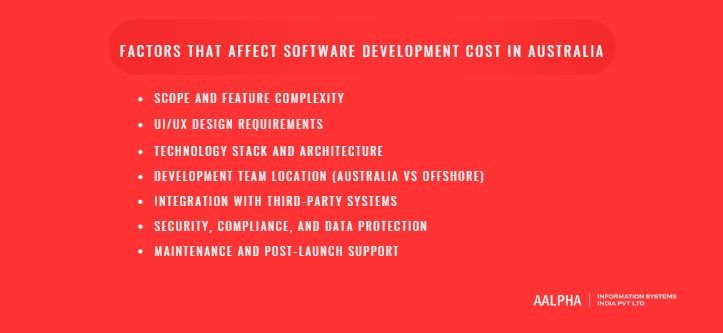
Software development cost in Australia is not determined by a single variable. It is the result of multiple interdependent factors that influence development hours, team structure, infrastructure, and long-term scalability. Businesses often underestimate costs because they focus only on visible features while ignoring underlying technical requirements. A clear understanding of these cost drivers allows decision-makers to budget accurately, avoid scope creep, and choose the right development strategy.
-
Scope and Feature Complexity
The most significant factor affecting software development cost is scope and feature complexity. Every feature added to a product increases development time, testing requirements, and system dependencies. A simple login system may take a few hours, while implementing role-based access control with permissions, audit logs, and security layers can take several days or even weeks.
Complexity grows not just with the number of features, but with how those features interact. For example, adding real-time notifications, analytics dashboards, or multi-user collaboration requires backend logic, database optimization, and frontend synchronization. These interdependencies multiply effort and increase the likelihood of bugs, requiring more rigorous testing.
In the Australian market, where developer hourly rates are high, even small increases in scope can significantly impact cost. A project that starts as a basic MVP can quickly move into a higher cost bracket if additional features are introduced mid-development. This is why clearly defining requirements early is critical.
Businesses that prioritize essential features and adopt a phased development approach typically control costs more effectively. Instead of building everything at once, they focus on delivering core functionality first and expanding based on user feedback.
-
UI/UX Design Requirements
UI/UX design plays a crucial role in both user adoption and development cost. A basic interface with standard components is relatively inexpensive to implement. However, custom, high-end design significantly increases effort across both design and development phases.
Advanced UI/UX requirements include custom animations, micro-interactions, responsive layouts across devices, and accessibility compliance. Each of these elements requires additional design iterations, prototyping, and frontend engineering. For example, designing a seamless mobile experience with gesture-based interactions takes considerably more time than building a static web interface.
In Australia, where businesses often prioritize premium digital experiences, design expectations are high. This leads to increased collaboration between designers and developers, extending timelines and raising costs.
Well-designed UI/UX can improve conversion rates, reduce churn, and enhance brand perception, making it a valuable investment. However, over-designing early-stage products can lead to unnecessary expenses. A practical approach is to start with functional design and refine the experience as the product matures.
-
Technology Stack and Architecture
The choice of technology stack and system architecture has a direct impact on development cost, scalability, and long-term maintenance. Different technologies require different levels of expertise, and in Australia, specialized skills often come at a premium.
For example, building a standard web application using widely adopted frameworks is generally more cost-effective than developing a system using niche or emerging technologies. Similarly, choosing between a monolithic architecture and a microservices-based system can significantly influence cost. While microservices offer scalability and flexibility, they require more development effort, infrastructure management, and coordination between services.
Cloud infrastructure decisions also play a role. Platforms such as AWS, Azure, or Google Cloud provide scalability but introduce additional configuration, monitoring, and cost management requirements. These factors increase both initial development and ongoing operational costs.
Another consideration is future scalability. Systems designed for rapid growth require more upfront planning, which increases initial cost but reduces the need for costly rework later. Businesses often face a trade-off between building quickly and building for scale.
Choosing the right technology stack is not just a technical decision. It is a strategic one that affects both short-term budget and long-term sustainability.
-
Development Team Location (Australia vs Offshore)
One of the most debated cost factors is team location. Australian developers are among the highest paid globally, with hourly rates significantly exceeding those in offshore markets such as India, Southeast Asia, or Eastern Europe.
Hiring a local Australian team provides advantages such as better communication, time zone alignment, cultural understanding, and adherence to local regulations. This often leads to smoother collaboration and fewer misunderstandings, which can reduce project risk.
However, the cost difference is substantial. While Australian developers may charge AUD 100 to AUD 200 per hour, offshore developers can charge AUD 30 to AUD 80 per hour for similar technical capabilities. This cost gap is the primary reason many companies adopt outsourcing or hybrid models.
Offshore development introduces its own challenges, including communication barriers, time zone differences, and quality variability. Without proper management, these issues can lead to delays and rework, offsetting initial cost savings.
A common strategy is to combine both approaches. Businesses use Australian teams for product strategy, architecture, and client communication, while leveraging offshore teams for execution. This hybrid model balances cost efficiency with quality control.
-
Integration with Third-Party Systems
Modern software rarely operates in isolation. Most applications require integration with third-party systems such as payment gateways, CRM platforms, analytics tools, or external APIs. Each integration adds complexity, development time, and potential points of failure.
For example, integrating a payment gateway involves not only API implementation but also security considerations, error handling, and compliance with financial regulations. Similarly, connecting to external data sources may require data transformation, synchronization, and ongoing maintenance.
In Australia, where businesses often rely on multiple SaaS tools, integration requirements can significantly increase project scope. Each additional system introduces dependencies that must be managed throughout the software lifecycle.
Testing also becomes more complex. Developers must ensure that integrations work reliably under different conditions, including network failures or API changes. This increases both development and QA effort.
While integrations add cost, they also enhance functionality and reduce the need to build features from scratch. The key is to carefully evaluate which integrations are essential and avoid unnecessary dependencies.
-
Security, Compliance, and Data Protection
Security and compliance are critical cost drivers, especially for industries such as healthcare, fintech, and enterprise software. In Australia, businesses must comply with strict regulations related to data privacy, cybersecurity, and user protection.
Implementing security features such as encryption, secure authentication, role-based access control, and audit logging requires additional development effort. Compliance requirements may also involve data storage restrictions, regular security audits, and documentation.
For example, applications handling sensitive user data must adhere to standards such as the Australian Privacy Act. This often requires secure data handling practices, consent management systems, and breach notification mechanisms.
These requirements increase both development time and cost, but they are non-negotiable for many industries. Failing to meet compliance standards can result in legal penalties, reputational damage, and loss of customer trust.
Security should not be treated as an afterthought. Incorporating it early in the development process is more cost-effective than retrofitting it later.
-
Maintenance and Post-Launch Support
Software development does not end at launch. Maintenance and post-launch support are ongoing costs that must be factored into the overall budget. Many businesses underestimate this phase, focusing only on initial development.
Post-launch activities include bug fixes, performance optimization, feature updates, and infrastructure management. As user demand grows, systems may require scaling, which introduces additional costs for cloud resources and monitoring tools.
In Australia, software maintenance costs typically range from 15% to 25% of the initial development cost annually. This includes developer time, server costs, and support services.
Regular updates are essential to keep software secure and competitive. Technologies evolve, user expectations change, and new vulnerabilities emerge. Without continuous maintenance, even well-built software can become outdated or insecure.
Businesses should plan for long-term investment rather than treating development as a one-time expense. A well-maintained system delivers better performance, higher user satisfaction, and longer lifespan, ultimately providing a stronger return on investment.
Understanding these factors allows businesses to move from rough estimates to realistic budgeting. Software development cost in Australia is not just about hourly rates but about how these variables combine to shape the overall scope, complexity, and long-term value of the product.
Hidden Costs in Software Development
When businesses estimate software development costs, they often focus only on visible expenses such as developer hourly rates and initial build costs. However, a significant portion of the total investment lies in hidden or overlooked costs that emerge during development and after launch. These costs are not optional; they are essential for ensuring performance, reliability, and long-term sustainability.
Understanding these hidden components is critical for accurate budgeting. Many projects exceed their initial estimates not because of poor planning, but because these underlying costs were not fully accounted for. This section breaks down the most common hidden costs that directly impact software development in Australia.
-
Infrastructure and Cloud Hosting Costs
Infrastructure is the foundation on which your software runs, and it represents a recurring expense that scales with usage. Most modern applications rely on cloud platforms such as AWS, Azure, or Google Cloud for hosting, storage, and computing power.
In the early stages, infrastructure costs may appear minimal, often ranging from AUD 100 to AUD 500 per month for small applications. However, as user traffic increases, these costs can grow rapidly. High-traffic applications, real-time systems, or data-intensive platforms may incur monthly costs of AUD 2,000 to AUD 10,000 or more.
Key cost drivers include server usage, database storage, bandwidth, and content delivery networks (CDNs). Additional services such as backups, monitoring, and load balancing further increase expenses.
Businesses often underestimate how quickly infrastructure costs scale. A product that gains traction can see exponential growth in hosting expenses, especially if not optimized early. Proper architecture planning and cost monitoring are essential to prevent unexpected financial strain.
-
Licensing and Third-Party Tools
Most modern software products depend on third-party tools to accelerate development and enhance functionality. These tools include payment gateways, analytics platforms, CRM systems, communication APIs, and development libraries.
While some tools offer free tiers, many operate on subscription-based pricing models. Costs can range from AUD 50 to AUD 1,000+ per month per tool, depending on usage and features. For example, payment processors charge transaction fees, while analytics platforms may charge based on data volume.
Over time, these subscriptions accumulate and become a significant operational expense. Businesses often adopt multiple tools during development without fully evaluating long-term costs.
Another consideration is vendor dependency. Relying heavily on third-party services can create lock-in, making it difficult or costly to switch providers later. A strategic approach involves selecting tools that balance functionality, scalability, and cost efficiency.
-
Testing and Quality Assurance
Testing and quality assurance (QA) are often underestimated in early cost projections, yet they are essential for delivering reliable software. Without proper testing, applications are prone to bugs, performance issues, and security vulnerabilities.
QA involves multiple layers, including manual testing, automated testing, performance testing, and security validation. Each layer requires time, tools, and specialized expertise. In Australia, QA engineers typically charge rates similar to developers, adding to overall project cost.
Testing is not a one-time activity. It occurs throughout the development lifecycle and intensifies before launch. Complex systems with multiple integrations require extensive testing to ensure stability under different conditions.
Skipping or minimizing QA may reduce initial costs, but it often leads to higher expenses later due to bug fixes, downtime, and user dissatisfaction. Investing in thorough testing upfront is more cost-effective than addressing issues post-launch.
-
Project Management Overhead
Project management is a critical but often overlooked cost component. Coordinating developers, designers, stakeholders, and timelines requires dedicated effort to ensure the project stays on track.
Project managers handle tasks such as planning, resource allocation, communication, risk management, and progress tracking. In agency settings, project management is typically included in hourly rates, but it still contributes significantly to the overall cost.
In Australia, project management can account for 10% to 20% of the total development cost, depending on project size and complexity. Larger projects with multiple stakeholders require more coordination, increasing overhead.
Without effective project management, projects are more likely to experience delays, scope creep, and budget overruns. Clear communication and structured workflows reduce inefficiencies and improve delivery outcomes.
-
Scaling and Performance Optimization
Scaling and performance optimization are often overlooked during initial development but become critical as the user base grows. Software that performs well with 100 users may fail under the load of 10,000 users if not designed for scalability.
Optimization involves improving database performance, reducing latency, implementing caching strategies, and upgrading infrastructure. These activities require additional development effort and specialized expertise.
In Australia, scaling costs can vary widely depending on system complexity. For high-growth applications, performance optimization can add AUD 10,000 to AUD 50,000+ in development costs, along with increased infrastructure expenses.
Another hidden factor is technical debt. Systems built quickly without scalability in mind often require rework, which can be more expensive than building correctly from the start.
Businesses should anticipate growth and design systems that can scale efficiently. While this increases initial cost, it prevents major disruptions and expensive rebuilds in the future.
Accounting for these hidden costs provides a more realistic view of software development investment. Rather than treating development as a one-time expense, businesses should approach it as an ongoing commitment that includes infrastructure, tools, quality assurance, and continuous improvement.
Cost Comparison: Australia vs Other Countries
One of the most common questions businesses ask before starting a software project is: Should we build locally in Australia or outsource to another country? The answer depends on balancing cost, quality, communication, and risk. Australia is widely regarded as a premium market, but understanding how it compares to other regions helps decision-makers choose the right strategy.
Globally, software development pricing varies based on labor costs, talent availability, and economic conditions. Australia sits at the higher end of the spectrum, but it offers advantages in quality, compliance, and collaboration that are not always available in lower-cost regions.
-
Australia vs USA
Australia and the United States are often compared because both are mature, high-cost software development markets. In the US, developer hourly rates typically range between USD 100 to USD 250+ (approximately AUD 150 to AUD 380) depending on location and expertise. In comparison, Australian developers generally charge between AUD 80 to AUD 200 per hour.
This makes Australia slightly more affordable than the US on average, particularly when compared to major tech hubs like San Francisco or New York, where rates are significantly higher due to intense competition for talent.
However, the difference is not just about cost. Both countries offer high-quality engineering standards, strong communication, and advanced technical expertise. Businesses operating in regulated industries such as healthcare or fintech often find both markets equally capable in terms of compliance and security.
Where Australia can offer an advantage is cost efficiency relative to quality. Companies can achieve similar outcomes at a somewhat lower cost compared to US-based teams. Time zone differences also matter. For businesses in Asia-Pacific regions, Australia provides better alignment than the US, reducing communication delays.
For global companies, the decision often comes down to proximity and budget. While the US remains the most expensive option, Australia presents a slightly more cost-effective alternative without compromising on quality.
-
Australia vs UK
The United Kingdom represents another high-cost development market, though slightly more moderate compared to the US. Developer rates in the UK typically range from GBP 60 to GBP 120 per hour (approximately AUD 115 to AUD 230).
When compared to Australia, the cost difference is relatively small. In many cases, UK and Australian rates overlap, particularly for mid-level and senior developers. Both markets offer strong technical expertise, established development practices, and reliable project delivery.
The primary difference lies in market focus and time zone alignment. UK-based teams are often preferred by European businesses due to proximity, while Australian teams are better suited for Asia-Pacific operations.
Another factor is availability of talent. The UK has a larger population and a broader talent pool, which can sometimes lead to more competitive pricing for certain roles. However, Australia maintains a high standard of engineering quality, particularly in enterprise and government-backed projects.
In practical terms, choosing between Australia and the UK is less about cost and more about strategic alignment. Businesses prioritize factors such as communication, regulatory familiarity, and collaboration efficiency rather than significant price differences.
-
Australia vs India
India is one of the most popular destinations for outsourcing software development due to its significantly lower costs. Developer hourly rates in India typically range from AUD 25 to AUD 80 per hour, making it substantially more affordable than Australia.
This cost difference can reduce overall project budgets by 40% to 70%, depending on the complexity and team structure. For startups and cost-sensitive businesses, this makes India an attractive option.
However, cost savings come with trade-offs. While India has a vast talent pool and many highly skilled developers, quality can vary widely across providers. Communication challenges, time zone differences, and project management gaps can lead to delays or rework if not properly managed.
That said, many companies successfully leverage Indian development teams by adopting a hybrid approach. In this model, Australian teams handle product strategy, architecture, and client communication, while Indian teams focus on execution. This structure combines cost efficiency with quality control.
India is particularly effective for scalable development tasks, long-term projects, and maintenance work. However, for projects requiring strict compliance, real-time collaboration, or close stakeholder involvement, Australian teams may provide better outcomes despite higher costs.
-
Australia vs Eastern Europe
Eastern Europe, including countries such as Poland, Ukraine, and Romania, has emerged as a strong alternative for software outsourcing. Developer rates in this region typically range between AUD 50 to AUD 120 per hour, placing it between India and Australia in terms of cost.
One of the key advantages of Eastern Europe is high technical proficiency combined with relatively lower costs. Many developers in this region have strong backgrounds in computer science and experience working with global clients. English proficiency is generally high, which reduces communication barriers.
Compared to India, Eastern Europe often offers more consistent quality and closer alignment with Western development practices. However, costs are higher than India, though still significantly lower than Australia.
Time zone differences can be a consideration. For Australian businesses, Eastern Europe operates several hours behind, which can affect real-time collaboration. However, overlapping working hours can still be managed with proper planning.
Eastern Europe is well-suited for complex development projects that require skilled engineers at a moderate cost. It provides a balance between affordability and quality, making it a popular choice for companies seeking alternatives to both high-cost local development and low-cost outsourcing.
Understanding these regional differences allows businesses to make informed decisions based on their priorities. Australia offers premium quality and strong alignment, while regions like India and Eastern Europe provide cost advantages with varying trade-offs. The most effective approach often involves combining these strengths to optimize both cost and performance.
How to Reduce Software Development Costs Without Compromising Quality
Reducing software development costs is not about cutting corners. It is about making strategic decisions that eliminate waste, improve efficiency, and focus investment on high-impact areas. Many businesses overspend not because development is inherently expensive, but because of poor planning, unclear requirements, or inefficient execution models.
The key question decision-makers should ask is: How can we build high-quality software while optimizing cost? The answer lies in a combination of product strategy, technical choices, and execution models. The following approaches provide practical, proven ways to reduce costs without sacrificing quality.
-
Prioritize MVP Development
One of the most effective ways to control costs is to start with a Minimum Viable Product (MVP). Instead of building a fully featured system from day one, businesses focus on delivering only the core functionality required to validate the idea.
An MVP typically includes essential features that solve the primary user problem, while excluding advanced capabilities such as complex analytics, automation, or scalability enhancements. This reduces development time, minimizes risk, and allows faster market entry.
In the Australian context, where development costs are high, MVP-first thinking can significantly reduce initial investment. A full-scale product that might cost AUD 150,000+ can often be launched as an MVP for AUD 30,000 to AUD 60,000.
Beyond cost savings, MVPs provide valuable user feedback. Instead of guessing what users want, businesses can make data-driven decisions based on real usage. This prevents investing in features that may never deliver value.
The key is discipline. Clearly defining what is “essential” versus “nice to have” ensures that the project remains focused and within budget.
-
Choose the Right Development Model
The choice of development model has a direct impact on cost efficiency. Selecting the wrong model can lead to budget overruns, delays, and misaligned expectations.
For projects with clearly defined requirements, a fixed price model offers cost predictability. It works well for small to mid-sized projects where scope is unlikely to change. However, it can become expensive if requirements evolve, as change requests often incur additional charges.
The time and material model provides flexibility, allowing businesses to pay only for actual work completed. This is particularly useful for startups or products in early stages where requirements are expected to change. While it requires careful monitoring, it prevents overpaying for rigid contracts.
For long-term development, the dedicated team model can be the most cost-effective. Instead of paying high hourly rates for short-term engagements, businesses gain access to a consistent team at a predictable monthly cost.
Choosing the right model depends on project maturity, clarity of requirements, and long-term goals. Aligning the model with these factors helps avoid unnecessary expenses and ensures better resource utilization.
-
Use Pre-Built Components and Frameworks
Building every feature from scratch is one of the fastest ways to increase costs. Modern software development offers a wide range of pre-built components, frameworks, and libraries that accelerate development and reduce effort.
For example, instead of developing authentication systems, payment processing, or analytics tools from scratch, businesses can integrate existing solutions. Frameworks for frontend and backend development also provide reusable structures that reduce coding time.
Using pre-built components can reduce development effort by 20% to 50%, depending on the project. This directly translates into lower costs and faster delivery.
However, it is important to balance speed with flexibility. Over-reliance on third-party tools can create dependencies and limit customization. The goal is to use proven components for standard functionality while focusing custom development on core features that differentiate the product.
-
Outsourcing vs Local Hiring Strategy
One of the most impactful cost optimization strategies is deciding between local hiring and outsourcing. Australian developers offer high quality and strong collaboration, but at a premium cost. Outsourcing to regions such as India or Eastern Europe can significantly reduce expenses.
A practical approach is to adopt a hybrid model. In this structure, local teams handle product strategy, architecture, and stakeholder communication, while offshore teams focus on development and execution. This allows businesses to maintain quality control while benefiting from lower development costs.
For example, instead of building an entire team in Australia at AUD 120+ per hour, companies can reduce overall costs by 40% to 60% by leveraging offshore talent for execution tasks.
However, outsourcing requires proper management. Clear communication, well-defined processes, and strong technical leadership are essential to ensure quality. Without these, cost savings can be offset by delays and rework.
The decision should be based on project complexity, required collaboration level, and risk tolerance. When implemented correctly, a hybrid approach offers the best balance between cost and quality.
-
Agile Development Approach
Adopting an Agile development approach is another effective way to control costs. Unlike traditional models that require detailed upfront planning, Agile focuses on iterative development and continuous improvement.
In Agile, projects are divided into smaller increments or sprints. This allows teams to deliver working features quickly, gather feedback, and adjust direction as needed. It reduces the risk of building unnecessary features and ensures that development effort is aligned with business priorities.
From a cost perspective, Agile minimizes waste. Instead of investing heavily in features that may not deliver value, businesses can refine their product based on real-world usage. This leads to more efficient use of resources and better return on investment.
Agile also improves transparency. Regular progress updates and feedback loops help identify issues early, preventing costly rework later in the project.
For Australian businesses dealing with high development costs, Agile provides a structured way to stay within budget while maintaining flexibility and quality.
Reducing software development cost is not about choosing the cheapest option. It is about making informed decisions that maximize value while minimizing unnecessary effort. By focusing on MVP development, selecting the right engagement model, leveraging existing tools, optimizing team structure, and adopting Agile practices, businesses can achieve high-quality outcomes without exceeding their budget.
How to Choose the Right Software Development Company in Australia
Selecting the right software development company in Australia is one of the most critical decisions that directly impacts project success, cost efficiency, and long-term scalability. Many businesses focus heavily on pricing, but experienced decision-makers understand that the cheapest option rarely delivers the best outcome. The real goal is to find a partner who can balance technical capability, communication, and strategic alignment.
A well-chosen development partner does more than write code. They help shape product strategy, anticipate technical challenges, and ensure that the final solution aligns with business goals. The following factors provide a structured framework for evaluating and selecting the right company.
-
Technical Expertise and Experience
Technical expertise is the foundation of any successful software project. A development company should demonstrate strong capabilities across relevant technologies, including frontend, backend, cloud infrastructure, and emerging areas such as AI or automation if required.
Experience matters not only in terms of years but also in the type of projects delivered. A company that has built scalable SaaS platforms or enterprise systems is better equipped to handle complexity than one focused solely on small websites or basic applications. Businesses should evaluate whether the team has worked on similar use cases, such as real-time systems, integrations, or high-traffic applications.
Another important factor is the presence of senior engineers and architects. These professionals play a key role in designing scalable systems, making critical technical decisions, and avoiding costly mistakes. Without strong technical leadership, projects are more likely to face performance issues, security vulnerabilities, or expensive rework.
A reliable development partner will also stay updated with modern development practices, including cloud-native architecture, DevOps, and automation. This ensures that the software is not only functional but also future-ready.
-
Industry Knowledge
Industry knowledge significantly influences how well a development company understands business requirements. Building software for healthcare, fintech, logistics, or eCommerce involves domain-specific challenges that go beyond technical implementation.
For example, healthcare applications must comply with strict data privacy regulations, while fintech platforms require robust security and transaction handling. A company with prior experience in a specific industry can anticipate these requirements early, reducing development delays and compliance risks.
Industry expertise also improves decision-making during the product design phase. Instead of relying solely on client input, experienced teams can recommend best practices, feature prioritization, and workflow optimization based on previous projects.
Choosing a partner with relevant domain knowledge reduces the learning curve and ensures that the final product aligns with both technical and business expectations.
-
Transparent Pricing Models
Transparent pricing is essential for maintaining trust and avoiding unexpected costs. A professional development company should clearly explain its pricing structure, whether it is fixed price, time and material, or a dedicated team model.
Hidden costs, vague estimates, or unclear billing practices are red flags. Businesses should look for partners who provide detailed cost breakdowns, including development hours, design effort, testing, and project management.
Transparency also extends to change management. As requirements evolve, the company should clearly communicate how changes will impact cost and timeline. This prevents misunderstandings and ensures that both parties remain aligned throughout the project.
In the Australian market, where development costs are relatively high, clarity in pricing helps businesses make informed decisions and avoid budget overruns.
-
Communication and Project Management
Strong communication is one of the most underestimated factors in software development success. Even highly skilled teams can fail to deliver if communication is inconsistent or unclear.
A reliable development company should have structured processes for regular updates, milestone tracking, and stakeholder communication. This includes weekly progress reports, sprint reviews, and clear documentation of deliverables.
Project management practices also play a crucial role. Effective coordination ensures that timelines are met, risks are identified early, and resources are used efficiently. Companies that follow Agile or similar methodologies tend to provide better visibility and flexibility.
For Australian businesses, working with teams that understand local business culture and communication expectations can significantly improve collaboration. Clear communication reduces errors, minimizes rework, and ensures that the project stays on track.
-
Portfolio and Case Studies
A company’s portfolio provides direct evidence of its capabilities. Reviewing past projects helps businesses assess whether the company can deliver solutions similar to their requirements.
Strong case studies go beyond visuals. They explain the problem, the approach taken, the technologies used, and the results achieved. This level of detail demonstrates not only technical skill but also strategic thinking.
Businesses should look for projects that reflect scalability, performance, and real-world impact. For example, applications handling high user volumes, complex integrations, or measurable business outcomes indicate a higher level of expertise.
It is also valuable to check client testimonials and long-term partnerships. Consistent positive feedback suggests reliability and professionalism.
Experienced providers, including global development firms like Aalpha, often stand out by combining strong technical expertise with a proven track record across industries. Such companies bring structured processes, experienced teams, and the ability to deliver complex projects efficiently.
Choosing the right software development company in Australia is not just about evaluating vendors. It is about selecting a strategic partner who can guide your product from concept to scale. By focusing on expertise, industry knowledge, transparency, communication, and proven results, businesses can significantly improve their chances of building successful, cost-effective software solutions.
FAQs: Software Development Cost in Australia
How much does custom software development cost in Australia?
Custom software development in Australia typically ranges from AUD 20,000 to AUD 500,000+, depending on complexity. Basic applications cost on the lower end, while enterprise platforms, SaaS products, or AI systems require significantly higher investment due to advanced features, integrations, and scalability requirements.
What is the hourly rate of developers in Australia?
Developer rates generally range between AUD 80 to AUD 200+ per hour. Junior developers charge less, while senior engineers and specialists in areas like AI or cloud architecture command higher rates. Agencies may charge more due to end-to-end services.
Is it cheaper to outsource software development?
Yes, outsourcing to regions like India or Eastern Europe can reduce costs by 40% to 70%. However, savings depend on quality, communication, and project management. Many businesses use a hybrid model combining local oversight with offshore development.
How long does it take to build software?
Timelines vary based on complexity. Simple applications take 1 to 2 months, medium complexity projects take 3 to 6 months, and complex systems such as enterprise or AI platforms can take 6 to 12+ months.
What is the cost of maintaining software annually?
Maintenance typically costs 15% to 25% of the initial development cost per year. This includes updates, bug fixes, performance improvements, and infrastructure expenses.
What is the cheapest way to build software?
The most cost-effective approach is to start with an MVP, use pre-built components, and adopt an Agile development process. Outsourcing or hybrid team models can further reduce costs while maintaining quality.
How much does an MVP cost in Australia?
An MVP usually costs between AUD 30,000 and AUD 60,000, depending on features and design complexity. This approach helps validate ideas quickly without committing to full-scale development.
What factors increase development cost the most?
The biggest cost drivers include feature complexity, integrations, scalability requirements, custom UI/UX design, and security or compliance needs. Projects with real-time processing or AI capabilities tend to be the most expensive.
Is hiring an in-house team more expensive than outsourcing?
Yes, in most cases. In-house teams involve salaries, benefits, infrastructure, and recruitment costs. Outsourcing or hiring dedicated external teams is often more cost-efficient, especially for short- to mid-term projects.
Can software development costs be reduced without affecting quality?
Yes, by focusing on core features, choosing the right engagement model, leveraging existing tools, and adopting Agile development. Strategic planning and phased execution are key to controlling costs while maintaining high quality.
Final Thoughts
Software development cost in Australia varies widely, but the core principle remains the same: you are paying for expertise, reliability, and long-term scalability. Lower costs may reduce upfront investment, but poor execution often leads to higher expenses later through rework, delays, and performance issues.
The smartest approach is to align your budget with your business goals. Start with a clear scope, prioritize essential features, and choose a development model that fits your stage of growth. Whether you build locally, outsource, or adopt a hybrid model, the focus should be on value delivered, not just cost saved.
If you are planning to build software and need a realistic cost estimate or technical guidance, it is worth consulting with experienced development partners. A team with proven expertise can help you define scope, optimize budget, and deliver a scalable solution from day one.
Contact Aalpha Information Systems to discuss your project requirements and get a tailored cost estimate based on your business needs.