





Legacy software refers to applications, systems, or platforms that are still in use but are built on outdated technologies, architectures, or programming languages. These systems often continue to power mission-critical operations despite lacking modern capabilities such as scalability, security standards, and integration flexibility. In practical terms, legacy software is not defined by age alone, but by its inability to meet current business and technological requirements efficiently.
Many organizations continue to rely on legacy systems because they are deeply embedded in core business processes. For example, banks still operate on decades-old mainframe systems that handle millions of transactions daily, and healthcare institutions depend on legacy hospital management systems that store sensitive patient data accumulated over years. Replacing such systems is not straightforward. It involves significant risk, potential downtime, regulatory challenges, and the possibility of disrupting essential operations. As a result, businesses often choose to maintain and patch these systems rather than fully replace them.
From a cost perspective, legacy software maintenance is far from trivial. Industry estimates consistently show that maintaining legacy systems can consume 60% to 80% of an organization’s total IT budget. This includes expenses related to bug fixes, infrastructure upkeep, security patches, compliance updates, and specialized talent required to work with outdated technologies. On an annual basis, the cost of maintaining a single legacy system can range from approximately $30,000 for smaller applications to well over $500,000 for complex enterprise systems, with some large-scale environments exceeding even that range.
The core challenge lies in the imbalance between cost and value. While maintenance expenses continue to rise year after year, the business value delivered by these systems often stagnates or declines. Legacy systems are typically harder to scale, slower to adapt to new market demands, and more vulnerable to security risks. They also limit innovation by restricting integration with modern tools such as cloud platforms, APIs, and AI-driven solutions. This creates a situation where organizations are investing heavily just to keep systems operational, rather than driving growth or competitive advantage.
Understanding how much it costs to maintain legacy software is not just a budgeting exercise. It is a strategic decision point. Businesses must evaluate whether continuing to invest in maintenance is sustainable, or whether modernization, replacement, or hybrid approaches offer better long-term value. This article explores those costs in detail, breaking down the factors, hidden expenses, and decision frameworks that define legacy software maintenance today.
What Is Legacy Software? Definition, Characteristics, and Examples
Understanding what qualifies as legacy software is essential before evaluating its maintenance cost. Many organizations underestimate how deeply these systems are embedded in their operations, which leads to misjudging both their importance and the long-term financial burden they create. Legacy software is not simply “old software.” It represents systems that are still operational but increasingly misaligned with modern technological standards and business requirements.
Definition of Legacy Software
Legacy software refers to systems, applications, or platforms that are considered outdated in terms of technology, architecture, or maintainability, yet continue to be actively used within an organization. These systems often form the backbone of critical business functions, such as transaction processing, customer data management, or operational workflows. Despite their age, they remain in place because replacing them is complex, risky, or cost-prohibitive.
A key characteristic of legacy software is its reliance on obsolete or aging technologies. This includes programming languages, frameworks, and infrastructure that are no longer widely supported or actively developed. In many cases, vendors have discontinued official support, meaning organizations must rely on internal teams or niche specialists to maintain the system. This lack of support increases both operational risk and maintenance cost.
Another defining factor is architectural limitation. Legacy systems are typically not designed for modern computing environments such as cloud infrastructure, microservices, or API-driven ecosystems. As a result, they struggle to integrate with newer applications or adapt to changing business needs. For decision-makers, this creates a fundamental tension between stability and innovation: the system works, but it is increasingly difficult and expensive to evolve.
Key Characteristics of Legacy Systems
Legacy systems share several technical and operational characteristics that directly influence their maintenance complexity and cost.
One of the most common traits is monolithic architecture. In a monolithic system, all components are tightly integrated into a single codebase. While this approach may have been efficient at the time of development, it makes updates and changes difficult. A small modification in one area can have unintended consequences across the entire system, increasing the risk of errors and requiring extensive testing.
Another defining feature is the use of outdated programming languages and frameworks. Languages such as COBOL, Visual Basic 6 (VB6), or older versions of Java are still found in many enterprise systems. The challenge is not just technical but also economic. Developers with expertise in these technologies are scarce, and their services often command a premium. This directly drives up maintenance costs and creates long-term talent dependency risks.
Legacy systems also suffer from poor or outdated documentation. Over time, original developers leave, and institutional knowledge is lost. New engineers must rely on reverse engineering or trial-and-error approaches to understand the system. This significantly increases the time and effort required for even minor updates, making maintenance inefficient and error-prone.
A further complication is tight coupling and fragile dependencies. Components within legacy systems are often interdependent, meaning changes in one module can break functionality in another. External dependencies, such as outdated libraries or unsupported hardware, add another layer of risk. This fragility makes the system difficult to scale, integrate, or modernize without substantial rework.
Together, these characteristics explain why legacy software is not just harder to maintain but also more expensive to sustain over time.
Real-World Examples of Legacy Systems
Legacy software is prevalent across industries, particularly in sectors where reliability and continuity are prioritized over rapid innovation.
In the banking sector, mainframe systems are a classic example. Many global financial institutions still rely on systems developed decades ago to process transactions, manage accounts, and ensure data integrity. These systems are highly stable and capable of handling massive workloads, but they are also expensive to maintain and difficult to modernize. Integrating them with mobile banking apps or real-time analytics platforms often requires complex middleware solutions.
Healthcare provides another prominent example through hospital management systems. Many hospitals operate on legacy platforms that store patient records, manage appointments, and handle billing. These systems are deeply integrated into daily operations and must comply with strict regulatory requirements. Replacing them involves not only technical challenges but also significant risk to patient care continuity, which is why organizations continue to maintain them despite rising costs.
Government institutions also depend heavily on legacy infrastructure. Public sector systems for taxation, social services, and identity management are often built on outdated technologies. These systems must handle large populations and sensitive data, making reliability critical. However, limited budgets and bureaucratic constraints often delay modernization efforts, resulting in prolonged reliance on legacy platforms.
Finally, many enterprises still use early ERP and CRM systems that were implemented years ago. While these systems may still function, they often lack the flexibility and user experience expected in modern software. Customizations made over time further complicate maintenance, as each modification introduces additional dependencies and potential points of failure.
These real-world examples highlight a consistent pattern: legacy systems persist because they are essential, but maintaining them becomes increasingly complex and costly. Understanding this foundation is critical for evaluating the true cost of legacy software maintenance and the strategic decisions that follow.
Why Companies Continue Maintaining Legacy Software
A common question decision-makers ask is straightforward: if legacy software is expensive and inefficient, why do companies not simply replace it? The answer lies in a combination of risk, operational dependency, financial trade-offs, and regulatory constraints. In many cases, maintaining legacy systems is not a preference but a calculated decision driven by practical realities. Understanding these factors is essential before evaluating whether modernization is viable.
-
High Replacement Risk
Replacing legacy software is inherently risky, especially when the system supports mission-critical operations. Unlike building a new application from scratch, legacy replacement involves replicating years or even decades of accumulated business logic, workflows, and edge cases. Much of this logic is undocumented or poorly understood, which increases the likelihood of errors during migration.
One of the biggest risks is system failure during or after replacement. Even minor discrepancies in data handling or processing rules can lead to operational disruptions. For example, in financial systems, a small inconsistency in transaction processing can result in compliance issues or financial loss. These risks are amplified in large enterprises where systems are interconnected across multiple departments and geographies.
There is also a significant risk of project failure. Industry data consistently shows that large-scale IT transformation projects often exceed budgets, miss deadlines, or fail to deliver expected outcomes. As a result, many organizations prefer the predictability of maintaining an existing system over the uncertainty of a full replacement initiative.
-
Business Continuity Requirements
Legacy systems often sit at the core of daily business operations. They handle essential functions such as order processing, customer management, billing, and reporting. Any disruption to these systems can directly impact revenue, customer experience, and operational stability.
Maintaining business continuity is a top priority, particularly in industries such as banking, healthcare, logistics, and government services. These sectors cannot afford downtime, even for short periods. For instance, a hospital system outage could delay patient care, while a payment processing failure in a bank could halt transactions for thousands of customers.
Replacing a legacy system typically requires either a “big bang” migration or a phased transition. Both approaches carry operational risks. A big bang approach introduces a single point of failure, while a phased approach requires running old and new systems in parallel, which increases complexity and cost. In many cases, organizations choose to continue maintaining legacy systems because they offer stability and reliability, even if they are not optimal from a technological perspective.
-
Cost of Migration vs Maintenance
At first glance, maintaining legacy software may appear expensive, but replacing it is often significantly more costly in the short term. A full system replacement involves expenses such as system design, development, testing, data migration, integration, training, and deployment. For enterprise systems, this can easily run into millions of dollars.
In contrast, maintenance costs are typically incremental and predictable. Organizations can budget for ongoing expenses such as support staff, infrastructure, and periodic updates. This makes maintenance financially manageable, especially for companies with limited capital for large transformation projects.
Another important factor is return on investment. Modernization projects often take years to deliver measurable benefits. During this period, organizations must continue to operate the legacy system while investing in the new one, effectively doubling costs. For many businesses, particularly those operating on tight margins, this dual-cost scenario is difficult to justify.
As a result, companies often choose to extend the life of legacy systems while postponing large-scale modernization efforts, even if this leads to higher long-term costs.
-
Regulatory and Compliance Constraints
In highly regulated industries, legacy systems are often deeply tied to compliance requirements. These systems have been audited, validated, and approved over time, making them trusted components of the organization’s compliance framework. Replacing them requires re-certification, which can be both time-consuming and expensive.
For example, healthcare systems must comply with strict data protection regulations, while financial institutions must adhere to reporting and auditing standards. Any change to the underlying system may require extensive validation to ensure continued compliance. This process can involve regulatory approvals, third-party audits, and detailed documentation, all of which add to the complexity and cost of replacement.
There is also the risk of non-compliance during transition. If a new system fails to meet regulatory requirements, organizations may face penalties, legal consequences, or reputational damage. To avoid these risks, many companies prefer to maintain existing systems that are already compliant, even if they are technologically outdated.
In practice, regulatory constraints create a strong incentive to preserve legacy systems. They act as a barrier to rapid change, reinforcing the decision to maintain rather than replace.
Maintaining legacy software is rarely a purely technical decision. It is a strategic choice shaped by risk tolerance, operational dependency, financial constraints, and regulatory obligations. While these systems may be costly and inefficient, the alternatives often involve greater uncertainty and disruption. This is why many organizations continue to invest in maintaining legacy software, even as the pressure to modernize continues to grow.
Key Factors That Influence Legacy Software Maintenance Costs
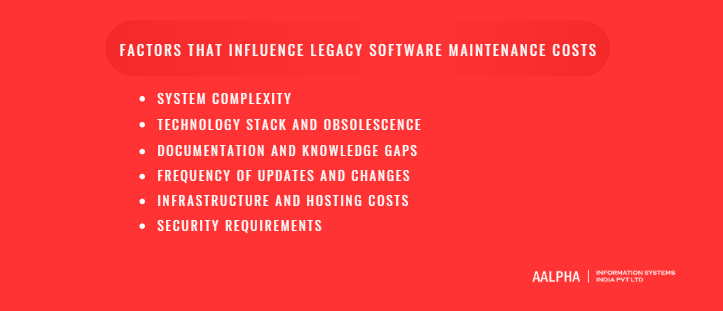
The cost of maintaining legacy software is not fixed. It varies significantly based on technical, operational, and organizational factors. Two systems with similar business functions can have drastically different maintenance costs depending on how they were built, how they are used, and how well they are understood. For decision-makers evaluating budgets or modernization strategies, understanding these cost drivers is critical. Each factor below directly contributes to ongoing expenses and explains why legacy maintenance often becomes disproportionately expensive over time.
-
System Complexity
System complexity is one of the most significant drivers of legacy software maintenance cost. The larger and more intricate the codebase, the more effort is required to understand, modify, and test it. Legacy systems often contain hundreds of thousands or even millions of lines of code accumulated over years of iterative development. This complexity is compounded when the system lacks modular design, making it difficult to isolate and update individual components.
Another major contributor is the number of integrations and dependencies. Legacy systems are rarely standalone. They are typically connected to multiple internal systems, third-party tools, databases, and external APIs. Each integration introduces a dependency that must be maintained and tested whenever changes are made. For example, updating a payment module may require validation across billing systems, reporting tools, and external financial gateways.
Tightly coupled dependencies further increase risk. A small change in one part of the system can trigger unexpected failures elsewhere, requiring extensive regression testing. This increases both development time and operational cost. As complexity grows, even routine maintenance tasks become time-consuming, requiring senior-level engineers and longer testing cycles.
In practical terms, higher system complexity leads to slower development, increased error rates, and higher resource consumption, all of which directly inflate maintenance costs.
-
Technology Stack and Obsolescence
The technology stack used in a legacy system has a direct impact on maintenance cost, particularly when it involves outdated or obsolete technologies. Systems built using older programming languages such as COBOL, VB6, or early versions of Java often require specialized expertise that is increasingly difficult to find in the market.
This scarcity of skilled developers creates a supply-demand imbalance. Engineers who can work on legacy technologies typically command higher salaries or consulting fees due to their niche expertise. In some cases, organizations must rely on retired professionals or external consultants, further increasing costs and reducing operational flexibility.
Obsolete frameworks and tools also introduce compatibility challenges. Legacy systems may not work seamlessly with modern operating systems, databases, or third-party services. This often requires custom workarounds, middleware layers, or partial rewrites to maintain functionality. Each workaround adds technical debt, increasing future maintenance effort.
Another overlooked cost is the lack of vendor support. When vendors discontinue updates or security patches, organizations must take full responsibility for maintaining the system. This includes identifying vulnerabilities, developing fixes, and ensuring compatibility with evolving infrastructure. Without vendor support, maintenance becomes both more complex and more expensive.
Ultimately, the older and more obsolete the technology stack, the higher the cost of keeping the system operational.
-
Documentation and Knowledge Gaps
Poor documentation is a common issue in legacy systems and a major contributor to maintenance cost. Over time, original developers leave the organization, taking with them critical knowledge about how the system works. What remains is often incomplete, outdated, or entirely missing documentation.
This creates a dependency on tribal knowledge, where only a few individuals understand specific parts of the system. When these individuals are unavailable or leave the organization, maintaining the system becomes significantly more difficult. New developers must spend considerable time reverse-engineering the codebase, which slows down development and increases the risk of errors.
Lack of documentation also complicates troubleshooting. Identifying the root cause of a bug or performance issue requires deeper investigation, often involving trial-and-error approaches. This increases both time-to-resolution and operational downtime.
From a cost perspective, poor documentation leads to inefficiency. Tasks that should take hours can take days, and simple updates may require extensive analysis. Over time, this inefficiency accumulates, significantly increasing the total cost of maintenance.
-
Frequency of Updates and Changes
The frequency at which a legacy system needs to be updated plays a crucial role in determining maintenance cost. Systems that require frequent changes due to business needs, market conditions, or regulatory requirements are inherently more expensive to maintain.
For example, industries such as finance and healthcare are subject to continuous regulatory updates. Compliance requirements may mandate changes in data handling, reporting formats, or security protocols. Implementing these changes in a legacy system is often complex due to outdated architecture and limited flexibility.
Business-driven changes also add to the cost. As organizations evolve, they need to introduce new features, integrate with modern tools, or adapt to changing customer expectations. Legacy systems are not designed for rapid iteration, making even minor enhancements resource-intensive.
Frequent updates also increase testing and deployment costs. Each change must be thoroughly validated to ensure it does not disrupt existing functionality. In complex legacy systems, this often involves extensive manual testing, which is both time-consuming and expensive.
In essence, the more frequently a system needs to change, the higher the cumulative maintenance cost over time.
-
Infrastructure and Hosting Costs
Infrastructure is another critical factor influencing legacy software maintenance cost. Many legacy systems are hosted on on-premises infrastructure, which requires ongoing investment in hardware, data centers, and maintenance personnel. These costs include server upgrades, power consumption, cooling, and physical security.
On-prem systems also lack the scalability and cost-efficiency of modern cloud environments. Organizations must provision infrastructure based on peak demand, leading to underutilized resources during normal operations. This results in higher operational costs compared to cloud-based systems that offer pay-as-you-go pricing models.
Migrating legacy systems to the cloud is not always straightforward. Compatibility issues, architectural limitations, and data migration challenges can make cloud adoption complex and expensive. As a result, many organizations continue to operate legacy systems on outdated infrastructure, incurring higher long-term costs.
Additionally, legacy infrastructure often relies on outdated operating systems and hardware that are no longer supported by vendors. This increases the risk of failure and requires custom maintenance solutions, further driving up costs.
-
Security Requirements
Security is one of the most critical and costly aspects of maintaining legacy software. Older systems were not designed to להתמודד modern cybersecurity threats, making them more vulnerable to attacks. This creates a continuous need for security monitoring, patching, and risk mitigation.
One of the main challenges is the lack of regular security updates from vendors. Organizations must identify vulnerabilities independently and develop custom patches, which requires specialized expertise and additional resources. In some cases, security fixes must be implemented without disrupting system functionality, adding to the complexity.
Legacy systems also struggle to meet modern security standards such as encryption protocols, access controls, and compliance frameworks. Upgrading these capabilities often requires significant modifications to the system, increasing both cost and risk.
The financial impact of security issues can be substantial. Data breaches, system downtime, and compliance violations can result in direct financial losses, legal penalties, and reputational damage. As a result, organizations invest heavily in securing legacy systems, even if the underlying architecture is not ideal.
In practice, security requirements transform legacy maintenance from a routine operational task into a high-stakes, resource-intensive activity.
Understanding these factors provides a clear picture of why legacy software maintenance costs vary so widely. It also highlights a critical insight: maintenance costs are not just a function of time but a reflection of complexity, risk, and adaptability. Organizations that recognize and address these factors are better positioned to control costs and make informed decisions about modernization.
Breakdown of Legacy Software Maintenance Costs
Legacy software maintenance is not a single line item in an IT budget. It is a combination of multiple cost categories that together determine the total cost of ownership. These costs are typically grouped into four core maintenance types, along with infrastructure and personnel expenses. Understanding this breakdown provides clarity on where money is actually being spent and why legacy systems become increasingly expensive over time.
-
Corrective Maintenance Costs
Corrective maintenance refers to the cost of identifying and fixing defects in the system. This includes bug fixes, error resolution, and addressing system failures that disrupt normal operations. In legacy systems, corrective maintenance often consumes a significant portion of the maintenance budget due to the fragile nature of the codebase.
Unlike modern systems where bugs can be isolated and resolved quickly, legacy applications require extensive investigation. Developers must navigate complex, poorly documented code to identify the root cause of an issue. Because components are tightly coupled, fixing one bug may introduce new issues elsewhere, requiring additional testing and validation.
The cost of corrective maintenance is also influenced by system criticality. For example, if a bug affects transaction processing in a financial system or patient data in a healthcare system, it must be resolved immediately. This often requires dedicated support teams, emergency patches, and round-the-clock monitoring, all of which increase operational expenses.
Over time, as the system ages and technical debt accumulates, the frequency of bugs tends to increase. This creates a cycle where more resources are allocated to fixing problems rather than improving the system, driving up long-term maintenance costs.
-
Adaptive Maintenance Costs
Adaptive maintenance involves updating the system to ensure compatibility with changing environments. This includes adjustments required for new operating systems, browser updates, database upgrades, or integration with modern third-party services.
Legacy systems are particularly sensitive to environmental changes because they were not designed with flexibility in mind. For example, a system built for older versions of Windows or outdated web browsers may not function correctly when the underlying platform is upgraded. Even minor updates, such as browser security changes, can break functionality in legacy applications.
These compatibility updates are often more complex than they appear. Developers may need to rewrite portions of the code, replace deprecated libraries, or introduce middleware to bridge gaps between old and new technologies. Each of these activities requires time, expertise, and thorough testing.
Adaptive maintenance is also continuous. As technology ecosystems evolve, legacy systems must be repeatedly updated to remain functional. This creates an ongoing cost burden that is difficult to eliminate without modernization. In many organizations, adaptive maintenance becomes one of the most persistent and unavoidable expenses.
-
Perfective Maintenance Costs
Perfective maintenance focuses on improving the system by adding new features or enhancing existing functionality. This type of maintenance is driven by business needs, such as improving user experience, supporting new workflows, or integrating with modern tools.
In legacy systems, perfective maintenance is often expensive because the architecture was not designed for extensibility. Adding a new feature may require significant modifications across multiple components. For example, introducing a new reporting capability might involve changes to the database schema, backend logic, and user interface, all of which are tightly interconnected.
Another challenge is performance optimization. As user demands increase, legacy systems may struggle to handle higher loads or deliver acceptable response times. Improving performance often requires deep changes to the system, such as optimizing queries, restructuring code, or upgrading infrastructure.
Perfective maintenance is essential for keeping the system relevant, but it comes at a cost. Organizations must balance the need for new capabilities with the effort required to implement them. In many cases, the cost of adding features to a legacy system is significantly higher than building them in a modern environment.
-
Preventive Maintenance Costs
Preventive maintenance aims to reduce future risks by improving the internal quality of the system. This includes activities such as code refactoring, removing redundant components, updating outdated libraries, and improving system architecture.
In theory, preventive maintenance should lower long-term costs by making the system easier to maintain. However, in practice, it is often deprioritized because it does not deliver immediate business value. As a result, technical debt continues to accumulate, making future maintenance more expensive and complex.
Refactoring legacy code is particularly challenging. Developers must ensure that changes do not alter system behavior while improving code structure. This requires deep system knowledge and extensive testing, which increases both time and cost.
Despite these challenges, preventive maintenance is critical for controlling long-term expenses. Systems that receive regular refactoring and cleanup are more stable, easier to update, and less prone to critical failures. Organizations that invest in preventive maintenance can slow the growth of maintenance costs, even if they cannot eliminate them entirely.
-
Infrastructure and Licensing Costs
Infrastructure and licensing costs are a significant component of legacy software maintenance. Many legacy systems run on outdated hardware and require dedicated on-premises infrastructure. This includes servers, storage systems, networking equipment, and data centers, all of which incur ongoing operational expenses.
Maintaining this infrastructure involves costs such as hardware upgrades, power consumption, cooling, and physical security. Additionally, older systems may require specialized hardware that is difficult to replace, further increasing costs.
Licensing is another important factor. Legacy systems often rely on proprietary software, databases, or middleware that require annual licensing fees. These fees can be substantial, particularly for enterprise-grade solutions. In some cases, vendors may increase licensing costs over time, especially if the product is nearing end-of-life.
Unlike modern cloud-based systems, where costs can be scaled based on usage, legacy infrastructure often involves fixed costs that are difficult to optimize. This lack of flexibility contributes to higher overall maintenance expenses.
-
Personnel Costs
Personnel costs are typically the largest component of legacy software maintenance. Maintaining a legacy system requires a combination of developers, DevOps engineers, system administrators, and support staff, all of whom contribute to the overall cost.
One of the main challenges is the need for specialized skills. Developers with experience in legacy technologies are scarce, and their expertise commands higher salaries or consulting fees. Organizations may also need to invest in training or retain experienced employees to ensure continuity.
In addition to development costs, there are operational expenses associated with system monitoring, incident response, and user support. Legacy systems often require more hands-on management compared to modern automated systems, increasing the need for dedicated support teams.
Another factor is productivity. Working with legacy systems is generally slower and more complex, which means tasks take longer to complete. This reduces overall efficiency and increases labor costs. For example, implementing a feature that would take days in a modern system may take weeks in a legacy environment.
Personnel costs also include indirect expenses such as onboarding new team members, knowledge transfer, and managing dependencies on key individuals. Over time, these costs accumulate and become a major driver of the total cost of maintaining legacy software.
A detailed breakdown of legacy software maintenance costs reveals a clear pattern: expenses are distributed across multiple categories, each contributing to the overall financial burden. From bug fixes and compatibility updates to infrastructure and personnel, every aspect of maintenance becomes more complex and costly as systems age. This understanding is essential for organizations looking to optimize their IT budgets and evaluate long-term strategies for managing legacy systems.
Average Cost of Maintaining Legacy Software
The cost of maintaining legacy software varies widely depending on system size, complexity, and industry context. While it is difficult to assign a single fixed number, most organizations fall within predictable cost ranges based on the scale of their systems. These ranges provide a practical benchmark for decision-makers evaluating budgets or considering modernization strategies. The key insight is that maintenance costs tend to increase over time as systems age, dependencies grow, and technical debt accumulates.
-
Small Systems ($10,000–$50,000 per year)
Small legacy systems typically include internal tools, basic web applications, or limited-scope business software used by a single department. These systems usually have a smaller codebase, fewer integrations, and lower operational complexity, which keeps maintenance costs relatively manageable.
Annual maintenance costs in this category generally range from $10,000 to $50,000. This includes expenses such as occasional bug fixes, minor updates, basic infrastructure hosting, and limited developer involvement. In many cases, a single developer or a small part-time team can manage the system.
However, even small systems can become costly if they rely on outdated technologies or lack documentation. A simple issue may take longer to resolve due to unfamiliar code or missing knowledge. Additionally, if the system is critical to a specific workflow, any downtime can have disproportionate business impact, increasing the urgency and cost of maintenance.
While small systems are often seen as low-risk, they can quietly accumulate technical debt. Over time, maintenance costs may increase, especially if the system needs to integrate with newer tools or comply with updated security standards.
-
Medium Systems ($50,000–$250,000 per year)
Medium-sized legacy systems are more complex and typically support multiple business functions or departments. Examples include CRM platforms, inventory management systems, or regional operational tools. These systems often involve multiple integrations, moderate user bases, and more frequent updates.
Annual maintenance costs for medium systems generally fall between $50,000 and $250,000. This range reflects the need for a dedicated team that may include developers, QA engineers, and support staff. Costs are driven by regular bug fixes, compatibility updates, performance improvements, and occasional feature enhancements.
One of the defining characteristics of medium systems is the growing impact of dependencies. Integrations with third-party services, databases, and internal systems require continuous monitoring and updates. When one component changes, it can trigger a chain reaction of required adjustments across the system.
Another cost factor is testing. As the system becomes more complex, ensuring stability requires more extensive testing cycles. This increases both time and resource requirements for each update or fix.
Organizations operating in this range often begin to feel the strain of legacy maintenance. While the system remains functional, the cost of maintaining it starts to compete with the potential investment in modernization.
-
Enterprise Systems ($250,000–$1M+ per year)
Enterprise legacy systems represent the highest level of complexity and cost. These systems are typically mission-critical platforms that support core business operations across large organizations. Examples include banking transaction systems, large-scale ERP platforms, and nationwide healthcare management systems.
Annual maintenance costs for enterprise systems commonly range from $250,000 to over $1 million, with some large organizations spending significantly more. These costs reflect the scale of the system, the number of users, and the critical nature of the operations it supports.
Maintaining enterprise systems requires large, specialized teams that include senior developers, system architects, DevOps engineers, security experts, and dedicated support staff. These systems often operate 24/7, requiring continuous monitoring, incident response, and performance optimization.
Another major cost driver is risk management. Because these systems handle sensitive data and high transaction volumes, any failure can have severe financial and reputational consequences. As a result, organizations invest heavily in redundancy, backup systems, and disaster recovery planning.
Enterprise systems also face significant challenges in adapting to modern requirements. Integrating with cloud platforms, mobile applications, or advanced analytics tools often requires complex workarounds or partial system redesigns. These efforts add to the overall maintenance cost while highlighting the limitations of legacy architecture.
In many cases, enterprise-level maintenance costs reach a point where they rival or exceed the cost of modernization, prompting organizations to reconsider their long-term strategy.
-
Cost by Industry
The cost of maintaining legacy software also varies by industry, largely due to differences in regulatory requirements, system complexity, and operational criticality.
In healthcare, maintenance costs are driven by strict compliance requirements and the need for high system reliability. Hospital management systems must handle sensitive patient data and support continuous operations. As a result, organizations invest heavily in security, data integrity, and uptime, often placing maintenance costs in the higher end of the spectrum even for medium-sized systems.
In banking and financial services, legacy systems are among the most expensive to maintain. These systems process large volumes of transactions and must meet stringent regulatory and security standards. The reliance on mainframe technology and specialized programming languages further increases costs. It is not uncommon for financial institutions to spend millions annually on maintaining legacy infrastructure.
In retail and eCommerce, maintenance costs are generally lower compared to healthcare and banking, but they can still be significant. Retail systems must integrate with inventory management, payment gateways, and customer-facing platforms. The need for frequent updates to support changing consumer behavior and seasonal demand adds to the cost.
Across industries, a consistent pattern emerges: the more critical the system is to core operations and compliance, the higher the maintenance cost. This reinforces the importance of evaluating not just the technical aspects of legacy systems, but also their strategic role within the organization.
Understanding these cost ranges provides a clear benchmark for organizations assessing their legacy software expenses. Whether managing a small internal tool or a large enterprise platform, the underlying trend is the same: maintenance costs increase with complexity, scale, and criticality. This makes it essential for businesses to regularly evaluate whether continued investment in maintenance delivers sufficient value or whether alternative approaches should be considered.
Hidden Costs of Legacy Software Maintenance
When organizations evaluate the cost of maintaining legacy software, they often focus on visible expenses such as developer salaries, infrastructure, and licensing. However, the most significant financial impact frequently comes from hidden costs that are harder to measure but far more damaging over time. These costs affect productivity, innovation, security, and overall business performance. Ignoring them leads to underestimating the true total cost of ownership of legacy systems.
-
Downtime and Performance Issues
Legacy systems are more prone to downtime and performance degradation due to aging infrastructure, inefficient code, and outdated architectures. Unlike modern systems designed for scalability and resilience, legacy applications often struggle to handle increased workloads or unexpected spikes in usage.
Downtime has a direct financial impact. For example, if a system responsible for order processing or payment handling becomes unavailable, revenue loss can occur immediately. In addition, there are indirect costs such as customer dissatisfaction, reputational damage, and loss of trust. Even short periods of downtime can have long-term consequences, especially in competitive markets.
Performance issues also reduce operational efficiency. Slow response times can delay workflows, frustrate users, and increase the time required to complete tasks. Over time, these inefficiencies accumulate, leading to reduced productivity across the organization. While these costs may not appear as line items in a budget, they significantly affect overall business performance.
-
Security Vulnerabilities
Legacy systems are inherently more vulnerable to security threats because they were not designed to withstand modern cyberattacks. Many rely on outdated encryption methods, unsupported libraries, or unpatched vulnerabilities. This creates a continuous risk that requires constant monitoring and mitigation.
The cost of addressing security vulnerabilities goes beyond routine maintenance. Organizations must invest in additional security tools, audits, and specialized expertise to protect legacy systems. In some cases, custom security patches must be developed internally due to lack of vendor support, increasing both complexity and cost.
The financial consequences of a security breach can be severe. These include regulatory fines, legal liabilities, incident response costs, and reputational damage. For industries such as healthcare and finance, where sensitive data is involved, the stakes are even higher. As a result, organizations often spend disproportionately on securing legacy systems, making security one of the most significant hidden costs.
-
Reduced Developer Productivity
Working with legacy systems is inherently slower and more complex than working with modern software. Developers must navigate outdated codebases, understand undocumented logic, and deal with fragile dependencies. This reduces productivity and increases the time required to complete even simple tasks.
For example, a feature that could be implemented in a few days using modern frameworks may take weeks in a legacy environment. Debugging is also more time-consuming, as identifying the root cause of issues often requires deep system knowledge and extensive testing.
Reduced productivity has a direct impact on cost. Organizations must allocate more developer hours to achieve the same outcomes, effectively increasing labor expenses. It also affects team morale and retention. Engineers often prefer working with modern technologies, and prolonged exposure to legacy systems can lead to dissatisfaction and higher turnover rates.
Over time, this productivity gap becomes a significant hidden cost, limiting the organization’s ability to deliver new features and respond to market demands efficiently.
-
Integration Limitations
Modern businesses rely on interconnected systems to deliver seamless experiences and data-driven insights. Legacy systems, however, are often difficult to integrate with newer technologies due to outdated architectures and lack of standardized interfaces such as APIs.
This limitation creates additional costs in the form of custom integration solutions. Organizations may need to build middleware, adapters, or workarounds to connect legacy systems with modern applications. These solutions are often complex, fragile, and expensive to maintain.
Integration challenges also slow down digital transformation initiatives. For example, integrating a legacy system with a cloud-based analytics platform or a mobile application may require significant effort and time. This delays the adoption of new technologies and reduces the overall efficiency of the organization.
In many cases, integration limitations force businesses to operate in silos, where data cannot flow freely between systems. This reduces visibility, limits decision-making capabilities, and increases operational inefficiencies, all of which contribute to hidden costs.
-
Opportunity Cost
Opportunity cost is the most significant and often overlooked hidden cost of legacy software maintenance. It represents the value of what the organization could achieve if resources were allocated differently.
When a large portion of the IT budget and team capacity is dedicated to maintaining legacy systems, fewer resources are available for innovation. This includes developing new products, improving customer experiences, or adopting emerging technologies such as artificial intelligence and automation.
For example, a company spending hundreds of thousands of dollars annually on maintaining an outdated system may delay launching a new digital platform that could generate additional revenue. Similarly, the inability to integrate with modern tools may prevent the organization from leveraging data analytics to make better business decisions.
Opportunity cost also affects competitiveness. Organizations that rely heavily on legacy systems often struggle to adapt to changing market conditions. Competitors using modern, flexible systems can innovate faster, respond to customer needs more effectively, and capture market share.
Unlike direct costs, opportunity cost is not immediately visible, but its long-term impact is substantial. It represents lost growth, missed opportunities, and reduced strategic flexibility. For many organizations, this hidden cost ultimately outweighs the visible expenses of maintaining legacy software.
Hidden costs reveal the true financial burden of legacy software. While direct maintenance expenses are easier to quantify, factors such as downtime, security risks, reduced productivity, integration challenges, and lost opportunities often have a greater impact on the organization. Recognizing these hidden costs is essential for making informed decisions about whether to continue maintaining legacy systems or invest in modernization strategies.
Cost of Legacy Maintenance vs Modernization
One of the most critical strategic decisions organizations face is whether to continue maintaining legacy software or invest in modernization. While maintenance offers short-term stability and predictable costs, modernization promises long-term efficiency, scalability, and innovation. The challenge lies in understanding when each approach makes financial and operational sense. This section provides a clear framework to evaluate both options and determine the most cost-effective path forward.
-
When Maintenance Is Cheaper
Maintaining legacy software is often the more cost-effective option in the short term, particularly when the system is stable and still meets business requirements. If the application is not undergoing frequent changes, has low integration needs, and operates reliably, the cost of maintaining it may remain manageable.
This scenario is common in systems that support internal processes with limited user interaction. For example, a reporting tool used by a small team or a back-office application with minimal updates may not justify the cost of full modernization. In such cases, maintenance costs are predictable and can be controlled through incremental improvements.
Another factor is risk tolerance. If replacing the system introduces significant operational risk or potential downtime, organizations may choose to continue maintenance to ensure continuity. This is especially relevant in industries where system reliability is critical.
Maintenance is also cheaper when the system has already been heavily customized. Rebuilding these customizations in a new system can be expensive and time-consuming. In such cases, extending the life of the existing system may be financially justified.
However, this cost advantage is typically temporary. As the system ages and technical debt increases, maintenance costs tend to rise, eventually reducing the financial benefit of this approach.
-
When Modernization Is More Cost-Effective
Modernization becomes more cost-effective when the long-term costs of maintaining a legacy system exceed the investment required to upgrade or replace it. This is often the case when maintenance costs are consistently increasing due to complexity, security requirements, or frequent updates.
If a system requires continuous bug fixes, compatibility updates, and performance improvements, the cumulative cost can become unsustainable. In such situations, modernization offers a way to reduce ongoing expenses by transitioning to a more efficient and scalable architecture.
Another key indicator is limited functionality. If the legacy system cannot support new business requirements, such as integration with modern tools, mobile applications, or data analytics platforms, organizations may lose competitive advantage. Modernization enables faster innovation and better alignment with current business needs.
Security is another critical factor. Legacy systems that cannot meet modern security standards require significant investment to remain compliant. Modern systems are typically built with security in mind, reducing the cost and effort required to manage risks.
In essence, modernization is more cost-effective when the system becomes a bottleneck for growth, innovation, or compliance. While the upfront investment may be high, the long-term savings and strategic benefits often outweigh the initial cost.
-
ROI of Modernization
Return on investment (ROI) is a critical factor in deciding whether to modernize legacy systems. While modernization requires significant upfront investment, it can deliver substantial financial and strategic benefits over time.
One of the primary sources of ROI is reduced maintenance cost. Modern systems are easier to maintain due to modular architecture, better documentation, and active vendor support. This reduces the need for specialized skills and lowers ongoing operational expenses.
Another important benefit is improved productivity. Developers can work more efficiently with modern tools and frameworks, reducing development time and enabling faster delivery of new features. This translates into lower labor costs and increased output.
Modernization also enables better scalability and performance, allowing organizations to handle increased workloads without significant additional investment. This is particularly valuable for businesses experiencing growth or seasonal demand fluctuations.
From a revenue perspective, modernization supports innovation and new capabilities. Organizations can integrate with advanced technologies such as cloud platforms, analytics tools, and automation systems, creating new opportunities for growth and differentiation.
When evaluated over a multi-year horizon, the ROI of modernization often outweighs the initial cost. Organizations that invest in modernization position themselves for long-term efficiency and competitiveness.
-
Hybrid Approach (Strangler Pattern, APIs)
For many organizations, the choice between maintenance and modernization is not binary. A hybrid approach offers a practical middle ground, allowing businesses to modernize incrementally while maintaining system stability.
One widely used strategy is the Strangler Pattern. This approach involves gradually replacing parts of the legacy system with new components, rather than performing a full system replacement. Over time, the new system “strangles” the old one by taking over its functionality. This reduces risk and spreads the cost of modernization across multiple phases.
Another common approach is the use of APIs and middleware to extend the capabilities of legacy systems. By exposing certain functionalities through APIs, organizations can integrate legacy systems with modern applications without modifying the core system. This enables gradual modernization while preserving existing investments.
Hybrid approaches also allow organizations to prioritize high-impact areas. For example, customer-facing components can be modernized first, while backend systems continue to operate in their existing form. This delivers immediate business value while minimizing disruption.
From a cost perspective, hybrid strategies provide flexibility. Organizations can control spending, reduce risk, and adapt their modernization efforts based on business needs. While this approach may take longer than a full replacement, it often results in a more manageable and sustainable transition.
The decision between maintaining and modernizing legacy software is ultimately a balance between short-term cost and long-term value. Maintenance offers stability and predictability, while modernization enables efficiency and growth. By understanding the cost implications of each approach and considering hybrid strategies, organizations can make informed decisions that align with their business goals and financial constraints.
Strategies to Reduce Legacy Software Maintenance Costs
Reducing the cost of maintaining legacy software does not always require a full system replacement. In many cases, organizations can significantly lower expenses by applying targeted strategies that improve efficiency, reduce risk, and extend system usability. These approaches focus on optimizing existing systems while preparing for long-term modernization. The goal is not just cost reduction, but better control over maintenance efforts and improved operational stability.
-
Code Refactoring and Optimization
Code refactoring is one of the most effective ways to reduce maintenance costs without altering system functionality. It involves restructuring existing code to improve readability, modularity, and performance. Legacy systems often contain redundant logic, inefficient algorithms, and tightly coupled components, all of which increase the effort required for maintenance.
By refactoring the codebase, developers can simplify complex structures, eliminate unnecessary dependencies, and make the system easier to understand. This reduces the time required to implement changes, fix bugs, and test updates. Over time, even small improvements in code quality can lead to significant cost savings.
Optimization also plays a critical role. Improving database queries, reducing processing overhead, and enhancing performance can lower infrastructure costs and improve user experience. While refactoring requires an upfront investment, it directly reduces long-term maintenance effort and risk.
-
Documentation and Knowledge Transfer
Poor documentation is a major driver of maintenance inefficiency. Investing in comprehensive documentation can significantly reduce costs by making the system easier to understand and maintain.
Documentation should include system architecture, data flows, key modules, and dependencies. It should also capture business logic and edge cases that may not be obvious from the code itself. This ensures that new developers can quickly onboard and contribute without relying on trial-and-error approaches.
Knowledge transfer is equally important. Organizations should actively capture insights from experienced team members and convert them into structured documentation. This reduces dependency on specific individuals and minimizes the risk associated with employee turnover.
Clear documentation and knowledge sharing improve productivity, reduce debugging time, and enable faster decision-making. Over time, this leads to more efficient maintenance processes and lower overall costs.
-
Automation and Monitoring
Automation is a critical strategy for reducing manual effort and improving system reliability. Legacy systems often rely on manual processes for testing, deployment, and monitoring, which increases both time and cost.
Implementing automated testing can significantly reduce the effort required to validate changes. Automated test suites ensure that updates do not introduce new issues, reducing the need for extensive manual testing. Similarly, automating deployment processes can streamline updates and minimize downtime.
Monitoring is another key area. Real-time monitoring tools can detect performance issues, system failures, and security threats early. This enables faster response times and prevents small issues from escalating into costly incidents.
Automation and monitoring together improve operational efficiency, reduce human error, and lower the overall cost of maintaining legacy systems. While initial setup requires investment, the long-term savings are substantial.
-
Cloud Migration
Migrating legacy systems to the cloud can reduce infrastructure and operational costs while improving scalability and flexibility. Traditional on-premises systems require significant investment in hardware, maintenance, and physical infrastructure. Cloud environments offer a more cost-efficient alternative with pay-as-you-go pricing models.
Cloud migration can be approached in stages. Organizations may start by moving non-critical components or data storage to the cloud, gradually expanding the scope based on compatibility and business needs. This reduces risk and allows for controlled cost management.
In addition to cost savings, cloud platforms provide built-in features such as automated scaling, backup, and security, which reduce the need for manual intervention. This lowers both infrastructure and personnel costs.
However, migration must be carefully planned. Not all legacy systems are easily compatible with cloud environments, and improper migration can lead to increased costs. A well-executed cloud strategy, however, can significantly improve efficiency and reduce long-term maintenance expenses.
-
Outsourcing Maintenance
Outsourcing legacy software maintenance to specialized service providers can be a cost-effective strategy, particularly for organizations lacking in-house expertise. External providers often have dedicated teams with experience in legacy technologies, enabling them to deliver maintenance services more efficiently.
Outsourcing reduces the need to hire and retain specialized developers, which can be expensive and challenging. It also provides access to a broader talent pool and flexible resource allocation, allowing organizations to scale support based on demand.
Another advantage is cost predictability. Many outsourcing providers offer fixed or subscription-based pricing models, making it easier to manage budgets. This is particularly useful for organizations with fluctuating maintenance requirements.
However, outsourcing requires careful vendor selection. Organizations must ensure that the provider has the necessary expertise, security standards, and communication processes. When executed effectively, outsourcing can reduce both direct and indirect maintenance costs while maintaining system reliability.
-
Incremental Modernization
Incremental modernization is a strategic approach that reduces maintenance costs by gradually improving the system rather than replacing it entirely. This approach focuses on modernizing specific components or functionalities over time, allowing organizations to spread costs and reduce risk.
One common method is to identify high-impact areas, such as user interfaces or integration layers, and modernize them first. This delivers immediate benefits while leaving the core system intact. Over time, additional components can be updated or replaced, progressively improving the overall system.
Incremental modernization also helps reduce technical debt. By replacing outdated components and introducing modern architecture patterns, organizations can make the system more maintainable and scalable. This reduces future maintenance effort and cost.
Another advantage is flexibility. Organizations can prioritize modernization efforts based on business needs and budget constraints, avoiding large upfront investments. This makes incremental modernization a practical and sustainable strategy for managing legacy systems.
Reducing legacy software maintenance costs requires a combination of technical improvements, operational efficiency, and strategic planning. By focusing on refactoring, documentation, automation, cloud adoption, outsourcing, and incremental modernization, organizations can control costs while maintaining system stability. These strategies not only lower expenses but also create a foundation for future transformation, enabling businesses to transition from maintenance-focused operations to innovation-driven growth.
How to Decide: Maintain, Modernize, or Replace?
Deciding whether to maintain, modernize, or replace legacy software is a strategic decision that directly impacts cost, operational stability, and long-term growth. There is no one-size-fits-all answer. The right choice depends on how the system performs today, how much it costs to sustain, and whether it supports the organization’s future direction. A structured decision framework helps remove guesswork and ensures that decisions are based on measurable factors rather than assumptions.
-
Cost vs Value Analysis
The first step is to evaluate whether the system is delivering sufficient value relative to its cost. Legacy maintenance includes not only visible expenses such as developer salaries, infrastructure, and licensing, but also hidden costs like inefficiency, downtime, and limited innovation.
If the system continues to operate reliably, requires minimal updates, and supports critical processes effectively, maintaining it may still be financially justified. In such cases, the cost is predictable and the value remains stable.
However, problems arise when costs increase while value remains constant or declines. For example, if a system consumes a large portion of the IT budget but slows down development, limits integration, or prevents new feature rollout, it is no longer efficient. Over time, organizations may find themselves spending more just to keep the system running without gaining any competitive advantage.
A practical approach is to evaluate the total cost of ownership over the next three to five years and compare it with the expected benefits of modernization. This helps determine whether continued maintenance is sustainable or whether investment in change will yield better returns.
-
Risk Assessment
Every option carries risk. Maintaining a legacy system introduces ongoing risks such as system failure, increasing security vulnerabilities, and dependence on outdated technologies. These risks grow over time and can eventually lead to critical failures or compliance issues.
On the other hand, modernization or replacement introduces transformation risk. This includes potential downtime during migration, data loss, integration failures, and project overruns. Large-scale system replacements are particularly complex and require careful planning to avoid disruption.
The key is to compare these risks in context. If the existing system is stable and the organization has low tolerance for disruption, maintenance may be the safer option in the short term. However, if the system is already showing signs of instability, frequent failures, or security exposure, continuing to maintain it may be riskier than replacing it.
Organizations should assess factors such as how critical the system is, what happens if it fails, how exposed it is to security threats, and whether the organization has the capability to manage a transformation project effectively.
-
Business Alignment
A legacy system must be evaluated against current and future business goals. Technology should enable growth, not restrict it. If the system aligns well with business operations and supports existing workflows without significant limitations, maintaining it may still make sense.
However, many legacy systems were designed for a different business environment. They may not support modern requirements such as real-time data access, mobile integration, cloud scalability, or advanced analytics. When this happens, the system becomes a bottleneck rather than an asset.
For example, if a company is expanding into digital channels, launching new services, or adopting automation, a rigid legacy system can slow down execution. In such cases, modernization becomes necessary to support strategic initiatives.
Business alignment also includes scalability. If the organization expects growth in users, transactions, or data volume, the system must be able to handle increased demand efficiently. Systems that require disproportionate effort to scale are strong candidates for modernization or replacement.
-
Decision Framework Example
A practical way to approach this decision is to evaluate the system across a few core dimensions and identify where it stands.
If maintenance costs are relatively low, the system is stable, and it continues to meet business needs without limiting growth, maintaining the system is a reasonable choice. This approach prioritizes stability and avoids unnecessary investment.
If costs are rising, the system is becoming harder to maintain, and it partially limits business capabilities, modernization is often the most balanced option. This allows organizations to improve the system incrementally while controlling risk and cost.
If the system is expensive to maintain, difficult to scale, poses security or compliance risks, and significantly restricts business growth, replacement becomes the most viable option. Although it requires higher upfront investment, it provides a foundation for long-term efficiency and innovation.
This type of structured evaluation helps organizations move beyond subjective decision-making. Instead of asking whether the system is “old,” the focus shifts to whether it is cost-effective, reliable, and aligned with business goals.
Choosing between maintaining, modernizing, or replacing legacy software is ultimately about balancing short-term stability with long-term value. Maintenance offers predictability, modernization provides gradual improvement, and replacement enables transformation. By evaluating cost, risk, and alignment together, organizations can make decisions that support both operational needs and future growth.
How to Choose the Right Legacy Software Maintenance Partner
Selecting the right legacy software maintenance partner is a critical decision that directly affects system stability, cost efficiency, and long-term scalability. Legacy systems require specialized expertise, disciplined processes, and a deep understanding of both outdated and modern technologies. Choosing the wrong partner can increase costs, slow down issue resolution, and introduce operational risks. A structured evaluation ensures that organizations work with partners who can deliver consistent, reliable results.
-
Technical Expertise in Legacy Systems
The most important factor when choosing a maintenance partner is their depth of technical expertise in legacy systems. Unlike modern development, legacy maintenance involves working with complex, often fragile codebases that may lack structure or documentation.
A capable partner should demonstrate hands-on experience with legacy architectures, including monolithic systems and tightly coupled components. They must be skilled in debugging, reverse engineering, and making changes without disrupting existing functionality. This requires not just coding ability, but also strong analytical skills and a disciplined approach to testing.
In addition, the partner should understand how to gradually improve the system over time. This includes identifying areas for optimization, reducing technical debt, and preparing the system for future modernization. Experienced software development company such as Aalpha Information Systems bring this balanced approach, combining deep legacy expertise with forward-looking strategies that help organizations control costs while improving system performance.
-
Availability of Rare Skill Sets
Legacy systems often depend on technologies that are no longer widely used, making skilled professionals difficult to find. A strong maintenance partner should have access to developers and engineers who specialize in these technologies.
This includes expertise in older programming languages, legacy frameworks, and outdated infrastructure. Without these skills, even minor issues can become time-consuming and expensive to resolve. The availability of experienced professionals ensures faster turnaround times and more reliable outcomes.
It is also important to assess how the partner manages their talent pool. A well-structured team with multiple experts reduces dependency on any single individual. This ensures continuity of support, even if team members change, and minimizes the risk of knowledge gaps.
-
Proven Experience Across Industries
Experience across different industries is a strong indicator of a partner’s ability to handle complex legacy systems. Each industry presents unique challenges, whether it is compliance requirements in healthcare, transaction reliability in finance, or integration needs in retail.
A partner with diverse experience is more likely to understand these challenges and apply best practices effectively. They can anticipate common issues, implement proven solutions, and maintain high standards of reliability.
Organizations should review case studies, client references, and past projects to evaluate experience. A track record of successfully maintaining systems of similar scale and complexity provides confidence in the partner’s capabilities.
-
Transparent Pricing Models
Transparent pricing is essential for managing maintenance costs and avoiding unexpected expenses. Legacy maintenance can become unpredictable if pricing structures are unclear or poorly defined.
A reliable partner should offer clear pricing models that align with the organization’s needs. This may include fixed monthly contracts, dedicated resource models, or usage-based pricing. Each model has its advantages, but the key requirement is clarity.
Organizations should also understand what is included in the pricing. This includes support hours, response times, issue resolution, and additional services such as performance optimization or security updates. Clearly defined service-level agreements help ensure accountability and prevent misunderstandings.
-
Long-Term Support and Scalability
Legacy software maintenance is an ongoing process that requires long-term commitment. The right partner should be capable of providing consistent support while adapting to changing business needs.
This includes the ability to scale resources as demand increases, handle system upgrades, and support gradual modernization efforts. A partner that can grow with the organization reduces the need for frequent vendor changes and ensures continuity.
Long-term support should also be proactive. Instead of only responding to issues, the partner should continuously monitor system performance, identify risks, and recommend improvements. Established providers like Aalpha Information Systems typically follow structured maintenance frameworks, ensuring consistent delivery, proactive optimization, and long-term system stability.
Choosing the right legacy software maintenance partner is not just about technical capability. It is about ensuring stability, controlling costs, and preparing for future growth. By focusing on expertise, skill availability, experience, pricing transparency, and long-term support, organizations can build a reliable partnership that keeps legacy systems efficient and manageable over time.
Final Thoughts
Legacy software maintenance is often necessary, but it should never become an unchecked cost center. As systems age, expenses rise while flexibility and innovation decline. The key is to continuously evaluate whether your current approach still delivers value or simply sustains outdated infrastructure.
Organizations that take a strategic approach, balancing maintenance, modernization, and gradual transformation, are better positioned to control costs and stay competitive. The goal is not just to keep systems running, but to ensure they support future growth.
If you are assessing your legacy systems and need a clear cost analysis or modernization roadmap, working with experienced partners like Aalpha Information Systems can help you make informed, cost-effective decisions. Contact now!