






TL;DR
To hire Indian programmers, define the work first, pick a hiring model (freelancer, dedicated developer through a company, staff augmentation, offshore team, direct hire, or Employer of Record), then shortlist, test with a real task, check references, and sign a contract that assigns you the IP before any code is written. India gives you a deep pool of engineers across web, mobile, cloud, data, and AI, with working hours that overlap UK mornings fully and US mornings partly. In 2026, experienced developers through an established Indian company typically bill in the range of USD 18 to 45 per hour, or roughly USD 2,800 to 7,000 a month for a full-time dedicated engineer, depending on seniority and stack. Treat those figures as market estimates, not fixed rates. The cheapest quote rarely produces the cheapest project: rework, turnover, and weak specifications cost more than the hourly difference. Start with a paid trial or a small milestone, keep your repositories and cloud accounts in your own name, and judge the result by working code. Companies such as Aalpha Information Systems, which has supplied dedicated developers to international clients since 2008, can shorten the search by handling recruitment, replacement, and project oversight.
Why are businesses hiring Indian programmers in 2026?
Businesses hire Indian programmers because India offers a large supply of experienced engineers, rates well below US and UK salaries, and a mature outsourcing industry that already knows how to work with foreign clients. The hard part is no longer finding developers. It is choosing the right model and verifying skill before you commit.
Indian engineers build and maintain software for banks, retailers, SaaS companies, healthcare providers, and startups across North America, Europe, the Gulf, Africa, and Asia. Most large technology companies run engineering centres in Bengaluru, Hyderabad, Pune, or Chennai. Smaller cities such as Hubballi-Dharwad, Coimbatore, and Indore now have their own development firms as well.
What you can expect depends heavily on who you hire and how. A senior engineer at a well-run company will write tested code, raise questions about vague requirements, and document decisions. A low-cost freelancer found in an afternoon may do none of these things. The country is not the variable. The vetting is.
This guide covers the full decision, from choosing a hiring model to managing a team after it starts. You will find the main ways to hire, a 12-step hiring process, where to look, how to interview, what developers cost in 2026, the contracts you need, India’s current data protection rules, and the mistakes that sink offshore projects. Each section starts with a short answer you can act on, followed by the detail.
Why hire programmers from India?
Hire programmers from India when you need skilled engineers at a lower total cost and can manage remote work well. India combines a very large developer workforce, rates often a quarter to a third of US salaries, broad technology coverage, and long experience serving foreign clients. Communication and vetting still decide whether the savings hold.
-
Access to a large pool of skilled programmers
India produces hundreds of thousands of engineering and computer science graduates each year and has one of the largest developer communities on GitHub. For a buyer, the practical effect is choice. If you need a Laravel developer who has worked on payment integrations, or a Flutter engineer with healthcare experience, you can usually find several candidates within days rather than months.
-
Competitive development costs
The US Bureau of Labor Statistics reports a median annual wage of USD 133,080 for software developers in May 2024, before benefits, payroll tax, equipment, and recruiting fees. A full-time senior engineer from an Indian development company typically costs a fraction of that in total, including the vendor’s overhead. Section 10 breaks the numbers down.
-
Coverage across modern languages and frameworks
Indian teams work across JavaScript and TypeScript (React, Next.js, Node.js, NestJS), Python, Java, PHP and Laravel, .NET, Go, Swift, Kotlin, Flutter, and React Native, plus AWS, Azure, Google Cloud, and the data and AI tooling built around Python. Older stacks such as classic ASP.NET and legacy PHP also have plenty of maintainers, which matters for modernisation work.
-
Experience with international clients
Many Indian engineers have spent their whole careers on projects for clients in the US, UK, Europe, Australia, and the Gulf. They are used to written specifications, sprint ceremonies, Jira and Slack, and client calls in English. That experience shows up as fewer surprises during onboarding.
-
Flexible engagement models
You can hire one freelancer for two weeks, a dedicated developer month to month, a full squad with a project manager, or a permanent employee through an Employer of Record. Few local markets offer that range at short notice.
-
Time zone coverage
India Standard Time is UTC+5:30. A developer starting at 1 pm IST overlaps the full UK morning and the early US East Coast day. With a split shift, teams can hand work back and forth so that progress continues while your local office sleeps. The downside is real for US West Coast companies, where overlap is thin and someone has to move their hours.
-
English communication and remote collaboration
English is the working language of the Indian software industry. Written English is usually strong. Spoken fluency and the confidence to push back on a client vary more, so test both during interviews rather than assuming either.
-
Scaling up or down
An established Indian vendor can usually add a developer in one to three weeks and release one with a month’s notice. That makes it easier to staff a product launch or a migration without committing to permanent headcount.
How India compares with the USA, UK, and Eastern Europe
India is usually the lowest-cost option of the four for comparable experience, with the widest range of skills and the most flexible contracts. The USA and UK cost the most but give you the easiest collaboration and the simplest legal setup. Eastern European countries such as Poland, Romania, and Ukraine sit between them on price, with better time zone overlap for European clients and a strong reputation in complex backend work. India’s main operational cost is management time: clearer specifications, more structured communication, and closer quality control in the first months. Buyers who invest in that tend to keep the savings. Buyers who do not often lose them to rework.
What types of Indian programmers can you hire?
You can hire almost any software specialist from India, from frontend and backend developers to mobile, AI, DevOps, QA, and data engineers. The right choice depends on what you are building. Most product teams start with full-stack or backend developers and add specialists as the product grows.
Frontend developers. They build the interface users see and click. Typical tools are React, Next.js, Vue, Angular, TypeScript, and Tailwind CSS. Hire one when you have a design system to implement, a slow interface to fix, or a single-page application to build.
Backend developers. They write the server logic, APIs, database access, authentication, and integrations. Common stacks are Node.js and NestJS, Python with Django or FastAPI, Java with Spring Boot, PHP with Laravel, and .NET. Backend skill is where poor hiring hurts most, because mistakes in data models and security are expensive to undo.
Full-stack developers. They work across frontend and backend, usually in one ecosystem such as MERN (MongoDB, Express, React, Node.js) or Next.js with Node.js and PostgreSQL. They suit MVPs and small products. On larger systems, expect a full-stack developer to be stronger on one side than the other.
Mobile app developers. Native developers use Swift for iOS and Kotlin for Android. Cross-platform developers use Flutter or React Native to ship both apps from one codebase. Choose native for apps that lean on device hardware or need top performance, and cross-platform for most business and consumer apps where budget matters.
Web application developers. These developers build browser-based business systems: portals, dashboards, booking engines, CRMs, and internal tools. The role overlaps with full-stack, but the emphasis is on workflows, permissions, and reporting.
eCommerce developers. They work on Shopify, Magento (Adobe Commerce), WooCommerce, or headless setups such as Next.js with Medusa or Shopify’s Storefront API. Look for experience with payment gateways, tax rules, inventory sync, and site speed.
AI and machine learning developers. In 2026 most of this demand is for applied AI: integrating large language models, building retrieval pipelines over company data, writing agents that call tools, and evaluating output quality. Classic ML work (forecasting, recommendation, computer vision) continues alongside. These engineers command the highest rates in India, and the gap between real experience and a weekend course is wide, so test them hard.
Cloud and DevOps engineers. They set up AWS, Azure, or Google Cloud infrastructure, CI/CD pipelines, Docker and Kubernetes, monitoring, backups, and cost controls. One good DevOps engineer often saves more than their cost in cloud bills.
SaaS application developers. SaaS work adds multi-tenancy, subscription billing (Stripe, Paddle, Razorpay), role-based access, audit logs, and usage metering. Hire developers who have shipped and run a SaaS product, not only built one.
Enterprise software developers. They build and integrate systems such as ERPs, HR and payroll platforms, and supply chain tools, often connecting to SAP, Salesforce, or Microsoft Dynamics. Expect slower, more documented delivery and more attention to compliance.
QA automation and testing engineers. They write automated tests with Playwright, Cypress, Selenium, Appium, or Postman, and run manual and regression testing. Teams that skip QA tend to pay for it in production bugs and lost users.
Database developers and data engineers. Database developers design schemas, tune queries, and manage PostgreSQL, MySQL, SQL Server, or MongoDB. Data engineers build pipelines into warehouses such as BigQuery, Snowflake, or Redshift, using tools like dbt and Airflow, so that reporting and AI features have clean data to work from.
What are the different ways to hire Indian programmers?
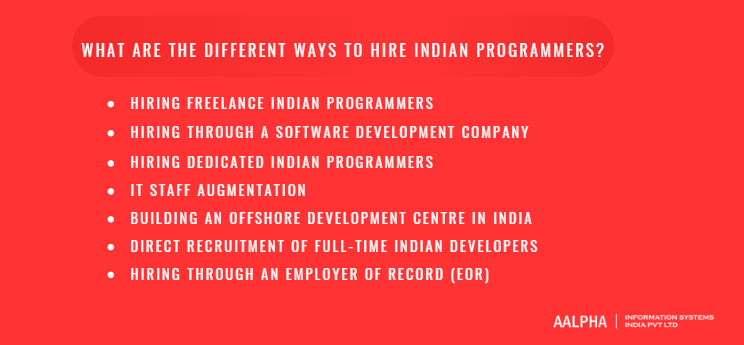
There are seven main ways to hire Indian programmers: freelancers, a software development company, dedicated developers, staff augmentation, an offshore development centre, direct full-time hiring, and an Employer of Record. They differ in who manages the work, who carries employment risk, and how quickly you can change course.
-
Hiring freelance Indian programmers
Freelancers work directly for you, usually through Upwork or a referral, and bill hourly or per task. This is the fastest and cheapest route for a defined piece of work such as a bug fix, a landing page, or an API integration. The weakness is continuity. A freelancer may take other clients, disappear mid-project, or be unavailable when you need a change six months later. Nobody replaces them for you, and nobody reviews their code unless you do.
-
Hiring through a software development company
You hand a defined project to a company, which supplies the team, project management, QA, and delivery. This suits founders and businesses without in-house technical leadership. You buy an outcome rather than hours. The risk sits in vendor selection: a weak vendor can hide junior developers behind a senior sales pitch, so check portfolios, reviews on Clutch, and the actual people assigned.
-
Hiring dedicated Indian programmers
A dedicated developer is employed by an Indian company but works full-time on your project only, under your direction, for a monthly fee. You get the control of an in-house hire without Indian payroll, office, or HR. The vendor handles salary, equipment, leave cover, and replacement. You handle the backlog and priorities. This is the most common model for startups and product companies with a technical lead.
-
IT staff augmentation
Staff augmentation adds Indian developers to your existing team to fill a skill gap or speed up a deadline. They join your standups, use your tools, and follow your processes. It works well when you already have engineering management in place. It works badly when you expect the augmented developers to manage themselves.
-
Building an offshore development centre in India
An offshore development centre (ODC) is a dedicated team, often ten people or more, that operates as your own engineering unit in India. A partner usually provides the office, hiring, payroll, and compliance, sometimes with an option to take the team over later (build-operate-transfer). ODCs make sense for long-term product work at scale. They need more upfront planning and at least a year of commitment to pay off.
-
Direct recruitment of full-time Indian developers
You can hire Indian developers as your own employees, but only if you have a legal entity in India. Setting one up means company registration, a local bank account, payroll, Provident Fund, professional tax, and statutory filings. This is worth it for large, permanent teams. For fewer than about 20 people, most companies find it slower and costlier than the alternatives.
-
Hiring through an Employer of Record (EOR)
An EOR such as Deel, Remote, or Multiplier legally employs the developer in India on your behalf and handles payroll, tax deductions, benefits, and employment contracts. You choose and manage the person. You pay their salary plus an EOR fee, typically several hundred US dollars a month per employee. This gives you an actual employee without an Indian entity, but you still do all the recruiting and technical vetting yourself.
Comparing the hiring models
Freelancers fit small projects and specific tasks, and the main thing to watch is availability and continuity. Dedicated developers fit ongoing development where you want direct collaboration, and your main responsibility is giving clear direction. Staff augmentation fits teams that already have engineering leadership and need more hands, since internal management is required. A software development company fits complete projects with a defined scope, and success depends on vendor selection and delivery oversight. An offshore development centre fits long-term team operations and needs greater initial planning. Direct employees fit permanent engineering needs, but you take on recruitment and Indian employment compliance. EOR hiring sits between direct employment and dedicated developers: you get a real employee without an entity, but recruitment and vetting stay with you.
On cost, freelancers usually have the lowest hourly rate, direct hires and EOR the lowest long-run monthly cost for a single person, and companies and dedicated developers a middle price that includes replacement, management, and continuity. On control, direct hires, EOR, and dedicated developers give you the most. On flexibility, freelancers and dedicated developers are easiest to scale up or down.
How do you choose the right Indian programmer for your project?
Choose an Indian programmer by working backwards from the project: what you are building, which skills it needs, how senior the person must be, how long the work lasts, what you can spend, and how much overlap you need with your working hours. Write these down before you look at a single profile.
-
Define your project goals and business requirements
Describe what the software must do for users and for the business, not just which screens it has. “Customers can book and pay for a repair slot, and the shop sees bookings on a calendar” gives a developer far more to work with than “a booking app”. List integrations, expected user numbers, and any compliance needs such as HIPAA, PCI DSS, or GDPR.
-
Identify the required technical skills
If you already have a codebase, the stack is decided for you. If you are starting fresh, choose a mainstream stack with a large hiring pool, such as Next.js with Node.js and PostgreSQL, or Flutter for mobile. Unusual choices make every future hire harder.
-
Decide between junior, mid-level, and senior programmers
Juniors (0 to 2 years) need supervision and suit well-defined tasks inside an existing codebase. Mid-level developers (3 to 5 years) can own features. Seniors (6 years and above) design systems, review others’ code, and catch problems before they become expensive. A project with no technical lead on your side needs at least one senior, even if the rest of the team is mid-level.
-
Determine whether you need specialists or full-stack developers
For an MVP or a small internal tool, one or two full-stack developers usually cover everything. Add specialists when a part of the system becomes hard: a mobile developer when the app needs offline sync, a DevOps engineer when deployments become risky, an AI engineer when you add model-based features.
-
Estimate project duration and workload
A four-week task suits a freelancer or a fixed-price project. Six months of steady work suits a dedicated developer. Open-ended product development suits a dedicated team or an ODC. If you cannot estimate the duration, buy a short discovery phase first.
-
Identify your budget and preferred engagement model
Set a monthly or total ceiling and include management time, tools, cloud costs, and a buffer of 15 to 20 percent for scope changes. Then pick the engagement model that fits both the budget and the uncertainty in the scope.
-
Establish communication and time zone expectations
Decide how many hours of daily overlap you need, which tools the team will use, how often you will meet, and who on your side answers questions. Put this in writing for candidates. A developer who cannot meet your overlap requirement is the wrong hire, however skilled.
How do you hire Indian programmers step by step?
To hire Indian programmers, follow 12 steps: define requirements, pick a hiring model, choose sources, shortlist, review past work, run technical tests, assess communication, compare quotes, check references, sign contracts covering IP, start with a paid trial, and onboard properly. Skipping the trial and the contract are the two most expensive shortcuts.
- Define your software development requirements. Write a one to three page brief: the problem, the users, core features for the first release, integrations, the existing stack if any, and what “done” means. Add a rough timeline and budget range. Vendors and candidates quote far more accurately against a written brief, and you will reuse it for every interview.
- Select the right hiring model. Use section 4 to decide. As a rule of thumb, choose a freelancer for tasks under a month, a development company for a defined project when you lack technical leadership, and dedicated developers or staff augmentation when you have a technical lead and ongoing work.
- Identify suitable hiring platforms or development companies. Freelancers come from Upwork, Toptal, and referrals. Employees and EOR hires come from LinkedIn, Naukri, and Instahyre. Companies come from Clutch, GoodFirms, and recommendations from other founders. Section 7 covers each source.
- Shortlist programmers based on skills and experience. Filter for the exact stack and for projects similar to yours in domain or scale. Five to eight candidates is a workable shortlist. If you are working through a company, ask for named profiles, not a generic team description.
- Review portfolios, GitHub profiles, and previous projects. Look at live apps and websites they built, and ask which parts they personally wrote. On GitHub, recent commits, readable code, tests, and sensible commit messages matter more than star counts. Many good developers have little public code because client work is private, so ask for a walkthrough of a past project instead.
- Conduct technical interviews and coding assessments. Use a structured interview with the same core questions for every candidate, plus a practical exercise based on your real work. Section 9 has the detail.
- Evaluate communication and problem-solving abilities. Give the candidate an ambiguous requirement and see whether they ask clarifying questions or start coding on assumptions. Ask them to explain a technical trade-off to a non-technical person. You will rely on both skills daily.
- Request quotes and compare pricing structures. Ask each vendor or candidate to price the same brief. Compare what the price includes: project management, QA, code review, replacement guarantees, post-launch support, and notice periods. A low hourly rate with no QA often ends up costing more.
- Conduct reference checks and verify credentials. Speak to two past clients, ideally ones from your region. Ask what went wrong and how the developer or company handled it. For companies, check incorporation details, reviews on independent platforms, and how long they have been operating.
- Finalise contracts, NDAs, and intellectual property rights. Sign an NDA before sharing sensitive material and a development agreement before work starts. The agreement must assign all IP and source code to you on payment. Section 12 lists the clauses to include.
- Begin with a paid trial assignment or defined milestone. Run a one to four week paid trial on a real but contained piece of work. Judge the code, the questions asked, the updates, and whether deadlines held. A trial costs little compared with three months spent with the wrong person.
- Onboard your programmer and establish delivery expectations. Give access to repositories, tickets, staging environments, and documentation on day one. Agree working hours, sprint length, the definition of done, code review rules, and reporting format. Assign one person on your side to answer questions in the first two weeks.
Example: a US SaaS startup hiring two full-stack developers
A seed-funded SaaS startup in Austin has a CTO and a Next.js and Node.js product with paying customers. It needs two full-stack developers to clear a feature backlog over the next 12 months.
The CTO writes a two-page brief listing the stack, the first three features, and a requirement for four hours of overlap with Central Time. Because the company has technical leadership and long-term work, it chooses dedicated developers through an Indian development company rather than freelancers. It shortlists four companies from Clutch with relevant SaaS work and asks each for two named developer profiles.
Each candidate gets a 60-minute technical interview and a paid four-hour task: add a filtered, paginated API endpoint and its React table to a stripped-down copy of the codebase. Two developers from one company submit clean, tested code and ask good questions about edge cases. The startup checks two client references, signs an agreement assigning all IP on payment with 30 days’ notice and free replacement, and starts with a four-week trial on a real feature.
At the end of the trial, both developers have shipped the feature through code review into production. The startup moves to a 12-month engagement at a monthly rate it calculates at well under half the cost of two local hires, before counting the time it would have spent recruiting in the US market.
Where can you find and hire Indian programmers?
The best places to find Indian programmers are software development companies for managed teams, Clutch and GoodFirms for vetted vendors, LinkedIn and Indian job portals for direct hires, Upwork for freelancers, and Toptal or Turing for pre-screened individuals. Referrals from other founders often beat all of them for reliability.
Software development outsourcing companies
Indian development companies supply dedicated developers, full teams, or end-to-end projects. They handle recruitment, payroll, equipment, replacement, and often project management and QA. This is the best source if you want a working team quickly and do not want to vet individuals yourself. Check their reviews, the size of their bench in your stack, and whether they let you interview the actual developers.
LinkedIn is the main channel for recruiting senior Indian engineers directly or through an EOR. Search by skill, city, and current employer, and post jobs with a clear salary range. Expect high message volume and some inflated profiles, so screen with a short technical questionnaire before booking calls.
Upwork
Upwork has a very large pool of Indian freelancers and agencies. Job success scores, completed project history, and client reviews help, but quality varies widely. It works best for small, clearly scoped jobs where you can review the output yourself.
Toptal
Toptal screens freelancers before admitting them and matches you with candidates. Rates are well above typical Indian freelance rates, but you skip most of the screening. It suits companies that want one strong individual quickly and can manage them directly.
Turing
Turing offers pre-vetted remote developers, many in India, matched to your stack, and in recent years has also moved into AI model training work. Like Toptal, it trades a higher rate for speed and pre-screening.
GitHub and developer communities
GitHub, Stack Overflow, and local meetup groups in Bengaluru, Pune, and Hyderabad help you find developers who contribute to open source in your stack. This is slow, but it surfaces engineers whose code you can read before you contact them.
Clutch and GoodFirms
Clutch and GoodFirms list development companies with verified client reviews, project sizes, hourly rate bands, and focus areas. Read the detailed reviews rather than the star rating, and look for reviewers in your industry and region.
Indian recruitment platforms and job portals
Naukri, Instahyre, Foundit, and Cutshort are where Indian developers actively look for jobs. They are useful only if you are hiring employees, through your own Indian entity or an EOR. Expect to run your own screening and to compete with Indian product companies on salary.
Professional referrals and technology networks
Ask founders, CTOs, and investors you know which Indian developers or companies they have used and would use again. A referral comes with context no review can give you: how the team behaved when something went wrong.
Which sources suit which hiring model
Use Upwork and referrals for individual freelancers and contractors. Use LinkedIn and Indian job portals for direct employees and EOR hires. Use Toptal and Turing for pre-screened individuals when speed matters more than price. Use Clutch, GoodFirms, and referrals for development companies, dedicated developers, and managed teams.
How to identify trustworthy hiring sources
Trust sources that give you verifiable evidence. For companies, that means a registered entity, several years of history, independent reviews with named reviewers, a portfolio with live links, and willingness to let you interview developers and talk to past clients. Be wary of anyone who refuses a paid trial, asks for large upfront payments before any delivery, or cannot explain who will actually write your code.
What skills should you look for in Indian programmers?
Look for depth in the specific language and framework you use, sound database and API design, clean and tested code, comfort with Git and code review, awareness of security basics, and clear written communication. Technical skill without the ability to explain trade-offs and flag problems early produces software you cannot maintain.
Programming language proficiency. The developer should know the language well beyond syntax: its standard library, common pitfalls, and performance traits. A TypeScript developer should use the type system properly rather than scattering any across the code.
Framework and technology expertise. Ask about versions and real projects. A React developer in 2026 should be comfortable with hooks, server components in Next.js, and state management choices, and should explain when not to use a library.
Database design and management. Good developers design normalised schemas, add the right indexes, write efficient queries, and handle migrations safely. Ask them to model a small part of your domain and explain the trade-offs.
API development and third-party integrations. Look for experience with REST and GraphQL, authentication (OAuth, JWT), webhooks, rate limits, retries, and versioning. Most real projects depend on payment gateways, email and SMS providers, maps, and CRMs.
Software architecture and code quality. Seniors should be able to explain how they would structure a system for your expected load and team size, and why. Look for small functions, meaningful names, and separation of concerns in their code.
Git, version control, and collaborative development. The developer should use branches, write clear commit messages, open focused pull requests, and review others’ code constructively. Weak Git habits make collaboration painful.
Testing, debugging, and quality assurance. Ask what they test and how. Unit and integration tests, a habit of reproducing bugs before fixing them, and familiarity with logging and monitoring tools separate professional developers from hobbyists.
Application security and data protection awareness. Developers should know the OWASP Top 10, store secrets outside the code, validate input, hash passwords properly, and apply least-privilege access. For regulated data, they should understand what GDPR, HIPAA, or India’s DPDP Act mean for the code they write.
Communication, documentation, and team collaboration. Read their written answers to your screening questions. Clear writing in tickets, pull requests, and status updates matters more in remote work than accent or speaking speed.
Analytical thinking and independent problem-solving. The best remote developers investigate before asking, but ask before guessing. Give a scenario with a missing detail and see which way they lean.
How should you interview and assess Indian programmers?
Assess Indian programmers with a structured interview, a practical task based on your real work, a code review of something they built, and a check of communication and security awareness. Score every candidate on the same weighted scorecard so the decision rests on evidence rather than on who interviewed best.
-
Prepare a structured technical interview
Write eight to ten core questions that every candidate answers, covering your stack, a past project, a debugging story, and a design problem. Keep 60 to 75 minutes for the main interview. Consistency lets you compare candidates fairly and stops one confident talker from winning by default.
-
Ask language-specific questions
Ask questions that need experience to answer well. For Node.js: how the event loop handles a CPU-heavy task, and what they would do about it. For Python: when they would choose FastAPI over Django. For React: how they would stop unnecessary re-renders in a large list. Trivia about syntax tells you little.
-
Assess real-world problem-solving
Describe an actual problem from your product, such as duplicate orders appearing when users double-click Pay, and ask how they would investigate and fix it. Good candidates ask about logs, reproduce the issue, and suggest a server-side fix such as an idempotency key rather than just disabling the button.
-
Review code samples and previous work
Ask the candidate to share their screen and walk you through code they wrote, explaining a decision they would change today. People who wrote the code can explain it. People who copied it struggle.
-
Conduct live coding sessions
Keep live coding short, about 30 minutes, and realistic. Let candidates use their normal editor and look things up. Watch how they break the problem down, test as they go, and talk through their thinking.
-
Use paid technical assignments
For finalists, set a paid take-home task of three to six hours that mirrors your work. Paying signals respect, attracts stronger candidates, and gives you working code to review. Review it for correctness, tests, structure, and the README.
-
Assess software architecture knowledge
For senior roles, ask the candidate to sketch a system: a multi-tenant SaaS with role-based access, or an order service that must handle 10 times today’s traffic. Listen for trade-offs, not buzzwords.
-
Evaluate English communication and remote collaboration
Ask for a short written status update about the take-home task, as if reporting to a manager. Ask how they handle a requirement they think is wrong. You want someone who raises concerns politely and early.
Common red flags during developer interviews
Watch for answers that recite definitions without examples, inability to explain their own code, reluctance to share screen or turn on video for the interview, a take-home task that looks very different from their live coding, vague answers about who did what on team projects, and agreement to every requirement without a single question. Also watch for a vendor who substitutes a different developer after the interview.
Create a developer evaluation scorecard
Score each area from 1 to 5, multiply by its weight, and add the results for a total out of 100 (a 5 in every area gives 100). Adjust the weights to your project, but agree them before the first interview.
- Technical skills in your stack: 30 percent (weight 6)
- Relevant project experience: 20 percent (weight 4)
- Communication and collaboration: 20 percent (weight 4)
- Reliability, from references and trial behaviour: 15 percent (weight 3)
- Security awareness: 10 percent (weight 2)
- Cost relative to budget: 5 percent (weight 1)
For a security-sensitive product such as fintech or healthcare, move five points from cost to security. Set a minimum of 3 on technical skills and communication, so a high score elsewhere cannot hide a weakness there.
How much does it cost to hire Indian programmers in 2026?
In 2026, Indian programmers typically cost USD 10 to 60 per hour as freelancers and USD 15 to 45 per hour through an established development company, with specialist AI and cloud engineers above that. A full-time dedicated developer usually costs about USD 2,400 to 7,000 a month depending on seniority. These are market estimates, not fixed rates.
One distinction matters before the numbers. A developer’s salary in India and the rate a company bills you are different things. The billing rate covers salary, benefits, office, equipment, software licences, recruitment, replacement, management, QA support, and the vendor’s margin. Comparing a vendor’s rate with an Indian salary figure from a job site will always make the vendor look expensive.
The ranges below are estimates for October 2026 and assume 160 billable hours a month for full-time work. They are based on rates commonly quoted by established Indian development companies and freelance platforms. Your quotes will vary with city, vendor size, stack, and contract length.
Average hourly rates by experience level
Through an established development company:
- Junior developer (0 to 2 years): USD 15 to 22 per hour
- Mid-level developer (3 to 5 years): USD 22 to 32 per hour
- Senior developer (6 years and above): USD 32 to 45 per hour
- Technical lead or architect: USD 45 to 60 per hour
As an independent freelancer, rates run from about USD 10 to 20 per hour for juniors, 20 to 35 for mid-level, and 35 to 60 for seniors, with top-rated specialists on screened platforms charging more.
Monthly cost of a dedicated developer
At 160 hours, a dedicated junior developer costs roughly USD 2,400 to 3,500 a month, a mid-level developer USD 3,500 to 5,000, and a senior developer USD 5,000 to 7,000. Monthly contracts are usually cheaper per hour than hourly billing because the vendor has guaranteed utilisation. Aalpha Information Systems, for example, lists rates starting at USD 15 per hour on Clutch, with the final rate set by seniority and stack.
Programmer costs by technology
Technology changes the rate more than many buyers expect. Mid-level to senior engineers through a company typically fall in these bands:
- PHP and Laravel: USD 18 to 35 per hour
- React and Next.js: USD 20 to 40 per hour
- Node.js: USD 20 to 40 per hour
- Python (web and backend): USD 22 to 42 per hour
- Java and Spring Boot: USD 22 to 42 per hour
- .NET: USD 22 to 40 per hour
- Flutter and React Native: USD 20 to 40 per hour
- Cloud and DevOps: USD 28 to 50 per hour
- AI and machine learning engineering: USD 35 to 65 per hour
Freelance versus development company pricing
Freelancers can be 20 to 40 percent cheaper per hour. The company rate buys continuity: a replacement if the developer leaves, code review by a senior, QA, a project manager, and a business you can hold to a contract. For short tasks, freelancers often win on value. For anything you will maintain for years, the company premium usually pays for itself.
Indian rates compared with the USA, UK, and Europe
The BLS median wage for US software developers was USD 133,080 in May 2024. Add benefits, payroll taxes, and equipment, and an employer’s fully loaded cost is commonly 25 to 40 percent higher, or roughly USD 165,000 to 185,000 a year. A senior dedicated Indian developer at USD 6,000 a month costs USD 72,000 a year. UK costs are lower than the US but still well above India, and Eastern European agencies typically charge somewhere between Indian and Western European rates.
Factors that influence hiring costs
Seniority, technology, and domain experience set most of the rate. Contract length, team size, overlap requirements (night shifts cost more), the vendor’s city and reputation, and compliance demands such as HIPAA or SOC 2 controls move it further. Long contracts and larger teams usually earn a discount.
Hidden expenses to consider
Budget for your own management time, third-party tools and licences, cloud hosting, a technical lead or code reviewer if you lack one, onboarding time, travel for occasional in-person workshops, international bank charges and currency conversion, and rework if requirements were unclear. For direct or EOR hires, add recruitment time, EOR fees, equipment, and statutory benefits.
How to estimate your total development budget
Estimate the team you need for each phase, multiply each role’s monthly rate by the months required, then add 10 to 15 percent for tools, hosting, and management overhead and a further 15 to 20 percent contingency for scope change. Example budgets using mid-range company rates:
- One mid-level dedicated developer: about USD 4,000 a month, or USD 48,000 a year
- A three-person team (one senior, two mid-level): about USD 14,000 a month, or USD 168,000 a year
- A five-person team (one senior lead at USD 6,500, three mid-level developers at USD 4,000 each, one QA engineer at USD 3,500): about USD 22,000 a month, or USD 264,000 a year
A real-world annual cost scenario for a three-person team
Assume a US company needs one senior and two mid-level developers for 12 months. Hiring locally at around the BLS median, with a 30 percent load for benefits and taxes, costs roughly USD 520,000 a year before recruiting fees. Through an Indian development company at the mid-range rates above, the same team costs about USD 168,000, including management and replacement. Through an EOR at Indian market salaries, the direct cost can be lower still, but the company takes on recruiting, vetting, retention, and day-to-day management, and has no replacement if someone resigns. The numbers favour India in every version. The choice between the Indian options depends on how much management you can supply yourself.
How to reduce costs without losing quality
Write clearer specifications, since unclear requirements are the largest source of waste. Mix seniority instead of hiring only seniors. Commit to longer contracts for a lower rate. Use a cross-platform mobile framework where it fits. Automate tests and deployments early. Do not cut costs by choosing the lowest bidder, removing QA, or skipping code review.
Which engagement and payment models work best?
Use fixed price for small, tightly defined projects, time and materials for evolving work, a monthly dedicated model for ongoing product development, and milestone payments to tie money to delivered results. Most long-term clients of Indian vendors settle on a monthly dedicated model with clear sprint goals.
-
Fixed-price development contracts
In fixed-price development contracts, the vendor delivers an agreed scope for an agreed price. You know the cost upfront, which suits a landing site, an MVP with a frozen feature list, or a defined integration. The catch is that every change becomes a change request, and vendors build risk margins into fixed quotes. Fixed price works only when the scope is genuinely fixed.
-
Hourly billing and time-and-materials agreements
You pay for hours worked, usually billed weekly or monthly with timesheets. This suits projects where requirements will shift as you learn. It needs tracking on your side: set a monthly cap and review hours against delivered work.
-
Monthly dedicated programmer model
You pay a flat monthly fee for a full-time developer working only on your project. It is predictable, gives you control of priorities, and usually carries the lowest effective hourly rate. The risk is paying for idle time if you do not keep the backlog full.
-
Milestone-based payments
Payment is released when defined deliverables are accepted, for example 25 percent on design approval, 50 percent spread across feature milestones, and 25 percent on launch. This protects you on fixed-price projects. Write acceptance criteria for each milestone so there is no argument about whether it is done.
-
Part-time versus full-time engagements
Part-time arrangements, often 80 hours a month, suit maintenance, small enhancements, or specialist input such as DevOps or security reviews. Full-time suits active development. Part-time developers usually split their time with other clients, so agree response times in writing.
-
Retainer-based development services
A retainer buys a block of hours each month for support, bug fixes, and small changes, often with unused hours expiring or rolling over for one month. It suits live products that need steady upkeep without a full-time developer. Note that support windows are usually weekday business hours, so confirm what happens with urgent issues outside them.
How to choose the most suitable payment model
Match the model to how certain your scope is. High certainty favours fixed price with milestones. Medium certainty favours time and materials with a monthly cap. Ongoing product work favours the monthly dedicated model. Many projects move between models: a fixed-price discovery phase, then a dedicated team for the build, then a retainer after launch.
What legal, contractual, and security issues should you cover?
Before work starts, sign an NDA and a development agreement that assigns all IP and source code to you, defines scope and acceptance, sets payment and tax terms, covers data protection under GDPR and India’s DPDP Act where relevant, and explains replacement, termination, and dispute resolution. Keep ownership of every repository and cloud account.
This section is general guidance, not legal advice. Have a lawyer in your own jurisdiction review contracts for significant engagements.
-
Non-disclosure agreements (NDAs)
Sign a mutual NDA before sharing business plans, data, or code. It should cover the vendor’s employees and subcontractors, survive termination for several years, and require return or deletion of your materials when the engagement ends. Reputable Indian vendors sign NDAs as a matter of routine.
-
Intellectual property ownership and source code rights
The development agreement should state that all code, designs, documentation, and other work product created for you belong to you, and that rights are assigned to you on payment. Ask the vendor to confirm that its employees have signed IP assignment clauses with the vendor, so the chain of ownership is unbroken. List any pre-existing libraries or tools the vendor reuses, and get a perpetual licence to them.
-
Software development agreements and statements of work
Use a master services agreement for the legal terms and a separate statement of work (SOW) for each project or phase. The SOW defines scope, deliverables, timelines, acceptance criteria, team composition, and fees. Keeping them separate means you can start new phases without renegotiating the whole contract.
-
Confidentiality and data protection requirements
If developers will access personal data, define what they can access, where it is stored, how it is protected, and what happens after the engagement. Use anonymised or synthetic data in development and testing wherever possible. Require breach notification within a fixed period.
-
GDPR, India’s DPDP Act, and other privacy rules
If you process personal data of people in the EU or UK, GDPR or UK GDPR applies regardless of where your developers sit, and you need a data processing agreement and an approved transfer mechanism such as Standard Contractual Clauses. US companies should check sector rules such as HIPAA for health data.
India’s Digital Personal Data Protection Act, 2023 is now being brought into force in stages. The government notified the DPDP Rules, 2025 in mid-November 2025. Provisions on the Data Protection Board took effect immediately, consent manager provisions follow after 12 months (around November 2026), and most obligations on organisations that process personal data apply after 18 months, around May 2027. The Act allows penalties of up to INR 250 crore for failing to take reasonable security safeguards. The Act mainly applies to processing in India and to processing of personal data of people in India. If your Indian vendor only processes your foreign customers’ data under contract, check with counsel how the Act applies, since some provisions are relaxed for that situation. If your product serves Indian users, plan for DPDP compliance in your design now.
-
Access controls, repositories, and infrastructure ownership
Create the GitHub or GitLab organisation, cloud accounts, domain registrations, app store accounts, and third-party service accounts in your company’s name, and invite developers as members. Use individual accounts, multi-factor authentication, least-privilege roles, and a password manager. When someone leaves, you remove access in minutes rather than asking for your own assets back.
-
Payment terms, taxes, and international invoicing
Agree the invoicing currency, payment schedule, and method. Indian vendors billing foreign clients in foreign currency for software services are generally treated as exporting services, which usually means no Indian GST on the invoice. Check your own country’s rules on withholding tax and on reporting foreign contractor payments. Payment by international wire or a platform such as Payoneer or Wise is common.
-
Developer replacement and termination clauses
For dedicated developers, the contract should guarantee a replacement within a stated period, often two to four weeks, at no extra cost, with a handover overlap where possible. Define notice periods for both sides (30 days is typical), what happens to work in progress, and the vendor’s obligation to hand over all code, credentials, and documentation on termination.
-
Dispute resolution and governing law
Choose the governing law and the forum for disputes. Many international contracts with Indian vendors specify arbitration in a neutral venue such as Singapore or London, or in India under the Arbitration and Conciliation Act, 1996, because court enforcement across borders is slow. Add an escalation step, such as a meeting between senior managers, before formal proceedings.
How do you manage Indian programmers effectively?
Manage Indian programmers the way you would manage any remote team, with more structure in the first months: clear goals per sprint, a fixed daily overlap, one channel for decisions, visible tickets, regular code review, written documentation, and metrics based on delivered work rather than hours online.
-
Establish clear project objectives and deliverables
Every sprint should start with a short list of outcomes, each with acceptance criteria. “User can reset password via email link that expires after 30 minutes” is testable. “Improve login” is not. Developers anywhere do better work when they know what finished looks like.
-
Set up communication channels
Use Slack or Microsoft Teams for daily conversation, Jira, Linear, or ClickUp for tickets, and a shared document space such as Notion or Confluence. Agree which channel holds decisions so nothing important lives only in a call. Hold a short daily standup during overlap hours and a weekly call with stakeholders.
-
Manage time zone differences and working hours
Fix two to four hours of daily overlap and protect it for meetings, reviews, and questions. Outside overlap, rely on written updates. Many Indian teams serving the US work an afternoon-to-evening shift in IST. Ask rather than assume, and do not expect regular midnight calls from people with families.
-
Use Agile and Scrum practices
One or two week sprints with planning, standups, a demo, and a retrospective give remote teams a steady rhythm and you a regular look at working software. Keep ceremonies short. The demo is the most useful of them because it shows real progress.
-
Track progress through project management tools
Every piece of work should be a ticket with an owner, a status, and a link to the pull request. A burn-down or cycle-time chart tells you more than a status report. If you cannot see progress in the tool, ask why before the sprint ends, not after.
-
Conduct sprint reviews and code reviews
Require at least one approval on every pull request and run automated tests and linting in CI before merge. If you have no senior engineer in-house, ask your vendor to assign one as reviewer or hire an independent reviewer for a few hours a week.
-
Maintain documentation and knowledge sharing
Keep a living README, setup instructions, architecture notes, API documentation, and a decision log. Ask developers to update documentation as part of the definition of done. Good documentation is your insurance against turnover.
-
Build trust and long-term collaboration
Treat remote developers as team members: include them in product context, share customer feedback, credit their work, and explain the reasons behind priorities. Developers who understand the business make better decisions on their own. Occasional in-person visits, even once a year, strengthen working relationships considerably.
-
Measure developer productivity through meaningful metrics
Track delivered features against sprint goals, cycle time from ticket start to production, escaped defects, and review turnaround. Avoid lines of code, commit counts, and screenshots of activity trackers, which reward the wrong behaviour.
-
Handle performance issues and escalations professionally
Raise problems early, privately, and with specific examples. Agree an improvement plan with a time frame. If you hired through a vendor, involve their account manager; a good vendor will coach or replace the developer quickly. Escalate in writing if a pattern continues.
What are the common challenges, and how do you overcome them?
The common problems with Indian programmers are the same as with any offshore team: unclear requirements, limited time zone overlap, uneven code quality, missed deadlines, turnover, IP worries, scope creep, and poor visibility. Nearly all of them trace back to weak specifications, missing review, or a contract that left key points open.
Miscommunication and unclear requirements. Many developers will build exactly what a ticket says even when it seems wrong, especially early in a relationship. Write acceptance criteria, add mock-ups or examples, and invite questions explicitly. Ask developers to restate the requirement in their own words before starting.
Time zone coordination. Fix overlap hours, push routine communication into writing, and avoid making developers wait a full day for answers. A designated decision-maker on your side who checks messages at the start of the Indian day removes most delays.
Inconsistent code quality. Set coding standards, enforce linting and tests in CI, and require code review. Quality problems usually mean there was no reviewer, not that the developer was incapable.
Missed deadlines and project delays. Break work into small tickets, track cycle time, and ask for early warning when estimates slip. Delays found on day two of a sprint can be managed. Delays found at the demo cannot.
Developer turnover and knowledge loss. Turnover in Indian IT is real, particularly among mid-level engineers. Reduce the impact with documentation, pair programming, shared code ownership, and a contract requiring replacement with a handover period.
Security and intellectual property concerns. Keep repositories and cloud accounts in your name, use least-privilege access, sign IP assignment and NDA clauses, and use test data instead of production data.
Unexpected costs and scope changes. Use a change request process. Every addition gets an estimate and a decision before work starts. For time-and-materials work, set a monthly cap.
Excessive dependence on individual developers. If only one person understands a critical system, you have a single point of failure. Rotate work, require documentation, and make sure at least two people can deploy and debug production.
Lack of project visibility. Insist on access to the ticket board, the repository, staging environments, and a weekly written update. A vendor reluctant to give you this access is a warning sign.
Practical strategies to reduce hiring and delivery risk. Start with a paid trial, hold back final payment until acceptance, keep ownership of assets, add independent code review, and agree the exit process before you need it.
What practices lead to better results when hiring Indian programmers?
The practices that produce good results are simple: pay for proven skill rather than the lowest rate, start small, prefer relevant domain experience, define acceptance criteria, own your assets, review code and automate tests, report transparently, plan for retention, write things down, and review the relationship regularly.
Prioritise demonstrated skills over low hourly rates. A USD 30 developer who finishes a feature in 20 hours costs less than a USD 15 developer who takes 60 hours and leaves bugs behind.
Start with a small, clearly defined assignment. A paid trial reveals working habits that interviews cannot.
Select developers with relevant industry experience. Someone who has built fintech, healthcare, or logistics software already knows the compliance traps and data patterns of that field.
Establish clear acceptance criteria. Define “done” for every ticket and milestone so payment, testing, and expectations line up.
Maintain ownership of project assets and credentials. Repositories, cloud accounts, domains, and app store listings belong in your company’s name from day one.
Use code reviews and automated testing. Make review and passing tests a condition of merging code, without exceptions.
Create a transparent reporting structure. Agree what you will see each week: completed work, blockers, upcoming tasks, and hours if relevant.
Plan for developer retention. Long engagements, interesting work, fair rates, and recognition keep good developers on your project. Ask your vendor how they retain staff.
Document critical processes and decisions. Deployment steps, architecture choices, and integration details should never live only in one person’s head.
Review performance and collaboration regularly. A short quarterly review with your developers or vendor catches problems while they are still small.
Should you hire Indian programmers or local developers?
Hire Indian programmers when cost, speed of hiring, and access to a wide skill range matter most and you can run structured remote work. Hire locally when the role needs constant in-person collaboration, deep local regulatory knowledge, security clearance, or a permanent leadership position. Many companies combine both.
-
Development cost
India is cheaper by a wide margin. A three-person Indian team through a development company can cost about a third of the equivalent US team, as the scenario in section 10 shows. The UK gap is smaller but still large. Eastern Europe sits in between.
-
Access to technical skills and specialists
India’s talent pool lets you find niche skills, such as a particular payment integration or a legacy framework, faster than most local markets. Local markets are stronger where domain knowledge is tied to the country, such as US healthcare billing or UK public sector procurement.
-
Recruitment speed and availability
An Indian vendor can usually place a developer in one to three weeks. Local senior hiring in the US or UK commonly takes two to four months, plus notice periods.
-
Communication and time zones
Local developers win on spontaneous conversation and shared business hours. Indian teams need deliberate overlap and more written communication. For UK and European companies the overlap is comfortable; for US West Coast companies it takes real effort.
-
Scalability and team flexibility
Offshore teams scale up and down far more easily, without layoffs or long hiring cycles. Local teams are harder to resize but build institutional knowledge more naturally.
-
Project management and compliance responsibilities
With a vendor, the vendor carries Indian employment compliance and you carry delivery oversight. With local staff, you carry everything but have simpler contracts and data transfer arrangements.
-
When local hiring is the better choice
Choose local hiring for a CTO or head of engineering, for roles requiring security clearance or on-site hardware access, where regulation restricts data leaving the country, or when your product depends on daily in-person work with customers.
-
When offshore hiring makes more sense
Choose India for product development with a defined backlog, MVPs on a limited budget, scaling an existing team quickly, long-running maintenance, and specialist skills you need for months rather than years. A common pattern is a local product owner or technical lead working with an Indian development team.
When should you hire dedicated Indian programmers?
Hire dedicated Indian programmers when you have continuous development work for at least three to six months and want people who learn your product deeply: building an MVP, running a SaaS product, scaling an existing team, modernising legacy systems, adding a specialist skill, or maintaining software long term.
Building a minimum viable product. A dedicated team of two to four developers can usually build a focused MVP in three to four months, then stay on to iterate based on user feedback, so knowledge is not lost at launch.
Developing and maintaining SaaS applications. SaaS products ship constantly. Dedicated developers who know the codebase, billing logic, and customer issues move faster than a rotating cast of contractors.
Scaling an existing software product. When your in-house team cannot keep up with the roadmap, dedicated developers can take on whole features or modules under your technical lead.
Modernising legacy business applications. Migrating from old PHP, classic .NET, or a monolith to a modern stack is long, careful work that rewards continuity.
Adding specialised technical expertise. A dedicated DevOps, AI, or mobile engineer for six to twelve months fills a gap without a permanent hire.
Expanding capacity without permanent recruitment. Dedicated developers give you headcount you can adjust with a month’s notice.
Supporting long-term product development and maintenance. For products that will run for years, a stable dedicated team keeps knowledge, standards, and response times steady.
Why choose Aalpha Information Systems to hire Indian programmers?
Aalpha Information Systems is an India-based software development company that has supplied dedicated developers and complete project teams to international clients since 2008. It offers vetted programmers across web, mobile, cloud, and AI stacks, flexible monthly or project engagement, and the replacement and oversight that independent hiring lacks.
Experienced software development professionals
Aalpha’s engineers work from development centres in Hubballi and Bengaluru, Karnataka. Clients interview the developers before they start, so the people you meet are the people who write your code.
Expertise across programming technologies
Teams cover React, Next.js, Node.js, NestJS, Python, Java, PHP and Laravel, .NET, Flutter, React Native, Swift, Kotlin, AWS, Google Cloud, and applied AI including LLM integration and AI agents. See Aalpha’s Node.js, Python, and Flutter pages for stack-specific detail.
Dedicated developer hiring options
You can hire dedicated remote developers individually, add them to your team through staff augmentation, or set up an offshore development centre for a larger long-term team.
Flexible engagement models and pricing
Aalpha works on dedicated monthly resources, fixed-price projects, and time-and-materials arrangements, explained on its engagement models page. Rates start at USD 15 per hour and depend on seniority and technology.
Experience with international clients
Aalpha’s work spans clients in the US, UK, Europe, the Gulf, Africa, and Asia, from startups to organisations such as the World Bank and Swiss Re. Its portfolio includes MoneyWellth, a fintech SaaS platform for iOS, Android, and web, and AgileHRO, a global HR platform built on a microservices architecture. The company holds a 4.9 out of 5 rating from more than 215 reviews on Clutch, where clients regularly mention communication and project management.
Transparent communication and project management
Every engagement gets an account manager, access to your own ticket board and repositories, agreed overlap hours with your time zone, and regular written progress reports.
Software quality, testing, and post-development support
Aalpha runs its delivery under ISO 9001:2015 certified quality processes, with code review, automated and manual testing, and post-launch software maintenance plans for live products.
How to hire Indian programmers through Aalpha Information Systems
Share your requirements through the contact page. Aalpha reviews the brief, recommends a team and engagement model, and sends developer profiles for you to interview. After you select developers and sign the agreement and NDA, work typically starts within one to two weeks, often with a trial period so you can judge the fit before committing long term.
What is the right way to choose Indian programmers for your business?
The right Indian programmers are the ones whose skills you have verified on real work, under an engagement model that matches how certain your scope is, with a contract that gives you the IP and the code. India’s cost advantage is real, but it holds only when you pair it with clear requirements, code review, and steady communication.
Start by writing down what you need built and how long the work will last. That answer usually points to the right model: a freelancer for a short task, a development company for a defined project, or dedicated developers for ongoing product work. Test candidates with a paid task, check references, and keep your repositories and accounts in your own name.
If you want a vetted team without running the search yourself, contact Aalpha Information Systems with your requirements to receive developer profiles and a cost estimate.
Frequently asked questions
How much does it cost to hire a programmer in India?
In 2026, Indian programmers typically cost USD 10 to 60 per hour as freelancers and USD 15 to 45 per hour through an established company. A full-time dedicated developer costs about USD 2,400 to 7,000 a month depending on seniority and stack. AI and cloud specialists charge more. These are market estimates, so compare written quotes against the same brief.
How can I hire Indian programmers remotely?
Write a project brief, choose a hiring model, find candidates through a development company, Clutch, LinkedIn, or Upwork, then interview, run a paid test task, check references, and sign an agreement covering IP and confidentiality. Start with a short trial before committing long term.
Where can I find reliable Indian programmers?
Reliable sources include established Indian software development companies, Clutch and GoodFirms for reviewed vendors, LinkedIn for direct hires, Toptal and Turing for pre-screened individuals, and referrals from people who have worked with Indian teams. Reliability shows in verifiable reviews, live portfolio work, and willingness to run a paid trial.
Is it safe to hire programmers from India?
Yes, when you use proper contracts and controls. Sign an NDA and an IP assignment agreement, keep repositories and cloud accounts in your own name, grant least-privilege access, use test data, and work with registered companies or vetted individuals. Most problems come from missing contracts and shared credentials, not from the country.
What programming languages are Indian developers skilled in?
Indian developers work across JavaScript and TypeScript (React, Next.js, Node.js), Python, Java, PHP and Laravel, .NET, Go, Swift, Kotlin, Flutter, and React Native, along with SQL and NoSQL databases, AWS, Azure, Google Cloud, and AI tooling. Legacy stacks are also well covered, which helps with modernisation projects.
How do I hire dedicated programmers from India?
Choose an Indian development company that offers dedicated developers, share your requirements, interview the developers it proposes, and sign a monthly agreement with IP assignment, a replacement guarantee, and a notice period. The developer then works full-time on your project under your direction while the company handles payroll and HR.
Can I hire Indian programmers on an hourly basis?
Yes. Freelancers and most development companies offer hourly or time-and-materials billing, usually with weekly or monthly timesheets. Hourly suits small or uncertain work. For full-time ongoing work, a monthly dedicated contract usually works out cheaper per hour.
What is the difference between Indian freelance programmers and dedicated developers?
A freelancer works independently, often for several clients, and you manage them directly with no backup if they leave. A dedicated developer is employed by a company, works only on your project, and comes with replacement, equipment, and often code review and project management included. Freelancers are cheaper; dedicated developers give more continuity.
How do I verify the technical skills of Indian programmers?
Review live projects and code they wrote, run a structured technical interview, give a paid task based on your real work, ask them to explain their own code, and speak to past clients. A short paid trial on your codebase is the most reliable check of all.
How long does it take to hire a programmer in India?
Through a development company, you can usually interview candidates within a few days and start within one to three weeks. Hiring a freelancer can take days. Direct or EOR recruitment of a full-time employee often takes four to eight weeks, plus the candidate’s notice period, which is commonly 30 to 90 days in India.
Can Indian programmers work in US or UK time zones?
Yes. India Standard Time is UTC+5:30, so a normal day overlaps fully with UK mornings. For the US, many Indian teams work an afternoon-to-evening shift that gives two to four hours of overlap with the East Coast. Full overnight shifts are possible but cost more and are harder to sustain.
How do I protect my intellectual property when hiring Indian developers?
Sign an NDA and a development agreement assigning all code and work product to you on payment, confirm the vendor’s employees have assigned IP to the vendor, keep repositories and accounts in your company’s name, and require full handover of code and credentials on termination.
What are the best hiring models for startups and small businesses?
Startups without a technical co-founder usually do best with a development company that supplies a full team including a project manager. Startups with a CTO often prefer one to three dedicated developers. Freelancers suit small, defined tasks. Most early-stage companies should avoid setting up an Indian entity until the team is large.
Can I hire a team of Indian programmers instead of one developer?
Yes. Indian companies routinely supply complete teams with developers, QA engineers, designers, a DevOps engineer, and a project manager. A team gives you broader skills, internal code review, and resilience if one person is unavailable. Larger long-term teams can be set up as an offshore development centre.
Should I hire Indian programmers through a company or directly?
Hire through a company if you want speed, replacement guarantees, and no Indian employment compliance. Hire directly, through your own entity or an EOR, if you want permanent employees, have strong engineering management, and can handle recruitment and retention yourself. Many businesses start with a company and move to direct hiring later.