





TL;DR
Hiring Docker developers means bringing in engineers who can package an application into containers, wire those containers together, and keep them running in production without nasty surprises at 2am. The job sits between development and operations: writing Dockerfiles, building images small enough and safe enough to ship, setting up Compose so the whole stack runs on a laptop, and connecting all of it to a deployment pipeline. Rates in 2026 run roughly $25 to $50 an hour for offshore teams in India and South Asia, $45 to $80 in Eastern Europe and Latin America, and $90 to $180 in the US and Western Europe, with dedicated monthly engagements landing between $3,000 and $8,000 per developer. The candidates worth hiring know Linux and networking first and Docker second. Most projects do not need Kubernetes, and hiring for it anyway is the most common way teams overspend. Test with a real containerization task rather than a coding quiz, and settle your hiring model before you start shortlisting people. Aalpha Information Systems has been delivering containerized builds since 2008 across 5,500+ projects in 55+ countries, and can put a dedicated Docker engineer on your stack within a week or two.
Understanding the role of a Docker developer
What is a Docker developer?
A Docker developer is an engineer who takes an application and makes it run the same way everywhere: on a developer laptop, in a test environment, and on production servers. The tool is Docker, but the actual skill is understanding what an application depends on and how to isolate those dependencies.
In practice the title is loose. Very few people are hired with “Docker Developer” on the contract. You are usually hiring a backend engineer with strong container skills, a DevOps engineer, or a platform engineer. What matters is whether the person can look at your codebase and tell you, within a day or two, which parts will containerize cleanly and which parts will fight back. Applications that write to local disk, hold sessions in memory, or expect a fixed hostname are the ones that fight back.
Docker developer vs. DevOps engineer
A DevOps engineer owns the whole delivery path: source control workflow, build pipelines, infrastructure provisioning, monitoring, incident response. Containers are one piece of that.
A Docker developer, as most companies use the term, is narrower and closer to the code. They rewrite the build so it produces a working image, split a monolith into services that can run independently, fix the startup ordering problem between your API and your database, and get local development working with a single command.
If your problem is “our deployments are slow and manual,” hire a DevOps engineer. If your problem is “this application only runs on Raj’s machine and nobody knows why,” hire someone who works close to the application. The two overlap, and a good senior candidate covers both, but the interview should be aimed at whichever problem you actually have.
Docker developer vs. Kubernetes engineer
Docker builds and runs containers. Kubernetes schedules them across a cluster and keeps them alive. They are different jobs with different failure modes.
A Kubernetes engineer spends their time on manifests, Helm charts, ingress controllers, resource limits, node autoscaling, and figuring out why a pod is stuck in CrashLoopBackOff. That skill set costs 30 to 50 percent more than plain container work, and it is wasted on an application that runs four services and serves a few thousand users a day.
The honest advice: if you can run your workload on Docker Compose on two servers, or on ECS, Cloud Run, or App Runner, do that and skip Kubernetes. Hire the Kubernetes specialist when you have enough services that manual placement has become a real cost, or when a client contract requires it.
Key responsibilities of Docker developers
The day to day work looks like this. Writing and maintaining Dockerfiles for each service. Cutting image sizes down, usually with multi-stage builds and a smaller base image. Defining Compose files so the full stack starts locally. Setting up container networks and volumes so services can talk to each other and data survives a restart. Building images in CI and pushing them to a registry with sensible tags. Adding health checks so a broken container gets replaced rather than silently serving errors. Patching base images when a CVE lands. Writing down how any of it works, which is the part most often skipped.
How Docker developers support the software development lifecycle
The value shows up before deployment, not at it. When every developer runs the same Postgres version, the same Redis version, and the same Python build, a whole category of bug reports disappears. New joiners get productive in an hour instead of a day and a half. QA tests the same artifact that goes to production, so “works in staging” stops being a phrase anyone uses.
Later in the lifecycle, the same images make rollback trivial. You redeploy the previous tag. Teams that have lived through a bad release without that capability understand why this is worth paying for.
When should you hire Docker developers?
-
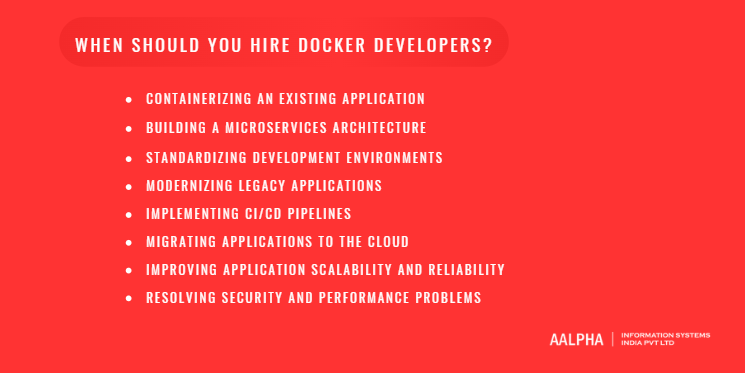
Containerizing an existing application
This is the most common trigger. You have a working application deployed by hand or by script onto virtual machines, and you want it packaged. The work is rarely just writing a Dockerfile. It involves finding hardcoded paths, pulling secrets out of config files, separating build-time from run-time dependencies, and dealing with whatever the application writes to disk. Budget two to six weeks for a mid-sized application, longer if nobody remaining at the company built it.
-
Building a microservices architecture
If you are splitting a monolith, containers are the packaging format you will almost certainly use. Hire early. The decisions made in the first three services, around service boundaries, shared libraries, configuration, and inter-service authentication, get copied into the next twenty whether they were good decisions or not.
-
Standardizing development environments
Smaller scope, fast payback. One engineer, two to four weeks, and the result is a repository where docker compose up gives you a running system. Worth doing even if you never deploy a container to production.
-
Modernizing legacy applications
Older applications can be containerized, including a lot of .NET Framework and PHP 5 era code, though Windows containers carry their own constraints and larger images. The realistic outcome is usually a lift and shift: the application runs in a container, gets consistent deployment, and becomes easier to move to cloud hosting. It does not become cloud native. Anyone promising that in a fixed six-week engagement is selling you something.
-
Implementing CI/CD pipelines
Containers and pipelines belong in the same project. The pipeline builds an image, runs tests against that image, scans it, tags it, and pushes it. If you hire for containerization without touching the pipeline, you end up with images built on someone’s laptop, which is worse than what you had.
-
Migrating applications to the cloud
Containers make the application portable between providers, which is genuinely useful during a migration and mildly useful afterward. The catch is that the moment you adopt a managed database, a provider queue, or a provider identity service, portability narrows again. Containerize for operational consistency, not because you expect to switch clouds.
-
Improving application scalability and reliability
Containers let you run more copies of a service behind a load balancer and replace unhealthy copies automatically. That solves horizontal scaling for stateless services. It does not solve a slow query, a lock contention problem, or a single-writer database. Diagnose the bottleneck before hiring someone to containerize your way out of it.
-
Resolving security and performance problems
Container security work is specific: running as a non-root user, dropping capabilities, pinning base image digests, scanning for vulnerabilities in CI, and keeping secrets out of image layers. Performance work is mostly about image size, layer caching, build times, and resource limits. Both are good standalone engagements for a senior contractor, usually two to four weeks.
Essential skills to look for in Docker developers
-
Docker engine and container fundamentals
Namespaces, cgroups, the union filesystem, the difference between an image and a container, how layers are cached and invalidated. A candidate who cannot explain why reordering two lines in a Dockerfile changes build time by five minutes does not understand layer caching, and layer caching is most of the job.
-
Dockerfile creation and optimization
Multi-stage builds, choosing base images, the difference between COPY and ADD, why RUN commands get chained, ENTRYPOINT versus CMD, and how to avoid baking secrets into a layer that remains readable even after a later layer deletes the file. Ask for a before and after image size from a real project. Good candidates have that number ready.
-
Docker Compose and multi-container applications
Service definitions, dependency ordering, named volumes, environment files, profiles for different environments. A candidate should know that depends_on controls start order but not readiness, and should reach for a health check condition or a wait script.
-
Container networking and storage
Bridge, host, and overlay networks. Port publishing. DNS resolution between services. Bind mounts versus named volumes, and why bind mounts behave differently on macOS. This is where Linux knowledge shows up, and where weak candidates get exposed fastest.
-
Linux administration and shell scripting
Process management, signals, file permissions and ownership inside versus outside the container, users and UIDs, systemd basics, and enough shell to write an entrypoint script that handles SIGTERM properly. A developer who has never used Linux outside a container will struggle the first time something breaks.
-
CI/CD tools and automation
GitHub Actions, GitLab CI, Jenkins, CircleCI, or whatever you already run. The specific tool matters less than whether they have built a pipeline that produces a tagged, scanned, signed image and deploys it without manual steps.
-
Kubernetes and container orchestration
Useful as a bonus, not a requirement. If you do need it, look for real cluster experience rather than a certification. Ask what broke and how they found it.
-
Cloud platform knowledge
At least one of AWS, Azure, or GCP, and specifically the container services: ECS and Fargate, EKS, ACI, AKS, Cloud Run, GKE. Also the registry services, since image storage and pull permissions cause a surprising share of early deployment failures.
-
Infrastructure as code
Terraform most commonly, sometimes Pulumi or CloudFormation. Relevant once containers are running somewhere that needs provisioning. Not relevant if you are containerizing for local development only.
-
Container security and compliance
Image scanning with Trivy, Grype, or Snyk. Non-root users. Read-only root filesystems. Secrets management through the platform rather than environment variables in a Compose file committed to Git. Understanding of what SOC 2 or HIPAA actually asks for, if your business needs it.
-
Monitoring, logging, and troubleshooting
Container logs to stdout, log aggregation, metrics through Prometheus or a hosted equivalent, and the practical skill of debugging a container that exits immediately. Ask a candidate how they investigate a container that restarts every thirty seconds with no useful log output. The answer tells you a lot.
-
Programming and scripting languages
Enough of your stack to modify application code when containerization requires it, which it often does. Python, Go, Bash, and at least reading familiarity with whatever your backend is written in.
How to define your Docker development requirements
Assess the existing application architecture
Write down what the application is made of: the runtimes and versions, the databases, the caches, the queues, the background workers, the cron jobs, the file storage. Include the parts nobody maintains. A one-page architecture note saves a week of discovery and makes every quote you receive more accurate.
Identify the containers, services, and dependencies
Decide roughly what becomes a container and what stays external. Databases in production usually stay managed. Stateless services containerize first. Anything that needs a GPU, a hardware dongle, or a fixed IP gets flagged early rather than discovered in week five.
Determine deployment and hosting requirements
Where will these containers run? A single VM with Compose is a legitimate answer for many businesses. ECS or Cloud Run covers a large middle ground. Kubernetes covers the top end. Choose before hiring, because the choice changes which skills you need and roughly doubles the cost at the top end.
Define security and compliance expectations
Name the standard if there is one. Specify whether images must be scanned before deployment, where secrets live, who can push to the registry, and whether you need image signing or an SBOM. These requirements are cheap to include at the start and expensive to retrofit.
Establish performance and availability targets
Give numbers. Deployment should take under ten minutes. Rollback under two. The API should hold p95 latency under 400ms at 200 concurrent users. Without targets, “it works” is the only acceptance criterion available, and that is not enough to hold anyone to.
Specify deliverables, milestones, and acceptance criteria
For a containerization project the deliverables list is short and concrete:
- Dockerfile per service, with documented build arguments
- Compose file that starts the full stack locally
- CI pipeline that builds, tests, scans, and pushes images
- Deployment configuration for the target environment
- Runbook covering deploy, rollback, and log access
- Handover session recorded
Prepare a realistic budget and timeline
A straightforward containerization of a single application with three or four services, including pipeline work, runs four to eight weeks with one senior engineer. Add a month if you are also moving hosting providers. Add two if you are splitting a monolith at the same time, and do not do both at once unless someone has convinced you with a plan you believe.
Docker developer hiring models
-
Hiring a full-time Docker developer
Right when container work is continuous: multiple product teams, frequent releases, an internal platform to maintain. Wrong when you have one application to containerize and then two days of work a month. The failure mode is boredom followed by resignation eight months in, leaving you with infrastructure only that person understood.
-
Working with freelance Docker developers
Good for scoped, well-defined work. Fast to start, no long commitment, and the market is deep. The risks are availability and continuity. A freelancer who takes a full-time role mid-project leaves you with half a pipeline. Mitigate with clear milestones, code in your repository from day one, and documentation as a paid deliverable rather than a favor.
-
Hiring dedicated Docker developers
A dedicated developer from an agency works only on your project, on a monthly retainer, under your direction. You get continuity and a backup engineer behind them. Typical monthly cost runs $3,000 to $8,000 depending on region and seniority. This suits projects of three months or more where the scope will keep shifting.
-
Using IT staff augmentation
Similar economics, different framing. You are adding an engineer to your existing team rather than handing over a project. Works well when you have in-house technical leadership and need capacity, poorly when you need someone to make architectural decisions you cannot evaluate.
-
Outsourcing to a Docker development company
You hand over an outcome and the vendor assigns the team. Best for fixed-scope work with a defined end state, such as containerize this application and set up the pipeline. You give up day to day control and gain a single point of accountability. Contract carefully around scope, since container projects expand when the application turns out to be messier than documented, and it usually does.
-
Onshore, nearshore, and offshore hiring
Onshore costs the most and buys timezone overlap and easy contracting. Nearshore, meaning Latin America for US buyers or Eastern Europe for EU buyers, splits the difference at $45 to $80 an hour. Offshore, primarily India and South and Southeast Asia, is the lowest cost at $25 to $50 an hour with a deep pool of container and cloud engineers, and requires two to four hours of deliberate overlap to work well.
The overlap matters more than the timezone gap. A team with three fixed hours of shared working time and a written handover habit will outperform a team in your own city that communicates only in stand-ups.
Which hiring model is right for your project?
Short and defined, under six weeks: freelancer or fixed-scope outsourcing. Three to twelve months with changing scope: dedicated developer or staff augmentation. Permanent platform ownership with multiple teams depending on it: full-time hire, ideally after a contractor has built the first version so the role is concrete when you advertise it.
Where to find qualified Docker developers
-
Specialized software development companies
Agencies with a DevOps practice carry bench capacity and can start within a week or two. You are paying for the vetting, the replacement guarantee, and the fact that someone senior reviews the work. Check their case studies for projects at your scale rather than their largest client logo.
-
Freelance marketplaces
Upwork and Toptal for breadth, with very different filtering. Upwork gives you volume and requires you to do the screening. Toptal screens first and charges accordingly. Both work if you have someone technical to evaluate the shortlist. Neither works if you are hiring blind.
-
Professional networks and developer communities
LinkedIn is the default and the slowest. Better signal comes from places where the work shows: Docker and Kubernetes community forums, the CNCF Slack, regional DevOps meetups. People answering other people’s container questions in public are demonstrating exactly what you want to buy.
-
Technical recruitment agencies
For permanent hires. Expect 15 to 25 percent of first year salary. Worth it when the role is senior and the market is tight, less so for mid-level roles you could fill through a direct posting.
-
Open-source communities and GitHub
Underrated for evaluation even if you never hire from it directly. Search GitHub for well-maintained Dockerfiles and Compose setups in your language ecosystem. The authors are often available for contract work, and their public repositories are a better portfolio than any resume.
-
Employee referrals and industry connections
Highest conversion rate, smallest pool. Ask your existing engineers, ask the agencies you already work with, and ask the vendors who run your infrastructure. Container engineers tend to know each other.
Comparing different recruitment channels
The channels differ mainly on how fast you can start and how much screening you have to do yourself. A development company is usually the quickest route to a working engineer, one to two weeks from first call to first commit, at a medium cost that covers vetting and a replacement guarantee. Freelance marketplaces are faster still, three to ten days, and cheapest on paper, but the screening load falls entirely on you and the model suits short, well-defined tasks rather than open-ended platform work.
Recruitment agencies sit at the opposite end. Six to twelve weeks is normal for a senior container hire, and the fee is 15 to 25 percent of first year salary, which only makes sense when the role is permanent and the local market is thin. A direct posting costs almost nothing beyond your own time and runs four to ten weeks, though it depends heavily on whether engineers have heard of you. Referrals beat every other channel on conversion and cost, and can move in days, but the pool is only as good as the network you already have.
If you need someone working this month, the realistic shortlist is a development company or a marketplace. Everything else is a hiring plan, not a delivery plan.
How to evaluate and interview Docker developers
-
Review resumes and Docker project experience
Look for what was containerized, not how many years the word Docker appeared. “Containerized a Django monolith with Celery workers and moved deployment from Capistrano to GitHub Actions” tells you something. “Experience with Docker, Kubernetes, and CI/CD” tells you nothing and appears on every resume in the pile.
-
Examine GitHub repositories and portfolios
Open their Dockerfiles. Check whether they run as root, whether the base image is pinned, whether the build is multi-stage, and whether the layer order makes sense for caching. Five minutes of this filters harder than a thirty-minute call.
-
Conduct an initial technical screening
Thirty minutes, on a call, no coding. Ask them to describe the last containerization project they worked on and what went wrong. Everyone has a story. The ones without a story either have not done the work or are not telling you about it.
-
Ask scenario-based interview questions
Give them your actual situation. “We have a Rails app with a Sidekiq worker, Postgres, Redis, and a shared uploads directory. Walk me through how you would containerize it.” Listen for whether they ask about the uploads directory. That is the hard part and good candidates spot it immediately.
-
Use a practical Docker assessment
A short take-home, two to three hours of work, paid if you can. Give them a small broken repository and ask for a working container setup. This is worth more than every other stage combined.
-
Evaluate security and troubleshooting skills
Ask what they do about a critical CVE in a base image they depend on. Ask how they keep a database password out of an image. Ask how they debug a container that will not start. Weak candidates give you general principles. Strong candidates give you commands.
-
Assess communication and documentation abilities
Ask for a runbook or README they wrote. Container infrastructure that only one person understands is a liability with a delayed invoice. If the candidate cannot write a clear paragraph, that liability is already priced in.
-
Check references and previous project results
Ask the reference two questions: what did this person actually build, and what happened after they left. The second question is the useful one.
-
Use a weighted candidate scorecard
Score each candidate out of 100 and agree the weights before you start interviewing, not after you have met someone you like. A workable split is 30 for the practical assessment, 20 for Linux and networking depth, 15 for CI/CD and cloud, 15 for security, 10 for communication, and 10 for domain fit.
Docker developer interview questions and practical test
Fundamental Docker interview questions
- What is the difference between an image and a container, and where does the writable layer live?
- Why is a container not a virtual machine, and what does that mean for kernel compatibility?
- What happens to data written inside a container when it is removed?
- What does the build cache invalidate on, and how do you take advantage of it?
Dockerfile and image optimization questions
- Explain a multi-stage build and when you would not bother with one.
- You have a 1.8GB Node image. Walk me through getting it under 300MB.
- What is the difference between ENTRYPOINT and CMD, and when do you need both?
- Why does deleting a file in a later layer not reduce image size?
Networking and storage questions
- How do two containers in the same Compose project resolve each other by name?
- When would you use host networking, and what do you lose?
- Bind mount or named volume for a Postgres data directory, and why?
- A container can reach the internet but not another container. Where do you start?
Docker Compose questions
- What does depends_on guarantee, and what does it not guarantee?
- How do you run the same Compose stack with different settings for local and CI?
- How do you handle a service that needs to wait for a migration to finish?
Security questions
- How do you run a container as a non-root user when the application needs to bind to port 80?
- Where do secrets live in your setup, and why not in environment variables?
- What do you scan, when, and what do you do when the scan fails the build?
- What is the risk of mounting the Docker socket into a container?
CI/CD and deployment questions
- Describe your image tagging strategy.
- How do you make sure the artifact tested is the artifact deployed?
- How do you roll back a bad release, and how long does it take?
Kubernetes and cloud questions
- When would you tell a client they do not need Kubernetes?
- What is the difference between a liveness and a readiness probe, and what breaks if you confuse them?
- How do resource requests and limits affect scheduling and eviction?
Troubleshooting scenarios
- A container exits with code 137. What happened and how do you confirm it?
- The same image works locally and fails in CI. What differs?
- Build times went from two minutes to eleven after a small Dockerfile change. Find it.
- Production containers are healthy but the application returns 502s. Where do you look?
Sample hands-on assignment
Give the candidate a small repository containing an API service, a worker, a database, and a deliberately broken setup: the Dockerfile copies the entire source before installing dependencies, the application runs as root, secrets sit in the Compose file, and the worker starts before the database is ready.
Ask for a working docker compose up, an image under a size target you set, the application running as a non-root user, secrets moved out of version control, and a short README. Two to three hours of work. Tell them the time limit and mean it.
How to score the technical assessment
Correctness first: does it run. Then image size and build time against your target. Then security: non-root user, pinned base image, no secrets in layers. Then the README, which should be readable by someone who has not seen the repository. Then the Git history, which shows how they work. A candidate who submits one commit called “done” is telling you how they will behave on your codebase.
Cost of hiring Docker developers
Factors affecting Docker developer rates
Seniority, region, and whether orchestration is in scope, roughly in that order. Cloud certifications add less than people expect. Kubernetes and security specialization add the most, commonly 30 to 50 percent over base container work. Contract length matters too: a three-month commitment usually buys a 10 to 20 percent lower rate than a two-week engagement.
Cost by experience level
Junior engineers with one to two years of container exposure run $20 to $35 an hour offshore and $50 to $75 onshore. Mid-level, three to five years, runs $35 to $60 offshore and $75 to $110 onshore. Senior engineers with six or more years and production incident experience run $60 to $120 offshore and $120 to $200 onshore.
For most containerization projects, one senior engineer beats two mid-level ones. The work is design-heavy and does not parallelize well.
Cost by hiring model
Freelancers on marketplaces span $30 to $120 an hour depending on where they sit in the above bands. Dedicated developers through an agency run $3,000 to $8,000 a month full time. Fixed-scope project outsourcing for a standard containerization and pipeline engagement typically lands between $8,000 and $30,000. Full-time permanent hires cost salary plus 25 to 35 percent in benefits, taxes, equipment, and tooling.
Cost by geographic region
Region | Hourly range |
India, South and Southeast Asia | $25 to $50 |
Eastern Europe | $45 to $80 |
Latin America | $45 to $75 |
Western Europe | $85 to $160 |
United States and Canada | $90 to $180 |
Full-time salary vs. hourly and monthly rates
A US DevOps engineer with strong container skills commands roughly $125,000 to $185,000 in 2026, higher in the Bay Area and New York. In India, the equivalent role sits around INR 12 to 30 lakh per year, with the top of that band reserved for people who have run production Kubernetes.
Compare like with like. A $6,000 monthly dedicated developer is $72,000 a year with no recruitment fee, no notice period risk, and a replacement clause. That is the comparison to run, not hourly rate against hourly rate.
Hidden costs to consider
Recruitment fees of 15 to 25 percent on permanent hires. Cloud spend during migration, when you are running old and new infrastructure at once, often for longer than planned. Registry storage, which grows quietly until someone sets a retention policy. Paid scanning and monitoring tools. Engineering time from your own team answering questions, which for a containerization project is typically 10 to 20 percent of one person. And the cost of the second engagement you will need if the first one ships no documentation.
How to estimate the total project budget
Take the engineer’s rate, multiply by a realistic week count, add 20 percent contingency, then add your internal team’s time and the tooling line. For a four to eight week containerization project with a senior offshore engineer at $45 an hour, that is roughly $9,000 to $18,000 in engineering plus $2,000 to $5,000 in everything else.
Balancing development cost with technical quality
The cheapest quote is usually cheap because discovery was skipped. A vendor who quotes containerization without asking about your data layer, your secrets, or your deployment target has not scoped anything and will raise a change request in week three. Pay for the scoping call. If a vendor charges nothing for it and still asks good questions, better still.
Managing Docker developers and measuring performance
Create an effective onboarding process
Repository access, cloud account access with the right permissions, a written description of what the application does, and a named person who answers questions. Container engineers are blocked by access more than anything else. Sorting permissions before day one buys back most of the first week.
Establish coding and containerization standards
Agree the rules early and write them down: which base images are allowed, how images are tagged, whether containers run as root (they do not), where secrets come from, and what a service must expose for health checks. Two pages is enough. Without it, every service gets a slightly different Dockerfile and you discover the inconsistency during an incident.
Define access controls and security responsibilities
Decide who can push to the production registry and who can deploy. Contractors generally should not hold long-lived production credentials. Use short-lived tokens and pipeline-based deployment, which is better practice anyway and removes an awkward conversation at the end of the engagement.
Set up code review and approval workflows
Dockerfiles and pipeline configuration get reviewed like application code. Someone on your side must be able to read them, even if they could not have written them. If nobody can, that is an argument for training one of your engineers alongside the contractor.
Maintain documentation and knowledge transfer
Make documentation a payment milestone rather than a request. The minimum is a runbook covering how to deploy, how to roll back, how to read logs, how to restart a service, and what to do when an image scan fails. Record one handover session. It will be watched more than once.
Track deployment, reliability, and security metrics
Useful numbers: deployment frequency, lead time from merge to production, change failure rate, time to restore service, image build time, image size per service, and open critical vulnerabilities in deployed images. Four of those come straight from DORA and are worth tracking whether or not you care about the framework.
Define service-level objectives
Set them for the delivery system, not only the application. Deploys complete in under ten minutes. Rollback in under two. CI build under five. Base images patched within seven days of a critical CVE. These are the things a container engineer controls, so these are the things to hold them to.
Avoid dependency on a single developer
The classic container failure: one engineer builds everything, documents nothing, and leaves. Guard against it with mandatory review, documentation milestones, and at least one of your own engineers pairing on the work. If you are using an agency, ask specifically who the backup engineer is and whether they have been briefed.
Common hiring mistakes and how to avoid them
Treating Docker as a standalone skill
Docker is not a job. It is a tool used by backend, platform, and DevOps engineers. Hiring someone whose entire skill set is Docker commands gets you working containers and nothing else the moment a network route or a permission problem appears.
Hiring without defining the application architecture
You cannot scope container work without knowing what the application depends on. Teams that skip this get quotes with a wide spread and no way to compare them, then choose on price and rescope in month two.
Overlooking Linux and networking knowledge
The single most common gap. Container problems are almost always Linux problems in a container-shaped wrapper: permissions, signals, DNS, routing, file ownership. Test for this directly.
Ignoring container security
Running as root is the default and it is the wrong default. So is putting secrets in environment variables committed to a repository. Ask the security questions in the interview and fail candidates who wave them off as a production concern for later.
Using generic coding tests
A LeetCode-style test tells you nothing about whether someone can containerize your application. Use the hands-on assignment described above. It is more work to set up once and it filters correctly every time after that.
Focusing only on the lowest hourly rate
The difference between a $30 engineer and a $55 engineer on a six-week project is about $6,000. The difference in outcome can be a pipeline that works versus a set of Dockerfiles that build on one machine. Rate is a weak signal on its own, but the bottom of the market is cheap for reasons that surface later.
Failing to plan for production operations
Containers that run are not the same as containers that run reliably. Health checks, resource limits, log aggregation, restart policies, and an alert when things break are all part of the job. Put them in the scope or you will pay for them separately.
Neglecting documentation and knowledge transfer
Covered above, and worth repeating because it is the most expensive mistake on this list. Undocumented infrastructure gets rebuilt from scratch eventually, at full price.
Hiring Kubernetes specialists for unnecessarily complex projects
A Kubernetes engineer will build you a Kubernetes cluster, because that is the job you gave them. If your workload is four services and modest traffic, you have bought a cluster plus the permanent operational cost of running one. Ask candidates when they would recommend against Kubernetes. The good ones have an answer ready.
Why hire Docker developers from Aalpha Information Systems?
Access to experienced Docker and DevOps professionals
Aalpha has been building and deploying software since 2008, with more than 5,500 completed projects across 55+ countries. Our container and DevOps engineers work daily on containerization, pipeline automation, and cloud deployment across client stacks in Node, Python, PHP, Java, and .NET. Client feedback sits at 4.9 out of 5 across 215+ reviews on Clutch.
Flexible engagement models
You can hire a dedicated Docker developer on a monthly basis, add engineers to your existing team through staff augmentation, or hand over a fixed-scope containerization project with defined deliverables. Short engagements of two to four weeks for a security or image optimization pass are also possible, and are often the right first step.
Experience with cloud, microservices, and CI/CD
Our teams have delivered container work on AWS, Azure, and Google Cloud, including ECS, Fargate, EKS, AKS, and Cloud Run. Recent work spans e-commerce replatforming onto headless architectures, fintech platforms such as MoneyWellth, and delivery and logistics products including our own white-label platform, DeliveryStack, which runs a containerized microservice backend across multiple client deployments.
Secure and transparent development process
We work under ISO 9001:2015 certified processes, sign NDAs before technical discussion, and keep all code in your repositories from the first commit. Image scanning, non-root execution, and secrets management are part of the standard delivery, not a paid add-on.
Scalable teams for short- and long-term projects
Engagements start with one engineer and scale as the work grows. Every dedicated developer has a named backup engineer briefed on the project, so a resignation or an illness does not stall your delivery.
How to start your Docker development project
Send Aalpha what you have: a repository, an architecture note, or a description of what currently breaks. We’ll come back with a scope, timeline, and fixed or monthly price. If you’d rather talk it through first, get in touch with Aalpha to review your stack and discuss the next steps.
Final Docker developer hiring checklist
Before you make an offer or sign a contract, confirm the following:
- Technical skills: Dockerfile authoring and optimization, Compose, container networking and volumes, Linux administration, shell scripting
- Architecture and cloud: at least one cloud platform, its container service, its registry, and CI/CD pipeline experience on a real project
- Security: non-root execution, image scanning in the pipeline, secrets handling outside of image layers and version control
- Practical assessment: completed hands-on task, scored against agreed weights, with image size and build time measured
- Communication: a writing sample or runbook, plus confirmed overlap hours if the engagement is remote
- Engagement terms: rate, notice period, replacement clause, IP ownership, and who holds production credentials
- Documentation: runbook and recorded handover defined as paid deliverables tied to a milestone
- Ownership and knowledge transfer: all code in your repositories from day one, and one internal engineer assigned to shadow the work
Frequently asked questions
What does a Docker developer do?
They package applications into containers and keep those containers running. That covers writing Dockerfiles, defining multi-service setups with Compose, handling networking and persistent storage, building images in CI, and fixing the application code that stops it from running cleanly in a container.
How much does it cost to hire a Docker developer?
Between $25 and $180 an hour depending on region and seniority, or $3,000 to $8,000 a month for a dedicated offshore or nearshore engineer. A typical fixed-scope containerization project with pipeline work runs $8,000 to $30,000.
How long does it take to hire a qualified Docker developer?
Days to two weeks through an agency or a marketplace. Four to twelve weeks for a permanent in-house hire, longer if the role requires production Kubernetes experience.
Should I hire a Docker developer or a DevOps engineer?
Hire closer to the application if the problem is that your software will not run consistently. Hire a DevOps engineer if the problem is the delivery process: manual deploys, no pipeline, no monitoring. Senior candidates often cover both, so the distinction matters most when you are hiring mid-level.
Does every Docker project require Kubernetes?
No, and assuming it does is the most expensive mistake on this list. Compose on a couple of servers, or a managed service like ECS or Cloud Run, handles the majority of small and mid-sized workloads at a fraction of the operational cost.
Can a Docker developer containerize a legacy application?
Usually yes. Older Linux applications containerize well. Windows-only applications can be containerized but produce larger images and carry licensing and base image constraints. Expect the result to be consistent deployment rather than a cloud native rewrite.
What should a Docker developer know about security?
Running as a non-root user, pinning base images by digest, keeping secrets out of image layers and out of version control, scanning images in the pipeline and failing the build on critical findings, and limiting what the container can do through dropped capabilities and a read-only root filesystem.
Is it better to hire a freelancer or a dedicated developer?
Freelancer for short, well-defined work with a clear end. Dedicated developer for anything running past three months or where scope will keep moving, because you also get continuity and a briefed backup engineer.
How do I test a Docker developer’s practical skills?
Give them a small broken repository and a two to three hour task: make it run with Compose, get the image under a size target, run as non-root, move secrets out, write a README. Score on correctness, image size, security, documentation, and commit history.
Can offshore Docker developers work with an in-house team?
Yes, with two conditions. Agree fixed overlap hours, two to four is enough, and require written handovers at the end of each side’s day. Teams that do both barely notice the timezone gap. Teams that rely on live conversation alone struggle regardless of where anyone sits.
Conclusion
Hiring for container work goes wrong in two predictable ways. The first is hiring for the tool instead of the problem, which produces someone who can write a Dockerfile but cannot tell you why your worker container keeps getting killed. The second is hiring for a scale you do not have, which produces a Kubernetes cluster and a permanent operations bill for a business running four services.
Both are avoidable with the same discipline. Write down your architecture and your deployment target before you talk to anyone. Test candidates with your actual problem rather than a generic exercise. Weight Linux and networking depth above container-specific trivia. Make documentation a milestone with money attached. And pick the engagement model by how long the work will last, not by which option looks cheapest in the first month.
If you want experienced Docker and DevOps engineers on your project without a three-month recruitment cycle, get in touch with Aalpha to discuss your requirements. We can provide a scoped proposal and help you determine whether your project needs one engineer for a month or a team for a quarter.