






TL;DR
Transport management software is the system a shipper, carrier, broker or fleet operator uses to plan loads, choose carriers, dispatch vehicles, track shipments in transit, capture proof of delivery and settle freight invoices in one place. It replaces the spreadsheet, the WhatsApp group and the phone calls that many transport operations still rely on. The businesses that need it are the ones moving enough volume that a dispatcher can no longer hold the schedule in their head: manufacturers with outbound freight, 3PLs, freight brokers, last-mile delivery operators, distributors, school and staff transport providers, and cold chain carriers.
A working system needs order and shipment management, carrier and rate management, route optimisation, dispatch, GPS tracking, electronic proof of delivery, freight audit, and reporting, plus integrations into ERP, WMS, ecommerce platforms, telematics devices and accounting. Aalpha, a custom software development company, can help businesses design and develop transport management platforms around these operational requirements. Custom development for an MVP typically runs $40,000 to $75,000 over four to six months, a mid-market platform $90,000 to $180,000, and an enterprise or AI-enabled build $250,000 upward across twelve to eighteen months. The hard parts are rarely the screens. They are route optimisation with real constraints, data synchronisation with drivers who lose signal, and integration with carrier APIs that all behave differently.
Buy off-the-shelf when your workflow is standard. Build when your routing rules, pricing model or client mix is the thing that makes you money.
Understanding transport management software
What is transport management software?
Transport management software is an operational system for moving goods or people. It holds the transport orders, decides how each one gets moved, assigns it to a vehicle or a carrier, tracks execution, and produces the paperwork and the invoice at the end. Everything else it does is downstream of those five jobs.
The category is broad enough to cover a freight broker matching loads to carriers, a bakery running twelve delivery vans, a school district managing 300 bus routes, and a global manufacturer tendering ocean freight across four continents. What they share is a planning problem, a tracking problem and a settlement problem, in that order.
What is a transportation management system (TMS)?
A TMS is the enterprise term for the same thing, usually implying the freight side rather than passenger transport. In classic supply chain architecture it sits between the ERP or order management system, which says what needs to move, and the warehouse management system, which says what has been picked and staged. The TMS decides how it moves and what that costs.
The distinction between “transport management software” and “TMS” is mostly one of vocabulary. Logistics buyers in North America and Europe say TMS. Operators in South Asia, Africa and the Gulf more often say transport management system or fleet software and mean something closer to dispatch plus tracking plus billing.
How a TMS works
An order enters the system from an ERP, an ecommerce store, an EDI feed or manual entry. The system groups orders into shipments and loads based on destination, weight, volume, service level and pickup window. It then decides who moves each load: an internal vehicle, a contracted carrier at a negotiated rate, or a spot market carrier quoted through an API.
Once a load is tendered and accepted, dispatch assigns a driver and vehicle, and the driver app becomes the source of truth. Position updates arrive from the phone or from a telematics device on the vehicle. Status changes fire notifications to the customer. At delivery the driver captures a signature, photos and any exceptions, and that record becomes the basis for invoicing.
Settlement closes the loop. The system compares the carrier invoice against the rate that was agreed and the service that was actually delivered, flags the variance, and pushes an approved amount into accounting. In most operations this is where the money leaks, and it is the module clients undervalue during scoping and complain about six months after launch.
Main users of transport management software
Shippers and manufacturers buy a TMS to control outbound freight spend and to stop paying accessorial charges nobody checks. Freight brokers and forwarders need carrier sourcing, margin visibility per load, and documentation for cross-border movements. Third-party logistics providers need multi-client separation, because one instance runs freight for twenty customers who cannot see each other’s rates.
Carriers and fleet operators care about vehicle utilisation, driver hours and maintenance more than they care about rate shopping. Retail and ecommerce companies come to the category through last-mile: delivery slots, customer notifications and failed-delivery handling. Distributors and wholesalers sit in between, running their own vehicles for dense routes and hiring capacity for the rest.
The point of listing them is that these groups want different software. A carrier-first product forced onto a broker will fail on the margin reporting, and a broker product handed to a fleet operator will have no maintenance module at all.
TMS vs fleet management software
Fleet management software is about the asset. It tracks vehicles, fuel, maintenance schedules, insurance and licence renewals, driver behaviour and cost per kilometre. A TMS is about the shipment. It tracks orders, loads, carriers, rates and delivery performance.
Fleet operators usually need both, and vendors blur the line because it helps them sell. If you run your own vehicles, buy or build the shipment layer first and integrate a telematics provider for the asset layer. Building your own telematics stack is a project that eats the budget for everything else.
TMS vs warehouse management system
A WMS ends at the dock door. It manages receiving, putaway, inventory locations, picking and packing, and staging for dispatch. The TMS starts at the dock door and manages what happens to the goods after they leave.
The handover between them is where most integration effort goes: the WMS must tell the TMS what is ready, in what packaging, at what weight and dimensions, and the TMS must tell the WMS which loads to stage in which order for which vehicle at which dock. Get that contract wrong and both systems look broken.
TMS vs logistics management software
Logistics management software is an umbrella term covering transport, warehousing, inventory and sometimes procurement. A TMS is one component of it. When a client asks for “logistics software”, the first job in discovery is finding out which of those four they actually need, because the cost difference between a transport module and a full logistics suite is roughly four times.
Cloud-based, on-premises, and hybrid deployment
Nearly every new build is cloud-based, and multi-tenant SaaS if the client intends to sell the product. The reasons are unremarkable: drivers and customers need access from outside the corporate network, load volumes are spiky, and mapping and routing services are cloud APIs anyway.
On-premises deployment persists in two situations. Large enterprises with existing data centre investment and internal security policy that forbids customer data leaving the estate, and operators in markets where cross-border data residency rules bite. Hybrid is common in the Gulf and parts of Africa: application in the cloud, a database replica or document archive on local infrastructure to satisfy a regulator or a nervous board.
The honest downside of on-premises is release cadence. Clients who choose it get updates quarterly instead of weekly, and they pay for an upgrade project every eighteen months.
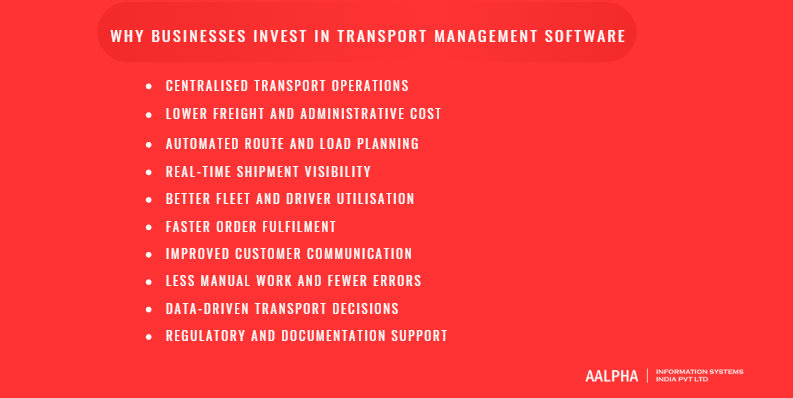
Why businesses invest in transport management software
-
Centralised transport operations
Before the software, the state of the operation lives in four places: a spreadsheet on the planner’s laptop, a WhatsApp group with the drivers, an email thread with the carrier, and the dispatcher’s memory. When that person takes leave, throughput drops. Centralising the data is the change that makes every other benefit possible, and it is the one clients underestimate because it sounds administrative.
-
Lower freight and administrative cost
Savings come from three places. Rate comparison across contracted carriers instead of defaulting to the usual one. Load consolidation, which removes trips rather than optimising them. And freight audit, which catches billing errors that nobody has time to check manually.
The first two get talked about in sales decks. The third is where the recoverable money usually sits, because a mid-sized shipper processing 800 carrier invoices a month cannot check them by hand and knows it.
-
Automated route and load planning
Route planning software takes a set of stops, a fleet, and a list of constraints, and produces a sequence. The constraints are what make it hard: delivery windows, vehicle capacity by weight and volume, driver shift limits, vehicle access restrictions in city centres, load order so the first drop is not at the back of the truck.
A planner doing this by hand for 60 stops produces a workable answer in an hour. Software produces a better one in seconds and, more usefully, re-plans when a vehicle breaks down at 10am.
-
Real-time shipment visibility
Visibility means two different things to two audiences. Operations wants to know which loads are running late so it can intervene. Customers want to know when their delivery arrives so they can plan their day. The same GPS feed serves both, but the interfaces are nothing alike, and building one and assuming it covers the other is a common scoping error.
-
Better fleet and driver utilisation
Utilisation improves when the system can see all the demand and all the capacity at once. Empty running drops when return legs are matched to inbound loads. Driver idle time drops when dispatch can reassign work mid-shift instead of waiting for the driver to call in.
-
Faster order fulfilment
The time saved is mostly in the gaps: order received to order planned, planned to tendered, tendered to picked up. In manual operations those gaps run to hours and often to a full day, because they depend on a person being at a desk. Automating tendering and auto-assignment against rules removes most of it.
-
Improved customer communication
Automated status notifications, a tracking link, and an accurate ETA cut inbound “where is my order” calls significantly. For a delivery operation running 2,000 drops a day, that call volume is a staffed cost centre, and reducing it is often easier to get board approval for than freight savings, because the number is visible in the support rota.
-
Less manual work and fewer errors
Manual re-keying between systems produces wrong addresses, wrong weights and wrong rates. Each of those has a cost: a redelivery, a rejected load, a disputed invoice. Integration removes the re-keying. Validation at the point of order entry removes most of the rest.
-
Data-driven transport decisions
After twelve months of clean data you can answer questions that were previously arguments. Which carrier actually delivers on time on the Nairobi lane. What a delivery costs on a Tuesday against a Saturday. Whether the third vehicle earns its keep. None of this is possible while the data lives in the dispatcher’s head.
-
Regulatory and documentation support
Depending on the market, this covers e-way bills and GST documentation in India, hours-of-service and ELD compliance in the United States, tachograph and driver hours rules in the EU, customs paperwork for cross-border freight, and temperature records for cold chain. Compliance features are rarely the reason a client buys. They are frequently the reason a project overruns, because they get discovered in month four.
Types of transport management software
-
Shipper transportation management systems
Built for the company that owns the freight but not the trucks. The centre of gravity is rate management, carrier selection, tendering and freight audit. Shippers measure success in cost per tonne-kilometre and on-time delivery against their carriers, so reporting is weighted toward carrier scorecards.
-
Carrier management systems
Built for the company that owns the trucks. Load acceptance, dispatch, driver assignment, fuel and maintenance, and settlement with drivers and owner-operators. A carrier system that cannot handle driver pay rules, per-trip, per-kilometre, percentage of revenue, or a mix, will be rejected in week one.
-
Freight brokerage software
Brokers match shippers to carriers and live on the spread. The software has to show margin per load in real time, hold both a customer rate and a carrier rate against the same shipment, manage carrier compliance documents such as insurance certificates and operating authority, and support fast quoting. Credit exposure per customer matters here in a way it does not elsewhere.
-
Freight forwarding software
Forwarders handle multimodal international movements, so the data model changes shape. Shipments become consolidations, houses under masters, with containers, customs entries, arrival notices and multi-currency charges. Anyone scoping a forwarding system against a domestic trucking data model will rewrite it.
-
Fleet transportation management platforms
The combined build: shipment planning plus vehicle and driver management plus telematics. Distributors, beverage companies, LPG and water delivery operators, and industrial services companies land here. The build is larger than a pure TMS because the asset side brings maintenance schedules, fuel reconciliation and vehicle document expiry into scope.
-
Last-mile delivery management software
High drop density, tight time windows, consumer-facing tracking, cash or digital collection on delivery, and a failed-delivery workflow that actually works. Route re-optimisation during the shift matters more than perfect planning the night before. Aalpha’s DeliveryStack product covers this segment as a white-label base for operators who want to launch quickly rather than build the standard delivery stack from scratch.
-
Public and passenger transport management systems
Different problem entirely. Fixed routes, timetables, stop sequences, vehicle rostering, driver duty rosters, fare collection and passenger information displays. Optimisation targets headway and vehicle count, not cost per drop.
-
School and employee transportation software
Fixed routes with a safety layer on top: student or employee manifests, boarding and alighting confirmation, parent or HR notifications, and attendance records. Consent and child data protection change the compliance requirements sharply, and route changes have to be communicated to hundreds of families at once.
-
Cold chain transportation software
Everything a standard TMS does plus continuous temperature logging from IoT sensors, excursion alerts, and an audit trail that stands up to a food safety or pharmaceutical inspection. The temperature record has to be tamper-evident and retained for years, which pushes the storage and audit design in a direction most transport systems never need.
-
Multimodal transportation management systems
Road, rail, sea and air on one shipment, with handovers between them. The complexity is in the handover events, the differing document sets and the fact that transit time uncertainty compounds. Only build this if the business genuinely runs multimodal today. Speculative multimodal support doubles the data model for no return.
-
Industry-specific systems
Construction materials, waste collection, fuel distribution, agriculture, healthcare courier work and heavy haulage each have rules that generic software handles badly: skip exchange logic, bulk metering, hazardous goods documentation, chain of custody for specimens, permit routing for oversize loads. This is where custom development wins against off-the-shelf, and it is usually the reason a client is reading a guide like this one.
Core features of transport management software
-
User, role and permission management
Transport systems have more actor types than most business software: planners, dispatchers, drivers, carrier users, customer users, finance, and admin. Permissions have to be scoped by data as well as by screen, so a carrier logging in sees only their own loads and their own rates. For 3PLs, add tenant separation on top.
-
Order and shipment management
The core record. Orders arrive from integration or manual entry, get validated, then grouped into shipments and loads. This is where the data model is won or lost: an order that can be split across vehicles, a load that carries orders for multiple customers, and a shipment that has its own lifecycle independent of both. Retrofitting order splitting into a system that assumed one order equals one delivery is a rewrite.
-
Carrier onboarding and management
Carrier profiles, service coverage by lane, equipment types, insurance and authority documents with expiry tracking, and performance history. Document expiry deserves an automated check. Discovering that a carrier’s insurance lapsed after an incident is an expensive way to learn this.
-
Rate management and carrier comparison
Contract rates by lane, weight break, equipment type and service level, plus fuel surcharges and accessorials. Then the comparison view that ranks options by landed cost and transit time. Rate structures vary so much between markets that this module almost always needs custom logic rather than a configurable table.
-
Route planning and optimisation
The engine that turns stops and constraints into sequences. Most builds should start with a commercial routing API and only move to a custom solver when the constraint set genuinely exceeds what the API handles. That decision is covered in more detail in the challenges section, because getting it wrong in either direction is costly.
-
Load planning and consolidation
Grouping orders into vehicle loads against weight, volume, stacking rules and delivery windows. Consolidation removes trips, which saves more than optimising an existing trip ever will. For pallet and container operations the packing logic gets three-dimensional and slow, and it needs its own performance budget.
-
Vehicle and fleet management
Vehicle master data, capacity, equipment, availability, service schedules, document expiry and odometer tracking. Fleet operators expect maintenance to reduce vehicle availability automatically in the planning view. If it does not, planners plan loads onto trucks that are in the workshop.
-
Driver management
Driver profiles, licence and endorsement expiry, shift patterns, working hours, leave, and pay rules. Driver availability feeds dispatch, and driver hours constrain routing. In markets with hours-of-service enforcement, this module is a legal control rather than a convenience.
-
Dispatch and scheduling
The screen the operation lives in all day. It needs a board view showing loads against vehicles and drivers over time, drag and drop reassignment, conflict warnings, and bulk actions. Dispatchers judge the whole system by this screen, so it deserves a disproportionate share of the design and usability budget.
-
GPS tracking and real-time visibility
Position updates from driver phones, telematics devices, or both, rendered on a live map with status. Update frequency is a trade-off: every 15 seconds gives smooth movement and drains batteries and data plans, every five minutes is cheap and makes ETAs unreliable. Thirty to sixty seconds while moving, with motion-triggered reporting when stationary, works for most operations.
-
Geofencing and automated alerts
Geofences around depots, customer sites and restricted zones trigger arrival and departure events without the driver pressing anything. Those events drive automatic status changes, customer notifications, and detention time calculation, which is a billable item most operators fail to invoice.
-
Electronic proof of delivery
Signature, photos, delivered quantity, reason codes for shortages and refusals, and timestamped location. It must work offline and sync later, because delivery locations include basements, industrial estates and rural areas with no coverage. Proof of delivery is the evidence that supports the invoice, so it needs to be immutable once captured.
-
Freight audit and payment
Automated comparison of carrier invoices against agreed rates and delivered services, with tolerance thresholds and a dispute workflow. This is the module that pays for itself fastest in shipper deployments and the one most often cut from the MVP to save time.
-
Invoicing and billing
Customer invoicing from delivered shipments, with per-client rate cards, accessorial charges, taxes and credit notes. Push to the accounting system rather than rebuilding accounting inside the TMS. Every client asks for the second and regrets it.
-
Document management
Consignment notes, bills of lading, delivery notes, customs documents, weighbridge tickets and proof of delivery images, attached to shipments and searchable. Storage volume grows faster than clients expect once every delivery carries four photos.
-
Claims, damage and exception management
A structured record of what went wrong, linked to the shipment and the evidence, with an assignee and a resolution. Without it, exception handling happens in email and nobody can answer how much damage costs per year.
-
Customer and carrier portals
Self-service access for the two external groups: customers place orders and track them, carriers see tendered loads, accept or decline, and upload documents. Portals reduce phone traffic and, in broker operations, are the difference between scaling headcount with volume and not.
-
Notifications and communication
Email, SMS, push and WhatsApp depending on the market, driven by shipment events, with per-recipient preferences. In India, the Gulf and much of Africa, WhatsApp is the channel customers and drivers actually read. Building an elegant email notification system for a market that lives on WhatsApp wastes the budget.
-
Reports, dashboards and transport KPIs
On-time delivery, cost per delivery, cost per kilometre, vehicle utilisation, empty running, first-attempt delivery rate, dwell time, carrier scorecards and margin per load. Give operations a fixed dashboard and analysts an export. Attempting a general-purpose report builder inside the TMS adds months and rarely satisfies the finance team anyway.
-
Administrative controls and audit logs
Configuration of business rules, tenants, rate cards and workflows without a code deployment, plus an immutable audit trail of who changed what. In disputes over rates or delivery status, the audit log is the evidence.
Advanced technologies used in modern TMS development
-
Artificial intelligence and machine learning
The useful applications are narrow and worth doing. Demand forecasting predicts volume by lane and day so capacity is booked before it gets expensive. Predictive arrival times beat naive ETAs because a model trained on your own historical trips learns that a particular customer’s unloading takes 40 minutes, not the 15 the planner assumed.
Dynamic route optimisation adjusts sequences during the shift as traffic and new orders arrive. Carrier selection models rank carriers on predicted on-time performance and claims risk, not just price. Delay prediction flags loads likely to miss their window early enough for someone to act.
The condition on all of it is data. A model needs twelve to eighteen months of clean historical trips before its predictions beat a good planner’s judgement. Selling AI features to a client on day one of a greenfield build is dishonest, and the sensible sequence is to design the data capture now and add models in year two.
-
Internet of things and telematics
Vehicle telematics units report location, speed, harsh braking, idling, fuel level and engine faults. Trailer sensors report door open and close events. Cold chain sensors report temperature continuously. The build decision is almost always to integrate an existing telematics provider through their API rather than to develop hardware. Hardware programmes are a different business with different margins and a two-year lead time.
-
Real-time GPS and geospatial technology
Beyond showing a dot on a map, geospatial work covers snapping raw GPS points to the road network, distance and duration matrices for planning, geofence evaluation at scale, and isochrone calculations for service area planning. PostGIS handles the spatial queries well. The map rendering and routing come from Google Maps, Mapbox, HERE or an OSRM instance you host.
-
Electronic logging devices
In the United States, ELD integration is a compliance requirement for most commercial drivers, and the TMS consumes hours-of-service data to constrain dispatch. In the EU, digital tachograph data serves the same function. Outside those regions, driver hours are usually a policy rather than a legal control, which changes how strictly the system should enforce them.
-
Optical character recognition
OCR reads scanned consignment notes, weighbridge tickets, carrier invoices and delivery receipts, and turns them into structured records. It saves real data entry time in operations that still receive paper, which is most of them. Accuracy sits high enough to be useful and low enough to need a human review queue, so design the review queue as a first-class feature rather than an afterthought.
-
Robotic process automation
RPA has a place where a carrier or customs portal has no API and never will. A bot logs in, submits the booking, and reads back the reference. It is fragile, it breaks when the portal changes its layout, and it should be treated as a temporary bridge with a plan to replace it. Clients who build a permanent process on RPA end up maintaining a small unreliable integration team.
-
Blockchain for transport records
The honest position is that blockchain solves a narrow problem: a shared, tamper-evident record across parties who do not trust each other and have no common system of record. Cross-border trade documentation consortia are the plausible case. For a single operator’s TMS, an append-only audit log in Postgres gives the same practical guarantee at a fraction of the cost. Aalpha builds it when a client’s consortium requires it, and advises against it otherwise.
-
Digital twins and transport simulation
A simulation model of the network lets planners test scenarios before committing: adding a depot, changing shift patterns, moving from three-day to next-day service. It is a genuinely valuable capability for large fleets and an expensive indulgence for operations running under 50 vehicles.
-
Generative AI assistants for transport operations
Natural language querying of operational data, automatic exception summaries for the morning meeting, and drafting customer communications about delays. These are cheap to add because the retrieval layer is just the database, and they land well with users who dislike report builders. Keep them read-only for the first release. An assistant that can reassign loads is a different risk conversation.
-
Big data and predictive analytics
Once shipment volume passes a few million records, operational reporting starts to slow the transactional database. The standard answer is a separate analytics store fed by change data capture or nightly ETL, with dashboards built on top. Plan for the split at design time even if it is deferred, because retrofitting reporting off the primary database under load is an emergency project.
Transport management software integrations
-
Enterprise resource planning systems
The ERP is usually the source of orders and the destination of costs. SAP, Oracle, Dynamics, NetSuite and Odoo all have API or middleware paths, with varying pain. Agree the integration contract early: which system owns the customer master, which owns the item master, and what happens when an order is amended after it has been planned.
-
Warehouse management systems
The warehouse management systems supplies dispatch-ready shipments with actual weights, dimensions and packaging, and receives back the load and dock sequence. Two-way and time-sensitive, so build it event-driven rather than on a nightly batch.
-
Order management systems
Retail and ecommerce operations often route orders through an OMS that decides fulfilment location before transport is involved. The TMS then needs both the order and the sourcing decision, and it needs to handle the OMS changing its mind.
-
Ecommerce platforms and marketplaces
Shopify, WooCommerce, Magento and marketplace APIs feed direct-to-consumer volume. The integration is straightforward. The operational complexity is address quality, which is poor in consumer channels and is the single largest cause of failed first deliveries.
-
Carrier and freight marketplace APIs
Rating, booking, label generation, tracking and cancellation across parcel carriers, LTL carriers and load boards. Every carrier’s API is different in structure, authentication and error behaviour. Build an internal carrier abstraction layer with per-carrier adapters on day one. Teams that integrate the first three carriers directly into business logic rewrite it when they reach the fifth.
-
GPS, telematics and ELD providers
Position, engine and hours data from Samsara, Geotab, Webfleet, Motive and dozens of regional providers. Normalise their formats into one internal event model. Assume a client will change telematics vendor within three years, because they usually do.
-
Mapping, traffic and weather services
Geocoding, distance matrices, live traffic, turn-by-turn navigation and severe weather alerts. Mapping is a recurring cost that scales with request volume and it surprises clients at year one renewal. Cache geocoded addresses and distance matrices aggressively. Recomputing the same depot to customer distance 400 times a day is how a $200 monthly bill becomes $3,000.
-
Accounting and payment systems
QuickBooks, Xero, Zoho Books, Tally or the client’s ERP finance module for invoices, credit notes and carrier payables. In last-mile operations, add payment gateway integration for cash and digital collection on delivery, with driver-level reconciliation at end of shift.
-
Fuel card and toll management platforms
Fuel card transaction feeds reconcile against trips and expose fuel theft, which is a real and common loss in owned-fleet operations. Toll platform data adds accurate cost per trip and removes a monthly manual claims process.
-
CRM and customer support systems
Salesforce, HubSpot, Zoho or Zendesk. Support agents need shipment context inside the ticket rather than in a second system, so the practical integration is often a widget that pulls live shipment status into the helpdesk view.
-
EDI integration
Large shippers and retailers still run on EDI, and if your client sells to them, EDI is not optional. The relevant transaction sets for road freight include 204 load tender, 214 shipment status, 210 freight invoice and 990 tender response. Budget for a VAN or an EDI service provider rather than parsing X12 or EDIFACT in-house.
-
Customs, tax and compliance platforms
Cross-border movements need customs declarations, and domestic movements in some markets need statutory documents such as the Indian e-way bill. These are usually government APIs with their own authentication, downtime and rate limits, and they need retry and reconciliation logic rather than fire-and-forget calls.
-
API strategy for external partners
If customers or carriers will integrate with the platform, design the public API as a product: versioned, documented, authenticated with scoped keys, rate limited, with webhooks for status events. Retrofitting a public API onto internal endpoints exposes the internal data model and locks the team out of refactoring it later.
How to develop transport management software
-
Define the business model and operational scope
Start with what the business actually does and how it earns. A broker’s margin per load, a carrier’s cost per kilometre, and a 3PL’s contract structure produce different products from the same feature list. Also decide, at this point, whether the software is an internal tool or a product to be sold, because multi-tenancy, configurability and onboarding are architectural decisions and not features to add later.
-
Map existing transport workflows
Spend time in the dispatch office. Watch how a load actually gets planned, tendered, assigned and closed, including the workarounds. The workarounds are the requirements, because they exist to solve something the official process does not handle. Documented processes describe how the operation is supposed to run. Software has to support how it does run.
-
Identify users and access levels
List every person who touches a shipment, inside and outside the company, and what each is allowed to see. External access, meaning carriers and customers, is the part that gets underestimated, and it drives the permission model more than internal roles do.
-
Gather functional and non-functional requirements
Functional requirements come out of workflow mapping. The non-functional ones decide the architecture: expected shipments per day at launch and at three years, concurrent dispatcher sessions, position update volume, acceptable page load under peak, offline requirements for drivers, uptime target, data retention, and regional data residency. A system built for 500 shipments a day and asked to handle 20,000 does not scale up gracefully. It gets replaced.
-
Decide between an MVP and a full-scale platform
The MVP for a transport platform is narrower than most clients want to accept: order intake, load planning, dispatch, driver app with tracking and proof of delivery, and basic reporting. Rate management, freight audit, portals and analytics come in phase two. The reason to sequence it this way is that the first four modules are what the operation runs on daily, and putting them in front of real dispatchers in month five surfaces design errors while they are still cheap.
Full-scale from the start makes sense in one situation: replacing an existing system that already does everything, where a partial replacement means running both in parallel and doubling the operational load.
-
Select the technology stack
Choose for the team you will have in three years, not for what is fashionable now. Specific recommendations are in the stack section below, but the meta-rule is to keep the routing engine, the tracking pipeline and the transactional core separable, because those three have different scaling profiles and will need different treatment as volume grows.
-
Design the system architecture
Model the domain before the screens: order, shipment, load, stop, trip, vehicle, driver, carrier, rate, and the events that connect them. Most failed transport projects are failed data models. Decide the event backbone here too, since position updates and status changes are high-volume streams that should not be handled as synchronous API calls into the main database.
-
Create the UI and UX design
Two interfaces, two design problems. The dispatch console is a dense professional tool used eight hours a day by people who will learn keyboard shortcuts and want information density, not whitespace. The driver app is used one-handed, outdoors, in sunlight, by someone in a hurry, and it needs large targets, minimal steps per stop and clear offline state. Designing both in the same visual idiom produces one that fails.
-
Develop the backend and business logic
Build the core domain services first: orders, shipments, planning, dispatch, tracking, settlement. Enforce business rules server-side, since the mobile app cannot be trusted as a source of validation. Make status transitions explicit state machines rather than a status column that anything can write to, because ambiguous status is the most common source of production disputes in transport systems.
-
Build the web and mobile applications
The web application serves planners, dispatchers, finance, customers and carriers. The mobile application serves drivers, and it is the harder build despite having fewer screens: offline data storage, background location, battery management, sync conflict resolution, camera and signature capture, and the fact that it runs on a five-year-old Android device on a weak network.
-
Connect external systems and data sources
Integration work is routinely underestimated by half. Sequence it by dependency: telematics and mapping early because they affect the core experience, ERP and WMS next, then accounting, then the long tail of carrier APIs. Each integration needs a sandbox, a retry strategy, an error queue and a way to reprocess failures without duplicating shipments.
-
Test the platform
Functional testing covers the workflows. Beyond that, transport systems need load testing against projected shipment and position volumes, field testing of the driver app in real conditions including dead zones, integration testing with each external system’s sandbox, and scenario testing of the exception paths, which are where the operational value sits. Test the failed delivery, the vehicle breakdown, the cancelled order after dispatch, and the carrier that never accepts the tender.
-
Migrate existing transport data
Customers, addresses, rate cards, carriers, vehicles, drivers and open shipments. Address data is always the worst of it: duplicates, missing postcodes, free-text landmarks. Geocode and deduplicate during migration rather than after, and keep the old identifiers in the new records so support can trace a shipment back for the first year.
-
Pilot deployment and user training
Run one depot or one route set on the new system while the rest stays as-is. Two to four weeks of pilot exposes the process gaps that testing does not. Train dispatchers and drivers separately, and expect the driver rollout to need on-site support for the first week, because a driver who cannot complete a delivery on the app will go back to paper immediately and quietly.
-
Launch, monitor and improve
After go-live, watch the operational metrics rather than server metrics alone: proof of delivery capture rate, app crash rate by device model, sync failure rate, and the number of shipments manually corrected by dispatch. That last one is the honest measure of whether the software fits the operation. It should fall week on week. If it does not, something in the workflow was modelled wrong.
Recommended technology stack and architecture
Frontend
React or Next.js for the dispatch console and portals. The dispatch board needs virtualised lists and a map component that stays responsive with several hundred moving markers, so component choice matters more than framework choice. Mapbox GL or Google Maps JavaScript API for rendering, with clustering above a few hundred points. TypeScript throughout, because the shipment domain has enough shapes that untyped payloads become a maintenance tax within months.
Backend
Node.js with NestJS, Python with FastAPI or Django, Java with Spring Boot, or .NET, in roughly that order of prevalence in the projects Aalpha delivers. Node suits event-heavy tracking workloads and shares types with the frontend. Python is the right choice when routing, forecasting and analytics are central, because the optimisation and modelling libraries live there. Java and .NET are the safe answers for enterprise clients with existing platform standards and in-house teams who will inherit the code.
Mobile
React Native or Flutter for the driver app in most cases. Both handle background location, offline storage and camera work adequately, and either saves roughly 35 percent against two native builds. Go native when the app must run continuously with the screen off for a ten-hour shift on low-end hardware, because battery and background execution behaviour is where cross-platform frameworks cost you.
Databases
PostgreSQL with PostGIS as the primary store. It handles the relational core, spatial queries, and JSON for carrier payloads that refuse to fit a schema. Add Redis for caching, session state and the live position layer. Add a time-series or document store, ClickHouse or MongoDB, for the raw GPS ping history once volume passes a few million points a month, and keep it out of the transactional database.
Cloud infrastructure
AWS, Azure or Google Cloud, containerised, with managed database and message services. Managed Kubernetes is worth it above roughly ten services or when the client has platform engineers. Below that, ECS Fargate, App Service or Cloud Run costs less and breaks less. Pick the region that satisfies the client’s data residency obligation before comparing prices.
Mapping and geolocation
Google Maps has the best global coverage and the highest cost. Mapbox is cheaper and stronger on custom cartography and navigation SDKs. HERE is strong on truck-specific routing with vehicle restrictions. A self-hosted OSRM or Valhalla instance on OpenStreetMap data cuts the per-request cost to near zero for distance matrices at high volume, which is where the bills actually accumulate. A common production pattern is OSRM for bulk planning calculations and a commercial provider for live traffic and consumer-facing maps.
Real-time messaging and event processing
WebSockets for pushing position and status to the dispatch console. Kafka, or a managed equivalent, for the event backbone once you are ingesting tens of thousands of position updates an hour. Below that, Redis Streams or a cloud queue is sufficient and considerably less to operate. Do not put GPS pings through the same synchronous API path as order creation.
Analytics and business intelligence
A separate analytics store fed by change data capture, with Metabase, Superset or Power BI on top for the finance and management audience. Operational dashboards stay inside the product where dispatchers already are.
Microservices vs modular monolith
Start with a modular monolith and extract services where the scaling profile genuinely differs, which in transport systems means the tracking ingestion pipeline and the routing engine. Teams that start with fifteen microservices for a product with three users spend their first six months on infrastructure instead of dispatch logic. That is the most common architectural mistake in this category.
Multi-tenant SaaS architecture
If the product will be sold to multiple operators, decide the tenancy model before the first migration: shared schema with a tenant column, schema per tenant, or database per tenant. Shared schema scales cheapest and demands discipline, since one missing tenant filter is a data breach. Database per tenant suits a small number of large enterprise customers with residency requirements. Changing this decision later is a data migration project, not a refactor.
Offline functionality for the driver app
Assume no connectivity. The app holds the day’s assigned stops locally, records deliveries, signatures and photos to local storage, and syncs opportunistically with an outbound queue. Conflict resolution needs a stated rule, and the workable one is that driver-captured delivery events win on the field data while dispatch wins on assignment changes. Photos sync separately from status, on a lower priority, so a driver with a weak signal is not blocked from completing the next stop.
Scalability, availability and disaster recovery
Transport operations run to a clock, so an outage during the morning dispatch window is a different severity from one at 2am. Design for horizontal scaling of the API and ingestion tiers, use read replicas for reporting, and set an explicit recovery point and recovery time objective with the client. For most mid-market operations, 15 minutes and one hour respectively is achievable without exotic infrastructure. Also decide what the operation does when the system is down, because a printed manifest as a fallback is a legitimate answer and needs to exist before it is needed.
Security, compliance and data protection
-
Role-based access control
Enforce permissions server-side on every request, scoped by both role and data ownership. In multi-tenant deployments, apply the tenant filter at the data access layer rather than in individual queries. Human error at that layer is what causes cross-tenant leaks.
-
Data encryption
TLS 1.3 in transit, AES-256 at rest, with keys in a managed key service rather than configuration files. Encrypt database backups and object storage holding delivery photos and signed documents, which is a step frequently missed because those files feel like operational exhaust rather than sensitive data.
-
API and integration security
OAuth 2.0 or scoped API keys for partner access, mutual TLS for high-value carrier and financial integrations, signed webhooks, rate limiting per client, and strict payload validation. Credentials for third-party systems go in a secrets manager with rotation, not in environment files copied between engineers.
-
Driver and customer data privacy
Collect what the operation needs and no more. Driver licence numbers, personal phone numbers and customer addresses all carry obligations under GDPR and comparable regimes. Set retention periods per data type and enforce them automatically, since an operation that keeps every delivery address forever is accumulating liability with no operational benefit.
-
Location data protection
Driver location is personal data. That has practical consequences: track during shift hours and stop when the shift ends, tell drivers plainly what is tracked and why, restrict historical location access to named roles, and separate operational tracking from any performance monitoring use. Works councils in Germany and the Netherlands will ask about this specifically, and the answer needs to be in the product rather than in policy.
-
Secure payment processing
For cash and digital collection on delivery, keep card data out of your systems entirely by using a gateway with tokenisation. Reconcile driver collections daily with a signed handover record. Cash handling is the highest-fraud area of last-mile operations and deserves stronger controls than the rest of the product.
-
Audit trails and activity monitoring
Immutable, append-only logs of who changed what and when, covering rate changes, status overrides, permission changes and data exports. Keep them for the retention period the client’s contracts require, and alert on the patterns that matter: bulk exports, out-of-hours administrative access, repeated permission failures.
-
Backup and disaster recovery
Automated encrypted backups with point-in-time recovery, stored in a second region, and restore tested on a schedule. An untested backup is a hypothesis.
-
Regional transport regulations
Requirements vary by market and they are functional requirements, not a legal footnote. Hours-of-service and ELD mandates in the United States, driver hours and tachograph rules plus the Mobility Package in the EU, e-way bill generation in India, and vehicle and driver licensing regimes everywhere. Establish the applicable set in discovery, because retrofitting a compliance document flow into a live system is disruptive.
-
GDPR, CCPA and privacy requirements
Lawful basis for processing, data subject access and deletion, breach notification within the mandated window, records of processing, and data processing agreements with every subprocessor including your telematics and mapping vendors. Build the deletion path early. Implementing an erasure request against a system that never planned for one takes days per request.
-
Cross-border freight compliance
Customs declarations, restricted and dangerous goods classification, sanctions screening on counterparties, and country-specific documentation. Where the platform stores customs data, residency rules may dictate where that data physically sits, which loops back to the cloud region decision.
Transport management software development cost
What drives the cost
Product scope dominates everything else. The gap between dispatch plus tracking, and a platform with rate management, freight audit, portals and analytics, is roughly three times the budget.
The number of user roles matters more than clients expect, because each external role adds a full interface: a carrier portal is a separate application with its own authentication, permissions and support burden. Platform selection compounds it, since web plus Android plus iOS is three surfaces to build and maintain.
Routing complexity is the largest single technical variable. Nearest-neighbour sequencing with a mapping API is a two-week task. A constrained vehicle routing problem with time windows, capacities, driver hours and multi-depot logic is a two to four month specialist workstream.
Real-time tracking scales cost with volume: 50 vehicles reporting every 30 seconds is trivial, 5,000 is an ingestion architecture. Third-party integrations run $3,000 to $12,000 each depending on the quality of the counterparty’s API, and EDI more than that. Security and compliance obligations add 10 to 20 percent when a formal certification is in scope. Development team location moves the rate from $120 an hour in the United States to $25 to $45 in India for comparable senior engineering.
Estimated cost by complexity
A basic TMS MVP covering order intake, load planning, dispatch, a driver app with tracking and proof of delivery, and standard reports, runs $40,000 to $75,000.
A mid-level platform adding rate management, carrier portal, customer portal, invoicing, two or three integrations and a fuller analytics layer runs $90,000 to $180,000.
An enterprise TMS with multi-entity support, advanced optimisation, freight audit, EDI, deep ERP integration and formal compliance work runs $250,000 to $500,000 and occasionally beyond.
An AI-enabled or multimodal platform starts around $350,000, and the premium sits in data engineering and model work rather than in the application.
These are Aalpha’s ranges for offshore delivery from India with senior engineers, and they assume a defined scope. A client engaging a US or Western European agency for the same scope should expect two and a half to three times these figures.
Cost by development stage
For a typical mid-market build, discovery and business analysis takes 8 to 12 percent of budget, UI and UX design 10 to 15 percent, backend development 30 to 35 percent, frontend 15 to 20 percent, mobile 15 to 20 percent, QA 12 to 15 percent, and DevOps and deployment 5 to 8 percent. Integrations and data migration are frequently excluded from headline quotes and then reappear as change requests. Ask any vendor to price them explicitly.
Web application vs mobile app cost
The web application is usually 55 to 65 percent of the build because it carries the dispatch console, portals, rate management and reporting. The driver app is 20 to 30 percent, and its cost per screen is high: offline sync, background location and field reliability testing consume time that a screen count does not predict.
Integration and data migration cost
Budget $3,000 to $12,000 per standard API integration, $15,000 to $40,000 for ERP integration depending on the ERP and who owns the middleware, and $8,000 to $25,000 for data migration where address quality is poor. Cleaning and geocoding a customer master of 50,000 addresses is a project in its own right.
Cloud and third-party API expenses
Running costs are usually $500 to $3,000 a month for a mid-market deployment, and mapping is the line that grows fastest. A last-mile operation making 100,000 geocoding and matrix calls a day will pay more for maps than for compute unless the caching strategy is deliberate. SMS, WhatsApp Business messaging and telematics licences all price per unit and belong in the client’s operating model from the start.
Maintenance and support
Plan 15 to 20 percent of the original build cost per year for maintenance, and treat it as non-optional. It covers OS and library updates, mobile platform changes that break background location every few Android releases, carrier API changes, security patching and small enhancements. Products that skip maintenance for two years need a modernisation project that costs more than the maintenance would have.
Preparing a realistic budget
Take the scoped estimate, add 15 to 20 percent contingency for the requirements that discovery will not catch, add the first year of running costs, add maintenance, and add internal time for the client’s own people during pilot and training, which is real cost that never appears in a vendor quote. A budget built that way survives contact with the project. One built from the headline development figure alone does not.
Development timeline and team structure
-
Typical timeline
Discovery and requirements take three to five weeks. Design runs four to six weeks and overlaps development. Core development is where the range opens: three to four months for an MVP, eight to twelve for an enterprise platform. Testing and hardening add four to six weeks, pilot two to four, and rollout depends on how many depots and drivers are involved.
-
Time required for an MVP
Four to six months from kickoff to a pilot depot running live. That assumes a decided scope, a client-side owner who can answer questions within a day, and integrations limited to mapping and one upstream system. The most common cause of overrun is not engineering speed. It is waiting for access to the ERP sandbox or for a decision about rate structures.
-
Time required for an enterprise platform
Twelve to eighteen months to full rollout, and the second half is dominated by integration, migration and change management rather than feature development. Enterprise programmes that try to go live everywhere at once slip. Sequenced rollout by region or business unit takes longer on paper and finishes earlier in practice.
-
Recommended team
A mid-market build runs with a product manager, a business analyst with logistics domain knowledge, a UI and UX designer, two frontend developers, two or three backend developers, one or two mobile developers, one or two QA engineers, and a part-time DevOps engineer. Add a data or optimisation specialist when custom routing or forecasting is in scope, which is a distinct skill set from general backend work and should not be assigned to whoever is free.
The business analyst is the role clients most often try to cut and the one that pays for itself most reliably. Someone has to sit with dispatchers and translate what they do into requirements, and if nobody does, developers guess.
-
In-house vs outsourcing
In-house suits companies where transport software is the product they sell. Outsourcing suits companies where transport is an operation to be run, because hiring routing engineers, mobile developers and DevOps for a one-time build and then keeping them busy is a difficult problem to solve. A middle path that works well is an outsourced build with one or two client engineers embedded through the project, who then own the system afterwards.
-
Dedicated team vs fixed price
Fixed price fits a well-defined MVP with a scope both sides can write down. It creates friction on change requests, which is the point. Dedicated team fits longer programmes where scope will evolve, and it needs an engaged product owner on the client side to work. Choosing a dedicated team model and then leaving the vendor to decide priorities produces a system nobody asked for.
Common development challenges and practical solutions
-
Inaccurate or incomplete transport data
Address quality is the chronic problem. Missing postcodes, duplicate customer records, landmark-based addresses that no geocoder resolves. Fix it during migration with automated geocoding, a confidence score, and a human review queue for low-confidence records. At the point of order entry, use address autocomplete and let drivers pin a corrected location that feeds back into the master record. Within a few months, driver-corrected coordinates become the most accurate address data the business holds.
-
Complex route optimisation
The trap is choosing the wrong tool at either end. Teams overbuild a custom solver for problems a commercial API handles, or they force a genuinely constrained problem through an API that ignores half the constraints. The test is the constraint set: time windows, capacity, driver hours, vehicle restrictions, multi-depot, and pickup and delivery pairing. Two or three constraints, use the API. Five or more with hard feasibility rules, use OR-Tools or a commercial optimiser and staff it properly. Either way, run the optimiser asynchronously with progress feedback, because planners will accept 20 seconds for a good answer and will not accept a frozen screen.
-
Real-time data synchronisation
Position and status updates arrive out of order, duplicated, and delayed. Design for it: idempotent event handling keyed on a client-generated identifier, event timestamps from the device rather than the server, and reconciliation that discards stale updates instead of applying them. A driver whose phone reconnects after two hours will flood the pipeline with queued events, and the system has to absorb that without corrupting the shipment timeline.
-
Unreliable mobile connectivity
Offline-first is the only workable design for a driver app. Local database, outbound sync queue, clear visual indication of sync state, and photo upload decoupled from status updates. Test in real dead zones, not with airplane mode toggled in the office. The failure mode that matters is not a crash. It is a driver completing ten deliveries that never reach the server, which is discovered at end of shift.
-
Integration with legacy systems
Some clients run software with no API, only a database or nightly file exports. The pragmatic path is a staging layer that reads what the legacy system can produce, normalises it, and presents a clean interface to the TMS. It is not elegant and it works. Avoid writing directly into a legacy database unless the vendor supports it in writing.
-
Carrier API and data format differences
Every carrier models addresses, service levels and status codes differently, and their error responses range from structured JSON to HTML pages containing a message. An adapter layer per carrier behind a single internal interface is the only structure that survives the fifth integration. Log every raw request and response for at least 30 days, because carrier disputes are settled with those logs.
-
Scaling for high shipment volumes
The three pressure points are position ingestion, the dispatch board query, and reporting. Split raw telemetry into its own store, denormalise the dispatch view or cache it in Redis, and move analytics off the transactional database. Doing this proactively at design time is a week of work. Doing it during a peak season outage is a bad month.
-
Driver resistance and adoption
Drivers abandon apps that add steps or drain batteries. Reduce the taps per stop to the minimum, make the app faster than the paper process it replaces, involve five drivers in testing before rollout, and provide on-site support for the first week. Where incentives are misaligned, because the app also monitors performance, say so directly rather than letting drivers discover it. Covert monitoring destroys adoption faster than any usability problem.
-
Security and location privacy risk
Beyond the technical controls, the governance question is who can see historical driver location and for what purpose. Restrict it by role, log access, and set a retention limit. Publish the policy to drivers.
-
Controlling development and operating cost
Scope creep in transport projects usually arrives as reasonable-sounding additions from individual departments. Hold a phased roadmap and defer rather than refuse. On operating cost, the controllable lines are mapping API calls, SMS volume and cloud egress, and all three respond to caching and batching.
-
Preventing vendor and technology lock-in
Own the source code and the repository from day one. Use standard, portable technologies rather than a vendor’s proprietary low-code platform. Keep mapping, telematics and payment providers behind internal interfaces so any one can be swapped without touching business logic. Insist on documentation and a knowledge transfer clause in the contract, not as a courtesy at the end.
How to choose a transport management software development company
-
Relevant logistics experience
Ask for transport and logistics projects specifically, and ask what went wrong on them. A team that has built dispatch systems knows why order and shipment are separate entities without being told. A generalist team will learn that in month three, at your expense.
-
Product discovery and business analysis
The vendor should insist on discovery before quoting. If they produce a fixed price from a two-page brief, they have either padded it heavily or they will bill the difference as change requests. Ask who does the business analysis, whether that person will sit with your dispatchers, and what the discovery deliverable actually contains.
-
Mapping, GPS and route optimisation expertise
Ask directly which routing engines they have used in production, how they handle distance matrix cost at volume, and how they decide between a mapping API and a custom solver. Vague answers here predict the most expensive kind of rework.
-
Integration and cloud engineering
Ask about the ERPs, telematics platforms and carrier APIs they have integrated, and how they handle failures and retries. Ask whether they have run a production system on the cloud platform you use, not just deployed to it.
-
Security and compliance practice
Look for secure development practice, code review, dependency scanning, secrets management, and experience with the specific regime that applies to you. ISO 9001:2015 certification, which Aalpha holds, indicates process discipline. It is not a security certification and no vendor should present it as one.
-
Methodology and communication
Two-week sprints, a named point of contact, demos you attend, and a shared backlog you can see. Time zone overlap of at least four hours matters more than total time zone difference. Ask what happens when a sprint slips, because the answer reveals how the relationship will work under pressure.
-
Quality assurance
Ask for the test strategy, not the promise of testing. For transport systems it should cover functional coverage, load testing at projected volumes, field testing of the driver app on real devices in real coverage conditions, and integration testing against each external sandbox.
-
Intellectual property and source code ownership
The contract should assign all IP to you on payment, with repository access from the first commit rather than at handover. Check for third-party components with licence obligations, and check whether the vendor retains rights to reuse any part of the build.
-
Post-launch support
Agree the support model before signing: response times by severity, who handles a production incident at 6am on a Monday, how enhancements are prioritised and priced, and what a transition looks like if you move the work in-house or elsewhere.
-
Questions to ask before hiring
Which transport systems have you built and can I speak to those clients. Who specifically will work on my project and what else are they assigned to. What does your discovery produce. How do you price integrations and data migration. What are your assumptions in this estimate. What happens if we are three weeks behind at month four. Who owns the code. What does year one support cost.
-
Warning signs
A quote produced without discovery. Reluctance to name references. A demo of somebody else’s product presented as their work. No business analyst on the team. Estimates that ignore integrations and migration. Pressure to sign before scope is agreed. And the strongest signal of all, a vendor who agrees with every requirement without ever saying that something is a bad idea.
Why choose Aalpha for TMS development
-
Custom transport and logistics software development
Aalpha builds transport and logistics systems to the shape of the operation rather than fitting the operation to a template. That covers dispatch and fleet platforms, last-mile delivery systems, freight brokerage tools, multi-carrier integration layers and driver applications, for clients running anything from 20 vehicles to multi-country networks.
-
Web, mobile, cloud, AI and integration capability
One team covers the whole surface: React and Next.js consoles, React Native and native driver apps, Node, Python and Java backends, AWS and Azure infrastructure, PostGIS and routing work, and the integration layer into ERP, WMS, telematics and accounting systems. Transport projects fail at the seams between those disciplines, which is the argument for keeping them under one delivery team rather than splitting the build across vendors.
-
Experience building scalable digital products
Aalpha has been building software since 2008 and has delivered more than 5,500 projects for clients across 55 and more countries, including World Bank, Bausch + Lomb, Swiss Re, Zee5 and Emaar. The company holds a 4.9 out of 5 rating from over 215 reviews on Clutch and is ISO 9001:2015 certified. Aalpha’s own DeliveryStack product, a white-label on-demand delivery platform, comes out of this domain work and gives last-mile operators a faster route to launch than a from-scratch build.
-
Flexible engagement models
Fixed-price delivery for defined MVPs, dedicated teams for longer product programmes, and staff augmentation where a client has an internal team that needs specific skills such as mobile, routing or DevOps.
-
Delivery record
More than 250 technology professionals across engineering, design, QA and DevOps, a client retention rate above 96 percent, and delivery experience across the US, UK, Gulf, Africa and Asia. Retention is the number worth weighing when choosing a partner, because it measures what happens after the first release rather than during the sales process. The Clutch profile at carries the detailed reviews.
-
From discovery to post-launch support
Engagements start with discovery and workflow mapping, move through design, development, integration and testing, and continue into pilot deployment, training, rollout and ongoing maintenance. The team that builds the system supports it, so the people answering a production question in month eighteen are the ones who wrote the dispatch logic.
Get in touch with Aalpha to scope your transport management platform with an engineering team that has built similar solutions before. Share your current workflow rather than a feature list, and we’ll discuss the right approach for your project.
Future trends in transport management software
-
Autonomous transport planning
Planning systems are moving from recommending a plan to executing one, with a human reviewing exceptions rather than approving every decision. The prerequisite is trust built on months of the system’s recommendations matching what experienced planners would have chosen.
-
AI-powered control towers
A single operational view across carriers, modes and regions that flags what needs attention instead of showing everything. The value is in exception ranking. Large shippers already have visibility. What they lack is a defensible order in which to act on it.
-
Predictive maintenance
Telematics and engine data feeding models that predict component failure before it strands a vehicle. Fleet operators with unplanned downtime as their top cost line are the natural adopters, and the accuracy depends on sensor data quality more than on model sophistication.
-
Connected and electric fleets
Electric vehicles change routing constraints in a specific way: range depends on load and terrain, charging takes time that must be scheduled as a stop, and charger availability is an external dependency the planner does not control. Any TMS scoped for a fleet that will electrify within five years should model range and charging as first-class constraints now.
-
Dynamic pricing and capacity procurement
Spot rate volatility has pushed shippers toward algorithmic tendering, mixing contracted and spot capacity based on predicted rates. Expect more procurement logic inside the TMS rather than in a separate sourcing exercise.
-
Greater supply chain visibility
Pressure from customers and regulators is pushing visibility beyond the operator’s own network into supplier and subcontractor movements, which is mostly a data-sharing problem between companies rather than a technical one.
-
Sustainability and carbon tracking
Carbon reporting per shipment is becoming a customer requirement in Europe and increasingly a tender condition. The practical implication for a build is that fuel, distance, load weight and mode need to be captured accurately at shipment level from the start, because retrospective emissions calculation from incomplete data produces numbers nobody can defend in an audit.
-
Autonomous and semi-autonomous vehicles
Yard automation and long-haul highway pilots are running, with mixed fleets the realistic outcome for the next decade. The TMS implication is a vehicle model that does not assume a driver, which is a schema decision worth making early and cheaply.
-
Logistics platform ecosystems
Transport software is trending toward open platforms with marketplaces of carrier, telematics and compliance integrations rather than monolithic suites. A public API and a documented integration path is becoming a commercial requirement rather than a technical nicety.
-
Natural language interfaces
Asking the system which loads are at risk this afternoon and getting an answer, instead of building a report. This is the trend most likely to reach mid-market operations soonest, because the implementation cost is low and it removes the reporting backlog that every operations team complains about.
Frequently asked questions
What is transport management software?
Transport management software plans, executes, tracks and settles the movement of goods or people. It holds transport orders, builds them into loads, assigns vehicles or carriers, tracks execution in real time, captures proof of delivery and produces invoices. It replaces the spreadsheets, phone calls and messaging groups that most transport operations run on before they adopt a system.
What does a transportation management system do?
A TMS handles four jobs: planning, which covers load building, route optimisation and carrier selection; execution, which covers tendering, dispatch and driver assignment; visibility, which covers GPS tracking, status updates and customer notifications; and settlement, which covers proof of delivery, freight audit and invoicing. Reporting sits across all four.
Who needs a TMS?
Any operation where transport decisions have outgrown one person’s memory. In practice that means shippers with regular outbound freight, 3PLs, freight brokers and forwarders, fleet operators, last-mile delivery companies, distributors, and school or staff transport providers. The usual trigger is a specific pain: rising freight cost, poor delivery performance, or an inability to answer where a shipment is.
What are the main features of transport management software?
Order and shipment management, load planning, route optimisation, carrier and rate management, dispatch, GPS tracking, a driver mobile app with electronic proof of delivery, customer and carrier portals, freight audit, invoicing, document management, notifications, and reporting. An MVP needs the first six plus proof of delivery. The rest can follow.
How much does it cost to develop a TMS?
An MVP runs $40,000 to $75,000, a mid-market platform $90,000 to $180,000, and an enterprise system $250,000 to $500,000 or more, based on Aalpha’s offshore delivery rates. Integrations add $3,000 to $12,000 each, ERP integration considerably more, and annual maintenance runs 15 to 20 percent of the build cost.
How long does transport management software development take?
Four to six months for an MVP to a live pilot, eight to twelve months for a mid-market platform, and twelve to eighteen months for an enterprise rollout. Timelines slip most often on integration access and on decisions the client has not yet made, not on development speed.
Can a TMS integrate with ERP and warehouse software?
Yes, and it should. SAP, Oracle, Dynamics, NetSuite and Odoo all have integration paths, as do the major WMS products. The work is in agreeing which system owns which data and how amendments after dispatch are handled, rather than in the API mechanics.
What is the difference between TMS and fleet management software?
A TMS manages shipments: orders, loads, carriers, rates and delivery performance. Fleet management software manages assets: vehicles, fuel, maintenance, driver behaviour and cost per kilometre. Operators running their own vehicles usually need both, and the common approach is to build the shipment layer and integrate a telematics provider for the asset layer.
Can transport management software track vehicles in real time?
Yes, through the driver’s phone, a telematics device on the vehicle, or both. A reporting interval of 30 to 60 seconds while moving balances map accuracy against battery and data cost. Position data drives live ETAs, geofence events, automatic status changes and customer tracking links.
How does AI improve transport management?
The reliable applications are ETA prediction trained on your own trip history, demand forecasting by lane, carrier selection scored on predicted performance, dynamic re-routing during the shift, and delay prediction. All of them need twelve to eighteen months of clean operational data before they outperform an experienced planner, so design the data capture first and add models later.
Should a company build or buy a TMS?
Buy when your workflow is standard and an off-the-shelf product covers 80 percent of it, since implementation is faster and cheaper. Build when your routing rules, pricing model, customer mix or compliance requirements are the thing that differentiates the business, or when you plan to sell the software itself. A hybrid is also valid: buy the commodity layer and build the differentiating module against its API.
What should a TMS MVP include?
Order intake, load planning, dispatch, a driver app with tracking and electronic proof of delivery, customer notifications and basic reporting. That set is enough to run daily operations, which is what makes the pilot informative. Rate management, portals, freight audit and analytics belong in phase two.
Can the software support multiple carriers and transport modes?
Yes, with the caveat that multi-carrier support needs an adapter layer per carrier behind one internal interface, and true multimodal support changes the shipment data model to handle legs, handovers and different document sets per mode. Build multimodal only if the business runs it today.
How is sensitive location and driver data protected?
Through encryption in transit and at rest, role-based access to historical location, tracking limited to shift hours, defined retention periods with automatic deletion, audit logging of who views location data, and clear disclosure to drivers about what is tracked and why. Where GDPR applies, driver location is personal data and needs a lawful basis and a working erasure path.
How do I select a TMS development company?
Look for delivered transport projects you can verify, a discovery process before any fixed quote, named routing and mapping experience, integration depth with ERP and telematics platforms, full IP assignment with repository access from the first commit, and a defined post-launch support model. Treat a vendor who never pushes back on a requirement as a risk rather than a convenience.
Final words
The operational case for a TMS is not that it produces better routes. It is that it puts the state of the operation in one place, where it can be measured, questioned and improved. Everything else, the cost savings, the utilisation gains, the delivery performance, follows from having data that used to live in a dispatcher’s head.
Start with the workflow, not the feature list. The projects that succeed begin with someone spending a week in the dispatch office documenting how loads actually get planned, including the workarounds, and only then deciding what to build. The projects that struggle begin with a feature comparison spreadsheet and discover in month four that the data model does not match how the business works.
On the build-or-buy decision, be honest about what makes your operation different. If the answer is nothing much, buy a product and spend the saved budget on integration and adoption. If your routing constraints, pricing logic or client structure are genuinely yours, custom development pays for itself and off-the-shelf software will fight you for years.
Choose a partner who has built this category before, who asks about your exception handling in the first meeting, and who tells you which parts of your requirement are a bad idea. That last quality is worth more over an eighteen-month programme than any hourly rate difference.