






TL;DR:
MVP as a Service means a specialist team handles discovery, design, agile development, testing and launch of a startup’s minimum viable product, so founders can get a working version to real users in weeks instead of months. It costs less than hiring an in-house team, and the user data it produces makes fundraising easier. The trade-offs are a deliberately thin first release and technical debt if the architecture is rushed. Aalpha Information Systems is a strong fit here: in business since 2008, it has delivered 5,500+ projects across 55+ countries, holds a 4.9/5 rating from 215+ Clutch reviews, and supports products well past launch as they scale.
Startups operate in an environment where speed, capital efficiency, and market validation determine survival. Building a full-scale product without testing assumptions often leads to wasted resources and failed launches. This is where the concept of MVP as a Service becomes critical. It enables startups to transform ideas into functional products quickly, test them with real users, and iterate based on feedback before committing to large-scale development.
Instead of investing months or years into building a complete product, founders can launch a simplified version that delivers core value. This approach aligns with modern product development strategies focused on validation over speculation. Many early-stage founders ask a fundamental question: how can you test a business idea without spending heavily on development? The answer lies in combining MVP thinking with specialized service providers who handle design, development, and launch efficiently.
MVP as a Service is not just about building a prototype. It is a structured process that includes idea validation, user experience design, rapid development, and continuous iteration. By leveraging experienced teams, startups can avoid common pitfalls such as overengineering, feature bloat, and misalignment with user needs. The result is a faster path to product-market fit and stronger positioning when seeking funding or scaling operations.
What is an MVP (Minimum Viable Product)?
A Minimum Viable Product, commonly referred to as an MVP, is the simplest version of a product that delivers its core functionality to users while allowing for maximum learning with minimal effort. The concept originates from the Lean Startup methodology, popularized by Eric Ries, which emphasizes rapid experimentation and validated learning.
An MVP is not a rough or incomplete product; it is a focused version designed to solve a specific problem effectively. Instead of building a feature-rich platform, startups identify the most critical functionality that addresses user needs and launch with that. This allows them to test key assumptions, gather user feedback, and make informed decisions about future development.
The primary goal of an MVP is early validation. It helps answer essential questions such as whether users find value in the product, whether they are willing to use or pay for it, and which features matter most. By focusing on learning rather than perfection, startups can reduce risk and improve their chances of building a successful product.
What is MVP as a Service?
MVP as a Service is a development model where specialized teams design, build, and launch a startup’s MVP on behalf of the founder. Instead of assembling an in-house team or managing freelancers, startups partner with experienced providers who handle the entire MVP lifecycle, from concept validation to deployment.
This service model differs significantly from traditional product development. In conventional approaches, development often begins with a full set of features, detailed specifications, and long timelines. MVP as a Service, in contrast, prioritizes speed, iteration, and core functionality. The focus is on building just enough to validate the idea in the market.
Another key distinction lies in expertise and process. MVP service providers typically follow agile methodologies, use proven frameworks, and bring cross-functional expertise in design, development, and product strategy. This reduces the trial-and-error phase that many startups face when building internally.
Startups frequently wonder whether they should hire a development team or outsource MVP creation. MVP as a Service offers a practical middle ground by providing access to experienced professionals without the overhead of full-time hiring. It enables founders to focus on business strategy, user acquisition, and fundraising while the technical execution is handled by specialists.
Why Startups Choose MVP as a Service
Startups choose MVP as a Service primarily because it aligns with their need for speed and efficiency. In competitive markets, being first to validate an idea can make a significant difference. By outsourcing MVP development to experienced teams, startups can launch products in weeks instead of months, gaining early feedback and traction.
Cost efficiency is another major factor. Building an in-house team requires significant investment in hiring, onboarding, and infrastructure. MVP as a Service eliminates these upfront costs by offering a flexible engagement model. Startups pay for the outcome rather than maintaining a full team, which is particularly valuable during early stages when resources are limited.
Risk reduction also plays a critical role. Many startups fail because they build products based on assumptions rather than real user needs. MVP as a Service mitigates this risk by focusing on validation and iterative development. Providers often incorporate user testing, analytics, and feedback loops to ensure the product evolves based on actual data.
Access to expert guidance further strengthens the value proposition. Experienced MVP teams have worked across industries and understand common challenges, technical trade-offs, and market dynamics. This expertise helps startups avoid costly mistakes and make better product decisions.
Ultimately, MVP as a Service enables founders to move from idea to validated product faster, with lower risk and better resource utilization. It transforms product development into a strategic, data-driven process rather than a speculative investment.
Understanding the Role of MVP in Startup Success
In early-stage startups, success rarely depends on how advanced a product is at launch. It depends on how quickly founders can validate whether their idea solves a real problem. This is where the Minimum Viable Product becomes a strategic tool rather than just a development step. An MVP allows startups to test assumptions in real market conditions, gather actionable feedback, and refine their product direction before committing significant resources.
Many founders initially believe they need a fully developed platform to attract users or investors. In practice, the opposite is often true. Investors and early adopters are more interested in evidence of demand than polished features. A well-executed MVP demonstrates that users are willing to engage, use, or even pay for the product. It answers fundamental questions about product-market fit, which is one of the most critical determinants of startup success.
Another key role of the MVP is enabling iterative development. Instead of building in isolation, startups can continuously improve based on real user behavior. This reduces uncertainty and increases the likelihood of building something that aligns with market needs. When startups ask how to reduce failure risk while building a new product, the answer consistently points to early validation through an MVP.
MVP in the Lean Startup Methodology
The concept of MVP is deeply rooted in the principles of the The Lean Startup, which introduced the Build-Measure-Learn feedback loop as a systematic approach to product development. This loop is designed to minimize waste and maximize learning by continuously testing ideas in the real world.
The process begins with the “Build” phase, where startups create a basic version of the product with only essential features. The goal is not perfection but functionality that allows users to experience the core value proposition. Once launched, the product enters the “Measure” phase, where data is collected through user interactions, engagement metrics, and feedback. This data provides insights into how users actually behave, rather than how founders expect them to behave.
The final stage, “Learn,” involves analyzing the data to determine whether the product assumptions are valid. Based on these insights, startups either iterate, pivot, or scale the product. This loop repeats continuously, enabling rapid experimentation and informed decision-making.
By integrating MVP development into this framework, startups can move away from guesswork and build products based on validated learning. It transforms product development into a structured, evidence-based process.
Why Building an MVP is Critical Before Full Product Development
Building an MVP before full-scale development is essential because it prevents startups from investing heavily in unvalidated ideas. One of the most common reasons startups fail is building products that users do not need. An MVP addresses this risk by focusing on testing core assumptions early.
When founders skip the MVP stage, they often fall into the trap of overbuilding. This includes adding unnecessary features, investing in complex architectures, and spending months developing functionality that may never be used. This not only increases costs but also delays time-to-market, giving competitors an advantage.
An MVP enables startups to validate key aspects of their business model, including user demand, usability, and willingness to pay. For example, a simple landing page or prototype can help determine whether users are interested in the solution before any major development begins. This approach ensures that resources are allocated efficiently.
Another critical advantage is speed. In fast-moving markets, being able to launch quickly and adapt is more valuable than launching a perfect product late. An MVP allows startups to enter the market early, gather feedback, and iterate faster than competitors who are focused on full-scale development.
Real-World Examples of Successful MVPs
Several of today’s most successful companies started with simple MVPs that validated their core ideas before scaling.
The early version of Airbnb was far from the global platform it is today. The founders initially created a basic website to rent out air mattresses in their apartment to conference attendees. This simple experiment validated that people were willing to pay for short-term accommodations in private homes. Only after confirming demand did they expand the platform.
The early version of Uber was a simple app that allowed users in a single city to request a ride from a limited number of drivers. There was no complex infrastructure or global expansion at the beginning. The focus was on solving a specific problem in a controlled environment. Once validated, the company scaled rapidly.
These examples highlight a consistent pattern. Successful startups start small, validate demand, and then expand. They prioritize learning over completeness and use MVPs as a strategic foundation for growth.
Common Mistakes Startups Make Without an MVP
Startups that skip the MVP stage often encounter predictable and costly mistakes. One of the most significant is overinvestment in development without validation. Founders may spend months building a feature-rich product, only to discover that users do not find it valuable. This leads to wasted time, capital, and effort.
Another common mistake is building the wrong features. Without user feedback, product decisions are based on assumptions rather than real needs. This often results in complex products that fail to solve the core problem effectively. In contrast, an MVP forces startups to focus on essential functionality.
Lack of user validation is another critical issue. Without early testing, startups have no reliable data on user behavior, preferences, or willingness to adopt the product. This makes it difficult to refine the product or attract investors, who typically look for evidence of traction.
Additionally, startups may struggle with delayed market entry. By aiming for a perfect product, they miss the opportunity to launch early and learn from real users. Competitors who adopt an MVP approach can capture market share faster.
These mistakes highlight why the MVP is not optional but essential. It serves as a safeguard against uncertainty, enabling startups to build smarter, faster, and with greater confidence.
What Does MVP as a Service Include?
MVP as a Service is a structured, end-to-end offering that covers every stage required to transform a startup idea into a functional, market-ready product. Unlike fragmented development approaches, where founders manage designers, developers, and testers separately, this model provides a cohesive workflow managed by a single experienced team. The goal is not just to build software, but to validate a business idea through a carefully orchestrated process that combines strategy, design, engineering, and iteration.
Startups often ask what exactly they receive when they engage an MVP service provider. The answer goes beyond coding. It includes product discovery, user-centric design, rapid development cycles, technology decision-making, quality assurance, and post-launch support. Each component is designed to reduce uncertainty and accelerate learning, ensuring that the final output is not just a product, but a validated solution aligned with market needs.
-
Product Discovery and Validation
Product discovery is the foundation of MVP as a Service. Before any design or development begins, the focus is on understanding the problem, target audience, and market dynamics. This stage involves detailed market research to identify gaps, analyze competitors, and assess demand for the proposed solution.
A critical part of this phase is defining user personas. These personas represent the ideal users of the product, including their behaviors, needs, and pain points. By clearly identifying who the product is for, startups can avoid building generic solutions that fail to resonate with any specific audience.
Problem definition is equally important. Many startups fail because they attempt to solve problems that are either insignificant or poorly understood. MVP service providers work closely with founders to refine the problem statement and ensure that the proposed solution addresses a real and measurable need.
Validation techniques such as surveys, landing pages, and early prototypes are often used to test assumptions. This ensures that development efforts are grounded in real-world insights rather than speculation.
-
UX/UI Design for MVPs
Once the problem and target users are clearly defined, the next step is designing the user experience. MVP design focuses on simplicity, clarity, and usability rather than visual complexity. The objective is to create an interface that allows users to easily interact with the core functionality of the product.
The process typically begins with wireframes, which are basic visual representations of the product’s layout and structure. These are followed by interactive prototypes that simulate user flows and interactions. Prototypes allow stakeholders to visualize the product before development begins, making it easier to identify usability issues early.
A strong emphasis is placed on user-centric design. Every screen and interaction is crafted to ensure that users can achieve their goals with minimal friction. This approach not only improves user satisfaction but also increases the likelihood of meaningful feedback during the MVP phase.
-
Rapid Development and Agile Execution
Development in MVP as a Service is driven by agile methodologies, which prioritize flexibility, speed, and continuous improvement. Instead of building the entire product at once, development is broken down into short sprints, typically lasting one to two weeks. Each sprint focuses on delivering a specific set of features or improvements.
This iterative approach allows startups to see progress quickly and make adjustments based on feedback. For example, if early users find a feature confusing or unnecessary, it can be modified or removed in subsequent sprints without disrupting the entire project.
Agile execution also encourages close collaboration between developers, designers, and stakeholders. Regular updates, demos, and feedback sessions ensure that everyone remains aligned throughout the development process. This reduces the risk of miscommunication and ensures that the final product reflects the original vision while adapting to new insights.
The emphasis on rapid development does not mean compromising quality. Instead, it ensures that the most important features are built and tested first, enabling faster market entry and early validation.
-
Technology Stack Selection
Choosing the right technology stack is a critical component of MVP development. The goal is to balance speed, scalability, and cost efficiency. MVP service providers evaluate various factors, including the product’s requirements, expected user load, and future growth plans, before selecting the appropriate technologies.
For early-stage products, the focus is often on using frameworks and tools that enable quick development and easy iteration. This might include modern web frameworks, cloud-based infrastructure, and pre-built components that reduce development time. At the same time, the chosen stack must be scalable enough to support future expansion without requiring a complete rebuild.
Another important consideration is maintainability. The technology stack should allow for easy updates, integration with third-party services, and long-term support. By making informed technology decisions early, startups can avoid costly technical debt and ensure a smoother transition from MVP to full-scale product.
-
Testing and Quality Assurance
Testing is an integral part of MVP as a Service, ensuring that the product functions as intended and provides a reliable user experience. This phase includes both functional testing and user testing.
Functional testing focuses on verifying that all features work correctly. This involves checking workflows, identifying bugs, and ensuring that the system performs consistently across different devices and environments. Even though the MVP is a simplified product, it must still meet basic quality standards to gain user trust.
User testing, on the other hand, involves real users interacting with the product. Their feedback provides valuable insights into usability, feature relevance, and overall experience. This feedback is critical for identifying areas of improvement and guiding future iterations.
-
Deployment and Launch Support
The final stage of MVP as a Service involves deploying the product and supporting its launch. This includes setting up hosting environments, configuring servers, and ensuring that the application is accessible to users. Cloud platforms are commonly used to enable scalability and reliability.
Launch support goes beyond technical deployment. It often includes monitoring the product’s performance, tracking user behavior, and addressing any issues that arise post-launch. Analytics tools are implemented to gather data on user interactions, which helps in making informed decisions for future development.
A well-managed launch ensures that the MVP reaches the target audience smoothly and begins generating valuable insights immediately. This marks the transition from development to validation, where the real learning process begins.
MVP as a Service vs Traditional Product Development
Choosing between MVP as a Service and traditional product development is a critical decision that directly impacts a startup’s speed, cost structure, and likelihood of success. While both approaches aim to build functional products, they differ significantly in philosophy, execution, and outcomes. MVP as a Service is rooted in lean principles, prioritizing rapid validation and iterative learning, whereas traditional development often focuses on building a complete product before market entry.
For startups operating under uncertainty, the ability to test assumptions quickly can determine whether a product gains traction or fails silently. Traditional approaches may still be suitable for enterprises with established requirements and predictable markets, but early-stage startups benefit far more from a model that emphasizes flexibility and real-world feedback. Understanding these differences helps founders make informed decisions aligned with their stage, resources, and risk tolerance.
Key Differences in Approach
The core difference between MVP as a Service and traditional product development lies in their approach to building products. MVP as a Service follows a lean methodology, where the focus is on developing a minimal version of the product that solves a specific problem. The objective is to validate assumptions quickly and refine the product based on real user feedback.
Traditional product development, on the other hand, typically begins with extensive planning, detailed requirements, and a complete feature set. The goal is to deliver a fully functional product in its first release. While this approach may ensure completeness, it often leads to long development cycles and increased risk if the product does not meet market needs.
Another key distinction is the mindset. MVP as a Service treats development as an ongoing experiment, where learning is prioritized over perfection. Traditional development tends to follow a linear path, where changes after launch can be costly and time-consuming. For startups, the lean approach provides a more adaptive and responsive framework.
Time-to-Market Comparison
Time-to-market is one of the most significant advantages of MVP as a Service. Startups can typically launch an MVP within a few weeks to a few months, depending on complexity. This rapid execution allows them to enter the market early, gather feedback, and iterate before competitors gain traction.
In contrast, traditional product development often takes several months or even years to complete. The emphasis on building a full-featured product delays market entry, which can be a critical disadvantage in fast-moving industries. By the time the product is launched, market conditions or user expectations may have already changed.
For startups asking how to launch quickly without compromising quality, MVP as a Service offers a practical solution. It enables early validation and continuous improvement, ensuring that speed does not come at the expense of strategic learning.
Cost Comparison
Cost structures differ significantly between the two approaches. MVP as a Service is designed to minimize initial investment by focusing only on essential features. Startups pay for a targeted development effort aimed at validation rather than a complete product build. This makes it a cost-efficient option, especially for early-stage ventures with limited funding.
Traditional product development requires a much larger upfront investment. Building a full-scale product involves hiring a complete team, investing in infrastructure, and allocating resources for extended development timelines. This increases financial risk, particularly if the product fails to achieve market fit.
Another important factor is cost flexibility. MVP as a Service allows startups to adjust their investment based on feedback and performance. If the idea shows strong potential, additional resources can be allocated for scaling. If not, losses are minimized. This controlled spending approach is critical for maintaining financial sustainability in the early stages.
Flexibility and Iteration
Flexibility is a defining characteristic of MVP as a Service. Because the product is built in small increments, startups can quickly adapt to user feedback, market changes, or new insights. Features can be added, modified, or removed without significant disruption to the overall system.
Traditional development models are less flexible due to their structured and linear nature. Once the product is built and launched, making changes can be complex and expensive. This often results in delayed updates or resistance to change, even when user feedback suggests improvements are needed.
For startups operating in uncertain environments, adaptability is essential. MVP as a Service supports continuous iteration, enabling products to evolve alongside user needs. This dynamic approach increases the chances of achieving product-market fit and sustaining long-term growth.
Risk Reduction and Validation
Risk reduction is one of the most compelling reasons startups choose MVP as a Service. By validating ideas early, startups can identify potential issues before they become costly problems. This includes understanding user behavior, testing pricing models, and evaluating feature relevance.
Traditional product development carries higher risk because validation often occurs after significant investment has already been made. If the product fails to meet user expectations, the financial and operational impact can be substantial.
MVP as a Service mitigates this risk by incorporating continuous validation throughout the development process. Each iteration provides new data, enabling informed decision-making and reducing uncertainty. This approach aligns with how successful startups operate: they test, learn, and adapt before scaling.
In practical terms, this means startups are not just building products, but systematically increasing their probability of success. By focusing on validation rather than assumptions, MVP as a Service transforms product development into a controlled, data-driven process with significantly lower failure rates.
Step-by-Step Process of MVP as a Service
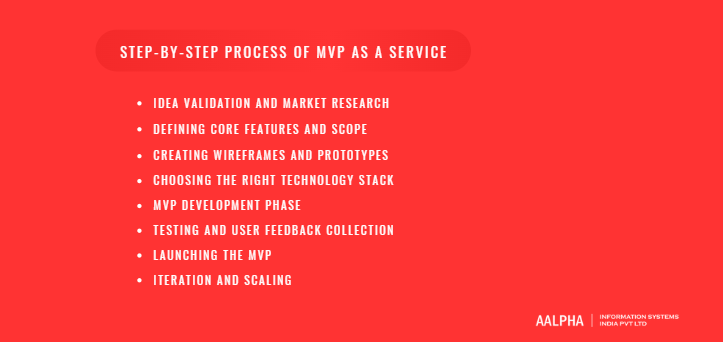
Building a successful MVP is not a random or purely technical exercise. It is a structured, decision-driven process designed to validate ideas quickly while minimizing cost and risk. MVP as a Service providers follow a systematic approach that combines product strategy, user-centered design, and agile engineering. Each stage builds on the previous one, ensuring that the final product is not only functional but also aligned with real user needs.
Startups often ask what the exact process looks like from idea to launch. The answer lies in a sequence of clearly defined steps that transform a concept into a validated product. This section breaks down that process in detail, making it actionable for founders and decision-makers.
-
Idea Validation and Market Research
The MVP journey begins with validating the core idea and identifying a clear problem-solution fit. This stage focuses on understanding whether the problem is real, significant, and worth solving. Market research is conducted to analyze industry trends, competitor offerings, and target audience behavior.
A critical part of this phase is identifying the specific pain point the product aims to address. Many startups fail because they attempt to solve broad or poorly defined problems. MVP service providers help refine the idea into a focused value proposition that resonates with a defined audience segment.
Validation methods may include surveys, interviews, landing pages, or even simple pre-launch campaigns to gauge interest. These techniques provide early signals about demand and user expectations. The goal is to answer a fundamental question: are users willing to adopt or pay for this solution?
By the end of this stage, startups gain clarity on their target market, user needs, and product direction. This ensures that development efforts are grounded in real-world insights rather than assumptions.
-
Defining Core Features and Scope
Once the idea is validated, the next step is defining the core features that will be included in the MVP. This involves prioritizing functionality based on its importance to solving the primary problem. The focus is on identifying must-have features while eliminating anything that does not directly contribute to the product’s core value.
A common approach used in this stage is feature prioritization frameworks such as MoSCoW (Must-have, Should-have, Could-have, Won’t-have). This helps ensure that development efforts remain focused and efficient. Startups often feel tempted to include additional features, but doing so increases complexity, cost, and development time.
Defining scope also involves outlining user flows and key interactions. This ensures that the product delivers a seamless experience, even in its simplified form. The goal is not to build a minimal product in terms of quality, but a minimal product in terms of functionality.
By clearly defining scope, startups can maintain control over timelines and budgets while ensuring that the MVP delivers meaningful value to users.
-
Creating Wireframes and Prototypes
With the feature set defined, the next step is translating ideas into visual representations. Wireframes serve as the blueprint of the product, outlining the structure, layout, and flow of different screens. They provide a clear understanding of how users will interact with the product.
Prototypes take this a step further by simulating real interactions. These interactive models allow stakeholders to experience the product before development begins. This is particularly valuable for identifying usability issues and refining user journeys early in the process.
Design at the MVP stage emphasizes clarity and usability over visual complexity. The objective is to ensure that users can easily navigate the product and achieve their goals without confusion. Every design decision is guided by the principle of reducing friction.
Prototyping also facilitates collaboration between founders, designers, and developers. It ensures alignment and reduces the likelihood of costly changes during development. By validating design concepts early, startups can move into development with greater confidence.
-
Choosing the Right Technology Stack
Selecting the appropriate technology stack is a strategic decision that impacts both the speed of development and the product’s ability to scale. MVP as a Service providers carefully evaluate the requirements of the product, expected user load, and future growth plans before making this decision.
At the MVP stage, the priority is often speed and flexibility. Technologies that enable rapid development, such as modern web frameworks and cloud-based platforms, are commonly preferred. These tools allow teams to build and deploy quickly while maintaining the ability to iterate.
However, scalability cannot be ignored. The chosen stack should support future expansion without requiring a complete rebuild. This involves balancing short-term efficiency with long-term sustainability.
Another key consideration is integration capability. The product may need to connect with third-party services such as payment gateways, analytics tools, or APIs. A well-chosen technology stack ensures seamless integration and reduces technical complexity.
-
MVP Development Phase
The development phase is where the MVP takes shape as a functional product. MVP as a Service providers typically use agile methodologies, breaking the development process into short, manageable sprints. Each sprint focuses on delivering a specific set of features or improvements.
Development is divided into frontend and backend components. The frontend focuses on the user interface and experience, ensuring that users can interact with the product smoothly. The backend handles data processing, business logic, and system integrations. Both components are developed in parallel to accelerate progress.
Regular sprint reviews and demos allow stakeholders to track progress and provide feedback. This ensures that the product evolves in the right direction and aligns with the original vision. If changes are needed, they can be implemented quickly without disrupting the overall timeline.
The emphasis during this phase is on building a stable, functional product that delivers core value. Advanced features and optimizations are intentionally deferred to later stages. This approach enables faster launch while maintaining a strong foundation for future development.
-
Testing and User Feedback Collection
Testing ensures that the MVP performs reliably and meets basic quality standards. This stage includes both internal testing and real-world user feedback. Functional testing is conducted to identify and fix bugs, ensuring that all features work as intended.
User feedback collection is equally important. Beta users are invited to interact with the product and share their experiences. This provides insights into usability, feature relevance, and overall satisfaction. Feedback can be collected through surveys, interviews, or in-app analytics.
The goal is to understand how users actually use the product, rather than how it was intended to be used. This often reveals unexpected behaviors or pain points that require attention.
By combining testing with user feedback, startups gain a clear understanding of what works and what needs improvement. This information becomes the foundation for the next phase of iteration.
-
Launching the MVP
Launching the MVP marks the transition from development to real-world validation. This is typically done through a soft launch, where the product is released to a limited audience before a full-scale rollout. This controlled approach allows startups to monitor performance and address issues without exposing the product to a large user base.
Deployment involves setting up hosting environments, configuring servers, and ensuring that the product is accessible and stable. Cloud platforms are commonly used to provide scalability and reliability.
During the launch phase, startups also implement analytics tools to track user behavior. Metrics such as user engagement, retention, and conversion rates provide valuable insights into the product’s performance.
A successful MVP launch is not defined by perfection, but by learning. The objective is to gather as much data as possible to inform future decisions.
-
Iteration and Scaling
The final step in the MVP process is continuous iteration and scaling based on real user data. This is where the true value of the MVP becomes evident. Insights gathered from user interactions and feedback are used to refine the product, improve features, and address pain points.
Iteration involves making incremental improvements rather than large, disruptive changes. This ensures that the product evolves steadily while maintaining stability. Features that perform well can be enhanced, while those that do not add value can be removed or redesigned.
Scaling decisions are made based on validated demand. If the MVP demonstrates strong user adoption and engagement, startups can invest in expanding functionality, improving performance, and reaching a larger audience.
This stage also includes optimizing infrastructure, enhancing security, and preparing the product for long-term growth. By the time scaling begins, the product is no longer based on assumptions but on proven user behavior.
Ultimately, this step transforms a validated MVP into a полноценный product capable of supporting business growth and market expansion.
Benefits of MVP as a Service for Startups
MVP as a Service has emerged as a preferred approach for startups because it directly addresses the core challenges of early-stage product development: uncertainty, limited resources, and the need for rapid execution. Instead of committing to long development cycles and high upfront investments, startups can validate ideas quickly, adapt based on real user feedback, and build products with a higher probability of success.
Founders often ask whether outsourcing MVP development compromises control or quality. In practice, the opposite is true when working with experienced providers. MVP as a Service combines structured processes, technical expertise, and strategic guidance, enabling startups to move faster while making better decisions. The benefits extend beyond development into areas such as funding readiness, risk management, and long-term scalability.
-
Faster Time to Market
Speed is one of the most critical advantages of MVP as a Service. In competitive markets, the ability to launch quickly and gather user feedback can determine whether a startup gains traction or loses relevance. MVP service providers use agile methodologies, pre-built components, and streamlined workflows to significantly reduce development timelines.
Instead of spending months building a full-featured product, startups can launch a functional MVP within weeks. This allows them to test their idea in real market conditions and start learning immediately. Early entry also provides a strategic advantage by enabling startups to capture user attention before competitors.
Another important aspect of speed is iteration. MVP as a Service not only accelerates the initial launch but also supports rapid updates based on feedback. This continuous improvement cycle ensures that the product evolves in alignment with user needs, rather than being locked into a rigid development plan.
-
Cost Efficiency
Cost efficiency is a major concern for startups operating with limited budgets. MVP as a Service addresses this by focusing only on essential features required for validation. This prevents unnecessary spending on complex functionality that may not be needed.
Traditional development models often involve hiring full-time teams, investing in infrastructure, and committing to long development cycles. In contrast, MVP as a Service offers a more flexible engagement model, where startups pay for a targeted outcome rather than maintaining a large team.
This approach also reduces the risk of financial waste. If the product idea does not perform as expected, losses are minimized because the initial investment is controlled. On the other hand, if the MVP shows strong potential, startups can confidently invest further in scaling.
By aligning spending with validated outcomes, MVP as a Service enables startups to use their resources more strategically and extend their financial runway.
-
Access to Experienced Teams
Building a successful MVP requires more than technical skills. It involves product strategy, user experience design, and an understanding of market dynamics. MVP as a Service provides startups with access to experienced, cross-functional teams that have worked on multiple products across industries.
These teams bring proven frameworks, best practices, and practical insights that are difficult to replicate with an in-house team, especially at an early stage. They understand common pitfalls, such as overengineering or misaligned features, and help startups avoid them.
Another advantage is the ability to leverage specialized expertise without long-term commitments. Startups can benefit from senior developers, designers, and product managers without the overhead of hiring and managing them internally.
This access to expertise accelerates decision-making and improves the overall quality of the product. It ensures that the MVP is not just built quickly, but built correctly.
-
Reduced Development Risk
Risk reduction is one of the most significant benefits of MVP as a Service. Startups operate in highly uncertain environments, where assumptions about user behavior, market demand, and product functionality may not hold true. Building a full product without validation increases the likelihood of failure.
MVP as a Service mitigates this risk by focusing on early validation and iterative development. Each stage of the process is designed to test assumptions and gather real-world data. This allows startups to identify potential issues early and make informed decisions.
For example, if users do not respond positively to a feature, it can be modified or removed before additional resources are invested. This reduces the chances of building a product that fails to meet market needs.
By turning product development into a data-driven process, MVP as a Service helps startups navigate uncertainty with greater confidence and control.
-
Better Investor Readiness
Investor readiness is another key advantage of MVP as a Service. Investors are more likely to fund startups that demonstrate traction, user engagement, and a clear understanding of their market. A well-executed MVP provides tangible evidence that the product has potential.
Instead of presenting only an idea or concept, founders can showcase a working product, user feedback, and performance metrics. This significantly strengthens their position during fundraising discussions. It answers critical questions about market demand, scalability, and revenue potential.
Additionally, the structured approach of MVP as a Service ensures that startups have a clear product roadmap and data-backed insights. This level of preparation builds credibility and trust with investors.
In many cases, startups that launch an MVP early are able to secure funding faster because they reduce uncertainty for investors. They demonstrate not just vision, but execution capability and market validation.
Challenges and Limitations of MVP as a Service
While MVP as a Service offers clear advantages in speed, cost control, and early validation, it is not without limitations. A balanced evaluation is essential for founders making strategic decisions. Understanding these challenges allows startups to plan proactively, set realistic expectations, and select the right partner with appropriate safeguards in place.
MVP development is intentionally constrained to prioritize learning over completeness. This constraint, while beneficial for validation, can introduce trade-offs in functionality, scalability, and control. In addition, outsourcing critical parts of product development introduces dependencies and potential risks that must be managed carefully.
The key is not to avoid MVP as a Service, but to approach it with clarity and structure. When startups anticipate these limitations and address them early, they can maximize the benefits while minimizing potential downsides.
-
Limited Initial Features
By design, an MVP includes only the core features necessary to validate the product idea. While this focus accelerates development and reduces costs, it also means that the initial version may feel incomplete compared to fully developed products. Users accustomed to feature-rich applications may perceive the MVP as lacking depth or sophistication.
This limitation can affect early user perception and engagement if not managed carefully. Startups must clearly communicate the purpose of the MVP and set expectations with early adopters. Positioning the product as an evolving solution rather than a finished offering helps mitigate this issue.
Additionally, prioritization becomes critical. If the wrong features are selected for the MVP, the product may fail to demonstrate its true value. This reinforces the importance of strong product discovery and user research before development begins.
-
Dependency on Service Provider
Engaging an MVP as a Service provider introduces a level of dependency on external teams for product development and execution. While this provides access to expertise, it can also create challenges if the provider does not meet expectations in terms of quality, communication, or timelines.
Startups may face difficulties if they lack visibility into the development process or if knowledge transfer is insufficient. This can become particularly problematic when transitioning from MVP to full-scale product development, especially if the startup decides to build an internal team later.
To mitigate this risk, startups should ensure clear documentation, regular communication, and well-defined ownership of code and assets. Choosing a provider with transparent processes and a collaborative approach is essential.
Ultimately, dependency is not inherently negative, but it must be managed strategically to maintain control over the product’s future.
-
Potential Misalignment with Vision
Another challenge is the potential misalignment between the startup’s vision and the service provider’s execution. Even experienced teams may interpret requirements differently, leading to outcomes that do not fully align with the founder’s expectations.
This misalignment often occurs when requirements are not clearly defined or when communication is inconsistent. In the early stages of a startup, where ideas are still evolving, it can be difficult to articulate the product vision precisely.
Regular feedback loops, sprint reviews, and collaborative planning sessions are essential to address this issue. Founders must remain actively involved in the process, providing continuous input and clarifying priorities.
When managed effectively, this collaboration can enhance the final product. However, without strong alignment, it can lead to delays, rework, and missed opportunities.
-
Scalability Concerns if Not Planned Well
MVP development prioritizes speed and validation, which can sometimes lead to compromises in scalability. If the technology stack and architecture are not chosen carefully, the product may struggle to handle increased user demand as it grows.
For example, shortcuts taken during the MVP phase to accelerate development can result in technical debt. This may require significant refactoring or even rebuilding parts of the system when scaling becomes necessary.
To avoid this, MVP as a Service providers must strike a balance between rapid development and long-term viability. While the product does not need enterprise-level scalability at the outset, it should be designed with future growth in mind.
Startups should also plan for a clear transition from MVP to a scalable product. This includes evaluating infrastructure, performance optimization, and system architecture as the user base expands.
-
Data Security and Compliance Risks
Data security and compliance are critical considerations, especially for startups operating in regulated industries such as healthcare, finance, or eCommerce. When outsourcing MVP development, sensitive data may be handled by external teams, increasing the risk of security vulnerabilities or compliance issues.
Inadequate security measures during the MVP phase can lead to data breaches, legal complications, and loss of user trust. This risk is often underestimated because the focus is primarily on speed and functionality.
Startups must ensure that basic security practices are implemented from the beginning. This includes secure data storage, encrypted communication, access controls, and adherence to relevant regulations.
Additionally, clear agreements regarding data ownership, confidentiality, and compliance responsibilities should be established with the service provider. By addressing security early, startups can build trust with users and avoid costly issues in later stages.
A realistic understanding of these challenges reinforces the importance of choosing the right MVP partner and maintaining active involvement throughout the process. When managed effectively, the limitations of MVP as a Service become manageable trade-offs rather than barriers, allowing startups to benefit from rapid validation while preparing for long-term growth.
Cost of MVP as a Service
Understanding the cost of MVP as a Service is essential for startups planning their product development strategy. Unlike traditional software development, where costs can escalate quickly due to extensive feature sets and long timelines, MVP as a Service is designed to optimize spending by focusing only on what is necessary for validation. However, pricing is not fixed. It varies significantly based on multiple factors, including product complexity, scope, and technical requirements.
Startups often ask how much it realistically costs to build an MVP. The answer depends less on a single number and more on how efficiently the product is scoped and executed. A well-defined MVP can cost a fraction of a full-scale product while delivering meaningful insights and traction. This makes cost not just an expense, but a strategic investment in validation and learning.
-
Factors Affecting MVP Cost
Several key factors influence the cost of MVP as a Service, and understanding them helps startups make informed budgeting decisions.
The most significant factor is product complexity. A simple MVP with basic functionality, such as a landing page or a single-feature application, will cost significantly less than a platform with multiple integrations, user roles, and advanced workflows. The number and complexity of features directly impact development time and effort.
Another important factor is the timeline. Faster delivery often requires more resources, such as larger teams or parallel development processes, which can increase costs. Conversely, a longer timeline may reduce immediate expenses but delay market entry.
Design requirements also play a role. Highly customized UI/UX designs require more time and expertise compared to standard templates. Similarly, integration with third-party services, such as payment gateways or APIs, can add to the overall cost.
Geographical location of the service provider and team expertise further influence pricing. Experienced teams may charge higher rates but often deliver faster and more reliable outcomes, which can reduce long-term costs.
-
Cost Breakdown by MVP Type
The type of MVP being developed significantly affects the overall cost. Different product categories require varying levels of effort, infrastructure, and expertise.
Web-based MVPs are generally the most cost-effective option. They typically involve building a responsive web application with core functionality, making them suitable for early validation. Costs for web MVPs are usually lower because development frameworks and deployment processes are relatively straightforward.
Mobile app MVPs tend to be more expensive due to platform-specific requirements. Developing for iOS and Android may require separate builds or cross-platform solutions, increasing complexity. Features such as push notifications, device integrations, and app store deployment add to the cost.
SaaS platforms often fall into a higher cost range because they involve more complex architectures. These products typically include user management, subscription systems, dashboards, and integrations with multiple services. The need for scalability and data handling further increases development effort.
Each type of MVP serves a different purpose, and the choice should align with the startup’s target audience and business model rather than cost alone.
-
Custom MVP Development vs MVP as a Service
Startups frequently compare custom MVP development with MVP as a Service to determine the most cost-effective approach. Custom development usually involves building an in-house team or hiring freelancers to create the product from scratch. While this provides greater control, it often comes with higher costs and longer timelines.
MVP as a Service, in contrast, offers a bundled solution that includes design, development, testing, and launch support. This integrated approach reduces overhead costs associated with hiring, onboarding, and managing multiple resources. Startups benefit from a predefined process and experienced teams, which can accelerate development and reduce errors.
Another key difference lies in predictability. Custom development projects often experience scope creep, leading to unexpected cost increases. MVP as a Service typically operates with clearer scope definitions and structured pricing models, making it easier to manage budgets.
For early-stage startups, MVP as a Service provides a more efficient path to validation. It allows founders to focus on business strategy while technical execution is handled by specialists, resulting in better resource allocation.
-
ROI and Business Impact
The true value of MVP as a Service is not measured solely by its cost, but by its return on investment. An MVP enables startups to validate ideas, test market demand, and gather user feedback with minimal financial risk. This significantly increases the chances of building a successful product.
One of the most important outcomes is validation. By launching an MVP, startups can determine whether users are willing to engage with or pay for their solution. This insight prevents costly investments in ideas that may not work.
MVPs also play a crucial role in fundraising. Investors are more likely to support startups that demonstrate traction, user engagement, and a clear understanding of their market. A functional MVP with real user data provides strong evidence of potential, making it easier to secure funding.
In some cases, MVPs can even generate early revenue. This not only validates the business model but also contributes to financial sustainability. Additionally, the insights gained from user behavior help startups refine their product and improve long-term performance.
Ultimately, MVP as a Service transforms development costs into a strategic investment. It enables startups to move forward with confidence, backed by data and real-world validation rather than assumptions.
MVP as a Service for Different Industries
MVP as a Service is not limited to a single domain. Its principles apply across industries where uncertainty, user behavior, and market demand must be validated before large-scale investment. However, the way an MVP is designed and executed varies significantly depending on the industry. Each sector has unique requirements related to compliance, user expectations, technical complexity, and business models.
Startups often ask whether MVP strategies differ across industries or if a one-size-fits-all approach works. The reality is that while the core philosophy remains the same, the implementation must be tailored to industry-specific challenges. A SaaS product prioritizes usability and scalability, while a FinTech solution must address security and regulatory concerns from day one. Understanding these nuances allows startups to build more effective MVPs and avoid costly mistakes.
-
MVP for SaaS Startups
For SaaS startups, the MVP focuses on delivering a core feature set that solves a specific problem for a defined user segment. The goal is to validate whether users are willing to adopt the software as part of their workflow. This often involves building a basic version of the platform with essential functionalities such as user onboarding, a primary dashboard, and one or two key features.
Scalability is an important consideration even at the MVP stage. SaaS products are typically subscription-based, so features like user authentication, billing integration, and usage tracking are often included early. However, advanced capabilities such as automation, analytics, and customization are deferred until validation is achieved.
User experience plays a critical role in SaaS MVPs. Since adoption depends heavily on usability, the interface must be intuitive and efficient. Early feedback helps identify friction points and refine the product before scaling.
-
MVP for FinTech Startups
FinTech MVPs require a careful balance between innovation and compliance. Unlike other industries, financial products must adhere to strict regulatory standards and security requirements. Even at the MVP stage, startups must implement basic safeguards such as data encryption, secure authentication, and compliance with financial regulations.
The MVP typically focuses on a single financial service, such as payments, lending, or expense tracking. The objective is to validate user trust and willingness to use the platform for financial transactions. Features such as real-time processing, transaction history, and integration with banking systems may be included depending on the use case.
Trust is a key factor in FinTech. Users are more cautious when dealing with financial data, so the MVP must provide a reliable and secure experience. Early validation often revolves around user confidence as much as functionality.
-
MVP for Healthcare Startups
Healthcare MVPs are among the most complex due to regulatory, ethical, and data privacy considerations. Startups in this space must comply with standards such as HIPAA or regional equivalents, even in early versions of the product.
The MVP typically focuses on a narrow use case, such as appointment booking, teleconsultation, or patient data management. The goal is to validate whether the solution improves efficiency for patients or healthcare providers. Features are kept minimal but must be reliable and secure.
User experience in healthcare MVPs must prioritize clarity and accessibility. Patients and medical professionals often require simple, intuitive interfaces that reduce complexity rather than add to it. Additionally, accuracy and reliability are critical, as errors can have serious consequences.
Validation in healthcare often involves smaller, controlled user groups due to compliance requirements. This makes the MVP process more structured but equally important.
-
MVP for eCommerce Platforms
eCommerce MVPs focus on validating demand for products and the effectiveness of the purchasing experience. Instead of building a full-featured marketplace, startups typically launch with a simplified version that includes product listings, a basic checkout process, and payment integration.
The primary objective is to test whether customers are willing to browse, purchase, and return to the platform. Features such as advanced search, recommendations, and inventory management are usually added later based on user behavior.
One of the most common approaches in eCommerce marketplace MVPs is using existing platforms or tools to accelerate development. This allows startups to focus on validating their product-market fit rather than building complex infrastructure from scratch.
Metrics such as conversion rate, average order value, and customer retention provide valuable insights during the MVP phase. These indicators help determine whether the business model is viable and scalable.
-
MVP for Logistics and Delivery Startups
Logistics and delivery MVPs are designed to validate operational efficiency and user demand. These platforms typically involve multiple stakeholders, including customers, service providers, and administrators. The MVP focuses on enabling basic interactions between these groups.
Core features often include order placement, tracking, and communication between users and service providers. For example, a delivery startup may launch with a simple system that allows users to request deliveries and track them in real time. Advanced features such as route optimization, automated dispatching, and analytics are introduced later.
Operational testing is a key aspect of logistics MVPs. Startups must validate not only the digital platform but also the real-world processes that support it. This includes delivery times, cost structures, and service reliability.
Because logistics involves physical operations, the MVP must strike a balance between software functionality and operational feasibility. Early validation helps identify inefficiencies and refine processes before scaling to larger markets.
By tailoring MVP strategies to industry-specific requirements, startups can ensure that their initial product is both relevant and effective. This targeted approach increases the likelihood of achieving product-market fit and building a scalable business.
How to Choose the Right MVP Development Partner
Selecting the right MVP development company or partner is one of the most important decisions a startup will make in its early stages. The partner you choose will directly influence not only the quality of your product but also the speed of execution, cost efficiency, and your ability to achieve product-market fit. While many companies offer development services, not all are equipped to handle the unique demands of startup MVPs, which require a combination of speed, strategic thinking, and technical excellence.
Startups often ask how to evaluate MVP partners beyond pricing. The answer lies in assessing a combination of experience, technical capability, execution speed, and long-term support. A strong partner does more than build software. They act as a product advisor, helping you make informed decisions at every stage of development. This section outlines the key factors to consider when choosing the right MVP development partner.
-
Experience in Startup MVP Development
Experience in building MVPs for startups is a critical factor because early-stage products require a different approach compared to enterprise software. An experienced partner understands the importance of validation, prioritization, and rapid iteration. They know how to translate an idea into a functional product without overcomplicating the process.
Startups should look for partners with a proven track record of delivering MVPs across different industries. This experience ensures familiarity with common challenges such as unclear requirements, evolving product visions, and tight timelines. It also indicates the ability to guide founders through the decision-making process.
A partner with startup experience is more likely to challenge assumptions, suggest improvements, and focus on delivering real value rather than just executing instructions. This strategic input can significantly improve the chances of building a successful product.
-
Technical Expertise and Stack Knowledge
Technical expertise is essential for building a reliable and scalable MVP. The development partner should have strong proficiency in modern technologies, frameworks, and tools that enable rapid development without compromising quality. This includes both frontend and backend capabilities, as well as experience with cloud infrastructure and integrations.
Equally important is the ability to choose the right technology stack based on the product’s requirements. An experienced team understands the trade-offs between speed and scalability and can recommend solutions that align with the startup’s goals. Poor technology decisions at the MVP stage can lead to technical debt and increased costs later.
Startups should also evaluate the partner’s ability to integrate third-party services such as payment gateways, analytics platforms, and APIs. This ensures that the MVP can deliver essential functionality while remaining flexible for future enhancements.
-
Ability to Deliver Fast and Iterate
Speed is a defining characteristic of successful MVP development. The right partner should be able to deliver a functional product within a short timeframe while maintaining the flexibility to iterate based on feedback. This requires a strong understanding of agile methodologies and efficient project management practices.
Startups should assess whether the partner follows a structured sprint-based approach, with regular updates and deliverables. The ability to adapt quickly to changing requirements is equally important, as product direction often evolves during the MVP phase.
A partner that prioritizes speed without sacrificing quality can help startups gain early market insights and stay ahead of competitors.
-
Communication and Transparency
Clear communication and transparency are essential for a successful partnership. MVP development involves continuous collaboration between founders and the development team, making it important to have open and consistent communication channels.
Startups should look for partners who provide regular progress updates, conduct sprint reviews, and actively seek feedback. Transparency in timelines, deliverables, and challenges ensures that there are no surprises during the development process.
Effective communication also helps prevent misalignment between the startup’s vision and the final product. A partner who listens, asks the right questions, and provides honest feedback can significantly improve the outcome.
-
Pricing and Engagement Model
Pricing is an important consideration, but it should not be the sole deciding factor. Startups need to understand how the partner structures their pricing and what is included in the engagement. MVP as a Service providers typically offer more predictable pricing compared to traditional development models, which helps in budget planning.
Common engagement models include fixed-price, time-and-materials, or milestone-based pricing. Each model has its advantages depending on the project scope and level of flexibility required. Startups should choose a model that aligns with their needs and risk tolerance.
It is also important to ensure that the scope of work is clearly defined to avoid unexpected costs. A transparent pricing structure reflects professionalism and builds trust.
-
Post-Launch Support and Scaling
MVP development does not end with the launch. Post-launch support is crucial for maintaining the product, fixing issues, and implementing improvements based on user feedback. The right partner should offer ongoing support to ensure the product continues to perform effectively.
As the startup grows, the MVP will need to evolve into a scalable product. This requires enhancements in performance, infrastructure, and feature set. A development partner with experience in scaling products can provide valuable guidance during this transition.
Working with an experienced provider such as Aalpha Information Systems ensures that startups have access to both initial MVP development and long-term product growth support. This continuity reduces friction and enables a smoother path from validation to scale.
Choosing the right MVP development partner is not just a technical decision. It is a strategic investment in your startup’s future. By focusing on experience, expertise, communication, and long-term support, startups can build a strong foundation for success and significantly improve their chances of achieving product-market fit.
Final Thoughts
MVP as a Service gives startups a structured way to validate ideas quickly, control costs, and build products based on real user feedback rather than assumptions. Instead of committing to full-scale development upfront, founders can test, learn, and iterate with confidence. This approach not only reduces risk but also strengthens your position when seeking market traction or investor funding.
If you are planning to turn your idea into a validated product, the next step is to partner with an experienced team that understands both technology and startup dynamics. Working with a proven provider like Aalpha Information Systems can help you move from concept to launch faster while ensuring your MVP is built with the right strategy and foundation.
Connect with us to discuss your idea and take the first step toward building a successful, scalable product.