


The integration of artificial intelligence (AI) into healthcare IT marks a structural shift in how clinical data is collected, interpreted, and used for care delivery. Electronic Health Records (EHR) and Electronic Medical Records (EMR), once designed primarily for digital storage and documentation, are now evolving into intelligent systems that actively support clinical and operational decisions. Understanding this transition requires looking at how EHR/EMR systems evolved, why AI has become unavoidable, the data challenges healthcare faces today, and what AI-enabled systems are expected to achieve.
Evolution of EHR and EMR Systems
Early EMR systems emerged in the 1970s and 1980s as digital replacements for paper charts within individual hospitals or clinics. Their scope was limited to storing patient demographics, diagnoses, prescriptions, and lab results within a single organization. Interoperability was minimal, and data exchange across providers was rare.
EHR systems expanded this concept in the 2000s by supporting longitudinal patient records across multiple care settings. Government initiatives such as the HITECH Act in the United States accelerated adoption by incentivizing “meaningful use” of EHRs. Modern EHR platforms now support clinical documentation, computerized physician order entry (CPOE), lab and imaging integration, billing, and reporting.
Despite these advances, most EHR and EMR systems remain transactional in nature. They capture data efficiently but offer limited analytical intelligence. Clinical insights often depend on manual review, static rules, or retrospective reporting. This gap between data availability and actionable intelligence has set the stage for AI integration.
Why AI Integration Has Become Necessary
Healthcare organizations generate massive volumes of data, far exceeding human capacity to analyze it in real time. A single patient encounter can produce structured data (vitals, lab values, medication codes) and unstructured data (physician notes, discharge summaries, imaging reports). Clinicians are expected to synthesize this information quickly while managing increasing patient loads and administrative responsibilities.
AI addresses this problem by enabling:
- Automated pattern recognition across large datasets
- Real-time risk prediction and alerts
- Natural language processing of clinical narratives
- Continuous learning from historical outcomes
Without AI, EHR and EMR systems function mainly as passive repositories. With AI, they can proactively surface relevant information, reduce cognitive burden on clinicians, and support earlier, data-driven interventions. The growing shortage of healthcare professionals and rising care costs further reinforce the need for intelligent automation embedded directly into clinical workflows.
Current Challenges in Clinical Data Management
Despite widespread EHR adoption, healthcare data management remains fragmented and inefficient.
Key challenges include:
- Data silos: Patient data is often scattered across multiple systems, departments, and vendors.
- Unstructured content: Clinical notes, imaging reports, and referral letters are difficult to analyze using traditional methods.
- Data quality issues: Missing values, inconsistent coding, and duplicate records reduce reliability.
- Limited interoperability: Variations in standards and implementations restrict seamless data exchange.
- Information overload: Clinicians receive excessive alerts and reports, many of which lack contextual relevance.
These challenges limit the ability of healthcare organizations to extract meaningful insights from existing data. AI technologies, when properly integrated, are specifically designed to address these issues by normalizing data, extracting meaning from unstructured text, and prioritizing clinically relevant signals.
Objectives of AI-Enabled EHR and EMR Systems
The primary goal of integrating AI with EHR and EMR systems is not to replace clinicians, but to augment their capabilities.
Key objectives include:
- Improved clinical decision-making: Delivering timely, evidence-based recommendations at the point of care.
- Early risk detection: Identifying patients at risk of deterioration, readmission, or adverse events.
- Operational efficiency: Automating documentation, coding, scheduling, and administrative tasks.
- Personalized care: Using historical and population-level data to tailor treatment plans.
- Reduced clinician burden: Minimizing manual data entry and alert fatigue.
- Better patient outcomes: Enabling proactive, preventive, and coordinated care.
When aligned with clinical workflows and regulatory requirements, AI-enabled EHR and EMR systems transform healthcare IT from a record-keeping tool into an intelligent clinical partner. This foundation sets the context for understanding how AI can be technically and strategically integrated into existing healthcare systems, which the next sections will explore in detail.
Understanding EHR vs EMR: Technical and Functional Differences
Although Electronic Medical Records (EMR) and Electronic Health Records (EHR) are often used interchangeably, they differ significantly in scope, architecture, and integration requirements. These differences directly influence how artificial intelligence can be embedded, scaled, and governed within each system.
Definition and Scope of EMR Systems
An Electronic Medical Record is a digital version of a patient’s chart maintained within a single healthcare organization, such as a clinic or hospital. EMR systems are primarily designed to support internal clinical workflows.
Core characteristics of EMR systems include:
- Storage of patient demographics, diagnoses, medications, allergies, and lab results
- Documentation of encounters within one provider organization
- Limited data exchange outside the originating system
- Focus on treatment history rather than longitudinal care
From a technical standpoint, EMRs are often tightly coupled with legacy databases and monolithic architectures. Many EMR platforms were built before interoperability standards became widespread, which limits their ability to integrate external data sources or advanced analytics tools without customization.
AI integration in EMRs is typically narrow in scope, focusing on tasks such as clinical documentation assistance, coding automation, or basic decision support within a single care setting.
Definition and Scope of EHR Systems
Electronic Health Records extend beyond the boundaries of a single organization. An EHR represents a longitudinal, patient-centric record designed to follow individuals across providers, specialties, and care settings.
Key characteristics of EHR systems include:
- Aggregation of data from multiple healthcare entities
- Support for care coordination and continuity of care
- Built-in interoperability features using standards such as HL7 and FHIR
- Inclusion of administrative, clinical, and sometimes patient-generated data
EHR systems are typically more modular and API-driven, enabling integration with third-party applications, analytics platforms, and external data sources. This architecture makes EHRs more suitable for advanced AI use cases such as population health analytics, predictive modeling, and cross-institutional risk stratification.
Data Ownership, Interoperability, and Access Differences
One of the most critical distinctions between EMR and EHR systems lies in how data is owned, shared, and accessed.
- Data ownership:
EMR data is usually controlled by the healthcare provider that created it. In contrast, EHR data is often governed by shared frameworks that emphasize patient access and portability. - Interoperability:
EMRs may lack standardized interfaces, making data extraction and integration complex. EHRs are designed to exchange data across systems using standardized protocols and APIs. - Access control:
EMR access is typically limited to internal users. EHR systems support role-based access across organizations, patients, and third-party services.
These differences affect how AI models are trained and deployed. EMR-based AI often relies on localized datasets, while EHR-based AI can leverage larger, more diverse datasets that improve model accuracy and generalizability.
Why Integration Strategies Differ for EHR and EMR
Because of their architectural and functional differences, AI integration strategies must be tailored accordingly.
For EMR systems:
- Integration often occurs through embedded modules or custom interfaces
- AI use cases focus on local optimization rather than system-wide intelligence
- Data preparation requires extensive normalization and manual mapping
For EHR systems:
- AI integration is commonly API-driven and service-oriented
- Models can operate across multiple datasets and care settings
- Governance, compliance, and scalability play a larger role
In practical terms, integrating AI with an EMR is often a point solution aimed at improving efficiency within a single organization. Integrating AI with an EHR is a platform-level initiative that supports predictive care, interoperability, and system-wide clinical intelligence.
Recognizing these distinctions is essential before designing any AI integration roadmap. The technical foundation of the underlying record system determines not only what AI can do, but also how safely and effectively it can be deployed in real clinical environments.
Role of Artificial Intelligence in Healthcare Systems
Artificial intelligence has moved from experimental pilots to production-grade systems across healthcare organizations. Within EHR and EMR environments, AI serves as the analytical layer that transforms raw clinical data into actionable insights, supporting both patient care and operational efficiency. Understanding its role requires clarity on core AI technologies, healthcare data types, application domains, and organizational readiness.
Overview of AI, ML, NLP, and Deep Learning in Healthcare
Artificial intelligence in healthcare is an umbrella term that includes multiple computational techniques, each addressing different problems.
- Machine Learning (ML):
ML models learn patterns from historical data to make predictions or classifications. In healthcare, ML is used for risk scoring, disease prediction, readmission forecasting, and anomaly detection in clinical metrics. - Natural Language Processing (NLP):
NLP enables systems to extract meaning from unstructured text such as physician notes, discharge summaries, pathology reports, and referral letters. In EHR and EMR systems, NLP is critical for converting narrative documentation into structured, searchable data. - Deep Learning:
Deep learning, a subset of ML, uses neural networks with multiple layers to model complex relationships. It is widely applied in medical imaging, waveform analysis, and speech recognition, including radiology interpretation and voice-based clinical documentation. - Rule-based AI and hybrid systems:
Many healthcare AI implementations combine statistical models with clinical rules to maintain safety, interpretability, and regulatory compliance.
Together, these technologies allow healthcare systems to move beyond static reporting toward real-time intelligence embedded in clinical workflows.
Structured vs Unstructured Healthcare Data
Healthcare data is heterogeneous, and its structure determines how AI models can be applied.
- Structured data:
Includes coded elements such as lab results, vital signs, medications, diagnoses, and procedure codes. This data is easier to analyze using traditional ML models and is commonly used for predictive analytics and reporting. - Unstructured data:
Includes free-text clinical notes, imaging reports, scanned documents, and audio recordings. This data represents a large portion of clinically relevant information but is not directly usable without NLP, computer vision, or speech recognition techniques.
EHR and EMR systems contain a mix of both. AI plays a central role in bridging this gap by extracting clinically meaningful signals from unstructured data and linking them with structured records. This integration improves data completeness and reduces reliance on manual abstraction.
Clinical Decision Support vs Administrative Automation
AI applications in healthcare broadly fall into two categories, each with different risk profiles and integration requirements.
- Clinical decision support (CDS):
These systems assist clinicians by providing alerts, recommendations, or risk assessments at the point of care. Examples include sepsis prediction, medication interaction warnings, and diagnostic suggestions. CDS systems require high accuracy, explainability, and regulatory oversight, as they directly influence patient care decisions. - Administrative and operational automation:
These use cases focus on non-clinical tasks such as appointment scheduling, coding, billing, prior authorization, and documentation. While they carry lower clinical risk, they deliver significant efficiency gains and often serve as entry points for AI adoption.
Most healthcare organizations begin with administrative AI use cases before expanding into clinical decision support, building confidence, governance structures, and technical expertise along the way.
AI Maturity Levels in Healthcare Organizations
Healthcare organizations vary widely in their ability to adopt and scale AI solutions. AI maturity can be understood in progressive stages:
- Descriptive stage:
AI is used primarily for reporting and retrospective analysis. EHR data supports dashboards and basic analytics. - Predictive stage:
ML models forecast outcomes such as readmissions or disease progression using historical data. - Prescriptive stage:
AI systems recommend actions or interventions based on predicted risks and clinical guidelines. - Integrated intelligence stage:
AI is embedded directly into EHR and EMR workflows, operating in real time with continuous learning and clinician feedback.
Organizations at lower maturity levels often struggle with data quality and interoperability, while more advanced organizations focus on governance, explainability, and long-term sustainability.
Understanding the role of AI within these contexts is essential before attempting integration with EHR or EMR systems. The next sections build on this foundation by examining how data, standards, and architectures enable practical AI deployment in healthcare IT environments.
Core Use Cases of AI in EHR and EMR Systems
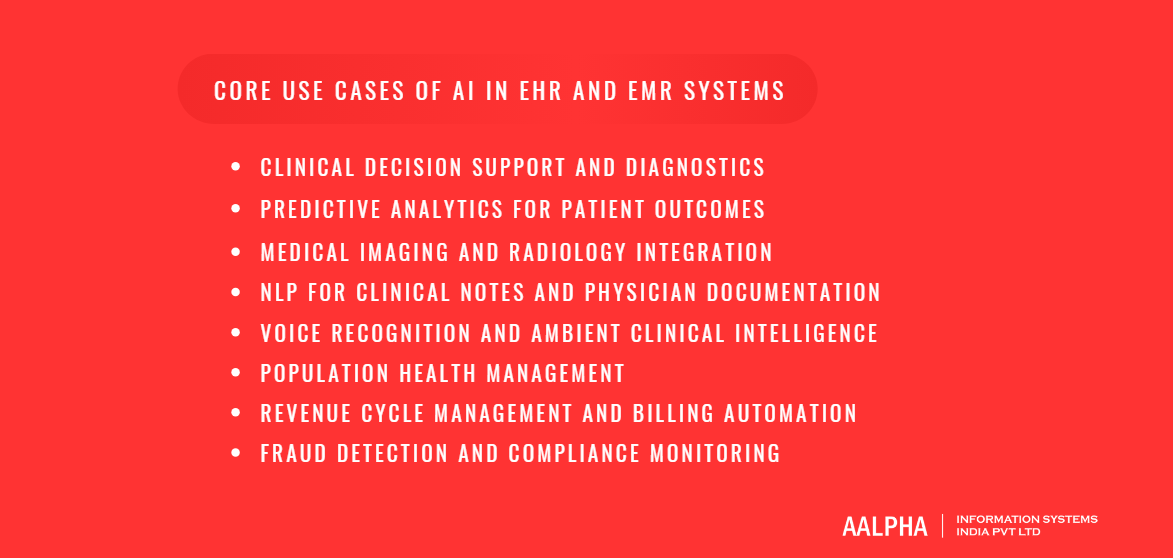
AI integration with EHR and EMR systems is driven by clearly defined, high-impact use cases that address clinical, operational, and financial challenges. These use cases differ in complexity and regulatory risk, but together they demonstrate how AI transforms health records from static repositories into active systems of intelligence.
-
Clinical Decision Support and Diagnostics
Clinical decision support (CDS) is one of the most visible applications of AI within EHR and EMR systems. AI-driven CDS tools analyze patient data in real time to assist clinicians during diagnosis and treatment planning.
Common applications include:
- Early detection of conditions such as sepsis, stroke, or acute kidney injury
- Medication safety checks, including drug–drug and drug–allergy interactions
- Diagnostic suggestions based on symptom patterns and historical outcomes
- Risk stratification for adverse events
Unlike rule-based alerts, AI-powered CDS adapts to patient-specific factors and evolving clinical evidence. When embedded directly into clinician workflows, these systems reduce missed diagnoses while minimizing unnecessary alerts.
-
Predictive Analytics for Patient Outcomes
Predictive analytics uses historical EHR and EMR data to forecast future clinical events. These models support proactive care by identifying risks before they result in complications.
Key use cases include:
- Hospital readmission prediction
- Length-of-stay forecasting
- Deterioration and mortality risk scoring
- Chronic disease progression monitoring
By integrating predictive insights into dashboards or point-of-care views, healthcare teams can prioritize high-risk patients and intervene earlier, improving outcomes and resource utilization.
-
Medical Imaging and Radiology Integration
AI plays a significant role in imaging-heavy specialties such as radiology, cardiology, and pathology. Deep learning models analyze images to detect abnormalities and quantify findings.
Integration with EHR and EMR systems enables:
- Automated annotation and preliminary interpretation of imaging studies
- Faster triage of urgent cases
- Linking imaging insights with clinical history and lab data
- Structured reporting for downstream analytics
Rather than replacing radiologists, these systems act as a second reader, improving consistency and reducing turnaround times while maintaining clinical oversight.
-
NLP for Clinical Notes and Physician Documentation
A large portion of clinically relevant information resides in free-text documentation. NLP systems extract structured data from clinical notes, making it accessible for analytics and decision support.
Practical applications include:
- Automated problem list and diagnosis extraction
- Identification of symptoms, comorbidities, and social determinants of health
- Clinical coding support for billing and reporting
- Reduction of manual chart review
By integrating NLP outputs directly into EHR and EMR fields, organizations improve data quality without increasing clinician documentation burden.
-
Voice Recognition and Ambient Clinical Intelligence
Voice-based AI systems capture and interpret clinician–patient conversations in real time. These tools automatically generate clinical documentation and update EHR records.
Key benefits include:
- Reduced manual data entry
- Improved clinician focus on patient interaction
- More complete and accurate documentation
- Faster note completion and review
Ambient clinical intelligence systems go beyond dictation by understanding context, identifying relevant clinical concepts, and organizing them into structured records.
-
Population Health Management
AI enables population-level analysis across EHR datasets to identify trends, gaps in care, and at-risk groups.
Common use cases include:
- Identification of patients missing preventive screenings
- Chronic disease cohort management
- Risk segmentation based on social and behavioral factors
- Outcome tracking across populations
These insights support value-based care models and help organizations design targeted interventions that improve health outcomes at scale.
-
Revenue Cycle Management and Billing Automation
Administrative inefficiencies are a major cost driver in healthcare. AI automates revenue cycle processes by analyzing clinical and billing data.
Applications include:
- Automated medical coding
- Claim validation and error detection
- Denial prediction and prevention
- Prior authorization support
When tightly integrated with EHR and EMR systems, these tools reduce claim rework, accelerate reimbursements, and improve financial performance.
-
Fraud Detection and Compliance Monitoring
AI models analyze billing patterns, clinical documentation, and transaction data to identify anomalies and compliance risks.
Key functions include:
- Detection of upcoding and duplicate claims
- Monitoring documentation consistency
- Identification of unusual provider or patient behavior
- Support for audit preparedness
These systems operate continuously, helping organizations maintain regulatory compliance while reducing manual review efforts.
Data Foundations for AI–EHR/EMR Integration
AI performance in healthcare is determined less by algorithms and more by the quality, structure, and governance of data. EHR and EMR systems already contain vast amounts of information, but this data must be prepared correctly before it can support reliable AI-driven insights. A strong data foundation is therefore the prerequisite for any successful AI integration.
Types of Healthcare Data Used by AI
AI models in healthcare rely on multiple data categories, each contributing different clinical and operational signals. Effective integration requires aligning these data types into a unified, analyzable format.
Clinical Data
Clinical data forms the core of EHR and EMR systems and is the primary input for most AI models.
Common clinical data elements include:
- Diagnoses and problem lists
- Medications and allergies
- Vital signs and physiological measurements
- Laboratory results
- Clinical notes and discharge summaries
Structured clinical data supports predictive modeling and decision support, while unstructured clinical narratives require NLP to extract actionable insights. The completeness and accuracy of clinical data directly influence AI reliability in patient care scenarios.
Administrative Data
Administrative data supports operational and financial workflows but also provides valuable context for AI analysis.
Key administrative data includes:
- Patient demographics
- Appointment schedules
- Insurance and payer information
- Billing and claims data
- Resource utilization records
AI models use administrative data for revenue cycle optimization, access management, population segmentation, and cost analysis. When combined with clinical data, it also helps identify disparities in access and outcomes.
Imaging Data
Imaging data includes radiology, pathology, cardiology, and other diagnostic images stored in PACS systems and referenced within EHRs.
Characteristics of imaging data:
- High dimensional and storage-intensive
- Often stored separately from core EHR databases
- Requires specialized AI models, such as convolutional neural networks
Integration allows imaging insights to be linked with patient history, lab results, and treatment plans, enabling more contextual and clinically relevant interpretations.
Wearable and IoT Data
Wearables and medical IoT devices generate continuous streams of patient-generated health data.
Examples include:
- Heart rate and activity data from wearables
- Continuous glucose monitoring
- Remote patient monitoring devices
- Home-based vital sign sensors
This data supports longitudinal monitoring, early detection of deterioration, and personalized care. AI systems must handle high-frequency, time-series data and integrate it with episodic EHR records.
Data Normalization and Standardization
Healthcare data originates from diverse systems with varying formats, units, and terminologies. Normalization and standardization are essential for AI model consistency.
Key practices include:
- Mapping local codes to standardized vocabularies such as ICD-10, SNOMED CT, and LOINC
- Standardizing units of measurement and reference ranges
- Harmonizing timestamps and encounter identifiers
- Aligning data schemas across sources
Without normalization, AI models risk learning artifacts rather than clinically meaningful patterns, leading to unreliable outputs.
Data Labeling and Annotation Requirements
Supervised AI models require labeled data to learn from historical outcomes.
Common labeling requirements include:
- Clinical outcomes such as mortality, readmission, or disease progression
- Diagnostic confirmations
- Procedure success or complication indicators
- Imaging annotations created by specialists
Labeling in healthcare is resource-intensive and often requires clinician involvement. Clear labeling guidelines, audit trails, and inter-annotator agreement processes are critical to maintain accuracy and reproducibility.
Data Quality, Bias, and Completeness Challenges
Healthcare data is inherently noisy and incomplete, which introduces risks for AI systems.
Major challenges include:
- Missing or inconsistent documentation
- Variation in clinical practice and coding habits
- Historical bias reflecting unequal access or treatment
- Underrepresentation of certain populations
If left unaddressed, these issues can produce biased models that perform poorly across patient groups. Data quality checks, bias audits, and continuous monitoring are necessary to ensure that AI outputs remain clinically fair and trustworthy.
A well-governed data foundation transforms EHR and EMR systems into reliable sources for AI-driven intelligence. Once data pipelines, standards, and quality controls are in place, organizations can focus on interoperability and technical architectures that enable scalable AI deployment—topics addressed in the next section.
Interoperability Standards and Protocols
Interoperability is the technical backbone of AI integration in EHR and EMR systems. AI models depend on consistent, machine-readable data flows across clinical, administrative, and diagnostic systems. Without standardized protocols and shared vocabularies, AI remains confined to isolated datasets and cannot scale across departments or organizations.
HL7 v2 and v3
Health Level Seven (HL7) standards have been central to healthcare data exchange for decades.
- HL7 v2:
Widely adopted for real-time messaging, HL7 v2 supports data exchange for admissions, discharges, transfers, lab results, and orders. Its flexibility enabled broad adoption, but this same flexibility often leads to inconsistent implementations. - HL7 v3:
Designed to address structural inconsistencies, HL7 v3 introduced a more formal data model. However, its complexity limited widespread adoption, especially in operational environments.
From an AI perspective, HL7 v2 remains common in legacy systems, requiring transformation layers to convert messages into structured formats suitable for analytics and machine learning.
FHIR (Fast Healthcare Interoperability Resources)
FHIR represents a major shift toward modern, API-driven interoperability.
Key features include:
- Modular “resources” representing clinical concepts such as patients, observations, and medications
- RESTful APIs compatible with web and mobile technologies
- Native support for JSON and XML formats
- Strong alignment with cloud-based architectures
FHIR simplifies data access for AI services by providing standardized, granular endpoints. This enables near real-time data ingestion, model inference, and feedback loops embedded directly into clinical workflows.
DICOM for Imaging Data
Digital Imaging and Communications in Medicine (DICOM) is the standard for storing, transmitting, and managing medical imaging data.
Core capabilities include:
- Consistent image formatting and metadata
- Integration with PACS and imaging modalities
- Support for large file sizes and complex imaging studies
AI models for imaging rely on DICOM metadata to align images with patient context, study types, and clinical timelines. Integration with EHR systems allows imaging-derived insights to be incorporated into broader clinical decision-making.
SNOMED CT, LOINC, and ICD-10 Coding Systems
Standard clinical terminologies ensure that data has consistent meaning across systems.
- SNOMED CT:
Provides detailed clinical concepts for symptoms, findings, and procedures. - LOINC:
Standardizes laboratory tests and clinical measurements. - ICD-10:
Used primarily for diagnoses and billing classification.
For AI models, standardized coding reduces ambiguity and improves generalizability. Models trained on standardized data are more likely to perform reliably across institutions and patient populations.
APIs and Microservices Architecture
Modern AI integration relies on APIs and microservices rather than monolithic system extensions.
Key architectural principles include:
- Decoupling AI services from core EHR/EMR systems
- Using APIs for secure, controlled data exchange
- Enabling independent deployment and scaling of AI components
- Supporting real-time and batch processing
This approach allows healthcare organizations to introduce new AI capabilities without disrupting existing clinical systems.
Role of Interoperability in AI Scalability
Interoperability determines whether AI remains a localized tool or becomes a system-wide capability.
Scalable AI integration depends on:
- Consistent data access across multiple systems
- Standardized data models for training and inference
- Ability to deploy AI services across sites and vendors
- Governance frameworks that support shared data use
When interoperability is embedded into the integration strategy, AI solutions can evolve from pilot projects into enterprise-grade platforms that support clinical, operational, and population-level intelligence.
AI Integration Architectures for EHR and EMR Systems
Choosing the right integration architecture is a strategic decision that affects performance, scalability, compliance, and long-term sustainability of AI within EHR and EMR systems. Healthcare environments impose unique constraints around latency, data privacy, and reliability, making architectural design as critical as model accuracy.
Embedded AI vs External AI Services
Embedded AI is built directly into the EHR or EMR platform, often provided by the vendor itself.
Characteristics:
- Tight integration with existing workflows
- Low latency and seamless user experience
- Limited flexibility and vendor dependency
- Slower innovation cycles
Embedded AI is common for core functions such as clinical decision support alerts or documentation assistance, where deep system access is required.
External AI services operate as independent applications that integrate through APIs.
Characteristics:
- Faster iteration and model updates
- Ability to use best-of-breed AI tools
- Easier cross-platform deployment
- Dependence on reliable interoperability
External services are preferred for advanced analytics, imaging AI, and population health use cases that require scalability and frequent updates.
Cloud-Based vs On-Premise AI Models
Cloud-based AI models leverage cloud infrastructure for data processing and model training.
Advantages:
- Elastic compute and storage
- Faster deployment and scaling
- Access to advanced AI tooling
- Simplified model lifecycle management
Challenges include data residency requirements and network latency.
On-premise AI models are deployed within the healthcare organization’s infrastructure.
Advantages:
- Greater control over sensitive data
- Lower dependency on external networks
- Easier alignment with strict compliance policies
However, on-premise deployments often face higher maintenance costs and limited scalability.
Hybrid Architectures
Hybrid architectures combine cloud and on-premise components to balance scalability and control.
Typical patterns include:
- Training models in the cloud using de-identified data
- Deploying inference services on-premise
- Using secure gateways for controlled data exchange
Hybrid models are increasingly common in healthcare, allowing organizations to adopt AI while respecting regulatory and operational constraints.
Real-Time vs Batch Processing Models
AI workloads in EHR and EMR systems can be categorized by timing requirements.
- Real-time processing:
Used for alerts, clinical decision support, and monitoring. Requires low latency and high reliability. - Batch processing:
Used for retrospective analytics, reporting, and model training. Prioritizes throughput over immediacy.
Most healthcare AI architectures support both modes, ensuring responsiveness without overloading clinical systems.
Event-Driven Architectures
Event-driven architectures respond to specific triggers, such as new lab results or patient admissions.
Key features:
- Asynchronous processing
- Decoupled system components
- Improved scalability and fault tolerance
For AI integration, event-driven models allow real-time inference without constant polling, reducing system load and improving responsiveness.
Edge AI in Healthcare Environments
Edge AI processes data close to the source, such as medical devices or bedside systems.
Use cases include:
- Monitoring vital signs in intensive care units
- Real-time imaging analysis
- Wearable and remote patient monitoring
Edge AI reduces latency and minimizes data transmission, making it suitable for time-sensitive and bandwidth-constrained environments.
Step-by-Step Process to Integrate AI with EHR and EMR
Integrating AI with EHR and EMR systems requires a structured approach that balances clinical impact, technical feasibility, and regulatory compliance. A systematic step-by-step process ensures that AI models deliver actionable insights without disrupting workflows or compromising data security.
Step 1: Assess Clinical and Business Requirements
The first step involves understanding both clinical priorities and operational objectives. Key considerations include:
- Which clinical processes would benefit most from AI?
- What operational inefficiencies exist in the organization?
- Stakeholder expectations, including clinicians, IT teams, and administration
- Compliance, security, and patient privacy requirements
A clear requirements assessment defines the scope of AI integration and establishes measurable success criteria.
Step 2: Identify High-Impact AI Use Cases
Not all AI initiatives produce equal value. Selecting high-impact use cases ensures early adoption and visible benefits. Common criteria include:
- Potential for improving patient outcomes
- Reduction of clinician workload
- Cost savings or efficiency gains
- Availability of quality data for model development
Prioritizing use cases such as predictive risk scoring, clinical documentation automation, or revenue cycle optimization helps achieve tangible ROI.
Step 3: Evaluate EHR/EMR Vendor Capabilities
Understanding the capabilities of the existing EHR or EMR system is critical for integration planning. Key evaluation points:
- API availability and interoperability standards supported (FHIR, HL7, DICOM)
- Support for embedded or external AI modules
- Data extraction and query capabilities
- Workflow customization and alerting mechanisms
This step identifies potential technical limitations and informs architectural choices.
Step 4: Choose AI Models and Tools
Selecting the right AI approach depends on use case requirements, data availability, and technical constraints. Considerations include:
- Type of model: machine learning, deep learning, NLP, or hybrid
- Frameworks and platforms (TensorFlow, PyTorch, scikit-learn, cloud AI services)
- Explainability and interpretability requirements
- Regulatory compliance considerations for clinical decision support
Choosing appropriate tools ensures that AI solutions are maintainable, scalable, and auditable.
Step 5: Data Extraction and Pipeline Setup
Data preparation is essential for AI model training and inference. Steps include:
- Extracting structured and unstructured data from EHR/EMR systems
- Data normalization and standardization (ICD-10, SNOMED CT, LOINC)
- Handling missing values, duplicates, and inconsistencies
- Establishing secure ETL pipelines for batch or real-time processing
Well-constructed data pipelines enable reliable AI predictions and minimize integration friction.
Step 6: Model Training and Validation
AI models are trained on historical data and validated for accuracy, robustness, and fairness. Key steps include:
- Splitting data into training, validation, and test sets
- Addressing class imbalance and potential biases
- Using cross-validation and performance metrics relevant to healthcare (e.g., AUROC, sensitivity, specificity)
- Ensuring models meet clinical safety thresholds before deployment
Validation also includes engaging clinicians to assess model recommendations for practical relevance.
Step 7: API Integration and Workflow Embedding
Once validated, AI models must be integrated with EHR/EMR workflows:
- Expose AI services via APIs for real-time or batch inference
- Embed AI outputs into clinician dashboards or workflow triggers
- Design intuitive user interfaces and alert systems
- Maintain logging and traceability for audit purposes
Effective workflow integration ensures AI is used as a practical decision support tool rather than a standalone analytics service.
Step 8: Testing in Clinical Environments
Before full deployment, AI integration must be tested in controlled clinical settings:
- Pilot studies with limited user groups
- Performance monitoring under real-world conditions
- Feedback collection from clinicians on usability and accuracy
- Safety checks to prevent unintended consequences
Pilot testing helps refine models, interfaces, and alert mechanisms prior to scaling.
Step 9: Deployment and Rollout Strategy
Deployment should be phased and carefully managed to minimize disruption:
- Gradual rollout across departments or facilities
- Training sessions for clinicians and administrative staff
- Monitoring adoption rates and identifying barriers
- Contingency plans for rollback in case of issues
A structured deployment strategy ensures smooth adoption and stakeholder confidence.
Step 10: Continuous Monitoring and Optimization
AI integration is an ongoing process that requires continuous evaluation:
- Monitor model performance and drift over time
- Collect clinician feedback and adjust alert thresholds
- Update models with new data to maintain accuracy
- Ensure compliance with evolving regulatory standards
Continuous monitoring and optimization transform AI from a pilot project into a sustainable, reliable component of healthcare IT infrastructure.
AI Model Development for Healthcare Integration
Developing AI models for EHR and EMR integration requires a careful balance between technical performance, clinical reliability, and regulatory compliance. Unlike generic AI applications, healthcare AI must account for sensitive patient data, rare events, and the critical consequences of decisions. The model development lifecycle spans selection, training, evaluation, deployment, and continuous learning.
Model Selection (Rule-Based, ML, Deep Learning)
Selecting the right AI model depends on the problem type, data availability, and desired outcomes:
- Rule-Based Systems:
- Use predefined clinical rules, thresholds, or decision trees.
- Best suited for straightforward alerts, clinical guidelines enforcement, and initial CDS prototypes.
- Advantages: interpretable, low regulatory risk.
- Limitations: cannot adapt to new patterns in complex datasets.
- Machine Learning (ML) Models:
- Algorithms such as logistic regression, random forests, or gradient boosting analyze structured data to predict outcomes like readmissions or deterioration.
- ML offers flexibility and predictive power for mid-complexity tasks.
- Deep Learning Models:
- Neural networks excel at processing high-dimensional data such as imaging, waveforms, and unstructured text.
- Deep learning enables automated feature extraction, but often sacrifices interpretability.
Hybrid approaches, combining rule-based logic with ML or deep learning, are commonly used to balance accuracy with explainability.
Training with Historical EHR/EMR Data
Historical patient data forms the foundation for AI model training. Key considerations include:
- Data extraction and cleaning: Remove duplicates, standardize codes, and normalize measurements.
- Feature engineering: Convert clinical variables, lab results, and medication histories into model-ready features.
- Temporal context: Account for time-series data in disease progression or vital sign trends.
- De-identification: Ensure patient privacy by anonymizing data while preserving clinical meaning.
Well-prepared historical data ensures models learn patterns that generalize to real-world clinical settings.
Handling Class Imbalance and Rare Events
Healthcare datasets often exhibit skewed distributions:
- Rare diseases or adverse events may comprise a small fraction of the dataset.
- Models trained on imbalanced data may ignore these critical outcomes.
Common mitigation strategies include:
- Oversampling or undersampling techniques
- Synthetic data generation (e.g., SMOTE)
- Weighted loss functions to prioritize rare events
- Evaluation metrics that reflect clinical priorities (e.g., sensitivity for adverse events rather than overall accuracy)
Proper handling ensures AI systems remain sensitive to clinically important cases.
Model Explainability and Interpretability
Clinicians must trust AI recommendations to act upon them. Explainability techniques make model decisions understandable:
- Feature importance visualization: Highlights which variables influenced a prediction.
- Local interpretable model-agnostic explanations (LIME): Explains individual predictions.
- SHAP values: Quantify the contribution of each feature to model output.
Explainable AI is crucial for clinical adoption, regulatory approval, and medico-legal accountability.
Human-in-the-Loop Systems
Human-in-the-loop (HITL) systems combine AI predictions with expert oversight:
- Clinicians validate or override AI recommendations before action.
- Feedback from clinicians is fed back into model training to improve accuracy.
- HITL ensures patient safety while enabling AI to learn continuously from human expertise.
This approach balances automation with accountability in high-stakes clinical environments.
Continuous Learning and Model Retraining
Healthcare data evolves over time, necessitating ongoing model maintenance:
- Model drift detection: Identify performance degradation due to changes in patient demographics or clinical practice.
- Periodic retraining: Update models with new data to maintain predictive accuracy.
- Version control and audit trails: Track changes in model parameters and training datasets to support regulatory compliance.
Continuous learning allows AI models to remain effective and clinically relevant in dynamic healthcare environments.
Integration Challenges and How to Overcome Them
Integrating AI with EHR and EMR systems offers significant benefits but also presents a range of technical, operational, and organizational challenges. Understanding these obstacles and applying targeted strategies is essential for successful AI adoption in healthcare.
Legacy EHR/EMR System Limitations
Many healthcare organizations rely on older, monolithic EHR or EMR systems that were not designed for AI integration. Limitations include:
- Lack of API support for real-time data exchange
- Rigid workflows that cannot accommodate new AI-driven alerts or dashboards
- Limited ability to process large datasets required for machine learning
Overcoming Strategies:
- Implement middleware or integration platforms that bridge legacy systems with AI services
- Prioritize AI use cases that do not require extensive system modification initially
- Plan long-term modernization of EHR/EMR systems to support scalable AI integration
Data Silos and Fragmentation
Healthcare data is often dispersed across departments, facilities, and different software systems, creating silos that hinder AI effectiveness.
- Fragmented data reduces model accuracy and makes population-level insights difficult.
- Inconsistent coding and formats further complicate data consolidation.
Overcoming Strategies:
- Adopt interoperability standards such as FHIR, HL7, and DICOM
- Implement enterprise data warehouses or data lakes that aggregate structured and unstructured data
- Apply data normalization and standardization procedures to ensure consistency across sources
Clinician Resistance and Adoption Barriers
Clinicians may resist AI integration due to concerns about workflow disruption, accuracy, or autonomy. Alert fatigue, unfamiliar interfaces, and mistrust of “black-box” models can hinder adoption.
Overcoming Strategies:
- Engage clinicians early in AI design and testing
- Focus on AI solutions that complement rather than replace human decision-making
- Provide training, explainability, and actionable insights at the point of care
- Start with administrative or low-risk use cases to build confidence
Performance and Latency Issues
AI models, especially those processing large datasets or imaging data, can introduce latency, slowing workflows or delaying critical alerts.
Overcoming Strategies:
- Use hybrid architectures with cloud-based model training and on-premise inference
- Employ edge AI for time-sensitive tasks
- Optimize models for speed and efficiency without compromising accuracy
- Implement event-driven pipelines to process data asynchronously
Vendor Lock-In Concerns
Proprietary EHR/EMR platforms may limit integration with third-party AI services, creating dependence on a single vendor and reducing flexibility.
Overcoming Strategies:
- Prefer AI solutions that use open APIs and standardized data formats
- Negotiate integration clauses with vendors early in the procurement process
- Maintain modular architecture that allows components to be replaced or upgraded independently
Cost and ROI Justification
AI integration involves upfront investment in infrastructure, model development, and staff training. Healthcare organizations often struggle to quantify ROI or justify expenditures.
Overcoming Strategies:
- Begin with high-impact, low-complexity use cases to demonstrate tangible benefits
- Track measurable metrics such as reduced readmissions, improved coding accuracy, or decreased clinician workload
- Incorporate operational savings, efficiency gains, and quality improvements into ROI calculations
- Consider phased deployment to spread costs and reduce financial risk
Why Choose Aalpha to Integrate AI with EHR and EMR Systems in Healthcare
Aalpha Information Systems is a trusted healthcare software development company for integrating AI with EHR and EMR systems, combining deep healthcare IT expertise with advanced AI capabilities. Their team has extensive experience in building healthcare software that complies with regulations such as HIPAA and GDPR, ensuring patient data security while enabling intelligent, workflow-driven systems.
By leveraging AI technologies including machine learning, natural language processing, and deep learning, Aalpha helps automate administrative processes, extract actionable insights from clinical documentation, and deliver predictive decision support. This enables healthcare organizations to improve patient outcomes, reduce clinician workload, and achieve measurable gains in operational efficiency.
Final Words
Transforming your EHR and EMR systems with AI is no longer optional—it’s essential for delivering smarter, faster, and more personalized patient care. By integrating AI, healthcare organizations can automate routine tasks, gain predictive insights, improve clinical decision-making, and enhance operational efficiency. Aalpha brings the expertise, technology, and healthcare domain knowledge to make this transformation seamless. Partner with Aalpha to integrate AI into your healthcare IT infrastructure, unlock the full potential of your patient data, and create intelligent, patient-centric systems that drive measurable outcomes and long-term value.