






TL;DR: Online Course Marketplace
What Is It?
Multi-instructor platform where educators sell courses and learners browse and buy. Network effects drive growth—more instructors attract more learners.Why Build One?
Digital learning is booming. Proven scalable model (Udemy, Coursera). High demand, lower barriers than traditional education.Platform Types:
Marketplace (commission-based), subscription, instructor-led, corporate training, niche-focused.Essential Features:
- Students: Discovery, search, progress tracking, certificates
- Instructors: Upload, analytics, earnings tracking
- Admins: Moderation, analytics, payments
- Payments: Multi-currency, secure
- Advanced: AI recommendations, adaptive learning
Build Steps:
- Validate niche
- Define business model (commission, subscription, hybrid)
- Plan MVP (core features only)
- Choose tech (React/Vue, Node.js/Django, CDN for video)
- Design mobile-first UI
- Build core features
- Integrate payments
- Test, launch, iterate
Cost:
- MVP: $20K–$50K
- Full platform: $50K–$150K+
- Recurring: Hosting, video streaming, payments
Monetization:
Commission, subscriptions, paid certifications, corporate licensing, affiliate revenue.Main Challenges:
Quality control, user acquisition, instructor retention, scalability, compliance.Bottom Line:
Start with MVP, validate demand early, build for scale. Partner with Aalpha Information Systems for scalable, EdTech-focused development with proven expertise in multi-vendor platforms, post-launch support, and long-term growth strategy.
An online course marketplace is a digital platform that connects instructors who create educational content with learners who want to acquire new skills, certifications, or knowledge. Unlike traditional learning systems, these platforms operate as multi-sided ecosystems where multiple educators can publish courses, and users can browse, purchase, and consume content in one centralized environment. The rapid rise of digital education has made course marketplaces one of the most scalable business models in the edtech space.
Platforms such as Udemy, Coursera, and Skillshare have demonstrated how global demand for flexible, affordable, and accessible education can be effectively monetized. These platforms host thousands of instructors and millions of learners, covering topics from programming and business to design and personal development. The model thrives because it removes traditional barriers to education, enabling anyone with expertise to teach and anyone with internet access to learn.
As digital transformation accelerates across industries, the question is no longer whether online learning platforms are viable, but how to build one that is scalable, competitive, and aligned with user expectations. Understanding what defines a course marketplace and how it differs from other learning systems is the first step toward building a successful platform.
Definition of an Online Course Marketplace
An online course marketplace is a platform where multiple instructors can create, upload, and sell courses to a broad audience of learners. Unlike a single-instructor website, it aggregates content from different educators, offering users a wide variety of topics and price points. Platforms like Udemy focus on open access, allowing almost anyone to publish courses, while Coursera partners with universities and institutions to deliver structured, accredited programs. Skillshare emphasizes creative skills and subscription-based learning.
The key distinction between a marketplace and a standalone Learning Management System (LMS) lies in ownership and scale. A standalone LMS is typically used by a single organization or educator to host and deliver their own courses, whereas a marketplace supports multiple instructors, manages transactions, and handles discovery, recommendations, and user engagement at scale. This multi-vendor model creates network effects, where more instructors attract more learners, and vice versa.
Why Online Learning Platforms Are Booming
The growth of online course marketplaces is driven by structural shifts in how people learn, work, and acquire skills. The global transition toward remote work and digital-first environments has increased demand for self-paced, on-demand education. Professionals are continuously upgrading their skills to stay relevant, while students are seeking alternatives to traditional, expensive degree programs.
Another major factor is the rise of the creator economy, where individuals monetize their expertise directly. Platforms like Udemy have enabled millions of instructors to generate income by sharing knowledge, effectively turning education into a scalable digital product. At the same time, learners benefit from lower costs, diverse course options, and flexible schedules.
Advancements in technology, including high-speed internet, mobile accessibility, and video streaming infrastructure, have further accelerated adoption. As a result, online learning is no longer supplementary; it has become a primary mode of education for millions worldwide.
Who Should Build a Course Marketplace
Building an online course marketplace is particularly suitable for startups and founders looking to enter the edtech space with a scalable, platform-driven model. Entrepreneurs who identify gaps in niche learning segments, such as healthcare training, logistics, or regional language education, can create highly targeted marketplaces with strong user demand.
Edtech companies and enterprises can also leverage this model to expand their offerings by enabling external instructors to contribute content, thereby increasing platform value without proportionally increasing internal content production. Additionally, educators and subject-matter experts who want to move beyond single-course platforms can build marketplaces to onboard other instructors and grow into full-fledged learning ecosystems.
The opportunity is strongest for those who can combine domain expertise with platform thinking, focusing not just on content creation but on building a system that facilitates discovery, engagement, and monetization at scale.
Types of Online Course Platforms
Understanding the different types of online course platforms is essential before building a marketplace. Each model serves a distinct audience, follows a different revenue strategy, and requires specific product features. The choice of platform type directly impacts how content is created, distributed, and monetized.
When founders ask what kind of learning platform they should build, the answer depends on three core factors: who creates the content, how users access it, and how revenue is generated. Some platforms focus on scale by onboarding multiple instructors, while others prioritize control by enabling a single educator or organization to manage the entire experience. In many cases, successful platforms combine multiple models over time as they grow.
-
Course Marketplace Platforms (Udemy Model)
A course marketplace platform is an open ecosystem where multiple instructors can create and sell courses to a large audience. The platform acts as an intermediary, providing infrastructure for content hosting, payments, discovery, and user engagement. Instructors retain ownership of their content, while the platform earns revenue through commissions on each sale.
This model benefits from strong network effects. As more instructors join and publish courses, the variety of content increases, attracting more learners. In turn, higher learner demand encourages more instructors to participate. This creates a self-reinforcing growth loop that can scale rapidly if executed correctly.
For users, the value lies in access to a wide range of topics, price points, and teaching styles in a single place. For platform owners, the challenge is maintaining quality control, ensuring discoverability, and balancing supply and demand across categories.
-
Instructor-Led Platforms (Teachable Model)
Instructor-led platforms are designed for individual educators or organizations that want full control over their content, branding, and pricing. Instead of hosting multiple instructors, the platform focuses on delivering courses created by a single entity. This model is often used by subject-matter experts, coaches, and businesses that want to build a direct relationship with their audience.
In this setup, the educator manages everything from course creation and pricing to marketing and user engagement. The platform functions more like a personal learning website rather than a marketplace. This allows for higher margins since there is no revenue sharing with third-party instructors.
The key advantage of this model is control. Educators can maintain consistent quality, build a strong brand, and tailor the learning experience to their audience. However, growth is limited by the creator’s ability to produce and update content, making scalability more challenging compared to marketplace platforms.
-
Subscription-Based Learning Platforms
Subscription-based learning platforms operate on a recurring revenue model, where users pay a monthly or annual fee to access a library of courses. Instead of purchasing individual courses, learners gain unlimited or tiered access to content, similar to how streaming services provide access to media libraries.
This model shifts the focus from individual course sales to long-term user engagement and retention. The platform must continuously provide fresh, high-quality content to justify ongoing subscriptions. As a result, content strategy and user experience become critical success factors.
For learners, this approach offers cost efficiency and flexibility, especially for those who want to explore multiple topics. For platform owners, it provides predictable revenue and higher lifetime value per user. However, maintaining content relevance and preventing churn requires consistent investment in new courses and platform improvements.
-
Corporate Training Platforms
Corporate training platforms are designed for enterprises that need to train employees, partners, or stakeholders at scale. These platforms function as internal learning systems, offering structured courses, certifications, and progress tracking tailored to organizational goals.
Unlike consumer-focused platforms, corporate solutions prioritize features such as role-based access, compliance tracking, reporting dashboards, and integration with internal systems. Content is often customized to align with company processes, policies, and industry requirements.
The primary objective is not just learning, but measurable outcomes such as improved productivity, compliance adherence, and skill development. This makes enterprise training platforms highly specialized, with a strong emphasis on analytics and performance tracking.
-
Niche Learning Platforms
Niche learning platforms focus on a specific domain or audience segment, such as coding, healthcare, fitness, finance, or language learning. Instead of offering a broad range of topics, these platforms specialize in a particular area, allowing them to deliver deeper expertise and more targeted content.
This specialization creates a strong value proposition for users who are looking for high-quality, domain-specific knowledge. It also enables platform owners to differentiate themselves in a crowded market by building authority within a focused category.
From a business perspective, niche platforms often achieve higher engagement and conversion rates because they attract a clearly defined audience with specific needs. However, success depends on identifying a segment with sufficient demand and consistently delivering expert-level content that meets user expectations.
Key Features of an Online Course Marketplace
A successful online course marketplace is not defined only by the quantity of content it hosts, but by how effectively it connects learners with the right courses, empowers instructors to create and monetize content, and provides administrators with full control over operations. Every feature in the platform should serve a clear purpose across three core stakeholders: students, instructors, and platform administrators. In addition, modern marketplaces increasingly rely on intelligent systems to improve personalization, engagement, and retention.
When evaluating what features are essential in an online learning platform, the focus should be on usability, scalability, and monetization. The following breakdown explains each feature layer in detail.
-
User Features (Students)
Student-facing features are the foundation of user experience and directly influence engagement, retention, and conversion rates. Course discovery is one of the most critical elements. Users should be able to browse courses through categories, trending sections, and curated recommendations. Without effective discovery, even high-quality content remains underutilized.
Search and filtering capabilities must go beyond basic keyword matching. Advanced filters such as skill level, duration, language, ratings, and price allow users to quickly find relevant courses. A well-optimized search experience significantly improves user satisfaction and reduces drop-offs.
Wishlist functionality enables users to save courses for later, which plays a crucial role in conversion. Many learners do not purchase immediately, so allowing them to revisit saved courses increases the likelihood of future transactions.
Progress tracking is essential for maintaining learning continuity. Features such as course completion indicators, lesson checkpoints, and resume playback ensure that users can pick up where they left off. This not only improves the learning experience but also increases course completion rates, which is a key metric for platform success.
-
Instructor Features
Instructors are the supply side of the marketplace, and their experience determines the quality and quantity of content available on the platform. A robust course creation dashboard is essential, allowing instructors to structure courses into modules, lessons, and sections with minimal technical complexity. The interface should be intuitive, enabling creators to focus on teaching rather than navigating complicated tools.
Content upload capabilities must support multiple formats, including video lectures, downloadable PDFs, presentations, and interactive quizzes. Video streaming should be optimized for different devices and internet speeds to ensure accessibility for a global audience. Quizzes and assessments help instructors evaluate learner progress and improve course effectiveness.
Earnings tracking is another critical feature. Instructors should have access to real-time insights into revenue, enrollments, and student engagement. Transparent reporting builds trust and encourages instructors to invest more time in creating high-quality courses. Additionally, features such as payout history and commission breakdowns help instructors understand how their earnings are calculated, which is essential in a marketplace model.
-
Admin Panel Features
The admin panel is the control center of the platform, enabling operators to manage users, content, and overall system performance. User management tools allow administrators to monitor student and instructor activity, handle account issues, and enforce platform policies. This includes managing user roles, permissions, and account verification processes.
Course moderation is essential to maintain quality and credibility. Administrators should be able to review newly submitted courses, approve or reject content, and ensure compliance with platform guidelines. This prevents low-quality or misleading courses from affecting the platform’s reputation.
An analytics dashboard provides insights into key performance indicators such as user growth, course enrollments, revenue trends, and engagement metrics. These insights are crucial for making data-driven decisions, optimizing marketing strategies, and identifying areas for improvement. Without a strong analytics layer, scaling the platform becomes significantly more challenging.
-
Payment & Monetization Features
A course marketplace must support seamless and secure payment processing to convert users effectively. Multi-currency payment support is essential for global platforms, allowing users from different regions to pay in their local currencies. This reduces friction and improves conversion rates.
Commission-based revenue models are the backbone of most marketplaces. The platform typically takes a percentage of each course sale while the instructor receives the remaining share. Flexibility in commission structures, such as promotional discounts or instructor-specific rates, can help optimize revenue strategies.
Secure transactions, refund management, and automated payouts are equally important. A reliable payment system builds trust with both learners and instructors, ensuring smooth financial operations across the platform.
-
Engagement Features
Engagement features play a critical role in retaining users and improving learning outcomes. Reviews and ratings allow students to share feedback on courses, helping other users make informed decisions. High-quality reviews also incentivize instructors to maintain and improve their content.
A built-in question-and-answer system enables learners to interact with instructors and clarify doubts. This creates a more interactive learning environment and enhances the perceived value of courses. Timely responses from instructors can significantly improve user satisfaction.
Certificates of completion provide tangible recognition for learners. These certificates can be used for career advancement, skill validation, or personal achievement. Adding verifiable or shareable certificates increases the credibility of the platform and encourages course completion.
-
Advanced Features (AI & Personalization)
Modern course marketplaces increasingly rely on artificial intelligence to deliver personalized learning experiences. Recommendation engines analyze user behavior, preferences, and past interactions to suggest relevant courses. This improves course discovery and increases conversion rates by showing users content that aligns with their interests.
AI-powered tutors or chatbots can assist learners in real time by answering questions, summarizing lessons, or guiding them through complex topics. This reduces dependency on instructors for basic queries and ensures continuous support for users.
Adaptive learning systems take personalization further by adjusting content based on a learner’s progress, performance, and pace. For example, the platform can recommend additional resources for topics where a user struggles or skip content that the user has already mastered. This dynamic approach enhances learning efficiency and keeps users engaged over longer periods.
As competition in the online education space intensifies, these advanced features are no longer optional. They are becoming essential components for platforms that aim to deliver a differentiated and scalable learning experience.
Step-by-Step Guide to Build an Online Course Marketplace
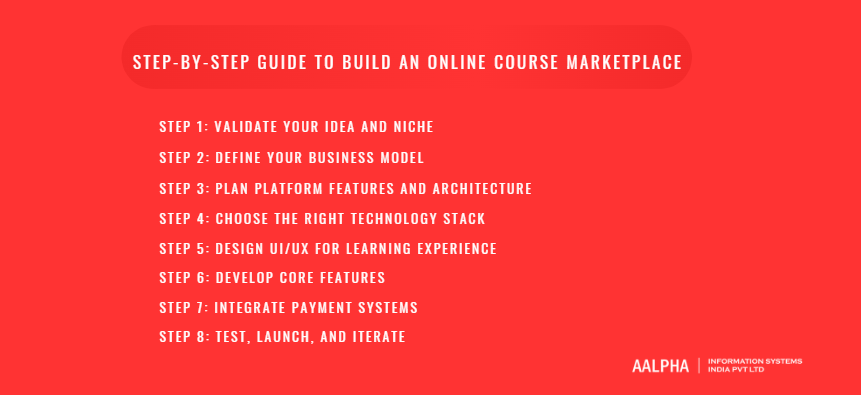
Building an online course marketplace is not a single development task; it is a structured process that combines product strategy, user experience design, engineering decisions, and business modeling. The most common mistake founders make is starting with development before validating demand or defining a clear monetization path. A successful platform is built by progressing through well-defined stages, each reducing risk and improving product-market fit.
The following step-by-step framework outlines how to build a scalable, high-performing course marketplace from the ground up.
Step 1: Validate Your Idea and Niche
The foundation of any successful course marketplace lies in validating whether there is real demand for the platform you plan to build. This begins with market research. Instead of targeting a broad audience, identify a specific niche where learning demand is growing but supply is either fragmented or underserved. For example, sectors like healthcare training, logistics operations, or regional language education often present strong opportunities due to limited high-quality content availability.
A practical approach is to analyze search behavior and user intent. If people are actively looking for courses in a particular domain but struggling to find structured, credible content, that indicates a potential market gap. Additionally, studying online communities, forums, and professional networks can reveal what learners are willing to pay for.
Competitor analysis is equally critical. Examine existing platforms offering similar content and evaluate their strengths and weaknesses. Look at factors such as course quality, pricing models, user experience, and instructor engagement. The goal is not to replicate competitors but to identify differentiation opportunities. For instance, if existing platforms lack structured learning paths or certification credibility, these can become your unique value propositions.
Validating your idea at this stage prevents unnecessary development costs and ensures that you are building a platform aligned with real user needs.
Step 2: Define Your Business Model
Once the niche is validated, the next step is to define how the platform will generate revenue. The business model directly influences product design, pricing strategy, and user acquisition efforts.
A commission-based model is the most common approach for marketplaces. In this setup, instructors list their courses, and the platform takes a percentage of each sale. This model aligns incentives, as both the platform and instructors benefit from increased sales. However, it requires a strong balance between commission rates and instructor retention.
The subscription-based model offers users access to a library of courses for a recurring fee. This approach provides predictable revenue and encourages long-term engagement. It is particularly effective when the platform offers a large and continuously updated content library. However, it demands consistent content quality and regular updates to justify ongoing subscriptions.
A freemium model combines free and paid offerings. Basic content or limited access is provided for free, while premium features, advanced courses, or certifications require payment. This model is effective for user acquisition, as it lowers the barrier to entry and allows users to experience the platform before committing financially.
Choosing the right model depends on your target audience, content strategy, and long-term growth plan. In many cases, hybrid models that combine multiple revenue streams are the most sustainable.
Step 3: Plan Platform Features and Architecture
Before writing a single line of code, it is essential to define the platform’s feature set and technical architecture. This step ensures that development is aligned with business goals and user expectations.
Start by mapping user flows for all key stakeholders. For students, this includes onboarding, course discovery, enrollment, and learning progression. For instructors, it involves course creation, content upload, and earnings tracking. For administrators, it covers moderation, analytics, and platform management. Clearly defined user journeys help identify required features and eliminate unnecessary complexity.
Next, decide between building a Minimum Viable Product (MVP) and a full-featured platform. An MVP focuses on core functionalities such as user registration, course browsing, video playback, and payments. The objective is to launch quickly, gather feedback, and iterate based on real user behavior. Building a full platform from the start often leads to over-engineering and delayed market entry.
From a technical perspective, the architecture should support scalability from day one. This includes modular design, API-driven development, and the ability to integrate third-party services such as video hosting and payment gateways. A well-planned architecture reduces future rework and ensures that the platform can handle growth efficiently.
Step 4: Choose the Right Technology Stack
The technology stack determines the performance, scalability, and maintainability of the platform. Choosing the right combination of tools and frameworks is critical for long-term success.
For the frontend, modern frameworks that support dynamic, responsive interfaces are essential. The user interface must handle complex interactions such as video streaming, real-time updates, and personalized recommendations. Performance optimization is key, as slow-loading pages directly impact user retention.
The backend should be designed to manage user data, course content, transactions, and analytics efficiently. It must support high concurrency, especially during peak usage times such as course launches or promotions. A robust backend architecture ensures smooth operation even as the user base grows.
Cloud infrastructure plays a central role in scalability. Using cloud services allows the platform to handle fluctuating traffic without performance degradation. Features such as auto-scaling, load balancing, and distributed storage are essential for maintaining reliability.
Additionally, integrating a Content Delivery Network (CDN) ensures fast video streaming across different geographic locations. Since video is the core content format in most course platforms, optimizing delivery speed and quality is critical for user experience.
Step 5: Design UI/UX for Learning Experience
User interface and user experience design are critical factors that determine whether learners stay engaged or abandon the platform. A well-designed learning interface reduces friction and enhances content consumption.
A mobile-first approach is essential, as a significant portion of users access online courses through smartphones. The platform should be fully responsive, with intuitive navigation and optimized layouts for smaller screens. Features such as offline access, adaptive streaming, and easy navigation between lessons improve usability.
Accessibility is another key consideration. The platform should support features such as subtitles, adjustable playback speeds, and screen reader compatibility. This ensures that content is accessible to a wider audience, including users with different learning preferences and abilities.
Consistency in design also plays a major role. Clear typography, structured layouts, and intuitive interactions help users focus on learning rather than figuring out how to use the platform. Small details, such as progress indicators and interactive elements, significantly enhance engagement and completion rates.
Step 6: Develop Core Features
With a clear plan and design in place, the development phase begins with building core functionalities. User authentication is the first essential feature, enabling secure registration and login for students and instructors. This includes support for email-based login, social authentication, and password management.
The course player is the central component of the platform. It must support high-quality video streaming, playback controls, and seamless transitions between lessons. Additional features such as subtitles, playback speed adjustment, and bookmarking enhance the learning experience.
Dashboards for students and instructors are equally important. The student dashboard should display enrolled courses, progress tracking, and recommendations. The instructor dashboard should provide tools for managing courses, tracking performance, and analyzing revenue.
Other essential features include course listing pages, search functionality, and review systems. These components work together to create a cohesive platform where users can discover, purchase, and consume content efficiently.
Building these features in a modular way allows for easier updates and scalability in the future.
Step 7: Integrate Payment Systems
A reliable payment system is critical for converting users into paying customers. The platform must support secure and seamless transactions across different regions.
Payment gateways should be integrated to handle various payment methods, including credit cards, digital wallets, and regional payment options. Supporting multiple currencies ensures that users from different countries can complete transactions without friction.
Security is a top priority. Payment systems must comply with industry standards to protect user data and prevent fraud. Features such as encrypted transactions, secure authentication, and refund management are essential for building trust.
Additionally, the platform should automate revenue distribution, ensuring that instructors receive their earnings accurately and on time. Transparent payment processes improve instructor satisfaction and encourage long-term participation.
Step 8: Test, Launch, and Iterate
The final step in building a course marketplace is testing, launching, and continuous improvement. Quality assurance (QA) ensures that all features function correctly across different devices and scenarios. This includes testing user flows, payment processes, and content playback.
A beta launch is highly recommended before a full-scale release. By inviting a limited group of users, you can gather real feedback and identify issues that may not have been detected during internal testing. This stage provides valuable insights into user behavior and platform performance.
After launch, iteration becomes an ongoing process. Collecting user feedback, analyzing usage data, and continuously improving features are essential for long-term success. Platforms that evolve based on user needs are more likely to retain users and stay competitive.
Building an online course marketplace is not a one-time project but a continuous cycle of improvement. The platforms that succeed are those that adapt quickly, prioritize user experience, and consistently deliver value to both learners and instructors.
Technology Stack for Online Course Marketplace
The technology stack of an online course marketplace determines how well the platform performs under load, how easily it scales, and how efficiently new features can be added over time. A poorly chosen stack can lead to performance bottlenecks, high operational costs, and limited flexibility, while a well-architected system enables rapid growth and seamless user experience.
When founders ask what technology is best for building an online learning platform, the correct approach is not to choose tools based on trends, but to align them with product requirements such as video streaming performance, real-time interactions, global accessibility, and scalability. The stack should support modular development, cloud deployment, and integration with third-party services.
-
Frontend Technologies
Frontend technologies are responsible for everything users see and interact with, including course browsing, video playback, dashboards, and navigation. Modern JavaScript frameworks such as React and Vue.js are widely used because they enable the development of dynamic, responsive, and highly interactive user interfaces.
These frameworks support component-based architecture, allowing developers to build reusable UI elements such as course cards, search filters, and progress trackers. This improves development speed and ensures consistency across the platform. They also handle real-time updates efficiently, which is essential for features like live progress tracking and notifications.
Performance optimization is critical at the frontend level. Techniques such as lazy loading, code splitting, and caching help reduce load times, especially for content-heavy pages. Since a large percentage of users access learning platforms via mobile devices, responsive design and mobile-first development are essential to ensure a seamless experience across different screen sizes.
-
Backend Technologies
The backend is the core engine of the platform, managing user authentication, course data, transactions, and business logic. Technologies such as Node.js and Django are commonly used due to their scalability and strong ecosystem support.
Node.js is well-suited for real-time applications and high-concurrency environments. Its non-blocking architecture allows it to handle multiple requests efficiently, making it ideal for platforms with large user bases and simultaneous interactions. Django, on the other hand, provides a structured and secure framework with built-in features for rapid development, making it a strong choice for platforms that prioritize stability and maintainability.
The backend should be designed using an API-first approach, enabling seamless communication between frontend, mobile apps, and third-party services. A well-structured backend ensures that the platform can scale horizontally, handle increasing traffic, and integrate new features without disrupting existing functionality.
-
Database & Storage
An online course marketplace deals with multiple types of data, including user profiles, course metadata, transactions, and large media files. Choosing the right database and storage solutions is essential for performance and reliability.
Relational databases are commonly used to manage structured data such as user accounts, enrollments, and payments. For unstructured data, such as course descriptions or logs, flexible storage solutions may be required. The database must support high read and write operations while maintaining data integrity.
Video storage is one of the most critical components. Since courses are primarily video-based, storing and delivering content efficiently is essential. Cloud-based storage solutions combined with a Content Delivery Network (CDN) ensure that videos are streamed quickly and reliably across different geographic regions. A CDN reduces latency by delivering content from servers closest to the user, significantly improving playback performance.
-
Payment Integration
Payment integration is a core component of any course marketplace, enabling users to purchase courses securely and instructors to receive their earnings. Platforms typically integrate with global payment providers such as Stripe and PayPal to handle transactions.
These systems support multiple payment methods, including credit cards, digital wallets, and region-specific options, making it easier to serve a global audience. They also provide built-in security features such as encryption, fraud detection, and compliance with industry standards.
A well-designed payment system should handle not only transactions but also refunds, subscriptions, and automated payouts to instructors. Supporting multiple currencies and localized payment methods reduces friction during checkout and increases conversion rates. Reliability and transparency in payment processing are essential for building trust with both learners and instructors.
-
AI & Analytics Tools
AI and analytics tools are becoming essential for modern course marketplaces, enabling personalized learning experiences and data-driven decision-making. Recommendation engines analyze user behavior, such as browsing history, course enrollments, and completion rates, to suggest relevant courses. This improves user engagement and increases revenue by promoting content that aligns with individual preferences.
User analytics tools provide insights into platform performance, including metrics such as user acquisition, retention, course popularity, and revenue trends. These insights help platform owners optimize content strategy, marketing campaigns, and feature development.
AI-powered systems can also enhance the learning experience through automated support, content tagging, and adaptive learning paths. For example, algorithms can identify where learners struggle and recommend additional resources or adjust the course flow accordingly.
As competition increases, platforms that leverage AI and analytics effectively gain a significant advantage by delivering more relevant, engaging, and efficient learning experiences.
Cost to Build an Online Course Marketplace
The cost of building an online course marketplace varies widely depending on scope, technical complexity, and long-term scalability requirements. Founders often underestimate the total investment by focusing only on development while overlooking infrastructure, third-party services, and ongoing maintenance. A realistic cost estimate must include both initial build expenses and recurring operational costs.
When evaluating how much it costs to build a platform similar to leading learning marketplaces, the correct approach is to break the cost into components such as development effort, feature complexity, infrastructure, and scaling requirements. The following sections provide a structured breakdown.
-
Factors Affecting Development Cost
Several key factors directly influence the cost of building an online course marketplace. The most significant factor is platform complexity. A simple platform with basic features such as course listings, video playback, and payments will cost substantially less than a fully featured system with AI recommendations, analytics dashboards, and advanced instructor tools.
Feature set also plays a major role. Adding functionalities like real-time analytics, adaptive learning, multi-language support, and mobile applications increases both development time and cost. Each additional feature introduces design, development, and testing overhead.
Geographic location of the development team is another important factor. Development costs vary significantly between regions. Teams in North America and Western Europe typically charge higher rates, while skilled teams in regions such as India or Eastern Europe offer more cost-effective solutions without compromising quality when managed correctly.
Other influencing factors include design complexity, scalability requirements, security standards, and integration with third-party services. A platform designed for global reach with high traffic expectations will require a more robust and expensive architecture compared to a smaller, niche-focused solution.
-
MVP vs Full Platform Cost Breakdown
The cost difference between building a Minimum Viable Product (MVP) and a full-featured platform is substantial. An MVP focuses on core functionalities such as user registration, course browsing, video playback, and payment integration. The goal is to launch quickly, validate the idea, and gather user feedback. This approach reduces initial investment and minimizes risk.
In contrast, a full platform includes advanced features such as AI-driven recommendations, detailed analytics, multi-language support, mobile applications, and sophisticated instructor dashboards. While this provides a more comprehensive user experience, it significantly increases development time and cost.
In practical terms, an MVP may take a few months to build and requires a relatively moderate investment, whereas a full-scale platform can take six months or more with a much higher budget. Most successful platforms start with an MVP and gradually expand based on user feedback and market demand, rather than building everything upfront.
-
Third-Party Costs
Beyond development, third-party services represent a recurring and often underestimated cost. Hosting and cloud infrastructure are essential for running the platform, with costs depending on traffic volume, storage requirements, and performance needs.
Video streaming is one of the largest expenses for course marketplaces. Since video is the primary content format, platforms must invest in reliable storage and streaming solutions to ensure smooth playback across different devices and regions. This often involves using cloud storage combined with a Content Delivery Network (CDN) to reduce latency.
Additional third-party costs include APIs for payments, email notifications, analytics, and security services. While these integrations accelerate development, they add ongoing subscription or usage-based costs that must be factored into the overall budget.
-
Maintenance and Scaling Costs
Building the platform is only the beginning. Ongoing maintenance is required to ensure stability, security, and performance. This includes fixing bugs, updating dependencies, improving features, and responding to user feedback.
As the platform grows, scaling costs become a major consideration. Increased user traffic leads to higher server usage, storage requirements, and bandwidth consumption. Without proper optimization, these costs can rise rapidly.
Security updates and compliance requirements also contribute to maintenance expenses. Protecting user data and ensuring secure transactions require continuous monitoring and updates.
In addition, product evolution requires ongoing investment. New features, UI improvements, and performance enhancements are necessary to stay competitive in the market. A sustainable budget must account for both technical maintenance and product innovation.
-
Cost Optimization Strategies
Optimizing costs without compromising quality is critical for long-term success. One of the most effective strategies is to start with an MVP and expand gradually. This approach reduces initial investment and ensures that resources are allocated based on real user demand.
Leveraging third-party services instead of building everything from scratch can also significantly reduce development time and cost. For example, using existing payment gateways, video hosting solutions, and authentication systems allows teams to focus on core platform features.
Choosing a scalable cloud infrastructure helps manage costs efficiently. Pay-as-you-go models ensure that you only pay for the resources you use, making it easier to handle growth without over-investing upfront.
Another important strategy is prioritizing features based on impact. Instead of building a complex system with unnecessary functionalities, focus on features that directly contribute to user acquisition, engagement, and revenue.
Finally, working with experienced development teams that understand edtech platforms can prevent costly mistakes and rework. Efficient planning and execution often result in significant cost savings over the lifecycle of the project.
Monetization Strategies for Course Marketplaces
Monetization is the core driver of sustainability for any online course marketplace. A well-designed platform does not rely on a single revenue stream but combines multiple monetization strategies to maximize lifetime value from both learners and instructors. The choice of monetization model influences pricing, user acquisition, content strategy, and overall platform positioning.
When evaluating how online learning platforms make money, the answer typically lies in a hybrid approach. Some users prefer one-time purchases, others prefer subscriptions, while enterprises require structured licensing. The most successful platforms align monetization with user behavior and continuously optimize pricing based on demand, engagement, and retention metrics.
-
Commission-Based Revenue
Commission-based revenue is the most common monetization model for course marketplaces. In this setup, instructors list their courses on the platform, and the platform takes a percentage of each sale. This model works effectively because it aligns incentives between the platform and instructors. Both parties benefit from higher enrollments and better course performance.
The commission rate can vary depending on factors such as promotional involvement, instructor contribution, and platform policies. For example, platforms may take a higher commission on courses sold through their marketing channels and a lower percentage when instructors bring their own audience.
This model allows marketplaces to scale quickly without investing heavily in content creation. However, maintaining a fair commission structure is critical to retaining high-quality instructors. If the commission is too high, instructors may prefer to host courses independently.
-
Subscription Plans
Subscription-based monetization offers users access to a library of courses for a recurring fee, typically billed monthly or annually. This model provides predictable revenue for the platform and encourages long-term user engagement.
Instead of purchasing individual courses, learners can explore multiple topics at their own pace, making this model particularly attractive for continuous learning. It also lowers the barrier to entry, as users can start with a relatively small payment compared to buying multiple courses individually.
For the platform, the key challenge is retention. Users will only continue paying if they perceive ongoing value. This requires a steady pipeline of new content, regular updates, and personalized recommendations to keep learners engaged.
Subscription models often perform best when combined with high-quality, structured learning paths rather than standalone courses, as this increases perceived value and reduces churn.
-
Paid Certifications
Paid certifications add an additional revenue layer by offering learners a recognized credential upon course completion. While the course content itself may be free or part of a subscription, users pay for the certification that validates their skills.
This model is particularly effective in professional and career-oriented domains, where learners are motivated by tangible outcomes such as job opportunities or career advancement. Certifications can be positioned as proof of expertise, making them valuable for resumes and professional profiles.
From a platform perspective, certifications enhance credibility and increase course completion rates. Learners are more likely to finish courses when there is a clear reward at the end. Additionally, offering verified or industry-recognized certifications can justify premium pricing and attract more serious learners.
-
Corporate Licensing
Corporate licensing targets businesses and organizations that want to train employees at scale. Instead of individual users purchasing courses, companies pay for bulk access to the platform or specific course bundles.
This model generates high-value contracts and provides a stable revenue stream. Enterprises typically require features such as progress tracking, reporting, compliance management, and customized learning paths tailored to their workforce.
Corporate clients are less price-sensitive compared to individual learners, as the focus is on measurable outcomes such as improved productivity and skill development. This makes corporate licensing one of the most profitable monetization strategies for mature platforms.
To succeed in this segment, platforms must offer enterprise-grade features, dedicated support, and the ability to integrate with existing corporate systems.
-
Ads & Affiliate Revenue
Advertising and affiliate revenue provide additional income streams without directly charging users. Platforms can display targeted ads based on user behavior or promote third-party products and services relevant to their audience.
Affiliate marketing involves recommending tools, software, or services within course content or platform interfaces. When users make a purchase through these recommendations, the platform earns a commission.
While this model should not be the primary revenue source, it can complement other monetization strategies effectively. The key is to ensure that ads and promotions do not disrupt the learning experience. Poorly placed or excessive advertising can negatively impact user satisfaction and retention.
When implemented strategically, ads and affiliate partnerships can generate incremental revenue while maintaining a seamless user experience.
Challenges in Building a Course Marketplace
Building an online course marketplace is a high-opportunity venture, but it comes with structural challenges that directly impact growth, user trust, and long-term sustainability. Unlike single-product platforms, marketplaces must simultaneously manage supply (instructors), demand (learners), and platform infrastructure. If any one of these fails, the entire ecosystem weakens.
Founders often assume that adding more courses will automatically lead to growth. In reality, success depends on maintaining quality, acquiring the right users, retaining instructors, and ensuring the platform can scale technically and operationally. The following are the most critical challenges that must be addressed early in the development process.
-
Content Quality Control
Maintaining consistent content quality is one of the most difficult challenges in a multi-instructor marketplace. When anyone can publish courses, the risk of low-quality, outdated, or misleading content increases significantly. Poor-quality courses can damage the platform’s reputation and reduce user trust.
To address this, platforms must implement structured review and moderation processes. This includes pre-publishing checks, content guidelines, and periodic audits of existing courses. Rating and review systems also help surface high-quality content while pushing weaker courses down in visibility.
However, over-regulation can discourage instructors from joining, while under-regulation can lead to quality issues. Striking the right balance between openness and control is essential for long-term success.
-
User Acquisition
Acquiring users in the online education space is highly competitive and often expensive. Many platforms struggle to attract initial users because learners tend to prefer established platforms with proven credibility and a large content library.
To overcome this, new marketplaces must focus on niche targeting and differentiated value propositions. Instead of competing broadly, focusing on a specific audience or domain can reduce competition and improve conversion rates. Organic channels such as SEO, content marketing, and partnerships with instructors are often more sustainable than relying solely on paid advertising.
Retention is equally important as acquisition. If users do not find value quickly, they are unlikely to return, making it difficult to build a loyal user base.
-
Instructor Retention
Instructors are the backbone of a course marketplace, and retaining high-quality educators is critical for platform growth. If instructors do not see consistent earnings or engagement, they may choose to leave the platform or host their content independently.
Transparent revenue sharing, timely payouts, and strong analytics tools are essential for maintaining instructor trust. Instructors need clear visibility into how their courses are performing and how they can improve.
Additionally, platforms must support instructors with marketing tools, audience reach, and content optimization insights. When instructors feel that the platform actively contributes to their success, they are more likely to remain engaged and continue producing high-quality content.
-
Platform Scalability
As the platform grows, scalability becomes a major technical and operational challenge. Increased user traffic, large volumes of video content, and simultaneous interactions can strain infrastructure if not properly designed.
Without scalable architecture, platforms may experience slow performance, downtime, or poor user experience, especially during peak usage periods. This can lead to user dissatisfaction and loss of credibility.
To handle growth effectively, platforms must adopt cloud-based infrastructure, optimize database performance, and use content delivery networks for efficient video streaming. Scalability should be planned from the beginning, as retrofitting a system for high traffic is significantly more complex and costly.
-
Payment & Compliance Issues
Handling payments across different regions introduces both technical and regulatory challenges. Platforms must support multiple currencies, payment methods, and regional regulations, which can complicate the payment process.
Compliance requirements, such as tax regulations, data protection laws, and financial reporting standards, vary by country and must be carefully managed. Failure to comply can result in legal issues and financial penalties.
Security is another critical concern. Protecting user data and ensuring secure transactions is essential for building trust. Features such as encryption, fraud detection, and secure authentication must be implemented to prevent breaches.
Managing refunds, chargebacks, and instructor payouts adds another layer of complexity. A well-structured payment system that ensures transparency and reliability is crucial for both user satisfaction and platform credibility.
Future Trends in Online Learning Marketplaces
Online learning marketplaces are evolving from static content libraries into intelligent, immersive, and outcome-driven ecosystems. The next phase of growth is shaped by advancements in artificial intelligence, changing user behavior, and new content delivery formats. Learners today expect more than recorded lectures; they want personalized guidance, flexible learning formats, and engaging experiences that mirror real-world applications.
For founders building a course marketplace, understanding these trends is critical. Platforms that align with these shifts will not only attract users but also retain them over longer periods. The following trends highlight where the industry is heading and what features will define the next generation of learning platforms.
-
AI-Powered Learning
Artificial intelligence is transforming how users interact with educational content. AI-powered learning systems analyze user behavior, preferences, and performance to deliver highly personalized experiences. Instead of offering the same content to all users, platforms can recommend courses, adjust difficulty levels, and suggest learning paths tailored to individual needs.
AI tutors and chatbots are also becoming integral components of modern platforms. They provide instant support by answering questions, summarizing lessons, and guiding learners through complex topics. This reduces dependency on instructors for routine queries and ensures continuous learning support.
In addition, AI can automate content tagging, generate quizzes, and identify knowledge gaps. This improves both content discovery and learning efficiency, making AI a core differentiator for future-ready course marketplaces.
-
Microlearning & Short Courses
Microlearning focuses on delivering content in short, focused modules that can be consumed quickly. Instead of long, multi-hour courses, learners increasingly prefer bite-sized lessons that fit into their daily routines. This shift is driven by shorter attention spans and the need for just-in-time learning.
Short courses are particularly effective for skill-based learning, where users want immediate, practical knowledge. For example, learning a specific tool feature or solving a targeted problem does not require a full-length course.
From a platform perspective, microlearning increases engagement and completion rates. Users are more likely to finish shorter modules, leading to better learning outcomes and higher satisfaction. It also enables platforms to continuously release new content, keeping the library fresh and relevant.
-
Gamification
Gamification introduces game-like elements into the learning experience to increase engagement and motivation. Features such as points, badges, leaderboards, and progress milestones encourage users to stay active on the platform.
These elements tap into intrinsic motivation by rewarding progress and creating a sense of achievement. For example, completing lessons, maintaining streaks, or achieving high quiz scores can unlock rewards or recognition.
Gamification is particularly effective for younger audiences and skill-based learning environments where continuous practice is required. When implemented thoughtfully, it transforms learning from a passive activity into an interactive experience, improving retention and long-term engagement.
-
VR/AR Learning Experiences
Virtual reality (VR) and augmented reality (AR) are redefining how complex subjects are taught. These technologies enable immersive learning experiences where users can interact with simulated environments instead of passively consuming content.
For example, medical training can involve virtual simulations of procedures, while technical education can include interactive 3D models. This approach enhances understanding by allowing learners to practice in realistic scenarios without real-world risks.
Although VR and AR adoption is still emerging, advancements in hardware and software are making these technologies more accessible. For course marketplaces, integrating immersive learning experiences can provide a strong competitive advantage, especially in domains that require hands-on training and practical application.
How to Choose the Right Development Partner
Choosing the right software development partner is a decisive factor in whether your online course marketplace launches successfully and scales without friction. A marketplace platform is not a simple application; it involves multi-user systems, high-performance video delivery, payment workflows, and continuous iteration. This requires a partner who combines technical expertise with product thinking and long-term commitment.
Many founders make the mistake of selecting partners based purely on cost. In reality, the right decision comes down to evaluating experience, execution capability, communication, and post-launch support. A structured evaluation ensures that your investment translates into a scalable and reliable platform.
-
Experience in EdTech Development
Experience in building education platforms is critical because online learning systems have unique requirements compared to generic applications. A partner with prior edtech experience understands how to structure courses, design learning flows, and optimize engagement.
For example, they know how to design features such as progress tracking, content modularization, and interactive assessments in a way that improves completion rates. They are also familiar with common pitfalls, such as low user retention or poor course discoverability.
When evaluating a partner, review their past projects, especially those involving marketplaces or content-driven platforms. A company like Aalpha Information Systems demonstrates this advantage by delivering tailored digital platforms that align with real business use cases rather than generic solutions.
-
Technical Expertise
Technical expertise ensures that the platform can handle real-world demands such as thousands of concurrent users, large video libraries, and secure financial transactions. A capable development partner should be proficient in frontend, backend, cloud infrastructure, and system architecture.
Beyond coding, the team should be able to design scalable systems, implement secure authentication, and integrate third-party services like payment gateways and streaming solutions. They should also make strategic decisions about architecture to avoid future performance bottlenecks.
A partner like Aalpha Information Systems brings this capability by focusing on scalable, performance-driven development, ensuring that your platform is built for long-term growth rather than short-term deployment.
-
Speed & Scalability Capability
Speed of execution is essential, especially when launching a Minimum Viable Product to validate your idea quickly. A strong partner should be able to deliver core features within a defined timeline without compromising quality.
At the same time, scalability must be built into the system from the beginning. As user traffic and content volume increase, the platform should continue to perform reliably. This requires expertise in cloud infrastructure, load balancing, and modular system design.
The ability to balance rapid development with scalable architecture is a key indicator of a mature development partner.
-
Communication & Transparency
Effective communication is the backbone of a successful development process. A reliable partner maintains transparency in timelines, deliverables, and potential challenges. This ensures that stakeholders remain aligned throughout the project lifecycle.
Regular updates, clear documentation, and collaborative workflows reduce the risk of misunderstandings and delays. Transparency also includes honest feedback on feasibility, trade-offs, and technical decisions.
Partners that prioritize structured communication help ensure that the final product aligns closely with business goals and user expectations.
-
Post-Launch Support
Launching the platform is only the beginning. Continuous support is required to maintain performance, fix issues, and introduce new features. A development partner should provide long-term maintenance, including updates, monitoring, and optimization.
As your marketplace grows, you will need to scale infrastructure, enhance features, and respond to user feedback. Without reliable post-launch support, maintaining the platform becomes difficult and costly.
Working with an experienced partner such as Aalpha Information Systems ensures that your platform is not only built effectively but also evolves continuously to meet changing market demands.
Conclusion
Building an online course marketplace requires more than just development. It involves validating demand, choosing the right business model, designing a strong user experience, and building a scalable system that supports both learners and instructors. Platforms that succeed focus on delivering real value, maintaining content quality, and continuously improving based on user behavior and feedback.
The opportunity in digital learning continues to grow, but competition is increasing at the same pace. A well-planned approach, combined with the right technology and execution strategy, is what separates scalable platforms from short-lived products.
Ready to build your online course marketplace? Define your idea, start with an MVP, and move to execution quickly. Partner with Aalpha Information Systems to develop a scalable, custom platform. Connect now to get started.