





As businesses expand beyond regional markets, customer communication is no longer confined to a single language. Users expect to interact with digital platforms in their native language, whether they are browsing an eCommerce store, booking a service, or seeking support. This shift has made multilingual communication a core requirement rather than an optional feature. A multilingual chatbot directly addresses this need by enabling businesses to engage users across different languages in a seamless, automated manner.
Many decision-makers ask what it actually takes to support global customers without building large, multilingual support teams. The answer increasingly lies in AI-driven chatbot systems capable of understanding, processing, and responding in multiple languages. These systems are designed not only to translate text but to interpret meaning, context, and intent across linguistic boundaries. As a result, they deliver conversations that feel natural rather than mechanical.
From startups entering international markets to enterprises managing global operations, multilingual chatbots are becoming foundational to digital strategy. They reduce operational overhead while improving customer satisfaction and accessibility. More importantly, they allow businesses to offer consistent service quality regardless of geography, time zone, or language preference.
What is a Multilingual Chatbot?
A multilingual chatbot is an AI-powered conversational system designed to understand and respond to user inputs in multiple languages within a single interface. Unlike standard chatbots that operate in one predefined language, multilingual chatbots dynamically detect or adapt to the user’s language and provide responses accordingly.
At a technical level, these chatbots combine natural language processing, language detection algorithms, and either translation systems or multilingual language models to handle diverse linguistic inputs. For example, a user might initiate a conversation in Spanish, switch to English midway, and still receive accurate, context-aware responses without interruption.
The key difference lies in adaptability and linguistic intelligence. Standard bots rely on fixed scripts or single-language models, which limits their usability across regions. In contrast, multilingual chatbots are designed to handle variations in grammar, vocabulary, and cultural nuances, making them suitable for global deployments where user diversity is high.
Why Businesses Need Multilingual Chatbots Today
The demand for multilingual chatbots is driven by the rapid globalization of digital services. Businesses no longer serve customers from a single region; instead, they operate in markets where multiple languages coexist. This raises a critical question many organizations face: how can you provide consistent customer support when your users speak different languages? Hiring native-speaking support teams for every language is costly and difficult to scale, which makes automation a practical necessity.
Customer expectations have also evolved significantly. Research consistently shows that users are far more likely to engage with and purchase from brands that communicate in their native language. Language is directly tied to trust, comprehension, and user experience. A chatbot that fails to understand or respond correctly can lead to frustration and lost conversions.
Localization further complicates the problem. It is not just about translating words but adapting communication to cultural context, tone, and intent. Multilingual chatbots help address this by delivering responses that align with local expectations while maintaining brand consistency. For businesses aiming to expand globally or serve diverse populations, multilingual chatbot capability is no longer optional. It is a competitive requirement.
Key Benefits of Multilingual Chatbots
The primary advantage of multilingual chatbots is their ability to reduce operational costs while expanding service coverage. Instead of maintaining multiple language-specific support teams, businesses can deploy a single intelligent system capable of handling conversations across languages. This significantly lowers staffing requirements and training overhead.
Scalability is another major benefit. As user demand grows, the chatbot can handle thousands of concurrent conversations without additional resource allocation. Whether a company serves 1,000 users or 1 million, the system can scale without compromising response time or quality.
Round-the-clock availability ensures that customers receive instant support regardless of time zones. This is particularly valuable for global businesses where users may interact at any hour. A multilingual chatbot eliminates delays caused by limited support hours and improves overall user satisfaction.
Finally, global reach becomes achievable without friction. Businesses can enter new markets with confidence, knowing they can communicate effectively with local audiences. This ability to bridge language barriers directly impacts engagement, retention, and conversion rates, making multilingual chatbots a critical component of modern digital infrastructure.
How Multilingual Chatbots Work
Multilingual chatbots operate through a layered architecture that combines language detection, natural language processing, translation or multilingual modeling, and contextual response generation. At a high level, the system receives a user message, identifies the language, interprets the intent, and generates a response in the appropriate language. What makes this process complex is the need to maintain accuracy, context, and cultural relevance across different linguistic structures.
A common question arises when businesses evaluate this technology: how does a chatbot understand multiple languages without confusion? The answer lies in how modern AI models process language not just as words, but as patterns, relationships, and contextual signals. Instead of relying on direct word-to-word matching, these systems use trained models that map meaning across languages, enabling them to interpret intent even when phrasing varies significantly.
The workflow typically includes language detection, intent recognition, entity extraction, response generation, and output formatting. Each layer must be optimized for multilingual input, which introduces challenges such as grammatical variation, idiomatic expressions, and mixed-language queries. Understanding these components is essential before moving into development or implementation.
Language Detection and Processing
The first step in any multilingual chatbot interaction is identifying the language of the incoming message. Language detection is handled using natural language processing models trained on large datasets containing text from multiple languages. These models analyze character patterns, vocabulary, and sentence structure to determine the most probable language with high accuracy.
Modern systems can detect dozens of languages within milliseconds, even when the input is short or informal. For example, a simple greeting or a single-word query can still be classified correctly due to probabilistic modeling. This becomes more complex when users mix languages in a single sentence, a common behavior in multilingual regions. Advanced models handle this by segmenting the input and identifying dominant language patterns.
Once the language is detected, the system routes the query to the appropriate processing pipeline. Some chatbots maintain separate pipelines for each language, while others use unified multilingual models. The goal is to ensure that subsequent processing stages interpret the input correctly without requiring manual language selection from the user.
Natural Language Processing (NLP) Across Languages
After detecting the language, the chatbot uses natural language processing to understand the user’s intent and extract relevant information. NLP across languages involves handling differences in grammar, syntax, and semantics that vary significantly between linguistic systems.
For instance, sentence structure in English follows a subject-verb-object pattern, while other languages may use different ordering. Some languages rely heavily on context rather than explicit words, which requires the model to infer meaning from fewer cues. Additionally, the same phrase can carry different meanings depending on cultural or regional usage.
To address this, multilingual NLP models are trained on diverse datasets that include multiple languages and contexts. These models learn to map similar intents across languages, allowing the chatbot to recognize that different phrases can represent the same user request. Entity recognition also plays a critical role, identifying names, dates, locations, or product references regardless of language.
The effectiveness of NLP in multilingual chatbots depends on the quality and diversity of training data. Systems that fail to account for linguistic variation often produce inaccurate or irrelevant responses, which can negatively impact user experience.
Machine Translation vs Native Language Models
Multilingual chatbots typically rely on one of two approaches: machine translation-based systems or native multilingual language models. Each approach has distinct advantages and limitations.
In translation-based systems, user input is first translated into a base language, such as English, where the chatbot processes the request. The response is then translated back into the user’s original language. This approach is relatively simple to implement and works well for basic interactions. However, it introduces risks such as loss of meaning, incorrect phrasing, or unnatural responses, especially when dealing with complex or context-heavy queries.
Native multilingual models take a different approach. Instead of translating text, they are trained to understand and generate multiple languages directly. These models process input in its original language and produce responses without an intermediate translation step. This results in more accurate and natural conversations, as the model retains context and linguistic nuances.
For businesses aiming to deliver high-quality user experiences, native multilingual models are generally preferred. However, translation-based systems may still be suitable for simpler use cases or when supporting a large number of languages with limited resources.
Training Data and Localization Challenges
The performance of a multilingual chatbot is heavily influenced by the quality of its training data. Building an effective system requires datasets that cover not only multiple languages but also different dialects, cultural contexts, and usage patterns. This is where many implementations face challenges.
Languages are not uniform. Variations in slang, regional expressions, and informal speech can significantly impact how users communicate. A chatbot trained on formal language data may struggle to understand casual or conversational inputs. Similarly, cultural differences affect how users phrase requests, express emotions, or interpret responses.
Localization goes beyond translation. It involves adapting content to align with cultural expectations, tone, and context. For example, a response that is appropriate in one region may be perceived as overly formal or even inappropriate in another. This requires careful design of conversation flows and response templates.
Another challenge is the availability of data for low-resource languages. While widely spoken languages have extensive datasets, many regional languages lack sufficient training data, which can limit accuracy. Addressing this requires data augmentation techniques, transfer learning, or custom dataset creation.
Role of AI and LLMs in Multilingual Bots
The introduction of advanced AI models, particularly large language models (LLMs), has significantly improved the capabilities of multilingual chatbots. These models are trained on vast amounts of multilingual data, enabling them to understand context, generate coherent responses, and handle complex queries across languages.
A common consideration for businesses is whether modern AI can truly replace traditional chatbot systems. In many cases, LLMs provide a substantial upgrade by offering better contextual understanding, reduced dependency on predefined scripts, and improved adaptability to user behavior. They can handle open-ended conversations, interpret ambiguous queries, and maintain continuity across multiple interactions.
LLMs also support code-switching, where users switch between languages within a conversation. This is particularly important in regions where multilingual communication is common. The model can maintain context even when the language changes, ensuring a seamless user experience.
However, deploying AI-driven multilingual chatbots requires careful implementation. Factors such as response accuracy, latency, and cost must be managed effectively. When implemented correctly, AI and LLMs enable chatbots to deliver highly natural, context-aware interactions that closely resemble human conversation, making them a powerful tool for global communication.
Types of Multilingual Chatbots
Choosing the right type of multilingual chatbot is a strategic decision that directly affects performance, scalability, and user experience. Not all chatbots are built the same, and the architecture you select depends on your business goals, complexity of interactions, and the number of languages you intend to support. A frequent question businesses ask is whether a simple rule-based system is sufficient or if they should invest in AI-driven conversational models. The answer depends on how dynamic and context-sensitive your user interactions are.
Broadly, multilingual chatbots can be categorized into rule-based, AI-powered, hybrid, and voice-enabled systems. Each type offers a different balance between control, flexibility, and intelligence. Understanding these categories helps organizations align their chatbot implementation with real-world use cases rather than overengineering or under-delivering.
-
Rule-Based Multilingual Chatbots
Rule-based multilingual chatbots operate on predefined conversation flows and decision trees. They follow structured scripts where user inputs are matched against specific keywords or patterns, and responses are triggered accordingly. When extended to multiple languages, these bots rely on separate language-specific scripts or simple translation layers.
This approach works best for predictable interactions such as FAQs, order status checks, or guided workflows where user inputs are limited and clearly defined. Because the logic is explicitly programmed, businesses have full control over responses, ensuring consistency and compliance.
However, the limitation lies in flexibility. Rule-based systems struggle with variations in phrasing, slang, or unexpected queries, especially across different languages. As the number of supported languages increases, maintaining and updating these scripts becomes complex and resource-intensive. While they are cost-effective for simple use cases, they are not suitable for dynamic, conversational interactions.
-
AI-Powered Multilingual Chatbots
AI-powered multilingual chatbots use advanced natural language processing and machine learning models to understand user intent and generate responses dynamically. Unlike rule-based systems, these chatbots are not restricted to predefined scripts. They can interpret a wide range of inputs, including variations in phrasing, tone, and context across multiple languages.
These systems are trained on multilingual datasets, enabling them to recognize patterns and relationships between languages. For example, a customer asking for a refund in French or Spanish can be understood as the same intent, even if the phrasing differs significantly. This makes AI-powered chatbots highly adaptable and capable of handling complex, real-world conversations.
Another advantage is continuous learning. These chatbots improve over time by analyzing user interactions, identifying gaps, and refining responses. They also support context retention, allowing them to manage multi-turn conversations without losing track of the user’s intent.
For businesses aiming to deliver high-quality, scalable customer experiences across regions, AI-powered multilingual chatbots are the most effective solution. They reduce manual effort while significantly improving accuracy and engagement.
-
Hybrid Chatbots
Hybrid multilingual chatbots combine the strengths of rule-based systems and AI-powered models. They use predefined rules for structured interactions while leveraging AI for handling open-ended or unpredictable queries. This approach provides a balance between control and flexibility.
In practice, a hybrid chatbot might use rule-based logic for tasks such as collecting user information or guiding users through a process, while switching to AI-driven responses when the conversation becomes more complex. This ensures reliability in critical workflows while maintaining the ability to handle natural language variations across different languages.
Hybrid systems are particularly useful for businesses that require both precision and adaptability. They allow organizations to maintain control over key interactions while benefiting from the scalability and intelligence of AI. This makes them a practical choice for applications such as customer support, onboarding, and transactional workflows.
-
Voice-Based Multilingual Assistants
Voice-based multilingual assistants extend chatbot functionality beyond text by incorporating speech recognition and speech synthesis technologies. These systems allow users to interact using spoken language, making them ideal for hands-free or accessibility-focused applications.
The process involves converting speech to text, processing the input using multilingual NLP models, and then generating a response that is converted back into speech. This adds another layer of complexity, as the system must accurately recognize accents, pronunciations, and variations in spoken language across regions.
Voice assistants are widely used in industries such as healthcare, automotive, and customer service, where users may prefer or require voice interaction. They are particularly valuable in regions with low literacy levels or where typing is less convenient.
While highly powerful, voice-based multilingual systems require robust infrastructure and careful optimization to ensure accuracy and low latency. When implemented effectively, they provide a more natural and accessible user experience, further expanding the reach of multilingual communication.
Use Cases of Multilingual Chatbots Across Industries
Multilingual chatbots are not limited to a single domain. They are being deployed across industries where communication barriers directly impact customer experience, operational efficiency, and revenue. As digital platforms expand globally, businesses are increasingly expected to interact with users in their preferred language without delays or inconsistencies. This raises a practical concern: how can companies deliver consistent service across regions without scaling support teams linearly? Multilingual chatbots address this by standardizing communication while adapting to local language needs.
Their value becomes evident when applied to real-world scenarios. From handling customer queries in multiple languages to enabling seamless transactions across borders, these systems reduce friction at every stage of the user journey. The following use cases illustrate how different industries are leveraging multilingual chatbots to solve specific operational and customer-facing challenges.
-
Customer Support Automation
Customer support is one of the most common and impactful applications of multilingual chatbots. Businesses serving global audiences often struggle to provide timely and consistent responses across different languages. A multilingual chatbot enables organizations to handle support queries instantly, regardless of the user’s location or language preference.
These systems can manage high volumes of repetitive inquiries such as order status, account issues, or service information. By automating these interactions, companies reduce dependency on large support teams while maintaining response quality. For example, a customer in Germany can ask a question in German and receive an accurate response without requiring a German-speaking agent.
Another advantage is consistency. Unlike human agents, chatbots deliver standardized responses aligned with company policies. This reduces errors and ensures compliance across regions. As a result, businesses can scale their support operations globally without compromising service quality.
-
eCommerce and Retail
In eCommerce and retail, multilingual chatbots play a critical role in guiding users through the purchasing journey. Customers are more likely to explore products, understand features, and complete transactions when information is presented in their native language. This directly influences conversion rates and customer satisfaction.
Chatbots assist with product discovery by interpreting user queries and recommending relevant items. For instance, a user searching for a specific product in French can receive tailored suggestions without needing to switch languages. They also support cart management, checkout assistance, and post-purchase interactions such as order tracking and returns.
Another key benefit is reducing cart abandonment. Many users drop off during checkout due to confusion or lack of clarity. A multilingual chatbot can address these concerns in real time, providing explanations, resolving doubts, and guiding users through the process. This creates a smoother and more engaging shopping experience across international markets.
-
Healthcare Communication
Healthcare systems often serve diverse populations with varying language preferences, making clear communication essential. Multilingual chatbots help bridge this gap by enabling patients to interact with healthcare providers in their preferred language. This improves accessibility and reduces the risk of miscommunication.
These healthcare chatbots can handle tasks such as appointment scheduling, reminders, symptom checking, and basic medical guidance. For example, a patient can describe symptoms in their native language and receive relevant information or be directed to appropriate services. This is particularly valuable in regions where language barriers can delay or complicate care.
Additionally, multilingual chatbots support patient engagement by providing consistent follow-ups, medication reminders, and health education. While they do not replace medical professionals, they enhance communication and streamline administrative processes, allowing healthcare providers to focus on critical tasks.
-
Travel and Hospitality
The travel and hospitality industry operates in a highly multilingual environment, where customers from different countries interact with services at every stage of their journey. Multilingual chatbots simplify this interaction by providing instant assistance in the user’s language, from booking to post-trip support.
Travelers can use chatbots to search for flights, book accommodations, check itineraries, and receive real-time updates. For instance, a user can inquire about hotel availability in Spanish and receive detailed responses without switching interfaces. This reduces friction and improves the overall booking experience.
During travel, chatbots can provide local recommendations, directions, and emergency assistance. In hospitality settings, they can handle guest requests, room service orders, and feedback collection. By offering multilingual support, businesses in this sector can enhance customer satisfaction and build stronger relationships with international travelers.
-
Banking and FinTech
In banking and financial services, clear and accurate communication is critical. A Chatbot for financial services helps institutions deliver consistent, multilingual support while maintaining strict compliance and security standards. These chatbots enable organizations to serve customers across regions and languages without compromising accuracy.
They handle a wide range of interactions, including account inquiries, transaction details, and onboarding processes. For example, a user opening a new account can receive step-by-step guidance in their native language, ensuring they understand requirements and complete the process correctly. This reduces errors and improves onboarding efficiency. Chatbots also assist with routine queries such as balance checks, payment status, and service information.
Another important use case is financial education. A chatbot for financial services can simplify complex financial concepts into easy-to-understand explanations, tailored to the user’s language and context. This improves accessibility, builds trust with a diverse customer base, and reduces the workload on human support teams.
-
Logistics and Delivery Platforms
Logistics and delivery platforms operate in environments where real-time communication is essential. Multilingual chatbots enable seamless interaction between customers, delivery personnel, and support teams across different languages. This is particularly important in regions with diverse linguistic populations.
Customers can use chatbots to track orders, receive delivery updates, and resolve issues without language barriers. For example, a user can ask about delivery status in their local language and receive accurate, real-time information. This improves transparency and reduces support requests.
Chatbots also assist delivery personnel by providing route information, order details, and communication support. In scenarios where drivers and customers speak different languages, the chatbot acts as an intermediary, ensuring smooth coordination.
By streamlining communication and reducing delays, multilingual chatbots enhance operational efficiency and customer experience in logistics and delivery services.
Key Features of a Custom Multilingual Chatbot
Building a custom multilingual chatbot requires more than simply adding multiple languages to an interface. The system must be designed to handle linguistic diversity, maintain context, and deliver consistent user experiences across regions and platforms. A common misconception is that translation alone is sufficient. In practice, effective multilingual chatbots combine language intelligence, contextual understanding, and scalable infrastructure to ensure conversations remain accurate and natural regardless of the language used.
When organizations evaluate what to include in a multilingual chatbot, they often ask which features are essential versus optional. The answer depends on the complexity of use cases, but certain core capabilities are non-negotiable. These features ensure that the chatbot can operate seamlessly across languages while maintaining performance, reliability, and user satisfaction.
-
Automatic Language Detection
Automatic language detection is the foundation of any multilingual chatbot. It allows the system to identify the user’s language instantly without requiring manual selection. This is critical because forcing users to choose a language creates friction and interrupts the conversational flow.
Modern chatbots use NLP-based models to analyze input text and determine the language with high accuracy, even for short or informal messages. This capability becomes particularly important in regions where users frequently switch between languages within a single conversation. The chatbot must detect these changes dynamically and adapt its responses accordingly.
By eliminating the need for manual input, automatic language detection ensures a seamless user experience. It enables the chatbot to initiate and maintain conversations in the user’s preferred language from the very first interaction, which improves engagement and reduces drop-offs.
-
Real-Time Translation Capabilities
Real-time translation enables the chatbot to process and respond to user inputs across different languages instantly. This feature is essential when the system relies on a base language for processing or when supporting a wide range of languages with limited native model coverage.
The translation layer works by converting user input into a processing language, generating a response, and then translating the output back into the user’s language. While this approach introduces additional processing steps, it allows businesses to scale language support quickly.
However, accuracy is a critical factor. Poor translation can distort meaning and lead to misunderstandings. To address this, advanced systems use context-aware translation models that preserve intent rather than relying on literal word-to-word conversion.
When implemented correctly, real-time translation ensures that users receive immediate, understandable responses, regardless of the language they use, making global communication efficient and accessible.
-
Context Awareness Across Languages
Maintaining context is one of the most challenging aspects of multilingual chatbot design. Users often engage in multi-turn conversations where each message builds on the previous one. The chatbot must retain this context even when the language changes during the interaction.
Context awareness involves tracking user intent, previous queries, and relevant data points throughout the conversation. For example, if a user starts a conversation in English and switches to another language, the chatbot should continue the discussion without losing track of the original request.
This capability is powered by advanced NLP models that store and interpret conversational state. Without it, interactions become fragmented, leading to confusion and poor user experience.
Effective context management ensures that conversations feel natural and coherent, regardless of language transitions. It is a critical feature for delivering high-quality, human-like interactions in multilingual environments.
-
Multi-Channel Support
A modern multilingual chatbot must operate across multiple communication channels, including messaging platforms, websites, mobile applications, and SMS. Users expect consistent experiences regardless of where they interact with the business.
Multi-channel support requires the chatbot to integrate with platforms such as messaging apps, web chat interfaces, and backend systems. Each channel may have different constraints, such as message formats, response times, or interface limitations, which the chatbot must handle effectively.
For example, a user might start a conversation on a website and continue it on a messaging app. The chatbot should maintain continuity and provide consistent responses across both channels. This requires centralized conversation management and synchronization.
By supporting multiple channels, businesses can reach users where they are most active, ensuring accessibility and convenience while maintaining a unified communication strategy.
-
Personalization and User Profiling
Personalization enhances the effectiveness of multilingual chatbots by tailoring responses to individual users. This involves collecting and analyzing user data such as language preference, location, interaction history, and behavioral patterns.
A personalized chatbot can adapt its tone, recommendations, and responses based on the user’s profile. For instance, it can prioritize a specific language, suggest relevant products, or provide localized information that aligns with the user’s context.
User profiling also enables the chatbot to deliver more efficient interactions. By understanding past behavior, the system can anticipate user needs and reduce the number of steps required to complete a task.
In multilingual environments, personalization goes beyond language selection. It includes cultural adaptation, ensuring that responses are not only accurate but also appropriate for the user’s region and expectations.
-
Analytics and Performance Tracking
Analytics and performance tracking are essential for optimizing a multilingual chatbot over time. These systems collect data on user interactions, response accuracy, engagement rates, and language-specific performance metrics.
Businesses can use this data to identify patterns, such as which languages have higher error rates or where users drop off during conversations. This insight allows for targeted improvements, such as refining training data, adjusting conversation flows, or enhancing translation accuracy.
Performance tracking also helps measure the return on investment. Metrics such as reduced support costs, increased engagement, and improved conversion rates provide a clear picture of the chatbot’s impact.
In multilingual deployments, analytics must be segmented by language and region to provide meaningful insights. This ensures that the chatbot performs consistently across all supported languages and continues to improve based on real-world usage.
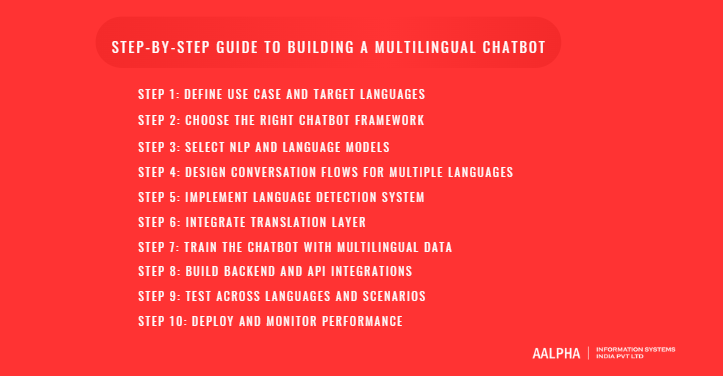
Step-by-Step Guide to Building a Multilingual Chatbot
Building a multilingual chatbot is not a single implementation task but a structured process that combines strategy, AI model selection, conversation design, and continuous optimization. Many teams underestimate the complexity by assuming that adding translation support is enough. In reality, a production-grade multilingual chatbot requires coordinated decisions across data, architecture, and user experience.
A practical question often arises at this stage: what is the exact sequence to build a multilingual chatbot that actually works in real-world conditions? The answer lies in following a step-by-step approach where each layer builds on the previous one. Skipping foundational steps, such as defining use cases or designing localized flows, often leads to poor accuracy and fragmented conversations.
The following process outlines how to design, build, and deploy a scalable multilingual chatbot system from the ground up.
Step 1: Define Use Case and Target Languages
Every successful chatbot begins with a clearly defined use case. Without this, the system risks becoming overly complex or misaligned with business goals. Start by identifying the primary function of the chatbot. Is it intended for customer support, sales assistance, onboarding, or internal automation? Each use case requires a different level of conversational complexity and language handling.
Next, define the target audience and geographic regions. This directly influences which languages the chatbot must support. For example, a logistics platform operating in India may need to handle English, Hindi, and regional languages, while a global SaaS product might prioritize English, Spanish, French, and German. The selection should be based on user data, market expansion plans, and customer demand.
It is also important to prioritize languages rather than attempting to support too many at once. Start with high-impact languages and expand gradually. This ensures better quality and easier maintenance.
Business objectives should be clearly mapped to chatbot outcomes. For instance, reducing support costs, increasing conversions, or improving response times. These goals will guide decisions in later stages, such as model selection and feature implementation. Defining success metrics early, such as response accuracy or resolution rate, ensures that the chatbot delivers measurable value.
Step 2: Choose the Right Chatbot Framework
Once the use case is defined, the next step is selecting the appropriate chatbot framework. This decision determines the flexibility, scalability, and level of customization available in your system.
There are three primary approaches: fully custom development, chatbot platforms, and API-based solutions. A custom-built chatbot offers maximum control over architecture, language processing, and integrations. It is ideal for complex use cases where standard solutions cannot meet requirements. However, it requires significant development effort and expertise.
Chatbot platforms provide prebuilt tools for building and deploying bots quickly. They often include visual flow builders, basic NLP capabilities, and integrations. While they reduce development time, they may limit customization, especially when handling advanced multilingual scenarios.
API-based solutions allow developers to integrate language models, translation services, and messaging capabilities into a custom backend. This approach strikes a balance between flexibility and speed, enabling teams to build tailored solutions without starting from scratch.
The choice depends on the scale and complexity of the project. For enterprise-grade multilingual chatbots, a hybrid approach using custom backend logic with external APIs is often the most effective.
Step 3: Select NLP and Language Models
Selecting the right NLP and language models is one of the most critical decisions in building a multilingual chatbot. These models determine how well the system understands user input and generates responses across different languages.
There are two main approaches: multilingual models and translation-based systems. Multilingual models are trained to process multiple languages directly. They can understand intent and generate responses without requiring translation. This results in more natural and accurate conversations, especially for complex queries.
Translation-based systems, on the other hand, convert input into a base language, process it, and then translate the response back. While easier to implement, this approach can lead to loss of context and unnatural phrasing.
When evaluating models, consider factors such as language coverage, accuracy, latency, and cost. It is also important to assess how well the model handles code-switching, where users mix languages in a single conversation.
In many cases, a combination of multilingual models and translation layers is used to balance performance and coverage. The goal is to ensure that the chatbot can handle diverse inputs while maintaining high response quality.
Step 4: Design Conversation Flows for Multiple Languages
Conversation design is where the chatbot’s user experience is defined. In multilingual systems, this process goes beyond translating existing flows. Each language requires localization to ensure that interactions feel natural and culturally appropriate.
Start by mapping user intents and defining conversation paths for each use case. Identify common queries, edge cases, and fallback scenarios. For each intent, create responses that are tailored to the language and context of the user.
Localization is a key consideration. The same message may need different phrasing depending on cultural norms and expectations. For example, tone and formality levels vary significantly across languages. A direct translation may not convey the intended meaning or may feel unnatural.
It is also important to design for flexibility. Users may switch languages mid-conversation or use mixed-language inputs. The chatbot should handle these transitions seamlessly without breaking the flow.
Effective conversation design ensures clarity, reduces confusion, and improves engagement. It is one of the most important factors in delivering a high-quality multilingual chatbot experience.
Step 5: Implement Language Detection System
With conversation flows in place, the next step is implementing a language detection system. This component identifies the language of each user input and routes it to the appropriate processing pipeline.
Automatic detection is generally preferred, as it removes the need for users to manually select a language. This improves user experience and reduces friction. The system should be capable of handling short inputs, informal text, and mixed-language messages.
In some cases, manual selection can be offered as a fallback option, especially when accuracy is critical. For example, users can be given the option to confirm or change the detected language.
The detection system must also integrate seamlessly with the rest of the chatbot architecture. It should pass language information to downstream components, ensuring that responses are generated and delivered in the correct language.
Accuracy and speed are key metrics here. A slow or incorrect detection system can disrupt the entire conversation flow, leading to poor user experience.
Step 6: Integrate Translation Layer
If the chatbot uses a translation-based approach or supports a large number of languages, a translation layer must be integrated into the system. This layer handles the conversion of user input and chatbot responses between different languages.
The translation pipeline typically includes input translation, processing in a base language, and output translation. Each step must be optimized to preserve context and intent. Poor translation can result in incorrect or confusing responses, which directly impacts user trust.
Advanced translation models use context-aware algorithms to improve accuracy. These models consider the surrounding text and conversation history rather than translating words in isolation.
Latency is another important factor. Real-time conversations require fast processing, so the translation layer must be optimized for speed without compromising quality.
In many implementations, translation is combined with multilingual models to improve performance. This hybrid approach ensures broader language coverage while maintaining conversational quality.
Step 7: Train the Chatbot with Multilingual Data
Training is where the chatbot learns to understand and respond to user inputs effectively. For multilingual systems, this requires datasets that cover all supported languages, including variations in dialect, tone, and usage.
Data collection is the first step. This can include historical chat logs, customer support transcripts, and domain-specific content. The data must then be labeled to identify intents, entities, and context.
Fine-tuning the model with this data improves accuracy and relevance. It ensures that the chatbot can handle real-world queries rather than relying solely on generic training data.
Special attention should be given to low-resource languages, where data availability may be limited. Techniques such as transfer learning and data augmentation can help improve performance in these cases.
Continuous training is also important. As the chatbot interacts with users, new data is generated, which can be used to refine the model. This iterative process ensures that the system improves over time.
Step 8: Build Backend and API Integrations
A multilingual chatbot must connect with backend systems to perform meaningful actions. This includes integrating with databases, CRM systems, payment gateways, and other third-party services.
The backend architecture should be designed for scalability and reliability. It must handle multiple concurrent conversations, process requests efficiently, and ensure data consistency across languages.
APIs play a critical role in enabling these integrations. For example, a chatbot may use APIs to fetch order details, update user information, or trigger transactions. These interactions must be synchronized with the chatbot’s conversation flow to provide accurate responses.
Security is another important consideration. Sensitive data, such as personal information or financial details, must be handled securely, with proper authentication and encryption.
A well-designed backend ensures that the chatbot is not just a conversational tool but a fully functional system capable of executing real-world tasks.
Step 9: Test Across Languages and Scenarios
Testing is essential to ensure that the chatbot performs consistently across all supported languages. This involves validating both functionality and conversational quality.
Start by testing common user scenarios for each language. Verify that the chatbot correctly understands inputs, maintains context, and generates appropriate responses. Edge cases, such as ambiguous queries or mixed-language inputs, should also be tested.
Localization testing is equally important. Ensure that responses are culturally appropriate and align with user expectations. This may require input from native speakers or domain experts.
Performance testing should evaluate response time, accuracy, and system stability under load. Multilingual systems often introduce additional complexity, so thorough testing is critical.
User feedback can provide valuable insights during this phase. Real-world interactions often reveal issues that are not apparent in controlled testing environments.
Step 10: Deploy and Monitor Performance
The final step is deploying the chatbot and continuously monitoring its performance. Deployment involves integrating the chatbot with production systems and making it available across selected channels.
A phased rollout is often recommended. Start with a limited user base or a subset of languages to identify potential issues before full-scale deployment. This reduces risk and allows for controlled optimization.
Monitoring is critical for long-term success. Track metrics such as response accuracy, user engagement, resolution rates, and language-specific performance. These insights help identify areas for improvement.
Regular updates and retraining ensure that the chatbot remains relevant and effective. As user behavior evolves, the system must adapt to new patterns and requirements.
A multilingual chatbot is not a one-time implementation. It is an evolving system that requires ongoing optimization to deliver consistent, high-quality interactions across languages.
Technology Stack for Multilingual Chatbots
Selecting the right technology stack determines how well a multilingual chatbot performs under real-world conditions. Technical decision-makers often face a critical question at this stage: which components should be prioritized to ensure accuracy, scalability, and maintainability across multiple languages? The answer lies in combining robust NLP capabilities, reliable infrastructure, and flexible integration layers.
A multilingual chatbot is not a single system but a combination of interconnected components. These include language processing engines, translation services, backend systems, frontend interfaces, and cloud infrastructure. Each layer must be carefully chosen to support multilingual processing without introducing latency or complexity.
The goal is to build a stack that can handle high volumes of conversations, adapt to multiple languages, and integrate seamlessly with business systems. The following components form the core of a production-ready multilingual chatbot architecture.
-
NLP Frameworks and Libraries
NLP frameworks and libraries form the core intelligence layer of a multilingual chatbot. They enable the system to understand user intent, extract entities, and generate responses across different languages. When selecting an NLP framework, the primary consideration is its ability to support multilingual processing natively.
Modern frameworks offer pre-trained multilingual models that can handle multiple languages within a single architecture. These models are trained on large datasets and can recognize patterns across languages, making them suitable for global applications. For example, transformer-based architectures are widely used due to their ability to capture context and semantic relationships effectively.
Another factor is customization. Businesses often need to fine-tune models using domain-specific data to improve accuracy. Frameworks that support transfer learning and custom training pipelines provide a significant advantage in this regard.
The choice of NLP library should also consider performance and scalability. Lightweight models may be sufficient for simple use cases, while complex applications require more advanced models capable of handling nuanced conversations across languages.
-
Machine Translation APIs
Machine translation APIs are used when the chatbot relies on translation-based processing or needs to support a large number of languages quickly. These APIs convert text from one language to another in real time, enabling the chatbot to interact with users in their preferred language.
The decision to use translation APIs versus native multilingual models depends on the use case. Translation APIs are ideal for rapid deployment and broad language coverage. They allow businesses to add support for new languages without retraining the entire system.
However, translation introduces potential challenges such as loss of context and unnatural phrasing. This is particularly evident in complex or domain-specific conversations. For this reason, translation APIs are often combined with context-aware processing to improve accuracy.
Latency and cost are also important considerations. Real-time translation requires fast processing, and API usage can become expensive at scale. Businesses must evaluate these factors when deciding how heavily to rely on translation services.
-
Backend Infrastructure
The backend infrastructure is responsible for managing conversation logic, integrating with external systems, and ensuring the chatbot operates reliably under load. A scalable backend is essential for handling multiple languages and high volumes of concurrent users.
A typical architecture includes microservices that handle different functions such as language detection, NLP processing, translation, and response generation. This modular approach allows each component to scale independently based on demand.
Databases play a critical role in storing user data, conversation history, and training datasets. The system must be designed to handle multilingual data efficiently, including different character sets and encoding formats.
APIs connect the chatbot to business systems such as CRM platforms, payment gateways, and inventory management systems. These integrations enable the chatbot to perform real-world actions rather than just providing information.
Reliability and fault tolerance are key considerations. The backend must ensure consistent performance even during peak usage, with mechanisms for error handling and recovery.
-
Frontend and Channel Integration
The frontend layer defines how users interact with the chatbot. In a multilingual system, this includes not only the interface design but also how language preferences are handled across different channels.
Chatbots are typically deployed across multiple platforms, including websites, mobile applications, messaging services, and SMS. Each channel has its own constraints, such as message length limits, formatting options, and interaction patterns. The chatbot must adapt its responses to fit these constraints while maintaining consistency.
User experience design is particularly important. The interface should support seamless language switching, clear messaging, and intuitive navigation. For example, users should be able to continue a conversation across channels without losing context or language settings.
Localization also plays a role in frontend design. Elements such as date formats, currency, and cultural references must be adapted to the user’s region. This ensures that the chatbot delivers a cohesive and user-friendly experience across all supported languages.
-
Cloud and Deployment Tools
Cloud infrastructure provides the foundation for deploying and scaling multilingual chatbots. It enables businesses to handle variable workloads, manage resources efficiently, and ensure high availability.
Cloud platforms offer services such as compute instances, serverless functions, and managed databases, which can be used to build and deploy chatbot systems. Serverless architectures are particularly useful for handling unpredictable traffic, as they automatically scale based on demand.
Containerization and orchestration tools allow for efficient deployment and management of chatbot components. These tools ensure that updates can be rolled out بسرعة without disrupting ongoing conversations.
Performance monitoring and logging are essential for maintaining system health. Cloud-based monitoring tools provide insights into response times, error rates, and resource usage, enabling teams to identify and resolve issues quickly.
Security is another critical aspect. Cloud platforms offer features such as encryption, access control, and compliance support, which are essential for protecting user data and maintaining trust.
A well-designed cloud deployment ensures that the multilingual chatbot remains reliable, scalable, and responsive, even as user demand grows across different regions and languages.
Challenges in Building Multilingual Chatbots
Building a multilingual chatbot introduces complexity that goes far beyond adding language support. While the benefits are significant, the underlying challenges can impact accuracy, user experience, and system performance if not addressed properly. A common assumption is that modern AI models solve most language-related problems automatically. In practice, real-world deployments reveal several limitations that require careful planning and continuous optimization.
Organizations often encounter issues related to linguistic diversity, cultural variation, data limitations, and system performance. These challenges become more pronounced as the number of supported languages increases. Understanding these constraints early helps in designing a system that is resilient, scalable, and capable of delivering consistent results across regions.
The following challenges represent the most critical areas that must be addressed when building a production-grade multilingual chatbot.
-
Language Ambiguity and Context Loss
Language ambiguity is one of the most fundamental challenges in multilingual chatbot development. Words and phrases often carry different meanings depending on context, tone, and cultural usage. When this ambiguity is processed across languages, the risk of misinterpretation increases significantly.
For example, a phrase that is clear in one language may translate into multiple possible meanings in another. This becomes even more complex in conversational settings where context evolves over multiple turns. If the chatbot fails to retain or correctly interpret this context, responses can become irrelevant or incorrect.
Translation-based systems are particularly vulnerable to context loss, as meaning can be distorted during conversion. Even multilingual models may struggle when dealing with idiomatic expressions or informal language.
To mitigate this, chatbots must be designed with strong context management capabilities and trained on diverse datasets that reflect real-world usage patterns. Without this, user experience can degrade quickly, especially in complex interactions.
-
Cultural and Regional Differences
Localization is not limited to language translation. Cultural and regional differences play a significant role in how users communicate and interpret responses. A message that is appropriate in one region may be perceived as overly formal, informal, or even offensive in another.
For instance, tone, politeness levels, and communication styles vary widely across cultures. Some languages require formal addressing, while others favor a more casual approach. Failing to account for these differences can lead to poor user engagement and reduced trust.
Additionally, cultural context influences how users phrase queries and what they expect in responses. This includes references to local customs, holidays, and societal norms. A chatbot that ignores these factors may deliver technically correct but contextually inappropriate responses.
Effective multilingual chatbots incorporate localization strategies that adapt content to regional expectations. This requires collaboration with native speakers and continuous refinement based on user feedback.
-
Data Availability for Low-Resource Languages
The performance of a multilingual chatbot is heavily dependent on the availability and quality of training data. While widely spoken languages have extensive datasets, many regional or low-resource languages lack sufficient data for effective model training.
This creates a significant challenge for businesses aiming to support diverse user bases. Without adequate data, the chatbot may struggle to understand user intent, recognize entities, or generate accurate responses. This can lead to inconsistent performance across languages.
To address this, developers often use techniques such as transfer learning, where knowledge from high-resource languages is applied to low-resource ones. Data augmentation methods, such as generating synthetic training data, can also help improve coverage.
However, these approaches require careful implementation to avoid introducing errors or biases. Building high-quality datasets for underrepresented languages remains one of the most resource-intensive aspects of multilingual chatbot development.
-
Maintaining Consistency Across Languages
Consistency is critical for maintaining brand identity and user trust. In multilingual chatbots, this means ensuring that responses convey the same message, tone, and intent across all supported languages.
Achieving this is challenging because direct translations often fail to capture nuances. A response that aligns with brand voice in one language may lose its impact or clarity when translated into another. This can result in inconsistent user experiences and confusion.
To maintain consistency, businesses must define clear guidelines for tone, style, and messaging. These guidelines should be applied across all languages, with adjustments for cultural context where necessary. Regular audits and quality checks are also essential to ensure alignment.
Consistency is not just about language but also about functionality. Features, workflows, and responses must behave uniformly across languages to avoid discrepancies that could affect user experience.
-
Performance and Latency Issues
Multilingual chatbots often involve additional processing steps, such as language detection and translation, which can impact performance. Real-time interactions require fast response times, and any delay can negatively affect user satisfaction.
Latency becomes a critical issue when the system handles multiple languages simultaneously or processes large volumes of requests. Translation layers, in particular, can introduce delays if not optimized properly.
Scalability is another concern. As the number of users and supported languages increases, the system must handle higher loads without compromising performance. This requires efficient architecture, load balancing, and resource management.
To address these challenges, developers must optimize each component of the chatbot pipeline. This includes using efficient models, caching frequently used responses, and leveraging scalable cloud infrastructure.
Ensuring low latency and high performance is essential for delivering a seamless user experience, especially in applications where real-time communication is critical.
Cost of Building a Multilingual Chatbot
The cost of building a multilingual chatbot varies significantly based on scope, technology choices, and the level of intelligence required. Businesses often ask for a fixed number early in the process, but the reality is that pricing depends on multiple interdependent factors. A simple chatbot supporting two languages with basic FAQs will cost far less than an AI-driven system handling complex workflows across ten or more languages.
From a commercial perspective, it is important to treat chatbot development as both a one-time investment and an ongoing operational expense. The initial build covers design, development, and deployment, while long-term costs include model updates, infrastructure, and performance optimization. Understanding this cost structure helps organizations plan budgets realistically and avoid underestimating the total investment required.
-
Factors Affecting Cost
Several key factors directly influence the cost of a multilingual chatbot. The number of supported languages is one of the most significant variables. Each additional language increases the effort required for training, localization, testing, and maintenance. Supporting widely spoken languages is relatively straightforward, but adding low-resource or regional languages often requires custom data preparation, which increases cost.
The complexity of the chatbot also plays a major role. A basic chatbot with predefined responses and simple workflows is less expensive than an AI-powered system capable of handling open-ended conversations, context retention, and integrations with backend systems. Advanced features such as voice support, personalization, and analytics further increase development effort.
Integrations are another cost driver. Connecting the chatbot to CRM systems, payment gateways, databases, or third-party APIs requires additional development and testing. The more systems the chatbot interacts with, the higher the implementation cost.
Finally, the choice between custom development and platform-based solutions impacts pricing. Custom solutions offer flexibility but require higher upfront investment, while platforms may reduce initial costs but introduce ongoing subscription fees.
-
Development Cost Breakdown
The development cost of a multilingual chatbot can be broken down into three main stages: design, development, and testing. Each stage contributes to the overall investment and requires specialized expertise.
The design phase includes defining use cases, mapping conversation flows, and creating localized content for each language. This stage is critical for ensuring that the chatbot delivers a consistent and user-friendly experience. Poor design often leads to higher costs later due to rework and optimization.
The development phase involves building the chatbot architecture, integrating NLP models, implementing language detection and translation layers, and connecting backend systems. This is the most resource-intensive stage, as it requires skilled developers, data scientists, and AI engineers. The cost increases with the complexity of features and the number of supported languages.
Testing is equally important and often underestimated. Multilingual chatbots must be tested across all languages to ensure accuracy, consistency, and cultural appropriateness. This includes functional testing, performance testing, and user acceptance testing. Thorough testing reduces the risk of errors in production but adds to the overall cost.
-
Ongoing Maintenance Costs
Building a multilingual chatbot is not a one-time expense. Ongoing maintenance is essential to ensure that the system remains accurate, relevant, and performant over time. These costs should be considered as part of the total investment.
One major component is model retraining. As user behavior evolves, the chatbot must be updated with new data to improve accuracy and handle emerging queries. This requires continuous data collection, labeling, and fine-tuning.
Infrastructure costs also contribute to ongoing expenses. Hosting the chatbot, processing requests, and running AI models require cloud resources, which scale with usage. High-traffic applications may incur significant operational costs.
Regular updates and feature enhancements are another factor. Businesses often need to add new languages, integrate additional systems, or improve existing workflows. These updates require development effort and testing.
Monitoring and support are also critical. Tracking performance metrics, resolving issues, and ensuring uptime require dedicated resources. Without proper maintenance, the chatbot’s performance can degrade, leading to poor user experience and reduced ROI.
Best Practices for Multilingual Chatbot Development
Building a multilingual chatbot that performs reliably across languages requires more than selecting the right tools. It demands a disciplined approach to design, data, and continuous improvement. Many implementations fail not because of technology limitations, but because of poor execution in areas such as localization, training, and conversation design. A common question at this stage is how to ensure that a multilingual chatbot delivers consistent, high-quality interactions across regions. The answer lies in following proven best practices that address both technical and user experience challenges.
These practices focus on improving accuracy, maintaining consistency, and ensuring that the chatbot evolves with user behavior. They are essential for moving from a basic implementation to a production-ready system that can operate effectively at scale.
-
Prioritize Native Language Understanding
One of the most important principles in multilingual chatbot development is prioritizing native language understanding over heavy reliance on translation. While translation can enable quick deployment, it often fails to capture nuances, context, and intent accurately, especially in complex or domain-specific conversations.
Native multilingual models are designed to process languages directly, allowing the chatbot to interpret meaning more effectively. This reduces the risk of errors caused by literal translations and improves the natural flow of conversations. For example, idiomatic expressions or culturally specific phrases are better understood when processed in their original language rather than translated.
Investing in models that support native language processing leads to higher accuracy and better user experience. It also reduces dependency on translation layers, which can introduce latency and additional points of failure. For long-term scalability and quality, native understanding should be the foundation of any multilingual chatbot system.
-
Focus on Localization, Not Just Translation
Localization goes beyond translating words into another language. It involves adapting the chatbot’s responses to align with cultural norms, communication styles, and regional expectations. This is critical because language is deeply connected to culture, and users expect interactions that feel familiar and relevant.
For instance, tone and formality levels vary across languages. A response that is appropriate in one region may be perceived as too casual or overly formal in another. Localization ensures that the chatbot communicates in a way that resonates with the target audience.
This also includes adapting elements such as date formats, currency, and references to local practices. Ignoring these details can create confusion or reduce trust in the system.
Effective localization requires input from native speakers and continuous refinement based on user feedback. By focusing on localization, businesses can deliver interactions that are not only accurate but also culturally appropriate and engaging.
-
Optimize for Conversational Simplicity
Simplicity is a key factor in successful chatbot interactions, especially in multilingual environments. Complex sentences, technical jargon, and ambiguous phrasing increase the likelihood of misunderstandings, particularly when users communicate in different languages.
Design conversations with clear, concise language that is easy to understand. Break down complex processes into smaller steps and guide users through them logically. This reduces cognitive load and improves completion rates for tasks such as onboarding or transactions.
It is also important to anticipate variations in user input. Users may phrase the same request in multiple ways, so the chatbot should be trained to handle these variations without requiring precise wording.
By prioritizing simplicity, businesses can improve accuracy, reduce errors, and create a more intuitive user experience across all supported languages.
-
Continuously Train and Improve
A multilingual chatbot is not a static system. Its effectiveness depends on continuous learning and improvement based on real-world interactions. User behavior evolves, new queries emerge, and language usage changes over time, making regular updates essential.
Collect data from user interactions to identify patterns, gaps, and areas where the chatbot struggles. This data should be used to retrain models, refine conversation flows, and improve response accuracy. Feedback loops play a critical role in this process, enabling the system to adapt to changing requirements.
Monitoring performance metrics such as response accuracy, user satisfaction, and resolution rates provides insights into how well the chatbot is performing across different languages. These insights guide optimization efforts and help prioritize improvements.
Continuous training ensures that the chatbot remains relevant, accurate, and capable of delivering high-quality interactions as it scales across languages and regions.
How to Choose the Right Development Partner
Selecting the right chatbot development company or partner is one of the most critical decisions when building a multilingual chatbot. Even with a clear strategy and defined requirements, execution quality ultimately determines whether the chatbot delivers real business value. Many organizations underestimate this step and focus only on cost or timelines, but multilingual chatbot development requires specialized expertise in AI, language processing, and system architecture.
A common concern businesses have is how to identify a partner capable of handling both technical complexity and real-world deployment challenges. The answer lies in evaluating experience, technical depth, customization capabilities, and long-term support. A strong partner does not just build the chatbot but ensures it performs reliably across languages, scales with demand, and evolves with user behavior.
-
Experience in AI and NLP Projects
Experience in AI and NLP is a non-negotiable requirement for building multilingual chatbots. Unlike traditional software development, chatbot systems rely heavily on machine learning models, language understanding, and data-driven optimization. A partner with proven experience in these areas is better equipped to handle challenges such as intent recognition, context management, and multilingual processing.
When evaluating a partner, it is important to review their past projects. Have they built AI-driven conversational systems before? Do they have experience working with multilingual datasets? These factors directly influence the quality of the final product.
Experienced teams also bring practical insights that go beyond theory. They understand common pitfalls, such as handling ambiguous queries or managing language transitions within conversations. This expertise reduces development risks and ensures that the chatbot performs effectively in real-world scenarios.
-
Ability to Handle Multilingual Complexity
Multilingual chatbot development introduces layers of complexity that require specialized handling. It is not just about supporting multiple languages but ensuring consistent performance, accuracy, and user experience across all of them.
A capable development partner should demonstrate a clear approach to managing this complexity. This includes strategies for language detection, localization, training data preparation, and performance optimization. They should also understand how to handle challenges such as code-switching, dialect variations, and cultural differences.
Scalability is another key factor. As businesses expand into new markets, the chatbot must support additional languages without significant rework. A partner with experience in building scalable multilingual systems can design an architecture that accommodates growth from the outset.
Without this capability, businesses risk deploying a chatbot that works well in one language but fails to deliver consistent results across others.
-
Custom Development Capabilities
Every business has unique requirements, and a one-size-fits-all solution rarely delivers optimal results. Custom development capabilities are essential for building a chatbot that aligns with specific workflows, integrations, and user expectations.
A strong development partner should be able to design and implement tailored solutions rather than relying solely on prebuilt platforms. This includes customizing conversation flows, integrating with backend systems, and adapting the chatbot to industry-specific use cases.
Custom development also ensures flexibility. As business needs evolve, the chatbot can be updated or expanded without being constrained by platform limitations. This is particularly important for multilingual systems, where requirements may change based on new markets or user feedback.
Partners that offer custom development services typically provide more control over the final product, enabling businesses to build a solution that fits their exact needs.
-
Post-Launch Support and Scaling
Launching a multilingual chatbot is only the beginning. Long-term success depends on continuous monitoring, optimization, and scaling. A reliable development partner should offer post-launch support to ensure that the chatbot remains effective as usage grows.
This includes monitoring performance metrics, identifying issues, and implementing updates based on user interactions. Regular retraining of models is necessary to maintain accuracy and adapt to changing user behavior.
Scalability is equally important. As the chatbot handles more users and supports additional languages, the underlying infrastructure must scale without compromising performance. A partner with experience in scaling AI systems can design solutions that handle increasing demand efficiently.
Working with an experienced provider such as Aalpha Information Systems can offer advantages in both development and long-term support. Established teams bring structured processes, technical expertise, and ongoing maintenance capabilities that ensure the chatbot continues to deliver value well beyond the initial launch.
Final Thoughts
Multilingual chatbots have moved from a competitive advantage to a core requirement for businesses operating across regions. They enable organizations to communicate effectively with diverse audiences, reduce operational costs, and deliver consistent customer experiences at scale. However, building a high-performing system requires the right combination of strategy, technology, and execution. From selecting the right models to designing localized conversations and ensuring continuous improvement, every step directly impacts the final outcome.
For businesses looking to expand globally or improve customer engagement, investing in a custom multilingual chatbot is a practical and scalable solution. The key is to approach development with a clear roadmap and partner with experts who understand both AI and multilingual complexity.
If you are planning to build a multilingual chatbot tailored to your business needs, working with an experienced team like Aalpha Information Systems can help you move faster and avoid common pitfalls. Connect now to explore how a custom-built solution can support your growth and deliver measurable results.