





TL;DR
To hire AI developers for finance projects, look for engineers who combine machine learning skill with hands-on experience in financial data, model risk, and regulatory controls. General AI experience falls short in finance because models must be explainable and auditable from the first release. Start with a written problem statement and a data audit, then test shortlisted developers on a finance-specific task. A paid proof of concept typically takes 4 to 8 weeks and costs about USD 15,000 to 40,000, while a production MVP usually runs USD 60,000 to 250,000 over 3 to 6 months, depending mostly on data readiness and integration depth. The team needs at least an ML engineer with finance experience, a data engineer, and someone accountable for security and compliance. For companies without an in-house ML team, the lowest-risk route is a paid proof of concept with an experienced AI development company, followed by a dedicated team once the model proves itself on your own data. Aalpha Information Systems follows this model, offering fixed-fee finance AI proofs of concept that scale into dedicated teams, backed by 5,500+ delivered projects since 2008 and fintech product experience such as the MoneyWellth financial wellness platform.
What does AI development for finance involve?
AI development for finance means building models and AI applications that make or support money decisions, such as approving a loan, blocking a card payment, or flagging a customer for AML review. The engineering tools are the same as in other industries. The difference is that each output may have to be explained to a customer, an auditor, or a regulator.
The role of AI in financial services
Banks, lenders, insurers, payment companies, and wealth platforms use AI in two broad places. The first is high-volume decisions that people cannot make fast enough, such as scoring a card transaction during authorisation or screening millions of transfers overnight. The second is document-heavy work: reading bank statements for underwriting, extracting data from identity documents, or summarising a suspicious activity case for an investigator.
Most AI running in production at financial institutions is still classical machine learning on tabular data. Large language models are growing fastest in operations, compliance support, and customer service, where a person usually reviews the output.
Why finance projects require specialised developers
A developer without finance experience can build a fraud model that reports 99.8% accuracy and catches nothing. When only 0.2% of transactions are fraudulent, a model that approves everything scores 99.8%.
Finance data has other traps. It is time-ordered, so random train and test splits leak future information into training. It contains fields that quietly encode the outcome, such as a collections flag in a credit dataset. Labels arrive late, because chargebacks can take weeks or months to come back.
Mistakes also carry legal weight. In the United States, a lender that declines a credit application must give the applicant the specific principal reasons under the Equal Credit Opportunity Act and Regulation B, and the rule makes no exception for complex models. A developer who has never worked under constraints like this tends to deliver a model that passes a notebook test and then stalls in compliance review.
Predictive AI versus generative AI
Predictive AI scores or classifies. It estimates fraud probability, default risk, or the likelihood that an AML alert is genuine, and it learns from labelled historical records, usually in tabular form. Teams measure it with precision, recall, AUC, calibration, and the losses it prevents. Its main risks are bias, drift, and weak explanations, although scorecards and SHAP reason codes make its decisions explainable enough for most regulators.
Generative AI reads, writes, and summarises text, answers questions, and calls tools. In finance it handles KYC document extraction, alert summaries, customer assistants, and report drafting, working from documents, policies, and product data on top of a foundation model. It is measured by answer accuracy on a test set, hallucination rate, and how often it escalates to a person. Its risks are different: wrong or invented answers, data leakage, and prompt injection. Because its reasoning is hard to explain, generative AI works best in assistive roles, away from final decisions.
Most serious finance products use both. A lending platform might use an LLM to extract income figures from uploaded payslips, then feed those figures into a gradient-boosted credit model that makes the actual decision. Keeping the final decision in the predictive model is easier to defend in an audit.
Major technical and regulatory challenges
Data access is often the slowest part of the project. Customer data sits across core banking systems, card processors, and CRM tools, and getting approved access inside a bank can take longer than building the first model. Real-time use cases add strict latency limits. Fraud patterns change as soon as attackers adapt, so models degrade faster than in most industries.
Regulation shapes the architecture too. Data residency rules can dictate where training happens; the Reserve Bank of India, for example, requires payment system data to be stored in India. Hosted LLM APIs raise third-party risk questions about data retention and logging. Credit decisions carry fairness obligations, and supervisors expect documented, independent model validation. Finance teams know all this well. Many AI developers do not.
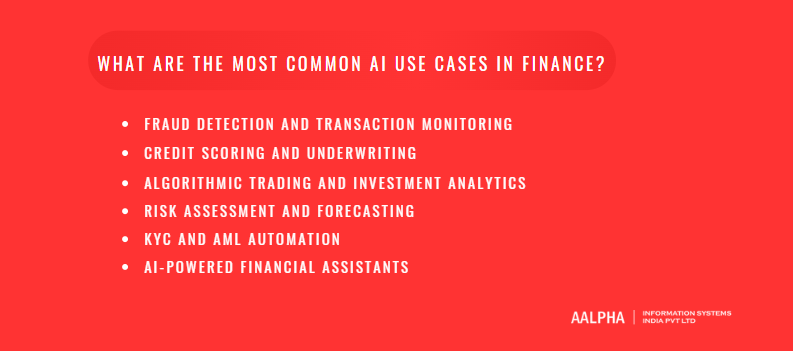
What are the most common AI use cases in finance?
The most common finance AI use cases are fraud detection, credit scoring and underwriting, trading and investment analytics, risk forecasting, KYC and AML automation, and AI assistants for customers or staff. Each needs a different skill mix, so the use case should decide who you hire.
-
Fraud detection and transaction monitoring
Fraud models score card payments, logins, transfers, and merchant activity. The usual approach is a gradient-boosted model such as XGBoost or LightGBM on engineered features like spend velocity, device and IP history, merchant category, and distance from a customer’s normal behaviour. Graph features help find mule account networks that look ordinary one account at a time.
Developers need to work within tight latency budgets, often well under 100 milliseconds at authorisation, and design a feedback loop for labels that arrive late. They should also know how to run a model alongside existing rules instead of replacing the rules overnight. The downside to plan for is false positives. Every blocked legitimate payment costs customer patience, and sometimes the customer.
-
Credit scoring and underwriting
Credit models estimate the probability of default and support approval, limit, and pricing decisions. Logistic regression scorecards remain common because their logic is easy to show a regulator. Gradient-boosted models often perform better and can be explained with SHAP values converted into adverse action reason codes.
Newer lenders score thin-file applicants using cash-flow data from bank statements or open banking feeds. That widens access but introduces new proxies for protected characteristics, so fairness testing needs more attention. Under the EU AI Act, AI used to assess the creditworthiness of individuals is classified as high-risk. Developers for this work should understand reject inference, population stability, and how a model decision becomes a customer notice.
-
Algorithmic trading and investment analytics
This covers signal generation, portfolio optimisation, execution algorithms, sentiment analysis from news and filings, and research tools for analysts. Backtesting discipline matters more than model choice. Look-ahead bias, survivorship bias, and ignored transaction costs make many strategies look profitable on paper and lose money live.
Hire developers who can show out-of-sample results and explain why a signal might decay. In the EU, firms running algorithmic trading must also meet MiFID II requirements on testing, risk controls, and kill switches. Be realistic about outcomes. A model that works in backtesting is common. A model that survives six months of live trading is rare.
-
Risk assessment and forecasting
Cash-flow and liquidity forecasting, probability of default and loss given default models, stress testing, collections prioritisation, and claims risk all sit here. These models feed capital planning and financial reporting, so validation standards are high. Developers need time-series and scenario modelling skills, and the patience to document every assumption a model risk team will challenge.
-
KYC and AML automation
KYC automation uses OCR and document AI to extract data from passports, utility bills, and company registration papers, along with face matching and liveness checks during onboarding. AML work includes sanctions and politically exposed person screening, where fuzzy name matching across transliterations is genuinely hard, and transaction monitoring, where legacy rule systems generate far more false alerts than true ones.
AI works best here as a triage layer. A model ranks alerts by risk and an LLM drafts a case summary for the investigator. The decision to file a suspicious activity report should stay with a trained person. Developers must understand the FATF-based AML obligations in your markets and should never design a system that closes alerts automatically without an audit trail.
-
AI-powered financial assistants
Assistants answer customer questions, explain transactions, help staff search policy documents, and guide users through applications. Most use retrieval-augmented generation (RAG), where the model answers from approved documents and account data instead of from its training memory, plus tool calls for actions like fetching a balance.
The risks are specific to finance. An assistant can quote an outdated interest rate, drift into personalised investment advice your firm is not licensed to give, or be manipulated through prompt injection into revealing data. Developers should build guardrails, evaluation test sets, conversation logging, and a clean handoff to a human agent. Budget as much time for evaluation as for the build itself.
How do you define your finance AI project requirements?
Define requirements by writing down the exact financial decision or task you want to improve, who will use the output, what data you have, and what number will prove success. Then cut the first release to the smallest version that can be tested on real data. Clear requirements are also your best filter when hiring.
-
Identify the financial problem
Write the problem as a decision with a cost attached. “Use AI for fraud” is not a requirement. “Reduce card-not-present fraud losses of about USD 400,000 a year without raising good-customer declines above 1.5%” is. The second version tells a developer what data to request, which metric to optimise, and where the trade-off sits. It also shows you quickly whether a candidate understands the problem.
Check whether AI is needed at all. Some problems are solved by better rules, cleaner data, or an off-the-shelf vendor. A good developer will tell you so.
-
Define users and workflows
List everyone who touches the output: the fraud analyst reviewing queued transactions, the underwriter who can override a score, the compliance officer who approves the model, and the customer who receives a decline notice. Map where the AI output enters each workflow and what happens next. A score that nobody sees in time is wasted work. This exercise also reveals the systems that need integration, such as the core banking platform, loan origination system, or case management tool.
-
Assess data availability and quality
Answer these questions internally before hiring anyone:
- Do you have labelled outcomes, such as confirmed fraud, defaults, or filed SARs, and how reliable are those labels?
- How much history exists? Fraud and credit models generally need at least 12 to 24 months to capture seasonality and economic change.
- Where does the data live, and how long will access approval take?
- Do you have a lawful basis and customer consent to use the data for model training?
- Does any of it include card numbers or other data covered by PCI DSS?
If the answers are unclear, make a paid data audit the first deliverable. It costs far less than a failed build.
-
Set measurable performance targets
Pick metrics that reflect business cost and agree on them before development starts. For fraud detection, track recall at a fixed false positive rate, fraud losses, and p95 scoring latency. A realistic example target is catching 70% of fraud value while declining fewer than 1% of good customers and scoring each transaction in under 80 milliseconds. Credit scoring relies on Gini or AUC, default rate by approved band, approval rate, and fairness ratios, and a common goal is holding the default rate steady while approving 10% more applicants.
AML alert triage is judged on alert volume, confirmed cases retained, and investigator time per case, so a sensible target is reviewing 40% fewer alerts without missing a single confirmed case. A financial assistant is measured on accuracy against a test set, escalation rate, and containment rate, for example 95% correct answers on 300 approved test questions. These targets are illustrative. Your current baseline decides what is realistic.
-
Determine MVP scope, budget, and timeline
A finance AI MVP should cover one product, one market, and one decision. A card fraud MVP might score only card-not-present transactions in one region and run in shadow mode beside existing rules for a month before it blocks anything. Add a contingency of around 20% to the budget, because data problems nearly always surface in the first few weeks. A realistic first production release takes 3 to 6 months. Anyone promising a production credit model in six weeks has not worked with a compliance team.
What skills should finance AI developers have?
Finance AI developers should have strong machine learning fundamentals, practical experience with LLMs and RAG, solid Python, SQL, and data engineering, cloud and MLOps skills, working knowledge of financial products, and disciplined security habits. No single person covers all of this at depth, so hire for the combined skill mix across the team.
-
Machine learning and deep learning
Look first for depth in supervised learning on tabular data, since that is most of finance. That means gradient boosting, logistic regression, class imbalance handling, probability calibration, and time-based validation. Deep learning matters for sequence models on transaction histories, document understanding, and some trading work. A strong candidate can explain why they would choose LightGBM over a neural network for a credit model with 40 features, and name the situations where they would not.
-
Generative AI, LLMs, RAG, and AI agents
For assistants, document processing, and compliance tooling, developers need hands-on experience with commercial foundation models and with open-weight models that can be hosted privately. Practical RAG skills include chunking long financial documents, hybrid search, reranking, and citing sources in answers. Agent work adds tool calling, permission scoping, and approval steps before an agent takes any action with financial consequences.
Strong candidates talk about evaluation first. They build test question sets and measure answer quality before they spend time tuning prompts.
-
Python, SQL, APIs, and data engineering
Python is the working language for modelling, typically with pandas or Polars, scikit-learn, and PyTorch. SQL matters just as much. Finance data lives in relational warehouses, and a developer who cannot write a windowed query for rolling 30-day spend will struggle from week one.
Data engineering skills include feature pipelines built with tools such as Airflow, dbt, Spark, or Kafka for streaming, and model serving through REST or gRPC APIs. Point-in-time correctness is mandatory. A feature pipeline that returns today’s value for a transaction from last year will inflate every test result and fail in production.
-
Cloud platforms and MLOps
Most finance AI runs on AWS, Azure, or Google Cloud, often inside the client’s own account with private networking. Developers should know managed services such as SageMaker, Azure Machine Learning, or Vertex AI, along with containers and infrastructure as code. MLOps skills cover experiment tracking with MLflow or similar tools, model registries, CI/CD for models, shadow and canary deployments, and drift monitoring. Auditors regularly ask which model version made a specific decision months earlier, and the team must be able to answer with evidence.
-
Financial-domain knowledge
Developers do not need banking careers. They do need to understand the products and processes they model: how card authorisation and chargebacks work, what a loan origination flow looks like, how interest and fees are calculated, what a SAR is, and why a risk team tracks population stability. Domain knowledge shows up in better feature ideas and sharper scoping questions.
-
Security and compliance expertise
Every developer should practise secure coding, secrets management, encryption, least-privilege access, and careful handling of personal data in datasets and prompts. Senior team members should know PCI DSS, GDPR, SOC 2 controls, and model risk documentation well enough to design for them. They should also recognise when a question belongs with your compliance team.
What security, compliance, and responsible AI requirements apply?
Finance AI systems need encrypted, access-controlled data, compliance with rules such as PCI DSS, GDPR, and AML regulations, explainable decisions with audit trails, fairness testing, human oversight for high-impact outcomes, and formal model governance. Write these into the developer’s scope and contract from the first sprint, because retrofitting them later is slow and expensive.
-
Financial data privacy and encryption
Encrypt data in transit with TLS 1.2 or higher and at rest with AES-256, with keys held in a cloud KMS or HSM. Tokenise or remove card numbers before any data reaches a training environment. Use masked or synthetic data in development. For LLM features, redact personal data before prompts leave your environment, and choose providers or plans that offer zero data retention or private deployment. Confirm data residency requirements for each market before choosing a cloud region.
-
PCI DSS, GDPR, SOC 2, KYC, and AML
PCI DSS v4.0.1 protects payment card data. For AI developers, that means keeping cardholder data out of training sets, logs, and prompts, and segmenting AI systems from the cardholder data environment. The future-dated requirements introduced in v4.0 became mandatory on 31 March 2025.
GDPR governs the personal data of people in the EU. Training a model requires a lawful basis and data minimisation, high-risk processing requires a data protection impact assessment, and Article 22 restricts decisions based solely on automated processing that have legal or similarly significant effects on a person.
SOC 2 is not a law. It is an attestation against AICPA criteria that banks often demand from technology vendors. Developers support it by building access reviews, change management, logging, and vendor controls that an auditor can test.
KYC and AML obligations come from national rules built on FATF standards, such as the Bank Secrecy Act in the US and the RBI’s KYC directions in India. Screening and monitoring logic must be documented, tunable, and auditable, and the decision to file a suspicious activity report stays with a trained person.
The EU AI Act takes a risk-based approach and classifies creditworthiness assessment of individuals as high-risk, which brings requirements for risk management, data governance, logging, and human oversight. The timeline has moved. The high-risk rules were originally due to apply in August 2026, but under the Digital Omnibus agreement reached on 7 May 2026, obligations for stand-alone high-risk systems apply from 2 December 2027. Credit scoring falls in that stand-alone category. Obligations differ by market, so treat this section as a starting map and confirm the current position with legal counsel.
-
Explainable AI and audit trails
For every automated decision, log the input features, model version, score, threshold, explanation, and any human override. Keep those logs for as long as your record retention rules require. Use SHAP or a comparable method to generate per-decision reason codes, and check that the reasons stay stable and make sense to a non-technical reviewer. For LLM features, log the retrieved documents and prompt template version alongside each answer.
-
Bias and fairness testing
Test outcomes across groups before launch and after every retrain. Common checks include approval rate ratios, false positive rates by group, and calibration by group. Watch for proxies: postcode, device type, and spending patterns can all stand in for protected characteristics. When a disparity appears, the developer should present options, such as removing features, adjusting thresholds, or accepting a documented trade-off that compliance has approved.
-
Access controls and human oversight
Give people and services only the access they need. Separate development data from production data and require approval before any model is promoted. Define which decisions a model can make alone and which go to a person. A common pattern is automated approval for low-risk cases, human review for declines and borderline scores, and a kill switch that falls back to rules if the model misbehaves.
-
Model governance and documentation
Maintain a model inventory that records the owner, purpose, data sources, validation results, known limits, and monitoring plan for every model. US bank practice in this area grew out of the Federal Reserve’s SR 11-7 guidance on model risk management, published in 2011, and regulators in other markets expect something comparable. Validation should be carried out by someone other than the person who built the model. Ask candidates to show you a model card or validation document they have written, with client details removed.
Which hiring model should you use, and where do you find AI developers?
The right hiring model depends on how long you need the capability and how much ML leadership you already have. In-house hiring suits long-term core platforms. Staff augmentation fills gaps in an existing team. A dedicated team or AI development company suits companies that need a complete, experienced squad quickly. Freelancers work best for narrow, well-defined tasks.
-
In-house recruitment
Your own team gives full control and keeps knowledge inside the company. It is also the slowest and most expensive route, with each senior hire commonly taking three to six months to find and onboard. A senior ML engineer with finance experience in the US earns around USD 180,000 to 260,000 in base salary, before equity, benefits, and recruiting fees. Retention is its own problem, since banks, fintechs, and AI labs all compete for the same people.
Search LinkedIn, fintech and AI meetups, speaker lists from the ACM International Conference on AI in Finance, and alumni of established banks and fintechs. Hire an experienced ML lead first. Junior hires without a lead tend to produce notebooks instead of production systems.
-
Freelance developers
Freelancers from platforms such as Toptal or Upwork can usually start within one to three weeks at low to medium cost. They handle defined pieces of work well: a backtest review, a feature pipeline, or a RAG prototype built on public documents. They are a weak fit for systems that touch sensitive customer data, because you carry all the security and continuity risk, and knowledge leaves when the contract ends. If you use them, keep code and data in your own environment and insist on documentation as the work progresses.
-
Staff augmentation
Staff augmentation adds vetted engineers to your team under your management, typically within one to four weeks and at medium cost. It works when you already have an ML lead and need, say, an MLOps engineer and a data engineer for six months. It does not replace missing leadership. Without an internal reviewer for model design, augmented developers will build exactly what they are told, including the wrong thing.
-
Dedicated development teams
A dedicated development team works only on your product, usually through a partner that handles recruitment, payroll, and replacements while you set priorities. Teams generally form within two to six weeks at medium cost, and you keep high control over the roadmap. This model suits companies building an AI product over a year or more that do not want to hire a full internal team. It needs a strong product owner on your side. Verify that the partner can supply a finance-experienced ML lead, because that person determines whether the team builds the right thing.
-
AI development companies
A development company delivers a defined outcome, such as a proof of concept or MVP, with its own architecture, project management, and QA. Work can often start within two to four weeks, frequently priced in fixed phases. For companies without ML staff, it is usually the fastest route from idea to a working system, though you give up some day-to-day control. Quality varies widely. Judge vendors on finance case studies, the named people proposed for your project, and a paid proof of concept. Clutch reviews are a practical place to start a shortlist.
-
Local, nearshore, and offshore hiring
Location affects cost, time zone overlap, and sometimes compliance. Developers in the United States and Canada bring market proximity and regulatory familiarity at the highest rates, and hiring competition there is intense. UK and Western European teams know GDPR well and have deep fintech talent, also at high cost. Eastern Europe offers strong engineering in EU time zones, although rates are rising and senior AI specialists are scarce. Latin America overlaps with US working hours but has a smaller pool of finance AI specialists. India has a large talent pool with long experience in banking technology and the lowest rates, and it calls for deliberate planning around time zones and data access controls. Hourly rates for each region are listed in the cost section below.
Offshore teams can work safely with regulated data when they access it only inside your cloud environment, through VPN or zero-trust access, using masked data and keeping no local copies. Where residency rules prohibit access from abroad, limit offshore work to code, synthetic data, and pipelines that execute inside the approved region.
How do you evaluate and hire finance AI developers?
Evaluate finance AI developers in stages. Review finance-specific case studies, interview for both ML depth and domain understanding, set a practical finance assessment, test security and compliance knowledge, run a paid proof of concept on your data, and check references before signing. Skipping the proof of concept is the most expensive shortcut in the process.
-
Review relevant portfolios and case studies
Ask specifically for finance or fintech work, and ask what each model did in production. What was the baseline? Which metric improved, and by how much? Who validated the model, and is it still running? NDAs often limit detail, but an experienced developer can describe the problem, approach, and result without naming the client. Be cautious with portfolios full of chatbot demos and nothing that ever influenced a real decision.
-
Conduct technical and domain interviews
Run at least two interviews. The technical round covers modelling choices, validation design, leakage, deployment, and monitoring. The domain round, ideally with someone from your risk, fraud, or compliance team present, checks whether the candidate understands the business process. Ask them to walk through a past model from raw data to production and listen closely to how they describe the messy parts.
-
Use practical finance-focused assessments
Set a short exercise on a realistic, anonymised dataset. Four to six hours is enough. Good options include an imbalanced transaction dataset with a timestamp column, or a small credit dataset with one leaky feature deliberately planted. Score the reasoning above the accuracy figure. The best candidates find the leak, split by time, pick a business metric, and explain one decision in words a customer would understand. Pay candidates for anything longer than a few hours.
-
Evaluate security and compliance knowledge
Ask how they would keep card data out of a training pipeline, how they would log decisions for audit, how they would handle a GDPR erasure request that touches training data, and what they would never send to a third-party LLM API. Expect concrete answers. “We follow best practices” does not count as one.
-
Run a paid proof of concept
A proof of concept is the most reliable test of a developer or vendor. Keep it to 4 to 8 weeks with a fixed fee, a single use case, and written success criteria agreed before work starts. Use masked or synthetic data inside your own environment, and make sure you own the code, notebooks, and model artefacts at the end.
Judge the working method as closely as the result, including communication, documentation, and how the team reports bad news. A PoC that concludes “the data cannot support this yet” is a good outcome if it saves you from a six-figure build.
-
Verify references and finalise contracts
Speak with at least two past clients, preferably in financial services, and ask what went wrong and how the team responded. Read Clutch or similar reviews for detail beyond the star rating. The contract should include:
- Full IP assignment for code, models, prompts, and documentation
- A data processing agreement and confidentiality terms
- Security obligations, breach notification timelines, and your right to audit
- Named key personnel and a replacement process
- Restrictions on subcontracting without your approval
- Knowledge transfer and documentation deliverables
- Post-launch support, monitoring, and retraining terms
- Exit terms that return all assets in usable form
What interview questions should you ask, and what warning signs should you watch for?
Ask questions that make candidates show how they handle imbalanced data, leakage, explainability, compliance, and production monitoring in a financial setting. Warning signs include accuracy-only thinking, vague security answers, no production experience, and proposals that skip discovery, validation, or maintenance.
Machine learning and data questions
- Our fraud rate is 0.15%. How would you build and evaluate the model, and which metric would you report to the business?
- How would you split training and test data for a transaction dataset, and why?
- Describe a data leakage problem you found in a past project and how you spotted it.
- When would you choose logistic regression over gradient boosting for credit scoring?
- How do you calibrate predicted probabilities, and why does calibration matter for pricing or credit limits?
Finance-domain questions
- Walk me through a card transaction from authorisation to chargeback. Where would a model sit?
- What are adverse action reason codes, and how would you generate them from a gradient-boosted model?
- What is population stability, and what would you do if it shifted after launch?
- How would you reduce AML false positives without missing real suspicious activity?
Security and compliance questions
- How would you keep cardholder data out of training data and logs?
- What personal data would you send to a hosted LLM API, and what would you redact first?
- How would you test a credit model for bias, and what would you do if you found a disparity?
- What does the audit record for an automated decision need to contain?
Model deployment and monitoring questions
- How would you release a new fraud model without risking a spike in declined payments?
- What would you monitor daily, and what would trigger a retrain or rollback?
- How do you reproduce a decision made by an older model version?
- How do you evaluate an LLM assistant before release and after it goes live?
Scenario-based assignments
- Give six months of anonymised transactions and ask for a fraud model, a justified decision threshold, and an estimate of losses avoided against good customers declined.
- Provide a lending dataset with a planted leaky feature and ask the candidate to find it, build a model, and write reason codes for three declined applicants.
- Ask for an AML triage design that reduces alert volume while retaining every confirmed suspicious case, with a clear human review step.
- Ask for a small RAG prototype over sample fee and product documents, with 30 test questions and a report on accuracy and failure cases.
Technical and commercial warning signs
On the technical side, be wary of candidates who quote accuracy on imbalanced data, split time-series data randomly, or never mention drift monitoring. Other red flags include proposing that an LLM make credit decisions directly, being unable to explain a past model in plain language, and asking for production data to be copied to personal machines. A developer who has never taken a model through validation or compliance review will learn that process on your budget.
Commercial warning signs are just as telling. Watch for a fixed price on a full production system before anyone has seen your data, or a plan with no discovery phase. A timeline under eight weeks for a regulated production model is another. So are proposals with no line item for monitoring and maintenance, vendors who refuse a paid proof of concept or will not name the engineers assigned to you, vague IP ownership terms, and proprietary platforms that lock your models inside the vendor’s tooling.
How much does it cost to hire finance AI developers, and how long does it take?
A finance AI proof of concept typically costs USD 15,000 to 40,000 and takes 4 to 8 weeks. A production MVP usually costs USD 60,000 to 250,000 over 3 to 6 months, and larger regulated platforms can exceed USD 300,000. The biggest cost drivers are data readiness, integrations, compliance work, and team location.
-
Factors affecting development cost
Data condition moves cost more than anything else. Clean, labelled, accessible data can halve a build; scattered data with unreliable labels can double it. Real-time scoring costs more than batch scoring because it needs streaming pipelines and low-latency serving. Every integration with a core banking, card processing, or loan origination system adds weeks. Explainability, fairness testing, and validation documentation add real effort in credit and AML work. Operating in several regulated markets multiplies compliance work, and private LLM hosting costs more than API access.
Costs by hiring model and region
Hourly rates vary most by region. The ranges below reflect approximate 2026 market rates for senior AI and ML engineers hired on contract or through an agency, and they shift with seniority and specialisation.
Region | Approximate hourly rate (senior AI/ML engineer) |
United States and Canada | USD 120 to 220 |
UK and Western Europe | USD 90 to 170 |
Eastern Europe | USD 50 to 95 |
Latin America | USD 50 to 95 |
India | USD 25 to 60 |
At project level, typical costs look like this.
Project type | Typical timeline | Estimated cost |
Proof of concept on one use case | 4 to 8 weeks | USD 15,000 to 40,000 |
Internal LLM assistant with RAG | 8 to 14 weeks | USD 40,000 to 120,000 |
Fraud detection or transaction monitoring MVP | 3 to 6 months | USD 70,000 to 200,000 |
Credit scoring and underwriting engine with explainability | 4 to 7 months | USD 90,000 to 250,000 |
KYC and AML automation platform | 4 to 8 months | USD 100,000 to 300,000 |
Multi-model enterprise AI platform | 9 to 18 months | USD 300,000 and above |
These project estimates assume a senior-led team working through an offshore or nearshore partner, a client-side product owner, prompt data access, and integration with two or three core systems. A team based entirely in the US or Western Europe usually costs two to three times more for the same scope.
For comparison, a four-person in-house US team with an ML lead, ML engineer, data engineer, and MLOps engineer can cost around USD 1 million a year once salaries, benefits, and overheads are included. That makes sense for a long-term core platform. It rarely makes sense for a first proof of concept.
Typical finance AI project timelines
Discovery and the data audit take 2 to 4 weeks and produce the problem definition, data assessment, success metrics, and architecture. Data engineering follows over 3 to 8 weeks to build clean, point-in-time feature pipelines. Model development takes another 4 to 8 weeks and ends with trained, evaluated, and documented models. Integration and application work, covering APIs, analyst dashboards, and connections to case management tools or customer apps, runs 4 to 10 weeks.
Before launch, allow 3 to 6 weeks for validation, security testing, and compliance review, which should produce a validation report, fairness test results, and penetration test findings. Most finance models then run in shadow mode or a limited pilot for 4 to 8 weeks to prove live performance before full rollout. These phases overlap, which is why a typical MVP lands at 3 to 6 months instead of the sum of every phase.
Development team roles
Every project needs a product owner on your side who sets priorities, makes business decisions, and accepts deliverables. On the build side, an ML lead or AI architect owns model design, technical decisions, and validation readiness, while an ML engineer handles features, training, and evaluation. Predictive projects add a data engineer for pipelines, data quality, and the feature store. Generative AI features need an LLM application engineer for RAG, prompts, agents, and evaluation.
From the MVP stage onward, add an MLOps or DevOps engineer for deployment, monitoring, CI/CD, and infrastructure, plus a QA engineer for functional, integration, and regression testing. When the AI feeds a user-facing product, backend and frontend developers build the APIs, analyst dashboards, and customer apps. Regulated data or decisions call for a security and compliance specialist to manage controls, documentation, and audit support. A project manager becomes worthwhile once the team reaches four or more people. A proof of concept often needs only two or three people, while an MVP typically needs five to eight.
Infrastructure and third-party expenses
Budget separately for running costs. A small predictive model served on CPU instances may cost a few hundred dollars a month, while GPU training or a privately hosted LLM can cost several thousand dollars a month before usage grows. LLM API bills scale with volume and prompt length. Identity verification vendors charge per check, credit bureaus charge for data pulls, and market data licences for trading can cost more than the software build. Add monitoring tools, penetration testing, and, if you sell to banks, a SOC 2 audit.
Ongoing maintenance and model-monitoring costs
Plan for roughly 15 to 25 percent of the initial build cost each year. That covers drift monitoring, retraining, revalidation, infrastructure, security patches, and re-testing when LLM providers retire model versions. Fraud models often retrain monthly or quarterly, and credit models are usually revalidated at least annually. Teams that skip this budget rarely see a dramatic failure. Their models simply lose accuracy quietly until someone notices the losses.
Why hire finance AI developers from Aalpha Information Systems?
Aalpha Information Systems builds AI and software products for financial services companies, with machine learning, LLM, data engineering, and application development skills in one team. Aalpha has delivered 5,500+ projects for clients in 55+ countries since 2008, and finance clients can start with a scoped, fixed-fee proof of concept before committing to a larger build.
-
Finance-focused AI development capabilities
Aalpha’s teams take on finance use cases such as risk scoring, underwriting support, KYC document automation, financial analytics dashboards, and LLM assistants for customers and operations staff. Aalpha built MoneyWellth, a US financial wellness SaaS platform that employers provide to their staff, so the team has worked through the product, data, and security questions that come with handling people’s financial information.
-
Experienced multidisciplinary development teams
A finance AI system rarely stops at the model. It needs data pipelines, APIs, analyst dashboards, mobile or web apps, QA, and cloud infrastructure. Aalpha provides ML engineers, data engineers, LLM specialists, full-stack developers, QA, and DevOps under one engagement, which removes the handoff problems that appear when three vendors share a regulated project. Aalpha’s client list includes organisations such as Swiss Re and the World Bank.
-
Flexible engagement models
Companies can start with a fixed-fee proof of concept, then move to a dedicated team, add specific engineers through staff augmentation, or contract a full project build. Aalpha’s delivery base in India keeps rates competitive, with working-hour overlap arranged for US, UK, Gulf, and African clients. Aalpha holds a 4.9/5 rating from 215+ reviews on Clutch.
-
Secure and scalable development practices
Aalpha works under NDAs and data processing agreements, and can build inside client-owned cloud accounts so sensitive data never leaves your control. Standard practice includes masked data in development, role-based access, code reviews, versioned models, and decision logging designed for audit. Delivery follows ISO 9001:2015 certified quality management processes.
-
Complete development and maintenance support
Engagements can cover discovery, data audit, model development, application build, validation documentation support, deployment, and post-launch monitoring and retraining. The team that builds the model can also maintain it, which avoids a costly knowledge transfer six months in.
Aalpha is a weaker fit for high-frequency trading systems that need colocated, microsecond-level infrastructure, or for projects that require every engineer on-site in a specific country. The team will tell you that on the first call.
How to start a project with Aalpha
- Share a short brief covering the financial problem, the users, where your data lives, and any compliance constraints.
- Join a discovery call to test feasibility and data readiness.
- Receive a written scope for a fixed-fee proof of concept with agreed success metrics.
- Run the proof of concept on masked or synthetic data in your environment.
- Scale to an MVP with a dedicated team once the results justify it.
More about Aalpha’s services is available at aalpha.net.
What should your final developer-selection checklist include?
Before signing with any developer or vendor, confirm that they have finance-specific production experience, passed a realistic assessment, answered security questions concretely, delivered a successful paid proof of concept, and accepted contract terms that give you ownership of every asset.
- The business problem, users, and success metrics are written down and agreed
- A data audit confirms labels, history, access, and lawful basis for training
- The team includes a finance-experienced ML lead, not only generalist developers
- Candidates found the leakage and imbalance issues in a practical assessment
- Security answers covered card data, PII in prompts, access control, and audit logs
- The proposal includes explainability, fairness testing, and validation documentation
- Monitoring, retraining, and maintenance are priced, not left open
- A paid proof of concept met the agreed success criteria
- References from financial services clients were checked
- The contract covers IP assignment, a DPA, named personnel, and exit terms
What hiring mistakes should you avoid?
The most common mistake is hiring for AI skill alone. A developer with an impressive generative AI portfolio and no experience with imbalanced, time-ordered financial data will spend your first three months learning lessons a finance specialist already knows.
The second is starting development before checking the data. Many finance AI projects fail because labels are unreliable, history is too short, or access approval takes a quarter, and each of those problems could have been found in a two-week audit.
Buying on the lowest hourly rate is another costly error. A cheaper team that skips point-in-time features or validation documentation produces a model that compliance will not approve, and the rework costs more than the savings. The opposite error also happens: paying premium rates for a large team before a proof of concept has shown the idea works.
Finally, many companies treat launch as the finish line. Finance models drift, regulations change, and LLM providers retire models. Without a monitoring and maintenance budget, a model that worked on launch day slowly becomes a liability.
Which hiring approach do we recommend?
For fintech startups and financial companies without an internal ML team, start with a paid proof of concept through an AI development company, then move to a dedicated team with a finance-experienced ML lead. This gets working evidence on your own data within two months and avoids a year of recruitment.
Banks and larger institutions that already employ data scientists usually get more value from staff augmentation in specific gaps, most often MLOps, data engineering, and LLM application development, while keeping model ownership and validation in-house.
For AI that will become a long-term competitive core, such as a lender’s underwriting engine, a hybrid works well. Hire one senior internal ML lead to own the roadmap and model risk, and let a partner team handle the build and operations around them. The downside is coordination overhead, which a clear product owner and weekly reviews keep under control.
Frequently asked questions
How much does it cost to hire AI developers for a finance project?
Senior AI and ML developers cost roughly USD 25 to 60 per hour in India, USD 50 to 95 in Eastern Europe or Latin America, and USD 120 to 220 in the US. At project level, a proof of concept usually costs USD 15,000 to 40,000, and a production MVP USD 60,000 to 250,000.
How long does it take to build an AI fraud detection system?
A fraud detection proof of concept takes 4 to 8 weeks. A production MVP that scores live transactions usually takes 3 to 6 months, including data engineering, payment system integration, validation, and a shadow-mode period where the model runs beside existing rules before it blocks any payments.
Should I hire a freelancer or an AI development company for a finance project?
Freelancers suit small, well-defined tasks that do not touch sensitive customer data. For systems that make or support financial decisions, an AI development company or dedicated team is usually safer, because it provides continuity, security controls, QA, and roles such as data engineering and MLOps that one freelancer cannot cover.
Do AI developers for finance need domain knowledge?
Yes. Financial data is imbalanced, time-ordered, and full of fields that can leak the outcome, and many decisions must be explained to customers or regulators. Developers do not need banking careers, but they should understand the products, processes, and compliance rules behind the models they build.
Can offshore AI developers work with regulated financial data?
Yes, with the right controls. Offshore developers should access data only inside your cloud environment, through VPN or zero-trust access, using masked data and keeping no local copies. Where residency rules forbid foreign access, offshore teams can work on code, pipelines, and synthetic data while processing stays in the approved region.
Can large language models make credit or lending decisions?
It is usually unwise. LLM outputs are hard to explain and can vary between runs, which conflicts with adverse action and fairness requirements. A safer design uses LLMs to extract and summarise information from documents, then passes structured data to an explainable predictive model, with human review for declines.
What should a finance AI proof of concept include?
A good proof of concept covers one use case, runs 4 to 8 weeks for a fixed fee, and has written success metrics agreed before work starts. It should use masked or synthetic data in your environment and deliver the code, model artefacts, a results report, and a clear recommendation on whether to proceed.
How much does it cost to maintain a finance AI model after launch?
Plan for about 15 to 25 percent of the initial build cost each year. That covers drift monitoring, retraining, revalidation, infrastructure, security updates, and re-testing when LLM providers retire model versions. Fraud models often retrain monthly or quarterly, while credit models are typically revalidated at least once a year.
Ready to scope your finance AI project?
Aalpha Information Systems helps banks, lenders, fintech startups, and financial platforms scope, build, and maintain AI systems designed for audit and compliance review from the start. Get in touch with Aalpha to discuss your use case, data, and what a fixed-fee proof of concept could cover.