





A healthcare membership platform charges patients a recurring fee for access to care instead of billing a payer for each visit. That one change to the revenue model rewrites most of the software around it. Scheduling has to know whether a visit is included in the plan or billed separately. The billing engine has to handle proration, failed cards, and mid-cycle plan changes while sitting next to clinical data that HIPAA protects. Retention stops being a marketing concern and becomes a product concern, because a member who does not open the app for four months cancels in the fifth.
This guide covers what to build, what it costs, where the regulatory edges sit, and when building from scratch is the wrong decision.
TL;DR
A healthcare membership platform is software that sells recurring access to care, usually monthly or annually, and delivers that care through scheduling, video consultations, messaging, and record access rather than through claims. A healthcare software development company Aalpha can build such platforms by splitting the product into four layers: the clinical layer, the membership and billing layer, the integration layer that connects to EHRs, labs, pharmacies, and payment processors, and the compliance layer that governs all three. An MVP covering registration, plan management, scheduling, video visits, secure messaging, and recurring billing usually runs $45,000 to $90,000 across four to six months. A multi-specialty platform with EHR, lab, e-prescribing, and claims integration runs $250,000 to $700,000 and takes a year or more. Cost is driven by integrations and compliance work far more than by feature count. HIPAA sets the floor in the United States, and for direct primary care there is a second regulatory layer: roughly half of US states have statutes that keep membership fees outside insurance regulation, and most of those statutes dictate contract terms your product has to enforce. Since 1 January 2026, direct primary care fees up to $150 per month for an individual and $300 for a family are HSA eligible under the One Big Beautiful Bill Act, which puts a hard ceiling into your pricing architecture rather than just your pricing page.
1. What is a healthcare membership platform?
1.1 Definition
A healthcare membership platform is a digital system that sells and administers recurring healthcare subscriptions. Patients pay a fixed periodic fee, and in exchange they get a defined bundle of services: unlimited primary care visits, a set number of virtual consultations, preventive screenings, discounted procedures, or direct messaging access to a clinician. The platform handles enrollment, payment collection, service delivery, and the record keeping that proves what a member is entitled to and what they have used.
The word “platform” does real work here. A membership website that collects card details and emails the front desk is not one. The defining characteristic is that entitlement logic runs in software: when a member books an appointment, the system knows whether that appointment is covered by their plan, partially covered, or chargeable, and it applies that answer at the point of booking rather than at the point of invoicing.
1.2 How healthcare membership platforms work
The typical flow starts with plan selection. A prospective member browses tiers, picks one, and completes registration. Somewhere in that flow the platform collects consent, a membership agreement, and payment credentials, and creates a subscription with a billing anchor date.
From there the member gets a care surface: an app or web portal where they book visits, start a video consultation, message their clinician, view lab results, and request refills. Behind that surface, the platform maintains a benefit ledger for each member, tracking what has been consumed against the plan. When a member requests something outside the plan, a dermatology referral on a primary care membership, for instance, the system either declines it, quotes a member price, or routes it to a partner.
The provider side runs on a separate set of screens: a schedule, a patient list scoped to the panel, charting or an EHR link, and a queue of messages that carries a clinical response obligation rather than a support ticket SLA. Administrators sit above both, configuring plans, resolving billing failures, onboarding clinicians, and watching churn.
1.3 Membership platform versus traditional patient portal
A patient portal is an access window onto an EHR. It exists so patients can see results, request appointments, and pay bills against a fee-for-service or insurance-billed encounter. It has no concept of a subscriber, no billing engine of its own, and no reason to care whether a patient comes back.
A membership platform inverts this. The subscription is the primary object, and clinical activity attaches to it. That changes the data model, because you now need a member record with plan state, billing state, entitlement state, and household relationships, and it changes the incentives, because the platform’s job is to drive appropriate utilization rather than to record billable events. Practices that try to bolt membership onto a portal usually end up running the membership in a spreadsheet next to it, which works until roughly the fiftieth member.
1.4 Membership platform versus health insurance platform
Insurance platforms exist to price risk, adjudicate claims, and manage networks. They deal in eligibility files, claims, prior authorization, and coordination of benefits. A membership platform deals in subscriptions and service delivery, and it typically avoids claims entirely.
This distinction is not academic. If your membership promises an undefined volume of future services for a fixed fee, some state regulators will look at that and see risk transfer, which is the legal definition of insurance. That is the reason so many US states have written direct primary care statutes, and it is covered in section 8. A related consumer point: direct primary care is not minimum essential coverage under the Affordable Care Act, so a well-built platform should say so in its own signup flow rather than letting members assume they are insured.
1.5 Common healthcare membership business models
Four models cover most of the market. Flat-fee unlimited access charges one price for all included services, which is the classic direct primary care structure and the hardest to price correctly. Tiered access sells bronze, silver, and gold bundles with different visit counts and inclusions. Hybrid subscription plus fee-for-service charges a low membership fee for access and convenience, then charges separately for consultations. Amazon’s One Medical runs a version of this: membership is $199 a year at list price, $99 for Prime members and $66 for each additional family member, with on-demand visits outside membership priced from $29 for messaging and $49 for video.
The fourth model is B2B2C, where an employer or association buys memberships in bulk and the platform onboards populations rather than individuals. This one has the best unit economics and the most complicated software, because you inherit eligibility files, seat management, invoicing on net terms, and a sponsor who wants aggregate reporting without breaching member privacy.
1.6 Who uses healthcare membership platforms
Independent primary care practices converting to a direct pay model, concierge medicine groups, telehealth startups, dental practices selling in-house plans to uninsured patients, mental health providers packaging therapy sessions, wellness and longevity clinics, employer health benefit providers, and increasingly hospital groups building a retail front door alongside their insured business. In emerging markets the same software often powers something closer to a family health subscription, bundling teleconsultation, discounted diagnostics, and pharmacy delivery at a price point where insurance penetration is low.
2. Why providers build membership platforms
2.1 The shift toward subscription-based care
The demand comes from two directions. Patients who are uninsured or hold high-deductible plans get very little value from insurance for routine care, and a fixed monthly fee that includes same-day access is easier to reason about than a deductible. On the provider side, insurance reimbursement for primary care has not kept pace with the administrative cost of collecting it, so panels get larger and visits get shorter until the practice is unpleasant to work in.
Dental is the clearest example of the pattern. The CareQuest Institute for Oral Health puts the number of American adults without dental insurance at roughly 72 million. Those patients visit less often and accept less treatment, and practices lose them quietly. In-house membership plans exist because that population will pay for preventive care directly if the offer is simple.
2.2 Predictable recurring revenue
The financial argument is straightforward. A practice with 400 members at $85 a month has $34,000 in monthly revenue that arrives on schedule, before anyone walks through the door. That changes hiring decisions, lease decisions, and how much runway a startup needs.
It also changes what your software has to be good at. Recurring revenue is only predictable if collection is reliable, and collection is where these platforms leak. Involuntary churn from expired cards and failed charges typically accounts for a meaningful share of total churn in consumer subscriptions, and every one of those failures is recoverable with retry logic and pre-expiry notifications that cost almost nothing to build.
2.3 Access, convenience, and continuity
Members buy access more than they buy medicine. Same-day appointments, a clinician who answers messages, and not having to explain their history again are the things people describe when they say a membership is worth it. Software supports this through short booking paths, asynchronous messaging with a real response commitment, and a longitudinal record the clinician actually reads before the visit.
2.4 Retention and lifetime value
Fee-for-service practices measure visits. Membership businesses measure months. A member who stays 30 months at $85 is worth $2,550 in revenue, and the acquisition cost that justifies is very different from the cost you can justify for a single visit. This is why membership platforms need cohort analytics from launch rather than as a phase-two nicety. Without them you cannot tell whether your $220 acquisition cost is fine or fatal.
2.5 Lower administrative overhead
A direct pay practice that bills no insurance eliminates claim submission, denial management, coding for reimbursement, and accounts receivable follow-up. Practices that make the full switch commonly reduce administrative headcount or redeploy it to patient-facing work. Note the qualifier: hybrid practices that keep billing insurance for some services get the membership admin plus the claims admin, which is why partial conversions often feel worse than either endpoint.
2.6 What the market looks like, including the failures
Amazon bought One Medical for roughly $3.9 billion in 2022 and folded a discounted membership into Prime. Hims and Hers built a public company on subscription telehealth. Kleer and Membersy merged in 2024 under Charlesbank Capital Partners and now operate as Clerri, serving over 20,000 dentists with in-house dental membership software. Hint Health does the equivalent for direct primary care practices. The category is not speculative.
The instructive case is Forward. Founded in 2016, it raised roughly $650 million, reached a $1 billion valuation, ran 19 tech-enabled clinics, and charged a membership fee in the $99 to $150 per month range for unlimited primary care. It shut down abruptly in November 2024 having generated under $100 million in total revenue across eight years, after spending its final $100 million round on AI-driven CarePod kiosks that never scaled.
Two lessons matter for anyone specifying a build. First, the technology was not the constraint; the cost of delivering unlimited human care at $150 a month was. Software cannot fix a plan whose covered utilization exceeds its price, so the entitlement model and the pricing model need to be designed together, before the first sprint. Second, when Forward closed, patients reported being unable to retrieve their medical records or get prescription refills. Build member data export and a documented wind-down path early. It is a small feature, it is required by patient record access rules in most jurisdictions, and it is the difference between an orderly exit and a regulatory complaint.
3. Types of healthcare membership platforms
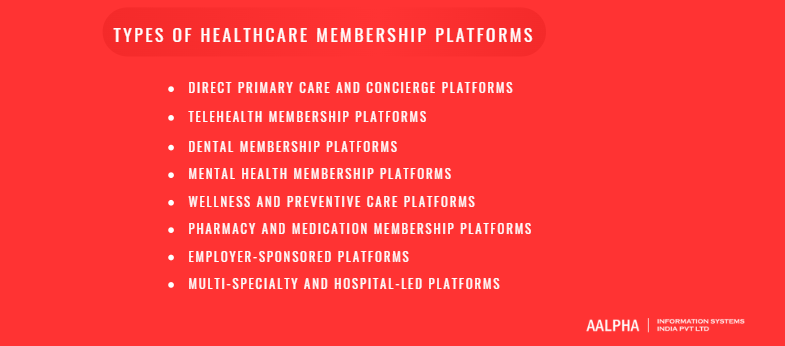
3.1 Direct primary care and concierge platforms
Direct primary care charges a monthly fee, typically $50 to $150 for an adult, and includes most primary care in that fee without billing insurance. Concierge medicine charges considerably more, often $1,500 to $5,000 a year, keeps insurance billing in place, and sells access and time on top. The software differs in one important way: concierge platforms still need claims and eligibility handling, while DPC platforms can skip it entirely and instead need airtight membership agreement handling to stay outside insurance regulation.
Panel size is the number that governs the whole build. A DPC physician typically caps at 400 to 800 patients against 2,000 or more in insurance-based primary care, so the platform needs hard panel limits, waitlists, and per-clinician capacity rules rather than open scheduling.
3.2 Telehealth membership platforms
These sell virtual access, sometimes nationally, and the hard problem is licensure. A clinician licensed in three states cannot see a patient physically located in a fourth, so the scheduling engine has to filter provider availability by the patient’s current state and block bookings that would create an unlicensed encounter. This is not a nice-to-have validation rule. It is the single most common compliance defect in telehealth products built by teams without healthcare experience.
Controlled substances add another layer. Prescribing them via telemedicine sits under the Ryan Haight Act and DEA rules that have been repeatedly extended and revised since 2020, so if your platform touches ADHD, addiction, or pain treatment, get current legal advice specific to your launch date rather than relying on any guide, including this one.
3.3 Dental membership platforms
Dental plans are usually annual, cover cleanings and exams in full, and apply a percentage discount to restorative work. The software problem is benefit tracking against a fee schedule: the platform has to know that this member has used one of two included cleanings and is entitled to 20 percent off a crown at this practice’s prices. Integration with practice management systems such as Dentrix, Eaglesoft, and Open Dental is the main technical constraint, and it is the main reason practices choose one vendor over another.
3.4 Mental health membership platforms
Therapy subscriptions sell a number of sessions per month plus messaging between sessions. Three things make these builds distinctive: session credits that need clear expiry and rollover rules, crisis escalation paths that must be present in the product rather than in a footer, and heightened confidentiality expectations. In the US, psychotherapy notes get stronger protection than the rest of the record under the HIPAA Privacy Rule, which means separate storage and separate access control rather than a flag on a table.
3.5 Wellness and preventive care platforms
Longevity clinics, executive health programs, and coaching subscriptions bundle biomarker panels, wearable data, and periodic reviews. These are often not covered entities under HIPAA, which teams misread as freedom. It is not. Washington’s My Health My Data Act, similar laws in Nevada and Connecticut, and the FTC Health Breach Notification Rule all reach consumer health data outside HIPAA, and My Health My Data carries a private right of action. Building to HIPAA-grade standards regardless is usually cheaper than building twice.
3.6 Pharmacy and medication membership platforms
Subscription pharmacy models charge a flat fee for generic medication access or bundle refills into a broader plan. The build is dominated by regulated integrations: e-prescribing over the Surescripts network, pharmacy dispensing systems, adherence tracking, and in most markets a licensed pharmacy partner whose rules constrain your product more than your own design does.
3.7 Employer-sponsored platforms
Employers buy memberships for staff, usually to reduce claims spend and absence. The software adds eligibility file ingestion, seat allocation and reallocation as employees join and leave, dependent enrollment, invoice-based billing on net terms, and sponsor reporting that must aggregate above a minimum cohort size so the employer cannot infer an individual’s care. Sponsors will ask for member-level detail. The product should be built so you can decline.
3.8 Multi-specialty and hospital-led platforms
Health systems build membership products as a retail front door: a subscription that provides virtual urgent care, navigation, and priority scheduling across an existing network. These are integration projects more than product projects. Expect to spend most of the budget connecting to Epic or Oracle Health, the enterprise scheduling system, and the identity provider, and expect the master patient index to be the hardest single problem you solve.
4. Core features
Feature lists for these platforms usually run to forty items and tell you nothing about sequencing. It is more useful to group by who is using the screen, because each group has a different definition of the product working.
4.1 Patient registration, profiles, and household accounts
Registration carries more weight here than in most consumer software because it is where you collect identity, consent, the membership agreement, and payment credentials in one uninterrupted flow. Every additional field costs conversion, and healthcare signup forms are usually bloated with data that could be collected at the first visit instead.
Household structure needs deciding before you write the schema. A family membership where one payer covers four members with separate clinical records, separate logins for adults, proxy access for children, and a transition rule when a dependent turns 18 is a materially different data model from four individual subscriptions with a shared discount. Retrofitting the first onto the second is a rewrite, and it is one of the most common expensive mistakes in this category. Age-based access transitions carry legal weight too: in most US states a minor gains independent control of some categories of their record before 18, and the platform has to reflect that.
4.2 Plan selection and entitlement
The member needs to see what they are buying, what they have used, and what a given service will cost them. That last one is the feature most teams underbuild. If a member has to book a visit to discover whether it is included, they will call the front desk instead, and the administrative saving that justified the platform disappears.
Entitlement should be a service the rest of the system queries, not logic duplicated in the booking screen, the messaging module, and the billing job. Build it as one component that answers a single question: for this member, this service, on this date, what is covered, what is the member price, and is there a limit remaining.
4.3 Scheduling
Scheduling looks generic and never is. A membership platform’s scheduler needs per-clinician panel limits, visit types with different durations and preparation requirements, the licensure filter described earlier for any virtual visit, buffer and travel rules for multi-location practices, and cancellation policies that connect to the membership rather than to a card charge. It also needs a waitlist, because the promise of same-day access collides with reality within the first quarter of operation.
No-shows deserve specific attention. In fee-for-service the cost is an unbilled slot. In a membership model the member has already paid, so the only lever is a policy the software can enforce: reminders at sensible intervals, easy rescheduling, and a documented rule about repeated no-shows that the platform tracks.
4.4 Video consultations
Video is a buy decision, not a build decision. Use a vendor that will sign a business associate agreement and that handles the parts you do not want to own: network resilience on poor connections, mobile browser quirks, and waiting rooms. Zoom’s healthcare offering, Amazon Chime SDK, Vonage, and Daily are the usual candidates, priced per participant minute at rates low enough that video is rarely a significant line item until you reach real scale.
What you do build is everything around the call: the pre-visit intake, the waiting room state, the fallback to a phone call when video fails, which happens more than vendor demos suggest, and the post-visit summary that lands in the record. Do not record consultations by default. Recording changes your retention obligations, your consent requirements, and your storage costs, and most clinical teams do not want it.
4.5 Secure messaging
Asynchronous messaging is the feature members value most and the one that most often breaks the operating model. If the plan promises clinician access and the product offers an unbounded inbox, clinician time gets consumed by messages that generate no additional revenue. Build message categories, routing to the right role so nurses handle what nurses can handle, response time targets that are visible to both sides, and a rule for converting a thread into a billable or plan-covered visit when it exceeds a threshold.
Messaging is clinical documentation, not chat. It belongs in the record with retention aligned to your medical records policy, and it needs the same audit logging as any other view of protected health information.
4.6 Records, results, and prescriptions
Members expect lab results, visit summaries, medication lists, and refill requests. Results release is the subtle part. In the United States, information blocking rules under the 21st Century Cures Act mean you cannot routinely delay releasing results to the patient while waiting for a clinician to review them, so the product needs to handle a member reading an abnormal result before anyone has called them. Plain language explanations attached to the result and a clear path to ask a question are the mitigation, and clinical teams should agree the wording before launch.
4.7 The clinician workspace
Clinicians need a schedule, a patient list scoped to their panel, a charting surface or a link into the EHR that does not require a second login, a message queue with clear ownership, and refill and order entry. The measure of success is how many clicks stand between opening the day and starting the first visit. If your platform is a second system alongside an EHR, expect resistance proportional to the duplicate data entry it creates, and plan the integration rather than assuming adoption.
4.8 The administrative console
This is the part that gets deferred and should not be. Administrators need to create and version plans, see who is enrolled on which version, fix billing failures, issue refunds and credits, pause or cancel memberships, onboard clinicians with license and credential expiry tracking, and manage the employer sponsors if you have them. Every capability missing here becomes a developer ticket and a database query in production, which is both expensive and a HIPAA problem, because direct database access to production PHI is very hard to justify in an audit.
Plan versioning deserves its own note. Prices change, inclusions change, and existing members are usually grandfathered on old terms. If plans are mutable records rather than versioned ones, you will not be able to answer what a member who joined in March 2025 is entitled to today, which is a question that arrives as a complaint or a legal request.
4.9 Analytics
Three dashboards earn their place. Membership health covers enrollment, churn by cohort, revenue retention, and the ratio of voluntary to involuntary churn. Clinical operations covers utilization per member, visit mix, no-show rates, and message volume per clinician, which is your early warning for burnout and for a mispriced plan. Financial covers monthly recurring revenue, collection rate, failed payment recovery, and refunds.
5. The subscription and billing layer
This is where healthcare membership platforms go wrong most often, partly because it looks like solved commodity work and partly because the healthcare-specific constraints only appear late.
5.1 Plan and pricing architecture
Model plans as versioned objects with an inclusion set, a price, a billing interval, eligibility rules such as age bands, and an effective date range. Members hold a subscription that references a plan version, not a plan. Build it this way on day one; the cost is a few hours and the alternative is a data migration under commercial pressure.
The HSA rules now constrain this directly. From 1 January 2026, under the One Big Beautiful Bill Act and IRS Notice 2026-05, a direct primary care service arrangement no longer disqualifies someone from contributing to an HSA, and the fees are a qualified medical expense, provided the fee does not exceed $150 per month for an individual or $300 per month for an arrangement covering more than one person, with those limits indexed for inflation. The arrangement must be compensated solely by a fixed periodic fee, may be billed for periods up to a year as long as the annualized total stays within the cap, and excludes certain services including prescription drugs other than vaccines. For a US direct primary care product this is a pricing constraint expressed in code: plans should be flagged when they cross the threshold, and the annualized check has to run on the aggregate fee rather than the headline monthly number.
5.2 Recurring billing mechanics
Charge dates, proration, upgrades, downgrades, pauses, and refunds are the plumbing. Decide early whether everyone bills on the first of the month or on their own anniversary. Anniversary billing spreads support load and failed payment volume across the month, which is why most mature platforms use it, at the cost of harder revenue reporting.
Use a subscription billing provider rather than writing this yourself. Stripe Billing, Chargebee, or Recurly will handle proration and retries better than a first implementation will. One healthcare-specific caution: Stripe does not sign business associate agreements for standard accounts, so no protected health information can go into payment metadata. Send an internal member identifier and a plan code, never a diagnosis, a service description, or anything that reveals a condition. Teams routinely leak PHI into invoice line item descriptions without noticing.
5.3 Failed payments and involuntary churn
A card fails and a member silently disappears. Retry on a schedule that respects issuer behaviour, usually three to four attempts over two weeks rather than daily hammering, use account updater services offered by the major processors to catch reissued cards, notify before expiry rather than after decline, and define exactly what happens to access during the grace period. Suspending clinical access the day a card fails is a bad outcome for a patient with an active issue and a worse one for your reputation, so most platforms keep care available and restrict only non-urgent booking during a defined grace window.
5.4 Cancellation, refunds, and the terms your statute requires
Cancellation is where regulation reaches into the product. State direct primary care statutes commonly require the membership agreement to include specific patient protections, including clear cancellation and refund terms, and some prescribe notice periods. Those requirements need to be reflected in what the software actually does, rather than only in the PDF the member signed. If the statute allows cancellation with 30 days notice and a pro rata refund, the cancellation flow should produce that outcome automatically.
Make self-service cancellation available. Beyond being decent practice, US Federal Trade Commission enforcement on negative option marketing has focused on subscriptions that are easy to start and hard to stop, and healthcare is not exempt from that scrutiny.
5.5 Payment methods and regional realities
ACH or direct debit costs a fraction of card processing and churns less, which matters at $85 a month. In the US, HSA and FSA cards are ordinary card rails, so accepting them is mostly a matter of correct merchant category coding and clean receipts that a member can substantiate. Outside the US the picture changes: UPI mandates in India, mobile money in East Africa, and local card schemes in the Gulf each have their own recurring payment behaviour, and the assumption that a card on file will simply keep working does not survive contact with markets where cards expire or get replaced frequently.
6. Advanced features and integrations
Integrations, not features, are what make these projects long. Budget accordingly: on a mid-sized build, connecting to external systems routinely consumes a third of the engineering effort.
6.1 EHR and EMR integration
Start by deciding whether your platform is the system of record or a layer on top of one. Both are valid. Being the system of record means building charting, problem lists, allergies, medication reconciliation, and clinical documentation to a standard clinicians will accept, which is a large undertaking that teams consistently underestimate. Being a layer means integrating.
For integration, FHIR R4 is the target. The resources that matter for a membership platform are Patient, Appointment, Schedule, Encounter, Observation for results and vitals, MedicationRequest, Condition, and DocumentReference. SMART on FHIR handles authorization and lets your app launch inside the EHR context. Older systems still speak HL7 v2 over interface engines, and if you are integrating with a hospital you will meet both.
Access to the large vendors is a commercial process before it is a technical one. Epic and Oracle Health both run developer programs with review steps, and timelines are measured in months rather than weeks. Middleware such as Redox, Health Gorilla, or 1upHealth trades a per-connection fee for a normalized API and a much shorter path to the first working connection. For a platform expecting to connect to more than three or four practice systems, middleware is usually the cheaper answer once engineering time is priced honestly.
6.2 E-prescribing
E-prescribing runs through the Surescripts network in the US, reached in practice through certified vendors such as DoseSpot or NewCrop rather than directly. Controlled substances require EPCS, which brings identity proofing for prescribers and two-factor authentication at the moment of signing, specified by DEA rules rather than by your own security preferences. Certification takes time. Put it on the critical path early or it will land on it late.
6.3 Labs and diagnostics
Quest and Labcorp both offer ordering and results interfaces, and aggregators cover regional labs. The technical work is order transmission, requisition generation, results ingestion as discrete values rather than PDFs where possible, and abnormal flagging. The operational work is the harder part: who is accountable for a critical result arriving at 2am, and what does the platform do about it. Answer that before you turn results ingestion on.
6.4 Pharmacy and delivery
Where the plan includes medication, you are integrating with a dispensing partner and, often, a delivery network. Refill orchestration, substitution rules, and adherence tracking sit on top. Delivery logistics is its own build, and for anyone who needs the fulfilment layer rather than the clinical layer, a white-label on-demand delivery product such as DeliveryStack covers dispatch, routing, and tracking without a bespoke project.
6.5 Remote monitoring and wearables
Blood pressure cuffs, glucometers, and consumer wearables feed continuous data through Apple HealthKit, Health Connect on Android, or device-specific APIs. Two constraints govern the design. Ingested consumer data is not clinical-grade and should be stored and displayed distinctly from measurements taken under clinical supervision. And a stream of readings creates an implied duty to look at them, so alert thresholds, escalation rules, and a documented monitoring policy have to exist before the first device connects. In the US, remote monitoring can also be separately reimbursable, which pulls a membership platform back into claims territory it may have been trying to avoid.
6.6 AI features that are worth building
Three uses carry their weight today. Ambient documentation that drafts a visit note from the consultation audio saves clinicians real time and is the highest-value AI feature in this category by a wide margin. Intake summarization that turns a member’s messages and history into a briefing before the visit is second. Administrative triage that classifies incoming messages by urgency and routes them is third.
Symptom checkers and autonomous triage are a different risk category. Software that assesses symptoms and recommends a course of action can meet the definition of a medical device under FDA rules and under the EU Medical Device Regulation, where symptom checkers have been classified at higher risk classes. Advisory framing, clinician review before any patient-facing recommendation, and legal review of the intended-use wording are the difference between a feature and a regulated product. Whatever you build, any AI processing protected health information needs a BAA with the model provider and a clear stance on whether prompts and outputs are retained.
6.7 Insurance, claims, and CRM
Hybrid models still need eligibility checks and claims submission, usually through a clearinghouse rather than direct payer connections. On the growth side, a CRM and marketing automation link matters more than it does in most healthcare software, because member acquisition and renewal campaigns are core operations here. Keep the boundary strict: marketing tools are not built for PHI, and syncing a segment called “diabetes program members” into a mail platform is a breach waiting to be reported.
7. Technology stack and architecture
7.1 Frontend
React or Next.js for the web surfaces, with server-side rendering on the marketing and plan selection pages where conversion depends on load speed and the member portal behind authentication. Vue is a reasonable alternative where the team already knows it. The interesting frontend problems are not framework choices: they are a booking flow that works on a five-year-old Android phone, an accessible design that meets WCAG 2.1 AA because healthcare products face accessibility complaints more often than most, and clinician screens that stay usable at speed.
7.2 Backend
Node.js with TypeScript, Python with Django or FastAPI, and Java or Kotlin with Spring are all defensible. Choose for the team you can hire and support. What matters more is that clinical data, subscription data, and audit data are separated at the service boundary, so a change to billing logic cannot touch the clinical record and every access path to PHI runs through a layer that logs it.
7.3 Data
PostgreSQL for the transactional core. Clinical records benefit from an append-only, versioned design where corrections create new versions rather than overwriting, because the ability to reconstruct what a clinician saw at the time of a decision is a medico-legal requirement, not a nice property. Keep an event log for anything that changes entitlement or billing state. Redis for sessions and caching, and an object store with server-side encryption for documents and images.
7.4 Cloud and infrastructure
AWS, Azure, and Google Cloud all sign business associate agreements and publish lists of HIPAA-eligible services. The BAA does not make your architecture compliant; it makes compliance possible. You still own configuration: encryption at rest with managed keys, TLS 1.2 or higher in transit, private subnets for data stores, no public buckets, secrets in a managed vault, and logging that cannot be edited by the accounts it monitors. Deploy to the region your data residency rules require, which for EU members means an EU region and for several Gulf and Indian projects means in-country hosting.
7.5 Mobile
Cross-platform with React Native or Flutter is the right default for a membership app. The features that push teams to native are Bluetooth device pairing for peripherals and heavy background health data sync, both of which are workable cross-platform but stop being cheaper. Both app stores review health apps closely, and both require an explicit account deletion path, which for a healthcare product must reconcile with medical record retention law. Deleting the login and retaining the record under a documented retention policy is the usual answer, and it needs to be stated plainly in the app.
7.6 Monolith or microservices
Start with a modular monolith. Almost every membership platform at launch is serving fewer than 10,000 members with modest concurrency, and a distributed architecture at that scale buys operational overhead and debugging pain in exchange for scalability nobody needs yet. Keep clean module boundaries around billing, clinical, scheduling, and integrations so that when one of them genuinely needs to scale or be replaced, extracting it is a project rather than an archaeology exercise. The one component worth isolating early is the integration layer, because third-party healthcare APIs fail in slow and creative ways and you do not want their timeouts inside your request path.
8. Compliance, security, and regulation
8.1 HIPAA in practice
If you handle protected health information on behalf of a covered entity, you are a business associate and you need a BAA with your client and BAAs with every subprocessor that touches PHI, including your cloud provider, your video vendor, your error tracking service, and any AI provider in the path. Error tracking is the one teams forget: a stack trace containing a patient identifier in a third-party monitoring tool is a disclosure.
The Security Rule requires administrative, physical, and technical safeguards, and the control OCR cites most often in enforcement is the absence of a current, documented security risk analysis. Do it before launch, not after the first audit request. The Breach Notification Rule requires notice to affected individuals without unreasonable delay and no later than 60 days, with breaches affecting 500 or more individuals reported to HHS and the media. Build the detection and logging that would let you determine scope inside that window, because reconstructing who accessed what after the fact is what turns a small incident into a large one.
One current point worth stating precisely, since a lot of published advice gets it wrong. HHS published a Notice of Proposed Rulemaking in December 2024 that would make encryption of ePHI at rest and in transit mandatory rather than addressable, require multi-factor authentication for systems accessing ePHI, mandate annual penetration testing and network segmentation, and require an annual security risk analysis. As of August 2026 that rule is still proposed. It missed its spring 2026 target, OCR is working through thousands of comments, and the current Security Rule remains the law in force. The sensible position for a new build is to implement encryption everywhere, MFA everywhere, and annual penetration testing anyway, because they are cheap when designed in and expensive when retrofitted.
8.2 The membership-specific regulatory question
Selling unlimited future services for a fixed fee can look like insurance to a state regulator. About half of US states have enacted statutes that explicitly exempt direct primary care agreements from insurance regulation, and McDermott maintains a 50-state survey worth reading before launch. These statutes are not blanket permissions. They typically apply to a narrow definition of the arrangement and require the agreement to contain specified patient protections, including clear cancellation and refund terms. In states without a statute, the general definition of insurance may be broad enough to catch the model, and this is a question for healthcare counsel in each state where you enroll members, not a question for your architect.
The practical product implication is that your membership agreement is a configurable, versioned, state-aware artifact rather than a single PDF, and your platform needs to record which version each member accepted and when.
8.3 Privacy beyond HIPAA
Consumer wellness products that are not covered entities still face the FTC Health Breach Notification Rule, which the FTC amended in 2024 and has enforced against health apps, and state consumer health privacy laws. Washington’s My Health My Data Act is the strictest, requiring separate consent for collection and sharing of consumer health data and carrying a private right of action, which means plaintiffs rather than only regulators.
For international deployments, GDPR treats health data as a special category under Article 9, requiring an explicit lawful basis, a data protection impact assessment for large-scale processing, and appropriate transfer mechanisms if data leaves the EEA. India’s Digital Personal Data Protection Act, Saudi Arabia’s PDPL, and the UAE health data laws each add localization or consent requirements that shape hosting decisions. Get the residency answer before you pick a region, because moving a production database across regions later is a migration nobody enjoys.
8.4 Access control and audit logging
Role-based access with a minimum necessary posture is the baseline: a front desk user should not see clinical notes, and a clinician should see the panel they treat rather than every member. Add break-glass access for genuine emergencies, logged and reviewed, rather than pretending nobody will ever need it.
Audit logging should record every access to PHI, not just modifications, including who, what record, when, and from where, in a store the application cannot rewrite. Retain the logs in line with your policy and applicable state record retention rules. This is the single most useful control you will build, because it answers the only question that matters after an incident.
8.5 Payment compliance
Card handling is scoped out of your environment by using a hosted payment element from a PCI DSS Level 1 provider, which reduces your obligation to a self-assessment questionnaire rather than a full audit. Do not accept card numbers into your own forms or logs to save a redirect. The saving is trivial and the scope increase is not.
8.6 Testing and vendor management
Penetration testing annually and after significant architectural change, dependency scanning in CI, and a documented incident response plan that has been rehearsed. Keep an inventory of every vendor touching PHI with its BAA status and review date. When a client’s compliance team arrives, that inventory and the risk analysis are the two documents that decide how the conversation goes.
9. How to build one
9.1 Model the business before the software
Write down the plan price, what it includes, and the expected utilization per member per year. Multiply utilization by the cost to deliver it. If that number approaches the price, the product cannot save the business, and the plan design needs to change before development starts. This exercise takes a day and prevents the failure mode described in section 2.6.
9.2 Requirements and compliance mapping
Alongside user stories, produce a data map showing what PHI you hold, where it lives, who can see it, and which third parties receive it. This document drives your BAA list, your access control design, your logging requirements, and your privacy notice, and it will be requested by every enterprise client and every auditor. Producing it during requirements is cheap. Reverse-engineering it from a running system is not.
9.3 Design for two audiences
Patient-facing design optimizes for conversion and low-effort repeat use. Clinician-facing design optimizes for speed and information density. Applying a consumer aesthetic to clinician screens produces a beautiful product they route around, and the tell is a practice that keeps a paper schedule next to the app.
9.4 Scope the MVP honestly
A defensible first release covers registration and plan purchase, recurring billing, scheduling, video visits, secure messaging, a basic record with results, notifications, and an admin console. Things that feel necessary but can wait: a native mobile app if the web experience is good, deep EHR integration if you can start as the system of record for a small panel, AI features, wearables, insurance claims, and employer group management. Things that cannot wait, because retrofitting them is disproportionately expensive: the household data model, plan versioning, entitlement as a service, audit logging, and data export.
9.5 Build, integrate, and test
Two-week iterations with clinical stakeholders in the review. Start the long-lead integration work in parallel from week one: EHR program applications, e-prescribing certification, and payment underwriting all have queue times you do not control.
Testing needs three layers beyond the usual. Clinical workflow testing with real clinicians running a full simulated day, because defects that matter here are workflow defects rather than functional ones. Billing testing across a simulated year including proration, failed payments, refunds, upgrades, and cancellations, ideally with a clock-advancing test harness. And security testing before launch, not after.
9.6 Launch and operate
Launch with a bounded cohort, often the practice’s most engaged existing patients, and watch three things: activation rate within the first fortnight, first-month utilization against your model, and support ticket themes. Members who never complete a first meaningful action in the first month churn at a much higher rate than those who do, so the onboarding sequence is a retention feature and deserves iteration in the first quarter rather than the second year.
10. Cost and timeline
The ranges below reflect blended offshore and nearshore delivery, which is where most of this work is built. Comparable scope delivered entirely by a US or Western European team typically costs two to three times these figures.
10.1 What actually drives cost
Four things, in order. The number and type of external integrations, because each regulated integration carries certification, sandbox access, and error handling well beyond the happy path. The compliance posture, because HIPAA-grade infrastructure, audit logging, and documentation add roughly 15 to 25 percent to a build compared with a general consumer product of the same feature count. Whether you are the system of record, since building charting instead of integrating can double the clinical scope. And the number of distinct user roles, because each one is a separate interface with its own permissions and testing surface.
Feature count matters far less than teams assume. Adding a tenth report is cheap. Adding the first EHR connection is not.
10.2 Cost by platform tier
An MVP costs $45,000 to $90,000 and takes four to six months. That buys registration and household profiles, plan management with a working entitlement engine, recurring billing with proration and dunning, scheduling, video consultations through a vendor, secure messaging, a basic clinical record with results, and an administrative console. It is a web product with no EHR integration and no native mobile app, and it is enough to run a single practice or a focused telehealth line with a few hundred members.
A mid-level platform costs $120,000 to $250,000 over seven to eleven months. The increment over an MVP is mostly integration and reach: native apps on both mobile platforms, one EHR connection, lab ordering and results ingestion, e-prescribing, family and dependent accounts with proxy access, and cohort analytics. This is the tier most funded startups and multi-location practices end up at, and the range is wide because a single EHR connection can swing $35,000 on its own depending on which system and whether you go direct or through middleware.
An enterprise build starts around $300,000 and runs past $700,000 over twelve to eighteen months. It covers multiple specialties, several EHR and claims integrations, employer group management with eligibility files and sponsor reporting, remote patient monitoring, AI-assisted documentation, and multi-region deployment with separate data residency. Health system projects usually land here, and the cost is dominated by integration and identity work rather than by anything a member sees.
Comparable scope delivered entirely by a US or Western European team typically costs two to three times these figures, which is the main reason most of this category is built with blended or offshore delivery.
10.3 Indicative module costs
Taken module by module, the patient-facing basics are the cheapest part of the build. Registration, profiles, and household accounts run $6,000 to $12,000. Plan management and the entitlement engine run $8,000 to $18,000. Video consultation integration, which is configuration and workflow around a vendor SDK rather than original engineering, runs $6,000 to $14,000, and secure messaging with routing and response tracking runs $7,000 to $15,000.
The next band is where the healthcare-specific work sits. Recurring billing with proration, dunning, refunds, and plan versioning runs $10,000 to $20,000, and scheduling with licensure filtering and panel limits runs $9,000 to $18,000. Both look like commodity modules and both carry rules that generic implementations get wrong. Records, results, and prescription handling runs $12,000 to $30,000, and the administrative console, which is the module most often deferred and most often regretted, runs $10,000 to $22,000. Analytics and cohort reporting add $8,000 to $18,000.
Integrations dominate the top of the range. A single EHR connection costs $15,000 to $50,000 depending on the vendor, the depth of the integration, and whether you go direct or through middleware, and each additional system is a fresh project rather than a discount. E-prescribing with EPCS certification runs $12,000 to $30,000 and carries a certification queue that no amount of budget shortens. Employer group management, with eligibility ingestion, seat allocation, invoice billing, and aggregate sponsor reporting, runs $15,000 to $35,000. Native mobile apps for both platforms add $30,000 to $70,000.
Two notes on reading these figures. They assume the modules are built together, since a module retrofitted into a live platform typically costs 30 to 50 percent more than the same module built in sequence. And they exclude discovery, compliance documentation, and the security risk analysis, which together add roughly 10 to 15 percent across the project.
10.4 Running costs
Cloud infrastructure for a platform serving a few thousand members typically runs $600 to $3,000 a month, rising with video minutes and stored imaging. Video is usually priced per participant minute and stays modest until high volume. Payment processing runs around 2.9 percent plus a fixed fee for US cards, with a small additional percentage for subscription billing tooling, and ACH or direct debit is substantially cheaper where members will accept it. E-prescribing and lab interfaces are commonly per-provider or per-transaction subscriptions in the hundreds to low thousands per month. Middleware for EHR connectivity is priced per connection and per volume.
Compliance has its own line: an annual penetration test runs $8,000 to $25,000 depending on scope, and a first SOC 2 Type II, which enterprise and employer clients will ask for, generally lands between $25,000 and $60,000 including tooling and auditor fees. Budget ongoing maintenance at 15 to 20 percent of the original build cost per year, and treat that as the floor rather than a contingency.
10.5 Controlling cost without weakening security
Cut scope, not controls. Launch one specialty instead of five, one region instead of three, web before native mobile, and manual admin processes before automated ones. Buy the commodity layers: video, subscription billing, e-prescribing, identity, and where you have more than a couple of EHRs to reach, integration middleware. Defer AI until you have real usage data to point it at.
What not to cut: encryption, audit logging, access control, the security risk analysis, penetration testing, and the data model decisions in section 9.4. Every one of those is cheap now and expensive later, and the last category is expensive in a way that shows up as a rewrite rather than a line item.
11. What separates platforms that keep their members
11.1 The failure patterns
The most common technical failure is treating the subscription as an afterthought to a clinical product, which produces a system that cannot answer basic questions about entitlement and revenue. The most common operational failure is unbounded clinician access commitments that make the plan unprofitable once utilization matures, usually around month nine when early members stop being polite about messaging. The most common commercial failure is acquisition cost that exceeds member lifetime value in a business where lifetime value takes two years to observe.
Adoption failures follow their own pattern. Members sign up during a moment of need, use the platform once, and forget it exists. Preventive outreach, annual check-in prompts, and results notifications are what keep the product present between episodes of illness, and they are worth more to retention than any feature added to the visit itself.
11.2 Integration reality
Healthcare integrations fail slowly and partially. An EHR endpoint returns a 200 with an empty bundle. A lab feed drops overnight and nobody notices for three days. Build for it: queue everything, make ingestion idempotent, alert on absence of expected traffic rather than only on errors, and give administrators a visible reconciliation view instead of a silent failure. Data quality is the other half. Patient matching across systems without a national identifier produces duplicates, and a deduplication and merge workflow needs to exist before it is urgent.
11.3 The metrics to run the business on
Monthly churn is the headline, split into voluntary and involuntary, because those have completely different fixes. Track activation, meaning the share of new members completing a meaningful first action within 30 days, since it predicts retention better than any demographic. Track utilization per member per year against the model you built in section 9.1, because drift there is an early warning that the plan is mispriced. Then net revenue retention, CAC payback period, collection rate, and the clinical operations pair of visit completion and message response time. Six numbers on one dashboard beat a reporting suite nobody opens.
12. Building a healthcare membership platform with Aalpha
Aalpha Information Systems has been building custom software since 2008, with 5,500+ completed projects across 55+ countries, a 4.9 out of 5 rating from more than 215 Clutch reviews, and ISO 9001:2015 certification. The healthcare work spans telemedicine platforms, patient portals, practice management systems, and HIPAA-compliant cloud architecture, and the subscription and billing experience comes from building SaaS and marketplace products where recurring revenue is the core mechanic. Those two skill sets are what a membership platform actually requires, and they rarely sit in the same team.
Engagements usually start with a two to three week discovery that produces the business model check described in section 9.1, a data map, an integration plan with realistic lead times, and a costed scope. From there, teams work in dedicated or fixed-scope models depending on how settled the requirements are, with clinical stakeholders in the sprint reviews. Post-launch support covers infrastructure monitoring, compliance maintenance, integration upkeep as third-party APIs change, and the iteration that the first two quarters of real usage will demand.
If you want to talk through a specific plan design, integration scope, or budget, get in touch with Aalpha to discuss your requirements.
Final words
The hardest part of a healthcare membership platform is not the code. It is the arithmetic between what the plan promises and what delivering it costs, and the discipline to encode that arithmetic in entitlement rules rather than trusting it to goodwill. Get the plan model, the household model, and the audit trail right at the start, buy the commodity layers, and launch with a small cohort you can watch closely. Everything else is iteration.
FAQs
What is a healthcare membership platform?
Software that sells recurring healthcare subscriptions and delivers the care those subscriptions promise. It combines plan and billing management with scheduling, video visits, messaging, and record access, and it enforces what each member is entitled to at the point of service.
How much does it cost to build one?
An MVP runs $45,000 to $90,000, a mid-level platform with EHR and lab integration runs $120,000 to $250,000, and an enterprise multi-specialty build runs $300,000 to $700,000 or more, based on blended offshore delivery rates.
How long does development take?
Four to six months for an MVP, seven to eleven months for a mid-level platform, and twelve to eighteen months for an enterprise build. Regulated integrations such as e-prescribing certification have queue times outside your control, so start them in week one.
Does a healthcare membership platform need to be HIPAA compliant?
If it handles protected health information for a covered entity in the United States, yes, including BAAs with every subprocessor. Consumer wellness products outside HIPAA still face the FTC Health Breach Notification Rule and state laws such as Washington’s My Health My Data Act.
Is a direct primary care membership considered insurance?
Roughly half of US states have statutes that place direct primary care agreements outside insurance regulation, usually on condition that the agreement includes specified patient protections such as clear cancellation and refund terms. In states without such a statute the question is open, and it needs local healthcare counsel.
Can members pay with an HSA?
Since 1 January 2026, under the One Big Beautiful Bill Act and IRS Notice 2026-05, direct primary care fees up to $150 per month for an individual and $300 per month for a family are HSA-qualified and no longer disqualify HSA contributions, subject to the arrangement’s definition and exclusions.
Should we build or buy?
Buy if you are a single practice running a standard plan, since platforms such as Hint Health for direct primary care and Clerri for dental cover that ground at low cost. Build when your plan design, integrations, or brand experience are the product, when you are running multiple specialties or markets, or when you intend to sell the platform itself.
Do we need EHR integration at launch?
Not always. If you are starting a new panel, the platform can be the system of record for the first phase. If you are adding membership to an established practice with an existing EHR, integration moves onto the critical path immediately, because clinicians will not use two systems for long.
What are the biggest development risks?
Underestimating integration effort, a household and plan data model that cannot be changed later, unbounded access promises that make the plan unprofitable at scale, and compliance work deferred until an enterprise client asks for evidence.
What ongoing costs should we plan for?
Cloud infrastructure, per-transaction integration fees, payment processing, an annual penetration test, SOC 2 if enterprise clients require it, and maintenance at 15 to 20 percent of build cost per year.