



Headless Shopify development refers to an ecommerce architecture in which Shopify is used strictly as the backend commerce engine while the customer-facing frontend is built and delivered using a separate technology stack. In a headless setup, the presentation layer is decoupled from Shopify’s theme system, allowing businesses to design and control the storefront independently while continuing to rely on Shopify for core commerce functions such as product management, inventory, orders, customers, payments, and integrations. This approach has gained traction as brands demand faster performance, richer user experiences, and the ability to deliver commerce across multiple digital touchpoints from a single backend.
At its core, headless commerce in the context of Shopify means that Shopify no longer dictates how the storefront looks or behaves. Instead of rendering pages through Liquid themes hosted within Shopify, the frontend is built using modern web frameworks and communicates with Shopify via APIs. Shopify becomes the system of record for commerce data, while the frontend is free to evolve without the constraints of the traditional theme architecture.
Traditional Shopify Themes vs Headless Architecture
In a traditional Shopify setup, the frontend and backend are tightly coupled. The storefront is built using Shopify’s Liquid templating language, and page rendering, layout logic, and data access all occur within Shopify’s theme layer. This model is simple to launch and works well for small to mid-sized stores, but it imposes clear limitations. Custom user experiences, advanced interactions, and deep performance optimizations are constrained by the theme system and by what Liquid allows.
Headless Shopify replaces this coupled model with a decoupled architecture. The frontend is built as a standalone application, often using JavaScript-based frameworks, and it fetches product data, collections, pricing, and customer information through Shopify APIs. This separation allows frontend teams to move faster, experiment more freely, and deliver experiences that are difficult or impossible to achieve with standard themes. It also enables a single Shopify backend to power multiple frontends, such as a website, mobile app, progressive web app, or even in-store kiosks.
How Shopify Enables Headless Frontends Through APIs
Shopify’s evolution toward headless commerce is largely driven by its API-first capabilities. The Storefront API allows developers to securely access product data, manage carts, apply discounts, and initiate checkouts from any external frontend. The Admin API provides deeper access for backend operations such as order management, inventory updates, and customer data synchronization. Together, these APIs make it possible to treat Shopify as a commerce platform rather than a website builder.
In a headless Shopify implementation, the frontend controls routing, rendering, state management, and performance optimizations, while Shopify handles transactional reliability and commerce logic. This division of responsibilities is particularly valuable for businesses operating at scale, where frontend performance and flexibility directly impact conversion rates and brand perception. It also aligns well with modern development practices such as continuous deployment, component-driven design, and omnichannel delivery.
Common Misconceptions About Headless Shopify
One of the most common misconceptions is that headless Shopify is automatically faster and better for every business. While headless architectures can deliver exceptional performance, those benefits are only realized when the frontend is designed, cached, and deployed correctly. A poorly implemented headless storefront can perform worse than a well-optimized traditional theme.
Another misconception is that headless Shopify eliminates Shopify’s checkout or ecosystem. In practice, most headless implementations still rely on Shopify’s hosted checkout for payments and compliance, especially for PCI and tax handling. Headless does not mean replacing Shopify, but rather extending it. There is also a belief that headless is only for Shopify Plus merchants. While larger brands adopt headless more frequently, the underlying APIs are available to a broader range of Shopify plans, making headless technically accessible beyond enterprise use cases.
When Headless Shopify Is Not the Right Choice
Despite its flexibility, headless Shopify is not a universal solution. For early-stage startups, small merchants, or businesses with limited development resources, the added complexity may outweigh the benefits. Headless architectures require ongoing engineering involvement, disciplined deployment processes, and more responsibility for performance, SEO, and security at the frontend layer. Content updates may also require additional tooling or workflows compared to Shopify’s native theme editor.
Headless Shopify is also unnecessary when a store’s requirements align well with what standard themes already provide. If speed to market, low maintenance, and simplicity are the primary goals, traditional Shopify development often delivers better value. Headless becomes most compelling when a business has clear needs for advanced customization, multi-channel delivery, or performance at scale.
In summary, headless Shopify development represents a shift from theme-driven ecommerce to platform-driven commerce architecture. It matters because it gives businesses full control over how commerce experiences are built and delivered, while still leveraging Shopify’s reliability and ecosystem. Understanding when and why to adopt this approach is critical before committing to the technical and operational implications that come with going headless.
How Headless Shopify Works: Architecture Explained
Headless Shopify works by separating the customer-facing storefront from the commerce engine that powers products, orders, customers, and payments. Instead of Shopify rendering pages through its built-in theme system, Shopify operates purely as a backend platform while an external frontend application controls how content is displayed and how users interact with the store. This architectural shift changes how data flows, how systems are deployed, and how teams build and scale ecommerce experiences, which is why understanding the underlying structure is essential before adopting headless commerce.
-
Decoupled Frontend and Backend Architecture
In a headless Shopify setup, the frontend and backend are completely decoupled. The backend is Shopify itself, responsible for commerce-critical functions such as catalog management, inventory tracking, pricing rules, discounts, orders, customers, taxes, and payments. The frontend is a separate application that handles user interface, navigation, layout, animations, and performance optimization.
This separation allows each layer to evolve independently. Frontend teams can redesign user experiences, introduce new interaction patterns, or optimize performance without touching backend commerce logic. Backend teams can manage products, fulfillment, and integrations without worrying about frontend rendering constraints. From an architectural standpoint, this aligns Shopify with modern distributed system design, where each component has a clearly defined responsibility and communicates through well-documented APIs.
In contrast to tightly coupled systems, decoupling also reduces long-term technical constraints. As traffic grows or requirements change, the frontend can be scaled, cached, or rebuilt without migrating commerce data or disrupting order processing. This is one of the core reasons large and fast-growing brands adopt headless Shopify architectures.
-
Role of Shopify Storefront API and Admin API
APIs are the foundation that makes headless Shopify possible. Shopify exposes its commerce capabilities through two primary API layers, each serving a distinct purpose.
The Storefront API is designed for customer-facing interactions. It allows the frontend to fetch product data, collections, pricing, variants, availability, and metadata. It also supports cart creation, cart updates, discount application, and checkout initialization. Because the Storefront API is optimized for public access, it is secured using tokens that limit scope and protect sensitive operations. This ensures customers can browse and transact without exposing administrative controls.
The Admin API is used for backend and operational workflows. It enables deeper access to orders, customers, inventory levels, fulfillment status, refunds, and integrations with external systems such as ERPs, CRMs, and analytics platforms. In headless architectures, the Admin API is typically used by server-side services rather than directly by the frontend, ensuring sensitive data remains protected.
Together, these APIs allow Shopify to function as a commerce engine rather than a page-rendering system. The frontend becomes a consumer of Shopify’s data and actions, while Shopify remains the authoritative source of truth.
-
Data Flow in a Headless Shopify Store
Understanding how data flows through a headless Shopify system helps clarify how responsibilities are divided between layers. When a customer visits a headless storefront, the frontend application loads first. Instead of pulling HTML from Shopify, it requests product and collection data via the Storefront API. This data is rendered dynamically or statically depending on the chosen frontend strategy.
When a customer adds items to a cart, the frontend communicates with Shopify to create or update a cart object. Cart state may be stored temporarily in the browser, in a server-side session, or in a distributed cache, but Shopify remains responsible for pricing accuracy, discounts, and availability. When the customer proceeds to checkout, most headless implementations redirect the user to Shopify’s hosted checkout. This ensures compliance with payment security standards and leverages Shopify’s mature checkout infrastructure.
Customer data follows a similar pattern. Account creation, login, and order history can be managed through Shopify’s customer APIs, with authentication handled securely. The frontend controls how these flows look and feel, but Shopify manages identity, order records, and transactional integrity. This separation ensures that even though the experience is custom-built, the underlying commerce logic remains stable and compliant.
-
Hosting and Deployment Models for Headless Frontends
One of the most significant architectural differences in headless Shopify is how and where the frontend is hosted. Unlike traditional Shopify themes, which are hosted and rendered within Shopify’s infrastructure, headless frontends are deployed independently. This allows teams to choose hosting models that align with performance, scalability, and geographic reach requirements.
Common deployment approaches include static site generation, server-side rendering, or hybrid models that combine both. Static builds pre-render pages at build time and serve them via CDNs, offering excellent performance and reliability. Server-side rendering generates pages on demand, enabling dynamic personalization and real-time data fetching. Hybrid approaches use static generation for most pages while rendering dynamic content selectively.
Because the frontend is decoupled, it can be deployed using modern CI/CD pipelines, enabling faster iteration and safer releases. Scaling is handled independently of Shopify, meaning traffic spikes can be absorbed at the frontend layer without overwhelming the commerce backend. This architectural flexibility is a major advantage for brands running high-traffic campaigns or operating across multiple regions.
-
Comparison With Monolithic Shopify Theme Architecture
Traditional Shopify themes follow a monolithic architecture where frontend and backend are tightly integrated. Shopify renders pages using Liquid templates, retrieves data internally, and serves HTML directly to users. This approach simplifies development and reduces infrastructure responsibility, but it limits customization and performance optimization.
In a headless architecture, Shopify no longer controls rendering or layout. Instead of serving HTML, it serves data. This shift gives developers full control over frontend performance, accessibility, and user experience, but it also introduces new responsibilities. SEO, routing, caching, and error handling must be explicitly designed rather than inherited from Shopify’s theme system.
From a systems perspective, monolithic Shopify is easier to manage but harder to customize deeply. Headless Shopify is more complex but far more flexible. The architectural choice ultimately depends on business goals, scale, and internal capabilities.
In summary, headless Shopify works by transforming Shopify from a theme-based website platform into a backend commerce service. Through a decoupled architecture powered by APIs, data flows cleanly between frontend and backend, enabling faster experiences, multi-channel delivery, and long-term scalability. Understanding this architecture is critical for making informed decisions about whether headless Shopify aligns with a business’s technical and strategic objectives.
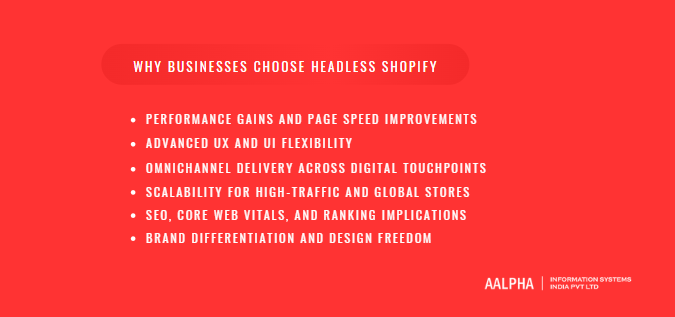
Why Businesses Choose Headless Shopify
Businesses adopt headless Shopify not because it is trendy, but because it directly addresses structural limitations that emerge as digital commerce scales. As brands grow, expectations around speed, experience, reach, and differentiation increase significantly. Traditional theme-based ecommerce setups often struggle to meet these demands simultaneously. Headless Shopify offers a business-driven architectural shift that aligns technology decisions with measurable outcomes such as conversion rates, customer retention, global expansion, and long-term brand value.
-
Performance Gains and Page Speed Improvements
Performance is one of the most compelling reasons businesses move to headless Shopify. In a traditional Shopify theme, pages are rendered within Shopify’s templating system, which introduces limitations in how aggressively assets can be optimized, cached, and delivered. While Shopify themes have improved over time, they are still constrained by shared infrastructure and generalized optimization strategies.
Headless Shopify allows brands to control performance at a granular level. Frontends can be optimized using modern rendering strategies, aggressive caching, edge delivery, and lightweight payloads. Pages can be pre-rendered and served instantly from global CDNs, significantly reducing time to first byte and largest contentful paint. For high-traffic ecommerce stores, even small performance improvements translate into tangible revenue gains. Faster storefronts reduce bounce rates, improve conversion rates, and create a smoother browsing experience across devices and network conditions.
From a business perspective, performance is not just a technical metric. It directly affects customer trust, perceived brand quality, and the likelihood that users complete purchases rather than abandon carts due to slow or unresponsive pages.
-
Advanced UX and UI Flexibility
As ecommerce matures, user experience becomes a key differentiator. Standard Shopify themes are designed to serve a wide audience, which limits how deeply they can be customized without introducing technical debt. Headless Shopify removes these constraints by giving teams full control over the frontend experience.
With a headless approach, businesses can design bespoke interfaces tailored to their audience rather than adapting their brand to a theme. Complex navigation patterns, interactive product configurators, immersive storytelling layouts, and personalized journeys become feasible without fighting the limitations of Liquid templates. This level of flexibility is particularly valuable for brands competing in crowded markets where experience, not price, is the primary differentiator.
For internal teams, advanced UX flexibility also means faster experimentation. Frontend changes can be deployed independently of backend commerce operations, enabling A/B testing, iterative design improvements, and rapid adaptation to customer feedback. Over time, this ability to evolve the storefront experience becomes a strategic advantage rather than a cosmetic enhancement.
-
Omnichannel Delivery Across Digital Touchpoints
Modern commerce is no longer limited to a single website. Customers interact with brands across websites, mobile apps, progressive web apps, in-store displays, kiosks, voice assistants, and emerging connected devices. Headless Shopify is inherently designed for this omnichannel reality.
Because Shopify functions as a centralized commerce backend, the same product catalog, pricing logic, and inventory system can power multiple frontends simultaneously. A business can deliver a consistent commerce experience across web and mobile while tailoring the interface and interaction model to each channel. This is significantly harder to achieve with traditional Shopify themes, which are tightly coupled to a browser-based storefront.
For businesses expanding into new markets or experimenting with new channels, headless Shopify reduces duplication and operational complexity. Instead of maintaining separate commerce systems for each channel, teams manage one backend and deploy multiple frontends as needed. This flexibility supports long-term growth strategies and future-proofs the commerce stack against changing consumer behavior.
-
Scalability for High-Traffic and Global Stores
Scalability is a critical consideration for brands that experience traffic spikes, seasonal demand, or rapid international growth. In a traditional Shopify setup, frontend rendering and backend commerce logic are closely linked, which can create bottlenecks during peak traffic periods.
Headless Shopify separates these concerns. The frontend can be scaled independently using distributed infrastructure, ensuring that traffic surges are absorbed at the delivery layer rather than impacting commerce operations. Shopify continues to handle orders, payments, and inventory reliably, while the frontend focuses on fast content delivery.
For global brands, headless architecture also enables region-specific optimizations. Frontends can be localized by geography, language, and currency while still connecting to a single commerce backend. This allows businesses to deliver regionally optimized experiences without fragmenting operations or data. From a strategic standpoint, this makes international expansion more manageable and less risky.
-
SEO, Core Web Vitals, and Ranking Implications
SEO is often a concern when considering headless commerce, but it is also one of the strongest drivers of adoption when implemented correctly. Search engines increasingly reward fast, stable, and user-friendly experiences. Headless Shopify enables brands to optimize Core Web Vitals more effectively than theme-based storefronts.
By controlling rendering strategies and asset delivery, headless frontends can achieve excellent scores for loading performance, interactivity, and visual stability. This directly impacts organic visibility, especially in competitive ecommerce categories. Additionally, headless architectures allow finer control over metadata, structured data, and URL handling, which are essential for advanced SEO strategies.
From a business perspective, improved SEO performance reduces dependency on paid acquisition channels. Over time, this can significantly lower customer acquisition costs while increasing sustainable organic traffic.
-
Brand Differentiation and Design Freedom
In highly competitive ecommerce markets, brand identity and differentiation are critical. Traditional Shopify themes often lead to visual and experiential sameness, where many stores look and behave similarly. Headless Shopify breaks this pattern by allowing brands to design experiences that reflect their unique positioning.
Design freedom extends beyond aesthetics. It includes storytelling, motion, content hierarchy, and how products are contextualized within the brand narrative. For premium and experience-driven brands, this level of control is essential for building emotional connection and long-term loyalty.
Headless Shopify also supports consistency across touchpoints. A brand’s design language can be applied uniformly across web, mobile, and emerging platforms, reinforcing recognition and trust. Over time, this consistency strengthens brand equity and makes the commerce experience harder to replicate by competitors.
In summary, businesses choose headless Shopify because it aligns technical architecture with strategic goals. Performance, flexibility, scalability, omnichannel reach, SEO control, and brand differentiation are not isolated benefits. Together, they create a commerce foundation that supports growth, experimentation, and resilience in an increasingly competitive digital landscape.
Headless Shopify vs Traditional Shopify: A Detailed Comparison
Choosing between headless Shopify and traditional Shopify is a strategic decision that affects development cost, operational complexity, performance outcomes, and long-term ownership. Both approaches are built on Shopify, but they serve different business needs. A clear comparison across architecture, cost, flexibility, performance, maintenance, and real-world use cases helps decision-makers align the choice with growth objectives rather than trends.
-
Architecture Differences
Traditional Shopify uses a monolithic architecture where the frontend and backend are tightly coupled. Pages are rendered using Liquid templates within Shopify’s infrastructure, and data access, layout, and rendering occur in a single system. This simplifies setup and reduces integration points, which is why traditional Shopify is widely adopted by small and mid-sized merchants.
Headless Shopify introduces a decoupled architecture. Shopify operates as a backend commerce service, exposing products, carts, customers, and orders via APIs. The frontend is a separate application responsible for rendering, routing, and user experience. This separation allows independent evolution of each layer. Architecturally, traditional Shopify prioritizes simplicity and speed to launch, while headless Shopify prioritizes flexibility, scalability, and control.
-
Development Complexity and Cost
Development complexity is one of the most important differentiators. Traditional Shopify development is relatively straightforward. Teams work within a known theme framework, leverage Shopify’s built-in editor, and rely on a large ecosystem of ready-made themes and apps. Development timelines are shorter, and costs are lower because many features are available out of the box.
Headless Shopify introduces higher upfront complexity. Teams must design and build a custom frontend, integrate APIs, manage deployments, and implement SEO, performance, and security explicitly. This requires experienced frontend and backend developers and disciplined engineering practices. As a result, initial development costs are higher than traditional Shopify.
From a cost perspective, traditional Shopify is more predictable and budget-friendly in the short term. Headless Shopify becomes cost-effective when the business benefits from performance gains, conversion improvements, or multi-channel reuse that offsets the higher initial investment over time.
-
Customization Limits vs Flexibility
Customization is where the trade-off becomes clear. Traditional Shopify themes allow customization within predefined boundaries. While Liquid and theme settings provide flexibility, deeply custom interactions, unconventional layouts, or advanced logic often require workarounds that increase technical debt.
Headless Shopify removes most of these limitations. The frontend can be built with any framework, following any design system, without being constrained by Shopify’s rendering model. This enables advanced UX patterns, personalized experiences, and content-driven commerce that would be difficult to implement cleanly in a theme-based setup.
For businesses where brand experience and differentiation are critical, this flexibility is a decisive advantage. For businesses with standard ecommerce requirements, the added flexibility may be unnecessary.
-
Performance Benchmarks and Real-World Implications
Performance differences are often cited as a reason to go headless, but the reality is nuanced. Traditional Shopify themes can perform well when optimized correctly, especially for moderate traffic volumes. Shopify’s infrastructure handles caching, CDN delivery, and many performance concerns automatically.
Headless Shopify allows teams to push performance further. Frontends can be optimized with static rendering, edge delivery, and fine-grained caching strategies. In real-world scenarios, headless storefronts often achieve faster load times and better Core Web Vitals scores, particularly on mobile and in regions with slower networks.
However, these gains are not automatic. Poorly implemented headless frontends can underperform compared to well-optimized themes. Performance improvements depend on architectural decisions, frontend expertise, and operational discipline. Decision-makers should view headless as an enabler of performance, not a guarantee.
-
Maintenance, Updates, and Long-Term Ownership
Maintenance responsibilities differ significantly between the two approaches. Traditional Shopify benefits from managed updates. Shopify handles platform upgrades, security patches, and infrastructure maintenance. Theme updates and app compatibility are generally predictable, reducing long-term operational overhead.
Headless Shopify shifts more responsibility to the business. Frontend frameworks, hosting infrastructure, build pipelines, and integrations must be maintained and updated over time. While this increases operational complexity, it also increases ownership and control. Businesses are not dependent on theme limitations or third-party app constraints and can evolve their stack at their own pace.
From a long-term ownership perspective, headless Shopify favors organizations with internal engineering capability or reliable development partners. Traditional Shopify favors teams that prioritize simplicity and minimal maintenance.
-
Use-Case Driven Recommendation Matrix
The right choice depends on business context rather than technical preference. Traditional Shopify is best suited for early-stage startups, small merchants, and businesses that value speed to market, lower costs, and ease of management. It works well when requirements align with standard ecommerce patterns and when rapid iteration without engineering overhead is a priority.
Headless Shopify is better suited for high-growth brands, global businesses, and experience-driven commerce models. It is particularly effective for stores with high traffic volumes, complex UX requirements, or omnichannel strategies that extend beyond a single website. Businesses that view ecommerce as a core product rather than a simple sales channel benefit most from the architectural freedom headless provides.
In conclusion, headless Shopify and traditional Shopify are not competing solutions but complementary approaches for different stages and strategies. Traditional Shopify optimizes for simplicity and speed. Headless Shopify optimizes for flexibility, scalability, and long-term differentiation. Decision-makers should evaluate their technical maturity, growth plans, and customer experience goals before committing to either path.
Shopify Headless Stack: Technologies and Tools
A headless Shopify implementation is not a single technology choice but a composable stack of frontend, content, infrastructure, and integration tools that work together around Shopify’s commerce backend. Understanding this ecosystem is critical because headless success depends less on individual tools and more on how well the stack aligns with business goals, internal capabilities, and long-term maintainability. This section provides a practical, experience-driven overview of the Shopify headless stack without vendor hype or marketing promises.
-
Frontend Frameworks Commonly Used With Headless Shopify
The frontend is the most visible and customizable part of a headless Shopify stack. Most teams choose modern JavaScript frameworks that support component-based architecture, routing control, and flexible rendering strategies. These frameworks allow developers to build fast, interactive storefronts that are not constrained by Shopify’s Liquid templating system.
What matters most at the frontend layer is not the framework name but its ability to support server-side rendering, static generation, incremental updates, and seamless API integration. Mature ecosystems, strong community support, and predictable upgrade paths are also essential. Since the frontend becomes a long-term asset, teams should avoid experimental stacks that introduce unnecessary risk. From a business standpoint, frontend choices directly influence hiring, onboarding, and long-term development velocity.
-
Static vs Dynamic Rendering Approaches
Rendering strategy is one of the most important architectural decisions in a headless Shopify project. Static rendering generates pages at build time and serves them via CDNs. This approach delivers excellent performance, strong reliability, and low infrastructure overhead. Product and collection pages that do not change frequently are ideal candidates for static rendering.
Dynamic rendering generates pages on request, allowing real-time personalization, dynamic pricing logic, and user-specific content. This approach is useful for logged-in experiences, personalized recommendations, and region-specific content that cannot be prebuilt efficiently.
Most successful headless Shopify implementations use a hybrid model. Core pages are statically generated for speed and SEO, while dynamic rendering is used selectively where real-time data is required. The key is to avoid overusing dynamic rendering, as it increases complexity and operational cost without always delivering proportional business value.
-
CMS Options for Content Management
Content management is often underestimated in headless Shopify projects. Once the storefront is decoupled from Shopify themes, businesses must decide how non-product content such as landing pages, blogs, and brand storytelling is managed. Relying solely on Shopify for content can be limiting, especially when marketing teams need editorial flexibility.
Headless CMS platforms are commonly introduced to fill this gap. These systems allow content teams to manage structured content independently of the frontend codebase. Content is delivered via APIs and rendered by the frontend alongside commerce data from Shopify. This separation enables faster content updates, better editorial workflows, and clearer ownership between marketing and engineering teams.
However, adding a CMS also adds operational complexity. Teams must define content models carefully, ensure preview workflows work reliably, and avoid duplicating functionality already available in Shopify. The right CMS choice balances editorial freedom with simplicity and should match the organization’s content maturity rather than future aspirations.
-
Search, Personalization, and Analytics Integrations
Search and personalization are critical to conversion performance, but they are rarely handled entirely by Shopify in headless setups. Advanced search experiences, filtering, and ranking often require dedicated search services that integrate with Shopify’s product data. These services index catalogs externally and provide fast, relevant results tailored to user behavior.
Personalization typically operates at the frontend layer, combining Shopify data with behavioral signals, session context, and analytics. This allows businesses to deliver dynamic product recommendations, targeted messaging, and adaptive layouts. The challenge is ensuring personalization enhances the experience without degrading performance or creating opaque systems that are hard to maintain.
Analytics in headless Shopify also require deliberate planning. Because the frontend is custom-built, tracking must be implemented manually and validated carefully. Businesses gain more control over data collection and attribution, but they also assume responsibility for accuracy and compliance. A well-designed analytics setup supports informed decision-making rather than vanity metrics.
-
Hosting, CDN, and Infrastructure Considerations
In traditional Shopify, hosting and infrastructure are abstracted away. Headless Shopify shifts these responsibilities to the business. The frontend must be hosted independently, often using platforms optimized for global delivery and edge caching. CDN configuration becomes a first-class concern, as it directly affects performance and resilience.
Infrastructure decisions should prioritize reliability, scalability, and simplicity. Overengineering infrastructure is a common mistake, especially for teams new to headless commerce. The goal is not to build complex systems, but to deliver fast and stable experiences consistently. Automated deployments, monitoring, and rollback mechanisms are essential to reduce operational risk as the storefront evolves.
From a cost perspective, infrastructure expenses are ongoing rather than one-time. Businesses should account for hosting, bandwidth, build processes, and third-party services as part of the total cost of ownership when evaluating headless Shopify.
-
Shopify Hydrogen and Oxygen: Overview and Limitations
To support headless adoption, Shopify introduced Hydrogen and Oxygen as an opinionated toolkit for building and hosting headless storefronts. Hydrogen provides a framework optimized for Shopify data access and storefront development, while Oxygen offers a managed hosting environment designed to work closely with Shopify’s ecosystem.
Hydrogen lowers the barrier to entry for teams adopting headless Shopify by providing prebuilt patterns for common commerce workflows. It accelerates development and reduces boilerplate, particularly for teams already aligned with Shopify’s way of thinking. Oxygen simplifies deployment and scaling by abstracting infrastructure concerns.
However, Hydrogen and Oxygen are not universally suitable. They are tightly coupled to Shopify’s ecosystem, which can limit flexibility for teams that require custom infrastructure, multi-backend integrations, or non-standard workflows. Businesses should evaluate whether the convenience of an integrated solution outweighs the potential constraints on long-term architectural freedom.
-
Strategic Perspective on the Headless Stack
The Shopify headless stack is best understood as a set of trade-offs rather than a checklist of tools. Each layer introduces both capability and responsibility. The most successful implementations are those where technology choices are driven by clear business needs rather than assumptions about scale or complexity.
In practice, a well-designed headless Shopify stack enables faster storefronts, richer experiences, and greater adaptability. A poorly chosen stack increases cost, slows teams down, and erodes the very advantages headless architecture is meant to provide. For decision-makers, the focus should remain on alignment, maintainability, and measurable outcomes rather than chasing the most advanced tools available.
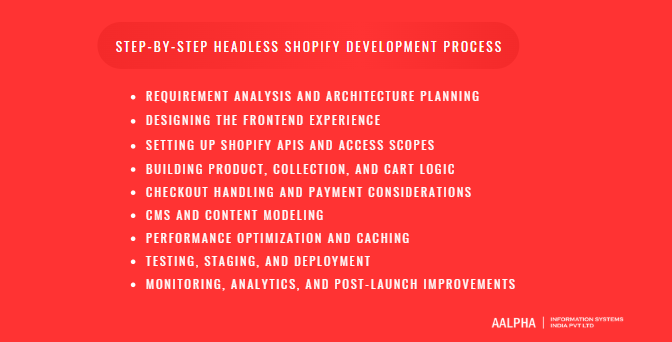
Step-by-Step Headless Shopify Development Process
Building a headless Shopify storefront is not a single development task but a structured, multi-phase process that spans strategy, design, engineering, and ongoing optimization. Unlike traditional Shopify projects, where many decisions are abstracted away by the platform, headless development requires deliberate choices at every stage. This section walks through the end-to-end process in a practical, implementation-oriented manner, explaining not only what to do, but why each step matters from both technical and business perspectives.
-
Requirement Analysis and Architecture Planning
Every successful headless Shopify project begins with rigorous requirement analysis. This phase is not about choosing technologies, but about defining outcomes. Teams must clearly articulate why headless is being adopted and what problems it is expected to solve. Common drivers include performance bottlenecks, the need for advanced UX, omnichannel expansion, or long-term scalability. Without explicit goals, headless architecture often introduces unnecessary complexity.
From an architectural standpoint, this phase establishes the system boundaries. Decisions include whether Shopify will be the sole commerce backend or one of multiple systems, how content will be managed, and how many frontends will consume the same backend. Teams should map data ownership clearly, identifying which system is the source of truth for products, pricing, content, and customer data. This clarity prevents duplication and integration issues later.
Architecture planning also includes selecting a rendering strategy, defining environments for development, staging, and production, and determining deployment and rollback requirements. These decisions shape the entire build and should be documented before implementation begins.
-
Designing the Frontend Experience
Frontend design in a headless Shopify project goes far beyond visual aesthetics. Because the frontend is fully decoupled, it becomes a product in its own right. Design teams must think in terms of user flows, interaction models, accessibility, and performance from the outset.
This phase typically starts with experience mapping rather than page mockups. Teams should define how users browse products, discover content, add items to carts, and complete purchases across devices. Particular attention should be paid to mobile behavior, as performance and usability issues are amplified on smaller screens and slower networks.
Design systems play a critical role in headless projects. A component-driven design approach ensures consistency and accelerates development by allowing reusable UI patterns. Close collaboration between designers and developers is essential to ensure that design decisions translate cleanly into maintainable code without excessive customization or rework.
-
Setting Up Shopify APIs and Access Scopes
Once the frontend direction is clear, the next step is configuring Shopify as a headless backend. This involves setting up API access correctly and securely. Shopify exposes its commerce capabilities through multiple APIs, each with specific scopes and permissions.
The Storefront API is configured for public-facing access. Teams must generate access tokens with the minimum required permissions to fetch products, collections, pricing, and cart data. Over-permissioning should be avoided to reduce security risk. Rate limits and query complexity should also be considered, as inefficient API usage can impact performance at scale.
The Admin API is configured separately for backend operations such as order management, inventory synchronization, and integrations with external systems. In most architectures, the Admin API is accessed only from secure server-side services, not directly from the frontend. Clear separation between public and private access ensures compliance and protects sensitive data.
-
Building Product, Collection, and Cart Logic
Product and collection rendering is at the heart of any ecommerce storefront. In a headless Shopify setup, this logic is implemented entirely in the frontend using data fetched from Shopify APIs. Teams must design efficient data queries, normalize responses, and structure components to handle variations in product attributes and availability.
Cart logic requires careful attention. While Shopify manages pricing rules, discounts, and inventory validation, the frontend is responsible for managing cart state and user interactions. Decisions must be made about where cart state is stored, whether in local storage, cookies, or server-side sessions. Each approach has implications for performance, persistence, and user experience across devices.
Edge cases such as out-of-stock items, price changes, and discount application must be handled gracefully. A robust cart implementation anticipates these scenarios and communicates clearly with users rather than failing silently or producing inconsistent states.
-
Checkout Handling and Payment Considerations
Checkout is one of the most critical and sensitive parts of a headless Shopify architecture. While it is technically possible to build a fully custom checkout, most production-grade implementations rely on Shopify’s hosted checkout. This approach reduces risk by leveraging Shopify’s compliance with payment security standards, tax calculation, and fraud prevention.
In a typical headless flow, the frontend initiates checkout by creating a checkout session through the Storefront API and then redirects the user to Shopify’s checkout domain. This handoff must be seamless and well-branded to avoid user confusion. Post-checkout redirects, order confirmation pages, and transactional emails must also be configured carefully to maintain a cohesive experience.
Businesses should evaluate whether their checkout requirements justify deviating from Shopify’s hosted flow. In most cases, the operational and compliance overhead of a custom checkout outweighs the benefits unless there are strong regulatory or experiential requirements.
-
CMS and Content Modeling
Content modeling is a critical but often overlooked step. Once the storefront is decoupled, teams must decide how marketing pages, blogs, landing pages, and brand content are managed. This typically involves integrating a headless CMS alongside Shopify.
Effective content modeling starts with understanding how content will be reused across pages and channels. Structured content models allow marketers to update text, images, and layouts without developer involvement. Preview workflows are essential to ensure content changes can be reviewed before going live.
At the same time, overengineering content models can slow teams down. The goal is to enable flexibility without creating a content system that is difficult to understand or maintain. Clear governance and documentation are key to long-term success.
-
Performance Optimization and Caching
Performance optimization is where headless Shopify delivers much of its value, but only when implemented intentionally. Teams must design caching strategies at multiple levels, including CDN caching, application-level caching, and API response caching.
Static generation should be used wherever possible for product and content pages that do not change frequently. Dynamic rendering should be reserved for areas that require personalization or real-time data. API queries should be optimized to fetch only the data required for each page, reducing payload size and latency.
Performance budgets should be defined early and enforced throughout development. Metrics such as time to first byte, largest contentful paint, and interaction latency should be monitored continuously. Performance is not a one-time optimization task, but an ongoing discipline.
-
Testing, Staging, and Deployment
Testing in a headless Shopify project spans multiple layers. Frontend components must be tested for functionality, responsiveness, and accessibility. API integrations should be tested for error handling, rate limits, and edge cases. End-to-end testing ensures that critical flows such as checkout and account management work reliably across devices.
Staging environments are essential for validating changes before production release. These environments should mirror production as closely as possible, including integrations and data structures. Automated testing and deployment pipelines reduce the risk of regressions and enable faster iteration.
Deployment strategies should include rollback mechanisms to quickly recover from issues. Because the frontend is decoupled, deployments can often be performed without impacting backend operations, which reduces risk compared to monolithic systems.
-
Monitoring, Analytics, and Post-Launch Improvements
Launching a headless Shopify storefront is not the end of the process. Ongoing monitoring and optimization are essential to realize long-term value. Teams should implement monitoring for frontend performance, API errors, and infrastructure health. Alerts should be configured to detect anomalies before they impact customers.
Analytics implementation should go beyond basic traffic tracking. Headless architectures provide an opportunity to capture detailed behavioral data, enabling deeper insights into user journeys and conversion bottlenecks. This data should feed continuous improvement cycles focused on performance, usability, and conversion optimization.
Post-launch improvements often include iterative UX enhancements, performance tuning, and expansion into additional channels. Because the architecture is decoupled, these changes can be implemented incrementally without major platform migrations.
The headless Shopify development process is fundamentally about intentional design and disciplined execution. Each step builds on the previous one, and shortcuts taken early often result in compounding issues later. When executed correctly, headless Shopify transforms ecommerce from a theme-driven website into a flexible commerce platform capable of supporting growth, experimentation, and differentiation.
For product teams and developers, success lies in aligning technical decisions with business objectives, documenting architecture clearly, and treating the storefront as a long-term product rather than a one-off build.
Cost of Headless Shopify Development
The cost of headless Shopify development is one of the most common and legitimate concerns for decision-makers evaluating this architecture. Unlike traditional Shopify projects, where much of the functionality is bundled into themes and apps, headless development introduces additional layers of responsibility and investment. Understanding where costs come from, how they evolve over time, and when they are justified helps businesses make informed decisions and avoid overcommitting to an architecture that does not align with their stage or goals.
-
Development Cost Breakdown
Initial development is the largest cost component of a headless Shopify project. This phase includes frontend development, API integration, architecture setup, and quality assurance. Because the frontend is custom-built, development effort is significantly higher than theme-based Shopify builds. Teams must implement product listings, product detail pages, cart logic, checkout flows, SEO handling, performance optimization, and error management manually rather than relying on Shopify’s default behavior.
Costs also increase with design ambition. Highly customized user experiences, animations, personalization logic, and multi-language or multi-region support all add complexity. In addition, architecture planning, documentation, and testing are more extensive in headless projects, which further increases upfront investment.
From a realistic budgeting perspective, headless Shopify development typically costs several times more than a standard Shopify theme implementation. The exact range depends on scope, but the key distinction is that headless development is a product build, not a configuration exercise.
-
Ongoing Maintenance and Infrastructure Costs
Unlike traditional Shopify stores, headless storefronts incur ongoing engineering and infrastructure costs. The frontend application must be maintained, updated, and monitored independently of Shopify. This includes framework upgrades, dependency management, security patches, and performance tuning.
Infrastructure costs are also recurring. Headless frontends are hosted separately, often using cloud platforms and global CDNs. While these costs are predictable, they do not exist in theme-based Shopify setups, where hosting is bundled into the platform fee. As traffic grows, infrastructure costs scale with usage, which must be accounted for in long-term financial planning.
Maintenance effort also increases when businesses introduce custom integrations, personalization engines, or advanced analytics. These systems require monitoring and occasional refactoring to remain reliable as the storefront evolves.
-
CMS, Hosting, and Third-Party Service Costs
Most headless Shopify implementations introduce additional tools that are optional or unnecessary in traditional setups. A headless CMS is often used to manage marketing pages, editorial content, and landing pages. These platforms typically charge subscription fees based on usage, users, or content volume.
Search and filtering services, personalization tools, and analytics platforms may also be added to compensate for functionality that Shopify themes handle natively or through apps. Each additional service introduces both direct subscription costs and indirect integration and maintenance costs.
Hosting expenses vary depending on rendering strategy and traffic volume. Static sites are relatively inexpensive to host, while dynamic rendering and edge functions increase costs. Businesses should evaluate not only the monthly cost but also operational overhead when comparing options.
-
Comparison With Traditional Shopify Development Costs
Traditional Shopify development is cost-effective because it leverages Shopify’s integrated ecosystem. Themes provide ready-made layouts, built-in SEO handling, and a managed hosting environment. App subscriptions replace custom development for many common features, keeping upfront costs low.
However, this cost efficiency comes with trade-offs. Customization is limited, performance optimization is constrained, and scaling complex experiences often requires accumulating apps and workarounds. Over time, app subscriptions, theme customizations, and performance issues can create hidden costs that are not obvious at launch.
Headless Shopify shifts costs from ongoing app subscriptions and workarounds to upfront engineering and controlled infrastructure expenses. While initial costs are higher, businesses gain predictability and ownership over their storefront behavior.
-
When Headless Delivers ROI and When It Does Not
Headless Shopify delivers return on investment when the benefits outweigh the added cost and complexity. This typically happens when performance improvements lead to measurable increases in conversion rates, when a single backend powers multiple revenue-generating channels, or when brand differentiation directly impacts customer lifetime value.
High-traffic stores, global brands, and experience-driven businesses are more likely to see positive ROI because small improvements in speed or UX translate into significant revenue gains. In these scenarios, the cost of headless development is justified as a growth investment rather than an expense.
Conversely, headless Shopify does not deliver ROI for businesses with simple requirements, limited traffic, or minimal internal technical capability. For these organizations, traditional Shopify offers faster time to market, lower risk, and better cost alignment. Adopting headless too early often results in underutilized flexibility and unnecessary operational burden.
-
Cost as a Strategic Decision
The cost of headless Shopify development should be evaluated in strategic terms rather than as a one-time project estimate. It represents a shift in how ecommerce is built and owned. Businesses that view their storefront as a long-term digital product, not just a sales channel, are better positioned to justify the investment.
In summary, headless Shopify is more expensive upfront and more demanding operationally, but it offers greater control, scalability, and long-term flexibility. The right decision depends not on budget alone, but on whether the architecture supports the business outcomes the organization is trying to achieve with Shopify.
Common Challenges in Headless Shopify Projects
Headless Shopify projects unlock significant flexibility, but they also introduce challenges that are often underestimated during planning. Demonstrating experience with headless commerce means acknowledging these issues upfront and understanding how they affect timelines, budgets, and long-term sustainability. Most problems do not arise from Shopify itself, but from the additional responsibility that comes with decoupling the frontend from the platform.
-
Increased Development Complexity
The most immediate challenge in headless Shopify projects is increased technical complexity. Traditional Shopify development abstracts away many concerns such as routing, rendering, caching, and SEO defaults. In a headless setup, these responsibilities move to the development team. Frontend architecture, API orchestration, rendering strategies, and performance optimization must all be designed explicitly.
This complexity increases the surface area for errors. Poor architectural decisions early in the project can lead to fragile systems that are difficult to extend or optimize later. Complexity also affects timelines, as building a production-grade headless storefront typically takes longer than implementing or customizing a Shopify theme. Teams without prior headless experience often underestimate this learning curve.
-
Dependency on Engineering Teams
Headless Shopify significantly increases dependency on engineering resources. In a theme-based store, many changes can be handled by non-technical users through Shopify’s admin interface or visual editors. In a headless setup, even seemingly simple changes may require developer involvement if the content or layout is tightly coupled to frontend code.
This dependency can slow marketing teams and reduce agility if workflows are not designed carefully. It also creates risk when internal engineering capacity is limited or when knowledge is concentrated among a small number of developers. Without proper documentation and ownership planning, headless storefronts can become bottlenecks rather than enablers.
-
Content Editing Challenges for Non-Technical Users
Content management is a common pain point in headless Shopify projects. Once the storefront is decoupled, Shopify’s native theme editor is no longer available for managing pages and layouts. While headless CMS platforms address this gap, they introduce their own learning curves and operational overhead.
If content models are poorly designed, marketers may struggle to publish or update content without developer assistance. Preview workflows can also be challenging, especially when content is rendered dynamically. These issues often surface after launch, when content velocity becomes more important than architectural elegance.
-
Checkout and App Compatibility Limitations
Checkout handling is another area where expectations must be managed. Most headless Shopify implementations rely on Shopify’s hosted checkout to maintain compliance and reliability. While this approach is robust, it limits customization options compared to fully custom checkout experiences.
App compatibility is also more restricted in headless setups. Many Shopify apps assume a theme-based storefront and do not integrate cleanly with headless frontends. This means features that are trivial to add in traditional Shopify may require custom development in a headless project. Businesses migrating from an app-heavy store often discover that some functionality must be rebuilt or replaced.
-
Debugging, Monitoring, and Long-Term Maintenance
Debugging headless Shopify systems is more complex than debugging traditional stores. Issues can originate in the frontend, the API layer, the CMS, or the infrastructure. Tracing problems across these boundaries requires strong observability practices and experienced engineers.
Long-term maintenance is also more demanding. Frontend frameworks evolve quickly, dependencies require regular updates, and integrations must be monitored for breaking changes. Unlike traditional Shopify, where many updates are handled by the platform, headless storefronts require ongoing technical stewardship to remain secure, performant, and compatible with Shopify’s evolving APIs.
-
How to Mitigate These Challenges Effectively
The key to mitigating headless Shopify challenges lies in planning and governance rather than tooling. Clear architectural documentation reduces onboarding friction and prevents knowledge silos. Choosing stable, well-supported technologies lowers long-term maintenance risk. Content models should be designed collaboratively with marketing teams to ensure usability rather than theoretical flexibility.
Engineering dependency can be reduced by investing in robust CMS workflows, reusable components, and internal documentation. App limitations should be identified early, with critical functionality validated during the discovery phase rather than after launch. Monitoring and analytics should be treated as core infrastructure, not optional add-ons.
Most importantly, businesses should adopt headless Shopify only when they are prepared to operate it as a product, not a one-time build. Teams that approach headless with realistic expectations and disciplined execution are far more likely to succeed with Shopify than those driven by hype or assumptions about scale.
How to Choose the Right Headless Shopify Development Partner
Selecting the right Shopify development company or partner is one of the most critical decisions in a headless Shopify project. Unlike traditional Shopify builds, headless implementations place long-term architectural responsibility on the team that designs and delivers the system. The wrong partner can leave a business with an expensive, fragile storefront that is difficult to scale or maintain. The right partner, on the other hand, acts as a strategic collaborator who understands both commerce and engineering realities.
-
Evaluating Shopify API Expertise
Headless Shopify development is fundamentally API-driven. A capable partner must demonstrate deep, practical experience with Shopify’s Storefront API and Admin API, not just surface-level familiarity. This includes understanding API rate limits, query optimization, access scopes, authentication patterns, and secure handling of customer and order data.
During evaluation, decision-makers should look beyond marketing claims and ask how the partner has handled real-world challenges such as high-traffic scenarios, complex product catalogs, multi-region pricing, or custom checkout flows. Strong API expertise is reflected in architectural clarity, not just code output. A partner that treats Shopify as a backend platform rather than a theme engine is better equipped to deliver a resilient headless solution.
-
Frontend Architecture Experience
Frontend architecture is where most headless Shopify projects succeed or fail. The partner should have proven experience building large-scale, production-grade frontends that prioritize performance, accessibility, and maintainability. This goes beyond choosing a popular framework. It includes structuring components, managing state cleanly, implementing rendering strategies correctly, and designing systems that can evolve without major rewrites.
Teams should assess whether the partner can explain architectural decisions in plain language. An experienced partner can justify why certain pages are statically generated, where dynamic rendering is used, and how frontend complexity is kept under control. This level of clarity indicates maturity and reduces the risk of long-term technical debt.
-
SEO and Performance Track Record
SEO and performance are common reasons businesses adopt headless Shopify, but they are also areas where inexperienced partners struggle. A credible development partner should be able to demonstrate past work where headless storefronts achieved strong Core Web Vitals scores, stable indexing, and measurable organic growth.
Evaluation should include questions about how the partner handles metadata, structured data, URL management, redirects, and crawlability in a headless environment. Performance should be discussed in terms of metrics and outcomes, not vague promises. Partners who understand how frontend architecture affects SEO are far more likely to deliver commercial value rather than just technical novelty.
-
Documentation and Maintainability Standards
Headless Shopify storefronts are long-lived systems. Documentation quality is a strong indicator of whether a partner builds for handover and scalability or for short-term delivery. Clear documentation should cover architecture, data flows, deployment processes, and key design decisions.
Maintainability standards also matter. This includes coding conventions, modular design, testing practices, and upgrade strategies. A partner that prioritizes maintainability reduces dependency risk and ensures internal teams or future vendors can work on the system without excessive friction.
-
Red Flags When Selecting Agencies or Freelancers
Certain warning signs consistently appear in unsuccessful headless projects. Partners who oversell headless as a universal solution without challenging business assumptions often prioritize hype over fit. Lack of discussion around long-term maintenance, SEO implications, or operational ownership is another red flag.
Overreliance on proprietary frameworks, minimal documentation, or reluctance to explain architectural choices should also raise concerns. In headless Shopify projects, transparency and accountability are essential. If a partner cannot clearly explain how the system will work and be maintained, that risk compounds over time.
-
Long-Term Support and Scalability Mindset
Headless Shopify is not a one-off build. It is an evolving commerce platform that requires ongoing optimization, feature development, and occasional re-architecture as the business grows. The right partner approaches the project with a long-term mindset, planning for scale, future channels, and changing requirements from the start.
This includes designing extensible systems, planning for traffic growth, and supporting post-launch improvements rather than disengaging after delivery. Partners who think in terms of product lifecycle rather than project milestones are better aligned with headless commerce realities.
For businesses looking for such an approach, Aalpha Information Systems is one example of a development partner that positions headless Shopify as a strategic, long-term investment rather than a one-time implementation. The emphasis on architecture, performance, and maintainability aligns well with the demands of headless commerce.
In conclusion, choosing the right headless Shopify development partner requires evaluating technical depth, architectural thinking, and long-term alignment, not just price or speed. A partner that understands Shopify as a platform, frontend engineering as a discipline, and ecommerce as a business system is far more likely to deliver outcomes that justify the headless investment built on Shopify.
Final Words
Headless Shopify development is not an upgrade to a theme. It is a fundamental shift in how ecommerce systems are designed, owned, and scaled. Throughout this guide, the consistent pattern is clear: headless Shopify delivers its strongest value when businesses treat ecommerce as a long-term digital product rather than a plug-and-play storefront. Performance gains, UX flexibility, omnichannel reach, and architectural scalability are real advantages, but they come with higher responsibility, deeper technical involvement, and the need for disciplined execution.
For decision-makers, the key takeaway is alignment. Headless Shopify works best when business goals demand speed at scale, experience-led differentiation, and the ability to evolve rapidly without platform constraints. It is not the right choice for every store, and adopting it prematurely can create more friction than value. When chosen intentionally, however, headless Shopify becomes a durable foundation that supports growth, experimentation, and competitive resilience in modern commerce.
If you are evaluating headless Shopify and want clarity before committing to a complex architecture, working with an experienced partner matters as much as the technology itself. Aalpha Information Systems helps businesses approach headless Shopify with a strategy-first mindset, focusing on measurable outcomes rather than architectural hype. From frontend engineering and Shopify API architecture to SEO, performance optimization, and long-term maintainability, the focus is on building systems that scale cleanly and remain practical to operate over time.
If you want an honest assessment of whether headless Shopify fits your business, or need a clear roadmap that balances flexibility, cost, and operational risk, this is the stage where the right guidance can prevent expensive missteps later. Contact us to discuss your requirements, validate the headless approach for your use case, and define a technically sound, business-aligned path forward.