


TL;DR: FinTech App Maintenance
What Is It?
Continuous monitoring, securing, updating, and optimizing financial apps after launch to keep them secure, compliant, reliable, and scalable.Why It Matters
Financial apps handle real money—downtime, breaches, or compliance failures directly harm customers and destroy trust. Unlike social apps, outages cost actual money.Key Maintenance Areas:
- Security (patch vulnerabilities, monitor fraud, encryption)
- Compliance (PCI DSS, GDPR, PSD2, KYC/AML, regional rules)
- Performance (database optimization, API monitoring, scaling)
- Infrastructure (cloud management, failover, disaster recovery)
- Fraud prevention (real-time monitoring, model retraining)
- Third-party integrations (banking APIs, payment gateways)
Why FinTech Is Harder Than Standard Apps:
- High security (financial data = high-value target)
- 24/7 uptime required (no tolerance for downtime)
- Real-time transactions (delays = lost money)
- Strict compliance (regulations change constantly)
- Fraud is sophisticated and evolving
- Sudden traffic spikes need rapid scaling
Core Team:
DevOps engineers, cybersecurity specialists, backend engineers, cloud infrastructure teams, compliance officers, QA automation, incident response.Common Challenges:
Legacy system integration, downtime risk, cybersecurity threats, scaling costs, compliance changes, large data volumes, balancing innovation with stability.Cost:
- Startup: $3K–$15K/month
- Mid-size: $15K–$50K/month
- Enterprise: $100K+/month
In-House vs Outsourced:
Build internal teams for control, or partner with experts like Aalpha to reduce overhead and access specialized fintech expertise.Bottom Line:
Proper maintenance prevents breaches, fraud, downtime, and penalties while building trust. Skipping maintenance costs far more through losses and reputational damage. Treat maintenance as a mission-critical investment.
Financial technology applications have transformed how people save money, transfer funds, invest, borrow, insure assets, and manage daily financial activities. From digital banking platforms and payment gateways to stock trading apps and cryptocurrency wallets, fintech solutions now process millions of real-time transactions every day. However, launching a fintech application is only the beginning. The long-term success of any financial platform depends heavily on continuous maintenance, monitoring, security management, and regulatory adaptation.
Unlike standard mobile or web applications, fintech systems operate in an environment where downtime, security vulnerabilities, or compliance failures can directly impact customer finances and organizational credibility. A delayed transaction, failed payment, or data breach can lead to regulatory penalties, financial loss, customer distrust, and reputational damage. This is why fintech app maintenance is considered a mission-critical business function rather than a simple technical support activity.
Modern fintech ecosystems are also becoming more interconnected. Financial applications now integrate with banking APIs, payment processors, fraud detection systems, identity verification providers, and cloud infrastructure platforms. As regulations evolve and cyber threats become more sophisticated, fintech businesses must continuously update and optimize their applications to remain secure, compliant, and competitive.
What Is FinTech App Maintenance?
FinTech app maintenance refers to the continuous process of managing, monitoring, securing, updating, and optimizing financial applications after launch. It includes all technical and operational activities required to keep a fintech platform stable, compliant, secure, and fully functional over time.
In practical business terms, fintech maintenance goes far beyond fixing bugs. It involves real-time infrastructure monitoring, transaction reliability management, database optimization, API maintenance, fraud prevention updates, cloud infrastructure management, and security patching. Maintenance teams also handle mobile operating system compatibility updates, server performance tuning, and user experience improvements based on customer behavior and feedback.
Another major component of fintech maintenance is regulatory compliance management. Financial regulations frequently change across different countries and jurisdictions. Fintech platforms must continuously adapt their systems to comply with standards such as PCI DSS, GDPR, PSD2, AML, KYC, and regional banking laws. Failure to maintain compliance can result in penalties, legal action, or operational restrictions.
In essence, fintech app maintenance ensures that a financial application remains secure, scalable, legally compliant, and operationally reliable throughout its lifecycle.
Why Maintenance Is Critical in Financial Applications
Maintenance is especially important in fintech applications because these systems handle sensitive financial data and real-money transactions in real time. Unlike entertainment or social media apps, financial applications cannot tolerate operational failures, security weaknesses, or prolonged downtime.
Every transaction processed through a fintech platform involves trust. Users expect instant transfers, accurate balances, secure authentication, and uninterrupted service availability. Even a small technical issue can disrupt payment processing, block fund transfers, or expose sensitive customer information such as banking credentials, transaction history, or identity verification documents.
Cybersecurity threats are another major concern in financial technology systems. Fintech platforms are common targets for phishing attacks, API exploitation, account takeovers, ransomware, and payment fraud. Continuous maintenance helps businesses apply security patches, monitor suspicious activities, strengthen authentication systems, and update encryption standards before vulnerabilities are exploited.
Regulatory obligations also make maintenance mandatory rather than optional. Financial authorities across the world require fintech businesses to maintain secure infrastructure, transaction logs, customer data protection systems, and fraud prevention controls. Compliance requirements regularly evolve, making continuous updates necessary to avoid legal and operational risks.
Downtime can also have severe business consequences. If a payment gateway or banking app becomes unavailable during peak transaction periods, companies may lose revenue, damage customer trust, and face reputational harm. In financial services, reliability directly influences customer retention and brand credibility.
Difference Between FinTech App Development and Maintenance
FinTech app development and fintech app maintenance are closely connected but serve entirely different purposes within the software lifecycle.
Fintech app development focuses on building the platform itself. This phase includes designing the user interface, developing core banking or payment features, integrating APIs, creating transaction workflows, implementing authentication systems, and deploying the application to production environments. The primary goal of development is to launch a functional fintech product that satisfies business requirements and user expectations.
Maintenance begins after deployment and continues throughout the product’s operational life. The purpose of maintenance is to ensure the application remains secure, stable, scalable, optimized, and compliant as technology, regulations, and customer expectations evolve.
For example, a digital wallet app may initially launch with payment transfer capabilities, but over time it will require security patches, fraud monitoring updates, cloud scaling adjustments, API compatibility fixes, and compliance upgrades to support new financial regulations. Maintenance teams continuously monitor performance metrics, investigate incidents, optimize infrastructure costs, and prevent operational disruptions.
In simple terms, development creates the fintech platform, while maintenance protects, improves, and sustains it long after launch.
The Growing Importance of Continuous FinTech Operations
Continuous fintech operations are becoming increasingly important because modern financial ecosystems now operate in real time across global digital environments. Consumers expect instant payments, 24/7 banking access, real-time investment updates, and uninterrupted financial services from any device and location.
The rise of open banking has significantly increased system complexity by enabling third-party financial integrations through APIs. Fintech companies must continuously monitor these integrations to maintain reliability, security, and compliance. Real-time payment systems also require near-zero downtime because transaction delays directly affect users and businesses.
Artificial intelligence is further transforming financial services through automated lending decisions, fraud detection, robo-advisors, and predictive analytics. These AI-driven systems require ongoing model maintenance, monitoring, and retraining to maintain accuracy and reduce operational risk.
At the same time, cyber threats targeting financial platforms continue to grow in sophistication. Attackers constantly search for vulnerabilities in APIs, authentication systems, cloud environments, and transaction workflows. Continuous maintenance helps fintech companies proactively defend against evolving security risks.
Global digital banking adoption is also accelerating rapidly, increasing transaction volumes and infrastructure demands. Fintech businesses must continuously optimize performance, scale cloud infrastructure, and improve operational resilience to support growing user expectations and market expansion.
Types of FinTech Applications That Require Ongoing Maintenance
FinTech applications operate in highly dynamic environments where security threats, customer expectations, compliance regulations, and transaction volumes continuously evolve. Unlike traditional software products that may receive occasional updates, fintech platforms require ongoing operational maintenance to ensure reliability, security, scalability, and regulatory compliance. Different categories of fintech applications also face unique maintenance requirements depending on their functionality, transaction sensitivity, and infrastructure complexity.
Whether the platform handles digital banking operations, payment processing, investment management, or cryptocurrency trading, continuous monitoring and optimization are necessary to maintain user trust and business continuity. Below are the major types of fintech applications that require long-term maintenance and operational support.
-
Digital Banking Apps
Digital banking applications require some of the most intensive maintenance processes in the fintech industry because they manage core financial services such as account access, money transfers, bill payments, deposits, and transaction histories. These systems must remain available 24/7 while maintaining high security and transaction accuracy.
Maintenance activities typically include fraud monitoring, API integration management with core banking systems, database optimization, security patch deployment, and infrastructure scaling during peak usage periods. Banks must also continuously update authentication mechanisms such as biometric login and multi-factor authentication to protect customer accounts.
For example, if a mobile banking app experiences delayed balance synchronization after transactions, maintenance teams must quickly identify whether the issue originates from backend APIs, caching systems, database replication delays, or third-party banking integrations. Continuous uptime monitoring and incident response are therefore critical in digital banking environments.
-
Payment Gateway and Wallet Apps
Payment gateways and digital wallet applications process high volumes of real-time financial transactions, making operational stability and transaction reliability extremely important. Even a few minutes of downtime can result in failed payments, merchant losses, customer dissatisfaction, and reputational damage.
These applications require constant monitoring of payment APIs, transaction queues, fraud detection systems, settlement workflows, and third-party payment processor integrations. Maintenance teams must also ensure compliance with standards such as PCI DSS to protect payment card information.
Practical maintenance examples include monitoring failed transaction rates, optimizing payment processing speed, updating tokenization systems, and fixing compatibility issues caused by banking API changes. Wallet applications also require regular mobile SDK updates and compatibility testing across Android and iOS versions to ensure smooth payment experiences for users.
-
Investment and Trading Platforms
Investment and stock trading applications operate in highly time-sensitive environments where performance delays can directly impact financial outcomes for users. These platforms require continuous maintenance to ensure real-time market data delivery, trade execution accuracy, portfolio synchronization, and system scalability during market volatility.
Maintenance operations often include low-latency infrastructure optimization, monitoring of market data feeds, order execution system testing, and performance scaling during periods of heavy trading activity. Security maintenance is equally important because trading platforms are common targets for account takeover attacks and financial fraud attempts.
For instance, during major market events or IPO launches, trading volumes can increase dramatically within minutes. Maintenance teams must proactively scale cloud resources, optimize database performance, and monitor system response times to prevent transaction failures or delayed order execution.
-
Lending and BNPL Applications
Lending platforms and Buy Now Pay Later (BNPL) applications require ongoing maintenance because they rely heavily on credit scoring systems, payment schedules, customer verification workflows, and financial risk assessment engines. These systems also integrate with external services such as banking APIs, credit bureaus, and identity verification providers.
Maintenance responsibilities include updating risk assessment algorithms, monitoring loan repayment systems, improving fraud detection logic, and ensuring accurate EMI calculations. Compliance updates are also important because lending regulations frequently change across jurisdictions.
A practical maintenance example involves updating loan eligibility rules when financial regulations or internal lending policies change. Maintenance teams may also need to optimize backend systems during high loan application periods to avoid delays in credit approvals and payment disbursements.
-
Insurance Technology Applications (InsurTech)
InsurTech applications help users purchase policies, submit claims, manage coverage, and interact with insurance providers digitally. These platforms require continuous maintenance because they process sensitive personal information, policy documents, medical records, and financial claims data.
Maintenance operations commonly involve claims workflow optimization, document storage management, policy database updates, fraud detection monitoring, and integration maintenance with healthcare providers or third-party verification systems. InsurTech platforms also require strong cybersecurity measures to protect confidential customer information.
For example, if an insurance claims platform introduces AI-based claim verification, maintenance teams must continuously retrain machine learning models and monitor false claim detection accuracy. Regular updates are also necessary to accommodate changing insurance policies, underwriting rules, and regulatory standards.
-
Cryptocurrency and Blockchain Apps
Cryptocurrency exchanges, blockchain wallets, and decentralized finance (DeFi) platforms require highly specialized maintenance because they operate in volatile, security-sensitive environments involving digital assets and blockchain transactions.
Maintenance tasks include wallet security management, smart contract monitoring, blockchain node maintenance, transaction validation optimization, and protection against hacking attempts or phishing attacks. Crypto platforms must also continuously update security protocols because attackers frequently target exchange infrastructure and wallet systems.
Practical maintenance examples include upgrading smart contracts, monitoring gas fee optimization, handling blockchain network congestion, and updating wallet integrations after blockchain protocol changes. Cryptocurrency exchanges also require continuous liquidity monitoring and infrastructure scaling during periods of high market volatility.
-
Personal Finance and Budgeting Apps
Personal finance and budgeting applications help users track expenses, manage savings, analyze spending patterns, and connect bank accounts. Although these apps may appear less complex than banking platforms, they still require ongoing maintenance because they process sensitive financial data and depend heavily on third-party banking integrations.
Maintenance activities typically include synchronization management with banking APIs, financial categorization updates, dashboard performance optimization, and security monitoring for connected accounts. User experience improvements are also important because these applications rely heavily on customer engagement and usability.
For example, if a connected bank changes its API authentication flow, maintenance teams must quickly update the integration to prevent account synchronization failures. Personal finance apps also require regular updates to spending analytics algorithms and AI-based financial recommendation systems to maintain accuracy and relevance for users.
Why FinTech App Maintenance Is More Complex Than Regular App Maintenance
Maintaining a fintech application is significantly more complex than maintaining a standard mobile app, eCommerce platform, or social networking product. Financial applications operate in a high-risk environment where security, compliance, uptime, transaction accuracy, and customer trust directly affect business survival. A minor technical issue in a regular consumer application may cause inconvenience, but in a fintech platform, the same issue can result in financial loss, legal exposure, regulatory penalties, or reputational damage.
Fintech systems also operate within interconnected financial ecosystems involving banks, payment gateways, fraud detection providers, investment exchanges, identity verification services, and regulatory frameworks. This creates operational dependencies that require continuous monitoring, rapid incident response, and strict infrastructure management.
Additionally, fintech businesses must maintain secure environments capable of handling real-time transactions at scale while adapting to changing compliance standards and evolving cyber threats. These operational demands make fintech maintenance a continuous business-critical function rather than a simple post-launch support process.
-
High Security Requirements
Security is one of the biggest reasons fintech app maintenance is more demanding than regular software maintenance. Financial platforms store and process highly sensitive information, including banking credentials, payment card details, investment records, transaction histories, and identity verification documents. This makes fintech applications attractive targets for cybercriminals.
Maintenance teams must continuously monitor for fraud attempts, phishing attacks, account takeovers, API exploitation, ransomware threats, and unauthorized access attempts. Security maintenance includes regular vulnerability patching, penetration testing, access control reviews, and encryption updates across databases, APIs, and cloud infrastructure.
Secure APIs are especially important because fintech platforms rely heavily on integrations with banks, payment processors, and third-party financial systems. An insecure API endpoint can expose customer data or allow fraudulent transactions. Maintenance teams therefore implement authentication controls, API throttling, tokenization, and encryption standards to reduce risk exposure.
Unlike regular apps where occasional bugs may be acceptable temporarily, security vulnerabilities in fintech applications require immediate response because even a single breach can cause severe financial and legal consequences.
-
Regulatory Compliance and Legal Updates
Fintech applications operate under strict financial and data protection regulations that continuously evolve across countries and industries. Maintaining compliance is therefore an ongoing operational responsibility rather than a one-time implementation task.
Fintech maintenance teams must regularly update systems to comply with standards such as PCI DSS for payment security, GDPR for customer data protection, PSD2 for open banking regulations, and KYC/AML requirements for identity verification and anti-money laundering compliance. In India, fintech companies may also need to align with RBI guidelines governing digital payments, lending operations, and data storage practices.
Many enterprise fintech businesses additionally maintain SOC 2 compliance to demonstrate secure handling of customer information and operational controls. Regulatory audits often require detailed transaction logging, security documentation, infrastructure monitoring records, and incident reporting mechanisms.
As regulations change, fintech companies must continuously modify authentication workflows, consent management systems, reporting structures, and customer verification processes. Failure to maintain compliance can result in fines, legal restrictions, reputational harm, or suspension of financial operations.
-
Real-Time Transaction Reliability
Real-time transaction reliability is another major factor that makes fintech maintenance highly complex. Financial users expect transactions to process instantly and accurately regardless of time, traffic volume, or geographic location. Even a few seconds of downtime or processing delay can have serious consequences.
For example, failed payment processing during checkout may result in abandoned purchases and revenue loss for merchants. Delayed bank transfers can disrupt salary payments, vendor settlements, or urgent financial transactions. In trading applications, latency issues may prevent users from executing market orders at intended prices.
Because fintech systems operate continuously, maintenance teams must implement advanced uptime monitoring, failover infrastructure, database replication systems, and disaster recovery strategies. Infrastructure issues must often be resolved within minutes to prevent operational disruption.
Unlike entertainment or social platforms where brief outages may only frustrate users temporarily, fintech downtime directly affects customer finances and trust. This creates pressure for near-zero downtime operations and highly responsive incident management processes.
-
Third-Party Banking and Payment Integrations
Most fintech applications depend heavily on external integrations with financial institutions and third-party service providers. These integrations add operational complexity because fintech businesses often rely on systems outside their direct control.
Common integrations include payment gateways, banking APIs, credit bureaus, fraud detection engines, identity verification providers, tax systems, and financial reporting platforms. If any integration changes its API structure, authentication method, transaction response format, or rate limits, the fintech platform may experience failures or degraded performance.
Maintenance teams must continuously monitor integration health, test API compatibility, manage token expirations, and update workflows when providers release infrastructure changes. In many cases, failures in third-party systems can cascade into transaction delays or customer-facing errors within the fintech application itself.
This interconnected architecture makes fintech maintenance significantly more demanding than standalone consumer applications with fewer external dependencies.
-
High User Trust Expectations
Financial applications operate on trust. Users expect their money, personal information, and transaction records to remain secure and accessible at all times. Because financial services involve direct economic impact, users have far lower tolerance for technical issues compared to entertainment or social media platforms.
A minor bug in a video streaming app may simply inconvenience users temporarily. However, a fintech bug that displays incorrect account balances, duplicate transactions, or failed transfers can immediately trigger panic, customer complaints, and reputational damage.
Fintech maintenance teams must therefore prioritize stability, accuracy, and consistency in every update. Even small UI changes require extensive testing because confusing financial interfaces may lead to transaction mistakes or customer distrust.
Maintaining customer confidence requires proactive issue resolution, transparent incident handling, continuous monitoring, and rapid response to operational problems before they affect users at scale.
-
Scalability During Transaction Spikes
Fintech applications frequently experience sudden spikes in transaction activity that require rapid infrastructure scaling and performance optimization. These spikes can occur during salary processing periods, stock market opening hours, festive shopping seasons, tax filing deadlines, or major investment events.
For example, payment applications may process significantly higher transaction volumes during holiday sales or festival periods. Trading platforms often experience intense traffic surges during market volatility or IPO launches. Digital banking systems may also face heavy loads during monthly payroll cycles.
Maintenance teams must continuously monitor infrastructure utilization, database performance, transaction queues, and cloud resource consumption to prevent slowdowns or outages during peak demand periods.
Scalability management often involves auto-scaling cloud infrastructure, load balancing, caching optimization, and database sharding strategies. This level of operational complexity is far more demanding than standard applications with relatively predictable traffic patterns.
-
Continuous Fraud Monitoring Requirements
Fraud prevention in fintech applications is not a one-time setup process. Fraud tactics constantly evolve, requiring continuous monitoring, rule adjustments, and security intelligence updates to protect users and businesses.
Maintenance teams must monitor suspicious transactions, abnormal login behavior, device fingerprint mismatches, location anomalies, account takeover attempts, and payment manipulation activities in real time. Many fintech platforms also use AI-driven fraud detection systems that require ongoing tuning and retraining to maintain accuracy.
Without continuous monitoring, fraud detection systems may generate excessive false positives or fail to identify emerging attack patterns. Both scenarios negatively affect customer experience and operational security.
Fintech companies therefore invest heavily in transaction monitoring systems, behavioral analytics, risk scoring engines, and real-time alerting infrastructure to maintain operational integrity and prevent financial losses.
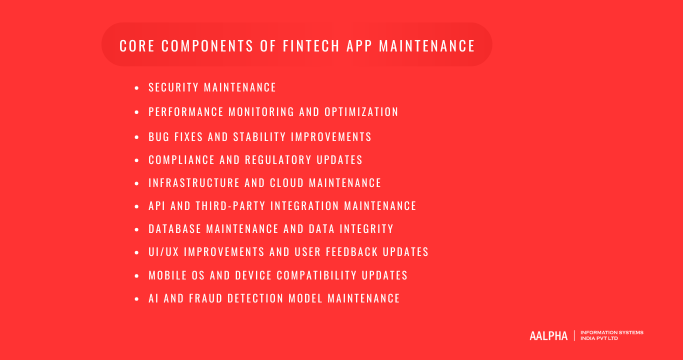
Core Components of FinTech App Maintenance
FinTech app maintenance involves far more than occasional software updates or bug fixes. Financial applications operate in environments where security, compliance, uptime, transaction accuracy, and scalability directly influence customer trust and business continuity. As fintech platforms grow, maintenance becomes a continuous operational discipline that combines cybersecurity, infrastructure engineering, performance optimization, compliance management, and user experience improvements.
A modern fintech application may interact with banking systems, payment gateways, fraud detection engines, investment exchanges, cloud infrastructure platforms, and AI-based financial models simultaneously. Each component introduces operational dependencies that must be continuously monitored and optimized. The core components of fintech maintenance therefore focus on keeping the platform secure, reliable, scalable, compliant, and capable of supporting real-time financial operations without interruption.
-
Security Maintenance
Security maintenance is one of the most important aspects of fintech app operations because financial platforms are constant targets for cyberattacks and fraud attempts. Maintenance teams continuously monitor systems for vulnerabilities, unauthorized access attempts, suspicious transaction behavior, and API exploitation risks.
A core responsibility involves vulnerability patching. Software frameworks, cloud services, APIs, and operating systems frequently release security patches to address newly discovered weaknesses. Delayed patching can expose fintech applications to ransomware attacks, account takeovers, or data breaches. Regular penetration testing is also essential to simulate real-world attack scenarios and identify exploitable weaknesses before attackers discover them.
Threat monitoring systems continuously analyze login activity, transaction patterns, IP addresses, and device behavior to detect fraudulent activities in real time. Many fintech companies implement Security Information and Event Management (SIEM) systems to centralize security monitoring and incident response.
Encryption upgrades are another critical maintenance area. Financial applications must continuously strengthen encryption standards for stored data, API communication, payment information, and authentication workflows to comply with evolving security expectations.
Many fintech businesses are also adopting zero-trust architecture models where no user, device, or system is automatically trusted. Continuous identity verification, least-privilege access control, and network segmentation help reduce the risk of internal and external security breaches.
-
Performance Monitoring and Optimization
Fintech users expect instant transaction processing, fast dashboard loading, and uninterrupted account access. Performance monitoring therefore becomes a continuous maintenance process focused on speed, scalability, and operational reliability.
One major area involves monitoring API response times because fintech platforms rely heavily on APIs for banking integrations, payment processing, market data feeds, and identity verification. Slow APIs can delay transactions and negatively affect customer experience.
Database optimization is equally important because financial applications handle massive volumes of transactional data. Maintenance teams optimize queries, indexing structures, replication systems, and storage configurations to improve read/write efficiency and reduce latency.
Transaction speed monitoring is particularly critical for payment apps, digital wallets, and trading platforms where delays can directly affect financial outcomes. Infrastructure scaling strategies such as load balancing, caching layers, and auto-scaling cloud resources help maintain performance during traffic spikes.
Continuous monitoring tools allow maintenance teams to identify bottlenecks before they impact users. By proactively optimizing infrastructure performance, fintech businesses can maintain stable user experiences even during periods of rapid growth or heavy transaction activity.
-
Bug Fixes and Stability Improvements
Bug fixing in fintech applications requires significantly higher precision than in standard consumer apps because even minor technical issues can affect financial transactions, account balances, or regulatory reporting.
Maintenance teams continuously investigate crashes, transaction mismatches, synchronization failures, login issues, and API communication errors. Stability improvements focus on minimizing downtime, preventing system failures, and ensuring transactional consistency across distributed financial systems.
In many cases, fintech bugs are not immediately visible to users but may affect backend calculations, payment settlements, or reporting systems. Maintenance teams therefore use logging systems, monitoring tools, and automated testing frameworks to identify operational issues early.
Stability maintenance also includes optimizing transaction workflows, improving fault tolerance, strengthening failover mechanisms, and reducing infrastructure dependencies that could trigger cascading failures. The goal is to maintain predictable and reliable financial operations under all conditions.
-
Compliance and Regulatory Updates
Regulatory maintenance is a permanent operational requirement in fintech systems because financial regulations frequently evolve across jurisdictions and industries. Fintech businesses must continuously adapt their applications to remain compliant with legal and financial standards.
Maintenance teams regularly update systems to support requirements related to PCI DSS payment security, GDPR data privacy, PSD2 open banking regulations, anti-money laundering policies, and Know Your Customer verification processes. Regional regulations from authorities such as the Reserve Bank of India (RBI), Financial Conduct Authority (FCA), or Securities and Exchange Commission (SEC) may also require operational adjustments.
Compliance maintenance often includes updating consent management workflows, customer onboarding procedures, transaction logging systems, audit trails, and reporting mechanisms. Documentation and security evidence collection are equally important because regulators may request proof of operational controls and risk management practices.
Failure to maintain compliance can result in penalties, service restrictions, legal liabilities, or loss of financial licenses. For fintech companies operating internationally, maintenance becomes even more complex because multiple regulatory frameworks may apply simultaneously.
-
Infrastructure and Cloud Maintenance
Modern fintech platforms typically rely on cloud infrastructure providers such as Amazon Web Services (AWS), Microsoft Azure, or Google Cloud Platform (GCP). Continuous infrastructure maintenance is necessary to ensure scalability, reliability, disaster recovery readiness, and operational efficiency.
Maintenance teams monitor server uptime, CPU utilization, memory usage, storage capacity, network latency, and infrastructure health across cloud environments. Proactive resource management helps prevent service outages and performance degradation during high transaction periods.
Many fintech businesses use Kubernetes for container orchestration and infrastructure automation. Kubernetes maintenance involves cluster monitoring, workload balancing, security configuration management, and deployment optimization to maintain stable application environments.
Disaster recovery planning is another essential infrastructure maintenance activity. Fintech companies must prepare for data center failures, cyberattacks, hardware outages, and cloud service disruptions. Backup systems, multi-region deployments, failover strategies, and recovery testing ensure business continuity during emergencies.
Cloud maintenance also includes cost optimization by identifying underutilized resources, scaling workloads dynamically, and improving infrastructure efficiency without compromising reliability or security.
-
API and Third-Party Integration Maintenance
Fintech applications depend heavily on third-party integrations for banking connectivity, payment processing, identity verification, tax calculation, fraud detection, and financial data aggregation. Maintaining these integrations is a continuous operational challenge.
Third-party providers frequently modify API structures, authentication protocols, request limits, and response formats. Maintenance teams must continuously monitor API health, update integration logic, and test compatibility whenever external systems change.
Payment gateways and banking APIs require especially careful monitoring because failures can disrupt transactions or create synchronization inconsistencies. Maintenance teams also monitor API latency, token expiration cycles, and webhook reliability to ensure smooth financial operations.
Strong API governance, logging systems, and fallback handling mechanisms help fintech platforms maintain operational resilience even when third-party services experience temporary issues or outages.
-
Database Maintenance and Data Integrity
Fintech applications manage large volumes of highly sensitive transactional and customer data. Maintaining database integrity is critical because inaccurate records can lead to financial discrepancies, compliance violations, and customer disputes.
Database maintenance involves optimizing queries, monitoring replication systems, managing backups, and validating transactional consistency across distributed systems. Maintenance teams also monitor storage growth, indexing efficiency, and data retention policies to maintain long-term performance.
Data integrity checks help identify duplicate transactions, synchronization failures, corrupted records, or reconciliation mismatches. Backup and recovery procedures are regularly tested to ensure critical financial information can be restored quickly in case of system failures.
Because fintech systems often operate in real time, database maintenance must be performed carefully to avoid disrupting active transactions or degrading application performance.
-
UI/UX Improvements and User Feedback Updates
User experience maintenance plays an important role in customer retention and operational efficiency. Fintech users expect simple, intuitive, and transparent financial interfaces that minimize confusion during sensitive financial activities.
Maintenance teams regularly analyze customer feedback, usability reports, transaction abandonment patterns, and support tickets to identify friction points within the application. Small interface improvements can significantly improve transaction completion rates and customer trust.
Examples include simplifying payment workflows, improving account dashboards, clarifying transaction statuses, and optimizing onboarding processes. Accessibility improvements and multilingual support updates may also be implemented to support broader user adoption.
Unlike entertainment applications, fintech platforms must prioritize clarity and accuracy over visual experimentation because confusing financial interfaces can lead to transaction errors or customer dissatisfaction.
-
Mobile OS and Device Compatibility Updates
Fintech mobile applications require continuous compatibility maintenance because mobile operating systems and device ecosystems evolve rapidly. Apple and Google regularly release iOS and Android updates that may affect app performance, permissions, security behavior, or SDK compatibility.
Android fragmentation creates additional complexity because fintech apps must support multiple device manufacturers, screen sizes, hardware capabilities, and operating system versions simultaneously. Maintenance teams continuously test applications across devices to identify compatibility issues before users encounter them.
SDK updates for payment processing, biometric authentication, analytics, and push notifications also require regular implementation and testing. Delayed updates can expose security vulnerabilities or cause functionality failures after operating system upgrades.
Maintaining compatibility ensures fintech users can access financial services securely and reliably regardless of their device environment.
-
AI and Fraud Detection Model Maintenance
Many modern fintech platforms use artificial intelligence for fraud detection, credit scoring, customer support automation, transaction monitoring, and financial recommendations. These AI systems require ongoing maintenance to remain accurate and effective.
Fraud detection models must continuously adapt to evolving attack patterns and behavioral changes. Maintenance teams retrain machine learning models using updated datasets to improve threat detection accuracy and reduce false positives that may incorrectly block legitimate users.
AI maintenance also includes monitoring model drift, validating prediction accuracy, optimizing processing performance, and ensuring compliance with financial regulations governing automated decision-making systems.
Without regular retraining and monitoring, AI systems may become outdated, inaccurate, or biased over time. Continuous optimization ensures fintech platforms maintain strong fraud prevention capabilities while minimizing operational friction for legitimate customers.
FinTech App Security Maintenance Best Practices
Security maintenance is one of the most important operational responsibilities in fintech application management. Financial platforms process sensitive personal information, banking credentials, payment details, investment records, and high-value transactions, making them prime targets for cybercriminals. Unlike ordinary consumer applications, fintech systems must operate under strict security expectations because a single breach can lead to financial losses, legal consequences, regulatory penalties, and long-term reputational damage.
Modern cyber threats targeting financial systems continue to evolve rapidly. Attackers increasingly use phishing campaigns, API exploitation, credential stuffing, ransomware, social engineering, account takeover techniques, and AI-assisted fraud attacks to compromise fintech platforms. As a result, fintech security maintenance must be continuous, proactive, and deeply integrated into daily operations.
Strong fintech security maintenance involves regular audits, real-time threat monitoring, secure infrastructure management, fraud prevention systems, encryption controls, disaster recovery planning, and rapid incident response processes. The following best practices help fintech businesses maintain secure and resilient financial platforms.
-
Regular Security Audits
Regular security audits help fintech companies identify weaknesses in infrastructure, authentication systems, APIs, cloud environments, databases, and application workflows before attackers can exploit them. Security audits are not one-time activities performed only during product launch. They must be conducted continuously because fintech platforms constantly evolve through new features, integrations, and infrastructure changes.
A comprehensive security audit typically reviews user access controls, privilege management, transaction workflows, encryption standards, logging systems, API security, server configurations, and cloud infrastructure policies. Audits also verify compliance with industry standards such as PCI DSS, GDPR, SOC 2, and banking security requirements.
Many fintech companies conduct both internal and third-party audits to obtain independent assessments of their security posture. External auditors often identify hidden risks or configuration issues that internal teams may overlook.
Security audits also improve incident preparedness by identifying operational gaps in monitoring systems, response procedures, and backup mechanisms. Continuous auditing allows fintech organizations to maintain a proactive security strategy instead of reacting only after breaches occur.
-
Penetration Testing and Vulnerability Assessments
Penetration testing and vulnerability assessments are essential components of fintech security maintenance because they simulate real-world attack scenarios against the application environment. These exercises help organizations discover exploitable vulnerabilities before malicious actors identify them.
Vulnerability assessments typically involve automated scanning tools that detect outdated software, insecure configurations, weak authentication controls, exposed APIs, and known security flaws. Penetration testing goes further by allowing ethical security professionals to actively attempt exploitation using techniques similar to real attackers.
Fintech platforms commonly test mobile applications, web portals, APIs, payment systems, authentication workflows, cloud infrastructure, and transaction processing environments. Because financial systems often interact with multiple external services, penetration testing also evaluates third-party integration risks.
Regular testing is especially important after major infrastructure changes, API integrations, feature releases, or cloud migrations. Even small modifications can unintentionally introduce new attack surfaces.
By continuously identifying and fixing vulnerabilities, fintech companies reduce the likelihood of data breaches, fraudulent transactions, and operational disruptions caused by cyberattacks.
-
Multi-Factor Authentication Maintenance
Multi-factor authentication (MFA) is one of the most effective defenses against unauthorized account access and credential-based attacks. However, implementing MFA alone is not sufficient. Fintech businesses must continuously maintain and optimize authentication systems to ensure both security and usability.
Maintenance activities include monitoring failed login attempts, updating authentication libraries, reviewing device trust policies, and strengthening protection against SIM swap attacks or phishing attempts targeting one-time passwords. Biometric authentication systems such as fingerprint or facial recognition also require regular compatibility updates across devices and operating systems.
Fintech companies frequently evaluate authentication flows to balance security with customer experience. Excessively complicated verification processes may increase user friction, while weak authentication controls increase fraud risk.
Continuous MFA maintenance ensures authentication systems remain resilient against evolving attack methods while supporting smooth and secure user access across platforms and devices.
-
Encryption Key Rotation and Management
Encryption is a foundational security requirement in fintech systems because financial platforms store and transmit highly sensitive data. However, encryption security depends heavily on proper key management practices.
Encryption key rotation involves regularly replacing cryptographic keys used to secure customer information, payment data, API communications, and transaction records. Long-term use of static keys increases exposure risk because compromised keys may allow attackers to decrypt sensitive information.
Fintech maintenance teams implement automated key rotation schedules, secure key storage systems, and strict access controls to reduce the possibility of unauthorized key exposure. Hardware Security Modules (HSMs) are commonly used to strengthen key protection in enterprise fintech environments.
Maintenance also includes upgrading encryption algorithms when older standards become vulnerable or outdated. Proper encryption key management ensures financial data remains protected even if attackers gain access to infrastructure components or communication channels.
-
Fraud Detection Monitoring
Fraud monitoring is a continuous operational process in fintech systems because fraud techniques constantly evolve. Attackers adapt rapidly to new security controls, making static fraud prevention systems ineffective over time.
Maintenance teams continuously analyze transaction behavior, account activity, geographic anomalies, device fingerprints, and login patterns to detect suspicious activities in real time. AI-driven fraud detection systems often use behavioral analytics and machine learning models to identify abnormal user behavior.
However, fraud detection models require continuous tuning and retraining to maintain effectiveness. Poorly maintained systems may generate excessive false positives that block legitimate customers or fail to identify sophisticated fraud attempts.
Fintech organizations also maintain transaction scoring systems, velocity rules, and risk analysis engines to improve fraud prevention accuracy. Real-time monitoring dashboards and alerting systems help security teams respond quickly to suspicious activities before financial damage escalates.
Strong fraud monitoring maintenance reduces financial losses while maintaining smooth experiences for legitimate users.
-
Secure API Gateway Management
APIs are central to modern fintech ecosystems because they enable communication between banking systems, payment processors, mobile apps, fraud detection platforms, and third-party financial services. As API usage grows, API security maintenance becomes increasingly important.
Secure API gateway management involves continuously monitoring authentication tokens, rate limits, access permissions, traffic patterns, and abnormal request behavior. Maintenance teams regularly update API security policies to prevent unauthorized access, data leakage, and API abuse attacks.
Fintech organizations often implement OAuth 2.0, tokenization, API throttling, IP whitelisting, and Web Application Firewalls (WAFs) to strengthen API security. Continuous monitoring also helps identify suspicious traffic spikes or bot-driven attacks targeting financial endpoints.
Because fintech APIs directly interact with sensitive transaction systems, API maintenance plays a critical role in protecting the broader financial infrastructure.
-
Data Backup and Disaster Recovery Planning
Fintech businesses must prepare for infrastructure failures, cyberattacks, accidental data corruption, cloud outages, and ransomware incidents that could disrupt operations or compromise financial records. Data backup and disaster recovery planning therefore form a core part of security maintenance.
Maintenance teams regularly perform automated backups of transaction databases, customer records, audit logs, and operational systems. Backup integrity testing is equally important because unusable backups create serious operational risks during emergencies.
Disaster recovery strategies often include multi-region cloud deployments, failover infrastructure, replication systems, and recovery time objective planning. Financial platforms must restore services quickly to minimize transaction disruption and customer impact.
Regular disaster recovery simulations help organizations verify operational readiness and identify weaknesses in recovery procedures before real incidents occur.
-
Security Incident Response Planning
Even highly secure fintech systems may eventually experience security incidents, making incident response planning essential for operational resilience. A well-maintained incident response framework helps organizations contain threats quickly and minimize financial and reputational damage.
Incident response maintenance includes defining escalation procedures, assigning response responsibilities, maintaining communication workflows, and continuously updating recovery playbooks for different attack scenarios. Security teams also conduct incident simulation exercises to improve preparedness and coordination.
Modern fintech response plans typically include automated alerting systems, forensic investigation procedures, legal reporting protocols, customer notification processes, and regulatory communication strategies.
Fast and organized incident response can significantly reduce the impact of breaches or fraud attempts. In financial services, the speed and transparency of incident handling often influence long-term customer trust as much as the incident itself.
Compliance and Regulatory Maintenance in FinTech
Compliance maintenance is one of the most demanding aspects of fintech operations because financial applications must continuously align with evolving legal, security, and data protection regulations. Unlike many traditional software platforms, fintech systems operate within heavily regulated environments where non-compliance can lead to financial penalties, operational restrictions, lawsuits, reputational damage, or even suspension of services.
Regulatory maintenance is not limited to documentation or periodic audits. It directly affects technical architecture, data storage practices, customer onboarding workflows, payment processing systems, authentication methods, transaction monitoring, and reporting mechanisms. As fintech platforms scale internationally, compliance complexity increases further because multiple jurisdictions may impose different legal obligations simultaneously.
Fintech businesses therefore require continuous compliance monitoring, infrastructure adjustments, policy enforcement, and reporting updates to remain legally operational and maintain customer trust. Strong compliance maintenance also improves relationships with banking partners, payment providers, investors, and regulatory authorities.
-
PCI DSS Compliance Maintenance
Payment Card Industry Data Security Standard (PCI DSS) compliance is mandatory for fintech applications that process, store, or transmit cardholder information. Continuous PCI DSS maintenance helps protect payment data from theft, fraud, and unauthorized access.
Maintenance activities include regular vulnerability scanning, secure network configuration reviews, encryption management, access control audits, and monitoring of payment processing environments. Fintech companies must also continuously update firewalls, endpoint protection systems, and transaction security mechanisms to align with evolving PCI requirements.
Employee access management is another critical area because unauthorized internal access can expose sensitive cardholder information. Maintenance teams regularly review permissions and authentication controls to minimize risk exposure.
PCI DSS maintenance also requires periodic security testing, log monitoring, and documentation updates to demonstrate compliance during audits. Failure to maintain PCI compliance can result in penalties, higher transaction processing fees, or restrictions from payment providers.
-
GDPR and Data Privacy Regulations
The General Data Protection Regulation (GDPR) introduced strict rules governing how businesses collect, process, store, and manage personal data belonging to individuals within the European Union. Fintech platforms handling customer financial information must continuously maintain GDPR compliance to avoid legal and financial consequences.
Compliance maintenance includes managing user consent systems, data retention policies, encryption controls, access permissions, and customer data deletion workflows. Fintech companies must also ensure customers can request access to their personal information or request its removal when legally applicable.
Regular audits help identify unnecessary data collection practices or insecure storage systems that may violate privacy regulations. Maintenance teams also monitor third-party vendors and cloud infrastructure providers to ensure external systems comply with data protection obligations.
As privacy regulations expand globally, many fintech businesses adopt GDPR-level standards across all operations to simplify compliance management and strengthen customer trust.
-
KYC and AML Rule Updates
Know Your Customer (KYC) and Anti-Money Laundering (AML) regulations require fintech companies to verify customer identities, monitor suspicious activities, and prevent illegal financial transactions such as money laundering, fraud, and terrorist financing.
KYC and AML maintenance involves continuously updating identity verification workflows, risk scoring systems, transaction monitoring engines, and suspicious activity reporting mechanisms. Regulatory authorities frequently revise compliance requirements, forcing fintech businesses to modify onboarding processes and transaction review policies.
Maintenance teams also update sanction screening databases, politically exposed person (PEP) monitoring systems, and document verification tools to improve fraud prevention accuracy. AI-driven risk analysis systems often require retraining to adapt to evolving financial crime patterns.
Failure to maintain KYC and AML compliance can expose fintech businesses to significant legal liabilities and regulatory enforcement actions. Continuous monitoring and process refinement are therefore essential for operational integrity.
-
Open Banking and PSD2 Requirements
Open banking regulations and the Revised Payment Services Directive (PSD2) have transformed the fintech ecosystem by enabling secure data sharing between banks and authorized third-party providers through APIs.
Maintaining PSD2 compliance requires fintech businesses to continuously secure API infrastructures, strengthen customer authentication mechanisms, and monitor consent management systems. Strong Customer Authentication (SCA) requirements under PSD2 also force companies to maintain advanced identity verification processes for payment authorization.
API monitoring is especially important because open banking ecosystems depend heavily on stable and secure communication between financial institutions and fintech platforms. Maintenance teams continuously update authentication tokens, encryption protocols, and API access controls to maintain secure connectivity.
As open banking frameworks continue evolving globally, fintech companies must regularly adapt integration standards and data-sharing practices to remain compliant and competitive within interconnected financial ecosystems.
-
Audit Trails and Transaction Logging
Audit trails and transaction logging are critical compliance requirements in fintech systems because regulators often require detailed records of financial activities, security events, customer actions, and operational changes.
Maintenance teams continuously monitor logging systems to ensure transaction records remain complete, accurate, and tamper-resistant. Logs typically include transaction timestamps, authentication activities, account modifications, payment processing details, and administrative actions.
Strong audit trail maintenance improves fraud investigations, dispute resolution, compliance reporting, and forensic analysis after security incidents. Many regulations also require long-term retention of financial records, making secure storage and archival management essential operational responsibilities.
Fintech businesses often implement centralized logging systems and automated monitoring tools to detect suspicious activities or operational anomalies in real time. Continuous log management helps organizations maintain transparency, accountability, and regulatory readiness.
-
Regional Compliance Requirements
Fintech companies operating internationally must comply with regional financial regulations that vary significantly across countries and regulatory authorities. Continuous regional compliance maintenance is therefore essential for global fintech operations.
In India, the Reserve Bank of India (RBI) regulates digital payments, lending operations, data localization requirements, and payment infrastructure security. Fintech businesses operating in Indian markets must continuously align with RBI circulars and evolving digital finance policies.
In the United States, organizations such as the U.S. Securities and Exchange Commission (SEC) and Financial Industry Regulatory Authority (FINRA) impose regulations related to investment platforms, securities trading, reporting obligations, and investor protection.
In the United Kingdom, the Financial Conduct Authority (FCA) regulates payment services, open banking operations, and consumer financial protection standards. Meanwhile, Singapore fintech businesses often follow requirements established by the Monetary Authority of Singapore (MAS), which focuses heavily on cybersecurity, operational resilience, and digital payment governance.
Because regulations continuously evolve, fintech maintenance teams must actively monitor legal changes, update operational workflows, revise reporting systems, and maintain strong documentation practices across every region where the platform operates.
FinTech App Maintenance Team Structure
FinTech app maintenance requires a multidisciplinary team because financial platforms operate in highly sensitive, security-driven, and compliance-heavy environments. Unlike standard software products where maintenance may involve a small engineering support team, fintech applications require collaboration between infrastructure engineers, cybersecurity professionals, backend developers, compliance experts, QA specialists, and operational support teams.
Each role contributes to maintaining platform reliability, transaction accuracy, security, scalability, and regulatory compliance. Since fintech applications often process real-time payments, investment transactions, lending workflows, or banking operations, maintenance teams must work continuously to prevent downtime, detect fraud, and resolve technical issues before they affect customers.
As fintech systems scale, maintenance operations become increasingly complex due to growing transaction volumes, expanding API ecosystems, cloud infrastructure demands, and evolving regulatory obligations. A properly structured fintech maintenance team therefore becomes a critical operational asset that directly supports customer trust and business continuity.
-
DevOps Engineers
DevOps engineers play a central role in maintaining fintech application reliability, deployment efficiency, and operational stability. Their primary responsibility is to ensure smooth coordination between development, infrastructure, and operational environments.
In fintech systems, DevOps teams manage CI/CD pipelines, deployment automation, infrastructure monitoring, container orchestration, and incident recovery processes. They continuously monitor system uptime, transaction processing environments, API availability, and server health to identify operational bottlenecks before they affect users.
DevOps engineers also help fintech businesses implement infrastructure scalability strategies during high transaction periods such as market openings, festive payment spikes, or salary processing cycles. They frequently work with Kubernetes, Docker, Terraform, Jenkins, and cloud-native monitoring tools to automate operational workflows and reduce deployment risks.
Efficient DevOps operations improve release stability while minimizing downtime during updates or infrastructure changes.
-
Cybersecurity Specialists
Cybersecurity specialists are responsible for protecting fintech platforms against fraud attempts, cyberattacks, data breaches, and unauthorized access. Because financial systems are high-value targets for attackers, cybersecurity maintenance is a continuous operational requirement rather than an occasional activity.
Security teams monitor threat intelligence feeds, suspicious transactions, authentication anomalies, API vulnerabilities, and infrastructure risks in real time. They also conduct penetration testing, vulnerability assessments, access control reviews, and security audits to identify weaknesses proactively.
Cybersecurity specialists manage encryption systems, zero-trust access policies, fraud prevention tools, endpoint protection platforms, and incident response procedures. They also help maintain compliance with standards such as PCI DSS, GDPR, SOC 2, and banking security regulations.
As fintech threats evolve, security teams continuously strengthen defense mechanisms to protect customer data, transaction integrity, and platform reputation.
-
Backend Engineers
Backend engineers maintain the core transactional logic and server-side systems that power fintech applications. Their responsibilities include optimizing APIs, transaction workflows, databases, payment processing systems, authentication services, and financial calculation engines.
In fintech environments, backend maintenance is highly sensitive because even small logic errors can lead to transaction mismatches, balance inconsistencies, or settlement failures. Backend teams therefore continuously monitor application logs, optimize database queries, and improve fault tolerance mechanisms to maintain operational reliability.
Backend engineers also manage integrations with banking systems, payment gateways, investment platforms, credit bureaus, and fraud detection services. As external providers update APIs or authentication protocols, backend teams ensure compatibility and operational continuity.
Strong backend maintenance helps fintech platforms deliver accurate, secure, and real-time financial operations at scale.
-
Cloud Infrastructure Teams
Cloud infrastructure teams manage the hosting environments that support fintech applications across platforms such as Amazon Web Services (AWS), Microsoft Azure, or Google Cloud Platform (GCP). Their role is critical because fintech systems require high availability, scalability, and disaster recovery readiness.
Infrastructure teams monitor server performance, storage utilization, network latency, load balancing systems, and cloud security configurations continuously. They also manage auto-scaling policies to handle transaction spikes without degrading performance.
Kubernetes cluster management, backup systems, replication strategies, and failover infrastructure are often handled by cloud operations teams. Disaster recovery testing is another essential responsibility because fintech businesses must recover quickly from outages or cyber incidents.
Infrastructure optimization also helps reduce operational costs while maintaining strong reliability and compliance standards.
-
Compliance and Risk Officers
Compliance and risk officers ensure fintech applications operate according to financial regulations, data protection laws, and operational governance standards. Their role becomes increasingly important as fintech businesses expand into multiple markets and regulatory jurisdictions.
Compliance teams monitor changing requirements related to KYC, AML, PCI DSS, GDPR, PSD2, RBI regulations, SEC reporting standards, and financial transaction governance. They work closely with technical teams to update onboarding workflows, reporting systems, audit trails, and customer verification processes.
Risk officers also evaluate operational vulnerabilities, fraud exposure, transaction risks, and third-party vendor risks that could affect business continuity or regulatory compliance. They help organizations prepare for audits and maintain proper documentation for financial authorities.
Strong compliance maintenance reduces legal exposure and improves long-term operational stability.
-
QA and Automation Testing Teams
Quality assurance (QA) and automation testing teams help maintain fintech application reliability by continuously testing features, transaction workflows, APIs, and infrastructure behavior. Since financial platforms cannot tolerate critical bugs, extensive testing is required before every deployment or system update.
QA teams perform regression testing, functional testing, performance testing, security validation, and compatibility testing across devices and operating systems. Automation testing frameworks help accelerate repetitive validation processes while reducing human error.
Testing teams also simulate real-world financial scenarios such as payment failures, transaction reversals, concurrent user activity, and infrastructure outages to verify system stability under stress conditions.
Continuous testing reduces the likelihood of production failures and helps fintech companies maintain consistent customer experiences even during rapid feature releases or infrastructure changes.
-
Customer Support and Incident Response Teams
Customer support and incident response teams serve as the operational bridge between fintech users and technical maintenance teams. Because financial applications involve sensitive transactions and real-money activities, users expect fast issue resolution and transparent communication during operational problems.
Support teams handle account access issues, payment disputes, failed transactions, verification delays, and customer-reported technical problems. They also escalate critical incidents to engineering and security teams when operational risks arise.
Incident response teams coordinate rapid recovery efforts during outages, fraud attacks, infrastructure failures, or security breaches. Their responsibilities include monitoring alerts, managing escalation procedures, coordinating technical investigations, and communicating updates internally and externally.
Efficient incident response operations help fintech businesses reduce downtime impact, maintain customer trust, and minimize reputational damage during high-pressure situations.
Common Challenges in FinTech App Maintenance
FinTech app maintenance presents a unique set of operational and technical challenges because financial applications must remain secure, compliant, scalable, and highly reliable at all times. Unlike many traditional software products, fintech systems operate in real-time financial environments where technical failures can directly affect customer funds, regulatory standing, and business reputation.
As fintech platforms expand, maintenance complexity increases due to growing transaction volumes, evolving cybersecurity threats, multi-country regulatory obligations, and interconnected banking ecosystems. Maintenance teams must continuously optimize infrastructure, strengthen security, manage integrations, and support rapid feature development without disrupting critical financial operations.
The following are some of the most common challenges fintech businesses face while maintaining financial applications.
-
Legacy Banking System Integration
Many fintech applications depend on integrations with traditional banking infrastructure that was not originally designed for modern real-time digital ecosystems. Legacy banking systems often use outdated architectures, slow communication protocols, limited APIs, and rigid operational workflows, creating major maintenance challenges for fintech companies.
Maintenance teams frequently encounter issues related to API incompatibility, delayed transaction synchronization, inconsistent data formats, and limited system flexibility. Even minor updates on the banking side can affect payment processing, account verification, or fund transfer workflows within fintech platforms.
Legacy systems may also have restricted uptime windows, batch-processing dependencies, or slower release cycles that conflict with agile fintech development practices. As a result, fintech maintenance teams must build middleware layers, fallback mechanisms, and monitoring systems to maintain operational stability while interacting with older financial infrastructure.
-
Downtime and Transaction Failures
Downtime is one of the most serious operational risks in fintech maintenance because financial users expect uninterrupted access to payments, banking services, investments, and account management features. Even a few minutes of downtime can trigger failed transactions, revenue loss, customer complaints, and reputational damage.
Transaction failures may occur due to API outages, infrastructure overload, database inconsistencies, third-party integration issues, or cloud service disruptions. In payment systems, failed or duplicated transactions can create reconciliation challenges and customer distrust.
Maintaining high availability requires continuous infrastructure monitoring, load balancing, failover systems, and disaster recovery planning. Fintech maintenance teams must rapidly identify root causes and restore operations before financial disruption escalates.
Unlike social media or entertainment apps where temporary outages may be tolerated, downtime in financial applications directly impacts customer money and business operations.
-
Cybersecurity Threats and Fraud Attacks
Cybersecurity threats continue to grow in sophistication, making security maintenance one of the biggest operational challenges in fintech applications. Financial platforms are frequent targets for phishing attacks, ransomware, API exploitation, credential theft, payment fraud, and account takeover attempts.
Attackers constantly adapt to new security controls, forcing fintech companies to continuously strengthen authentication systems, encryption standards, fraud monitoring tools, and threat detection infrastructure. Maintenance teams must monitor suspicious activity in real time and respond rapidly to emerging threats.
Fraud attacks have also become increasingly complex with the use of automation, bot-driven abuse, synthetic identities, and AI-assisted social engineering tactics. Poorly maintained security systems can expose fintech businesses to financial losses, compliance violations, and reputational damage.
Continuous vulnerability management, penetration testing, incident response readiness, and fraud detection optimization are therefore essential parts of long-term fintech maintenance.
-
Scaling Infrastructure Cost Efficiently
Fintech applications often experience unpredictable growth patterns and transaction spikes that require rapid infrastructure scaling. However, maintaining scalability while controlling operational costs can be difficult, especially for growing startups and high-volume platforms.
Cloud infrastructure costs can increase significantly due to transaction processing workloads, real-time analytics, data storage, backup systems, AI processing, and continuous monitoring requirements. Overprovisioning resources may improve reliability but can also lead to excessive operational expenses.
Maintenance teams must carefully balance performance, availability, and cost optimization. This often involves implementing auto-scaling systems, workload optimization, caching strategies, and infrastructure monitoring tools to improve efficiency.
Scaling becomes even more challenging during high-demand events such as festive payment spikes, stock market volatility, or large promotional campaigns where sudden traffic increases may strain infrastructure unexpectedly.
-
Managing Frequent Compliance Changes
Financial regulations evolve continuously across regions and industries, making compliance maintenance a long-term operational challenge for fintech businesses. Regulatory authorities frequently update rules related to data privacy, digital payments, anti-money laundering, identity verification, and transaction reporting.
Maintenance teams must continuously modify onboarding workflows, authentication systems, reporting mechanisms, audit trails, and customer consent processes to remain compliant. Global fintech businesses face additional complexity because different jurisdictions often impose conflicting or overlapping requirements.
For example, a platform operating across Europe, India, and the United States may simultaneously manage GDPR compliance, RBI payment regulations, and SEC reporting obligations. Each update may require technical, operational, and legal adjustments throughout the platform.
Failure to adapt quickly to compliance changes can result in penalties, operational restrictions, or reputational harm.
-
Handling Large Volumes of Financial Data
Fintech applications generate and process massive amounts of transactional, behavioral, and customer data every day. Managing this growing data volume while maintaining performance, accuracy, and security is a major maintenance challenge.
Financial data systems require real-time synchronization, high-speed query performance, secure archival processes, and accurate reconciliation mechanisms. Poor database optimization can lead to slow transaction processing, reporting delays, or inconsistent financial records.
Maintenance teams must continuously optimize database structures, indexing strategies, replication systems, and storage architectures to support scalability. Backup and recovery systems also become increasingly important as data volumes grow.
Data governance is another critical concern because fintech companies must protect sensitive information while complying with retention policies, privacy regulations, and audit requirements across multiple jurisdictions.
-
Balancing Innovation with Stability
Fintech businesses operate in highly competitive markets where rapid innovation is necessary to attract users and expand services. However, frequent feature releases can increase operational risk if stability and security are not carefully maintained.
Adding new payment methods, AI-driven financial tools, lending features, or open banking integrations may introduce new vulnerabilities, infrastructure dependencies, or transaction complexities. Maintenance teams must therefore carefully test and monitor every change before deployment.
Balancing innovation with stability often requires staged rollouts, feature flag systems, automated testing pipelines, and continuous monitoring frameworks. Fintech companies must avoid situations where aggressive product expansion compromises transaction reliability or customer trust.
Successful fintech maintenance strategies focus on sustainable innovation where new capabilities are introduced without weakening operational resilience, compliance standards, or platform security.
Cost of FinTech App Maintenance
FinTech app maintenance is a long-term operational investment that directly affects platform security, regulatory compliance, customer trust, and business continuity. Unlike standard mobile or web applications, fintech platforms require continuous monitoring, infrastructure optimization, fraud prevention, compliance management, and security maintenance. As a result, maintenance costs in fintech environments are generally higher than those of conventional software products.
The actual cost of maintaining a fintech application depends on several technical and operational factors, including transaction volume, infrastructure complexity, compliance obligations, user growth, and the number of third-party integrations. Businesses evaluating overall fintech app development cost must also account for long-term maintenance expenses such as cybersecurity investments, cloud hosting costs, incident response capabilities, and continuous testing requirements.
While maintenance expenses may appear significant initially, insufficient maintenance often leads to far greater financial risks through downtime, fraud losses, compliance penalties, customer churn, and reputational damage. Proper maintenance therefore functions as both a technical necessity and a strategic business investment.
Factors Affecting FinTech Maintenance Costs
Several variables influence the total cost of fintech app maintenance, and these factors can vary significantly between startups and enterprise financial platforms. These operational considerations also contribute directly to the overall app maintenance cost over time.
Infrastructure size is one of the largest cost drivers. Applications serving millions of users require distributed cloud environments, high-availability systems, disaster recovery infrastructure, and continuous monitoring tools. Larger infrastructure footprints naturally increase operational expenses.
Compliance requirements also heavily influence maintenance costs. Fintech businesses operating under PCI DSS, GDPR, PSD2, AML, KYC, SOC 2, or regional financial regulations must continuously invest in audits, reporting systems, security controls, and compliance monitoring processes.
The number of third-party integrations further increases maintenance complexity. Payment gateways, banking APIs, fraud detection systems, investment data feeds, and credit bureau integrations require continuous monitoring, testing, and compatibility management.
User base growth and transaction volume also impact costs substantially. Higher transaction activity requires stronger infrastructure scaling, database optimization, fraud monitoring, and customer support operations. A digital wallet processing thousands of transactions daily will have significantly different maintenance requirements than a large-scale payment platform processing millions of transactions every hour.
Monthly Maintenance Cost Breakdown
Monthly fintech maintenance costs vary widely depending on platform size, feature complexity, and operational scale. Early-stage fintech startups typically spend less than enterprise financial platforms because they manage smaller infrastructures and lower transaction volumes.
For startups, monthly maintenance costs may range from approximately $3,000 to $15,000 depending on cloud hosting, monitoring systems, security management, API integrations, and basic compliance requirements. Small fintech applications with limited features and moderate user activity may operate within lower maintenance budgets initially.
Mid-sized fintech platforms often spend between $15,000 and $50,000 per month as infrastructure demands, transaction processing volumes, customer support requirements, and compliance obligations increase. These businesses usually require dedicated DevOps support, fraud monitoring systems, automated testing pipelines, and stronger disaster recovery infrastructure.
Enterprise fintech systems and digital banking platforms may spend well beyond $100,000 monthly on maintenance operations. Large-scale financial institutions typically maintain distributed cloud environments, 24/7 incident response teams, advanced fraud detection systems, enterprise-grade security operations, compliance departments, and large engineering teams to support mission-critical financial services.
Maintenance costs also increase over time as platforms scale globally and expand into multiple regulatory regions.
Security and Compliance Cost Considerations
Security and compliance represent a major portion of fintech maintenance expenses because financial platforms operate in high-risk regulatory environments. Continuous investment is required to protect customer data, prevent fraud, and maintain legal compliance.
Security costs often include penetration testing, vulnerability scanning, SIEM systems, endpoint protection, encryption management, fraud monitoring tools, Web Application Firewalls (WAFs), and security incident response capabilities. Many fintech businesses also maintain bug bounty programs and third-party security audits to strengthen protection against evolving threats.
Compliance maintenance introduces additional operational expenses related to PCI DSS certification, GDPR readiness, KYC verification systems, AML monitoring tools, audit preparation, legal consulting, and regulatory reporting infrastructure.
For fintech businesses handling sensitive financial data, reducing security investments may create far greater long-term costs through fraud losses, regulatory penalties, lawsuits, operational disruption, or reputational damage. As a result, security and compliance maintenance should be treated as core operational investments rather than optional expenses.
In-House vs Outsourced Maintenance Costs
Fintech businesses must decide whether to maintain internal maintenance teams or outsource operational support to specialized fintech technology providers. Each model has different cost implications and operational advantages.
In-house maintenance provides greater operational control, direct communication, and deeper internal knowledge of the platform architecture. However, building internal teams can be expensive because fintech maintenance requires specialized professionals such as DevOps engineers, cybersecurity specialists, compliance experts, backend engineers, and QA automation teams.
Recruitment costs, salaries, training, infrastructure tools, and 24/7 operational support can significantly increase long-term expenses for internal teams.
Outsourced fintech maintenance can reduce operational overhead while providing access to experienced specialists and established operational processes. Many fintech businesses work with specialized technology providers to manage infrastructure monitoring, security operations, cloud maintenance, compliance support, and application updates.
Outsourcing may be especially beneficial for startups and growing fintech companies that require enterprise-level expertise without maintaining large internal operational teams. Experienced firms such as Aalpha Information Systems often help fintech businesses manage maintenance operations cost-effectively while supporting scalability and compliance requirements.
Long-Term ROI of Proper Maintenance
Proper fintech app maintenance delivers significant long-term return on investment by reducing operational risk, improving customer trust, and supporting sustainable platform growth. Well-maintained fintech systems experience fewer outages, lower fraud exposure, stronger compliance readiness, and better transaction reliability.
Continuous maintenance also improves customer retention because users are more likely to trust platforms that provide stable, secure, and responsive financial services. Strong operational reliability helps fintech businesses protect brand reputation while reducing costly emergency incidents and infrastructure failures.
From a business perspective, proactive maintenance is far less expensive than recovering from security breaches, prolonged downtime, regulatory penalties, or large-scale transaction failures. Companies that invest consistently in maintenance often scale more efficiently and maintain stronger competitive positioning in highly regulated financial markets.
Final Thoughts
FinTech app maintenance is not just about fixing bugs after launch. It is a continuous process focused on security, compliance, performance, scalability, and transaction reliability. As financial platforms grow, proper maintenance becomes essential for protecting customer trust, preventing fraud, and ensuring uninterrupted operations.
Businesses that invest in proactive fintech maintenance are better positioned to scale securely, adapt to changing regulations, and deliver stable user experiences in highly competitive financial markets.
If you are planning to build or maintain a secure fintech platform, working with an experienced technology partner like us can help ensure long-term operational success, compliance readiness, and scalable infrastructure management. Connect with us to discuss your fintech app development and maintenance requirements.
FAQs
What is fintech app maintenance?
Fintech app maintenance is the continuous process of monitoring, updating, securing, and optimizing financial applications after launch. It includes security updates, bug fixes, compliance management, infrastructure monitoring, API maintenance, and performance optimization to keep the platform stable and secure.
Why is fintech app maintenance important?
Fintech applications handle sensitive financial data and real-money transactions. Regular maintenance helps prevent security breaches, transaction failures, downtime, compliance violations, and fraud attacks while maintaining customer trust and operational reliability.
How much does fintech app maintenance cost?
Fintech app maintenance costs vary based on infrastructure size, transaction volume, security requirements, compliance obligations, and third-party integrations. Startup fintech apps may spend a few thousand dollars monthly, while enterprise financial platforms can spend significantly more on infrastructure, monitoring, and security operations.
How often should fintech apps be updated?
Fintech apps require continuous updates. Security patches, infrastructure improvements, API upgrades, and compliance changes may occur weekly or monthly. Major feature updates and performance optimizations are typically scheduled regularly based on business needs and regulatory requirements.
What security measures are required for fintech apps?
Fintech applications require strong encryption, multi-factor authentication, fraud monitoring, secure APIs, penetration testing, access control systems, threat detection, transaction monitoring, and regular vulnerability assessments to protect financial data and user accounts.
What compliance standards apply to fintech applications?
Common compliance standards include PCI DSS for payment security, GDPR for data privacy, PSD2 for open banking, KYC and AML regulations for identity verification and fraud prevention, and regional financial regulations such as RBI guidelines in India or FCA requirements in the UK.
Can fintech app maintenance be outsourced?
Yes. Many fintech businesses outsource maintenance operations to experienced technology providers that specialize in fintech infrastructure, security, compliance, cloud management, and DevOps operations. Outsourcing can reduce operational costs while providing access to specialized expertise.
What happens if a fintech app is not maintained properly?
Poor maintenance can lead to security breaches, failed transactions, compliance penalties, fraud attacks, downtime, customer dissatisfaction, and reputational damage. In severe cases, operational failures may result in financial losses or regulatory restrictions on the business.