



Modern eCommerce platforms succeed or fail based on the strength, stability, and intelligence of their backend systems. While customers interact with the visual interface on the frontend, every action that creates value for a business happens beneath the surface. The backend processes transactions, manages product and inventory data, orchestrates logistics, secures user information, and ensures that thousands or even millions of operations occur consistently without breaking. As online retail continues to scale across devices, channels, and markets, the backend has become the core infrastructure that enables reliability, speed, personalization, and automation. Businesses often ask what drives the seamless experiences shoppers now take for granted, and the answer almost always leads back to backend architecture.
A strong backend determines the reliability and scalability of modern eCommerce because it dictates how efficiently the system can respond to real-time customer activity while accommodating long-term growth. Retailers increasingly operate in environments defined by sharp traffic spikes, seasonal demand fluctuations, multi-location fulfillment, complex catalogs, and omnichannel journeys. A poorly designed backend begins to fail when orders surge, when inventory updates lag, or when systems cannot synchronize across warehouses and marketplaces. Research from Google shows that even a one-second delay in page load time reduces conversions by up to seven percent, and backend performance plays a major role in serving dynamic content quickly. Scalable architectures, such as microservices or serverless models, allow eCommerce businesses to isolate workloads, rapidly introduce new features, and handle unpredictable loads without downtime. This resilience becomes a competitive advantage in markets where customers expect uninterrupted availability and fast checkout flows at all times.
To understand what the backend does in an eCommerce platform, it helps to view it as the command center responsible for enabling every critical transaction. It stores and manages the product catalog, ensuring accurate information across thousands of SKUs. It authenticates users, maintains profiles, and secures personal data. It powers the shopping cart and checkout logic, validates inventory, calculates taxes and shipping, and communicates with payment gateways. The backend triggers order creation, sends instructions to fulfillment centers, updates stock levels, and tracks shipments across courier partners. It also integrates search engines, recommendation modules, reviews, discounts, and automated notifications. From placing an item in the cart to receiving a delivery update, every step is orchestrated by the backend’s business logic and its connections to internal and external systems.
The experiences shoppers expect today are highly dependent on backend intelligence, even though users rarely see it. When visitors browse a store and instantly find relevant products through autocomplete search, it is powered by backend indexing and search engines like Elasticsearch. When they view personalized recommendations such as “Customers also bought,” the backend analyzes behavior patterns and uses machine learning models to surface relevant items. Real-time inventory updates ensure shoppers don’t purchase out-of-stock items, and accurate delivery estimates appear only because backend systems communicate with logistics APIs. Order tracking, proactive notifications, guest checkout, seamless payment processing, and smooth returns workflows all rely on robust backend execution. As eCommerce becomes more interactive and omnichannel, the backend increasingly handles tasks such as syncing products across marketplaces like Amazon or Flipkart, coordinating restocks between warehouses, and processing data streams from mobile apps and point-of-sale systems.
A powerful backend directly improves conversion rates, retention, speed, and automation because it optimizes the performance and intelligence of every customer action. Fast database queries and efficient caching reduce page load times, which correlates strongly with higher conversion rates according to multiple industry studies. Smooth checkout flows supported by well-designed backend logic reduce abandonment. Automated order routing, dynamic pricing engines, and rules-based promotions improve operational efficiency while enabling personalized experiences that drive repeat purchases. A strong backend also supports predictive analytics, helping businesses anticipate demand, prevent stockouts, and optimize supply chains. Automation reduces manual errors in order management, inventory reconciliation, refunds, and customer service. When systems operate reliably, customers trust the platform, return more often, and spend more per visit.
The backend is therefore not just a technical layer but a strategic foundation for eCommerce growth. As competition intensifies and expectations rise, businesses that invest in scalable, secure, and data-driven backend infrastructure position themselves to innovate faster, respond to customer needs more accurately, and expand into new markets without fear of system failures. In the chapters that follow, this guide explores how backends work, which components matter most, how architecture decisions shape performance, and what it takes to build a future-proof eCommerce backend capable of supporting millions of transactions in real time.
TL;DR
Modern eCommerce relies on backend systems that coordinate everything customers never see yet depend on every second. The backend manages product data, user authentication, carts, payments, inventory, and logistics while ensuring millions of real-time operations execute reliably. Architectural choices such as monolithic, microservices, headless, or serverless models determine how well a platform scales during peak traffic and how easily it evolves. Technologies like relational and NoSQL databases, distributed caching, search engines, message queues, and CI/CD pipelines form the backbone of performance. Scalability strategies such as database sharding, distributed caching, autoscaling, and event-driven processing are essential for handling surges like Black Friday. Integrations with payment gateways, logistics APIs, ERPs, CRMs, and recommendation engines turn the backend into a unified operational ecosystem. The methodologies commonly applied by an expert eCommerce development company highlight how crucial structured engineering, observability, and domain-specific workflows are for delivering seamless shopping experiences. Ultimately, the strength of the backend determines conversion rates, site speed, reliability under load, automation depth, and long-term business growth.
How eCommerce Backends Work: Core Concepts Explained
An eCommerce backend is a complex orchestration of server-side logic, data storage systems, communication layers, and integration components that together enable the entire shopping experience. While the frontend handles what customers see, the backend executes the operations that make transactions possible. Understanding how these components work together provides insight into why backend engineering is central to building stable, scalable, and conversion-focused digital commerce systems. The effectiveness of the backend determines how fast data loads, how accurately orders are processed, how secure payments are, and how reliably inventory synchronizes across channels. As eCommerce grows more data-heavy and experience-driven, the backend acts as the operational engine that transforms business rules into practical customer functionality.
At the core of every backend is server-side logic, which governs how requests from the frontend are processed. Whenever a user performs an action, such as browsing a product or adding an item to their cart, the frontend sends a request to the server. Server-side logic interprets that request, interacts with the database or third-party APIs, applies business rules, and sends a properly structured response. This logic determines how search results should be ranked, how discounts should apply, how many items should be available to purchase, and whether a checkout session should be approved or rejected. It also enforces security considerations such as authentication and authorization. Without strong server-side logic, an eCommerce platform becomes inconsistent, slow, or prone to failures during high-traffic periods. Languages such as Node.js, Python, Java, PHP, and Go are commonly used to implement this logic, supported by frameworks that enforce clean architectural patterns.
Databases form another critical layer, responsible for storing and retrieving vast amounts of structured and unstructured data. eCommerce systems manage large datasets across multiple categories, including product information, user profiles, order histories, inventory counts, and transactional logs. Relational databases such as PostgreSQL and MySQL are widely used for structured data due to their consistency models and reliable transaction handling. They excel in ensuring that order integrity and inventory updates happen correctly. NoSQL databases like MongoDB, DynamoDB, or Cassandra are used when flexible schema design or high-speed reads are required. Databases rely on indexing strategies, replication, partitioning, and caching to optimize performance. For example, product queries often use indexed fields to retrieve thousands of SKUs quickly, while order tables are optimized to maintain strong ACID properties. The backend determines how this data is stored, how it is updated during peak load, and how efficiently it is served to the user.
To connect the backend with frontends, mobile apps, admin dashboards, and third-party systems, eCommerce platforms rely heavily on APIs and microservices. APIs define how different components communicate and exchange data. REST and GraphQL APIs are commonly used to support storefronts, mobile apps, warehouse systems, and marketing tools. Modern platforms increasingly use microservices to separate the eCommerce backend into smaller, independently deployable units. A microservice may handle a specific domain such as cart management, search, payments, or inventory. Each service communicates with others over APIs or message queues. This modular approach improves reliability, fault tolerance, and scaling flexibility. For example, during a festival sale, the cart or checkout service may need far more compute resources than the reviews service. Microservices allow independent scaling, reducing overall infrastructure cost while improving performance. They also support faster development cycles because teams can update services without impacting the entire system.
Understanding the difference between monolithic and microservice-based architectures is essential for choosing the right approach. A monolithic eCommerce backend bundles all business logic, APIs, and database interactions into a single codebase and deployment unit. Monoliths are easier to build initially, simpler to debug, and cost-effective for small to mid-size applications. However, they become rigid and harder to scale as complexity grows. Introducing new features may affect the entire system, and high-traffic surges can strain the application because resources cannot be allocated selectively. In contrast, microservice-based eCommerce decomposes the backend into separate services that operate independently. This approach excels in large, high-volume environments where services must scale horizontally and function even when other components fail. It supports continuous deployment, reduces downtime, and enables global expansion with region-specific optimizations. The trade-off is that microservices require strong DevOps, observability, and API governance to avoid fragmentation.
Real-world backend workflows illustrate how these concepts work together. The search workflow begins with the frontend sending a search query to the backend. The backend forwards the query to a search engine such as Elasticsearch, which has indexed millions of product attributes. It returns ranked results, and the backend formats them before delivering them to the frontend. In the checkout workflow, the backend validates the cart against inventory, checks address eligibility, calculates taxes and shipping rates, and creates an order. This involves real-time communication between inventory services, payment gateways, and shipping providers. When the user initiates payment, the backend securely transfers transaction details to a payment gateway. The gateway returns a confirmation or failure response, which the backend uses to finalize the order workflow. After payment success, the backend generates an order ID, reserves stock, issues invoices, updates the database, and triggers a fulfillment request to the warehouse or logistics system.
Similarly, the order tracking workflow relies on backend integrations with logistics APIs. Couriers send status updates such as “picked up,” “in transit,” or “delivered,” which the backend stores and pushes to the user through notifications and the order tracking page. These workflows highlight the importance of synchronization, data accuracy, and latency control. Any delay in a backend process directly affects customer trust and conversion outcomes.
In practice, the backend acts as the nervous system of eCommerce. It coordinates hundreds of interconnected operations that happen every second across catalog management, cart processing, payments, order orchestration, and logistics. As eCommerce continues to evolve with AI-driven personalization, multi-warehouse fulfillment, omnichannel retail, and real-time data flows, backend systems must be engineered with a balance of scalability, resilience, and extensibility. A deep understanding of these core concepts allows businesses to innovate confidently while ensuring that the shopper experience remains seamless, secure, and fast across every touchpoint.
Key Backend Components of an eCommerce Platform
A high-performing eCommerce backend is made up of interconnected components that collectively support product discovery, secure transactions, order fulfillment, and post-purchase engagement. Each component plays a distinct role but must operate seamlessly with others to ensure fast, accurate, and reliable shopping experiences. Understanding these components in detail is essential for designing systems that scale with demand, minimize operational friction, and deliver customer journeys that feel effortless. The following sections break down the most critical backend modules that underpin modern eCommerce platforms, covering how they work, why they matter, and how they shape business performance.

-
Product Information Management
Product information management sits at the core of any eCommerce system because it maintains the integrity of all product-related data. This includes titles, descriptions, specifications, pricing, variants, images, stock status, and metadata. The backend must support a flexible, structured schema to handle thousands or even millions of SKUs efficiently. It also needs mechanisms for bulk updates, version control, and approval workflows when teams manage catalogs collaboratively. Strong indexing and caching ensure that product pages load quickly and that changes propagate instantly across the store, marketplaces, and mobile apps. When product information is inconsistent or slow to update, customers face broken experiences, leading to reduced trust and lower conversions. That is why PIM systems often integrate with ERP, DAM, and SEO tools to maintain accuracy across channels.
-
User Authentication and Account Systems
A secure and reliable authentication system ensures that users can create accounts, log in, and manage personal information safely. This module handles password encryption, token-based authentication, session management, and multi-factor authentication. It must also protect against common vulnerabilities like session hijacking, credential stuffing, and brute-force attacks. Beyond basic login functionality, account systems store order histories, saved addresses, payment methods, wishlists, and preferences. Backend logic ensures that users can retrieve past purchases, reorder items, or seamlessly transition between devices while staying logged in. When authentication is robust and frictionless, customers feel safe and confident making purchases regularly.
-
Cart and Checkout Logic
Cart management is one of the most critical backend functions, as it determines how users accumulate items, apply rules, and progress toward conversion. The backend must maintain cart state, handle multiple device sessions, validate availability, enforce pricing logic, and manage time-based expiry of cart data. During checkout, the backend applies address validation, calculates taxes and shipping costs, checks payment eligibility, and confirms inventory allocation. A well-designed checkout logic reduces abandonment rates significantly. Studies in digital commerce consistently show that slow or complex checkout processes are among the primary reasons for customer drop-off. Efficient backend workflows ensure that checkout remains fast, responsive, and intelligent enough to adapt to complex business rules like multi-warehouse routing or region-specific tax calculations.
-
Order Management Engine
The order management engine orchestrates the lifecycle of every purchase from confirmation to final delivery. Once an order is placed, the backend must validate payment, record the transaction, allocate stock, generate an invoice, and assign the order to the appropriate fulfillment center or vendor. It also tracks order status changes such as processing, packed, shipped, out for delivery, and delivered. In marketplace or multi-seller models, the engine manages split shipments and vendor-specific workflows. It must support cancellation, modification, returns, and refund logic while ensuring accurate audit trails. A reliable order management engine reduces operational overhead and eliminates manual intervention by automating routing rules, exception handling, and reconciliation processes.
-
Payment Processing and Settlements
Payment processing is one of the most sensitive backend components because it directly involves secure financial transactions. The backend integrates with payment gateways, wallets, UPI providers, credit card networks, and alternative payment methods. It handles tokenization, fraud checks, payment authorization, and response validation. It also ensures compliance with PCI-DSS and other financial regulations. A strong payment module must support multiple currencies, settlement workflows, subscription billing, partial payments, and refunds. The speed at which a payment request is processed has a measurable impact on conversion rates. A resilient backend ensures that failed transactions are retried intelligently, customer data remains protected, and reconciliation with financial institutions happens reliably.
-
Inventory and Warehouse Management
Inventory accuracy is vital for preventing stockouts, overselling, and operational inefficiencies. The backend must maintain real-time stock counts across warehouses, stores, and distribution centers. It also needs logic for managing reserved quantities during checkout, replenishment forecasting, expiry-based products, and lot tracking for regulated goods. For fast-moving eCommerce operations, inventory data must sync instantly across all channels including marketplaces, POS systems, and third-party logistics partners. Backend systems often integrate predictive analytics to forecast demand and automate purchase orders. When inventory management is precise, businesses reduce carrying costs and improve customer satisfaction by ensuring availability.
-
Shipping, Logistics, and Tracking Systems
The shipping and logistics module connects the business with delivery partners and fulfillment centers. The backend must calculate shipping costs based on distance, weight, speed, and courier availability. It generates shipping labels, manages pickups, and tracks parcel movements. Integration with logistics APIs allows the backend to receive real-time updates such as “shipped,” “in transit,” or “delivered.” These updates flow into the user’s account and trigger notifications. For multi-warehouse operations, the backend intelligently routes shipments from the nearest location to reduce cost and delivery time. Efficient logistics systems directly influence customer satisfaction and repeat purchase behavior.
-
Search, Filtering, and Recommendations
Search is one of the strongest conversion drivers in eCommerce. Backend systems rely on search engines like Elasticsearch or OpenSearch to index product attributes and return accurate, fast results. Autocomplete suggestions, typo correction, synonym matching, and relevance scoring occur at the backend level. Filtering capabilities depend on the backend’s ability to structure product attributes and apply dynamic query logic. Personalized recommendations use machine learning models, browsing patterns, and collaborative filtering techniques to suggest relevant products. A robust search and recommendation engine improves product discovery, increases average order value, and enhances customer engagement.
-
Promotions, Coupons, and Pricing Engines
The pricing engine governs how products are priced and how promotional rules are applied. This module must support percentage discounts, fixed-amount coupons, BOGO rules, tiered pricing, bulk discounts, dynamic pricing, subscription discounts, and loyalty points. The backend must enforce rule precedence, validate eligibility, prevent misuse, and ensure that promotions do not conflict. For marketplaces, vendor-specific pricing logic and commission structures must be managed. A flexible pricing engine enables businesses to experiment with marketing campaigns, drive conversions, and adjust strategies based on real-time demand without risk of errors.
-
Notifications, Emails, and Transactional Messaging
Timely and accurate communication is essential for completing the purchase journey and maintaining customer trust. The backend handles automated messaging workflows, including order confirmations, shipment updates, delivery alerts, payment receipts, refund notifications, and abandoned cart reminders. It integrates with email providers, SMS gateways, push notification services, and WhatsApp APIs. These communication channels rely on backend event triggers and message queues to ensure real-time delivery without overwhelming the infrastructure. Well-structured messaging logic strengthens customer experience, reduces support queries, and reinforces transparency throughout the lifecycle of an order.
Each backend component plays an essential role in enabling reliable, scalable, and user-centric eCommerce operations. When these modules are designed with strong data consistency, efficient workflows, and seamless integration, the result is a platform that can support rapid growth, complex business models, and global expansion. Together, these backend systems form the operational backbone that transforms digital storefronts into fully functional retail engines capable of serving millions of customers with speed, accuracy, and personalization.
Choosing the Right Backend Architecture
Selecting the right backend architecture is one of the most strategic decisions in eCommerce development because it affects scalability, performance, development velocity, infrastructure costs, and the ability to evolve the platform over time. The architecture determines how backend services communicate, how data flows between systems, and how the platform responds during peak demand. With eCommerce businesses ranging from small online shops to global marketplaces handling millions of requests per minute, there is no single architecture that fits all. Instead, the decision must reflect the business model, expected traffic, operational complexity, and long-term growth plans. The following sections explore the four most relevant backend architectures in modern eCommerce and offer guidance on when each approach performs best.
Monolithic Architecture: When It Works and When It Doesn’t
A monolithic architecture bundles all backend components such as product management, checkout logic, order processing, payments, and inventory into a single unified codebase and deployment unit. This approach was the default for early eCommerce platforms because it is simpler to build, easier to manage initially, and more cost-effective for small teams.
Monolithic backends work well in scenarios where traffic levels are moderate, product catalogs are small to medium sized, and business logic is not highly specialized. Startups and small retailers often prefer monoliths because they allow faster development cycles, simplified debugging, and fewer infrastructure requirements. A single application can handle all requests, and developers can make changes without coordinating multiple services.
However, monolithic systems begin to struggle when scalability and flexibility become priorities. As order volumes grow, a monolith cannot scale individual components independently. For example, during a festival sale, the checkout module may require more compute resources than the reviews module, but a monolith scales everything together whether needed or not. This increases cost and reduces reliability. Monolithic architectures also slow down development when teams grow, because multiple developers modifying the same codebase increases risk of conflicts, longer deployments, and higher chances of system-wide failures. For businesses planning rapid expansion, multi-location warehouses, or heavy customization, monolithic platforms become limiting.
Microservices Architecture: Benefits and Trade-offs
Microservices architecture breaks the backend into multiple small, independently deployable services. Each service handles a specific domain such as cart management, search, payments, or inventory. These services communicate through APIs or message queues, enabling flexibility, fault tolerance, and horizontal scaling.
Microservices offer major benefits for scaling eCommerce operations. During high traffic events, individual services can scale independently. If only the cart and checkout services need additional resources, they can expand without affecting other modules. This reduces infrastructure cost and improves overall performance. Teams can also develop and deploy services independently, improving development velocity and reducing downtime risk. Microservices also support global expansion by allowing region-specific services, such as localized taxes or shipping rules.
However, the trade-offs are significant. Microservices introduce architectural complexity and require strong DevOps practices, observability systems, distributed logging, and mature CI/CD pipelines. If service communication is not carefully designed, latency issues can emerge. Coordination across multiple services increases operational overhead, and debugging becomes more challenging due to distributed processes. Therefore, microservices should be adopted by businesses with experienced engineering teams, clear domain boundaries, and a need for large-scale operations.
Headless eCommerce Backends: Best Use Cases and Risks
Headless eCommerce decouples the frontend and backend, allowing each to operate independently with communication through APIs. The backend provides data, business logic, and order processing, while the frontend can be built with frameworks like React, Next.js, Vue, or mobile native apps.
Headless architecture is ideal for businesses that require multi-channel experiences. If a retailer wants to serve content across web, mobile, kiosks, in-store displays, marketplaces, and social commerce platforms, a headless backend becomes a strategic advantage. It enables fast frontend development, experimentation with user experiences, and flexibility to redesign interfaces without touching backend logic. Headless systems also integrate well with microservices and modular APIs, allowing brands to deliver rich, dynamic, and personalized content across channels.
However, going headless introduces challenges. It requires a strong API layer capable of managing real-time requests efficiently. If the API is slow or poorly designed, the entire user experience suffers. Additionally, headless setups demand more development resources because the frontend must be built from scratch rather than relying on pre-designed themes. Businesses with simple storefronts may find headless architecture unnecessarily complex and expensive.
Serverless Architecture for eCommerce
Serverless architecture allows backend logic to run on demand through cloud functions rather than dedicated servers. Providers like AWS Lambda, Google Cloud Functions, and Azure Functions execute code when triggered, scaling automatically based on incoming traffic. This model is especially useful for unpredictable traffic patterns common in retail.
Serverless backends significantly reduce infrastructure management efforts. Auto-scaling ensures high availability during flash sales or product launches without manual intervention. Costs also decrease because businesses only pay for actual compute usage instead of idle server time. Serverless functions work well for tasks such as image processing, payment confirmation, catalog synchronization, webhook handling, and personalized recommendations.
Despite its advantages, serverless architecture has limitations. Cold-start latency can impact user experience if functions are not frequently invoked. Long-running processes like complex order workflows may not fit serverless constraints. Additionally, debugging and monitoring distributed serverless functions require advanced tooling. Serverless works best as a complement to microservices or modular architectures rather than a full replacement for traditional backends.
Modular APIs vs. All-in-One Platforms
Businesses often face a choice between using modular APIs or adopting all-in-one backend platforms. Modular API ecosystems such as Stripe, CommerceTools, and ElasticPath allow businesses to assemble best-in-class components for payments, catalog, cart, promotions, and search. This increases flexibility and allows rapid innovation.
Modular APIs benefit companies with complex business models, marketplace requirements, or specialized workflows. They reduce development time because backend teams can integrate ready-made components instead of building from scratch. However, this approach increases dependency on third-party vendors, which may affect long-term costs and performance.
In contrast, all-in-one platforms like Magento, Shopify Plus, and BigCommerce provide prebuilt backend modules in a unified system. These platforms simplify architecture design, reduce integration overhead, and accelerate time to market. They work well for mid-sized businesses that prioritize convenience and predictable maintenance. The trade-off is reduced customization and limited control over infrastructure, which becomes restrictive for enterprises with unique needs.
Example Architectural Diagrams and Scenarios
Scenario A: Small Retailer with Low to Moderate Traffic
A monolithic backend with a relational database is ideal.
Architecture:
Frontend → Monolithic Backend → Database → Payment Gateway → Logistics API
Why it works: Low complexity, minimal operational overhead, fast launch.
Scenario B: Mid-Size Brand with Omnichannel Selling
A headless backend with modular APIs provides agility.
Architecture:
Frontend Apps → API Gateway → Cart/Order Services → PIM → Payment & Search APIs
Why it works: Supports web, mobile, POS, and marketplace channels through a unified backend.
Scenario C: High-Volume Enterprise or Marketplace
A microservices architecture is necessary for scaling.
Architecture:
API Gateway → Microservices (Cart, Search, Orders, Payments, Inventory) → Event Bus → Databases
Why it works: Each service scales independently; ideal for millions of transactions.
Scenario D: Event-Driven, Dynamic Retail Operations
Serverless functions enhance responsiveness.
Architecture:
Frontend → Backend Services → Serverless Functions (Notifications, Media Processing) → Event Triggers
Why it works: Automatically handles unpredictable spikes and reduces compute cost.
Backend architecture influences every aspect of eCommerce performance. The decision depends on traffic expectations, business complexity, development capabilities, and long-term goals. Whether choosing monolithic simplicity, microservice scalability, headless flexibility, or serverless efficiency, the architecture must support fast, secure, and resilient customer experiences. Businesses that invest wisely in backend architecture gain the capacity to innovate faster, handle surging demand, and expand into new markets with confidence.
Technology Stack for eCommerce Backend Development
Choosing the right technology stack for an eCommerce backend is a foundational step that influences performance, scalability, development velocity, security, and long-term maintainability. Modern digital commerce requires a mix of programming languages, frameworks, databases, caching layers, search technologies, messaging queues, CDNs, and DevOps tools. Each technology plays a distinct role in ensuring the platform processes transactions quickly, handles high traffic reliably, and supports evolving business logic. In this section, we break down the essential components of a robust eCommerce backend technology stack, why they matter, and where they fit into the overall architecture.
Programming Languages Commonly Used
Different programming languages offer unique strengths, making them suitable for specific eCommerce requirements.
Node.js:
Node.js is widely used for eCommerce because it handles asynchronous operations efficiently. High-traffic workflows such as checkout, search, and real-time inventory updates benefit from Node’s event-driven architecture. The large ecosystem of npm packages accelerates development.
Python:
Python offers rapid development capabilities and clean syntax, making it ideal for building scalable backend services and AI-driven personalization engines. Frameworks like Django and Flask power secure, modular eCommerce architectures. Python’s rich data science ecosystem also supports demand forecasting and recommendations.
PHP:
PHP continues to be popular due to platforms like Magento, WooCommerce, and Laravel-based custom systems. It excels in traditional monolithic eCommerce setups. Its wide developer community and cost-effective hosting make PHP accessible for small and mid-sized businesses.
Java:
Java is a mature, enterprise-grade language known for reliability, multithreading, and performance. It is often used in large marketplaces and global commerce platforms. Frameworks like Spring Boot allow modular, microservices-friendly architectures capable of handling millions of requests.
Go (Golang):
Go is increasingly used for performance-critical systems due to its high concurrency support and low resource footprint. It is ideal for backend services requiring fast response times, such as cart management, search indexing, and payment processing.
Each language brings a different balance of simplicity, power, and scalability, and businesses often choose based on their team’s expertise and architectural goals.
Backend Frameworks and Why They Matter
Backend frameworks accelerate development by providing reusable components, structured architecture, and built-in security features.
Express.js (Node.js):
Known for flexibility and minimalism, Express is widely used for building REST APIs and microservices. Its middleware ecosystem allows rapid customization.
NestJS (Node.js):
A more structured framework, NestJS supports TypeScript and modular architecture. It is ideal for enterprise-grade systems requiring dependency injection and monorepo-style organization.
Django (Python):
Django offers batteries-included capabilities such as ORM, authentication, admin dashboards, and security features. It suits monolithic or modular eCommerce platforms.
Flask (Python):
Lightweight and flexible, Flask is preferred for microservices or custom backend services where developers want full control.
Laravel (PHP):
Laravel provides elegant syntax, built-in authentication, queue management, and caching. It is highly suited for feature-rich monolithic eCommerce systems.
Spring Boot (Java):
Spring Boot offers production-ready microservices, dependency management, and strong performance. It is widely used in enterprise-scale commerce systems.
Framework choice affects code maintainability, performance, deployment strategies, and developer productivity, making it a crucial architectural decision.
Databases: SQL vs NoSQL for eCommerce
Data storage is a core concern for eCommerce because the system must manage products, users, orders, transactions, and inventory at scale.
SQL Databases
Examples: PostgreSQL, MySQL, MariaDB
SQL databases are ideal when strong consistency, ACID transactions, and structured schemas are required. Order management, payments, and inventory depend on reliable relational models.
Benefits include:
- Complex joins and structured queries
- High data accuracy and transactional integrity
- Mature tooling and backup strategies
NoSQL Databases
Examples: MongoDB, DynamoDB, Couchbase
NoSQL databases support flexible schemas and high-speed reads, which are valuable for catalogs, analytics, and personalized experiences.
Benefits include:
- Horizontal scalability
- Schema flexibility for rapidly changing product data
- Fast reads for caching and recommendation systems
Most high-growth eCommerce platforms use a hybrid approach. SQL handles financial and inventory workflows, while NoSQL powers product catalogs, user behavior analytics, and search metadata.
Caching Systems (Redis, Memcached)
Caching is essential for reducing database load and improving response times.
Redis:
Redis is commonly used for session storage, cart management, rate limiting, and caching frequently accessed data. Its in-memory structure allows microsecond-level read and write speeds.
Memcached:
A lightweight distributed caching system, Memcached is efficient for simple key-value lookups, particularly useful for caching HTML fragments or query results.
Caching benefits include:
- Faster page loads
- Reduced backend load during peak traffic
- Enhanced scalability
eCommerce platforms often combine Redis with application-level caching and edge caching for maximum performance.
Search Engines (Elasticsearch, OpenSearch, Solr)
Search engines power product discovery, which significantly impacts conversions.
Elasticsearch:
A distributed search engine that supports full-text search, faceted filters, ranking, and suggestions. It is widely used due to scalability and flexibility.
OpenSearch:
An open-source fork of Elasticsearch, suitable for large-scale indexing and analytics workloads.
Apache Solr:
A mature search engine preferred for enterprise-grade search implementations with complex schemas.
These engines allow fast retrieval of millions of product attributes, supporting autocomplete, typo correction, personalization, and relevance ranking. Backend teams often integrate machine learning to enhance search quality and revenue performance.
Message Queues and Event Streaming (Kafka, RabbitMQ, SQS)
Message queues ensure reliability and scalability in distributed eCommerce systems.
Kafka:
Kafka supports high-throughput event streaming for systems requiring real-time data ingestion such as order events, inventory updates, and analytics pipelines.
RabbitMQ:
Ideal for traditional message queuing patterns, RabbitMQ handles asynchronous processes such as email dispatch, payment verification, and webhook processing.
Amazon SQS:
A fully managed queue service suitable for scalable, serverless eCommerce environments.
Message queues decouple services, prevent system overload during traffic spikes, and ensure that long-running tasks operate reliably.
CDN, Storage, and Media Optimization
Media assets such as images, videos, and product files significantly affect load speed and SEO performance.
CDNs (Content Delivery Networks):
Platforms like Cloudflare, Akamai, and AWS CloudFront deliver media from geographically distributed servers, reducing latency.
Object Storage:
S3, Google Cloud Storage, and Azure Blob Storage provide scalable, durable storage for product images and assets.
Media Optimization:
Image compression, responsive image generation, WebP conversion, and lazy loading reduce bandwidth usage and improve user experience.
An optimized media pipeline directly enhances conversion rates by improving page speed, especially on mobile devices.
DevOps Infrastructure for High-Traffic eCommerce Stores
DevOps ensures that the backend remains stable, scalable, and continuously deployable.
Key components include:
Containerization (Docker): Ensures consistent deployment across environments.
Orchestration (Kubernetes): Manages scaling, load balancing, and failover for microservices.
CI/CD Pipelines: Automate testing, deployment, and rollback.
Monitoring Tools: Prometheus, Grafana, Datadog, ELK Stack.
Infra-as-Code: Terraform and CloudFormation support reproducible infrastructure.
Auto-Scaling: Cloud platforms adjust compute resources based on traffic.
A mature DevOps foundation prevents downtime, mitigates risk during updates, and ensures fast response times even during large-scale promotions.
A successful eCommerce backend depends on choosing the right combination of languages, frameworks, databases, caching systems, search engines, messaging tools, CDNs, and DevOps infrastructure. The technology stack must balance performance, flexibility, and long-term scalability. By selecting technologies aligned with business goals and traffic expectations, companies can build backends that deliver fast experiences, support complex workflows, and evolve with changing market demands.
Step-by-Step eCommerce Backend Development Process
Building a scalable and reliable eCommerce backend requires a structured, multi-phase engineering approach that aligns business requirements with robust systems design. From defining business models to designing data relationships, constructing core modules, integrating payments and logistics, and establishing continuous monitoring, each step contributes to a platform capable of handling thousands or even millions of transactions with speed and accuracy. In many large-scale implementations, the engineering practices used by an experienced eCommerce marketplace development company illustrate how backend architecture must balance performance, security, flexibility, and long-term maintainability. The following steps outline a comprehensive methodology that engineering teams can use to deliver a modern, high-performing eCommerce backend.
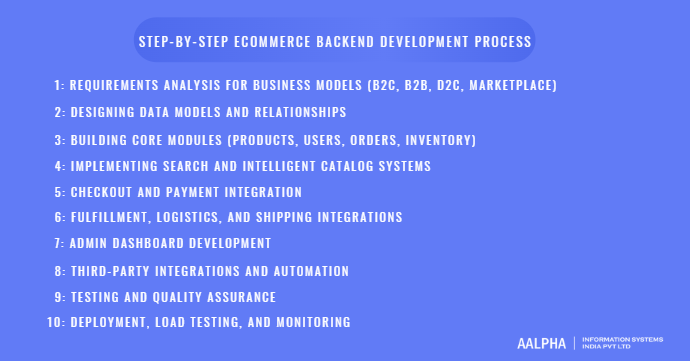
Step 1: Requirements Analysis for Business Models (B2C, B2B, D2C, Marketplace)
The first step is understanding the business model because backend requirements differ significantly across B2C, B2B, D2C, and marketplace operations.
B2C platforms focus on fast browsing, high-volume transactions, and personalized experiences. Backend systems must support large catalogs, promotions, user segmentation, and efficient checkout flows.
B2B platforms introduce complexity such as contract-based pricing, bulk ordering, account hierarchies, credit limits, and custom catalogs for specific clients. These models require sophisticated pricing engines and workflow automation.
D2C brands emphasize storytelling, subscriptions, memberships, and deep personalization. The backend must integrate marketing automation, recommendation engines, and systems for recurring billing or bundles.
Marketplace platforms involve multi-vendor management, commission logic, vendor settlements, catalog moderation, split payments, and multi-location fulfillment. This business model demands a strong microservices-friendly architecture due to higher operational complexity.
During requirements analysis, teams must document workflows such as product onboarding, order routing, returns, customer support, and analytics needs. This ensures the backend is designed for the specific operational realities of the business rather than being retrofitted later.
Step 2: Designing Data Models and Relationships
Data modeling is the foundation of backend engineering because it defines how information is stored, accessed, and managed. Poor data design leads to performance bottlenecks, inaccurate reporting, and unstable transactions.
Key entities typically include:
- Products: attributes, variants, pricing rules, metadata
- Users: profiles, addresses, preferences
- Orders: order lines, payments, fulfillment status
- Inventory: stock counts, reserved stock, warehouse locations
- Promotions: rules, coupons, discount conditions
- Reviews and ratings: user-generated content, moderation data
Developers create ER diagrams or schema definitions to establish relationships such as:
- One-to-many relationships for products and variants
- Many-to-many relationships for users and wishlists
- Transactional relationships for orders and payments
- Hierarchical relationships for categories and subcategories
Data normalization ensures efficient storage, while caching and indexing strategies improve performance for read-heavy operations. For hybrid architectures, SQL handles critical workflows, while NoSQL supports flexible product metadata, logs, or personalization data.
Step 3: Building Core Modules (Products, Users, Orders, Inventory)
The core modules form the backbone of the backend and must be engineered for accuracy and speed.
Product Module
Handles SKU creation, variant logic, attributes, categories, catalog visibility, and SEO data. It integrates with media storage and indexing systems for search optimization.
User Module
Manages authentication, authorization, account details, order histories, and preference storage. Security features like encryption, rate limiting, and MFA are critical.
Order Module
Executes the full order lifecycle including creation, validation, payment linking, fulfillment, and status updates. It must support cancellation, modifications, and refunds.
Inventory Module
Tracks stock levels per warehouse, reserves stock during checkout, and synchronizes updates from fulfillment centers. It ensures real-time accuracy to prevent overselling.
These modules must interact seamlessly through APIs or event-driven workflows. Their reliability directly affects customer trust and operational efficiency.
Step 4: Implementing Search and Intelligent Catalog Systems
Search functionality is one of the strongest conversion drivers in eCommerce. Implementing a fast, accurate search engine is essential for product discovery and user satisfaction.
Search Indexing
Backend systems must structure product attributes, images, variants, and metadata for indexing by engines like Elasticsearch or OpenSearch. Periodic syncs and real-time updates ensure accuracy.
Search Features
- Full-text search
- Autocomplete suggestions
- Typo correction
- Synonym matching
- Category-based filters
- Faceted search
Intelligent Catalog Systems
Machine learning models recommend:
- Trending products
- Frequently bought together items
- Personalized recommendations based on browsing or purchase history
Dynamic catalog ranking improves conversion rates by tailoring product visibility to user intent. This system often integrates with analytics tools to evaluate performance and refine algorithms.
Step 5: Checkout and Payment Integration
Checkout is the most critical step in the customer journey and must be engineered for speed and security.
Checkout Logic
Backend systems validate:
- Product availability
- Address eligibility
- Shipping options
- Taxes
- Discounts and coupons
- Payment eligibility
These checks must occur instantly, even during high-load events.
Payment Processing
Integrations with eCommerce payment gateways like Stripe, Razorpay, PayPal, or Adyen must support:
- Tokenized payments
- Credit/debit cards
- UPI
- Wallets
- BNPL (Buy Now Pay Later)
- International currencies
Security considerations include PCI-DSS compliance, data encryption, and fraud prevention workflows. The backend must handle retries, failures, and asynchronous confirmation from payment providers.
Step 6: Fulfillment, Logistics, and Shipping Integrations
Once an order is placed and confirmed, the backend coordinates the fulfillment workflow.
Fulfillment Tasks
- Assign order to the correct warehouse
- Generate packing instructions
- Communicate order details to fulfillment centers
- Handle multi-warehouse or split shipments
Logistics Integrations
Backend systems connect with shipping aggregators or courier APIs to:
- Get real-time shipping rates
- Print labels
- Schedule pickups
- Track shipments
Tracking updates such as “shipped,” “out for delivery,” and “delivered” must sync into the user account and trigger notifications. Robust logistics integration improves operational efficiency and customer satisfaction.
Step 7: Admin Dashboard Development
Admin dashboards allow internal teams to manage operations, monitor performance, and update catalog data. They are vital for day-to-day business management.
Key Admin Features
- Product and inventory management
- Order and returns management
- Promotions engine control
- User management
- Revenue and analytics dashboards
- Role-based access controls
- Vendor portals for marketplaces
A well-designed admin interface reduces manual work, increases operational accuracy, and allows non-technical staff to manage the platform effectively.
Step 8: Third-Party Integrations and Automation
Modern eCommerce relies on a wide ecosystem of tools and services.
Key Integrations
- Marketing tools: email platforms, automation tools, CRM systems
- Accounting tools: QuickBooks, Xero
- ERP/WMS: inventory and warehouse systems
- AI engines: personalization, fraud detection
- Marketplace sync: Amazon, Flipkart, eBay
- Payment and tax APIs
Automation is crucial. Event-driven architectures enable workflows such as:
- Automatically generating invoices
- Triggering shipment requests
- Sending lead information to CRM
- Updating stock when warehouse events occur
Integrating third-party systems enhances platform capabilities while allowing teams to scale operations without increasing manual workload.
Step 9: Testing and Quality Assurance
Quality assurance ensures that all modules operate correctly, securely, and at scale.
Types of Testing
- Unit testing: verifies individual functions
- Integration testing: validates interactions between modules
- Performance testing: simulates heavy user traffic
- Security testing: evaluates vulnerabilities such as SQL injection, XSS, CSRF
- User acceptance testing: ensures business teams validate workflows
Load testing is essential for preparing the system for festival sales or marketing events. Backend teams simulate peak traffic to identify bottlenecks, optimize caching, and improve query performance.
Step 10: Deployment, Load Testing, and Monitoring
Deployment and monitoring strategies determine how effectively the system performs in production.
Deployment Strategies
- CI/CD pipelines for automated deployments
- Blue-green or canary deployments to minimize downtime
- Container orchestration using Kubernetes for microservices
Load Testing
Teams must evaluate:
- API response times
- Database performance under stress
- Queue behavior during transaction spikes
- Cache hit ratios
Monitoring and Observability
Tools such as Prometheus, Grafana, Datadog, and ELK Stack track:
- Latency
- Error rates
- Infrastructure health
- Event logs
Alerts ensure teams respond quickly to issues before they affect users.
The eCommerce backend development process is a structured sequence that transforms business requirements into a high-performance retail engine. Each step—from requirements analysis to monitoring—ensures the platform remains scalable, secure, and capable of delivering seamless customer experiences. A disciplined, engineering-first approach creates a foundation for long-term innovation and growth.
Scalability and Performance Optimization
Scalability and performance optimization define the long-term success of an eCommerce backend. As order volumes increase, catalogs expand, traffic spikes surge during promotional events, and customer expectations rise, the backend must be engineered to respond instantly and reliably. Even minor delays in page load times or checkout processing can affect conversion rates and revenue. Modern eCommerce platforms operate in a high-demand ecosystem where infrastructure must scale flexibly, data must sync accurately, and every micro-interaction must perform with minimal latency. This section explores the systems, strategies, and architectures that allow businesses to maintain optimal performance under varying loads, ensuring both stability and customer satisfaction.
Database Sharding and Replication
Databases are often the first bottleneck when traffic and data volumes grow. Sharding and replication address this challenge by distributing load and improving performance.
Database Replication
Replication involves creating multiple copies of a database to distribute read load and increase availability.
- Master database: handles write operations
- Replica or slave databases: handle read operations
Read-heavy operations such as product browsing, search, and catalog queries benefit significantly from replicas. If one node fails, the system continues operating using remaining replicas, increasing resilience.
Database Sharding
Sharding divides large datasets horizontally across different servers or clusters. Each shard stores a subset of the data, such as:
- By user ID
- By region
- By product category
Sharding enhances write performance and prevents single-node overload. Large marketplaces and global eCommerce platforms rely on sharding to handle millions of users and orders. Proper shard key design is critical; poorly chosen shard keys lead to uneven load distribution or “hot shards.”
Both replication and sharding allow systems to scale horizontally, supporting large datasets and high query traffic without degrading performance.
Caching Strategies (CDN, Application, Database, Edge Caching)
Caching improves response times by serving data from faster, in-memory locations rather than querying databases or running complex computations repeatedly.
CDN Caching
Content Delivery Networks such as Cloudflare and Akamai store and serve static assets (images, CSS, JS) from servers closer to users. This reduces latency and improves global performance.
Application Caching
Backend applications cache frequently accessed data such as product lists, category trees, or exchange rates. Tools like Redis store this data in memory for microsecond retrieval.
Database Caching
Query caching reduces repetitive database operations by storing results for commonly executed queries. Proper cache invalidation strategies are essential to maintain accuracy.
Edge Caching
Edge functions run at distributed nodes near the user, offering personalized responses such as localized pricing or user-specific recommendations.
When implemented correctly, caching reduces infrastructure load, lowers latency, and ensures predictable performance during traffic surges.
Load Balancing and Autoscaling
High-traffic eCommerce systems must distribute incoming requests evenly across multiple servers.
Load Balancing
Load balancers such as NGINX, HAProxy, or cloud-managed solutions distribute traffic based on:
- Round robin
- Least connections
- Geographic routing
- Health checks
By preventing any single server from becoming overloaded, load balancers improve uptime and system reliability.
Autoscaling
Autoscaling automatically adjusts server capacity based on real-time traffic. Cloud providers use metrics such as CPU usage, memory consumption, response time, or queue depth to decide when to scale up or down.
Autoscaling ensures two crucial advantages:
- Resources increase during sales events or viral promotions
- Costs decrease during low-traffic periods
Together, load balancing and autoscaling create a backend capable of responding efficiently to both predictable and unexpected traffic spikes.
Queue-Driven Architecture for Order Spikes
ECommerce platforms must handle bursts of sudden activity, especially during flash sales or major marketing campaigns. Queue-driven architectures decouple operations, allowing the backend to process tasks asynchronously without overwhelming key systems.
Message queues such as Kafka, RabbitMQ, or Amazon SQS handle:
- Order creation workflows
- Payment verification
- Notification dispatch
- Inventory synchronization
- Fraud checks
Instead of processing everything synchronously, the backend places events in queues and workers handle them in the background. This improves reliability by smoothing out traffic spikes and ensuring that a temporary surge doesn’t disable core functions.
Queue-driven designs also support event sourcing, enabling platforms to track and replay events for audits, analytics, or system recovery.
Optimizing Search Performance
Search is a computationally intensive task, especially on large catalogs with complex filters. Optimizing search performance transforms product discovery and significantly improves conversions.
Indexing Strategies
Search engines like Elasticsearch, Solr, or OpenSearch use inverted indexes to provide fast, relevant results. Developers must design indexes with hierarchical categories, synonyms, weights, and attributes that align with user intent.
Incremental Updates
Whenever a product changes, only the updated fields should be indexed rather than reindexing the entire catalog.
Sharded Clusters
Large platforms distribute search load across multiple nodes.
This ensures:
- Faster search queries
- Higher availability
- Lower latency
Relevance Tuning
Search algorithms must account for popularity, customer behavior, product ratings, and personalization. These signals help surface the most appealing products first.
A well-optimized search backend improves user satisfaction by delivering relevant results instantly, even under high load.
Handling Peak Traffic: Black Friday, Sales Seasons
Peak events stress every layer of the backend. Preparing for these events requires predicting demand, optimizing infrastructure, and running simulations.
Key Preparations
- Load testing: simulate multiples of expected traffic
- Database indexing: ensure queries run efficiently
- Cache warm-up: pre-load frequently accessed data
- Autoscaling policies: increase cloud capacities ahead of time
- Circuit breaker patterns: prevent cascading failures
Traffic Shaping and Rate Limiting
Some platforms slow down non-critical requests during peak times to preserve essential workflows like checkout. Rate limiting protects the backend from abuse or accidental overload.
Read/Write Splitting
During major sales, read-heavy operations shift to replicas, while writes are throttled or staggered for stability.
Disaster Recovery
Failover clusters and multi-region deployments ensure continuity if a primary node fails.
Brands that prepare thoroughly can handle peak loads smoothly, avoiding the downtime or crashes that often lead to viral customer dissatisfaction.
Logging, Observability, and Real-Time Monitoring
Modern eCommerce environments require full observability to identify performance issues before they affect customers. Logging and monitoring form the diagnostic foundation.
Structured Logging
Structured logs (JSON logs) help engineers trace issues across microservices, APIs, and queues.
Metrics Monitoring
Tools like Prometheus, Datadog, and Grafana monitor:
- API response times
- Error rates
- JVM/node heap usage
- Database slow queries
- Cache hit ratios
- Queue depth
Distributed Tracing
Systems like Jaeger or OpenTelemetry trace requests across multiple services, identifying latency hotspots and failures.
Real-Time Alerts
Engineering teams receive notifications for anomalies such as:
- Sudden purchase failures
- High checkout abandonment
- Slow API responses
- Low inventory thresholds
- CPU spikes
Observability ensures fast diagnosis, prevents revenue loss, and maintains seamless user experiences.
Scalability and performance optimization require a multi-layered strategy that addresses database design, caching, distributed infrastructure, search optimization, and real-time observability. As eCommerce traffic continues to grow dynamically, platforms must evolve to support surges gracefully, respond to user actions instantly, and deliver consistent performance regardless of load. Businesses that invest in scalable systems gain long-term resilience, the ability to innovate rapidly, and the confidence to handle global expansion.
Integrations Every eCommerce Backend Needs
Modern eCommerce platforms rely on a sophisticated network of integrations to deliver seamless experiences, efficient operations, and data-driven decision-making. While the backend handles core functionality such as products, checkout, orders, and inventory, it becomes significantly more powerful when connected with external systems that automate workflows, enhance personalization, streamline logistics, and unify business operations. These integrations form the larger ecosystem that allows an eCommerce business to scale across channels, markets, and customer segments without increasing manual workload. Below are the essential categories of integrations every robust eCommerce backend must support.
-
Payment Gateways and Wallets
Payment gateway integrations are among the most critical components of an eCommerce backend because they enable secure transactions and directly influence conversion rates. Backends commonly integrate with global and regional gateways such as Stripe, PayPal, Razorpay, Adyen, Square, and Authorize.net. These gateways support multiple payment methods including credit cards, debit cards, net banking, BNPL options, digital wallets, and regional instant payment systems such as UPI.
Strong payment integrations include:
- Tokenization for storing payment credentials securely
- Multi-currency support for global selling
- 3D Secure and SCA compliance
- Fraud detection systems that prevent suspicious transactions
- Webhooks for asynchronous confirmation of payment status
- Smart retries for failed transactions
Wallet integrations such as Apple Pay, Google Pay, Paytm, and Amazon Pay reduce friction during checkout by enabling one-tap purchases. A well-integrated payment module increases trust, speeds up the buying process, and reduces abandonment.
-
ERP and Warehouse Management Systems
Enterprise Resource Planning (ERP) and Warehouse Management System (WMS) integrations ensure that back-office operations remain synchronized with the eCommerce platform. ERPs like SAP, NetSuite, Odoo, or Tally handle financials, procurement, vendor management, and inventory master data. A WMS manages picking, packing, storage, replenishment, and movement across warehouses.
Key backend workflows include:
- Automated inventory sync across locations
- Purchase order generation when stock reaches thresholds
- Real-time stock availability on the storefront
- Batch, lot, and expiry tracking for regulated industries
- Stock reservation during checkout
- Order routing based on warehouse proximity
Without ERP and WMS integrations, businesses suffer from stock discrepancies, delayed order processing, and inefficient warehouse operations. Seamless connectivity ensures accurate data flow and operational efficiency at scale.
-
Shipping Aggregators and Logistics Partners
Shipping and logistics integrations enable the backend to automate fulfillment and provide accurate delivery experiences. Aggregators like Shiprocket, EasyPost, ShipBob, Delhivery, FedEx APIs, and UPS APIs allow businesses to access multiple courier services through a unified interface.
Backend systems use these integrations to:
- Fetch real-time shipping rates
- Validate delivery areas
- Generate shipping labels and AWBs
- Schedule pickups
- Track shipment status
- Estimate delivery times
- Handle COD workflows where applicable
Logistics APIs push status updates such as “picked up,” “in transit,” “out for delivery,” and “delivered,” which the backend stores and communicates to the user. Real-time syncing improves transparency and reduces support queries related to order tracking.
-
CRM and Marketing Automation Tools
CRM (Customer Relationship Management) and marketing automation tools allow businesses to build long-term customer relationships and deliver personalized communication.
Popular integrations include HubSpot, Salesforce, Zoho CRM, Klaviyo, Mailchimp, ActiveCampaign, and MoEngage.
CRM systems help the backend:
- Sync customer profiles and segmentation
- Track purchase behavior and lifetime value
- Manage support tickets and interactions
- Trigger customer journeys based on actions
Marketing automation tools enable:
- Cart abandonment campaigns
- Post-purchase follow-ups
- Personalized product recommendations
- Re-engagement workflows
- Feedback and NPS surveys
By integrating CRMs and marketing tools, eCommerce businesses can turn transactional interactions into long-term engagement, increasing retention and average order value.
-
Accounting Software Integrations
Accounting integrations ensure accurate financial reconciliation and simplify bookkeeping. Tools like QuickBooks, Xero, Zoho Books, Sage, or Tally connect the backend with financial operations.
Backend accounting workflows include:
- Syncing sales invoices and credit notes
- Reconciling payment gateway settlements
- Handling GST/VAT calculations
- Managing cash flow and expense reports
- Tracking refunds and returns
Without accounting integrations, businesses rely on manual reconciliation, which becomes error-prone as order volume grows. Automated synchronization reduces administrative overhead and ensures compliance with taxation and financial reporting standards.
-
AI Recommendation Engines and Personalization Systems
AI-driven personalization is now a core expectation in modern eCommerce. Integrations with recommendation engines and machine learning services help improve product discovery, increase cart size, and tailor the shopping experience.
Examples include:
- AWS Personalize
- Google Recommendations AI
- Segment + machine learning models
- In-house ML services built using TensorFlow or PyTorch
AI engines generate insights like:
- Frequently bought together products
- Personalized homepages
- Dynamic upselling and cross-selling
- Real-time recommendations based on user behavior
- Predictive search suggestions
These integrations rely on high-quality backend data related to browsing history, purchase patterns, and behavioral analytics. Properly implemented personalization improves conversion rates significantly and differentiates the brand experience.
-
Third-Party Marketplaces (Amazon, eBay)
Marketplace integrations allow eCommerce stores to expand their reach by syncing catalog and orders with external platforms like Amazon, eBay, Walmart Marketplace, Etsy, and Flipkart.
The backend must support:
- Syncing product listings and stock availability
- Importing marketplace orders into the central OMS
- Updating order status across platforms
- Consolidated inventory management
- Automated pricing adjustments
- Marketplace-specific compliance (image sizes, product attributes)
These integrations reduce the need for manual uploads and allow seamless multi-channel selling. Businesses that rely on omnichannel strategies gain a competitive advantage by keeping data consistent across all marketplaces.
A powerful eCommerce backend is not limited to internal modules. It thrives within a broader ecosystem of payment processors, ERP systems, logistics providers, CRMs, accounting tools, AI engines, and external marketplaces. Effective integration ensures operational accuracy, richer customer experiences, and higher scalability. By connecting the backend to the right external systems, businesses unlock new growth channels while maintaining efficiency and consistency across all touchpoints.
Cost of eCommerce Backend Development
The cost of developing an eCommerce backend varies significantly depending on the business model, scale, complexity, integrations, team expertise, and architectural decisions. While some businesses can launch with a streamlined monolithic backend, others—especially marketplaces and enterprise retailers—require advanced features, distributed systems, and global infrastructure. This section breaks down the key cost determinants, typical pricing across business sizes, and factors that influence both initial development and ongoing operational expenses. Understanding these cost variables helps businesses plan budgets effectively and make long-term technical decisions that balance reliability with cost efficiency.
Cost Factors: Complexity, Custom Features, Integrations
Several elements influence the cost of eCommerce backend development, and these relate directly to the functionality and scalability the business requires.
Complexity of the Business Model
- B2C stores require standard modules like products, cart, checkout, orders, and inventory.
- B2B platforms introduce advanced workflows such as contract-based pricing, bulk orders, credit limits, account hierarchies, and custom catalogs.
- Marketplaces require multi-vendor management, settlement logic, catalog moderation, and logistics orchestration.
The more complex the workflows, the more time and engineering depth the backend requires.
Customization and Features
Custom features such as subscription billing, dynamic pricing engines, loyalty programs, AI-driven personalization, or multi-warehouse routing increase development cost. Prebuilt platforms reduce cost but limit customization.
Number and Depth of Integrations
Integrations with payment gateways, logistics partners, ERPs, CRMs, accounting systems, and marketplaces can account for a large portion of backend development cost.
Complex integrations—like SAP or Salesforce—require significant engineering effort.
Scalability Requirements
High-volume environments require microservices, distributed caching, database sharding, search indexing, and event-driven architecture, all of which add cost.
Security and Compliance
PCI-DSS, GDPR, SOC 2, and industry-specific regulations impose additional development and testing costs.
Cost Breakdown for Simple, Mid-Scale, and Enterprise Stores
Cost varies widely based on feature depth, scalability requirements, and the engineering team’s experience level.
Simple eCommerce Store Backend
Typical use-case: Small D2C brand or local retailer
Architecture: Monolithic backend with essential modules
Estimated cost: USD 10,000 to 40,000
Includes:
- Product catalog
- User accounts
- Cart and checkout
- Basic order management
- Payment integration
- Standard shipping integration
- Admin panel
These systems do not require high traffic resilience, advanced personalization, or complex ERP integrations.
Mid-Scale eCommerce Backend
Typical use-case: Growing retail brand or multi-category store
Architecture: Modular monolith or hybrid microservices
Estimated cost: USD 40,000 to 150,000
Includes:
- Advanced search
- Multi-warehouse inventory
- Automated order routing
- CRM and marketing tool integrations
- Multiple payment methods
- Analytics dashboards
- Role-based admin system
- Moderate traffic optimization
This tier suits businesses planning to scale across regions or integrate with multiple third-party systems.
Enterprise or Marketplace Backend
Typical use-case: Large-scale retail platform or marketplace
Architecture: Full microservices, event-driven, globally distributed
Estimated cost: USD 150,000 to 500,000+
Includes:
- Multi-vendor flows and settlements
- Sophisticated pricing engines
- High-performance search clusters
- AI-driven personalization
- ERP/WMS integrations
- Multi-region deployment
- Queue-driven asynchronous processing
- Redundancy and disaster recovery
- Enterprise-grade observability
These backends mimic the engineering complexity of platforms like Amazon, Flipkart, or Shopify Plus.
Cost of Monolithic vs Microservice Implementation
Monolithic Backend Costs
Monoliths are easier and cheaper to build initially.
- Lower development cost
- Fewer engineers required
- Simple deployment
- Reduced DevOps overhead
However, costs increase over time as complexity and traffic grow.
Microservice Backend Costs
Microservices require more investment upfront.
Costs include:
- Designing distributed architecture
- Building multiple services
- Implementing API gateways
- Managing CI/CD pipelines
- Setting up observability and monitoring tools
- Handling service communication and testing complexity
Long-term benefits include:
- Independent scaling reduces infrastructure cost
- Faster feature development for large engineering teams
- Improved reliability and fault isolation
Businesses transitioning from monolith to microservices often incur refactoring costs of USD 50,000 to 200,000 depending on depth.
Cloud Hosting and Infrastructure Expenses
Cloud hosting represents an ongoing operational cost. Expenses depend on architecture complexity, traffic, and redundancy requirements.
Common Infrastructure Cost Areas
- Compute instances (AWS EC2, Google Compute
- Serverless functions (Lambda, Cloud Functions)
- Databases (RDS, DynamoDB, MongoDB Atlas)
- CDN usage
- Object storage for media
- Load balancers
- Cache layers (Redis, Memcached)
- Search clusters (Elasticsearch/OpenSearch)
Typical Monthly Cloud Costs
- Small business: USD 200 to 1,000/month
- Mid-scale platform: USD 1,000 to 8,000/month
- Enterprise marketplace: USD 10,000 to 60,000+/month
High-traffic promotional events may temporarily increase cloud costs due to autoscaling and bandwidth usage.
Ongoing Maintenance, DevOps, and Scaling Costs
Maintaining an eCommerce backend requires continuous updates, optimizations, and support.
Maintenance includes:
- Security patches
- Performance monitoring
- Bug fixes
- Database optimization
- Updating APIs and SDKs
- Feature enhancements
DevOps Costs
A DevOps engineer or consulting team ensures reliable deployments, infrastructure scaling, CI/CD management, and observability.
Costs range from USD 1,500/month for small teams to USD 10,000+/month for enterprise operations.
Scaling Costs
Scaling infrastructure during high-traffic events requires additional compute, database replicas, search nodes, and caching layers.
These are variable but must be budgeted for seasonal spikes.
How to Reduce Backend Development Costs Without Compromising Reliability
Several strategies help businesses optimize costs while maintaining high performance.
Build a Monolith First, Then Modularize
Start with a clean, modular monolith and evolve into microservices when traffic volume justifies the complexity.
Use Managed Services
Cloud services like AWS RDS, DynamoDB, or Firebase reduce DevOps overhead and improve reliability.
Leverage Prebuilt APIs
Payments, search, analytics, and CMSs can be integrated instead of built from scratch.
Focus on Critical Features Only
Avoid building rarely used features during the early stages.
Instead, prioritize:
- Search
- Checkout
- Payment
- Inventory accuracy
Optimize Media and Caching Early
Reducing database and server load decreases infrastructure costs dramatically.
Adopt Serverless for Event-Driven Workloads
Serverless functions reduce hosting costs for tasks like image processing, notifications, or webhooks.
Automate QA and CI/CD
Automation reduces long-term testing and deployment costs.
The cost of eCommerce backend development varies widely based on complexity, integration requirements, architectural choices, and scaling needs. By understanding these variables, businesses can make informed decisions that balance budget constraints with performance and growth objectives. Investing in a well-planned backend ensures stability, supports expansion, and reduces long-term operational expenses.
Why Choose Aalpha for eCommerce Backend Development
Choosing the right development partner for an eCommerce backend is a strategic decision that determines whether a platform will scale reliably, integrate seamlessly across systems, and deliver the performance customers expect. Aalpha stands out as a trusted partner for retailers, D2C brands, marketplaces, and global enterprises because it brings together deep technical expertise, a mature engineering culture, and a proven track record of delivering high-performance backend architectures. The company combines domain knowledge with engineering excellence to build systems capable of supporting the demanding real-time operations of modern commerce.
Expertise Across Full-Stack, Scalable, and Secure Architectures
Aalpha’s strength lies in its ability to design and build robust backend systems tailored to the unique requirements of each business model. The team works across all major backend technologies including Node.js, Python, Java, PHP, Go, and modern cloud-native stacks. This versatility ensures that each backend is engineered using the most suitable tools rather than forcing a one-size-fits-all solution.
Aalpha is proficient in both monolithic and microservices architectures, enabling businesses to start with the right foundation and scale as their traffic and operational complexity increase. The team also implements advanced backend patterns such as event-driven systems, distributed caching, search indexing, and asynchronous workflows, all while maintaining strong API governance and data consistency. Security remains a top priority throughout development. Aalpha designs systems that comply with PCI-DSS, GDPR, and industry-specific standards, integrating encryption, tokenization, rate limiting, and intelligent fraud prevention to safeguard transactions and customer data.
Proven Experience in Complex eCommerce Systems
Aalpha has delivered eCommerce platforms across a wide spectrum of industries including retail, consumer goods, pharmaceuticals, logistics, and marketplaces. This experience gives the team a deep understanding of the complexities behind catalog management, order routing, vendor onboarding, subscription commerce, multi-warehouse inventory, and multi-currency payments.
The company has built systems capable of handling high-traffic environments, personalized recommendations, and omnichannel integrations that synchronize data across mobile apps, marketplaces, POS systems, and ERP solutions. This knowledge helps Aalpha construct backends that are resilient, flexible, and optimized for conversion. With experience in B2C, B2B, D2C, and marketplace ecosystems, Aalpha ensures that each backend aligns with the operational workflows and business goals of its clients.
Strong DevOps, Observability, and Performance Engineering
Backend reliability depends not only on code quality but also on the strength of the DevOps pipeline and observability practices. Aalpha brings advanced DevOps capabilities, setting up automated CI/CD pipelines, infrastructure-as-code, containerized deployments, and multi-cloud strategies. These ensure rapid, stable deployments and minimal downtime.
The team uses modern observability stacks—including Prometheus, Grafana, ELK, Datadog, and OpenTelemetry—to provide real-time visibility into performance, latency, load behavior, and system health. Aalpha’s engineers conduct extensive load testing and implement horizontal scaling strategies, database sharding, caching layers, and search optimization techniques to maintain fast response times during peak traffic events. This disciplined approach helps clients handle seasonal demand, major sales campaigns, or rapid growth without performance degradation.
Transparent Processes, Communication, and Quality Benchmarks
Aalpha follows a process-driven delivery model built on clear communication, predictable timelines, and continuous client collaboration. Every project begins with a detailed requirement analysis and technical blueprint. Clients receive transparent updates through sprint-based execution, milestone tracking, and shared documentation.
Quality assurance is embedded throughout the development cycle. Automated and manual testing ensure that every module performs reliably under real-world conditions. Code reviews, architectural audits, and performance benchmarks maintain engineering consistency across the platform. Aalpha’s commitment to clarity and support continues after deployment through structured maintenance, optimization cycles, and long-term scaling guidance.
Aalpha delivers eCommerce backend systems that combine engineering excellence, scalability, security, and operational clarity. For businesses seeking a long-term partner who understands both the technical and commercial dimensions of digital commerce, Aalpha provides the expertise, reliability, and strategic support required to build and sustain world-class eCommerce platforms.
Conclusion
Building a high-performing eCommerce backend is not simply a technical exercise. It is a strategic investment that determines how effectively a business can scale, compete, and deliver meaningful customer experiences. The most successful eCommerce platforms share a common foundation: stable architectures, efficient databases, intelligent automation, secure payment systems, powerful search engines, and robust integrations that synchronize operations across every channel. A well-designed backend transforms complex retail workflows into seamless customer journeys, enabling faster browsing, smoother checkout experiences, accurate order fulfillment, and personalized interactions that build long-term loyalty.
Businesses navigating the competitive landscape of digital commerce must evaluate their backend needs through both a technical and operational lens. The decision to invest in custom backend development becomes essential when off-the-shelf platforms no longer support the organization’s scale, integrations, business logic, or growth vision. Custom development is the right fit for companies with evolving catalog structures, multi-warehouse operations, B2B workflows, marketplace models, specialized pricing rules, subscription commerce, or heavy reliance on automation. A custom backend also becomes critical for organizations that expect rapid growth, require unique differentiators, or operate in regulated industries where control, security, and compliance must be deeply embedded into the architecture.
For businesses seeking to modernize their infrastructure, improve performance, or build a future-ready eCommerce platform, Aalpha offers the technical expertise, architectural depth, and implementation experience needed to deliver backends engineered for scale and reliability. Whether you are launching a new store, re-architecting an existing system, or expanding into a multi-vendor or omnichannel environment, Aalpha’s engineering teams help design, build, and maintain backend systems that support long-term growth.
If you are ready to develop an eCommerce backend that delivers speed, security, and seamless customer experiences, Aalpha can guide you through each stage, from architecture strategy and development to integration, optimization, and ongoing support. Reach out to Aalpha to begin building a scalable and future-proof eCommerce foundation tailored to your business goals.