


What Is Construction ERP Software?
Construction ERP software is a specialized enterprise resource planning system built specifically for construction companies, contractors, infrastructure firms, and real estate developers. Unlike generic ERP platforms designed primarily for manufacturing, retail, or service businesses, construction ERP is structured around projects rather than products. Every financial transaction, procurement activity, labor allocation, and equipment movement is tied directly to a job site or contract.
In an industry where profit margins often range between 3 percent and 8 percent according to data from the Associated General Contractors of America, even minor cost overruns can erase profitability. Construction ERP software centralizes financial management, project tracking, procurement workflows, subcontractor coordination, and compliance documentation into a single integrated system. It provides real-time visibility into budgets, timelines, and resource allocation across multiple sites.
When construction leaders ask what construction ERP software actually does, the answer is straightforward: it connects the field and the office through a unified digital backbone that controls cost, risk, and performance across the entire project lifecycle.
Construction ERP software is an integrated platform that manages all operational and financial aspects of construction projects within a single system. Its core purpose is to align project management, accounting, procurement, equipment tracking, payroll, and compliance into one centralized data structure.
Unlike generic ERP systems that are organized around inventory units or manufacturing processes, construction ERP is structured around projects and job codes. Every expense, labor hour, subcontractor invoice, and material purchase is mapped to a specific cost code. This enables accurate job costing and profitability tracking at a granular level.
For example, if a contractor is building a commercial complex, the ERP system can track concrete costs separately from electrical labor and HVAC installation. It does not merely record transactions; it attributes them directly to project phases and budget categories. This project-centric model is what distinguishes construction ERP from standard enterprise systems.
The primary goal is financial clarity and operational control. Construction firms need to know, in real time, whether a project is over budget, underperforming, or at risk due to procurement delays. Construction ERP software provides that visibility.
Why Construction Businesses Need ERP
Construction is one of the most operationally complex industries in the world. Projects involve multiple stakeholders, fluctuating material costs, subcontractor dependencies, regulatory requirements, and tight deadlines. Without centralized coordination, businesses rely on spreadsheets, disconnected accounting tools, and manual communication, which increases the risk of errors and cost overruns.
Project-based accounting is a fundamental reason construction companies require ERP systems. Unlike traditional businesses that measure profitability monthly or quarterly at an organizational level, construction firms must calculate profit per project. Each contract operates as a separate financial entity with its own revenue recognition model, billing milestones, and expense tracking.
Cost control is another major driver. Material price volatility, especially in steel, cement, and fuel, can significantly affect margins. ERP systems allow firms to monitor committed costs versus actual costs in real time, helping prevent overruns before they escalate.
Subcontractor coordination also demands structured systems. A single project may involve dozens of subcontractors with different payment schedules, compliance documents, and insurance certifications. Construction ERP software centralizes these workflows, reducing disputes and payment delays while maintaining documentation integrity.
How Construction ERP Differs from Traditional ERP
Traditional ERP systems are typically product-oriented. They are designed for businesses that manufacture goods, manage warehouses, or operate retail supply chains. Their architecture revolves around inventory items, production schedules, and standardized billing cycles.
Construction ERP, by contrast, uses a project-centric architecture. Every data object in the system, whether it is a purchase order, timesheet, or invoice, is linked to a specific project and cost code. This structure enables detailed job costing, which is essential for construction profitability analysis.
Equipment tracking is another major differentiator. Construction firms operate heavy machinery that must be allocated, maintained, and depreciated across multiple projects. A construction ERP tracks equipment utilization rates, maintenance schedules, and operational costs in relation to job sites. Traditional ERP platforms rarely offer this depth of asset allocation.
Compliance integration is also industry-specific. Construction companies must manage safety certifications, labor regulations, environmental permits, and contractual obligations. ERP systems designed for construction include compliance documentation workflows that align with regulatory frameworks and audit requirements.
Construction ERP software is not simply an accounting tool with added features. It is a purpose-built operational control system engineered around the realities of project-driven, multi-site, high-risk construction environments.
Benefits of Custom Construction ERP Software
Custom construction ERP software delivers measurable operational and financial advantages that generic systems cannot fully replicate. Construction companies operate in project-driven environments where each contract functions as an independent profit center. A custom-built ERP aligns precisely with internal workflows, cost structures, compliance requirements, and reporting standards. Instead of forcing teams to adapt to rigid software limitations, the system adapts to the company’s operational model.
When leadership evaluates whether custom ERP development is justified, the primary consideration is long-term control over profitability, visibility, and risk. The benefits extend beyond digitization. A well-designed custom construction ERP strengthens financial discipline, enhances coordination across job sites, reduces waste, and improves governance.
Below are the core advantages of investing in custom construction ERP software.
-
Improved Project Profitability
Construction profitability depends on accurate job costing, disciplined budget tracking, and early detection of cost overruns. Custom ERP software is designed around a company’s specific cost code structure, revenue recognition model, and contract management processes.
Every expense, including labor hours, material consumption, equipment usage, subcontractor payments, and overhead allocation, is mapped directly to defined project phases. This granularity allows management to compare estimated, committed, and actual costs in real time.
Variance analysis tools identify performance gaps before they escalate. For example, if labor costs exceed planned budgets for a particular phase, corrective action can be taken immediately rather than after project completion.
Custom ERP systems also integrate milestone billing and retention tracking, improving cash flow forecasting. When profitability insights are continuously available, executives make faster, data-backed decisions that protect margins across projects.
-
Real-Time Visibility Across Sites
Construction companies frequently manage multiple projects across different locations simultaneously. Without centralized systems, reporting delays and fragmented data limit executive oversight.
Custom ERP software consolidates operational and financial data from all active job sites into unified dashboards. Project managers can monitor schedule progress, procurement status, equipment utilization, and cost performance without waiting for manual reports.
Field teams update task completion, material usage, and timesheets through mobile interfaces, ensuring that central data reflects current site conditions. This real-time visibility reduces miscommunication between office and field teams.
Multi-project reporting allows leadership to analyze portfolio performance at both site and company levels. Underperforming projects can be identified quickly, and successful practices can be replicated across other sites.
Centralized visibility strengthens accountability and accelerates informed decision-making throughout the organization.
-
Reduced Operational Costs
Custom ERP systems reduce administrative overhead by automating repetitive workflows such as purchase approvals, invoice matching, payroll processing, and compliance tracking. Automation minimizes manual errors and eliminates duplicate data entry.
Improved inventory tracking reduces material waste and emergency procurement. Equipment utilization monitoring lowers idle time and unnecessary rentals. Structured procurement workflows improve supplier negotiation and cost transparency.
By eliminating inefficiencies across departments, construction firms reduce indirect costs and improve operational productivity.
-
Better Compliance and Risk Control
Construction projects operate under strict regulatory frameworks involving safety standards, tax laws, labor regulations, and contractual obligations. Custom ERP software embeds compliance requirements directly into workflows.
Permit renewals, safety logs, subcontractor documentation, and inspection records are centrally stored and automatically tracked. Audit trails ensure that every financial and operational transaction is traceable.
Early warning alerts for documentation gaps or compliance deadlines reduce exposure to penalties and project shutdown risks.
Structured risk management within the ERP environment strengthens governance, improves contractual discipline, and protects long-term business sustainability.
Custom construction ERP software is not simply an internal management tool. It is a strategic system that directly influences profitability, efficiency, and risk mitigation across complex construction operations.
Core Modules of Construction ERP Software
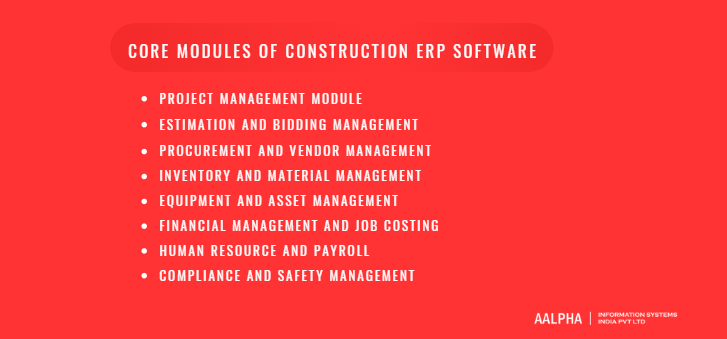
A high-performance construction ERP system is modular by design, yet tightly integrated. Each module addresses a specific operational function, but all modules share a unified database. This integration eliminates data silos, reduces duplication, and enables real-time project visibility. The strength of a construction ERP lies not merely in feature count, but in how effectively these modules interconnect to control cost, time, and risk across projects.
Below are the core modules that define a robust construction ERP system.
-
Project Management Module
The project management module serves as the operational backbone of construction ERP software. It centralizes scheduling, milestone tracking, task allocation, and project performance monitoring within a single dashboard.
Scheduling tools typically include interactive Gantt charts that visualize task dependencies, timelines, and resource allocation. Project managers can define critical paths, assign responsibilities, and track progress against baseline schedules. When delays occur, the system automatically recalculates downstream impacts, allowing proactive intervention.
Milestone tracking is essential for construction billing and stakeholder reporting. ERP systems link milestones to financial triggers such as progress billing, retention release, or subcontractor payments. This ensures alignment between operational progress and financial recognition.
Task allocation features enable assignment of responsibilities to site engineers, supervisors, subcontractors, or vendors. Mobile access allows field teams to update task completion status in real time, reducing reporting lag between site and head office.
Without structured project management functionality, construction firms rely on fragmented tools that limit visibility. An integrated module ensures that schedule performance, resource deployment, and financial progress remain synchronized throughout the project lifecycle.
-
Estimation and Bidding Management
The estimation and bidding module governs the pre-construction phase, where profitability is largely determined. Accurate cost estimation directly impacts bid competitiveness and margin protection.
Construction ERP software supports Bill of Quantities (BOQ) management, enabling estimators to itemize materials, labor, equipment, subcontractor costs, and overhead allocations. Historical project data stored within the ERP improves estimation accuracy by referencing actual past costs.
Tender workflows are digitized, including document management, version control, and approval routing. Estimators can generate detailed cost breakdowns aligned with standardized cost codes, ensuring consistency across projects.
What distinguishes this module from standalone estimating tools is integration. Once a bid is won, the estimated budget flows directly into project accounting and job costing modules, eliminating re-entry errors and maintaining financial continuity from bidding to execution.
-
Procurement and Vendor Management
Procurement in construction is dynamic and project-specific. Materials, subcontractor services, and rental equipment must be sourced according to schedule requirements and budget constraints.
The procurement module manages purchase requisitions, purchase orders, approval workflows, and supplier contracts. Each procurement transaction is tied to a specific project and cost code, enabling committed cost tracking against budget allocations.
Vendor management functionality includes supplier performance tracking, delivery timelines, quality assessments, and contract compliance monitoring. Construction ERP systems also manage subcontractor documentation such as insurance certificates, tax forms, and contractual obligations.
By integrating procurement with financial modules, companies gain real-time insight into committed versus actual expenditures. This reduces surprise cost overruns and improves negotiation leverage with vendors. Centralized procurement control also strengthens audit readiness and contractual transparency.
-
Inventory and Material Management
Material management in construction differs significantly from retail or manufacturing inventory management. Materials are distributed across multiple sites, consumed at varying rates, and often stored temporarily.
The inventory module tracks warehouse stock levels, site-based inventory, and material transfers between locations. Real-time stock alerts prevent shortages that could delay project timelines. Barcode or RFID integration may be used to automate tracking.
Material usage is linked directly to project cost codes. When materials are issued to a site, the ERP system records consumption against the corresponding job phase. This enables accurate job costing and prevents material leakage.
Construction firms often struggle with excess procurement or emergency purchasing due to poor tracking. A structured inventory module reduces waste, improves forecasting accuracy, and ensures that procurement aligns with actual consumption patterns.
-
Equipment and Asset Management
Construction projects rely heavily on machinery such as excavators, cranes, loaders, and generators. These assets represent significant capital investment and operational risk.
The equipment management module tracks asset allocation across projects, monitoring usage hours, fuel consumption, maintenance schedules, and depreciation. Preventive maintenance logs reduce downtime and extend asset lifespan.
Equipment costs are allocated to specific projects based on usage, ensuring accurate cost attribution. This is particularly important when assets are shared across multiple job sites.
Depreciation tracking supports financial reporting and tax compliance. Integration with accounting modules ensures alignment between operational asset data and financial records.
Traditional ERP systems rarely provide detailed asset utilization tracking at a project level. Construction ERP systems treat equipment as revenue-impacting assets, not just balance sheet entries.
-
Financial Management and Job Costing
Financial management is the most critical component of construction ERP software. Unlike generic accounting systems that operate at an organizational level, construction ERP emphasizes project-based accounting.
Job costing functionality tracks expenses at granular levels using structured cost codes. Labor hours, material costs, equipment usage, subcontractor invoices, and overhead allocations are recorded against specific project phases. This enables real-time visibility into budget performance.
Revenue recognition models such as percentage-of-completion accounting are supported, ensuring compliance with financial reporting standards. Billing schedules can be aligned with milestones or contract terms, including retention management.
Budgeting tools allow comparison between estimated, committed, and actual costs. Variance analysis dashboards highlight potential overruns before they become critical.
Integrated financial controls reduce disputes, improve cash flow forecasting, and enhance profitability tracking. When executives ask whether a specific project is profitable at any given moment, this module provides immediate, data-backed answers.
-
Human Resource and Payroll
Construction labor management requires precise tracking of workforce allocation across multiple sites. The HR module records attendance, timesheets, overtime, certifications, and subcontractor labor records.
Labor hours are mapped directly to project cost codes, ensuring accurate payroll processing and job costing alignment. Compliance features track regulatory requirements such as wage standards, labor contracts, and statutory deductions.
Payroll automation reduces administrative errors and ensures timely payments. Integration with financial modules guarantees consistency between labor expenses and project accounting records.
This module ensures that workforce management remains structured, compliant, and financially aligned.
-
Compliance and Safety Management
Construction projects operate under strict regulatory frameworks involving safety standards, environmental compliance, and contractual documentation.
The compliance module manages safety logs, inspection reports, permits, certifications, and incident tracking. Documentation is stored centrally and linked to projects, subcontractors, and site managers.
Automated reminders ensure that licenses and certifications remain current. Incident reporting workflows improve accountability and risk mitigation.
In an industry where non-compliance can result in financial penalties or project shutdowns, this module provides structured governance and audit readiness.
Together, these modules create an integrated system that governs the full lifecycle of construction projects, from tendering and execution to financial reporting and compliance control.
Key Features That Define a High-Performance Construction ERP
A construction ERP system is only as strong as the features that support real-world execution. In an industry characterized by thin margins, tight timelines, and multi-stakeholder coordination, performance depends on visibility, control, and system integration. A high-performance construction ERP does not merely record transactions. It provides real-time intelligence, enforces governance, and connects field operations with financial oversight.
The following features define whether a construction ERP system delivers operational impact or becomes just another administrative tool.
-
Real-Time Data and Reporting Dashboards
Real-time reporting is a foundational requirement for construction ERP software. Project managers, finance teams, and executives need instant access to key performance indicators such as cost variance, schedule variance, committed costs, cash flow position, and equipment utilization.
Interactive dashboards consolidate data from multiple modules into a single visual interface. Instead of waiting for weekly reports, decision-makers can monitor project health daily. Alerts can be configured for budget overruns, procurement delays, or milestone slippage.
Granular drill-down capabilities allow users to trace performance issues to specific cost codes or subcontractors. For example, if concrete costs exceed budget, managers can immediately identify whether the variance is due to material pricing, labor inefficiency, or equipment downtime.
Without real-time dashboards, construction firms operate reactively. High-performance ERP systems enable proactive risk management and evidence-based decision-making across projects.
-
Mobile Access for Field Teams
Construction is inherently field-driven. Supervisors, engineers, and subcontractors spend most of their time on-site rather than in offices. A high-performance ERP must therefore provide secure mobile access.
Mobile functionality allows site teams to update task completion, upload site photos, record labor hours, approve purchase requests, and log safety incidents directly from smartphones or tablets. This reduces reporting lag and ensures that central systems reflect current site conditions.
Field-based data entry improves accuracy. Instead of handwritten logs later transcribed into spreadsheets, information is captured at the source. GPS tagging and time stamping enhance accountability and audit readiness.
Mobile access also supports faster approvals. Procurement requests or variation orders can be reviewed and approved remotely, preventing schedule delays.
An ERP without strong mobile capability fails to bridge the gap between project sites and head office operations.
-
Role-Based Access Control
Construction projects involve diverse stakeholders, including project managers, finance teams, procurement officers, subcontractors, and executives. Each role requires access to specific information without compromising data security.
Role-based access control ensures that users can only view and modify data relevant to their responsibilities. Financial records, contract values, and sensitive compliance documentation remain restricted to authorized personnel.
This structured access model enhances data protection, reduces the risk of internal errors, and supports regulatory compliance. In large construction firms managing multiple concurrent projects, controlled access is essential for maintaining governance and operational discipline.
-
Multi-Project and Multi-Location Support
Construction firms often manage multiple projects across different cities or regions simultaneously. A high-performance ERP must support centralized oversight while preserving project-level autonomy.
Multi-project functionality enables consolidated financial reporting across all active contracts. Executives can analyze profitability at both project and portfolio levels. Comparative dashboards help identify which projects are outperforming or underperforming.
Multi-location support ensures accurate management of region-specific tax regulations, labor laws, and compliance requirements. Inventory, equipment, and workforce data can be segmented by site while remaining accessible within a unified system.
Scalability is critical. As construction companies expand geographically, their ERP system must handle increased data volumes and complex reporting requirements without performance degradation.
An ERP designed only for single-project management limits growth potential. High-performance systems are built for scale.
-
Integration with BIM, IoT, and Accounting Systems
Modern construction increasingly relies on digital integration. A high-performance ERP must connect seamlessly with external technologies.
Integration with Building Information Modeling platforms such as Autodesk Revit allows project data to align with 3D design models. Quantities, materials, and cost codes can be synchronized between design and execution phases, improving accuracy and reducing rework.
IoT integration supports real-time equipment monitoring. Sensors installed on machinery can transmit usage data directly into the ERP, enabling predictive maintenance and cost allocation.
Accounting integrations with systems such as QuickBooks ensure financial consistency and streamline reporting workflows.
Open API architecture enables connectivity with CRM platforms, payroll systems, and procurement marketplaces. Integrated systems eliminate manual data transfer and reduce operational friction across digital tools.
-
Document Management and Workflow Automation
Construction projects generate extensive documentation, including contracts, drawings, permits, inspection reports, and change orders. A high-performance ERP centralizes document storage with version control and structured access permissions.
Workflow automation streamlines approvals for purchase orders, variation requests, subcontractor invoices, and compliance renewals. Automated routing reduces administrative delays and enforces procedural consistency.
Digital document trails enhance transparency and audit readiness. In dispute scenarios, complete historical records can be retrieved instantly.
Effective document management reduces miscommunication, minimizes risk, and ensures that all stakeholders operate from the same verified information.
These features transform construction ERP software from a record-keeping tool into a strategic control system that enhances project performance, reduces risk exposure, and supports long-term organizational growth.
Step-by-Step Construction ERP Software Development Process
Developing construction ERP software is not a typical enterprise application project. A reliable software development company must bring deep domain understanding, strong architectural planning, and careful alignment between operational workflows and financial control systems. Construction companies operate in dynamic, multi-site environments where profitability depends on precise cost tracking and real-time coordination. A structured development process ensures that the ERP system reflects real-world execution rather than theoretical design.
The following step-by-step framework outlines how to build construction ERP software from strategy to rollout.
-
Requirement Gathering and Industry Analysis
The success of construction ERP development begins with rigorous requirement discovery. Unlike generic ERP implementations, construction ERP must reflect complex project lifecycles, cost code structures, subcontractor relationships, and compliance obligations.
Stakeholder interviews form the foundation of this phase. Project managers, site engineers, procurement heads, finance controllers, HR teams, and executive leadership must all be consulted. Each department operates with distinct workflows, and understanding these nuances prevents misalignment later in development.
Workflow mapping is critical. Development teams document how a project moves from bidding to execution, billing, and closure. This includes identifying how purchase orders are approved, how materials are issued to site, how labor hours are logged, and how cost variances are reported. Process diagrams expose inefficiencies and data silos that the ERP system must resolve.
Industry analysis also includes regulatory review. Construction firms must comply with tax regulations, safety standards, environmental documentation, and contractual frameworks. Requirements gathering must incorporate these compliance layers.
A well-executed discovery phase reduces costly revisions during development and ensures that the ERP system is built around operational reality rather than assumptions.
-
System Architecture Planning
Architecture planning determines scalability, performance, and long-term maintainability. Construction ERP systems handle high data volumes, including financial records, equipment logs, site documentation, and multi-project reporting.
The primary architectural decision involves choosing between a monolithic structure and a microservices architecture. A monolithic system centralizes functionality within a single codebase. It is simpler to deploy initially but may become rigid as feature complexity grows. Microservices architecture divides modules such as procurement, accounting, project management, and HR into independent services. This approach supports scalability and modular updates but requires advanced DevOps management.
Cloud-native design is increasingly preferred. Cloud infrastructure enables distributed access across multiple job sites, automatic scaling during high transaction volumes, and centralized data control. Containerization and continuous integration pipelines improve deployment reliability.
Architecture planning must also address multi-tenant capabilities if the ERP will be offered as a SaaS product. Data segregation, security isolation, and performance optimization are essential considerations at this stage.
-
UI/UX Design for Construction Workflows
Construction ERP interfaces must accommodate both office administrators and field operators. Poor usability leads to low adoption rates, data inconsistencies, and operational resistance.
User interface design begins with role-based workflow modeling. Project managers require dashboards showing milestones and cost performance. Procurement officers need streamlined purchase approval interfaces. Site engineers require simplified task update and material request forms.
Field usability is a central priority. Many users access the system through mobile devices under challenging conditions such as low connectivity or bright outdoor environments. The design must emphasize clarity, large touch-friendly controls, minimal data entry fields, and offline synchronization capabilities.
Mobile-first considerations improve real-time reporting. Timesheets, safety logs, equipment usage entries, and site photographs should be uploadable within seconds. Reducing friction in data entry directly improves data accuracy.
Consistency across modules ensures a predictable user experience. Standardized layouts, logical navigation structures, and clear financial terminology enhance system adoption across departments.
-
Backend Development and Database Design
Backend development translates business workflows into structured logic and scalable data architecture. Construction ERP systems require complex relational modeling to support job costing, equipment allocation, subcontractor billing, and compliance documentation.
Database design begins with defining project data hierarchies. Each project must include structured cost codes that categorize expenses such as materials, labor, equipment, subcontracting, and overhead. These cost codes form the backbone of financial tracking and reporting.
Project entities are interconnected with purchase orders, invoices, timesheets, equipment logs, and compliance records. Referential integrity is essential to prevent inconsistencies across modules. For example, when a purchase order is approved, it must automatically update committed cost values in financial dashboards.
Scalability considerations include indexing strategies, optimized query performance, and archival mechanisms for completed projects. Construction firms often retain historical data for years due to contractual and audit requirements.
Security controls must be embedded at the database level, including encrypted data storage and access logging. Backend architecture must support high concurrency without performance degradation, especially when multiple project sites operate simultaneously.
-
Integration Development
Construction ERP systems rarely operate in isolation. Integration development connects the ERP platform with external systems to create a unified digital ecosystem.
Accounting integrations ensure synchronization between ERP job costing modules and financial reporting tools. CRM integration connects project acquisition workflows with execution tracking, ensuring seamless transition from sales to operations.
Third-party API connections may include payment gateways, payroll systems, procurement marketplaces, and compliance verification services. For firms using BIM platforms, integration enables cost and quantity synchronization between design models and execution modules.
Open API architecture improves flexibility. Instead of hard-coded integrations, modern ERP systems provide secure endpoints for data exchange. This approach supports future expansion without major structural changes.
Integration testing is essential to ensure data consistency across platforms. Errors in integration logic can lead to financial discrepancies, which are costly and damaging to operational trust.
-
Testing and Quality Assurance
Construction ERP software must undergo rigorous testing before deployment. Given the financial and operational impact of the system, errors can disrupt active projects and compromise profitability.
Functional testing verifies that each module operates according to documented requirements. This includes validating purchase approvals, timesheet submissions, cost variance calculations, and billing workflows.
Performance testing evaluates system responsiveness under high transaction loads. Large construction firms managing multiple concurrent projects require stable performance even during peak reporting periods.
Security audits assess data protection mechanisms, access controls, and vulnerability exposure. Construction ERP systems store sensitive financial data and contractual information, making them attractive targets for cyber threats.
User acceptance testing involves real-world simulation by internal teams. Project managers and finance staff should validate that workflows align with daily operations before final approval.
Thorough testing minimizes post-launch disruptions and builds organizational confidence in the system.
-
Deployment and Rollout Strategy
Deployment strategy determines how effectively the ERP system is adopted across the organization. Construction firms often operate active projects during implementation, making abrupt transitions risky.
A phased deployment approach is frequently recommended. Modules such as financial management or procurement can be introduced gradually while legacy systems remain operational for specific functions. This reduces operational shock and allows incremental training.
Full launch strategies may be appropriate for smaller firms or new businesses without legacy complexity. However, they require intensive preparation and staff readiness.
Data migration planning is crucial. Historical project data, vendor records, and financial ledgers must be accurately transferred into the new system. Validation procedures ensure integrity during migration.
Training programs should accompany rollout. Workshops, documentation, and role-specific tutorials improve adoption rates and reduce resistance.
Post-launch monitoring ensures stability. Performance metrics, support tickets, and feedback loops help refine the system during early operational phases.
A structured rollout transforms ERP development from a technical project into a controlled organizational transformation initiative.
A disciplined, step-by-step development process ensures that construction ERP software delivers measurable operational value, supports scalability, and strengthens financial control across complex project environments.
Construction ERP Development Cost Breakdown
The cost of developing construction ERP software varies significantly depending on project size, feature depth, architectural decisions, integration scope, and long-term scalability requirements. Construction ERP systems are complex because they must integrate financial accounting, project management, procurement, inventory, HR, equipment tracking, and compliance into one unified platform, which directly impacts the overall ERP software implementation cost.
When executives ask, “How much does it cost to build construction ERP software?”, the accurate answer is that cost is driven by scope and complexity rather than a fixed market price. A small contractor digitizing internal workflows will have vastly different requirements compared to a multi-region infrastructure enterprise managing hundreds of concurrent projects.
Below is a structured breakdown of cost factors.
Cost by Project Size (Small, Mid, Enterprise)
Small Construction Companies
For small contractors handling limited concurrent projects, ERP requirements are typically focused on core modules such as project management, procurement, financial accounting, and basic job costing. These companies often seek automation of spreadsheets and improved financial visibility.
Development costs for small-scale ERP systems usually range between $40,000 and $80,000 depending on customization and integration needs. The scope may include web-based dashboards, limited mobile functionality, and essential accounting integrations. Infrastructure costs are moderate because transaction volumes are relatively low.
The focus at this level is operational efficiency rather than enterprise-scale analytics.
Mid-Sized Construction Firms
Mid-sized firms managing multiple projects across regions require more advanced features. These include multi-project financial consolidation, role-based access controls, advanced reporting dashboards, subcontractor compliance management, and deeper integration with accounting and payroll systems.
Development costs typically range between $80,000 and $200,000. The architecture often shifts toward modular or microservices-based design to accommodate scaling needs. Enhanced mobile capabilities and real-time dashboards increase development effort.
Integration complexity significantly influences cost at this level, especially when syncing ERP systems with legacy financial tools or CRM platforms.
Enterprise-Level Construction Companies
Large construction enterprises require highly scalable ERP systems capable of handling thousands of users, multi-location tax regulations, asset-heavy equipment tracking, predictive analytics, and multi-entity financial consolidation.
Enterprise-grade ERP development may range from $250,000 to $800,000 or more. These systems demand high-availability infrastructure, advanced security layers, multi-tenant data architecture, and complex compliance modules.
Customization depth, analytics sophistication, and integration breadth drive cost upward at this stage. However, for enterprises managing large infrastructure contracts, the ROI justifies the investment due to improved cost control and operational efficiency.
Cost by Feature Complexity
Feature complexity is one of the most significant cost drivers in construction ERP development. Core modules such as accounting, procurement, and project tracking form the baseline. However, advanced features substantially increase development time and budget.
Basic ERP functionality includes cost code structures, purchase order workflows, invoice management, and milestone tracking. This foundational layer accounts for a significant portion of initial development cost.
Advanced analytics dashboards with real-time predictive forecasting, AI-driven cost variance alerts, and customizable executive reporting increase development complexity. These features require sophisticated data modeling and performance optimization.
Integration with BIM platforms, IoT equipment monitoring systems, and external compliance databases further adds to cost. Real-time synchronization across platforms demands secure APIs and robust testing environments.
Mobile-first architecture also influences complexity. Offline synchronization, field data validation, and cross-device consistency require additional engineering effort.
Another major cost factor is customization depth. Highly customized workflows tailored to a specific contractor’s internal processes demand more development hours than standardized industry templates.
The broader the feature set and the more tailored the solution, the higher the investment required.
Custom Development vs Off-the-Shelf Customization
Organizations must decide whether to build a fully custom construction ERP or customize an existing platform such as SAP Business One or Oracle NetSuite.
Off-the-shelf ERP customization typically costs less upfront, ranging from $20,000 to $150,000 depending on licensing, configuration, and integration scope. However, these systems may require ongoing subscription fees and may not fully align with construction-specific workflows. Extensive customization can also create upgrade limitations.
Custom-built ERP systems require higher initial investment but provide full control over architecture, scalability, and feature evolution. Companies operating in specialized construction niches often prefer custom development to accommodate unique cost structures, compliance needs, and operational processes.
Long-term flexibility and competitive differentiation often justify custom development despite higher initial cost. The decision ultimately depends on organizational scale, strategic goals, and internal process complexity.
Ongoing Maintenance and Upgrade Costs
ERP development does not end at deployment. Ongoing maintenance typically accounts for 15 to 25 percent of initial development cost annually.
Maintenance includes security updates, performance optimization, infrastructure hosting, database management, and bug resolution. As regulatory frameworks change, compliance modules must be updated to reflect new standards.
Feature enhancements are also part of lifecycle cost. Construction firms frequently expand operations, requiring additional modules or integration capabilities.
Cloud hosting expenses, DevOps monitoring, and periodic security audits further contribute to operational expenditure.
Organizations must budget for long-term system evolution, not just initial development, to ensure that the ERP platform remains reliable, secure, and aligned with business growth.
A structured understanding of cost drivers enables construction leaders to make informed investment decisions. The true value of construction ERP software lies not in its upfront cost, but in its ability to prevent overruns, improve financial visibility, and enhance operational efficiency across complex project environments.
Common Challenges in Construction ERP Development
Developing construction ERP software is not purely a technical initiative. It is an organizational transformation that affects financial workflows, procurement processes, project tracking, compliance management, and field operations. Construction companies operate in complex, high-risk environments where system disruptions can directly affect project profitability and contractual performance. Even well-designed ERP systems can fail if common implementation challenges are not proactively addressed.
Below are the most frequent obstacles construction firms encounter during ERP development and deployment.
-
Resistance to Adoption
Resistance to adoption is one of the most persistent barriers in construction ERP projects. Construction teams often rely on long-established workflows, spreadsheets, manual approvals, and informal reporting practices. Introducing a centralized ERP system can initially feel restrictive or overly complex.
Field supervisors may perceive digital reporting as administrative overhead. Finance teams may hesitate to adopt new cost coding structures. Project managers may worry that transitioning systems during active projects will create operational delays.
Resistance is frequently driven by usability concerns rather than unwillingness. If the ERP interface is not intuitive, mobile-friendly, and aligned with real site workflows, users revert to parallel manual processes.
Successful adoption requires early involvement of department leaders, clear communication about measurable benefits, structured training programs, and phased rollouts. When teams see improved cost visibility, faster approvals, and reduced duplication of work, resistance gradually declines.
-
Data Silos and Integration Complexity
Construction firms often operate multiple disconnected systems for accounting, procurement, payroll, document management, and project tracking. Integrating these fragmented tools into a unified ERP ecosystem is technically demanding.
Legacy data may be inconsistent, incomplete, or structured differently across departments. Migrating this data requires cleansing, normalization, and validation. Poor data preparation can result in financial discrepancies, reporting errors, and operational confusion after deployment.
Integration complexity also increases when synchronizing ERP modules with design systems, payroll services, compliance databases, or internal CRM platforms. Data synchronization must be secure, accurate, and real-time to prevent duplication or loss.
Without structured integration planning, organizations risk creating new digital silos inside the ERP environment. Careful architectural design and rigorous testing are essential to ensure seamless connectivity and long-term system stability.
-
Customization Overload
Construction companies often request extensive customization to mirror existing internal processes. While certain tailoring is necessary, excessive customization introduces technical risk and long-term maintenance burden.
Every additional approval path, reporting configuration, or specialized workflow increases development time and complicates future upgrades. Over-customized ERP systems may become rigid, difficult to scale, and costly to maintain as business requirements evolve.
Scope expansion during development is another frequent issue. When stakeholders continuously introduce new features, architectural consistency suffers and testing cycles expand. This often results in timeline delays and budget escalation.
A disciplined approach involves prioritizing mission-critical workflows while standardizing non-essential processes. ERP development should balance operational flexibility with scalable system design. Strategic restraint in customization ensures long-term sustainability and adaptability.
-
Budget and Timeline Overruns
Budget and timeline overruns are common in ERP projects due to evolving requirements, underestimated complexity, and cross-department coordination challenges.
Inadequate requirement analysis at the outset often leads to mid-development scope expansion. Additional reporting needs, compliance updates, or integration requests can significantly increase engineering effort. Without strict change management, costs escalate quickly.
Timeline delays frequently occur when internal stakeholders are unavailable for approvals, data migration preparation is incomplete, or testing phases are rushed. Construction companies operating live projects may struggle to allocate sufficient internal resources to ERP implementation.
Effective governance includes milestone-based planning, transparent scope documentation, defined approval processes, and continuous performance monitoring. Regular project reviews allow leadership to detect deviations early and apply corrective measures.
When managed with discipline and strategic oversight, construction ERP development remains within investment boundaries and delivers measurable operational improvements.
How to Choose the Right Construction ERP Development Partner
Selecting the right development partner is one of the most critical decisions in a construction ERP initiative. Construction ERP systems directly impact financial reporting, project execution, compliance management, and executive oversight. A poorly designed system can disrupt active projects and expose the organization to financial and regulatory risk. A well-designed system, by contrast, becomes the operational backbone of the company.
When evaluating a development partner, construction leaders should assess domain expertise, architectural competence, security maturity, and long-term scalability capability. The objective is not merely to build software, but to implement a structured digital foundation that supports growth for years to come.
Below are the core evaluation criteria.
-
Industry Experience in Construction Tech
Construction ERP development requires deep understanding of project-driven business models. Unlike retail or manufacturing, construction firms operate with job-based accounting, subcontractor coordination, retention management, milestone billing, and regulatory documentation requirements.
A qualified development partner should demonstrate proven experience working with construction companies, contractors, infrastructure developers, or engineering firms. They must understand cost code hierarchies, equipment allocation, procurement cycles, compliance documentation, and project lifecycle workflows.
Experience reduces risk during requirement discovery. Partners familiar with construction workflows can anticipate operational bottlenecks and design systems aligned with real-world execution rather than generic ERP templates.
Industry experience also improves change management strategy. Developers who understand field operations can design mobile-friendly interfaces and realistic reporting structures that drive adoption.
For construction firms seeking a reliable development partner, working with an experienced technology provider such as Aalpha Information Systems ensures domain-aligned execution. With extensive experience delivering enterprise-grade software solutions, Aalpha combines technical expertise with structured industry analysis to design ERP systems tailored for construction environments.
-
Technical Architecture Expertise
Construction ERP systems must handle complex data relationships, multi-project reporting, high transaction volumes, and integration with external systems. Technical architecture decisions directly affect system stability, performance, and scalability.
A competent development partner should demonstrate expertise in scalable backend design, secure database modeling, API-based integration frameworks, and cloud-native infrastructure. They should be able to justify architectural decisions, whether modular, service-oriented, or enterprise-scale distributed systems.
Performance optimization, concurrent user management, and data integrity safeguards are essential for companies managing multiple active projects simultaneously.
Without strong architectural planning, ERP systems may struggle under growth pressure. Selecting a partner with proven technical leadership ensures that the system remains reliable as operations expand.
-
Security and Compliance Standards
Construction ERP systems manage sensitive financial data, contractual records, payroll information, and compliance documentation. Security failures can result in financial loss, reputational damage, and regulatory penalties.
A development partner should follow secure coding practices, encrypted data storage standards, role-based access control implementation, and regular vulnerability assessments. Audit logging, backup strategies, and disaster recovery planning must be embedded into system design.
Compliance considerations are equally important. Construction companies must adhere to tax regulations, labor laws, environmental documentation requirements, and contractual governance standards. ERP workflows must reflect these regulatory frameworks.
Security maturity is not optional. It is foundational. A responsible development partner integrates governance and protection mechanisms from the earliest design stages rather than treating security as an afterthought.
-
Long-Term Support and Scalability Planning
ERP systems are long-term investments. Construction companies evolve, expand into new regions, adopt new technologies, and face changing regulatory requirements.
The right development partner offers structured post-deployment support, performance monitoring, system updates, and feature enhancement planning. They should provide scalability roadmaps that accommodate growth in users, projects, and data volumes.
Ongoing collaboration ensures that the ERP system continues to align with business strategy rather than becoming outdated.
Choosing a development partner with a long-term engagement mindset, such as Aalpha Information Systems, provides stability, technical continuity, and strategic alignment throughout the ERP lifecycle.
Selecting the right construction ERP development partner determines whether the initiative becomes a cost center or a strategic advantage. Firms that prioritize industry expertise, architectural strength, security governance, and long-term scalability position themselves for sustainable operational excellence.
Final Thoughts
Construction ERP software development is not simply a technology upgrade. It is a strategic transformation that reshapes how construction companies manage projects, control costs, ensure compliance, and scale operations. When designed correctly, a construction ERP system becomes the central command center of the organization, connecting field teams, finance departments, procurement units, and leadership into one unified data ecosystem. The result is improved profitability, stronger governance, and faster, data-driven decision-making across every project.
If you are planning to build a custom construction ERP solution tailored to your workflows and long-term growth strategy, partnering with an experienced technology provider is critical. Aalpha Information Systems specializes in designing and developing enterprise-grade ERP systems aligned with industry-specific requirements. Connect with Aalpha to discuss your construction ERP roadmap and transform your operational infrastructure into a scalable, future-ready platform.