


Backend integration is the structured process of connecting servers, databases, third-party services, internal systems, and cloud platforms so that data can move reliably, securely, and efficiently across an application ecosystem. In modern web applications, backend integration is not optional infrastructure. It is the operational backbone that enables authentication, payments, notifications, analytics, inventory updates, workflow automation, and cross-platform synchronization.
When businesses ask what backend integration actually means in practice, the answer is straightforward: it is the engineering discipline that ensures different systems talk to each other correctly, at scale, and without breaking user experience. Whether a customer completes a purchase, a hospital syncs patient data, or a SaaS platform updates billing records, backend integration is what makes those actions possible behind the scenes.
Modern digital products are rarely built as isolated systems. They depend on APIs, cloud services, microservices, data warehouses, and external vendors. Backend integration coordinates all these moving parts.
What Is Backend Integration?
Backend integration refers to the technical mechanisms that allow separate backend systems to exchange data and trigger actions. These systems may include:
- Application servers
- Databases
- Third-party APIs
- Payment processors
- CRM and ERP systems
- Authentication providers
- Messaging queues
- Cloud services
At a technical level, backend integration typically uses APIs, webhooks, message brokers, and event-driven workflows. For example, when a user signs up on a web app:
- The authentication service validates credentials.
- The database stores user data.
- A billing system creates a subscription profile.
- An email service sends a welcome message.
- Analytics tools log user behavior.
All of these systems operate independently, yet they function as one cohesive workflow because of backend integration.
Without integration logic, applications would become fragmented, unreliable, and impossible to scale.
Why Backend Integration Is Critical for Modern Web Applications
Modern web applications are distributed systems. They rely on multiple backend services rather than a single monolithic database and server. Backend integration is critical because it:
1. Enables System Interoperability
Applications must interact with payment gateways, identity providers, shipping APIs, AI engines, and external SaaS platforms. Backend integration ensures compatibility across these services.
2. Supports Real-Time Data Exchange
Users expect immediate updates. Inventory levels, transaction confirmations, chat messages, and dashboard metrics must sync in real time.
3. Reduces Manual Operations
Integrated systems automate workflows. Instead of manually exporting data between tools, integration pipelines move information automatically.
4. Improves Business Intelligence
Centralized data flows allow businesses to generate accurate reports, perform analytics, and feed machine learning models.
5. Powers Omnichannel Experiences
Mobile apps, web apps, admin dashboards, and third-party partners must all access consistent backend data.
In digital ecosystems where speed, automation, and accuracy are competitive advantages, backend integration becomes a strategic capability rather than a technical afterthought.
Difference Between Frontend Integration and Backend Integration
Frontend integration focuses on user interface components, client-side logic, and the interaction between the browser or mobile app and APIs. Backend integration operates entirely on the server side.
The distinction is operational:
- Frontend integration connects UI elements to backend endpoints.
- Backend integration connects backend systems to each other.
For example:
- When a React application calls an API endpoint, that is frontend-to-backend communication.
- When that backend API calls a payment processor and updates a database, that is backend integration.
Frontend integration affects user experience directly. Backend integration affects system reliability, data consistency, and architectural scalability.
Confusing the two leads to architectural weaknesses. Many early-stage systems optimize frontend features while neglecting backend integration robustness, resulting in technical debt and instability as traffic grows.
Role of Backend Integration in Digital Transformation
Digital transformation initiatives depend on backend integration. Organizations migrating from legacy systems to cloud-native environments must connect old infrastructure with new platforms.
Backend integration enables:
- Legacy ERP synchronization with cloud applications
- Real-time analytics pipelines
- API-driven partner ecosystems
- AI and automation deployment
- SaaS product extensibility
For enterprises undergoing modernization, integration is often the most complex part of the transformation journey. It requires structured data mapping, system interoperability, compliance alignment, and secure authentication protocols.
In industries such as healthcare, fintech, logistics, and e-commerce, backend integration determines whether digital transformation efforts succeed or stall.
How Backend Integration Impacts Scalability, Performance, and Security
Backend integration design directly influences system stability.
Scalability
Loosely coupled integrations allow horizontal scaling. Event-driven systems prevent traffic spikes from overwhelming services.
Performance
Efficient caching, load balancing, and asynchronous processing reduce latency. Poor integration can introduce bottlenecks.
Security
Every integration endpoint must be authenticated and encrypted. Secure token validation, rate limiting, and API monitoring reduce breach risks.
Reliability
Retry mechanisms, circuit breakers, and fallback logic prevent cascading failures.
Modern web applications often fail not because of frontend errors but because backend integration layers are fragile. Resilient integration design enables systems to handle traffic growth, vendor outages, and unexpected load without service disruption.
Backend integration is not just infrastructure plumbing. It is the connective tissue of digital systems. Organizations that invest early in scalable, secure, and well-documented backend integration architectures reduce future technical debt, accelerate feature development, and create extensible platforms.
In the era of microservices, cloud computing, SaaS ecosystems, and AI-driven automation, backend integration defines whether an application remains a standalone tool or evolves into a scalable digital platform.
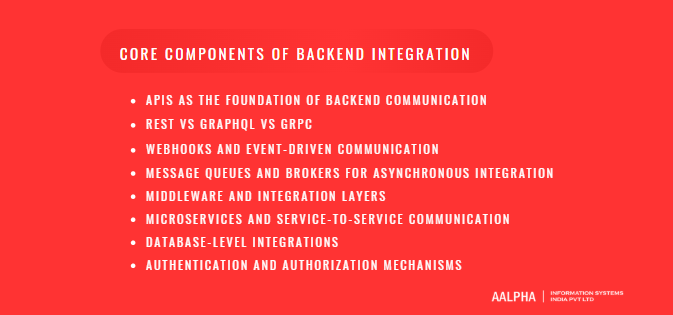
Core Components of Backend Integration
Backend integration is built on a structured set of foundational components that enable communication, coordination, and secure data exchange between distributed systems. Modern web applications depend on these building blocks to ensure services operate reliably across cloud platforms, internal databases, third-party APIs, and microservices environments. Understanding these components is essential for designing backend systems that scale efficiently and remain resilient under production workloads.
-
APIs as the Foundation of Backend Communication
Application Programming Interfaces are the primary mechanism through which backend systems communicate. An API defines how one service requests data or triggers actions in another service using standardized protocols. In practical terms, APIs act as formal contracts that describe available endpoints, required parameters, response formats, and authentication methods.
For example, when an e-commerce platform processes payments using Stripe, the backend server sends structured HTTP requests to Stripe’s API endpoints. Stripe validates the request, processes the transaction, and returns a response in JSON format. This structured exchange ensures interoperability without exposing internal infrastructure.
APIs allow backend systems to remain modular. Instead of tightly coupling services, each component exposes defined interfaces that can be consumed by other services. This decoupling improves maintainability and enables faster iteration.
Well-designed APIs follow versioning standards, enforce input validation, and provide comprehensive documentation through specifications such as OpenAPI. Poorly structured APIs create integration instability, version conflicts, and long-term technical debt.
-
REST vs GraphQL vs gRPC: Architectural Comparison
Backend communication frameworks typically rely on one of three major paradigms: REST, GraphQL, or gRPC. Each has architectural implications for scalability, performance, and development complexity.
- REST Architecture
REST, or Representational State Transfer, is the most widely adopted API standard. It uses standard HTTP methods such as GET, POST, PUT, and DELETE to interact with resources. REST APIs return structured JSON responses and are compatible with caching mechanisms at multiple levels.
REST is highly interoperable and simple to implement. However, it can lead to over-fetching or under-fetching of data, especially in complex applications where multiple resources must be retrieved in separate requests.
- GraphQL Architecture
GraphQL was originally developed by Meta to solve data inefficiency problems in large-scale applications. Unlike REST, GraphQL allows clients to request exactly the fields they need within a single query.
This flexibility reduces redundant data transfer and improves efficiency in applications with complex relational data. However, GraphQL increases backend complexity because servers must resolve nested queries dynamically and implement advanced caching strategies.
GraphQL is often chosen for frontend-driven ecosystems where performance optimization and flexible data retrieval are high priorities.
- gRPC Architecture
gRPC is a high-performance communication protocol created by Google. It uses Protocol Buffers for serialization rather than JSON, resulting in compact binary data transfer.
gRPC is particularly effective for internal microservices communication due to its speed and strongly typed contracts. It is commonly used in distributed systems where low latency and efficiency are critical.
However, gRPC is less human-readable than REST and requires additional tooling for browser compatibility. It is most suitable for backend-to-backend communication rather than public APIs.
-
Webhooks and Event-Driven Communication
Webhooks enable systems to push information automatically when predefined events occur. Instead of continuously polling an API to check for updates, a system subscribes to events and receives notifications when actions happen.
For example, when a payment succeeds through Stripe, the payment system triggers a webhook that sends transaction details to the merchant’s backend. This reduces unnecessary API calls and ensures near real-time updates.
Event-driven communication expands this model further. In event-driven architectures, services publish events to an event bus or messaging system. Other services subscribe to relevant events and respond independently. This approach reduces direct dependencies between systems and enhances scalability.
Event-driven integration is foundational in cloud-native systems because it supports horizontal scaling and fault isolation.
-
Message Queues and Brokers for Asynchronous Integration
Asynchronous communication mechanisms allow backend systems to process tasks independently of user-facing operations. Message queues and brokers play a critical role in achieving scalability and resilience.
Technologies such as Apache Kafka and RabbitMQ enable services to publish messages to queues. Consumer services then process these messages at their own pace.
This architecture prevents backend systems from becoming overloaded during traffic spikes. If a downstream service temporarily fails, messages remain stored in the queue until processing resumes.
Asynchronous integration improves fault tolerance, load management, and overall system reliability. Without it, synchronous API calls can create cascading failures under high demand.
-
Middleware and Integration Layers
Middleware acts as an intermediary layer between backend systems. It handles orchestration, routing, transformation, validation, and security enforcement.
In enterprise environments, middleware centralizes integration logic instead of embedding it within individual services. For example, an integration layer may transform data formats between legacy systems and cloud services, apply authentication rules, and manage retries in case of temporary failures.
This architectural layer reduces tight coupling between services and improves maintainability. It also simplifies debugging and monitoring by centralizing communication flows.
Effective middleware implementation prevents integration logic from spreading across multiple services, which can lead to fragmented and inconsistent behavior.
-
Microservices and Service-to-Service Communication
Modern web applications frequently adopt microservices architectures. Instead of building one large backend, developers create independent services that handle specific business domains such as billing, authentication, inventory, or notifications.
These services communicate through APIs, message brokers, or service meshes. Service-to-service communication requires secure authentication, load balancing, service discovery, and distributed tracing.
Microservices improve modularity and independent deployment cycles. However, they increase integration complexity. Each service must be able to communicate reliably with others while maintaining security and performance standards.
Service mesh technologies help abstract networking concerns and enforce encryption between services automatically. Without structured integration mechanisms, microservices environments can quickly become unstable.
-
Database-Level Integrations
Backend integration extends beyond APIs and messaging systems. Databases themselves must often synchronize data across environments.
Database-level integration includes replication, change data capture pipelines, and ETL workflows. For example, transactional databases may feed real-time updates into analytics warehouses to support business intelligence dashboards.
Data consistency is critical in distributed systems. Poorly designed database integration strategies can result in duplicated records, outdated information, and reporting inaccuracies.
Modern backend architectures frequently use streaming platforms to synchronize data changes in near real time. This approach reduces dependency on batch processing and improves data freshness.
-
Authentication and Authorization Mechanisms
Security is a fundamental component of backend integration. Every service-to-service communication channel must implement authentication and authorization controls.
Common mechanisms include OAuth 2.0 for delegated authorization, JWT for token-based authentication, and API keys for service-level access control.
OAuth enables secure delegated access without sharing credentials directly. JWT allows services to verify identity through signed tokens. API keys provide controlled access to external services.
Secure backend integration requires encryption using TLS, proper token validation, rate limiting, and role-based access control. Each integration point expands the potential attack surface of a system.
Failure to implement strong authentication mechanisms can result in data breaches, unauthorized access, and compliance violations.
Backend integration is built on a coordinated combination of APIs, communication protocols, asynchronous processing systems, middleware orchestration, microservices architecture, database synchronization, and security frameworks.
Each component plays a specific role. APIs define communication contracts. Protocols determine data exchange efficiency. Message brokers enable scalability. Middleware enforces governance. Microservices distribute functionality. Databases ensure consistency. Authentication mechanisms protect system integrity.
When these components are designed strategically, backend systems become scalable, resilient, and secure. When they are implemented without architectural discipline, integration complexity grows rapidly, leading to performance bottlenecks and operational risk.
Understanding these foundational building blocks is essential before designing advanced backend integration architectures.
Types of Backend Integration
Backend integration can be classified into multiple categories depending on how systems communicate, what kind of data is exchanged, and whether the integration occurs internally or externally. For business stakeholders, understanding these categories clarifies investment decisions and operational risk. For technical teams, it determines architecture patterns, tooling choices, and governance requirements.
Modern web applications rarely rely on a single integration type. Instead, they combine several models simultaneously to support payments, analytics, enterprise workflows, cloud infrastructure, and distributed services.
-
API-Based Integration
API-based integration is the most widely adopted integration model in modern web ecosystems. In this approach, backend systems communicate through structured endpoints exposed over HTTP, HTTPS, or binary protocols such as gRPC. APIs define how services request data, trigger actions, and handle responses.
For example, a SaaS platform may expose APIs to manage users, subscriptions, and billing workflows. Another internal service consumes those APIs to synchronize data across applications. API-based integration creates a standardized contract between systems, making them interoperable and easier to maintain.
This model supports modular architecture because each service can evolve independently as long as API contracts remain stable. However, governance is critical. Without proper versioning, documentation, and monitoring, API-based integration can create compatibility issues and service disruptions.
-
Third-Party Service Integration
Third-party service integration connects an application to external providers that offer specialized capabilities. Rather than building infrastructure from scratch, organizations leverage established platforms to accelerate development and reduce operational overhead.
Common third-party integrations include communication platforms, analytics providers, fraud detection systems, and authentication services. For example, businesses frequently integrate with Twilio to send SMS notifications and manage messaging workflows.
While third-party integrations improve development speed, they introduce dependency risks. API rate limits, downtime, pricing changes, or policy updates from external vendors can directly affect application performance. Strong monitoring, fallback logic, and clear service-level agreements are necessary to mitigate these risks.
-
Payment Gateway Integration
Payment gateway integration is a highly specialized form of backend integration that involves financial transactions and regulatory compliance. Applications integrate with payment processors to securely handle card transactions, digital wallets, and subscription billing.
Platforms such as Stripe and PayPal provide APIs that manage payment authorization, tokenization, and fraud detection.
Payment integration requires strict implementation standards. Backend systems must securely handle tokens rather than raw card data, implement webhook verification for transaction confirmation, and comply with PCI requirements. Errors in payment integration can lead to revenue loss, failed transactions, or compliance penalties.
Because financial data is sensitive, encryption, secure authentication, and audit logging are mandatory components of payment gateway integration.
-
CRM and ERP System Integration
Customer Relationship Management and Enterprise Resource Planning systems serve as the operational backbone of many enterprises. Backend integration with CRM and ERP platforms ensures that customer records, financial transactions, and inventory data remain synchronized across business units.
For instance, integrating a web application with Salesforce enables automatic updates of customer profiles and sales activities. ERP integration may synchronize accounting records, procurement workflows, or warehouse data.
These integrations are often complex due to rigid schema requirements, validation rules, and compliance constraints. Data mapping, transformation layers, and middleware orchestration are frequently required to maintain consistency.
CRM and ERP integration is critical for operational transparency, financial reporting accuracy, and regulatory compliance.
-
Cloud Service Integration
Cloud service integration connects applications with infrastructure and platform services provided by cloud vendors. Modern web applications rely heavily on cloud platforms for hosting, storage, authentication, analytics, and event streaming.
Organizations using Amazon Web Services or Microsoft Azure integrate with services such as managed databases, object storage, serverless functions, and identity management systems.
Cloud integration emphasizes automation, scalability, and resilience. Infrastructure-as-code tools often manage integration configurations to ensure consistent deployment across environments.
While cloud integration provides elasticity and high availability, it also introduces operational cost considerations. Monitoring resource usage and managing service dependencies are essential to prevent unexpected infrastructure expenses.
-
Legacy System Integration
Legacy system integration connects modern applications with older infrastructure that may not support contemporary API standards. Many enterprises operate legacy ERP systems, mainframes, or proprietary databases that remain critical to business operations.
These systems often lack RESTful APIs or modern authentication mechanisms. As a result, integration may require middleware adapters, data transformation layers, or batch file processing techniques.
Legacy integration presents unique challenges, including limited documentation, outdated protocols, and performance constraints. Despite these difficulties, legacy systems frequently store mission-critical data. Integration strategies must preserve data integrity while gradually modernizing infrastructure.
In digital transformation initiatives, integrating legacy systems is often a necessary intermediate step before full replacement.
-
Microservices Integration
Microservices integration occurs within distributed architectures where backend functionality is divided into independent services. Instead of a single monolithic backend, microservices architectures separate domains such as authentication, billing, product management, and notifications.
Each service communicates through APIs, message brokers, or event streams. Microservices integration requires structured service discovery, secure internal authentication, and monitoring tools that trace requests across multiple services.
This model improves scalability and deployment flexibility. Individual services can scale independently and be updated without affecting the entire system. However, integration complexity increases significantly. Distributed systems require robust observability, fault tolerance mechanisms, and consistent contract enforcement.
Without disciplined integration governance, microservices architectures can suffer from latency issues and cascading failures.
-
Real-Time vs Batch Integration
Backend integration strategies often differ based on timing requirements.
Real-time integration enables immediate data exchange. It is critical for payment confirmations, live notifications, inventory updates, and fraud detection systems. Real-time models rely on APIs, webhooks, and event-driven communication to ensure near-instant synchronization.
Batch integration processes data at scheduled intervals rather than continuously. It is commonly used for reporting workflows, large-scale data transfers, financial reconciliations, and analytics pipelines. Batch processing reduces real-time system load but introduces latency.
The choice between real-time and batch integration depends on business needs. Systems requiring immediate user feedback prioritize real-time integration, while data-heavy reporting tasks may rely on scheduled batch jobs.
-
Internal vs External Backend Integration
Backend integration can also be categorized by organizational boundaries.
Internal backend integration connects services within the same organization. Examples include user authentication communicating with billing services or inventory systems updating internal dashboards. Internal integration typically operates within secure networks and controlled infrastructure environments.
External backend integration connects systems across organizational boundaries. Examples include payment providers, logistics APIs, banking systems, and partner platforms. External integrations require stronger authentication, encryption, rate limiting, and monitoring due to broader trust boundaries.
Understanding this distinction is important because external integrations introduce greater security risks and operational dependencies.
Modern web applications rarely depend on a single integration type. A typical SaaS platform may use API-based integration for internal services, third-party integrations for messaging and analytics, payment gateway integration for transactions, CRM integration for sales tracking, cloud integration for infrastructure, and microservices integration for scalability.
Categorizing backend integration types clarifies architectural decisions and operational risk management. It enables organizations to align integration strategies with performance requirements, compliance standards, and long-term scalability goals.
A structured understanding of these integration types provides the foundation for designing robust backend architectures capable of supporting modern digital ecosystems.
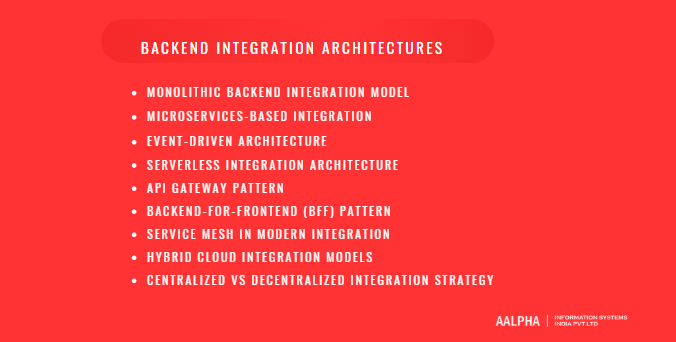
Backend Integration Architectures
Backend integration architecture defines how systems are structured, how services communicate, and how data flows across an application ecosystem. Architecture is not just a technical choice. It determines scalability, resilience, operational cost, team structure, and long-term maintainability.
Selecting the right backend integration architecture depends on product maturity, traffic volume, compliance requirements, and engineering capacity. This section explores the major architectural models used in modern web applications and provides guidance on when each approach is appropriate.
-
Monolithic Backend Integration Model
The monolithic architecture is the traditional backend integration model. In this approach, all business logic, integration logic, database access, and third-party connections are managed within a single unified application.
Integration in a monolithic model occurs internally through shared code modules rather than external service calls. External integrations, such as payment processors or CRM systems, are handled within the same application runtime.
Strengths of Monolithic Integration
Monolithic architectures are simpler to develop in early-stage products. They provide:
- Easier debugging and deployment
- Lower infrastructure complexity
- Centralized logging and monitoring
- Faster initial development cycles
For small applications with limited integration requirements, a monolith reduces overhead.
Limitations of Monolithic Integration
As systems grow, integration complexity increases. A single codebase handling payments, notifications, analytics, and internal workflows becomes harder to maintain. Scaling individual components independently becomes impossible.
Monolithic integration is often sufficient for MVPs and small-scale applications. However, high-growth systems eventually require architectural separation to handle performance and reliability challenges.
-
Microservices-Based Integration
Microservices architecture divides backend functionality into independent services, each responsible for a specific domain. Instead of one large system, services such as authentication, billing, product management, and notifications operate independently.
Integration occurs through APIs, message queues, or event streams. Services communicate over secure internal networks using structured contracts.
Advantages of Microservices Integration
Microservices enable:
- Independent scaling of services
- Faster team autonomy
- Fault isolation
- Flexible deployment cycles
If one service fails, others can continue operating. This improves resilience.
Architectural Trade-Offs
Microservices increase operational complexity. Distributed tracing, service discovery, secure service-to-service authentication, and monitoring become mandatory. Without structured governance, communication overhead can lead to latency issues.
Microservices architecture is appropriate for growing platforms that require scalability, modularity, and continuous deployment.
-
Event-Driven Architecture
Event-driven architecture decouples services by allowing them to communicate through events rather than direct API calls. Instead of calling another service synchronously, a service publishes an event when something occurs.
For example, when a user completes a purchase, the order service emits an event. The billing, notification, and analytics services subscribe to that event and react independently.
Event-driven systems often rely on technologies such as Apache Kafka for event streaming.
Benefits of Event-Driven Integration
Event-driven architecture provides:
- Loose coupling between services
- Improved scalability
- Fault tolerance
- Real-time responsiveness
Services can process events asynchronously without blocking user requests.
Design Considerations
Event-driven systems require strong observability tools and idempotent processing to avoid duplicate execution. Without proper event governance, systems may become difficult to debug.
This architecture is particularly effective for high-volume applications and real-time data processing environments.
-
Serverless Integration Architecture
Serverless architecture leverages managed cloud functions to execute backend logic in response to events. Instead of maintaining persistent servers, developers deploy event-triggered functions that scale automatically.
Cloud providers such as Amazon Web Services and Microsoft Azure offer serverless integration services.
Characteristics of Serverless Integration
Serverless integration often includes:
- Event-triggered functions
- Managed API endpoints
- Automatic scaling
- Pay-per-execution pricing
This model reduces infrastructure management overhead.
Limitations
Serverless architecture introduces cold start latency and vendor dependency. Complex workflows may require orchestration services to manage multiple function invocations.
Serverless integration is suitable for event-based workloads, lightweight APIs, and applications with unpredictable traffic patterns.
-
API Gateway Pattern
The API gateway pattern introduces a centralized entry point for all client requests. Instead of clients interacting directly with multiple backend services, they communicate with the gateway.
The gateway handles:
- Request routing
- Authentication and authorization
- Rate limiting
- Logging
- Response aggregation
By centralizing cross-cutting concerns, API gateways improve security and maintainability.
However, a poorly configured gateway can become a bottleneck. High-traffic systems must ensure that gateways scale horizontally and support load balancing.
API gateways are essential in microservices architectures where client applications need a unified interface.
-
Backend-for-Frontend (BFF) Pattern
The Backend-for-Frontend pattern creates dedicated backend services tailored to specific client applications. For example, a mobile app and a web dashboard may have separate backend layers optimized for their unique data requirements.
Instead of forcing all clients to use the same API structure, BFF services aggregate and shape data for each frontend.
Advantages of BFF
- Optimized payloads for different devices
- Reduced frontend complexity
- Improved performance
This pattern is especially useful when mobile apps and web apps require different data formats or business logic.
-
Service Mesh in Modern Integration
A service mesh provides infrastructure-level management of service-to-service communication in microservices environments. It abstracts networking, encryption, and observability from application code.
Service mesh capabilities typically include:
- Automatic TLS encryption between services
- Traffic routing and load balancing
- Circuit breaking
- Distributed tracing
By handling networking logic externally, a service mesh reduces complexity within individual services.
Service mesh architecture is most relevant in large-scale distributed systems where microservices communication must be tightly controlled and monitored.
-
Hybrid Cloud Integration Models
Many enterprises operate across multiple environments, combining on-premise infrastructure with public cloud services. Hybrid cloud integration connects these environments securely and efficiently.
For example, legacy databases hosted on-premise may synchronize with cloud-based analytics platforms.
Hybrid integration requires:
- Secure VPN or private network connections
- Data transformation layers
- Compliance enforcement
- Monitoring across environments
Hybrid architectures are common in regulated industries where sensitive data must remain on-premise while benefiting from cloud scalability.
-
Centralized vs Decentralized Integration Strategy
Backend integration governance can be centralized or decentralized.
Centralized Integration
In centralized models, a dedicated integration layer or team manages all service communication. This improves consistency, documentation, and security control.
However, centralized governance can slow development if teams depend heavily on a single integration authority.
Decentralized Integration
In decentralized models, individual teams manage integration logic within their own services. This promotes agility and faster deployment cycles.
The trade-off is potential inconsistency in implementation standards.
Organizations must balance speed with governance. Large enterprises often adopt a hybrid approach, combining centralized standards with decentralized execution.
Architectural Decision Framework
Choosing a backend integration architecture requires evaluating several factors:
- Application scale and traffic volume
- Team expertise and structure
- Regulatory requirements
- Performance expectations
- Budget constraints
- Time-to-market goals
Early-stage startups may begin with a monolithic integration model. Growing SaaS platforms often transition to microservices with API gateways. High-volume systems adopt event-driven architectures. Enterprises integrate hybrid cloud models to modernize legacy infrastructure.
No single architecture is universally optimal. The right decision aligns technical design with business strategy.
Backend integration architecture defines how adaptable and resilient a system will be in the face of growth, vendor dependency, regulatory pressure, and evolving user demands. Selecting the appropriate model early reduces future re-architecture costs and operational instability.
Step-by-Step Backend Integration Process
A backend integration project succeeds when it is treated as a product capability, not as a set of ad-hoc connections. The most common reason integrations fail in production is not “bad code.” It is unclear requirements, unmanaged dependencies, weak security boundaries, and missing operational controls such as monitoring, retries, and versioning. A disciplined integration process helps product teams ship faster while keeping systems stable as traffic, features, and third-party dependencies expand.
The steps below reflect a practical workflow used by modern engineering teams. Each step is written to be actionable for CTOs and product owners while still giving developers enough detail to implement correctly.
1) Defining Integration Requirements
Backend integration starts with a precise definition of what must be connected, why it matters to the business, and how success will be measured. Requirements should be captured as integration outcomes, not vague technical tasks. A useful way to frame requirements is to describe what needs to happen when a user or system performs an action, and what systems must react.
At this stage, define the scope by answering questions such as: Which workflows must be automated end-to-end? What data must be consistent across systems? What must happen in real time versus what can be processed later? What are the acceptable delays, failure rates, and recovery expectations? For example, payment confirmation usually requires near real-time reliability, while analytics ingestion can tolerate latency.
Good requirements also include constraints. These include compliance needs, data residency rules, vendor restrictions, and operational limits such as API rate caps. If the integration touches regulated data, requirements must include auditability, access control, and retention policies from day one. Once these requirements are documented, align stakeholders on a definition of done. For integration work, “done” must include observability and failure handling, not just “the API call works.”
2) Identifying Systems and Data Flows
After defining outcomes, identify every system involved and map the data flows between them. This is where many teams discover hidden complexity. Backend integration rarely involves only two services. Even a simple “create order” workflow may require order management, inventory, billing, shipping, notifications, CRM updates, and analytics events.
Create an integration map that includes internal services, external vendors, databases, and event streams. For each integration path, document the direction of data movement and the trigger condition. Common triggers include user actions, scheduled jobs, webhooks from third parties, and internal events published by services.
Then, define the data contract. Specify what fields are required, what fields are optional, the expected formats, and the rules for validation. If two systems represent the same concept differently, define the canonical model and the transformation logic. For example, one system may represent “customer” as a single object while another splits it into “account,” “contact,” and “billing profile.” Data flow mapping forces these differences to be handled explicitly rather than becoming implicit bugs.
Finally, define ownership. Every integration must have an owner responsible for keeping it healthy, responding to incidents, and managing changes when upstream or downstream systems evolve.
3) Choosing Integration Approach and Architecture
With flows and contracts defined, choose the integration approach that best matches reliability and scaling needs. The two most common integration styles are synchronous API-based integration and asynchronous event-driven integration. Many production systems use both.
Synchronous integration is appropriate when a user-facing workflow requires an immediate response, such as checking inventory availability at checkout or validating authentication. Asynchronous integration is appropriate when tasks can happen in the background, such as sending notifications, updating CRMs, or writing analytics events. Asynchronous architectures reduce coupling and improve resilience by allowing downstream services to process messages at their own pace.
Architectural choices must also consider organizational maturity. A monolithic system may be appropriate early, but it should still enforce integration boundaries through clear interfaces. In microservices environments, an API gateway often becomes essential to enforce security, throttling, and routing consistency. If multiple client types exist, such as web, mobile, and partner portals, the Backend-for-Frontend pattern can reduce frontend complexity and prevent fragile data-fetching logic in clients.
Choose architecture based on failure domain boundaries, expected traffic growth, compliance requirements, and your team’s ability to operate distributed systems. The architecture that looks elegant on paper is not always the one that is easiest to run in production.
4) API Design and Documentation Standards
Integration stability depends on clear, enforceable contracts. This is where disciplined API design and documentation matter. APIs should be designed as products. They must be consistent, versioned, and predictable.
Start with resource modeling and naming conventions. Standardize status codes, error responses, pagination behavior, and filtering patterns. Most integration outages come from ambiguous behavior, such as an endpoint sometimes returning null fields, changing a field type, or returning success with partial failure details buried in payloads.
Document your APIs using OpenAPI specifications. Documentation should include example requests and responses, authentication method, rate limits, idempotency requirements, and known error cases. If your integration uses webhooks, document the signature verification method and retry semantics.
Versioning must be explicit. When changes are breaking, publish a new version, keep the old version alive for a defined period, and provide migration guidance. This is not bureaucracy. It is how you prevent downstream consumers from breaking unexpectedly.
5) Security Implementation Strategy
Backend integration expands the attack surface because every connection becomes a potential entry point. Security must be designed into integration flows, not added after the fact.
Define authentication and authorization per integration boundary. For external APIs, OAuth 2.0 is commonly used when delegated authorization is required, while API keys are often used for service access. For internal service-to-service communication, use short-lived tokens and mutual TLS where possible. JWTs are commonly used for stateless identity assertions, but they must be validated correctly, including issuer validation, audience validation, and expiry checks.
Implement least privilege. Each service or integration client should only have permissions required for its job. Protect secrets using a dedicated secret manager rather than environment variables shared across pipelines. Enforce encryption in transit with TLS and consider encryption at rest for stored integration payloads.
Security also includes abuse protection. Rate limiting, request size limits, and input validation reduce exploitation risk. For high-risk integrations, implement anomaly detection and audit logs that capture who accessed what and when. If compliance frameworks apply, align logs, retention, and access controls accordingly.
6) Environment Setup and Testing Frameworks
Integration work must be tested under conditions that resemble production. A common mistake is testing integration only in local development with mocked services, then discovering failures in staging or production due to authentication differences, firewall rules, or rate limits.
Set up environments that reflect production topology, including network boundaries, service discovery, and authentication rules. Use separate credentials and separate secrets per environment. Ensure webhook endpoints are configured for staging as well, with the same verification flow used in production.
Testing should happen at multiple layers. Unit tests validate transformation logic and contract parsing. Integration tests validate real network calls or controlled sandbox environments from vendors. Contract tests validate schema compatibility between producer and consumer. End-to-end tests validate that workflows complete across all systems.
Where possible, use vendor sandbox environments for payment providers, messaging services, and analytics ingestion. This is particularly important for systems with webhooks because webhook delivery and verification behave differently than simple REST calls.
7) Error Handling and Retry Mechanisms
In production, failures are normal. Networks fail. Vendors throttle. Databases temporarily lock. Integration design must treat failure as expected behavior.
Implement consistent error handling. Distinguish between transient errors and permanent errors. Transient errors, such as timeouts or rate limit responses, should trigger retries with exponential backoff and jitter. Permanent errors, such as invalid input or authorization failure, should not be retried blindly and must generate actionable error logs.
Idempotency is essential. Retried requests must not create duplicate orders, duplicate charges, or repeated side effects. For payment flows, idempotency keys are a standard mechanism that ensures repeated requests are safe. For internal workflows, use deduplication based on event IDs or unique request identifiers.
Consider implementing circuit breakers. When a downstream service is failing, circuit breakers stop repeated calls and allow systems to degrade gracefully. Dead-letter queues are also important in asynchronous architectures. Messages that fail repeatedly should move to a separate queue for investigation rather than blocking the entire pipeline.
8) Monitoring and Logging Strategy
An integration that cannot be observed cannot be trusted. Monitoring and logging must be implemented as part of the integration itself.
Define metrics that reflect integration health, such as request latency, error rates, retry counts, queue depth, and webhook delivery success rates. For asynchronous systems, monitor consumer lag and dead-letter queue volume. For synchronous APIs, monitor p95 and p99 latency because average latency hides spikes that impact user experience.
Logs must be structured and correlated. Every request should carry a correlation ID that flows across services. This enables tracing a single user action across multiple systems. Distributed tracing tools are especially important in microservices environments, where a single workflow may touch multiple services.
Monitoring should include alerting thresholds aligned with business impact. For example, a 2 percent payment failure rate may be an incident, while a 2 percent analytics ingestion failure might be acceptable temporarily.
9) Performance Optimization
Performance is not only about speed. It is also about predictable behavior under load. Integration performance issues often come from repeated synchronous calls, excessive payload sizes, and lack of caching.
Optimize by reducing round trips. Use aggregation patterns when multiple data sources are required. Implement caching for read-heavy endpoints and stable reference data. Use asynchronous processing for workflows that do not require immediate completion.
For high-volume integrations, consider streaming rather than batch uploading. If APIs have rate limits, implement throttling and queue-based backpressure. For database-heavy integrations, optimize query patterns, use indexes, and avoid N+1 query behavior in integration services.
Load testing should simulate real workflows, not isolated endpoints. The most valuable performance tests replicate user journeys that trigger multiple integrations, because that is where bottlenecks appear.
10) Deployment and CI/CD Integration
Integration changes must be deployable safely and repeatedly. CI/CD pipelines should include automated tests, contract checks, and security scans. Deployments should follow staged rollouts to reduce risk.
Use feature flags to control exposure of new integrations. This allows gradual rollout and quick rollback without redeploying. For APIs, support backward compatibility and avoid breaking changes in place. For event-driven systems, use schema evolution patterns so that new consumers can read old events and vice versa.
Deployment must also include operational readiness. That means dashboards, alerts, runbooks, and incident ownership are in place before release. Integration releases should be treated as production changes with measurable impact.
A reliable backend integration process is fundamentally about engineering discipline. The goal is not simply to connect systems. The goal is to connect systems in a way that remains stable when traffic grows, vendors change, and failures occur. When requirements, contracts, security, testing, reliability mechanisms, observability, performance practices, and deployment controls are handled as first-class deliverables, backend integration stops being a fragile dependency and becomes a scalable foundation for modern web applications.
Backend Integration Technologies and Tools
Backend integration architecture is only as strong as the technologies used to implement it. Decision-makers must understand not only what tools are available, but also when and why to use them. The wrong tooling choice can increase operational complexity, create vendor lock-in, or limit scalability. The right stack improves maintainability, performance, and governance across distributed systems.
This section provides a practical overview of the most widely adopted backend integration technologies and how they fit into modern web applications.
Backend Frameworks
Backend frameworks provide the foundation for building APIs, managing business logic, and handling service-to-service communication.
- Node.js
Node.js is widely used for API-driven applications due to its non-blocking, event-driven architecture. It is particularly effective for I/O-heavy integrations such as real-time messaging, streaming, and API orchestration.
Node.js supports high concurrency with efficient resource usage. Frameworks like Express and NestJS simplify REST and GraphQL API development. It is commonly used in SaaS platforms and microservices environments.
- Django
Django is a high-level Python framework known for rapid development and built-in security features. It includes authentication modules, ORM capabilities, and administrative interfaces.
Django is suitable for integration projects requiring structured data management and rapid API development, particularly when Python-based analytics or AI services are involved.
- Spring Boot
Spring Boot is widely adopted in enterprise environments. It supports microservices architecture, dependency injection, and secure service-to-service communication.
Spring Boot integrates well with large-scale distributed systems and is often used in financial services and regulated industries where strong typing, performance, and long-term maintainability are priorities.
- Laravel
Laravel is a PHP framework known for elegant syntax and strong support for RESTful APIs. It includes built-in authentication, ORM capabilities, and queue management.
Laravel is frequently used in startup and SME environments where rapid development and integration simplicity are important.
Selecting a backend framework depends on team expertise, ecosystem maturity, and long-term scalability requirements.
API Management Platforms
API management platforms help organizations govern, secure, and monitor APIs at scale. They provide centralized control over routing, authentication, analytics, and rate limiting.
Common platforms include:
- Kong
- Apigee
- AWS API Gateway
API management platforms are essential when:
- Multiple teams publish APIs
- External partners consume APIs
- Rate limiting and throttling are required
- Analytics and monitoring are necessary
These platforms enforce security policies and provide dashboards for traffic insights, making them valuable for large-scale integrations.
Integration Platforms (iPaaS Solutions)
Integration Platform as a Service solutions simplify connecting cloud applications without building custom middleware.
Popular iPaaS platforms include:
- MuleSoft
- Dell Boomi
- Zapier
These platforms offer visual workflow builders, prebuilt connectors, and data transformation tools. They reduce engineering effort for standard integrations such as CRM, ERP, and marketing automation connections.
However, iPaaS solutions may introduce cost and customization limitations. They are best suited for business process automation rather than high-performance, low-latency integrations.
Message Brokers
Message brokers enable asynchronous communication between services. They decouple producers and consumers, improving scalability and resilience.
Apache Kafka
Apache Kafka is a distributed event streaming platform designed for high-throughput, real-time data pipelines. It is widely used for analytics ingestion, event-driven microservices, and log aggregation.
Kafka supports horizontal scaling and durable event storage, making it suitable for high-volume systems.
RabbitMQ
RabbitMQ is a lightweight message broker focused on reliable message delivery. It supports multiple messaging protocols and is commonly used for background task processing.
Choosing between Kafka and RabbitMQ depends on workload type. Kafka excels in event streaming and replayable logs, while RabbitMQ is effective for traditional message queue scenarios.
API Documentation Tools
Clear documentation is critical for stable integration. API documentation tools generate interactive API specifications that help internal and external teams understand integration contracts.
Swagger and OpenAPI
Swagger is a widely used tool for generating interactive documentation from OpenAPI specifications. OpenAPI defines machine-readable API contracts.
Documentation tools enable:
- Schema validation
- Mock server generation
- Client SDK generation
- Automated contract testing
Without standardized documentation, integrations become fragile and error-prone.
Authentication Services
Authentication and authorization are foundational for backend integration security.
Common authentication services include:
- Auth0
- Keycloak
- Okta
These platforms handle OAuth 2.0 flows, token issuance, user identity management, and multi-factor authentication.
Centralizing authentication reduces duplication of security logic and simplifies compliance management across distributed systems.
Database Connectors and ORMs
Backend integration frequently involves data synchronization and transformation across databases. Object-Relational Mapping tools simplify database interactions by abstracting SQL queries into application-level models.
Examples include:
- Hibernate
- Sequelize
- Django ORM
Database connectors and ORMs improve development speed but must be used carefully in high-performance integrations. Improper query patterns can introduce latency and scaling issues.
For real-time data streaming and change data capture, specialized connectors may integrate operational databases with analytics systems.
Cloud Integration Tools
Cloud-native backend integration relies heavily on managed services offered by cloud providers.
Amazon Web Services
Amazon Web Services provides services such as Lambda for serverless execution, SQS for message queuing, SNS for notifications, and EventBridge for event routing.
Microsoft Azure
Microsoft Azure offers Azure Functions, Service Bus, and Logic Apps for integration workflows.
Google Cloud Platform
Google Cloud provides Cloud Functions, Pub/Sub messaging, and API Gateway services.
Cloud integration tools enable scalability, global availability, and managed infrastructure, reducing operational overhead. However, they can increase vendor lock-in if not designed with portability in mind.
DevOps Tools for Backend Integration
DevOps tooling ensures integration deployments remain stable and repeatable.
Common tools include:
- Docker for containerization
- Kubernetes for orchestration
- Jenkins for CI/CD pipelines
- GitHub Actions for automated workflows
These tools support:
- Automated testing
- Continuous deployment
- Infrastructure as code
- Rollback mechanisms
DevOps integration ensures that backend changes do not break production environments. It also enforces consistency across development, staging, and production systems.
Selecting backend integration technologies requires balancing performance, security, scalability, cost, and team expertise. Startups may prioritize rapid development frameworks and managed cloud services. Enterprises may prioritize robust governance platforms and compliance-ready authentication services.
No single tool solves all integration challenges. The optimal stack aligns architectural needs with operational capacity. Decision-makers should evaluate ecosystem maturity, vendor support, community adoption, and long-term maintainability before committing to a technology choice.
Backend integration tooling is not just an implementation detail. It is a strategic investment that determines how reliably systems can communicate, scale, and evolve over time.
Security in Backend Integration
Security in backend integration is not a feature that can be layered on after systems are connected. Every integration point increases the attack surface of an application. APIs expose endpoints, message brokers open communication channels, third-party services introduce external dependencies, and distributed systems create multiple trust boundaries. A secure backend integration strategy must address authentication, encryption, token handling, traffic control, data validation, compliance requirements, and operational monitoring in a unified manner.
When organizations ask what makes backend integration secure, the answer lies in layered defense. Security must operate at transport, application, identity, infrastructure, and governance levels simultaneously.
-
API Authentication Methods
Authentication is the first line of defense in backend integration. Every API request, whether internal or external, must verify the identity of the caller. Weak authentication mechanisms are one of the most common causes of data breaches in distributed systems.
Common API authentication methods include API keys, OAuth 2.0, and JSON Web Tokens. API keys are simple to implement and suitable for service-to-service communication, but they must be rotated regularly and never embedded in client-side code. OAuth 2.0 is widely adopted for delegated authorization, allowing applications to access resources without sharing user credentials. JSON Web Tokens are frequently used to transmit identity claims securely between services. However, JWTs must be validated carefully, including signature verification, issuer validation, audience validation, and expiration checks.
Internal service-to-service communication should use short-lived credentials and mutual TLS wherever possible. Long-lived static credentials significantly increase risk. Identity providers such as Okta or Auth0 can centralize authentication management and reduce inconsistent security implementations across services.
-
Encryption in Transit and at Rest
Encryption protects data from interception and unauthorized access. All backend integration traffic must use TLS encryption to secure data in transit. Unencrypted HTTP connections expose credentials, tokens, and sensitive payloads to interception attacks.
Transport Layer Security ensures that communication between services, APIs, and databases remains confidential and tamper-resistant. Certificates must be managed properly, including renewal policies and certificate pinning where necessary.
Encryption at rest protects stored data, including database records, logs, and integration payloads. Cloud platforms such as Amazon Web Services and Microsoft Azure provide managed encryption capabilities for storage and databases. However, enabling encryption alone is not sufficient. Key management practices must be enforced, and access to encryption keys must be strictly controlled.
-
Secure Token Management
Tokens represent trust. When a service receives a valid token, it grants access to protected resources. Improper token handling can undermine the entire security model.
Secure token management includes storing tokens in secure secret managers rather than in code repositories or configuration files. Tokens should have short expiration times to reduce exposure risk. Refresh token workflows must be protected against replay attacks. For highly sensitive integrations, consider rotating tokens automatically and using ephemeral credentials.
Logging systems must avoid storing raw tokens in plaintext. Even debug logs can become attack vectors if they contain authentication details. A secure integration design treats tokens as sensitive assets that require lifecycle governance.
-
Rate Limiting and Throttling
Rate limiting and throttling protect backend systems from abuse, denial-of-service attacks, and unexpected traffic spikes. Integration endpoints exposed publicly or to partners must enforce request limits per client or API key.
Without rate limiting, malicious actors can flood endpoints, exhausting server resources or exploiting computationally expensive operations. Throttling mechanisms slow down requests when limits are exceeded rather than allowing abrupt system failure.
Rate limiting also protects against accidental overload caused by misconfigured clients or runaway scripts. API gateways often provide built-in rate limiting controls, enabling centralized enforcement of traffic policies.
-
Input Validation and Sanitization
Input validation prevents injection attacks, malformed payloads, and unintended system behavior. Every integration endpoint must validate incoming data before processing it.
Validation includes checking required fields, data types, allowed value ranges, and expected formats. Sanitization ensures that user-supplied data cannot execute unintended commands or alter database queries.
Common attack vectors include SQL injection, cross-site scripting payloads passed through APIs, and command injection in improperly sanitized inputs. Backend systems must never assume that upstream services provide clean data.
Validation should occur at multiple layers. API gateways can enforce schema validation, while application logic enforces business rules. Defense-in-depth reduces the likelihood of exploitable vulnerabilities.
-
Zero-Trust Architecture Principles
Zero-trust architecture assumes that no system, user, or network segment should be trusted by default. Every request must be authenticated, authorized, and verified, regardless of its origin.
In backend integration, zero-trust means internal services must not bypass authentication simply because they operate within the same network. Service-to-service communication should require identity verification and encrypted channels.
Network segmentation, role-based access control, and least-privilege permissions are core zero-trust principles. Microservices environments particularly benefit from zero-trust enforcement because lateral movement between services is a common attack strategy.
Implementing zero-trust reduces the risk that a compromised service can escalate privileges or access unrelated systems.
-
Compliance Considerations
Backend integration frequently involves regulated data, including personal information, financial records, and healthcare data. Compliance frameworks such as GDPR, HIPAA, and SOC 2 impose strict requirements on data handling, retention, access control, and audit logging.
GDPR requires clear data processing agreements, consent tracking, and mechanisms for data deletion upon request. HIPAA mandates safeguards for protected health information, including encryption and strict access control. SOC 2 emphasizes operational security, availability, confidentiality, and integrity controls.
Integration design must include audit logging to track data access and modifications. Logs should be tamper-resistant and retained according to compliance requirements. Access controls must be role-based, and data exposure minimized through selective field sharing rather than full dataset transfers.
Security controls should align with regulatory requirements from the earliest design phase rather than being retrofitted after deployment.
-
Secure Third-Party API Consumption
Integrating with third-party APIs introduces trust boundaries that must be carefully managed. External APIs may change, degrade in performance, or become compromised.
Secure third-party integration includes verifying SSL certificates, validating webhook signatures, and implementing retry logic with rate limits. Sensitive data sent to external vendors must be minimized to reduce exposure risk.
Organizations should assess vendor security posture, including certifications, encryption standards, and breach response policies. Monitoring outbound traffic to third-party services can detect abnormal behavior or unexpected data transmission.
Dependency management tools should track third-party SDK versions to prevent vulnerabilities caused by outdated libraries.
-
Common Security Vulnerabilities in Integration
Backend integrations often expose vulnerabilities when security controls are inconsistent or incomplete. Common risks include broken authentication mechanisms, excessive permissions, insecure direct object references, and insufficient logging.
Another frequent issue is improper error handling that exposes sensitive information in API responses. Detailed stack traces returned to clients can reveal internal system architecture.
Replay attacks occur when integration endpoints fail to enforce idempotency or timestamp validation. Man-in-the-middle attacks become possible if TLS enforcement is inconsistent.
Security misconfiguration, including open ports, default credentials, and exposed admin endpoints, remains one of the most prevalent causes of integration breaches.
Proactive vulnerability scanning, penetration testing, and security reviews should be incorporated into integration release cycles.
Security in backend integration is continuous, not static. As systems evolve and new integrations are added, threat models must be updated. Monitoring, patch management, credential rotation, and policy enforcement require ongoing governance.
A secure backend integration strategy integrates identity verification, encryption, validation, compliance controls, traffic management, and monitoring into a unified framework. When security is embedded at architectural, operational, and governance levels, backend integration becomes resilient against both accidental failures and deliberate attacks.
Organizations that prioritize security early reduce the risk of breaches, regulatory penalties, and reputational damage. In distributed systems, trust must be engineered deliberately. Security is not an add-on to backend integration. It is its structural foundation.
Performance Optimization and Scalability
Performance and scalability in backend integration are not achieved through a single optimization. They emerge from coordinated architectural decisions, infrastructure planning, and runtime controls. As traffic increases, integrations that were stable under low load often become bottlenecks. API latency spikes, database queries slow down, message queues back up, and external services begin throttling requests. Operational maturity requires anticipating these pressures and designing systems that absorb growth without degrading user experience.
This section outlines the core strategies used to optimize backend integration performance and ensure scalable operation.
-
Load Balancing Strategies
Load balancing distributes incoming traffic across multiple servers or service instances to prevent overload. Without load balancing, a single server handling integration logic can become a performance bottleneck.
Modern load balancers operate at different layers. Layer 4 load balancing distributes traffic based on IP and TCP information, while Layer 7 load balancing makes routing decisions based on HTTP headers, paths, or request content. Cloud platforms such as Amazon Web Services and Microsoft Azure provide managed load balancing services that automatically distribute traffic across instances.
Effective load balancing also includes health checks. If one integration service instance becomes unhealthy, traffic is automatically redirected to functioning instances. This prevents cascading failures and improves availability.
For microservices environments, load balancing must operate both at the external API level and internally between services. Without internal load distribution, certain services may become overloaded even when overall traffic appears balanced.
-
Caching Mechanisms
Caching reduces latency and database load by storing frequently accessed data closer to the requesting service or user. Backend integration often involves repeated calls to the same resources, such as product catalogs, user profiles, or configuration settings.
In-memory caching systems such as Redis allow services to retrieve data quickly without querying a database repeatedly. This dramatically improves response times for read-heavy endpoints.
Content Delivery Networks, or CDNs, cache static assets and API responses at edge locations closer to users. This reduces round-trip latency and improves global performance.
However, caching requires clear invalidation strategies. Stale data can cause inconsistencies across integrated systems. For example, cached inventory data must refresh immediately when stock changes. Designing cache expiration policies and event-driven cache invalidation mechanisms ensures data freshness without sacrificing performance.
-
Database Indexing Strategies
Databases frequently become the performance bottleneck in backend integration. When services depend on database queries to retrieve or update data, inefficient indexing can slow entire workflows.
Indexes improve query performance by allowing the database to locate records without scanning entire tables. However, over-indexing can slow write operations. The correct indexing strategy balances read performance with write efficiency.
Integration-heavy systems should analyze query patterns and index fields used in filtering, sorting, and joins. Monitoring tools can identify slow queries and high-latency database operations.
For high-scale environments, read replicas can distribute load, allowing read-heavy integrations to scale independently from write operations. Partitioning and sharding strategies may also be required for very large datasets.
Database optimization is not a one-time activity. As integration patterns evolve, indexing strategies must adapt.
-
Asynchronous Processing
Asynchronous processing decouples user-facing workflows from background tasks. Instead of forcing users to wait for every integration to complete, systems can enqueue tasks for later processing.
Message brokers such as Apache Kafka or RabbitMQ allow services to publish tasks into queues. Consumer services then process those tasks independently.
This approach improves responsiveness and prevents bottlenecks. For example, sending emails, updating analytics, or synchronizing CRM records can occur asynchronously without delaying a user checkout flow.
Asynchronous processing also enhances fault tolerance. If a downstream system fails temporarily, queued messages remain intact until processing resumes.
-
Horizontal vs Vertical Scaling
Scalability depends on how infrastructure grows in response to demand.
Vertical scaling increases the capacity of a single server by adding more CPU, memory, or storage. While simple, it has physical limits and may require downtime during upgrades.
Horizontal scaling adds more instances of a service and distributes traffic across them. This approach aligns with cloud-native and microservices architectures, enabling elastic growth based on load.
Horizontal scaling is generally more resilient because failures in one instance do not impact the entire system. However, it requires stateless service design and distributed session management.
Integration services should be designed to scale horizontally from the beginning. Stateless APIs, shared caches, and externalized session storage simplify horizontal expansion.
-
Circuit Breaker Patterns
The circuit breaker pattern prevents cascading failures when a downstream service becomes unresponsive. Instead of continuously retrying failed requests and overwhelming the failing service, the circuit breaker temporarily stops calls and returns fallback responses.
For example, if a third-party payment API begins returning errors, the circuit breaker opens and prevents further requests for a defined cooldown period. This protects system resources and allows graceful degradation.
Circuit breakers are especially important in distributed microservices environments. Without them, a single failing dependency can bring down an entire integration chain.
Implementing circuit breakers alongside retry logic ensures systems remain resilient under failure conditions.
-
API Versioning Best Practices
API versioning plays a crucial role in scalability and maintainability. As systems evolve, integration contracts change. Without versioning, updates can break existing consumers.
Best practices include embedding version numbers in URL paths or headers and maintaining backward compatibility for a defined transition period. Deprecation notices should be communicated clearly to API consumers.
Versioning enables controlled evolution of integration logic while minimizing disruptions. It also supports gradual rollout of performance improvements without forcing immediate client upgrades.
-
Handling High Concurrency
High concurrency occurs when many users or services attempt to access integration endpoints simultaneously. This is common during product launches, promotional campaigns, or peak transaction periods.
Handling high concurrency requires a combination of strategies:
- Stateless service design
- Efficient connection pooling
- Optimized thread management
- Queue-based backpressure
- Rate limiting
Connection pooling reduces the overhead of repeatedly opening and closing database or external API connections. Backpressure mechanisms prevent systems from being overwhelmed by more requests than they can process.
Stress testing and load testing simulate real-world traffic patterns to identify bottlenecks before production incidents occur.
Performance optimization and scalability are continuous processes rather than isolated tuning exercises. As user traffic grows and integrations multiply, operational pressure increases.
Effective backend integration performance relies on balanced load distribution, intelligent caching, optimized database queries, asynchronous workflows, scalable infrastructure, failure isolation, disciplined versioning, and concurrency control.
Organizations that treat scalability as an architectural principle from the beginning avoid costly re-architecture later. Backend integration must not only function correctly under ideal conditions but remain stable under peak load, vendor instability, and unpredictable growth.
Scalable backend integration transforms technical infrastructure into a durable competitive advantage, enabling consistent performance as digital ecosystems expand.
Common Backend Integration Challenges and Solutions
Backend integration rarely fails because of a single coding mistake. It fails due to systemic issues: inconsistent data models, unanticipated latency, poorly managed dependencies, and evolving contracts between services. Real-world integration environments involve multiple systems owned by different teams, vendors operating under separate SLAs, and distributed architectures where observability is often incomplete.
Understanding common backend integration challenges and implementing structured mitigation strategies separates stable production systems from fragile ones.
-
Data Inconsistency Across Systems
Data inconsistency is one of the most persistent backend integration problems. When multiple systems store related information independently, synchronization errors can lead to conflicting records. For example, a CRM system may reflect an updated customer address while the billing system retains outdated information.
Inconsistent data usually emerges from asynchronous workflows, delayed updates, or schema mismatches. If integrations rely on batch processing, delays can create temporary mismatches. In event-driven systems, duplicate event handling or message loss can produce inconsistencies.
The solution begins with defining a clear source of truth for each data entity. Every core object such as customer, order, or subscription must have a primary system responsible for ownership. Downstream systems should treat replicated data as derived, not authoritative.
Implementing idempotent processing prevents duplicate updates. Change Data Capture pipelines or event streaming platforms such as Apache Kafka help maintain near real-time synchronization. Data validation and reconciliation jobs should run periodically to detect and correct discrepancies before they impact business operations.
-
Latency and Timeout Issues
Latency becomes visible when integration chains grow longer. A single user action may trigger multiple synchronous API calls across internal services and third-party providers. If one service responds slowly, the entire request chain can exceed timeout thresholds.
Timeout issues frequently arise in synchronous architectures that depend on multiple upstream services. Network delays, DNS resolution issues, or overloaded endpoints compound latency across distributed systems.
Mitigating latency requires minimizing synchronous dependencies. Non-critical workflows should be processed asynchronously using message brokers such as RabbitMQ. Caching frequently accessed data reduces repeated external calls. Connection pooling and optimized query performance reduce backend bottlenecks.
Timeout values should be configured intentionally. Excessively long timeouts delay failure detection, while short timeouts increase false positives. Circuit breaker patterns prevent slow services from cascading into system-wide outages.
-
API Rate Limits
Most third-party APIs enforce rate limits to protect infrastructure from overload. When integration traffic exceeds allowed thresholds, requests are rejected or throttled.
Rate limiting becomes problematic when traffic spikes unexpectedly or when retry logic is poorly implemented. Aggressive retries can amplify traffic rather than stabilize it.
Effective rate limit handling requires reading and respecting provider documentation. Implement exponential backoff with jitter for retries. Cache responses where appropriate to reduce repeated calls. Use asynchronous queuing mechanisms to smooth traffic spikes rather than sending bursts of simultaneous requests.
Monitoring rate limit response headers allows proactive traffic management before failures occur.
-
Versioning Conflicts
APIs evolve. When integration consumers and providers update independently, version conflicts can break production workflows.
Versioning conflicts often arise when breaking changes are introduced without backward compatibility. Field names change, data types shift, or required parameters are added unexpectedly.
The solution is disciplined API governance. Version numbers should be explicit in URLs or headers. Deprecation timelines must be communicated clearly. Contract testing ensures that consumer applications remain compatible with provider changes.
When possible, implement additive changes rather than breaking modifications. Maintaining backward compatibility reduces operational risk and avoids forced migration under pressure.
-
Debugging Distributed Systems
Debugging backend integration in distributed architectures is significantly more complex than debugging monolithic systems. A single transaction may traverse multiple services, message queues, and third-party APIs.
Without proper observability, identifying the source of failure becomes time-consuming. Logs may exist across different services without shared context.
The solution is structured observability. Correlation IDs must propagate across every request. Distributed tracing tools record request flows and latency at each step. Structured logs enable searchability and automated alerting.
Integration debugging should not depend on manual log inspection alone. Dashboards that visualize service health, queue depth, error rates, and response times allow proactive issue detection.
-
Integration Failures in Production
Even well-designed integrations fail in production due to unexpected input, vendor downtime, configuration errors, or scaling bottlenecks.
Production failures are particularly damaging when systems lack graceful degradation strategies. For example, if a third-party analytics service fails, it should not block user transactions.
Failure management requires retry logic, dead-letter queues, circuit breakers, and fallback responses. Systems should be designed so that non-critical integrations degrade independently without affecting core workflows.
Incident response playbooks should document recovery procedures. Post-incident analysis must identify root causes and improve resilience.
-
Third-Party Dependency Risks
Third-party integrations introduce external risks outside organizational control. Vendors may change pricing models, modify API behavior, deprecate endpoints, or experience outages.
Dependency risk management requires redundancy where feasible. For example, maintaining alternative communication providers reduces reliance on a single vendor. Monitoring external service health allows early detection of disruptions.
Legal agreements and service-level expectations should be documented clearly. Vendor due diligence must include reviewing security certifications, uptime history, and data handling policies.
Overreliance on third-party platforms without contingency planning increases operational vulnerability.
-
Technical Debt Accumulation
Backend integration technical debt accumulates when quick fixes replace structured architecture. Temporary workarounds become permanent dependencies. Hardcoded values, undocumented transformations, and inconsistent error handling create fragile systems.
Debt often accumulates during rapid product growth when new integrations are added without refactoring legacy ones.
Mitigation requires periodic integration audits. Refactoring integration layers, standardizing error handling, and consolidating duplicated logic reduce complexity. Documentation must be updated continuously, not retroactively.
Technical debt in integration systems is particularly dangerous because it may remain hidden until a major failure occurs.
Strategies for Long-Term Maintainability
Long-term maintainability requires architectural discipline and operational governance. Establish integration standards covering API design, authentication methods, logging formats, and versioning practices.
Centralize integration documentation and maintain clear ownership for each connection. Implement automated testing and contract validation in CI pipelines. Regularly review vendor contracts and monitor performance metrics.
Adopt observability as a core principle. Dashboards and alerting systems should evolve alongside integration complexity. Refactoring should be treated as an investment rather than deferred indefinitely.
Finally, treat backend integration as an evolving capability rather than a completed task. As systems scale and business needs change, integration architecture must adapt proactively.
Backend integration challenges are inevitable in modern distributed systems. Data inconsistencies, latency spikes, rate limits, version conflicts, debugging complexity, and third-party dependencies are not signs of failure. They are operational realities.
Organizations that anticipate these challenges and implement structured solutions build resilient integration ecosystems. Those that ignore them often encounter production instability and rising operational costs.
Real-world backend integration success depends on disciplined architecture, proactive monitoring, controlled version management, and continuous improvement. When challenges are addressed systematically, backend integration transforms from a risk factor into a scalable foundation for growth.
Backend Integration Use Cases Across Industries
Backend integration is not an abstract architectural concern. It directly enables revenue generation, compliance, automation, and competitive differentiation across industries. The structure of integration workflows varies by sector, but the underlying principles remain consistent: secure data exchange, reliable orchestration, scalability, and observability.
The following industry-specific use cases illustrate how backend integration supports operational and commercial success.
-
E-commerce Backend Integration
E-commerce platforms are among the most integration-intensive systems in modern web architecture. A typical online store integrates product catalogs, inventory management systems, payment gateways, shipping providers, CRM platforms, and marketing automation tools.
When a customer places an order, multiple backend systems must coordinate in near real time. The order service validates inventory, triggers payment authorization through providers such as Stripe, updates stock levels, generates invoices, and notifies logistics partners. Simultaneously, analytics systems record transaction data and CRM systems update customer profiles.
E-commerce integration must handle peak traffic during promotional events. Failures in integration pipelines can result in lost revenue, overselling inventory, or delayed fulfillment. For this reason, asynchronous processing, caching strategies, and event-driven architecture are widely adopted in this sector.
Backend integration in e-commerce directly impacts conversion rates, order accuracy, and customer satisfaction.
-
Fintech and Payment Processing
Fintech platforms operate under strict security and compliance constraints. Backend integration in financial services must ensure transactional accuracy, encryption, identity verification, and regulatory auditability.
Payment processing integrations connect banking APIs, fraud detection services, and compliance monitoring systems. Many fintech platforms integrate with providers such as PayPal or global banking APIs to manage transfers and settlements.
Integration challenges in fintech include handling high transaction volumes, preventing duplicate processing through idempotency controls, and ensuring low latency for authorization flows. Regulatory requirements often mandate audit trails and encryption standards.
Because financial systems are highly sensitive, integration design must prioritize secure authentication, encrypted communication, and detailed logging. Performance and reliability directly affect trust and regulatory standing.
-
Healthcare Data Integration
Healthcare systems rely heavily on backend integration to synchronize patient records, appointment scheduling, billing systems, and insurance claims processing.
Healthcare data integration often involves connecting Electronic Health Record systems with external labs, pharmacies, and insurance providers. Regulatory frameworks such as HIPAA require strict access controls and encryption for protected health information.
Real-time integration may be required for appointment confirmations or telemedicine sessions, while batch processing may handle billing reconciliations. Healthcare integrations must enforce granular authorization rules to prevent unauthorized data access.
System downtime or data inconsistencies in healthcare can have serious operational consequences. As a result, secure authentication, encryption, audit logging, and compliance verification are mandatory components of healthcare backend integration.
-
SaaS Platforms and Multi-Tenant Systems
SaaS platforms often serve multiple tenants within a shared infrastructure environment. Backend integration enables authentication, billing, subscription management, analytics, and third-party application connectivity.
Multi-tenant SaaS systems must isolate tenant data while allowing shared infrastructure. Integration with identity providers such as Auth0 simplifies centralized authentication and authorization.
Backend integration in SaaS platforms also supports ecosystem expansion. Public APIs allow third-party developers to build extensions and integrations, creating platform stickiness and network effects.
Scalability is critical in SaaS environments. Event-driven architectures and API gateways help manage growing tenant activity while maintaining performance isolation between customers.
-
Logistics and Supply Chain Systems
Logistics and supply chain platforms depend on real-time integration across multiple stakeholders. Backend systems connect warehouse management systems, transportation providers, customs processing services, and inventory tracking tools.
When a shipment moves across borders, backend integration coordinates status updates between carriers, customs authorities, and internal dashboards. Integration must handle high concurrency during peak shipping seasons.
Data consistency is particularly important in logistics. Incorrect tracking updates or inventory mismatches can disrupt supply chains and erode customer trust.
Event-driven architecture is frequently used to publish shipment updates. Integration resilience is critical because supply chain disruptions often originate from delayed or failed data exchange rather than physical logistics failures.
-
Real-Time Analytics Platforms
Real-time analytics platforms collect, process, and analyze data streams from operational systems. Backend integration pipelines ingest transactional events and transform them into structured insights.
Event streaming technologies such as Apache Kafka are commonly used to capture high-volume data streams. Analytics engines process these streams to power dashboards and predictive models.
Integration must ensure minimal latency between event occurrence and data availability. Batch-based ingestion is insufficient for applications requiring real-time visibility, such as fraud detection or live performance monitoring.
Scalable data pipelines and schema governance are essential to prevent analytics inaccuracies. Backend integration supports decision-making speed and operational transparency.
-
AI and Machine Learning Backend Integration
AI-powered applications require backend integration to feed machine learning models with clean, structured data and to distribute predictions back into operational systems.
For example, an AI recommendation engine may consume user behavior data, purchase history, and inventory information. The model generates recommendations, which are then integrated into frontend APIs in real time.
Backend integration ensures training data pipelines remain consistent and that inference results propagate across services. Data preprocessing, feature transformation, and feedback loops must operate reliably.
In AI ecosystems, integration errors can degrade model accuracy or cause inconsistent predictions. Observability and data validation are critical to maintain model performance.
-
IoT System Integrations
Internet of Things platforms integrate physical devices with cloud-based backend systems. Sensors transmit data continuously to backend services, which analyze and respond to events.
IoT integrations often rely on message brokers and event streaming platforms to handle high-frequency data transmission. Devices may operate in unreliable network conditions, requiring buffering and retry logic.
Backend systems process telemetry data, trigger alerts, and store historical records for analysis. Security is especially important in IoT integration because compromised devices can serve as entry points into broader networks.
Scalability and fault tolerance are essential as device counts grow. Backend integration ensures stable communication between hardware devices and cloud infrastructure.
Across industries, backend integration determines operational efficiency, compliance readiness, and customer experience quality. Whether processing financial transactions, managing patient records, synchronizing supply chains, or powering AI recommendations, integration logic directly affects business performance.
Organizations that invest in robust backend integration architectures gain measurable advantages: reduced operational friction, improved system reliability, faster innovation cycles, and stronger ecosystem partnerships.
Industry-specific requirements may vary, but the underlying principle remains constant. Backend integration is the structural foundation that allows modern digital systems to function as unified platforms rather than isolated applications.
Cost of Backend Integration
The cost of backend integration varies widely depending on architecture complexity, number of systems involved, compliance requirements, performance expectations, and long-term scalability goals. For organizations evaluating integration investments, understanding cost drivers is essential. Backend integration is not a one-time development expense. It includes implementation, infrastructure, governance, monitoring, vendor management, and continuous optimization.
This section breaks down the primary cost components and strategic considerations.
-
Cost Factors Influencing Backend Integration
Several variables directly influence integration costs. The most significant factor is the number of systems involved. Integrating two internal services is fundamentally different from integrating multiple third-party APIs, legacy systems, and cloud platforms simultaneously.
Complexity increases when real-time processing is required. Synchronous integrations demand higher availability, stricter error handling, and stronger observability controls. Asynchronous event-driven systems introduce infrastructure costs such as message brokers and monitoring tools.
Compliance requirements also increase costs. Integrations involving financial data, healthcare records, or personally identifiable information require encryption, audit logging, and secure authentication frameworks.
Additional cost drivers include:
- Data transformation requirements
- API versioning and backward compatibility support
- Scalability expectations
- High-availability architecture
- Security hardening and penetration testing
The more mission-critical the integration, the higher the required engineering rigor and operational safeguards.
-
In-House vs Outsourcing Cost Comparison
Organizations must decide whether to build backend integrations internally or partner with external engineering providers.
In-house development provides direct control, architectural continuity, and domain familiarity. However, it requires hiring experienced backend engineers, DevOps specialists, and security professionals. Salary costs, recruitment overhead, and ongoing training expenses can significantly increase total investment.
Outsourcing backend development tasks like integrations, reduces recruitment burden and accelerates time-to-market. Specialized engineering firms often bring domain expertise and established architectural frameworks. However, outsourcing requires clear documentation, structured communication, and governance oversight to ensure long-term maintainability.
From a cost perspective, in-house development typically involves higher fixed costs but may offer lower marginal cost for continuous expansion. Outsourcing may reduce initial investment but requires careful partner selection to avoid rework or quality issues.
The optimal model depends on integration complexity, internal expertise, and long-term product roadmap.
-
Ongoing Maintenance Costs
Backend integration costs do not end after initial deployment. APIs evolve, vendors update contracts, security patches must be applied, and traffic patterns change.
Ongoing maintenance costs include:
- Monitoring and incident response
- Updating API versions
- Refactoring integration logic
- Scaling infrastructure
- Compliance audits
- Credential rotation and security reviews
Maintenance can represent 15 to 25 percent of the initial development cost annually, depending on system complexity and vendor dependencies.
Organizations that neglect maintenance often accumulate technical debt, leading to higher re-architecture costs later.
-
Infrastructure and Hosting Expenses
Infrastructure costs depend heavily on architectural choices. Monolithic systems may run on fewer servers but scale vertically, while microservices architectures require container orchestration, service discovery, and distributed monitoring.
Cloud providers such as Amazon Web Services and Microsoft Azure charge based on compute usage, storage, data transfer, and managed service consumption.
Asynchronous systems using message brokers such as Apache Kafka incur additional infrastructure expenses. Caching systems, load balancers, and monitoring tools further increase operational costs.
Infrastructure optimization requires balancing performance requirements with cost efficiency. Overprovisioning increases expense, while underprovisioning introduces reliability risks.
-
API Licensing and Third-Party Fees
Many integrations depend on third-party services that charge usage-based fees. Payment gateways, messaging services, analytics platforms, and identity providers often bill per transaction or per user.
For example, payment processors charge transaction fees per payment, while communication platforms charge per message or API call.
These costs scale with usage. Organizations must model projected traffic to estimate long-term vendor expenses. High-growth systems may see third-party costs increase substantially over time.
Vendor pricing models should be evaluated carefully to prevent unexpected financial strain as traffic grows.
-
Hidden Costs in Complex Integrations
Hidden costs frequently emerge during large-scale backend integration projects. These include:
- Data migration from legacy systems
- Unexpected vendor API limitations
- Security remediation efforts
- Refactoring due to poor initial architecture
- Production incident recovery
- Reconciliation of inconsistent datasets
Additionally, integration complexity may require more extensive documentation, cross-team coordination, and governance processes than initially anticipated.
Organizations often underestimate the cost of debugging distributed systems and resolving intermittent failures. Investing in observability and automated testing early reduces hidden long-term expenses.
Backend integration should be evaluated not only by cost but by return on investment. Effective integration reduces manual operations, improves data accuracy, accelerates workflows, and enables automation.
For example, integrating CRM systems with marketing automation platforms reduces data duplication and increases campaign efficiency. Real-time analytics integration improves decision-making speed. Automated billing integration reduces administrative overhead.
ROI also includes risk mitigation. Secure and resilient integration reduces the likelihood of downtime, compliance violations, and reputational damage.
When modeled correctly, backend integration supports revenue growth, operational efficiency, and scalability. The question is not whether integration costs money. The question is whether the integration architecture enables the business to grow without operational bottlenecks.
The cost of backend integration depends on complexity, security requirements, infrastructure scale, and vendor dependencies. Upfront development is only one component. Ongoing maintenance, cloud infrastructure, and third-party licensing represent continuous operational expenses.
Organizations that treat backend integration as a strategic investment rather than a short-term technical task gain long-term scalability and efficiency. Proper cost planning, vendor evaluation, and architectural discipline prevent unexpected financial overruns.
A well-designed backend integration system pays for itself through automation, improved reliability, and accelerated product innovation.
How to Choose the Right Backend Integration Partner
Selecting a backend integration partner is a strategic decision that directly impacts system stability, scalability, and long-term operational efficiency. Integration work is foundational. If it is poorly designed, every future feature, vendor connection, or scaling effort becomes more complex and expensive. Decision-makers must evaluate partners not only on technical delivery but on architectural discipline, security rigor, governance standards, and post-deployment accountability.
The following framework helps CTOs, product leaders, and enterprise buyers assess backend integration vendors effectively.
-
Evaluating Technical Expertise
Technical expertise is the baseline requirement, but it must be assessed in context. Backend integration is not just about writing API calls. It involves distributed system design, performance optimization, failure handling, and observability.
When evaluating a partner, examine whether they have experience with:
- API-first architectures
- Microservices and event-driven systems
- Message brokers and asynchronous workflows
- Cloud-native deployment models
- Secure authentication frameworks
Ask for real examples of complex integration projects they have completed. Look for experience handling multi-system orchestration, third-party vendor dependencies, and high-volume transactional environments.
An experienced integration partner should be able to explain trade-offs between synchronous and asynchronous design, discuss failure isolation patterns, and articulate scalability strategies clearly.
-
Architecture Capability Assessment
Integration architecture determines long-term maintainability. A strong partner will propose a structured architecture aligned with your business growth roadmap rather than implementing quick fixes.
Assess whether the vendor:
- Designs modular integration layers
- Implements API gateways or service meshes where appropriate
- Plans for versioning and backward compatibility
- Considers performance bottlenecks proactively
- Designs observability into the architecture
Review architectural documentation and ask how they handle scaling from thousands to millions of transactions. A mature integration partner anticipates growth rather than retrofitting architecture after traffic increases.
Architecture capability should extend beyond code to include governance standards, environment separation, and disaster recovery planning.
-
Security Standards Verification
Security cannot be assumed. It must be verified. Backend integration expands the attack surface of your system, especially when third-party services and external APIs are involved.
A qualified partner should demonstrate:
- Secure authentication and authorization practices
- Encryption in transit and at rest
- Token lifecycle management
- Rate limiting and abuse prevention
- Compliance alignment for GDPR, HIPAA, or SOC 2 if applicable
Ask how they manage secrets, how they implement least-privilege access control, and how they validate third-party webhook signatures. Request documentation of prior security audits or compliance certifications.
Security maturity separates enterprise-ready partners from basic development vendors.
-
Documentation and Process Maturity
Backend integration must be documented thoroughly. Without documentation, long-term maintenance becomes dependent on individual developers rather than structured knowledge.
Evaluate whether the partner:
- Uses OpenAPI specifications for API documentation
- Maintains architectural diagrams
- Implements contract testing
- Follows structured CI/CD pipelines
- Provides clear integration runbooks
Process maturity also includes communication workflows, sprint planning, and change management. Ask how they manage API version changes and how they communicate breaking changes.
Integration work without documentation often results in hidden technical debt.
-
Post-Deployment Support Capability
Integration does not end at launch. APIs evolve, vendors update contracts, and infrastructure scales. Post-deployment support is critical for maintaining system stability.
A strong partner provides:
- Monitoring and alert configuration
- Incident response support
- Version upgrade management
- Performance tuning assistance
- Ongoing security updates
Clarify service-level agreements for response times and escalation procedures. Ask how they handle vendor API changes and whether they provide long-term optimization guidance.
Sustainable backend integration requires continuous governance, not one-time delivery.
Questions to Ask Integration Vendors
Before finalizing a partner, decision-makers should ask direct, technical questions such as:
- How do you handle idempotency and retry logic in distributed systems?
- What is your strategy for scaling integration services under peak load?
- How do you ensure backward compatibility during API upgrades?
- What monitoring tools do you implement for observability?
- How do you secure service-to-service communication?
- Can you provide case studies of integration in similar industries?
Clear, structured answers indicate experience. Vague responses signal potential risk.
Red Flags to Avoid
Certain warning signs suggest integration risk:
- Overpromising timelines without architectural assessment
- Lack of security documentation
- No structured API versioning strategy
- Absence of monitoring or observability planning
- Minimal discussion of failure handling or retry logic
- Heavy reliance on hardcoded solutions
Another red flag is focusing solely on development cost without addressing long-term maintenance. Backend integration is an ongoing capability, not a short-term deliverable.
For organizations seeking a structured, secure, and scalable backend integration partner, working with an experienced backend development company such as Aalpha Information Systems can provide both architectural depth and operational governance. A mature integration partner brings not only development expertise but also documented processes, security discipline, and long-term scalability planning to ensure your backend ecosystem remains resilient, compliant, and ready for sustained growth.
Choosing the right backend integration partner requires evaluating technical strength, architectural foresight, security rigor, process maturity, and post-deployment commitment. Integration errors are expensive to fix after deployment. A structured evaluation process reduces risk and ensures your backend ecosystem remains stable as your business grows.
Backend integration is foundational infrastructure. Selecting the right partner determines whether that foundation supports long-term scalability or becomes a recurring operational bottleneck.
Final Words
Backend integration is the structural backbone of modern web applications. It determines how reliably systems communicate, how securely data flows, and how effectively platforms scale under growth. From API design and security architecture to performance optimization and long-term governance, integration is not a secondary concern. It is a strategic capability that directly influences operational efficiency, compliance readiness, and customer experience.
Organizations that invest in structured backend integration frameworks reduce technical debt, improve system resilience, and create platforms that can evolve without constant re-architecture. The difference between a fragile digital product and a scalable one often lies in the quality of its integration foundation.
If you are planning to modernize your backend systems, integrate complex third-party services, or build a scalable microservices architecture, Aalpha Information Systems offers structured, security-focused, and performance-driven backend integration solutions. Our team combines architectural expertise with disciplined implementation practices to ensure your systems remain stable, secure, and ready for growth.
Contact us to discuss how we can help design and implement a backend integration strategy aligned with your long-term business goals.