



AI-powered backend development refers to the design and implementation of server-side systems that integrate artificial intelligence models directly into backend workflows. Unlike traditional backend development, which relies on predefined rules and static logic, AI-powered backends can analyze data, learn from patterns, and make data-driven decisions in real time.
The scope of AI-powered backend development extends across core backend layers, including APIs, databases, data pipelines, authentication systems, and infrastructure management. AI models may be embedded within backend services to support functions such as prediction, classification, recommendation, anomaly detection, and automation. These systems often operate behind the scenes, enabling intelligent behavior without direct user interaction.
AI-powered backend development is not limited to a specific industry or application type. It is used across SaaS platforms, enterprise systems, fintech applications, healthcare platforms, eCommerce solutions, and data-driven products where backend intelligence directly impacts performance, reliability, and user experience.
Why AI Is Becoming Part of Backend Systems
Backend systems are increasingly required to handle large volumes of data, unpredictable workloads, and complex decision-making logic. Traditional rule-based backend architectures struggle to scale efficiently under these conditions. AI addresses these limitations by introducing adaptive, data-driven logic into backend operations.
Several factors have accelerated the adoption of AI in backend systems:
- Growth of data-intensive applications that require real-time analysis and insights
- Rising expectations for personalized and responsive digital experiences
- Need for automation to reduce manual intervention in backend operations
- Advancements in cloud infrastructure that make AI model deployment practical and cost-effective
AI allows backend systems to move beyond static processing and respond dynamically to changing inputs. Tasks such as load prediction, fraud detection, recommendation generation, and system monitoring are now handled more accurately through AI-driven logic embedded in backend services.
Business Problems AI-Powered Backends Solve
AI-powered backend development helps businesses address several persistent technical and operational challenges.
One major problem is scalability under variable demand. AI models can predict traffic patterns and resource usage, enabling backend systems to scale proactively rather than reactively. This reduces downtime and performance bottlenecks.
Another challenge is operational inefficiency. Manual monitoring, debugging, and optimization consume significant engineering effort. AI-powered backends automate these tasks by analyzing logs, detecting anomalies, and identifying performance issues before they impact users.
Data utilization is also a common issue. Many organizations collect large volumes of data but fail to extract actionable insights. AI-powered backend systems process and analyze this data in real time, supporting smarter business decisions and personalized services.
Security and fraud prevention present additional challenges. AI models embedded in backend services can identify unusual behavior patterns, detect potential threats, and reduce false positives more effectively than traditional rule-based systems.
By solving these problems, AI-powered backend development enables businesses to build systems that are more reliable, efficient, and capable of supporting long-term growth.
Backend Development Fundamentals
Core Backend Components (APIs, Databases, Servers)
Backend development forms the foundation of any modern application by managing data processing, business logic, and system communication. While users interact with the frontend, the backend is responsible for ensuring that every request is handled correctly, securely, and efficiently.
At the center of backend systems are servers, which receive requests from clients, execute application logic, and return responses. These servers may run as monolithic applications, microservices, or serverless functions depending on the system architecture. They handle authentication, authorization, data processing, and integrations with third-party services.
APIs (Application Programming Interfaces) act as the communication layer between the frontend, backend services, and external systems. REST and GraphQL APIs expose backend functionality in a structured way, enabling web apps, mobile apps, and external platforms to interact with backend services. APIs also play a critical role in enforcing security, validation, and access control.
Databases store and manage application data. Backend systems typically use a combination of relational databases for structured data and NoSQL databases for high-volume or unstructured data. The backend controls how data is created, retrieved, updated, and deleted while maintaining consistency, integrity, and performance.
Together, servers, APIs, and databases form the core backend infrastructure that supports application functionality, data flow, and system stability.
Traditional vs AI-Enabled Backend Architecture
Traditional backend architectures rely on predefined rules and deterministic logic. Business workflows are implemented through conditional statements, fixed thresholds, and manually configured processes. While this approach works for predictable use cases, it becomes difficult to maintain as systems grow in complexity and scale.
AI-enabled backend architectures introduce adaptive intelligence into backend workflows. Instead of relying solely on static rules, AI models analyze historical and real-time data to influence backend decisions. For example, an AI-enabled backend may adjust resource allocation based on traffic forecasts, detect anomalies in system behavior, or personalize responses based on user patterns.
In traditional systems, backend optimization often requires manual tuning and reactive fixes. In AI-enabled backends, optimization becomes proactive. Machine learning models continuously learn from system behavior and improve decision-making over time. This results in backend systems that respond more effectively to changing workloads and evolving business requirements.
The shift from traditional to AI-enabled backend architecture does not replace core backend components. Instead, AI enhances existing backend layers by adding intelligence where automation, prediction, and pattern recognition are needed.
Role of Backend in Scalability and Reliability
The backend plays a critical role in determining how well an application scales and how reliably it performs under load. Poorly designed backend systems lead to slow response times, system failures, and degraded user experiences.
From a scalability perspective, the backend manages how resources are allocated as demand changes. This includes load balancing, database performance, caching strategies, and service orchestration. AI-enabled backends improve scalability by predicting demand patterns and enabling systems to scale in advance rather than reacting after performance degrades.
Reliability depends on the backend’s ability to handle failures gracefully. This includes retry mechanisms, fault isolation, monitoring, and recovery processes. AI enhances reliability by identifying abnormal behavior early, detecting failure patterns, and supporting automated recovery actions before issues escalate.
In AI-powered systems, the backend evolves from a passive request handler into an active decision-making layer. It continuously evaluates system health, usage patterns, and performance metrics to maintain stable and dependable application behavior.
Key AI Technologies Used in Backend Development
Machine Learning in Backend Logic
Machine learning plays a central role in AI-powered backend development by enabling systems to learn from data rather than rely solely on predefined rules. In backend logic, machine learning models are embedded within services to support decision-making processes such as classification, scoring, ranking, and anomaly detection.
Common backend use cases for machine learning include fraud detection in financial systems, recommendation engines in eCommerce platforms, user behavior analysis in SaaS applications, and predictive maintenance in operational systems. These models process structured and unstructured data received through APIs, databases, or event streams and return predictions that influence backend workflows.
Unlike static business rules, machine learning models improve over time as they are exposed to more data. Backend systems integrate these models as services or internal components, allowing applications to adapt dynamically to changing usage patterns and business requirements.
Natural Language Processing for Data Handling
Natural language processing (NLP) enables backend systems to understand, interpret, and extract value from text-based data. Many backend applications process large volumes of unstructured content, such as customer messages, support tickets, documents, logs, and user-generated content. NLP allows backend services to convert this data into structured information that can be analyzed and acted upon.
Backend use cases for NLP include text classification, sentiment analysis, entity extraction, document parsing, and search optimization. For example, NLP models can automatically categorize support tickets, extract key details from contracts, or improve search relevance within applications.
By integrating NLP into backend pipelines, businesses reduce manual data processing and improve accuracy in handling language-driven workflows. NLP-powered backend services often operate asynchronously, processing incoming text data and feeding structured outputs into databases or downstream services.
Predictive Analytics and Decision Engines
Predictive analytics enables backend systems to anticipate future events based on historical data. In AI-powered backend development, predictive models are used to forecast demand, estimate user behavior, identify risks, and support automated decision-making.
Decision engines combine predictive analytics with business logic to determine the best course of action in real time. For example, a backend system may use predictive models to decide whether a transaction requires additional verification, which content to recommend to a user, or when to scale infrastructure resources.
These decision engines are typically implemented as backend services that receive inputs from APIs or data streams, apply predictive models, and return outcomes that influence application behavior. This approach allows backend systems to make consistent, data-backed decisions at scale.
Model Training vs Inference in Backend Systems
Understanding the distinction between model training and inference is essential for designing AI-powered backend architectures. Model training involves feeding large datasets into machine learning algorithms to create or update predictive models. This process is computationally intensive and often performed offline or in dedicated environments.
Inference, on the other hand, refers to using trained models to generate predictions in real time or near real time. Backend systems primarily focus on inference, as it directly impacts application behavior and user experience. Inference services are optimized for low latency, high availability, and scalability.
In production-grade backend systems, training and inference are usually separated. Trained models are deployed as versioned services or artifacts, while backend applications call these models through APIs or internal interfaces. This separation allows teams to update models without disrupting backend operations and maintain system stability.
AI-Powered Backend Architecture
AI in Monolithic and Microservices Backends
AI-powered backend architecture can be implemented in both monolithic and microservices-based systems, depending on the application’s scale, complexity, and growth requirements.
In monolithic backends, AI components are typically embedded directly into the core application. Machine learning models may exist as internal modules that handle tasks such as scoring, classification, or recommendation. This approach works well for early-stage products or systems with tightly coupled workflows, as it simplifies deployment and reduces inter-service communication overhead. However, as the system grows, updating AI models or scaling specific AI workloads can become challenging.
In microservices-based backends, AI capabilities are usually exposed as independent services. Each AI function—such as fraud detection, recommendation, or demand forecasting—runs as a separate service that communicates with other backend components through APIs or message queues. This architecture allows teams to scale AI services independently, update models without affecting the rest of the system, and experiment with new models more safely.
Choosing between monolithic and microservices architecture depends on factors such as team size, release frequency, and system complexity. In practice, many organizations adopt a hybrid approach, starting with a monolithic backend and gradually extracting AI-driven components into separate services as requirements evolve.
Event-Driven and Real-Time AI Backends
Event-driven architecture plays a key role in AI-powered backend systems that require real-time intelligence. In this model, backend components respond to events—such as user actions, data updates, or system signals—rather than relying solely on synchronous requests.
AI models integrated into event-driven backends process streams of events to generate insights or trigger actions. For example, an AI model may analyze user behavior events to detect anomalies, personalize content, or predict churn. These insights are then published as new events or used to update downstream systems.
Real-time AI backends are designed to handle low-latency inference at scale. This requires efficient message handling, optimized model serving, and reliable data pipelines. Event-driven AI architectures are particularly effective for applications that demand immediate responses, such as fraud detection, recommendation engines, and operational monitoring systems.
By decoupling event producers from AI consumers, backend systems gain flexibility and resilience while maintaining real-time intelligence.
Designing Backend Systems Around AI Models
Designing backend systems around AI models requires a shift in architectural thinking. Instead of treating AI as an add-on, AI becomes a core component that influences data flow, system design, and decision-making logic.
One key consideration is model accessibility. Backend services must be able to access AI models efficiently through well-defined interfaces. This often involves deploying models as APIs or internal services with strict performance and availability requirements.
Another consideration is data flow design. AI models depend on high-quality data, so backend architectures must include robust pipelines for data ingestion, validation, and transformation. Poor data flow design directly impacts model accuracy and system reliability.
Versioning and rollback are also critical. Backend systems should support multiple model versions and allow controlled rollouts to reduce risk. This enables teams to test new models without disrupting production workloads.
By designing backend systems around AI models rather than forcing AI into existing architectures, organizations build systems that are more adaptable, intelligent, and easier to evolve over time.
Data Management for AI-Powered Backend Systems
Data Pipelines and Preprocessing
Data pipelines are a foundational component of AI-powered backend systems. They define how raw data is collected, processed, and delivered to AI models and backend services. Unlike traditional backend systems that often process data on demand, AI-powered systems rely on continuous data flow to maintain model accuracy and relevance.
Backend data pipelines typically ingest data from multiple sources, including application logs, user interactions, third-party APIs, and transactional databases. This data must be cleaned, validated, and transformed before it can be used by AI models. Preprocessing steps such as normalization, deduplication, feature extraction, and enrichment are handled within backend services or dedicated pipeline components.
Well-designed data pipelines ensure that AI models receive consistent and reliable inputs. Poor preprocessing leads to inaccurate predictions, increased system errors, and unreliable backend behavior. For this reason, preprocessing logic is treated as a first-class backend concern rather than a secondary data task.
Structured and Unstructured Data Handling
AI-powered backend systems must handle both structured and unstructured data efficiently. Structured data, such as database records and transactional data, is typically easier to process and analyze. Backend systems enforce schemas, relationships, and constraints to maintain consistency and integrity.
Unstructured data, including text, images, documents, and logs, presents greater complexity. Backend services use AI techniques such as natural language processing and pattern recognition to extract meaningful signals from unstructured data. This extracted information is then converted into structured formats that can be stored, queried, and analyzed.
Effective backend systems are designed to process structured and unstructured data in parallel. This allows AI models to combine transactional accuracy with contextual insights, leading to more informed decisions and intelligent backend behavior.
Data Storage Strategies for AI Workloads
Data storage plays a critical role in supporting AI workloads within backend systems. Traditional storage strategies focused primarily on transactional performance, but AI-powered systems must also support high-volume data access, historical analysis, and model training requirements.
Relational databases are commonly used for structured, transactional data, while NoSQL databases and object storage systems handle large-scale and unstructured datasets. Time-series databases are often introduced to manage event streams and monitoring data used by predictive models.
Backend architectures typically adopt a layered storage approach, separating operational data from analytical and training datasets. This separation prevents AI workloads from impacting application performance while enabling efficient data access for both inference and model improvement.
Data Quality and Consistency Challenges
Data quality is one of the most significant challenges in AI-powered backend development. AI models are highly sensitive to inconsistent, incomplete, or biased data. Backend systems must actively enforce data validation rules to prevent errors from propagating through AI workflows.
Consistency across data sources is equally important. Backend services often aggregate data from multiple systems, each with different formats and update frequencies. Without proper synchronization and validation, these inconsistencies can degrade model performance and lead to incorrect backend decisions.
To address these challenges, backend systems implement monitoring, auditing, and feedback mechanisms that track data health over time. By treating data quality as a continuous backend responsibility, organizations maintain reliable AI-driven functionality and reduce long-term operational risk.
AI in API and Database Layer
AI-Driven API Management and Monitoring
APIs are the primary interface through which backend systems communicate with applications and external services. In AI-powered backend development, AI is used to monitor, analyze, and optimize API behavior beyond traditional metrics.
AI-driven API management systems analyze request patterns, response times, error rates, and usage trends to identify abnormal behavior and performance degradation. Instead of relying on static thresholds, AI models learn normal traffic patterns and detect anomalies that may indicate failures, misuse, or attacks.
These insights enable backend systems to take proactive actions, such as rerouting traffic, scaling services, or alerting engineering teams before issues impact users. AI-driven monitoring improves system visibility and reduces the operational burden of manual API oversight.
Intelligent Query Optimization
Database performance is a critical factor in backend responsiveness. Traditional query optimization relies on static execution plans and manual tuning, which often fail under changing workloads and data growth.
AI-powered backend systems use machine learning to analyze query patterns, execution times, and resource usage. Based on this analysis, the system can recommend or automatically apply optimizations such as query rewriting, caching strategies, or execution plan adjustments.
By continuously learning from real-world usage, AI-driven query optimization adapts to evolving access patterns. This results in faster response times, reduced database load, and more efficient use of backend resources.
Predictive Indexing and Database Scaling
Indexing strategies play a significant role in database performance, but managing indexes manually becomes increasingly complex as data volume and query diversity grow. AI-powered backend systems address this challenge through predictive indexing.
Predictive models analyze historical query data to identify which indexes will deliver the greatest performance benefit. The backend can then create, modify, or remove indexes based on actual usage rather than assumptions. This reduces storage overhead and improves query efficiency.
AI also supports predictive database scaling by forecasting workload growth and resource consumption. Backend systems can scale database instances or adjust configurations before performance issues arise, maintaining stability during traffic spikes and data expansion.
AI-Based API Security and Throttling
Security and traffic control are essential responsibilities of the backend API layer. AI enhances these capabilities by identifying malicious patterns that traditional rule-based systems may miss.
AI-based API security models analyze request behavior to detect suspicious activity such as credential abuse, scraping, or denial-of-service attempts. These models adapt to new attack patterns and reduce false positives compared to static security rules.
AI-driven throttling systems dynamically adjust rate limits based on real-time usage patterns and risk assessment. Instead of enforcing rigid limits, the backend can allow legitimate high-usage clients while restricting potentially harmful traffic.
By integrating AI into API security and throttling, backend systems become more resilient, secure, and responsive to real-world usage conditions.
Backend Automation and Performance Optimization
AI-Assisted Code Generation and Debugging
AI-assisted code generation has become a practical tool in backend development, helping teams write, review, and improve server-side code more efficiently. In AI-powered backend systems, these tools support developers by generating boilerplate code, suggesting optimized logic, and identifying potential issues early in the development cycle.
For debugging, AI models analyze code behavior, error patterns, and execution traces to identify root causes faster than manual inspection. Instead of scanning logs line by line, developers receive contextual insights that highlight problematic sections of code and suggest fixes. This reduces development time and improves code quality without replacing human oversight.
By integrating AI into backend development workflows, teams reduce repetitive tasks and focus more on system design and business logic.
Intelligent Log Analysis
Backend systems generate large volumes of logs that capture application behavior, system events, and error conditions. Manually analyzing these logs becomes impractical as systems scale. AI-powered log analysis automates this process by identifying patterns, anomalies, and correlations across log data.
Machine learning models classify log entries, detect unusual sequences, and surface issues that may otherwise go unnoticed. For example, AI can correlate minor warnings across services to predict larger failures or performance degradation.
Intelligent log analysis improves incident response times and supports proactive system maintenance. Backend teams gain better visibility into system behavior without increasing operational complexity.
Predictive Performance Monitoring
Traditional performance monitoring focuses on tracking metrics such as CPU usage, memory consumption, and response times. While useful, these metrics often signal problems only after performance has already degraded.
Predictive performance monitoring uses AI to analyze historical and real-time system data to forecast performance issues before they occur. AI models identify early indicators of bottlenecks, resource exhaustion, or service instability and generate alerts or trigger corrective actions.
This proactive approach allows backend systems to maintain consistent performance during traffic spikes, feature releases, or infrastructure changes. Predictive monitoring reduces downtime and improves user experience by addressing issues before they impact applications.
Auto-Scaling and Cost Optimization
Auto-scaling is essential for backend systems that experience fluctuating workloads. Traditional auto-scaling rules rely on fixed thresholds, which often lead to delayed responses or unnecessary resource usage.
AI-powered auto-scaling systems predict demand based on usage patterns, seasonal trends, and historical data. Backend resources are scaled up or down in advance, maintaining performance while avoiding over-provisioning.
In addition to scaling, AI supports cost optimization by identifying inefficient resource usage and recommending adjustments. Backend systems can balance performance requirements with budget constraints, ensuring efficient infrastructure utilization over time.
Benefits of AI-Powered Backend Development
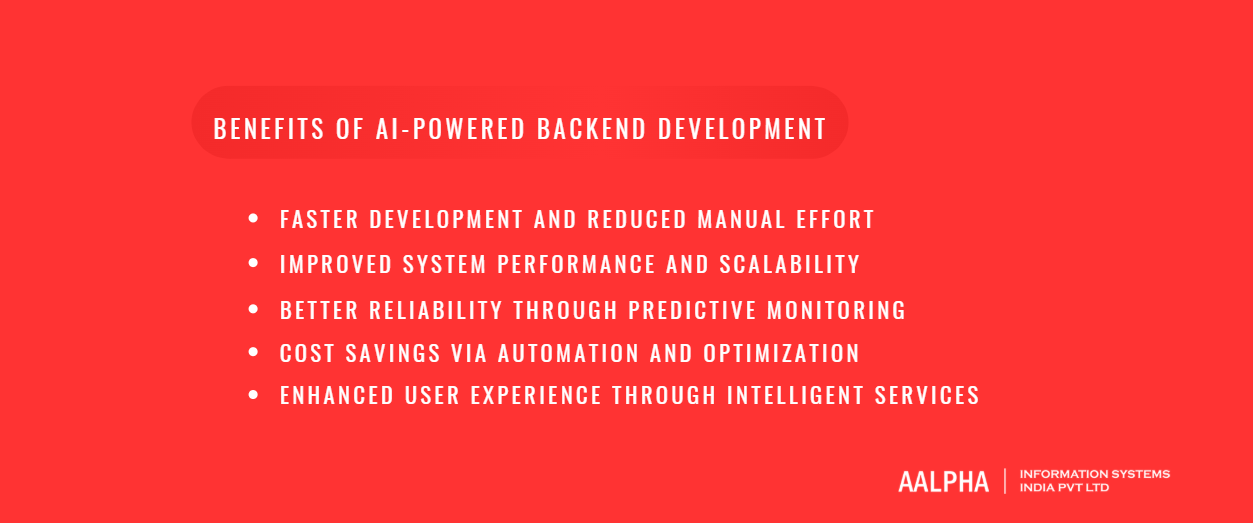
Faster Development and Reduced Manual Effort
AI-powered backend development significantly reduces the amount of manual work involved in building and maintaining server-side systems. AI-assisted code generation, automated testing, and intelligent debugging tools accelerate development cycles by handling repetitive and time-consuming tasks.
Backend teams spend less time writing boilerplate code, searching for errors, or manually tuning configurations. This allows developers to focus on core business logic and architectural decisions. Faster development also shortens time-to-market, which is especially valuable for startups and fast-moving product teams.
Improved System Performance and Scalability
AI-powered backend systems continuously analyze usage patterns and system behavior to improve performance. Machine learning models optimize query execution, cache usage, and request routing based on real-world data rather than static assumptions.
Scalability also improves because AI-driven systems anticipate demand changes instead of reacting after performance issues arise. Backend resources are allocated more efficiently, enabling applications to handle growth and traffic spikes without compromising stability or responsiveness.
Better Reliability Through Predictive Monitoring
Reliability is a critical requirement for modern backend systems. AI-powered predictive monitoring identifies early warning signs of system failures by analyzing logs, metrics, and historical incidents.
Instead of responding to outages after they occur, backend systems can trigger alerts or automated recovery actions before users are affected. This proactive approach reduces downtime, improves service availability, and strengthens trust in the application.
Cost Savings via Automation and Optimization
Backend infrastructure costs can increase rapidly as systems scale. AI-powered automation helps control these costs by optimizing resource usage and reducing waste.
Predictive scaling prevents over-provisioning, while intelligent monitoring identifies underutilized resources. Automated optimization reduces the need for constant manual intervention, lowering operational expenses and improving cost predictability.
Over time, these efficiencies translate into measurable savings without sacrificing performance or reliability.
Enhanced User Experience Through Intelligent Services
Although backend systems operate behind the scenes, they directly influence user experience. AI-powered backends enable features such as personalized recommendations, real-time responses, and adaptive system behavior.
By delivering faster, more reliable, and context-aware services, backend systems support smoother interactions and higher user satisfaction. Intelligent backend services allow applications to respond to user needs more accurately, creating more engaging and consistent digital experiences.
Use Cases, Best Practices, and Choosing the Right Partner
Industry Use Cases of AI-Powered Backend Development
AI-powered backend development is applied across industries where backend intelligence directly impacts performance, security, and decision-making.
In fintech, AI-powered backends are used for fraud detection, transaction risk scoring, credit assessment, and real-time compliance monitoring. Backend AI models analyze transaction patterns and user behavior to identify anomalies while maintaining low latency for high-volume financial operations.
In healthcare, AI-enabled backends support data processing for electronic health records, clinical decision support, medical data classification, and predictive analytics. Backend systems handle sensitive data while integrating AI models that assist with diagnosis support, workflow automation, and population health insights.
For SaaS platforms, AI-powered backends improve user engagement through personalization, churn prediction, usage analytics, and automated onboarding logic. Backend intelligence helps SaaS products adapt features and pricing models based on real usage patterns.
In eCommerce, AI-driven backend systems power recommendation engines, dynamic pricing, inventory forecasting, and customer behavior analysis. Backend AI models process large volumes of transactional and behavioral data to optimize operations and improve conversion rates.
These use cases demonstrate how AI at the backend level enables scalable, intelligent functionality that directly supports business growth.
Best Practices for Building AI-Powered Backends
Successful AI-powered backend development starts with a strong architectural foundation. AI should be integrated where it adds measurable value, not applied indiscriminately across all backend components.
Backend systems should be designed with clear separation between AI models and core application logic. This improves maintainability and allows models to be updated without disrupting backend services. Data pipelines must be reliable, well-validated, and monitored continuously to ensure consistent model performance.
Scalability and observability are equally important. AI-powered backends require robust monitoring for both system health and model behavior. Versioning, rollback mechanisms, and controlled deployments help manage risk as models evolve.
Security should be built into every layer of the backend, particularly when AI models handle sensitive or high-risk data. Proper access controls, audit trails, and compliance checks are essential for long-term reliability.
Common Challenges and How to Avoid Them
One of the most common challenges in AI-powered backend development is poor data quality. Inconsistent or biased data leads to unreliable model outcomes. This can be avoided by enforcing strict data validation and continuously monitoring data health.
Another challenge is overengineering early-stage systems. Introducing complex AI architectures before the product or data matures increases cost and maintenance effort. A phased approach—starting with simple models and scaling gradually—is more effective.
Operational complexity is also a concern. Without proper tooling and processes, managing models in production becomes difficult. Separating training from inference, automating deployments, and monitoring model drift reduce long-term operational risk.
By addressing these challenges early, organizations can build backend systems that remain stable and adaptable as requirements evolve.
How to Choose an AI-Powered Backend Development Company
Choosing the right development partner is critical for the success of an AI-powered backend initiative. Beyond general backend expertise, the partner should demonstrate practical experience in integrating AI models into production-grade systems.
Key evaluation criteria include backend architecture knowledge, data engineering capabilities, experience with scalable AI deployments, and a strong focus on security and compliance. The partner should also follow a transparent development process and provide long-term support for system evolution.
Aalpha Information Systems is one such AI development company that combines deep backend engineering expertise with applied AI implementation. Their approach focuses on building scalable, secure backend systems where AI is integrated to solve real business problems rather than added as a surface-level feature.
Challenges in AI-Powered Backend Development
While AI-powered backend systems offer significant advantages, implementing them comes with unique challenges. Understanding these obstacles helps organizations plan effectively, reduce risks, and ensure successful deployment.
1. Data Quality and Availability
AI models rely heavily on high-quality data for training and inference. Incomplete, inconsistent, or biased datasets can lead to inaccurate predictions and unreliable backend behavior. Many organizations struggle to aggregate data from multiple sources or maintain clean pipelines, which can compromise AI performance.
Mitigation: Establish robust data validation processes, implement ETL pipelines with preprocessing, and continuously monitor data quality to ensure models receive reliable inputs.
2. Model Performance and Accuracy
Even with good data, AI models may underperform due to overfitting, poor feature selection, or outdated training. Backend systems that depend on these models risk delivering incorrect outputs, leading to user dissatisfaction or operational issues.
Mitigation: Use iterative model evaluation, implement versioning for AI models, and conduct A/B testing in production to ensure models maintain accuracy over time.
3. Infrastructure Complexity
Integrating AI into backend systems adds layers of complexity. Organizations must manage model deployment, inference services, GPU or CPU requirements, storage for large datasets, and orchestrating multiple AI services alongside traditional backend components.
Mitigation: Adopt microservices or containerized architectures, separate training from inference environments, and leverage cloud services for scalable AI deployment.
4. Performance Overhead
AI-powered backends require additional computational resources, which can introduce latency if models are large or inference is frequent. Poorly optimized systems can slow down API responses or increase operational costs.
Mitigation: Optimize models for low-latency inference, use caching and batching strategies, and employ predictive scaling to allocate resources efficiently.
5. Security and Compliance Risks
AI integration often involves sensitive data, especially in healthcare, finance, or SaaS applications. Exposing models or pipelines without proper security can lead to breaches or regulatory violations.
Mitigation: Implement end-to-end encryption, strict access controls, secure model serving, and compliance monitoring to meet GDPR, HIPAA, or industry-specific standards.
6. Skill Gap and Team Readiness
AI-powered backend development requires expertise in machine learning, data engineering, backend architecture, and DevOps/MLOps. Many teams lack the combined skills needed to implement and maintain production-grade AI systems.
Mitigation: Upskill existing teams, collaborate with experienced AI-backend development partners, or adopt managed services to bridge gaps in expertise.
7. Model Drift and Maintenance
AI models degrade over time as data patterns change—a phenomenon known as model drift. Without continuous monitoring and retraining, backend systems may deliver outdated or incorrect decisions.
Mitigation: Set up monitoring pipelines for model performance, automate retraining schedules, and implement alerting for drift detection.
Conclusion
AI-powered backend development is no longer a futuristic concept—it is becoming a core component of modern, scalable, and intelligent applications. By integrating AI into backend systems, businesses can automate repetitive tasks, optimize performance, anticipate demand, enhance security, and deliver personalized user experiences. From predictive analytics and intelligent APIs to real-time decision-making and event-driven architectures, AI transforms the backend from a passive data processor into an active, strategic driver of business value.
While implementing AI in backend systems presents challenges such as data quality, infrastructure complexity, and model maintenance, careful planning, best practices, and the right expertise can mitigate these risks. Organizations that embrace AI-powered backends position themselves to innovate faster, respond more intelligently to user behavior, and maintain a competitive edge in an increasingly data-driven world.
Take Action
Building an AI-powered backend requires deep technical expertise, proven methodologies, and scalable solutions. Aalpha Information Systems offers end-to-end backend development services with AI integration, helping businesses design, deploy, and optimize intelligent backend systems tailored to their unique needs.
Start transforming your backend today, contact Aalpha to explore how AI can make your systems smarter, faster, and more reliable.