


Understanding AI chatbot development cost begins with a simple, practical question most businesses ask upfront: how much does it actually cost to build a chatbot that delivers real business value? The answer depends on multiple factors such as the level of intelligence, integrations, scalability, and industry-specific requirements. However, at a high level, businesses can expect to invest anywhere from a few thousand dollars for a basic chatbot to well over six figures for a fully customized, enterprise-grade AI assistant.
AI chatbots have evolved from simple rule-based systems into intelligent conversational agents powered by natural language processing (NLP) and large language models. This shift has significantly expanded their capabilities, enabling them to handle complex queries, personalize interactions, and automate entire workflows. As a result, chatbot development is no longer just a technical implementation; it is a strategic investment that impacts customer experience, operational efficiency, and revenue generation.
Businesses exploring chatbot development often want clarity on several fronts: What drives the cost? Is it cheaper to use a pre-built platform or build a custom solution? How do ongoing costs like API usage and maintenance affect the total investment? This guide addresses these questions in detail, starting with a clear understanding of what AI chatbots are, why companies are investing heavily in them, and what typical development costs look like across different levels of complexity.
What Is an AI Chatbot?
An AI chatbot is a software application designed to simulate human-like conversations using text or voice interactions. Unlike traditional rule-based bots that follow predefined scripts, modern AI chatbots leverage technologies such as natural language processing (NLP), machine learning, and large language models to understand user intent and generate dynamic responses.
There are three primary categories of chatbots. Rule-based chatbots operate on fixed decision trees and are limited to structured interactions. NLP-based chatbots can interpret user input more flexibly, allowing them to handle variations in language and context. Generative AI chatbots, powered by advanced models, can produce human-like responses, maintain conversational context, and adapt to complex scenarios such as customer support, sales assistance, and workflow automation.
This progression from static automation to intelligent systems is a key reason why chatbot development costs vary significantly, as more advanced capabilities require deeper AI integration, data training, and infrastructure.
Why Businesses Are Investing in AI Chatbots
Businesses are investing in AI chatbots because they deliver measurable improvements in efficiency, customer engagement, and cost reduction. One of the most immediate benefits is customer support automation. Chatbots can handle a large volume of repetitive queries, reducing the need for human agents and enabling 24/7 support without increasing operational costs.
Another major driver is lead generation and sales optimization. AI chatbots can qualify leads, recommend products, and guide users through purchasing decisions in real time. This directly impacts conversion rates and revenue, especially in industries such as eCommerce, real estate, and financial services.
Cost savings also play a critical role. Companies that deploy chatbots often reduce customer service expenses by 20% to 40%, depending on the scale of automation. In addition, chatbots improve response times and consistency, which enhances customer satisfaction and retention. As businesses increasingly prioritize digital transformation, AI chatbots are becoming a core component of modern customer interaction strategies.
Average Cost of AI Chatbot Development
The cost of developing an AI chatbot varies widely based on complexity, features, and deployment requirements. However, most projects fall into three broad pricing categories that provide a useful starting point for budgeting and decision-making.
A basic chatbot, typically rule-based and designed for simple FAQs or structured interactions, generally costs between $3,000 and $10,000. These chatbots are suitable for small businesses or use cases where automation requirements are limited and do not require advanced AI capabilities.
A mid-level AI chatbot, which includes natural language processing, integrations with systems like CRM or databases, and basic personalization, typically ranges from $10,000 to $50,000. These solutions are common for growing businesses that need more intelligent interactions and workflow automation.
An advanced AI chatbot, often powered by generative AI models and capable of handling complex, context-aware conversations, can cost anywhere from $50,000 to $200,000 or more. These systems may include features such as multilingual support, voice interaction, deep integrations, and continuous learning capabilities, making them suitable for enterprise-level applications.
Ultimately, the total cost depends on how sophisticated the chatbot needs to be and how deeply it integrates into business operations. Subsequent sections will break down these cost components in detail to help businesses make informed investment decisions.
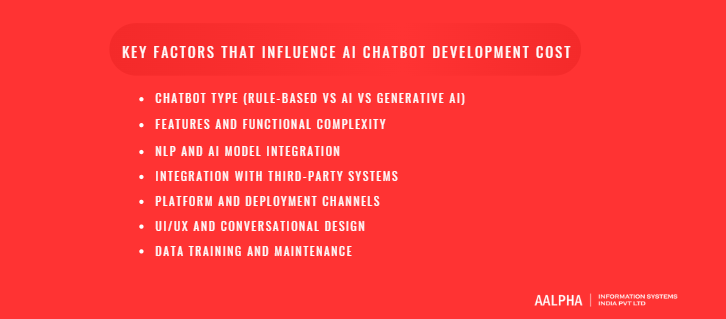
Key Factors That Influence AI Chatbot Development Cost
AI chatbot development cost is not a fixed number. It is determined by a combination of technical, functional, and operational decisions made during planning and implementation. Businesses often assume the cost depends only on the number of features, but in reality, the primary cost drivers include the type of chatbot, level of intelligence, integrations, deployment channels, and ongoing training requirements.
A simple FAQ chatbot built for a website may take a few weeks and a limited budget, while a fully integrated AI assistant that connects to internal systems, supports multiple languages, and uses generative AI can take several months and require a significantly higher investment. Understanding these cost drivers is essential for accurate budgeting and for avoiding unexpected expenses during development and post-launch scaling.
-
Chatbot Type (Rule-Based vs AI vs Generative AI)
The type of chatbot is the most fundamental factor influencing development cost because it determines the level of intelligence and technical complexity required.
Rule-based chatbots are the most affordable option. They operate on predefined decision trees and respond to specific inputs with fixed outputs. These are typically used for FAQs, simple support queries, or guided workflows. Since they do not require advanced AI or training, development costs remain relatively low.
AI/NLP-based chatbots introduce natural language understanding, allowing users to interact more flexibly. These bots can interpret intent, handle variations in phrasing, and provide more dynamic responses. This increases development complexity due to the need for NLP models, intent classification, and training datasets, which raises the overall cost.
Generative AI chatbots represent the most advanced category. They use large language models to generate human-like responses, maintain conversational context, and handle complex queries. These systems require API integration, prompt engineering, safety controls, and infrastructure for scaling. As a result, they are significantly more expensive but offer the highest level of automation and user experience.
-
Features and Functional Complexity
The number and sophistication of features directly impact chatbot development cost. A basic chatbot with limited functionality is relatively inexpensive, but as feature requirements expand, costs increase rapidly.
Simple features such as predefined responses, basic forms, and static workflows require minimal development effort. However, when businesses require advanced capabilities like multilingual support, voice interaction, real-time personalization, and analytics dashboards, the complexity grows significantly.
For example, multilingual chatbots require language processing models and localization efforts, which add both development and testing time. Voice-enabled chatbots need speech-to-text and text-to-speech integration, increasing both technical complexity and infrastructure costs. Personalization features require access to user data and logic for tailoring responses, which introduces additional backend development.
Analytics and reporting features also contribute to cost, as they involve data tracking, visualization, and performance monitoring. Each additional feature not only increases initial development cost but also affects ongoing maintenance and scaling expenses.
-
NLP and AI Model Integration
The choice of AI model and the level of customization required play a major role in determining chatbot cost. Businesses can either use pre-trained models through APIs or invest in custom machine learning models tailored to their specific use case.
Using pre-trained models such as GPT-based APIs is generally faster and more cost-effective for most applications. These models provide high-quality language understanding and generation capabilities without the need for extensive training. However, they introduce recurring costs based on usage, such as token-based pricing.
Custom AI models, on the other hand, require significant investment in data collection, training, and optimization. This approach is often used in industries with specialized requirements, such as healthcare or finance, where domain-specific accuracy is critical. The cost includes data labeling, model training, testing, and ongoing refinement.
Additionally, integrating AI models into the chatbot system involves backend development, API management, latency optimization, and security considerations. The more advanced and customized the AI integration, the higher the development and operational costs.
-
Integration with Third-Party Systems
Most business chatbots do not operate in isolation. They need to integrate with existing systems such as customer relationship management (CRM) platforms, enterprise resource planning (ERP) systems, payment gateways, and internal databases.
Each integration adds complexity because it requires API connections, data synchronization, authentication mechanisms, and error handling. For example, a chatbot that retrieves customer data from a CRM or processes transactions through a payment system must ensure secure and reliable communication between systems.
The cost increases further when dealing with legacy systems or custom-built platforms that do not have standard APIs. In such cases, additional development effort is required to create middleware or custom connectors. Integration testing and maintenance also contribute to long-term costs, especially when external systems are updated or modified.
-
Platform and Deployment Channels
The platforms where the chatbot will be deployed significantly influence development cost. A chatbot built for a single platform, such as a website, is relatively straightforward compared to one that operates across multiple channels.
Businesses often want chatbots to be available on websites, mobile apps, messaging platforms like WhatsApp, and collaboration tools like Slack. Each platform has its own APIs, design guidelines, and technical requirements, which increases development effort.
For instance, deploying a chatbot on WhatsApp requires integration with messaging APIs, template approvals, and compliance with platform policies. Mobile app integration may require SDK implementation and additional testing across devices. Multi-channel deployment also requires synchronization of conversations and user data across platforms.
As the number of channels increases, so does the complexity of maintaining a consistent user experience, which adds to both development and ongoing operational costs.
-
UI/UX and Conversational Design
The design of the chatbot experience plays a critical role in its effectiveness and cost. A well-designed chatbot is not just about functionality; it requires thoughtful conversational flows, intuitive interfaces, and a consistent brand voice.
Conversational design involves mapping user journeys, defining intents, creating dialogue flows, and handling edge cases. This process requires collaboration between designers, product managers, and developers. The more complex the use case, the more time and effort are needed to design effective interactions.
UI/UX design also includes visual elements such as chat interfaces, buttons, quick replies, and integrations with web or mobile layouts. Businesses aiming for a premium user experience often invest more in design to ensure the chatbot feels natural and engaging.
Poor design can lead to user frustration and low adoption, which is why many organizations allocate a significant portion of their budget to this area. As a result, advanced conversational design and UI/UX improvements can substantially increase development costs.
-
Data Training and Maintenance
AI chatbots require continuous training and maintenance to remain effective over time. Unlike static software, AI systems improve based on data and user interactions, which introduces ongoing costs beyond initial development.
Training involves feeding the chatbot with relevant data, such as FAQs, product information, and historical conversations. For AI and generative chatbots, this may include fine-tuning models or optimizing prompts to improve accuracy and relevance.
Maintenance includes monitoring performance, updating responses, fixing errors, and adapting to changing business requirements. For example, a chatbot used in eCommerce must be updated regularly with new products, pricing, and promotions.
Additionally, usage-based costs such as API calls, cloud hosting, and data storage contribute to long-term expenses. Businesses must plan for these recurring costs to ensure the chatbot continues to deliver value and maintain high performance.
Types of AI Chatbots and Their Cost Breakdown
AI chatbot development cost varies significantly depending on the type of chatbot being built. Each category represents a different level of intelligence, technical complexity, and business capability. For decision-makers, this is often the most practical way to estimate budget because it aligns cost directly with expected outcomes.
A small business looking to automate FAQs does not need the same investment as an enterprise deploying a fully integrated AI assistant across multiple departments. The key is to match chatbot type with business objectives. Choosing a more advanced chatbot than necessary leads to unnecessary costs, while choosing a simpler one can limit scalability and performance.
The following breakdown explains the major chatbot categories, what they are typically used for, and how much they cost to develop.
-
Rule-Based Chatbots
Cost: $3,000–$10,000
Rule-based chatbots are the simplest and most cost-effective type of chatbot. They operate on predefined decision trees and respond to user inputs using fixed scripts. These bots do not understand language context or intent; instead, they guide users through structured options such as buttons or keyword triggers.
They are commonly used for basic customer support, answering frequently asked questions, booking simple appointments, or collecting user information through forms. Since they do not require AI model integration or data training, development is relatively quick and inexpensive.
However, their limitations become apparent when users ask questions outside predefined flows. They lack flexibility and cannot handle complex or conversational queries. As a result, they are best suited for businesses with straightforward automation needs and limited interaction complexity.
-
AI/NLP Chatbots
Cost: $10,000–$50,000
AI/NLP chatbots represent a significant step up in capability compared to rule-based systems. These chatbots use natural language processing to understand user intent, allowing them to interpret a wide range of inputs and respond more intelligently.
Instead of relying on rigid scripts, NLP-based chatbots can handle variations in phrasing and provide more natural interactions. They are commonly used in customer support, lead qualification, and internal business automation where flexibility is required.
The higher cost is driven by the need for intent recognition models, training datasets, and backend logic to process user inputs effectively. Development also involves designing fallback mechanisms, handling ambiguous queries, and improving response accuracy over time.
These chatbots strike a balance between cost and functionality, making them a popular choice for mid-sized businesses that want better automation without the complexity of full generative AI systems.
-
Generative AI Chatbots (GPT-Based)
Cost: $30,000–$150,000+
Generative AI chatbots are the most advanced and rapidly growing category in chatbot development. These systems use large language models to generate human-like responses, maintain conversational context, and handle complex, open-ended queries.
Unlike traditional chatbots, generative AI systems do not rely on predefined responses. Instead, they dynamically generate answers based on user input, making them highly adaptable across use cases such as customer support, virtual assistants, knowledge base interaction, and sales automation.
The cost of developing generative AI chatbots is higher due to several factors. Integration with AI APIs, prompt engineering, response optimization, and safety mechanisms all require specialized expertise. Additionally, these systems often need context management, memory handling, and guardrails to ensure accurate and appropriate responses.
Another major cost component is ongoing usage. Generative AI models typically operate on a usage-based pricing model, meaning businesses incur costs based on the volume of interactions. Infrastructure for scaling, latency optimization, and monitoring also adds to the total investment.
Despite the higher cost, these chatbots deliver superior user experience and can automate complex workflows, making them a strong choice for businesses aiming to build highly intelligent and scalable conversational systems.
-
Voice-Enabled Chatbots
Cost: $20,000–$100,000
Voice-enabled chatbots extend traditional chatbot functionality by allowing users to interact through speech instead of text. These systems combine conversational AI with speech recognition (speech-to-text) and voice generation (text-to-speech) technologies.
They are widely used in call centers, virtual assistants, customer service hotlines, and smart device applications. Voice chatbots enable hands-free interaction and are particularly valuable in scenarios where typing is inconvenient or impractical.
The cost of voice-enabled chatbots is higher due to additional technical components. Speech recognition and synthesis require integration with specialized APIs or services, and ensuring accuracy across different accents and languages adds complexity. Real-time processing and low latency are also critical, requiring robust infrastructure.
Testing and optimization are more intensive compared to text-based chatbots, as voice interactions introduce new challenges such as background noise, speech variability, and user interruptions. As a result, businesses investing in voice chatbots should expect higher development and maintenance costs.
-
Enterprise AI Assistants
Cost: $100,000–$300,000+
Enterprise AI assistants represent the most sophisticated and expensive category of chatbot solutions. These systems are designed to operate at scale, handle complex workflows, and integrate deeply with multiple business systems.
Unlike standalone chatbots, enterprise assistants function as centralized AI interfaces that can access data from CRM systems, ERPs, internal databases, and third-party tools. They are used for advanced customer support, employee productivity, decision support, and process automation across departments.
The high cost is driven by extensive customization, security requirements, and integration complexity. These systems often require role-based access control, compliance with regulations, and advanced data handling capabilities. They may also include features such as multilingual support, predictive analytics, and continuous learning mechanisms.
Development timelines for enterprise AI assistants are longer, often spanning several months, and require collaboration between multiple teams, including AI engineers, backend developers, and business stakeholders. While the upfront investment is substantial, these systems deliver significant long-term value by improving efficiency, reducing operational costs, and enabling scalable automation across the organization.
AI Chatbot Development Cost by Features
AI chatbot development cost is heavily influenced by the specific features a business chooses to implement. While chatbot type provides a high-level estimate, features determine the actual scope of work, development time, and infrastructure requirements. Each added capability increases not only the initial build cost but also long-term operational expenses such as maintenance, API usage, and scaling.
A practical way to estimate chatbot cost is to break features into tiers: basic, intermediate, and advanced. This approach helps businesses understand what they are paying for and how each feature contributes to overall functionality and return on investment. In many cases, cost overruns occur because feature requirements expand during development without clear prioritization.
-
Basic Features
Basic features form the foundation of entry-level chatbots and are typically used for simple automation tasks. These include predefined responses, FAQ handling, and structured conversational flows where users select from fixed options such as buttons or menus.
Chatbots with basic features are commonly deployed for customer support scenarios like answering common questions, providing business information, or guiding users through simple processes such as appointment booking or order tracking. Since these features rely on static logic rather than AI, development is relatively straightforward and cost-effective.
The primary cost components at this level include conversation flow design, backend setup, and basic user interface implementation. There is minimal need for data training or AI integration, which keeps costs low. However, these chatbots are limited in flexibility and cannot handle unexpected queries or complex interactions.
For businesses just starting with automation, basic features offer a low-risk, affordable entry point, but they may require upgrades as user expectations grow.
-
Intermediate Features
Intermediate features introduce intelligence and flexibility into chatbot systems, significantly increasing their value and cost. At this level, chatbots move beyond scripted interactions and begin to incorporate AI-driven responses, system integrations, and performance analytics.
AI-powered responses enable the chatbot to understand user intent and respond more naturally, improving user experience. Integrations with systems such as CRM platforms, databases, or inventory management tools allow the chatbot to retrieve and process real-time information. For example, a chatbot can check order status, fetch customer data, or update records dynamically.
Analytics features provide insights into user behavior, conversation success rates, and performance metrics. These insights are essential for optimizing chatbot effectiveness and identifying areas for improvement.
The cost increase at this stage is driven by additional backend development, AI model integration, and data handling requirements. Testing also becomes more complex, as the chatbot must handle a wider range of inputs and scenarios. Intermediate features are ideal for businesses that require meaningful automation without the full complexity of advanced AI systems.
-
Advanced Features
Advanced features represent the highest level of chatbot capability and are a major driver of development cost. These features enable chatbots to deliver highly personalized, context-aware, and intelligent interactions that closely resemble human conversations.
Context awareness allows the chatbot to remember previous interactions within a session, enabling more coherent and relevant responses. For example, a customer support chatbot can track the progress of a conversation and avoid asking repetitive questions. Personalization takes this further by using user data, preferences, and behavior to tailor responses and recommendations.
Memory capabilities extend beyond single sessions, allowing the chatbot to retain information across interactions. This is particularly valuable for applications such as customer relationship management, where continuity is important. Implementing memory requires secure data storage, retrieval mechanisms, and privacy considerations.
Other advanced features may include recommendation engines, predictive responses, sentiment analysis, and workflow automation. These capabilities require sophisticated AI models, extensive data processing, and robust infrastructure.
The cost of implementing advanced features is significantly higher due to the need for specialized expertise, longer development timelines, and ongoing optimization. However, these features deliver substantial business value by improving user engagement, increasing conversion rates, and enabling deeper automation.
-
Multilingual Capabilities
Adding multilingual support increases chatbot development cost due to the need for language processing, translation, and localization. A chatbot that supports multiple languages must be able to understand and respond accurately in each language, which may require additional NLP models or translation APIs.
Localization goes beyond translation. It involves adapting content, tone, and context to suit different regions and cultural expectations. This requires additional design and testing efforts to ensure consistency and accuracy across languages.
Multilingual chatbots are particularly valuable for global businesses, but they require careful planning and additional resources, which increases both development and maintenance costs.
-
Voice and Speech Recognition
Voice capabilities add another layer of complexity and cost to chatbot development. These features rely on speech-to-text (STT) and text-to-speech (TTS) technologies to enable voice-based interactions.
Integrating voice functionality requires additional APIs, real-time processing capabilities, and optimization for accuracy and latency. The system must be able to handle variations in accents, speech patterns, and background noise, which increases testing and refinement efforts.
Voice-enabled chatbots are commonly used in call centers, virtual assistants, and smart devices. While they offer a more natural interaction experience, they also introduce higher infrastructure and operational costs compared to text-based chatbots.
-
Security and Compliance Features
Security and compliance are critical components of chatbot development, especially in industries such as healthcare, finance, and eCommerce. Implementing these features increases development cost but is essential for protecting user data and meeting regulatory requirements.
Security measures include data encryption, secure authentication, access control, and protection against unauthorized access. Compliance requirements such as GDPR or HIPAA add additional layers of complexity, including data handling policies, audit trails, and user consent management.
Developing a compliant chatbot often requires specialized expertise, legal consultation, and rigorous testing. It may also involve hosting data in specific regions and implementing strict access controls.
While these features increase both initial and ongoing costs, they are non-negotiable for businesses handling sensitive information. Investing in security and compliance not only reduces risk but also builds trust with users, which is critical for long-term success.
AI Chatbot Development Cost by Industry
AI chatbot development cost varies significantly across industries because each sector has different requirements for compliance, data handling, integrations, and user experience. A chatbot built for eCommerce may focus on speed and conversions, while one developed for healthcare or banking must prioritize accuracy, privacy, and regulatory compliance.
Understanding industry-specific cost drivers helps businesses estimate budgets more accurately and avoid underinvestment in critical areas such as security or integrations. It also explains why two chatbots with similar features can have vastly different costs depending on the domain in which they are deployed.
-
Healthcare Chatbots
Healthcare chatbots are among the most complex and expensive to develop due to strict regulatory requirements and the sensitivity of patient data. These chatbots are commonly used for appointment scheduling, symptom checking, patient engagement, and follow-up care.
The primary cost driver in healthcare chatbot development is compliance. Regulations such as HIPAA in the United States or GDPR in Europe require secure data handling, encryption, audit trails, and strict access controls. Ensuring compliance often involves additional development layers, legal consultation, and rigorous testing.
Another factor is accuracy. Healthcare chatbots must provide reliable and contextually correct information, which may require integration with medical databases or domain-specific AI models. In some cases, human-in-the-loop systems are implemented to review critical interactions, further increasing cost.
Integration with hospital systems, electronic health records (EHR), and scheduling platforms also adds complexity. As a result, healthcare chatbot development typically falls on the higher end of the pricing spectrum, often ranging from $30,000 to $150,000 or more depending on scope.
-
eCommerce Chatbots
eCommerce chatbots are designed to drive sales, improve customer experience, and automate support. These chatbots typically handle product discovery, order tracking, recommendations, and customer queries.
The cost of eCommerce chatbot development is influenced by the level of personalization and integration required. Basic chatbots that answer FAQs or provide order status updates are relatively affordable. However, costs increase when businesses implement advanced features such as AI-driven product recommendations, dynamic pricing responses, and personalized shopping experiences.
Integration with inventory systems, payment gateways, and CRM platforms is another key cost factor. Real-time data synchronization is essential for accurate responses, which requires reliable backend infrastructure.
Compared to other industries, eCommerce chatbots are generally more cost-efficient because they do not require heavy regulatory compliance. Typical development costs range from $10,000 to $50,000, with higher investments for advanced AI-driven shopping assistants.
-
Banking and Fintech Chatbots
Banking and fintech chatbots are among the most security-intensive systems, making them expensive to develop and maintain. These chatbots are used for account inquiries, transaction assistance, fraud alerts, financial advice, and customer support.
The primary cost driver in this sector is security. Chatbots must handle sensitive financial data, which requires strong encryption, multi-factor authentication, and secure APIs. Compliance with financial regulations and standards adds additional complexity, including audit logging and risk management systems.
Another factor is integration with core banking systems, payment processors, and financial databases. These integrations must be highly reliable and secure, often requiring custom development and extensive testing.
Accuracy and reliability are also critical, as errors can have financial consequences. This often necessitates advanced AI models and validation mechanisms. As a result, fintech chatbot development typically ranges from $40,000 to $200,000 or more, depending on the level of functionality and compliance requirements.
-
Real Estate Chatbots
Real estate chatbots are primarily used for lead generation, qualification, and property inquiries. These chatbots help automate interactions with potential buyers or renters by answering questions, collecting user preferences, and scheduling property visits.
The cost of real estate chatbots is generally moderate because they focus on structured workflows rather than complex AI capabilities. Basic implementations can capture leads and provide property details, while more advanced versions can recommend listings based on user preferences and behavior.
Integration with property databases, CRM systems, and scheduling tools is a key cost factor. Chatbots must access up-to-date listings and manage appointment bookings efficiently.
Since regulatory requirements are relatively low compared to healthcare or finance, development costs are more manageable. Most real estate chatbots fall within the $8,000 to $30,000 range, depending on the level of automation and personalization.
-
Travel and Hospitality Chatbots
Travel and hospitality chatbots are designed to streamline booking processes, provide customer support, and enhance user experience. These chatbots are commonly used for hotel reservations, flight inquiries, itinerary management, and customer assistance.
The main cost driver in this industry is integration with booking systems, global distribution systems (GDS), and third-party APIs. Real-time availability and pricing updates are essential, which requires robust backend connectivity.
Multilingual support is often a requirement, as travel businesses serve a global audience. This adds to development and testing costs. Additionally, chatbots must handle dynamic queries such as cancellations, rescheduling, and special requests, which increases complexity.
While compliance requirements are not as strict as in healthcare or finance, the need for real-time data and seamless user experience drives costs upward. Travel and hospitality chatbots typically range from $15,000 to $60,000, depending on features and integrations.
AI Chatbot Development Cost by Region
AI chatbot development cost varies significantly by geographic region due to differences in labor rates, talent availability, regulatory environments, and operational overhead. For businesses planning to build a chatbot, choosing the right development location can impact total project cost by 2–4 times without necessarily compromising quality.
Regional pricing differences are primarily driven by developer hourly rates, but they also reflect broader factors such as infrastructure costs, demand for AI talent, and experience with enterprise-scale projects. Understanding these variations helps businesses make informed decisions about whether to build locally, outsource, or adopt a hybrid model.
-
North America
Average Rate: $100–$250/hour
North America, particularly the United States and Canada, has the highest AI chatbot development costs globally. This is due to a combination of high labor costs, strong demand for AI expertise, and the presence of leading technology companies.
Development teams in this region often bring deep expertise in advanced AI systems, enterprise integrations, and compliance-heavy applications. This makes North America a preferred choice for large enterprises, especially in industries such as healthcare, fintech, and SaaS, where reliability and regulatory compliance are critical.
However, the premium pricing reflects not just technical capability but also operational overhead, including higher salaries, infrastructure costs, and business expenses. A mid-level chatbot project that might cost $40,000 offshore could easily exceed $100,000 in North America.
For businesses with complex requirements and a need for close collaboration, North America offers high-quality outcomes, but at a significantly higher investment.
-
Europe
Average Rate: $80–$200/hour
Europe offers a balance between quality and cost, making it a popular choice for businesses seeking experienced development teams without the highest price tags. Countries such as Germany, the UK, and the Netherlands have strong AI ecosystems and skilled professionals.
European developers are well-versed in data privacy regulations, particularly GDPR, which is a major advantage for businesses handling user data. This expertise can reduce compliance risks and ensure smoother implementation in regulated markets.
Costs vary across the region, with Western Europe being more expensive than Central or Southern Europe. While rates are lower than North America, they are still relatively high compared to offshore destinations.
Europe is often chosen for projects that require a combination of technical expertise, regulatory knowledge, and moderate cost efficiency.
-
India and Asia
Average Rate: $25–$80/hour
India and other Asian countries have become leading destinations for AI chatbot development due to their cost-effectiveness and growing pool of skilled developers. Businesses can achieve significant cost savings while still accessing high-quality technical talent.
The lower rates are driven by reduced labor and operational costs rather than a lack of expertise. Many development companies in India specialize in AI, machine learning, and chatbot solutions, offering services to global clients across industries.
Another advantage is scalability. Offshore teams in Asia can quickly scale resources based on project requirements, making them ideal for both startups and enterprises. Time zone differences can also be leveraged for faster development cycles when managed effectively.
However, businesses must ensure clear communication, well-defined requirements, and strong project management to avoid potential challenges. When executed correctly, outsourcing to India or Asia can reduce development costs by 40% to 70% compared to Western markets.
-
Eastern Europe
Average Rate: $40–$120/hour
Eastern Europe has emerged as a strong middle-ground option for AI chatbot development. Countries such as Poland, Ukraine, and Romania offer highly skilled developers at more competitive rates than Western Europe.
This region is known for its strong technical education systems and expertise in software engineering and AI development. Many teams have experience working with international clients, which helps ensure smooth collaboration and communication.
Costs are higher than Asia but lower than Western Europe and North America, making Eastern Europe an attractive option for businesses seeking a balance between affordability and quality.
For companies that prioritize technical expertise and cultural alignment with Western markets, Eastern Europe is often a reliable choice.
Offshore vs Onshore Cost Comparison
The decision between offshore and onshore development is one of the most important factors influencing overall chatbot cost. Onshore development, typically within the same country or region, offers advantages such as easier communication, cultural alignment, and faster collaboration. However, it comes at a significantly higher cost due to elevated labor rates and operational expenses.
Offshore development, on the other hand, provides substantial cost savings by leveraging lower-cost regions such as India or Southeast Asia. Businesses can access skilled developers at a fraction of the cost, making it an attractive option for startups and companies with budget constraints.
The trade-off lies in management and coordination. Offshore projects require clear documentation, structured communication, and effective project management to ensure alignment and quality. Time zone differences and communication gaps can be challenges if not handled properly.
Many organizations adopt a hybrid approach, combining onshore strategy and planning with offshore development execution. This model balances cost efficiency with control and quality, making it increasingly popular for AI chatbot projects.
Cost Breakdown: Development Stages
AI chatbot development cost is best understood by breaking it down into individual stages. Each phase contributes a specific portion of the total budget and requires different expertise, tools, and timelines. Businesses often underestimate costs because they focus only on development, while ignoring planning, testing, and post-launch optimization.
A well-structured chatbot project typically follows a sequence: planning, design, development, AI integration, testing, deployment, and ongoing maintenance. Skipping or underinvesting in any of these stages can lead to poor performance, higher long-term costs, and reduced return on investment.
-
Planning and Requirement Analysis
The planning phase lays the foundation for the entire chatbot project and directly influences both cost and success. This stage involves defining business objectives, identifying use cases, mapping user journeys, and outlining technical requirements.
Teams analyze questions such as: What problems will the chatbot solve? Who are the target users? What systems need to be integrated? Clear answers help avoid scope creep and unnecessary feature additions later in development.
This stage also includes selecting the chatbot type, deciding on deployment channels, and estimating timelines and resources. While planning may represent a smaller portion of the total budget, it is critical for cost control. Poor planning often leads to rework, which significantly increases overall expenses.
-
UI/UX and Conversation Design
UI/UX and conversational design determine how users interact with the chatbot and how effective those interactions are. This stage goes beyond visual design and focuses on creating intuitive, natural, and goal-oriented conversations.
Designers map out conversation flows, define user intents, and create dialogue structures that guide users toward desired outcomes. They also design fallback scenarios for handling unclear or unexpected inputs. A well-designed chatbot minimizes user frustration and improves engagement.
On the visual side, UI/UX includes chat interfaces, quick reply buttons, forms, and integration with web or mobile layouts. Businesses aiming for a premium experience invest more in refining these elements to ensure consistency with their brand.
The cost of this stage increases with complexity. Simple bots require basic flow design, while advanced chatbots with personalization and multi-step workflows require extensive design effort and iteration. Investing in this stage reduces future costs by minimizing usability issues and improving performance.
-
Backend Development
Backend development is one of the most resource-intensive stages and a major contributor to overall cost. This phase involves building the core architecture that powers the chatbot, including server-side logic, databases, APIs, and integrations.
Developers create systems to process user inputs, manage conversation states, and handle data securely. If the chatbot integrates with external systems such as CRM, ERP, or payment gateways, additional development is required to ensure seamless communication between platforms.
Scalability is another key consideration. The backend must be designed to handle varying levels of traffic without performance issues. This may involve cloud infrastructure, load balancing, and performance optimization.
The cost of backend development increases with the number of integrations, complexity of workflows, and volume of data processing required. For advanced chatbots, this stage can account for a significant portion of the total project budget.
-
AI Model Integration
AI model integration is the stage where the chatbot gains its intelligence. This involves connecting the chatbot to natural language processing systems or generative AI models and ensuring they function effectively within the application.
For chatbots using pre-trained models, this stage includes API integration, prompt design, and response optimization. Developers must ensure that the chatbot understands user intent accurately and generates relevant responses. This often requires iterative testing and refinement.
For custom AI models, the process is more complex and costly. It includes data collection, labeling, training, and fine-tuning to achieve the desired level of accuracy. Businesses in specialized industries may require domain-specific models, which further increases cost.
Additional considerations include latency optimization, cost management for API usage, and implementing safeguards to prevent incorrect or inappropriate responses. AI integration is a critical cost driver, especially for advanced and generative chatbots.
-
Testing and Deployment
Testing ensures that the chatbot performs reliably across different scenarios, devices, and platforms. This stage includes functional testing, performance testing, and user acceptance testing.
Developers and testers simulate various user interactions to identify issues such as incorrect responses, broken flows, or integration failures. For AI chatbots, testing also involves evaluating response accuracy and handling edge cases.
Deployment involves setting up the chatbot in the production environment, configuring servers, and integrating it with live systems. It also includes ensuring compliance with platform requirements, such as messaging APIs or app store guidelines.
While testing and deployment may represent a smaller portion of the budget compared to development, they are essential for ensuring a smooth launch. Skipping thorough testing can lead to costly fixes and damage to user trust.
-
Post-Launch Maintenance
Post-launch maintenance is an ongoing cost that businesses must account for when planning chatbot development. Unlike static software, AI chatbots require continuous monitoring, updates, and optimization to remain effective.
Maintenance includes updating conversation flows, improving AI responses, fixing bugs, and adapting to changing business requirements. For example, an eCommerce chatbot must be updated with new products, pricing, and promotions regularly.
For AI-driven chatbots, ongoing training and optimization are critical. User interactions generate data that can be used to improve performance, but this requires analysis and implementation. Additionally, businesses must manage recurring costs such as API usage, cloud hosting, and data storage.
Security updates and compliance adjustments are also part of maintenance, especially in regulated industries. Over time, these costs can represent a significant portion of the total investment.
A well-maintained chatbot continues to deliver value by improving efficiency, enhancing user experience, and supporting business growth. Ignoring this stage can lead to declining performance and reduced return on investment.
Cost of Building vs Buying Chatbots
One of the most important decisions businesses face when adopting conversational AI is whether to build a custom chatbot from scratch or use an existing SaaS chatbot platform. This choice directly impacts both upfront investment and long-term costs, as well as flexibility, scalability, and control over the solution.
Many organizations initially assume that SaaS solutions are always cheaper and faster, while custom development is expensive and time-consuming. While this is often true in the short term, the long-term economics can differ significantly depending on business requirements, scale, and integration needs.
-
Custom Development Cost
Custom chatbot development involves building a solution tailored specifically to business requirements. This approach typically requires an upfront investment ranging from $10,000 to $200,000+, depending on complexity, features, and integrations.
The primary cost components include design, development, AI integration, testing, and deployment. In addition, businesses must account for infrastructure costs such as cloud hosting, API usage, and ongoing maintenance.
While the initial investment is higher, custom development offers full control over functionality, data, and user experience. Businesses can design workflows that align precisely with their operations, integrate deeply with internal systems, and scale the solution as needed.
Over time, custom chatbots can become more cost-efficient for high-volume use cases because there are no per-user or subscription-based pricing limitations. However, they require continuous investment in updates, optimization, and technical support.
-
SaaS Chatbot Platforms Cost
SaaS chatbot platforms provide pre-built solutions that businesses can configure and deploy quickly. These platforms typically operate on a subscription-based pricing model, ranging from $50 to $1,500+ per month depending on features, usage limits, and scale.
The main advantage of SaaS platforms is speed and simplicity. Businesses can launch a chatbot within days or weeks without extensive development. Most platforms include built-in features such as templates, integrations, analytics, and basic AI capabilities.
However, costs can increase over time due to subscription fees, usage-based pricing, and add-ons for advanced features. For example, higher conversation volumes, additional integrations, or premium AI capabilities often come with extra charges.
SaaS platforms also impose limitations on customization and flexibility. Businesses may not have full control over data, workflows, or integrations, which can become a constraint as requirements grow.
-
Pros and Cons Comparison
The choice between building and buying depends on trade-offs between cost, control, and scalability.
Custom development offers complete flexibility and ownership. Businesses can tailor every aspect of the chatbot, integrate it deeply into their systems, and avoid recurring subscription fees. This approach is ideal for organizations with complex workflows or unique requirements. However, it requires higher upfront investment, longer development timelines, and ongoing technical maintenance.
SaaS platforms, in contrast, provide a faster and more affordable entry point. They reduce the need for technical expertise and allow businesses to deploy chatbots quickly. This makes them suitable for startups and small businesses with limited budgets. The downside is limited customization, potential vendor lock-in, and increasing costs as usage scales.
Another key consideration is data control. Custom solutions allow businesses to manage their data internally, while SaaS platforms often store data on third-party servers, which may raise concerns in regulated industries.
-
When to Choose Each Option
The decision ultimately depends on business goals, budget, and long-term strategy.
SaaS chatbot platforms are a good choice for businesses that need a quick solution with minimal upfront investment. They are particularly suitable for simple use cases such as FAQ automation, basic customer support, or early-stage experimentation. If the goal is to validate a concept or launch quickly, SaaS platforms provide a practical starting point.
Custom chatbot development is the better option for businesses with complex requirements, high interaction volumes, or a need for deep system integration. It is also the preferred approach for industries that require strict data control and compliance. Organizations planning to scale their chatbot significantly over time often find custom solutions more cost-effective in the long run.
Some businesses adopt a hybrid approach, starting with a SaaS platform to validate their use case and later transitioning to a custom solution as their needs evolve. This strategy balances speed and cost efficiency while allowing for future scalability.
How to Reduce AI Chatbot Development Cost
Reducing AI chatbot development cost does not mean compromising on quality or functionality. The most effective cost optimization strategies focus on prioritization, smart technology choices, and efficient execution. Businesses that approach chatbot development with a clear plan can reduce costs by 30% to 50% while still delivering a high-performing solution.
A common mistake is trying to build a fully featured chatbot from the beginning. This leads to longer development cycles, higher costs, and increased risk of failure. Instead, a structured approach that focuses on essential features, scalable architecture, and iterative improvements allows businesses to control spending while maximizing return on investment.
-
Start with MVP
Building a minimum viable product (MVP) is one of the most effective ways to reduce chatbot development cost. An MVP focuses only on core features that solve the primary problem, such as answering FAQs, handling basic customer queries, or capturing leads.
By limiting the initial scope, businesses can launch faster, validate their assumptions, and gather real user feedback. This reduces the risk of investing heavily in features that may not deliver value. For example, instead of building a fully personalized AI assistant, a business can start with a simple support chatbot and expand based on usage patterns.
An MVP approach also allows for phased investment. Costs are distributed over time rather than incurred upfront, making it easier to manage budgets and adapt to changing requirements.
-
Use Pre-Trained Models
Leveraging pre-trained AI models significantly reduces both development time and cost. Instead of building custom machine learning models from scratch, businesses can use existing APIs that provide advanced language understanding and generation capabilities.
Pre-trained models eliminate the need for data collection, labeling, and training, which are some of the most expensive aspects of AI development. They also provide high accuracy out of the box, allowing teams to focus on integration and user experience rather than model development.
While these models introduce usage-based costs, they are often more cost-efficient than maintaining custom models, especially for small to mid-sized applications. Businesses can further optimize costs by controlling API usage, refining prompts, and implementing caching strategies for repeated queries.
-
Choose the Right Tech Stack
Selecting the appropriate technology stack has a direct impact on development cost and long-term scalability. Using modern, well-supported frameworks and tools can reduce development time, improve performance, and simplify maintenance.
Open-source technologies and pre-built components can significantly lower costs by eliminating licensing fees and reducing the need for custom development. For example, using established chatbot frameworks or integration tools can accelerate implementation.
It is also important to choose technologies that align with the development team’s expertise. A familiar tech stack reduces learning curves, minimizes errors, and speeds up delivery. Poor technology choices can lead to inefficiencies, higher maintenance costs, and the need for costly rework.
-
Outsource Strategically
Outsourcing chatbot development to regions with lower labor costs is a proven way to reduce expenses without compromising quality. Countries such as India and other parts of Asia offer skilled developers at significantly lower rates compared to North America or Western Europe.
However, cost savings depend on how outsourcing is managed. Clear communication, well-defined requirements, and structured project management are essential for success. Businesses should focus on selecting experienced development partners with a strong portfolio in AI and chatbot solutions.
A strategic approach is to combine onshore and offshore teams. For example, core planning and decision-making can be handled internally or onshore, while development and implementation are outsourced. This hybrid model balances cost efficiency with control and quality.
-
Avoid Overengineering
Overengineering is one of the most common reasons for inflated chatbot development costs. Businesses often attempt to include advanced features such as complex AI models, extensive integrations, or unnecessary automation before validating their actual need.
Each additional feature increases development time, complexity, and maintenance requirements. In many cases, simpler solutions can achieve the same business outcomes at a fraction of the cost. For example, a rule-based or hybrid chatbot may be sufficient for handling common queries without requiring full generative AI capabilities.
The key is to align features with business goals and user needs. Prioritizing essential functionality and avoiding unnecessary complexity ensures efficient use of resources. Advanced features can always be added later as the chatbot evolves and requirements become clearer.
How to Choose the Right AI Chatbot Development Company
Selecting the right AI chatbot development company is one of the most critical decisions in the entire project lifecycle. The quality of the development partner directly impacts not only the cost but also the performance, scalability, and long-term success of the chatbot. A poorly chosen vendor can lead to delays, cost overruns, and underperforming solutions, while the right partner can help you build a scalable, high-impact AI system that delivers measurable business value.
Businesses often ask: What should I look for in an AI chatbot development company? The answer lies in evaluating a combination of technical expertise, AI capabilities, industry understanding, communication practices, and proven results.
-
Technical Expertise
Technical expertise is the foundation of any reliable AI chatbot development company. The team should have strong experience in backend development, API integrations, cloud infrastructure, and scalable system design.
A competent development partner should be able to build chatbots that handle high traffic, integrate with multiple systems, and maintain performance under load. This includes knowledge of modern development frameworks, database management, and secure architecture design.
It is also important to assess whether the company follows best practices such as modular development, version control, and proper documentation. These practices ensure that the chatbot can be maintained, upgraded, and scaled over time without requiring a complete rebuild.
Without strong technical expertise, even the most advanced chatbot ideas can fail during implementation, leading to increased costs and delays.
-
AI/ML Capabilities
AI and machine learning capabilities are what differentiate a basic development company from a true AI solutions provider. A strong partner should have hands-on experience with natural language processing, conversational AI, and integration of advanced AI models.
This includes expertise in working with pre-trained models, designing conversational logic, and optimizing chatbot responses for accuracy and relevance. For more advanced use cases, the company should also be capable of handling data training, fine-tuning models, and implementing context-aware systems.
Another important aspect is prompt engineering and response optimization, especially for generative AI chatbots. The ability to control outputs, reduce hallucinations, and ensure safe interactions is critical for business applications.
Companies with deep AI capabilities can help you build not just a chatbot, but a system that continuously improves and adapts to user behavior.
-
Industry Experience
Industry experience plays a significant role in chatbot success because each sector has unique requirements, workflows, and compliance standards. A development company that has worked in your industry will better understand your challenges and can provide more relevant solutions.
For example, healthcare chatbots require strict compliance and data privacy measures, while eCommerce chatbots focus on conversions and personalization. Fintech solutions demand high security and integration with financial systems.
An experienced partner can anticipate potential issues, recommend best practices, and accelerate development by leveraging prior knowledge. This reduces both risk and cost, as fewer iterations are needed to achieve the desired outcome.
When evaluating companies, look for evidence of industry-specific projects and the ability to adapt solutions to your business context.
-
Communication and Transparency
Clear communication and transparency are essential for successful chatbot development, especially when working with external teams or offshore partners. Many projects fail not because of technical issues, but due to misalignment between stakeholders and developers.
A reliable development company should provide regular updates, maintain clear documentation, and use structured communication channels. This includes progress reports, milestone tracking, and open discussions about challenges and solutions.
Transparency in pricing is equally important. The company should provide a detailed cost breakdown, explain what is included in the scope, and highlight any potential additional costs such as API usage or maintenance.
Effective communication ensures that expectations are aligned, reduces the risk of misunderstandings, and keeps the project on track.
-
Portfolio and Case Studies
A company’s portfolio and case studies provide concrete evidence of its capabilities and track record. Reviewing past projects helps you understand the types of solutions the company has built, the industries it has served, and the level of complexity it can handle.
Look for case studies that demonstrate measurable outcomes, such as improved customer support efficiency, increased conversions, or reduced operational costs. This indicates that the company not only builds chatbots but also delivers business value.
It is also useful to assess the diversity of projects. A company that has worked on multiple types of chatbots, from simple automation tools to advanced AI assistants, is more likely to adapt to your specific requirements.
Experienced providers such as Aalpha, for example, position themselves as custom AI solution experts rather than generic development vendors. This approach focuses on understanding client-specific workflows and building tailored chatbot systems that align with business goals.
Choosing the right AI chatbot development company is not just about cost; it is about finding a partner that can deliver a reliable, scalable, and future-ready solution. Businesses that invest time in evaluating technical expertise, AI capabilities, industry experience, communication practices, and proven results are far more likely to achieve successful outcomes and maximize their return on investment.
FAQs: AI Chatbot Development Cost
How much does it cost to build an AI chatbot?
The cost of building an AI chatbot typically ranges from $3,000 to $200,000+, depending on complexity. Basic rule-based chatbots fall on the lower end, while advanced AI or generative chatbots with integrations, personalization, and scalability requirements can reach enterprise-level budgets. The final cost depends on features, AI capabilities, and deployment scope.
What is the monthly cost of running a chatbot?
Monthly costs usually range from $50 to $5,000+ depending on usage and infrastructure. This includes API usage (for AI models), cloud hosting, maintenance, and monitoring. High-traffic chatbots or those using generative AI models incur higher costs due to usage-based pricing.
Is ChatGPT API expensive?
The ChatGPT API is generally cost-effective for most business use cases, but costs scale with usage. Pricing is typically based on tokens processed per request. For low to moderate usage, costs remain manageable, but high-volume applications can see significant monthly expenses if not optimized properly.
Can I build a chatbot for free?
It is possible to build a basic chatbot for free using open-source tools or free tiers of SaaS platforms. However, these solutions come with limitations in functionality, scalability, and customization. For business-critical applications, some level of investment is usually required.
How long does chatbot development take?
Development timelines vary based on complexity. A basic chatbot can be built in 2 to 4 weeks, while a mid-level AI chatbot may take 1 to 3 months. Advanced or enterprise-grade chatbots can take 3 to 6 months or longer, especially if they involve custom AI models and multiple integrations.
What factors increase chatbot cost the most?
The biggest cost drivers include AI model complexity, number of integrations, advanced features like personalization or voice support, and compliance requirements. Generative AI capabilities and enterprise-level scalability also significantly increase both development and operational costs.
Is it cheaper to use chatbot platforms?
SaaS chatbot platforms are generally cheaper upfront because they offer subscription-based pricing and faster deployment. However, costs can increase over time with usage, add-ons, and scaling. Custom development may be more cost-effective in the long run for high-volume or complex use cases.
Do AI chatbots require maintenance?
Yes, AI chatbots require ongoing maintenance to remain effective. This includes updating content, improving responses, monitoring performance, and managing infrastructure. For AI-driven systems, continuous optimization and training are essential to maintain accuracy and user satisfaction.
Can small businesses afford AI chatbots?
Yes, small businesses can start with low-cost chatbot solutions such as basic rule-based bots or SaaS platforms. Many businesses begin with an MVP and gradually upgrade as their needs grow, making chatbot adoption financially accessible.
What is the ROI of an AI chatbot?
The return on investment comes from reduced customer support costs, improved efficiency, and increased conversions. Many businesses report cost savings of 20% to 40% in support operations, along with faster response times and better customer engagement, which directly impact revenue growth.
Final Thoughts
AI chatbot development cost varies widely, but the key to making the right investment is aligning cost with business goals. Whether you start with a simple chatbot or build a fully customized AI assistant, the focus should be on delivering measurable value through automation, efficiency, and better user experience.
If you are planning to build an AI chatbot tailored to your business, working with an experienced development partner can help you avoid costly mistakes and accelerate results. Aalpha specializes in building custom AI chatbot solutions designed around real business workflows, ensuring scalability, performance, and long-term ROI.
If you want a clear cost estimate or a consultation for your chatbot project, now is the right time to explore your options and take the next step. Contact now!