





TL;DR:
Addiction recovery app development combines sobriety tracking, peer support, and clinician monitoring into a single HIPAA-compliant platform that extends care beyond scheduled treatment sessions. Costs typically run between $40,000 and $180,000 depending on whether the product is a standalone sobriety tracker or a clinician-connected platform with EHR integration and AI-driven relapse risk scoring, with build timelines running 4 to 9 months. The core technical challenges are not the mobile UI, they are HIPAA and 42 CFR Part 2 compliance, crisis-moment design, and retention in a user base that relapses at high rates by definition. Aalpha has built HIPAA-compliant healthcare platforms for clients across 55+ countries since 2008, with a 4.9/5 rating across 215+ verified Clutch reviews, and this guide walks through what actually goes into building one of these apps properly.
Most addiction recovery apps that fail do so for the same reason: they were built as generic habit trackers with a sobriety counter bolted on. A person who has just relapsed, or is about to, does not behave like someone trying to hit 10,000 steps. The design, the compliance posture, and the escalation logic all have to account for that from the first sprint, not retrofitted after launch.
What is an addiction recovery app
An addiction recovery app is software that supports someone through sobriety, whether that person is in active outpatient treatment, has completed inpatient rehab, or is managing recovery independently through a peer framework like AA or SMART Recovery. The apps split roughly into two audiences that get conflated far too often in early product discussions: the person in recovery, and the clinical or peer support system around them.
For the patient, the app is usually a companion tool. It tracks time sober, gives them somewhere to log cravings and moods, connects them to a sponsor or peer group, and gives them an escape hatch when they are at risk of using. For a clinician or counselor, the same underlying platform becomes a monitoring and care coordination tool. They see patient check-ins, flag risk patterns, and use the app to extend contact between scheduled sessions.
These two use cases share a database but need almost entirely different interfaces. A patient-facing screen built with sparse copy and large touch targets, because someone in crisis does not want to parse a dense dashboard, looks nothing like the caseload view a counselor needs to triage twelve patients before lunch. Treating them as one screen with a role toggle is a common early mistake that leads to a rebuild six months post-launch.
Digital recovery tools do not replace treatment. They sit alongside intensive outpatient programs (IOP), medication-assisted treatment (MAT), and 12-step meetings as the layer that covers the other 167 hours a week a patient is not in a clinician’s office. That framing matters for scope: an app that positions itself as a treatment replacement invites regulatory and liability exposure that a support tool does not.
It also matters for who actually pays. A wellness app competes for attention against every other download on a person’s phone and lives or dies on consumer subscription revenue, which is a hard business in behavioral health. A support tool that a treatment center hands to a patient at discharge, with the center’s name on it and a counselor already checking the dashboard, starts with retention and trust built in. That distinction should shape almost every product decision that follows, including which features to build first and who the actual buyer is.
A related distinction worth settling before any wireframes get drawn: is this a standalone consumer product, or an extension of an existing treatment relationship. The two answers lead to different feature priorities, different compliance postures, and different go-to-market plans, and trying to serve both with one roadmap tends to produce a product that does neither well.
Market landscape and why demand is growing
Behavioral health telehealth adoption expanded sharply from 2020 onward, and addiction and recovery services were part of that shift, partly because federal and state policy loosened restrictions on prescribing controlled substances like buprenorphine via telehealth during that period. Insurers in the US have also moved, unevenly but consistently, toward reimbursing digital therapeutics and remote patient monitoring codes, which changes the commercial case for a recovery app from purely consumer subscription to a mix of B2B2C sales through treatment centers and payer reimbursement.
Two structural forces keep pushing demand. First, the treatment capacity gap: outpatient and inpatient rehab slots are limited relative to need in most regions, and an app extends a counselor’s reach without requiring more counselors. Second, relapse is a chronic-disease pattern, not a one-time event, and chronic conditions are exactly where continuous, low-friction digital touchpoints outperform monthly in-person visits.
None of that means every recovery app succeeds commercially. The category has a graveyard of consumer sobriety trackers that got downloaded once and abandoned within a week, because sobriety counters alone are a commodity feature available for free in a dozen App Store listings. The apps that hold users are the ones tied to an actual care relationship, whether that is a sponsor, a counselor, or a peer group with real accountability.
Insurance coverage remains inconsistent across payers and states, and that inconsistency is itself a market signal worth reading correctly. Founders building purely on the assumption that reimbursement will arrive on schedule tend to underfund the direct-to-consumer and B2B2C channels that will need to carry the business in the meantime. A realistic go-to-market plan treats insurance reimbursement as an upside case for year two or three, not the primary revenue assumption for year one.
The competitive field also includes a growing number of point solutions built by health systems and payers themselves, often as a feature bolted onto a broader behavioral health platform rather than a dedicated recovery product. That changes the calculus for an independent developer or founder: differentiation increasingly comes from depth in one modality (MAT adherence, peer community, or clinician workflow) rather than trying to be the single app that does everything for every stakeholder.
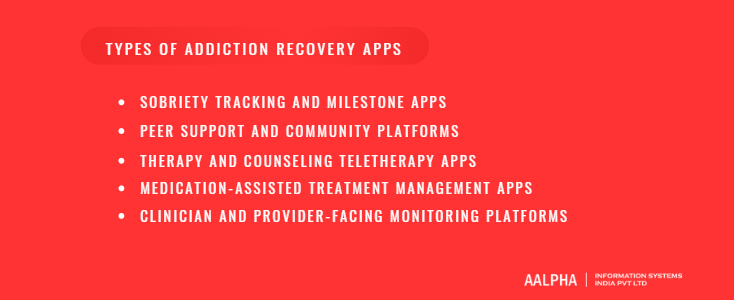
Types of addiction recovery apps
-
Sobriety tracking and milestone apps.
These are the simplest category: a day counter, money saved calculator, and streak-based motivation. They are cheap to build and easy to clone, which is exactly why they make a poor standalone business unless bundled with something stickier.
-
Peer support and community platforms.
These center on group chat, anonymous forums, and sponsor matching. The technical complexity here is moderation and safety, not the chat infrastructure itself. Anonymous, high-emotion communities need real-time content moderation for self-harm language, predatory behavior, and substance-sourcing discussion, which is a harder problem than most founders budget for.
-
Therapy and counseling teletherapy apps.
These layer video sessions, secure messaging, and scheduling on top of a therapist marketplace or a single practice’s patient roster. These inherit the full weight of telehealth compliance requirements: state licensing rules for cross-border therapy, session recording consent, and HIPAA-grade video infrastructure.
-
Medication-assisted treatment management apps.
These track dosing schedules for buprenorphine, naltrexone, or methadone, sometimes with adherence reminders and pharmacy integration. This category sits closest to the FDA’s software as a medical device (SaMD) boundary, particularly if the app makes any dosing recommendation rather than simply logging what a clinician prescribed.
-
Clinician and provider-facing monitoring platforms.
These are the B2B counterpart to all of the above: dashboards that aggregate patient-reported data, flag risk indicators, and feed into a treatment center’s existing EHR. These are usually sold on contract to treatment centers or health systems rather than downloaded directly by consumers.
Most commercially viable products end up as hybrids: a patient-facing app for the sobriety and support layer, paired with a lightweight clinician dashboard, sold into treatment centers as the primary channel and offered direct-to-consumer as a secondary one.
Choosing among these types is less about which is the biggest market and more about which one the founding team can actually credential itself to sell into. A clinician monitoring platform sold to treatment centers requires a sales motion built on clinical trust, often starting with a handful of design-partner facilities willing to pilot the product for months before paying. A consumer sobriety app can launch on an app store the same week the build finishes, but faces a much harder retention problem with no built-in accountability structure. Neither path is wrong. They require different funding runways, and conflating them in a single pitch deck is a common reason early-stage recovery app companies struggle to raise.
Core features for patients and users
-
Sobriety counter
The sobriety counter is table stakes, and it needs one design decision most teams skip: what happens on relapse. A counter that resets to zero and shames the user with a broken streak actively works against retention and against the clinical reality that relapse is part of most recovery journeys, not a failure state that ends the app relationship. The better pattern tracks cumulative time in recovery alongside the current streak, so a relapse doesn’t erase months of prior progress from the user’s view.
-
Mood and craving check-ins
Typically a short daily prompt rather than a long form, these generate the data that both the AI risk model and the clinician dashboard depend on. Keep these under thirty seconds to complete. A five-minute daily survey gets abandoned within two weeks regardless of how clinically useful the data would be.
-
Peer community and anonymous support groups
These need pseudonymous identity by default, not just an option. Real-name social features are one of the fastest ways to suppress honest disclosure in a recovery context, where the entire value of the group is candor about things users would not say under their real identity.
-
SOS or panic button
The SOS or panic button is the single feature that most differentiates a serious recovery app from a habit tracker with a sobriety skin. It needs to work in under three taps from anywhere in the app, and it needs a defined escalation path: a crisis line number, a designated emergency contact, and in serious cases a direct line to 988 (the US Suicide and Crisis Lifeline) or the regional equivalent. Do not build a custom crisis-response call center as a v1 feature. Route to existing, staffed crisis infrastructure and treat that routing logic as the actual deliverable.
-
Meeting locators and telehealth scheduling
Meeting locators for AA, NA, or SMART Recovery, often pulling from existing public meeting directories via API or scraped and licensed data, help users find in-person or virtual meetings near them. Telehealth scheduling, where relevant, connects to the counseling layer described above.
-
Gamification and milestone rewards
These work, cautiously. Badges for 30, 60, and 90 days sober are well understood in this space and users generally respond to them. Leaderboards and public comparison mechanics are the opposite: they introduce shame and competition into a context where neither helps, and should be avoided or made strictly opt-in.
-
Journaling and CBT-based exercises
These structured prompts, drawn from cognitive behavioral therapy frameworks, give users something active to do between check-ins. They work best when a licensed clinical advisor has actually reviewed the prompt library, not when they are generated wholesale from generic self-help content.
-
Trigger identification and coping plan tools
These deserve a specific mention because they’re frequently requested by clinical advisors and just as frequently skipped by product teams building to a deadline. A structured feature where a user maps their known triggers, a stressful phone call, a specific neighborhood, a certain time of day, against a pre-written coping response they chose while sober, gives them something concrete to reach for in the moment a craving hits, rather than asking them to problem-solve from scratch under stress. This is a relatively small build, a form and a retrieval screen, but the clinical value is disproportionate to the engineering cost.
-
Family and support network features
A way for a designated family member or friend to receive limited, consented updates without accessing the user’s full record, these come up often in discovery calls and get cut from scope just as often, usually because the consent and access-control logic is more involved than the feature itself looks on a wireframe. Worth scoping honestly rather than promising in a sales deck and cutting under deadline pressure.
Core features for clinicians and care teams
-
Patient dashboard
The patient dashboard is the clinician’s primary screen: check-in history, mood trends, and a risk indicator surfaced clearly enough to scan across a full caseload in a few minutes. Counselors managing 15 to 30 active patients will not open each patient’s full history daily. The dashboard needs to do the triage for them, surfacing the two or three patients who need attention today.
-
Care plan management
This lets the clinician document treatment notes, set goals, and track progress against a plan, usually structured to align with whatever documentation standard the treatment center already uses for insurance billing. Building this feature in isolation from the center’s existing billing and EHR workflow is a common and expensive mistake, since it creates a second system of record that staff will not maintain long term.
-
Relapse risk alerts
These flag patterns such as missed check-ins, declining mood scores, or specific keyword flags in journaling text, and route them to the assigned counselor. This is where the AI layer earns its complexity budget: a naive threshold-based alert system generates so many false positives that counselors learn to ignore it within a month.
-
Secure messaging and outcomes reporting
Secure messaging between patient and care team needs to be HIPAA-compliant end to end, which rules out routing through standard push notification services without additional encryption and data handling controls. Reporting for insurance and outcomes tracking, exporting structured data that supports reimbursement claims and treatment outcome studies, is often the actual feature that gets a treatment center to sign a contract, more than any patient-facing feature.
-
Caseload and staffing views
These matter once a treatment center has more than a handful of counselors on the platform. A director needs to see coverage gaps, which counselors are carrying too large a caseload, and which patients have gone unassigned, none of which shows up in a single-counselor dashboard designed around one person’s patient list. This is a feature that only becomes obvious once a pilot moves past three or four counselors, and it’s worth asking a prospective treatment center partner directly whether they’ll need it before scoping the MVP.
-
Consent and data-sharing controls
These are, in practice, a clinician-facing feature as much as a compliance requirement. Counselors need a clear, auditable way to see what a patient has consented to share, with whom, and for how long, particularly given the 42 CFR Part 2 requirements covered below. Building this as an afterthought bolted onto the patient record, rather than as a first-class object in the data model, is one of the more expensive retrofits a recovery app team can face.
Compliance and regulatory requirements
This is where addiction recovery apps diverge sharply from generic health and wellness apps, and where underestimating scope costs the most money later.
HIPAA. This governs protected health information for any US-based app that touches identifiable patient data, whether the company is a covered entity or a business associate. It requires encryption at rest and in transit, access controls, audit logging, and a signed business associate agreement (BAA) with every vendor in the stack, including the cloud hosting provider, the analytics tool, and the push notification service. Not every vendor offers a BAA. Confirm this before selecting infrastructure, not after.
42 CFR Part 2. This is the requirement most general health tech teams have never encountered, and it is stricter than HIPAA in specific ways. It governs substance use disorder treatment records in the US and generally requires explicit patient consent before disclosing SUD treatment information, even between providers who would otherwise share data freely under HIPAA. A 2020 update aligned some Part 2 provisions more closely with HIPAA, but consent requirements for SUD-specific records remain more restrictive. Any app that stores treatment records tied to a specific substance use disorder diagnosis needs its data-sharing and consent flows built around Part 2 from the start, not patched in later.
GDPR. This applies for any app serving EU or UK users, with the added sensitivity that health data is a special category requiring explicit consent and a documented legal basis for processing, plus the right to erasure, which has specific tension with clinical record-keeping requirements that mandate retention.
FDA oversight and SaMD classification. FDA oversight becomes relevant if the app crosses from a wellness or support tool into software as a medical device, which happens when the app makes a diagnostic claim, a treatment recommendation, or a dosing decision rather than simply logging clinician-directed information. A sobriety tracker with mood journaling is very unlikely to trigger SaMD classification. An AI feature that recommends a MAT dosing adjustment almost certainly does. Get regulatory counsel involved early if the AI roadmap includes anything that looks like clinical decision support, because retrofitting FDA compliance after launch is far more expensive than designing around the boundary from day one.
State-level variation. This adds another layer US-focused teams need to plan for. Telehealth prescribing rules for controlled substances used in MAT, counselor licensing reciprocity across state lines, and minor consent laws for users under 18 all vary by state, and a national product needs either a legal review of each state it operates in or a deliberate decision to launch in a smaller set of states first. Building the data model and consent flows to support state-by-state variation from the start is considerably cheaper than retrofitting it once the product has users in all fifty states and a compliance gap surfaces in one of them.
Informed consent and crisis-response liability. These round out the compliance picture. If the app includes an SOS feature, the legal team needs to define exactly what the app promises and does not promise during a crisis. An app that implies it will intervene, and then fails to route a genuine emergency correctly, carries real liability exposure. The safer pattern is transparent: the app connects the user to existing crisis infrastructure quickly, and says so plainly, rather than positioning itself as the intervention.
Technical architecture
Backend and infrastructure stack. A typical stack pairs a HIPAA-eligible cloud provider (AWS, Azure, or GCP, all of which offer BAAs on their healthcare-eligible service tiers) with a backend in Node.js, Python (Django or FastAPI), or a similarly mature framework, and a relational database like PostgreSQL for structured clinical data. Mobile frontends are usually built cross-platform with React Native or Flutter to control cost across iOS and Android, with a native build justified only when the app leans heavily on device-level features like biometric wearable integration or background location for meeting finders.
Real-time features. Chat between patients and sponsors, SOS alert dispatch, and push notifications for check-in reminders typically run through a managed service like Firebase Cloud Messaging or a WebSocket layer for in-app chat, with the caveat that any message payload containing PHI needs to be encrypted independently of whatever the platform provider offers by default. Do not assume a third-party push service is HIPAA-safe out of the box. Most are not, unless configured to send only a generic notification (“You have a new message”) that triggers the user to open the app for the actual content.
EHR and EMR integration. This matters primarily for the clinician-facing side, connecting to systems like Epic, Cerner, or smaller behavioral-health-specific EHRs through HL7 FHIR APIs where the treatment center’s system supports it. This integration work is consistently underestimated in early scoping. Budget real time for it, particularly for older EHR systems still running on HL7 v2 rather than FHIR.
Platform choice between native iOS, native Android, and cross-platform frameworks comes down to the actual user base more than developer preference. Recovery app users skew, in aggregate, toward lower-cost Android devices in many regions and toward iPhone in others, and a team building for a specific treatment center’s patient population should ask what devices those patients actually carry rather than defaulting to iOS-first because that’s the common startup pattern. Cross-platform frameworks close most of the gap for a product in this category, since the feature set rarely depends on cutting-edge native APIs, and the cost savings from a single codebase are substantial enough to be the default choice absent a specific reason otherwise.
API design. This should assume from day one that a web-based clinician dashboard and a mobile patient app are separate clients consuming the same core service, rather than building the mobile app first and retrofitting an API layer once the dashboard becomes a requirement. This sounds like standard engineering practice, and it is, but it’s skipped more often than expected on recovery app projects that start as a scrappy mobile-only MVP and only add the clinician side once a treatment center partner asks for it.
Wearable and biometric integration, pulling heart rate variability, sleep data, or activity levels from Apple Health, Google Fit, or a dedicated wearable API, feeds relapse risk models with physiological signals that self-reported check-ins miss. This is a genuinely valuable v2 feature and a poor v1 investment, since the core check-in and community features need to prove retention before the additional engineering cost is justified.
Data encryption and secure storage design. This underpins all of it: encryption at rest (AES-256 as a baseline), encryption in transit (TLS 1.2 or higher), field-level encryption for the most sensitive data points like SUD diagnosis codes, and a logging strategy that captures access without capturing content, so audit trails don’t themselves become a liability.
Environment separation. This is worth stating explicitly because it gets skipped under deadline pressure more often than any other architecture decision. Development and staging environments should never contain real patient data, which means the team needs a synthetic data generation strategy for testing from day one rather than the common shortcut of copying a scrubbed production snapshot, since scrubbing rarely removes every identifying detail and creates exactly the kind of compliance gap an auditor will find.
Offline behavior. This deserves specific design attention for this category. A user in a moment of crisis may not have reliable connectivity, particularly if they’re in a rural area or somewhere with poor cell coverage. The SOS flow should degrade gracefully, falling back to a direct phone call via the device’s native dialer rather than failing silently if the in-app escalation service can’t reach the server. Test this scenario explicitly rather than assuming best-case connectivity throughout QA.
AI and machine learning applications
Relapse risk prediction models. These take structured inputs, check-in frequency, mood trend, craving intensity scores, missed session counts, and output a risk score a counselor can act on. The realistic bar for a v1 model is a well-tuned logistic regression or gradient boosted model on tabular features, not a deep learning system. Most teams that reach for a large model here are solving a data problem (they don’t have enough labeled outcomes yet) with a modeling solution, and end up with something that performs no better than a simpler model while costing far more to maintain.
Sentiment analysis on journaling and check-in text can surface language patterns associated with elevated risk, hopelessness, isolation, specific mentions of access to substances, without a human reading every entry. This is one of the few places where a general-purpose language model API genuinely earns its cost, since building a custom sentiment classifier from scratch for a narrow domain rarely outperforms a well-prompted off-the-shelf model at this stage.
Personalized content and intervention timing. Surfacing a CBT exercise or a peer support prompt at the moment a user’s data suggests they need it, rather than on a fixed schedule, is a genuine differentiator but depends entirely on having enough usage data to personalize against. Do not build this before the app has real usage history to train on.
Chatbot-based first-line support. This has a narrow, defensible use case: answering logistical questions (where’s the nearest meeting, how do I log a craving) and providing scripted grounding exercises during a craving episode. It has no defensible use case as a crisis intervention substitute. Every chatbot flow needs a clear, fast escalation path to a human or to crisis infrastructure, and the chatbot should never be positioned, even implicitly through its tone, as a therapist.
Model selection and data governance for any of the above need to be settled before development starts, not discovered mid-build. Sending patient journaling text to a third-party language model API means that vendor becomes part of the compliance surface and needs its own BAA and data handling review, the same as any other processor touching PHI. Several major model providers now offer HIPAA-eligible API tiers with signed BAAs, which is the starting filter for vendor selection here, not an afterthought to confirm once a vendor is already integrated.
Model evaluation. Evaluation matters as much as model choice. A relapse risk model that’s never been validated against real outcomes is a guess with a confidence score attached. Plan for a retrospective validation period once the app has several months of check-in data and known outcomes to compare against, and be honest with clinical partners that the model’s accuracy will improve over that period rather than presenting day-one predictions as clinically validated.
Design considerations specific to recovery apps
Trauma-informed and stigma-aware design. This starts with word choice throughout the interface. “Addict” and “clean” carry judgment that “person in recovery” and “sober” don’t. This is not a cosmetic detail. Clinical literature on substance use disorder language has moved decisively toward person-first framing because stigmatizing language measurably affects treatment engagement, and an app that gets this wrong in its own copy undermines its clinical credibility before a user reads past the onboarding screen.
Anonymity and privacy-first design patterns run deeper than a pseudonym field. Consider what happens if someone else picks up the user’s phone: does a notification preview show “Your craving check-in” on the lock screen where a family member or employer might see it? Default notification copy to something generic, and let users opt into more detail if they want it.
Crisis-moment UI simplicity. This means the SOS flow, and ideally the craving check-in flow, should work with almost no cognitive load. Large touch targets, minimal text, no login friction if the user is already authenticated. This is the one part of the app where visual polish should defer entirely to speed and clarity.
Accessibility considerations matter more here than in most consumer app categories, given that recovery populations skew toward higher rates of co-occurring conditions, including cognitive and physical disabilities. Standard WCAG 2.1 AA compliance, sufficient contrast, screen reader support, and no reliance on color alone to convey status, is a reasonable baseline, not a stretch goal.
Onboarding design. This carries more weight in this category than in most consumer apps, because the first session often happens at a genuinely vulnerable moment, sometimes literally handed to a patient at discharge from inpatient treatment. A long onboarding flow with account creation friction, permission requests stacked up front, and a wall of legal consent text before any actual value is a poor fit for that moment. Front-load the parts of onboarding that build trust, a clear statement of what data is collected and why, who can see it, and how the SOS feature works, and defer anything that isn’t immediately necessary.
Visual design and tone. Visual design choices that would be neutral in most app categories carry different weight here. Overly clinical, sterile interfaces can feel institutional in a way that undercuts the peer-support framing many of these apps rely on, while overly playful, bright designs can feel dismissive of how serious the subject matter is to the person using it. The apps that get this right tend to land on a calm, warm visual language, muted color palettes, generous white space, and a tone in the copy that reads as a knowledgeable peer rather than either a clinical authority or a cheerleader.
Development process and timeline
Discovery phase: Discovery for a recovery app should include a clinical advisor, a licensed counselor or someone with direct treatment center experience, from week one, not as a late-stage review step. Feature decisions that look reasonable from a product management perspective, like public leaderboards or aggressive re-engagement notifications, often conflict with clinical best practice in ways a non-clinical team won’t catch until after launch complaints arrive.
MVP scoping for this category is narrower than founders typically expect. A defensible v1 covers sobriety tracking, daily check-ins, an SOS flow with real crisis-line routing, and one form of peer or sponsor connection, whether that’s a simple messaging feature or integration with an existing meeting directory. AI risk scoring, EHR integration, and wearable data can all wait for v2, and building them into v1 usually means shipping a worse version of the core experience later than necessary.
Phase breakdown and timeline. A typical phase breakdown runs discovery and clinical review at 3 to 4 weeks, design at 4 to 6 weeks (longer than a typical consumer app given the trauma-informed design work), core development at 12 to 20 weeks depending on scope, and a compliance and security review pass before launch that should not be compressed regardless of schedule pressure, since a HIPAA or Part 2 gap found post-launch is far costlier to fix than one caught in review. Total timeline for a solid MVP with clinician dashboard typically lands between 5 and 9 months.
QA and crisis-flow testing. QA needs a specific addition beyond standard functional testing: crisis-flow testing under realistic conditions (does the SOS button work with a poor connection, does the crisis line number stay current, does the app fail gracefully rather than silently if the escalation service is down) and data security testing, including penetration testing before any release that touches real patient data.
Team composition for a build like this typically runs a product manager with healthcare experience, a clinical advisor on a consulting basis rather than full time, two to four engineers split across backend and mobile, a designer with UX research capability rather than pure visual design, and a QA engineer who understands HIPAA testing requirements specifically, not just general functional QA. Smaller teams can compress this, but cutting the clinical advisor role entirely is the cut that causes the most expensive problems later, since it’s the one role whose absence doesn’t show up until a feature ships and a treatment center partner flags it as clinically inappropriate.
Pilot phase. A pilot phase with one or two design-partner treatment centers, running for four to eight weeks after core development completes and before a broader launch, catches workflow mismatches that no amount of internal QA will surface. Counselors will use the dashboard differently than the product team expects, and patients will find edge cases in the check-in flow that internal testing missed. Budget calendar time for this phase rather than treating launch as the day development finishes.
Post-launch iteration cadence. Iteration cadence after launch should be faster than a typical consumer app in one specific respect: the risk model and the alert thresholds it drives need frequent tuning in the first several months, based on counselor feedback about false positives and false negatives, in a way that a stable feature like the sobriety counter simply doesn’t. Plan for a two-week release cadence on the risk scoring logic specifically, even if the rest of the app ships on a slower monthly cycle, and set that expectation with clinical partners early so a slow first quarter of tuning doesn’t read as a broken product.
Cost breakdown
Basic sobriety tracker. A minimal sobriety tracker with check-ins and basic community features, no clinician dashboard, no AI, no EHR integration, runs roughly $40,000 to $65,000 for a cross-platform MVP. This buys a genuinely useful consumer app but not something a treatment center would contract for.
Mid-tier build. A mid-tier build adding a clinician dashboard, secure messaging, basic risk flagging based on simple rules rather than a trained model, and HIPAA-compliant infrastructure from the ground up, typically runs $75,000 to $130,000. This is the realistic range for most treatment-center-facing products at launch.
Full platform. A full platform with AI-driven risk scoring, EHR integration, MAT tracking, and wearable data, pushes into $140,000 to $220,000 or more, largely driven by the EHR integration work and the ongoing cost of building and validating a risk model against real outcome data rather than the mobile app itself.
Compliance costs. Compliance work deserves its own line item rather than being absorbed into general development estimates. A proper HIPAA and 42 CFR Part 2 compliant architecture, including a security audit and legal review of consent flows, typically adds $15,000 to $35,000 on top of the base build, depending on how much of the infrastructure choice already comes BAA-ready.
Ongoing operational costs. Ongoing costs after launch are worth budgeting alongside the initial build rather than treated as a separate future conversation. Cloud hosting on HIPAA-eligible infrastructure, third-party BAA-covered services (video, messaging, AI model APIs), annual security audits or penetration tests, and a maintenance and iteration cost for the counselor and patient feedback that inevitably surfaces post-launch typically run 15 to 20 percent of the initial build cost per year. A team that budgets the full build and nothing for year one operations tends to run out of runway right when the pilot data starts becoming useful.
Cost distribution by phase. Where the money actually goes also shifts by phase. Early development weights heavily toward core patient-facing features and infrastructure setup. Mid-build, EHR integration and compliance review consume a disproportionate share of both time and budget relative to how they look on a feature list, precisely because they involve external systems and legal review cycles the team doesn’t fully control. Late-stage costs skew toward QA, the pilot phase, and the first round of post-pilot fixes, which is exactly the phase most non-healthcare product timelines underestimate.
Monetization models
B2B2C. Selling the platform to treatment centers, sober living homes, or insurers, who then provide it to patients as part of their care package, is the most common path to sustainable revenue in this category, because it solves the retention problem structurally: the app is tied to an existing care relationship rather than competing for attention against every other app on the user’s phone.
Subscription and freemium models work direct-to-consumer, typically with core tracking and community features free and premium features like advanced journaling, ad-free peer support, or one-on-one coaching behind a paywall. Conversion rates in wellness subscription categories are generally modest, so this model works best as a secondary revenue stream alongside B2B2C rather than the sole business model.
Insurance reimbursement pathways, billing digital therapeutic or remote patient monitoring codes where a clinician is actively using the app’s data as part of a documented treatment plan, represent the most durable long-term model but require the clinical validation and regulatory posture to support insurer scrutiny. This is not a v1 monetization strategy. It’s a reason to build the clinician dashboard and outcomes reporting features well from the start, even before the app pursues reimbursement directly.
Challenges and how to address them
Retention in a high-relapse-risk population:
This cuts against most standard app engagement playbooks. Push notification cadence that would be normal for a fitness app can feel intrusive or shaming here if it’s not carefully tuned, and a user who lapses often stops opening the app entirely right when continued engagement would help most. Design re-engagement flows specifically for the post-relapse scenario: a gentle, non-judgmental prompt rather than silence or a broken streak counter.
Building trust and reducing stigma:
This is a product decision as much as a marketing one. Every screen, every notification, and every piece of onboarding copy either reinforces or undercuts the sense that this is a safe, judgment-free space. Have that copy reviewed by someone with lived experience of recovery, not just a clinical advisor, since the two perspectives catch different problems.
Balancing engagement mechanics with clinical responsibility:
This means resisting standard growth-team instincts. Gamification, streaks, and notification frequency all have a ceiling here that a typical consumer app doesn’t, past which the mechanic starts working against the user’s wellbeing rather than for the business’s engagement metrics.
Data sensitivity and breach risk:
These carry higher stakes than most health app categories, since a breach exposing someone’s SUD treatment history has consequences for employment, custody proceedings, and relationships that a breach of, say, fitness data does not. This should shape infrastructure decisions, incident response planning, and vendor selection from the start, not just the compliance checklist.
Clinician adoption:
This is a challenge separate from patient adoption, and it’s the one product teams coming from a consumer background most often underweight. Counselors are already using an EHR, already carrying a heavy documentation load, and have limited patience for a second system that duplicates work rather than reducing it. The dashboard needs to save a counselor time within the first week of use, whether through faster triage, automated documentation drafts, or fewer missed follow-ups, or adoption stalls regardless of how clinically sound the underlying risk model is.
Measuring outcomes honestly:
This is a challenge that compounds over time rather than showing up immediately. Recovery outcomes are genuinely hard to measure, self-reported sobriety data is not fully reliable, and attributing an outcome to the app specifically, versus the broader treatment relationship it supports, is methodologically difficult. Resist the temptation to make strong outcome claims in marketing before the data supports them. A treatment center evaluating a vendor will ask for evidence, and an overstated claim discovered during due diligence damages trust far more than a modest, honestly caveated claim would have.
Case examples and existing app models
The category includes several established patterns worth understanding, described generically rather than as an endorsement of any specific product. Sobriety-counter apps with strong community features have built large user bases on the strength of peer accountability rather than clinical features. MAT-focused apps built specifically around buprenorphine or naltrexone adherence have found traction by integrating tightly with prescribing physicians rather than trying to serve a general recovery audience. Treatment-center-branded apps, white-labeled platforms that a rehab facility offers under its own name to patients post-discharge, have proven to be one of the more durable B2B2C models, since they extend an existing trusted relationship rather than asking a user to trust a new, unfamiliar brand during a vulnerable period.
A pattern worth noting on the negative side: several early consumer sobriety apps launched with aggressive gamification, streaks, leaderboards, badges stacked on badges, borrowed directly from fitness app playbooks, and found that the mechanic backfired specifically around relapse. A broken streak that resets a very public counter to zero adds shame at the exact moment a user most needs support, and more than one product team has had to redesign this after launch once user feedback made the problem clear. It’s a useful cautionary example for any team tempted to import growth tactics wholesale from an unrelated app category.
How to choose a development partner
Domain experience:
Healthcare and behavioral health domain experience matters more here than general mobile development skill. Ask a prospective partner directly how many HIPAA-compliant builds they’ve shipped, and ask to speak with a past healthcare client if possible. A team that has only built consumer social apps will underestimate the compliance and clinical design work by a wide margin.
Compliance track record:
A compliance track record should be verifiable, not just claimed. ISO 9001:2015 certification, SOC 2 experience, or documented HIPAA compliance processes on past projects are reasonable things to request evidence of before signing a contract.
Questions to ask a prospective partner:
A few concrete questions separate a partner who has actually shipped healthcare software from one who is learning on this project. Ask how they handle BAAs with subcontractors and third-party vendors. Ask what their incident response process looks like if a security issue is discovered post-launch. Ask for a specific example of a clinical workflow they redesigned based on feedback from a clinician rather than a product manager’s assumption. Vague or generic answers to any of these are a signal worth taking seriously before committing budget.
Pricing structure:
This is worth discussing openly rather than treating as a negotiation to win. Fixed-price milestone billing works well for a well-scoped MVP where requirements are stable, while time-and-materials billing fits better once the roadmap includes exploratory AI work or EHR integrations where the actual effort can’t be fully known until discovery with the specific EHR system is complete. A partner who insists on fixed-price billing for the EHR integration phase, before knowing which EHR or which version, is either underestimating the risk or pricing it into a padded number that isn’t transparent to the client either way.
Post-launch support and iteration capability:
This matters especially in this category because the AI risk model, in particular, needs ongoing tuning against real outcome data that only becomes available after launch. A development partner who disappears after the initial build leaves a treatment center or founder unable to improve the one feature that differentiates the product most.
As a leading Healthcare development company – Aalpha has built HIPAA-compliant healthcare and behavioral health platforms across 5,500+ delivered projects since 2008, working with clients in 55+ countries, and holds ISO 9001:2015 certification alongside a 4.9/5 rating across 215+ verified Clutch reviews.
Frequently asked questions
How much does it cost to build an addiction recovery app?
Costs generally range from $40,000 for a basic sobriety tracker to $220,000 or more for a full platform with AI risk scoring and EHR integration. Most treatment-center-facing products with a clinician dashboard fall between $75,000 and $130,000.
How long does addiction recovery app development take?
A minimal MVP takes 3 to 4 months. A full platform with clinician dashboard, compliance review, and core AI features typically takes 5 to 9 months from discovery to launch.
Do addiction recovery apps need to be HIPAA compliant?
Any US-based app handling identifiable patient health information needs HIPAA compliance, and apps storing substance use disorder treatment records also need to comply with 42 CFR Part 2, which has stricter consent requirements than HIPAA alone.
Can an addiction recovery app replace therapy or a treatment program?
No. These apps are designed to support and extend treatment, not replace it. Positioning an app as a treatment substitute increases both regulatory exposure and clinical risk, and most successful products in this category are explicit that they complement, not replace, clinical care.
What AI features are realistic for a first version of a recovery app?
Sentiment analysis on journaling text and simple, rule-based risk flagging are realistic for v1. Predictive relapse risk models need real usage data to train against, so they’re better suited to a v2 build once the app has months of check-in history to learn from.
How do addiction recovery apps make money?
The most sustainable model is B2B2C, selling the platform to treatment centers or insurers who provide it to patients. Direct-to-consumer subscription works as a secondary revenue stream, and insurance reimbursement through digital therapeutic billing codes is a viable long-term path once the clinical evidence base is established.
Does a recovery app need FDA approval?
Most recovery apps with tracking, journaling, and community features do not trigger FDA software as a medical device classification. Features that make diagnostic claims or clinical treatment recommendations, particularly around medication dosing, are more likely to cross that line and need regulatory review early in the design process.
If you’re scoping an addiction recovery app and want a clear assessment of the compliance and clinical design requirements for your specific build, get in touch with Aalpha to discuss your project.