





TL;DR:
A forward deployed engineer is a software engineer who works embedded inside a client’s environment, building and adapting a product to that client’s specific data, workflows, and constraints in real time. The role sits between traditional software engineering and consulting, closer to the client than a product engineer and closer to the codebase than a solutions consultant. Companies use forward deployed engineers when a product cannot be sold off the shelf because the value only shows up once it is wired into a client’s actual systems. The model trades some of the predictability of standard implementation work for faster, more durable adoption. Organizations that need this capability without building an internal team often hire forward deployed engineers from Aalpha, which staffs embedded engineering talent for exactly this kind of deployment work.
What is a forward deployed engineer?
The core definition
A forward deployed engineer, usually shortened to FDE, is a software engineer whose job site is the client, not the product roadmap. Instead of building features for a general user base from inside a central engineering org, an FDE sits with a specific customer, learns their data and their operational reality, and writes code that makes the core product work inside that customer’s environment. The term was popularized by Palantir, where FDEs were sent into intelligence agencies, hospital systems, and manufacturing plants to configure Palantir’s platform against each client’s own data pipelines, often writing custom integrations and analytics that never left that single deployment.
The role has since spread well beyond Palantir. AI infrastructure companies, government contractors, and enterprise software vendors selling into complex regulated industries have all adopted some version of it, particularly since 2023, as large language model deployments made the gap between a generic model and a working enterprise system more visible. A model that can reason about a client’s documents is not the same as a system that has been wired into that client’s document management platform, permission structure, and review workflow. Someone has to build that wiring, and increasingly that someone is a forward deployed engineer.
Where it sits relative to other roles
The easiest way to place the role is by contrast. A product engineer builds for everyone and ships behind a feature flag. A solutions architect designs the integration on paper and hands it to someone else to build. A customer success engineer keeps an existing deployment healthy after go-live. A forward deployed engineer does the build itself, at the client site, often before the requirements are fully known, and often under time pressure that a normal sprint cycle does not allow for. The FDE is accountable for a working system in front of a specific client, not for a feature in a backlog.
That accountability is the core of the definition. Everything else in this article, the skills, the responsibilities, the trade-offs, follows from the fact that an FDE’s success is measured by whether a named client’s actual problem got solved, not by whether a ticket got closed.
Where the term comes from
The title itself borrows its framing from military language, where forward deployed units operate close to the front line rather than at a rear headquarters. The metaphor holds up reasonably well in software: an FDE operates close to where the problem actually lives, inside the client’s own environment, rather than at a comfortable distance inside a central engineering org. That proximity is deliberate. Problems that look simple from a product roadmap often turn out to be tangled with a client’s specific history, their old systems, their internal politics about who owns which data, in ways that only become visible once someone is sitting inside that environment rather than reading a requirements document about it.
What the role is not
It is worth being clear about what the role is not, because the title gets used loosely in job postings. An FDE is not simply a remote support engineer with a fancier title, and it is not a junior developer sent to shadow a client meeting. The defining feature is engineering authority combined with client proximity: the person in the room has to be able to actually change the system, not just relay a request back to someone else who can. Companies that hire for the title without giving the role that authority tend to end up with frustrated engineers and clients who correctly sense that nothing is moving faster than it would through a normal support channel.
A broader shift in enterprise go-to-market
The rise of the title also tracks a broader shift in how venture-backed software companies think about go-to-market strategy for complex products. A decade ago, a startup selling into the enterprise would typically pair a sales team with a separate professional services or implementation partner, keeping engineering focused entirely on the core product. The FDE model collapses that separation, treating deployment engineering as core to the product’s value rather than a downstream service to be outsourced. Companies including Palantir, Anduril, and a growing number of applied AI startups have built this collapsed model explicitly into how they hire and how they price contracts, and the approach has been influential enough that job boards now list “forward deployed engineer” as a distinct, searchable category rather than a one-off title specific to a single company.
Why the forward deployed engineer role exists
-
The limits of general-purpose software
Most enterprise software is built to be general. A CRM has to work for a twelve-person agency and a four-thousand-person insurer. That generality is what makes the software sellable at scale, and it is also exactly what breaks down when a client’s problem is specific enough that no configuration screen covers it. Some products, particularly in defense, healthcare, logistics, and applied AI, are valuable only to the extent they can absorb a client’s idiosyncratic data formats, legacy systems, and undocumented business rules. A hospital’s patient intake process was not designed with any vendor’s data model in mind. A defense agency’s classified data cannot leave its own network for a vendor’s cloud to process. A manufacturer’s decade-old ERP system has no clean API. In each case, the software has to bend to the client, and bending it requires an engineer who is close enough to both the product and the client to do that bending correctly and quickly.
-
A sales and adoption problem
There is also a sales and adoption problem that the FDE model solves. Enterprise buyers, especially in regulated industries, are reasonably skeptical of vendors who promise a platform will work with their systems and then disappear once the contract is signed. A forward deployed engineer on-site during the critical early weeks of a deployment is a credible signal that the vendor is committed to making the thing actually work, not just to closing the deal. Palantir’s own growth in defense and healthcare accounts leaned heavily on this dynamic: the software was sold alongside a promise of embedded engineering effort, and that promise is what got skeptical technical buyers to commit.
-
Time-to-value pressure
Time-to-value pressure compounds this. A platform that takes eighteen months to configure through a standard implementation partner will lose to a competitor that gets a working pilot in front of end users in six weeks, even if the competitor’s underlying platform is less mature. Forward deployed engineering compresses that timeline by putting someone with real engineering authority in the room, able to write a script, fix an integration bug, or reshape a data pipeline without waiting for a change request to move through a support queue. The role exists because the alternative, a slower and more layered implementation process, loses too many deals and too many renewals in markets where the client’s patience for a non-working system is short.
-
The economics behind the model
There is a quieter economic reason the model persists, which is that it lets a vendor charge for outcomes rather than for software licenses alone. A platform sold with a promise of embedded engineering effort can command a higher contract value than the same platform sold as a self-serve product, because the client is buying certainty of a working deployment, not just access to a tool. That pricing dynamic is part of why FDE programs tend to show up first at companies selling into large enterprise or government accounts, where a single contract can justify the cost of dedicating an experienced engineer to it for months, and shows up much less at companies selling a lower-priced product to a broad market, where the economics do not support that level of dedicated attention per account.
-
A bet on where value accumulates
The model also reflects a bet about where software value actually accumulates over the next several years. As more categories of software, particularly anything touching AI, become easier to prototype and harder to differentiate on features alone, the deployment and integration layer becomes a larger share of what a client is actually paying for. A vendor that treats deployment as an afterthought, something a partner or a generic implementation team handles after the “real” product work is done, is making a bet that the product itself is enough of a moat. Companies running FDE programs are making the opposite bet: that the ability to get a complex system working inside a specific, messy, real environment is itself the differentiator, and that it is worth staffing accordingly.
Core responsibilities of a forward deployed engineer
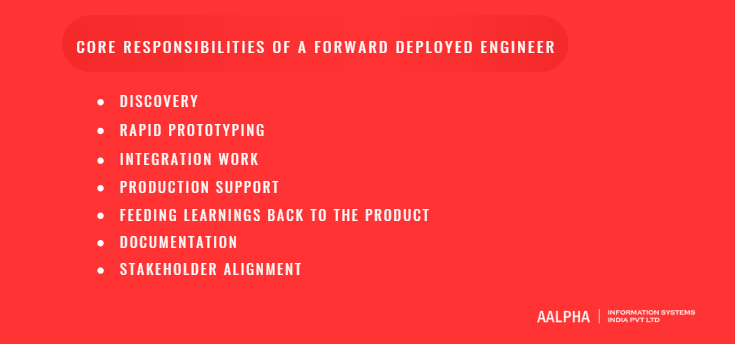
The day-to-day work of a forward deployed engineer changes by client and by week, which is part of what distinguishes the role from most software engineering jobs. A few responsibilities recur across nearly every FDE engagement, even though the specifics vary widely.
-
Discovery
Discovery comes first, and it is rarely a clean process. An FDE typically starts an engagement by sitting with the people who actually do the work the software is meant to support, not just the executives who bought it. That means reading real data exports, sitting through operational meetings, and asking the kind of specific questions that surface where the client’s documented process diverges from what people actually do. A hospital’s stated intake workflow and its actual intake workflow are rarely identical, and the gap between them is usually where the integration breaks if it is not caught early.
-
Rapid prototyping
Once the shape of the problem is clear, the FDE moves into rapid prototyping. This is closer to product engineering than to consulting: writing real code, standing up a working version of the integration or workflow, and putting it in front of the client within days rather than after a formal requirements sign-off. The iteration loop is tight because the client’s feedback is often the only reliable source of truth about whether the build is right. An FDE might rebuild a data mapping three times in a week based on what the client says after seeing each version, which is a pace that most standard software development processes are not built to support.
-
Integration work
Integration work sits at the center of the job. Client systems rarely expose clean, well-documented APIs, particularly in industries where the core software predates modern API conventions by a decade or more. An FDE spends real time reverse engineering data formats, writing adapters for legacy databases, and figuring out how to move data between systems that were never designed to talk to each other. This is unglamorous work, and it is also where most of the actual technical risk in an FDE engagement lives.
-
Production support
Production support is part of the job in a way that surprises engineers coming from a traditional product team. Because the FDE built the specific integration, they are often the first and sometimes the only person who understands why it broke at 2 a.m. when a client’s upstream system changed a field name without notice. Some organizations rotate this on-call responsibility to a broader team once a deployment stabilizes, but during the early weeks of an engagement it usually falls on the engineer who built the thing.
-
Feeding learnings back to the product
The last responsibility is less visible but arguably the most valuable to the company employing the FDE: feeding what gets learned back into the core product. A forward deployed engineer who solves the same integration problem for three different clients has effectively discovered a feature the product should have natively. Companies that run FDE programs well have a formal process for this feedback loop, because without it the organization ends up with the same custom code written from scratch at every client site, which is expensive and does not scale.
-
Documentation
Documentation is a responsibility that gets skipped more often than it should, usually under deadline pressure, and it tends to cause the most damage later. An FDE who builds a working integration under a six-week deployment clock and moves straight to the next client without writing down what the integration actually does, which fields map to which, which edge cases were handled and which were deliberately left unhandled, leaves the client and the eventual support team with a system nobody but the original engineer fully understands. Mature FDE programs treat a basic handoff document as a non-negotiable deliverable, even when it gets written the week after go-live rather than during the sprint itself.
-
Stakeholder alignment
Stakeholder alignment inside the client organization is a responsibility that sits alongside the technical work rather than after it. An FDE frequently discovers that the executive who signed the contract, the IT team who has to approve system access, and the frontline staff who will actually use the tool have three different and sometimes conflicting ideas of what the deployment is supposed to do. Part of the job is surfacing that misalignment early and getting the relevant people to agree on a single version of the requirements, since building against three different mental models at once is a reliable way to deliver something nobody is happy with.
Key skills and competencies
-
Technical range over narrow depth
Technical range matters more for an FDE than depth in any single stack. A forward deployed engineer needs to be comfortable writing backend code, working with APIs, handling reasonably large datasets, and increasingly, integrating with AI models and vector databases as more FDE work touches applied AI deployments. Cloud infrastructure knowledge, at least enough to stand up and troubleshoot a deployment environment without waiting for a dedicated DevOps team, is close to a baseline requirement. What separates a strong FDE from a strong generalist engineer is not any of these skills individually, since plenty of product engineers have them too, but the willingness to use all of them in service of one client’s specific problem rather than a general-purpose feature.
-
Domain adaptability
Domain adaptability is the skill that most differentiates FDE work from other engineering roles. An FDE working with a hospital system this quarter and a logistics company next quarter has to get functionally competent in each domain’s vocabulary, regulatory constraints, and operational rhythms fast enough to have a useful conversation with domain experts within days. This is not the same as becoming a domain expert. It means learning enough to ask the right technical questions and to recognize when a stated requirement is actually a workaround for a deeper process problem.
-
Communication
Communication carries more weight in this role than in most engineering jobs, because the FDE is often the only technical person a client’s operational staff interacts with regularly. That means translating engineering constraints into terms a hospital administrator or a plant manager can act on, and translating a client’s operational language back into something that can be built. Engineers who are excellent coders but uncomfortable running a working session with non-technical stakeholders struggle in this role regardless of their technical skill.
-
Comfort with ambiguity
Comfort with ambiguity is not optional. FDE engagements frequently start without a finished requirements document, sometimes without full agreement among the client’s own stakeholders about what the deployment should do. An engineer who needs a fully specified ticket before writing code will be unproductive in this environment. The useful instinct instead is to build a defensible first version quickly, show it to the people who will use it, and let their reaction do the work that a requirements document would otherwise do.
-
Systems thinking under time pressure
Systems thinking under time pressure ties the rest together. An FDE has to make real architectural decisions, what to build now versus defer, what technical debt is acceptable given a six-week deployment window, without the luxury of a full design review process. Judgment about which shortcuts are safe and which will cause real damage later is something that develops with experience, and it is the main reason companies tend to hire FDEs with several years of production engineering experience rather than treating the role as an entry point.
-
Prioritization under conflicting constraints
Prioritization under an unfamiliar set of constraints is a related but distinct skill. Most software engineers are used to prioritizing against a backlog they had a hand in shaping. An FDE frequently walks into a situation where the client’s priorities, the vendor’s contractual commitments, and the technical reality of what is actually broken all point in different directions, and has to decide, often without a manager immediately available, what gets fixed first. Getting that sequencing wrong, fixing a cosmetic issue while a data integrity bug sits unaddressed, for instance, can cost real trust with a client even when the engineer’s overall effort was substantial.
-
Data literacy
Data literacy deserves its own mention, separate from general technical skill. A large share of FDE work is, at its core, figuring out what a client’s data actually means, not just how to move it from one system to another. A field labeled “status” in a legacy database might carry six different meanings depending on which department entered the record, and an FDE has to catch that kind of ambiguity before it becomes a bug in production rather than after. Engineers who treat data as self-explanatory tend to build integrations that look correct in testing and fail quietly against real records.
-
Emotional resilience under scrutiny
Emotional resilience under scrutiny is a less discussed but real requirement. An FDE’s work is visible in a way that most engineering work is not: a client-facing bug is not an abstract ticket, it is a person in front of the engineer, sometimes frustrated, watching something not work. Handling that pressure without becoming defensive, and without over-promising a fix timeline just to end an uncomfortable conversation, is a skill that experienced FDEs develop deliberately rather than something most engineers arrive with.
Forward deployed engineer vs. related roles
The FDE role gets confused with several adjacent titles often enough that it is worth being precise about the differences.
FDE vs. solutions engineer
A solutions engineer, sometimes called a sales engineer, works primarily in the pre-sales cycle. Their job is to demonstrate that a platform can solve a prospect’s problem, often through a scoped proof of concept, and their success is measured by deals closed rather than systems shipped into full production. An FDE picks up roughly where a solutions engineer leaves off, after the contract is signed, and stays until the deployment is genuinely working in the client’s live environment. Solutions engineers optimize for a convincing demo. FDEs optimize for a system that survives contact with real data and real users.
FDE vs. implementation consultant
An implementation consultant, common in the ERP and CRM world, configures existing product features to match a client’s process, largely through settings, workflow builders, and low-code tools rather than original software development. The ceiling on what an implementation consultant can do is set by what the product’s configuration surface already exposes. An FDE writes actual code and can go beyond that ceiling, which is exactly why companies use FDEs for clients whose needs the standard product configuration cannot reach.
FDE vs. customer success engineer
A customer success engineer takes over after a deployment has stabilized, focused on adoption, renewal risk, and steady-state technical support. Their engagement is typically long-running and lower-intensity than an FDE’s. Many FDE programs are explicitly structured to hand a deployment to customer success once it is stable, which frees the FDE to move to the next client.
FDE vs. traditional software engineer
A traditional software engineer builds for the product roadmap and a broad user base, working from a backlog that reflects aggregated demand across many customers rather than one customer’s specific need. The core distinction from an FDE is proximity: a product engineer is several steps removed from any single client’s daily reality, while an FDE’s whole job is to close that distance.
FDE vs. field service engineer
A field service engineer, common in hardware and industrial equipment companies, is worth distinguishing too, since the titles occasionally get confused. Field service engineers primarily maintain and repair existing physical or software systems that are already deployed and largely stable. They diagnose and fix, but they are not typically building new software to reshape how a client’s process works. An FDE’s work product is closer to genuine software development, and the client relationship is usually earlier in the lifecycle, during initial deployment rather than ongoing maintenance.
A day in the life and the typical engagement lifecycle
-
The discovery phase
An FDE engagement usually opens with a discovery phase that runs anywhere from a few days to a few weeks, depending on how well-documented the client’s systems already are. The engineer spends this stretch in meetings with operational staff, pulling sample data, and mapping out where the client’s actual workflow diverges from whatever the sales team described during the deal. It is common for an FDE to discover during this phase that the scope agreed to in the contract does not match what the client’s staff actually need, which is one of the more delicate parts of the job: surfacing that gap early, before a build has been started on the wrong foundation.
-
The embedded build phase
The embedded build phase follows, and this is where most of an FDE’s hours go. Code gets written, shown to the client, revised, and shown again, often on a daily or near-daily cycle rather than a two-week sprint. An FDE working on an AI-powered clinical documentation tool, for example, might spend a morning adjusting how the system parses a specific hospital’s note templates, spend the afternoon in a room with nurses watching them use the tool live, and spend the evening rewriting the parsing logic based on what broke in front of them. That tight loop between building and watching real usage is the defining rhythm of the role, and it is very different from the cadence of most product engineering jobs.
This phase is also where an FDE has to manage a tension that does not fully go away for the rest of the engagement: building fast enough to keep the client engaged without cutting corners that will cause real problems once the system handles production volume rather than a small test sample. A prototype that works cleanly against fifty sample records the client hand-picked for a demo can fail in unpredictable ways against the full dataset, where missing fields, inconsistent formats, and duplicate records are the norm rather than the exception. Experienced FDEs learn to push for access to messy, representative data as early as possible, precisely because a clean demo is the least useful test of whether the build actually works.
Weekly or even daily check-ins with the client’s project sponsor tend to matter more during this phase than formal status reports. A sponsor who sees consistent, visible progress, even incremental progress, stays engaged and continues clearing internal obstacles like data access approvals or meeting time with operational staff. A sponsor who goes two weeks without a concrete update starts to lose confidence regardless of how much real progress is happening behind the scenes, which is part of why FDEs tend to over-communicate relative to what a standard engineering team would consider necessary.
-
Deployment and stabilization
Deployment and stabilization come next, when the build moves from a working prototype to something the client relies on for real operations. This phase surfaces the integration edge cases that discovery missed, the record with a null field nobody accounted for, the peak-load moment that breaks an assumption baked into the prototype. An FDE at this stage is doing a mix of debugging, monitoring, and often training the client’s own staff to operate parts of the system independently.
-
Handoff or continued embed
The engagement ends, formally or informally, with either a handoff to a customer success or support team, or a decision to keep the FDE embedded longer because the client’s needs keep evolving. Some vendors structure FDE contracts with a defined embed period after which the relationship converts to standard support. Others, particularly with strategic accounts in defense or intelligence, keep FDEs embedded indefinitely because the client’s environment is complex and sensitive enough that continuity of personnel matters more than efficiency.
A well-run handoff is its own distinct piece of work, not just an afterthought once the build is done. The receiving support or customer success team needs more than a codebase, they need the reasoning behind decisions that are not visible in the code itself: why a particular edge case was left unhandled, why one integration path was chosen over another that looked equally viable on paper, which parts of the system are fragile and which are solid. FDE programs that skip a deliberate handoff period tend to see support quality drop sharply in the months after a transition, since the receiving team is left reconstructing decisions from scratch, often at the exact moment a client hits an edge case the original engineer would have recognized immediately.
-
Renewal and expansion
Renewal and expansion conversations often piggyback on the tail end of a successful FDE engagement, since the embedded engineer is usually the person inside the vendor organization who best understands what else the client’s environment could support. It is common for an FDE to surface a second, unplanned use case partway through an engagement, an adjacent department that could use the same integration, a workflow the client did not originally mention that turns out to be a natural fit for the platform, and that discovery becomes the basis for the next commercial conversation. This is one of the quieter ways the FDE model pays for itself beyond the original contract.
Industries and use cases where FDEs are most valuable
-
Defense and government contracting
Defense and government contracting is where the model originated and remains one of its heaviest users. Classified or highly restricted data environments, agency-specific legacy systems, and procurement processes that reward vendors who can demonstrate working deployments quickly all favor embedded engineering over remote implementation. An FDE working with a defense client often needs a security clearance and spends extended periods on government facilities, which is a meaningfully different working arrangement than most commercial FDE roles.
-
Healthcare and life sciences
Healthcare and life sciences present a similar profile: fragmented legacy systems, strict regulatory constraints around patient data, and workflows that vary meaningfully from one hospital system to the next even when they are nominally using the same electronic health record platform. An FDE deploying a clinical AI tool has to account for HIPAA constraints, integrate with EHR systems that were not built for modern API access, and adapt to clinical workflows that differ by department and sometimes by individual physician preference.
-
Financial services
Financial services shares the regulatory intensity of healthcare with its own set of legacy infrastructure problems, particularly at large banks running core systems that are decades old. An FDE in this space often spends significant time on data lineage and audit trail requirements that have no equivalent in a typical SaaS deployment, since a financial regulator will ask not just whether a system works but exactly how a given number was derived.
-
Manufacturing and logistics
Manufacturing and logistics bring a different kind of complexity: physical world constraints, industrial equipment with proprietary data protocols, and operations that cannot tolerate downtime for a software rollout. An FDE working with a manufacturing client might spend weeks just building a reliable connection to plant floor sensors before any of the higher-level analytics work can begin.
-
AI-driven enterprise platforms
AI-driven enterprise platforms have become one of the fastest-growing use cases for forward deployed engineering since 2023. A large language model deployed against a client’s internal documents, code, or customer data needs retrieval infrastructure, access controls, and evaluation processes tailored to that client’s actual content, none of which a generic model API provides out of the box. This is close to the work Aalpha has done for clients building AI-powered platforms, including an AI-driven education platform for a Hong Kong-based client, where the value of the underlying model depended entirely on how well it was wired into the client’s specific content and user data.
-
On-demand and marketplace platforms
On-demand and marketplace platforms are a less obvious but increasingly common use case. A logistics or delivery platform expanding into a new country or vertical often needs its matching, pricing, and routing logic adjusted against local operational realities, traffic patterns, payment infrastructure, and regulatory rules that differ meaningfully from the market the platform was originally built for. An engineer embedded with the local team during that expansion, rather than a remote team working purely from specifications, tends to catch the operational mismatches faster. Aalpha’s work on on-demand service platforms across different regional markets, including a Qatar-based on-demand services deployment, reflects this same pattern: the core platform logic travels well, but the last mile of adapting it to a specific market’s constraints benefits from someone working close to that market’s actual conditions.
-
Telecommunications and utilities
Telecommunications and utilities share some of the same legacy-system burden as financial services, with the added complexity of physical network infrastructure and often decades-old billing and provisioning systems. An FDE in this space frequently spends a meaningful share of engagement time just establishing a reliable way to read data out of systems that were never built with modern integration in mind, work that rarely shows up in a sales deck but determines whether the rest of the deployment is even possible.
Benefits of the forward deployed engineering model
Benefits for clients
For clients, the most immediate benefit is speed. A working pilot in weeks rather than months changes the internal politics of a software rollout, because stakeholders who were skeptical can see something real before the initiative loses momentum. The deployment is also genuinely tailored, since an FDE builds against the client’s actual data and workflow rather than a generic best-guess configuration, which tends to reduce the awkward workarounds that end users build around software that almost fits their process. Integration risk drops as well, because problems that would otherwise surface after go-live, when they are expensive to fix, get caught during the embedded build phase instead.
Benefits for the vendor
For the company deploying FDEs, the model creates a product feedback loop that is hard to replicate any other way. Engineers who sit with real clients notice patterns that a product team working from support tickets and feature requests would take much longer to surface, and companies that formalize this feedback into their roadmap process end up building a genuinely better core product over time. FDE engagements also tend to correlate with stronger account retention and expansion, since a client with an engineer who understands their environment in depth has a harder time switching vendors, and often finds new use cases for the platform because the FDE is already positioned to build them.
Benefits for the engineers themselves
For the engineers themselves, the role offers a kind of exposure that is difficult to get inside a normal product team: direct contact with how software actually gets used, across a range of industries and problems, with real authority to make architectural decisions rather than implement someone else’s design. Engineers who move through several FDE engagements often develop a breadth of both technical and domain knowledge that accelerates career growth into technical leadership, solutions architecture, or founding roles, since the experience closely resembles running a small technical engagement independently.
Pattern recognition across accounts
There is a compounding benefit that shows up specifically at companies serving multiple clients in the same vertical, which is pattern recognition across accounts. An FDE who has now solved a similar integration problem for a third hospital system after doing it for two others is measurably faster the third time, and that speed advantage is close to impossible to replicate through documentation alone, since so much of what makes the third deployment faster is judgment the engineer would struggle to fully write down. Companies that keep the same engineers on the same vertical over multiple engagements, rather than rotating people through unrelated industries each time, tend to see this compounding effect show up clearly in deployment timelines.
A direct, responsive channel
Clients also benefit from a channel that most vendor relationships lack: a direct, technically credible line to raise a problem and see it addressed without going through a support ticket queue. That responsiveness matters most in the early, fragile weeks of adoption, when a slow response to a broken integration can be the difference between a deployment that gains momentum inside the client organization and one that quietly gets abandoned by frustrated end users before it ever reaches full rollout.
Challenges and trade-offs
-
Burnout risk
Burnout risk is real and worth naming plainly. Extended travel, embedded work in a client’s environment rather than a home office, and the pressure of being the visible face of a vendor’s technical credibility all add up over multiple engagements. Palantir’s own FDE program has drawn public criticism over the years for demanding hours and travel schedules, and companies building FDE functions now generally have to plan explicit rotation and rest periods into the role, not just leave it to individual engineers to manage.
-
Scope creep
Scope creep is close to a structural feature of the job rather than an occasional problem. Because an FDE is embedded and responsive, clients naturally start asking for adjacent things once they see how fast the engineer can move, and an FDE without support from account management can end up quietly absorbing work well outside the original contract. Managing that boundary requires a working relationship with whoever owns the commercial side of the account, since the FDE is usually not positioned to say no on their own.
-
Custom work vs. product scalability
The tension between custom work and product scalability is one that FDE programs have to actively manage rather than assume will resolve itself. Without the feedback loop mentioned earlier, a company can end up with dozens of nearly identical but not-quite-identical integrations built by different FDEs at different client sites, none of which make it back into the core product. That is expensive to maintain and creates real technical debt across the account base, even though each individual piece of work was reasonable at the time.
-
Talent scarcity
Talent scarcity is a practical constraint that shapes hiring in this space. The combination of strong engineering skill, domain adaptability, and client-facing communication is uncommon enough that most FDE programs report difficulty hiring at the pace they want, and the role’s demands mean not every strong engineer is a fit even with training. Companies that build FDE teams well tend to invest specifically in identifying engineers with prior consulting, startup, or founder experience, since that background often predicts comfort with the ambiguity and client exposure the role requires better than pure engineering credentials do.
-
Compensation friction
Compensation expectations add friction to hiring as well. FDE roles typically demand a premium over standard software engineering salaries, given the travel burden and the breadth of skill required, and that premium is not always accounted for accurately when companies first stand up the function. Underpricing the role relative to what it actually asks of the engineer is a common early mistake, and it shows up later as high turnover once the first cohort of FDEs realizes the compensation does not match the demands.
-
Knowledge concentration risk
There is also a knowledge concentration risk that mature FDE programs plan around deliberately. Because a single engineer often carries deep, undocumented context about a specific client’s environment, that engineer leaving, whether through attrition or simply moving to a new account, can create a real gap in institutional knowledge. Pairing engineers on larger accounts, or requiring a structured handoff period before an FDE rotates off an engagement, is one of the more effective mitigations, though it adds cost that not every organization is willing to carry.
How companies build a forward deployed engineering function
Hiring for the role
Hiring for FDE roles generally looks past the standard software engineering interview loop. Technical competence still matters and gets tested, but the harder signal to find is evidence that a candidate can operate independently in front of a client without a manager in the room, which is difficult to assess through a coding exercise alone. Companies that run mature FDE hiring processes often include a case study or working session designed to simulate ambiguous, client-facing pressure rather than a clean algorithmic problem.
Structuring the team
Structuring the team well means deciding, deliberately, how FDEs report and how their work feeds back into the product. Some organizations embed FDEs inside the product engineering org so that feedback flows naturally; others keep FDEs in a separate deployment or field engineering function with a formal process for surfacing recurring patterns to product managers. Neither structure is inherently correct, but the absence of any structure at all is the common failure mode, where FDE learnings stay locked inside individual engineers’ heads and never reach the roadmap.
Tooling
Tooling matters more than it might seem from the outside. FDEs need fast, low-friction ways to stand up environments, connect to client systems securely, and monitor what they have built once it is live, without waiting on a central platform team for every request. Companies that under-invest here end up with FDEs spending a disproportionate share of their time on infrastructure friction instead of the client-specific work that justifies the role’s cost.
Working with an external partner instead
For organizations that need this kind of embedded technical delivery but do not want to build and staff a permanent FDE function, working with a software development partner that can operate in this mode is often the more practical route. Aalpha has run engagements across AI-powered platforms, logistics and commerce systems, and on-demand service platforms where the work looked functionally similar to forward deployed engineering: embedded discovery, rapid iterative builds against a specific client’s data and workflow, and direct involvement through stabilization, delivered as part of a defined project rather than a permanent internal hire. That model gives a client the speed and specificity of embedded engineering without the overhead of recruiting, training, and retaining an FDE team in-house.
Is the forward deployed engineering model right for your organization?
The clearest signal
The clearest signal that an organization needs this model rather than a standard implementation process is that the value of the software genuinely depends on deep integration with a specific client’s systems and data, not just configuration of existing settings. If a standard onboarding flow and a support ticket system have historically been enough to get clients live, forward deployed engineering is probably unnecessary overhead. If instead every serious deployment turns into a months-long integration project regardless of how the sales team scoped it, that is a sign the product needs embedded engineering effort earlier and more deliberately than it is currently getting.
Weighing the cost
Cost is the other half of the decision. Forward deployed engineers are expensive relative to standard implementation staff, both in salary and in the opportunity cost of pulling strong engineers away from the core product. The return has to be measured against what it replaces: slower deployments, higher churn from clients who never got a working system, and the ongoing cost of building custom integrations reactively rather than through a deliberate embedded process. For a company selling into a small number of large, complex accounts, the math tends to favor the FDE model clearly. For a company selling a largely self-serve product to a broad market, it usually does not, and the better investment is in a more configurable product rather than in embedded engineers to compensate for a product that is not configurable enough.
Testing the model before committing
A useful middle path for organizations that are not ready to commit to a permanent internal FDE function is to treat the first one or two engagements as a deliberate test rather than a full program launch. Structuring a single embedded, client-specific deployment as a defined project, with clear success criteria and a set timeline, gives an organization real evidence about whether the model fits its client base before committing to the ongoing cost of hiring, training, and retaining engineers for a permanent function. This is also where working with an external partner for the first engagements can de-risk the decision, since it avoids the sunk cost of a full internal hiring process before the organization has confirmed the model actually solves its adoption problem.
How much your client base varies
The decision also depends on how much variation exists across the client base. A company whose clients are all reasonably similar in size, industry, and technical maturity has less need for the flexibility an FDE provides, since a standard implementation playbook will cover most cases well enough. A company whose clients range from a small regional operation to a multinational with a decade of legacy infrastructure faces a wider spread of integration complexity, and that spread is exactly the condition under which forward deployed engineering earns its cost, because no single standard playbook will fit both ends of that range.
FAQs
What does a forward deployed engineer do day to day?
A forward deployed engineer spends most working hours embedded with a specific client, moving between discovery conversations with operational staff, writing and revising code that integrates a product with that client’s systems, and troubleshooting issues as the deployment moves toward production. The exact mix shifts by week depending on which phase of the engagement the FDE is in.
How is a forward deployed engineer different from a solutions architect?
A solutions architect typically designs an integration or deployment plan and hands it off to be built. A forward deployed engineer builds it themselves, iterating directly with the client rather than working from a static design document, and stays through deployment and stabilization rather than moving to the next deal once the design is approved.
Do forward deployed engineers need to travel or relocate?
Many FDE roles, particularly in defense, healthcare, and other on-premises heavy industries, involve significant travel or extended stays at a client site. Some companies now run hybrid FDE models where engineers work remotely with periodic on-site visits, especially for clients whose systems can be accessed securely without a physical presence, but travel remains a common feature of the role.
What background do you need to become a forward deployed engineer?
Most companies hire FDEs with several years of production software engineering experience, since the role requires making real architectural decisions with limited support. Backgrounds in consulting, startups, or founding roles are often viewed favorably because they signal comfort with client exposure and ambiguity that a purely product-engineering background may not have developed.
Is forward deployed engineering the same as customer success engineering?
No. Customer success engineering typically starts once a deployment has stabilized and focuses on retention, adoption, and ongoing support. Forward deployed engineering happens earlier, during the build and stabilization phase, and involves writing substantial new code rather than maintaining an already-working system.
Why do AI companies increasingly use forward deployed engineers?
A large language model or AI platform only delivers value once it is connected to a client’s actual data, permissions, and workflows, none of which a generic model API handles automatically. Forward deployed engineers build that connective layer, which has made the role increasingly common at companies deploying AI systems into enterprise and regulated environments since 2023.
Can a software development agency provide forward deployed engineering services?
Yes. An agency with experience building integration-heavy, embedded engagements can deliver the same speed and client-specific depth as an in-house FDE team, without a client having to recruit and retain that function permanently. Aalpha has run engagements structured this way across AI platforms, logistics systems, and on-demand service platforms, where embedded discovery and rapid iterative builds against a client’s real data were central to the engagement.
How long does a typical forward deployed engineering engagement last?
Engagement length varies widely by client complexity and industry. A straightforward integration might stabilize within four to eight weeks, while a deployment in a heavily regulated environment like defense or healthcare can run for several months before the client is ready to take over independently. Some engagements, particularly strategic government or enterprise accounts, keep an FDE embedded indefinitely because the environment keeps changing.
What is the difference between a forward deployed engineer and a DevOps engineer?
A DevOps engineer focuses on infrastructure, deployment pipelines, and system reliability, usually across a company’s own environment rather than a client’s. A forward deployed engineer focuses on adapting a product to a specific external client’s data, workflows, and systems. The two roles occasionally overlap when an FDE has to stand up infrastructure inside a client’s own cloud environment, but their core mandates are different.
Does a forward deployed engineer need a security clearance?
Only for certain engagements, primarily in defense, intelligence, and government contracting, where the client’s data or systems are classified or otherwise access-restricted. FDEs working with commercial clients in healthcare, finance, or logistics typically do not need a clearance, though they may need to pass background checks or sign strict data handling agreements depending on the industry.
Have a project that needs embedded, client-specific technical delivery rather than an off-the-shelf implementation? Talk to Aalpha about how we structure engagements for exactly this kind of work.