



A website revamp is no longer a visual exercise or a branding refresh. It has become a direct business lever that influences trust, conversions, discoverability, and long-term growth. Today, a website functions as the primary interface between a business and its customers, often replacing sales teams, brochures, and even physical locations. When users land on a website that feels outdated, slow, or difficult to navigate, they subconsciously associate those flaws with the credibility of the business itself. This immediate judgment affects whether visitors stay, explore, convert, or abandon the site entirely. In competitive digital markets, even small UX inefficiencies can translate into lost revenue and declining customer confidence.
Outdated user experience has a measurable impact on conversions and engagement. Poor navigation, cluttered layouts, slow-loading pages, or non-responsive designs increase bounce rates and reduce time on site. Visitors expect intuitive flows, clear calls to action, and seamless interactions across devices. When a website fails to meet these expectations, users do not adapt. They leave. This behavior directly affects lead generation, ecommerce performance, and customer acquisition costs. A modern website revamp addresses these friction points by aligning design, content, and functionality with how users actually behave online, not how businesses assume they do.
User trust is formed within seconds, often before any content is read in detail. Visual hierarchy, typography, spacing, color consistency, and performance all signal professionalism and reliability at a glance. Research consistently shows that users form first impressions of a website in under a second, and those impressions strongly influence perceived credibility. In practical terms, this means that an outdated design can undermine even the strongest products or services. A strategic website revamp helps realign brand perception with current market expectations, ensuring that the first impression reinforces trust rather than eroding it.
From a search visibility standpoint, website redesign is now tightly linked to SEO performance. Google no longer evaluates websites solely on content relevance and backlinks. Core Web Vitals, mobile-first indexing, page experience signals, and usability metrics play a critical role in rankings. Websites that load slowly, shift layouts unexpectedly, or perform poorly on mobile devices are actively disadvantaged in search results. A website revamp that improves performance, responsiveness, and user interaction metrics directly supports better organic visibility. This makes redesign decisions not just design choices, but search optimization decisions as well.
In modern business environments, a website must serve multiple roles simultaneously. It must communicate value clearly, guide users efficiently, perform reliably across devices, and meet evolving search engine standards. A website revamp brings these elements together into a cohesive system. When approached strategically, it becomes a foundation for sustained growth rather than a one-time aesthetic update. This is why redesigning a website today is not about looking better. It is about functioning better in a digital ecosystem where user experience, performance, and trust determine success.
What is a Website Revamp/ Redesign?
A website revamp is a comprehensive overhaul of an existing website that goes far beyond visual updates or cosmetic changes. It involves rethinking how the website is structured, how users navigate and interact with it, how content is organized and presented, and how the underlying technology supports performance, scalability, and business goals. Unlike minor redesigns that focus on changing colors, layouts, or typography, a website revamp addresses fundamental issues that affect usability, conversions, search visibility, and long-term maintainability.
To understand the scope clearly, it is important to distinguish a website revamp from a basic website redesign. A redesign typically improves the look and feel of a site while preserving its existing architecture, content hierarchy, and functional logic. A website revamp, on the other hand, often involves changes to information architecture, navigation flow, content strategy, page-level user journeys, and technical foundations. This may include restructuring URLs, rebuilding templates, optimizing performance for mobile and speed, improving accessibility, integrating new functionalities, or aligning the site with updated branding and business positioning.
A full website revamp is usually driven by strategic needs rather than aesthetic preferences. Businesses opt for a revamp when their website no longer supports current objectives, fails to convert traffic effectively, performs poorly on mobile devices, or struggles to meet modern SEO and performance standards. In many cases, the existing website may have grown organically over time, resulting in inconsistent layouts, fragmented content, and inefficient user flows. A revamp consolidates these elements into a cohesive, data-informed system designed to support growth.
From a business perspective, a website revamp is an investment in operational efficiency and digital credibility. It ensures that every component of the website, from navigation and content to performance and integrations, works together to guide users toward meaningful actions. When executed correctly, a website revamp does not merely update how a site looks. It transforms how the site functions, how it is discovered, and how effectively it contributes to measurable business outcomes.
Types of Website Revamp Based on Business Goals
Not all website revamps serve the same purpose. The scope and focus of a revamp depend heavily on the business problem being solved and the outcomes the organization wants to achieve. Understanding the different types of website revamp helps businesses avoid unnecessary changes while ensuring that critical issues are addressed strategically. Each category below targets a specific set of challenges and is typically driven by clear performance, usability, or growth signals.
A UX-focused website revamp is needed when users struggle to navigate the site, find information, or complete basic actions. Common indicators include high bounce rates, low time on site, frequent user complaints, or inconsistent behavior between desktop and mobile users. This type of revamp concentrates on improving information architecture, simplifying navigation, enhancing accessibility, and optimizing user flows across key pages. It solves problems related to confusion, friction, and poor usability by aligning the website structure with real user behavior and expectations, resulting in smoother journeys and higher engagement.
A conversion-focused website revamp is appropriate when traffic levels are stable or growing, but leads, sales, or sign-ups remain low. In these cases, the issue is not discoverability but persuasion and flow. This revamp type prioritizes landing page optimization, clearer calls to action, streamlined funnels, and improved messaging that guides users toward desired outcomes. It addresses problems such as unclear value propositions, form abandonment, ineffective CTAs, and fragmented conversion paths, ultimately improving the return on existing traffic.
A performance-focused website revamp becomes necessary when a website is slow, unstable, or poorly optimized for mobile devices. Signs include long load times, high mobile bounce rates, low Core Web Vitals scores, or declining search visibility despite strong content. This revamp focuses on improving page speed, reducing layout shifts, optimizing assets, and ensuring consistent performance across devices. It solves technical bottlenecks that negatively impact user experience, search rankings, and overall reliability, making the site faster, more responsive, and more resilient.
A branding-focused website revamp is driven by changes in company identity, market positioning, or target audience. This type is common after rebranding initiatives, mergers, new product launches, or shifts in customer demographics. The focus is on visual identity, typography, color systems, imagery, and tone of voice, while maintaining or lightly adjusting existing structure. It addresses problems such as outdated brand perception, inconsistent visual language, or misalignment between the brand and its current market, ensuring the website accurately reflects the business today.
An SEO-driven website revamp is required when organic traffic is declining, content is poorly structured, or the site fails to perform well in search despite relevance. This revamp centers on content hierarchy, URL structure, internal linking, page templates, and on-page optimization. It solves issues related to crawlability, indexation, keyword alignment, and content discoverability while preserving or enhancing existing search equity. An SEO-driven revamp is particularly critical when websites have evolved without a clear content strategy, resulting in diluted authority and missed ranking opportunities.
In practice, many website revamps combine multiple categories. A well-planned revamp aligns the primary business objective with the appropriate focus areas, ensuring that design, content, and technical changes work together toward measurable results. Understanding these types helps businesses approach website revamp decisions with clarity, purpose, and realistic expectations.
How to know if a website requires redesigning?
Relying on subjective impressions alone is one of the most common mistakes businesses make when deciding whether to redesign a website. While visual appeal matters, professional website revamp decisions should be grounded in measurable performance data. Clear, data-driven indicators provide objective evidence that a website is no longer supporting business goals effectively and requires a structured revamp rather than incremental tweaks.
One of the strongest signals is declining organic traffic despite stable or improving content quality. When search traffic drops even though content remains relevant and updated, it often points to technical, UX, or performance-related issues. Poor mobile usability, slow page load times, outdated page structures, or weak internal linking can all reduce visibility in search results, even if the content itself is sound. This indicates that the website’s underlying structure or experience no longer aligns with modern search engine expectations.
High bounce rates on key landing pages are another critical indicator. Landing pages are designed to guide users toward specific actions, such as exploring services, submitting forms, or making purchases. When users exit these pages quickly without interacting, it suggests problems such as unclear messaging, poor visual hierarchy, slow loading, or misaligned user intent. Persistent bounce issues often mean the page layout, content flow, or calls to action need to be rethought as part of a broader revamp.
Poor mobile engagement metrics are particularly important in a mobile-first environment. If analytics data shows significantly lower engagement, higher bounce rates, or shorter session durations on mobile compared to desktop, the website is likely not optimized for smaller screens or touch-based interactions. This directly impacts both user experience and search rankings, making a mobile-focused revamp essential rather than optional.
Drop-offs in checkout processes or lead generation forms provide direct evidence of conversion friction. When users start but fail to complete key actions, such as submitting enquiries or completing purchases, it often points to usability barriers, excessive steps, confusing layouts, or trust-related concerns. These issues cannot be resolved through minor design changes alone and typically require a conversion-focused website revamp that simplifies flows and removes obstacles.
Finally, low engagement time compared to industry benchmarks signals that users are not finding the website compelling or easy to explore. Short session durations across core pages indicate that content structure, navigation, or visual presentation may be failing to hold attention. When users consistently spend less time on a site than competitors in the same industry, it is a strong indication that the website experience needs to be restructured.
Taken together, these objective indicators provide a clear, evidence-based foundation for deciding when a website revamp is necessary. By grounding redesign decisions in measurable performance data rather than assumptions or aesthetics, businesses can approach website revamp projects with confidence, clarity, and a much higher likelihood of meaningful improvement.
Things to consider while redesigning a website
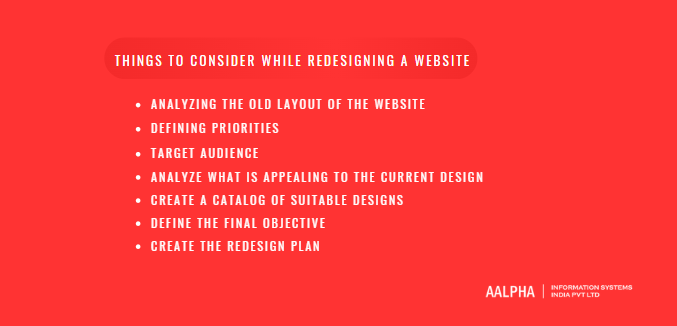
A redesign typically means that a website has a substantial change in coding and graphic presentation. For instance, a new visual identity and marketing strategy are created, pages are UX revamped to include additional modules and functionalities.
-
Analyzing the old layout of the website
Begin by checking your current design website pragmatically. What tends to work and what does not?
You may find unique concerns like empty orders on a food ordering website. In this scenario, the checkout protocol will need to be reworked and redesigned to help follow-up.
Research traffic dynamics using Google Analytics. You may have a high degree of spin? You may also find possible potential issues through visual reports such as heat maps or scroll maps to evaluate the actions of your audience. In essential areas of your website, like the e-mail login form, you may have close calls for action or minimal activity.
Recordings may offer much more comprehensive information on individual sites involving visits to the website. You can see where you are browsing, clicking, and engaging with your website otherwise.
-
Defining Priorities
The general look of your website can not be modified by a website redesign. It should change how it operates, especially regarding sales and conversions.
What are the metrics for your site update that you intend to improve? Perhaps you would like to gather more email addresses, sell more items, or inspire consumers to purchase packages.
In the redesign, you realize your priorities from the beginning and can work on producing specific outcomes.
-
Target audience
Over time, target markets change. When launching new goods, services, or new customers to your website, you must adjust your messages to those that are most able to order from you. Develop purchaser individuals for each target group.
You can continue to make wise choices by reassessing the website design by learning how to cater to those potential customers. For example, you may want to create a younger, more vibrant website if you are now approaching teenagers, rather than merely selling them to medium-aged professionals.
-
Analyze what is appealing to the current design
During a website update, you do not have to change something. You ought not, necessarily.
Some elements of your website can perform very well. E.g., you would not like to alter your existing logo if you are already pleased with it and obtain widespread brand exposure.
The same may be said of the color scheme, text options, or pictures of the website. You will determine what to hold and what to use with modifications based on factual data from Google Analytics or other resources.
-
Create a catalog of suitable designs
Consider this phase as a collection of aspirations. Type out all features you want to apply to your website, regardless of whether it is a color update or a different tool.
Remember any structural improvements for your website that you might choose. Shorter URLs are always trustworthy. Ask yourself if you want to add or remove anything from the search bar.
-
Define the final objective
There needs to be a purpose for all things on your wish list. Will you like to see a more complicated search bar? Your customers can find it difficult to find the content they require, so you will need to give relevant quicker.
There is no associated purpose or justification for any of the things on your list. Place a question mark next to them so you can verify the improvements.
Data-based modifications get more leverage after the update of the site and the website does not have to be redesigned as often.
-
Create the redesign plan
You need a plan, regardless of whether you are reorganizing the website or recruiting a competent design staff. Find out where each redesign feature is created and how these modifications are checked against improvements.
When you recruit a third party or collaborate with an in-house designer, nominate someone to systematically support any improvements. Be sure you set out the requirements in the deal with third parties’ agreements and know what it is you are receiving, including the amount of feedback, and added expenses in the future. Additionally, it is important to understand cost of redesigning a website in order to meet our expectations
How to Redesign a Website – Step-by-Step Process
A website revamp delivers results only when it follows a structured, end-to-end process. Treating redesign as a sequence of clearly defined phases prevents fragmented decisions, reduces risk, and ensures that improvements translate into measurable business outcomes. Below is a practical, lifecycle-based website revamp process used in professional digital projects.
-
Discovery and Data Analysis
The revamp process starts with a deep analysis of the existing website to understand what is working, what is failing, and why. This phase relies on quantitative and qualitative data, including traffic patterns, user behavior, conversion paths, performance metrics, and device usage. The objective is to identify structural, UX, content, and technical issues that limit effectiveness. Discovery provides evidence-based clarity and prevents redesign decisions driven by assumptions or aesthetics alone.
-
Goal Definition and KPI Alignment
Once insights are gathered, clear business goals must be defined for the website revamp. These goals may include increasing lead quality, improving ecommerce conversions, reducing bounce rates, enhancing mobile engagement, or strengthening organic search performance. Each goal is paired with measurable KPIs that establish success criteria before design or development begins. This alignment ensures that every redesign decision supports a specific outcome and can be evaluated objectively after launch.
-
UX and Information Architecture Planning
In this phase, the website structure is redesigned to align with user intent and behavior. Navigation models, page hierarchies, and user journeys are mapped to remove friction and guide users toward key actions efficiently. Information architecture planning addresses issues such as unclear menus, buried content, inconsistent layouts, and poor accessibility. A strong UX foundation ensures that users can intuitively understand the site and move through it without confusion.
-
Visual and Content Redesign
With structure in place, attention shifts to visual presentation and content clarity. Visual redesign focuses on hierarchy, spacing, typography, consistency, and trust signals, ensuring that users can scan and interpret pages easily. Content redesign aligns messaging with current business positioning, customer needs, and conversion goals. This phase ensures that design and content work together to communicate value clearly, build credibility, and support decision-making.
-
Development and Testing
The development phase translates approved designs and content into a functional website. This includes building templates, implementing responsive layouts, optimizing performance, and integrating required functionalities. Rigorous testing is critical at this stage and covers usability, mobile responsiveness, speed, accessibility, and cross-browser compatibility. Testing ensures that the revamped website performs reliably under real-world conditions before public release.
-
Launch and Continuous Optimization
Website revamp does not end at launch. Post-launch monitoring evaluates performance against the predefined KPIs, tracking metrics such as engagement, conversions, traffic quality, and technical stability. Issues identified after launch are addressed through ongoing optimization, refinements, and data-driven improvements. This final phase ensures that the website continues to evolve with user behavior, business goals, and search engine requirements.
By following a structured website revamp process, businesses move from reactive redesign efforts to strategic digital optimization. Each phase builds on the previous one, transforming the website into a scalable, performance-driven asset rather than a static marketing tool.
Cost of Redesigning a Website
The cost of redesigning a website varies significantly based on the scope of the revamp, the complexity of the website, and the level of expertise required. A basic visual refresh with minimal structural changes typically costs far less than a full-scale website revamp that includes UX restructuring, content optimization, performance improvements, and SEO preservation. Factors such as the number of pages, custom functionalities, integrations, and post-launch optimization requirements also influence the overall web designing cost.
Another key component affecting website redesign cost is the pricing model of the service provider. Web designer hourly rates can vary widely depending on experience, geographic location, and specialization. While hourly rates may appear cost-effective for small updates, comprehensive website revamp projects often benefit more from fixed-scope or value-based pricing models that align cost with business outcomes. Understanding these variables helps businesses set realistic budgets and evaluate redesign proposals based on long-term ROI rather than upfront expense alone.
Common Website Revamp Mistakes to Avoid
A website revamp can significantly improve performance and user experience, but only when executed with strategic discipline. Many redesign projects fail to deliver results because of recurring mistakes that undermine usability, search visibility, and conversions. Recognizing these pitfalls in advance helps businesses protect their investment and avoid costly setbacks.
-
Redesigning Without Data
One of the most common and damaging mistakes is initiating a website revamp without relying on performance data. Decisions based on opinions, trends, or internal preferences often miss the real issues affecting users. Without analyzing traffic behavior, conversion paths, engagement metrics, and device usage, redesign efforts risk addressing surface-level problems while ignoring structural weaknesses. Data-driven insights ensure that the revamp is aligned with actual user needs and business objectives.
-
Ignoring Existing SEO Equity
Many websites have accumulated valuable search visibility over time through indexed pages, backlinks, and established URL structures. Ignoring this existing SEO equity during a revamp can lead to significant traffic losses. Common errors include changing URLs without proper redirects, removing high-performing pages, or altering content structures without considering search intent. A successful website revamp preserves and strengthens SEO foundations rather than resetting them.
-
Overdesigning at the Cost of Usability
Visual appeal should enhance usability, not replace it. Overdesigning with excessive animations, complex layouts, or unconventional navigation often creates confusion and friction for users. When design choices prioritize aesthetics over clarity, accessibility, and performance, engagement and conversions suffer. Effective website revamps strike a balance between modern design and intuitive user experience.
-
Launching Without Proper Testing
Skipping or rushing testing is a frequent cause of post-launch issues. Without thorough testing across devices, browsers, and user scenarios, websites may launch with broken layouts, slow load times, or non-functional forms. These issues damage credibility and lead to immediate user drop-offs. Comprehensive testing ensures that the revamped website performs reliably before it reaches users.
-
Focusing on Visuals Over Conversions
A visually impressive website does not automatically convert visitors into customers. When redesign efforts focus primarily on appearance rather than user journeys, messaging, and calls to action, conversion performance often declines. A website revamp should prioritize guiding users toward meaningful actions, ensuring that design and content work together to support business outcomes rather than aesthetics alone.
Avoiding these common website revamp mistakes allows businesses to approach redesign projects with clarity, confidence, and measurable intent. By grounding decisions in data, preserving SEO value, and prioritizing usability and conversions, a website revamp becomes a strategic upgrade rather than a risky overhaul.
Why Choose Aalpha for Your Website Revamp
A website revamp is a strategic initiative that impacts visibility, credibility, and revenue generation. Choosing the right partner determines whether the effort delivers long-term business value or results in a purely cosmetic update. Aalpha delivers website revamp projects as part of its comprehensive website development services, combining strategy, design, technology, and performance optimization into a single, outcome-driven approach.
- Strategy-First Approach Backed by Business Goals
Aalpha begins every website revamp by aligning the project with core business objectives. Instead of starting with visuals, the team focuses on understanding target audiences, conversion goals, existing performance gaps, and growth priorities. This strategy-first mindset ensures that the website supports measurable outcomes such as lead generation, customer acquisition, and brand authority, making the revamp a business asset rather than a design exercise.
- Integrated UX, Performance, and SEO Expertise
Modern websites must excel in usability, speed, mobile experience, and search visibility. As part of its web development services, Aalpha integrates UX optimization, performance engineering, and SEO best practices throughout the revamp process. This includes improving navigation, enhancing accessibility, optimizing Core Web Vitals, and structuring content for discoverability. The result is a website that performs effectively for both users and search engines.
- Data-Driven Redesign Decisions
Aalpha relies on analytics and real user behavior to guide redesign decisions. Engagement metrics, funnel analysis, device-level performance data, and conversion insights are used to identify friction points and prioritize improvements. This data-backed methodology reduces risk and ensures that the revamped website addresses real-world issues instead of assumptions or trends.
- End-to-End Website Revamp Execution
Aalpha provides complete, end-to-end website revamp delivery under its web development services offering. This includes discovery and audits, UX and information architecture planning, visual and content redesign, development, testing, and post-launch optimization. Rigorous quality assurance ensures that the website launches without usability issues, performance bottlenecks, or broken conversion flows.
- Focus on Measurable Results and Continuous Optimization
Success is measured through tangible performance indicators such as engagement rates, conversion improvements, and organic traffic growth. Post-launch monitoring and optimization ensure that the website continues to evolve with user behavior, market changes, and search engine updates. This outcome-focused approach differentiates Aalpha’s web development services from one-time redesign engagements.
- Long-Term Digital Partnership
Aalpha positions itself as a long-term digital partner, not just a project vendor. Website revamp is treated as an ongoing process of improvement and adaptation. Through continuous support, optimization, and strategic guidance, Aalpha ensures that the website remains competitive, scalable, and aligned with evolving business needs.
For organizations seeking reliable, results-driven web development services, Aalpha combines strategic clarity, technical expertise, and disciplined execution to deliver website revamps that drive sustainable growth and measurable business impact.
Conclusion
A website revamp should never be viewed as a one-time design exercise or a visual upgrade driven by trends. In modern digital ecosystems, a website is a living business asset that must continuously adapt to user behavior, market expectations, and search engine standards. Successful redesigns are built on ongoing optimization, where insights from performance data, user engagement, and conversion metrics inform regular improvements rather than isolated updates.
The true value of a website revamp lies in its long-term return on investment, not in how modern or attractive the interface appears on launch day. Improvements in usability, performance, content structure, and search visibility compound over time, leading to sustained growth in qualified traffic, conversions, and customer trust. Businesses that treat website revamp as a strategic initiative consistently outperform those that approach it as a cosmetic refresh.
Professional web development plays a critical role in this process when it is positioned as a partnership rather than a transactional service. A strategic partner brings the discipline to protect existing SEO equity, the expertise to design data-driven user experiences, and the foresight to build scalable platforms that evolve with business goals. This approach ensures that redesign decisions remain aligned with measurable outcomes long after the website goes live.
Aalpha delivers website revamp projects with this long-term perspective at the core. Through strategy-led planning, data-backed execution, and continuous optimization, Aalpha helps businesses transform their websites into performance-driven digital platforms. If you are planning to revamp your website and want a partner focused on sustainable results rather than short-term visuals, Aalpha’s web development services provide the clarity, expertise, and accountability required to drive lasting impact. Connect with us today!
Also check: Responsive web design cost | Website development cost in India