
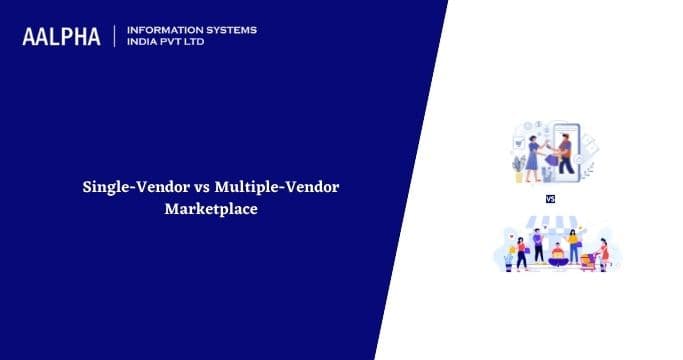





A marketplace platform connects buyers and sellers within a digital environment, but the structure of vendors can differ based on the business model. The two main types are single-vendor and multiple-vendor marketplaces. In a single-vendor marketplace, one business owns and manages all products or services offered, functioning much like a centralized online store. A multiple-vendor marketplace, on the other hand, allows numerous independent sellers to list and manage their offerings on the same platform, creating a broader range of choices for customers.
Choosing between these models involves considering factors such as operational complexity, control over inventory and pricing, scalability, and revenue opportunities. Each approach has distinct advantages and challenges, making the decision dependent on business objectives, resources, and long-term growth plans.
Single-Vendor vs Multiple Vendor Marketplace
A single-vendor ecommerce shop is an online marketplace in which a single vendor offers items to several buyers. Typically, these standalone establishments provide a limited selection of goods and services.
A multi-vendor ecommerce shop is an online marketplace where numerous vendors offer their goods and services to various clients. In multiple-vendor marketplaces, users can purchase goods from many merchants or brands.
In a multiple-vendor marketplace, as opposed to a single-vendor shop where the economic connection is bilateral, three parties are typically involved: a website administrator (owner), a vendor, and a client.
Single vs Multiple Vendor Marketplaces: Pros and Cons
There are benefits and drawbacks to operating or doing business with a single or multiple-vendor ecommerce site.
-
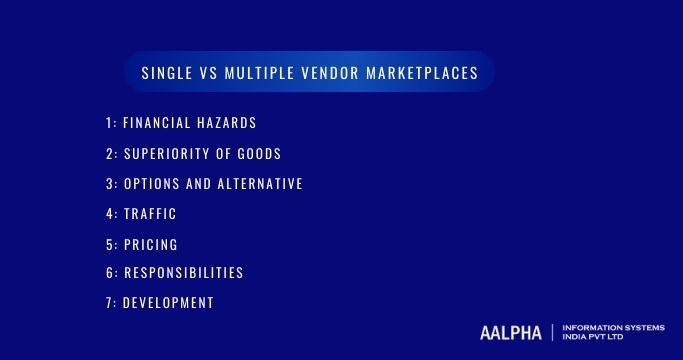
Financial hazards
Operating a multi-vendor business is less financially hazardous from the owner’s standpoint since you do not focus on a single speciality but instead diversify your offering by integrating other parties. Also, having numerous sellers implies you don’t have any inventory, which is a seller’s obligation — not investing in your website’s inventory minimizes your financial risks significantly.
-
Superiority of goods
On the other hand, monitoring each seller in a multi-vendor agreement is challenging to determine whether they produce exceptional items. However, a proper screening procedure before onboarding might minimize the danger of encountering a fraudulent or untrustworthy partner.
-
Options and alternative
In a multi-vendor marketplace, users may peruse product offers from several vendors and move between possibilities inside the same market area without leaving the site. On the other hand, a single-vendor store suggests some limitations in terms of selection and inventory, meaning that if a consumer is not satisfied with the offering, they will exit the site and shop elsewhere.
-
Traffic
The vendors you host will be the primary traffic generators on a multi-vendor website. In the case of a single-vendor shop, you will be in charge of all marketing, developing an online presence, and generating visitors (on top of maintaining all your business operations, inventory, and logistics).
-
Pricing
Lack of traffic is not the only obstacle facing online retailers. You cannot afford to reduce your pricing below a particular level as the single owner of the website. Because they can afford to, your clients are likely to search about and wind up at a marketplace where someone else offers a lower price.
-
Responsibilities
In a multi-vendor model, the roles and duties of the owner and sellers are clearly defined: as the owner of the marketplace, your obligations include maintaining the website, its infrastructure, and generating traffic, whilst the vendors’ only responsibility is to close the deal. As an owner of a single-vendor shop, you will wear numerous hats and be involved in every area of your company, including website upkeep and logistics.
-
Development
Due to the abundance of plug-and-play websites and ecommerce store builders such as Shopify, an essential ecommerce website might be pretty affordable and straightforward to set up. Custom solutions, various integrations, and several revisions are required to set up a multi-vendor shop, making the process more complicated.
Single vendor vs multi-vendor for consumer
From a customer’s perspective, building and sustaining a relationship with a single supplier in a single-vendor market may be advantageous; it is simpler to simplify processes, incorporate, and integrate systems with a single provider than with several. By making orders with a single supplier, organizations may keep administrative and other extra expenses to a minimum and leverage volume to achieve competitive prices. In contrast, there are always possibilities to take advantage of supplier rivalry in a multi-vendor environment. If one fails, there is always another one to rely on.
Single-vendor versus multi-vendor for suppliers
A marketplace also provides various benefits for vendors, including a reduction in the construction and implementation of an ecommerce website, a cost-effective entrance into either B2C or B2B ecommerce, and the chance to expand into new markets and client bases.
As a provider, you will be subject to commissions and fees while trading on a marketplace, which may make a long-term relationship with the marketplace dubious.
In addition, your items will constantly be compared to those of your rivals on your website, compelling you to cut your costs or seek other methods to attract clients.
Connect with eCommerce development company to know more in detail about Single-Vendor vs Multiple-Vendor Marketplace