


Payment gateways sit at the core of modern digital transactions. Whether a customer is paying for an online product, subscribing to a SaaS tool, or booking a service through a mobile app, the payment gateway is the technology that makes the transaction possible, secure, and compliant. Understanding what a payment gateway is and how it influences costs is essential before estimating development expenses.
What Is a Payment Gateway?
A payment gateway is a software system that authorizes, processes, and secures electronic payments between a customer, a merchant, and financial institutions. It acts as a bridge between the user-facing application (website or mobile app) and the backend financial network, including banks, card networks, and payment processors.
When a customer enters their payment details, the payment gateway encrypts the data, validates it, and transmits it securely for approval. Once the transaction is approved or declined, the gateway communicates the result back to the merchant system in real time.
In simple terms, a payment gateway:
- Collects payment information
- Encrypts sensitive data
- Sends it for authorization
- Returns the transaction status
Role of Payment Gateways in Digital Payments
Payment gateways play a critical role in the digital payment ecosystem by enabling trust, speed, and security. Without them, online and in-app payments would be unreliable and unsafe.
Key roles include:
- Transaction security: Encrypting card and bank details to prevent fraud and data breaches
- Payment authorization: Verifying funds and approving transactions instantly
- Multi-payment support: Handling cards, UPI, wallets, net banking, and international payment methods
- Compliance enforcement: Ensuring adherence to standards such as PCI DSS and regional regulations
- User experience: Offering smooth checkout flows that reduce cart abandonment
For businesses, a reliable payment gateway directly impacts revenue, customer trust, and conversion rates.
Why Businesses Invest in Custom Payment Gateway Development
While third-party payment gateways are widely available, many businesses choose to invest in custom payment gateway development to meet specific operational, security, or scalability needs.
Common reasons include:
- Full control over transaction flow: Custom gateways allow businesses to design payment logic around their exact business model
- Lower long-term transaction costs: Eliminating or reducing dependency on third-party per-transaction fees
- Advanced customization: Tailored features such as split payments, marketplace settlements, or custom subscription logic
- Brand ownership: Complete control over the checkout experience without redirects
- Regulatory or regional needs: Custom gateways help businesses comply with local banking APIs and country-specific regulations
For high-volume platforms, fintech products, and marketplaces, custom development often becomes cost-effective over time despite higher upfront investment.
Difference Between a Payment Gateway and a Payment Processor
Although often used interchangeably, payment gateways and payment processors serve different functions in the payment lifecycle.
- Payment gateway:
- Captures and encrypts payment data
- Communicates transaction details securely
- Acts as the interface between customers and payment infrastructure
- Payment processor:
- Routes transactions to card networks and banks
- Handles authorization, clearing, and settlement
- Moves funds from the customer’s bank to the merchant’s account
In short, the payment gateway handles how payment data is transferred securely, while the payment processor handles how the money actually moves.
Understanding this distinction is important because development costs usually apply to the gateway layer, while processor fees are ongoing operational expenses.
Overview of Cost Considerations
Payment gateway development costs vary widely depending on complexity, compliance requirements, and long-term business goals. Unlike simple payment integrations, building a gateway from scratch involves multiple cost layers.
Key cost drivers include:
- Technology stack and infrastructure
- Security and compliance implementation
- Supported payment methods and currencies
- Transaction volume and scalability needs
- Geographic and regulatory coverage
- Ongoing maintenance and certification costs
A basic gateway may cost significantly less than an enterprise-grade solution designed for cross-border transactions and high concurrency. This article breaks down these cost components in detail to help businesses plan realistic budgets and avoid hidden expenses.
How a Payment Gateway Works (Technical Flow)
To understand payment gateway development cost, it’s important to know what actually happens behind the scenes when a user makes a payment. A payment gateway is not a single action but a coordinated technical workflow involving multiple systems, security layers, and financial institutions. Each step in this flow adds to development complexity and cost.
Step-by-Step Payment Transaction Flow
A typical payment transaction follows a structured sequence from the moment a customer clicks “Pay” to the final settlement of funds.
- Payment initiation
The customer selects a payment method and enters details on a website or mobile app. - Data submission to the payment gateway
The front-end sends payment data to the gateway over a secure connection. - Data encryption
Sensitive information is encrypted before leaving the client or server environment. - Transaction routing
The payment gateway forwards the encrypted data to the payment processor or acquiring bank. - Authorization request
The acquiring bank sends the request to the card network (Visa, Mastercard, RuPay, etc.), which forwards it to the issuing bank. - Authorization response
The issuing bank approves or declines the transaction based on available funds and fraud checks. - Response to merchant
The gateway sends the transaction status back to the merchant’s system in real time. - Order confirmation
If approved, the merchant confirms the order and provides the service or product.
This entire process typically takes only a few seconds but involves multiple systems working in parallel.
Front-End vs Back-End Payment Processing
Payment gateway architecture is divided into front-end and back-end components, each with distinct responsibilities.
Front-end processing
- Captures user payment details
- Handles UI components such as card forms or UPI intent screens
- Performs basic validation (card number format, expiry date)
- Uses client-side encryption or hosted payment fields
Back-end processing
- Receives encrypted payment data
- Manages API communication with banks and processors
- Handles business rules, logging, and error handling
- Stores transaction metadata securely
- Manages retries, webhooks, and callbacks
From a cost perspective, front-end development affects user experience and conversion rates, while back-end development drives security, reliability, and scalability—often the more expensive part of the system.
Data Encryption and Tokenization
Security is central to payment gateway functionality, and two key mechanisms protect sensitive data: encryption and tokenization.
Encryption
- Converts payment data into unreadable formats using cryptographic algorithms
- Ensures data remains secure during transmission
- Commonly uses SSL/TLS and asymmetric encryption
Tokenization
- Replaces sensitive payment data with a non-sensitive token
- Tokens can be stored safely and reused for future transactions
- Reduces PCI DSS compliance scope for merchants
Implementing robust encryption and tokenization requires specialized expertise, secure key management, and compliance audits, which significantly influence development cost.
Authorization, Capture, Settlement, and Refund Lifecycle
Payment processing does not end with authorization. A complete gateway must manage the full transaction lifecycle.
- Authorization
Confirms that the customer has sufficient funds and the payment is valid. - Capture
The merchant requests the actual transfer of funds, either immediately or later. - Settlement
Funds are transferred from the issuing bank to the acquiring bank and then to the merchant account, usually within one to three business days. - Refunds and chargebacks
The gateway processes refunds and handles disputes initiated by customers or banks.
Each lifecycle stage requires separate APIs, transaction states, and reconciliation logic. Supporting partial captures, delayed settlements, and automated refunds adds further complexity and cost.
Role of Banks, Card Networks, and Merchants
A payment gateway operates within a broader financial ecosystem where each participant has a defined role.
- Merchants
Sell products or services and initiate payment requests. - Issuing banks
Provide cards or accounts to customers and approve or decline transactions. - Acquiring banks
Maintain merchant accounts and receive funds on the merchant’s behalf. - Card networks
Act as intermediaries that route transactions between issuing and acquiring banks.
The gateway must integrate reliably with all these entities, following strict protocols and response standards. Each integration point increases development effort, testing requirements, and ongoing maintenance costs.
Types of Payment Gateways and Their Cost Impact
Payment gateways can be implemented in different ways depending on business size, risk tolerance, compliance capability, and budget. Each type of payment gateway has a direct impact on development cost, security responsibility, and long-term operational expenses. Understanding these differences helps businesses choose the right model without overspending.
Hosted payment gateways
Hosted payment gateways redirect customers to a third-party payment page to complete the transaction. Since the payment data is handled entirely by the gateway provider, merchants do not need to manage sensitive card information or heavy compliance requirements. Development cost is relatively low because integration usually involves simple redirection or embedded checkout pages. However, businesses have limited control over user experience and branding, and recurring transaction fees are unavoidable. This model is cost-effective for startups and small businesses but becomes expensive at scale.
Self-hosted payment gateways
Self-hosted payment gateways collect payment details directly on the merchant’s website or application and then send the data to the payment processor. This approach gives businesses more control over the checkout experience but increases responsibility for data security and compliance. Development costs are higher due to the need for secure infrastructure, encryption, and PCI DSS compliance. Ongoing expenses also rise because regular security audits and system monitoring are mandatory.
API-based payment gateways
API-based gateways provide flexibility by allowing developers to build fully customized payment flows using secure APIs. These gateways support multiple payment methods, currencies, and advanced features such as subscriptions, split payments, and webhooks. Development cost depends on the level of customization and scalability required. While API-based gateways reduce time to market compared to building from scratch, they still involve backend development, security implementation, and integration testing, making them a mid- to high-cost option.
Local bank-integrated payment gateways
Local bank-integrated gateways are designed to work directly with domestic banking systems and country-specific payment methods such as UPI or local cards. Development costs increase due to custom integrations with bank APIs, compliance with regional regulations, and limited documentation support in some cases. These gateways are often slower to build and maintain but offer better approval rates and lower transaction fees in local markets.
White-label payment gateways
White-label gateways allow businesses to launch their own branded payment solution using a pre-built infrastructure. While the core system is already developed, customization, branding, and feature enhancements add to the overall cost. Initial investment is higher than hosted or API-based integrations but lower than building a gateway from scratch. This option suits businesses that want faster market entry with partial ownership of the payment experience.
Comparison of development cost by gateway type
Hosted payment gateways have the lowest development cost but higher long-term transaction fees. Self-hosted and API-based gateways require moderate to high upfront investment due to security and backend complexity. Local bank-integrated gateways tend to be more expensive because of custom banking integrations and regulatory requirements. White-label gateways fall in the mid-to-high cost range, balancing faster deployment with customization expenses. The right choice depends on transaction volume, compliance readiness, and long-term business goals.
Custom vs Third-Party Payment Gateway Development
Choosing between a custom-built payment gateway and a third-party solution is one of the most important cost decisions a business makes. While both options enable digital payments, their cost structures, flexibility, and long-term impact differ significantly.
What is custom payment gateway development?
Custom payment gateway development involves building a payment system tailored to a business’s specific requirements. The gateway is designed, developed, and maintained by the business or a development partner, with full control over payment flows, security logic, and integrations. This approach allows deep customization, including support for unique pricing models, multi-vendor settlements, custom fraud rules, and direct bank integrations. However, it requires a high upfront investment in development, compliance, infrastructure, and ongoing maintenance.
Using third-party payment gateways
Third-party gateways such as Stripe, Razorpay, PayPal, and similar providers offer ready-made payment infrastructure that businesses can integrate quickly. These platforms handle security, compliance, and transaction routing, reducing technical and regulatory burden. Development cost is minimal because integration is done through APIs or hosted checkout pages. The trade-off comes in the form of per-transaction fees, limited customization, dependency on external providers, and restrictions imposed by regional regulations or platform policies.
Cost comparison: custom vs ready-made solutions
Third-party gateways are significantly cheaper to launch since they eliminate most development and compliance costs. Businesses typically pay setup fees, transaction charges, and optional feature costs. Custom payment gateways, on the other hand, involve substantial initial spending on architecture design, security implementation, and certifications. Over time, high-volume businesses may recover these costs by reducing transaction fees and gaining operational efficiency. The cost difference is not just upfront versus ongoing but also fixed versus variable expenses.
When custom development makes business sense
Custom payment gateway development is justified when a business processes a large volume of transactions, operates a marketplace or fintech product, or requires complex settlement logic. It also makes sense for companies expanding across multiple countries with unique regulatory needs. Businesses that want complete ownership of user experience, data flow, and payment logic often find custom development more viable in the long run despite higher initial costs.
Scalability and long-term cost implications
Third-party gateways scale easily at first but can become costly as transaction volume grows due to recurring fees. Custom gateways require careful planning to scale securely, but once established, they offer predictable costs and better control over performance. Long-term expenses include maintenance, compliance renewals, and infrastructure upgrades, yet these costs are often lower than cumulative transaction fees for large-scale platforms. The decision ultimately depends on growth plans, transaction volume, and tolerance for upfront investment.
Key Factors Affecting Payment Gateway Development Cost
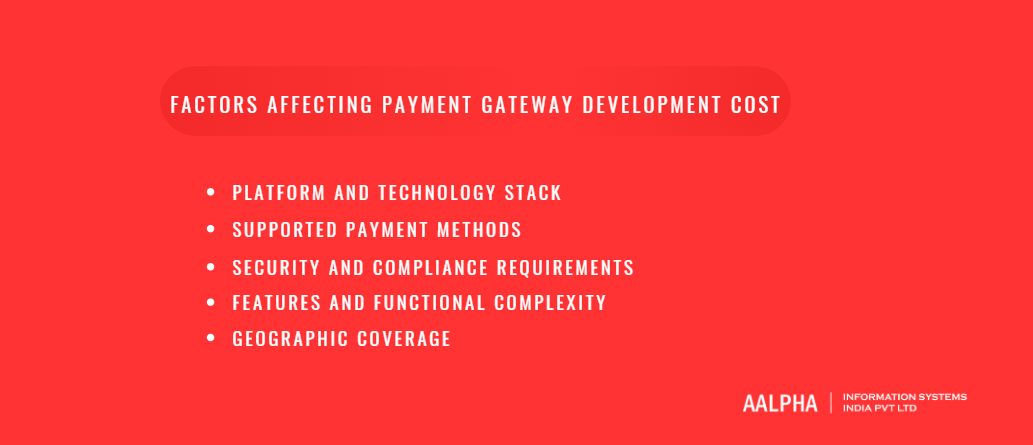
Payment gateway development cost is not fixed. It varies based on technical choices, security obligations, supported payment options, and the scale at which the system is expected to operate. Each decision made during planning directly influences both upfront development expenses and ongoing operational costs.
Platform and Technology Stack
The choice of platform and technology stack forms the foundation of a payment gateway and has a strong impact on cost. Programming languages and frameworks such as Java, Node.js, Python, or .NET are commonly used for payment systems due to their stability and security support. Enterprise-grade frameworks often require experienced developers, which increases development cost but reduces long-term risk. Lightweight stacks may cost less initially but can limit scalability and compliance readiness.
Infrastructure decisions also affect cost significantly. Cloud-based infrastructure offers flexibility, scalability, and faster deployment, with recurring usage-based expenses. On-premise infrastructure demands higher upfront investment in hardware, security controls, and maintenance but provides full control over data and compliance. In addition, database selection and server architecture influence cost through licensing fees, performance requirements, and redundancy planning. High-availability systems with real-time transaction processing require more robust and expensive setups.
Supported Payment Methods
The number and type of payment methods supported by a gateway directly increase development complexity. Supporting credit and debit cards requires integration with card networks and strict compliance with security standards. Adding UPI, net banking, and digital wallets involves separate APIs, validation flows, and reconciliation logic.
Buy Now Pay Later services introduce additional complexity due to credit checks, installment logic, and third-party integrations. Cryptocurrency payments require blockchain integration, wallet management, and volatility handling, which raises both development and security costs. Supporting international payments further increases cost because of currency handling, cross-border regulations, and settlement differences compared to domestic transactions.
Security and Compliance Requirements
Security and compliance are among the most expensive aspects of payment gateway development. PCI DSS compliance is mandatory for handling card payments, and the required compliance level depends on transaction volume and data storage practices. Achieving and maintaining compliance involves audits, documentation, and regular testing.
SSL encryption is essential for secure data transmission, while tokenization reduces exposure to sensitive payment data by replacing it with secure tokens. Fraud prevention systems, such as transaction monitoring and risk scoring, add another layer of complexity and cost. Regulatory requirements like GDPR, PSD2, and country-specific data protection laws further increase expenses due to consent management, data storage policies, and reporting obligations.
Features and Functional Complexity
The feature set of a payment gateway plays a major role in determining development cost. Simple one-time payment systems are cheaper to build compared to gateways that support recurring billing and subscription management. Subscription-based systems require logic for billing cycles, retries, plan changes, and cancellations.
Multi-currency support adds complexity in pricing, conversion rates, and settlement processes. Marketplaces and multi-merchant platforms need split payments, commission calculations, and separate settlements, which significantly raise development effort. Refunds, chargebacks, and dispute handling require additional workflows, reporting, and compliance checks, further increasing cost.
Geographic Coverage
Geographic reach has a direct impact on both development and operational expenses. Single-country payment gateways are easier and cheaper to build because they involve fewer regulations and limited banking integrations. Cross-border payment support requires compliance with multiple regulatory frameworks, integration with international banks, and currency conversion logic.
Local regulations and banking APIs vary widely by country, often requiring custom development and extended testing cycles. Currency conversion and settlement fees also affect long-term costs, as international transactions involve higher processing charges and longer settlement periods. Businesses targeting global markets must account for these added expenses early in the planning stage.
Payment Gateway Development Cost Breakdown
Payment gateway development involves multiple cost components, each contributing to the overall budget. Unlike simple software projects, payment systems require heavy backend logic, strict security controls, and continuous maintenance. Breaking down these costs helps businesses understand where most of the investment goes and how to plan budgets realistically.
Cost of UI/UX design
UI/UX design cost covers the creation of secure, intuitive, and conversion-focused payment interfaces. This includes checkout screens, error handling states, and responsive layouts for web and mobile devices. While UI design is a smaller portion of the total cost compared to backend development, poor design can increase cart abandonment and payment failures. Custom branding, multi-language support, and accessibility features further increase design effort and cost.
Backend development cost
Backend development is the most expensive part of building a payment gateway. It includes transaction processing logic, communication with payment processors and banks, database management, and business rule implementation. Developers must design systems capable of handling high concurrency, retries, and failures without data loss. The cost rises with transaction volume expectations, scalability needs, and the number of supported features such as subscriptions or split payments.
API development and integration
APIs enable communication between the payment gateway, merchant applications, banks, and third-party services. Development cost depends on the number of APIs, data formats, authentication mechanisms, and webhook systems required. Integrating with external providers such as card networks, UPI platforms, or fraud detection services adds complexity and testing effort. Well-documented and secure APIs are critical for long-term stability, which increases initial development cost but reduces future issues.
Security implementation cost
Security implementation is a major cost driver in payment gateway development. This includes encryption, tokenization, secure key management, access control, and fraud prevention mechanisms. Achieving PCI DSS compliance involves audits, penetration testing, and continuous monitoring. Security costs are not one-time expenses; they recur through regular assessments, updates, and compliance renewals, making them a significant long-term investment.
Testing and QA cost
Testing and quality assurance ensure that the payment gateway functions reliably under real-world conditions. This includes functional testing, security testing, performance testing, and compliance validation. Payment systems must be tested for edge cases such as network failures, duplicate transactions, and partial settlements. Extensive testing increases upfront cost but is essential to prevent revenue loss, fraud, and customer dissatisfaction.
Deployment and infrastructure cost
Deployment costs include setting up production environments, configuring servers, and implementing monitoring and alerting systems. Cloud infrastructure offers flexibility but involves ongoing usage costs based on traffic and transaction volume. High availability, failover mechanisms, and disaster recovery planning increase infrastructure expenses. These costs scale as the gateway grows and supports more users or regions.
Maintenance and upgrades
After launch, maintenance and upgrades become a continuous expense. This includes bug fixes, security patches, performance improvements, and compliance updates. Changes in regulations, banking APIs, or payment standards often require system updates. Over time, maintenance costs can equal or exceed initial development costs, making long-term budgeting an essential part of payment gateway planning.
Estimated Cost to Develop a Payment Gateway
The cost of developing a payment gateway depends on the scope of features, security standards, scalability requirements, and the location of the development team. Below are realistic cost estimates based on common industry practices and project complexity levels.
Basic payment gateway cost range
A basic payment gateway focuses on essential payment processing capabilities such as card payments, simple checkout flow, and standard security measures. These gateways usually support a limited number of payment methods and operate within a single country. The estimated cost for developing a basic payment gateway typically ranges between $30,000 and $60,000. This level is suitable for startups and small businesses looking to validate their product without heavy upfront investment.
Mid-level gateway with advanced features
A mid-level payment gateway includes additional capabilities such as multiple payment methods, recurring billing, improved fraud prevention, merchant dashboards, and basic multi-currency support. These systems are designed for growing businesses handling moderate transaction volumes. Development costs for this category generally fall between $80,000 and $250,000, depending on customization, integrations, and compliance requirements.
Enterprise-grade payment gateway cost
Enterprise-grade payment gateways are built for high transaction volumes, global operations, and strict regulatory compliance. They include advanced fraud detection, multi-merchant settlements, real-time analytics, high availability infrastructure, and cross-border payment support. The development cost for an enterprise-grade solution usually starts around $250,000 and can exceed $500,000 or more, based on complexity and geographic coverage.
Cost comparison by region (India, USA, Europe)
Development cost varies significantly by region due to differences in labor rates and market maturity. In India, payment gateway development is more cost-effective, making it a popular choice for outsourcing. Projects developed in the USA generally cost the most due to higher hourly rates and compliance expertise. Europe falls between these two, with Western Europe being more expensive than Eastern Europe. As a result, the same payment gateway project may cost substantially less when developed in India compared to the USA or Western Europe.
Hourly development rates by location
Hourly development rates play a major role in overall project cost. In India and Southeast Asia, experienced payment gateway developers typically charge $25 to $50 per hour. In Eastern Europe, rates usually range from $40 to $80 per hour. Western Europe averages between $70 and $120 per hour, while developers in the USA and Canada often charge $80 to $150 or more per hour. These differences directly influence the total development budget and should be considered when selecting a development partner.
Cost of Payment Gateway Integration
Payment gateway integration is a separate cost layer from core gateway development. Even when using an existing gateway or a custom-built system, integrating it with business applications, platforms, and external services requires additional development, testing, and maintenance. Integration complexity directly affects timelines and overall cost.
Integration with websites and mobile apps
Integrating a payment gateway with websites and mobile applications involves implementing secure checkout flows, handling callbacks, and managing transaction states. Web integrations are usually simpler, while mobile app integrations require platform-specific SDKs for Android and iOS, along with support for deep links and app-based payment flows. Costs increase when custom UI, multi-language support, or multiple payment methods are required. Ongoing updates to operating systems and devices also add to long-term integration expenses.
eCommerce platform integrations
Integrating payment gateways with platforms like Shopify, WooCommerce, and Magento often involves custom plugins or extensions. While these platforms provide standard integration points, customization is often required to support specific payment logic, tax rules, or regional methods. Development cost depends on platform complexity, version compatibility, and the need for ongoing updates. Businesses running multiple storefronts or marketplaces incur higher integration and maintenance costs.
ERP and CRM integrations
ERP and CRM integrations connect payment data with internal systems for accounting, invoicing, customer management, and reporting. These integrations require secure data synchronization, error handling, and reconciliation logic. Custom workflows such as automated invoicing, refund tracking, and financial reporting increase development effort. The cost rises further when integrating with legacy systems that lack modern APIs.
Bank and financial institution integrations
Direct integration with banks and financial institutions is one of the most complex and expensive aspects of payment gateway integration. Each bank may have unique APIs, authentication mechanisms, and compliance requirements. Extensive testing and certification are often required before going live. These integrations also require ongoing maintenance due to API updates and regulatory changes, adding to long-term costs.
Third-party service integration costs
Payment gateways often rely on third-party services such as fraud detection tools, identity verification systems, analytics platforms, and notification services. Each integration adds development, testing, and subscription costs. Pricing varies based on transaction volume and service usage. While these services improve security and operational efficiency, they increase both initial integration expenses and recurring operational costs.
Ongoing Costs After Payment Gateway Development
Launching a payment gateway is only the beginning. After development and deployment, businesses must plan for continuous operational expenses to keep the system secure, compliant, reliable, and scalable. These ongoing costs often extend throughout the lifetime of the product and can match or exceed initial development costs over time.
Hosting and cloud infrastructure
Hosting and infrastructure costs depend on transaction volume, traffic spikes, and availability requirements. Cloud-based infrastructure incurs recurring expenses for servers, storage, load balancing, and data transfer. High-availability setups with redundancy, auto-scaling, and disaster recovery increase monthly costs but are essential for payment systems. As transaction volumes grow, infrastructure costs rise proportionally, making long-term capacity planning critical.
Security audits and compliance renewals
Payment gateways must undergo regular security audits and compliance renewals to meet industry and regulatory standards. PCI DSS certification requires annual assessments, vulnerability scans, and documentation updates. Additional regulations may require periodic reporting and audits. These activities involve both internal resources and external auditors, resulting in recurring costs that cannot be avoided in payment systems.
API maintenance and updates
APIs require continuous maintenance to remain compatible with banks, card networks, and third-party services. Changes in payment standards, API versions, or regulatory requirements often necessitate updates. Maintenance includes performance optimization, bug fixes, version upgrades, and backward compatibility support. Neglecting API maintenance can lead to transaction failures and integration issues, making this an essential ongoing expense.
Customer support and monitoring
Payment systems require real-time monitoring to detect failures, fraud attempts, and performance issues. Businesses must invest in monitoring tools, alerting systems, and support teams to handle transaction issues and customer complaints. As transaction volume increases, support and monitoring costs rise due to the need for 24/7 availability and faster response times.
Transaction fees and operational expenses
Even with a custom payment gateway, businesses incur transaction-related costs. These include fees charged by payment processors, card networks, and banks for authorization and settlement. Operational expenses also include chargeback handling, refund processing, and reconciliation. While custom gateways can reduce dependency on third-party providers, transaction fees remain a significant ongoing cost, especially for high-volume platforms.
Cost Comparison: Building vs Buying a Payment Gateway
Deciding whether to build a payment gateway from scratch or use a ready-made third-party solution is a strategic cost decision. Both options enable digital payments, but their financial impact differs significantly over time. This comparison helps businesses evaluate short-term affordability against long-term value.
Initial investment vs long-term ROI
Buying a third-party payment gateway requires minimal upfront investment. Integration costs are low, and businesses can start accepting payments quickly. However, ongoing transaction fees, platform charges, and premium feature costs accumulate over time. Building a custom payment gateway demands a high initial investment in development, security, and compliance, but it reduces recurring per-transaction fees. For businesses with high transaction volumes, the long-term return on investment from a custom gateway often outweighs the initial cost.
Customization limitations in third-party gateways
Third-party gateways offer standardized payment flows designed to serve a broad range of businesses. While this simplicity speeds up implementation, it limits customization. Businesses may face restrictions in checkout design, settlement logic, reporting formats, and payment workflows. Custom gateways remove these limitations by allowing complete control over features and user experience, but this flexibility comes at a higher development cost.
Vendor lock-in risks
Using a third-party gateway creates dependency on the provider’s pricing, policies, and technical roadmap. Changes in fees, feature availability, or regional support can directly affect business operations. Migrating away from a provider can be costly and disruptive. Building a custom gateway reduces vendor lock-in by giving businesses ownership of the infrastructure and data flow, though it shifts responsibility for maintenance and compliance in-house.
Scalability and performance considerations
Third-party gateways scale easily in the early stages and handle infrastructure growth transparently. However, performance tuning and optimization are controlled by the provider. Custom gateways require careful planning to scale reliably, but they allow fine-grained control over performance, routing, and failover strategies. For high-growth platforms, this control can result in better reliability and predictable costs at scale.
Case-based cost comparison
For a small ecommerce store processing limited transactions, buying a third-party gateway is usually more cost-effective due to low setup costs and minimal maintenance effort. For a growing SaaS platform with recurring payments, transaction fees can quickly exceed the cost of building a custom solution. Large marketplaces and fintech platforms often benefit most from custom gateways, as their transaction volume and complex settlement needs justify the higher initial investment.
How to Reduce Payment Gateway Development Cost
Payment gateway development does not have to be excessively expensive if planned strategically. By making informed technical and operational choices early, businesses can control costs without compromising security or reliability. The following approaches help reduce both initial development expenses and long-term operational spending.
Choosing the right development approach
Selecting an approach that aligns with business goals is the first step in cost control. Not every business needs a fully custom, enterprise-grade payment gateway from day one. Using API-based or white-label solutions as a foundation can significantly reduce development effort. Clear requirement definition prevents unnecessary features and rework, which are common sources of budget overruns.
MVP-based development strategy
Building a minimum viable product allows businesses to launch with essential payment features and expand gradually. An MVP typically includes core payment methods, basic security, and limited geographic coverage. Advanced features such as multi-currency support or complex settlement logic can be added later based on real usage and revenue. This phased approach spreads costs over time and reduces the risk of overinvestment.
Using open-source components
Open-source libraries and frameworks can reduce development time and licensing costs. Many proven tools are available for encryption, API management, logging, and monitoring. When used correctly, open-source components speed up development while maintaining reliability. However, they must be carefully vetted and maintained to meet security and compliance requirements, as outdated or poorly managed dependencies can increase risk.
Cloud cost optimization
Cloud infrastructure offers scalability, but unmanaged usage can drive up costs. Optimizing cloud resources through auto-scaling, efficient database usage, and proper monitoring helps control expenses. Choosing the right cloud services for transaction processing, storage, and analytics avoids overprovisioning. Regular cost reviews ensure infrastructure spending stays aligned with actual transaction volume.
Outsourcing vs in-house development
Outsourcing payment gateway development to experienced teams in cost-effective regions can significantly reduce upfront costs. It eliminates the need for hiring and training a full in-house team. In-house development provides greater control but comes with higher long-term expenses such as salaries, infrastructure, and compliance training. Many businesses adopt a hybrid model, outsourcing initial development while maintaining core expertise internally for long-term management.
Common Mistakes That Increase Development Cost
Payment gateway projects often exceed budgets not because of complexity alone, but due to avoidable planning and execution mistakes. Identifying these pitfalls early can help businesses reduce unnecessary expenses and delays.
Ignoring compliance early
One of the most costly mistakes is treating compliance as a post-development task. Standards such as PCI DSS and regional data protection regulations must be considered during system design. Retrofitting compliance after development often requires architectural changes, additional security layers, and repeated audits. Addressing compliance from the beginning reduces rework and prevents unexpected costs later.
Overbuilding features
Adding too many features at the initial stage increases development time, testing effort, and maintenance cost. Many advanced features, such as complex reporting or multiple payment methods, may not be immediately necessary. Overbuilding leads to unused functionality and higher upfront investment. A focused feature set aligned with immediate business needs helps control costs.
Poor scalability planning
Failing to plan for growth can result in performance issues and costly redesigns. Systems that are not designed to handle increasing transaction volume may require significant reengineering later. While overengineering is expensive, underestimating scalability needs often leads to downtime and rushed upgrades, which cost more in the long run.
Choosing the wrong technology stack
Selecting technologies without considering security, performance, and long-term support can increase costs over time. Inexperienced teams may choose stacks that lack community support or compliance readiness. Migrating to a more suitable stack later involves redevelopment, retraining, and additional testing, all of which inflate costs.
Inadequate testing and security audits
Skipping or limiting testing to reduce upfront cost often leads to failures in production. Payment gateways must be tested for edge cases, security vulnerabilities, and high-load scenarios. Inadequate testing increases the risk of transaction errors, fraud, and compliance violations. Fixing issues after launch is significantly more expensive than investing in proper testing and audits during development.
Choosing the Right Payment Gateway Development Company
Selecting the right software or web development partner has a direct impact on the success, cost-efficiency, and security of your payment gateway project. Beyond technical skill, you need a partner that understands financial regulations, compliance requirements, and the long-term needs of payment systems.
Technical expertise to look for
A capable development company should have strong backend engineering skills, especially with secure, scalable architectures suitable for fintech systems. Experience with modern programming languages and frameworks, API development, microservices, and cloud-native deployments ensures your gateway performs reliably under real-world transaction loads. Look for teams with proven experience in secure transaction flows, real-time processing, and integrations with external financial systems.
Experience with financial regulations
Payment gateways must adhere to strict regulatory frameworks such as PCI DSS and data protection laws like GDPR. A good partner understands these standards and builds solutions that meet compliance requirements from the outset, avoiding costly rework later. Companies that have delivered fintech and payment-related projects are more likely to anticipate compliance pitfalls and design processes that align with legal and audit expectations.
Security and compliance track record
Security is a non-negotiable requirement for payment systems. A development partner should demonstrate a track record of implementing robust security controls such as encryption, tokenization, secure authentication, and fraud prevention mechanisms. They should follow established security best practices and be ready to support regular audits, vulnerability assessments, and certification processes.
Cost transparency and pricing models
Transparent pricing models help you plan budgets accurately. A company that breaks down costs clearly — including design, development, testing, deployment, and post-launch support — helps avoid surprise expenses. Fixed-price contracts, milestone-based payments, and clear documentation of deliverables are signs of a partner committed to clarity and accountability.
Questions to ask before hiring
Before signing a contract, ask prospective partners specific questions to gauge fit and reduce risk:
- What experience do you have with payment systems or fintech projects?
- Which security standards and compliance frameworks have you implemented?
- How do you handle long-term support and maintenance?
- Can you share case studies or client references for similar work?
- What is your approach to scaling payment infrastructure?
One example of a company that fits many of these criteria is Aalpha Information Systems. Aalpha has more than 20 years of experience delivering custom software solutions, including fintech-related systems that emphasize scalability and security. The company serves clients across 40+ countries, bringing domain expertise in finance and related industries. They follow structured development processes and prioritize compliance with global standards, which is critical for payment gateway projects.
Selecting the right partner involves balancing cost, expertise, and long-term support. Prioritize technical depth, security experience, and transparency when evaluating bids to ensure your payment gateway is built to perform reliably and securely.
Conclusion
Developing a payment gateway is a strategic investment that can significantly enhance your business’s digital payment capabilities. Whether you choose a custom solution or a third-party integration, careful planning, the right technology, and a reliable development partner are key to success.
For businesses looking for expert guidance and secure, scalable payment solutions, Aalpha Information Systems offers end-to-end payment gateway development services. With deep experience in fintech software, compliance expertise, and a focus on robust, user-friendly systems, Aalpha helps businesses launch reliable gateways efficiently and cost-effectively.
Partner with Aalpha to transform your digital payment infrastructure and ensure smooth, secure transactions for your customers.